Salita dei Borgia
In short. Salita dei Borgia is the covered staircase that links Via Cavour with Piazza San Pietro in Vincoli, in the heart of the Monti district, in Rome.
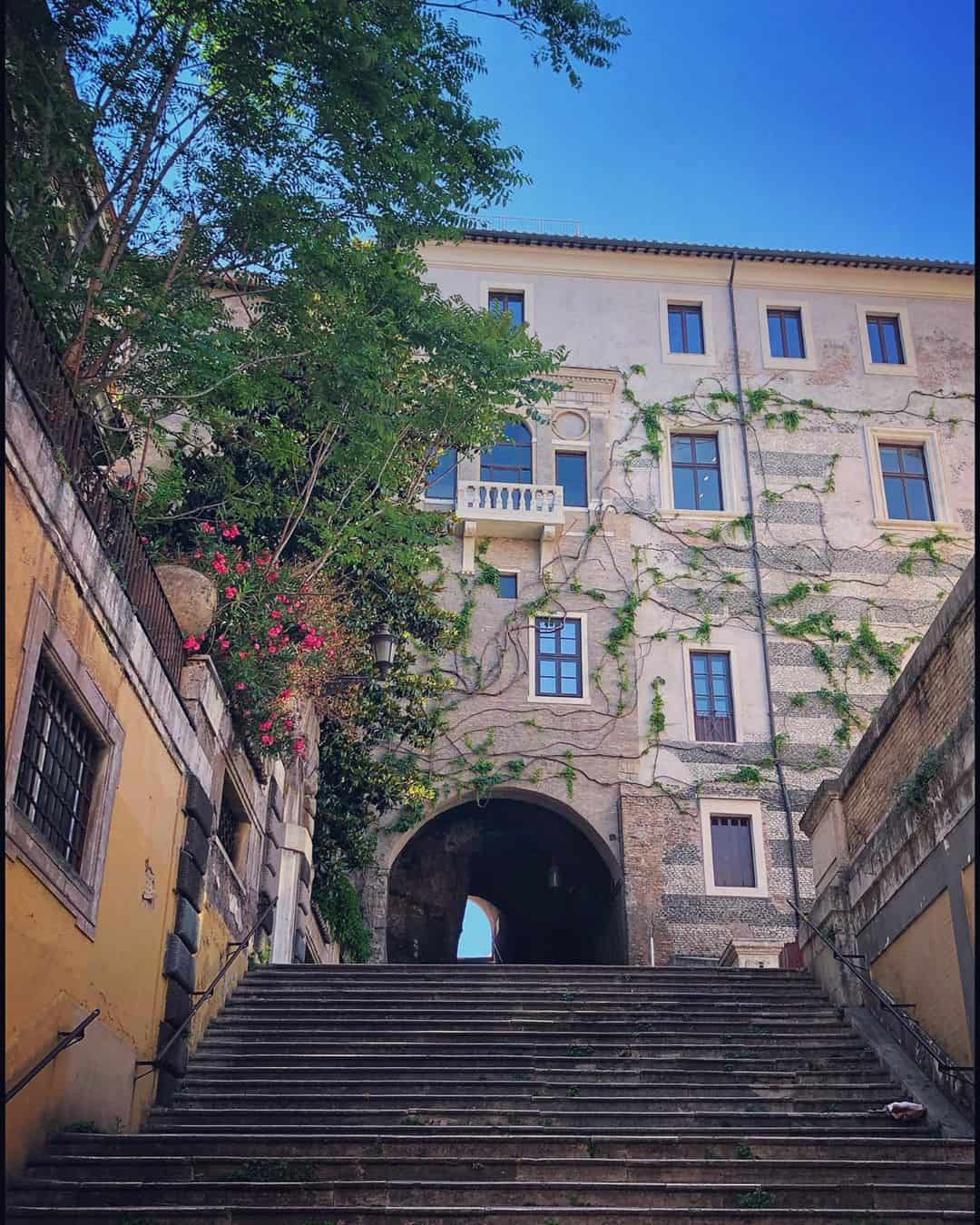
Salita dei Borgia is the covered staircase that links Via Cavour with Piazza San Pietro in Vincoli, in the heart of the Monti district, in Rome. It is a public urban passage, free, open at any hour of the day and night, with no ticket, no gates and no hours: a ramp of steps that starts from the sidewalk of Via Cavour, climbs toward the Oppian Hill, passes under the arch of an old small palazzo and comes out on Via San Francesco di Paola, a few steps from the basilica that holds Michelangelo's Moses. Whoever looks for it on maps also finds it listed as the staircase of Via San Francesco di Paola, because the upper stretch of the climb coincides with that street. Romans, instead, have called it for generations by yet another name, vicolo scellerato (the wicked alley), and that nickname carries a story that is worth telling in full. The Cavour stop of metro line B is less than 100 meters from the first steps, the Colosseum a few minutes' walk downhill, the ancient Subura all around. Whoever organizes a day in this area would do well to also read the pages dedicated to the Basilica of San Pietro in Vincoli, the Colosseum and the Domus Aurea, because the climb makes full sense only within the route that links it to these places.

Where Salita dei Borgia is and how to really get there
Geography counts here more than it seems, because Salita dei Borgia isn't a street you walk by chance: it's a change in level. The Monti district spreads over the slopes of the hills that give it its name, and between the low elevation of Via Cavour and the high elevation of Piazza San Pietro in Vincoli there are several meters of difference that someone, at some point in the city's urban history, decided to resolve with a ramp of steps instead of a road for vehicles. This detail explains everything else: the climb is narrow, steep, partly covered, and for that reason it has kept a character that the streets rebuilt around it have lost.
The most convenient starting point is the Cavour stop of metro line B. Coming out of the station you are directly on Via Cavour, the big artery that climbs from Largo Corrado Ricci toward Santa Maria Maggiore. Looking uphill, on the side of the odd numbers, you spot the entrance of the staircase between two buildings. It isn't marked with tourist signs and whoever passes by car or bus goes past it without noticing. The first step is at sidewalk level and from there on you climb all the way.
On foot from the Colosseum and the Forums
Whoever arrives from the Colosseum has a short walk ahead, slightly uphill. You take Via degli Annibaldi or you go back up Via Cavour from the square that links it to Via dei Fori Imperiali: in both cases it's 10 or 12 minutes of walking, less if the traffic light is in your favor. The route crosses a very busy stretch of city, with sidewalks that aren't always generous, so it's best to keep to the inner side. When you reach the staircase the noise drops suddenly, because the steps veer off the axis of the street and the arch works as an acoustic plug.
On foot from Termini and Santa Maria Maggiore
From Roma Termini you go down Via Cavour for about a kilometer, passing in front of the Basilica of Santa Maria Maggiore, which stays on the left at the top of its staircase. The trip takes about 20 minutes and is all downhill, so much more restful than the reverse route. Whoever takes this road reaches the climb from the top of the street, which means they will see it on the right: it's easy to go past it, so keep an eye on the street numbers and slow down when the building facade breaks off.
From above, that is, from Piazza San Pietro in Vincoli
The second access is the upper one. Whoever leaves the basilica after seeing the Moses finds themselves in a quiet square, leaning against the side of Sapienza's Faculty of Engineering, and from there takes Via San Francesco di Paola downhill. After a few tens of meters the street narrows, the paving gives way to steps and you enter under the arch. This direction of travel is the one I recommend to anyone who wants to understand the place: from top to bottom the passage opens up progressively and Via Cavour appears at the end like a slit of light, while from bottom to top the scene closes in and the effect is the opposite, more theatrical but less readable.
Accessibility: the issue to make clear right away
Salita dei Borgia is a staircase and there is no alternative route that follows the same path. Whoever uses a wheelchair, pushes a stroller or has mobility difficulties has to count on a longer detour: from Via Cavour continue to Via degli Annibaldi or climb toward Via Urbana and reach Piazza San Pietro in Vincoli by a road for vehicles. The change in level remains, but without steps. No elevator, no ramp, no continuous handrail: the passage has kept its configuration of always, and this, which is a merit from the point of view of the urban landscape, turns out to be a concrete limit from the point of view of access.
Parking, vehicles and hours
Parking here suits nobody. Via Cavour has a bus lane, parking is regulated and the entire area falls within the limited traffic zones of the historic center, which change hours depending on the season and municipal ordinances: whoever arrives by car loses more time looking for a space than it would take on foot from the metro. The buses that run along Via Cavour stop a few tens of meters from the entrance. The staircase, being a public street, never closes. Night lighting exists but is weak under the arch, and this should be kept in mind for the evening hours.
What Salita dei Borgia really is: a passage, not a monument
Here it's best to clear up a misunderstanding right away. Salita dei Borgia is not a fenced archaeological site, it's not a museum, it has no ticket office and does not belong to a visitor circuit. It's a street in Rome, cataloged as such, walked every day by residents coming home with their groceries, by students of the Faculty of Engineering heading down to the metro, by delivery riders on bicycles who shoulder them to cut through. This is the first thing to understand, because it radically changes the way it makes sense to visit it.
The value of the place doesn't lie in an object to see but in a condition to walk through: a medieval ramp that survived inside an urban fabric rebuilt twice, first after 1870 with the big street cuts of Rome as capital, then in the 1920s and 1930s with the demolitions that led to the opening of Via dei Fori Imperiali and the destruction of large portions of working-class housing and alleys of the district. Monti lost a great deal in those decades. Salita dei Borgia is one of the fragments that were saved, and it was saved precisely because it was an inconvenient change in level, unusable for traffic and therefore of no interest to those drawing the new arteries.
The structure of the passage, step by step
Climbing from Via Cavour you first meet an open stretch, with wide, low steps, enclosed between two walls. Then the passage enters under the arch of the small palazzo, where the vault lowers the sky and the light drops abruptly. Finally you come out into the open again and the ramp continues up to the level of Via San Francesco di Paola. This alternation of open, covered and open is the reason the place works visually: in a few meters you pass through three different light conditions, and whoever climbs finds their pupils adjusting twice.
The steps are worn stone, the surface made smooth by centuries of footsteps and by rain. On damp days the stretch under the arch becomes slippery, because it gets no sun and doesn't dry: whoever runs down in smooth-soled shoes is seriously at risk. The most banal advice is worth as much as the complicated ones: shoes with soles that grip, and a free hand.
Why it's called that
The current place name, Salita dei Borgia, points to the family that gave the Church Pope Callixtus III and Pope Alexander VI, that is Rodrigo Borgia, and that in the Roman imagination represents the very idea of unscrupulous power in the second half of the 15th century. Tradition has it that the Borgia had a residence in this area of the Subura and that the small palazzo under which the arch passes was tied to them. It has to be said clearly from the start: this association belongs to local tradition and to the anecdotal literature on Rome, not to archival documentation attesting that the family owned the building. The name of the street hands down a widespread belief, not a notarial deed. Further on the question is taken up calmly, because it is the most delicate point of the whole story of this place.
The arch, the small palazzo and the balcony everyone photographs
The visual protagonist of Salita dei Borgia is the building that spans the staircase. Whoever climbs from Via Cavour sees it coming at them: a dark, compact wall, almost without openings in the lower part, pierced by the arch that lets the steps through. Above the arch, in a dominant position, opens a loggia with three windows side by side, elegantly designed, which contrasts sharply with the hardness of the wall below. It's that contrast that produces the scenic effect of the place, and explains why a simple ramp of steps has ended up on thousands of postcards.
The main facade of the building, partly covered by a mantle of ivy that in the good seasons hides half the masonry, shows elements of different periods layered on top of each other: a layout of medieval origin, Renaissance reworkings and rebuildings, openings and frames of 16th-century taste. Reading the layers of a Roman facade is always a delicate exercise, because every century added, removed, walled up and reopened. Here the result is a building that looks older than most of its visible details suggest.
The so-called balcony of Vannozza
The three-window loggia is called by popular tradition the balcony of Vannozza, in reference to Vannozza Cattanei, the Roman woman who was Rodrigo Borgia's companion before he became Pope Alexander VI and who gave him the four best-known children of the family: Giovanni, Cesare, Goffredo and Lucrezia. The name has circulated for centuries and has become so established that a great many guides report it as if it were an acquired fact.
On the available sources the situation is as follows. Vannozza Cattanei was born in Mantua on July 13, 1442 and died in Rome on November 26, 1518, at the age of 76. She ran inns, among them a known business in the Campo de' Fiori area, lent money at interest, lived in several Roman houses, among them a palazzo in Piazza Pizzo di Merlo received from Rodrigo Borgia and later a home in Piazza Branca with her third husband Carlo Canale, and was buried in the basilica of Santa Maria del Popolo with solemn obsequies ordered by the papal court. Tradition links her to the family's summer stays in the Subura, in a residence near which the staircase called Salita dei Borgia is said to still exist today. This is the point at which the link between the woman and the place is attested by the literature: as reported tradition, not as a property document.
The name of Raphael and the attributions that circulate
A second level of anecdote attributes the design of the loggia to Raphael. The attribution appears in popular texts and is repeated by guides by word of mouth, but it does not appear to be supported by documentation that holds up: it's the kind of attribution that in Rome has stuck to dozens of windows, courtyards and portals, for the simple reason that a famous name makes an anonymous architectural detail more interesting. Whoever tells the place honestly says that the loggia is beautiful, that its design belongs to a mature Renaissance taste, and that the name of its author is not established. The same goes for the attribution of verses to Lord Byron on the balcony of Vannozza, which appears in some local reconstructions without any precise, verifiable reference ever being given within the poet's work.
What you actually see when you look up
Beyond the attributions, the concrete experience is this: stopping under the arch and looking up you see the masonry vault, the blocks that make it up, the trace of the successive repairs, and higher up the corner of the building with the loggia. Backlit, the profile stands out sharp against the sky. On windy days the ivy moves and the wall seems to breathe. These are the details that stay with whoever stops, and none of them needs a legend to work.
A curiosity about Salita dei Borgia
The most solid curiosity isn't about the Borgia but about the name Romans use for this ramp when they talk among themselves: vicolo scellerato. The nickname doesn't date from the 15th century nor from the affairs of the Valencian family. It comes from much farther back, from the Rome of the kings, and translates into dialect a Latin place name, vicus sceleratus, which the ancient sources link to one of the darkest episodes of the tradition on the end of the monarchy.
The story is this. Servius Tullius, sixth king of Rome, reigned according to traditional chronology between 578 and 535 BC. His daughter Tullia, the one the sources call Tullia Minor to distinguish her from her sister, married Lucius Tarquinius, whom history would know as Tarquin the Proud. Livy tells in the first book of his history of Rome, in chapters 47 and 48, that Tullia pushed her husband into a conspiracy against her father, that Tarquin hurled the old king down the steps of the Curia and that Tarquin's men finished him off in the street. Then, on her way home, Tullia ordered her charioteer to drive the cart over the body of her dying father. From that moment the street where it happened took the name vicus sceleratus, the street of the crime. The episode is taken up by Ovid in the sixth book of the Fasti and by Valerius Maximus in his collection of memorable deeds and sayings.
The point where the curiosity becomes hypothesis
The next question is obvious: does that street correspond to these steps? The honest answer is that it is a proposed topographical identification, not a certainty. Reconstructions of the ancient road network in this sector of the city link the vicus Cyprius and the vicus Sceleratus, formerly vicus Urbius, along the route that from the valley below the Colosseum climbed toward the Esquiline passing through the Subura. The literature that identifies the first stretch of the staircase with the vicus Cyprius and the upper stretch, that of Via San Francesco di Paola, with the vicus Sceleratus uses the conditional precisely because the overlap between the ancient route and the present one in this area is reconstructed from circumstantial evidence. In Livy's account Tullia, having reached the top of the vicus Cyprius, turned right into the clivus Urbius to climb the Esquiline: the general direction matches that of today's climb, the exact match meter by meter does not.
The popular name, then, preserves the memory of an episode of the Roman annalistic tradition and anchors it to a precise place that the tradition does not identify with the same precision. It's exactly the way Rome's toponymy has worked for 2,000 years, and that makes it a more interesting case study than a certain attribution.
The legend of the murder and what the sources really say
A story of blood has circulated around Salita dei Borgia for generations. In the versions you hear told on the spot the details change but the pattern stays: under this arch, in the darkness of the vault, a murder attributable to the Borgia family was supposedly committed. In some variants the victim is Vannozza Cattanei, in others one of the sons, in others still a nameless figure eliminated on the orders of the cardinal or the pope. The tale works because the place goes along with it: a narrow, covered passage, dark even at noon, with a lordly balcony overhead. Urban legends almost always come from architecture, not from archives.
Here, though, the check has to be made, and made on each version separately, because the documented facts say otherwise.
Vannozza Cattanei was not murdered
On the death of Vannozza Cattanei the biographical sources agree: she died in Rome on November 26, 1518, at 76, after years spent in works of charity and in a condition of recognized respectability. Her funeral was celebrated with a solemnity compared to that reserved for a cardinal, with the participation of the papal court by the will of Pope Leo X, and she was buried in the basilica of Santa Maria del Popolo. No element of the available biographical reconstructions speaks of a violent death. The legend of Vannozza's murder on this staircase, then, has no documentary support and should be told for what it is: Roman anecdote.
Giovanni Borgia was killed, but elsewhere
A second version, which often appears in written form too, places here the killing of Giovanni Borgia, Duke of Gandia, Rodrigo's eldest son, attributing it to his brother Cesare. The established facts are different and should be recalled precisely. Giovanni Borgia was assassinated on the night of June 14, 1497. According to the testimony gathered during the investigations he was attacked by five men and sustained nine wounds, one to the throat and the other eight to the head, body and legs. The body was thrown into the Tiber near the hospital of San Girolamo and was fished out of the river on June 16. The inquiry ordered by Alexander VI lasted more than a year and closed without results.
As for suspects, contemporary hypotheses pointed to the Orsini family, who had motives for revenge after the military defeat they had suffered, Cardinal Ascanio Sforza, later acquitted by the pontiff himself, and Giovanni Sforza. The accusation against Cesare Borgia appeared only nine months after the crime, and not in Rome but in Venice. Modern historiography considers it, in large majority, unfounded. The crime remains unsolved and is considered one of the most sensational scandals of the age of the Borgia.
Consequently the sentence you read in many popular reconstructions, according to which on these steps Cesare killed his brother Giovanni, with the possible complicity of Lucrezia, expert in poisons, does not hold up on any of three points: the place is wrong, the perpetrator is not established, and Lucrezia Borgia's reputation as a poisoner belongs to the political polemic of the time and to 19th-century literature more than to the documentation.
Why the legend stuck right here
The most likely explanation is architectural. The arch produces a dark, enclosed setting, the small palazzo above displays lordly power, the name of the street recalls a family that in the collective imagination is synonymous with intrigue. Three elements that add up and generate a narrative. To this is added the fact that the popular nickname of vicolo scellerato, born for an entirely different reason and referring to an episode six centuries before Christ, is naturally reread by those who don't know its origin as a reference to Renaissance crimes. Two layers of memory that blur together and reinforce each other.
Telling the legend remains legitimate, provided it's declared as such. Whoever leads visitors up this climb has in front of them a perfect case for explaining how the construction of an urban myth works, and that explanation is more interesting than the imaginary crime.

Something nobody tells you about Salita dei Borgia
No guide writes it, but Salita dei Borgia has a timing problem that doesn't depend on gates, since there are no gates, but on the sun. The passage is oriented in such a way that for a large part of the day the stretch under the arch gets very little direct light, while the lower ramp and the upper one light up at different moments. The result is that whoever happens by at the wrong hour sees a staircase in half-light with a blinding white patch at the end, and leaves convinced the place is overrated.
The useful window is narrow. In the middle hours, when the sun is high, the light enters at an angle in the lower part and the contrast with the underside of the arch becomes readable instead of blown out. In the late afternoon the masonry warms in color and the ivy takes on warm tones, but the vault stays dark. In the early morning everything is even and flat. Whoever wants to see the place at its best should plan to pass through twice at different times, which costs nothing here because passage is free.
The second detail that gets missed
The second thing almost nobody mentions is the noise. Via Cavour is one of the busiest arteries of the center, with buses, taxis and private traffic climbing continuously. In the first meters of the staircase the noise is still full. After around 10 steps it collapses. Under the arch it becomes almost absent and re-emerges from above, filtered, with the sounds of the square at the top. In a few seconds of walking you cross an acoustic jump that in other parts of Rome takes whole blocks. Whoever stops halfway up the staircase and closes their eyes for 20 seconds understands more about the place than they would reading 10 pages of history.
And the third, which concerns the residents
This is a passage that is someone's home route, not an attraction. Along the sides of the ramp open lived-in doorways, and on the upper floors there are windows that look directly onto the steps. Whoever camps in the middle of the staircase with tripod and gear, whoever talks loudly late in the evening, whoever occupies the usable width for half an hour of shots is in effect on someone else's landing. A minimum of restraint counts more here than elsewhere: the climb is narrow and whoever uses it to go home has the moral right of way over whoever uses it to photograph it.
The advice I give you for visiting Salita dei Borgia
The main advice is just one: don't treat it as a stop in itself. Salita dei Borgia alone is worth five minutes. Included in a well-built route it's worth half a day of walking among the best the center of Rome can offer to those who accept going up and down a few changes in level.
The route I recommend, in order
You start low, at the Cavour metro stop. Before climbing it's worth spending 10 minutes on the stretch of Via Cavour toward the valley, up to the junction with Via dei Fori Imperiali, to have in your head the elevation you're starting from. Then you go back and take the staircase from below: this direction of travel gives the full scenic effect, with the arch approaching and the balcony appearing suddenly when you raise your eyes. Once at the top you enter the Basilica of San Pietro in Vincoli, give the Moses and the chains the time they need, go out and sit a few minutes in the square. From there you continue toward the Oppian Hill, look down at the Colosseum from above, judge if a visit to the Domus Aurea fits your time, and finally go down toward the Trajan's Markets or head back into Monti by climbing Via Urbana. The loop closes on itself without ever repeating a street.
What to bring and how to dress
Closed shoes with a sole that grips: the steps are smooth and the covered part never dries completely. Water, because on this stretch there are no drinking fountains right along the ramp even though the district has several not far away. No bulky tripods if the day is crowded. Whoever visits the basilica at the top must keep in mind the dress rules valid in all Roman churches, shoulders and knees covered, so a light scarf in the bag solves the problem in the warm months without forcing wasted detours.
The contrarian advice
Most visitors walk the climb from bottom to top because they arrive from the metro. At least once it's worth doing the opposite: enter the basilica as soon as it opens, come out, take Via San Francesco di Paola downhill and go down the staircase with Via Cavour appearing at the end like a slit of light and noise. The descent has a not trivial technical advantage, because it lets you see the underside of the arch head-on instead of at an angle, and a practical advantage, because at that hour the ramp is almost deserted.
San Pietro in Vincoli at the top of the climb: the Moses and the chains
The staircase has an upper terminus that alone justifies the whole climb. The basilica of San Pietro in Vincoli faces the square of the same name, on the Oppian Hill, with the address Piazza di San Pietro in Vincoli 4a, a short distance from the Cavour metro stop and from the Colosseum. The building was rebuilt on older foundations between 432 and 440 precisely to house a relic, and it is that relic that gives it its name.
The chains
According to tradition they are the chains that bound the apostle Peter during his imprisonment in Jerusalem, donated to Pope Leo I by the empress Eudoxia. Today they are kept in a reliquary under the high altar and can be seen up close. For centuries they were the real reason for pilgrimage to this church, and the staircase climbing from the valley had for a very long time the function of a link between the lower city and the shrine up high. Whoever climbs the steps today to take a photograph retraces, without knowing it, an ancient devotional itinerary.
Michelangelo's Moses
The statue that made the basilica famous throughout the world was completed in 1515 and forms the centerpiece of the funerary monument of Pope Julius II. Michelangelo's Moses is shown with horns, a detail that in ancient religious iconography conveys the idea of divine radiance and that derives from a reading of the biblical text consolidated over the centuries. The statue is in the right transept and should be looked at calmly, possibly waiting for the previous group to move: the observer's position changes a lot the perception of the twist of the body and of the gaze.
Another tomb to notice
On the left side of the entrance is buried Antonio del Pollaiolo, a Florentine artist to whom we owe, among other things, the addition of the figures of Romulus and Remus to the Capitoline Wolf group kept today in the Capitoline Museums. It's the kind of detail almost everyone rushes past because they are in a hurry to reach the Moses, and which instead links this church to one of the most identity-defining objects of Rome.
Practical rules for the visit
Entry to the basilica is free. Opening hours change over the course of the year and include the usual midday closure typical of Roman churches, so they should be checked before climbing, also because the coincidence between the church being closed and your arrival at the top of the staircase is an avoidable disappointment. Services take precedence over visits. The lighting of the Moses, in some periods, works with coins or by donation: a few coins in your pocket change the look of the statue a great deal.
Another well-known fact, yet seldom cited
The well-known fact is that the Monti district corresponds in large part to the area of the ancient Subura, the working-class quarter of ancient Rome, extremely dense, disreputable, full of insulae, shops, taverns and brothels, the one the Latin sources describe as the exact reverse of the monumental city of the Forums. Many people know it. What is cited much less is the urban consequence of this fact, which you can still read today by walking here.
The lower city and the upper city
The Subura occupied the valley between the Viminal, the Quirinal and the Esquiline. The residences of important families stood on the heights. Between the two conditions there was a system of climbs, clivi and ramps, that linked the working-class level to the lordly one. Salita dei Borgia belongs to that system: it's a functional remnant of a very ancient urban logic, in which whoever climbed changed not only elevation but also the social condition of the fabric crossed. Walking on these steps means crossing in two minutes a border that for centuries was real.
What the 20th century did
The Monti district, which historically included the Esquiline, the Viminal and portions of the Quirinal and the Caelian, underwent radical transformations in the 20th century. Between 1924 and 1936 large portions of alleys and working-class houses were demolished to open Via dei Fori Imperiali. Entire blocks disappeared, with their streets, their courtyards and their climbs. In this context the survival of a ramp like Salita dei Borgia takes on a meaning that goes beyond the postcard-pretty: it's one of the few points where the vertical section of the ancient district can still be walked with your feet instead of read on a map.
The paradox of Via Cavour
There is one last element that almost nobody lines up. Via Cavour, the artery opened in the big urban works of Rome as capital to link Termini station to the Forums area, cut the district in two and severed the continuity between the lower part and the upper part. In doing so, though, it created the sharp change in level against which the staircase rests today, and gave it the look everyone photographs: a ramp that emerges from the side of a 19th-century street and climbs toward an older world. The cut that erased a lot is the same one that made this fragment visible.
The right photo to take at Salita dei Borgia
Photography here is the reason many people come, so it's worth thinking it through precisely instead of leaving it to chance. The subject is difficult: very high contrast, narrow space, converging lines, and an architectural element, the loggia, that sits high up and so forces you to tilt upward with all the perspective distortions that follow.
The classic framing
The most used position is from below, in line with the ramp, a few steps above the entrance from Via Cavour. The vertical format works better than the horizontal because it contains the whole sequence: steps in the foreground, arch in the center, loggia on top. It's best to step back just enough not to cut off the base of the arch and to hold the device at chest height rather than eye height, so the verticals stay more manageable. A moderate wide-angle lens does better than a fixed very wide focal length, which here distorts the side walls in an annoying way.
The framing I really recommend
The one from above, going down. You position yourself on the upper steps, above the arch, and frame downhill: the arch becomes a dark frame around the bright rectangle of Via Cavour at the bottom. The contrast works for you instead of against you, because the darkness of the vault acts as a natural vignette. If at that moment a person is walking up the ramp, their backlit silhouette closes the composition. It's the photograph that tells the place for what it is, a passage, instead of for what it seems, a monument.
Light and timing
The middle hours of the day offer the best balance between the brightness of the open part and the readability of the underside of the arch. Slightly hazy days do better than full sun, because they compress the dynamic range. On overcast days the place loses drama but gains detail on the masonry and the ivy. In the seasons when the ivy is thick the facade changes appearance completely: whoever returns months later finds a different scene with the same framing.
The detail almost nobody photographs
The intrados of the arch, that is, the inner surface of the vault seen from below, with the texture of the blocks and the traces of the repairs. All you need is to point upward while standing exactly under the center of the arch. You need correct exposure on the shadows and it's best to rest your back against the wall to stabilize. The result is an abstract, severe image that nobody recognizes at a glance and that tells the real age of the building better than the frontal postcard.
Some important events that happened here in history
Lining up the events tied to this stretch of the city requires a preliminary distinction between what tradition places here and what is documented. The distinction is kept explicitly in each entry.
535 BC, or thereabouts: the end of Servius Tullius
The Roman annalistic tradition places in this area of the city the crime that closes the reign of Servius Tullius, sixth king of Rome, whose traditional chronology runs from 578 to 535 BC. Tarquin the Proud had him hurled down the steps of the Curia and his men killed him in the street. Tullia Minor, the king's daughter, drove her cart over the body of her dying father as she headed up toward the Esquiline. From that episode the street took the name vicus sceleratus. The sources are Livy, book one, chapters 47 and 48, Ovid in the Fasti and Valerius Maximus. The exact topographical location of the episode is disputed and the overlap with today's staircase remains a reconstruction hypothesis, not an established fact.
432 to 440 AD: the basilica at the top
In those years the church that closes the climb at the top was rebuilt on earlier foundations to house the chains of Saint Peter. It is the event that for the following 15 centuries determined the function of this climb, transforming it from a neighborhood link into a pilgrimage route.
The 15th century of the Borgia
Tradition links the Borgia family to a residence in this area of the Subura, used for summer stays, and from that link derives the present place name of the climb. Documentation attesting the family's ownership of the small palazzo with the arch is not available: the name hands down an established tradition. In 1497, on June 14, Giovanni Borgia, Duke of Gandia, was assassinated in Rome and his body was recovered from the Tiber on June 16 near the hospital of San Girolamo. The inquiry, which lasted over a year, did not lead to a culprit. The crime did not take place on this staircase, despite what the common version says.
1515: the Moses
Michelangelo completes in that year the statue intended for the funerary monument of Julius II, placed in the basilica at the top of the climb. From that moment the flow of visitors to this point of the city changes nature: no longer only devotion, but also artistic pilgrimage, and the ramp becomes one of the accesses to that pilgrimage.
1518: the death of Vannozza Cattanei
On November 26, 1518 the woman whose name is linked by popular tradition to the loggia above the arch dies in Rome, at 76. She was buried at Santa Maria del Popolo with solemn honors. Her death was not violent, contrary to what the legend circulating about the climb claims.
After 1870: the birth of Via Cavour
With Rome as capital, urban plans cut new arteries through the fabric of the district. Via Cavour links Termini station to the Forums area and completely redraws the low flank of Monti. The staircase survives as a connection between the new elevation of the street and the ancient elevation of the hill.
1924 to 1936: the demolitions
Large portions of alleys and working-class houses of the district are demolished to make room for Via dei Fori Imperiali. Much of the small-scale fabric disappears. Salita dei Borgia remains, and its survival is the reason it is so photographed today: not because it is unique in absolute terms, but because it has few companions left.
Who has passed through Salita dei Borgia
The question has to be posed correctly, because on a public street everyone passes and nobody leaves a signature. What can be done is to list the names that history and tradition have linked to this point of the city, declaring each time what kind of link it is.
Names linked to the place by tradition
Vannozza Cattanei and the Borgia. The link is by tradition, so deeply rooted that it produced the official place name of the street and the popular name of the loggia. Rodrigo Borgia, later Pope Alexander VI, and his children Giovanni, Cesare, Goffredo and Lucrezia belong to this chapter because of the name, not because of a documented presence on the steps.
Tullia Minor, Servius Tullius and Tarquin the Proud. The link is with the annalistic tradition on the vicus sceleratus and passes through a topographical identification proposed by studies of the ancient road network, not through direct attestation.
Names linked to the place by facts
Michelangelo Buonarroti worked on the statue placed in the basilica at the top of the climb, completed in 1515. His work is a handful of meters from the highest step and for five centuries has determined the movement of people on this climb.
Pope Julius II, whose funerary monument is the reason for the Moses, belongs to the history of the high place to which the staircase leads.
Pope Leo I and the empress Eudoxia are the protagonists of the story of the relic that gave the basilica its name and function, and therefore to the climb that leads there from the valley.
Antonio del Pollaiolo, buried on the left side of the basilica's entrance, closes the group of documented names: the same artist who added Romulus and Remus to the Capitoline Wolf rests a few steps from the top of these stairs.
And then everyone else
Pilgrims headed to the chains for 15 centuries. Inhabitants of the Subura who climbed toward the lordly houses up high. Students of the Faculty of Engineering who for decades have been going down toward the metro. Photographers, camera operators, illustrators. Residents coming home with grocery bags who know by heart which step is the most worn. Whoever looks for the ghost of a Borgia on the ramp finds instead the layering of daily use stretching over 2,000 years, and this is the most extraordinary thing the place has to offer.
When to go to Salita dei Borgia and when to avoid it
The passage is always open and always free, so the question isn't about opening hours but about visiting conditions. And the conditions change quite a lot.
The season
Spring is the best moment: the ivy on the facade is in full growth, the light has a favorable angle and the heat doesn't make the climb tiring. Fall works just as well and adds the advantage of fewer tourists across the whole quadrant between the Colosseum and Monti. The Roman summer makes the ramp an oven in the middle hours, with the exception of the stretch under the arch, which stays the only cool spot. Whoever visits in July or August should move to early morning or late afternoon. Winter offers the climb almost deserted and an interesting low light, but wet steps require attention.
The time of day
Early morning, between the opening of the basilica and the arrival of the first groups: free ramp, silence, light still flat. Middle hours: best light for the classic photograph, moderate presence of visitors because most tourist flows concentrate down low, toward the Colosseum. Late afternoon: warm colors on the masonry, residents passing on their way home. Evening: evocative atmosphere for those walking, difficult conditions for those photographing, and in any case the common sense of anyone crossing a narrow, poorly lit passage in a big city.
The days to avoid
The days when the Colosseum and the central archaeological area have free entry pour onto the whole quadrant a number of people far above the average, and part of that flow climbs toward San Pietro in Vincoli. Sunny spring Sundays have the same effect. Whoever wants the climb deserted should pick a weekday, preferably in the morning.
Rain
In the rain the steps become slippery and the stretch under the arch collects the water coming down from the upper ramp. The passage remains walkable but requires caution. There is, though, an advantage worth pointing out: in the rain the wet stone reflects the light and the underside of the arch takes on a depth it doesn't have on dry days. Whoever isn't afraid of getting wet finds in a day of light rain one of the best versions of the place.
What's around Salita dei Borgia
The real value of the climb is its position. Within a radius of one kilometer there is a density of places that in other cities would be enough for a multi-day itinerary.
Above and alongside
The Basilica of San Pietro in Vincoli closes the climb at the top and is the natural stop. A little beyond opens the park of the Oppian Hill, from which you look over the Colosseum and under which extends the Domus Aurea, the Neronian residence that can be visited on a guided route with reservation. In the same area is the Auditorium of Maecenas, one of the least visited and most fascinating places in the sector.
Down below and toward the Forums
Going down the staircase and continuing along Via Cavour toward the valley you reach in a few minutes the Colosseum, the Arch of Constantine and the entrance to the Palatine. A little farther, along Via dei Fori Imperiali, you meet the Trajan's Markets with the Imperial Forums Museum, and at the top of the Campidoglio climb the Michelangelo-designed square of the Capitoline Hill with the Capitoline Museums.
Inside Monti
Behind the climb the real district begins: Via Urbana, Via dei Serpenti, Piazza della Madonna dei Monti with its fountain, the artisan shops and the venues that have made the quarter one of the most frequented for the Roman evening. On the same side is the Basilica of Santi Silvestro e Martino ai Monti, under which ancient structures of great interest are preserved and which almost no visitor puts on the program.
Toward the Esquiline
Climbing Via Cavour you reach the Basilica of Santa Maria Maggiore and, a little farther, the Nuovo Mercato Esquilino, the most international market in the city, useful for anyone who wants to see a Rome different from the postcard one. Continuing toward Termini you meet the Baths of Diocletian and Palazzo Massimo alle Terme, two sites of the Museo Nazionale Romano that are worth a day on their own.
Quick questions about Salita dei Borgia
Do you pay for Salita dei Borgia?
No. It's a public street in Rome, access is free and open 24 hours a day, with no ticket and no reservation.
Where exactly is it?
In the Monti district, between Via Cavour at the bottom and Via San Francesco di Paola with Piazza San Pietro in Vincoli at the top. The Cavour stop of metro line B is a few tens of meters from the lower entrance.
How long does the visit take?
Walking through takes two minutes. With a stop to look at the arch and the loggia and for a few photographs it reaches a quarter of an hour. Including the basilica at the top you easily go past two hours.
Is it accessible by wheelchair or stroller?
No. It's a staircase with no ramps or elevators. Whoever can't tackle the steps has to reach Piazza San Pietro in Vincoli by a road for vehicles, for example from Via degli Annibaldi or Via Urbana.
Why is it called vicolo scellerato?
The popular nickname translates the Latin vicus sceleratus, the name that according to Roman tradition was given to the street where Tullia Minor drove her cart over the body of her father Servius Tullius. The identification between that ancient street and this staircase is a topographical reconstruction proposed by studies, not a certainty.
Did the Borgia really live here?
Tradition claims so and the name of the street hands it down, but no documentation is available attesting the family's ownership of the small palazzo with the arch. Prudence requires speaking of established tradition and not of an ascertained fact.
Is it true that a Borgia murder was committed here?
No, based on what the sources document. Vannozza Cattanei died in Rome in 1518 at 76 and was buried with honors at Santa Maria del Popolo. Giovanni Borgia was assassinated in June 1497 and his body was recovered from the Tiber, not from this staircase. The inquiry closed without culprits and the accusation against Cesare Borgia appeared months later, outside Rome, and is today largely rejected by historians.
Was the balcony designed by Raphael?
The attribution circulates in popular literature but does not appear to be supported by documentation. The loggia belongs to a mature Renaissance taste. The name of the designer is not established.
Can you visit the palazzo with the arch?
No. It's a private building with homes. From outside you see the facade, the arch and the loggia, and there are no interior visits.
Is it safe in the evening?
The area is central and well frequented, but in the evening the ramp is narrow, poorly lit and with poor visibility under the arch. The normal precautions apply that you take in any enclosed urban passage after sunset.
In our view Salita dei Borgia is one of the places in Rome where the relationship between what you see and what you know is worth more than elsewhere. Whoever comes for the Borgia legend leaves with a photograph. Whoever comes knowing that this ramp links the working-class Subura to the lordly heights, that tradition places here the end of a king of the sixth century BC, that at the top rests Michelangelo's Moses and that the name of the most gossiped-about family of the Renaissance is stuck to a small palazzo whose 15th-century owner is unknown, leaves with all of Rome in two minutes of climbing. The passage costs zero and never closes: in a city where everything has a ticket, it's a luxury worth using twice in the same day, once going up and once going down.
Frequently asked questions about Salita dei Borgia
How much does it cost to visit Salita dei Borgia?
Salita dei Borgia costs nothing, because it's a public street in Rome and not a paid site. Access stays free 24 hours a day, with no ticket, no reservation and no gates. It is walked every day by residents and students like a normal ramp of the Monti district, not like an attraction with opening hours.
How do you get to Salita dei Borgia by public transport?
The most convenient way to reach Salita dei Borgia is metro line B, Cavour stop, which is a few tens of meters from the lower entrance of the ramp. From there you just take Via Cavour and look for the start of the staircase to climb toward Piazza San Pietro in Vincoli, the highest point of the route.
Is Salita dei Borgia really tied to the Borgia family?
The link between Salita dei Borgia and the Borgia family is above all legendary, and the sources don't agree on the details. A murder committed under the arch is told, with different versions about the victim, but the Roman nickname vicolo scellerato actually recalls the much older Latin place name vicus sceleratus, tied to a tradition about the Rome of the kings.
What do you see at Salita dei Borgia?
At Salita dei Borgia the focal point is the building that spans the staircase with a large arch, topped by a loggia with three windows side by side of elegant design. The contrast between the dark, compact lower part and the bright opening of the loggia above is what makes the passage so photographed.
When is it best to photograph Salita dei Borgia?
The light at Salita dei Borgia is uneven, because the stretch under the arch gets very little direct sun for much of the day, while the lower ramp and the upper one light up at different moments. It's therefore best to assess the timing in advance, instead of arriving at random and finding the arch in full shadow while everything else is blinding.
How long does it take to visit Salita dei Borgia?
Salita dei Borgia alone takes roughly five minutes, being a short ramp. It is worth much more, though, if included in a walking route in the Monti district that also takes in the basilica of San Pietro in Vincoli at the top and the Oppian Hill, coming to fill half a day among the best walks in the center of Rome.
What to see near Salita dei Borgia?
At the top of Salita dei Borgia is the basilica of San Pietro in Vincoli, in the square of the same name, which holds Michelangelo's Moses and the chains of the relic to which it is dedicated. A little beyond opens the park of the Oppian Hill, from which you look over the Colosseum and under which extends the Domus Aurea, the Neronian residence.
Article written by the editorial team of TourLeaderPro, contact them for Private/Corporate/V.I.P. Tours and Experiences. For a guided walk in the Monti district, among Salita dei Borgia, San Pietro in Vincoli and the Subura, with a licensed tour guide, start from the TourLeaderPro contact page. Tour operators who build walking itineraries in the center of Rome will instead find the consulting service in the section dedicated to tour operators.
Planning a trip to Rome? The English guides for visiting the city are on ItalyPlanner.com. Whoever wants to understand how to move among the districts of the center and how much time each quarter really takes will find the explanations in the Rome guides of ItalyPlanner.