Hungarian Academy at Palazzo Falconieri
In short. The Hungarian Academy in Rome is at Via Giulia 1, inside Palazzo Falconieri, and it is a cultural institute of the Hungarian State, not a museum with a ticket office.
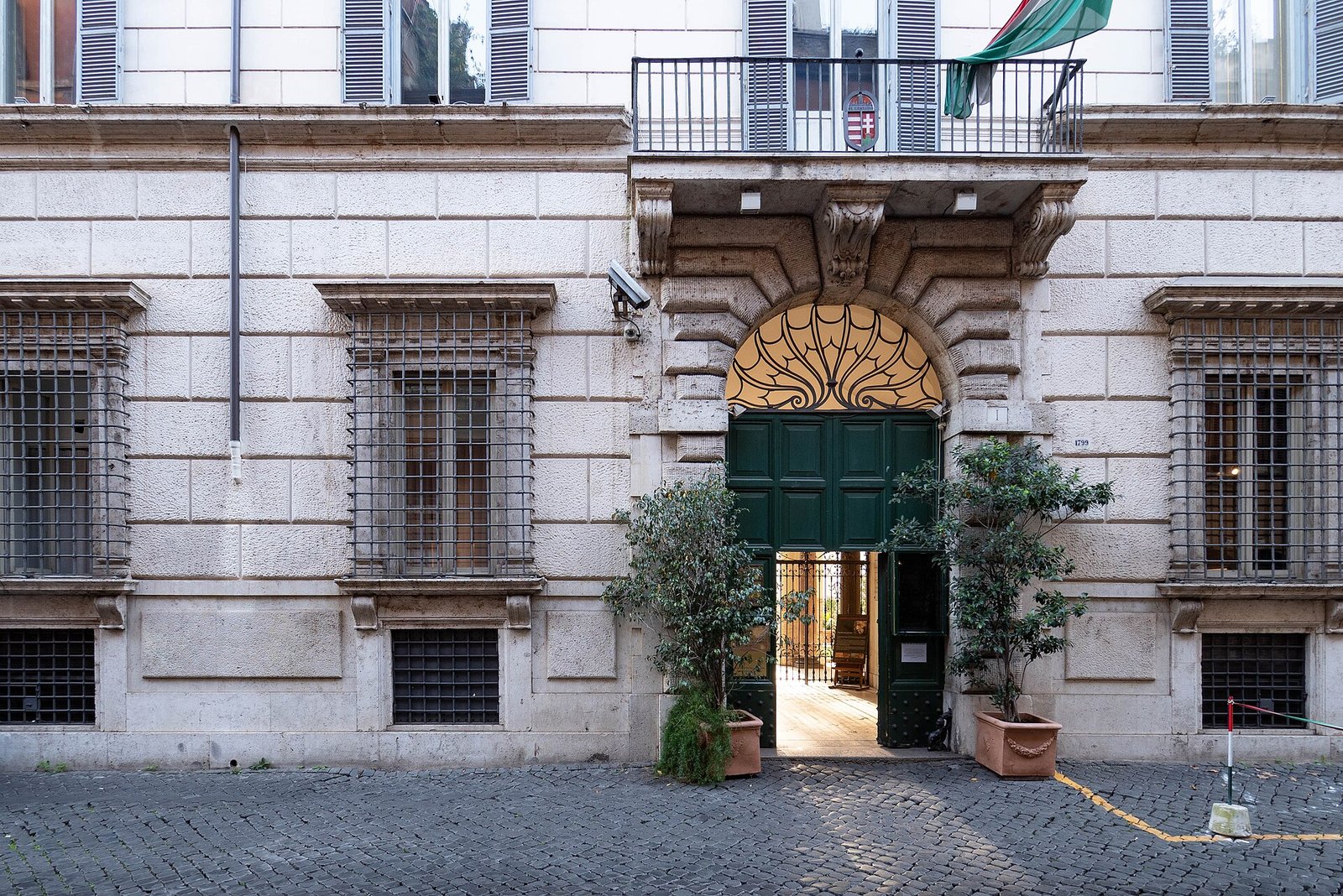
The Hungarian Academy in Rome is at Via Giulia 1, inside Palazzo Falconieri, and it is a cultural institute of the Hungarian State, not a museum with a ticket office. The interiors, according to the national tourist portal, can be visited only during the Academy's cultural initiatives and on special occasions: exhibitions, concerts, free guided tours by reservation on set dates, the Open House Roma days. Borromini's facade, on the other hand, can be seen from the street for free every day.
The palace has belonged to Hungary since the 1920s, and the sources do not agree on the exact year: 1927 for the purchase according to Open House Roma and the italia.it portal, 1928 according to the history published by the Academy itself. Behind that date there is a facade lengthened by Borromini, two herms with a falcon's head, a loggia on the Tiber and four rooms with stuccoes that for decades have fed esoteric readings, some serious and many fanciful.
The practical information given here comes from the check of September 29, 2026 on the Academy's official website, on the Open House Roma page, on the tourist portal of Roma Capitale and on the national one. Office hours, contacts, exhibition program and visit arrangements change often, because they depend on the institute's cultural calendar. Before setting out it's always best to check the events page and, if needed, email the office.
At a glance: address, hours, ticket
- Address: Palazzo Falconieri, Via Giulia 1, 00186 Rome, at the start of the street coming from Ponte Sisto.
- Operator: Accademia d'Ungheria in Roma, cultural institute of the Hungarian State, phone 06 68896700, email mission.rma@mfa.gov.hu.
- How to get in: only for exhibitions, events, guided tours on announced dates and special openings such as Open House Roma.
- Price: the guided tours announced by the Academy in January 2024 were free, for exhibitions the operator does not publish a ticket.
- Hours given by the Academy: Monday to Friday 9:30-19:30, Saturday 11:00-19:30, Sunday not given.
- Getting there: Open House Roma gives lines 8, 23, 40, 46, 64, 280 and 916.
- Accessibility: the operator does not publish information, ask the office before the visit.
Where it is and what you actually see
Palazzo Falconieri opens onto Via Giulia at the Ponte Sisto end, next to the church of Santa Maria dell'Orazione e Morte, in the Regola district. The main front faces the street opened by Pope Julius II at the beginning of the 16th century, the back faces the Lungotevere dei Tebaldi. You recognize it right away by the Hungarian and European flags and the two large herms at the corners, with the female bust and the falcon's head.
From the street you see three things. The facade on Via Giulia, extended by Borromini to 11 bays of windows, with a second door that is false and serves only to make the front symmetrical. The falcon herms, which are the family's true calling card. And, turning onto the Lungotevere, the three-arched loggia that originally looked directly onto the river, before the 19th-century embankment walls changed the relationship between the palace and the water.
Inside, when you get in, the route of the guided tours described by the Academy includes the main entrance with the courtyard of honor, the exhibitions on display, the piano nobile and Borromini's salons. The atrium has vaults on piers and gray granite columns, the inner garden is smaller than it once was, and on the piano nobile are the stucco ceilings that alone justify the reservation. The art gallery on the ground floor has been operating since 1992.
A useful clarification for those arriving with the wrong expectations: there is no museum route with numbered rooms, captions and works permanently on display. It is a working site, with offices, a specialized library of more than 20,000 volumes according to the Roma Capitale portal, Hungarian language courses and a calendar of events. Whoever enters does so as a guest of a foreign institution, on the timing and rules that institution decides.
The view from the street already says a lot about the building's history. The original door, in rustic ashlar, was decorated according to the Roma Capitale portal with the lilies of the Farnese, owners before the Falconieri. The twin door added by Borromini carries the falcon instead. Looking closely at these two entrances is worth more than many explanations, and requires no reservation and no opening hours.
The national tourist portal recalls that the palace is adjacent to Santa Maria dell'Orazione e Morte, and the closeness is obvious at once: the facade of the church and that of the palace touch. Looking at them together from the opposite sidewalk gives a precise idea of how Via Giulia mixed noble residences and religious institutions, often wall against wall, with no squares or buffer space between one building and the next.
A curiosity about the Hungarian Academy at Palazzo Falconieri
The two herms of the facade are hybrids: a woman's bust and a falcon's head. The falcon is the canting emblem of the Falconieri, a Florentine family that had made its fortune with the salt tax contract and that bought the palace in 1638. The tourist portal of Roma Capitale reports that the female breasts would probably allude to the beauty of the women of the house. It is a hypothesis, not a document, and should be taken with the lightness it deserves.
The falcon comes back often. On the door added by Borromini on the right side of the facade, in the lunettes of the green rooms of the piano nobile, according to the descriptions of the interiors. On the balustrade of the loggia toward the Tiber, instead, the herms change subject and become double-faced, with two faces, like a Janus. Heraldry, in 17th-century Rome, was a way of signing the building without needing inscriptions. Here the signature is repeated insistently, almost as if to remind passersby that the house had changed master.
Then there is a detail that almost everyone misses. The right-hand door, the one with the falcon, leads nowhere. Borromini added it blind, symmetrical and similar to the original one, as the Roma Capitale portal reports. The result is a facade that seems to have been born all at once, while in reality it is the sum of two houses and at least three different owners, stitched together with a trick of symmetry.
The shape of the herms is unusual too. The descriptions of the palace present them as tall fluted pilasters turned upside down, widening toward the top and ending with the falcon heads. The effect is a corner heavier at the top than at the bottom, the opposite of what the eye expects from a pillar. Many passersby mistake them for eagles or generic mythological figures. They are falcons.
One thing nobody tells you about the Hungarian Academy at Palazzo Falconieri
In our view the most interesting front is not the one on Via Giulia. It is the back toward the river. Here the architect added an entire wing and built the three-arched loggia, closed by a balustrade with double-faced herms. In the 17th century anyone going up or down the Tiber saw the palace from that side, and the belvedere was a calling card. Today you look at it driving past on the Lungotevere, without noticing.
The embankment walls built after Italian unification changed everything. The descriptions of the palace report that part of Borromini's work was lost with the arrangement of the Lungotevere and that the garden shrank. The loggia remains, but it is no longer reflected in the water. It is one of the many Roman cases where an architecture designed for the river was left an orphan of the river.
To grasp the scale of the change, try a simple test. Look at the loggia from the opposite bank, on the Trastevere side, then imagine the road and the embankment wall gone, with the garden going down to the water. The suburban villa that the Open House Roma description speaks of, a courtyard kept as a garden that recalls the layout of a villa, becomes understandable only this way, with the river in place of the asphalt.
The loggia has a second meaning too, less obvious. In the 17th century a covered terrace up high, facing the Janiculum and the villas of the Lungara, was a sign of rank, a way of taking part in the landscape of the city more than in its street. On the other side of the river stood the villa of Agostino Chigi, today the Farnesina. In our view the dialogue between the two banks counts as much as the street facade.
From the Ceci house to the Falconieri palace: what did Borromini really do?
The building history begins before Borromini. According to some reconstructions the first core was built by the Ceci family around 1515, then the palace passed to the Odescalchi and in 1606 to the Farnese, who left their lilies on the ashlar door. The Roma Capitale portal instead dates the original structure to 1576 and attributes it to the Odescalchi. The sources do not agree on the first decades, they agree on the rest.
In 1638 Orazio Falconieri arrived. In 1645 he also bought the neighboring property and in 1646 he called Francesco Borromini, who worked on the palace until 1649. The interventions are four: the lengthened facade with the three windows farthest from the church and the blind door, the falcon herms at the corners, the new wing toward the river with the loggia, and the stucco decoration of four rooms on the piano nobile.
On the number of starting windows the sources do not agree: eight according to most reconstructions and the Roma Capitale portal, seven according to others. The end point is the same, 11 bays. More interesting than the count is the method. Borromini does not demolish, he lengthens and unifies. It is the same attitude found in the Oratorio dei Filippini, where the architect works inside precise constraints and turns them into character.
Who were the patrons? The Falconieri were Florentines, and according to the Roma Capitale portal they owed their wealth to the salt tax contract, that is, to collecting a tax taken on contract. Like many Tuscan families who arrived in Rome with money before titles, they sought visibility. A palace renovated by a leading architect, facing the street of the Florentines, served exactly this purpose.
The stuccoes of the piano nobile are the least known part of the work. The available descriptions speak of four rooms, identified by the dominant color: a red room, a blue one and the green rooms. The ceilings combine frames, symbolic figures and plant motifs in a unified design, and the variety from one room to the next is surprising. For many visitors they are the real reason to reserve, more than the facade.
In our view Palazzo Falconieri is the best place in Rome to understand the private Borromini, the one working for a private patron and not for a religious order or the pope. Anyone who has already seen Sant'Ivo alla Sapienza finds here the same mind, applied to a house. Our itinerary Borromini in Rome lines up his main architectural works.
The advice I give you for visiting the Hungarian Academy at Palazzo Falconieri
The advice is not to show up at the door hoping for a stroke of luck. The most common mistake is to treat the Academy as a museum open during office hours. The hours published on the site are those of the institute, not those of a visit. You really get in with an exhibition under way, with an evening event, with an announced guided tour or with Open House Roma. Everything else is a closed door with offices behind it.
The strategy that works is to follow the events page of the official site and the Academy's social channels, then choose the guided tour of Borromini's salons when it is announced. In January 2024, for example, the Academy offered two Tuesdays with two time slots each, at 15:00 and 16:30, free, in Italian, 30 minutes long, with reservation through an online form and a maximum of 15 people per slot.
An exhibition under way is the simplest way to cross the threshold, but it does not always give access to the ceilings of the piano nobile. If you want to see the stuccoes you must aim for the guided tour or for Open House. In 2026 the palace was scheduled on Saturday, May 16 and Saturday, May 23, with entry every hour, 45-minute visits and at most 20 people per slot, always by reservation.
One last detail, but a decisive one for organizers. The guided tours announced by the Academy in 2024 were strictly individual, with no groups bringing their own guide. Anyone thinking of bringing a tour group must write first to mission.rma@mfa.gov.hu and ask if and how it is possible. There is no published procedure for groups, and showing up as 15 with an earpiece around your neck is the quickest way to be left outside.
How much does it cost and how do you reserve?
The starting point is simple: the Academy sells no tickets and has no ticket office. The guided tours announced in January 2024 were free and reserved with an online form, one slot per form. Open House Roma visits are reserved on the festival's website, with the option of joining a queue without a reservation if places remain free.
The official channel is just one, the website of the Accademia d'Ungheria in Roma, where exhibitions, events and announcements of visits appear with links to reserve. For the annual opening the reference is the Open House Roma page dedicated to the palace. On the big tour portals no specific product for Palazzo Falconieri turns up, and paid visits offered by private associations should be assessed separately.
Two practical tips apply to every reservation. The first: with one form per slot, choose the right time right away instead of booking two to be safe, because places are few and every duplicate takes an entry away from someone else. The second: if you can no longer go, write to the office to free the place. With slots of 15 or 20 people, even two absences weigh.
The hours given by the Academy on the contacts page are those of the institute and serve as a reference for calling or writing, not as visiting hours. The Roma Capitale portal instead reports an opening Monday to Saturday from 9:30 to 19:30, with no distinction for Saturday. The sources do not agree, and in case of doubt what the operator publishes prevails.
| Day | Hours given by the Academy |
|---|---|
| Monday-Friday | 9:30-19:30 |
| Saturday | 11:00-19:30 |
| Sunday | not given |
The exhibitions in the ground-floor gallery have their own hours, announced from time to time. In the calendar visible at the end of September 2026 there appeared the exhibition dedicated to the architect Imre Makovecz, from September 17 to October 8, and an exhibition project closing on September 30. For exhibitions the operator does not give an entry price: if you want certainty, write to the office or call 06 68896700.
An often overlooked channel is the evening events. The history published by the Academy recalls that the palace's great hall hosts conferences, concerts and film screenings, and the September 2026 calendar also included a study day on architecture and a cultural presentation evening. Attending an event is not the same as a guided tour, but it lets you see at least part of the reception rooms.
Another well-known fact, yet rarely cited
Many people know the palace is Hungarian. Few know that the Hungarian scholarly presence in Rome is older than Palazzo Falconieri by nearly 50 years. The history published by the Academy starts it in 1880, when Pope Leo XIII opened the Vatican Secret Archive to scholars. From there came Budapest's interest in the Roman documents on the history of Hungary, and from there came everything else.
The promoter was Vilmos Fraknói, a canon of Nagyvárad and member of the Academy of Sciences in Budapest. In 1894 he bought a plot in the Nomentano district and built there the seat of a Hungarian Historical Institute, with the first fellows from 1895. Between 1902 and 1904 he added a second building for Hungarian artists in Rome, which according to the Academy is the current seat of the Hungarian embassy to the Holy See.
Palazzo Falconieri comes later, as a leap in scale. Minister Kunó Klebelsberg decided on the purchase, and the institute opened under the name Royal Hungarian Academy in Rome with three branches: historical studies, artistic promotion, theological studies. From 1929 the Fraknói Historical Institute and the Hungarian ecclesiastical institute became sections with a special statute. Via Giulia, in short, collects a project that began in the Vatican archives.
The less brilliant period is part of the history too. In 1948, with Hungary's new political setup, the Academy was absorbed into the embassy and, according to the institute's own reconstruction, during the Cold War served mainly propaganda functions. The revival came only in the 1980s and 1990s, with the return under the ministry of culture, the opening of the gallery and the refounding of the historical institute dedicated to Fraknói.
There is another detail few mention. The Academy published a Yearbook with essays on relations between Italy and Hungary and on the work of the fellows. From 1996, with the refounding of the Fraknói Historical Institute, studies on the archives and libraries of Rome and the Vatican resumed systematically. The palace on Via Giulia is also a research center with almost a century of work behind it.
The right photo to take at the Hungarian Academy at Palazzo Falconieri
The photo that tells the story of the palace is the one of the herms. Stand on the opposite sidewalk of Via Giulia and frame one of the corners from below, vertically, with the falcon's head in the center and the female bust beneath. The street is narrow, so a wide-angle lens helps. The best light is the soft light of morning or late afternoon, when the stone doesn't flatten out.
The second photo is the loggia seen from the river. From the Lungotevere dei Tebaldi it is hard to see, too close and covered by trees. Much better is the Trastevere bank, where the rear facade can be read in full with the three arches at the top. The pedestrian bridge of Ponte Sisto offers an intermediate viewpoint. At the other end of Via Giulia is San Giovanni dei Fiorentini, the church where Borromini is buried.
Inside, if you get in, the Academy sets the rules. During guided tours and special openings it's best to ask before photographing the ceilings, especially with flash. The stuccoes of the colored rooms look good in ambient light with the phone resting on a surface, framing the center of the ceiling in plan. Don't photograph people working in the offices: they are employees of a diplomatic seat, not extras.
A third shot, less obvious, brings the two doors together. From the opposite side of the street, moving toward Ponte Sisto, you can take in the door with the lilies and the one with the falcon in a single image, and you understand Borromini's trick. It is a photo to take calmly, with no parked cars in front, so early in the morning or on holidays, when traffic on the street is at a minimum.
How do you get there from central Rome?
The best way is on foot. From Campo de' Fiori you go down toward Piazza Farnese and take Via Giulia south, to the end near Ponte Sisto. From Trastevere you cross Ponte Sisto and in a few steps reach the start of Via Giulia. From Largo Argentina and the Ghetto the route is short and entirely flat.
By public transport, the Open House Roma page gives lines 8, 23, 40, 46, 64, 280 and 916. None of these lines stops in front of the door, and the last stretch is on foot anyway among the lanes of the district. Before leaving, check updated stops and routes on the Rome transport company's site, because detours for construction are frequent.
By car it makes no sense. The historic center is largely a limited traffic zone and parking in the Regola district is extremely rare. If you come from outside Rome you are quicker leaving the car in a park-and-ride lot and continuing by public transport. By bicycle, the bike path along the Tiber gets you close, but the descents to the river have stairs and ramps to check in person.
From Termini and from Piazza Venezia the most convenient choice is one of the lines crossing the historic center among those given by Open House Roma, getting off in the Largo Argentina or Corso Vittorio area and doing the last stretch on foot. From St. Peter's and the Vatican, the walk along Via Giulia, starting from San Giovanni dei Fiorentini, crosses the whole street and reaches the palace with no climbs, with a possible stop at every church.
Some important events that happened here in history
From 1508 Pope Julius II opened Via Giulia and Via della Lungara, with Bramante overseeing the works, according to Artwave's reconstruction. In the 16th century the lot near Ponte Sisto filled with noble houses, among them the one that would become Palazzo Falconieri, passed from the Ceci to the Odescalchi and then to the Farnese. In 1638 Orazio Falconieri bought it, in 1646 Borromini entered the work site, in 1649 the works were finished.
From 1814 the palace was occupied by Cardinal Joseph Fesch, Napoleon's uncle, according to historical reconstructions. From 1815 to 1818 Maria Letizia Ramolino, the emperor's mother and the cardinal's half-sister, lived there. These are the years after Napoleon's fall, and Rome became the refuge of the Bonaparte family. Anyone who wants to look further into that period will find material at the Museo Napoleonico.
In 1865, according to the Roma Capitale portal, the Falconieri family died out and the palace changed owners several times. Between the late 19th and early 20th century the construction of the Tiber embankment walls cut the relationship with the river and reduced the garden. In the 1920s the Hungarian State arrived, with a purchase that the sources date to 1927 or 1928, followed by restorations and the opening of the Academy.
In 1948, according to the history published by the Academy, the institute became part of the embassy and lost its scientific and artistic autonomy. Only from 1981 did it return under the Hungarian ministry of culture and education. In 1992 the art gallery opened, in 1996 the Fraknói Historical Institute was refounded. The Roma Capitale portal finally reports a complete restoration of the interiors and facades, financed by the Hungarian government.
In 2013, the Italian-Hungarian cultural year, according to the blog Rerum Romanarum a bilingual plaque was placed in the palace in memory of the Hungarian artists who were fellows in Rome between 1928 and 1943. In more recent years the palace has become a regular part of the city's circuit of special openings, and in May 2026 Open House Roma included it in its program with two days of visits by reservation.
Who has passed through the Hungarian Academy at Palazzo Falconieri
First of all Francesco Borromini, who worked here between 1646 and 1649, and his patron Orazio Falconieri. The same family financed the high altar of San Giovanni dei Fiorentini, begun in 1634 to a design by Pietro da Cortona and completed by Borromini in 1667, with the Falconieri crypt behind it. Borromini is buried in that church, in the same tomb as Carlo Maderno.
In the 19th century came Cardinal Joseph Fesch and Maria Letizia Ramolino, Napoleon's mother. In the 20th century the Hungarians arrived. The history of the Academy cites among the guests of the 1930s and 1940s the scholar of mythology Károly Kerényi, the composer Zoltán Kodály, the philosopher György Lukács, the writers Antal Szerb and Sándor Weöres. Names that alone say how central this address was for the culture of Budapest.
Then there are the painters. In the Academy's rooms the so-called Hungarian Roman School developed, close to the Italian Novecento, with artists such as Vilmos Aba-Novák, Béla Kontuly and Pál Molnár C. According to the blog Rerum Romanarum a plaque placed in 2013 inside the palace remembers 129 Hungarian artists, former fellows, present in Rome between 1928 and 1943, among them István Szőnyi.
Behind all these names there is a precise political figure, Minister Kunó Klebelsberg, who according to the history of the Academy decided on the purchase of the palace and turned it into a seat with three souls, historical, artistic and theological. It was a prestige investment, and in our view also a political gesture, in years of close relations between Budapest and Rome. The result is an institute that, with ups and downs, has occupied the same palace for almost a century.
Today the people passing through are mostly fellows and researchers, students of the Hungarian language courses and the public for the exhibitions and concerts in the great hall. During special openings come architecture enthusiasts who came for Borromini. It is a mixed public, and the fact that a foreign institute opens its door to anyone who reserves is not a given, nor guaranteed for the future.
Symbols, Freemasonry, alchemy: what do the documents say and what is legend?
The first level is what you see and what is described in the sources on the palace. Borromini decorated four rooms of the piano nobile with stuccoes that mix the Falconieri heraldry, plant motifs, emblems taken from 16th-century texts and geometric figures. In the so-called red room appear three gilded circles with a radiant sun at the center. In the blue one an eye, a snake biting its tail, a globe, a cosmic axis.
The second level is the tradition of enthusiasts. Set squares, compasses and cornucopias in the pendentives of the blue room are read by some as Masonic symbols, and the site Roma Felix speaks of a Borromini mystery. The emblematic language of the 17th century, though, habitually used eyes, snakes and measuring instruments to speak of virtue, wisdom, eternity. No secret lodge was needed to draw them.
Then there is the legend proper, the one that makes Borromini an initiate and the palace a coded text. Here the position is clear: in our view it is the most overrated reading on all of Via Giulia. It sells themed tours, but shifts attention from the quality of the stuccoes to the game of clues. Anyone fond of the genre will find a broader picture on the page about Esoteric Rome and at the Alchemical Door.
The green rooms, less cited, are the most classical. Acanthus leaves, palms, continuous plant friezes, and the family falcon in the lunettes. Anyone with only a few minutes on the guided tour does well to look at them carefully, because they show a measured Borromini the decorator, far from the image of the tormented genius. Those who have seen the Oratorio dei Filippini can compare the Borromini of the facades with the one of the domestic interiors.
Via Giulia and the foreign academies: where does Palazzo Falconieri fit?
Rome hosts dozens of foreign cultural institutes, and some have historic seats that can be visited under similar rules. The Villa Medici of the French Academy, the American Academy and the British School have their own programs of visits and openings, described on their respective pages. Among our entries there is also Villa Massimo, seat of the German academy.
Palazzo Falconieri stands out for its position. It is not in a park or on a hill, but inside the densest fabric of Renaissance and baroque Rome, on a street that is already an itinerary by itself. The most useful comparison is with the Accademia Nazionale di San Luca and with the seat of the Arcadia at the Bosco Parrasio, Italian institutions in historic buildings.
Along Via Giulia and in the nearby streets are lined up churches of national communities and confraternities: Santo Spirito dei Napoletani, San Biagio degli Armeni, Santa Maria del Suffragio, the Oratorio del Gonfalone. The Hungarian Academy continues an old calling of the street, that of hosting communities from elsewhere who sought a prestigious address in Rome.
The practical difference from other institutes is the frequency of openings. Where other academies have weekly or seasonal visits, here the occasions are few and announced with variable notice. For this reason, in our view, it is worth including Palazzo Falconieri in an itinerary on the academies only if the date coincides with a confirmed event, and otherwise leaving it as an outside stop along Via Giulia, which remains a walk full of content anyway.
What does the Hungarian Academy do today?
Today the Academy is part of the Hungarian cultural network abroad and reports to the foreign ministry in Budapest, as the domain of the official email address also confirms. The institute's website lists research programs, scholarships and competitions, Hungarian language lectureships at Italian universities and collaborations with a dozen cultural institutions. It is the same network of Hungarian cultural centers abroad that publishes its programs on the culture.hu portal.
For the Roman public the most visible activities are three. The exhibitions in the ground-floor gallery, with Hungarian artists and fellows but also works by Italian artists. The events in the great hall, among concerts, conferences and screenings. The Hungarian language courses, which the Roma Capitale portal lists among the institute's services together with the specialized library. The program changes every month, and should be followed on the site.
Anyone who enters Palazzo Falconieri for Borromini, then, enters a house that works. It is both an advantage and a limit. The advantage is that the palace is not embalmed, the rooms are used and lived in. The limit is that the visit adapts to the needs of the institute, not the other way around. Those who accept this find one of the most unusual experiences among the historic palaces of Via Giulia.
When is it closed and what not to expect?
The palace should be considered closed to passersby, unless announced otherwise. The national tourist portal says so explicitly: the interiors can be visited only on the occasion of the Academy's cultural initiatives and for special events. Sunday does not appear in the hours published by the operator, and Hungarian and Italian holidays can affect the opening of the offices. The calendar must be checked every time.
Don't expect free access to the rooftop loggia. The guided tours announced by the Academy in 2024 described the entrance, courtyard, exhibitions, piano nobile and Borromini's salons, without mentioning the loggia. Some online reviews speak of a view of the Tiber from above, but no official source confirms that the belvedere is part of the ordinary route. If it matters to you, ask the office beforehand.
Don't expect a long visit either. The free tours of 2024 lasted half an hour, those of Open House Roma 45 minutes. It is enough time for the ceilings and the courtyard, not for the library, which is not part of the published visit routes. Anyone looking for books and documents for study reasons must contact the institute with a specific request, explaining the research.
Finally, the palace is an institutional seat of a foreign State. Last-minute changes of program are possible and do not depend on the goodwill of the staff. The operator does not publish detailed rules for visitor access, so prudence advises bringing an ID document and the reservation confirmation, and arriving a few minutes before the slot time.
For Open House days one more rule applies. The slots of 20 people sell out early and the queue without a reservation depends on the places left free, with no guarantee. Anyone who arrives without a reservation must allow for a wait and a possible refusal. In that case the facade, the loggia seen from the river and Via Giulia remain a more than decent consolation.
Eating in the area
The area between Via Giulia, Campo de' Fiori and Ponte Sisto is among the most heavily trodden by tourists, and the signs for spotting the places to avoid are always the same. The menu with photos of the dishes in 10 languages, the waiter at the door inviting you to sit, the kitchen open nonstop from 11 in the morning to midnight. They are clues to a place designed for people who pass through only once.
Other signs are subtler. The window with the lady rolling pasta by hand in front of passersby, often more stage set than kitchen. Menu items with no price, fish by weight with no weight indicated, the menu displayed outside different from the one that reaches the table. Places overlooking the most famous squares tend to set the bill by the customer's face, and the Romans know it.
Timing matters too. Anyone leaving an afternoon visit and looking for food at six finds open almost only the nonstop places, the ones designed for tourism. Anyone patient who waits for the Roman dinner hour has many more chances of sitting where the neighborhood people eat. The same goes for lunch: between 13:00 and 14:30 the serious kitchens are working, before and after often not.
Romans, generally, eat on the side streets, where the menu changes with the season and is handwritten. It is not snobbery, it is a matter of value for money and of regular clientele that keeps the level high. A useful resource, built street by street, is the list of addresses on Google Maps kept by the editorial team, without sponsorships.
What to combine in a day
The natural pairing is Via Giulia walked in its entirety. Next to the palace is Santa Maria dell'Orazione e Morte, a little farther on the church of Sant'Eligio degli Orefici, then the national churches as far as San Giovanni dei Fiorentini. On the opposite side, behind Palazzo Farnese, the Galleria Spada holds Borromini's perspective, a perfect complement to the Falconieri stuccoes.
If you follow the Borromini thread you can extend toward Corso Vittorio with the Oratorio dei Filippini, then Sant'Agnese in Agone at Piazza Navona, and finish at Sant'Ivo alla Sapienza. It is a well-spent half day, all on foot, that puts together the religious Borromini and the civic one. The broader picture is on the page about Baroque Rome.
Crossing Ponte Sisto you enter Trastevere. Within a short distance are Villa Farnesina, the Museo di Roma in Trastevere and the basilica of Santa Maria in Trastevere. If you have the legs, you can climb the Janiculum by way of San Pietro in Montorio and the Tempietto del Bramante. A useful guide is Trastevere: things to see.
In the Regola district there remain to see San Paolo alla Regola and Santa Maria in Monticelli, both a few minutes away. For another domestic interior, curated by a collector, there is the Mario Praz Museum. If you want to line up other zero-cost places you will find ideas in Free Rome and in the roundup of free museums in Rome.
On timing, the most sensible combination is the facade and Via Giulia in the morning, with the best light for photos and the lowest traffic, and the interior visit in the afternoon, when in the past the Academy has set the slots of the guided tours and many events. In between there is time for a lunch break in the Regola district and for one of the nearby churches, without rushing.
Frequently asked questions
Can you visit Palazzo Falconieri every day?
No. The national tourist portal indicates that the interiors are visited only during the Academy's cultural initiatives and on special events. The hours published on the site are those of the institute, Monday to Friday from 9:30 to 19:30 and Saturday from 11:00, and do not correspond to a visiting service. The facade on Via Giulia, instead, can be looked at freely at any time from the street.
How much does it cost to enter the Hungarian Academy?
The guided tours announced by the Academy in January 2024 were free, with mandatory reservation through an online form. Open House Roma visits are reserved on the festival's website. For gallery exhibitions the operator does not give an entry price. For confirmation it's best to write to mission.rma@mfa.gov.hu or call 06 68896700 before setting out, specifying the exhibition or event.
How do you reserve a guided tour of Borromini's salons?
The tours are announced on the events page of the Academy's official website, with a reservation form for each slot. In 2024 the slots were for 15 people at most, in Italian, 30 minutes long. There is no fixed published calendar: you have to follow the site and the institute's social channels and reserve as soon as the announcement appears, because places are few.
Can you enter with an organized group?
The guided tours announced by the Academy in 2024 were strictly individual and did not admit groups with their own guide. No published procedure for groups turns up. Anyone organizing trips must write to the office well in advance, giving number of people, desired date and purpose of the visit, and wait for a written reply before confirming the program to participants.
What are the herms with the falcon's head?
They are two large decorated pillars that close the corners of the facade on Via Giulia, with a female bust and a falcon's head. Borromini added them in the works of 1646-1649. The falcon is the emblem of the Falconieri family, who had bought the palace in 1638. The Roma Capitale portal gives the hypothesis that the breasts allude to the beauty of the women of the family.
Does Palazzo Falconieri take part in Open House Roma?
Yes. In the 2026 edition the Open House Roma page indicated two Saturdays, May 16 and 23, from 11:00 to 18:45, with entry every hour, 45-minute visits and at most 20 people per slot. Reservation was mandatory on the festival's website, with the option of joining a queue on site for places left free.
Is it true that the stuccoes contain Masonic symbols?
In the stuccoes of the piano nobile appear eyes, snakes biting their tails, set squares, compasses, globes and circles. Some enthusiasts read them as Masonic or alchemical symbols. The emblematic language of the 17th century, though, habitually used these images to speak of virtue and wisdom. The esoteric reading does not come from documents on the patron or the architect, and is an interpretation by enthusiasts.
Who lived in the palace before the Hungarians?
After the Ceci, the Odescalchi and the Farnese, the palace belonged to the Falconieri from 1638. From 1814 it was occupied by Cardinal Joseph Fesch, Napoleon's uncle, and from 1815 to 1818 Maria Letizia Ramolino, the emperor's mother, lived there. The Falconieri family died out in 1865, and the palace changed owners several times before the Hungarian purchase in the 1920s.
Can you see the herms and the loggia without going in?
Yes. The herms with the falcon's head are on the facade on Via Giulia and can be seen from the street at any time, free of charge. The three-arched loggia is at the back, toward the Lungotevere dei Tebaldi, and is best seen from the opposite bank of the Tiber or from Ponte Sisto. For the stuccoes of the piano nobile, though, you need a guided tour or a special opening.
Who wrote this and on what sources
The text comes from the editorial team of Tour Leader Pro, the Rome-based outfit that designs itineraries, visits and cultural events between Rome and Lazio. Rates, hours and reservation methods reported here come from the official sources cited in the text as of the date given at the start: the website of the Hungarian Academy, Open House Roma, the Roma Capitale portal and the national tourist portal. Tell us what you find changed.
Organizing a visit to Palazzo Falconieri means working with a calendar you don't control: dates announced at short notice, small slots, individual visits. For a group the most realistic solution is to build the day around the exterior, Via Giulia and the nearby churches, and keep the interior as an option. A useful resource for people organizing group trips is Tour Leader Pro.
Via Giulia is a good starting point also for a longer trip in Lazio, among the baroque palaces of the center, the villas of the Castelli Romani and the abbeys of the Sabina, with the foreign academies of Rome as a common thread for those who love architecture. A useful resource for building a multi-day itinerary is Italy Planner.