Accademia Nazionale di San Luca
In short. The gallery of the Accademia Nazionale di San Luca is at Piazza dell'Accademia di San Luca 77, 150 meters from the Trevi Fountain, and is open Tuesday to Friday from 15:00 to 19:00 and on Saturday from 10:00 to 19:00.
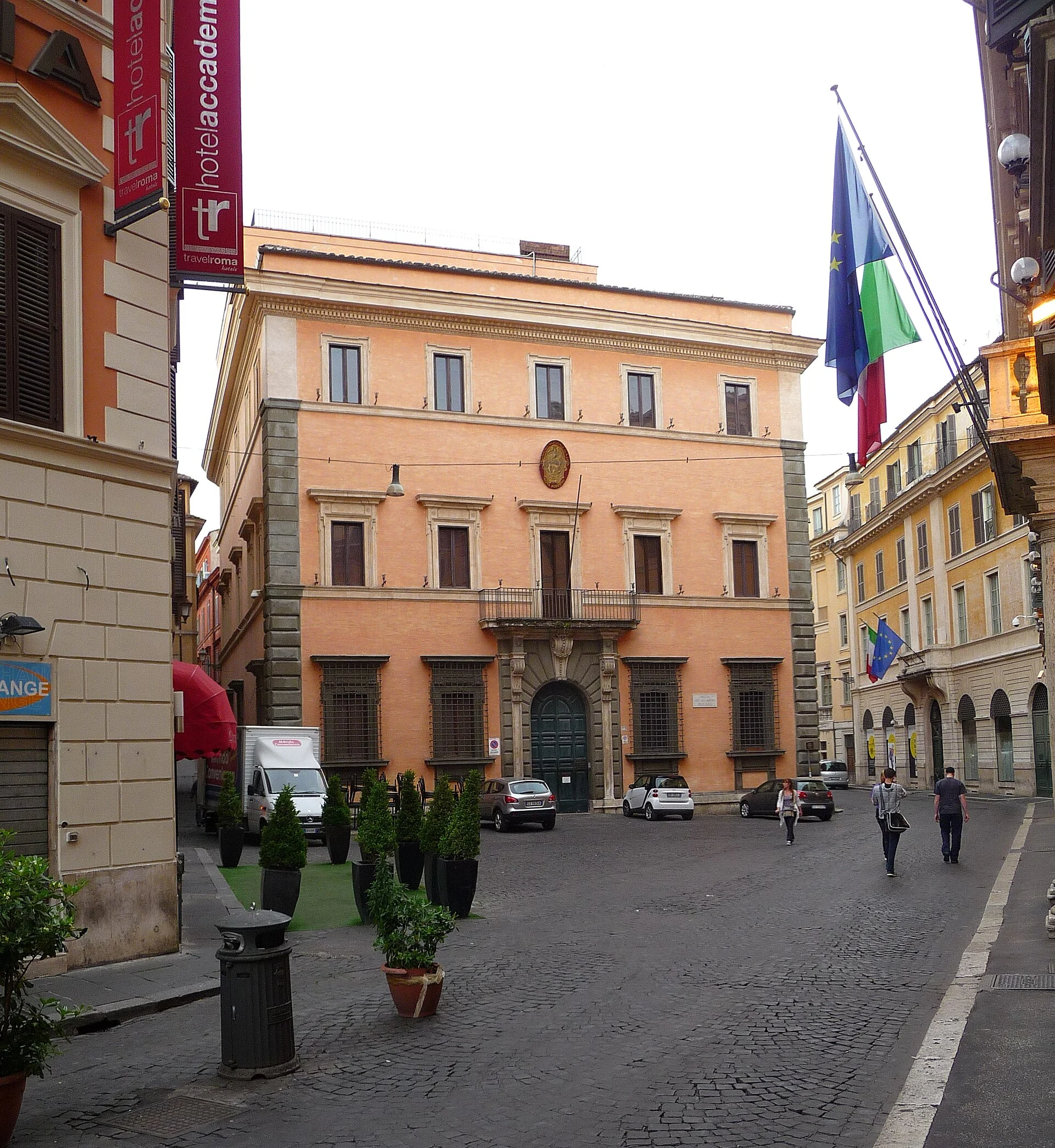
The gallery of the Accademia Nazionale di San Luca is at Piazza dell'Accademia di San Luca 77, 150 meters from the Trevi Fountain, and is open Tuesday to Friday from 15:00 to 19:00 and on Saturday from 10:00 to 19:00. Since April 1, 2026 there is a fee. Anyone who sends you there saying admission is free has read an old guide.
We are talking about the third and top floor of Palazzo Carpegna, the palace on which Francesco Borromini worked between the 1640s and 1650, leaving the portico, the courtyard, the interior portal and a helical ramp that climbs between the floors. The rest of his design, which was meant to reach as far as the fountain, was never built. Data checked on September 28, 2026 on the institution's website.
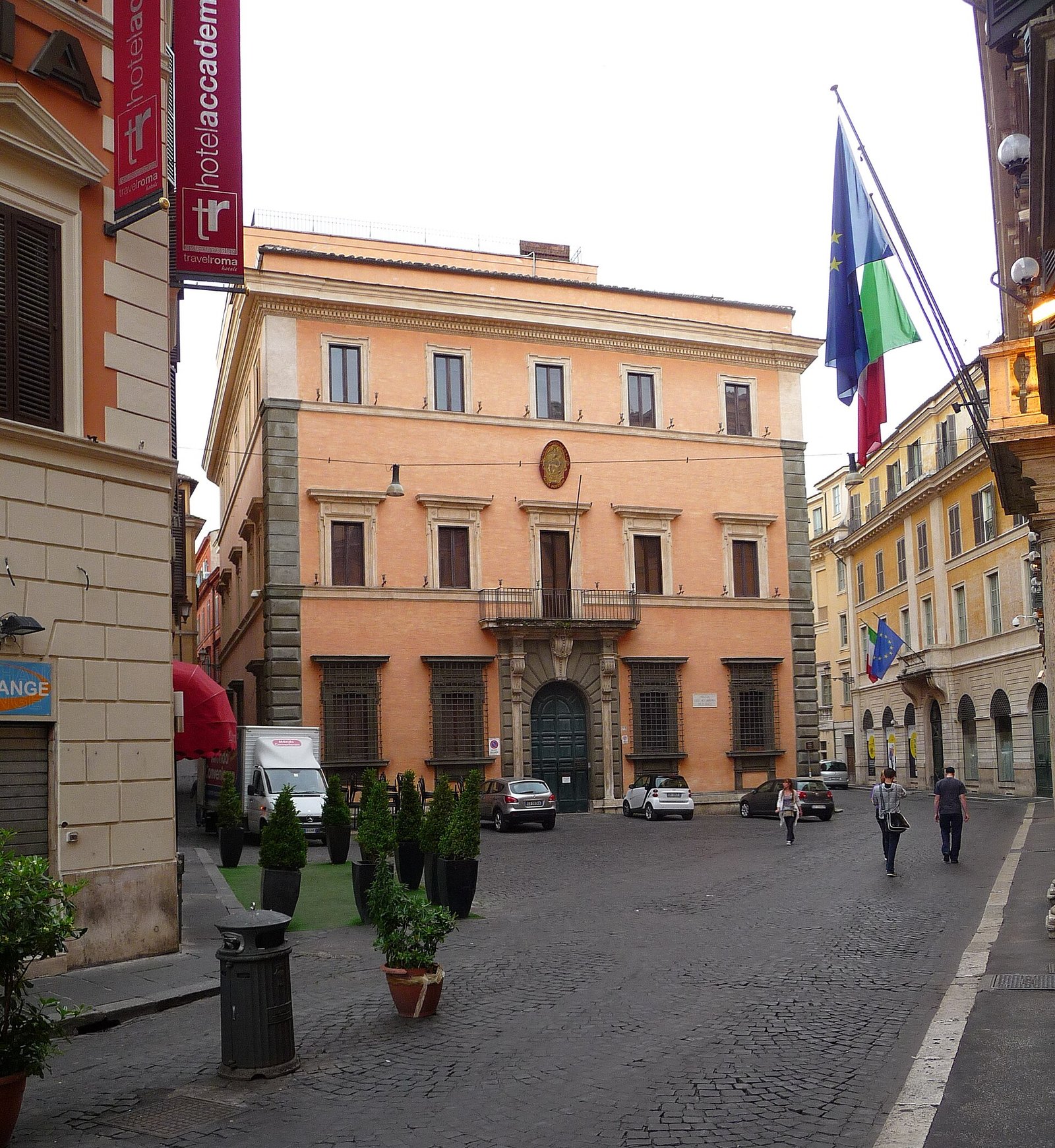
Where it is and how you really get there
The address is Piazza dell'Accademia di San Luca 77, 00187 Rome, Trevi district. The square is the narrow one that opens behind the fountain, on the side of Via della Stamperia, and anyone walking while looking at the water passes it without noticing. The doorway is big, the front desk is just inside, and the bookshop opens at the entrance. There are no flashy signs.
The useful subway is line A, Barberini stop: from there you go down Via del Tritone and in eight minutes at a normal pace you are in front of the doorway. The Spagna stop is farther than it looks on the map, because in between there's an uphill stretch and an awkward crossing. Anyone arriving from Termini gets there faster by subway than by bus.
The buses the Academy itself indicates are the 52, 53, 61, 63, 71, 80, 85, 119, 160, 492 and 630, Tritone stop. The 119 is an electric minibus and goes through the historic center, so it's the one that drops you closest. The others stop on Via del Tritone and from there you walk down toward the fountain.
From Piazza di Spagna you get there in 12 minutes via Via Propaganda and Via del Nazareno. From Via del Corso, at the level of the shopping gallery, it's eight minutes on a gentle uphill. From the Quirinale Palace you go down by Via della Dataria and the stairways: 10 minutes, but on a steep descent, to be weighed with older groups.
A taxi here is almost always a waste of time. The Trevi district is a funnel of one-way streets and pedestrian zones, and the driver leaves you a few hundred meters away anyway. For a group, the best meeting points are under the Quirinale obelisk or at the mouth of Via della Stamperia, two recognizable spots where you can stop without getting in the way.
Hours, tickets and booking: data checked on September 28, 2026
The hours published by the Academy for the gallery are these: Tuesday to Friday from 15:00 to 19:00, with last entry at 18:30, and Saturday from 10:00 to 19:00. On Sunday and Monday it is closed. The spaces for temporary exhibitions follow the same hours as the academic gallery, so there is no separate ticket for a different time slot.
The 2026 summer closure has been set from August 10 to 31 for the gallery, archives and offices, and from August 3 to 31 for the libraries. Anyone planning an August itinerary has to know this beforehand, because in that period half of institutional Rome pulls down the shutters and you end up improvising. The dates change from year to year: they should be checked again on the institution's website.
On admission we have to be clear, because it's the point on which the most wrong information circulates. The Academy has published a notice saying that since April 1, 2026 tickets for the gallery and exhibitions are bought at the ticket office of Palazzo Carpegna or online on the dedicated sales portal. Before that date access was free, and that's why almost all the guides in circulation still write free.
The price in euros does not appear in plain text on the institutional pages: the notice refers to the sales portal without indicating full and reduced rates. Writing a figure here would mean inventing it. Anyone who wants the certain figure before leaving should call the secretary's office number, +39.06.6798848, or the front desk, +39.06.6798850, and have them tell you.
Booking is not required for the individual visitor: you arrive, get the ticket and go up. It's different for guided tours, for the Historical Archive, for the Contemporary Archive and for the Drawings and Prints Cabinet, which can only be consulted by appointment. The address for tour bookings is prenotazioni@accademiasanluca.it, and the one for the historical archive is archivio@accademiasanluca.it.
The hours of the other sections are different from those of the gallery and it's best not to confuse them. The academic library and the Biblioteca Romana Sarti open Monday to Friday from 10:00 to 17:00, with booking at biblioteca@accademiasanluca.it. The Historical Archive receives Monday to Friday from 10:30 to 14:30. The Contemporary Archive only on Monday, from 10:30 to 16:30, by writing to contemporaneo@accademiasanluca.it.
The Drawings and Prints Cabinet works on a morning schedule, Monday to Friday from 08:30 to 13:00, and is booked at grafica@accademiasanluca.it. Anyone studying Roman graphic art of the 1700s and 1800s will find it useful to cross this site with the Istituto Centrale per la Grafica, 200 meters away, which holds the plates of the Calcografia.
All the service information given here comes from the page Visit Palazzo Carpegna and from the notice on ticket purchase published by the Academy. The Ministry of Culture keeps a page for the site that, however, gives different and older hours: the institution's website is the authority.
Palazzo Carpegna and the building site that scaled Borromini down
The original core of the building is sixteenth-century. It passed to the Carpegna, a family of Marche origin, who wanted to turn it into a showpiece residence to leave to their descendants, and to do so they called Francesco Borromini. The Academy dates his intervention between 1643 and 1650, commissioned by Cardinal Ulderico Carpegna. Other reconstructions move the start earlier to 1640, with the specifications signed by Count Ambrogio.
The divergence on the dates is not a pedant's detail. Anyone reading the Academy's entry finds 1643, anyone reading the encyclopedia entries finds 1640 as the start of preliminary works and 1643 as the year of Ambrogio's death and of the cardinal brother taking over. The two readings don't exclude each other: they describe a long building site with two different patrons. Both should be stated.
The initial project was enormous. Borromini imagined reorganizing the whole area as far as the fountain, with an urban stage set that would have changed the shape of the district. Political and family problems of the patrons reduced it to very little, and the Academy itself speaks openly of one of the architect's professional tragedies. Of that plan the drawings remain, kept at the Albertina in Vienna.
What was actually built is nonetheless remarkable: the portico, the courtyard, the helical ramp connecting the floors and the interior access portal. The densest invention is concentrated on the latter, with the frame that twists and the frieze that runs above it. The frieze was restored in the mid-2010s and has become legible again.
Anyone who wants to understand how this building site fits into the architect's career should take the short tour: San Carlo alle Quattro Fontane for the oval dome, Sant'Ivo alla Sapienza for the spiral lantern, and then Palazzo Carpegna for the work on interior emptiness. The full route is told in Borromini in Rome.
The comparison with the century's other great figure can be made a few steps away. Sant'Andrea al Quirinale and the Triton Fountain remain within a 10-minute radius, and the planned itinerary is in Bernini in Rome. Seeing the two authors in the same morning teaches more than any handbook.
The helical ramp: what it is and what it isn't
The ramp is a continuous spiral climb, without steps, that connects the floors of the palace by winding around a central void. It served to bring up people and sedan chairs without the jolt of the stairs, and Borromini shaped it as a hollow cylinder around which the inclined plane winds. The effect, looking up, is that of an upside-down funnel.
Beware of a frequent confusion: the ramp is not the entrance staircase you see on arriving. The grand staircase that leads to the upper floors is from the 1900s, designed in the restoration of the 1930s, and has a deliberately traditional air. They are two different things, built 300 years apart, and anyone who mixes them up tells clients the wrong story.
The Academy's website doesn't specify if the ramp is part of the ordinary visiting route to the gallery or if it can be seen only on particular occasions. It's information best asked for at the front desk on entering, or by calling beforehand at +39.06.6798850. Better to say so than to promise something you then find roped off.
The courtyard and the portico, on the other hand, are met as soon as you step through the doorway and are the first thing worth stopping for. Stop for two minutes before going up. Look at how the portico turns and how the interior portal cuts the back wall: that's where you understand why this palace, though mutilated of the grand project, remains a piece of architectural history.
A curiosity about the Accademia Nazionale di San Luca
The Academy hasn't always been here. Until the 1930s it was based in Via Bonella, at the Roman Forum, next to the Church of Santi Luca e Martina, which was and remains its church. In 1932 it had even started construction of a new seat near that church, inside the area of the Forum of Caesar.
The building site was overtaken by politics. In April the newspapers attacked harshly the idea of building a new building inside the archaeological area, then came Mussolini's visit to the site and the solemn inauguration of Via dell'Impero. At that point resisting was no longer convenient for anyone, and on December 28, 1932 the Academic Council resolved to purchase Palazzo Carpegna.
The move was completed with the official transfer of April 25, 1934. The restoration and adaptation of the palace were entrusted to Gustavo Giovannoni and Arnaldo Foschini, with the favorable opinion of the Class of Architects, and the interior was deeply transformed, also changing the structural system to bear the weight of the collections. Little of the sixteenth century remains inside.
Here is the real curiosity: the Academy of artists ended up in a Borromini palace because it was driven out of the Forum to make room for a road. The presence of Borromini, say the academic papers, pushed into second place the enormous technical difficulties the operation involved. They bought the palace for the architect's name too. Anyone who passes today through the Roman Forum or the Forum of Trajan walks on the void left by that clearance.
What you see in the gallery, room by room
The academic gallery reopened to the public on May 16, 2025 with a new display. The approach has changed: at the center there are no longer the isolated cover pieces, but the historic core of the collection, that is what was formed over the centuries through donations and bequests from academicians, heirs, patrons and collectors. It reads as a story of gifts, not of purchases.
Room I: Piranesi and the English bust
In the first room is displayed one of the six volumes of etchings that Giovan Battista Piranesi donated upon his appointment as academician, in 1761, together with the bust the English sculptor Joseph Nollekens dedicated to him. Two apparently minor objects that say a lot: entering the Academy involved a gift, and the gift became common heritage. Piranesi lived from 1720 to 1778.
Room II: the bequests, and the names that surprise
The second room gathers works donated at different times, in life or by will. Among the most recent bequests are the Maurice Dumarest bequest of 1913 and the Michele Lazzaroni bequest of 1935, alongside those of Pellegrini, Ferrata and Cavaceppi. The names on the wall are Giovan Battista Piazzetta, Michael Sweerts, Bronzino, Alessandro Algardi, Gian Lorenzo Bernini, the Cavalier d'Arpino, Anton van Dyck, Peter Paul Rubens and Domenico Pellegrini.
Finding Rubens and Van Dyck here throws off anyone who expected an all-Roman collection. It's no accident: both had dealings with the Roman association, and the Fleming passing through Rome in the 1600s also passes through the Academy. Anyone who wants the comparison with great seventeenth-century painting a quarter of an hour's walk away has the National Gallery of Ancient Art.
Room III: the accountant who bought paintings
The third room is entirely for the bequest of Fabio Rosa, who lived from 1681 to 1753, an accountant in the papal administration and an eccentric collector of early-1700s Rome. On his death he donated to the Academy more than 180 canvases, declaring he did so in gratitude for the memory of his father Francesco, a painter and academician. A public employee who leaves a picture gallery: it rarely happens.
Within that bequest are Salvator Rosa, Carlo Maratti, Giovanni Battista Gaulli, Giovanni Paolo Panini, Sebastiano Conca, Benedetto Luti and 20 paintings by Jan Frans Van Bloemen, known as l'Orizzonte, who turns out to be the most represented artist in the whole collection. 20 canvases by the same Flemish landscape painter say something about Roman taste of the early 1700s, and about the market that fed it.
Room IV: the pieces people fight over
The fourth room holds together the works most tied to the identity of the institution. The Putto Holding a Festoon entered the collections in 1834 with the bequest of the French painter Jean-Baptiste Wicar. The altarpiece with Saint Luke portraying the Virgin is flanked by the copy made in 1623 by Antiveduto Gramatica, and the close comparison between original and copy is the right way to display them.
The other paintings in the room have a curious provenance: they came from the so-called restricted cabinet of the Capitoline Picture Gallery, where they remained until 1836, when they were handed over to the Academy for teaching purposes. They were used to have students copy. Anyone who wants to see where they come from should make the jump to the Capitoline Museums, which are a 20-minute walk away.
Rooms V and VI: the drawings and the time of Canova
The fifth room displays a selection of the academic collection of architectural drawings, which is one of the most substantial holdings in Europe. Architecture at the Academy was also taught through competitions open to architects from different countries, and many professionals or their heirs chose to deposit their work here. Because of the fragility of the sheets, the works rotate often.
Frequent rotation has a practical consequence no guide writes: the drawing you saw in a photograph may not be on the wall the day you go. It's not a flaw, it's conservation. The sixth room covers instead the phase between the late 1700s and the early 1800s, with the works of the Balestra competitions, established in 1768, and the years when Canova was prince of the Academy.
On the Neoclassical sculptural side the Academy preserves plaster casts tied to Canova, Thorvaldsen and Tenerani. Anyone who wants to understand how a teaching plaster cast gallery worked in the 1800s finds a term of comparison in Antonio Canova's studio and house, in the Canova Tadolini atelier and in the plaster cast gallery of the Museum of Classical Art.
Something nobody tells you about the Accademia Nazionale di San Luca
The palace doesn't work like a museum. It's a working seat, and the gallery occupies only the top floor. On the ground floor are the spaces for temporary exhibitions and the storage of books, paintings, drawings and prints. On the main floor are the Presidency, the General Secretariat, the Conference Room and the Academic Council Room.
On the second floor are the Historical Archive, the academic library, the Biblioteca Romana Sarti and the administrative offices. Also on the main floor is kept the repository of the Funds of the Architects of the 1900s and 2000s, which is study material of the first rank for anyone working on contemporary Italian architecture. None of this can be visited with the ordinary ticket.
The consequence is that an enormous part of the heritage remains invisible to the ordinary visitor, and nobody tells them at the entrance. It's not bad faith: it's the nature of the institution, which is first of all a society of artists and a research center, and only secondarily a place open to the public. Anyone who wants to get into the archives has to write, give a reason and make an appointment.
Second thing that isn't said: the Academy still today gives itself the statutory aim of promoting the arts and architecture and of honoring merit by electing artists to the Academic Body. Since 1950 it has submitted to the Presidency of the Republic the names for the National Prize for Painting, Sculpture and Architecture, which is awarded every year in rotation among the three arts.
Third thing, the most practical: the gallery closes at 19:00 but last entry on weekdays is at 18:30, and Tuesday to Friday it opens only at 15:00. It means that on winter afternoons you have a real window of three and a half hours, and that a midweek morning here can't be planned. Saturday is the only day with continuous opening from 10:00.
The disputed attributions: the Putto and the altarpiece of Saint Luke
Here you have to go slowly, because these are the two pieces on which the sources openly diverge and about which all sorts of things are read around. The Academy's official entry records both works under the label Raffaello Sanzio, with the abbreviation attr. in parentheses. Attributed, not certain. The difference between the two words is worth a discussion two centuries long.
The Putto Holding a Festoon
The Putto is a detached fresco of about 100 by 41.5 centimeters, dated around 1513, inventory number 392, restored in 2021. It entered the Academy in 1834 with the bequest of Jean-Baptiste Wicar. In technical and formal characteristics it is almost identical to one of the two putti flanking the Isaiah painted by Raphael in the church of Sant'Agostino, and from there the whole problem arises.
In March 2021, after the restoration and a campaign of diagnostic investigations, the Italian press headlined that the attribution to Raphael was confirmed. A few days later the Academy publicly stated a more cautious position: the restoration had shown very high quality and a dating compatible with the era of the artist from Urbino, but the autograph question had to be discussed in scholarly forums, and the work could be traced back at least to his immediate circle.
The catalog page the institution publishes today confirms the caution: it speaks of a mysterious and debated fragment, of status and attribution still uncertain, and of a debate still open to which the study campaign of 2020 and 2021 added new questions instead of closing any. Anyone who tells you the question is settled is anticipating a conclusion the owning institution has never signed.
A curious detail concerns Gustave Moreau. The French painter, in 1858, during his stay in Rome, spent whole days in the Academy's gallery studying Raphael's technique and copying this very fragment. He called it mon petit enfant in his letters to his family, never parted with it, and the copy is today in his Paris atelier.
The altarpiece of Saint Luke portraying the Virgin
The altarpiece is an oil on panel transferred to canvas, 216 by 160 centimeters, inventory 283, dated generically to the 1500s. It's the symbol image of the association: the evangelist Luke portrays the Madonna who appears to him, the ox watches him in the foreground, and in the background appears the figure of Raphael looking at the panel on which the saint is painting.
The presence of Raphael inside the scene is not decorative: it establishes the primacy of the artist from Urbino as the model for those entering the profession. It should also be read as a Roman answer to what had happened in Florence in the 1560s, where Giorgio Vasari had built for the chapel of San Luca at the Santissima Annunziata a decorative program entirely oriented to Michelangelo and his school.
On the author the sources have been divided since the 1800s. There are studies that cast doubt on authenticity already in the first decades of the 1900s and studies that strongly defended Raphael's autograph authorship in the late 1980s. The Academy's entry reports both positions without choosing one, and the catalog wording remains attributed. That's enough to demolish any brochure certainty.
Then there is the story of the quarrel, which is documented by seventeenth-century sources and is too good to leave out. Federico Zuccari supposedly commissioned a restoration of the altarpiece from Scipione Pulzone. Pulzone, when the work was finished, put his own signature on a scroll inserted into the painting. Zuccari had it removed in a fury, and a rift opened between the two that was never mended.
During a further restoration carried out in 1858 by Giovanni Pileri something of that affair physically re-emerged from the panel. It's the kind of episode that explains better than a thousand pages what an academy of artists was in the 1500s: a place of prestige, hierarchies and settling of scores, not a circle of agreeing gentlemen.
Anyone who wants to widen the discussion to the whole city has two ready-made itineraries: Raphael in Rome for the certain and the debated works, and the Villa Farnesina for the artist from Urbino's most famous private commission. At the other end of the textbook spectrum, Caravaggio in Rome and the Contarelli Chapel show how much the problem changes when the sources are solid.
The advice I give you for visiting the Accademia Nazionale di San Luca
Go on Saturday morning, right at opening, at 10:00. It's the only day with continuous opening and the first hour is when the gallery is emptiest, because the mass arriving at the fountain moves later. At 11:30 the square in front of the doorway starts filling with groups in transit and the atmosphere changes.
Don't treat it as a long visit. Six rooms on a single floor can be walked calmly in an hour, an hour and a half if you really stop at room IV and at the architectural drawings. Anyone who insists on making it half a day ends up looking badly at everything. Better to fit it into a route that continues elsewhere, and to leave while you're still attentive.
The combination that works best is this: the fountain, then the Vicus Caprarius to understand where the water comes from, then the Academy, and close at Palazzo Poli or at the Istituto Centrale per la Grafica if there are exhibitions. Three and a half hours, four with stops, and you stay within a 300-meter radius.
Verify the opening the day before. Academic seats close for conferences, election ceremonies, installations and works, and the notice appears on the website with little warning. A phone call to +39.06.6798850 saves you a wasted trip, and with a group it saves you embarrassment. The check call is the least glorious and most decisive part of the preparation.
If you have a group, allow for the climb to the third floor and the time it takes. With 25 people just getting from the doorway to the first room takes a quarter of an hour. Better to split into two subgroups staggered by 10 minutes, as the Academy itself does, for that matter, with large school classes.
Another well-known fact, yet rarely cited
That the Academy was born at the end of the 1500s everyone knows, but almost nobody says that there is not a single version of the date of birth. Current reconstructions place the approval by papal brief in 1577, under Gregory XIII and at the urging of Girolamo Muziano, and indicate 1593 as the year in which Federico Zuccari became its first prince.
The statutes were supposedly ratified only in 1607, 30 years after the brief. And there is a third version, the one the Academy gives of itself: on its institutional page it traces its origin back to the ancient Universitas picturae ac miniaturae, active in Rome already in the fifteenth century, that is a century before any papal act.
The three dates don't contradict each other: they tell of an institution that forms in layers, from trade guild to recognized society. But anyone who writes that the Academy was founded in 1593 and that's it is choosing one of the three without saying so. In a serious entry all the versions are given, and it's stated which source supports which.
Another rarely cited element: in 1588 Sixtus V granted the institution the ancient church of Santa Martina al Foro, which later became Santi Luca e Martina with the facade by Pietro da Cortona. The link with that church explains the name of the society and explains why the clearance of the 1930s was felt as a wrench.
The right photo to take at the Accademia Nazionale di San Luca
The photograph to take home is not a painting: it's the void of the courtyard seen from below, with the portico that turns and the interior portal that closes the back. Stand just inside the doorway, on the right, and frame on a diagonal. The best light is that of Saturday morning, when the sun comes in from the side and separates the moldings from the shadow.
The second shot I recommend is from top to bottom, if and when the route takes you along the ramp. The spiral read vertically is a form the camera understands well, and you don't need a special lens: just rest your arms on the parapet and hold the phone still, without flash. Blurry photos here are the rule.
Inside the rooms the usual rules of cultural institutions apply: no flash, no tripod, and on temporary loans the limits may be tighter. Ask at the front desk before starting, because a 10-second question avoids a 10-minute argument. The conditions for reproductions for editorial use are instead agreed with the offices.
The wrong shot, the one everyone takes, is the selfie on the landing with the painting blurred behind you. It tells nothing. If you want a keepsake with a person in it, have them stand backlit in the portico, small, with the architecture around: you can tell where you were. The detail of the Borromini frieze, in tight close-up, is worth more than 20 panoramas.
Outside, the good frame of the square is taken from Via della Stamperia looking toward the doorway, with the fountain out of the shot. It's the way to show that this place exists a couple of steps from the water and that nobody looks at it. Anyone who instead wants a strong contrast should go down into Galleria Sciarra, five minutes away, and photograph the Liberty-style courtyard.
Some important events that happened here in history
On December 28, 1932 the Academic Council resolved to purchase Palazzo Carpegna. It's the date that changes the institution's geography, and it comes at the end of 30 years of discussion about relocation and of a tug-of-war lost against the regime's urban planning. The building site of the new seat at the Forums, started a few months earlier, was abandoned.
On April 25, 1934 the Academy officially moved into the new seat. In between there had been the work of Gustavo Giovannoni and Arnaldo Foschini, who radically transformed the interiors and intervened on the structural system to make the building fit to bear archives, libraries and collections. The grand entrance staircase seen today belongs to that period.
In 1834 the bequest of Jean-Baptiste Wicar brought the Putto Holding a Festoon into the collections. Two years later, in 1836, came the group of paintings handed over from the restricted cabinet of the Capitoline Picture Gallery for teaching purposes. The 1830s are the moment when the academic collection takes the shape that is still recognizable today in the gallery.
In 1761 Giovan Battista Piranesi was named academician and donated the six volumes of etchings. In 1768 the Balestra competitions were established, which for decades measured the talent of young people on assigned themes. Between the late 1700s and early 1800s Canova was prince of the Academy and led its renewal, in a phase when Rome was the European capital of art teaching.
1753 is the year of the death of Fabio Rosa and therefore of the arrival of the more than 180 canvases of his bequest. In 1913 the Maurice Dumarest bequest, in 1935 the Michele Lazzaroni bequest. A collection built like this, by successive donations and not by purchases, explains why the gallery doesn't have the linear logic of a museum conceived at a drawing board.
On May 16, 2025 the gallery reopened with the new display, after the previous setup that had lasted from 2000 to 2025. On April 1, 2026 the paid admission regime came into force with a ticket office on site and online sales. These are the two recent facts that really change the experience of anyone arriving today.
Who has passed through the Accademia Nazionale di San Luca
Federico Zuccari was the institution's first prince at the end of the 1500s, and his name remains tied also to the affair of the scroll torn from the altarpiece of Saint Luke. Pietro da Cortona designed the facade of the society's church at the Forums. Two names that say how much the Academy was, in the 1600s and 1700s, the place where Roman careers were decided.
Among the artists present in the collection with works of their own or tied to the society appear Gian Lorenzo Bernini, Alessandro Algardi, the Cavalier d'Arpino, Bronzino, Michael Sweerts, Giovan Battista Piazzetta, Peter Paul Rubens and Anton van Dyck. On the eighteenth-century side Carlo Maratti, Giovanni Battista Gaulli, Giovanni Paolo Panini, Sebastiano Conca, Benedetto Luti, Salvator Rosa and Jan Frans Van Bloemen.
Giovan Battista Piranesi entered as academician in 1761 and the English sculptor Joseph Nollekens dedicated to him the bust that is now in the first room. Antonio Canova was prince of the Academy and the whole sixth room revolves around his name. Bertel Thorvaldsen and Pietro Tenerani appear on the Neoclassical side of the plaster casts kept by the institution.
Jean-Baptiste Wicar, a French painter trained in Napoleonic Rome, left in his will the fresco fragment that has been prompting debate ever since. Gustave Moreau, in 1858, spent weeks copying that fragment inside the gallery: his letters to his family are one of the liveliest testimonies of what it meant to study here. Anyone who wants the French parallel should look at Villa Medici.
On the twentieth-century side, Gustavo Giovannoni and Arnaldo Foschini pass through as designers of the restoration, along with generations of architects who deposited their professional archives at the Academy. Paolo Portoghesi told the story of Palazzo Carpegna in one of the materials the institution itself makes available. The National Prize, since 1950, has run through almost all Italian art of the second half of the 1900s.
The contrarian position: the free gallery no longer exists, and that's fine
For years a formula has circulated about this place that has done well: the free gallery a couple of steps from the fountain. It was true until a few months ago and today it no longer is, because since April 1, 2026 the Academy has introduced a ticket office. Half of the content you find online hasn't noticed the change and keeps repeating the old formula.
In our judgment the ticket is good news, even if many won't like it. For years this gallery was treated as a half-hour fallback, something you did because it cost nothing, with visitors who walked in without knowing where they were and walked out 10 minutes later. Free, in the public's perception, meant irrelevant.
A private institution that maintains archives, libraries, a cabinet of drawings and prints and a heritage of paintings has costs that someone has to cover. As long as access was free, that someone remained the institution's budget. Asking for a contribution from those who enter is the most honest way of financing conservation, and it generally also improves the quality of the visit, because it filters out casual passage.
The flip side I say just as clearly: if you charge, you have to publish the rate in plain text on your own website, along with reductions and free admissions. At the time of checking, the notice referred to the sales portal without indicating the amount, and for a visitor planning from afar that is a lack of transparency. The Academy has to improve on this.
I'll add a second uncomfortable opinion. The commercial draw of this place is not the paintings, which still deserve it, but Borromini's signature on the courtyard: yet the institution's communication is built entirely around the collection. Anyone arriving from the fountain wants to understand the architecture, and should be welcomed with a clear explanation of the courtyard before even going up to the third floor.
Third opinion, on attributions. I find it wrong how the press, in 2021, turned a diagnostic campaign into a verdict. The Academy did the right thing in putting on the brakes, and keeps writing attributed in its entries. A collection that declares its doubts is more reliable than one that sells certainties, and visitors notice.
Guided tours, groups and schools: costs and rules
The Academy organizes scheduled tours on fixed days and times, in Italian, lasting an hour or an hour and a half. They are held on Tuesday and Thursday at 15:00 and 17:00, and on Saturday at 10:00, 12:00, 15:00 and 17:00. The cost indicated is €10 per person, added to the admission ticket.
Private tours are booked on request, in Italian or in English, French and Spanish, for a maximum of 25 people, at a cost of €150 plus tickets. For schools, again within 25 participants, the rate is €100 in Italian and €140 in a foreign language, with sessions Monday to Friday at 10:00, 11:30 and 13:00.
Large classes are divided into groups staggered by a quarter of an hour, which is the right choice on a route of small rooms on a single floor. Anyone working with outside guides can book groups of up to 25 people paying only the standard ticket, provided they choose days and times that don't overlap with the Academy's scheduled tours.
All bookings go through a single address, prenotazioni@accademiasanluca.it, and special requests should be written there. With Roman academic institutions it's best to move at least two weeks ahead and ask for written confirmation, because the calendar fills quickly in the spring months and in the weeks of temporary exhibitions.
Accessibility and services
Access for people with reduced mobility or disabilities is booked before arrival, by writing to prenotazioni@accademiasanluca.it or by calling the front desk at +39.06.6798850. The Academy provides a stair-lift chair free of charge and allows entry with wheelchairs. The advance notice really matters: in a seventeenth-century palace readapted in the 1930s nothing is automatic.
The bookshop is at the entrance of Palazzo Carpegna and sells the institution's publications, conference proceedings and exhibition catalogs. The volumes can also be bought remotely by writing to the secretary's office addresses. For anyone studying the history of the Academy or Palazzo Carpegna, those catalogs are often the only up-to-date bibliography available.
Don't expect a cafe service or a coat check like a big museum: there aren't any. Bulky bags and big backpacks on a route of narrow rooms are a practical problem, so arrive light. Anyone traveling with a roller suitcase should leave it at the hotel or in a storage facility before coming, because here there is nowhere to put it.
What to see around, without going far
The Trevi district is the place where the density of interesting things per square meter is highest in Rome and where 95 percent of visitors look at a single object. 50 meters from the Academy is Palazzo Poli, the building the fountain leans against and which almost nobody recognizes as a building in its own right.
Under the square runs the ancient water: the Vicus Caprarius shows the Roman structures and the branch of the Aqua Virgo that still feeds the fountain today. Next to the fountain itself is the small church of Santi Vincenzo e Anastasio, which keeps the praecordia of the popes and which groups walk past without going in.
Going up toward the hill you reach the Quirinale obelisk and the church of San Silvestro al Quirinale, which has a chapel with sixteenth-century landscapes worth the detour. The Scuderie del Quirinale host the big exhibitions, and Palazzo Barberini is 10 minutes uphill.
In the same radius are the Quattro Fontane, the Barberini Mithraeum which can only be visited by booking, and going down toward the Corso the Galleria Alberto Sordi. A little farther the Galleria Colonna and the Palazzo Doria Pamphilj with their intact family picture galleries.
Anyone who wants Roman baroque in its theatrical version has Sant'Ignazio, the basilica of Santa Maria in Via Lata and San Marcello al Corso along the same line. For exhibitions, the Museo di Roma at Palazzo Braschi and the Chiostro del Bramante are just under 20 minutes away.
One last note of method on costs: on the first Sundays of the month many state-run sites open without a ticket, and it's worth knowing which, as explained in the page on the free days. The Academy is a private body and follows its own rules, so it doesn't automatically fall under those initiatives: ask them directly.
Eating in the area: the honest warning
The triangle between the fountain, Via del Tritone and the Corso is the area of Rome with the highest concentration of dining built for people passing through once. I don't say this out of moralism. It's a market fact, and you can read it in the numbers. When turnover is total and no customer comes back, the incentive to cook well goes down and the incentive to cut costs goes up.
The signs can be read from the street, without going in. The menu with photographs of the dishes is the first: it serves to sell to those who don't read Italian, and a place that lives on regular customers doesn't need one. The lady rolling out the pasta sheet in the window or on the sidewalk is staging, not a guarantee of cooking: it's a visual lure designed to make you slow your pace.
Second sign: the person at the door inviting you to sit down. A place that has to stop you in the street is telling you it has no reservations. Third: the all-day schedule from morning to late at night with no kitchen break, which means dishes kept ready and reheated, because no kitchen crew holds up for 15 hours of real service.
Fourth and most expensive: the places with little tables in front of the famous monument, where the price adjusts to the customer. There you find the unpriced items on the menu, the fish and cuts of meat by weight with no clear indication, and different price lists between the indoor room and the outdoor tables. It's only partly legal and in any case unfair, and the bill comes in far above expectations.
On the chains with a repeated sign that you see every 200 meters in the center I'll say one thing without snobbery: they work as a tourist attraction, with their recognizable decor and always identical product, and those who go generally know exactly what they're buying. The point is another: Romans don't eat there, and so they're not a useful clue to where to eat well here.
There is only one criterion and it requires no apps or rankings. Look at who is sitting there and in what language they order. If at 20:30 in the evening the tables hold families speaking Italian and people calling the waiter by name, you're in the right place. If at 18:00 it's already full of suitcases, no.
In the Trevi district the practical rule is to move away. 300 meters toward the Quirinale, or the other way toward the Corso and the side streets behind it, completely change the type of clientele and the ratio between what you pay and what you eat. 300 meters is four minutes on foot and is worth €20 a head in difference.
The recommended addresses, in Rome and in Italy, are in a list updated by hand: Daniele's list on Google Maps. There are no commercial agreements behind it, and places go in and out depending on how they cook. That's the reason you won't find recommended names on this page.
Frequently asked questions about the Accademia Nazionale di San Luca
Is the gallery of the Accademia di San Luca free?
No, not anymore. The Academy has announced that since April 1, 2026 tickets for the gallery and exhibitions are bought at the ticket office of Palazzo Carpegna or online on the sales portal indicated by the institution. Many guides and articles in circulation still report free admission because they refer to the situation before that date.
How much does the ticket cost?
The rate does not appear in plain text on the institutional pages consulted on September 28, 2026: the notice refers to the sales portal without specifying full price, reduced and free admission. To have the certain amount before leaving, it's best to phone the secretary's office at +39.06.6798848 or the front desk at +39.06.6798850. Any figure read elsewhere should be verified at the source.
What are the opening days and hours?
Tuesday to Friday the gallery opens from 15:00 to 19:00, with last entry at 18:30. On Saturday the hours are continuous from 10:00 to 19:00. On Sunday and Monday it is closed. In 2026 the summer closure of the gallery, archives and offices runs from August 10 to 31, while the libraries close from August 3 to 31.
Do I need to book?
For the individual visitor, no: you arrive, buy the ticket and go up to the third floor. Booking is needed for guided tours, which are requested at prenotazioni@accademiasanluca.it, and for consulting the Historical Archive, the Contemporary Archive and the Drawings and Prints Cabinet, which receive only by appointment and with their own hours.
Where exactly is it and how do I get there?
The address is Piazza dell'Accademia di San Luca 77, 00187 Rome, in the Trevi district, behind the fountain on the side of Via della Stamperia. The subway is line A, Barberini stop, about eight minutes on foot. The buses indicated by the institution are 52, 53, 61, 63, 71, 80, 85, 119, 160, 492 and 630, Tritone stop.
Can you see Borromini's helical ramp?
The courtyard and the portico are met right after the doorway and can be seen without a ticket. On the ramp, however, the Academy's website doesn't specify if it is part of the ordinary gallery route: it's best to ask at the front desk on entering or phone beforehand at +39.06.6798850. Better one more question than a wrong promise to a group.
Are the works attributed to Raphael really his?
The Academy's catalog entries record both the Putto Holding a Festoon and the altarpiece of Saint Luke under the formula Raffaello Sanzio attributed. On the Putto, after the restoration and the investigations of 2021, the institution has stated that the debate on autograph authorship remains open. On the altarpiece there are both doubts raised from the 1800s onward and reasoned defenses of Raphael's autograph authorship.
How much time does the visit take?
An hour is enough for the complete route of the six rooms, an hour and a half if you stop at the fourth room and at the architectural drawings. The guided tours scheduled by the Academy last between an hour and an hour and a half. With a large group add a quarter of an hour just for the climb and the staggered entry.
Is it suitable for people with mobility difficulties?
Access for people with reduced mobility or disabilities must be booked before arrival by writing to prenotazioni@accademiasanluca.it or calling +39.06.6798850. The Academy provides a stair-lift chair free of charge and allows entry with wheelchairs. The palace remains a readapted historic building, so advance notice makes the difference between a calm visit and a complicated one.
Who wrote this page
The page is edited by the editorial team of Tour Leader Pro, the Roman organization that designs and coordinates visits, itineraries and cultural events in Rome and Lazio. Hours, rates and access conditions given here are checked at the date of publication against the official sources cited in the text: it's best to recheck them before leaving, because they change often. If you find an out-of-date piece of data, let us know.
Anyone building a Roman itinerary has to make work out afternoon-only openings, seats that are first of all offices and only secondarily visitable spaces, bookings to be requested by email weeks ahead and elevation changes that you don't see on the map. Planning tools and materials, for those who lead groups and for those who organize on their own, can be found at Tour Leader Pro.
For the wider picture, that is rail connections, rentals, airports and destinations in Lazio outside the center of Rome, from the Castelli to the lakes to the coast, a useful resource is Italy Planner.