Villa Massimo
In short. Villa Massimo is not visited like a museum: the seat of the Accademia Tedesca Roma Villa Massimo, at Largo di Villa Massimo 1-2, 00161 Rome, Nomentano district, opens its gate to the public only for exhibitions, parties and special…
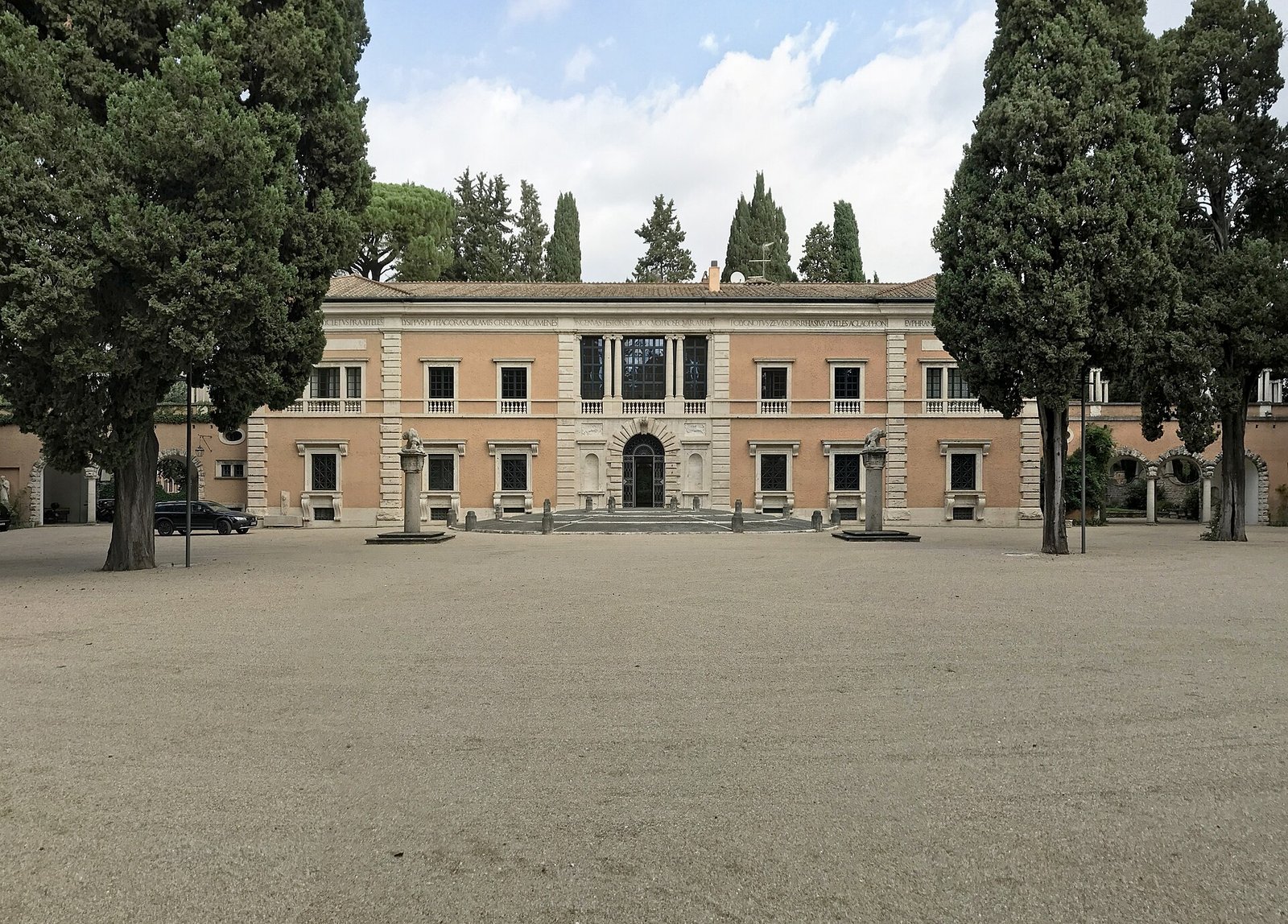
Villa Massimo is not visited like a museum: the seat of the Accademia Tedesca Roma Villa Massimo, at Largo di Villa Massimo 1-2, 00161 Rome, Nomentano district, opens its gate to the public only for exhibitions, parties and special openings, almost always with mandatory registration. The rest of the year it is home and workshop to nine German artists who are winners of the Rome Prize. Open House Roma visits are free, while for the other openings the operator gives no price and asks you to register on its site.
The institution depends on the Federal Government Commissioner for Culture and the Media of the Federal Republic of Germany, which every year awards the Rome Prize Villa Massimo to nine artists chosen by the Länder and by a national jury. Composers, writers, architects and visual artists stay 10 months, in 10 studios with an attached apartment, inside a park that the Academy itself describes with avenues of holm oaks, fountains and antique vases. It is a working residence, with the rules of a private home.
The practical information was checked on September 29, 2026 on the Academy’s official site (villamassimo.de), on the page of the 2026 edition of Open House Roma, on the tourist portal of Roma Capitale and on the other sources indicated in the text. The operator does not publish opening hours, because there are no regular ones. It publishes instead a calendar of events, and that is where to look before setting out for Nomentano.
At a glance: address, hours, ticket
- Address: Largo di Villa Massimo 1-2, 00161 Rome, Nomentano district, near Via Nomentana.
- Operator: Accademia Tedesca Roma Villa Massimo, an institution of the German Federal Government, phone (+39) 06 4425931.
- How to get in: only during public events, exhibitions and special openings such as Open House Roma, usually with registration.
- Price: Open House Roma visits free, for the other events the operator does not publish a price, limited places.
- Hours: no regular hours published, the calendar on the official site’s events page is authoritative.
- How to get there: metro B Bologna stop and buses 60, 62, 63, 66, 82, 168, 309, 310, 542, according to Open House Roma.
- Accessibility: the operator publishes no information, it’s best to ask by phone before the event.
Where it is and what you actually see
The Academy occupies a lot in Nomentano, near Via Nomentana and the Bologna stop of metro B, in the district born between the 1800s and 1900s outside Porta Pia. In 1910 there was still cultivated countryside here: the official source speaks of a plot of the vast Vigna Massimo, bought by the Berlin patron Eduard Arnhold. The city grew around the enclosure in the following decades, and today the villa is surrounded by small apartment buildings and residential streets.
Inside the enclosure there are three elements. The main villa, designed with rooms for the study of the nude, common spaces, guest rooms and a representative studio. The row of studios on the south side, designed for working on larger-than-life monuments, equestrian statues and canvases meters long. Then the park, which the Academy itself describes with avenues of holm oaks closed off by fountains, ruins of temples as a backdrop and antique vases along the paths.
What you actually see depends on the occasion. The summer Festa dell’Arte is the moment when the Academy presents to the public the work of the year’s fellows, and the program changes each edition. During Open House Roma the 2026 guided route included the villa, the park and some projects by former architect fellows. At an exhibition you see only the chosen exhibition space. None of these formulas allows roaming freely through the rooms and apartments, which remain inhabited.
Anyone arriving without an event finds a gate and a perimeter wall. The advice is not to count on glimpses from the street to understand the place. The neighborhood, however, deserves the walk: Villa Torlonia and the basilica of Sant'Agnese fuori le Mura are reached along the Nomentana and offer the part of this area of Rome that is visitable every day, with published hours and regular entrances.
The complex should also be read as architecture of its time. It was built in the same years when Rome, a capital for only a few decades, was expanding beyond the Walls with new districts and private villas. The choice of a still agricultural plot, outside the center but near a consular road, answered a concrete need: space, light and quiet to work. Today that choice explains why the villa appears closed in on itself, surrounded by a city that grew afterward.
A curiosity about Villa Massimo
The name doesn’t come from the German artists or from the founder. It comes from the Massimo family, owner of the great vineyard outside the gate from which Arnhold cut his plot in 1910. It is the same house that in Rome left its name to Palazzo Massimo alle Terme, today home of the Museo Nazionale Romano, and to the Casino Giustiniani Massimo al Laterano, with the frescoes of the German Nazarenes. The surname is the same, the addresses are far from each other.
The most curious coincidence concerns the Lateran itself. The Massimo casino near San Giovanni preserves the rooms painted at the beginning of the 1800s by German painters who came to Rome looking for a renewed painting. A century later, on a plot of another Massimo property, the residence was born that a Berlin patron wanted in order to send German artists to Rome. The two places have no documented links to each other, but the thread of the surname and of the German artistic presence returns in both.
There is a second detail that often escapes notice. The architect named by the official sources, Maximilian Zürcher, was also a painter, and the Academy writes that he built as if he were painting. Open House Roma cites as designers Zürcher himself and the client Arnhold. This explains a complex that resembles neither a boarding school nor a representative palace, but a set of workshops arranged inside a garden, with the main building as the common house.
Why did a Berlin patron build a villa in Rome?
Eduard Arnhold was a merchant and entrepreneur from Berlin, a patron, a senator of the Academies of the Arts according to the official source. Open House Roma presents him as a Prussian entrepreneur of Jewish origin and recalls that the operation was carried out together with his wife Johanna. The historical section of the official site in fact presents Johanna and Eduard Arnhold as founding spouses, and not only the husband as donor. The idea was to give German artists a long period of work in Rome.
Italy was not a new choice for Arnhold. According to biographical reconstructions, in 1902 he had already bought Villa Bellagio in Fiesole, above Florence. Eight years later came the Roman plot, and in 1911 the donation of the whole complex to the Prussian State, which from then on became responsible for it. It is a decisive step for understanding the later history: precisely because the villa was the property of a foreign State, it was seized in the First World War, passed under Allied administration after the Second and returned to Germany only with an agreement between governments.
The comparison with the national academies already present in Rome, like the French one, comes naturally, but the approach of Villa Massimo appears more practical. The studios were designed as real production spaces, with measurements suited to monumental statues and large-format canvases, and the main villa as a common house with rooms for the study of the nude. The park completed the whole with fountains, holm oaks and antique finds, a Rome in miniature available to those who worked there every day.
Something nobody tells you about Villa Massimo
In Rome there are two Villa Massimos, and confusing them is the most frequent mistake. One is the German Academy, fenced, at Largo di Villa Massimo. The other is a public municipal garden on Viale di Villa Massimo, today named for Giuseppe De Meo, of about 7,000 square meters according to the tourist portal of Roma Capitale. The public garden can be crossed freely during the municipal green-space hours. The Academy can’t. On maps and in online reviews they sometimes appear mixed together.
The municipal garden too has had a complicated history. According to the local press, the gates stayed closed for years because of legal disputes tied to the concession of the refreshment point, and the reopening came in May 2019, after tree safety work, with the felling of several pines, new furnishings and redesigned paths. Anyone looking for a lawn for a break in the neighborhood finds there what they are looking for. Anyone looking for the German artists’ studios must look elsewhere, that is at the Academy’s calendar.
The second little-said thing concerns the audience of the events. The official page explains that the Academy presents its events as a rule to a circle of invited guests, and that open to the public are, among others, the exhibitions and the summer party. Translated: not everything that appears in the calendar is open to whoever shows up at the gate. To avoid being left out it’s best to follow the Academy’s site and social channels, where public openings are announced.
Who decides who lives in the studios?
The Rome Prize Villa Massimo is awarded by the Federal Government Commissioner for Culture and the Media. The official site states that the nine winners of the year are selected by the federal Länder and by a national jury. The disciplines are four: composition, literature, architecture and visual arts. The awardees are, broadly, around 40 years old. The prize includes lodging, a studio and financial support for the 10 months of the stay, intended by the operator as financial relief.
Villa Massimo is not the only venue. The Academy also runs Casa Baldi in Olevano Romano, a mountain town that the official site places about an hour southeast of Rome, where stays last three months. Also in Olevano is Villa Serpentara, run by the Akademie der Künste of Berlin and dedicated to Berlin artists, here too with three-month stays. Central Italy thus remains an institutional stop for those who make art in Germany.
The long stay changes how the fellows use the city. 10 months are enough to get out of the monument circuit and really work, and that is the point of the prize. In 2026 the Academy also took the fellows outside Nomentano, with a concert at the Teatro Studio Gianni Borgna of the Auditorium Parco della Musica in March and a presentation at the former Frantoio Bonuglia in Olevano Romano in February, according to the official events page.
Anyone who wants to understand if the current year suits them can read the fellows page on the Academy’s site, which lists the names and disciplines of the awardees. For a composer or an architect the interest is obvious. For a general visitor the advice is different: choose the event by language, music, word or image, more than by the fame of the name. Many fellows are known in Germany and little translated in Italy, and discovering them on the spot is part of the point of the visit.
My advice for visiting Villa Massimo
Aim for the Festa dell’Arte, the Academy’s summer party, which in 2026 was held on June 17. It is the Academy’s most recognizable public event, devoted to the work of the year’s fellows. In 2025 registration for the party’s events opened on June 9 at 10:00, with a link published on the official site. It is reasonable to expect a similar mechanism in later editions, but the detail has to be checked every year.
The second reliable occasion is Open House Roma, the event that opens usually closed buildings for a weekend. In the 2026 edition the Academy offered on May 16 guided visits of 75 minutes, with departures every hour from 10:00 to 14:15, groups of at most 25 people and mandatory booking on the event’s site. With numbers this small the slots sell out fast. It’s best to note the date booking opens for Open House Roma and move right away.
Arrive a few minutes early and with an ID document, useful if at the entrance they ask you to confirm the registration in your name. Leave at home the idea of seeing everything. Choose two or three studios, stop and talk with whoever works there if the event allows, and keep part of the time for the park. The successful visit is the one where you leave with a new name to look up, more than with a list of rooms seen in a rush.
To avoid missing the dates, the practical advice is to follow the channels the Academy lists on the contacts page: besides the site, the profiles on Facebook, Instagram, Bluesky and YouTube. Public openings are announced there, and when places are limited the registration can close quickly. Anyone who lives in Rome or passes through often does best to check the calendar in early spring and early summer, the two periods when the public openings were concentrated in 2026.
How much does it cost to get in and how do you book?
There is no ticket office. Open House Roma visits are free, with mandatory booking and limited places. For the Festa dell’Arte and for exhibitions the operator publishes the registration link but gives no price, and no ticket appears on the pages consulted. The practical rule is one: no event, no entry. The operator does not sell tickets and names no authorized resellers, so a paid entry with no official event behind it corresponds to no channel of the Academy.
The channel to use is the events page of the official site of the Accademia Tedesca Roma Villa Massimo, which gives dates, places and, when needed, the link to register. For the Open House days the event’s site applies. There appears to be no paid tour dedicated to the Academy, and it makes no sense to buy generic neighborhood packages hoping they include entry. For questions about access, the official number is (+39) 06 4425931.
Anyone organizing a group, for example an architecture class or a cultural association, can try writing or phoning the Academy explaining the purpose of the visit. The site publishes no procedure for group visits, so there is no guarantee of a positive reply. The advice is to ask well in advance, to propose several dates and to tie the request to an event already in the calendar, when possible, because the studios are inhabited and the fellows’ work takes priority.
A note on timing. The events page consulted on September 29, 2026 listed as the most recent 2026 appointments the Festa dell’Arte in June, the March concert at the Auditorium, the February presentation in Olevano Romano and the visit of Wolfram Weimer, Federal Government Commissioner for Culture and the Media, in January. The autumn and winter dates were not yet published. It’s best to recheck regularly, because the new dates appear directly on that page.
Another well-known fact, yet rarely cited
That Villa Massimo was for decades in the hands of non-Germans, many people know. Few remember, though, who worked there in those years. According to the Academy’s historical reconstruction, between 1945 and 1956, during the Allied administration, the studios were used by Italian artists, and the official source names Renato Guttuso, Emilio Greco and Leoncillo. For about 10 years, then, the residence built for German artists functioned as a workshop of Italian sculpture and painting.
The detail helps read the Roman postwar period with different eyes. The city of the 1950s needed large, bright workspaces, and the studios designed for equestrian statues and canvases many meters long were exactly that. The return to Germany came with the cultural agreement signed in 1956 between the Federal Republic of Germany and the Italian Republic, and the reopening as a German academy took place in 1957, with the return of Herbert Gericke to the directorship.
There is another fact known to specialists and rare in the neighborhood’s stories. In 1930 the Academy opened to women artists, and the first was Hanna Cauer, according to the official source. From then on the list of awardees includes leading female names, like Hannah Höch, Marie Luise Kaschnitz, Luise Rinser, Sarah Kirsch and Ulla Hahn, cited by the Academy among the postwar fellows. An early opening, considering the times in which it came.
The relationship with today’s Italy is also rarely cited. The fellows don’t live closed in the park: the final presentations and off-site events take them to theaters, auditoriums and public spaces of the city and of Lazio, like the March 2026 concert at the Auditorium Parco della Musica. For an Italian audience it is one of the most direct ways to hear contemporary German composers and writers live, without having to go to Germany.
The right photo to take at Villa Massimo
If you enter during an opening, the photo that tells the place is that of an avenue of holm oaks ending at a fountain, the image with which the Academy itself describes its park. It works better in landscape, with the avenue in the center and the side light of the afternoon drawing the trunks. Avoid flash and tripods, which disturb at a crowded event. Before photographing inside a studio, always ask: the works in progress belong to the artists who are making them.
The second useful image is the row of studios on the south side, built according to the Academy for larger-than-life monuments and canvases many meters long. It tells the function of the complex better than any facade. People should be left out of the frame or photographed only with their consent, because during the Festa dell’Arte those present include artists and people who live there. The operator publishes no rules on photographs, so it’s best to ask at the entrance if there are limitations for that day.
Outside events the only possible photograph is that of the square and the enclosure, from public ground. It makes no sense to look for gaps or climb to see beyond the wall: this is a fenced and inhabited property. For a park photo in the neighborhood, the public garden on Viale di Villa Massimo, with its tall pines, is the legitimate choice. Or Villa Torlonia, with the Casino Nobile and the obelisks, a short distance along the Nomentana.
During Open House Roma the situation is different, because the visit is guided and the group moves together. In that case it’s best to stay at the tail of the group to have the avenue free for a few seconds, and to give up photos in the interior rooms if the guide asks. Anyone who wants a keepsake of the studios can photograph the exterior and the construction details, without entering the private space of those who work there and without framing the inhabited rooms.
How do you get there from central Rome?
The simplest way is Metro B to the Bologna stop, a few stops after Termini, which Open House Roma gives as the reference for the Academy. From the exit you continue on foot through the neighborhood to the square of Villa Massimo. The same source lists bus lines 60, 62, 63, 66, 82, 168, 309, 310 and 542. Routes and frequencies change, so the advice is to check on the day on the ATAC website.
From the historic center, if you prefer to stay above ground, you can take the lines that run up Via Nomentana from Porta Pia. It's also the nicest way to get there, because it passes Porta Pia, the Aurelian Walls and then Villa Torlonia. If you have time, you can get off earlier and walk the last stretch, turning the transfer into a stroll through Rome's 20th century.
By car the area is residential and street parking is never guaranteed. During the better-attended events, such as the Festa dell'Arte, arriving by public transport is the most sensible choice. For those coming from outside Rome by train, Termini station connects directly to Metro B. The operator doesn't publish any information on reserved parking or on access for people with disabilities, and on these points it's best to call ahead.
Anyone arriving on foot from Villa Torlonia or Sant'Agnese crosses a piece of the city built almost entirely in the 20th century, with small apartment buildings, villini and tree-lined avenues. The distances are short, but the neighborhood's sidewalks aren't always wide and some crossings on Via Nomentana require attention because of the traffic. If you have time, the walk is worth more than the bus, because it lets you understand how the vineyard of the early 1900s became a compact residential neighborhood.
Some important events that happened here in history
In 1910 Eduard Arnhold, a Berlin merchant and patron of Jewish origin, bought the land of the Vigna Massimo with his wife Johanna and had the main building and the studios built. According to the same accounts, he donated the whole complex to the Prussian state as early as 1911. The works, designed by Maximilian Zürcher, lasted until 1913 or 1914 depending on the source, and in 1913 the first artists awarded the Roman residency arrived. Arnhold, according to the same sources, had already owned Villa Bellagio in Fiesole since 1902.
The First World War interrupted everything after just two years. In 1915, when Italy entered the war, the villa was seized and used as a shelter for disabled war veterans. The seizure was lifted in 1929, with Herbert Gericke as director. It was a short, intense season: in 1930 the first woman artist arrived, and between 1928 and 1938 painters, sculptors and architects passed through whom the official source lists by name.
1938 is the hardest year to tell. During Hitler's visit to Rome, Gericke was removed, and the official source links the dismissal to his ties with the founder's Jewish family. In the Second World War the villa became the officers' club of the German air force. Here the sources don't agree on the year: the Academy gives 1943, other accounts 1942. In 1945 the complex passed under Allied administration, with the studios granted to Italian artists.
1956 marks the return of the property, within the cultural agreement between the Federal Republic of Germany and Italy. The following year the Academy reopened, again with Gericke at the helm until 1964. There followed the long directorship of Elisabeth Wolken, from 1965 to 1993, and that of Jürgen Schilling until 1999. In 1978, after a restoration, the official source speaks of a quiet reopening. The largest cycle of restorations ended in 2003, with the reopening under the direction of Joachim Blüher.
Since July 1, 2019 the Academy has been directed by Julia Draganović, a contemporary art curator who had previously led the Kunsthalle in Osnabrück, according to the director's official page. On January 24, 2026 the Federal Government Commissioner for Culture and the Media, Wolfram Weimer, visited Villa Massimo, as reported by the Academy's events page. In recent years the complex has also entered the Roman circuits of special openings, with Open House Roma and, according to FAI, with the FAI Spring Days of 2018.
Who passed through Villa Massimo
Among the guests of the early years, the official source recalls the poet Stefan George, the sculptor Adolf von Hildebrand, the architect Peter Behrens, the industrialist and politician Walther Rathenau, the composer Richard Strauss, the art historian Wilhelm von Bode and the theologian Adolf von Harnack. It's a portrait of early 20th-century German culture, which considered Rome a natural stage in an artist's education.
Among the fellows of the 1928-1938 period the Academy cites Werner Gilles, Karl Schmidt-Rottluff, Georg Schrimpf, Ernst Wilhelm Nay, Emy Roeder, Max Peiffer Watenphul, Felix Nussbaum, Arno Breker, Hans Poelzig, Konrad Wachsmann, Gerhard Marcks, Hanna Nagel and Toni Stadler. The list puts side by side painters, sculptors and architects who in the following years would have very different fates. Reading it knowing that in 1938 the director himself was removed for political reasons helps you understand how much that decade weighed even inside this enclosure.
The postwar period brings names that the Italian reader also knows. Between 1956 and 1965 the official source lists Heinrich Böll, Otto Dix, Uwe Johnson, Marie Luise Kaschnitz, Hannah Höch, Luise Rinser and the composer Bernd Alois Zimmermann. Between 1965 and 1993 there appear Anselm Kiefer, Botho Strauss, Sarah Kirsch, Wolfgang Rihm, Wolfgang Koeppen and the director Peter Stein. In the 1990s come Volker Braun, the photographer Thomas Ruff and the composer Mauricio Kagel.
Alongside the Germans we should remember the postwar Italians, Renato Guttuso, Emilio Greco and Leoncillo, who worked in the studios during the Allied administration. And we should remember the directors, from Herbert Gericke to Elisabeth Wolken, from Jürgen Schilling to Joachim Blüher and Julia Draganović. The complete list of prizewinners from 1928 to 2023 is published by the Academy on its own website, and it's the right document for anyone looking for a specific name without relying on secondhand lists.
A useful clarification for anyone looking for news on a single artist. Having won the Rome Prize doesn't mean having left a work in the villa. No permanent collection is displayed in the complex, and the operator doesn't publish a catalog of works kept in the villa. What remains of the fellows' stay is found mostly in their later work, in books, scores and projects carried out elsewhere. The villa keeps the memory of the residency, more than the objects.
What do the documents say and what is told?
The documents, in this case, are the Academy's historical pages and the encyclopedia entries open to the public. They say clearly who bought the land, when the villa was built, who seized it and when it was returned. On the dates there are small gaps, for example on the end of the works, 1913 or 1914, and on the military use in the Second World War, 1942 or 1943. They are differences of a few months, and it's better to report both instead of picking one at random.
More uncertain is the part that circulates about the villa before Arnhold. The FAI page dedicated to Villa Massimo speaks of an original 16th-century building, of a casino with early 18th-century features and of a house of culture for young actresses established by Eleonora Duse. The Academy's historical pages report none of these elements, which therefore are not confirmed by an official source. Before repeating them on a visit or in a text, it's better to ask the Academy directly.
Then there are the convenient labels. You sometimes hear Villa Massimo compared to Villa Medici, by analogy with the French Academy at Villa Medici. It's a useful comparison for understanding the function, but misleading as far as the place goes. Villa Medici is a Renaissance palace on the Pincio with historic gardens that can be visited for a fee. Villa Massimo is an early 20th-century complex in a residential neighborhood, with access only during events and a park designed for work.
The same method applies to 1938. The Academy's official source links the dismissal of the director Herbert Gericke, which took place during Hitler's visit to Rome, to his ties with the founder's Jewish family. It gives no other details on how the visit went or on who made the decision, and any more detailed reconstruction should be treated with caution until it finds confirmation in an official source. The documented fact is already eloquent enough on its own.
Where does it stand among Rome's foreign academies?
Rome has hosted foreign academies and institutes dedicated to the arts for centuries, created to give their own artists a period of study in the city. The best known is the French Academy at Villa Medici. On the Janiculum stands the American Academy in Rome, and at Valle Giulia the British School at Rome. Villa Massimo belongs to this family, with a more reserved character.
The difference from the others has to do with position and the way it opens up. Villa Medici and the American Academy offer more frequent chances to visit, and in the French case there are guided tours with a ticket. The British School hosts exhibitions and lectures in its spaces at Valle Giulia. Villa Massimo concentrates its openings in a few moments of the year. The Hungarian Academy at Palazzo Falconieri on Via Giulia is also another foreign institutional venue worth knowing, with its own access rules.
To complete the picture you need the Roman institutions. The Accademia Nazionale di San Luca, at Palazzo Carpegna, has been the academy of Rome's artists since the 16th century. The Bosco Parrasio on the Janiculum tells the story of the Arcadian Academy, and Villa Farnesina is today linked to the Accademia dei Lincei. Put in a row, these places tell how Rome has welcomed, for centuries, those who came to study it and work in it.
For those traveling with a specific interest in artists' houses, Rome has places you can visit that round out the picture nicely. The Hendrik Christian Andersen Museum is the studio-house of a foreign sculptor who settled in Rome. The Casa Moravia, the Casa Museo Pirandello and the Mario Praz Museum show instead how 20th-century writers and scholars lived.
When is it closed and what not to expect?
Villa Massimo is closed to the public for most of the year, every day when there is no open event. There are no weekly closing days to know about, because there are no regular opening days. In 2026 the public calendar was concentrated between spring and summer, with Open House Roma in May and the Festa dell'Arte in June, plus presentations at other venues during the year. The rest of the time belongs to the fellows.
Our opinion is clear-cut: the appeal of Villa Massimo as a place to see is overrated by those who look for it on maps. Anyone imagining frescoed halls or art collections will be disappointed. Here there is no museum, no permanent collection on display and no historic rooms to walk through. The value is in the work of the artists present that year and in the rare chance to talk to them. Those who go in with this expectation leave satisfied, those who go in looking for a monument don't.
Don't expect tourist-site services either. The operator doesn't publish information on coat check, accessible restrooms, café or bookshop, and during the most crowded events queues at the entrance are possible. Don't expect to be able to return freely to the park the next day: access is valid only for the occasion. And don't expect the public garden on Viale di Villa Massimo to be part of the Academy. They are different places, with different rules.
One last warning concerns online sources. Some travel and review sites treat Villa Massimo as an attraction with opening hours, or attribute to the Academy photos and comments that concern the municipal garden. The only reliable data point is the Academy's calendar. If a site gives daily opening hours for the venue at Largo di Villa Massimo, that information is not confirmed by an official source and it's better to ignore it, so you don't find the gate closed after the trip.
Eating in the area
The Nomentano is a residential neighborhood, frequented by those who live there, those who work in the offices and the students of the nearby University City. The typical traps of the historic center are less widespread here, but the rules remain valid everywhere. Be wary of menus with photographs of the dishes, of the barker at the door, of items with no price and of places open nonstop with no kitchen break. They are signs of an offer designed for people who pass through only once.
Other signs apply everywhere in the city: the menu displayed outside being different from the one handed to you at the table, dishes with no weight or with the wording "s.q." without a figure, the bill that arrives without itemized entries. In the streets near the most famous monuments it also happens that the price adapts to the customer. Asking for the menu before sitting down and checking the bill are normal habits, which no serious restaurant considers rude.
Romans avoid those places for a simple reason, without snobbery: they know that a restaurant that lives on regulars has to keep quality and prices steady, while one that lives on passersby can afford to get it wrong. In residential areas it's best to follow the places full at lunchtime with people from the neighborhood. To find your way around Rome without leaving it to chance, there's the list of addresses on Google Maps curated by the editorial team.
What to combine in a day
The natural pairing is Villa Torlonia, the public park on Via Nomentana with the Casino Nobile and the Casina delle Civette among the Villa Torlonia Museums, plus the obelisks of Villa Torlonia. Beneath the park extend the Jewish catacombs of Villa Torlonia, which have their own access rules. The park and its museums have regular hours, useful for giving the day some shape even if the event at the Academy is short.
Continuing along Via Nomentana to the north you reach the complex of Sant'Agnese fuori le Mura, with the basilica, the catacombs and the Mausoleum of Santa Costanza with its late antique mosaics. It's the oldest stop in the neighborhood and the easiest to combine with Villa Massimo. In the nearby Trieste district you'll find the Coppedè district, with its fanciful architecture of the 1910s and 1920s, contemporary with the construction of the German villa.
If you have the whole day you can go up to Via Salaria for Villa Ada and the Catacombs of Priscilla, or go down toward Villa Borghese, with the Galleria Borghese, the Casina di Raffaello and the Casa del Cinema. At Valle Giulia, next to the British School, you'll find the Etruscan Museum of Villa Giulia. From the Pincio you then go down toward the center.
The 20th-century itinerary continues also to La Sapienza University City, designed in the 1930s, and to the San Lorenzo district, with the Verano cemetery and the basilica of San Lorenzo fuori le Mura. If you want to stay on the theme of the Walls, you can visit the Museum of the Walls at Porta San Sebastiano. For more free ideas there's the page dedicated to Free Rome.
Frequently asked questions
Can Villa Massimo be visited every day?
No. Villa Massimo is the seat of the Deutsche Akademie Rom Villa Massimo and for 10 months a year hosts nine artists who live and work there. The public enters only during the open events announced by the Academy, such as the Festa dell'Arte in summer and some exhibitions, and during special openings such as Open House Roma. Outside these occasions the gate stays closed and there are no visiting hours, so it's best to check the official calendar before going.
How much does it cost to get into Villa Massimo?
The Open House Roma visits are free, with mandatory booking and limited places. For the other public events the Academy asks for registration and doesn't publish a price. There is no ticket office and the Academy doesn't name any authorized resellers. If you find a paid offer to get into Villa Massimo without a linked official event, treat it with caution. The right channel for knowing when and how to get in remains the events page of the villamassimo.de website, which lists dates and registration links.
Is the public park of Villa Massimo the same thing as the German Academy?
No, and the confusion is common. The municipal public garden on Viale di Villa Massimo, named after Giuseppe De Meo, is a green area of about 7,000 square meters according to the Rome city tourism portal, reopened in 2019 after years of closure according to the local press. You can enter freely during the public green space hours. The German Academy, at Largo di Villa Massimo 1-2, is instead a fenced property, open only during events.
Who can win the residency at Villa Massimo?
The Rome Prize Villa Massimo is intended for artists of the German scene in the disciplines of composition, literature, architecture and visual arts. The winners are selected by the federal states and a national jury, and every year there are nine, with a stay of 10 months. The official site gives a reference age of around 40. The Academy's site has a section dedicated to applications, with requirements and procedures to check every year.
How do you get to Villa Massimo by public transport?
The Open House Roma page dedicated to the Academy gives as references Metro B, Bologna stop, and bus lines 60, 62, 63, 66, 82, 168, 309, 310 and 542. From Termini station Metro B reaches Bologna in a few stops, then you continue on foot through the neighborhood to the square of Villa Massimo. Routes and frequencies of the lines change over time, so it's best to check the ATAC website on the day of the visit.
Can you take photos inside Villa Massimo?
The operator doesn't publish general rules on photography, so it's best to ask at the entrance of each event if there are restrictions. Common sense applies anyway: no flash in the studios, no photos of works in progress without the artist's permission, no portraits of people without consent. Outside events you photograph only from public ground. The property is fenced and lived in, and there's no point trying to see beyond the boundary wall.
Is Villa Massimo the Villa Medici of the Germans?
The comparison helps in understanding the function, but not the place. Both are national academies that host artists in Rome, like the American Academy and the British School. Villa Medici, however, is a Renaissance palace on the Pincio with gardens that can be visited for a fee, while Villa Massimo is a complex built starting in 1910 in a residential neighborhood, with access only during events. Anyone expecting the same visiting experience will be disappointed.
What are Casa Baldi and Villa Serpentara?
They are the two venues linked to the Academy in Olevano Romano, a town that the official site places about an hour southeast of Rome. Casa Baldi is run by the German Academy and hosts artists for three-month stays. Villa Serpentara is run by the Akademie der Künste in Berlin and is dedicated to Berlin artists, here too for three months. The site gives no visiting hours for either, and the presentation of February 2026 in Olevano took place in a theater in the town.
Is Villa Massimo accessible to people with disabilities?
The Academy's site doesn't publish information on the accessibility of the spaces, and the event pages consulted give no specific indications. Since it's a historic complex with a park and outdoor paths, it's advisable to phone before the event at the official number (+39) 06 4425931 to ask which spaces can be reached without steps and if any help at the entrance is planned. For Open House Roma it's best to also check the notes published on the visit's page.
Who wrote this and on what sources
The text comes from the editorial team of Tour Leader Pro, the Roman company that designs itineraries, visits and cultural events across Rome and Lazio. Rates, hours and booking procedures reported here come from the official sources mentioned in the text, as of the date given at the opening: for Villa Massimo the openings change every year, and only the calendar published by the Academy is authoritative. Let us know what you find changed.
Organizing a visit to Villa Massimo for a group means working on the calendar more than on the ticket: identifying the right event, signing up as soon as registrations open, handling small shifts and planning an alternative in the neighborhood if places run out. For those who plan cultural outings of this kind, a useful resource for those who organize group trips is Tour Leader Pro, with tools designed for those who coordinate visits and itineraries.
Villa Massimo also speaks of a less-traveled Lazio: the same Academy runs Casa Baldi in Olevano Romano, and the surroundings of Rome offer villages, abbeys and villas that lend themselves to a multi-day trip with stops outside the capital. Putting together the city, the Castelli, the Aniene valley and Ciociaria takes a bit of planning, and a useful resource for building a multi-day itinerary is Italy Planner.