British School at Rome
In short. The British School at Rome is at Via Antonio Gramsci 61, in Valle Giulia.
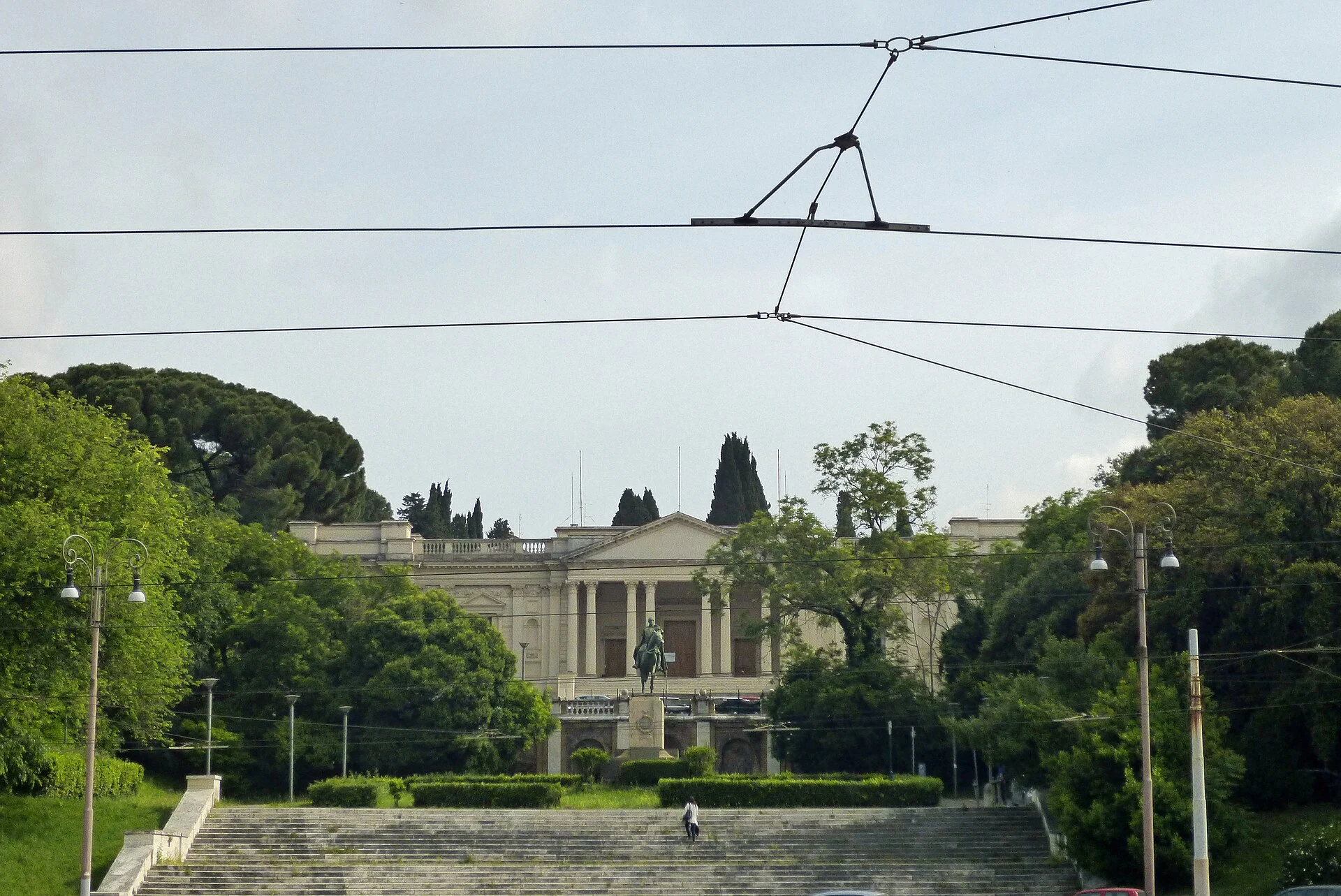
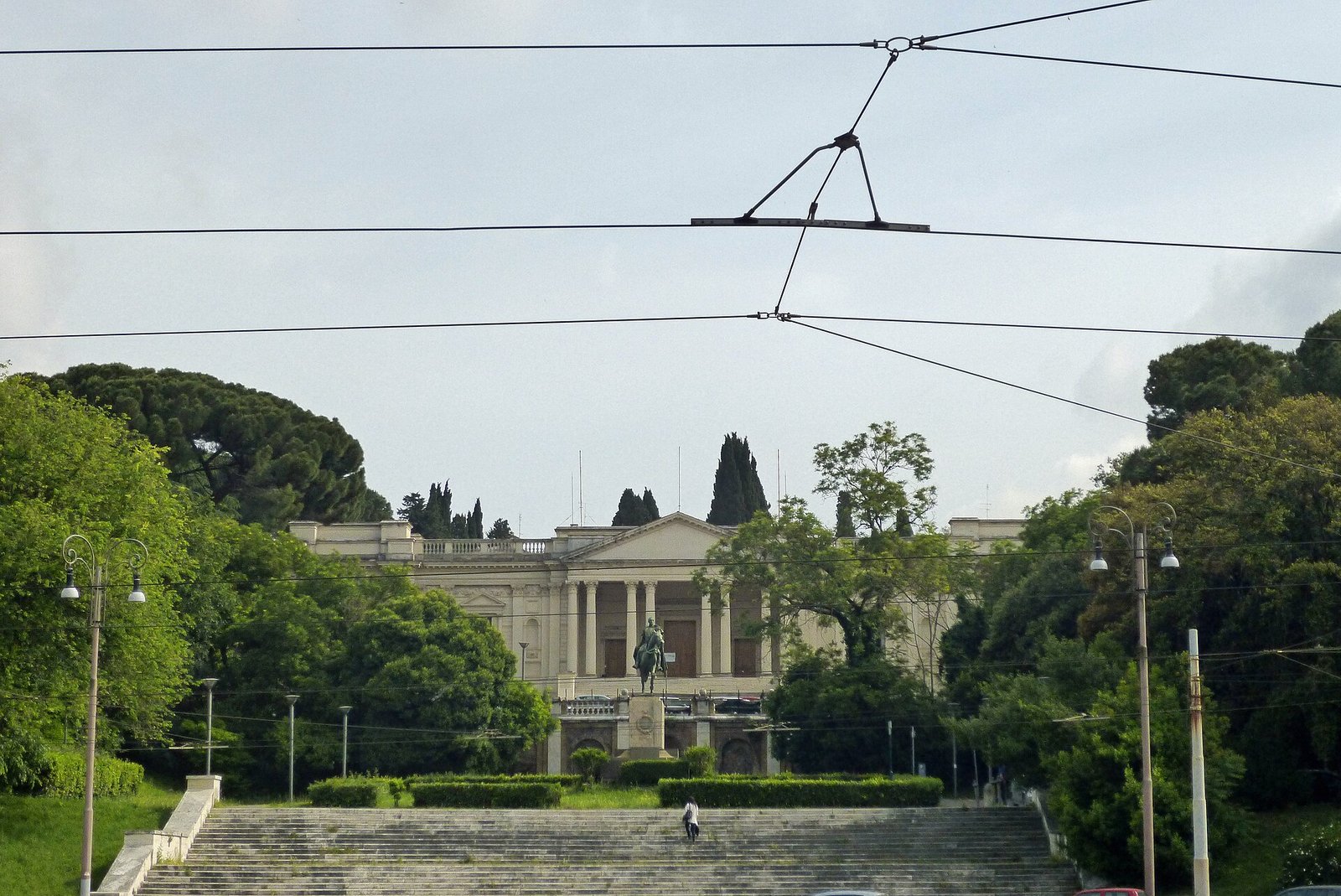
The British School at Rome is at Via Antonio Gramsci 61, in Valle Giulia. It is not a museum. It is a British research institute with a library, an archive and artists' studios, which opens to the public for exhibitions, lectures and presentations, almost always in the evening and almost always on a schedule. The building you see from the street began as the Great Britain pavilion at the 1911 International Exhibition of Art, designed by Edwin Lutyens.
If you arrive expecting a ticket office, a bookshop and a visiting route, you go away empty-handed. If you arrive knowing what it is, you find one of the few foreign institutions in Rome where you get in for free, listen to a lecture in English or Italian and leave having seen a courtyard that almost no Roman has ever seen.
What the British School at Rome is
The British School at Rome was founded in 1901 as a British school of archaeology and classical studies in Rome, and received its Royal Charter in 1912. Today it is an interdisciplinary institute: archaeology, ancient history, art history, architecture, medieval and Renaissance studies, contemporary visual arts. It hosts fellows and researchers from the United Kingdom and the Commonwealth countries, for periods ranging from 3 to 12 months.
The legal structure explains a lot about how it works. It is a charity registered in England and Wales, number 314176, and at the same time an institute supported by the British Academy. It receives no funds from the City of Rome, is not part of the Musei Civici circuit, and does not appear in the 060608 booking system. Anyone looking for the British School in the municipal channels won't find it, and not because it is hidden.
Since September 2021 the directorship has been held by Abigail Brundin, a scholar of Italian Renaissance literature. The honorary presidency belongs to Princess Alexandra. These are details that seem ceremonial and yet matter: the public programming of the British School depends on the choices of the director of the day, and in recent years it has opened up considerably to the outside compared with when it was, in effect, a club of archaeologists.
The three souls of the house
Under the same roof live three activities that usually occupy different buildings. The library of classical and Italian studies, with about 110,000 volumes and 600 current periodicals, serves researchers. The archive keeps photographic collections and excavation documentation of the British missions in Italy. The artists' studios, on the atelier floor, host resident painters, sculptors, photographers and architects.
This coexistence produces the most interesting thing about the place: an archaeologist arguing over dinner with a sculptor, and a landscape architect who discovers a photographic collection from the 1920s. The outside public notices only at the evening events, when the lecture hall fills with people who would never have met anywhere else in Rome.
Where it is and how to get there
Full address: Via Antonio Gramsci 61, 00197 Rome. Switchboard +39 06 3264939, email info@bsrome.it. The library has its own line, +39 06 32649380, and the mailbox library@bsrome.it. The archive answers at archive@bsrome.it. These are the contacts the institute publishes on its contacts page, checked on September 28, 2026.
Via Gramsci is the street that climbs from Viale delle Belle Arti toward the Parioli, behind the Galleria Nazionale. The useful stop is the one named after the museum, on Viale delle Belle Arti, less than 50 meters from the entrance. From there you walk up for a minute. No serious climb, no problem for anyone with mobility difficulties as far as the gate.
On public transport an honest clarification is needed, because in Rome in 2026 the tram network is an open construction site. Lines 3 and 19 are the ones that historically serve Valle Giulia. Since August 3, 2026 several tram sections have been replaced by buses, marked 3Nav and 19Nav, and between September 11 and October 9, 2026 these shuttles detour onto Viale Bruno Buozzi because of track works on Via Aldrovandi.
The practical consequence: the temporary terminus of the 3Nav coming from Porta Maggiore is on Viale delle Belle Arti and no longer at Valle Giulia. Before leaving it's best to check the status of the lines on the Roma Servizi per la Mobilità portal, the page on service status line by line, because the situation changes from month to month and printed maps are already out of date.
If you arrive by subway, get off at the Flaminio stop on line A and walk up Viale delle Belle Arti, a good 20 minutes slightly uphill, or cut through Villa Borghese and come out at the Bioparco, which is the most beautiful walk but also the longest. By car, forget it: Via Gramsci has resident parking and the whole Parioli area is blue lines.
A curiosity about the British School at Rome
The building was born to last six months. The British pavilion of the 1911 International Exhibition of Art was supposed to stand from April 29 to November 19 of that year and then be taken down, like all the other national pavilions in Valle Giulia. It was built with temporary materials, following the logic of every fair: light structure, stage finishes.
Then happened what rarely happens to temporary architecture. The pavilion was liked, the British ambassador James Rennell Rodd got moving, and the City of Rome donated both the land and the building to Great Britain. At that point it was rebuilt in masonry, with the facade in Roman cement, and adapted as a permanent home. Lutyens gave the design and the supervision of the works for free: he didn't take a cent.
The British School moved to Valle Giulia in 1916 and the building was inaugurated on April 30 of that year, in the middle of the First World War. A British school of archaeology inaugurating its Roman home while Europe is at war is a detail no guide tells, and it says a lot about the stubbornness of Rome's foreign institutes.
Something nobody tells you about the British School at Rome
The facade is not a copy of the facade of St Paul's in London. It is a reproduction of only the upper order of the western front of Christopher Wren's cathedral, and it was the British Board of Trade that imposed it as a requirement for the 1911 pavilion. Lutyens, who had never been to Rome before that commission, took the quotation and reassembled it on a completely different building.
The difference matters. St Paul's has a portico with two superimposed orders, with bell towers at the sides and the dome behind. Here there is a single order of Corinthian columns, no towers, no dome, and behind it not a nave but an open courtyard. Whoever says the British brought St Paul's to Rome tells a story more beautiful than the truth, and wrong.
The sources, for that matter, differ in their wording. The Lutyens Trust repertory speaks explicitly of a reproduction of the upper order of the western facade, requested by the Board of Trade. The Fine Arts archive of the British School itself uses a more cautious formula and writes that Lutyens incorporated a reference to the western front of St Paul's. They differ on how much, not on what: the quotation is there, the copy is not.
Why the transformation changed the plan
When the pavilion became a school, Lutyens kept the line of the perimeter walls and threw away the interior. The large exhibition galleries, which served to show paintings for six months, were replaced by an open courtyard. Around the courtyard three wings were added: one for the library, one for the offices and one for the artists' studios.
From outside you therefore read a building of 1911, from inside you live in one of 1916 and after. The widow of the painter Edwin Austin Abbey funded an exhibition hall and the courtyard. In the 1930s the architect H. C. Bradshaw designed the east wing. The library extension dates from 1962 and 1963. In 2002 came the lecture hall and the exhibition space designed by Hugh Petter, with the support of the Sainsbury family.
Lutyens's building, piece by piece
Edwin Lutyens is the most important English architect of his generation, the one of the country houses, of the gardens with Gertrude Jekyll, of the Cenotaph in Whitehall and then of imperial New Delhi. In 1911 he is 42 and has not yet built anything in the Mediterranean. The Roman pavilion is his first direct confrontation with continental classicism, and that is why historians of British architecture keep coming back to it.
From the street the sequence reads well: the continuous base, the staircase, the Corinthian colonnade, the entablature, the attic. Everything is strictly symmetrical about the entrance axis. The Roman cement of the facade, a poor material disguised as stone, has taken on over time a dirty ocher color that in winter turns gray and in July, at six in the evening, becomes almost pink.
What to look at, if you look seriously
Notice the depth of the portico. It is shallow: the columns are almost pressed against the wall, because in 1911 that was scenery and not structure. A real portico, like that of St Paul's, has a deep shadow you walk into. Here the shadow is a strip. The trick works very well in a photograph and much less in person, which is exactly the definition of exhibition architecture.
Then look at the relationship between the building and the level of the street. Via Gramsci climbs, Viale delle Belle Arti is lower, and the British School rests on a base that corrects the difference in level. Lutyens solved a ground problem with a podium, as an ancient Roman would have done. It is the smartest part of the design and nobody notices it.
My advice for visiting the British School at Rome
Don't come during the day hoping to get in. Come in the evening, to a scheduled event, and arrive 20 minutes early. It's the only way to see the courtyard in peace, to understand how the building is made behind the facade and to exchange a few words with someone who works there. This remains the rule that works with all foreign academies.
The public calendar can be read on the institute's website, on the events page, where lectures, presentations and exhibitions are listed with date and time. The events of autumn 2026 are three: a photographic exhibition on the school's 125 years of archaeology, October 15 from 18:00 to 21:00. The Rushforth Lecture on October 28 from 18:00 to 19:30. And the exhibition dedicated to the centenary of the Abbey Awards, November 4 from 18:00 to 21:00.
On cost and booking the school publishes no explicit indications for these appointments. The established practice of foreign cultural institutes in Rome is free entry with optional registration, but since it doesn't appear in plain writing on the site, it's best to write to info@bsrome.it a few days before and ask. Better one more email than a closed gate after half an hour on the bus.
If you just want to see the building
You look at the facade from the sidewalk of Via Gramsci in five minutes, free, at any hour. It's worth the detour if you're already at the National Gallery of Modern and Contemporary Art or at the National Etruscan Museum of Villa Giulia, which are 50 and 300 meters away respectively. It isn't worth a trip on purpose from the other side of the city.
What is open to the public and when
Clarity is needed here, because it is the point on which most online pages are vague. The British School at Rome has no generic visiting hours. It has three distinct modes of access, with different rules, and whoever confuses them loses the day.
Exhibitions and lectures
These are the scheduled appointments, generally in the evening, from 18:00 on. Exhibition openings last three hours, from 18:00 to 21:00, and in those three hours the building is open to anyone who shows up. The event listings don't say if the exhibition stays open to visitors on the following days, or at what hours: it has to be asked case by case at the secretariat.
Lectures last an hour and a half, the audience is a mix of scholars and curious people, and the language depends on the speaker. Many are in English, some in Italian, some bilingual. Nobody asks you for academic credentials at the door. It is the kind of evening you also find in Rome at Villa Medici and at Villa Farnesina, with different audiences and the same free admission.
The library
The library is open to outside readers and not only to fellows. The hours announced by the institute are Monday to Thursday from 9:00 to 19:00 and Friday from 9:00 to 17:00. The announcement of that evening extension dates from October 2022 and since then no notices of change have appeared, but since the information is four years old it should be confirmed by writing to library@bsrome.it before showing up.
The holdings are about 110,000 volumes between books and periodicals, plus 600 current periodicals, on open shelves. The subjects are Italian archaeology from prehistory to the Middle Ages, Greek and Latin philology, Roman history, epigraphy, numismatics, topography, art history, medieval and Renaissance history, church history, Grand Tour travel literature, plus a collection of rare books.
After a reorganization of the special collections some sections are temporarily not available for consultation, including general reference works, geology and geography and part of art history. The library belongs to the URBiS network, which puts 24 Roman research libraries in a common catalogue for almost 2 million records: if a title isn't here, the shared catalogue says where to find it.
The artists' studios
Open Studios are the days when the visual arts fellows open their ateliers to the public. They generally take place in the evening, from 18:00 on, and replace the old formula of the final group exhibition: you look at works in progress and talk to the people making them, instead of seeing finished works hung on a wall. From the available reports they are held at least twice a year, in winter and in spring.
The Open Studios calendar is not fixed and changes with the residency cycles. No date is published on the institute's website for the current year: follow the events calendar. It is by far the best chance to get in, because you walk through wings of the building that stay closed at the other events.
Booking, tickets and costs
The British School at Rome does not belong to the Musei Civici system and is not booked through the municipal number 060608, which serves the Ara Coeli insula, the columbarium of Pomponius Hylas, the Mithraeum of the Circus Maximus and the other monuments of the territory managed by the Sovrintendenza Capitolina. The channels of the state archaeological parks have nothing to do with it either.
The only existing channel is the institute's own: the website bsr.ac.uk, the mailbox info@bsrome.it and the switchboard. There is no ticket office, no booking portal, no published fee for events. Anyone who sells you a ticket to visit the British School is selling you something the institute does not issue.
For the library there are admission procedures for outside readers, and the institute's website publishes them: access is free, registration is done in person with a university ID as a lecturer or doctoral student or a letter of introduction from the university, plus a photo ID. Here too, no invented figures: if the institute doesn't publish it, it isn't the job of a web page to set it.
Another well-known fact, yet rarely cited
Valle Giulia was not a neighborhood: it was a vineyard. The area was called Vigna Cartoni and was transformed for the 1911 Exhibition, the celebration of 50 years of Italian Unification, by a team of architects led by Cesare Bazzani. Streets, utilities, public spaces and national pavilions were built from scratch in a little over two years.
Of the foreign pavilions of the time three remain: the British one, which became the British School, the Belgian one, and the Japanese one. The others, from the United States to Serbia, from France to Austria-Hungary, from Germany to Russia, were taken down as planned. The Palazzo delle Belle Arti, also by Bazzani, stayed and since 1915 has housed the Galleria Nazionale.
This explains the urban form of the area, which at first sight looks random. Viale delle Belle Arti is very wide because it had to handle the crowds of a fair. The buildings have monumental facades and modest backs because they were pavilions. The greenery is a remnant of the vineyard and of the edge of Villa Borghese. Walking in Valle Giulia means walking inside a 1911 fair that was never completely taken down.
The difference from the other Roman academies
The foreign academies in Rome follow two models. Some occupy historic buildings acquired or rented, like the French Academy at the 16th-century Villa Medici on the Pincio. Others, in Valle Giulia, live in buildings built on purpose in the 20th century to house them. The second model produces homes that are more functional and less photogenic, and in fact tourists ignore them.
The right photo to take at the British School at Rome
The frontal facade, from the opposite sidewalk of Via Gramsci, late afternoon. The sun comes from the west and cuts across the colonnade at an angle, bringing out the flutes of the columns and the shadows of the Corinthian capitals. At noon the same facade is flat as a technical drawing. Four hours apart, two completely different photographs.
The technical problem is the width of the street. Via Gramsci doesn't give enough distance to frame the whole front with a normal lens, and with a wide-angle the side columns lean inward. Two solutions: correct the perspective in post-production, or give up on the whole front and photograph a detail, three columns and a piece of entablature, which holds up better.
The photograph nobody takes is the one of the base. Kneel at the south corner, frame the podium and the first two columns from below, with the uphill street leaving the frame. You understand at a glance how Lutyens solved the difference in level, something the frontal photograph doesn't tell at all.
Inside, during events, the best subject is the courtyard at sunset with the library windows lit. Ask first if you can photograph: in the spaces with works by the resident artists the answer is often no, and the fellows have excellent reasons for not wanting works in progress on Instagram.
Some important events that happened here in history
On April 29, 1911 the International Exhibition of Art of Rome opens, and with it Lutyens's British pavilion. It closes on November 19 of the same year. In those seven months the pavilion hosts the British artistic delegation: it is, literally, a national showcase inside a world fair.
Between 1912 and 1916 the transformation takes place. The Royal Charter of 1912 gives the British School at Rome its own statute. The Roman donation of the building and the land allows a permanent home. The works of reconstruction in masonry occupy the war years. On April 30, 1916 the building opens as the school's home.
In the 1930s H. C. Bradshaw's east wing enlarges the school in a period when relations between the United Kingdom and Italy are deteriorating. Between 1962 and 1963 comes the library extension, which is the institute's real infrastructure. In 2002 the new lecture hall and exhibition space by Hugh Petter reopen the school to the outside public, and that is where the current evening programming comes from.
2026 is the year of the 125th anniversary of the founding and of the centenary of the Abbey Awards, the scholarships established in memory of the painter Edwin Austin Abbey. The two anniversaries explain why the autumn calendar is denser than usual and why two of the three public appointments are exhibitions of a historical and documentary character.
Who has passed through the British School at Rome
Edwin Lutyens, first of all. The 1911 pavilion and the later home are his only Roman work, and the fact that he gave up his fee to equip Great Britain with a school of classical studies in Rome tells of a Victorian architect in the best sense of the term. His later career, from New Delhi to the Cenotaph, has overshadowed this building even among the experts.
James Rennell Rodd, British ambassador in Rome, is the man who convinced the city authorities to donate the pavilion. Without him the building would have been taken down in the winter of 1911 like all the others. He was a diplomat with literary ambitions and deep Roman acquaintances, the kind of figure who in those years made the difference between a project carried out and a good intention.
Cesare Bazzani drew the plan of the exhibition area and the Palazzo delle Belle Arti that became the Galleria Nazionale. He is the architect who gave Valle Giulia the monumental scale you still see, and the author of the context into which Lutyens's pavilion fits. The two architectures talk badly to each other, to tell the truth: one is Italian and rhetorical, the other English and dry.
Edwin Austin Abbey, an American painter naturalized British who died in 1911, never passed through here, but his wife funded the exhibition hall and the courtyard, and the scholarships that bear his name have sent generations of English-speaking artists to Rome. Then there are the fellows: archaeologists, historians, architects and artists who from 1901 to today have used this house as their Roman base. The list is long and changes every year.
Valle Giulia, the district of the academies
Within a radius of 400 meters from Via Gramsci is concentrated the highest density of foreign and Italian cultural institutions in Rome outside the historic center. There is the Galleria Nazionale d'Arte Moderna, there is the Etruscan museum in the villa of Julius III, there is the Faculty of Architecture of the public university, there are academies and cultural institutes of several countries facing the same streets.
This concentration is neither random nor recent: it descends directly from the 1911 Exhibition and from the decision, after the fair, to assign the area to culture instead of the residential building of the Parioli that was growing around it. It is one of the few Roman urban planning choices of the 20th century that has stood the test of time.
For the ordinary visitor the district has a big flaw: it is almost all invisible from the street. The academies have gates, doorkeepers and programs of their own, and passersby see walls and trees. The greenery is that of Villa Borghese, which here is less trodden than at the Pincio or at Piazza di Siena, and in fact you walk for half an hour without meeting almost anyone.
What to combine in the same morning
The National Etruscan Museum of Villa Giulia and the Galleria Nazionale are five minutes apart on foot and together make a full day. If you have more time, go down toward the Bioparco, the Museo Carlo Bilotti in the Aranciera and the Museo Pietro Canonica, all inside the park.
On the other side, toward the Tiber, are the MAXXI, the Auditorium Parco della Musica with the Museo Aristaios, the Ponte della Musica and the Foro Italico. They are 20 minutes on foot downhill and another idea of Rome, all 20th century.
If you head toward the Parioli you find the Coppedè district, which is a quarter of an hour away and holds up very well to half an hour of walking, and further north Villa Ada. In the opposite direction you go down to the Pincio obelisk, to Piazza del Popolo and from there to Piazza di Spagna and to Trinità dei Monti.
The contrarian position: Valle Giulia is overrated as a place to visit
I'll say something unpopular among colleagues. Valle Giulia is described as the district of academies and international institutions, and it is, but as a visiting experience for someone without an appointment it is disappointing. You walk among closed gates and fences, you look at facades from afar, you don't get into anywhere except the two public museums.
The British School is no exception: without a scheduled event, the total of what you see is a facade from the street. Five minutes. Whoever offers you a Valle Giulia tour based on the appeal of the academies is selling you a walk among barred doorways, and knows it. Better to say it before than after.
The operational consequence is simple. Build the visit backwards: first look at the events calendar, then decide the day. If there is nothing that week, go to the Etruscan museum or the Galleria Nazionale and look at the British School in passing, the way you look at a beautiful building on a street you're walking for another reason. Nobody loses anything.
I'll add the uncomfortable part. The myth of the St Paul's facade transported to Rome, repeated on dozens of pages online, works as tourist bait and doesn't survive checking: it is the quotation of an order, not a transfer of a cathedral. Serious institutions don't need legends to deserve a visit, and this is a serious institution.
Accessibility, services and practical life
The main entrance is preceded by a staircase, as the base requires. On the existence of an alternative access for people with mobility difficulties the institute does not publish detailed information: whoever needs it should write to info@bsrome.it stating the event they want to attend, because the answer changes depending on the space used.
Restrooms and a cloakroom exist for the event audience, not as services open to the passerby. There is no bookshop, no public cafe, no luggage storage. The school also has a guesthouse, but it is reserved for fellows, visiting researchers and members, run by the residential management: it is not a hotel and cannot be booked online.
For the archive, which keeps photographic collections and archaeological documentation, consultation is by appointment by writing to archive@bsrome.it. It is also the right channel for anyone looking for historic images of British excavations in Italy, material that in many cases doesn't exist elsewhere in organized form.
Eating in the area
Valle Giulia has a rare advantage in Rome: with no mass tourist flow, the predatory restaurants that surround the monuments of the center did not develop. The other side of the coin is that around Via Gramsci there are very few places, and those there are work on architecture students and Parioli office workers, not on passersby.
Going up toward the Parioli prices rise with the street, and it's another logic: not tourist traps, but a well-off district where a first course costs what a second course costs elsewhere. Going down toward Flaminio you find more variety and more honesty in the price list. The practical choice, for someone finishing a lecture at eight in the evening, is to go down.
The signals worth recognizing
The menu with photographs of the dishes is the first. No place that cooks well needs to show you how the dish turns out, and that laminated sheet exists to make itself understood without a common language. Second signal: the woman rolling out pasta dough in the window or even on the sidewalk. It is a scenic lure, calculated to the centimeter, and says absolutely nothing about what comes out of the kitchen.
Third signal: the person at the door inviting you to sit down. A place with its own clientele doesn't send anyone to gather passersby, because the tables fill up by themselves. Fourth: the kitchen open without a break from 11 in the morning to midnight. In Italy the kitchen has two services and a pause in between. A place that never closes is reheating, not cooking.
Fifth, and it applies above all in front of famous monuments: items with no price on the menu, fish or meat by weight with no clear indication, and different price lists between the outdoor area and the dining room. When the bill arrives it's too late to argue. This area is almost immune, but 10 minutes of bus toward the center are enough to walk right into it.
The repeated signs of the center
In the center of Rome there are restaurant chains with the same sign repeated in several spots, often in the places of heaviest foot traffic. They work as tourist attractions, with their queue and their photograph, and are perfectly legitimate. Simply, Romans don't go, and not out of snobbery: tourists go because they are there, visible, and reassuring when you don't know the city.
The criterion for deciding in 30 seconds is only one: look at who is sitting inside and in what language they order. If at the tables there are people who speak Italian without looking at the menu, the place holds up. If you hear only foreign languages and nobody local, the place lives off passing trade and the kitchen adapts.
Whoever wants an already filtered list can start from the one Daniele keeps updated on Google Maps, built by going there in person and not by reading reviews. It serves above all to avoid the mistakes, which is the hard part: the good places can be found, the terrible ones are met by chance.
If you move for dinner
With half an hour of transit from Valle Giulia you reach Trastevere, where the selection is wide and so is the risk, or Testaccio, which remains the neighborhood where you eat Roman food with the least staging. Flaminio, closer, has a scene tied to the Auditorium and the MAXXI that works well in summer.
When to go and when to avoid
The best period runs from mid-October to early December and then from March to May: it is when the public programming of the foreign institutes is densest, because it coincides with the residency cycles. August is dead: the school reduces activity, the library stays closed and there is nobody in Valle Giulia.
Rainy days are, counterintuitively, good. The wet facade changes color and becomes darker and more legible, and the two nearby museums offer the shelter you need. July heat is instead an enemy: Viale delle Belle Arti in the 2 o'clock sun is an oven and the shade of the trees begins only inside the park.
If you come for an evening event, allow for the fact that at the end, around 21:00, public transport in the area thins out a lot and the replacement tram lines have worse frequencies than the tram. Check the last run before going in, because leaving at 21:00 and discovering you have to walk to Piazza del Popolo happens more often than it seems.
Frequently asked questions
Can you visit the British School at Rome without booking?
There is no free visit of the building. Public access happens during scheduled events, generally in the evening, and for the library according to the admission rules for outside readers. The facade can be looked at from the street, free and without formalities, at any hour of the day.
How much does it cost to get in?
For the scheduled events no fee is published on the institute's website, nor is there any indication of a ticket. The practice of foreign cultural institutes in Rome is free entry, but since the information is not in plain writing it's best to ask by email before going. No outside operator issues tickets for this address.
What is the exact address and how do you get there?
Via Antonio Gramsci 61, 00197 Rome. The nearest stop is the one on Viale delle Belle Arti in front of the Galleria Nazionale, less than 50 meters away. The historically useful lines are tram lines 3 and 19, but in 2026 several sections are replaced by buses because of works: the service status has to be checked on Rome's mobility portal before leaving.
Is the library open to everyone?
The library admits outside readers as well as fellows, with a registration procedure. The announced hours are Monday to Thursday from 9:00 to 19:00 and Friday from 9:00 to 17:00, but the announcement dates from October 2022 and must be reconfirmed by writing to library@bsrome.it. Some sections are temporarily not available for consultation after a reorganization of the special collections.
Is it true that the facade is a copy of St Paul's in London?
No, and it is the most widespread mistake. The facade takes up only the upper order of the western front of Wren's cathedral, at the explicit request of the British Board of Trade to the designer of the 1911 pavilion. Everything else is missing: the second order, the towers, the dome. It is a quotation, not a reproduction of the London building.
When are the artists' Open Studios?
Open Studios are generally held in the evening, from 18:00 on, and from the available reports at least twice a year, in winter and in spring. The dates depend on the residency cycles and are not fixed: they can be found in the events calendar on the institute's website. They are the best chance to see wings of the building that are otherwise closed.
Are there events scheduled in autumn 2026?
Yes, three appointments. On October 15, 2026 from 18:00 to 21:00 a photographic exhibition on the school's 125 years of archaeology. On October 28, 2026 from 18:00 to 19:30 the Rushforth Lecture dedicated to British visitors in medieval Rome. On November 4, 2026 from 18:00 to 21:00 the exhibition on the centenary of the Abbey Awards.
Can you take photographs inside?
It depends on the space and the event. The courtyard and the common areas usually pose no problem, but in the artists' studios and in exhibitions of works in progress the answer is often negative, because these are works not yet presented. The practical rule is to ask whoever is welcoming you before taking out your phone.
How much time does the visit take?
For the facade alone five minutes are enough. For an evening event allow two hours, arriving 20 minutes early to see the courtyard in peace. For a day in Valle Giulia that also includes the Etruscan museum and the Galleria Nazionale you need at least five hours, lunch excluded.
Other ideas in Rome, if you have time
Anyone interested in cultural institutions and exhibition venues finds in Rome a circuit that goes well beyond Valle Giulia. The Palazzo delle Esposizioni on Via Nazionale, the MACRO on Via Nizza, the Chiostro del Bramante and the Galleria d'Arte Moderna di Roma cover different genres with busy calendars.
On the state archaeological and museum front, the four sites of the Museo Nazionale Romano remain the base: Palazzo Massimo alle Terme, Palazzo Altemps, Crypta Balbi and the Baths of Diocletian. Alongside these are Palazzo Barberini, the Ara Pacis and the Centrale Montemartini, which is the most surprising of the three.
Anyone who wants to stay on the theme of academies and scientific institutions can look at the Bosco Parrasio of the Accademia dell'Arcadia on the Janiculum, at the Botanical Garden, at the Accademia di Storia dell'Arte Sanitaria and at the Museo di Roma at Palazzo Braschi.
For yet another Rome, that of parks and historic villas, there remain the Casina delle Civette at Villa Torlonia, the Temple of Aesculapius, the Casina di Raffaello, the Secret Gardens and the Galleria Borghese, which must be booked, and well in advance.
If you are looking for shows instead of museums, there is the Casa del Cinema inside the park, the Globe Theatre for the summer season and, if you want the exact opposite of Valle Giulia, the map of Roman street art in the outlying neighborhoods. I'll add Milvian Bridge, a short step away, to end the day on the river.
Who wrote this page
The page is edited by the team at Tour Leader Pro, the Rome-based project office that designs and coordinates visits, itineraries and cultural events in Rome and Lazio. Hours, contacts and access conditions given here were checked at the date of publication against the official sources cited in the text, in particular the institute's website. Before setting out it's best to recheck them, because they change often. Tell us about any information that is no longer valid.
Anyone putting together a Roman itinerary has to make fit together institutions that open only on a schedule, foreign academies with rules of their own, libraries that ask for prior registration and a transport network in perpetual rearrangement because of works. Anyone who organizes for themselves or for a group will find planning tools at Tour Leader Pro, where materials designed for guides and for people who travel independently are gathered.
For the big picture on trains, rentals, airports and destinations in Lazio outside the center of Rome, from the Castelli to the lakes to the coast, a good resource is Italy Planner.