Academy of the History of the Healing Arts
In short. The Academy of the History of the Healing Arts and its National Historical Museum of the Healing Arts occupy the 17th-century wing of the ancient Hospital of Santo Spirito, at Lungotevere in Sassia 3, 00193 Rome, just under 500 meters from the colonnade of St.
The Academy of the History of the Healing Arts and its National Historical Museum of the Healing Arts occupy the 17th-century wing of the ancient Hospital of Santo Spirito, at Lungotevere in Sassia 3, 00193 Rome, just under 500 meters from the colonnade of St. Peter's. You get there by Metro line A, Ottaviano stop, and then 10 minutes on foot along Borgo Sant'Angelo or along the river. By bus, ATAC lines 23, 34, 62 and 280 serve it, passing on the Lungotevere and at Borgo Santo Spirito. The museum entrance opens under the portico of the Alexandrine building, on the river side, and has nothing of the atrium of a civic museum: it is the door of a hospital that is still alive. The Academy's phone is 06 68352748, the email segreteria.asas@gmail.com, the official website accademiastoriasanitaria.it. The visit is arranged by appointment, by phoning or writing to the secretariat. There is no ticket window open every day, and whoever shows up without having booked risks finding the door closed. The Ministry's database of cultural sites lists a ticket of €5 for the museum, which becomes €7 with the guided visit. The amount and the conditions must be confirmed when booking. The attached library receives visitors Monday to Friday from 10:00 to 12:00 by appointment, closed on Saturday, Sunday and holidays, and asks for a letter of introduction for consultation. To get your bearings among the city's other addresses there is the page of tourist attractions in Rome.
What the Academy of the History of the Healing Arts really is
It's best to clear up right away a misunderstanding that confuses half the visitors. The Academy of the History of the Healing Arts is not the elegant name of a museum. It is a body, with a statute, a regency council, a board of arbitrators and regional centers scattered across Italy, and this body owns and runs three distinct things that live together in the same corridor of Santo Spirito. The first is the National Historical Museum of the Healing Arts, 850 square meters of exhibition rooms. The second is a specialist library of about 10,000 volumes on the history of medicine, from the 15th century to today. The third is an archive, with the institution's papers and the collections of donors.
The body works as a center for the study of the historical, medical and biological aspects of the medical and healing art, and organizes scientific and cultural activities with the Ministry of Health, with the Ministry of Culture and with Italian and foreign universities. Its emblem is a green palm on a gold field, the Latin motto Nec in arido arescit, which means that not even in the arid does it dry up. It is a declaration of stubbornness more than a heraldic ornament, and whoever knows the economic fortunes of this institution understands how fitting it is.
The practical consequence of this hybrid nature you see as soon as you walk in. A state museum has gallery staff, a ticket office, multilingual signage and a route marked on the floor. Here there is a custodian who opens up, a member or a researcher who accompanies you, 19th-century display cases with handwritten labels, and a density of objects per square meter that no modern museum would allow itself. Few places in Rome have such a lopsided ratio between the amount of history and the number of visitors, in favor of the former.
The Academy of the History of the Healing Arts and the hospital that houses it
A detail that changes the tone of the visit: the museum is inside a working hospital. The Santo Spirito complex belongs to ASL Roma 1 and houses outpatient clinics, offices, a historic emergency room, the Hospital Medical School and the Lancisiana Academy. You don't cross a fenced-off monumental zone, you cross a workplace. This demands two things: respect for silence in the corridors and absolute punctuality at the appointment, because the person who opens the door for you often has other commitments the same morning.
In our judgment the cohabitation of hospital and museum is the real reason this place is worth the trip. The anatomical tables, the surgical instruments and the apothecary jars are not displayed in a neutral container built for the purpose, but in the rooms where that medicine was really practiced, 20 meters from the ward where the sick were admitted from the 15th century. No contemporary installation can buy that kind of context.
Academy of the History of the Healing Arts and Museum of the History of Medicine: two different museums
Rome has two big museums devoted to the history of medicine and people confuse them regularly, also because search engines return them side by side. It's worth separating them once and for all.
The Academy of the History of the Healing Arts is at Lungotevere in Sassia 3, in the Borgo district, inside the Santo Spirito hospital, and is a recognized private body, born in 1920. Its museum displays layered historic collections: Etruscan and Roman votive offerings, surgical instruments from antiquity to the 20th century, 17th-century pathological-anatomical specimens, waxes, apothecary jars, the reconstruction of a pharmacy and an alchemical laboratory.
The Museum of the History of Medicine, on the other hand, is at the other end of the city, at Viale dell'Università 34a, in the Sapienza University City, and is part of the university's museum hub. It comes from another genealogy, the academic and university one, and its narrative is more didactic and systematic: the route goes from ancient ritual practices to clinical experimentation and the challenges of contemporary biomedicine. The Sapienza museum hub page gives the opening as Monday to Friday from 9:00 to 18:00 and the contact number 06 4991 4766.
Put brutally: you go to Sapienza to understand how medicine became science, you go to Santo Spirito to see the things medicine was made with. If you have only one afternoon and you care about the object, the iron, the jar, the wax, choose the Academy of the History of the Healing Arts. If you care about the argument, the method, the history of ideas, choose Sapienza. If you have two days, do both and add the Museum of Pathological Anatomy, which completes the picture from the Policlinico side.
And the other Roman science museums
The chapter doesn't end there. Sapienza also holds the Battista Grassi Museum of Comparative Anatomy, devoted to the anatomy of animals and named after the zoologist who understood the role of the mosquito in malaria, and the Herbarium Museum, where the history of the pharmacopoeia is read through dried plants. Whoever wants to follow the thread of chemistry and alchemy finds material at the Primo Levi Museum of Chemistry. They are all institutions with reduced openings and rules of their own. The advice is to treat them like the Academy, that is by writing first.
Santo Spirito in Saxia, the home of the Academy of the History of the Healing Arts
To understand the museum you have to understand the building, because the museum was born inside the building and inherited its objects. The monumental complex of Santo Spirito in Sassia claims more than 11 centuries of continuous care activity, a record few have in Europe. ASL Roma 1, which administers it today, dates the hospital proper to 1198, by the will of Pope Innocent III, but on land and structures that already had a function: a hospital attested in AD 498 and a hospice founded in 728 by Ina, king of the West Saxons, for the pilgrims who came to Rome from the British Isles. It is from that settlement, the Schola Saxonum, that the name of the district, Borgo, and that Sassia come, which still confuses less attentive Romans today: it has nothing to do with German Saxony, it comes from the Saxons of England. Even earlier, in the imperial age, the zone was occupied by the Horti Agrippinae, the gardens of the family of Agrippina the Elder that ran down from the Janiculum to the Tiber.
The Innocentian foundation and the children of the Tiber
Tradition ties the foundation to a dream. Innocent III is said to have seen in a vision an angel showing him the nets of the Tiber fishermen full of little bodies of newborns, thrown into the river by mothers who couldn't keep them. It is a foundation legend, and should be called what it is, but it explains better than any document what that hospital was: before being a place of care, a place of collection for those who had nobody. The pope entrusted the institution to Guy of Montpellier, who in Provence had already founded a hospital congregation dedicated to the Holy Spirit. From Rome that order spread across Europe, generating hundreds of complexes with the same name and the same sign of recognition: the double-armed cross, the Cross of Lorraine, which at Santo Spirito you find carved, painted and embroidered everywhere, even on the pharmacy jars displayed in the museum.
The design of the 13th-century hospital is attributed by the Roman scholarly tradition to Marchionne d'Arezzo. In 1204, to endow the foundation with revenues, even the income of an English church, that of Writtle, granted by John Lackland, came into play: a detail that says how much the Schola Saxonum still counted in relations between Rome and England.
The fire, Sixtus IV and the Sistine Wards
The 15th century was hard. In 1414 the hospital had to suspend services, and in 1471 a fire devastated the building. The reconstruction was wanted by Sixtus IV, the pope of the Sistine Chapel, and was an undertaking of equal ambition: the construction site of the Sistine Wards opened in 1473, and the design is attributed to Baccio Pontelli, with the names of Giovanni de' Gherarducci and Andrea Bregno beside his in the Roman scholarly tradition. Who held the pencil is still debated. The result is not.
The main ward measures 126 meters in length, 12 in width and 16 in height. At the center opens an octagonal crossing tower supported by four round arches, marked by double pilasters and cornices, with 12 statues of Apostles in the niches of the first order and painted Prophets in the second. Under the tower is the altar of Saint Job, surmounted by a marble ciborium that critics attribute to Andrea Palladio, with a 17th-century oil altarpiece by Carlo Maratta, dedicated precisely to Job: the patron of those with skin diseases, a choice anything but random in a hospital.
The high walls carry a cycle of frescoes of about 1,200 square meters, executed in fresco by workers of the Umbrian-Lazio school and divided into 69 narrative panels with Latin inscriptions dictated by Bartolomeo Sacchi, called Platina, the librarian of Sixtus IV. The panels tell the Innocentian foundation and the Sistine refoundation: a painted autobiography of the institution, with the pope having himself portrayed inside his own work of mercy. The monumental side entrance, the Portal of Paradise, is attributed to Andrea Bregno.
The Sistine Wards completed a restoration in 2022, funded by the Lazio Region, and can be visited with mandatory reservation, in groups of 25 people at most besides the guide, on weekdays and also on Saturday and Sunday. Visits are booked by writing to the ASL Roma 1 Museum Hub. The practical advice is to try to fit the two things into the same morning, because the Academy's museum and the Wards answer to different bodies but are less than 100 meters apart.
The Palazzo del Commendatore
On the Borgo Santo Spirito side rises the Palazzo del Commendatore, the residence of the hospital's rector, rebuilt between 1567 and 1571 on a design by Nanni di Baccio Bigio under Pius V. It has a two-order porticoed courtyard that is one of the most beautiful in the district and almost nobody sees it, because for years it has been the territory of offices. On the inner facade there is a baroque clock of 1827 commissioned by Monsignor Ludovico Gazzoli, framed so as to resemble a prelate's galero: a hat with tassels that serves as the dial. In the upper loggia of the palace is housed the Lancisiana Library. Guided visits to the Palazzo del Commendatore are currently suspended for safety reasons linked to restoration work, while the Sistine Wards remain regularly accessible.
The Alexandrine building, where the Academy of the History of the Healing Arts is
The piece of hospital that interests us is later. Between 1665 and 1667 Alexander VII had a new ward built perpendicular to the Sistine ones, which the Romans immediately called the little hospital because it was intended for war wounded. It is the Alexandrine Hall: 33.11 meters long, 10.78 wide, 10.89 high, with a capacity of 64 beds. In 1929 the Santo Spirito institute granted the Academy this wing, by then retired from its function as a ward, and since then the museum has occupied the former Alexandrine ward and the adjoining rooms. When you walk through the hall, keep that number in mind: 64 beds. Today's display cases and conference chairs occupy the space where the straw mattresses of the papal wounded were lined up.

The foundling wheel, a few steps from the Academy of the History of the Healing Arts
A few steps from the museum entrance, on the Borgo Santo Spirito front, to the left of the monumental baroque doorway, the walled-up opening of the foundling wheel is still there. It is not a didactic reconstruction. It is the real hole, with its stone frame, and most tourists walking past don't notice it.
The mechanism was simple and ruthless in its efficiency. A hollow wooden cylinder, mounted inside an opening in the wall and pivoted so as to rotate. The newborn was placed on the outer side, the cylinder was turned, the baby ended up inside the hospital and the mother disappeared without being seen. Tradition attributes the institution of the wheel at Santo Spirito to Innocent III himself, around 1204, and ties it again to the little bodies in the Tiber. The institution's rule prescribed that the abandoned orphans be fed as far as the house could manage.
Filius m. ignotae, or a Roman word
The children taken in were registered as filius matris ignotae, son of an unknown mother, abbreviated in the records to filius m. ignotae. From the contraction of that bureaucratic formula, Roman popular tradition derives a word that in Rome you still hear every day, and that nobody pronounces thinking that it was born in a 13th-century hospital register. It is a folk etymology, not a philological certainty, and as such it must be told. But it is too good not to tell, and it has the merit of reminding us that the most vulgar words often have painful origins.
The Academy's museum keeps material that completes this story: the model of the Sistine wards, the objects of care, the glazed ceramic plaques with the works of mercy. Whoever wants to go deeper into the chapter of abandoned childhood in Rome finds other places in the city that tell the same story from different angles, from the Museo delle Anime del Purgatorio on the Lungotevere Prati to the collections of votive offerings scattered through the churches of the center.
When the wheel stopped turning
The system of wheels was dismantled in Italy between the 19th and 20th centuries and replaced by forms of registered reception, with different timing from city to city. For Santo Spirito it's best to stay within that time span without chasing a precise year. What remains, and what you see, is the walled-up niche. Bring teenagers there and explain to them what it was for: it is the moment when a visit to Borgo stops being a stroll among souvenirs and becomes something you remember.
How the Academy of the History of the Healing Arts was born
The date the museum carries written on its facade, so to speak, is 1920. The genealogy, though, begins earlier, and at two different points.
The first point is internal to the hospital. At the end of the 18th century the surgeon Giuseppe Flaiani, chief physician of Santo Spirito, put together an anatomical museum for teaching use for the students of the surgical school: dry specimens, malformations, anatomical pieces preserved and studied. That 19th-century museum, with its display cases and its jars, was not lost. It is the old nucleus you see today in the room that bears his name.
The second point is external, and it is an exhibition. In 1911 Rome celebrated the 50th anniversary of Unification with the International Exposition, and within that exposition there was a section of retrospective art devoted to the healing arts, set up at Castel Sant'Angelo, with scientific material from several periods coming from the Santo Spirito hospital and from the private collections of Professors Carbonelli and Capparoni. For the occasion the reconstruction of a 17th-century pharmacy and that of an alchemical laboratory were built. The exhibition closed, but the material stayed, and with it the idea that the material deserved a permanent home.
1920, 1922, 1929, 1933, 1934
The five dates that count follow one another in a little over 10 years. On April 22, 1920 the Historical Institute for the Museum of the Healing Arts was born, on the initiative of three promoters and with the adhesion of the highest representatives of the city and the nation: the Municipality of Rome, the Ministries of the Interior, Public Education, War and the Navy, the Sovereign Military Order of Malta, the Order of Saints Maurice and Lazarus of Turin, the Italian Red Cross and the Pio Istituto di Santo Spirito e Ospedali Riuniti di Roma. In 1922 the institute was raised to a legal entity by Royal Decree No. 1756 of May 14, and took the name Italian Historical Institute of the Healing Arts, abbreviated I.S.I.D.A.S. In 1929 the hospital granted the wing of the former Alexandrine ward. On May 11, 1933 the museum was solemnly inaugurated. On October 16, 1934, with another royal decree, No. 2389, the institute took the form and name of Academy of the History of the Healing Arts, with the purpose of promoting historical-medical studies and running the museum.
The rest is a story of donations. To the collections left over from the 1911 exhibition were added in 1931 the collection of Giovanni Carbonelli, in 1939 that of General A. Cavalli Mulinelli, then those of Giuseppe and Orlando Solinas. A museum like this reads like geology: each layer bears the signature of whoever deposited it, and the display cases still preserve the mental order of the collector who filled them.
The three founders of the Academy of the History of the Healing Arts
Mariano Borgatti was a general of the Engineers, not a doctor. A man of fortifications and the history of military architecture, he was the first president of the Academy, and the organizational and institutional part of the undertaking is owed to him. Without an officer with ministerial connections, those adhesions of Ministries and chivalric orders would not have been gathered.
Giovanni Carbonelli was a gynecologist with a passion for collecting and scholarship. His collection of instruments, books and documents flowed into the museum in 1931 and forms the bulk of the room that bears his name. He is the kind of scholar who in Italy between the 19th and 20th centuries did alone, often with his own money, what elsewhere the universities did.
Pietro Capparoni, a Roman, 1868-1947, earned his medical degree in 1892, started out as a surgeon and ended up a historian of medicine. In 1907 he founded the Italian Society for the History of Medicine and the Natural Sciences. From 1913 to 1919 he directed the Rivista di storia critica delle scienze mediche e naturali. He taught the history of medicine in Bari in 1924, in Pisa in 1928 and in Bologna from 1931 to 1938, and was therefore one of the very first official professors of the discipline in Italy. From 1934 he was president of the Academy. His studies focused on the medical school of Salerno, and in 1923 he published the Magistri salernitani nondum cogniti, a repertory of medieval physicians unknown until then. Later critics faulted him for a method that was not always rigorous, and the criticism is justified. The fact remains that without him this collection would be scattered today among second-hand dealers and private homes.
The visit to the Accademia di Storia dell'Arte Sanitaria, room by room
The route covers nine rooms, between the ground floor and the upper floor, and has no set direction: whoever takes you around decides the order. What follows is the most logical sequence, which starts from the portico and goes up to the grand staircase.
The portico of the Accademia di Storia dell'Arte Sanitaria
The entrance room is part of the Alexandrine building constructed between 1665 and 1667. Look to the left: there is the coat of arms of Pius IX with a marble plaque from 1896, and below it a marble mortar flanked by two angels. A mortar in a hospital portico is not decoration. It is a sign, like the mortar painted on old pharmacies, and it tells whoever walks in that medicines are prepared inside.
Another plaque commemorates a restoration carried out in 1797, when the hospital was run by the preceptor Giovanni Castiglioni. On the walls there are travertine coats of arms of the hospital, with the double cross. Set into the wall in a corner on the right is a monument from 1902 dedicated to the physician Enrico Biondi, killed by a mentally ill patient: the memory of an occupational risk that 19th-century hospitals knew well and rarely spoke about.
My advice here is not to rush. The portico is the threshold between the living hospital and the museum, and in three square meters it already holds the three languages you will find in all the rooms: papal heraldry, the pharmacy object, the memory of the medical staff.
The Sala Alessandrina of the Accademia di Storia dell'Arte Sanitaria
You walk in and the scale of the place changes. The Sala Alessandrina is a 17th-century hospital ward 33.11 meters long, 10.78 wide and 10.89 high, set perpendicular to the Sistine wards of Sixtus IV. It began as a small hospital for those wounded in war and could hold 64 beds. Today it works as a conference room, and hosts the opening of the academic year and the institution's conferences.
Along the walls run 19 large-format anatomical plates, drawn and engraved by Antonio Serantoni on the basis of Paolo Mascagni's research, hand-colored, datable to the early 19th century. At the far end of the room, on a pedestal, stands a plaster statue of Aesculapius. The plates deserve a section of their own and will get one further on. Here it is enough to say that seeing them hung in a hospital ward, and not in a climate-controlled case, is an experience no reproduction conveys.
Personal opinion: the Sala Alessandrina is the museum's showpiece and almost all the photographs circulating online do not do it justice, because they shoot it from the center with a wide-angle lens. You understand it by standing in a corner, flush against the wall, and looking diagonally. Only then do you read its true length and understand what a hospital ward was before rooms with two beds.
The grand staircase of the Accademia di Storia dell'Arte Sanitaria and the anatomical table
From the monumental staircase you go up to the upper floor. Busts of illustrious physicians line both sides, among them Hippocrates and Giovanni Maria Lancisi. On the right is the museum's darkest and best-known object: a stone anatomical table with a drip channel and grooves along the edges, to collect fluids during dissections, which comes from the mortuary chamber of the Trinità dei Pellegrini hospital. The Academy's tradition holds that the body of Goffredo Mameli was laid on that surface. He died on July 6, 1849 after the amputation of the leg wounded in the defense of the Roman Republic. It is a memory the institution preserves and has celebrated publicly. Anyone who wants to reconstruct the whole story of 1849 will find it told at the Museo della Repubblica Romana e della memoria garibaldina, on the Janiculum, a few hundred meters from the sites of the fighting.
On the landing there is a 17th-century wooden chest, decorated with lion heads, which was used to store medicinal plants and comes from the hospital's apothecary. As you approach the door of the Sala Flajani you see, on either side, medallions with portraits of Pius VI and Cardinal Francesco Saverio de Zelada, and plaques commemorating the founders of the museum and the first president of the Academy.
A tip: stop at the anatomical table and don't be in a hurry to tell the Risorgimento part of its story. Look at the object first. The grooves along the edges and the drain hole tell you everything there is to know about the anatomist's trade before refrigeration: dissection was done quickly, often in winter, and the only technological feature available was the slope of the surface.
The Sala Flajani of the Accademia di Storia dell'Arte Sanitaria
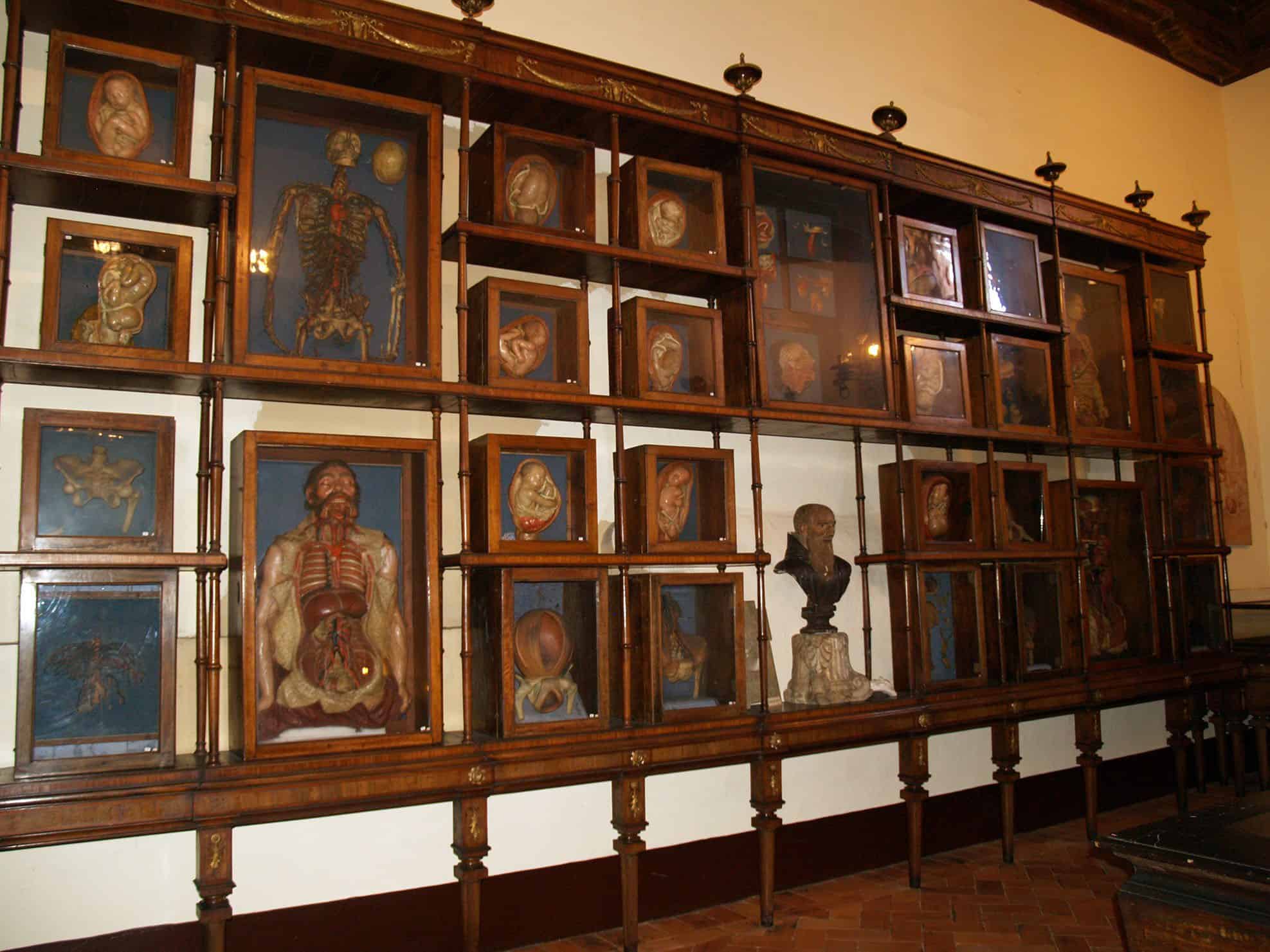
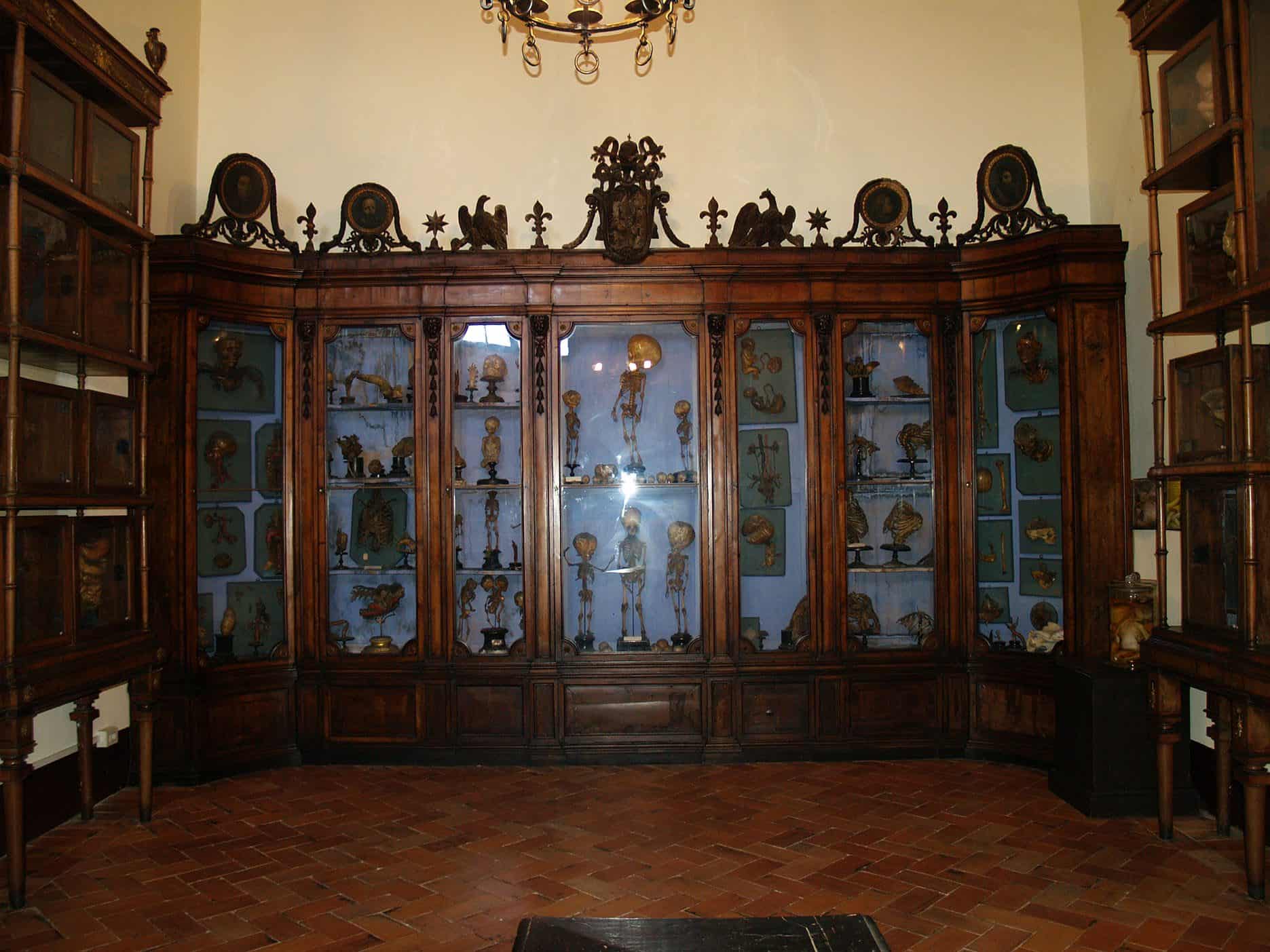
It is the first room you meet on the upper floor and the one that splits visitors in two. Here the old collections are displayed, that is the 18th-century anatomical museum put together by Giuseppe Flaiani, and for anyone with no familiarity with medicine the sight is hard: pathological and morbid deformities, displayed with the sobriety of the early 19th century, which is to say a total absence of mediation.
These are dry-prepared anatomo-pathological specimens from the late 17th century, and neonatal malformations preserved both dry and in formalin. The alterations affect the skeleton and the blood vessels, and document diseases that have disappeared in Italy, tertiary syphilis first among them. There are fetal skulls, small skeletons, cases of macrocephaly and a two-headed specimen. One thing is worth saying that usually goes unsaid: those pieces were not collected to astonish. They were collected because they were the only atlas available. Before radiology and genetics, a surgeon who wanted to know what a malformation looked like had to have seen one, and to see it he had to preserve it.
On rosewood shelving in the Empire style is displayed a collection of anatomical waxes by Giovanni Battista Manfredini, made under the supervision of the anatomist Carlo Mondini. At the center of the room a small temple held an 18th-century cinchona bark grinder, the work of Giovanni Battista Cipriani of Siena, and next to it is a model of the Sistine wards. Along the right wall is a collection of liver, kidney and bladder stones removed from patients hospitalized in the hospital in the 19th century: a display case that looks mineral and is in fact clinical.
And then there is the skull. This room holds the supposed skull of Pliny the Elder, found at the mouth of the Sarno in the early 1900s. It is discussed at length further on, because that story deserves space.
The Sala Capparoni of the Accademia di Storia dell'Arte Sanitaria
On the left side opens the collection of Etruscan, Roman, Greek and modern ex votos linked to health: heads, limbs, eyes, internal organs modeled in terracotta and offered to a healing deity. It is the oldest chapter of the museum and the one that links medicine to religion without pretense.
The display cases are still numbered according to the historical arrangement and it pays to follow them. In case B5 there is a horn mounted on a bronze unicorn, that is a supposed unicorn horn, a pharmaceutical material of very high price in the Renaissance and a universal antidote in the theory of the time. In B4, the bezoar ball, the concretion that forms in the stomach of some ruminants and that was believed capable of neutralizing poisons, together with portable pharmacies from the 17th to the 19th century and pastilles of terra sigillata, the clay of Lemnos stamped with a seal of guarantee and sold as a remedy.
In case B2, the anatomical Venus in ivory, a German piece from the 17th century: a female figurine that comes apart, with the belly that opens to show the viscera and the fetus. Next to it, Mauriceau's syringe and a 17th-century enema. Leaning on the floor is a funerary stele of Publio Elio Curziano, physician and freedman of Hadrian: name, trade, legal status, all in a few lines of epigraph. In case B9, glazed ceramic panels showing the care of the sick, which tradition attributes to the circle of Luca della Robbia.
On the back wall, pharmacy glass and jars. Above them, paintings of illustrious physicians, and in the center the portrait of Girolamo Fabrici d'Acquapendente, born in Acquapendente in 1533 and died in Padua in 1619, a student and successor of Fallopius in the Paduan chair of anatomy, author in 1603 of the first exact description of the venous valves and builder of that anatomical theater in Padua that is the only one of its era left perfectly preserved. The room also holds a 19th-century electrotherapy machine, ancestor of electroshock devices, and tools that belonged to Orlando Solinas and Giuseppe Bovio.
The Sala Carbonelli of the Accademia di Storia dell'Arte Sanitaria
On the right side there is an object that alone would justify the visit: the wooden lecturer's chair with its access steps that belonged to Giovanni Maria Lancisi, from which the great archiater gave medical lectures to the hospital's physicians and presided over conferences and scientific meetings. Climbing onto a chair with steps meant literally teaching from above, and there is no more exact metaphor for 18th-century medical teaching than that piece of furniture.
On the back wall is mounted a representation of the central and peripheral nervous system made by Luigi Raimondi in 1844. On the opposite wall, another one, by Stefano Fattocchio. They are real specimens, dissected and treated, mounted like paintings: two of the most spectacular pieces of Italian anatomical museography, and seeing them side by side lets you compare two hands and two schools.
The display cases follow a thematic order. In C1, the instruments with which surgeons of the past performed the most common operations. In C2, examination instruments, including vaginal and anal specula. In C3, the amputated hand of a 13-year-old girl who died in 1881, preserved with a metallization treatment. In C5 and C6, more ex votos, more surgical tools and archaeological finds reproduced in plaster and iron.
All around, a catalog that sounds invented and is in fact real: a collection of microscopes from different periods and of different sizes. Two prints, one showing the habit of medicine by an unknown artist and one of a young woman afflicted by disease engraved by Francesco Bartolozzi. Pharmacy glass and jars. Roman unguentaria. Matulas, that is the glass flasks for urine examination. Cupping glasses for bloodletting. Male urinals and chamber pots. A French baby bottle. A Leyden jar. An Avogadro apparatus. Obstetric instruments from the Lateran hospital. A wooden pharmacy press that arrived from a Turin hospital. A print of the plague doctor in his beaked costume. A 16th-century barber-surgeon's sign. A color print of a physician. A 16th-century wooden statue depicting an opiate, from a Piedmontese pharmacy. An oil painting with the anatomical amphitheater of the Ospedale della Consolazione. Another oil painting with a plague scene. And also two anesthesia devices from the early 19th century, a piece of furniture with the Savoy coat of arms and lectern-style display cases that hold 18th-century herbaria.
A blunt and perhaps unpopular judgment: the Sala Carbonelli is the hardest to digest, because it is overloaded, and anyone who visits it without someone to read it for them comes out with a full head and an empty memory. Pick three objects and look only at those. Worth your attention are Lancisi's chair, the two nervous systems and the barber-surgeon's sign, which explains the separation between learned medicine and manual practice better than an essay.
The reconstructed pharmacy of the Accademia di Storia dell'Arte Sanitaria
The pharmacy is the faithful reconstruction of an 18th-century apothecary, with a terracotta floor and a coffered ceiling. The wooden counter faces the door and above it is the scale with which the pharmacist weighed out powders. On the shelves are the pharmacy jars used for medicines, most of which really do come from the apothecaries of Santo Spirito, San Giacomo and Santa Maria della Consolazione, three of the great Roman hospitals of the old regime.
This is the point that usually escapes people. The room is a setup, but the objects inside the room are authentic and Roman. You are not looking at the set of a generic pharmacy. You are looking at the containers that stood on the shelves of this city's hospitals. Anyone who wants to see the other side of the coin, that is a historic apothecary still in its original place, has to cross the river and ask for the old apothecary of Santa Maria della Scala, in Trastevere.
The alchemical laboratory of the Accademia di Storia dell'Arte Sanitaria
The last room is the one visitors photograph the most, and it has a declared direction: the setup aims to evoke the magic and superstition from which pharmacology slowly broke away. From the ceiling hangs a stuffed crocodile, which in apothecary shops and European cabinets of curiosities was both a sign and an amulet.
Inside you find a cast of the hermetic door of the gardens of Piazza Vittorio Emanuele II. There is also a 17th-century stone container with a lid and bolt, used to prepare theriac, the drug made of dozens of ingredients that public apothecaries produced once a year with ceremony. A fireplace with the alchemist's furnace and an alembic. A cucurbit, that is the lower vessel of the still. Retorts, glass bells to cover preparations or collect gases, and a separatory funnel to divide immiscible liquids like oil and water.
The cast of the door deserves two more words. The original, the Porta Magica or Porta Alchemica, was built in the second half of the 17th century in the villa of the marquis Massimiliano Savelli Palombara, a man of letters and an alchemy enthusiast. The villa was expropriated in 1873 and demolished to build the Esquilino district. The door, dismantled that year, was repositioned around 1888 in the garden of Piazza Vittorio, where it still stands. Legend tells of a wanderer, identified by tradition with the physician and alchemist Francesco Giuseppe Borri, who vanished after a night in the villa leaving traces of the purest gold and indecipherable manuscripts. Modern studies instead trace the inscriptions back to a Vatican codex of rhymes by Palombara himself. Having the cast here, in a medical museum, is the best possible caption: pharmacology is born in the same laboratory as alchemy and leaves it only when it starts to measure.
The anatomical plates of the Accademia di Storia dell'Arte Sanitaria
The 19 large plates hung in the Sala Alessandrina are the museum's graphic masterpiece and have an editorial history worth knowing before you look at them.
Paolo Mascagni, born in Pomarance on January 25, 1755 and died in Castelletto on October 19, 1815, was the anatomist who first mapped the entire human lymphatic system. He worked on cadavers of people who had died with widespread edema, injecting mercury through very thin cannulas and following the network of lymphatic vessels throughout the body, brain excluded. He published the prodromo in 1784 and the history of the lymphatic vessels in 1787, with a German edition in 1789. His most ambitious project, the Anatomia universa, came out posthumously in Pisa between 1823 and 1831, in 44 plates of monumental size, edited by three professors of the Pisan university.
Antonio Serantoni was the man who translated that science into image: he drew, engraved and hand-colored the plates. His skill lies in a choice of presentation that we take for granted today and that was not so then: life-size figures, seen whole, with the body systems isolated by layers. The muscular system, the arterial, the venous, the lymphatic, the skeletal. Looking at one of those plates means seeing the body as an anatomist with a scalpel in hand saw it, not as a textbook reader sees it.
The plates kept at Santo Spirito belonged to the surgeon Guglielmo Riva, and are made on panel. Among the most cited images are a female figure with the belly dissected and the representations of the microcosm, the brain and the liver.
How to look at the plates of the Accademia di Storia dell'Arte Sanitaria
The practical advice is to stand two steps back and look for the hands and feet, not the torso. In Serantoni's plates quality is measured there: the extremities are the hardest part to render because the density of tendons, vessels and small muscles is at its maximum, and a mediocre engraver simplifies them. Here it is not simplified. Then move away all the way to the end of the room and look at the 19 plates together: the overall view is that of a human body broken down in 19 different ways, and it is exactly the teaching effect the authors were after.
A firm opinion: if I had to save only one thing from the whole museum, I would save these plates, not the macabre pieces. The macabre pieces make the news, the plates make art history as well as the history of medicine.
The anatomical waxes of the Accademia di Storia dell'Arte Sanitaria
Anatomical wax modeling is an Italian chapter. In the 18th century, when keeping a cadaver beyond a few days was impossible, people began to model in colored wax what the scalpel had uncovered, obtaining models that were permanent, handleable and replicable. Florence with La Specola and Bologna with the Bolognese school were the two poles.
The waxes on display in the Sala Flajani belong to the Bolognese strand: they are the work of Giovanni Battista Manfredini, who made them under the supervision of the anatomist Carlo Mondini. They are kept on rosewood shelving in the Empire style, and their quality is both scientific and artistic: modeling a specimen in wax means deciding what to show and what to leave out, and in those decisions you can read the anatomical theory of an era.
The detail that usually strikes people seeing them for the first time is the color. It is not photographic realism. It is a code. The reds, yellows and whites serve to tell the tissues apart at a glance, like on a map. Anyone expecting a touristy wax-museum effect is thrown off, and is right to be.
The ex votos of the Accademia di Storia dell'Arte Sanitaria
The ex voto collection of the Sala Capparoni covers an enormous chronological span, from the Etruscans to the modern world, and lets you follow a gesture that has never changed: asking for healing by offering the image of the diseased part.
The Etruscan-Latial anatomical ex votos are votive terracottas: heads, hands, feet, eyes, ears, wombs, hearts, intestines, deposited in sanctuaries between the 4th and 2nd century BC. Anyone seeing them in a row for the first time mistakes them for a catalog of statue fragments. They are instead objects produced like this from the start, in series, in molds, and sold on site. The serial production of anatomical votive offerings is one of the most modern facts of antiquity.
The jump to modern ex votos, painted or in silver, shows the continuity: the theology changes, the material changes, the logic does not. The museum lines up this continuity without commenting on it, and it is a stronger exhibition choice than any panel. Anyone who wants to see what happens when the same religious impulse meets death instead of healing can make a detour to the Capuchin Friars museum on Via Veneto.
The pharmacy jars of the Accademia di Storia dell'Arte Sanitaria
The apothecary jars displayed between the Sala Capparoni, the Sala Carbonelli and the reconstructed pharmacy form one of the most interesting collections in Rome, and deserve close attention because they are the object that says the most.
Each jar has a shape tied to its contents. The cylindrical albarello with a central narrowing, of Islamic origin, for pastes and electuaries. The pitcher with a handle for syrups. The hydria for liquids. The globular jar for preserves. Above the shape runs the cartouche with the Latin name of the substance, often abbreviated, and whoever learns to read those abbreviations discovers an entire pharmacopoeia: theriac, mithridate, diascordium, confectio hyacinthi, assorted opiates.
Provenance is the most precious part. The museum's jars come in large part from the apothecaries of Santo Spirito, San Giacomo degli Incurabili and Santa Maria della Consolazione. These were three hospitals with different specializations and different clienteles, and their containers carry different coats of arms. Look for the double-armed cross: it is the signature of Santo Spirito.
Theriac, the drug that was also a spectacle
Among the objects of the alchemical laboratory is the 17th-century stone container used for theriac. It is worth explaining what that was. Theriac is a preparation of ancient origin, attributed to Hellenistic and Roman pharmacology, made of dozens of plant, mineral and animal ingredients, including viper flesh, and considered a universal antidote against poisons and a remedy for nearly everything. Its production in the public apothecaries was regulated and ceremonial: it was prepared in public, under the control of the physicians of the College, so that the public could see that the ingredients were those declared. A pharmaceutical preparation that becomes a civic event says a lot about the relationship between trust and medicine, and it still does today.
The surgical instruments of the Accademia di Storia dell'Arte Sanitaria
The instruments are distributed mostly among cases C1, C2, C5 and C6 of the Sala Carbonelli and among the cases of the Sala Capparoni, and they cover the period from Roman times to the early 20th century.
The Roman instruments are the most impressive precisely because they are the least exotic: forceps, probes, specilla, hooks, catheters, cataract spoons. Anyone who imagines ancient surgery as a crude practice is thrown by the precision of the forms. The same forms, with minimal variations, will remain in use until well into the 19th century, and this is the real lesson of the case: between Galen and anesthesia, surgery changes little, because the limit is not the instrument, it is the patient's pain and the infection.
Then come the instruments that speak of speed. Long-bladed amputation knives, saws, tourniquets: tools designed to work fast, because before anesthesia the quality of a surgeon was measured in seconds. In the same room there are two anesthesia devices from the early 19th century, and the leap between the two cases is the epochal leap of modern surgery.
The obstetric instruments, from the Lateran hospital, tell another story: the forceps, Mauriceau's syringe displayed in the Sala Capparoni, the tools for difficult births. It is the chapter in which medicine enters the delivery room and takes it from the midwives, with gains and losses that historians still debate.
The library of the Accademia di Storia dell'Arte Sanitaria
The library is annexed to the museum and was founded in 1920 together with the Academy. It holds about 10,000 volumes on the history of medicine, housed in a 17th-century wooden shelving unit from a monastic chapter archive: the furniture alone is a museum piece.
The holdings run from the 15th century to the 21st and include incunabula, works from the press of Aldus Manutius and his son, manuscript recipe books, physicians' degree certificates, diplomas, regulations, miscellanies, about 300 engravings and anatomical plates. It is divided into the Fondo Capparoni and the Fondo Carbonelli, with a substantial collection of journals. The catalogs can be consulted online on the Servizio Bibliotecario Nazionale and on EDIT16, the census of Italian 16th-century editions.
The reading room is also an exhibition room: besides the volumes there are four 18th-century oil paintings with portraits of illustrious physicians, the 19th-century electrotherapy machine and the tools that belonged to Orlando Solinas and Giuseppe Bovio.
How to access the library of the Accademia di Storia dell'Arte Sanitaria
Access is for study, not for tourist curiosity, and the rules are precise: open Monday to Friday from 10 to 12 by appointment, closed Saturdays, Sundays and holidays, a letter of introduction required, appointment to be arranged by email. The service includes consultation on site, bibliographic information and reproduction of material. Lending is not offered. The contact named by the institution is Dr. Patrizia Ricca. The reference page is that of the Academy's library.
From someone who has sent more than one student there: write explaining what you are looking for and what you are working on. A generic request gets a generic answer, a detailed request usually gets much more than you hoped.
The Biblioteca Lancisiana, the other library of Santo Spirito
In the same complex, but under a different administration, stands one of the first public medical libraries in Italy. The Biblioteca Lancisiana occupies the upper loggia of the 16th-century Palazzo del Commendatore, with its entrance at Borgo Santo Spirito 3, and is run by ASL Roma 1 as part of its Polo Museale. It is not part of the Accademia di Storia dell'Arte Sanitaria: they are two separate institutions that share a courtyard.
Giovanni Maria Lancisi founded it in 1711, and the official inauguration took place on May 21, 1714. Lancisi gave the hospital his own collection of medical volumes, over 2,000, and wanted it open to physicians and scholars, not reserved for a religious order. The following year an academy was attached to it, so that the books would serve lively discussions and not exercises in erudition. The hospital order, in any case, had kept a library since the early 17th century, as the manuscript stamps of the period attest.
What the Biblioteca Lancisiana holds
The size of the holdings is given as an order of magnitude: around 20,000 printed volumes, a hundred incunabula, about 2,000 sixteenth-century editions and manuscripts from the 14th to the 19th century, for a few hundred codices. Among the famous pieces are a 13th-century codex of Avicenna and the Liber Fraternitatis, the register with the signatures of popes and sovereigns enrolled in the confraternity of Santo Spirito.
Anyone working on the history of Roman medicine ends up there sooner or later, and there is no alternative: what is there cannot be found elsewhere.
How to visit the Biblioteca Lancisiana
The library receives visitors by reservation. For study and consultation the schedule given is Monday, Wednesday and Friday from 9 to 13, with the addition of the afternoon from 14 to 16 on Monday and Wednesday. For guided visits the slots are 10-12 and 15-17. The contact is the email of the Polo Museale of ASL Roma 1 and the reference person is Dr. Patrizia Ricca. Guided visits to the Palazzo del Commendatore appear to be suspended because of restoration work, while the Sistine Wards remain visitable by reservation.
Practical advice: if you are organizing a themed day for a group, ask the Academy separately about the museum and the Lancisiana about the library and the wards, and leave an hour to breathe in between. They are two different worlds with two different calendars, and treating them as a single block is the surest way to ruin the day.
A curiosity about the Accademia di Storia dell'Arte Sanitaria
In the Sala Flajani, among anatomical specimens and fetal skulls, is kept a skullcap which, according to a stubborn tradition, belonged to Pliny the Elder, the admiral of the Misenum fleet who died during the eruption of Vesuvius in AD 79 while trying to bring help.
The story begins in the early 1900s on the Stabian shore, at the mouth of the Sarno, where the engineer and antiquities enthusiast Gennaro Matrone dug and found dozens of skeletons of people fleeing. One of those bodies wore necklaces, bracelets and a short sword with a worked buckle: signs of rank that seemed to Matrone compatible with a high officer. Mocked by the archaeologists of the day, who considered the find lacking in proof, he sold the gold and kept the skull, which then ended up in Rome, in this museum, inside a case with a cautious label.
For a century the thing stayed there, halfway between relic and legend. Then, between 2018 and 2020, a research group coordinated by the journalist and scholar Andrea Cionci, with specialists from the Sapienza and from the universities of Florence and Macerata and from the CNR's Institute of Environmental Geology and Geoengineering, subjected the find to a battery of analyses: examination of the cranial sutures, odontological study of the mandible, DNA investigations. The results, made public in January 2020, produced two opposite and complementary outcomes. The first: the cranial sutures indicate an age at death compatible with Pliny's 56 years. The second, more sensational: the mandible does not belong to the same individual as the skull, but to a person of about 37, who the researchers suggested might have been one of the men in the admiral's retinue.
The honest conclusion, the one the researchers themselves formulated, is that nothing so far disproves the attribution of the skullcap to Pliny, and that the probabilities have increased. It is not proof. It is a strong clue in a case more than a century old, and meanwhile it produces the most singular effect of the whole visit: in a hospital room on the Lungotevere, inside a display case that nobody points out, you could have in front of your eyes what remains of the author of the Naturalis historia.
The question people ask most is if it can be believed. I answer like this: I believe it enough to bring people there, and not enough to write it on a plaque. Which is, exactly, the degree of certainty with which the museum displays it.
Something nobody tells you about the Accademia di Storia dell'Arte Sanitaria
This museum does not work like the others and whoever does not know it loses the day. There is no ticket booth with a line, there are no continuous hours, there is no website that sells you a timed ticket. Opening depends on the availability of whoever opens, and the correct way in is to call or write to the secretariat and agree on a day and time.
The second thing nobody says concerns language and mediation. The historical captions are in Italian, often concise, sometimes 19th-century in vocabulary. A foreign visitor without a guide understands little more than half of what is in front of them. If you are accompanying foreign guests, ask explicitly when you book if a guided visit is available: the ministerial database lists the guided option at a higher rate than entry alone, and it is worth the difference.
The third thing concerns the address. Different contact details circulate online for the same institution: old phone numbers, a wrong postal code, even an internet domain that no longer responds. The reference to use is the Academy's official website, with the number 06 68352748 and the email segreteria.asas@gmail.com, and the address Lungotevere in Sassia 3, 00193 Roma. Note these down and ignore the rest.
The fourth thing is the most important and no guide writes it: this place is not for everyone. There are real anatomical specimens, fetal malformations, an amputated hand of a little girl. An adult interested in the history of medicine comes out enriched, an impressionable person comes out shaken. It is not a flaw of the museum, it is its nature, and whoever books it has to know that before going in, not after.
The advice I give you for visiting the Accademia di Storia dell'Arte Sanitaria
Book well in advance and ask for the first slot of the morning. There are three reasons, all practical.
The first is light. The Sala Alessandrina has high windows and receives abundant natural light in the middle hours of the morning: Serantoni's anatomical plates can only really be read in that light, because the artificial lighting in the rooms is weak and the display cases reflect.
The second is that whoever takes you around in the morning has more time. It is an institution that lives on people, not on shifts: in the first hour of the day you find someone willing to answer questions, at the end of the morning you find someone who has to close up.
The third is geographic. Leaving the museum around 11:30 you are five minutes on foot from St. Peter's and 10 from Castel Sant'Angelo, that is at the point of the city where a visitor's day is decided. With an hour and a half of museum behind you, you still have the whole afternoon.
Second tip, more technical: bring a small flashlight or use the one on your phone, without flash. The historical display cases are not lit inside and some tiny objects, the Roman unguentaria, the cataract instruments, the terra sigillata pastilles, can only be seen with a raking light pointed from up close. Ask permission first: it is usually granted without problems, while the flash is rightly refused.
Third tip, and here I go against the grain: don't try to see everything. Nine rooms and thousands of objects in an hour and a half are a sentence to superficiality. Pick two rooms and do them well. The Sala Alessandrina and the Sala Capparoni are recommended for first-time visitors, the Sala Flajani and the alchemical laboratory for those who come back.
Another well-known fact, yet rarely cited
That the Santo Spirito hospital is very ancient everybody knows. That it was the mother house of a European hospital order, far fewer.
When Innocent III called Guy of Montpellier to Rome, he was not hiring an administrator: he was importing a model. The Order of the Holy Spirit spread from Rome toward France, Germany, Poland, Hungary, the Iberian peninsula, generating hundreds of hospitals that bore the same name, the same rule and the same sign, the double-armed cross. Anyone who has traveled in central Europe has seen that cross on the facades of buildings that are now civic museums or town halls, without knowing that they all pointed back to a courtyard in the Borgo.
The consequence for the museum is concrete: many of the objects on display bear that cross, from the pharmacy jars to the travertine coats of arms of the portico. The museum of the Accademia di Storia dell'Arte Sanitaria is therefore also the material repository of the largest care network of the European Middle Ages, and this is a fact that no caption declares and that is worth keeping in mind while looking at a pitcher.
The second well-known and rarely cited fact concerns the school. Santo Spirito was not only a place of refuge: it was a medical and surgical school. Lancisi made it a center of research and teaching straddling the 1600s and 1700s. Flaiani founded the anatomical museum there and taught practical anatomy there. The hospital's anatomical amphitheater was for generations the place where Roman surgeons learned the trade on bodies. The wooden chair with steps displayed in the Sala Carbonelli is the physical remnant of that training system. Rome, which never had a university medical school comparable to Padua or Bologna, trained its physicians in hospitals, and this museum is the archive of that way of teaching.
Third element, which the Romans themselves ignore: within the complex three distinct scientific institutions still coexist today, the Accademia di Storia dell'Arte Sanitaria with its museum, the Accademia Lancisiana and the Scuola Medica Ospedaliera. They are not surviving plaques. They are active bodies that publish, hold sessions and train health personnel. A hospital 11 centuries old that continues to be also a place of study is a European rarity.
The right photo to take at the Accademia di Storia dell'Arte Sanitaria
First rule: ask permission when you book and respect what they answer. In a museum visited by appointment, the photography rules are decided by whoever opens, and they can change depending on loans in progress and restorations.
That said, there is only one photograph worth taking and it is not the one everyone takes. Everyone photographs the stuffed crocodile of the alchemical laboratory, which is in fact irresistible, and the result is always the same: a dark reptile hanging in a dark room, unreadable.
The right photo is in the Sala Alessandrina, taken from a long corner of the room, at chest height, with the row of anatomical plates fleeing in perspective on one side and the high windows on the other. You need a moderately wide-angle focal length, around 24 or 28 millimeters equivalent, no more, otherwise the walls curve and the room loses its severe proportion. Expose for the windows and let the floor go dark: that ward was never a bright space and there is no sense in presenting it as one.
The second framing I recommend is vertical and close-up: a single pharmacy jar with a legible cartouche, isolated against the dark background of the shelving. A photograph like that, with the Latin name of the substance in focus, tells the museum better than 20 panoramas, because it forces whoever looks at it to read.
The third, if they let you take it, is the anatomical table on the staircase shot edge-on, with the light coming in from the window raking across the surface and revealing the grooves. No caption, no context: the shape of the object already says everything.
What I advise against, and I say it as a professional: do not photograph the human anatomical specimens of the Sala Flajani in order to publish them. They are remains of real people, who arrived there in an era that did not ask for consent. Looking at them is study. Posting them is something else.
Some important events that took place here in history
The walls of Santo Spirito have witnessed a quantity of events that no civic museum can equal, simply because they have been standing for much longer.
1198 and the foundation
The birth of the Innocentian hospital on an area already occupied by a hospice for English pilgrims founded in 728 by the king of the Saxons Ina. It is the act that turns a hospitality service into a stable healthcare institution, with a rule, an endowment and a religious order behind it.
1204 and the wheel
The establishment of the wheel for foundlings, which tradition attributes to Innocent III. From that moment and for centuries, Santo Spirito becomes the place where the children that nobody can keep end up, with a system of registration, upbringing and placement into work that is in fact the city's first social service.
1471, the fire, and the Sistine reconstruction
Fire destroys the medieval hospital. Sixtus IV finances the reconstruction and makes it a propaganda operation as well as an act of charity: the Sistine Wards, with their 1200 square meters of frescoes in 69 panels and the inscriptions of Platina, are a political manifesto painted on the walls of a hospital ward. The construction site opens in 1473.
1665-1667 and the Alexandrine ward
Alexander VII has the small hospital for war wounded built. 64 beds, 33 meters in length. 260 years later, that ward will become the museum's main room.
1714 and the public library
On May 21 the Biblioteca Lancisiana is inaugurated. A papal archiater decides that medical books must be accessible to physicians and scholars, and not kept in a convent cupboard. It is one of the founding moments of modern Roman scientific culture.
1849 and the Roman Republic
During the French siege the hospitals of Rome fill with wounded. Goffredo Mameli, wounded in the fighting on the Janiculum, dies on July 6 after the amputation of his leg. The Academy's tradition links to that episode the anatomical table now kept on the staircase, from the mortuary chamber of the Trinità dei Pellegrini. The Academy dedicated a commemorative session to Mameli in December 2019.
1911 and the exhibition that generates the museum
The International Exposition for the 50th anniversary of Unification brings to Castel Sant'Angelo a retrospective section of health arts, with the reconstruction of a 17th-century pharmacy and an alchemical laboratory. That temporary exhibition becomes the seed of a permanent museum.
1920, 1933 and 1934
On April 22, 1920 the Institute is born. On May 11, 1933 the museum is inaugurated in the Alexandrine ward. On October 16, 1934 the body takes the form and name of Academy. In 14 years a heap of material left over from an exhibition becomes a national institution.
The century of donations
In 1931 the Carbonelli collection arrives, in 1939 that of General A. Cavalli Mulinelli, then those of Giuseppe and Orlando Solinas. Each arrival changes the layout of the rooms, and the stratification is still visible today in the display cases.
2022 and the restoration of the Wards
The restoration of the Sistine Wards, funded by the Lazio Region, concludes and returns to the city one of the most imposing 15th-century spaces in Europe, now visitable by reservation. In the same period visits to the Palazzo del Commendatore appear to be suspended because of works.
Who has passed through the Accademia di Storia dell'Arte Sanitaria
A museum born inside a thousand-year-old hospital also inherits the men that hospital passed through. The list that follows brings together those who worked here, those who left their objects here and those who, one way or another, ended up inside these display cases.
Giovanni Maria Lancisi
A Roman, born on October 26, 1654 and died on January 20, 1720, he entered Santo Spirito very young, and his career became intertwined with the hospital forever. He was physician to Innocent XI and then archiater and protomedico of Clement XI. He wrote the Anatomia per uso et intelligenza del disegno in 1691, the De subitaneis mortibus in 1707 after a wave of sudden deaths that had alarmed Rome, the De bovilla peste in 1712 on the cattle epizootic, the De recta medicorum studiorum ratione instituenda in 1715, and the De noxiis paludum effluviis in 1717, in which he linked malarial fevers to the exhalations of the swamps and, by intuition, to the insects that breed in them. The De motu cordis et aneurysmatibus came out posthumously in 1728. His wooden chair is displayed in the Sala Carbonelli, his bust is on the staircase, his library is 200 meters away.
Giuseppe Flaiani
Born in Ancarano, in the Teramo area, on July 4, 1739 and died in Rome on August 1, 1808. He entered Santo Spirito in 1761 as a ward assistant, became substitute surgeon in 1769, supernumerary in 1771, head surgeon in 1772 with the post of prefect of the anatomical museum and lecturer in practical anatomy. In 1775 he was appointed ordinary surgeon to Pius VI, in 1779 professor of operative surgery. He published a new method for fractures and dislocations in 1777, observations on amputation in 1791, and the Collezione d'osservazioni e riflessioni di chirurgia in four volumes between 1798 and 1803. In the memoir on a cold tumor of the front of the neck he described, in a Spanish painter, the enlargement of the thyroid associated with cardiac palpitations: one of the first descriptions of the syndrome that today bears the name of Flaiani-Graves-Basedow disease. The museum room that bears his name holds the old collection that he himself established.
Paolo Mascagni and Antonio Serantoni
They did not work in Rome, but their plates are here. Mascagni, the anatomist who mapped the lymphatic system, and Serantoni, the draftsman and engraver who translated his discoveries into life-size images, form one of the most important author-illustrator pairs in the history of Italian science. Of their plates, 19 hang in the Sala Alessandrina.
Guglielmo Riva
A surgeon, owner of the works on panel now kept in the museum. His name recurs in the papers of 17th-century Roman anatomy, and the plates that belonged to him are one of the cores of the Academy's graphic collection.
Girolamo Fabrici d'Acquapendente
His portrait holds the place of honor among the paintings of illustrious physicians in the Sala Capparoni. Born in Acquapendente in 1533, died in Padua in 1619, successor of Fallopius in the Paduan chair, he described the valves of the veins exactly in 1603 and built the anatomical theater of Padua, the only one of the period preserved intact. That he is at the center of the wall is no accident: in the mental hierarchy of whoever set up that room, Paduan anatomy was the source of everything.
Publio Elio Curziano
A freedman, physician to the emperor Hadrian. His funerary stele leans on the ground in the Sala Capparoni. Of him we know nothing else than the name, the trade and the master, and that is already a great deal: it is proof that court medicine, in imperial Rome, could be practiced by men born slaves.
Pliny the Elder, perhaps
The naturalist who died in the eruption of 79, if the skullcap in the Sala Flajani is really his. The analyses made public in 2020 do not disprove it and strengthen the hypothesis, without closing it.
Goffredo Mameli
The 21-year-old poet, author of the words of the national anthem, who died on July 6, 1849 from the consequences of the wound received during the defense of the Roman Republic. The Academy's tradition links him to the anatomical table on the staircase.
Enrico Biondi
A physician, killed by a mentally ill patient, remembered by a monument from 1902 set into the wall of the portico. A name nobody knows and that the museum has chosen not to forget.
Borgatti, Carbonelli, Capparoni
The general of the Engineers, the collector gynecologist and the historian of medicine who between 1911 and 1934 put together, with stubbornness and their own money, the institution you visit today. The plaques that commemorate them are at the entrance of the Sala Flajani.
How long it takes to visit the Accademia di Storia dell'Arte Sanitaria
A standard accompanied visit takes between 60 and 90 minutes. One hour is the minimum to go through the nine rooms without rushing, an hour and a half is the right measure for an interested adult. Someone with a medical or historical background can easily get to two hours and leave with the feeling of having seen half of the things.
In planning the day count at least 15 extra minutes for entry, waiting for the guide and exit: it is a hospital, and the timing is not that of a museum with turnstiles.
An itinerary that works: first hour, the Sistine Wards with the ASL guide. Second hour, a break and a pass in front of the foundling wheel on Borgo Santo Spirito. Third hour, the Academy's museum. Finish at St. Peter's or Castel Sant'Angelo. That is four and a half centuries of the history of care told in 300 linear meters.
The Accademia di Storia dell'Arte Sanitaria with children
It is worth being explicit. The museum displays human anatomical specimens, fetal malformations, infant skulls and an amputated hand. There is no educational mediation designed for childhood, there are no routes for families, there is no educational room.
The operational guidance for school groups: under 12 it is better to give up, unless the guide is willing to skip the Sala Flajani entirely and build the route around the pharmacy, the alchemical laboratory and the ex votos, which are curious spaces and not upsetting. From 14 up, though, this is one of the most formative places in Rome: a kid who has seen the display cases of surgical instruments before anesthesia understands what medical progress means better than from 10 lessons.
For families with small children who still want a science day in the area, the alternative is to move toward the university museums of the Sapienza or toward the Orto Botanico, which you reach in 20 minutes along the Lungotevere and which lets you tell the story of medicinal plants outdoors.
Accessibility of the Accademia di Storia dell'Arte Sanitaria
The museum route spreads over two levels, connected by the monumental staircase. This is the critical point: anyone with mobility difficulties must report it when booking and ask if an alternative access through the hospital corridors is available. It is a working healthcare building and has elevators, but their use for the museum route has to be agreed and cannot be taken for granted.
For the same reason avoid showing up with bulky strollers. The rooms are crowded with display cases and historic furniture, maneuvering space is tight and some pieces rest on the floor, starting with the funerary stele in the Sala Capparoni.
On dogs the rule of hospital environments applies: animals are not admitted, with the exception of guide dogs. Food and drinks do not come in.
What is around the Accademia di Storia dell'Arte Sanitaria
The advantage of this address is that it sits at the most visited point in Rome without being in the flow of visitors. Leaving the portico you have the Tiber in front of you and the Vatican behind you.
Five minutes on foot along Borgo Santo Spirito brings you to the colonnade of Piazza San Pietro and the entrance of St. Peter's Basilica. From there, going up Via di Porta Angelica, you reach in a quarter of an hour the entrances of the Vatican Museums, which remain the big commitment of any Roman day and must be booked separately. To get your bearings in the whole papal state in miniature there is the page on Vatican City.
In the opposite direction, 10 minutes along the Lungotevere take you to Castel Sant'Angelo, that is Hadrian's mausoleum turned into a papal fortress: and closing the circle with the stele of Hadrian's freedman physician seen in the museum is one of those coincidences that make a guide's trade.
Crossing Ponte Vittorio Emanuele II you enter the rione Regola and in a quarter of an hour you are at Via Giulia. Going up the river on the other side you reach Palazzo Corsini and, right behind it, the Botanical Garden, which occupies the villa's garden and preserves the ancient link between botany and pharmacy. Going up further you arrive at the Janiculum and the Museo della Repubblica Romana, at Porta San Pancrazio.
On the Lungotevere across the way, a 10-minute walk to the north, is the museum of the Souls in Purgatory, another very small collection, embarrassing in its sincerity, that pairs well with this one.
For eating, a warning: Borgo Pio and the streets around Piazza San Pietro are a minefield of tourist restaurants with unjustified prices. Walk five minutes more toward Via dei Gracchi or head down toward Via della Lungara, and the difference in quality and in the bill is clear.
When to go to the Accademia di Storia dell'Arte Sanitaria and when to avoid it
The ideal season is the cold one, from November to March. The rooms have no modern museum climate control and in July and August the temperature on the upper floor becomes tiring. On top of that, the Roman summer concentrates around the Vatican a number of people that makes the approach on foot uncomfortable.
The worst time of all is the days of major Vatican celebrations, because Borgo is closed to traffic and partly to pedestrian passage as well, and access to the hospital may be filtered. Before setting an appointment, check that on the chosen date there are no ceremonies in Piazza San Pietro.
The best time is a midweek morning in January or February. Low light coming in from the high windows, empty corridors, and the feeling, rare in this city, of being the only visitors in a place that would deserve 100,000 a year.
One last note on the calendar: the Academy is a body with an internal life, and its rooms host conferences and academic sessions. If the Sala Alessandrina is taken by a conference, the visit falls through or is cut short. Another good reason to book in advance and confirm the day before.
Quick questions about the Accademia di Storia dell'Arte Sanitaria
Where exactly is the Accademia di Storia dell'Arte Sanitaria
At Lungotevere in Sassia 3, 00193 Roma, inside the monumental complex of the Santo Spirito hospital, in the 17th-century wing built by Alexander VII. The museum entrance is under the portico of the Alexandrine building, on the front facing the Tiber.
How to get to the Accademia di Storia dell'Arte Sanitaria
By metro line A, Ottaviano stop, and a 10-minute walk, or by ATAC buses 23, 34, 62 and 280, which serve the Lungotevere and Borgo Santo Spirito. Driving is not recommended: the area is a limited traffic zone and parking is scarce and expensive.
How much is the ticket for the Accademia di Storia dell'Arte Sanitaria
The Ministry's database of cultural sites lists €5 for entry alone and €7 with the guided visit. The conditions should be confirmed at booking, by calling 06 68352748 or writing to segreteria.asas@gmail.com.
Do you need to book to visit the Accademia di Storia dell'Arte Sanitaria
Yes, in practice yes. There is no ticket booth with continuous opening: the visit is arranged with the institution's secretariat. Showing up without an appointment almost always means finding it closed.
What are the opening hours of the Accademia di Storia dell'Arte Sanitaria
The museum does not publish a fixed calendar of public opening and receives by appointment. The annexed library instead lists Monday to Friday from 10 to 12, by appointment, with closing on Saturday, Sunday and holidays. For the museum, the time is arranged with the secretariat.
How long does the visit to the Accademia di Storia dell'Arte Sanitaria take
Between 60 and 90 minutes for a complete accompanied visit. Two hours for those with specialist interests.
Can you take photographs at the Accademia di Storia dell'Arte Sanitaria
The rule is set by the institution and should be asked about at booking. Flash is normally excluded for the conservation of the materials. On human anatomical specimens, a criterion of respect counts for more than a permit.
Is the Accademia di Storia dell'Arte Sanitaria wheelchair accessible
The route spreads over two floors connected by a monumental staircase. The hospital building has elevators, but alternative access has to be arranged with the secretariat before the visit and is not automatically guaranteed.
Is it suitable for children
With reservations. There are anatomical specimens and fetal malformations. Under 12 I advise giving up or limiting the visit to the pharmacy, the alchemical laboratory and the ex votos. From 14 up it is one of the most formative museums in the city.
How many rooms does the Accademia di Storia dell'Arte Sanitaria have
Nine rooms, with a total area of about 850 square meters: portico, Sala Alessandrina, staircase, Sala Flajani, Sala Capparoni, Sala Carbonelli, reconstructed pharmacy, alchemical laboratory and library.
What is the difference between the Accademia di Storia dell'Arte Sanitaria and the Museo di Storia della Medicina
They are two different institutions. The Academy is a recognized private body, founded in 1920, headquartered at Lungotevere in Sassia 3, and it runs the Museo Storico Nazionale dell'Arte Sanitaria. The Museo di Storia della Medicina belongs to the Polo museale of the Sapienza and is at Viale dell'Università 34a, on the other side of the city.
Is the Accademia di Storia dell'Arte Sanitaria part of the civic museums of Rome
No. It does not belong to the system of the capital's civic museums, so municipal cards and discounts are not valid here. It is an autonomous body under the supervision of the Ministry responsible for cultural heritage.
Can you also visit the Sistine ward
Yes, but with a separate reservation. The Sistine Wards come under the Polo Museale of ASL Roma 1 and are visited with a guide, in groups of 25 people at most, on weekdays and on weekends.
Where is the foundling wheel
On the front of Borgo Santo Spirito, to the left of the monumental baroque portal. It is walled up, but the niche can be seen from the street and requires no ticket.
Is it true that the museum has the skull of Pliny the Elder
In the Sala Flajani is kept a skullcap found at the mouth of the Sarno in the early 1900s, attributed hypothetically to Pliny the Elder. The studies made public in January 2020 established that the cranial sutures are compatible with a man of 56 and that the mandible instead belongs to another individual, of about 37. The attribution remains a hypothesis not disproved, not a certainty.
What is the crocodile hanging from the ceiling
A stuffed crocodile, a typical element of the furnishings of old apothecaries and of European cabinets of curiosities, used here to evoke the atmosphere of the alchemical laboratory. It is not a scientific piece: it is a sign, and as such it should be read.
Are there guided visits in English at the Accademia di Storia dell'Arte Sanitaria
The availability of guides in a foreign language should be checked directly with the secretariat at booking. The historical captions of the display cases are in Italian.
Can you consult the old books
The Academy's library allows consultation on site, by appointment and with a letter of introduction, Monday to Friday from 10 to 12. It does not lend. The catalogs can be searched online on the Servizio Bibliotecario Nazionale and on EDIT16.
Is there a cloakroom at the Accademia di Storia dell'Arte Sanitaria
No. The museum has no storage services. Come light: bulky backpacks and rolling suitcases are incompatible with the rooms.
Is there a bookshop
There is no bookshop in the commercial sense of the term. The institution publishes proceedings and memoirs and makes the archive of its publications available on the official website.
Is the Accademia di Storia dell'Arte Sanitaria open on Sunday
It has no ordinary Sunday opening. Visits are arranged with the secretariat. The Sistine Wards, run by ASL Roma 1, instead also offer Saturday and Sunday by reservation.
How many volumes does the library of the Accademia di Storia dell'Arte Sanitaria have
About 10,000, from the 15th century to the 21st, with incunabula, 16th-century editions, manuscript recipe books, degree certificates, diplomas and about 300 engravings, divided between the Fondo Capparoni and the Fondo Carbonelli.
How big is the Sala Alessandrina
33.11 meters long, 10.78 wide and 10.89 high. Built between 1665 and 1667 by Alexander VII as a small hospital for war wounded, it could hold 64 beds.
Who founded the Accademia di Storia dell'Arte Sanitaria
General Mariano Borgatti, Professor Giovanni Carbonelli and Professor Pietro Capparoni, on April 22, 1920, with the support of the Municipality of Rome, of several ministries, of the Sovereign Military Order of Malta, of the Order of Saints Maurice and Lazarus, of the Italian Red Cross and of the Pio Istituto di Santo Spirito.
When was the museum of the Accademia di Storia dell'Arte Sanitaria inaugurated
On May 11, 1933, in the wing of the former Alexandrine ward granted by the hospital in 1929.
Is the Accademia di Storia dell'Arte Sanitaria worth visiting if you are not a doctor
Yes, on one condition: that you are interested in history. Anyone looking for a spectacular museum will be disappointed by the setup. Anyone looking for the relationship between objects, diseases and society will leave here with more ideas than from three prestigious museums.
Why I come back to the Accademia di Storia dell'Arte Sanitaria
Rome is full of museums that explain to you how good the ancients were. This one explains to you how much people suffered, and does it without rhetoric, putting in front of you the tools with which they tried to fix it. A surgeon who sawed off a leg in 90 seconds because the patient was awake. A pharmacist who weighed powders on a two-pan scale hoping the theriac would work. A mother who turned a wooden wheel and walked away without looking back. These are three gestures that separate us from those who came before us much more than any archaeological ruin.
If I had to give just one piece of advice to someone going for the first time, it would be this: book, arrive early, and in the Sala Alessandrina stay silent for a minute before looking at the plates. Under that ceiling, for two centuries, 64 men at a time waited to heal or to die. The museum they built inside it is an act of memory, and it should be crossed with the same attention you give to a cemetery or a library. Then, on the way out, stop in front of the wheel on Borgo Santo Spirito. It is free, it takes 30 seconds, and it is worth half a day of Vatican.
Article written by the editorial team of TourLeaderPro, contact them for Private/Corporate/V.I.P. Tours and Experiences.
Planning a trip to Rome? The guides in English for visiting the city are on ItalyPlanner.com.