Villa Giustiniani Massimo al Laterano
In short. Villa Giustiniani Massimo al Laterano can be visited in Rome at Via Matteo Boiardo 16, in the Esquilino district, 200 meters from Piazza San Giovanni in Laterano and a step from Via Tasso.
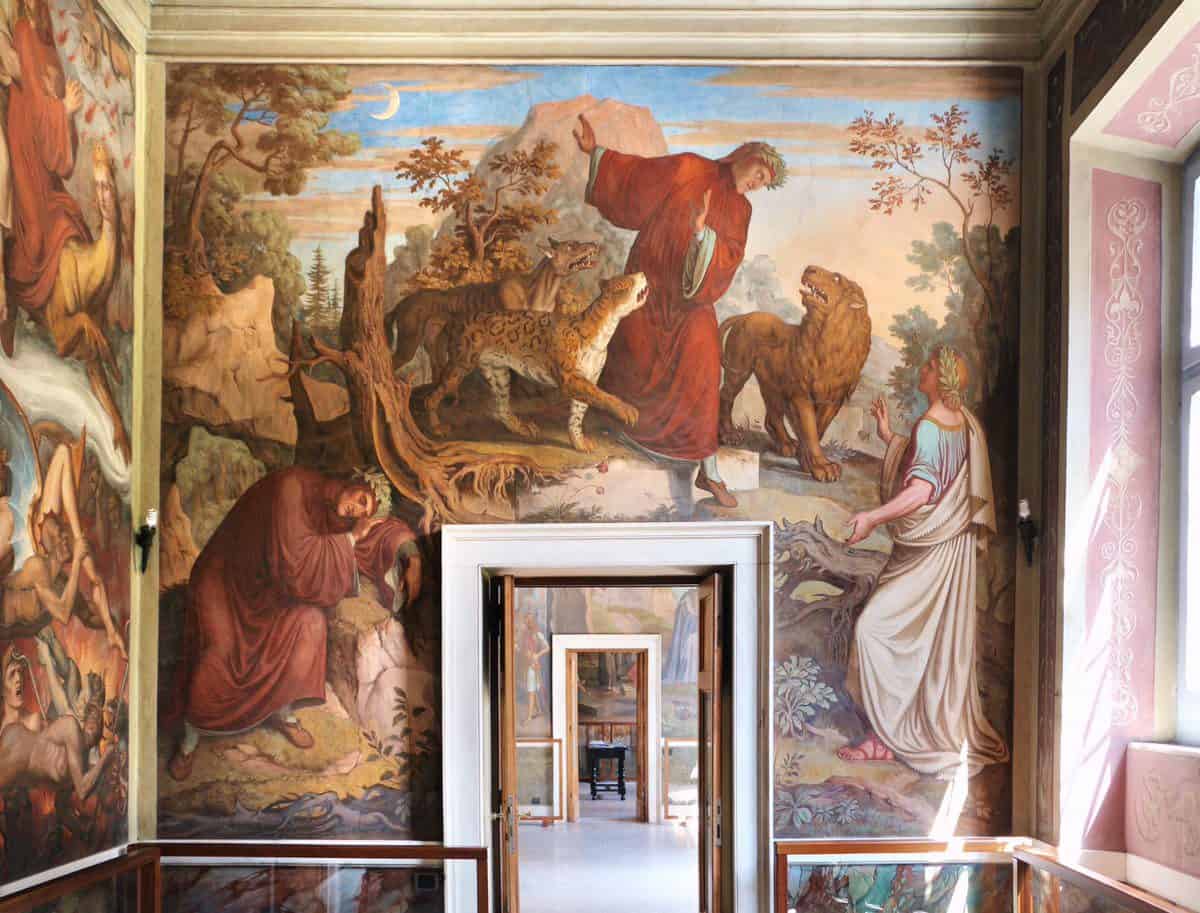
Villa Giustiniani Massimo al Laterano can be visited in Rome at Via Matteo Boiardo 16, in the Esquilino district, 200 meters from Piazza San Giovanni in Laterano and a step from Via Tasso. What remains of it is the 17th-century noble casino, today the seat of the Delegation for Italy of the Custody of the Holy Land. Admission is free and there is no ticket office, because it is not a civic museum but a religious house that opens the three rooms frescoed by the Nazarenes in limited time slots. The available sources indicate Tuesday and Thursday from 9 to 12 and from 16 to 18, Sunday from 10 to 12, with the telephone contact 06 70495651. Before setting out it's worth phoning: the hours of a religious community follow the liturgical calendar and the needs of the house, and a closed door in the early afternoon of an August Thursday is not a remote possibility. Groups always announce themselves in advance. You get there by metro line A, Manzoni stop, which is the closest and is seven minutes on foot. San Giovanni station, also on line A and an interchange with line C since 2018, is slightly farther. The visit to the three rooms takes roughly an hour, an hour and a half if you stop to read the frescoes episode by episode, as they deserve. Photographs: ask the friar who accompanies you, the rule changes depending on who opens.
To get oriented in the quadrant that surrounds the villa, the page on tourist attractions in Rome can help, where the Lateran is told together with the rest of the district.

What Villa Giustiniani Massimo al Laterano is today
We need to agree on the name, because four are in circulation and all four are legitimate. Villa Giustiniani Massimo al Laterano is the full historic wording: it recalls the first owner, the marquis Vincenzo Giustiniani, and the Roman family that took over two centuries later. Casino Massimo Lancellotti is the name under which the building appears in 19th-century art literature and in today's guides, from the Lancellotti branch that inherited the property in the mid-19th century. Villa Massimo al Laterano serves to distinguish it from the other Villa Massimo, the one on Via Nomentana that houses the German Academy and that has nothing to do with this one. Casino Giustiniani Massimo, finally, is the form that favors the building over the park, and it's the most honest, because the park hasn't existed for a century and a half.
What you walk into today is not a villa in the full sense of the term. It's an isolated noble casino, that is, the representative palazzina that once occupied the center of an estate of almost 16,000 square meters, and that today is wedged into a block of Umbertine and early 20th-century buildings. Those who arrive expecting a historic garden are thrown off. Those who arrive for the frescoes leave with the feeling of having seen one of the least predictable things in Rome: three rooms in which the Divine Comedy, the Orlando Furioso and the Gerusalemme Liberata are painted in full on the walls by a team of German and Austrian painters converted to Catholicism, between 1817 and 1829.
It's worth saying right away, without mediation: this is the place where you see Nazarene painting in Rome. The Casa Bartholdy cycle, the other great site of the group, was detached in 1887 and taken to Berlin. Here the frescoes have stayed where they were born, on the same walls they were conceived for, with the light coming in from the same windows. It's a rare condition and it is underrated.
Where it is and how to get to Villa Giustiniani Massimo al Laterano
The address and the door on Via Matteo Boiardo
Via Matteo Boiardo 16. The street number is that of the Holy Land Delegation and the door doesn't look like a museum entrance: no flashy sign, no bookshop, no line. Anyone looking for a tourist sign walks past and comes back after 100 meters. The street naming of the block is a courtesy of the city to the history of the building: the surrounding streets are called Via Matteo Boiardo, Via Ludovico Ariosto, Via Torquato Tasso. The chivalric poets that the Nazarenes painted inside the casino ended up giving their name to the streets built over the sold park. It doesn't often happen that a building development pays homage to exactly what it erased.
Metro, bus and tram for Villa Giustiniani Massimo al Laterano
The reference stop is Manzoni on metro line A, on the stretch between Vittorio Emanuele and San Giovanni: you exit onto Viale Manzoni and in seven or eight minutes of walking, slightly downhill, you reach Via Boiardo. San Giovanni station, again on line A, is the interchange with line C opened on May 12, 2018 and is convenient for those coming from the east. If you come from Termini you can do the whole trip on foot in just under 20 minutes following Via Merulana, which is the historic route between Santa Maria Maggiore and the Lateran. Piazza di Porta San Giovanni and Piazza San Giovanni in Laterano are served by a considerable number of surface lines: for up-to-date numbers it's best to rely on the transport company's site, which reorganizes them fairly often. By car, make your peace with it: the area is paid parking almost everywhere and free parking around the Lateran is an urban legend.
Hours, booking and cost of the visit to Villa Giustiniani Massimo al Laterano
Access to the three frescoed rooms is free. The time slots indicated by the available sources are Tuesday and Thursday 9-12 and 16-18, Sunday 10-12. The Delegation's phone number is 06 70495651. The operating advice is just one and hasn't changed in years: call. A religious house is not a municipal museum with guaranteed custody shifts, and openings can be canceled for a celebration, for a chapter of the order, for the absence of the confrere who holds the keys. Organized groups are required to arrange the time in advance, and anyone who shows up as a group of 20 without warning risks being left on the sidewalk. The paid guided visits that appear in Rome's cultural calendars are organized by outside associations: in that case you pay for the guide's service, not the admission ticket, because there is no admission ticket here.
Vincenzo Giustiniani, the marquis who bought a vineyard at the Lateran in 1605
From Chios to Rome, story of a family of bankers
Vincenzo Giustiniani was born on the island of Chios in 1564. The Giustiniani were a Genoese consortium that from the 14th century had administered the island in the Aegean on behalf of the Republic, and that had made the island a family business founded on mastic and Levant trade. In 1566 the Ottomans took Chios and the world of the Giustiniani ended in a week. The family moved to Rome, where it settled near San Luigi dei Francesi and where it started over from scratch with the only trade nobody can take away from a Genoese: money. The father Giuseppe built the bank, the son Vincenzo brought it to the level of the great financiers of the papal court. The brother Benedetto took the cardinal's hat in 1586. Within a generation the refugees from Chios were one of the richest families in Rome.
The collection: over 300 paintings and 1,200 sculptures
Vincenzo Giustiniani died in 1637 leaving a collection that at the time of the inventory counted more than 300 paintings and about 1,200 pieces of sculpture. He was not an ordinary collector: he was one of the first to understand Caravaggio, and at his death he owned about 15 canvases by Merisi, a number no other private Roman ever came close to. It was he who bought the first version of Saint Matthew and the Angel rejected by the patrons of San Luigi dei Francesi, a canvas that later ended up in Berlin and was destroyed in the fire of the Flakturm Friedrichshain in 1945. Giustiniani's taste was not only Caravaggesque, though: the Bolognese classicists also worked in his houses, Domenichino and Francesco Albani above all, who frescoed the villa at Bassano Romano.
The Galleria Giustiniana and the dispersal
Of the collection of ancient marbles the marquis had an illustrated catalog engraved, the Galleria Giustiniana, which remains one of the fundamental documents for understanding how people collected in Rome at the beginning of the 17th century: which pieces were bought, how they were restored, how much a mutilated torso was completed to make a presentable statue. The collection began to disperse in the 19th century. From 1815 the King of Prussia Frederick William III bought more than 160 paintings from it. Today about 40 of those canvases are in the Gemäldegalerie in Berlin, others in the National Gallery in London, the Kunsthistorisches in Vienna, the Hermitage in Saint Petersburg. Of all this, at the Lateran, almost nothing remained. Almost.
The architecture of the casino of Villa Giustiniani Massimo al Laterano
Carlo Lambardi and the 17th-century building
In 1605 Vincenzo Giustiniani bought at the Lateran a plot cultivated as a vineyard, in an area that was then countryside inside the walls: vegetable gardens, artichoke fields, fruit trees, a few farmhouses, and at the far end the facade of the cathedral. On that plot he had a representative residence built. The architect to whom critics trace the layout is Carlo Lambardi, a solid professional little visited today, who also authored the monumental portal of the boundary wall. The sources oscillate between 1605 and 1618 as the date of the building, which is normal for a suburban villa site that proceeds in successive campaigns: you buy the land, build, add, decorate.
The building is of an almost severe sobriety: rectangular plan, two levels, windows framed in travertine, no theatrical rustication, no staging of staircases. Those who know Rome's 17th-century villas recognize the type immediately, that of the vineyard casino designed for short holidays and conversation. The sumptuousness here is not in the masonry: it is in what was hung, walled in and placed inside and outside.
The ancient marbles set into the facades
The facades of the casino are a small open-air epigraphic and sculptural museum, and they are the part that hurried visitors look at least. You find imperial busts, 17th-century portraits in profile, fronts of ancient sarcophagi with mythological subjects, reliefs recomposed by putting together fragments of different origin. It was the practice of the time: the collector didn't preserve, he arranged. A fragment could be completed, restored, paired with another piece, walled into a facade as an ornament. Prince Andrea Giustiniani, Vincenzo's grandson, enriched the front further with marble friezes, stuccoes and ornaments where the eagle of the Giustiniani and the doves of the Pamphilj appear: he had married Maria Pamphilj, niece of Pope Innocent X, and the papal kinship is flaunted in stone as today it is flaunted in photographs.
The statue of Justinian, a declared fake four meters high
The piece that has remained in place is also the most shameless. In 1638 Prince Andrea Giustiniani commissioned from the sculptor Arcangelo Gonnelli a work that would demonstrate visually the family's claimed descent from the Byzantine emperor Justinian. The link is etymological and nothing more: Giustiniani, Giustiniano. But in Baroque Rome a genealogy was built the way a reputation is built today, that is, by producing proof.
Gonnelli worked by assemblage. He took a colossal headless torso of Greek marble, supplemented it heavily with modern parts, and for the head drew on a youthful portrait of Marcus Aurelius, rechristening it Justinian and depicting him in the prime of life. The result is a statue roughly four meters high that no archaeologist would take for ancient and that no 17th-century visitor would have taken for modern. In 1742 Giovan Battista Giustiniani had it placed in the position it still occupies, as the inscription set into the southern side of the casino records. Look at it carefully: it is the material proof of what it meant, in the 17th century, to have a collection. Not preserving the ancient, but using it.

Borromini, a name to be handled with caution
Some local sources attribute the casino to Francesco Borromini. It's an attribution that has circulated for some time and should be treated for what it is: an erudite tradition, not a documented fact. The dates make it implausible, because Borromini was born in 1599 and in 1605 he was six years old. That the Ticinese master intervened at a later moment on a part of the complex is not impossible in absolute terms, but anyone who tells it to you as an established fact is selling you a suggestion. On the page and on the visit the name that holds is Lambardi.
The vanished park of Villa Giustiniani Massimo al Laterano
Three avenues, fountains, statues and 15,000 square meters
The estate extended over about 15,600 square meters, laid out in three parallel avenues at different levels, with fountains, green architecture and statues arranged along the paths. It was at once a representative garden and a productive holding: vineyard, artichokes and fruit trees were cultivated, and the agricultural income was not a folkloric detail but a budget line. Roman villas of that type worked like this, halfway between an open-air museum and a farm. The perimeter touched the present Via Merulana, Via Tasso, Viale Manzoni and Piazza San Giovanni in Laterano: try walking it today and you'll get a concrete idea of what was lost.
The Esquilino subdivision and the sale of 1871
In 1871, a year after the breach of Porta Pia and with Rome just made capital, the owners put the vast park up for sale as building land. It's the episode that changed this quadrant of the city forever: the post-unification master plan had to house the administrative apparatus of the new State, and the Esquilino, with its large, little-built noble estates, was the perfect hunting ground. Within 20 years the vineyards became blocks, the avenues became streets, the noble casinos were either demolished or remained like this one, islands in the middle of the built-up area. The same fate befell a large part of the area's historic villas. If you want a point of comparison for what happens when a noble villa survives intact instead, look at the Casino Nobile of Villa Torlonia and the park that still surrounds it.
The portal that ended up at Villa Celimontana
Of the boundary wall the most beautiful part was saved. Carlo Lambardi's monumental portal was ceded to the State in 1885 and remained dismantled for decades, until in 1931 it was reassembled as the entrance to Villa Celimontana, on the Celio, where it still stands. It's one of those transfers that nobody in Rome tells and that explain the city better than many guides: a piece of 17th-century Lateran architecture that today serves as the threshold to a public park a kilometer and a half away, and that almost everyone passes through without knowing where it comes from. Next time you pass by, look up.
The Nazarenes, the painters who frescoed Villa Giustiniani Massimo al Laterano
The League of St. Luke, Vienna 1809
On July 10, 1809, at the Vienna Academy, six restless students founded a brotherhood they called the Lukasbund, League of St. Luke, after the patron saint of painters. They were Friedrich Overbeck, Franz Pforr, Ludwig Vogel, Johann Konrad Hottinger, Josef Wintergerst and Joseph Sutter. They pledged to remain faithful to truth and to fight the academic manner: words that sound naive today and that back then meant rejecting en bloc school neoclassicism, polished painting, drawing from plaster statues. Overbeck put it brutally: every virtue drowned in academic rigor.
On June 20, 1810 four of them arrived in Rome. They found lodging in the convent of Sant'Isidoro al Pincio, then half abandoned, and organized there a community life of an almost monastic kind: they painted by day in the friars' refectory, wore their hair long and parted in the middle, and the tunic, so much so that the Romans began jokingly calling them the Nazarenes. The nickname stuck. Their model was not the mature Raphael but Perugino, Fra Angelico, the Italian masters of the 15th century before the grand manner: clean line, light color, frontal compositions, and a declared religiosity that for many of them passed through conversion to Catholicism.
Casa Bartholdy, the dress rehearsal
In 1815 the Prussian consul general in Rome, Jakob Salomon Bartholdy, entrusted the group with the decoration of a room in his apartment at Palazzo Zuccari with the Stories of Joseph. It was the Nazarenes' first collective site and their calling card with international clients. That cycle is no longer in Rome: detached at the end of the 19th century, it is in Berlin. And that is exactly why the Casino Massimo matters so much.
Carlo Massimo, the patron who chose the Italian poets
The Massimo family, one of the oldest of the Roman aristocracy, took over ownership of the villa at the Lateran at the beginning of the 19th century: the sources indicate 1802 or 1803. It was the marquis Carlo Massimo, struck by the result at Casa Bartholdy, who commissioned the Nazarenes to decorate three rooms on the ground floor, on the garden side. The iconographic program is the most interesting part of the commission and should be understood well: Carlo Massimo did not ask for sacred stories, did not ask for the classical mythology that was the obligatory repertoire of every Roman villa, did not ask for family glories. He asked for Dante, Ariosto and Tasso.
It was a precise political and cultural choice. In 1817 the medieval revival and the chivalric poem were the heart of European Romantic sensibility, and entrusting the three great Italian poets to a team of German painters meant staging an idea: that the Christian art of the North and Italian literature belonged to the same tradition. The sources indicate that the original project was also to include a fourth room dedicated to Petrarch, never realized. The site opened in 1817 and closed around 1827 for the bulk of the work, with loose ends running to 1829.
The Dante Room at Villa Giustiniani Massimo al Laterano
It is the room that justifies the trip. The decoration was initially entrusted to Peter von Cornelius, who however left Rome for Bavaria, called by the crown prince Ludwig. Joseph Anton Koch took his place and worked on the walls from 1819, while the vault was painted by Philipp Veit. The division of labor is also a division of temperament, and it can be seen with the naked eye. Koch has the Inferno and the Purgatory, that is, earth, body, the crowd and the scream. Veit has the Paradise, that is, geometry, light and silence. Whoever enters perceives the gap before even reading a caption.
The philological precision of this room is its distinctive trait. The episodes are recognizable one by one and in many cases can be traced back to the exact verse that generated them. It is not a generic illustration of a poem: it is close reading, canto by canto, done by someone who knew the text by heart. The chronicles say that Koch recited entire cantos of the Commedia. Looking at his walls you are led to believe it.
Dante in the wood with the beasts and Virgil
The first episode is the absolute opening of the poem. Two scenes can be read on the wall. On the left Dante sleeps, and it is the sleep from which the first canto starts everything, that fullness of sleep that makes him lose the straight way. In the center the poet is surrounded by the three beasts, the lonza, the lion and the she-wolf, and tries to flee backward and downward. The shade of Virgil comes toward him, greets him and invites him on the journey into the afterlife. Koch arranges the scene as a heroic landscape, which was his specialty: rocks, trees, open depth. It is not a backdrop, it is a world.

Joseph Anton Koch's Inferno, wall by wall
The Inferno wall condenses the whole cantica onto a single surface, with a handling of space that recalls the great 16th-century machines more than early 19th-century painting. On the left the uncommitted run behind a flag with no emblem, and beside them Charon ferries the damned spirits. At the center of the wall stands Minos, the infernal judge, with his serpent tail wound around his body as many times as the number of the circles of destination: around him a throng of terrified damned.
At the bottom right the devils drag the souls toward the circles, whose flames can be seen. Then, again on the left, Cerberus appears, the three-headed dog who governs the third circle, that of the gluttons. At the top right the story resumes with Dante and Virgil astride Geryon, the monster with a man's face and a serpent's body who carries them from the seventh to the eighth circle. It is one of the passages in which Koch does his best, because the flying descent lets him open the landscape under the figures. At the bottom left the thieves of the eighth bolgia are bitten without respite by serpents, in that continuous metamorphosis between man and reptile that Dante describes with a technical relish almost like a naturalist's. Next to the thieves, Count Ugolino della Gherardesca gnaws the skull of Archbishop Ruggieri: we are in the ninth circle, the ice, the end.
A note on method for those looking. Koch doesn't follow the reading order from left to right: he arranges the episodes according to a visual economy, alternating dense and empty groups. If you look for the chronological sequence you get lost. If you accept the construction in blocks, the wall opens up.

The ship of Purgatory
Purgatory occupies two walls. The first, next to the Inferno, holds the fresco known as the ship of Purgatory, and it actually concerns the Ante-Purgatory, that is, the band that precedes the mountain proper. In the lower part an angel boatman ferries the penitent souls. Among them, with a lyre in hand, you recognize Casella, the musician friend of Dante who intones a song and stops everyone to listen, provoking Cato's rebuke. It is one of the most human moments of the poem and Koch paints it without rhetoric.
On the right the painter stages the story of Buonconte da Montefeltro, the soldier who died at Campaldino. At his death an angel and a devil fight over his soul, the angel wins, and the devil in reprisal unleashes the storm and throws the body into the river. On the left appears the valley of the princes, where two angels with swords drive away the serpent of temptation. In the center Dante and Virgil kneel before the angel doorkeeper who guards the keys of the gate of Purgatory, the gold one and the silver one.
The seven terraces of Purgatory
The next wall contains Purgatory proper, with all seven cornices of the second kingdom arranged vertically as on a mountain. At the bottom the proud: a spirit carries a boulder on his shoulders, and on the boulder the inscription TE DEUM LAUDAMUS can be read. Still at the bottom, on the right, the second and third cornices, with the envious whose eyes are sewn shut with iron wire and the wrathful immersed in a smoke so thick that it makes the figures of Dante and Virgil walking in it almost invisible.
In the center the fourth cornice, with the slothful running to the right, and the fifth, with the avaricious and the prodigal lying face down on the left. In this cornice a pope and a king are recognized: the pope is Adrian V, the king is Hugh Capet, founder of the French dynasty. Higher up the sixth cornice, with the gluttons reduced to spectral thinness stretching their hands toward the fruits of an unreachable tree, and the seventh, with the lustful wrapped in flames. The play of scales is calculated: the higher you go, the lighter the figures become and the clearer the color. Koch builds the ascent with painting, not with captions.
Philipp Veit's Paradise on the vault
On the vault Philipp Veit frescoed the Paradise, in a whole titled The Heavens of the Blessed and the Empyrean. The heavens are read counterclockwise and the Empyrean occupies the center. The first heaven is that of the Moon, and here the guide changes: in place of Virgil appears Beatrice, the woman loved by Dante and dead very young. In the heaven of the Moon dwell the spirits who failed their vows, and Veit depicts there Piccarda Donati, the Florentine nun torn from the convent by her brother, and the empress Constance of Hauteville, mother of Frederick II.
In the second heaven, that of Mercury, there are the spirits active for earthly glory, and among them Justinian, the Byzantine emperor who wanted to reorganize the law and rebuild the Roman empire. The coincidence is too beautiful not to have been noticed by the patron: the emperor who in the garden, four meters of marble, justified the surname of the first owners, reappears in heaven by Dante's will. In the third heaven, that of Venus, the loving spirits, among them Rahab, the woman of Jericho who hid Joshua's scouts.
In the fourth heaven, the Sun, Dante and Beatrice are among the wise spirits, and at the far left St. Thomas Aquinas is recognized. The fifth is the heaven of Mars, with the Latin cross formed by the warrior spirits and with Dante conversing with his great-great-grandfather Cacciaguida, the canto of exile and prophecy. The sixth is the heaven of Jupiter, with the judging spirits: on the left the emperor Trajan, on the right David king of Israel. The seventh is Saturn, with the contemplative spirits, among them St. Benedict of Norcia. In the heaven of the fixed stars Dante kneels before St. Peter, St. John the Evangelist and Adam, who examine him on faith, hope and charity. The ninth heaven, the Primum Mobile, is missing. At the center of the vault the Empyrean: Dante and St. Bernard of Clairvaux before Mary and the Most Holy Trinity.
A verdict, and it is not tender. Veit's vault is learned, orderly, cold in color and almost miniaturist in layout, and it remains much more didactic than the walls. It is the Paradise of someone who studied Perugino and 15th-century Umbrian painting with exemplary application. But it is Koch's Inferno that makes you come back through the door to look at it once more.
Who was Joseph Anton Koch, author of the Inferno of Villa Giustiniani Massimo al Laterano
Joseph Anton Koch was born in 1768 at Obergiblen, a village in Austrian Tyrol near Elbigenalp, to a peasant family. He studied at the Karlsschule in Stuttgart, the military school of the duke of Württemberg, and fled it in the climate of Jacobin ideas, crossing the Swiss Alps on foot. In 1795 he arrived in Rome and in Rome he mostly stayed, until his death in 1839. He was the great interpreter of heroic landscape, heir of Asmus Jacob Carstens and attentive reader of Annibale Carracci and Michelangelo. The young Nazarenes considered him a master, although he was of another generation and another temperament. He considered the Dante paintings of the Casino Massimo his masterpiece. He is buried in the Campo Santo Teutonico, behind St. Peter's.
Who was Philipp Veit, author of the Paradise of Villa Giustiniani Massimo al Laterano
Philipp Veit was born in Berlin in 1793, son of the banker Simon Veit and of Dorothea, who was the daughter of the philosopher Moses Mendelssohn and who later married Friedrich Schlegel. His biography sums up a typical trajectory of German Romanticism: birth in a Jewish family of the Berlin Enlightenment, conversion to Catholicism, adherence to the Nazarene group. He lived in Italy from 1815 to 1830, worked at Casa Bartholdy and at the Museo Chiaramonti in the Vatican, and his Immaculate Conception at Trinità dei Monti of 1829-1830 is considered one of the group's best showings as a colorist. Back in Germany he directed the Städel in Frankfurt, then frescoed the nave of the cathedral of Mainz between 1859 and 1864. He died in Mainz in 1877.
The Ariosto Room at Villa Giustiniani Massimo al Laterano
The central room is dedicated to the Orlando Furioso and is the only one of the three to have been painted entirely by a single hand: that of Julius Schnorr von Carolsfeld, who worked there between 1822 and 1827. The difference is felt. Where the Dante room is a dialogue, and at times a friction, between two artists, the Ariosto room has a single timbre from start to finish, a warmer color and a narrative ease that makes the reading easier.
Julius Schnorr von Carolsfeld, the painter of the Orlando Furioso
Schnorr was born in Leipzig on March 26, 1794, son of the painter Johann Veit Schnorr and brother of another painter, Ludwig Ferdinand. He trained in Vienna and arrived in Rome in the climate of the Nazarene group. He tackled the Casino Massimo commission after a long preparatory study, with a considerable quantity of drawings, sketches and cartoons: those who have seen those sheets in German museums know that the room in Rome is the tip of an enormous underground labor. After the Roman experience he returned to Germany, worked for the court of Bavaria and ended his career as director of the Dresden gallery, where he died on May 24, 1872.
Bradamante, Ruggiero and the House of Este
Ariosto's poem is, among other things, a colossal homage to the lords of Ferrara, and Schnorr does not forget it. In the room find place the two great encomiastic moments of the Furioso, those in which Bradamante and Ruggiero are told that they will marry and that from their union will be born the most splendid dynasty ever to appear on earth, the Este. It is the mechanism by which chivalric poetry pays the patron: the fable hooks onto the royal genealogy and ennobles it. That this theme ends up painted in the Roman villa of a 19th-century aristocrat, in a house that had already invented an imperial descent with four meters of marble in the garden, is a delightful coincidence.
The battles: Lipadusa, Bizerte, the siege of Paris
The cycle continues with the great war episodes: the battle between Christians and Saracens, the duel of the six at Lipadusa, the capture of Bizerte and the siege of Paris. Here Schnorr openly shows where his idea of historical composition comes from. The references to Raphael's Fire in the Borgo are explicit in the handling of the groups and in the way of making movement explode toward the background, and some figures openly look to the vault of Michelangelo's Sistine Chapel. It is not plagiarism, it is a declaration of belonging: the Nazarenes wanted to retie the thread with the great Italian tradition and did it by quoting it in the face of the viewer.
Orlando's madness and the wits recovered on the Moon
The reading by images then arrives at the core of the poem: the madness of Orlando, who discovers the love of Angelica and Medoro and loses his reason, and the journey of Astolfo, who recovers the paladin's wits on the Moon, enclosed in a flask. The cycle concludes with Charlemagne sanctioning the wedding of Bradamante and Ruggiero. Those who have read the Furioso recognize the whole structure of the poem in a single room: it is an exercise in narrative synthesis that in early 19th-century painting has few terms of comparison.
The Tasso Room at Villa Giustiniani Massimo al Laterano
The third room tells the Gerusalemme Liberata, and it is the most tormented of the three. Not because of the subject, but because of the story of its construction site.

Friedrich Overbeck, the head of the Nazarenes
Johann Friedrich Overbeck was born in Lübeck on July 3, 1789, in a family of Protestant pastors: his father was a lawyer, poet and mayor of the city. He entered the Vienna Academy in March 1806, under Heinrich Füger, a pupil of David's neoclassical line, and left it on bad terms. He founded the Lukasbund, moved to Rome in 1810 and stayed there until his death, on November 12, 1869. He was the last of the Nazarenes to remain in the city, when all the others had returned to Germany to pursue academic careers. He converted to Catholicism in 1813, and the conversion was not a biographical episode but the center of his idea of painting.
Tasso's poem on the walls of Villa Giustiniani Massimo al Laterano
Overbeck worked on the Tasso room between 1819 and 1827. On the ceiling stands the allegory of the Gerusalemme Liberata, while on the walls the poem unfolds: the holy city occupied by the infidels and then liberated, and around it the stories of love and sorrow that weave its plot. Tancredi and Clorinda, the Christian knight who kills in a duel, without recognizing her, the woman he loves and baptizes her as she dies. Armida and Rinaldo, the sorceress and the paladin, the enchantment and the abandonment. Olindo and Sofronia, the two who accuse each other of a sacred theft to save one another from the stake. The final message, declared without half measures, is that salvation comes only from faith in Christ: Overbeck filters the poem through his own conversion and turns it into a religious discourse.
The patron's death and the abandonment of 1827
In the course of the work the marquis Carlo Massimo died. Overbeck lost the harmony among work, executor and patron that had sustained him up to that point and left the site. Before leaving, though, he did one thing that alone is worth the visit: he introduced into one of the main scenes three portraits, that of the patron, his own and that of Torquato Tasso. The three men without whom that room would not have existed. It is a collective signature, and anyone who looks for it finds it.
Overbeck left for Assisi, where he worked on the facade of the Porziuncola in the basilica of Santa Maria degli Angeli. He never came back to these walls.
Joseph von Führich and the final scene with the Massimo family
To complete the room the Bohemian Joseph von Führich was called, born in 1800 and died in 1876, a painter of later formation and more markedly Baroque taste, who strove to respect the program set by his predecessor. He painted the minor scenes and the concluding scene, and in the concluding one he inserted the new owners of the villa: Massimiliano Massimo with his wife Cristina of Saxony, the children Barbara and Vittorio, and Giuseppina Massimo Giustiniani, all depicted as they witness the victory of Godfrey of Bouillon and his thanksgiving to God. The family portrait inserted inside the poem is an old convention, but here it works as a hinge: it closes the site and certifies the handover between two generations of patrons.

The other rooms of Villa Giustiniani Massimo al Laterano and the ornamental decorations
On the ground floor of the casino there are other rooms, today not included in the route open to the public. One of them is decorated entirely in Pompeian style, the repertoire of candelabra, panels and false architecture that after the 18th-century Vesuvian excavations became the European fashion for villa rooms. The coexistence, in the same building, of a Pompeian room and three Nazarene rooms is a small treatise on the history of taste: on one side antiquity rediscovered and turned into ornament, on the other the Middle Ages rediscovered and turned into faith.
Franz Horny also worked on the ornamental decorations of the frescoed rooms, a young German painter specialized in the vegetal frames and garlands that frame the scenes. They are the part nobody looks at and that instead holds everything together: without those ornamental bands the episodes would hang in the void. Horny died very young of tuberculosis at Olevano Romano, and his story is one of the melancholy chapters of the German colony in Rome.
In 1951 the friars built two low side wings on a colonnaded portico, transforming the old garden into a court of cloister shape. It is a modern intervention and it shows, but it has the merit of having given the casino a context back: without those wings the building would today be an isolated structure in the middle of an apartment-block courtyard.
A curiosity about Villa Giustiniani Massimo al Laterano
The most beautiful curiosity concerns an involuntary revenge of street naming. In 1871 the owners sold the villa's park as building land and within a few years the green disappeared under the buildings of capital Rome. Whoever designed the new streets could have named them after generals, Risorgimento dates, ministers: it was the practice in all the post-unification districts. Instead they chose the poets. Via Matteo Boiardo, Via Ludovico Ariosto and Via Torquato Tasso run exactly over the land of the Giustiniani vineyard, and bear the names of the authors whose poems had been painted on the walls of the casino 50 years earlier. The building ended up christening the district that smothered it.
There is a second curiosity, of a different order, which concerns the statue of Justinian. That four-meter colossus is a historical fake built in 1638 to prove a nonexistent descent: an ancient Greek torso, modern additions, and a head taken from a youthful portrait of Marcus Aurelius rechristened Justinian. Well, the Byzantine emperor returns to the same property two centuries later, and this time thanks to Dante: Philipp Veit paints him in the heaven of Mercury, among the spirits active for earthly glory, on the vault of the ground-floor room. Neither of the two Justinians has anything to do with the Genoese marquises. Both, in this house, worked for the same family.
The third curiosity is more technical and pleases those who love construction sites. The original program of the marquis Carlo Massimo provided for four rooms, one for each of the great poets: Dante, Ariosto, Tasso and Petrarch. The Petrarch room was never realized. The Canzoniere, which was nonetheless the most read text in Europe, didn't lend itself to narration by episodes like the three narrative poems, and perhaps this was the technical reason for the abandonment. The result is that at Villa Giustiniani Massimo al Laterano there is missing exactly the poet that everyone would expect to find in a cycle dedicated to Italian literature.
Something nobody tells you about Villa Giustiniani Massimo al Laterano
Almost nobody tells you, but this is today the only place in Rome where you can see a monumental Nazarene cycle in situ. The group worked in the city for two decades and was one of the most discussed international artistic phenomena of early 19th-century Rome, with a colony of German painters that frequented the cafés of Via Condotti and filled the countryside of the Castelli with drawings. And yet of that work, in Rome, very little remains. The other great collective cycle, the Stories of Joseph of Casa Bartholdy at Palazzo Zuccari, was detached from the walls at the end of the 19th century and transferred to Berlin, where it still is. Here instead the frescoes have remained where they were painted, and the difference is enormous: you look at a scene standing at the point where the artist imagined you would be, with the same ceiling height and the same side light.
The second thing they don't tell you concerns access. Many guides present the Casino Massimo as an inaccessible place, open only on special occasions. That is not accurate. The complex is a religious house and as such has its own limited hours, but it is not closed to the public: the available sources indicate openings on two weekdays and on Sunday morning, with free admission. The difference between an inaccessible place and a little-advertised place is all here, and in between passes a phone call. With Roman religious houses a courteous request made a few days ahead opens many more doors than the line at a ticket office does.
The third thing concerns reading the frescoes. In the Dante room the episodes are so close to the text that they can be traced back to the verses that generated them. Bring the Commedia, even in digital version on your phone, and check. The scene of the envious with their eyes sewn shut with iron wire, that of the gluttons stretching their hands toward the tree, that of the boulder with the inscription TE DEUM LAUDAMUS: all are literal translations of precise tercets. No panel in the room will explain it to you, because there are no panels in the room.
The advice I give you for visiting Villa Giustiniani Massimo al Laterano
Call. It is advice number one and is worth more than all the others put together: the Delegation's number is 06 70495651 and a two-minute call saves you a wasted trip. The time slots indicated are Tuesday and Thursday morning and afternoon and Sunday morning, but a religious community lives by its own calendar and the exceptions are published nowhere.
Choose the morning, and choose a bright day. The three rooms are on the ground floor and take natural side light from the windows on the garden side: with the sun high the colors of Koch's Inferno gain a depth that is entirely lost under an overcast sky. On gray days the Purgatory wall, which is the coldest in tone, becomes frankly unreadable in the upper part.
Give yourself at least a full hour. The route is short, three rooms in a row, and the temptation to dispatch it in 20 minutes is strong. It would be a waste. Do this: enter the Dante room, stand in the middle and turn around once without looking at details, to take the measure of the whole. Then start over from the Inferno wall and read it in blocks, starting from Minos in the center and widening toward the sides. Only at the end raise your eyes to Veit's vault: if you do it at the beginning, the Paradise will seem simply pale, while seen after the Inferno it becomes a choice of poetics, and you understand it.
One last recommendation. Don't come as a group of 20 without warning. It is not a museum with computed capacity and entry shifts, and a large unannounced group puts in difficulty whoever opens the door for you. If you have a group, call a week before, agree on the time, and bring the exact number of people you announced.
Another well-known fact, yet rarely cited
That the monumental portal of Villa Celimontana comes from another villa you will find written in many guides. That it comes precisely from here, and that its story is almost 50 years long, almost nobody tells. The portal was the entrance in the boundary wall of the Villa Giustiniani at the Lateran, the work of Carlo Lambardi, that is, the same architect to whom the casino is traced. In 1885 it was ceded to the Italian State, when the subdivision of the Esquilino had already dismembered the park. It remained dismantled for decades. Only in 1931 was it reassembled on the Celio as the entrance to Villa Celimontana, where it still stands and where every summer thousands of people pass under it on their way to the concerts in the park.
The fact deserves to be told in full because it says something precise about how Rome handled its own transformation between the 19th and 20th centuries. It was not barbaric demolition and it was not exemplary protection: it was piecemeal management. The park sold and built over, the casino preserved and then ceded to a religious order, the portal dismantled, stored and finally reused elsewhere as a decorative element of a public garden. Three different fates for three parts of the same complex, decided over 50 years by different administrations with different criteria. If you look for an explanation of why Rome's historic city often seems a collage, this story offers one on a reduced and perfectly documentable scale.
I add a detail that makes the story even more significant. The portal reassembled at Villa Celimontana is today the backdrop of countless photographs and of a very well-attended summer music event. Its Lateran origin almost never appears in the captions. A piece of 17th-century architecture can change district, function and audience, and keep working very well without anyone knowing where it comes from.
The right photo to take at Villa Giustiniani Massimo al Laterano
First question, always: ask if you can photograph. In a religious house the answer depends on who opens for you and on the room, and a question asked beforehand avoids embarrassment afterward. If permission comes, here is where I would point the lens.
The best photograph, the one nobody takes, is the detail of the boulder of the proud in the Dante room, with the inscription TE DEUM LAUDAMUS legible on the stone. It is a tight close-up, it calls for precise focus and it gives back exactly the key of this cycle: an early 19th-century German painter translating an Italian verse of the 14th century into a painted inscription on a fake rock. In a single frame there is the whole sense of the room.
The second frame is the Inferno wall seen at an angle, from a corner of the room, with Minos in the center and the window light coming in raking. Frontally the wall gives back little, because the surface is large and flat. From the side, instead, the painting gains relief and the throng of the damned takes on depth. Moderate wide-angle, no flash: flash on a fresco is no use at all and flattens everything.
The third is Veit's vault photographed from the exact center of the room, with the camera pointed up and the heavens counterclockwise around the Empyrean. You need a steady hand or a support, because indoors with natural light the exposure times get longer. Tripods in a religious house are usually not welcome, so tuck your elbows against your body and breathe slowly.
Outside, the image to take home is the facade of the casino with the ancient marbles set into it: busts, sarcophagus fronts, recomposed reliefs. A frontal photograph of the facade says little. A series of four or five close-up details of the ancient pieces tells instead what a Roman collection of the 17th century was. And if you have permission to go as far as the statue of Justinian, photograph it from below: four meters of assembled marble hold up very well to the heroic perspective, which is exactly the effect for which they were put together.
Some important events that happened here in history
1605: the purchase of the vineyard and the birth of the villa
The first event is the deed of purchase of 1605. Vincenzo Giustiniani, marquis of Bassano, prince of Bassano and one of the richest men in Rome, buys at the Lateran a plot of vineyard and decides to make of it a representative villa. It is not an isolated episode: it is part of the strategy by which a family of Genoese refugees from Chios roots itself in the capital of Christendom by buying land, palaces and antiquities. Within 30 years the villa becomes one of the destinations of cultured Rome, because there you can see the marbles of the Giustiniani collection.
1638 and 1742: the making of the statue and its placement
The second event is of 1638, when Prince Andrea Giustiniani commissions from Arcangelo Gonnelli the statue of Justinian. It is an episode of the history of culture more than of the history of art: a family materially produces the proof of its imaginary genealogy. In 1742 Giovan Battista Giustiniani has it placed where it still stands, and has the inscription that records it set into the southern side of the casino.
1817-1829: the Nazarene site
The third event, and the most important of all, is the opening of the painting site. Between 1817 and 1829 the marquis Carlo Massimo transforms three rooms of a suburban villa into one of the decisive laboratories of European Romanticism. Working there are a German from Lübeck converted to Catholicism, a Berliner grandson of Moses Mendelssohn, a Saxon from Leipzig, a Tyrolean raised in a military school and a Bohemian. The theme is Italian literature. The result is that German, Austrian and Italian scholars are still writing about it 200 years later.
1871: the sale of the park
The fourth event is the sale of the park as building land in 1871. A year after the taking of Rome, with the city promoted to capital and obliged to house tens of thousands of officials in a hurry, the great landowners of the Esquilino cash in. The villa loses its body and keeps its head. It is the moment in which the complex stops being a villa and becomes a building.
1885 and 1931: the portal ceded and reassembled
The fifth event is the cession of the portal to the State in 1885 and its reassembly at Villa Celimontana in 1931. Between dismantling and relocation passed 46 years: a very long time, which says a lot about the slowness with which the protection of heritage was built in Italy.
1943-1944: the German occupation
The sixth event is the hardest and the least told. During the German occupation of Rome, between September 1943 and June 1944, the building hosted the officers' mess of the occupying forces. A few hundred meters away, on Via Tasso, the prison of the German security police operated, today the Historical Museum of the Liberation. Whoever visits the two sites in the same morning makes a journey of a harshness that is not forgotten: within the same handful of blocks, the rooms where German painters of the early 19th century had painted Dante's Paradise and the cells where the German police of the 20th century interrogated the prisoners of the Roman Resistance. The same language, the same district, a century and an abyss of distance.
1947-1948: the arrival of the Custody of the Holy Land
The seventh event closes the ownership story. In the postwar period the remaining complex passes to the Franciscans of the Custody of the Holy Land, who set up the Delegation for Italy there: the sources indicate 1947 or 1948. In 1951 the friars build the two low wings on a portico that turn the garden into a cloister. Since then the house has been both a religious seat and a place of art, with all the practical consequences, hours included.
Who has passed through Villa Giustiniani Massimo al Laterano
The Giustiniani and the Massimo
The first name is Vincenzo Giustiniani, the marquis from Chios who was among the first admirers of Caravaggio and who wanted his villa here: a man who owned 15 canvases by Merisi and 1,200 ancient marbles, and who counted in Rome as much as a cardinal. After him his grandson Andrea Giustiniani, husband of Maria Pamphilj and therefore related to Innocent X, who filled the facades with coats of arms, eagles and doves. Then Giovan Battista Giustiniani, who in 1742 definitively placed the colossus in the garden. From the beginning of the 19th century the Massimo take over, and in particular the marquis Carlo Massimo, the patron of the Nazarene cycle, and after him Massimiliano Massimo with his wife Cristina of Saxony and the children Barbara and Vittorio, whom Führich portrayed in the final scene of the Tasso room. In the mid-19th century the property passes to the Lancellotti branch, hence the name under which the building is still best known.
The German and Austrian painters
Through these rooms have passed, and for years, the protagonists of northern Romanticism in Rome. Joseph Anton Koch, a Tyrolean, on the walls of the Dante room from 1819. Philipp Veit, a Berliner, on the vault. Julius Schnorr von Carolsfeld, a Saxon, sole author of the Ariosto room between 1822 and 1827. Friedrich Overbeck, the acknowledged head of the Nazarenes, in the Tasso room from 1819 to 1827. Joseph von Führich, a Bohemian, completing it. And Franz Horny, who painted the garlands and ornaments and who died very young at Olevano Romano. Peter von Cornelius received the first commission for the Dante room and did not finish it, because Bavaria called him to be court painter: a defection that ended up giving us Koch's Inferno, and it can't be said we lost out.
The poets, who passed through here in effigy
There is then a particular category of guests. Dante Alighieri, Ludovico Ariosto and Torquato Tasso never set foot in this house, for the excellent reason that they had been dead for centuries when it was built. And yet of the three this is, in Rome, the home. Tasso in particular appears here in portrait, inserted by Overbeck beside himself and the patron in one of the main scenes of his room. And it is a presence that makes sense geographically too: Torquato Tasso died in Rome on April 25, 1595, in the monastery of Sant'Onofrio on the Gianicolo, where he is buried. The street that bears his name, 200 meters from here, runs over the land of the Giustiniani vineyard.
Who passes through today
Today those who pass through here are the friars of the Custody of the Holy Land who have the Delegation for Italy here, German and Austrian art historians who study the Nazarenes and who consider these three rooms an obligatory stop in their work, and a small and devoted Roman public that returns on the occasion of the Dante anniversaries. There are no tour groups in line and there is no bookshop. The ratio between the quality of what you see and the number of people who see it is, in Rome, among the most lopsided of all.
What to see around Villa Giustiniani Massimo al Laterano
The Lateran five minutes from Villa Giustiniani Massimo al Laterano
Leaving Via Boiardo and heading south you reach Piazza San Giovanni in Laterano in a few minutes. The Basilica of San Giovanni in Laterano is the cathedral of Rome and the mother church of all churches, with the 18th-century facade by Alessandro Galilei and the Cosmatesque cloister. Opposite, the complex of the Holy Stairs with the Sancta Sanctorum, the ancient private chapel of the popes. On the square rises the Lateran obelisk, the tallest ancient obelisk in the world, brought to Rome by Constantius II in the 4th century.
Santa Croce and the Porta Maggiore quadrant
To the east, following Viale Carlo Felice under the plane trees, you reach Holy Cross in Jerusalem, the basilica of the relics of the Passion founded by St. Helena. The stretch of Aurelian Walls that accompanies the route is one of the best preserved in the city. Those who continue arrive at Porta Maggiore and the tram junction.
Via Merulana, Palazzo Merulana and Santa Maria Maggiore
To the north, Via Merulana connects the Lateran to the upper Esquilino. Halfway, Palazzo Merulana hosts the Cerasi collection with 20th-century Roman art, from Scipione to Mafai to Donghi. At the end of the street, Santa Maria Maggiore with the early Christian mosaics of the nave, which date from the 5th century and remain among the oldest and least looked at things in Rome.
The Celio, San Clemente and the Colosseum
To the west you go down to the Celio. The Basilica of San Clemente with its three superimposed levels, down to the 2nd-century Mithraeum, is one of the most effective visits in the city for understanding how Rome built itself on top of itself. A little farther, the Colosseum and, on the Oppian Hill, the Domus Aurea. And on the Celio, as said, the portal that once opened the villa at the Lateran, today the entrance to Villa Celimontana.
How to organize the visit: duration, children, accessibility
How long the visit to Villa Giustiniani Massimo al Laterano lasts
An hour is the bare minimum, an hour and a half the right time. There are three rooms, the route is short, but the density of what there is to read on the walls is very high. Those who visit with a prepared guide easily reach 90 minutes without getting bored. Those who go in alone and just glance around leave in 20 minutes and have seen nothing.
Villa Giustiniani Massimo al Laterano with children
It works better than you would think, on two conditions. The first is that the children are at least eight or nine years old. The second is that someone tells the stories while you look. A cycle dedicated to monsters, devils, three-headed dogs, mad paladins, sorceresses and nighttime duels is a goldmine for a young audience: Cerberus, Geryon, Minos with his serpent tail and the she-wolf of the dark wood have an immediate effect. The game that always works is the hunt for details: find the dog with three heads, find the man carrying a boulder on his shoulders, find the sewn eyes. Avoid instead telling the Paradise first, which at eight years old doesn't compete with the Inferno.
Accessibility of Villa Giustiniani Massimo al Laterano
The three frescoed rooms are on the ground floor, which is a favorable starting condition. The building is however a 17th-century structure in a religious house, without the amenities of a public museum, and the presence of steps or thresholds at the entrance has to be verified directly with the Delegation at the time of the call. If you use a wheelchair or accompany a person with mobility difficulties, ask the question explicitly when booking, also stating the arrival time.
When to go and when to avoid
The best time is spring, between March and June, and the beginning of autumn: long days, good light, and rooms that are neither freezing nor stifling. August is the least recommended month, because of the heat of the Lateran quadrant and because religious communities reduce activities in that period. The Dante anniversaries, and in general the weeks around March 25, bring more visitors than usual here and sometimes extraordinary openings: it is the moment when the Dante room is seen in company, which has advantages and disadvantages. If you have to choose, early Sunday morning is the slot with the best light and the fewest people.
Frequently asked questions about Villa Giustiniani Massimo al Laterano
Where exactly is Villa Giustiniani Massimo al Laterano?
Villa Giustiniani Massimo al Laterano is at Via Matteo Boiardo 16, in Rome, in the quadrant between Via Merulana, Via Tasso, Viale Manzoni and Piazza San Giovanni in Laterano. The surviving building is the noble casino of the 17th-century villa, today the seat of the Holy Land Delegation, and the door doesn't look like a museum entrance.
How much does it cost to enter Villa Giustiniani Massimo al Laterano?
Admission to the frescoed rooms of Villa Giustiniani Massimo al Laterano is free: there is no ticket office, because the complex is the seat of the Holy Land Delegation and not a state museum with fixed hours.
How do you book the visit to Villa Giustiniani Massimo al Laterano?
It's worth phoning first: the number of the Holy Land Delegation is 06 70495651, and a two-minute call avoids a wasted trip. The time slots indicated are Tuesday and Thursday morning and afternoon and Sunday morning, but since it is a religious community the exceptions are not published.
What is there to see inside Villa Giustiniani Massimo al Laterano?
The heart of the visit is three rooms frescoed by the Nazarene painters in the 19th century: the Dante Room, dedicated to the Divine Comedy, the Ariosto Room, painted entirely by Julius Schnorr von Carolsfeld on the Orlando Furioso, and the Tasso Room, inspired by the Gerusalemme Liberata.
How much time do you need to visit Villa Giustiniani Massimo al Laterano?
An hour is the minimum, an hour and a half the right time. There are three rooms and the route is short, but the density of what there is to read on the walls is very high: whoever goes in alone and just glances around leaves in 20 minutes without having understood much.
Can you take photographs inside Villa Giustiniani Massimo al Laterano?
You have to ask on the spot: since it is a religious house, the answer depends on who opens the rooms and on the day, so it is always worth asking permission before shooting to avoid embarrassment afterward.
What is there to see near Villa Giustiniani Massimo al Laterano?
Leaving Via Boiardo and heading south you reach Piazza San Giovanni in Laterano in a few minutes, where the Basilica of San Giovanni in Laterano stands, the cathedral of Rome, with the 18th-century facade by Alessandro Galilei and the Cosmatesque cloister, and opposite the complex of the Scala Santa.
Guides, groups and organizing the day
The three rooms hold up very well to an independent visit, as long as you arrive prepared. If instead you want someone to tell you the Commedia while you look at it on the wall, or if you have to organize a group, professional accompaniment changes the day: the network of guides and tour leaders of TourLeaderPro works in Rome all year and also manages the groups that ask for the opening of limited-hours places like this one. Those who organize itineraries on behalf of others will find on TourLeaderPro Rome the overview of services available in the city, while those who need a tour leader for a group on the move can start from the page dedicated to tourist accompaniment.
Those arriving from abroad and planning a Roman stay of a few days will do well to fit the Lateran into a single day, together with San Giovanni, the Scala Santa and Santa Croce: the English-language guide Best things to do in Rome and the itinerary Rome in 3 days give the framework in which to fit a morning like this without sacrificing the rest.
Quick questions about Villa Giustiniani Massimo al Laterano
Where exactly is Villa Giustiniani Massimo al Laterano
At Via Matteo Boiardo 16, in Rome, in the quadrant between Via Merulana, Via Tasso, Viale Manzoni and Piazza San Giovanni in Laterano. The surviving building is the noble casino of the 17th-century villa.
How much does it cost to enter Villa Giustiniani Massimo al Laterano
Admission to the frescoed rooms is free: there is no ticket office, because the complex is the seat of the Delegation for Italy of the Custody of the Holy Land and not a museum. The guided visits organized by outside cultural associations do have a cost, which covers the guide service.
What are the opening hours of Villa Giustiniani Massimo al Laterano
The available sources indicate Tuesday and Thursday from 9 to 12 and from 16 to 18, and Sunday from 10 to 12. Since it is a religious house, the hours can vary: it's always worth confirming them by phone at 06 70495651 before showing up.
Do you need to book the visit to Villa Giustiniani Massimo al Laterano
For the individual visitor booking is not indicated as mandatory, but a confirmation call is strongly recommended. For groups a prior request is in practice necessary.
Why is it also called Casino Massimo Lancellotti
Because after the Giustiniani the property passed to the Massimo at the beginning of the 19th century and then, in the middle of the century, to the Lancellotti branch. The compound name records the succession of the owning families.
What is the difference with Villa Massimo on the Nomentana
No relation. Villa Massimo on Via Nomentana hosts the German Academy and is a 20th-century cultural institution. Villa Giustiniani Massimo al Laterano is the 17th-century villa of the Giustiniani, later passed to the Massimo, of which the casino on Via Boiardo remains.
Who painted the frescoes of Villa Giustiniani Massimo al Laterano
The Nazarene painters, between 1817 and 1829: Joseph Anton Koch and Philipp Veit in the Dante room, Julius Schnorr von Carolsfeld in the Ariosto room, Friedrich Overbeck and Joseph von Führich in the Tasso room, with the ornaments by Franz Horny.
Who were the Nazarenes
A group of German and Austrian painters who in 1809 founded the League of St. Luke in Vienna and in 1810 moved to Rome, settling in the convent of Sant'Isidoro al Pincio. They rejected the neoclassical academy and took inspiration from the Italian masters of the 15th century, in an openly religious perspective.
How many frescoed rooms can you visit at Villa Giustiniani Massimo al Laterano
Three: the Dante room, the Ariosto room and the Tasso room. A fourth room, dedicated to Petrarch, was planned in the original program but was never realized.
How long does the visit to Villa Giustiniani Massimo al Laterano last
About an hour, an hour and a half if you read the episodes one by one. It is the time I recommend: the three rooms are small, but the amount of painted narrative is enormous.
Can you take photographs at Villa Giustiniani Massimo al Laterano
You have to ask on the spot of whoever opens the rooms. In a religious house the rule can vary from one day to the next. Flash, in any case, is to be avoided out of respect for the fresco and because it doesn't improve the photograph.
Is Villa Giustiniani Massimo al Laterano suitable for children
From age eight up it works very well, provided someone tells the stories. Devils, monsters, knights and sorceresses hold attention more than you would expect. Under age six the visit makes little sense.
Is Villa Giustiniani Massimo al Laterano wheelchair accessible
The frescoed rooms are on the ground floor, but the building is 17th-century and does not have the amenities of a public museum. The presence of steps or thresholds has to be verified directly at the time of the confirmation call.
Can you visit the garden of Villa Giustiniani Massimo al Laterano
The historic park no longer exists: it was sold as building land in 1871. What remains is the court turned into a cloister by the friars in 1951, with the two low wings on a portico.
Where did the portal of Villa Giustiniani Massimo al Laterano end up
Ceded to the State in 1885 and reassembled in 1931 as the entrance of Villa Celimontana, on the Celio, where it still stands today.
What is the statue of Justinian at Villa Giustiniani Massimo al Laterano
A sculpture about four meters high commissioned in 1638 by Prince Andrea Giustiniani from Arcangelo Gonnelli: an ancient Greek torso completed with modern parts and a head derived from a youthful portrait of Marcus Aurelius, rechristened as the emperor Justinian to lend credit to the family's descent. Placed in its current position in 1742.
Is the casino of Villa Giustiniani Massimo al Laterano the work of Borromini
The attribution to Francesco Borromini circulates in the erudite tradition, but the name the sources link to the building and the portal is that of Carlo Lambardi. In 1605 Borromini was six years old.
Are there other Nazarene frescoes in Rome besides those of Villa Giustiniani Massimo al Laterano
This is the monumental cycle that has remained in situ. The group's other great collective work, the Stories of Joseph of Casa Bartholdy, was detached and transferred to Berlin at the end of the 19th century.
How do you get to Villa Giustiniani Massimo al Laterano by public transport
Metro line A, Manzoni stop, seven or eight minutes on foot. San Giovanni station, also on line A and an interchange with line C since May 2018, is slightly farther. From Termini you can also walk in about 20 minutes along Via Merulana.
Is there a bookshop or a coat check at Villa Giustiniani Massimo al Laterano
No. It is not a museum: there is no ticket office, shop, coat check or cafeteria. Bring little with you.
How long is the wait in line
There is no line. The risk, if anything, is the opposite: finding it closed because the time slot fell through. Hence the insistence on the advance phone call.
What to see right after visiting Villa Giustiniani Massimo al Laterano
San Giovanni in Laterano and the Scala Santa are five minutes away. Santa Croce in Gerusalemme is 10 minutes away, and Palazzo Merulana and Santa Maria Maggiore are up Via Merulana. The Historical Museum of the Liberation on Via Tasso is a couple of steps away, and it is the hardest and most necessary complement to a morning like this.
Why the streets around are called Boiardo, Ariosto and Tasso
Because the 19th-century subdivision built over the villa's park chose to name the streets after the chivalric poets frescoed inside the casino. The district took its name from what it replaced.
Is Villa Giustiniani Massimo al Laterano worth the trip if you have few days in Rome
If you are in Rome for three days and have never seen the Colosseum, no. If you have already been there, or if you are interested in Dante, Romantic painting or the history of collecting, then it is absolutely worth it: it is one of the few things in the city that you see almost in solitude and that don't resemble anything else.
The verdict on Villa Giustiniani Massimo al Laterano
It pays to distrust places that present themselves as secret: nine times out of 10 they are minor places with a good press office. This is the tenth. Three rooms on the ground floor of a friars' house, with no ticket office, no panels and no line, in which the Divine Comedy, the Orlando Furioso and the Gerusalemme Liberata were painted in full by a team of painters from the North who had decided to remake painting by starting over from the Italian 15th century. There is nothing similar elsewhere in the city.
If I can give only one piece of advice to someone going for the first time, it is this: spend half your time on Koch's Inferno wall alone. The rest you will see anyway, and see well anyway. But it is in front of that wall that you understand why a Tyrolean painter from a peasant family, arrived in Rome in 1795 with barely anything, considered it the work of his life.
Article written by the editorial team of TourLeaderPro, contact them for Private/Corporate/V.I.P. Tours and Experiences.
Planning a trip to Rome? The English-language guides for visiting the city are on ItalyPlanner.com.