Orlando Furioso and the scar on the column
In short. Vicolo della Spada d'Orlando, Rione IX Colonna, in Rome: a little street of about 50 steps that connects Piazza Capranica to Via delle Colonnelle, about 100 meters from the Pantheon and barely a quarter of an hour's walk from Piazza di Spagna.
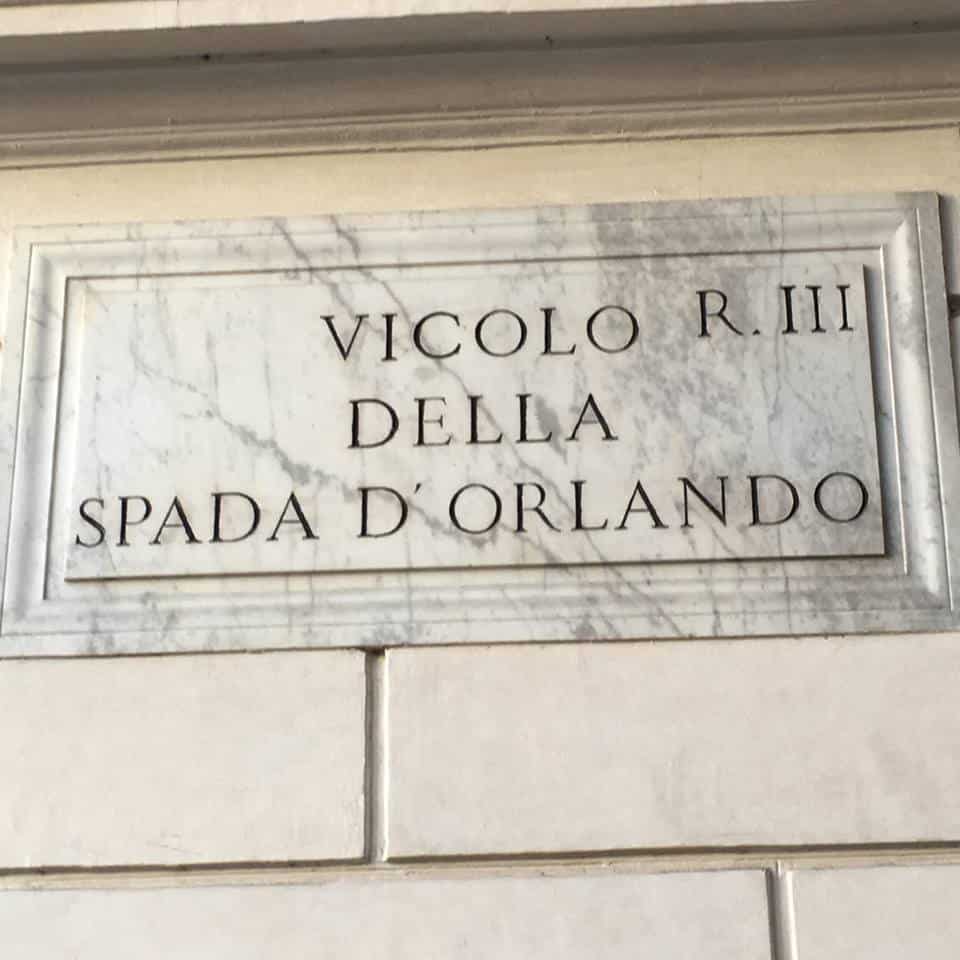
Vicolo della Spada d'Orlando, Rione IX Colonna, in Rome: a little street of about 50 steps that connects Piazza Capranica to Via delle Colonnelle, about 100 meters from the Pantheon and barely a quarter of an hour's walk from Piazza di Spagna. You can enter at any hour, day and night, and you pay nothing: it is a public street, not a fenced monument. There is no ticket office, no custodian, no reservation. The column shaft with the split emerges from the sampietrini paving on the right side coming from Piazza Capranica, set against the wall, a little over a meter high. The most convenient public transport is the surface lines that stop at Piazza San Silvestro and on Via del Tritone, and metro Line A with the Spagna and Barberini stations, both 10 or 12 minutes on foot. Bus line numbers change often, so it is best to check them on the transport company's website the same day. The underground of Piazza Capranica, where the rest of the temple that column comes from lies, is instead not a place with free access: it is visited only on organized occasions, and availability has to be asked of the body that manages the building.
This is one of the pages in the collection of tourist attractions in Rome, and it belongs to that category of stops that last five minutes and stay in your head for years.
Where exactly Orlando Furioso and the scar on the column is
The alley opens on the northern flank of Piazza Capranica, the one dominated by the 15th-century palace with the tower and the two-light windows. If you come from the Pantheon you cross Via dei Pastini, come out into Piazza Capranica and find the entrance on the left, narrow between two buildings. If you come from Piazza Colonna you go down Via in Aquiro or Via delle Colonnelle and take it from the other end. It is so short that most passersby cross it without noticing anything: the stump of column is low, gray, covered in dust, and to a distracted eye it looks like one of the many ancient bollards that in Rome protect the corners of buildings from cart wheels.
The address and the two entrances of the alley
The official place name is Vicolo della Spada d'Orlando. It has two entrances and no street number worth mentioning: the doors of the buildings flanking it are numbered on the major streets. The good reference to give a taxi driver is Piazza Capranica. The good one to give a friend waiting for you on the phone is the little fountain, because there is only one in the alley and you see it right away. Keep in mind that the name of the street is a rare case of Roman street naming that openly celebrates a literary legend: not a saint, not a pope, not a trade, but the sword stroke of a paladin who in historical reality never set foot here.
How to get to Orlando Furioso and the scar on the column
Rome's historic center is covered on foot, and this is one of those cases where there is no sensible alternative. From the Trevi Fountain it is eight minutes via Via delle Muratte and Piazza Colonna. From Piazza Navona it is a good 10 minutes, crossing Via della Rotonda and the flank of the Pantheon. From Piazza di Spagna you go along Via dei Condotti to Via del Corso, cut across on Via delle Convertite and go down toward Piazza Capranica: 12 or 13 minutes without running. From Largo di Torre Argentina, where many lines stop, you go up Via dei Cestari and Via della Minerva.
How much it costs to see Orlando Furioso and the scar on the column
Nothing. It is an open street, lit in the evening, passable at any hour. This makes it one of the few things in Rome you can see at seven in the morning on Ferragosto and at 11 at night on January 1, without a line and without entry slots. If someone offers you a ticket to see the column, you are talking to a swindler.
What you really see in the alley
A truncated column shaft, of cipollino marble, set into the paving next to the wall. Cipollino is an unmistakable stone: it comes from the island of Euboea, in Greece, and owes its name to the green, wavy veining that alternates with the white background like the layers of a cut onion. On Roman shafts that veining generally runs parallel to the axis, and if you bend down to look you can still distinguish it well, despite centuries of rain, wheels and hands. The diameter is that of an embrace: we are talking about an architectural element of monumental size, not a little courtyard pillar.
The cut on the column, measured by eye
The split crosses the shaft diagonally, from top to bottom, and widens in the middle like a mouth. It is not a frost crack, which would follow the veins of the marble. Nor is it a clean chisel cut, which would have regular edges. It has rather the look of an impact fracture, with slightly chipped margins. It is exactly the type of damage produced when a very heavy block falls from a few meters and hits an edge, or when it is struck repeatedly to reduce it to transportable pieces. Rome broke, sawed and recycled its ancient marbles for 15 centuries: the medieval lime kiln devoured more columns than any earthquake.
The little fountain in Vicolo della Spada d'Orlando
In the alley there is a small wall fountain fed by the Acqua Vergine, the Augustan aqueduct restored in the modern age that also brings water to the Trevi Fountain and the Barcaccia Fountain. Local sources date it to the pontificate of Gregory XIII, so to the period between 1572 and 1585, and report that in 1869 it was moved here from Via de' Pastini to free the passage of carriages. An inscription recalls the transfer. It is a detail almost nobody connects to the column, and yet it tells the same story: in this block everything was moved, reused, reassembled elsewhere.
The rest of the street: bricks, thresholds, walls
Walking slowly you notice, in the low walls and thresholds, fragments of Roman brick and pieces of white marble built into the masonry. Local scholars link them to the same monumental complex the column comes from. It is not spectacular archaeology: it is the normal way Rome built itself, quarrying material from the ruins on the floor below.

A curiosity about Orlando Furioso and the scar on the column
The real curiosity is not the cut: it is the chronological short circuit that the legend imposes and that nobody notices. The paladin Orlando, if he really existed, dies in 778. The first poem that makes him famous across Europe, the Chanson de Roland, was composed according to scholars between 1070 and 1080, and the oldest manuscript that hands it down is slightly later than 1100. The poem cited in the title, Ludovico Ariosto's Orlando furioso, came out in print in Ferrara on April 22, 1516. The column, instead, comes from a building erected in Rome around 119 AD. Between the stone and the knight who supposedly cut it run 650 years. Between the stone and the poet who made that knight famous run almost 1400. The Roman legend took an imperial ruin and stuck on top of it a Carolingian story made popular by a Renaissance man of letters. Three different eras stacked on a meter of marble.
The second layer of curiosity concerns street naming. Rome has thousands of streets named after saints, popes, families, trades, shops. The streets bearing the name of a character of literary fiction can be counted on the fingers. Here fiction won over archaeology so clearly that the official name of the street celebrates the sword stroke, while the real monument, the imperial temple buried five meters under the neighboring square, does not even have a plaque on the surface. If an archaeologist from the second century came back to this alley, he would not understand why the Romans renamed his temple with the name of a Frankish warrior.
Third curiosity, perhaps the funniest: the legend has two competing versions, and neither puts Orlando in the alley for a sensible reason. In one, Orlando strikes the column in Rome trying to break his own sword so it does not end up in the hands of the Saracens. In the other, it is Charlemagne in person who brings Durendal to Rome after his nephew's death and tries to destroy it with a blow. Whoever tells the second version usually does not notice that it contradicts the first, where the sword stays with Orlando to the end. Popular legends do not edit.
The temple of Matidia, the true owner of the column
Take away the sword and the stone remains. And the stone has a documented biography, which is worth more than the legend. The shaft in the alley most likely belongs to the temple that Emperor Hadrian had built in the Campus Martius in honor of his mother-in-law Salonina Matidia, deified at her death in 119 AD. It is a unique case in Roman history: no other emperor ever deified his wife's mother.
Who Salonina Matidia was
Matidia was the daughter of Ulpia Marciana, sister of Emperor Trajan, and the mother of Vibia Sabina, Hadrian's wife. In a dynasty that did not pass power by direct blood but by adoption, women were the glue: through Matidia, Hadrian held together his own name and Trajan's. Her deification was not a sentimental gesture, it was dynastic politics carved in marble. Hadrian personally delivered her funeral oration, and a coin of 120 bears the legend DIVAE MATIDIAE SOCRVI, to the divine Matidia, mother-in-law: the only time the word mother-in-law appears on a Roman imperial coin.
The temple: size, shape, materials
The temple was peripteral octastyle, that is, surrounded by columns on all sides with eight columns on the front, and measured about 36 meters in length. The columns were of cipollino marble, with bases of about one meter and 70 centimeters in diameter, which leads to an estimate of shafts no less than 17 meters tall. 17 meters is the height of a six-story building. Keep that number in mind when you look at the stump in the alley: what you see is the tip of a fingernail.
The two basilicas and the monumental block
The temple was not isolated. It stood at the center of a symmetrical complex, flanked by two large porticoed buildings that scholars identify as the Basilica of Matidia and the Basilica of Marciana, dedicated to the daughter and the mother. Their footprint corresponds to today's Via in Aquiro and Via de' Pastini, which keep the ancient orientation under the asphalt. Around, a few dozen meters away, were Hadrian's Pantheon, the Temple of Hadrian in Piazza di Pietra, the baths of Agrippa, the Serapeum, the Column of Marcus Aurelius. The central Campus Martius was a district of continuous marble, and this block was one of its nodes.
The underground of Piazza Capranica
In 2005, during restoration work on the 16th-century palace facing the square, the temple resurfaced five meters below street level. In the underground you can see the great column bases, a stretch of the staircase, part of the peristyle and patches of original paving with traces of pigment. Lower still, at a lower level, the wooden foundation piles emerged, dated to the middle of the first century. It is not a museum with a ticket office and continuous hours: access happens on organized occasions, and anyone who wants to go in has to act in good time by asking the body that manages the palace.
The other surviving columns
Besides the shaft in the alley, two other columns of the same temple are built into the masonry of a building facing Piazza Capranica. Local sources do not agree on the street number, so the most honest thing to say is that they are in Piazza Capranica and can be recognized by the curvature of the wall and the diameter, out of all proportion to any modern element. Look at the facades a meter and a half off the ground, on the side opposite the church: the belly of the column can be sensed under the plaster.

Something nobody tells you about Orlando Furioso and the scar on the column
That the column, almost certainly, never stood upright where you see it. This is one of the least told and most important things in the whole story. A cipollino shaft 17 meters tall belongs to the colonnade of a temple, and that colonnade stood on the area of the square, not on a side lane three meters wide. What emerges from the paving is a fallen stump, or more probably one sawed off and abandoned because it was too heavy to move, left where the centuries left it while the medieval city grew around it. The alley does not preserve a monument: it preserves a construction-site discard from the 12th or 13th century.
Second thing you do not hear: the cut is, in all likelihood, younger than the fall. When a marble shaft is reduced to pieces to obtain thresholds, steps or lime, it is scored with wedges and struck until it gives way. The fractures produced this way are oblique and ragged, exactly like the one you see. The sword stroke of the legend, in short, has a technical explanation that is much less epic and much more credible: someone tried to turn it into lime, struggled, and gave up. The piece was too big. That the scar on the column is the sign of a medieval craft failure, and not of a Carolingian blow, is a truth that no guide tells willingly.
Third thing. The sword of Rocamadour, in France, which tradition indicates as Durendal stuck in the rock, is not an early medieval weapon: studies consider it a much more recent artifact, materially poor, born to attract pilgrims and offerings. In June 2024 that blade disappeared from the rock wall where it was secured with a chain, and its theft was reported. Anyone who tells you today that Orlando's sword is still stuck in the French cliff is repeating outdated information.
Orlando: how much is history, how much is tradition, how much is legend
It is best to put things in order here, because this is the point where almost all the tellings slip. Three distinct levels, not to be mixed.
Documented: a Frankish commander dead in 778
The oldest testimony is read in the Vita Karoli of Einhard, biographer of Charlemagne, written between 829 and 839. Einhard recalls that the rear guard of the Frankish army, returning from Spain, was massacred in a pass of the Pyrenees, and among the fallen he names a Hruodlandus, prefect of the march of Brittany. The traditionally accepted date for the clash of Roncesvalles is August 15, 778, and the attackers were Basque populations, not Saracens. Three lines: everything history knows about Orlando fits in three lines.
Tradition: the Chanson de Roland and the Carolingian cycle
Three centuries later, between 1070 and 1080, an anonymous poet turns that ambush into a pitched battle between Christians and Saracens, invents the betrayal of Ganelon, puts in Orlando's mouth the ivory horn that he blows with such force that he dies of it. From then on the character grows by accumulation: cantari, romances, chivalric poems, the puppet theater. Durendal enters the story as an indestructible sword, and in the Chanson its golden pommel contains four relics that the text lists one by one: a tooth of Saint Peter, the blood of Saint Basil, the hair of Saint Denis, a piece of the robe of the Virgin Mary. This is literary tradition, not chronicle.
Legend: the blow on the Roman column
The third level is the local one, and it is the youngest of all. No ancient or medieval source links Orlando to this block of the Campus Martius. The name of the alley comes from the popular Roman habit of explaining ruins with a story: the column was broken, the cut looked like a blade stroke, and in the shared repertoire the most famous blade was Orlando's. The blow of Durendal in Vicolo della Spada d'Orlando is legend. Not a debated tradition, not an archaeological hypothesis: legend, and it has to be said with this clarity. The beauty of the thing does not diminish by a gram.
Where the sword ends up, according to the stories
The versions of the end of Durendal do not agree with each other. One has it hurled by the dying Orlando so that nobody picks it up. Another has it arrive miraculously at Rocamadour, in the French Quercy, where it would have remained stuck in the cliff beside the Marian sanctuary. Specialists consider that tale a modern construction, useful for pilgrimage. Our alley adds a further variant, entirely Roman: the sword would have passed through here, and left its mark before vanishing from history.

Ariosto's Orlando furioso and the fortune of the paladin
The name the alley carries in the memory of Romans does not come from the Chanson de Roland, which few in Italy have read, but from the poem of Ludovico Ariosto, which for three centuries was the most widely read secular book on the peninsula.
The three editions, with dates
Ariosto was born in Reggio Emilia on September 8, 1474 and died in Ferrara on July 6, 1533. The first edition of the Orlando furioso came out on April 22, 1516 in 40 cantos, with a dedication to Cardinal Ippolito d'Este, who showed very little enthusiasm for the work. The second edition, still in 40 cantos, is from February 13, 1521. The third and definitive one, the one everybody reads, is from October 1, 1532: 46 cantos, 4,842 octaves, 38,736 lines. A poet who works 16 years on the same book and rewrites it twice is not an entertainer: he is an obsessive craftsman.
From Boiardo to Ariosto
The Furioso was born as a continuation of Matteo Maria Boiardo's Orlando innamorato, left unfinished. Ariosto picks up the threads left open, adds some of his own and at a certain point stops considering himself a continuator: he treats the earlier poem as material, not as a constraint. Three lines hold up the plot: the war between Christians and Saracens around Paris, Orlando's madness, and the love between Ruggiero and Bradamante from which, according to the poem, descends the House of Este that paid the author's salary.
The madness, and the trip to the Moon
The heart of the poem is Orlando's collapse when he discovers that Angelica, whom he chases across half the world, has married the Saracen foot soldier Medoro. The paladin goes mad, throws away his arms and clothes, devastates the countryside. The one who restores his reason is Astolfo, who on the hippogriff flies to the Moon and finds Orlando's wits kept in a vial, among everything that men lose on earth. It is the most modern invention of Italian literature of the 1500s, and five centuries later it still holds up.
Ariosto in Rome
The poet knew this city well and did not particularly love it. He arrived on a diplomatic mission for the Este on December 16, 1509, to Pope Julius II, and returned several times in the years immediately following. In 1512 he accompanied Duke Alfonso I to the Vatican. In 1513 he witnessed the elevation to the papacy of Giovanni de' Medici, Pope Leo X, from whom he hoped for favors that did not arrive in the measure expected. On October 30, 1514 he set out again for Rome with Cardinal Ippolito. From 1517, when he refused to follow Ippolito to Buda, his court career ended. Between February 20, 1522 and March 1525 he was ducal commissioner in Garfagnana, dealing with bandits and feuds. He was buried without ceremony in the church of San Benedetto in Ferrara. His bones were solemnly transferred only in 1801.
The fortune of the character, and why the alley has this name
Between the 1500s and the 1800s the Furioso was read aloud in workshops, sung by street singers, printed in hundreds of illustrated editions, plundered by painters and librettists. In a Rome where literacy was low and oral memory very high, Orlando was a name as familiar as a saint's. When a people has to explain a split marble, it draws on the repertoire it owns: that is why in Vicolo della Spada d'Orlando the scar on the column became the work of Durendal and not, say, of an earthquake.
The advice I give you for visiting Orlando Furioso and the scar on the column
Go early in the morning, between seven and nine, and go on foot from the Pantheon. The reason is practical, not poetic: after 10 Piazza Capranica becomes a bottleneck of passing groups, delivery vans and café tables, and the alley is reduced to a corridor where nobody will let you crouch for two minutes in front of a stump of marble. At eight in the morning you are alone, the raking light enters from the end of the street and the cut reads much better.
Second piece of advice, and here I go against the current: do not treat it as a stop on its own. Five minutes of alley do not justify a special trip from Trastevere or the Aventine. Put it into a Campus Martius walk that starts from the Pantheon, touches Piazza Capranica, goes down to Piazza di Pietra to see the 11 columns of the Temple of Hadrian, continues to Piazza Colonna and ends in front of Montecitorio. In 40 minutes you will have seen four monuments of the same imperial district, and the stump in the alley will stop looking like a random wreck and become the last piece of a design.
Third: bring the kids and tell them the story before showing the stone. It always works. Ask what they expect to see after hearing about a sword that cuts marble, then have them turn the corner. The difference between the expectation and the dusty stump is the best lesson Rome can give on the relationship between legend and reality, and it does not require a ticket.
Fourth, on timing. If you want to see the temple's underground, move weeks in advance and do not count on improvising: it is not a free-entry site and openings are occasional. If instead you are content with the surface, you have total freedom: this is one of the very few things in Rome you can see at midnight walking back from dinner.
Another well-known fact, yet rarely cited
That the central Campus Martius, the part between the Pantheon, Piazza di Pietra and Piazza Colonna, was for decades a single imperial building site is known to all enthusiasts. What is rarely cited is the urban planning consequence: the streets you walk today trace the walls of those monuments. Via de' Pastini and Via in Aquiro are not random medieval layouts, they follow the footprint of the two porticoes that flanked the temple of Matidia. The church of Santa Maria in Aquiro, on the square, rests on ancient structures and in its underground the foundations of the temple can be read. The name of the church itself, in Aquiro, is a matter of discussion among scholars and is linked to the ancient building.
Second rarely cited fact: reuse. The 11 columns of the Temple of Hadrian in Piazza di Pietra survived because in 1695, under Innocent XII, the architect Carlo Fontana built them into the facade of the Dogana di Terra. They were not saved out of love for the ancient, they were saved because they were handy as a load-bearing wall. The columns of Matidia, which nobody built into a prestigious public building, ended up partly in the walls of private houses in Piazza Capranica and partly on the ground, like the one in our alley. The difference between a famous monument and a forgotten stump, in Rome, is almost always a question of reuse.
Third: the level. The ancient walking surface of the Campus Martius is about five meters below the current one. This means the column you see emerging a meter from the paving is actually at least six meters tall, and the rest is buried in the embankment of debris on which modern Rome walks. When you look at that stump, you are looking at the top of an element that continues under your feet.
Palazzo Capranica, the square that frames it
The square from which you enter the alley takes its name from the palace that closes it on the long side, and that palace deserves five minutes of attention before you slip into the little street.
Cardinal Domenico Capranica and the date 1451
Domenico Capranica, bishop of Fermo, started construction in 1451, and the date is carved on one of the two marble portals of the facade. The family came from Capranica Prenestina, on Via Prenestina, and with him rose to the top of the curia. On January 5, 1457 the cardinal founded the college for poor students that still bears his name today, the Almo Collegio Capranica, intended for young men of modest condition set on an ecclesiastical career, with studies in theology and canon law. His brother Angelo, also a cardinal, later obtained permission from Sixtus IV to enlarge the building.
The windows, the tower, the two portals
On the facade you can read three Gothic two-light windows and three Renaissance windows with a Guelph cross, a coexistence of languages that tells the exact moment when Rome passes from the Middle Ages to the Renaissance. On the corner tower there is a bas-relief with the Savior between two candelabra and two praying figures. There are two portals: one bears the inscription COLLEGIUM CAPRANICENSE, the other the date 1451 and the sign of the Teatro Capranica.
The Teatro Capranica, one of the first public theaters in Rome
Around 1670 Pompeo Capranica created a private theater on the first floor by knocking down the partitions. The inauguration took place on January 6, 1679. In 1694 the architect Carlo Buratti redesigned the palace with a U-shaped plan. The theater closed for good on March 1, 1881, then served as a furniture warehouse, became a cinema until 2000 and since 2005 has worked as a conference center. For two centuries, 20 meters from Orlando's column, opera in music was staged: and in Italian opera Orlando and Angelica are recurring characters, brought on stage dozens of times.
The right photo to take at Orlando Furioso and the scar on the column
The wrong photo is the one everybody takes: column in the center, frontal framing, flash. You get a gray rock on a gray background and nothing makes sense. The cut disappears, the scale disappears, an anonymous ruin remains.
The right photo is built in three moves. First, get low: bring the lens down to the height of the cut, that is, about 60 centimeters off the ground. From that height the split opens up and the shaft gains mass. Second, look for raking light: early in the morning or in the late afternoon the sun enters from the end of the alley and crosses the street sideways, and the shadow inside the crack becomes black and deep. In full midday light, with the sun straight overhead, the split flattens and cannot be seen.
Third, and here is the difference between an archive photo and a photo that tells a story: put a hand in the frame, resting on the marble next to the cut. It gives the scale. Without a human reference nobody understands that this shaft has the diameter of a centuries-old trunk, and the photograph loses its only argument.
If you feel like a second shot, move away toward the entrance on Piazza Capranica and frame the alley in depth, with the column in the foreground on the left and the 15th-century palace in the background. It is the image that explains the context: a piece of the second century, a street of the 1500s, a facade of the 1400s, all in a single frame. For the little fountain, wait for somebody to drink: still water in a photograph is mute.
One last technical recommendation. The alley is narrow and the walls are light: if you shoot with the phone on automatic, the camera exposes for the walls and gives you back a black column. Tap the screen on the marble to force the exposure on the subject, and if the phone allows it go down half a stop. It makes an enormous difference.
Some important events that happened here in history
An alley of 50 meters has no chronicle of its own, but the block does, and it is a chronicle 19 centuries long.
119: the deification of Matidia
At the death of his mother-in-law, in 119, Hadrian delivered her funeral oration and obtained her deification from the senate. The following year the imperial mint struck the coin with the legend DIVAE MATIDIAE SOCRVI. The temple that followed, with its cipollino colonnade, was born from that decision: the column in the alley is a fragment of that political gesture.
Between the fifth and the 13th century: the city eats the temple
There is no date for the fall of the temple of Matidia. The process was slow: collapses, plundering, lime kilns, houses built against the ruins. When in the Middle Ages the Campus Martius became the inhabited district of Rome again, the temple was already a quarry. The stump in the alley survived because nobody managed to break it up completely or carry it away.
1451 and 1457: Cardinal Capranica
The construction of the palace, begun in 1451, and the founding of the college, on January 5, 1457, shift the center of gravity of the block. From an area of ruins to the seat of an institution that still exists.
1572-1585 and 1869: the fountain
Under Gregory XIII the little Acqua Vergine fountain that you see today in the alley was built. In 1869 it was moved here from Via de' Pastini to widen the passage for vehicles. An inscription on the spot recalls the transfer.
Around 1590, 1774, 1861-1866: the church on the square
Santa Maria in Aquiro, attested by an oratory earlier than the middle of the eighth century and restored by Pope Gregory III between 731 and 741, was rebuilt around 1590 at the wish of Cardinal Anton Maria Salviati, who added the orphanage and the college next to it. The facade was completed in 1774 by Pietro Camporese. Between 1861 and 1866 the architect Gaetano Morichini carried out a general restoration.
1679 and 1881: the theater opens and closes
On January 6, 1679 the Teatro Capranica was inaugurated, one of the first Roman theaters open to a paying public. It closed on March 1, 1881, after two centuries of seasons.
2005: the temple resurfaces
During the restoration of the 16th-century palace on Piazza Capranica, five meters below street level, the column bases, the staircase and part of the peristyle of the temple of Matidia re-emerged, along with the wooden foundation piles from the middle of the first century. It is the moment when the legend of the sword finally finds its documentary counterpart.
Who has passed through Orlando Furioso and the scar on the column
Certainly not the paladin Orlando, who in all likelihood never saw Rome and died in the Pyrenees in 778. But people whose names stand up to the comparison have passed through this block.
Hadrian, emperor from 117 to 138, is the patron of the complex: it was he who wanted the temple for Matidia and, a stone's throw away, the Pantheon in the form we see today. That he walked on this ground is, for once, almost certain.
Antoninus Pius completed around 145 the nearby Temple of Hadrian, dedicated to his deified adoptive father: the 11 columns of Piazza di Pietra, 150 meters from here, are his work.
Pope Gregory III, pontiff between 731 and 741, restored the oratory from which Santa Maria in Aquiro would be born: we are in the full early Middle Ages, when the temple of Matidia was still standing at least in part.
Cardinal Domenico Capranica built the palace from 1451 and founded the college in 1457. His brother Angelo Capranica obtained its enlargement from Sixtus IV. Pompeo Capranica created the theater around 1670 and opened it in 1679. The architect Carlo Buratti redesigned the building in 1694.
Cardinal Anton Maria Salviati had the church rebuilt around 1590 and wanted the orphanage next to it. Pietro Camporese completed the facade in 1774 and Gaetano Morichini restored the whole between 1861 and 1866.
Ludovico Ariosto, the man who gave the legend its name, was in Rome several times between 1509 and 1514, on missions for the Este. There is no document placing him in this alley, and let nobody write otherwise: the link between him and the column passed through his readers, not through his feet.
Finally the Romans, who are the true protagonists of this story. It was they, generation after generation, who looked at that broken marble, chose one explanation among all the possible ones and made it the official name of the street. Few cities in the world have the power to turn neighborhood gossip into municipal street naming.
Capranica near Viterbo, the other trace of the paladin
55 kilometers from Rome on Via Cassia, on the Francigena, is Capranica, in the province of Viterbo. A local tradition holds that the paladin Orlando, in the retinue of Charlemagne headed for Rome, camped in its towers. It has to be said precisely what this is worth: it is a local tale, not a document. The historical sources on the town speak of other things, of the pastoral origin of the name and of the castle of the Anguillara, and do not record the paladin's passage. The interesting fact remains: the legend of Orlando, in Lazio, is not isolated in a Roman alley, it has a geography. Anyone who wants to follow it finds in Capranica the Torrione dell'Orologio, the church of San Francesco between the 13th and 16th centuries, the church of San Pietro from the ninth century and the Madonna del Piano designed by Vignola: a half-day trip that is worthwhile even without knights.
It is worth remembering that the same Capranica family of the Roman palace came from Capranica Prenestina, which is yet another town, in the Prenestini Mountains. Three places with almost identical names and different stories: anyone preparing an itinerary stumbles over them regularly.
Orlando Furioso and the scar on the column with children
It works very well, on one condition: first the story, then the stone. An eight-year-old child in front of a stump of marble sees nothing. The same child, after three minutes of the story of a knight gone mad who tries to break an indestructible sword, looks at that marble in a different way. Add the part that always wins them over, that is, the relics in the pommel of the sword and the trip to the Moon to recover the wits lost inside a vial.
Then let them touch the column: it is one of the very rare Roman antiquities you can brush against without breaking any rule, because it has been street furniture for centuries. The little fountain next to it solves the water problem, and 200 meters away are the Pantheon and the cat sanctuary of Largo Argentina, which for the under-10 age group is always the surest victory of the day.
Accessibility of the alley
The alley is flat and without steps, but it is paved with sampietrini and this, for anyone in a wheelchair or pushing a small-wheeled stroller, is the real obstacle of the center of Rome. The width is enough for passage, and the column shaft is set against the wall and does not get in the way. Anyone with mobility difficulties can still see the column by staying on Piazza Capranica side, which is paved more regularly. The temple's underground, being five meters below street level and reached by stairs, is not suitable for those who cannot manage ramps.
What to see within 10 minutes on foot
This is the real strength of the stop: you are in the middle of one of the densest districts in Europe. Within a radius of 600 meters, without ever taking transport:
The Pantheon and Piazza di Pietra
The Pantheon is two minutes away: Hadrian's temple, the best preserved of the ancient world, with the largest concrete dome ever built without reinforcement. In the opposite direction, three minutes, is Piazza di Pietra with the 11 Corinthian columns 15 meters high and one meter 44 centimeters wide, in white Proconnesian marble, built in 1695 by Carlo Fontana into the Dogana di Terra at the wish of Innocent XII.
Piazza Colonna, Montecitorio, Via del Corso
Piazza Colonna with the Column of Marcus Aurelius is 150 meters away. Behind it, Montecitorio with the obelisk of Psammetichus II. From there you come out on Via del Corso, the straight axis that Romans call that from the Carnival races of the Barbary horses.
The churches of the district
The church of Sant'Ignazio di Loyola with Andrea Pozzo's fake dome is four minutes away. The basilica of Santa Maria sopra Minerva, the only Gothic one in Rome, is five. The basilica of San Lorenzo in Lucina is six.
Toward the Tridente and toward the Tiber
In 10 minutes you reach the Trevi Fountain, Piazza di Spagna with the Barcaccia Fountain and the staircase of Trinità dei Monti. In the other direction, toward the river, the Ara Pacis and the Mausoleum of Augustus. Anyone who prefers archaeology can instead go down to Largo di Torre Argentina and the underground of the Stadium of Domitian beneath Piazza Navona.
When to go, and when to avoid
The best time is early morning on a weekday, in any season. The worst is Saturday afternoon from October to January, when the quadrilateral between the Pantheon and Via del Corso becomes impassable. In August, against all expectation, the alley is a blessing: it is in shade almost all day because of the height of the buildings, and at noon it is five degrees cooler than in the square. In the evening it is lit and safe like the whole district, and the column under artificial light looks surprisingly good, because the raking lamp digs out the cut.
Frequently asked questions about Orlando Furioso and the scar on the column
Where exactly is the scar on the Orlando Furioso column?
The scar on the Orlando Furioso column is in Vicolo della Spada d'Orlando, in the Colonna district of Rome, a little street that connects Piazza Capranica to Via delle Colonnelle, a few steps from the Pantheon. It is not inside a church or inside a portico: it is outdoors, on the public street, set against the wall on the sampietrini paving.
Do you pay a ticket to see the Orlando Furioso column?
No, the Orlando Furioso column in Vicolo della Spada d'Orlando can be seen free of charge at any time, being a find left on the public road and not a monument with a ticket office. You just enter the alley from Piazza Capranica or from Via delle Colonnelle to find it set against the wall.
How do you get to Vicolo della Spada d'Orlando from the Pantheon?
From the Pantheon you reach Vicolo della Spada d'Orlando by crossing Via dei Pastini to Piazza Capranica, where the entrance of the little street opens on the left, narrow between two buildings. If you come instead from Piazza Colonna you go down Via in Aquiro or Via delle Colonnelle and take the alley from the other end.
Is the column in the alley of the Orlando Furioso really linked to the paladin Orlando?
The link between the column in the alley and the paladin Orlando is popular legend, not historical fact: the cipollino marble shaft most likely belonged to the colonnade of the temple that Emperor Hadrian had built in the Campus Martius in honor of his mother-in-law Matidia, deified in 119 AD. The cut in the marble was attributed in Roman tradition to the indestructible sword of Orlando, protagonist of Ludovico Ariosto's Orlando furioso.
What is the best time to photograph the Orlando Furioso column?
The best time to photograph the Orlando Furioso column is early in the morning, between seven and nine, when Piazza Capranica and the alley are still empty and the raking light enters from the end of the street. After 10 the area fills with passing groups and delivery vans, and it becomes hard to stop calmly in front of the stump of marble.
Is Vicolo della Spada d'Orlando wheelchair accessible?
Vicolo della Spada d'Orlando is flat and without steps, but it is paved with sampietrini, which remain the real obstacle for anyone in a wheelchair or pushing a stroller with small wheels. The width is however enough for passage, and the column remains visible even from Piazza Capranica side, which is paved more regularly.
What is there to see around Vicolo della Spada d'Orlando?
Around Vicolo della Spada d'Orlando is one of the densest districts of Rome in points of interest: the Pantheon is two minutes' walk away, while in the opposite direction, three minutes away, opens Piazza di Pietra with its 11 columns of the Temple of Hadrian. A little further on you reach Piazza Colonna and Montecitorio.
Is it worth bringing children to see the Orlando Furioso column?
Bringing children to see the Orlando Furioso column works well, but only by first telling the story of the knight and the legend of the indestructible sword: without that premise a child sees only a stump of gray marble. With the story, and with the detail of the relics in the pommel of the sword, the stone becomes far more interesting to them.
How to fit Orlando Furioso and the scar on the column into an itinerary
Short stops are what decide the rhythm of a morning. Vicolo della Spada d'Orlando is the classic 90-second stop that revives attention between two major monuments, and it should be used that way, not as a goal.
For those traveling alone or as a couple
Build a loop: Pantheon, Piazza Capranica and the column, Piazza di Pietra, Piazza Colonna, Montecitorio, back by Via dei Pastini. An hour and a half at an easy pace, no tickets, no lines. If you have three full days in the city and want an already tested layout, the English-language guide Rome Itinerary 3 Days sets out the order of visits sensibly with respect to timed reservations. The reasoned list of the things worth seeing is instead in Best things to do in Rome.
For groups and for organizers
With a group of 40 people the alley does not hold up: it is three meters wide and a plug forms. With large groups it is best to tell the story in Piazza Capranica, where there is space, and let 10 people at a time into the alley. Anyone organizing private or corporate tours in Rome and wanting a guide who knows this kind of detail will find the picture of services and skills on the About us page of TourLeaderPro, and can ask for a quote from the Contacts page.
For those who want the underground
The openings of the archaeological area under Piazza Capranica are occasional and limited in number. Anyone who cares has to find out well in advance from the body that manages the palace, or rely on a professional who follows the calendar of extraordinary openings: it is exactly the kind of work done by the TourLeaderPro network.
Quick questions about Orlando Furioso and the scar on the column
Where exactly is the scar on the Orlando Furioso column?
In Vicolo della Spada d'Orlando, Colonna district, a little street that connects Piazza Capranica to Via delle Colonnelle, a few steps from the Pantheon. It is not inside a church and not inside a portico: it is outdoors, on the public street, set against the wall on the sampietrini paving. Anyone looking for the column inside a building will not find it.
Do you pay a ticket to see Orlando Furioso and the scar on the column?
No. It is a public street, always open and free, 24 hours a day.
How long does the visit take?
Five minutes for the column. 40 if you fit it into the loop Pantheon, Piazza di Pietra, Piazza Colonna, Montecitorio, which is the right way to use it.
Is the cut on the column really the work of Orlando's sword?
No. It is legend, and it has to be said without half measures. The most likely technical explanation is a fracture produced during a medieval attempt to break up the shaft to reuse the marble, or an impact from a fall.
Where does the column come from?
From the temple that Hadrian dedicated to his mother-in-law Salonina Matidia, deified in 119 AD, which stood in this area of the Campus Martius.
What marble is it made of?
Cipollino marble, quarried on the island of Euboea in Greece, recognizable by the wavy green veining on a light background.
How tall was the original column?
The base of about one meter and 70 centimeters in diameter leads to an estimate of shafts of at least 17 meters, the height of a six-story building.
Who was Matidia?
Daughter of Ulpia Marciana, sister of Trajan, and mother of Vibia Sabina, wife of Hadrian. So mother-in-law of the emperor, who deified her: a unique case in Roman history.
Can you visit the remains of the temple under Piazza Capranica?
The remains exist and are preserved in the underground of the palace facing the square, rediscovered in 2005 five meters below street level. Access is not free: it happens on organized occasions and has to be arranged with the body that manages the building.
Are there other columns from the same temple?
Yes, two others are built into the masonry of a building on Piazza Capranica. Sources do not agree on the street number, so it is best to look for them by eye, recognizing the curvature of the wall.
What is the relationship between the alley and Ariosto's poem?
No direct relationship. The Orlando furioso, published in 1516 and in its definitive version in 1532, made the paladin so popular in Italy that the Roman people attributed the cut in the marble to him. The poem gave the legend its name, not the other way around.
Is Orlando a historical or an invented character?
Historical, but very little is known about him. Einhard, in the Vita Karoli written between 829 and 839, mentions a Hruodlandus prefect of the march of Brittany who fell in the ambush of Roncesvalles, dated to August 15, 778. Everything else is literature.
Were the attackers at Roncesvalles Saracens?
No. Sources indicate Basque populations. The Saracens enter the story three centuries later, with the Chanson de Roland.
What did Durendal contain?
According to the Chanson de Roland the golden pommel held four relics: a tooth of Saint Peter, the blood of Saint Basil, the hair of Saint Denis and a piece of the robe of the Virgin.
Is Orlando's sword still at Rocamadour?
No. The blade displayed in the French cliff, considered by scholars a modern artifact tied to pilgrimage, disappeared in June 2024 and its theft was reported.
Can you take photos of Orlando Furioso and the scar on the column?
Yes, it is a public street. Shoot by getting low to the height of the cut and with raking light, and put a hand in the frame to give the scale.
Is the alley wheelchair accessible?
The route is flat and without steps, but paved with sampietrini, which make pushing tiring. The column can also be seen from Piazza Capranica side.
Is there drinking water nearby?
Yes, in the alley itself: an Acqua Vergine fountain, moved here from Via de' Pastini in 1869.
When is it best to go to find it empty?
Between seven and nine in the morning on a weekday. Saturday afternoon in autumn is the worst moment.
Is it suitable for children?
Very much, if you tell the story before showing the stone. And they can touch it: it has been street furniture for centuries.
How many important monuments are there within 10 minutes?
At least 10: Pantheon, Temple of Hadrian, Column of Marcus Aurelius, Montecitorio, Sant'Ignazio, Santa Maria sopra Minerva, San Lorenzo in Lucina, Trevi Fountain, Piazza di Spagna, Largo di Torre Argentina.
What is the difference between this alley and the Temple of Hadrian in Piazza di Pietra?
They are two different temples of the same imperial district. Matidia's, from which our column comes, dates to about 119 and is almost entirely buried. Hadrian's, completed around 145 by Antoninus Pius, survived in 11 columns because in 1695 it was built into the Dogana di Terra.
Is the name of the alley official?
Yes, Vicolo della Spada d'Orlando is the official place name, one of the very rare Roman cases in which a street bears the name of a literary episode.
The last word
In this alley the reaction is always the same: first disappointment, then a smile. You expect a spectacular wound and you find a gray stump a meter high. Then the right thought arrives, and it is this: in front of you is a piece of the colonnade that an emperor had raised for his deified mother-in-law, and the people of this city, to explain it to themselves, preferred to imagine on top of it a knight gone mad with an indestructible sword. It is not ignorance, it is a way of inhabiting ruins. Rome does not keep the ancient under glass: it uses it as a bollard, baptizes it with the name of a paper hero and keeps walking beside it.
The final advice: do not just photograph. Rest your hand on the marble, count in your head the 17 meters that column measured, and think that the rest is still down there, five meters lower, with its bases and its staircase. Then go off to the Pantheon. The alley has done its job.
Article written by the editorial team of TourLeaderPro, contact them for Private/Corporate/V.I.P. Tours and Experiences.
Planning a trip to Rome? The English-language guides to visiting the city are on ItalyPlanner.com.