San Lorenzo
In short. San Lorenzo is the neighborhood outside Porta Tiburtina where you can see four things in half a day: the Basilica of San Lorenzo fuori le Mura, the monumental Verano cemetery, the Sapienza University City and the grid of working-class…
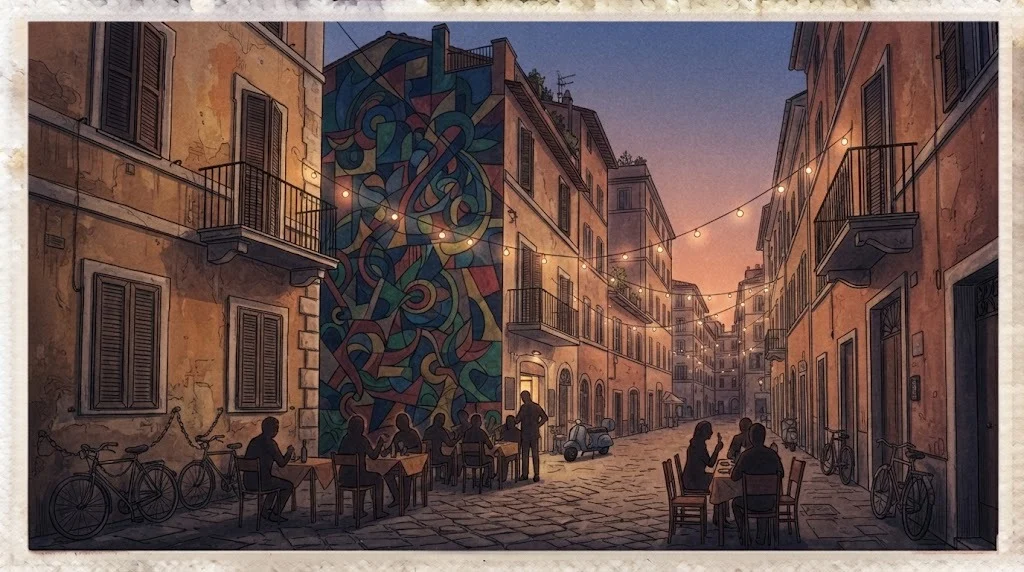
San Lorenzo is the neighborhood outside Porta Tiburtina where you can see four things in half a day: the Basilica of San Lorenzo fuori le Mura, the monumental Verano cemetery, the Sapienza University City and the grid of working-class streets built in the 1880s. You get there from Termini station in 10 minutes. It is also the neighborhood hit on July 19, 1943 by the most serious air raid Rome suffered.
Anyone who arrives here expecting the pictogram of postcard Rome is thrown off, and that's fine. Here the buildings are four or five stories, with no elevator, narrow courtyards and shops on the ground floor. The streets carry the names of the Italic peoples: Marrucini, Sabelli, Vestini, Marsi, Volsci, Equi. The fabric is a grid, the sidewalks are narrow, the walls are covered in writing. This is the shape of a neighborhood built to house the people who worked at the freight yard and the brewery.
Where San Lorenzo is and how to get there
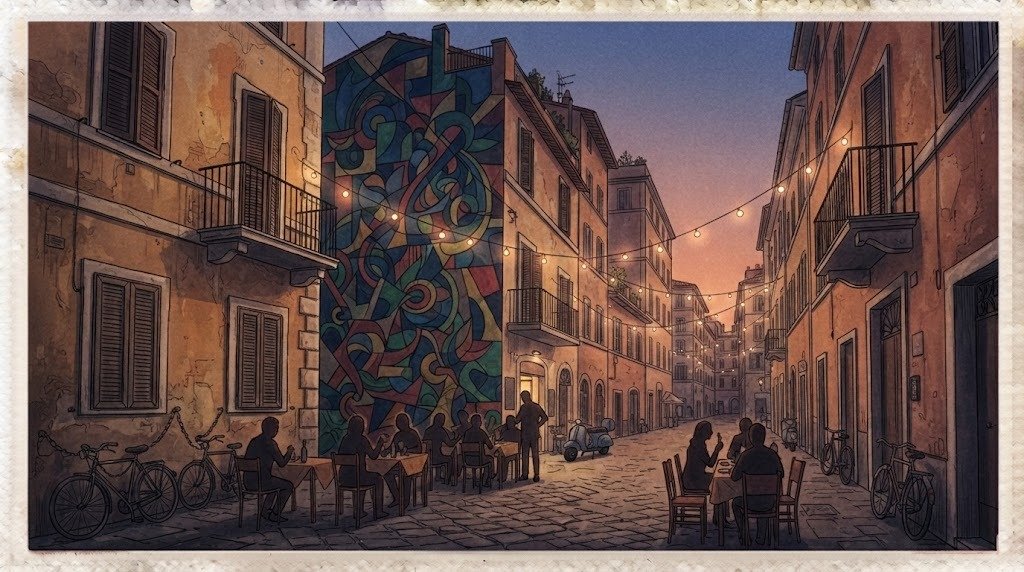
San Lorenzo occupies the rectangle between the Aurelian Walls, Via Tiburtina, the rail yard and the wall of the Verano, just outside Porta Tiburtina. The southern boundary is marked by the bundle of tracks entering Termini, the western one by the station, to the north are the University City and the Policlinico. In practice: from Piazza dei Cinquecento it's a little over 1000 meters on foot along Via Marsala and then Via dei Marrucini.
Metro line B stops at Policlinico and Castro Pretorio, both 10 minutes on foot from the heart of the neighborhood. Tiburtina station, also on line B, serves the north side and the Verano. Anyone coming from Fiumicino by train to Termini needs nothing more than their own legs. Keep in mind that there is no climb: the neighborhood is entirely flat, a rare thing in Rome.
Surface lines, checked on September 28, 2026
Trams 3 and 19 do not run on rails. In the official timetable in force at the end of September 2026 the two lines are replaced by buses, labeled 3BUS and 19BUS, and on Rome's tram network only line 8 remains in service. The 3BUS connects Valle Giulia to Trastevere station, the 19BUS connects Giulio Cesare/Ottaviano to Piazza dei Gerani. Both stop at the Verano and on Via dei Reti.
The useful buses are the 71, which reaches Tiburtina station passing along Via Tiburtina at the height of Via dei Reti, the 492 from Cipro to Tiburtina that cuts through the neighborhood on Via dei Marrucini and Via dei Ramni, and the cemetery lines C2 and C3, which run from the center to the Verano and continue to Flaminio. The 88, the 163 and the 545 also reach the Verano terminus.
The data on the lines comes from the official timetable published by Roma Mobilità and from the Atac service. The tram replacements change with work on the tracks: check again before you leave, because a line that is a bus today can become a tram again in six months.
If you come on foot from the historic center, take the right route: from Piazza Vittorio to Porta Maggiore, then along the walls to Porta Tiburtina and in along Via dei Marrucini. You pass in front of Santa Bibiana, the church sunk below street level that almost nobody opens. It's a 20-minute walk, and you understand where the papal city ends and the city of the building speculators begins.
The working-class neighborhood and how it was born
San Lorenzo was born as private building speculation right after 1870, on farmland around the Verano, and grew in the 1880s without the city's master plan having foreseen it. The result is still visible today: lots filled to the limit, minimal courtyards, no square worthy of the name, no green space. Building outside the plan cost less and paid more.
The year that recurs in almost all the reconstructions for the start of the neighborhood is 1884, but the sources available report it as a customary date and not as a single administrative act: growth was gradual, lot by lot, between the end of the 1870s and the early 1890s, and it stopped with the Roman building crisis at the end of the century. Anyone who gives you a flat date is simplifying for you.
The residents were largely workers at the railway freight yard and the Wührer brewery, along with stonecutters and marble workers who worked for the cemetery next door. The neighborhood had a very high density from the start and almost no services. It is the same logic that in Rome had already produced Testaccio, with the difference that that one was planned by the city and this one was not.
Why it looks like no other part of Rome
The orthogonal grid of San Lorenzo is an anomaly in a city that grew by layers and curves. Look at a map: here the streets cross at right angles like in a provincial American town, and the names follow a single criterion, the peoples of ancient Italy. No concession to scenographic decorum, no monumental axis, no studied perspective. Anyone arriving from Monti feels the difference in the first 100 meters.
Craft workshops on the ground floor were the rule: carpenters, blacksmiths, printers, body shops, marble workshops. Some of them survive, often converted. The industrial history of Rome in those years, beer included, can also be read well at the Peroni Beer Historical Archive and Museum, which is on the other side of the city but tells the story of the same world of workers and shifts.
A curiosity about San Lorenzo
The street names of San Lorenzo form a list of pre-Roman Italic peoples, and it isn't a literary whim: it was a choice of the city's street-naming office in the late 19th century, when the young capital needed a narrative of a united Italy. Marrucini, Sabelli, Vestini, Volsci, Equi, Marsi, Ramni, Luceri, Tiburtini. Peoples that Rome had subdued, set to name the streets of the people who worked in Rome.
The Ramnes, Tities and Luceres are the three original tribes of early Rome according to the annalistic tradition. Having put them here, in the workers' neighborhood, together with the Marsi and the Volsci, produces a short circuit that nobody had foreseen. The plaques are still the marble ones, with 19th-century lettering, and in several streets they have never been replaced.
The neighborhood borders the Verano cemetery, and the coincidence between the ancient names and the monumental cemetery is chance, not a plan. But the first time it's worth reading three plaques in a row before anything else. It works better than any historical introduction.
The bombing of July 19, 1943
On July 19, 1943, in the late morning, the Allied air force bombed Rome for the first time. The declared targets were three railway and airport facilities: the San Lorenzo freight yard, the Littorio yard to the north and Ciampino airport. The attack was carried out by a few hundred American aircraft in successive waves, concentrated between 11:00 and noon.
The bombs fell on the yard and on the houses around it. The San Lorenzo neighborhood, built right up against the tracks, was hit in its residential fabric. The Policlinico Umberto I and the Basilica of San Lorenzo fuori le Mura were also damaged. It is not one wartime episode among many: it is the day the neighborhood has carried with it for eight decades, and the people who live here do not treat it as tourist material.
The casualty figures do not match, and the difference is enormous
The estimates of the dead diverge in a way that cannot be ignored. Some reconstructions speak of about 1,500 victims, others place the total in a range between 1,600 and 3,200. The distance between the minimum and the maximum is more than double, and neither end can be presented as an established figure. Anyone who gives you a single round number is choosing one source and keeping quiet about the others.
The reasons for the divergence are technical before they are political: the count of bodies recovered from the rubble went on for weeks, the registry and hospital records do not match, many residents were displaced or away from home for work, and some of the dead at the railway yard were registered elsewhere. On top of this, the total sometimes includes the other areas hit that day and sometimes does not.
It's best to know the range and to know why it exists. Giving a precise number for an event like this is a form of convenience, not of respect. Anyone who wants to dig deeper will find the most reliable reconstruction in the historical bibliography on the subject, not in the commemorative plaques, which by their nature report the figure adopted by the body that placed them.
The pope's visit
Pius XII arrived in San Lorenzo on the same day as the bombing and visited the wounded among the rubble of the neighborhood. The photographs taken in those hours, with the pope in white among the crowd in front of the basilica, are among the most reproduced images of the war in Rome and circulated widely in the following years. The gesture was then used heavily in a political key, both for and against the pontiff.
Details of every kind have layered themselves around the episode, some documented and others not. What remains here are the two facts that hold: the pope came, and he came right away. The rest belongs to oral memory and to the historiographical controversy over Pius XII, which is a serious matter and is not settled in a neighborhood entry.
In front of the basilica a plaque remembers the dead. If you arrive in a group, read it in silence and move on: it is not a photo spot. The same goes for the rebuilt facades of the houses around it, recognizable by the different brick and the wider windows compared to the original buildings of the late 19th century.
One thing nobody tells you about San Lorenzo
The houses you see along Via degli Ausoni and Via dei Sabelli are not all from the 19th century. A substantial part of the street front was rebuilt between 1945 and the early 1950s, on the footprint of the destroyed houses, with different techniques and proportions. You recognize them by the more regular brick, the missing cornices and the concrete balconies instead of wrought iron.
Walking with your nose up, you read the map of the bombing without needing any panel. Where the front is continuous and uniform, the bomb did not land. Where two or three different buildings alternate in the middle of a homogeneous row, that is a filled-in crater. It's an exercise that changes how you look at the neighborhood for the rest of the visit.
The second invisible element is the wall of the freight yard, which runs along Via dello Scalo San Lorenzo and separates the neighborhood from the tracks. Freight and service rail traffic still passes there today. The industrial wound is still operational, and the Roman street art that grows on the walls of the area has largely this backdrop.
For a useful comparison go and see the Quadraro, which has a completely different history of resistance and roundup and a building fabric three decades later. Two working-class Roman neighborhoods, two war memories opposite in nature, both badly told.
The Basilica of San Lorenzo fuori le Mura: what was lost
The Basilica of San Lorenzo fuori le Mura is at Piazzale del Verano 3, on the northern edge of the neighborhood, and the phone number published by the Rome Capital tourism portal is 06 491511. It is one of the most layered churches in the city: it stands on the tomb of the deacon Lawrence, martyred under Valerian, and combines two different buildings built in eras far apart.
Constantine arranged the tomb in the 4th century with a cemetery basilica. Pope Pelagius II built at the end of the 6th century a three-aisle church that enclosed the tomb. In the 13th century Honorius III Savelli had a new hall erected in front of the Pelagian one, turning the earlier building into a presbytery: hence the floor that rises in level halfway through the church, which throws everyone off the first time.
The portico is attributed to the Vassalletto marble workers and dated around 1220, with Cosmatesque decoration and the remains of 13th-century frescoes under the arches. Look at the columns: they are reused, taken from ancient buildings, and no two are alike. It is the clearest sign of how people built in Rome in the Middle Ages, that is, with what was there.
The damage of 1943 and the reconstruction
The bombing hit the basilica. The brick facade was entirely rebuilt after the war and the frescoes that decorated it were lost: what you see today on the front is not the original. The restoration work continued until 1948 and was the occasion to remove some 19th-century additions, bringing the building back to an appearance closer to the medieval one.
Telling what is ancient from what is rebuilt, inside the basilica, takes an eye. The practical rule: the portico, the raised Pelagian presbytery, the Cosmatesque floor and the ambo are medieval material. The exterior facade and part of the roofing are postwar. The official sources summarize the restoration as a restoration of the medieval appearance, a formula that covers even major rebuilding choices.
In the basilica is the tomb of Alcide De Gasperi, a work by Giacomo Manzù, near the entrance. The Rome Capital tourism portal publishes for the basilica the Mass times, Monday to Saturday at 8:00 and 18:30, Sundays and holidays at 9:30, 11:00 and 18:30, and not a separate visiting schedule. Anyone who wants to see it at leisure should avoid those slots, and in any case phone first.
The comparison to make is with Saint Paul Outside the Walls and with San Sebastiano fuori le Mura: they are the other great extra moenia basilicas that rose over a martyr's tomb along a consular road. Add Sant’Agnese fuori le Mura and you have the map of suburban Roman Christianity before the city absorbed it.
Anyone who wants to close the circle on the pilgrimage basilicas should also plan Holy Cross in Jerusalem, on the other side of the city. The link with San Lorenzo runs along the same belt road between the great jubilee churches, which has existed in Rome for centuries and is older than any modern tourist itinerary.
The Verano, the cemetery the neighborhood found next door
The Verano cemetery is at Piazzale del Verano 1 and is Rome's great monumental cemetery. The Rome Capital tourism portal publishes these hours: from October 1 to March 31 from 7:30 to 18:00, from April 1 to September 30 from 7:30 to 19:00, with entry allowed until one hour before closing. Data checked on September 28, 2026.
The name comes from the Campo dei Verani, the estate that occupied this land. The cemetery was born in the Napoleonic era, in application of the Edict of Saint-Cloud that required burials outside the city walls, and the design was entrusted to Giuseppe Valadier between 1807 and 1812. The consecration came in 1835, and from then on Virginio Vespignani oversaw its expansions under Gregory XVI and Pius IX.
Vespignani also designed the cemetery church of Santa Maria della Misericordia, consecrated in 1860, the monumental entrance with the four allegorical statues of Silence, Prayer, Hope and Meditation, and the Quadriportico completed in 1880. The overall extent is about 83 hectares: it's not a walk you improvise in 20 minutes.
What to look for inside
The Verano works as an open-air museum of funerary sculpture, from the neoclassical to Liberty. There are the enameled portraits of Filippo Severati, who patented his technique in 1857 and left his main body of work at the Verano. There are the tombs of Trilussa, Giuseppe Ungaretti, Vittorio Gassman, Vittorio De Sica, Marcello Mastroianni, Tullio Levi-Civita and three prime ministers.
The cemetery has distinct sections: Catholic, Jewish (opened in 1895), Protestant and military. The Jewish section has its own entrance and its own access rules. Anyone looking for a comparison with Rome's other great cemetery of foreigners should go to the Non-Catholic Cemetery, beneath the Pyramid of Cestius: size, climate and public have nothing in common.
A practical warning: on November 1 and 2 the Verano becomes impassable because of visitor traffic, with reinforced cemetery lines and closed avenues. Anyone who wants to see the sculptures should pick a winter weekday morning, early. The low light among the cypresses and the white marbles in that season is the reason I go back.
My advice for visiting San Lorenzo
Come in the morning, between nine and noon, and come on a weekday. It's the only window in which the neighborhood works as a neighborhood: the shops open, the local markets in operation, the basilica without a Mass under way, the Verano empty, students in class and not on the sidewalks. In the evening San Lorenzo becomes something else and almost everything there is to see is closed.
The recommended order: Porta Tiburtina, Via dei Marrucini, Via degli Equi, Via dei Volsci as far as Via Tiburtina, then the Verano and the basilica, and finally the University City from the entrance on Piazzale Aldo Moro. Three and a half hours at an easy pace. Anyone with half a day more continues on foot toward Porta Maggiore, which is a quarter of an hour away.
Bring real walking shoes, not strolling shoes. The sidewalks of San Lorenzo are uneven, often occupied by scooters, and the crossings of Via Tiburtina and Via dello Scalo San Lorenzo have heavy traffic. Anyone with mobility problems should find a guide who knows the curb cuts: here the ramp is the exception, not the rule.
Beneath Porta Maggiore opens the underground basilica of Porta Maggiore, an underground monument of the imperial era that can be visited only by limited reservation. It's the best complement to a morning spent in San Lorenzo, because it tells the story of the same piece of city 2000 years earlier. Check availability and opening days well in advance, because places are very few.
10 minutes in the opposite direction, in Esquilino, is the Alchemical Gate, the only alchemical arch left in Rome. Anyone with a taste for urban oddities should pair it with San Lorenzo without thinking twice: they are two faces of the same 19th and 20th century Rome built in a hurry over ground nobody had ever excavated.
The Sapienza University City
The Sapienza has its main entrance at Piazzale Aldo Moro 5, on the northern edge of San Lorenzo. The university was founded in 1303 by Boniface VIII with the bull In suprema praeminentia dignitatis, was first in Trastevere, then from 1431 in the Sant’Eustachio district and from 1660 in the Palazzo della Sapienza on Corso del Rinascimento. The current campus is another story.
The University City was designed by Marcello Piacentini and inaugurated in 1935. It is the most complete complex of regime architecture in Rome after EUR, and unlike that one it has kept working for its original use without interruption. Travertine, symmetry, axiality on the Rectorate, statues and inscriptions: the rhetorical layout is entirely intact and can be read in 10 minutes.
You can walk freely into the open spaces of the campus during university hours. The Piazzale della Minerva, with the statue and the pool, is the point where you understand the layout. What Romans don't know is that inside this enclosure there are more than 10 scientific museums open to the public, almost all free or by donation, and almost all deserted.
The Sapienza museums nobody visits
The Gipsoteca, Museum of Classical Art holds casts of classical statuary in a room that is worth the visit by itself: it is the place where you understand how ancient art was studied before digital photography. The “G. Sergi” Museum of Anthropology displays 19th-century collections of physical anthropology, material that today is also looked at as a document of the history of science, with everything that entails.
The MLAC, Contemporary Art Laboratory Museum holds contemporary art exhibitions inside the university, with free entry and an irregular calendar. The “Battista Grassi” Museum of Comparative Anatomy and the Physics Museum are the two right ones for anyone traveling with high schoolers: comparative skeletons and historical instruments, easy explanation, zero lines.
Completing the picture are the “Primo Levi” Museum of Chemistry, the MUST, University Museum of Earth Sciences with its mineralogical and paleontological collections, and the Museum of Art and Mineral Deposits. Their openings are tied to the academic calendar: outside the teaching periods many close or receive visitors only by appointment. Phone, don't trust the website.
On the Policlinico side are the Museum of Pathological Anatomy and the Museum of the History of Medicine, which belong to the same university galaxy and have access regulated more strictly. Anyone with an interest in nature and not medicine will find a living, well-ordered collection at the Botanical Garden, in Trastevere, which is another world but the same university.
The information on the history of the university comes from the institutional page of Sapienza Università di Roma. The hours of the individual museums change too often for it to make sense to print them here: ask the office of the museum you're interested in, not the general switchboard.
Another well-known fact, yet rarely cited
San Lorenzo was bombed because the freight yard passed through here, and the freight yard is still there. Everybody knows about the bomb, few connect the fact that the military target was not dismantled after the war: the bundle of tracks keeps working, freight trains pass, and the perimeter wall runs along Via dello Scalo San Lorenzo for hundreds of meters.
The urban consequence is that the neighborhood remains closed to the south by an impassable barrier, exactly as in 1943. You can't cross it, you can't see beyond it, and the connections toward Pigneto and Via Prenestina happen only through the two openings at Porta Maggiore and the overpass. This explains why San Lorenzo has remained a social island even as the city grew all around it.
Anyone who wants to understand the same mechanism elsewhere should look at how the tracks cut through Esquilino: the Nuovo Mercato Esquilino and the Esquiline obelisk live on two sides of a similar break. In Rome the railway has done more damage to urban continuity than the Aurelian Walls ever did, and at least the walls have gates.
Nightlife and residents: the contrary position
San Lorenzo has an open, documented conflict between the people who live here and the people who come in the evening. Residents complain of noise until dawn, broken bottles, urine on doorways, scooters on the sidewalks and the loss of neighborhood shops. The operators and some of the students answer that the neighborhood lives off this and that without the evening many shutters would stay closed. Both are right on the facts and wrong on the conclusions.
The position here is unpopular on both sides: the problem of San Lorenzo is not the young people who drink, it is the economic model of the ground floors. When the rent on a commercial space pays only if you sell drinks standing inside it, every craft shop that closes is replaced by a drinks counter. The noise is the effect, not the cause.
It follows that interventions on hours do little. Moving up the closing time of the bars shifts consumption to the street, and in the street there is no responsible operator: the result is more noise outside and less control inside. Anyone who asks only for ordinances and patrols is treating the fever and leaving the infection.
There is a second point my colleagues don't like to hear. Taking tourists to San Lorenzo in the evening for the nightlife is a weak choice: the offer is ordinary, prices have gone up, and the neighborhood at night offers less than Trastevere or the area of the former Slaughterhouse. The value of San Lorenzo is in the morning, and it is historical and architectural. In the evening what's sold is a label.
Anyone looking for the atmosphere of a Roman working-class neighborhood with the evening life that goes with it should go to Testaccio, below Monte dei Cocci, where the layering of venues is older and the relationship with residents settled decades ago. San Lorenzo has not yet found that balance and probably won't as long as the ground floors are worth what they are worth.
That said, the people who live here have the right to sleep and the people who come have the right to be in a lively neighborhood. A reasonable landing point exists and runs through the regulation of commercial uses, not through a curfew. No Roman administration has put it into practice yet, and until then the quarrel will continue in the tone it has today.
The right photo to take in San Lorenzo
The best photograph of San Lorenzo is taken under the portico of the basilica, from the inside looking out, with the reused columns in the foreground and Piazzale del Verano blurred in the background. Early morning light, exposure on the shadows. You get in a single shot the 13th century, the reuse of the ancient and the neighborhood outside, which is exactly the story of this place.
The second framing that works is on Via degli Ausoni or Via dei Sabelli, standing in the middle of the roadway with a short telephoto lens, to compress the perspective of the wrought-iron balconies. Wait for a scooter to pass: without movement the photo is dead. The third is the wall of the freight yard, at sunset, with the graffiti catching the raking light.
Inside the Verano you don't photograph people visiting, ever, and you leave recent gravestones alone. The 19th-century sculptures and the Quadriportico are fair game and beautiful. Anyone looking for the same decorative register in residential form should go to Coppedè, in the Trieste district, which is the other eccentric masterpiece of Roman building.
On street art a warning is due. The walls of San Lorenzo change constantly, and the piece you saw in a photo from three years ago most likely no longer exists. Anyone who wants more stable and well-kept surfaces should go see the street art in Ostiense, where many works are authorized and maintained.
Some important events that happened here in history
The martyrdom of Lawrence, a deacon of Iberian origin killed under Valerian in the middle of the 3rd century, is the origin of everything: the tomb attracts worship, worship attracts the basilica, the basilica attracts the cemetery, the cemetery attracts the marble workers, the marble workers attract the neighborhood. 1600 years of cause and effect on the same piece of ground.
The consecration of the cemetery in 1835 and the completion of the Quadriportico in 1880 mark the moment this area becomes the capital's great funerary space. The residential neighborhood comes right after and grows up against the perimeter wall. Nobody planned this sequence: it added up by itself, as almost always happens in Rome.
The inauguration of the University City in 1935 brings tens of thousands of people a day to San Lorenzo and changes the social makeup of the area for good. The bombing of July 19, 1943 breaks it. Postwar reconstruction and then the massive arrival of out-of-town students, from the 1970s on, produce the neighborhood you see now.
In the 1970s and 1980s San Lorenzo was one of the centers of the Roman political movement and of occupations, and that season left physical marks: social centers, self-managed spaces, murals. Some still exist, others have been evicted. It is a recent and controversial history, told in opposite ways in the neighborhood depending on who is speaking.
Who passed through San Lorenzo
Pius XII arrived on July 19, 1943, among the rubble, and those photographs have entered the visual history of 20th-century Italy. Alcide De Gasperi came back for good: his tomb, sculpted by Giacomo Manzù, is in the basilica near the entrance. Two figures at opposite ends of the same national story, on the same square.
At the Verano rest Trilussa, Giuseppe Ungaretti, Vittorio De Sica, Vittorio Gassman, Marcello Mastroianni, the mathematician Tullio Levi-Civita and three prime ministers, among them Francesco Saverio Nitti and Luigi Luzzatti. It is the list of those who made Italian culture and politics of the 20th century, laid out over 83 hectares with signage that helps no one.
Marcello Piacentini signed here, with the University City, one of his major works. Giacomo Manzù left the tomb of De Gasperi, and his work can also be found in other Roman collections of 20th-century art: anyone who wants to follow the thread should go by the Galleria Nazionale d’Arte Moderna and then on to MACRO.
The neighborhood has hosted generations of students who then filled the city's cultural institutions, from the MAXXI on down. Anyone can name names: the most honest thing to say is that San Lorenzo is a place of obligatory passage for anyone who has studied in Rome over the last nine decades, and that counts for more than any list of celebrities.
What you don't see and when it's closed
Of the freight yard you see nothing: it is railway area, access is forbidden and the wall is high. Of the Wührer brewery nothing visitable remains. Of the original buildings of 1884 many were rebuilt after 1943 and others renovated entirely inside: the facade deceives, behind it there is almost always another house.
The basilica closes during the midday break with hours that vary, and during celebrations the visit to the apse area is not allowed. The Verano closes at 18:00 in winter and at 19:00 in summer, with last entry one hour earlier. The Sapienza museums follow the academic calendar and in the months of August and January are largely closed.
On November 1 and 2 the square of the Verano is congested all day, and on those two days a visit to the basilica becomes difficult. In the weeks of university exams, in June and January, the neighborhood fills with students from the morning and finding a seat in any place becomes complicated. These are banal pieces of information that nobody writes.
If you're looking for a civic museum open on regular and certain hours within 20 minutes, San Lorenzo doesn't offer one. You have to move: the Centrale Montemartini toward Ostiense, the museums of Villa Torlonia toward Via Nomentana. Inside the neighborhood the rule is to call first.
Eating in the area
San Lorenzo has one of the highest densities of places to eat in Rome, and for this very reason selection matters more than elsewhere. The neighborhood works for three different publics: students on a small budget, staff of the Policlinico and the Sapienza at lunch, and the evening flow that arrives from outside. Three publics, three levels of attention to the cooking, and they never coincide.
The signs that you're about to get fleeced
The menu with photographs of the dishes is the first clue, and it holds in San Lorenzo as in any other part of Rome: a place that has to show the photo of a carbonara has understood that the customer will never come back. Be wary also of the price list translated into six languages with numbered dishes. It serves people who pass through once, and the price is calibrated to that.
The lady rolling out the sheet of pasta in the window or directly on the sidewalk is a scenic lure, not a sign of good cooking. It is a marketing gimmick born in the center and arrived here too. In places where pasta is really made, it's made out back, in the kitchen, with clean hands and no audience. The theater in front of the door only tells you that the place needs to stop you.
The person at the entrance who invites you to sit down is the worst sign of all. A place that has to send someone to pick up customers in the street doesn't fill up on its own, and if it doesn't fill up on its own there is a reason. Add to this the place that serves nonstop from morning until late at night, with no break between lunch and dinner: that kitchen never rests because it isn't cooking, it's reheating.
In the spots where foot traffic concentrates, and here it concentrates between Piazzale del Verano and Via Tiburtina, there are places that adjust the price to the customer. The signs are always the same: menu items with no price, fish or truffle by an undeclared weight, the cover charge that appears only at the end, and different price lists between the indoor room and the outside tables. Ask for the written bill before ordering, and if they answer badly you've saved yourself an evening.
The chains with the repeated sign
In the center of Rome, and by now also in busy areas like this one, there are signs that repeat identically at 10 or 15 addresses. There is nothing scandalous in it: they are businesses that have standardized product and service and sell a predictable experience. The point is something else. They are tourist attractions, exactly like open-top buses, and people who live in Rome don't set foot in them.
Eating at one of those signs is not a moral mistake, it's just a choice that takes you where everyone who had the same guide as you has gone. If you have a few days and want to eat Roman, the odds play against you. If instead you need a safe place with tired kids at nine in the evening, it's a solution and nobody should lecture you.
The criterion
Look at who is sitting at the tables and in what language they order. It's the only criterion that never fails, in any neighborhood of Rome. In San Lorenzo, at lunch, the good tables are the ones with hospital staff and Sapienza researchers speaking Italian and ordering without looking at the menu. In the evening the same principle applies, adjusted: look for tables of Romans under 30.
The second criterion is the kitchen's closing time. A place that closes the kitchen at 15:00 and reopens at 19:30 is saying that someone in there has to prep. A place that never closes is saying the opposite. Third criterion, the short menu: four first courses and four main courses written by hand beat 30 printed items every single time.
The recommended addresses are collected in a public Google Maps list, updated and cleaned up when a place gets worse: Daniele’s list. There are no commercial agreements in it, and in fact every so often I remove a few.
A half-day itinerary in San Lorenzo
Start at nine from Porta Tiburtina, on the Aurelian Walls. 10 minutes to understand the boundary between the ancient city and the neighborhood, then in along Via dei Marrucini to Via dei Volsci. Along the way you read the plaques of the Italic peoples and recognize the fronts rebuilt after 1943. One hour of slow walking, no hurry.
At half past 10 you reach Piazzale del Verano. First the basilica, with the portico and the Pelagian presbytery, then De Gasperi's tomb. At half past 11 you enter the cemetery: an hour and a half is enough for the Quadriportico, the church of Santa Maria della Misericordia and the 19th-century sector, which is the part with the best sculptures.
At one o'clock you leave and have lunch in the neighborhood, applying the criteria of the previous section. At three o'clock you enter the University City from Piazzale Aldo Moro, look at Piacentini's layout and choose one museum, better one done well than three in a rush. At five o'clock you leave and continue on foot toward Porta Maggiore, or take metro line B at Policlinico.
If you have a whole day, add the afternoon at Testaccio or EUR: they are the two Roman neighborhoods with which the comparison makes sense, one planned by the city for workers, the other built by the regime for representation. Three neighborhoods, three opposite ideas of what a city should be.
Frequently asked questions about San Lorenzo
How many people died in the bombing of July 19, 1943?
The estimates diverge and there is no established figure. Some reconstructions indicate about 1,500 victims, others place the total in a range between 1,600 and 3,200. The difference depends on the counting criteria, on the prolonged recovery of the bodies, on discrepancies between registry and hospital records and on the fact that some estimates include the other areas of Rome hit that day.
Is San Lorenzo dangerous?
San Lorenzo presents no particular risks during the day, when it is a normal residential and university neighborhood. In the evening and at night, in the nightlife streets, crowds, alcohol and noise concentrate: the typical problems are pickpocketing and drunken quarrels, nothing else. The rules are those of any crowded area: bag in front, phone in your pocket, watch out for scooters on the sidewalks.
How much time do you need to visit the neighborhood?
Half a day covers the neighborhood, the basilica and the Verano well. Adding the University City and one of the Sapienza museums brings you comfortably to six or seven hours. Anyone who wants only the basilica and the cemetery can get by in two and a half hours, bearing in mind that the 83 hectares of the Verano can't all be covered and a selection is needed.
What are the opening hours of the Verano cemetery?
The hours published by the Rome Capital tourism portal are: from October 1 to March 31 from 7:30 to 18:00, from April 1 to September 30 from 7:30 to 19:00, with entry allowed until one hour before closing. The address is Piazzale del Verano 1. Data checked on September 28, 2026, to be verified again before the visit because cemetery openings change in holiday periods.
How do you get to San Lorenzo by public transport?
Metro line B stops at Policlinico, Castro Pretorio and Tiburtina, all within walking distance. At street level, at the end of September 2026 trams 3 and 19 are replaced by buses (3BUS and 19BUS) and stop at the Verano and on Via dei Reti. The area is also served by the 71, 492, 88, 163, 545 and the cemetery lines C2 and C3. From Termini it's a 15-minute walk.
Can you visit the Basilica of San Lorenzo fuori le Mura for free?
Entry to the basilica is free, as with the other churches of Rome, and no ticket appears to be published. For Piazzale del Verano 3 the Rome Capital tourism portal gives the Mass times, Monday to Saturday at 8:00 and 18:30, Sundays and holidays at 9:30, 11:00 and 18:30, and not a separate visiting schedule: it's best to phone the published number, 06 491511.
What is left of the medieval building after the bombing?
The portico attributed to the Vassalletto, the raised Pelagian presbytery, the Cosmatesque floor and the medieval liturgical furnishings survived. The brick facade was entirely rebuilt and the frescoes that decorated it were lost. The restoration continued until 1948 and was the occasion to remove some 19th-century additions, bringing the appearance of the building closer to the medieval one.
Is San Lorenzo suitable for people traveling with children?
San Lorenzo works with kids from age 10 up, thanks to the Sapienza science museums and the story of the bombing told in a serious way. With small children it's less convenient: narrow sidewalks, traffic on Via Tiburtina, few green areas and no playground inside the neighborhood. The Verano in any case requires a level of decorum that not all children can sustain for an hour.
Is it worth coming to San Lorenzo in the evening?
In the evening in San Lorenzo you drink, you don't sightsee. Anyone looking for nightlife will find it, but the offer has nothing specifically Roman and the prices are in line with those of the center. The neighborhood is at its best in the morning, when you see the basilica, the Verano, the university museums and the urban structure. It is one of the few areas of Rome where the advice is exactly the opposite of what you read around.
Who wrote this page
This page is edited by the editorial team of Tour Leader Pro, the Rome-based company that designs and coordinates visits, routes and cultural events in Rome and Lazio. The hours, addresses, phone numbers and transport lines given here were checked on September 28, 2026 against the official sources cited in the text. Openings in Rome change often: a phone call before you leave saves you a wasted trip.
Anyone who has to build an itinerary in Rome runs into the same variables every time: churches run by religious communities with their own hours, university museums tied to the academic calendar, cemeteries with strict access rules, tram lines replaced by buses because of roadworks, and distances that look short on paper. Planning materials designed for those who guide groups and for those who organize on their own can be found on Tour Leader Pro.
For the wider picture, from rail connections to airports, from rentals to destinations in Lazio outside Rome, the resource to keep open next to this one is Italy Planner, which covers travel logistics in Italy with the same verification standard used here.