Arch of Gallienus
In short. The Arch of Gallienus stands on Via di San Vito, on the Esquiline, and is viewed from the street: free, with no ticket, no reservation and no opening hours.
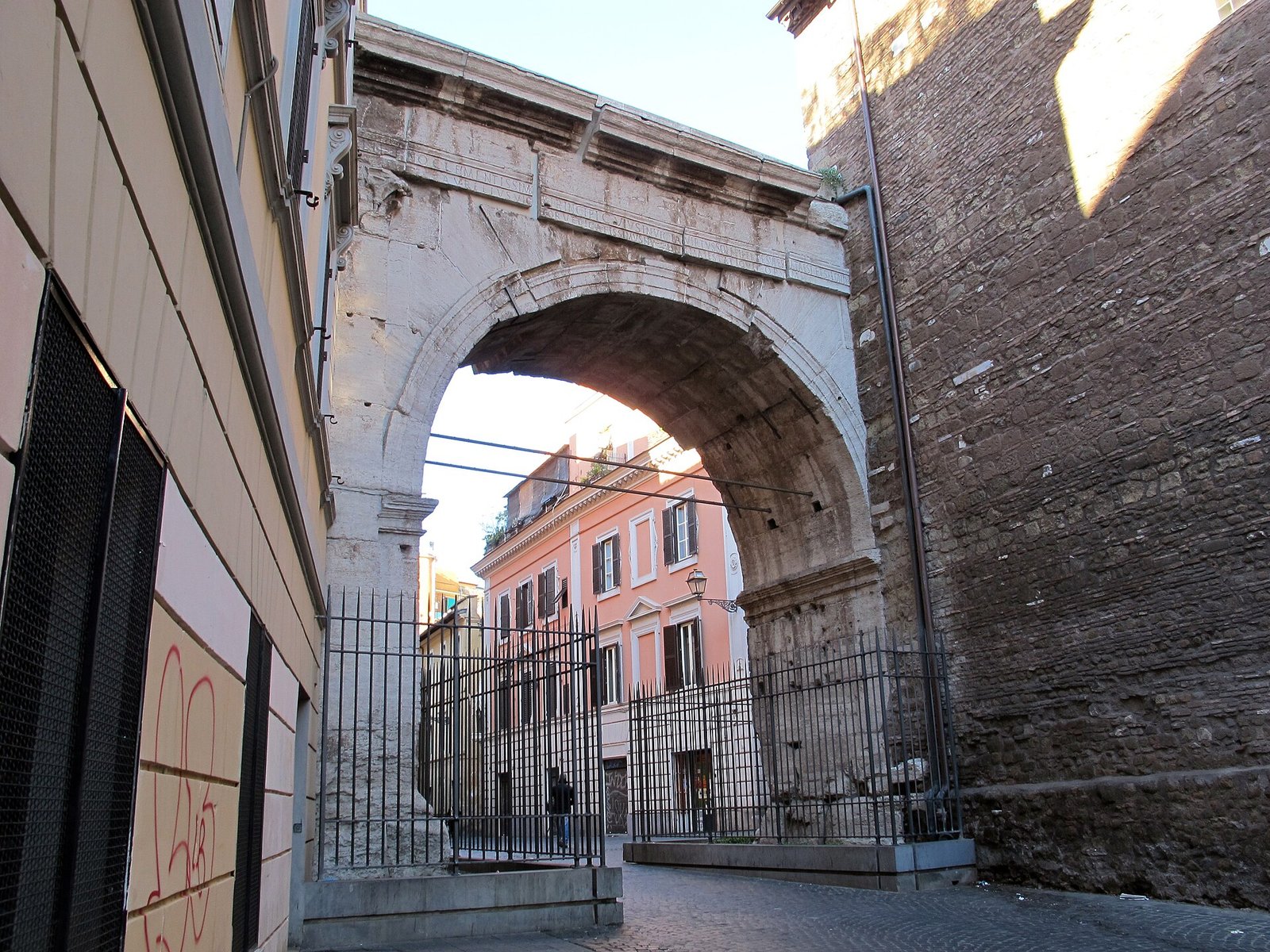
The Arch of Gallienus stands on Via di San Vito, on the Esquiline, and is viewed from the street: free, with no ticket, no reservation and no opening hours. The Rome city tourism portal attributes it to the Sovrintendenza Capitolina and refers to the contact center 060608 for information. There is no entrance because there is no interior. It is a single travertine archway, with the church of Santi Vito e Modesto leaning against one side.
What you see is the Porta Esquilina of the Servian Walls, rebuilt in the Augustan age in travertine with three archways. In 262 AD an official, Marcus Aurelius Victor, dedicated it to the emperor Gallienus and his wife Salonina, and since then it has borne the name of a ruler who didn't build it. The two side archways were demolished in the fifteenth century, when the church next to it was rebuilt.
Data checked on September 29, 2026 on the Sovrintendenza Capitolina page dedicated to the monument, on the Rome city tourism portal and on the other sources cited further on in the text. For the arch the variable is not hours but scaffolding and street traffic. For the church and its crypt, on the other hand, the published hours should be confirmed with the parish before setting out, by phoning the number given in the box below.
At a glance: address, hours, ticket
- Where: Via di San Vito, Rione Esquilino, between Piazza Vittorio and Santa Maria Maggiore. The Sotterranei di Roma survey gives numbers 11-13, 00185 Rome.
- Operator: Sovrintendenza Capitolina ai Beni Culturali, according to the Rome city tourism portal.
- How to get in: you don't. The arch is viewed from the street, from both sides.
- Price: free. No ticket and no reservation.
- Hours: none for the arch. Church next to it, at Via Carlo Alberto 47: weekday Masses at 8:00 and 18:30, Sunday at 11:00, according to Turismo Roma.
- Getting there: Metro line A, Vittorio Emanuele stop, then on foot.
- Information: 060608 for the monument, 06 4465836 for the parish.
Where it is and what you actually see
Via di San Vito is a short, narrow street that branches off Via Carlo Alberto, the axis connecting Piazza Vittorio to Santa Maria Maggiore. The arch spans it with its single archway. Anyone arriving from Via Carlo Alberto discovers it almost suddenly, squeezed between the Umbertine buildings and the side of the church, with the polygonal bell tower popping up right behind. There is no square in front, nor even an open space from which to take it in from a distance.
The measurements are given by the encyclopedia entry on the monument: about 8.80 meters in height, 7:30 in width and 3:50 in depth. The piers are one meter and 40 centimeters wide. On either side of the archway run two pilasters with Corinthian capitals, and a simple cornice marks the point where the arch begins to curve. Above, an entablature about two meters high carries the inscription. It is a sober monument, almost squared.
The Sovrintendenza Capitolina describes it just that way: quadrangular shape, Corinthian corner pilasters, and originally three archways. Today one remains. Looking at the two sides, though, you can still see where the other two were attached. On one side the church wall leans directly against the travertine, on the other the structure ends abruptly, cut off. Anyone who observes carefully reads the story of the fifteenth century in that asymmetry.
The travertine has the warm, slightly dirty color of Roman stones that have stood for centuries in the middle of the city. On the entablature, above the letters of Gallienus's inscription, there are holes. According to the encyclopedia entry they are the holes for the metal pins that fixed older marble slabs. They are the only trace of what was there before the dedication of 262, and they say the arch was rewritten at least once.
The church next to it is Santi Vito e Modesto, seat of the parish of Santa Maria Maggiore in San Vito. Turismo Roma gives its address as Via Carlo Alberto 47, but the entrance, after the restorations of the 1970s, is again on Via di San Vito, right next to the arch. The marble doorway and the Gothic two-light windows date from the rebuilding ordered by Sixtus IV in 1477.
All around is today's Esquiline: the neighborhood born after Unification, with the arcades of Piazza Vittorio, the shops, the market, the communities that came from half the world. The arch is not separated from this life. People pass under it with shopping bags, scooters, the odd tourist with a map in hand. For an idea of the whole rione, the site also has the guide Esquiline Hill: things to see.
To get your bearings it helps to remember where the circuit ran. The Sotterranei di Roma survey ties the name of the gate to the height of the Esquiline, on which it opened. The walls came here from the north, from the area of present-day Termini Station and Piazza Manfredo Fanti, and shortly after turned south. On Via Carlo Alberto, a short distance from the arch, a spur of the wall still remains, the same defensive system of which the gate was the opening.
The street level, then, is not the ancient one. Under the church next door, in the crypt, Turismo Roma lists stretches of a Roman road and structures of an aqueduct, that is, the city of 2,000 years ago, preserved lower than today's ground level. The arch you see therefore emerges from ground raised over the centuries. It's a detail you hardly notice from the street, and the crypt, during opening hours, finally makes it visible.
A curiosity about the Arch of Gallienus
For centuries, keys that didn't belong to Rome hung from the arch. The Sovrintendenza Capitolina writes that in the Middle Ages two keys of Viterbo were hung there, in memory of that city's submission to Rome, and that they stayed there until 1825. The Sotterranei di Roma survey specifies that they were the keys of the Porta Salcicchia of Viterbo, which arrived in Rome in the thirteenth century as a sign of surrender.
Hanging the keys of a defeated city on the gate of your own was a gesture everyone understood, even those who couldn't read. Anyone entering the city from this side passed right under the trophy. And the choice of the Arch of Gallienus was no accident: it was still an urban gate, a place of obligatory passage, where the message reached anyone coming from the countryside east of the city.
The detail that surprises is the duration. The keys stayed hung for about six centuries, until 1825, when Viterbo had long been part of the Papal State and the medieval rivalry no longer had any political sense. Where they ended up after removal is not stated by any official source. Today nothing hangs on the arch, and no panel in the street tells the story.
Something nobody tells you about the Arch of Gallienus
Gallienus didn't build this arch, and he didn't even restore it with his own hands. The Sovrintendenza says it without beating around the bush: it was built by Augustus in travertine, on the site of the Porta Esquilina, and only in 262 AD was it dedicated to the emperor and his wife. The name we use today is that of a changed plaque, not that of the builder.
The encyclopedia entry adds a second point that is often lost: it was not a triumphal arch. It was born as a gate of the republican circuit, an opening for roads and for controlling who came in. Putting it in the same family as the arches of the Roman Forum is a category error. Its form, so sober, is explained by its function: it served to let people through, not to celebrate a victory.
The contrarian position, in our opinion, is this. In the Esquiline of the curious, nearly all the attention goes to the Alchemical Gate of Piazza Vittorio, with its symbols and its legends. It is the Arch of Gallienus, though, that is the monument that weighs more: one of the very few gates of the Servian circuit left standing in monumental form, and still crossed by a street. Anyone who skips it to chase esotericism misses the most important piece of the rione.
There is also a detail that overturns the idea of an intact monument. The Augustan inscription that was on the attic can no longer be read: the article from the neighborhood periodical Il Cielo sopra Esquilino speaks of erasures made already in antiquity, and the encyclopedia entry notes the holes for the metal pins of the original slabs. What we call the Arch of Gallienus today is therefore a rewritten monument, in which the second signature covered the first.
How did the Porta Esquilina become an honorary monument?
The first gate at this point belonged to the circuit that tradition attributes to King Servius Tullius. The Sotterranei di Roma survey places it in the sixth century BC, built in tuff blocks with three archways. Here the defense was delicate: the plain offered no natural support, and from the Porta Collina to the Esquilina ran a great embankment, the agger, for about 1,300 meters according to the same source.
Important roads left from the gate. The Roma Segreta page dedicated to the arch recalls that here Via Labicana and Via Prenestina parted, heading toward the Colli and toward Palestrina. A little further on, where Porta Maggiore stands today, the two roads still run side by side under the arches of the aqueducts. The Esquilina was therefore a gate of traffic, of goods, of people arriving from the countryside.
In the Augustan age the gate changed its face. According to Sotterranei di Roma, Augustus rebuilt it entirely in travertine and made it monumental, placing an inscription on the attic of the central archway. That text can no longer be read today, erased already in antiquity. The walls, by then, had lost their defensive function: the city had grown beyond the circuit, and the gate became above all a monumental entrance to the center.
The decisive step came in 262 AD. On the occasion of a restoration, Marcus Aurelius Victor replaced the old dedication with a new one, addressed to Gallienus and Cornelia Salonina. From Augustus's gate the structure became an honorary monument to a third-century emperor. The sources don't agree on the dedicator's role: some call him a prefect, the English encyclopedia entry describes him as a member of the imperial administration.
In the third century, moreover, the Servian circuit was by now a memory inside a much larger city. A few years after the dedication to Gallienus, Rome gave itself a new boundary with the Aurelian Walls, built much farther out. The old Porta Esquilina stayed where it was, with no more military function, but with the role of urban passage and monument. It is this double role that allowed it to reach the present day.
What does the inscription on the attic say?
The Latin text, reported by the Sotterranei di Roma survey and by the encyclopedia entry on the monument, reads: «GALLIENO CLEMENTISSIMO PRINCIPI CVIVS INVICTA VIRTVS SOLA PIETATE SVPERATA EST ET SALONINAE SANCTISSIMAE AVG AVRELIVS VICTOR V E DICATISSIMVS NVMINI MAIESTATIQVE EORVM». The two letters V and E abbreviate vir egregius, the rank title of the dedicator. According to Roma Segreta the dedication appears on both faces of the arch.
The current translation, with some variation among the sources, goes more or less like this: to Gallienus, most clement prince, whose unconquered valor was overcome only by his devotion, and to Salonina, most holy Augusta, Aurelius Victor, man of distinction, most devoted to their divinity and majesty. These are court formulas, swollen with superlatives. But they say a lot about the moment: an emperor in difficulty needed to be celebrated, even at the cost of rewriting someone else's monument.
Gallienus reigned from 253 to 268. They were difficult years for the empire, and the reign did not enjoy a good reputation. The English encyclopedia entry ties the dedication precisely to this climate: a way to counter the bad publicity of a reign marked by military defeats. It is not an interpretation written on the stone, but it helps to understand why an official would choose a gate of Augustus for his tribute.
Reading the inscription from the street is not easy. The letters are high up, the light changes, and the travertine is marked by time and smog. It's best to bring a small pair of binoculars or use your phone's zoom, and compare what you see with the transcribed text. The words GALLIENO and SALONINAE are the most recognizable, and from there you reconstruct the rest without much effort.
It's worth pausing on the wife's name too. The inscription doesn't just mention Salonina next to her husband: it calls her most holy Augusta, with the official title of empresses, and puts her on the same level in the tribute. The sources identify her as Cornelia Salonina. For anyone passing under the arch it is one of the rare cases where the name of a woman of the imperial court can still be read on stone, right in the street, without entering a museum.
My advice for visiting the Arch of Gallienus
The advice is to arrive on foot from Santa Maria Maggiore along Via Carlo Alberto, and not from Piazza Vittorio. This way the arch appears at the end of the perspective, and you immediately grasp its relationship with the church. Stop before the archway, on the church side, and look at how the medieval wall leans against the ancient travertine. Then pass under and observe the other face.
The visit to the arch lasts a few minutes, but it only makes sense if you combine it with the church. Choose a time when the church is open and no services are under way. The weekday Masses listed by Turismo Roma are at 8:00 and 18:30, the Sunday one at 11:00: better to avoid those moments. Inside you will find the pietra scellerata and the altar with the painting attributed to Antoniazzo Romano.
A practical warning. Via di San Vito is a real street, with cars and scooters passing under the archway. Don't stop in the middle of the roadway to take photos or read the inscription. The best place to observe is the sidewalk, and with a bit of patience you find moments of calm. On Sunday mornings, before 11:00, traffic is usually lighter.
Anyone with a whole morning can build a loop around the gate. Start from the Esquiline Obelisk, behind the apse of Santa Maria Maggiore, go down Via Carlo Alberto to the arch, and continue toward Piazza Vittorio, with the Porta Alchemica and Sant'Eusebio all'Esquilino. The loop takes an hour and a half at an easy pace, and it all stays flat.
One last suggestion concerns the order of things. Before arriving at the arch, reread the inscription transcribed above, and take a look at Giuseppe Vasi's view with the church and the arch in the eighteenth century. On site you will know where to look: the letters on the entablature, the pin holes, the point where the church wall leans against the pier. Without this preparation, the arch risks looking like just a passage between two buildings.
Do you pay anything and do you need to book?
For the arch you pay nothing and book nothing. It is a street monument, visible at any hour, and the Rome city tourism portal gives neither fares nor special access arrangements. There are no official tickets or paid products dedicated to the arch. For general information the reference remains the contact center 060608 and the Sovrintendenza Capitolina page.
The church next door and its crypt are another matter. Turismo Roma publishes the hours of the parish and those of the archaeological area under the church, with an email address for group bookings. The cost of the crypt visit is not given. The table summarizes the published hours. They should be confirmed before going, by phoning the parish at 06 4465836.
| What | Days | Published hours |
|---|---|---|
| Masses | Weekdays | 8:00 and 18:30 |
| Mass | Sunday | 11:00 |
| Archaeological crypt | Monday-Saturday | 10:00-12:45 and 14:30-18:00 |
| Archaeological crypt | Sunday | 14:30-18:00 |
For organized groups, Turismo Roma gives cripta.sanvito@gmail.com as the contact for crypt bookings. The parish also publishes the addresses parrocchia@sanvito-roma.it and parroco@sanvito-roma.it. The official website is sanvito-roma.it. For those arriving on their own the advice is simple: phone the day before, because the hours of crypts run by parishes often change with the seasons.
A note on paid offers. If you find for sale tours of the Esquiline or of esoteric Rome that include the arch among the stops, remember that they are third-party services, legitimate, but they don't sell an access you wouldn't have on your own: the arch is on the street, and the crypt has its published hours. The value of a guided visit lies in the storytelling, not in the entrance, and should be judged on who leads it.
Another well-known fact, yet rarely cited
Many people know that the Esquiline was a cemetery before becoming an elegant neighborhood. Less often cited is the fact that the cemetery began right outside this gate. The Sotterranei di Roma survey describes the Esquiline necropolis as an area extending at least 300 meters beyond the walls, from present-day Piazza Manfredo Fanti to Piazza Vittorio, on the left of the ancient road.
It was not a monumental cemetery. The same source speaks of the puticuli, deep pits dug in the tuff, used as common graves where the bodies of slaves, the poor and the condemned ended up. During the works on the Umbertine neighborhood, in the nineteenth century, many came to light, four or five meters deep. Anyone leaving by the Porta Esquilina, in the republican age, passed beside this landscape of death and refuse.
Then came the reclamation. According to Sotterranei di Roma, between 42 and 38 BC the area was covered with a layer of earth eight meters high, at the will of the future Augustus. On that new ground Maecenas, his friend and advisor, received the concession for his gardens. The Auditorium of Maecenas, in Largo Leopardi, is what remains of that world, a few hundred meters from the arch.
The church's ancient name also tells of this landscape. Turismo Roma recalls that in the eighth century it was called San Vito in Macello, with reference to a nearby commercial complex dedicated to Livia, wife of Augustus. The parish speaks of Livia's macellum and adds that the area was later considered a place of Christian martyrdom. In a few meters, then, the necropolis, the imperial market and the medieval church overlap.
The right photo to take at the Arch of Gallienus
The photo that really tells the story of the arch is not the frontal, isolated one. It is the one that holds together the travertine archway and the side of the church, with the polygonal bell tower in the background. Stand on Via di San Vito, a bit to the side, so as to see both the arch and the point where the church wall touches it. In a single frame you have 2,000 years of overlapping history.
The second photo is a detail. With the zoom, look for the entablature and the letters of the inscription, and then the pin holes above the text. They are small but visible, and they tell the story of the monument's rewriting better than any explanation. You need soft light: in the middle hours of a sunny day the contrast between shaded and lit parts makes the letters hard to read.
A third possibility is to look through the archway, from the side of Via Carlo Alberto toward the inside of the street, or vice versa. The arch becomes a frame and the city behind it becomes the subject. The problem is the parked scooters and the passing cars: early on Sunday morning the chances of getting a clear street go up a lot. Don't climb the church steps during services to find the angle.
A useful exercise, before or after the shot, is the comparison with Giuseppe Vasi's engraving. The catalog of Stanford University's Imago Urbis project describes it as a view with the church of Santi Vito e Modesto, the arch, the remains called the Trophies of Marius and the monastery of the Viperesche. In the drawing the two smaller arches leave minimal traces. Putting the photo next to the view shows how much the surrounding neighborhood has changed in two and a half centuries.
How do you get there from central Rome?
The simplest solution is Metro line A, Vittorio Emanuele stop, shown on the line map published by ATAC a short distance from Termini. From the exit you cross Piazza Vittorio toward Via Carlo Alberto, and from there you turn into Via di San Vito in a few minutes. For surface lines it's best to use the route planner on the ATAC website, which lists up-to-date stops.
From Termini Station it's an easy walk. The most pleasant route goes through Piazza dell'Esquilino and Piazza di Santa Maria Maggiore, then down Via Carlo Alberto. Alternatively you head toward Piazza Manfredo Fanti, where the remains of the agger of the Servian Walls survive, and continue to the arch following the line of the old circuit. It's the best way to understand what the gate defended.
Anyone arriving from the Colosseum or the Forums can climb toward Rione Monti and then toward San Martino ai Monti, as far as Via Merulana. From there Via Carlo Alberto is reached in a few minutes. By car the Esquiline is not a good idea: the area is narrow, parking is scarce, and the rules of the center's limited traffic zone should be checked on the Roma Capitale website before leaving.
On accessibility the Rome city tourism portal doesn't go into detail for the arch and refers to the Roma Accessibile section for dedicated services. The monument is viewed from the sidewalk, on level ground, so there are no stairs or changes in level to overcome to see it. For the church and the crypt, on the other hand, the access conditions are not published: anyone using a wheelchair does well to ask the parish before going.
Some important events that took place here in history
The first date is the traditional one: in the sixth century BC, according to Sotterranei di Roma, the Porta Esquilina is born as part of the circuit attributed to Servius Tullius. Between 42 and 38 BC, outside the gate, the necropolis is covered with earth and turned into the gardens of Maecenas. In the Augustan age the gate is rebuilt in travertine with three archways and a first inscription.
In 262 AD comes the dedication to Gallienus and Salonina. In the Middle Ages the church of San Vito appears: Turismo Roma records it in the eighth century under the name San Vito in Macello, tied to the nearby market dedicated to Livia, wife of Augustus. The parish page places the first mention in the biography of Pope Leo III. From the thirteenth century the keys of Viterbo hang from the arch.
The fifteenth century changes the monument's form. The two side archways are demolished to make room for the church, and the sources don't agree on the date: some give 1447, others 1477, the year Sixtus IV had the church rebuilt. Roma Segreta adds that Nicholas V, pope from 1447 to 1455, established a free zone here for those supplying pilgrims headed to Santa Maria Maggiore.
On November 1, 1824 Leo XII establishes the parish of Santa Maria Maggiore in San Vito with the bull Super universam. The next year, in 1825, the keys of Viterbo are removed. In 1876, during the excavations for the new neighborhood, Rodolfo Lanciani discovers in the nearby necropolis a large pit 50 meters by 30, nine deep. In 1900 the church is turned toward Piazza Vittorio, and in the 1970s the restorations bring it back to its original orientation.
Who passed by the Arch of Gallienus
The first name is Augustus's, who according to the Sovrintendenza had the gate we see built in travertine. Then Gallienus and Salonina, who received its dedication in 262. And Marcus Aurelius Victor, the official who signed the inscription with the title of vir egregius. His name has remained legible on the attic, in the middle of the street, for over 17 centuries, and the sources don't even agree on the office he held.
A whole world lived and wrote beside the gate. Maecenas built his gardens on the reclaimed ground of the necropolis. Horace, according to Sotterranei di Roma, described in Satire I, 8 the Esquiline Field from before the reclamation, white with bones. The poet belonged to Maecenas's circle, and that poem remains a precious ancient glimpse of this corner of the city.
In the fifteenth century the popes pass through here. Nicholas V, according to Roma Segreta, with his free zone for the pilgrims' suppliers. Sixtus IV, who in 1477 rebuilt the church and tied his name to the doorway. The painter Antoniazzo Romano, to whom Turismo Roma attributes the altar painting, brings to the church the Roman painting of the late fifteenth century. Three centuries later, Giuseppe Vasi engraves the view with the church, the arch and the so-called Trophies of Marius.
The last name is Rodolfo Lanciani, the archaeologist who in the nineteenth century followed the excavations of the Umbertine neighborhood. According to Sotterranei di Roma he examined 75 wells of the Esquiline necropolis and in 1876 documented the great common pit. Without that work, done while the buildings now surrounding the arch were being built, we would know much less about what was outside the Porta Esquilina before Maecenas and his gardens.
Among the popes who left their mark here is also Leo XII, who according to the parish page established on November 1, 1824 the parish of Santa Maria Maggiore in San Vito, with the bull Super universam. Long before him, the biography of Pope Leo III contains the first mention of the church, between the eighth and ninth centuries. Two popes with the same name, 1,000 years apart, mark the beginning and the maturity of San Vito's history.
The keys of Viterbo and the pietra scellerata: documents, tradition, legend
On the keys the documents are clear in substance. The Sovrintendenza Capitolina writes that in the Middle Ages two keys of Viterbo were hung on the arch, in memory of the city's submission, and that they stayed until 1825. The Sotterranei di Roma survey adds the name of the Viterbo gate, the Porta Salcicchia, and places the arrival of the keys in the thirteenth century. On these two points the sources do not contradict each other.
Tradition, instead, concerns the church next door. According to Turismo Roma and Roma Segreta, the so-called pietra scellerata is kept in the right aisle. The medieval account described it as the stone on which Christian martyrs were supposedly tortured and killed. It is an account that arises from the place: the parish recalls that the church stands on an area considered a site of martyrdom, next to the ancient market of Livia.
The third level is popular legend. It was believed that scraping the stone helped heal the bites of rabid dogs, and according to Roma Segreta its surface still bears the deep scratches. The same source reports the modern reading: the stone is in fact a Roman funerary cippus, with the epitaph of a certain Elio Terzo, a lawyer. The parish, for its part, recalls that therapeutic powers were attributed to San Vito, and in our opinion it is hard not to connect the two things.
The church of Santi Vito e Modesto: why is it attached to the arch?
The answer is simple and a bit brutal: the church took the space of the side archways. The parish's history page describes it as close to the Arch of Gallienus and leaning against the ancient Servian walls, built on an area that had been Livia's macellum. In the fifteenth century, in rebuilding the structure, two ancient arches were sacrificed to a larger church. The central archway instead stayed standing, and the street still passes under it.
Turismo Roma describes a three-aisle interior, with a Renaissance altar and the painting attributed to Antoniazzo Romano. San Vito was a martyr much venerated in the Middle Ages, and his feast falls on June 15 according to the parish. The building's history is made of continual changes of direction: the facade was moved to Via Carlo Alberto at the beginning of the twentieth century and then returned to Via di San Vito in the 1970s.
Under the church is the archaeological crypt. Turismo Roma lists medieval foundations, stretches of a Roman road, structures of an aqueduct and late antique tombs. It is the level of the ancient city, lower than today's. Anyone interested in Underground Rome finds here a dig that can be visited without big lines, provided you respect the parish's hours and rules.
The relationship between church and arch is the key to understanding the place. If the church hadn't been rebuilt, perhaps the three archways would still be standing. But if the church hadn't been there, perhaps the arch would have been taken apart entirely, as happened to many other Servian gates. The forced coexistence saved at least part of the monument, and today the two buildings read as a single body, born from centuries of adaptations.
When is it closed and what shouldn't you expect?
The arch never closes. It is on a public street, and can be seen day and night. What can change is the scaffolding: a restoration, work on the travertine or on the church can cover part of the monument for months. The Sovrintendenza page doesn't report any works, but before organizing a targeted visit it's best to ask 060608 if there are building sites under way on the street.
Don't expect an archaeological site with fences, detailed panels and marked routes. The arch is part of the street, and around it are shops, doorways, parked cars. Don't expect to read the inscription with the naked eye without effort either. And above all don't expect to find the church always open: the hours published by Turismo Roma should be confirmed, and during services the visit is not possible.
The crypt has its own rules. The published hours speak of openings both morning and afternoon, but Roman parishes can suspend visits for celebrations, for feast days or for organizational needs. Anyone coming from far away specifically for the crypt does well to phone the day before. For the arch, instead, just walk by: 10 minutes is enough to see it well, even on a full day.
One last warning concerns June 15, the feast of San Vito according to the parish. On the days of liturgical feasts the church fills with the faithful and with celebrations, and the tourist visit takes a back seat. For those who want to see the interior in peace it's better to choose any weekday, mid-morning or mid-afternoon, away from Mass times and from the parish calendar's anniversaries.
Eating nearby
The Esquiline is one of the neighborhoods where you can eat best and worst in Rome within a few meters. The traps are concentrated toward Termini and on the streets most traveled by those arriving by train: picture menus in four languages, touters at the door, places open nonstop from morning to night with no kitchen break. These are clear signs. Romans recognize them immediately and walk straight on, not out of snobbery but from experience.
Other signs to watch for: the lady who makes fresh pasta in the window to attract passersby, items with no price on the chalkboard, a different menu inside and outside, places in front of monuments that adapt the bill to the customer. None of these on its own says the food is bad, but together they describe a place meant for people who pass through once and won't come back.
Anyone who wants something different can stop by the Nuovo Mercato Esquilino, where you buy spices, fruit and products from half the world, for an improvised lunch. To sit down at a table, the criterion is to look for places frequented by people who work in the neighborhood, with a short menu and the prices written. For a selection of addresses off the tourist circuits consult the list of addresses on Google Maps.
What to combine in a day
The most natural pairing is with the Servian Walls, of which the arch was a gate. The longest section is in front of Termini Station, another in Piazza Manfredo Fanti, a spur on Via Carlo Alberto. Following them in a row, from the agger to the arch, gives the sense of a defense that ran right here. To understand the difference from the later circuit, it's worth looking at the Aurelian Walls too.
On the side of Piazza Vittorio, a few minutes away, are the Alchemical Gate, the remains known as the Trophies of Marius and the church of Sant'Eusebio. Anyone who likes esoteric readings of the city can continue with the guide to Esoteric Rome. To the south, Via Merulana leads to Palazzo Merulana, with its collection of twentieth-century art, and to Palazzo Brancaccio.
For the Auditorium of Maecenas, in Largo Leopardi, check its opening status first on the Sovrintendenza website, because the monument has been closed for works and the reopening should be verified. Further on, toward the Colle Oppio, are the Basilica of Santi Silvestro e Martino ai Monti, San Pietro in Vincoli with Michelangelo's Moses and the Domus Aurea, which is visited by reservation.
Anyone who prefers to follow the ancient roads that left the gate can head east. Via Labicana and Via Prenestina lead to Porta Maggiore and the Underground Basilica of Porta Maggiore, and shortly before you meet Santa Bibiana, with Bernini's statue. Further south you reach Holy Cross in Jerusalem and the Amphitheatrum Castrense.
Anyone who instead wants to stay near Termini can end the day at the Baths of Diocletian and at Palazzo Massimo alle Terme, where some of the best paintings and sculptures of ancient Rome are kept. From there Piazza della Repubblica with the Fountain of the Naiads is a few minutes away. A whole day on the Esquiline holds up without ever taking a vehicle.
For those who collect gates and arches, the Arch of Gallienus is the oldest piece of a series that runs across the whole city. On the site you will also find Porta Pia, Porta Pinciana, Porta San Sebastiano with the Museum of the Walls, Porta del Popolo and Porta San Paolo. Lined up, they tell how Rome changed its boundary over 2,500 years.
Via Merulana, which runs not far from the arch, leads straight south to the Basilica of St. John Lateran and the Holy Stairs. It's a long but straightforward walk, which joins the Esquiline to the Lateran and lets you end the day in one of the four papal basilicas. Anyone with energy left can continue toward the Basilica of San Clemente, with its superimposed levels.
For those following the ancient roads outside the city, the Labicana and the Prenestina continue east beyond Porta Maggiore. Along the first you reach the Mausoleum of Saint Helena, along the second you cross the Pigneto. These are half-day outings, to be done by public transport, which show where the roads leaving the Porta Esquilina really went. For other ideas without a ticket, the site also has Free Rome.
Frequently asked questions
Do you pay to see the Arch of Gallienus?
No. The arch is on Via di San Vito, a public street on the Esquiline, and is viewed for free at any hour. There are no tickets, reservations or hours. The Rome city tourism portal attributes it to the Sovrintendenza Capitolina and gives the contact center 060608 for information. If anything, you pay only for the visit to the crypt of the church next door, whose cost is not published.
Why is it called the Arch of Gallienus if Augustus built it?
Because in 262 AD an official, Marcus Aurelius Victor, replaced the original dedication with a new one addressed to the emperor Gallienus and his wife Salonina. The Sovrintendenza Capitolina writes that the arch was built by Augustus in travertine, on the site of the Porta Esquilina of the Servian walls. The name, then, comes from the inscription and not from the builder. It's a frequent case in ancient Rome, where monuments were often reused.
Which keys were hung on the arch?
They were the keys of Viterbo. The Sovrintendenza Capitolina writes that in the Middle Ages two keys of the city were hung on the arch, in memory of its submission to Rome, and that they stayed there until 1825. The Sotterranei di Roma survey specifies that they were the keys of the Porta Salcicchia, which arrived in the thirteenth century. Today nothing hangs on the arch, and where the keys ended up is not stated.
Can you go into the church of Santi Vito e Modesto?
Yes, during the parish's opening hours. Turismo Roma lists weekday Masses at 8:00 and 18:30 and the Sunday Mass at 11:00, and publishes the hours of the archaeological crypt: Monday to Saturday 10:00-12:45 and 14:30-18:00, Sunday 14:30-18:00. These are data to confirm with the parish at 06 4465836, because the hours of Roman churches often change with the seasons and celebrations.
Is the Arch of Gallienus a triumphal arch?
No. It was born as a gate of the Servian city wall, the Porta Esquilina, and was rebuilt in travertine in the Augustan age. Only in 262 AD did it receive the dedication to Gallienus and Salonina, which turned it into an honorary monument. The encyclopedia entry on the monument stresses that it was not designed as a triumphal arch but as a gate. Its sober form, with no battle reliefs, confirms it at a glance.
Is the arch accessible to wheelchair users?
The arch is viewed from the sidewalk of Via di San Vito, on level ground, with no stairs to overcome. The Rome city tourism portal refers to the Roma Accessibile section for dedicated services. For the church of Santi Vito e Modesto and for the archaeological crypt the access conditions are not published: it's best to phone the parish at 06 4465836 before going, to find out if there are steps or alternative routes.
What is the pietra scellerata?
It is a stone set into the wall of the right aisle of the church of Santi Vito e Modesto. According to medieval tradition, Christian martyrs were tortured on it, and it was believed that scraping it healed the bites of rabid dogs. According to Roma Segreta, it is actually a Roman funerary cippus with the epitaph of a lawyer named Elio Terzo. The scratches left by devotees are still visible on the surface.
How much time do you need to see the arch?
For the arch 10 minutes is enough, time to look at the two faces, read the inscription with the zoom and observe the point where the church touches it. With the church and the crypt it comes to an hour. The advice is to fit the visit into a wider tour of the Esquiline, with Santa Maria Maggiore, Piazza Vittorio, the Porta Alchemica and Sant'Eusebio, which comfortably fills a morning.
What is the nearest metro stop?
The most convenient stop is Vittorio Emanuele, on Metro line A, according to the line map published by ATAC. From the exit you cross Piazza Vittorio toward Via Carlo Alberto, and from there you reach Via di San Vito in a few minutes on foot. Termini Station is also close: the walk goes through Santa Maria Maggiore or Piazza Manfredo Fanti, along the remains of the Servian walls.
Who wrote this and from which sources
The text comes from the editorial team of Tour Leader Pro, the Rome-based outfit that designs itineraries, visits and cultural events across Rome and Lazio. Rates, hours and booking arrangements given here come from the official sources cited in the text on the date given at the start: the Sovrintendenza Capitolina page on the arch, the Rome city tourism portal for the arch and the church, the parish's history page. Let us know what you find changed.
Organizing a stop at the Arch of Gallienus, for yourself or for a group, is easy only in appearance. The street is narrow, traffic passes under the archway, and the church with the crypt has its own hours to confirm. For those planning cultural outings on the Esquiline who need to coordinate timing, transfers and openings, a useful resource for people who organize group trips is Tour Leader Pro.
The arch is a short stop, and it pays off more within a trip that takes in ancient Rome, the basilicas and the neighborhoods born after Unification. Anyone with a few days can add to the city the Castelli Romani, Tivoli with its villas, or the Sabina with its abbeys. To put everything in order, a useful resource for putting together a multi-day itinerary is Italy Planner.