Pigneto
In short. You come to Pigneto for three things: the pedestrian stretch of Via del Pigneto with its market stalls, the recognizable corners from the films of Rossellini and Pasolini, and the low houses with the villini of the 1920s and 1930s that…
You come to Pigneto for three things: the pedestrian stretch of Via del Pigneto with its market stalls, the recognizable corners from the films of Rossellini and Pasolini, and the low houses with the villini of the 1920s and 1930s that survive a stone's throw from a railway. Everything else, murals included, revolves around these three. You can cover it on foot in an afternoon.
The neighborhood is not a neighborhood in the administrative sense. Pigneto is an urban area of Municipio V, wedged almost entirely into the Q. VII Prenestino-Labicano district and, for a smaller slice, into Q. VI Tiburtino. On the map it is an isosceles triangle that starts from Piazzale Labicano, just outside Porta Maggiore, and closes between Via Prenestina, Via Casilina and Via di Acqua Bullicante.
The three corners of the triangle can still be recognized today when you walk: Porta Maggiore between the Prenestina and the Casilina, Largo Preneste between the Prenestina and Via di Acqua Bullicante, Piazza della Marranella between Acqua Bullicante and the Casilina. If you arrive by metro and stay within the 200 meters of pedestrian street, you see less than a third of what the name covers. It's worth widening the walk.
Date the practical information given here was checked: September 28, 2026. Hours of markets, construction sites and surface lines in Rome change with notice that often doesn't exist, so the travel directions need to be rechecked before you leave the house, on the official channels linked in the text.

Where Pigneto begins and where it ends
Via del Pigneto is the mother street and zigzags along the whole length of the area, from Piazza Caballini to about halfway along Via di Acqua Bullicante. It is not a straight street and it was not designed as a monumental axis. It follows the boundaries of the vineyards and vegetable gardens that were here before 1870, when the built-up area did not yet exist. Walking it from end to end teaches you the shape of the place better than any map.
The first cluster of buildings forms starting in 1870, from the joining of residential nuclei that had their own names and separate identities: the Prenestino, the Torrione, the Galliano borgata, the Acqua Bullicante, the Marranella borgata and the Casilino. Pigneto proper sat in the middle. If you are looking for a neighborhood historic center, you won't find one, because there was never just one center.
The street names tell the story of the internal division better than a guidebook. Three areas, three naming criteria. The triangle between Via Prenestina, Circonvallazione Casilina and Via Casilina carries the names of Italian cities. The quadrilateral between Via Prenestina, Via di Acqua Bullicante, Via del Pigneto and Circonvallazione Casilina is dedicated to Italian condottieri between 1330 and 1550.
The third area, between Via del Pigneto, Via di Acqua Bullicante, Via Casilina and Circonvallazione Casilina, carries the names of geographers, cartographers and engravers. Walking, you notice the change without needing to look at the map: from one block to the next you go from Via l'Aquila to Via Fanfulla da Lodi and then to Via Vincenzo Coronelli. A detail that nobody tells you on the street.
The place name is older than the built-up area. Pigneto is attested already in the 1600s and referred to an entirely suburban area of vegetable gardens, vineyards and villas. The name comes from the row of pines planted by the Caballini family along the high wall of the 18th-century Villa Serventi, which faces Via Casilina and is still there, in its 19th-century form of 1860.
A curiosity about Pigneto
Under a building at the intersection with Via Braccio da Montone there opens a hypogeum dug into the pozzolana, with vaults that are dated to about 2,000 years ago. Nobody should call it a crypt or a catacomb. It is a cavity of the Etruscan-Roman period, reused at the beginning of the 19th century as the wine cellar of the farmstead that stood above it, and then as an air-raid shelter during the Second World War.
After the war that same hypogeum housed displaced and homeless people, until its definitive closure in the 1980s. It has been reopened and shown on special occasions, it is not part of a visiting circuit and it has no published hours. If someone tells you that you can visit it whenever you like, they are telling you something that doesn't correspond to the facts.
The interesting point is not the cave itself, since Rome has thousands of pozzolana caves. The point is the social stratigraphy: vineyard, cellar, bomb shelter, emergency dormitory, cellar again. In five steps you have the whole history of the neighborhood, without needing to read a book. Quadraro has a similar stratigraphy, but less compressed.
Another documented cavity in the area is the ancient quarry on Via del Pigneto, listed among the assets of the Ecomuseo Casilino ad Duas Lauros, the territorial ecomuseum that covers the area in its entirety. Here too we are not talking about a site with a ticket office. We are talking about a pre-existing structure under the building fabric, which explains why certain buildings here have complicated foundations.
Via del Pigneto and the pedestrian zone
The pedestrian zone occupies the central stretch of Via del Pigneto and is the thing that has changed the neighborhood most in the last 20 years. The pedestrianization in its current configuration dates to 2015 and since then the number of visitors has clearly grown. Barely 200 meters of street without cars, with the stalls on one side and the tables on the other.
The pedestrian stretch works in two different ways depending on the time. In the morning it is a market street, with the neighborhood's women doing their shopping and their bags set down on the ground. After 7 in the evening it becomes something else: tables, groups standing, music. These are two audiences that almost never cross paths and that use the same paving.
If you come to photograph the corners from the films, you should know that during the evening peak hours the street is full and clean shots don't work out. Early in the morning, between 7 and 9, the same street is empty and the light comes in low from the east. That is the right time, and not only for photography.
The paving and the furnishings of the pedestrianization have an age that shows. Don't expect historic-center paving: this is a borgata street fixed up with a neighborhood budget, and the changes in level are real. With a stroller or a wheelchair the stretch is passable, but it isn't smooth and in some places the stalls narrow the passage.
If you arrive thinking of a pedestrian street kilometers long, you will be disappointed. The stretch closed to traffic is short, and the rest of Via del Pigneto is a normal street, with cars, scooters double-parked and narrow sidewalks. The difference between the two parts is abrupt and you notice it within a single intersection.
Via del Pigneto market
Via del Pigneto market is a street market, not a covered market. The stalls are set up and taken down every day on the pedestrian stretch, and this changes everything compared with structures like the Nuovo Mercato Testaccio or the Nuovo Mercato Esquilino, which have a site, a roof and posted hours.
The exact hours do not appear to be published on any institutional page reachable at the date of the check. Anyone who writes that the market is open from 7:00 to 14:00, every day except Sunday, is copying information that no official source confirms in that form. For the current hours the right contact is Municipio V of Roma Capitale.
What you see on site is a morning market. The stalls work in the central hours of the morning and are cleared away in the early afternoon, because the space is then needed for the tables. If you arrive at 5 in the afternoon looking for the crates of fruit, you find the street already clean and nobody who told you beforehand.
The makeup of the stalls tells the story of today's neighborhood better than any report. Fruit and vegetables, a couple of fish stalls, low-cost clothing, and a considerable share of products for customers originally from the Indian subcontinent, who in Pigneto and in neighboring Torpignattara have been a historic presence for decades now, studied also in academic literature.
The market is not a tourist attraction and doesn't behave like one. There are no souvenir stalls, there is no street food built for the visitor, there are no signs in English. If you want the packaged experience, you find it elsewhere in the city. Here you find a neighborhood market that works for people living within 300 meters.
Something nobody tells you about Pigneto
The bar where Accattone and his friends pass the time, in Pasolini's 1961 film, did not exist. The shooting took place on Via Fanfulla da Lodi at number 50, and what you see on screen as a bar was a set fiction: the awning and the posted advertisements were put up for the film. There was no business to photograph, neither then nor now.
This information overturns half of the Pasolini walks that are done here. Every year hundreds of people arrive looking for Accattone's bar as if it were a real place that survived, and they are taken in front of an active establishment that doesn't have the relationship to that scene that is attributed to it. The street is the right one. The sign is not.
The sources diverge, and it's worth saying so. Some reconstructions place the start of shooting in Pigneto in October 1960, while the most widespread production chronology places the shooting between March 20 and June 2, 1961. The two versions cannot be reconciled as written, and neither one brings a production document in support.
The identification of the corners also varies from source to source. Accattone's house is placed on Via Ettore Giovenale at number 101, at the corner with a widening that locals call Vicolo dell'Accattone, a name that does not appear to be confirmed as an official street name of Roma Capitale. The film's second bar is placed at the intersection of Via Fanfulla da Lodi and Via del Pigneto.
The film's most quoted scene, the one of the second thoughts in front of the drinking fountain, is placed on Via del Pigneto at the corner with Via Ettore Giovenale. The nasone is a standard Roman model, identical to thousands of others in the city, and whoever expects a recognizable object is left with nothing. The value is in the point of view, not in the object.
The places of Accattone, one by one
Accattone came out in theaters on November 22, 1961, after its presentation at the Venice Film Festival on August 31 of the same year. It is Pier Paolo Pasolini's directorial debut, produced by Alfredo Bini, with Franco Citti in the role of Vittorio Cataldi, known as Accattone. On the crew, as assistant director, was a very young Bernardo Bertolucci.
Via Fanfulla da Lodi
Via Fanfulla da Lodi is the street that carries the weight of the whole Pasolini narrative of the neighborhood. It runs parallel to Via del Pigneto, has low houses on both sides and plaster that, where it hasn't been redone, still keeps the earthy colors of the 1960s. Number 50 is where the fake bar was set up. Today the street is lived in, ordinary, with no plaques.
Via Ettore Giovenale
Via Ettore Giovenale opens onto Via del Pigneto and onto Via Prenestina, where the tram has a stop named after this very street. Number 101 is indicated as the protagonist's house. The building is a normal borgata building and has no element that sets it apart at a glance: if you pass without knowing, you notice nothing.
Via Riccio da Parma
Via Riccio da Parma is indicated as the route to reach the house of Scucchia, one of the characters. It is a short side street, which makes you understand better than any explanation why Pasolini shot here: in 50 meters you have three different backdrops, all low, all closed off by a wall or a curve. A ready-made set.
What really remains
Of that Pigneto, the urban scale remains and little else. The houses are the same, the street layouts are the same, the proportions between building height and roadway width are identical. The window frames, the cars, the signs and the people change. If you arrive with the film frame in your head, you recognize the geometry and nothing else.
Pasolini defined the Roman periphery as the crown of thorns that encircles the city of God. The phrase is often quoted in Pigneto and it's worth reading it for what it is: a harsh judgment on a condition of exclusion, not a postcard compliment. Turning it into a promotional claim for a walk is an operation the text does not support.
Rome, Open City and Via Raimondo Montecuccoli
The most famous scene in Italian cinema was shot here, and not in Accattone. The run and the killing of Pina, played by Anna Magnani, behind the truck carrying away her husband arrested by the Germans, in Roberto Rossellini's Rome, Open City, was shot on Via Raimondo Montecuccoli, in the Prenestino-Labicano district. It is 1945, and shooting began in January.
Via Raimondo Montecuccoli is a narrow residential street, with nothing to point it out to those who don't know. The road surface and the facades have changed, but the depth of perspective that Rossellini exploited can still be read. The sequence was filmed from two angles, one from the side and one from the front, and cut by alternating them because Anna Magnani fell sooner than planned.
A lesser-known detail concerns the church in the film. The interiors of Don Pietro's parish were shot in the church of Santa Maria dell'Orto, in Trastevere, while the exterior facade you see on screen is that of the church of Sant'Elena, on Via Casilina, at Ponte Casilino. Two buildings, a single church in the story.
The church of Sant'Elena dates from 1913 and 1914 and stands on Via Casilina, in a position that someone on foot from the pedestrian stretch reaches in about 10 minutes. It is not open on continuous hours and has no staff dedicated to welcoming visitors: it is a working parish, with its Mass times and its afternoon closures.
The same Via Raimondo Montecuccoli returns in the neighborhood's crime news. On December 20, 2003, in a cellar at number 3, the hideout of the new Red Brigades was found. Two events 58 years apart on the same street, and no sign linking them. The theme of urban memory in Rome often passes through absences of this kind, as the page on places of memory in Rome recounts.
The advice I give you for visiting Pigneto
Come in the morning on a weekday and walk outside the pedestrian stretch. The advice sounds trivial and yet it's what separates a real visit from an hour spent photographing tables. In the morning the market is at work, the shops are open, the streets of villini have light and have nobody in them. In the late afternoon you see only the neighborhood putting on a show.
A route that works in 2 hours starts at Porta Maggiore and ends at Largo Preneste. From Piazzale Labicano you take Via del Pigneto, walk it as far as the pedestrian stretch, do the market, then slip into Via Fanfulla da Lodi, come out onto Via Ettore Giovenale and finish by climbing back toward Via Prenestina. Barely 5 kilometers, all on the flat.
If you have half a day, extend it to the former SNIA Viscosa on Via Prenestina. The industrial complex dates from 1922 and 1923, the rayon factory closed in 1954, and today the area hosts the Parco delle Energie and a body of water born from a construction-site flooding. The two dedicated pages, ex SNIA and Lago ex SNIA, explain the entrances.
Don't come on a Sunday afternoon expecting the market, and don't come on a Monday morning expecting everything open. The two worst time slots for understanding the place are Sunday afternoon, when the neighborhood is in consumption mode, and the dead of night on weekends, when the only thing legible is the volume of the music.
Comfortable shoes, but not for the usual reasons. There are no hills or sampietrini of the historic center here: there are broken sidewalks, roots that lift the asphalt and crossings without traffic lights on streets where cars go fast, Via Prenestina and Via Casilina above all. The risk in Pigneto is not a twisted ankle, it's the distracted crossing.
Bring cash. Many market stalls and several historic shops still work in cash and not all have a working terminal. The nearest ATM isn't always where you expect, and on the pedestrian stretch there isn't one on every corner. Someone who arrives with only a card risks wandering for 10 minutes for a purchase of 6 euros.
The villini, the low houses and the garden city
The building fabric of Pigneto is its real architecture. There are no monuments with tickets and no noble palaces: there are villini and two- or three-story houses built between the 1910s and the 1930s, often with a garden at the back and an iron gate at the front. The density is low by Roman standards.
Villa Valiani is the highest architectural episode in the area and almost nobody knows it. It stands at the intersection of Via Conte di Carmagnola and Via Romanello da Forlì, dates from 1929 and 1930 and was designed by Giovanni Michelucci, the architect of the Santa Maria Novella station in Florence. It is private property, it can't be visited, and you look at it from the street.
Villa Serventi is the 18th-century pre-existing building from which the neighborhood's name derives, in its 19th-century form of 1860, on Via Casilina. Here too we are talking about a building you observe from the outside. The row of pines that gave it its name is no longer there in its original extent, and the pines you see today were planted later.
The garden-city character of the Prenestino, as a local guide of the year 2000 called it, can still be read well in the streets dedicated to the condottieri. Via Braccio da Montone, Via Riccio da Parma, Via Fanfulla da Lodi, Via Conte di Carmagnola: low blocks, narrow sidewalks, railings, little doors. Rome has few areas like this, and none so close to the Walls.
The green areas inside are small and shouldn't be overestimated. The garden of Piazza del Pigneto and the Nuccitelli-Persiani gardens are neighborhood spaces, useful to those who live there, not destinations for a visit. The real green is outside the triangle: the Parco delle Energie on the former SNIA, the Parco del Torrione Prenestino, the Parco Roberto Almagià on Via Zenodossio.
If you compare Pigneto with other Roman neighborhoods with a low layout, you find clear similarities and differences. Garbatella was born from a single public plan, Pigneto was not: here growth is by addition of private lots, with no overall design. You see it in the irregular width of the streets and the inconsistent alignment of the facades.
Another well-known fact, yet rarely cited
Pigneto was bombed. With a working-class social makeup like San Lorenzo, it was active in antifascism and, like San Lorenzo, it suffered the Allied bombings of 1943 and 1944. Among the victims were 50 Atac employees, and among the streets hit is Via Raimondo Montecuccoli itself, the same one as Rossellini's.
This part of the history survives in the neighborhood in a diffuse, non-museum form. There is a memory trail with named stops, one of them dedicated to Fernando Nuccitelli, and a local section of the ANPI named after Giorgio Marincola, established recently for Pigneto and Torpignattara. It is not an itinerary marked with tourist signage.
The neighborhood's antifascist memory also explains the political tone that Pigneto keeps. The writing on the walls, the posters, the acronyms: they are continuity, not folklore. Those who photograph them as elements of local color are not reading what is in front of them, and those who judge them as urban decay make the opposite and equally big mistake.
Another little-told chapter is the industrial one. In Piazza Caballini is the entrance to the first depot for horse-drawn omnibuses and horse-drawn trams built by the Società Romana Tramways Omnibus between 1886 and 1891, built outside the Aurelian Walls. In 1904, with the electrification of the line, the depot became exclusively a tram depot.
The area hosted real factories until the 1970s. The former Pantanella pasta factory on Via Casilina began in 1871 as a milling plant of the firm Ducco e Valle, housed the Società molini e pastificio Pantanella in 1929, was rebuilt in 1950 after war damage, was abandoned in the 1970s and was turned into a residential complex in 2001.
The former Serono pharmaceutical institute, on Via Casilina at the corner with Piazza del Pigneto, dates from 1906 to 1909 and was inaugurated on March 22, 1909 in the presence of its founder, the pharmaceutical chemist Cesare Serono. After operations ceased, the building was converted into a hospitality facility in 2010. If you compare this trajectory with that of the Centrale Montemartini, you see two opposite fates for Roman industrial archaeology.
Street art in Pigneto, without exaggeration
In Pigneto there is no officially mapped circuit of commissioned murals. If you arrive thinking of an open-air museum with numbered works, as happens in other parts of Rome, you find something else: overlapping layers of stickers, pasted posters, political writing, quick pieces and a few medium-sized works on blind walls.
The difference from other Roman experiences is one of commissioning. In the areas where street art has become an attraction, the walls were assigned, the artists paid and the works cataloged. Here the stratification is spontaneous and changes within months: a photo from two years ago often no longer matches anything. The page on street art in Rome lines up the neighborhoods where the phenomenon is organized.
If you are looking for the big, photogenic mural, you have to move. Street art in Ostiense answers that need with monumental works and recognizable authors. In Pigneto you find another grammar: small format, political message, fast turnover and no intention of lasting. They are two different things and should be judged by different criteria.
A practical warning for those who photograph. Many of the works are on private property, rolling shutters and courtyard walls, and not all residents like a camera pointed at their front door. Asking costs nothing. In the residential streets of the villini it's best to keep a low profile, especially early in the morning when people are leaving for work.
Atelier Montez, not far away in the Tiburtino direction, is the closest reference for those who want to understand how the Roman scene works from the side of the artists rather than that of the walls. It isn't in Pigneto, but the distance is short and the context is the same arc of the city to the north east of the center.
The story of the authentic neighborhood, and why it doesn't hold up
Pigneto is sold as the authentic neighborhood of Rome, and this is the least true thing you can say about Pigneto. It pays to distrust the word authentic every time it appears in a brochure, and here it appears with a frequency that should make anyone suspicious.
The fact is documented and is not an opinion. The growth in visitors to Pigneto is tied to two phenomena of the last 20 years: the proximity to Sapienza and the resulting presence of out-of-town students, which has made the area one of the centers of Roman nightlife, and the 2015 pedestrianization of Via del Pigneto, which directly increased the influx.
A neighborhood whose appeal arises from an urban-planning choice of 2015 and from the demand for venues for students is not an intact remnant of the past. It is a piece of the city that has changed function, and has changed it quickly. Saying so takes nothing away from the place: it takes something away from the story that has been built on top of it.
There is then a second objection, a more serious one. If authentic means the daily life of those who live here, then the authentic Pigneto is not in the 200 pedestrian meters: it is on Via di Acqua Bullicante, in the Marranella, in the streets where the population of foreign origin shops, sends its children to school and opens small businesses. That part almost never appears in the stories.
Academic literature has studied this gap. A 2007 ethnography devoted to the neighborhood and a 2011 study on migration and citizenship conflicts in the area address exactly the theme of who lives in a place and who tells its story. They are texts you can consult, not partisan theses, and no tourist walk ever cites them.
In our judgment Pigneto should be visited as a case study of fast urban transformation, not as a relic of a vanished working-class Rome. With that key of interpretation it is one of the most interesting places in the city. With the key of authenticity it is only a street with some tables and a history of cinema behind it.
The right photo to take in Pigneto
The right photo is the one of Via Fanfulla da Lodi backlit, early in the morning, with the street empty. You stand on the side facing west, wait for the sun to rise above the low roofs and let the raking light carve out the plaster. It is the framing closest to the one Pasolini had in front of him, because the scale of the buildings hasn't changed.
The second photo I recommend is the one of the intersection between Via del Pigneto and Via Ettore Giovenale, with the nasone in the foreground and the perspective of the street behind. The fountain itself is worth little, because it follows the standard Roman model identical to a thousand others. That is precisely why the framing works: it says that the place in the film was an ordinary place.
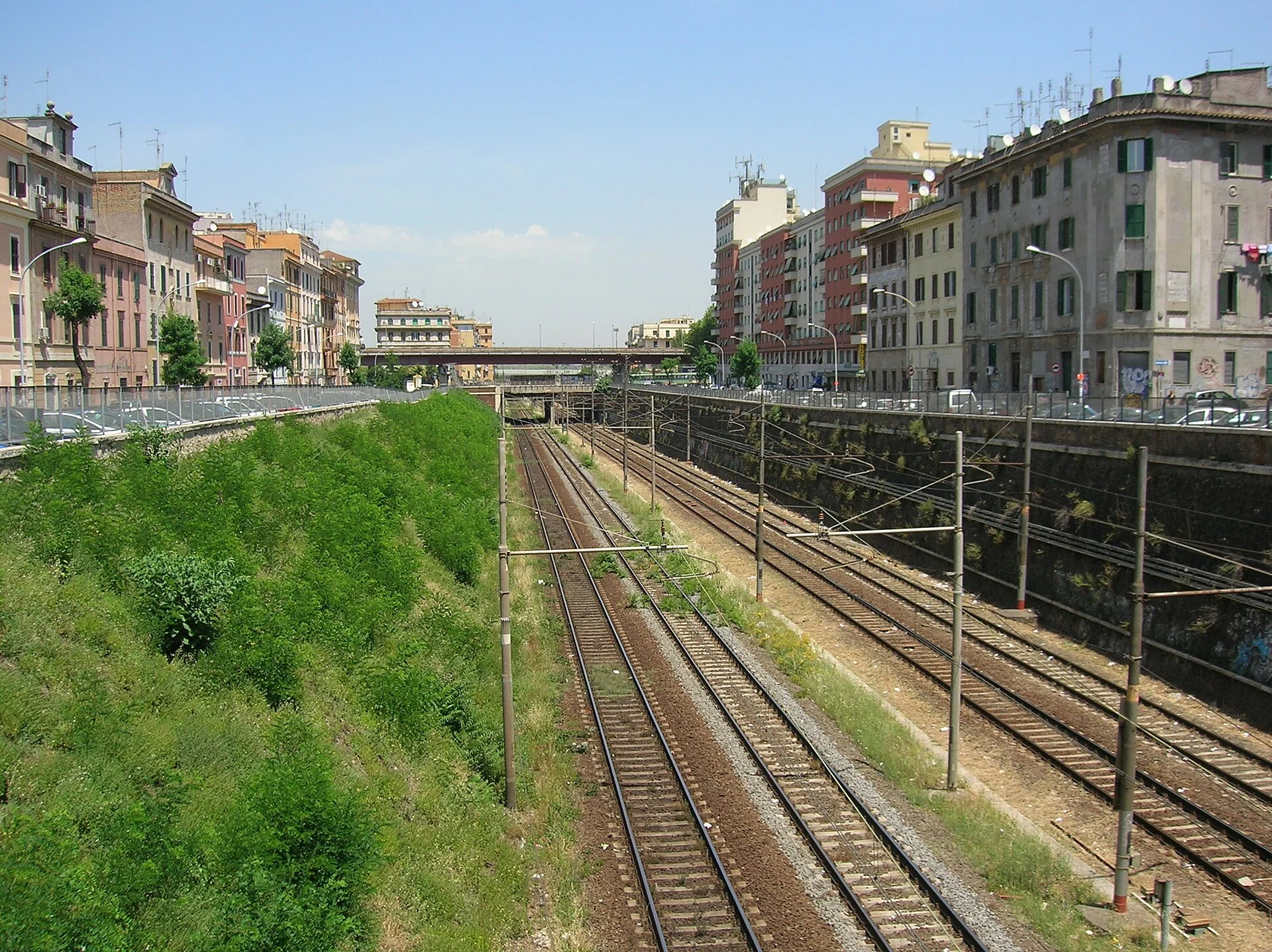
The third is from the top of the overpass, where Circonvallazione Casilina crosses over the bundle of tracks. From there you see the railway cutting that splits the neighborhood in two and you understand in one go why Pigneto stayed separate from the rest for a century. Go in the late afternoon, when the light hits the facades on the Prenestina side.
What to avoid. The photo of the packed tables in the evening, with the string lights, is the same one that 100,000 people have taken and it adds nothing. Also avoid close-ups of people at the market without asking: here people are working, they aren't scenery, and a camera pointed in the face of someone selling fish produces understandable reactions.
For night photography Pigneto is difficult and has no accessible high points. The public lighting on the pedestrian stretch is warm and uneven, and the contrasts are complicated to handle. If you want Rome at night with more predictable results, you find better directions on the page about Rome at night.
How to get there and how to get around
Metro C has a station called Pigneto and it has been open since June 29, 2015. It is under Via del Pigneto and this is the thing that surprises those who read confused news about the construction sites: the metro has been running for more than 10 years, with no works in progress and no restrictions. The previous station in the direction of Pantano is Malatesta.
The trams are the most convenient choice for arriving from the center. Lines 5, 14 and 19 run along Via Prenestina and stop at Piazzale Prenestino, about 350 meters from the Metro C station. The 5 connects Termini station to Piazza dei Gerani, the 14 connects Termini to Viale Palmiro Togliatti, the 19 passes through Porta Maggiore and continues toward Tor de' Schiavi.
There are three tram stops useful for Pigneto. Piazzale Prenestino serves the part toward Porta Maggiore, Prenestina Giovenale opens directly onto Via Ettore Giovenale and so onto the film locations, Prenestina Giussano serves the central part. Getting off at the right one saves 10 minutes on foot, and nobody explains it on the platform panels.
The Roma Giardinetti railway, the old narrow-gauge line, has stops at Porta Maggiore, Alessi, Ponte Casilino, Sant'Elena and Villini. Service is reduced compared with the past and the operating information needs to be checked on the Atac site before counting on it for a fixed-time itinerary.
By car the advice is firm: don't come. Parking in the triangle is full at every hour, Via del Pigneto has the pedestrian stretch closed and the side streets have one-way systems that change direction several times. If you arrive by car you spend 20 minutes circling and still end up 400 meters from where you wanted to be.
For the general picture on tickets, time validity and integration between metro, bus and tram, the page on getting around Rome lines up the rules that apply across the whole city. Pigneto has no special fares and falls within the ordinary urban zone, so you don't need travel tickets different from those for the center.
The railway station construction site and the bridge
The station discussed in the construction-site news is not the metro one. It is the Roma Pigneto railway stop, under construction along the urban link of the Florence-Rome line between Roma Tiburtina and Roma Tuscolana, beneath Circonvallazione Casilina. It will be an underground through stop with two tracks, served by the regional lines FL1 and FL3.
The story of this construction site is long and instructive. It has been discussed since the early 2000s, with the initial idea of starting the works at the same time as those of the Metro C station. In December 2014 Roma Capitale and Rete Ferroviaria Italiana signed a memorandum of understanding that provided for a start in September 2015 and completion by 2017. Neither of the two dates was met.
In January 2022 the mayor announced the station ready for the 2025 Jubilee. In June 2023 RFI launched the tender for a project worth 100 million euros, funded with money from the National Recovery and Resilience Plan. The first tender went unclaimed in September 2023.
The second tender also went unclaimed, in November 2023, and so did the third, in February 2024. Only in August 2024 did RFI identify the best bidder, a temporary consortium of firms, and on September 23, 2024 the works really started. Completion was indicated for the end of December 2026, but the local press in April 2026 reported a further slippage.
The underground link between the railway stop and the Pigneto station of Metro C, which is the real reason the project matters, is planned for a later stage and is indicated for 2029. Until then the interchange between regional train and metro will not be direct, and anyone who reads interchange hub needs to keep that in mind.
The construction site entailed the demolition of the old bridge over the railway cutting, documented in April 2025. For those on foot this means altered routes between the Casilina side and the Prenestina side, barriers and crossings moved. The situation changes from month to month and there is no reliable up-to-date map: you see it when you get there.
The pedestrian footbridge that connects the two parts of the neighborhood over the tracks is the element most used by residents and the least talked about to visitors. From up there you see the cut of the railway with its switches and the poles of the overhead line, and it is the point from which you understand the real geography of Pigneto in 30 seconds.
Some important events that happened here in history
1870 is the date of birth of the built-up area. Before that year the area is suburban countryside with vegetable gardens, vineyards and villas, attested as Pigneto already from the 1600s. After 1870 the nuclei of the Prenestino, the Torrione, the Galliano borgata, the Acqua Bullicante, the Marranella and the Casilino join along the perimeter of the triangle.
Between 1886 and 1891 the first depot for horse-drawn omnibuses and trams outside the Aurelian Walls is built in Piazza Caballini, the work of the Società Romana Tramways Omnibus. In 1904 electrification turns it into an exclusively tram depot. The relationship between Pigneto and Roman public transport begins here and lasts to this day.
In 1909, on March 22, the Serono pharmaceutical institute on Via Casilina is inaugurated, in the presence of its founder Cesare Serono and the municipal authorities. In the same decades the villini and the low houses that give the neighborhood its present look are built, with the Michelucci episode of Villa Valiani in 1929 and 1930.
In 1943 and 1944 the neighborhood suffers the Allied bombings, with 50 Atac employees among the victims and Via Raimondo Montecuccoli among the streets hit. In January 1945 Rossellini shoots on that same street the sequence of Pina's death in Rome, Open City, a few months after the real events.
In 1954 the rayon factory of the former SNIA Viscosa on Via Prenestina closes, born as CISA Viscosa in 1923 and absorbed by SNIA in 1969. The industrial decommissioning of the area begins from here and ends in the 1970s with the abandonment of the Pantanella pasta factory, converted to residences only in 2001.
In 1961 Pasolini shoots Accattone, and Pigneto enters the collective imagination with a force it has never lost. The film comes out on November 22 of the same year, after Venice. Before and after, the neighborhood hosts sets by Visconti in 1951, Germi in 1955, Loy in 1959, Risi in 1961 and Monicelli in 1977.
In 1996 the movie theater on Via l'Aquila is confiscated from the Banda della Magliana. In 2015, after modernization works, it is assigned and reopened, with a later interruption and a new reopening in 2018. It is a public hall, not a private business, and its story tells the relationship between organized crime and Roman real estate better than many essays.
In 2003, on December 20, the hideout of the new Red Brigades is found in a cellar at Via Raimondo Montecuccoli 3. In 2015 comes the Metro C station and the pedestrianization of Via del Pigneto in its present form. In 2024 the works on the railway stop finally begin. These are the three dates that have changed the neighborhood in 20 years.
Who has passed through Pigneto
Pier Paolo Pasolini is the name the neighborhood wears sewn onto it. Here he shot his directorial debut in 1961, and here he had already set part of his view of the Roman borgate. The phrase about the crown of thorns that encircles the city of God comes out of this geography, and Pigneto was one of its points.
Anna Magnani ran after a truck on Via Raimondo Montecuccoli in January 1945, for the scene in Rome, Open City, and came back in 1951 for Luchino Visconti's Bellissima. Two different films, two different directors, the same handful of streets. Few areas of Rome have a similar density of neorealist cinema on the same paving.
Roberto Rossellini in 1945, Luchino Visconti in 1951, Anton Giulio Majano in 1953 with Sophia Loren and Nino Manfredi, Pietro Germi in 1955 with Il ferroviere, Nanni Loy in 1959 with Audace colpo dei soliti ignoti and a cast from Vittorio Gassman to Claudia Cardinale. Pigneto was a continuous film set for 15 years.
Bernardo Bertolucci worked here as a young man as Pasolini's assistant director on Accattone, before shooting his own films. Franco Citti, a Roman born and raised, became a recognizable face with that role. Franca Pasut, Silvana Corsini and Adriana Asti completed the main cast, and Citti's voice was dubbed by Paolo Ferrari.
After neorealism the neighborhood keeps appearing. Dino Risi shoots Una vita difficile here with Alberto Sordi in 1961, Luciano Salce passes through for Fantozzi in 1975, Mario Monicelli returns with Un borghese piccolo piccolo in 1977, again with Sordi. Then Umberto Lenzi in 1978, Ricky Tognazzi with Ultrà in 1990.
In the 2000s Pigneto returns to the movies with other directors: Carmine Amoroso in 2006 with Cover boy, Francesca Archibugi in 2009 with Questione di cuore, starring Antonio Albanese and Kim Rossi Stuart. The neighborhood has changed its face but hasn't stopped working as a backdrop. Anyone who makes films has known it for 80 years.
What's around, if you have half a day more
Porta Maggiore is a 10-minute walk from the start of Via del Pigneto and is one of the densest points of ancient Rome outside the center. There you find the tomb of Eurysaces of 30 BC, the gate itself of AD 52 and the Neopythagorean underground basilica, which can only be visited by reservation and with limited access.
The Torrione Prenestino, at the second mile of Via Prenestina, is a mausoleum of the first century BC absorbed into the modern urban fabric. A little further on, at the third mile, is the tomb of Largo Preneste, listed by the Sovrintendenza Capitolina. These are monuments you look at from the street, with no ticket office and no hours.
Toward Torpignattara you reach the Mausoleum of Sant'Elena and the catacombs of Saints Marcellinus and Peter, which is the most substantial archaeological visit in the whole eastern sector of the city. You book, it has limited hours and it can't be improvised. If you have half a day, combine it with Pigneto without problems, it's 20 minutes by tram and on foot.
In the direction of Casilina and Tuscolana you go down toward the Mandrione, the other Pasolini location in the area, and toward Quadraro, a neighborhood with a history of resistance and roundup that has left precise traces. Further south still you enter the Aqueducts Park and the Appia Antica Park.
For those staying in the area there are two public libraries that are useful to a visitor too: the Goffredo Mameli library and the Cittadini del Mondo intercultural library. Air conditioning in summer, restrooms, wifi and no obligation to buy anything. On July afternoons in Rome this matters more than it seems.
On the summer events front the eastern quadrant has a packed program. The Casilino Urban Fest, the Cinema sul Tetto screenings at the Casilino Sky Park, the activities of the Casa della Cultura di Villa De Sanctis and the Castagneto Prenestino cover a large part of the summer.
If you want to compare Pigneto with other Roman neighborhoods with a strong identity, you have three useful points of comparison: Testaccio, with its Monte dei Cocci and the open-air museum, Trastevere and EUR. Three different models of how a Roman neighborhood is told and consumed.
Eating in the area
In Pigneto you eat better than in the center and spend less, but the area has developed its own traps in recent years, which are different from those of the historic center and harder to recognize. If you apply here the criteria you use in Piazza Navona, you aim at the wrong target, because the mechanism is another one.
The first warning sign remains universal and applies here too: the menu with photographs of the dishes. A kitchen that needs to show you the picture of an amatriciana to convince you is addressing people who will never come back. The same goes for menus translated into six languages with numbered dishes and for signs with flags.
The second sign is the lady rolling out fresh pasta in the window or directly on the sidewalk. It is a scenic lure, built to stop passersby, and it says absolutely nothing about the quality of what comes out of the kitchen. In the places where pasta really is made by hand, it's made in the morning, in a workshop, out of sight.
The third sign is the person at the entrance who invites you to sit down. A place that has to send someone to collect customers on the sidewalk has a filling problem, and that problem isn't solved with the cooking. In Pigneto this happens above all on the pedestrian stretch on midweek evenings, when foot traffic drops.
The fourth sign concerns hours. The place open continuously from morning to night, with no kitchen break, doesn't have a brigade that cooks: it has a counter that reheats. In the places where you really eat, the kitchen closes between 3 and 7, and if you arrive at 5 they tell you no. It's a good sign.
The fifth sign applies above all in the center, but it's worth knowing anyway. In front of famous monuments there are places that adjust the price to the customer: unpriced items on the menu, different price lists between the indoor room and the outdoor tables, a cover charge that appears only on the bill. In Pigneto it rarely happens, in the center it happens every day.
On the chains with repeated signs in the center an honest clarification is needed, without snobbery. Those places work as a tourist attraction: they have a standardized, predictable product, and they answer a real need of people who travel and don't want surprises. The point is simply that Romans don't go there, and so they are not a useful clue for understanding where to eat well.
The criterion that works is just one: look at who is sitting there and in what language they order. If the tables hold neighborhood families, people who greet the server by name and conversations in Italian, you're in the right place. If at the tables everyone speaks a language different from yours and nobody is from here, change street.
A specific note on Pigneto in the evening. The saturation of venues on the pedestrian stretch has produced a predictable effect: many signs open and close within two seasons, and the average quality swings quite a bit from one year to the next. Trusting a three-year-old review is riskier here than elsewhere.
For groceries, Via del Pigneto market in the morning remains the best choice if you have a kitchen available. Fruit and vegetables at neighborhood prices, fish on the right days, and a range of products you don't find in the center. If you rent an apartment in the area, you do well to plan the day around the market's hours.
If you want the full picture of places to eat in Rome and Lazio, unfiltered and updated over time, the list is public: the map of the places where I eat in Rome. It is not a ranking and it is not sponsored: it is a reasoned selection.
Frequently asked questions
Is Pigneto safe?
Pigneto is a lived-in residential neighborhood, with the petty-crime problems of any dense urban area near a station. By day you walk around without worries. In the evening the pedestrian stretch is full of people until late, while the side streets empty out: the rule that applies everywhere in Rome applies, keep your phone in your pocket and don't leave bags on chairs.
How much time do you need to visit Pigneto?
Two hours are enough for the pedestrian stretch, the market and the streets of the Pasolini locations. Half a day is needed if you add the former SNIA, Porta Maggiore and a lunch stop. A whole day only makes sense if you link the neighborhood to the Mandrione, Quadraro or the catacombs of Saints Marcellinus and Peter, which are the real archaeological visits in the area.
Can you see Accattone's bar?
The bar in the film never existed as a business: it was a set fiction put up on Via Fanfulla da Lodi at number 50 for the 1961 shoot. You can see the street, which has kept its original proportions, but there is no historic venue to visit as a set. Whoever points one out to you is simplifying something that is documented differently.
Is the Pigneto station of Metro C open?
The Pigneto station of line C has been in service since June 29, 2015 and is under Via del Pigneto. The works you read about concern something else: the Roma Pigneto railway stop of lines FL1 and FL3, under construction beneath Circonvallazione Casilina since September 2024, with an underground link to the metro planned for 2029.
Which trams reach Pigneto?
Tram lines 5, 14 and 19 run along Via Prenestina and serve the neighborhood. The 5 goes Termini to Piazza dei Gerani, the 14 goes Termini to Viale Palmiro Togliatti, the 19 crosses Porta Maggiore and continues toward Tor de' Schiavi. The useful stops are Piazzale Prenestino, Prenestina Giovenale and Prenestina Giussano.
When is Via del Pigneto market on?
The market works in the morning on the pedestrian stretch of Via del Pigneto and is cleared away in the early afternoon. The official hours do not appear to be published on any institutional page reachable at the date of the check, so for confirmation it's best to contact Municipio V. If you arrive in the afternoon you find the street clear and the tables in place of the stalls.
Can you visit Pigneto with children?
Yes, with two warnings. The sidewalks are narrow and uneven and the stroller often has to be pushed in the roadway on the side streets. The big streets, Via Prenestina and Via Casilina, have fast traffic and crossings that are not always protected. The historical educational museum of 20th-century games and toys, on Via Vincenzo Coronelli, is the best destination for the youngest in the area.
What can't you see in Pigneto?
There are no monumental churches, no state museums, no excavations that can be visited with a ticket. The churches of the area are 20th-century parish churches: Sant'Elena of 1913, San Leone I of 1950 to 1952, San Luca Evangelista of 1955 and 1956, San Barnaba of 1956 and 1957. If you are looking for classical Roman artistic heritage you have to go elsewhere.
Is it worth combining Pigneto with a tour of the center?
It is if you organize the day well. The tram from Termini station takes about 20 minutes and leaves you at Piazzale Prenestino. A combination that works is morning in Pigneto with the market and afternoon in the center, not the other way around, because the neighborhood gives its best in the hours when the center is still empty. The page on a weekend in Rome helps fit the half days together.
Who wrote this page
The editorial team that maintains these entries is that of Tour Leader Pro, a Rome-based outfit that designs itineraries, visits and cultural events in Rome and Lazio. The practical information given above appears to have been checked at the date given in the text against the official sources linked, and it changes often: a check before you go out saves you a closed door. Reports of data that is no longer correct are welcome.
Anyone who has to build a Roman route outside the center runs into problems that don't show on paper: construction sites that move crossings from one month to the next, markets with no published hours, parishes that open at their discretion, surface lines diverted without notice and distances that seem short until you do them with a group. On Tour Leader Pro you find planning tools designed both for those who guide and for those who organize on their own.
For the broad picture on how to reach Rome, get around Lazio, rail connections, rentals, airports and destinations beyond the Grande Raccordo Anulare, from the Castelli to the lakes to the coast, a useful resource is Italy Planner, which thinks on the regional scale rather than that of the single neighborhood.