Atelier Montez
In short. Production center for the audiovisual arts created by renovating an old industrial building in the Pietralata area.
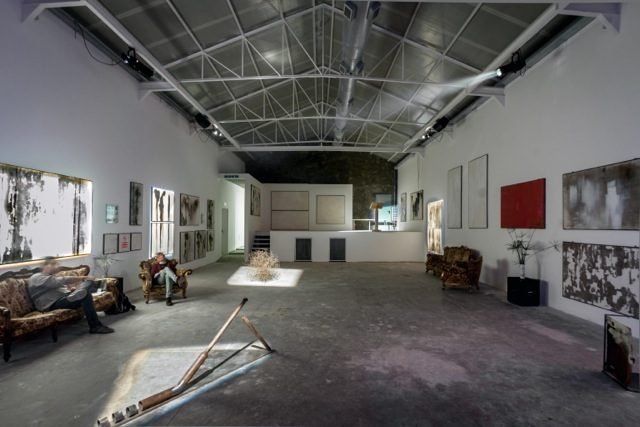
Atelier Montez
Via di Pietralata, 147/A
Rome
Production center for the audiovisual arts created by renovating an old industrial building in the Pietralata area. Sound stage, recording studio, exhibitions, clubbing and many other activities on the program. Put like that it sounds like the spec sheet of a converted warehouse, and in part it is. But behind those four lines of description there is a piece of Roman industrial history, a neighborhood that almost no guide names and a way of understanding cultural space that in Rome, outside the center, has produced over the last 20 years some of the most interesting things that have happened to the city.
It's worth starting here, from the dry sentence, because it already contains everything you need to know. It isn't a museum, it isn't a theater, it isn't a club and it isn't a gallery, and yet at certain moments it resembles each of these things. It's a place of work: a space where images, sounds and objects are produced, and which periodically opens its door to the public to show what is being made inside. The difference between a production center and an exhibition hall is subtle to explain and very clear to perceive as soon as you walk in: in the first case the public enters the workshop, in the second it enters the shop window.
It's wise to distrust mental maps that divide Rome into a postcard center and an undifferentiated periphery. Via di Pietralata, at number 147/A, is one of those addresses that perfectly explain how lazy that division is. 10 minutes of metro from the center, a wide street with workshops and low buildings, and inside an old industrial building a place that has nothing to do with the postcard and everything to do with the living city.
What an audiovisual arts production center really is
The definition is technical and it's worth taking apart piece by piece, because it's what distinguishes Atelier Montez from any other cultural space in the city. Audiovisual arts means, literally, everything that is watched and listened to together: cinema, video, moving photography, video art, documentary, music video, animation, but also the sound that accompanies those images and the sound that lives on its own, recorded music and music played live. Production center means that those things are not only shown: they are made.
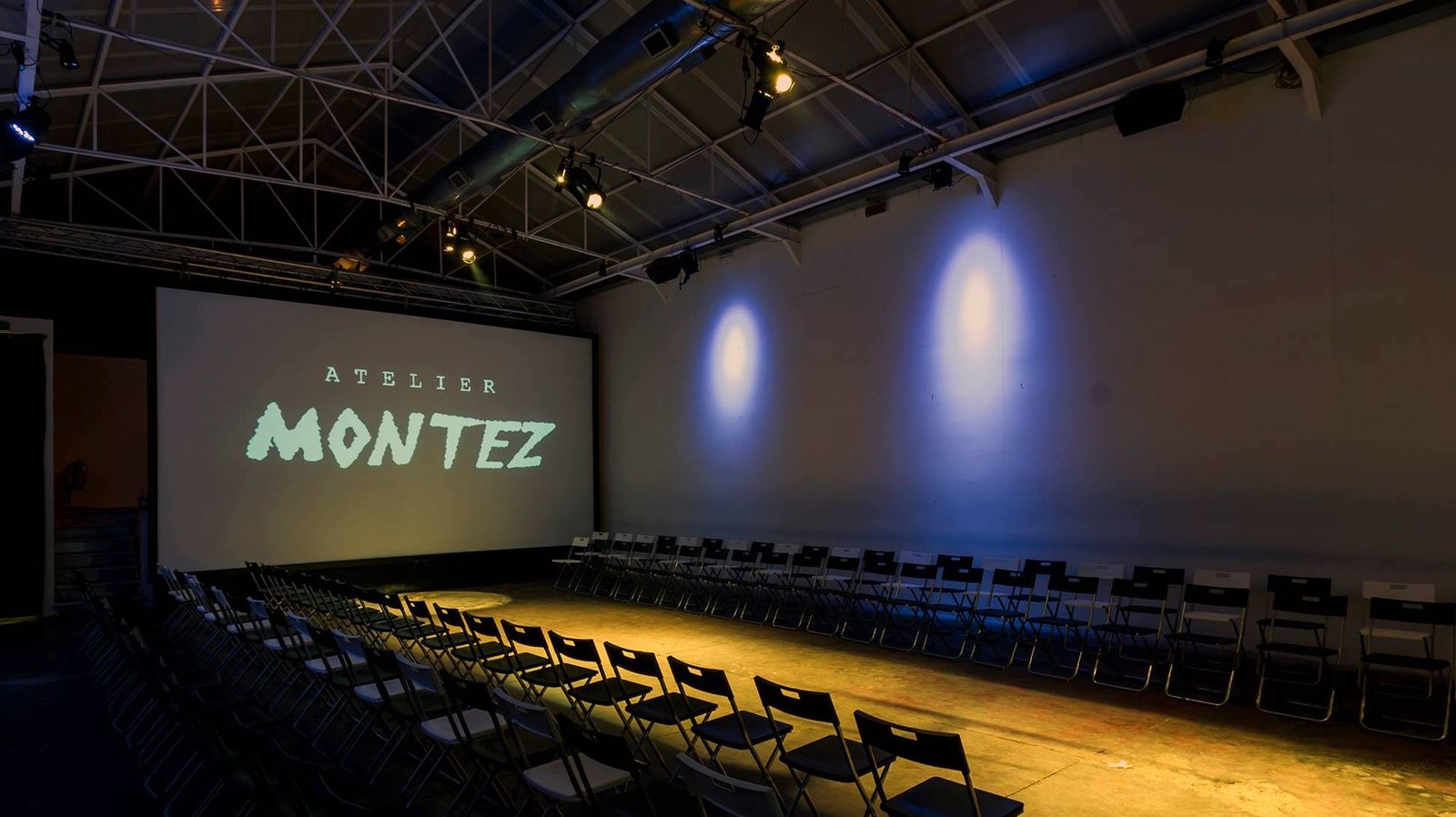
Which implies a precise set of equipment. A sound stage, that is, a large, tall room with neutral walls and the possibility of hanging lights from the ceiling and building sets from scratch. A recording studio, that is, an acoustically treated, soundproofed environment, with a control room separate from the recording room. And around these two cores, everything needed for them to work: storerooms, dressing rooms, editing areas, workshop spaces, a courtyard for unloading materials, oversized power outlets, warehouse heights.
A disused industrial building is exactly the right container for this kind of activity, and it's the reason why all over Europe cultural production centers are born in old factories and almost never in historic palazzi. You need volume, you need height, you need the possibility of making noise without the neighbor upstairs calling the municipal police at 11 at night. A noble apartment in the center has stuccoes, coffered ceilings and Soprintendenza restrictions. A warehouse in Pietralata has seven meters of clear height, a load-bearing structure that supports any hanging load and neighbors who in their lives have heard far worse noises than a vocal PA system.
The sound stage
Those who don't work in the field struggle to imagine what it is, because the sound stage is by definition invisible in the finished product. It's an empty box. Dark or white walls depending on use, a leveled floor, a structure of beams or grids on the ceiling from which the lighting fixtures are hung, and nothing else. Everything you see in a video, in an advertising photo, in a scene shot indoors, is built in there and then taken apart.
The reason spaces like this exist outside the big production complexes is economic before it is artistic. Cinecittà is expensive, and is designed for productions of a certain scale. An independent music video, a fashion shoot for a young brand, the pilot of a self-produced series, a short film funded with difficulty, a documentary with a crew of four: this whole band of production, which in Italy is where the people who will later do the rest are trained, needs accessible spaces, bookable by the day, run by people who understand what is needed. Spaces like this serve that.
An interesting consequence is that the public, when it enters, enters an environment that was not designed for it. Museum rooms are designed so that people walk in them looking at the walls. A sound stage is designed so that a crew works in it without tripping on cables. When the same space hosts an exhibition or an evening, that nature doesn't disappear: it stays in the air, in the gaffer marks on the floor, in the ceiling hooks, in the heavy doors. It's a kind of involuntary authenticity that no purpose-built space manages to manufacture.
The recording studio
The other core. A recording studio is a much more delicate technical object than a sound stage, because it has to solve two opposite problems: keeping outside sounds from getting in and inside sounds from getting out, and at the same time controlling the way sound behaves inside the room. The first problem is solved with mass and decoupling, that is, effectively building a room inside the room, resting on supports that don't transmit vibrations. The second is solved with the materials on the walls: absorbers where damping is needed, diffusers where reflections need to be broken.
Here too, the peripheral location is not a fallback but a rational choice. A studio in a residential building in the center fights every day against traffic noise, against the neighbors, against the delicacy of the floors and against rents that make it impossible to tie up square meters for an activity that produces little per square meter. A studio inside an industrial building starts with the right walls, the right floors and a context that isn't scandalized.
The exhibition side and the night side
The original description also names exhibitions and clubbing, and this is where the place stops being only a work tool and becomes a place of the city. It's a recurring passage in all spaces of this type: whoever opens a production center does so to work, but a large, equipped warehouse, in the evening and on weekends, is also the closest thing to a multipurpose hall you could wish for. From there to hosting exhibitions, presentations, screenings, concerts and music nights the step is short, and almost always taken.
This double nature is the real character of the place. A place that produces by day and hosts by night has a different audience from that of a pure club: those who go in the evening often work there too, or know someone who works there, or are there because they saw the thing being born. What comes out is an atmosphere you don't find in clubs built at a drafting table, and which Romans recognize instantly because it's the same one you breathe in the city's other reclaimed spaces, from the Lanificio a little farther along the same street to the experiences of the ex Snia on Via Prenestina.
Where it is and how to get there
The address is Via di Pietralata 147/A, and the first thing to say is that Via di Pietralata is long. Very long. It crosses the whole neighborhood lengthwise, runs roughly parallel to Via Tiburtina a bit farther up, and changes face several times along the way: stretches of public-housing blocks, stretches of small villas, stretches almost industrial with workshops and body shops, some leftover green. The high street numbers, those around 140 and beyond, correspond to the northeasternmost part, the one that looks toward Ponte Mammolo and toward the Aniene valley.
This detail, trivial to state, is the main cause of navigation errors for those going for the first time. Setting only the name of the street and trusting your instinct leads you to be off by a good kilometer and a half, with the unpleasant feeling of being on the right street and never finding the number. The street number, here, matters more than the name of the street.
By metro
Line B is the natural means. The useful stops are Pietralata and Monti Tiburtini, both on the branch that continues from Termini toward Rebibbia, that is, the historic branch of the line, the one that doesn't fork toward Conca d'Oro and Jonio. From the center the trip is short: from Termini you arrive in a handful of stops, from the Colosseum a little more, and in both cases it's barely a quarter of an hour by train.
From the platform to the door you walk, but it's a flat route, on wide sidewalks and streets that are lit even in the evening. It's wise, though, to look at the map before leaving the turnstile, because the B stations on that stretch have exits on opposite sides of the roadway and getting the side wrong means taking a big detour to find a decent crossing. It's five minutes lost that, in rain or cold, you feel entirely.
The advantage of the metro, in this area, is double. On one side it eliminates the parking problem, which on a street of workshops and businesses resolves itself in the evening but complicates things by day. On the other it lets you have a drink without worries, which in a place where there's also clubbing is not a secondary detail. The only serious limit is the closing time: the Roman metro stops early, and those who stay late must count on a return by other means.
By bus
The area is served by several surface lines that run along Via Tiburtina and the neighborhood's interior streets, and that connect the area to Stazione Tiburtina, to Ponte Mammolo and to the termini of the eastern quadrant. Buses are more useful than the metro in two cases: when you arrive from the north or the east without passing through the center, and when you leave late and the trains have already closed. In the middle hours of the day, instead, the metro almost always wins, because Via Tiburtina traffic is what it is.
A practical tip that holds for all of Rome and here in particular: the times shown at the stops should be taken as rough indications, and the difference between a three-minute wait and a 20-minute one comes down entirely to the ability to read real-time tracking apps. In an area where you go out in the evening, knowing if the next vehicle is around the corner or a quarter of an hour away changes the decision between waiting and calling something.
By train
Stazione Tiburtina, which is one of the city's great railway hubs, is south of the neighborhood and serves regional trains, high-speed trains and airport connections. Anyone who arrives in Rome by train and plans an evening around here has a rare logistical advantage: you get off at Tiburtina, take the metro for two or three stops and you're there. It's a convenience that the historic center, with its alleys and its clogged transport, almost never offers.
The same goes in reverse. Anyone leaving the next morning from Tiburtina and looking for a place to spend the evening before without going too far from the station has, in this quadrant, a range of options that includes cultural spaces, venues and some solid food addresses, all reachable with the same metro line.
By car, scooter, bicycle
The car works, with the usual Roman warnings. The neighborhood is not inside the limited traffic zone, street parking exists, and in the evening, when the daytime businesses close, spaces free up. By day it's more complicated, because the workshops and depots occupy a lot of street frontage and parking spaces are reduced. Those arriving by scooter solve everything, as always in Rome.
The bicycle is a concrete option for those who live in the quadrant and not for those coming from far away. The route along the Aniene and the interior streets of Pietralata are bikeable in reasonable conditions, but the area's big through roads, Via Tiburtina first among them, are hostile and noisy. If you arrive by bike, it's better to work out an itinerary that avoids Via Tiburtina for as long as possible.
A curiosity about Atelier Montez
The curiosity I prefer concerns the name, and it isn't the one many expect. Atelier Montez is not an acronym, not an institutional abbreviation, not the name of a European project and not the name of a neighborhood or a street. It's a proper name joined to the French word that indicates an artist's workshop. This lexical choice alone is enough to understand the philosophy of the place: not cultural center, not factory, not hub, not multipurpose space, but atelier. That is, workshop.
The word is not neutral. Atelier, in the European tradition, indicates the studio where an artist works and where, around him, students, collaborators and visitors gravitate. It's a private place that opens up, not a public place that programs. The difference is enormous and explains why in spaces of this kind the atmosphere is always different from that of a municipal cultural center: entering, you have the precise feeling of being a guest in someone's home, not a user of a service.
There is also a second, subtler level. Calling a warehouse of 700 or 1,000 square meters an atelier is almost an oxymoron: the atelier evokes the small, the artisanal, the table with the brushes, the warehouse evokes production, industrial scale, forklifts. Holding the two things together in the name is a statement of intent: here artisanal work is done with industrial means. It's exactly what happens in a sound stage, where a crew of six builds by hand, piece by piece, an image that will then be reproduced in series.
I add a note for anyone looking for the place online and at risk of getting confused. In Rome the word atelier is used by dozens of very different businesses, from tailor shops to ceramics workshops to bridal shops. And in the city there are other cultural spaces with names that sound similar. The right reference, here, is the address: Via di Pietralata 147/A. When in doubt, that's the piece of data that doesn't betray you.
Pietralata, the neighborhood no guide talks about
You can't understand Atelier Montez without understanding where it is, and Pietralata is one of the pieces of Rome with the densest history and the most unjustly scarce reputation. The name derives from a characteristic of the terrain, rocky and cut, and appears in Roman documents long before there was a neighborhood. For centuries it was countryside: farm estates, farmhouses, quarries, the Aniene valley a little farther on, and the consular road Tiburtina passing by on its way toward Tivoli.
The transformation comes in the 1930s, and comes brutally. These are the years in which the Fascist regime gutted the historic center of Rome to open the great monumental arteries, and in which thousands of people were removed from the demolished houses and moved out of the city. This is how the borgate were born: settlements built in a hurry, far from the center, often lacking essential services, explicitly designed to house those who had been displaced and those arriving from the countryside looking for work.
Pietralata is one of these. An official borgata, among the first, built on land that was then truly out of the way, in a rural and marshy context in the lower stretches toward the river. The houses were small, services arrived decades later, and the neighborhood built itself a very strong identity precisely from this condition of margin.
The 20th century of Pietralata
Those who know the Italian literature of the second half of the 20th century know these borgate even without ever having been there, because they are the landscape of the novels and films that told of the working-class Rome of the postwar period. The world of the borgata kids, of the shacks, of the uncultivated fields between one group of houses and the next, of the river as a boundary and as a place to play, is the world of these neighborhoods. Pietralata appears in that narrative geography alongside Tiburtino, Pigneto, Quarticciolo, Torpignattara.
There is also a harder story, and it concerns the war years. The quadrant between San Lorenzo, Tiburtino and Pietralata was one of those hardest hit by the bombing of July 1943, which devastated the railway yard and the San Lorenzo neighborhood with a very high number of civilian victims. And in the weeks immediately following the armistice, in September of the same year, the area was the scene of episodes tied to the defense of the city and the birth of the Roman resistance. These are pages that the neighborhood's memory preserves with precision, and that explain much of the political and civic character that Pietralata has kept for decades.
In the postwar period the neighborhood grows, consolidates, gets the services it lacked, fills with small buildings and productive activities. The workshops, depots, small factories and car dealerships arrive. And in the 1990s the metro arrives: the extension of line B toward Rebibbia permanently changes the relationship between this piece of the city and the rest of Rome, reducing to a quarter of an hour a distance that before was measured in buses and patience.
The Tiburtino quadrant today
Today the quadrant that runs from San Lorenzo to Ponte Mammolo, passing through Tiburtina, Portonaccio, Tiburtino and Pietralata, is one of the pieces of Rome with the greatest density of things happening. There are the universities and their departments, there is the great rebuilt railway station, there are the neighborhoods of the nightlife and the very quiet residential ones, there are converted warehouses and warehouses still in operation, there is an important piece of the city's health system and there is a quantity of independent cultural spaces that no other Roman quadrant equals.
This concentration is no accident. Where there was light industry there are now large, rentable spaces. Where there is the metro there are people who move around. Where there are universities there are people in their 20s looking for places to go. Add these three conditions together and you have the recipe that in every European city produces creative neighborhoods. In Rome that recipe has worked in a more disorderly and less planned way than elsewhere, but it has worked.
The result is that within a few kilometers of Via di Pietralata you find very different realities: rehearsal rooms, recording studios, dance spaces like the DAF di Pietralata, venues with live music, galleries, artisan workshops, breweries. None of these places on its own would make news. All together they draw an ecosystem.
Something nobody tells you about Atelier Montez
What you don't read anywhere, and which is instead the key to not being disappointed, is that a space like this does not have a continuous calendar. It doesn't work like a museum, which opens every day from nine to seven, and it doesn't work like a theater either, which publishes a season in September and keeps to it until May. It works in waves: weeks in which the door is closed because inside they're working on a production, and weeks in which something happens almost every evening.
This is the structural characteristic of all production centers, and it descends directly from their economic model. The revenue of a space like this comes in large part from rental days: when the sound stage is rented to a production, that space isn't available for anything else, and the public doesn't come in. The openings to the public fit into the spaces left free by the work, not the other way around. It's the exact opposite of how a cultural institution reasons, and anyone who arrives with a cultural-institution mindset finds themselves thrown off.
The practical consequence is just one, and it's the most useful thing I can say to the reader: always check before setting out. Not in the generic sense in which you check a museum's hours, but in the strong sense: knowing if there's an event that evening, which one, at what time, and if you need to book or sign up for a list. Showing up at an address on Via di Pietralata hoping to find the door open is an excellent way to make a wasted trip.
The second thing nobody says concerns the relationship between these spaces and time. Roman independent spaces have a life made of phases: openings, temporary closures, changes of management, moves, adaptation works, property disputes, periods of great activity and periods of silence. It isn't a local defect, it's the ordinary condition of a sector that works with thin margins inside buildings it almost never owns. Those who frequent this world as Romans know it and take it into account. Those who arrive from outside sometimes discover it at their own expense.
Finally there is a point about entry, worth spelling out because it generates recurring misunderstandings. Evenings in spaces of this kind don't always have a ticket in the usual sense of the word. They often work with a membership card, with registration, with a list, with a contribution. It isn't a way of complicating anyone's life: it's the legal form these places take in order to do what they do. Knowing in advance if a card is needed avoids finding yourself at the door filling in a form with 20 people lined up behind you.
The spaces, seen from inside
Entering an old converted industrial building is a physical experience before it is a cultural one, and it's worth describing because it's an important part of what you go looking for. The first thing that strikes you is the height. We are used to rooms of 2.70 meters. A warehouse reaches double that or more, and the body registers it immediately as something different, somewhat as happens on entering a church. The sound changes, the light changes, the way you move changes.
The second thing is the exposed structure. In industrial buildings the beams, trusses, pillars, tie rods and systems aren't hidden behind suspended ceilings: they remain visible, and become the aesthetic character of the space. A room with exposed metal trusses and pipes painted the same color as the walls has a severe elegance that no installation manages to imitate.
The third is the floor. In warehouses it's almost always industrial concrete, sometimes polished, sometimes raw, often marked by old demarcation lines, stains, pour joints. That floor tells the building's previous story better than any plaque, and whoever designs these recoveries generally has the good taste to leave it as it is.
Why industrial conversion works so well
Rome learned late to reuse its industrial buildings, much later than Turin, Milan or the German and English cities that built entire models of urban development on it. But when it began, it produced remarkable results. The most famous and institutional example is the Centrale Montemartini, where the ancient sculptures of the Capitoline Museums are displayed among the turbines and diesel engines of the city's first public power plant: a pairing that at the time of its birth was conceived as temporary and that has proved to be one of the most beautiful museums in Europe.
But institutional conversion is only the visible tip. Beneath it there is a much broader fabric of recoveries made by associations, cooperatives, cultural enterprises and individuals, who took empty warehouses and put them back into operation with tiny budgets and a lot of stubbornness. Atelier Montez belongs to this second family, the less told and more widespread one.
The reason these recoveries succeed is almost technical. An industrial building is designed to be flexible: few load-bearing walls, large spans between the pillars, oversized systems, vehicle access. It is, in architectural terms, a neutral container, and a neutral container adapts to any content. A historic palazzo, by contrast, has a hierarchy of rooms designed for a precise function, and every use different from the original requires compromises.
My advice for visiting Atelier Montez
The main advice has already been anticipated and is worth repeating, because it's what saves the evening: check the program and, when required, book. Everything else comes after. But since a single piece of advice is not much, I'll try to build a small practical guide to how to approach an evening around here, based on how spaces of this type work in Rome.
Choosing the right moment
If the occasion is an exhibition or a presentation, the first hour of opening is the best moment. You see better, you talk with those who set it up, you have time to walk around the space and look at the building as well as the works. If the occasion is an evening with music, the reasoning flips: arriving too early means finding an empty hall and a sound system still in testing, and the interesting part starts later. In mixed places, which are the majority, it's best to arrive early and stay: you see the transition, which is often the best part.
Dressing for a warehouse
It seems like nothing and is instead the variable that decides how long you hold out. An industrial building has enormous thermal inertia: in winter it takes hours to heat up and never quite manages it, in summer it accumulates heat all day and releases it in the evening. In the cold season you need one more layer than you'd wear for a theater. In the warm season you need the opposite, and you need to accept that with 300 people inside the temperature will rise. Shoes: comfortable and closed, always, because the floor is concrete and the cables run along the ground.
Eating beforehand, or knowing where to eat
This is the area where you see the difference between those who know the neighborhood and those who don't. Pietralata and Tiburtino have a solid tradition of working-class dining, made up of neighborhood trattorias, pizza-by-the-slice places, bakeries and some historic signs. It isn't the area of guidebook restaurants, but it's an area where you eat well spending the right amount, which is rarer than it seems. The point is that many of these businesses close relatively early, and anyone arriving at 10 at night thinking they'll find the street full of lit signs risks going hungry.
The best strategy: dine early, in the area, and then go in. Alternatively you eat elsewhere, maybe in San Lorenzo or Pigneto, and arrive when the evening has already started. The worst solution is to arrive hungry counting on a buffet.
The way back
This is the part most often neglected. The metro closes before most evenings end, and the area is not full of taxis in circulation like the center. Anyone counting on returning by public transport must know the night surface lines or must plan to leave earlier. Anyone counting on a booked vehicle must consider that in certain time slots the wait times get much longer. Anyone arriving by car or scooter solves everything, but then the old rule applies: if you drive, you don't drink, and in Rome the night checks on the eastern quadrant's through roads really do exist.
Going in with the right mindset
The last piece of advice is the least practical and the most important. A space like this is not a monument: it isn't there to be visited, it's there to function. Anyone going in expecting captions, guided routes, a bookshop and impeccable restrooms will be disappointed. Anyone going in expecting to see a piece of the city at work, to be inside a beautiful and badly lit building, to cross paths with people who make things and to discover a neighborhood they had never considered, will go home happy. It's a matter of expectations, and expectations are adjusted before leaving.
The relationship with the neighborhood
A frequent question is if spaces like this serve the neighborhood or only those who come from outside. It's a serious question, because the recent history of European cities is full of cases in which the arrival of cultural activities in working-class neighborhoods set off undesirable processes of social replacement. Rome, for a series of reasons of its own, has seen these processes in a milder form than elsewhere, and the neighborhoods of the eastern quadrant are the proof: Pigneto has changed a lot, San Lorenzo has changed enormously, Pietralata almost not at all.
The reason is simple: Pietralata's building stock is not attractive to the high-end real estate market. There are no Liberty-style buildings, no historic courtyards, no proximity to a monument. There is a consolidated borgata of the 1930s and 1950s, with normally sized houses inhabited by normal families. This shields the neighborhood from the most violent transformation, and lets a cultural space settle in without becoming the vanguard of speculation.
The flip side is that the audience of cultural spaces and the population of the neighborhood meet less than would be desirable. Those who come for an evening arrive by metro, go in, come out and leave, and of the neighborhood see 200 meters of street. It's a shame, because the neighborhood has a lot to show to those curious enough to walk through it by day, perhaps arriving on foot from the stop by the long street instead of the short one.
Another well-known fact, yet rarely cited
The well-known fact is that in Rome the interesting things happen in the periphery. Everyone says it, the newspapers repeat it, essays on the contemporary city write it. What almost nobody does is draw the practical consequences, which is to build a Roman evening that really goes outside the center instead of limiting oneself to praising the periphery from afar.
Let's look at the urban planning numbers, which are merciless. The historic center of Rome, the one inside the walls, hosts a minimal fraction of the city's population, and is more and more a place of offices, hotels, short-term rentals and businesses aimed at visitors. The real city, where people live, work, raise children and look for places to spend the evening, is almost entirely outside. It follows that the everyday cultural offer, the non-monumental one, can only be peripheral: that's where the audience is and where the spaces are.
The second piece of data, less obvious, concerns costs. The square meter of cultural space, in the center, has a price that no production activity can sustain. A sound stage, a recording studio, a rehearsal room, a set-design workshop take up a lot of surface and produce little revenue per square meter. In the historic center that model is not economically possible, period. The periphery is not an ideological choice: it's the only place where the numbers add up.
There is then a third reason, which is the most interesting and the least cited. Peripheral spaces have a freedom to experiment that central ones don't have. An institution in the center must answer to a broad audience, to attentive critics, to a series of established expectations. A space in Pietralata can afford to get it wrong, to try things that don't work, to host an unknown artist without anyone asking for an account of the choice. It's in that margin of tolerated error that new things are born, and it's no accident that almost all the artists and groups who later reach the big stages began in places like this.
The quadrant around Via di Pietralata is a good example of how this mechanism works. Within a few kilometers coexist spaces for dance, for music, for the visual arts, for theater, and almost all have the same form: a readapted industrial building, an independent management, an audience that builds over time. Those who want to see the same dynamic in other quadrants find it at Casilino, at Testaccio in the spaces of the former general markets, or in the neighborhood network described by the Roma Borgata Festival.
The right photo to take at Atelier Montez
The temptation, in a place like this, is to photograph what happens: the stage, the people, the hanging work. The advice is the opposite. The photo that counts, in a converted industrial building, is the one that photographs the building, and in particular the point where the old function and the new one touch.
The subject
Look for the hybrid detail. A rusty metal truss above a freshly whitewashed wall. A decommissioned industrial electrical panel next to a sound stage spotlight. A sliding warehouse door open onto a set-up hall. An iron staircase that no longer leads anywhere. These are the images that tell what happened to that building, and they are the only ones that, looked at again years later, still say something. The photo of the stage with colored lights, instead, is identical in all the warehouses of Europe.
The light
Here lies the technical difficulty, and it's a serious one. Converted industrial spaces almost always have a mixed and complicated light: high windows that by day throw in very strong beams creating impossible contrasts, and in the evening a mix of warm spotlights, cold LEDs and colored show lighting that confuses any automatic balance. With a phone, the typical result is an image with blown highlights and gray, noisy shadows.
There are two simple remedies. The first is to lower the exposure manually: almost all phones let you tap the screen and drag a slider downward. Underexposing by one stop saves the highlights and makes the image more dramatic, which in a warehouse is exactly the right effect. The second is to brace yourself: in low light the shutter time lengthens and the hand shakes, while a pillar, a windowsill or a railing solves the problem without needing tripods.
The framing
In very tall environments a vertical shot that includes the ceiling works well, because height is the thing that makes that space different from any ordinary room and the horizontal cancels it. The opposite also works, that is, the close-up detail of a technical element, which becomes almost abstract. What usually doesn't work is the in-between framing, the one that takes half the hall without a clear subject.
A small compositional trick: put a person in the frame, even from behind and even small. Without a human reference, the scale of a warehouse can't be read and the photo looks like a photograph of a model. With a figure at the bottom left, the ceiling at seven meters suddenly becomes seven meters high.
Common sense
Two rules that hold in all spaces of this kind. The first: during exhibitions and shows, ask if you can photograph, because sometimes you can't and the reason is almost always a constraint from the artist or the production, not a whim. The second: no flash. In a dark room the flash ruins the evening for those watching, produces a worse photo than the one you'd have taken without it, and in sound stages it can interfere with shooting in progress. The phone held at your side and common sense switched on are enough.
Some important events that happened here in history
To tell the history of this address honestly, you have to distinguish two levels. The first is that of the physical place and the neighborhood that contains it, and it is documented. The second is that of the individual evenings and individual productions that have followed one another in the warehouse, and it is by its nature ephemeral: independent spaces don't keep archives, and what passed through lives in the memory of those who were there and in some scattered photograph. I prefer to tell the first level well rather than invent the second.
The birth of the borgata
The first event concerning this piece of land is its forced urbanization in the 1930s. Until then the area was countryside, with scattered farmhouses and the course of the Aniene a little farther downstream. The decision to build a borgata there to take in those displaced by the demolitions in the center transforms an agricultural landscape into an urban settlement within a very few years. It's a founding event, and you can still read it today in the pattern of the streets and the type of houses.
The war and the reconstruction
The second decisive passage is the 1940s. The railway quadrant between Tiburtina and San Lorenzo is a strategic target, and the bombing of July 1943 leaves a wound the city still remembers. In the following months, between the armistice and the liberation, the eastern borgate are an important place of the Roman resistance. Anyone walking these streets today passes by gravestones and plaques that remember that season with precise names and dates, and it's worth stopping to read them.
Industry and its end
The third event is longer and less dramatic, but it's the one that directly generated the building we are talking about. In the postwar period the Tiburtino quadrant becomes one of the productive areas of Rome: not large heavy industry, which in Rome has almost never existed, but light industry, workshops, garages, warehouses, print shops, small manufacturers. In the 1980s and 1990s that fabric enters a crisis, for the same reasons as all of urban Italy: costs, offshoring, change in the economic structure. The warehouses empty out.
The fourth event is the consequence of the third, and it is the conversion. Starting from the 1990s and with acceleration in the new century, those empty warehouses are progressively reused: some become depots and logistics, others showrooms, still others cultural spaces. The recovery of the industrial building at Via di Pietralata 147/A belongs to this season, and is an episode of a collective story that has involved dozens of Roman addresses.
The arrival of the metro
The fifth passage is infrastructural and is the one that made everything else possible. The extension of line B toward Rebibbia, with the stations of Monti Tiburtini and Pietralata, connected this quadrant to the center in a stable way. Without that line, an evening audience in a warehouse on Via di Pietralata would be a fantasy: with that line, it's an evening like any other. Transport infrastructure, in a city, doesn't only move people: it moves the very possibility that certain places exist.
Who has passed through Atelier Montez
Here too the rule of honesty applies. I won't make the list of famous names that in cases like this is always found somewhere, because for a production center the list of names is almost always misleading: a sound stage rented by the day hosts dozens of very different productions in a year, and the presence of a known face in front of a camera says no more than the name of a hotel says on a traveler's passport. I prefer to tell the categories of people that such a place goes through, because those are true and explain the character of the place much better.
The crews
The first category is the professional one. Photographers and videomakers with their teams, advertising productions, documentary crews, groups shooting music videos, film school students with their final exam. They arrive early in the morning with vans, unload black cases for an hour, set up, shoot, take down and leave at night. They are the invisible part of the life of a warehouse, the one the public never sees and which pays the bills.
The curious detail is that these people bring with them an entire ephemeral landscape: fake walls, carpeting, furniture, plastic plants, paper backdrops three meters high. For two days a corner of the warehouse becomes a bourgeois living room, a 1970s office or a beach, and then goes back to being concrete and black walls. Those who work in these spaces develop a particular relationship with reality, because they see it built and demolished continuously.
The musicians
The second category is the recording studio. Bands cutting an album, singer-songwriters recording demos, instrument sessions that don't fit in small studios, composers working on soundtracks, producers. It's a slow kind of attendance: a serious recording takes days, sometimes weeks, and the people working inside end up living in the place, bringing their own coffee, getting to know the neighbors. In industrial areas, recording studios create small, stable communities.
The visual artists
The third category is the exhibition side. Painters, illustrators, sculptors, artists working with installation or video, independent curators, collectives. For a young artist in Rome, the main difficulty isn't producing but exhibiting: commercial galleries are few and selective, and public spaces have long timelines and complicated procedures. An independent space that opens its doors to a group show solves a real problem, and that's why a grateful, loyal community of artists always forms around places like this.
The night crowd
The fourth category is the evening events. It's the largest and most mobile audience: people from the neighborhood, university students from the nearby campus on Via Tiburtina, people in their twenties and thirties who come from all over the city following the name of whoever is playing or spinning records, curious people brought along by a friend. It's also the audience that gives a warehouse its public image, because it's the one that photographs, tells the story and spreads the word.
The neighborhood
The last category is the most important and the least visible: the neighbors. In a historic borgata like Pietralata, the relationship between a cultural space and the people who live around it is a concrete matter, made of occupied parking spots, noise, people walking under the windows late at night, but also of kids from the neighborhood walking into a recording studio for the first time. The spaces that last are the ones that look after this relationship. The ones that don't, sooner or later, close.
What's around it
One of the reasons it's worth arriving early is that this stretch of Via di Pietralata is not isolated. Within a few hundred meters there is a concentration of spaces that elsewhere would take an afternoon of getting around.
On the same street, a little farther along, is the Lanificio, one of the best-known examples of industrial reuse in the area, carved out of an old manufacturing complex and over the years turned into a reference point for music and events. Also on Via di Pietralata is the DAF, Dance Arts Faculty, which is Rome's home of contemporary dance and which in summer opens its rooms to the public with a dedicated program. Three addresses on the same street, three different activities, three ways of using a warehouse.
Widen the radius a little and you reach the Aniene valley, the big green space of this quadrant, which includes equipped parks and natural areas of considerable size. If you have time to arrive in the afternoon, you can combine a walk in Parco di Aguzzano or at the Cervelletta with an indoor evening. It's a combination few people know, and it gives you the idea of a Rome completely different from the one on postcards.
Toward the center, the same metro line takes you in a few minutes to San Lorenzo, which remains the neighborhood with the highest density of bars and nightlife in the area, and where the neighborhood film festival is also held in summer. If you want to build a long evening, you can have dinner there and then move on, or do the opposite.
How to fit it into a Roman evening
People who live in Rome don't need strategies: they go when there's something that interests them. It's different for visitors with only a few days, and here the reasoning deserves some attention.
The first thing to say is that a space like this shouldn't compete with the big Roman sights. Nobody gives up the Forums or the Galleria Borghese for a warehouse in Pietralata, and it would be wrong to. But the big Roman sights are visited by day, and the evenings stay free. That's where the difference is made between a trip that sees Rome and a trip that meets it.
The second is that an evening in the outskirts works better if it isn't isolated. A well-built Roman week alternates registers: one evening downtown, one evening outdoors in a park, one evening in a neighborhood where there's nothing to photograph. If you want to understand how the city's summer calendar works, look at how the big festivals move, from the Romaeuropa Festival to Short Theatre, which for years have brought the contemporary into unconventional spaces of the city, all the way to neighborhood festivals like the Aniene Festival in Parco Nomentano, which is on the other side of the same river.
The third, and it holds as a general principle, is that Rome's outskirts should be approached with a minimum of logistical preparation and zero fear. There is nothing dangerous about a street in Pietralata at 11 at night: there are just fewer people around than in Trastevere, which in some ways is a plus.
Frequently asked questions
Is it a nightclub or an exhibition space?
Both, at different times, and neither exclusively. Its primary nature is production: a film stage and a recording studio. Exhibitions and evenings are the public side of a place that exists to work. If you arrive expecting a pure club, you'll find something rougher and more interesting. If you arrive expecting a gallery, you'll find something less polished and more alive.
Can you go in during the day for a look?
Generally no, and not out of unfriendliness: if a production is under way inside, walking in means disturbing a set. Visits, when they're possible, follow the public openings. That's another reason the golden rule remains to check the program for the period beforehand.
Is it suitable for children?
It depends entirely on the occasion. An afternoon exhibition in a warehouse seven meters high is an experience children love, much more than a traditional museum, because the space is big and the feeling is one of adventure. An evening with club-volume music, obviously not.
How long do you stay?
For an exhibition, a full hour is plenty, considering that half the time goes to looking at the building. For an evening, as long as you like. For a visit to the neighborhood, half a day is not wasted, especially if you get off at the metro stop and walk in the long way.
How do I find out what's on?
The right channels are the space's own direct ones and the listings of Roman events. It's worth remembering that independent spaces communicate mostly through social channels and sign-up lists, and that the announcement often comes only a few days ahead: that's the rhythm of the sector, not carelessness.
Frequently asked questions about Atelier Montez
Where is Atelier Montez?
Atelier Montez is at Via di Pietralata 147/A, a long street that runs lengthwise through the Pietralata neighborhood, roughly parallel to Via Tiburtina, along an almost industrial stretch with workshops and body shops.
What is Atelier Montez?
Atelier Montez is a production center for the audiovisual arts, built in a converted old industrial building, with a film stage and a recording studio inside. Its name joins a word of its own to the French word for an artist's workshop.
Is Atelier Montez always open?
No. Atelier Montez doesn't have a continuous calendar like a museum or a fixed theater season: it works in waves, with weeks when the door is closed because a production is under way inside and periods when it hosts exhibitions and evenings open to the public.
Do I need to book to attend an event at Atelier Montez?
The main advice for Atelier Montez is to check the program and, when required, book, because it's the move that keeps you from finding the door closed or the event already sold out when you arrive without checking first.
How do I get to Atelier Montez by metro?
Atelier Montez is reached by metro line B, getting off at the Pietralata or Monti Tiburtini stops, in a little less than a quarter of an hour from the center of Rome toward the Tiburtino quadrant.
Is Atelier Montez a nightclub or an exhibition space?
Atelier Montez is both, at different times, and neither exclusively. Its primary nature is productive, as a film stage and recording studio: exhibitions and evenings are the public side of a place that exists first of all to work.
Summary
Atelier Montez, at Via di Pietralata 147/A, is a production center for the audiovisual arts, built by reclaiming an old industrial building in the Tiburtino quadrant of Rome. It has a film stage, a recording studio and spaces that host exhibitions, evenings and different activities. You get there on metro line B, stops Pietralata and Monti Tiburtini, in a little less than a quarter of an hour from the center. Around it are a borgata from the 1930s with a dense history, a green river valley and a concentration of independent cultural spaces that few other Roman quadrants can claim.
If you go, you need to know two things. The first is that the program isn't continuous, and that checking before you leave isn't generic advice but the very condition of the visit. The second is that what you're going to see isn't a monument but a workplace, with the rough charm and the imperfection that workplaces have. If you accept this deal, you'll find a Rome that the guidebooks don't tell about and that, once discovered, is hard to forget.
If you're building a trip to Rome and you don't want evenings like this to be a missed chance, the quickest way is to be accompanied by someone who knows the city's calendar from the inside: for private, corporate or tailor-made tours and experiences, with licensed guides and tour leaders, the reference is Tour Leader Pro, which works with professionals all over Italy. To organize the rest of the trip around an evening, from getting around the city to transfers and days outside Rome, the starting point is ItalyPlanner.
Contact Information
Via di Pietralata, 147/A
Roma Roma Città, Roma Città