Lapis Niger
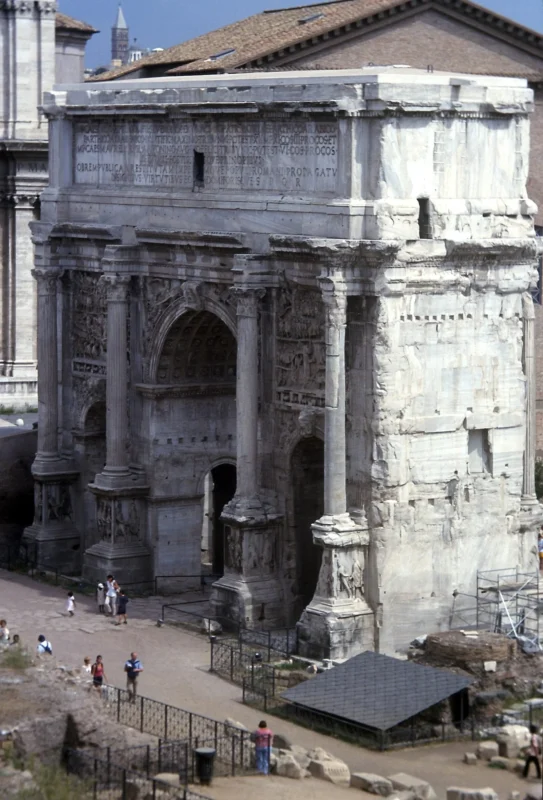
In short. The Lapis Niger is the square of black marble slabs that you see in the Roman Forum, a few meters from the facade of the Curia Iulia and almost in the shadow of the Arch of Septimius Severus.
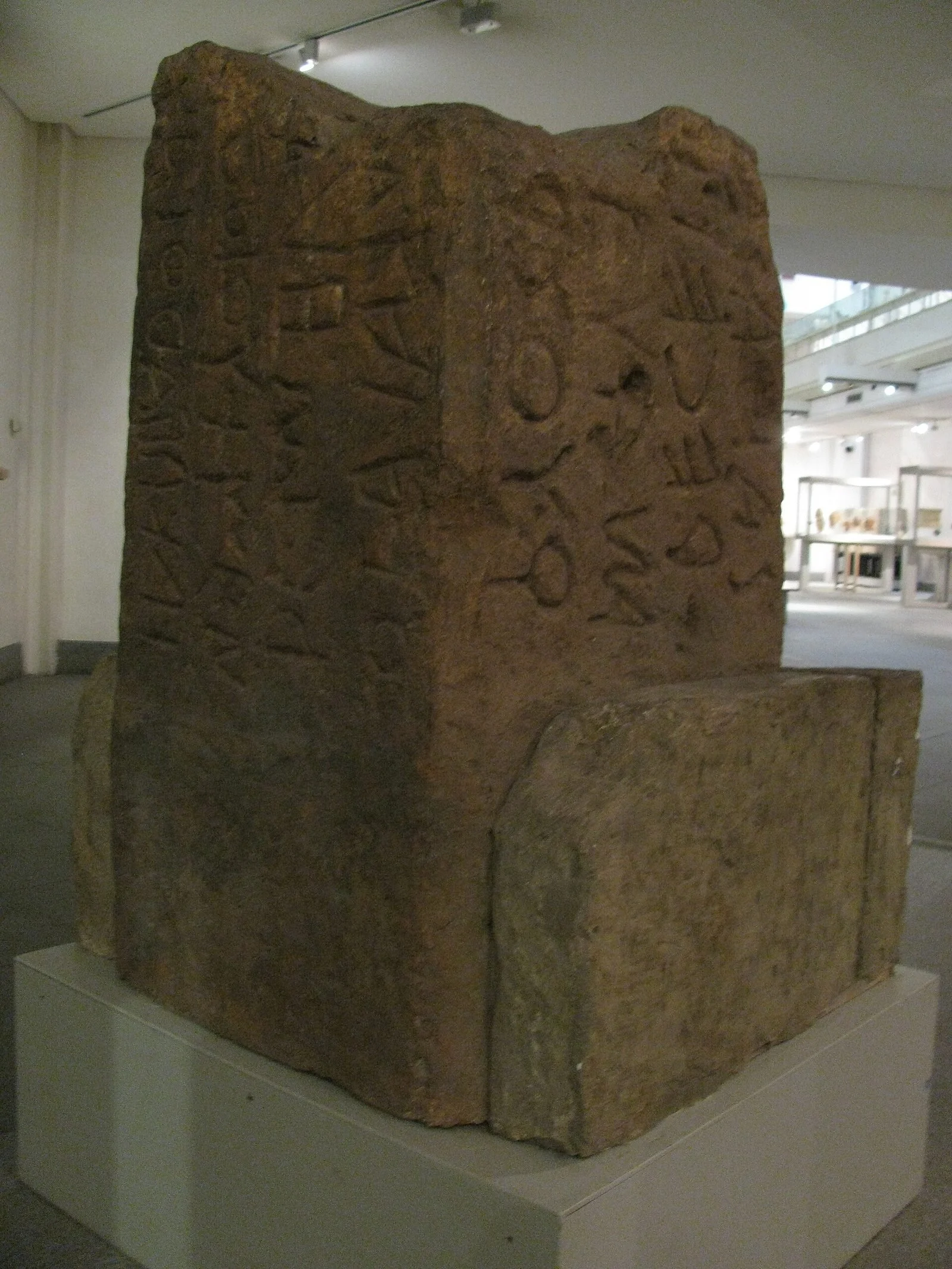
The Lapis Niger is the square of black marble slabs that you see in the Roman Forum, a few meters from the facade of the Curia Iulia and almost in the shadow of the Arch of Septimius Severus. A dark rectangle of a few square meters, surrounded by a low barrier, which most visitors walk past without stopping as they head for the Colosseum or the Palatine. That black pavement is a marker: it is there to say that something lies below, and that this something was considered delicate already in Roman times. Under the slabs, at a depth of about a meter and a half, there is a small archaic complex that includes an altar, a base and a tuff cippus inscribed with a text in archaic Latin from the 6th century BC: the oldest document in the Latin language that we know. The text is damaged and its interpretation is still debated among scholars. The lines that follow tell what you see on the surface, what lies below, what that inscription says and what it doesn’t say, why the ancient sources spoke here of a tomb of Romulus and why that story should be treated as tradition reported by late authors and not as an excavation finding.

Where the Lapis Niger is inside the Roman Forum
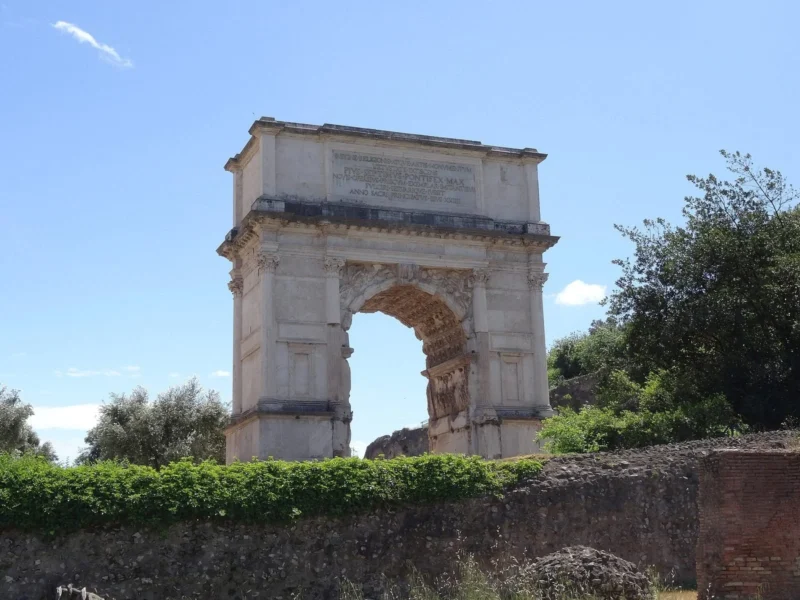
The Lapis Niger is in the northwest corner of the Roman Forum, in the area of the Comitium, between the Curia Iulia and the platform of the Rostra, right by the Arch of Septimius Severus. Anyone entering from the entrance at Largo della Salara Vecchia, on Via dei Fori Imperiali, meets it after a few dozen meters, on the right, going down toward the bottom of the valley. Anyone arriving instead from the Colosseum reaches it at the end of the route, after the Arch of Titus, the Basilica of Maxentius and the long side of Via Sacra.
The visual reference that never fails
The quickest way to find it is to take the brick of the Curia Iulia as a reference. With your back to the facade of the Curia, a few steps toward the river, you see a low metal barrier that encloses a rectangle of dark slabs flush with the ancient travertine pavement. That is the Lapis Niger. The black surface contrasts with the light color of the surrounding paving and is easy to notice up close, much less from the panoramic terraces of the Capitoline Hill, from which the square looks like a dark patch that is hard to read.
The Comitium, that is, the context
The Lapis Niger occupies the edge of what archaeologists call the area of the Comitium: the space for political assembly of early Rome and the early Republican age, where the assembly of citizens was held before the Forum took on the monumental form we know. The Comitium was a square distinct from the Forum proper, in direct relation with the Curia, that is, the seat of the senate. Knowing this changes how you read the monument: the black square is not an isolated object planted at random, but the marked remnant of a place of worship that stood inside the political space of the archaic city.
How to get to the Roman Forum
The nearest metro stop is Colosseo, on line B, from which you walk along Via dei Fori Imperiali for 5 to 10 minutes to the entrances of the archaeological area. On the surface, the bus lines that run along Via dei Fori Imperiali and Piazza Venezia leave you a short distance away, and from Piazza Venezia you get there on foot in a few minutes, passing in front of the Forum of Trajan and the Markets of Trajan. For getting your bearings on public transport in general, the page on how to get around Rome is useful, explaining tickets and connections. By car it’s not worth it: the whole area is a limited traffic zone and there is no parking near the entrances.
What you actually see on the surface
What the visitor sees of the Lapis Niger is a covering, not the monument: the black marble slabs are the modern and ancient marker of a complex that remains below walking level. This is the point that causes the most disappointment among those who arrive having read somewhere the words tomb of Romulus and expect a funerary chamber they can visit. On the surface there are dark slabs, a barrier and, in some periods, a protective structure. Little to look at. All the content lies in the depth and in the history of the object.
The black slabs and their chronology
The dark pavement that encloses the area is ancient, but it is much more recent than the complex it protects. Scholars link it to the rebuilding of the Comitium in the late Republican age, when the area was reorganized and the archaic monument was buried and at the same time marked with a covering of dark stone. The precise chronology of the covering remains debated, with proposals ranging between the Sullan age and the early imperial age: the publications don’t agree, and it’s better to report the divergence than to choose a date and take it as certain.
Why black
The color is not by chance. In Roman culture black was the color of mourning, and a black stone placed at a precise point of the Forum marked an ill-omened place, that is, one touched by death and withdrawn from ordinary use. The grammarian Festus, who wrote in the 2nd century AD summarizing an older author, explains the presence of the black stone in the Comitium in exactly these terms. The marker served to keep daily foot traffic away from a point that the city considered untouchable.
The modern protection and its effect
During the 20th century the area was protected several times with service coverings, canopies and fences, changed over time according to conservation works. The look of the monument in photographs therefore varies a lot depending on the year of the shot. Before planning a targeted visit, it’s best to check the state of the area in the notices of the Parco archeologico del Colosseo, which manages the site.
The discovery by Giacomo Boni in 1899
The Lapis Niger was brought to light in 1899 by Giacomo Boni, the Venetian architect who in those years directed the excavations of the Roman Forum. The discovery had an enormous echo in the press of the time because it was immediately linked to the ancient reports about the tomb of Romulus, and because it came at a moment when unified Italy was looking in its most remote past for a foundation of national identity. The part that interests us today is another: the method with which Boni dug.
Who Giacomo Boni was
Boni, born in Venice in 1859 and died in Rome in 1925, came from architecture and restoration, not from classical philology. He took over the direction of the Forum excavations in 1898 and systematically introduced stratigraphic excavation, that is, reading the layers of earth one by one, with progressive graphic and photographic documentation. Before him, in the Forum area people dug mainly to free the visible monuments and recover marbles and inscriptions. With Boni the attention shifts to the succession of levels, and this makes it possible for the first time to distinguish the archaic phases from the Republican and imperial ones.
What he found under the slabs
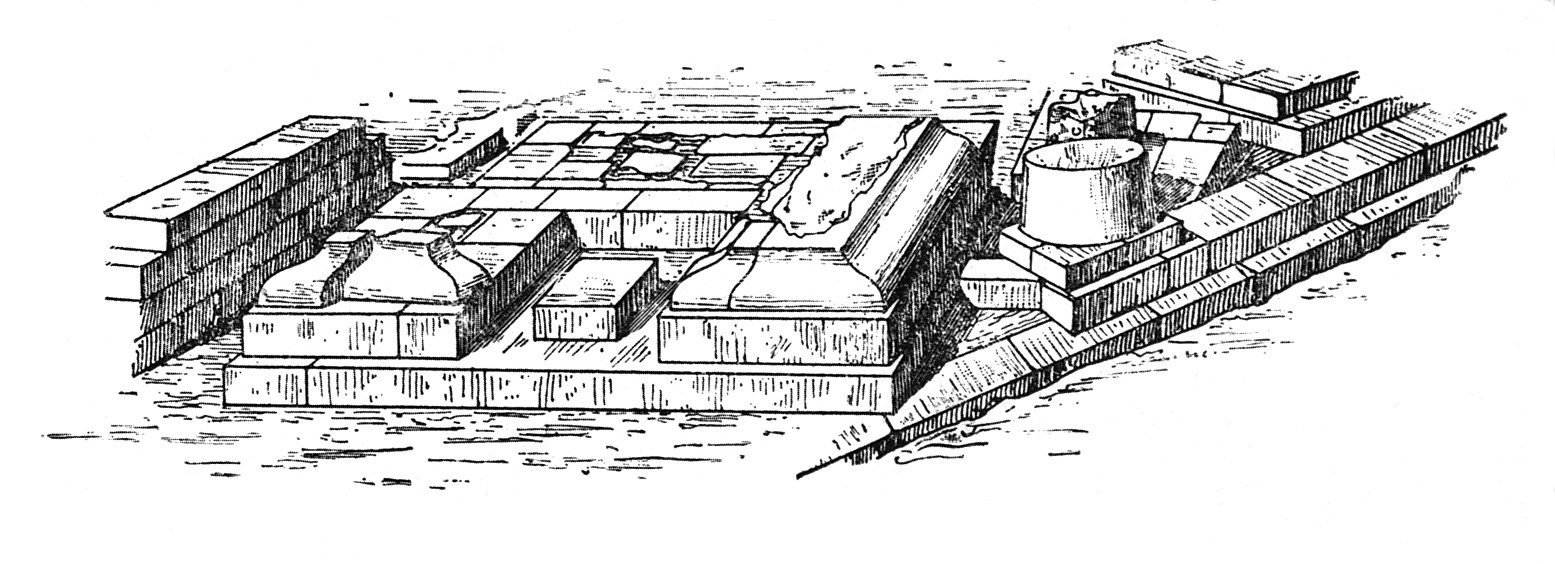
Removing the dark covering, Boni found a small buried monumental complex, made up of a structure interpreted as a U-shaped altar, a truncated-cone base and a tuff cippus inscribed on four faces. All of it lay at a limited depth relative to the level of the imperial Forum, and turned out to have been deliberately buried and sealed by the pavement above. The burial of the complex was therefore a deliberate act: the city covered the archaic monument and at the same time marked its position.
Boni’s other excavations in the Forum
In the same years Boni excavated the archaic burial ground near the Temple of Antoninus and Faustina, a necropolis that documents the funerary use of the Forum valley before it became a public square. He also worked on Santa Maria Antiqua, the early medieval church carved out inside a Roman building on the slopes of the Palatine. Boni is buried in the Orti Farnesiani on the Palatine, inside the archaeological area he had directed: a rare circumstance, and one you can verify on the spot.
What lies below: the archaic complex
Under the black slabs of the Lapis Niger there is an archaic complex made up of three main elements: a U-shaped tuff structure interpreted as an altar, a base in the shape of a truncated cone and an inscribed quadrangular cippus. Scholars place the layout in the 6th century BC, that is, in the phase of the Rome of the kings, and read it as a sacred area, a sacellum, not as a tomb in the proper sense. No excavation find has produced a burial under the black stone.
Altar, base, cippus
The U-shaped structure is commonly described as an altar with two side arms, of the type documented in other archaic Latium contexts. The truncated-cone base, in tuff, is interpreted as the support of a vertical element, perhaps a column or a statue, of which the upper part does not survive. The cippus, that is, the inscribed block, was planted next to it: it is preserved for part of its original height, with the top broken off. The mutilation of the block is the reason the incised text is incomplete.
What was found around it
In the layers that sealed the complex, ceramic fragments, remains of offerings and materials were recovered that helped fix its chronology. These materials have been reread several times, and the dating of the whole was revised in the course of the 20th century. Anyone who wants to see materials comparable in period and context will find a broader picture at the Museum of Etruscan and Italic Antiquities and at the Museo Etrusco di Villa Giulia, where archaic Latium and the Etruscan world contemporary with Rome are documented systematically.
Why it isn’t a tomb
The definition of tomb comes from the ancient literary sources, not from the excavation. On the ground the complex presents itself as a cult area: an altar, a vertical element, a cippus with a text of a normative or sacral character. It’s a substantial difference, and it should be said right away, because the formula tomb of Romulus has circulated for more than a century in newspaper headlines and captions and is responsible for most of the misunderstandings about this monument.
The inscribed cippus and the oldest Latin text we know
The cippus beneath the Lapis Niger bears incised what scholars consider the oldest text in the Latin language to have come down to us, commonly dated to the 6th century BC. It is a block of tuff, of the kind called cappellaccio in Rome, inscribed on four faces with a text arranged in vertical columns. The top of the block is broken: a portion of the inscription is missing, and with it the overall sense of the document. This is the fact to start from, before any translation you read around.
Boustrophedon, that is, how it reads
The text is written in boustrophedon, a writing system in which the lines run alternately in opposite directions: the first from left to right, the second from right to left, the third again from left to right, and so on. The term comes from Greek and recalls the movement of oxen plowing a field and turning at the end of the furrow. On the cippus of the Forum the layout is vertical, on the faces of the block, and the letters change orientation at each change of direction. It is an archaic feature found in the oldest Greek and Etruscan inscriptions and which by itself constitutes an element of early dating.
What can actually be read
Of the inscription, individual words and sequences can be read with reasonable certainty, not a continuous discourse. The form recei appears, generally understood as the dative of rex and therefore translated to the king or for the king. A formula of a sacral character appears that scholars trace to a curse against anyone who violates the place, built on the archaic concept of sacer, that is, consecrated and therefore withdrawn from common use. Terms appear that refer to ritual, among them one interpreted as kalator, the herald in the service of a priest, and one referring to draft animals. The rest is fragmentary.
Why the translation is still debated
There is no shared translation of the cippus of the Forum. Proposed readings have followed one another for more than a century and keep diverging on substantial points: if the text is a sacred law regulating behavior at that spot in the Comitium, if the king named is the king of Rome in the political sense or the rex sacrorum, that is, the priestly figure who after the fall of the monarchy inherits its ritual functions, and if the curse concerns those who damage the place or those who bring animals and carts into it. In popular pages you often find translations presented as definitive: they are not. The correct way to report the content is to say which words can be read and which hypotheses circulate.
What makes the cippus important even without a translation
Even without a continuous reading, the cippus says decisive things. It documents that in Rome, in the 6th century BC, people wrote in Latin, with an alphabet derived from the Etruscan one, itself derived from the Greek. It documents the existence of a figure called rex in an official context. It documents a written normative language, that is, a society that entrusts to a stone planted in public a prescription meant to last. For the history of the Latin language and of archaic Roman institutions, this handful of uncertain words is worth more than many pages by later authors.
Where the cippus is today
According to current documentation the cippus is still in its place, under the covering of the Lapis Niger, together with the other elements of the archaic complex. It is not on display in a museum, and anyone looking for it in the rooms of the Palatine Museum, of Palazzo Massimo alle Terme or of the Imperial Forums Museum won’t find it. We are not, however, able to independently verify the current location of the block, nor any temporary moves tied to conservation work: before planning a visit motivated by the wish to see the cippus, it’s best to ask the Parco archeologico del Colosseo for confirmation. Photographic reproductions of the inscription are available in scholarly publications and in epigraphic repertories.
Tomb of Romulus, Faustulus, Hostus Hostilius: what the ancient sources say
The ancient sources link the spot of the Lapis Niger to a burial, but they don’t agree on who was supposedly buried there, and in any case they are authors much later than the events they tell. These are literary traditions reported centuries afterward, not excavation results.
The three versions
The first version links the black stone to the tomb of Romulus, the founder. The second links it to Faustulus, the shepherd who according to the traditional story picked up and raised the twins. The third links it to Hostus Hostilius, whom tradition names as the grandfather of the third king Tullus Hostilius, fallen in battle against the Sabines. A fourth line of the story doesn’t speak of a burial but of the spot where Romulus was supposedly killed, or of the place where he disappeared. The versions are found side by side in the same late authors, a sign that already in Roman times the memory of the place was confused and that ancient scholars collected alternative explanations without knowing how to choose.
Why the tradition has to be labeled as such
The story of the tomb of Romulus is popular and literary tradition, not established history. Romulus himself is a figure of tradition, not a documented person. Boni’s excavation produced no burial under the Lapis Niger, and no later excavation has. What the ancient sources attest with certainty is another fact, historically much more interesting: that the Romans of the Republican and imperial age considered that spot an ill-omened place tied to the origins of the city, and that they had lost its original meaning. The Lapis Niger is first of all a monument to oblivion, that is, the material proof that Rome forgot why it had made that piece of pavement sacred and went on respecting it all the same.
The Comitium, the Rostra and the relationship with the Curia
The Lapis Niger lies within the area of the Comitium, the space where the Roman people gathered in assembly in the oldest phases of the city, and this explains its position right by the Curia Iulia. Comitium and Curia were two parts of a single institutional apparatus: outside, the assembly of citizens, inside, the session of the senate. The black pavement therefore marks a sacred place set at the exact spot where archaic Rome made its decisions.
What the Comitium was like
Excavations have identified in the area of the Comitium a succession of superimposed pavements, which rise in level over time as the level of the Forum rises. In the oldest phases the space had a stepped layout, with the public arranged around a central area and the speakers’ platform on one side. The platform of the Rostra, so called from the rams of enemy ships that were fixed there as trophies, had the role of stage: from there the assembly was addressed.
Caesar’s reform and the shifting of the axes
With the works promoted by Julius Caesar and completed under Augustus, the layout of the sector changed radically. The Curia was rebuilt in the form we now call the Curia Iulia, oriented differently from the earlier Curia Hostilia, and the Rostra were moved to the western side of the square. The archaic Comitium thus lost its function and shrank to a passage surface between the Curia and the square. The Lapis Niger went through this reorganization staying where it was: it is one of the very few elements of the Forum that never moved.
The visual relationship with the Arch of Septimius Severus
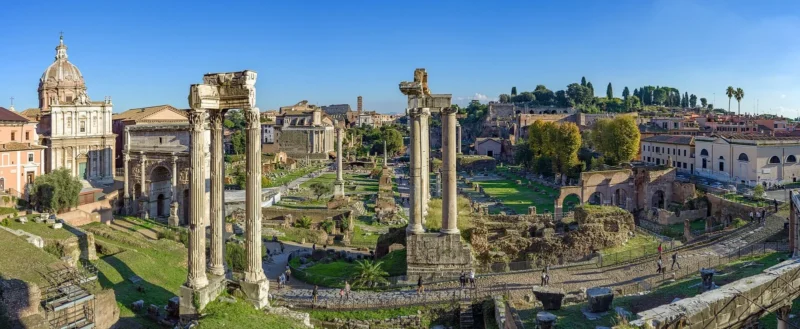
The Arch of Septimius Severus, built in AD 203, stands a few meters from the Lapis Niger and affects how it is perceived. The mass of the arch dominates the scene and draws the eye upward, while the black square requires you to look down. This is the practical reason so many visitors walk past the oldest monument of the Forum without noticing it, their eyes fixed on the bigger one. Beside it are the remains of the Temple of Saturn, with the eight surviving columns of the pronaos, which close the scene toward the Campidoglio.
A curiosity about the Lapis Niger
The curiosity that holds up best of all concerns the name: Lapis Niger is not the ancient name of the monument, but a Latin expression taken up by modern scholars from an entry in the lexicon of Festus, where it says that the black stone in the Comitium marks an ill-omened place. For the Romans the monument had no proper name. It had a function and a prohibition.
A stone that served to keep people from passing
The function of the dark covering was signaling even before it was decorative. In a square crossed every day by thousands of people, an immediate way was needed to say that at this spot you don’t pass and you don’t touch. The color contrast did exactly this, and did it without any need for writing: anyone, even someone who couldn’t read, understood that that dark rectangle was not ordinary pavement.
A text older than the Republic
If the dating to the 6th century BC holds, the cippus of the Forum is older than the Roman Republic, whose traditional date of birth is 509 BC. This means that the oldest written document of Rome is a document of the regal age, and that it names a king. And this is exactly the reason the word recei has generated so much literature: because it touches the most delicate institutional passage in Roman history.
One thing nobody tells you about the Lapis Niger
What almost nobody says is that the subsoil of the Lapis Niger is not normally accessible: what you visit is the surface, and the descent to the archaic complex has been opened to the public only intermittently, on the occasion of extraordinary openings or guided routes organized by the Parco archeologico del Colosseo. Anyone arriving at the Forum with photographs of the inscribed cippus in mind and expecting to go down is left empty-handed in the great majority of cases.
What this means in practice
In practice it means that the ordinary ticket of the archaeological area entitles you to see the square of black slabs behind a barrier, and nothing more. The openings of the lower level, when there have been any, were announced as limited-capacity events with reservations, often close to the date. As far as we know, there is no stable, predictable calendar. Anyone who wants to try has to follow the Park’s official notices and move fast when an announcement appears.
Why the subsoil stays closed
The reasons are conservation and safety. The space under the slabs is cramped, the covering structure needs maintenance, and the tuff of the cippus is a fragile material, sensitive to humidity and to the temperature swings that a continuous flow of visitors would produce. In the Roman Forum the same logic applies to other closed or limited-access spaces, such as Santa Maria Antiqua, which can be visited with its own terms and calendars, separate from the rest of the area.
The consequence for how to visit
It’s worth turning the expectation around. The Lapis Niger should be visited knowing you are looking at a signal, not at contents. It’s an exercise in reading: you observe the square, you reconstruct in your mind what lies below, you look around to understand where the Comitium ran and where the Rostra stood. Anyone who approaches it this way gets a lot out of it. Anyone who approaches it looking for the founder’s tomb leaves disappointed.
How to visit the Lapis Niger: tickets, timing and access
The Lapis Niger has no separate ticket and is seen with the entry ticket of the Roman Forum, Palatine and Colosseum archaeological area, run by the Parco archeologico del Colosseo. Fares, ticket types, hours and closing days change often and we don’t give them here so as not to leave outdated data on the page: the reference is the Park’s official website. What we can say concerns timing and how to organize the visit.
How much time you need
For the Lapis Niger alone, five minutes are enough: it’s a square of a few square meters and is seen from a single useful position. It only makes sense, though, within the visit to the Roman Forum, which takes at least two hours walking at an easy pace, becoming three or four when you add the Palatine and the Palatine Museum. With the Colosseum on the same day you easily get to five or six hours, breaks included, and it’s best to schedule the Colosseum entry in a time slot different from the middle of the day.
Accessibility
The Comitium area is on the low, flat part of the Forum, reachable from the entrance at Largo della Salara Vecchia without major changes in elevation, but the walking surface is uneven, made of ancient slabs, gravel and broken stretches. Anyone who gets around in a wheelchair or has mobility difficulties will find dedicated routes marked by the Park, with conditions that vary according to open worksites: up-to-date accessibility information should be requested directly from the Parco archeologico del Colosseo before leaving. The Palatine, which you reach uphill, is more demanding than the Forum.
What to pair it with
On the same day the Forum pairs well with the Mamertine Prison, which is a short walk away going up toward the Campidoglio, and with the Arch of Constantine together with the Circus Maximus. Anyone who wants to understand the material context of the archaic cippus will find at the Crypta Balbi the best account of Roman urban stratigraphy and at the Baths of Diocletian one of the most important epigraphic collections in the city. For the subsoil in general there is the page on underground Rome, while anyone with a second day can go on to Ostia Antica or to the Necropolis of Banditaccia at Cerveteri, where the Etruscan world contemporary with the Rome of the kings reads much better than in the Forum.
The season factor
The Roman Forum is an area almost without shade. Between June and September the middle of the day, roughly from 11:00 to 16:00, is the worst for a visit on foot: the glare off the light-colored stones amplifies the heat and fatigue cuts attention long before the Lapis Niger, which lies at the beginning or the end of the route depending on the entrance used. The first hours after opening and the last ones before closing remain the only comfortable time slots in summer.
The advice I give you for visiting the Lapis Niger
The practical advice is to enter from Largo della Salara Vecchia, on Via dei Fori Imperiali, and go straight to the Lapis Niger before anything else: it’s a few dozen meters from the entrance and in the first half hour after opening it is almost always free. Anyone entering from the Colosseum instead reaches it after an hour and a half of walking, tired and amid the groups converging on the Arch of Septimius Severus.
Going against the flow of the crowd
The mass of visitors walks the Forum in the direction of the Colosseum, because that is the final goal of almost all visits. Walking it the other way means passing the groups instead of following them, and finding free the spots the others reach midway. At the Lapis Niger the difference is sharp: at 9:00 in the morning you are alone in front of the barrier, at 11:00 there are three guided groups standing in the same 10-meter radius, because the stop in front of the Arch of Septimius Severus is a fixed stage of every guided itinerary.
What to look at, in order
First, the black square and its relationship with the light pavement around it: you can tell by eye that it’s an insert. Second, the distance from the facade of the Curia Iulia, which explains the relationship between the sacred place and the seat of the senate. Third, the level: the Forum floor visible today is much higher than the archaic one, and the complex under the slabs belongs to a city that stood several meters below our feet. Fourth, the line of the Rostra toward the Campidoglio. Four looks in five minutes: that is all the monument grants on the surface.
The verdict, without beating around the bush
Let’s say something unpopular: as a visual experience the Lapis Niger is disappointing, and anyone who enters the Forum only to see this spends their ticket badly. As a historical document, on the other hand, it is among the three or four most important things in the entire area, more than the Temple of Saturn and more than the Basilica of Maxentius in terms of information on the origins of Rome. The practical conclusion is that it should be visited with an explanation, read beforehand or heard on the spot. Without context it is a dark rectangle behind a railing.
A guided visit makes sense here
For few monuments of the Forum does a guide change the result as much as for this one. The Parco archeologico del Colosseo organizes thematic visits and extraordinary openings on the area of the Comitium, announced on its website with variable notice: they are the only realistic way to see the lower level. Anyone planning a wider itinerary, one that combines the Forum, the Palatine, the Markets of Trajan and the Capitoline Museums, should allow at least two separate days.
Another well-known fact, yet rarely cited
The fact is this: the valley of the Roman Forum, before becoming the political square of Rome, was a wet zone used as a burial area, and Giacomo Boni’s excavation proved it by finding an archaic necropolis a few dozen meters from the Lapis Niger. It’s in every textbook, and almost no one tells it in front of the ruins.
The burial ground of the Forum
The tombs identified by Boni near the Temple of Antoninus and Faustina belong to a phase in which the inhabitants lived on the hills and used the valley floor for the dead, following a constant rule of the ancient world: the living high up and dry, the dead outside the settlement. There are both cremations in small pits, with urns and miniature grave goods, and inhumations in trenches. Some of these materials are displayed in the rooms of the Palatine Museum and in other Roman archaeological collections.
The drainage and the Cloaca Maxima
The passage from a funerary area to a public square required a hydraulic reclamation: channeling the waters that came down from the hills and flowed together on the valley floor, with the construction of the great collector that tradition attributes to the Etruscan kings of Rome and that still partly works today. Without that work there would have been no Forum, and so no Comitium. The complex under the Lapis Niger sits at exactly the moment when the valley changes purpose: it is a threshold monument, planted between the Rome of villages and the Rome of the city.
Why this changes how you read the Lapis Niger
Knowing that the valley floor had been a cemetery makes the ancient sources’ insistence on a tomb less surprising. In the Forum of the Republican age the memory of that funerary use survived as a diffuse feeling, and a place marked as ill-omened could easily attract the story of a prominent burial. It remains a working hypothesis, not a proof. But it points to the right method for reading the ancient sources on the origins of Rome: ask why they say what they say.
The ground level, a fact nobody gives
The walking level of the Forum rose progressively over the centuries, through the accumulation of collapses, fill and rebuilding. Walking on Via Sacra today you stand at a level much higher than that of the Rome of the kings, and the archaic complex of the Lapis Niger lies just below the pavement of the imperial age, which in turn had already been raised. Of this vertical stratigraphy the visitor sees nothing, because the surface left by the 19th- and 20th-century excavations looks flat and uniform. This is the reason the Forum, to be understood, has to be read in section and not in plan.
The right photo to take at the Lapis Niger
There is only one useful photograph at the Lapis Niger and it should be taken from above looking down, framing together the square of black slabs and at least a portion of the light pavement around it: without the color contrast the image communicates nothing and the subject becomes an indistinguishable dark patch. The best light is the side light of early morning or late afternoon, which brings out the relief of the slabs and their joints.
The framing that works
Position: right behind the barrier, on the side facing the Curia Iulia. Tilt of the camera downward by about 45 degrees, so as to have the black marble in the foreground and, in the background, up high, the brick of the Curia or the attic of the Arch of Septimius Severus. This way the photograph contains the subject and its context at the same time, and whoever looks at it understands where the stone is. A tight close-up of the slabs alone is technically correct and useless as communication.
What ruins the shot
Three things. The first is the high midday sun, which flattens the black and burns out the travertine around it: the contrast becomes unmanageable and the image loses all detail. The second is the barrier, which if framed head-on cuts the field with a metal line: it’s best to use it as the bottom edge of the frame or exclude it altogether by working from above. The third is the guided groups standing in front of the arch, which in the middle of the day steadily fill the field behind the square.
The alternative photograph
Anyone who wants a single image that tells the story of the monument rather than just the object can step back and build a wide framing that holds together, from left to right, the columns of the Temple of Saturn, the Arch of Septimius Severus, the black square and the mass of the Curia Iulia. In a single frame there are six centuries of Roman history and the relationship between the archaic sacred and imperial monumentality. With a moderate wide-angle lens you keep everything without distorting the verticals.
Park rules
Photography for personal use is allowed in the archaeological area. Professional shooting, tripods, drones and bulky equipment are subject to authorization by the Parco archeologico del Colosseo, which publishes its own regulations: the conditions should be checked there before showing up with equipment.
Eating around the Forum without getting fleeced
The area between Via dei Fori Imperiali, Piazza Venezia and the Colosseum is among the most exposed in Rome in terms of dining, because it concentrates a continuous flow of visitors and very few residents who eat lunch there every day. We don’t name restaurants, here as on the other pages: a list of signs goes out of date in a few months and helps no one. What you need is the method for choosing in three minutes, on the spot.
The five signs that point to a trap
The first is the lady rolling out fresh pasta in the window or in front of the door: it’s a theatrical lure for passersby, not the sign of a kitchen. The second is the menu with photographs of the dishes, in several languages, displayed on the street. The third is the tout, the person who invites you to sit as you walk by. The fourth is non-stop hours from morning to late at night, with no kitchen break: a real kitchen stops. The fifth is the places set in front of famous monuments, which often adjust the price to the tourist in front of them, with items without prices and different price lists inside and outside.
The simplest criterion of all
Look at who is sitting at the tables and in what language they order. If at 13:30 on a Tuesday the tables are taken by people speaking Italian who come back because they always come, the place is the right one. If instead the room fills and empties all at once every 40 minutes following the rhythm of the tour buses, the kitchen is working on a model that has little to do with quality.
The chains of the center
In recent years in the center of Rome places with the same sign repeated at several points of the city have multiplied, the same menu, the same window and the line with a number ticket. We don’t name names. We observe one thing that anyone who lives in Rome can check for themselves: Romans don’t go there, and not because they are snobs, but because for the same spend they eat better 500 meters away, off the axis of the monuments.
Where the price changes
10 minutes on foot are enough to leave the tourist axis and change the level of the bill and of the cooking: toward the Monti district climbing beyond Via Cavour, toward the Ghetto and the Portico d’Ottavia, or in the direction of the Aventine and Testaccio. The rule holds in every direction: moving 300 meters away from the monument lowers the bill and raises the quality. For a wider picture there is the page on where to eat in Rome.
The list we use
For anyone who wants a concrete reference without lists of signs inside the pages, there is Daniele Dezi’s personal list on Google Maps: a curated collection, not sponsored, updated over time based on what really passes the test of going back.
Some important events that happened here in history
The chronology of the Lapis Niger is measured over very long times: the construction of the sacellum in the 6th century BC, the burial and covering in the late Republican age, the rediscovery in 1899. In between are episodes that left legible traces on the area of the Comitium.
The 6th century BC: the archaic building site
The first event is the construction of the complex: altar, base and inscribed cippus, at a time when Rome is a city in formation, governed by kings and in close contact with the Etruscan world. It is the same chronological horizon as the great building phase attributed to the Tarquins, which includes the drainage of the Forum and the layout of the sanctuary on the Campidoglio.
The burial and the covering
The second event is the decision to bury the sacellum and mark it with the dark pavement. We don’t know the exact date or the circumstance: proposals range between the Sullan age and the early imperial age, and the sources don’t tell it. It is, however, a public, deliberate act, which presupposes an institutional decision on how to treat a sacred place that was in the way of a square being transformed.
The Caesarian and Augustan reorganization of the Comitium
The third event is the great building project that between the middle of the 1st century BC and the age of Augustus redesigns the sector: new Curia, moving of the Rostra, redefinition of the assembly space. The archaic Comitium ceases to function as a political place. The Lapis Niger survives because it was already buried and untouchable.
AD 203 and the Arch of Septimius Severus
The fourth event is the construction of the Arch of Septimius Severus in AD 203, which occupies the edge of the area and changes its perception forever. From that moment the black square coexists with one of the most imposing architectural masses of the Forum, a few meters away.
1899 and Boni’s excavation
The fifth event is the rediscovery. In 1899 Giacomo Boni removes the covering, identifies the archaic complex and brings the inscribed cippus back to light. The news goes around Europe as the discovery of the tomb of Romulus, a definition that the excavation does not confirm and that later historiography has scaled back.
Who has passed through the Lapis Niger
Through this point of the Comitium passed, in the literal sense, the Roman political class of six centuries: those entering the senate crossed the area, those speaking from the Rostra had their backs to it. In a documented sense, though, the names tied to the Lapis Niger almost all belong to the history of scholarship.
Giacomo Boni
Boni (1859 to 1925) is the name that counts. He directed the Forum excavations from 1898, identified the Lapis Niger in 1899, imposed the stratigraphic method and turned the area into a research site. He rests in the Orti Farnesiani, on the Palatine.
Festus and the ancient scholars
The entry in the lexicon of Sextus Pompeius Festus, who in turn summarized an Augustan author, is the source that hands us the expression niger lapis and the definition of the place as ill-omened. Beside Festus, other authors of the late Republican and imperial age collect the versions about the burial: they are scholars working on an already obscure memory, not witnesses.
The epigraphists
From 1899 on, the cippus of the Forum has been read, traced and discussed by generations of scholars of archaic Latin, in Italy and abroad. Their proposals for supplying the text have filled specialist journals for more than a century and keep diverging. The monument that you see in five minutes has produced a bibliography that can’t be exhausted in one lifetime.
Frequently asked questions about the Lapis Niger
What exactly is the Lapis Niger?
The Lapis Niger is a square of black marble slabs in the Roman Forum, in front of the Curia Iulia, that marks and protects an archaic sacred area buried below walking level. The lower complex, datable to the 6th century BC, includes an altar, a truncated-cone base and a tuff cippus with an inscription in archaic Latin. It was identified by Giacomo Boni in 1899.
Is the Lapis Niger really the tomb of Romulus?
No, the Lapis Niger is not the tomb of Romulus, and the excavation produced no burial. Some ancient sources link the place to Romulus, others to Faustulus, others to Hostus Hostilius: these are traditions reported by much later authors, not archaeological data. Archaeologists interpret the underground complex as a sacellum, that is, a cult area, not as a tomb.
What does the inscription of the Lapis Niger say?
The inscription of the Lapis Niger is the oldest known Latin text, but it is damaged and its interpretation remains debated. Individual words can be read, among them recei, understood as the dative of rex, and a curse formula against anyone who violates the place. There is no shared translation: the versions that circulate as definitive should be taken with caution.
What does it mean that the text is written in boustrophedon?
The text of the Lapis Niger is written in boustrophedon, that is, with the lines running alternately in opposite directions, one from left to right and the next from right to left, with the letters turning accordingly. The name recalls the movement of plowing oxen. It is a feature typical of archaic writing and helps date the inscription early.
Can you go down under the Lapis Niger?
The subsoil of the Lapis Niger is not normally accessible: with the ordinary ticket you see only the covering of black slabs, behind a barrier. Openings of the lower level have been intermittent, tied to extraordinary limited-capacity visits organized by the Parco archeologico del Colosseo. Anyone who cares about it should follow the Park’s official notices and book as soon as an announcement appears.
How much does it cost to see the Lapis Niger and what are the hours?
The Lapis Niger has no separate ticket and is seen with the entry ticket of the Roman Forum, Palatine and Colosseum archaeological area. Fares and hours change often and we don’t give them here so as not to leave outdated data: the reference is the official website of the Parco archeologico del Colosseo, where you can also buy tickets with date and time slot.
Where is the inscribed cippus today?
The inscribed cippus of the Lapis Niger is still in place, under the covering, and is not on display in a museum. We are not able to independently verify any temporary moves tied to conservation work: anyone visiting the Forum with the goal of seeing the cippus would do well to ask the Parco archeologico del Colosseo for confirmation before leaving.
How much time do you need and how do you get there?
Five minutes are enough for the Lapis Niger, but it only makes sense within the visit to the Roman Forum, which takes at least two hours, three or four with the Palatine. You get there by metro line B, Colosseo stop, or by the buses serving Piazza Venezia and Via dei Fori Imperiali. The most convenient entrance for reaching it right away is Largo della Salara Vecchia.
Who wrote this page
This page is edited by the editorial team of Tour Leader Pro, the Rome project office that designs and coordinates visits, itineraries and cultural events in Rome and Lazio. The hours, fares and access conditions given here were verified at the date of publication against the official sources named in the text. Check them again before you leave, because they change often. If you find a piece of information that is out of date, let us know.
Anyone building an itinerary that ties the Lapis Niger to the rest of the Forums sector, bringing together travel times, opening calendars and reservations, will find planning tools and operational support at Tour Leader Pro, which handles the design and coordination of visits in Rome and Lazio.
For the wider picture, that is, travel between cities, trains, real timing and Lazio destinations to fit into a trip of several days, a good reference resource is Italy Planner, useful above all for those arriving in Rome from outside who have to decide how many days to give to the archaeological center.
Nearby
 Roman Forum100 m
- Ancient Roman Festivals: The Calendar and the Places100 m
- The Rostra of the Roman Forum100 m
- Temple of Antoninus and Faustina100 m
- Church of Santa Maria Antiqua100 m
- Basilica of Maxentius200 m


Upcoming events nearby
- The Greeting by Bill Viola in the Roman Forum. Homage to Pontormo: through Saturday, February 6, 2027100 m
- Ti Porto al PArCo: inclusive guided visit by joëlette: Sunday, November 22, 2026100 m
- Saffo. Lo spirito della poesia (Sappho: The Spirit of Poetry): through Sunday, January 31, 2027100 m
- Diego Rivera at the Capitoline Museums: the Big Exhibition on 20th-Century Mexican Art400 m