Torre Flavia Marsh
In short. The Torre Flavia Marsh Natural Monument is a coastal protected area between the municipalities of Ladispoli and Cerveteri, on the Tyrrhenian coast north of Rome.

The Torre Flavia Marsh Natural Monument is a coastal protected area between the municipalities of Ladispoli and Cerveteri, on the Tyrrhenian coast north of Rome. The operational reference for the visitor is the protected area's office at Via Roma 141, in Ladispoli (00055), which also serves as a meeting point for guided visits and volunteer days organized by the managing body. The phone of the Protected Areas Service is 06 67663321 and the institutional email address is direttoreareeprotette@cittametropolitanaroma.it. The area is managed by the Metropolitan City of Rome Capital, which administers it together with the other metropolitan reserves. There is no ticket office, no turnstile, no opening time posted on a gate: the marsh is walked along the embankments and the outer walkways, and the sensitive nesting zones are fenced off seasonally. Guided visits and environmental education activities are booked by contacting the managing body, because the calendar changes from season to season. Anyone arriving by train gets off at Ladispoli-Cerveteri station, on the regional line linking Roma Termini to Civitavecchia, and continues toward the sea heading north. Anyone arriving by car leaves the car in the free spaces at the end of the streets of Campo di Mare or of the northern district of Ladispoli and finishes on foot. For hours, temporary closures and permits it is always best to check ahead with the managing body.
If the coast north of the capital interests you as a whole, the page dedicated to the Roman coast collects the main stops between the mouth of the Tiber and the border with Tuscany.

Where the Torre Flavia Marsh Is and How to Get There
The marsh occupies the back-dune strip north of the built-up area of Ladispoli, toward Campo di Mare, and runs parallel to the shore for about 1,500 meters. The maximum depth inland reaches 500 meters, the elevation ranges between zero and three meters above sea level. These are numbers that explain a lot: here you don't climb, you don't descend, there are no viewpoints. You walk on the flat inside a landscape that changes every 100 meters because of salinity and moisture, not altitude.
By Train: Ladispoli-Cerveteri Station
Ladispoli-Cerveteri station serves both municipalities and is the most sensible way to arrive without a car. From the passenger building the sea is a little under a kilometer and a half to the west, and the marsh begins where the built-up front ends, on the northern edge of the city. On foot it takes between 25 and 35 minutes, depending on the chosen entry point, by bicycle, 10. The practical advice for those coming from Rome is to check the return before leaving: evening trains thin out, and at the marsh you lose track of time with a surprising ease.
By Car and Where to Leave the Car
Anyone arriving by car has two options. The first is to aim for the northern edge of Ladispoli and park along the streets that end toward the beach: from there the protected area begins practically behind the last houses. The second is to arrive from Campo di Mare, that is from the Cerveteri side, and approach the marsh from the northern side. In summer, on weekends, free parking becomes a hunt. In winter you find it everywhere. There is no dedicated parking for the protected area, and this is one of the limits the managing body has carried since the day of its establishment.
Access and Walkways of the Torre Flavia Marsh
The marsh is not an urban park with paved paths. You move on beaten-earth embankments that separate the water bodies, along the inner edge of the dune ridge and on the waterline. In some stretches passage is allowed, in others not: the nesting areas are fenced with stakes and cord in the breeding season, and that cord is not a suggestion. Via Roma 141 office is the reference for understanding, from time to time, what is open and what is off-limits. Closed shoes, always: the ground alternates dry sand, wet silt and sharp vegetation.
What the Torre Flavia Marsh Natural Monument Is
A natural monument, under the regional legislation of Lazio, is a small protected area established to conserve a singular natural element. The Torre Flavia Marsh falls into this category for a precise reason: it is what remains of a system of wetlands and brackish marshes that occupied the whole coastal strip between the mouth of the Tiber and Civitavecchia, and that land reclamation wiped out almost everywhere. Together with the nearby Macchiatonda nature reserve, a little farther north, it constitutes the last pair of coastal wetlands still functioning on this stretch of the Tyrrhenian.
The Establishment of the Protected Area and the Managing Body
The Torre Flavia Marsh Natural Monument was established by decree of the President of the Lazio Region number 613 of March 24, 1997, and falls within the municipal territories of Ladispoli and Cerveteri. Management is entrusted to the Metropolitan City of Rome Capital, the body that inherited the legacy of the Province of Rome and that administers a small system of protected areas: the reserves of Nomentum, of Macchia di Gattaceca and Macchia del Barco, of Monte Catillo, of Monte Soratte, Villa Borghese reserve in Nettuno and, precisely, this marsh. It is the only coastal wetland of the group, and also the most exposed: the others have a forest or a mountain around them, this one has a city on one side and the advancing sea on the other.
How Big the Torre Flavia Marsh Is
The official documentation of the protected area describes it as extending a little under 50 hectares. It's a tiny surface for an area of this ornithological importance, and it has to be read together with the historical fact: the original marsh, the one that appeared on maps before land reclamation, was enormously larger. The reclamations of the early 20th century first, and the urbanization of Campo di Mare in the 1960s then, progressively reduced the wetland to the present patches. Anyone walking the embankments today sees a fragment, not a whole ecosystem: that is why every square meter counts more here than elsewhere.
The Geology of the Coast and the Torre Flavia Marsh
The evolution of the Tyrrhenian coasts of Lazio is tied to two great processes: the tectonic movements of opening and uplift of the Tyrrhenian basin and the volcanism of the Lazio districts. The sand you walk on here is not a neutral material, it tells where it comes from. The stretch between Santa Severa and Palo Laziale is characterized by sandy beaches often dark in color, almost iron gray: the color depends on the presence of minerals of volcanic origin, pyroxenes and magnetite, carried by the watercourses that drain the volcanic edifices of the hinterland. If you pass a magnet over dry sand, the magnetite responds. It's an experiment that always works.
The Macco of Marina di San Nicola
In the Marina di San Nicola area a geological formation called Macco outcrops, referred to the middle and upper Pliocene. It is made of sandy and biocalcarenitic facies rich in fragments of bryozoans, lithothamnia, echinoderms and mollusks: in practice a rock made of shells, an ancient seabed consolidated and then uplifted. From Marina di San Nicola to Santa Marinella the picture changes again: in the higher areas you find Pleistocene conglomerates and sands, while in the low areas peaty silts, marsh deposits and recent alluvium appear. Those peaty silts are the signature of the ancient coastal marshes, and they are exactly the substrate on which Torre Flavia rests.
What the Torre Flavia Marsh Is Made of Underfoot
The protected area develops on clayey-silty soils rich in organic material of plant origin. It is this composition that makes possible the accumulation of waters in the back-dune portion: a poorly permeable bottom holds rainwater and rising water, and the marsh forms behind the dune instead of draining toward the sea. Since the 1970s the area has been progressively reclaimed, and hydraulic works have modified the natural functioning of the system. Residual patches of an ancient sand dune still separate the wetland from the open sea: they are the only barrier between the brackish inner water and the storm surges.
Morphologically the surface is flat, with elevation differences that do not exceed two or three meters. It seems little, and instead it is everything: two meters of difference decide if a piece of ground stays flooded for six months a year or dries out in May, and on this depends which plant species grows on it.
Hydrogeology and Water Deficit of the Torre Flavia Marsh
The soil types present in the area have very heterogeneous grain sizes and permeabilities, which suggests the presence of small suspended underground water tables of limited extent. Two pressures bear on this fragile balance. The first is the pumping of wells in the vicinity, grown recklessly with the building expansion of the coastal strip. The second is the canalization works, which drain water toward the sea instead of letting it stagnate. The result is a state of water deficit that affects the whole zone. Put plainly: the marsh is thirsty, and its thirst is of human origin.
The prevailing winds come from the sea. In the autumn months those from the northwest prevail, in summer the hot winds from the western and southern quadrant, which accentuate the effects of evapotranspiration on vegetation that is already stressed. Anyone who visits the marsh in August and finds it arid is not looking at a dead ecosystem: they are looking at the dry phase of a cycle, made worse however by withdrawals and drainage that have made that cycle more extreme.

Coastal Erosion and the Torre Flavia Marsh
The coast north of Rome is affected by a phenomenon of linear retreat of the shoreline. It isn't uniform: there are stretches in erosion and stretches in accumulation, and the difference depends on the nearshore currents, on the solid load of rivers and, increasingly, on defense works built upstream. The protected area of Torre Flavia represents a situation of strong erosion, among the most marked on the Roman coast.
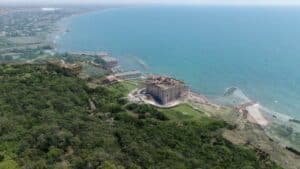
The fact that makes this understandable to anyone concerns the tower. Until the 1940s the ruin stood at the waterline: you could reach it with dry feet. Today it is completely isolated in the water and connected to the mainland by a causeway of boulders about 100 meters long. 100 meters of coast eaten in 80 years, measurable with a tailor's tape against a building that has not moved. There is no more effective lesson in coastal geography than this, and you need no chart to understand it.
The 2011 Works and the Effect to the North
In 2011 works were carried out to protect the ruin of the tower from the action of the sea. They achieved the immediate goal: the tower is still standing, for what is left of it. But they had a consequence that those who deal with coastal dynamics had factored in: any rigid structure traps sediment upstream and removes it downstream. Erosion moved north, with marked effects precisely on the dunes of the protected area. It's the recurring paradox of coastal defense: you save a structure and lose a dune, and the dune is the only thing that keeps the marsh alive.
Why the Dune Matters More Than the Tower
This opinion is not popular among those who come here to photograph the ruin. The dune ridge of the Torre Flavia Marsh Natural Monument is now reduced to a slender, interrupted sequence of fragments. If it disappears entirely, the sea enters the back-dune depression during winter storm surges, salinity spikes, the reed bed dies and the wetland becomes a salt lagoon without its specificity. The tower is a beautiful and doomed ruin. The dune is a living organism that can still be saved. If I had to choose where to put public money, I wouldn't hesitate for a moment.
The Tower: History of Torre Flavia
Torre Flavia gives its name to the whole protected area, and is the reason many visitors come here the first time. It is a 16th-century coastal tower, erected in all probability on the remains of an older construction: local tradition speaks of a medieval stronghold and of the presence, in the immediate vicinity, of a Roman villa. The Cerveteri coast was densely occupied in the imperial age, and that is not surprising at all.
Cardinal Flavio Orsini and the Papal Defense System
The name of the tower comes from Cardinal Flavio Orsini, to whom the documentation of the managing body attributes the construction, at the will of Pope Leo X, within the defensive system of the Papal State. The historical context is that of the great plan to reorganize coastal defenses launched by the papacy in the early 1500s, motivated by the fragility of a coast continually exposed to Barbary raids. The towers along the Lazio coast were not fortresses: they were eyes. They served to spot sails on the horizon and to relay the alarm to the hinterland with smoke by day and fire by night, giving the peasants time to take shelter.
To the same period dates the fortification of the Palo castle, which precisely then took the form that has come down to us. Torre Flavia and the Palo castle were not two independent garrisons: they were part of a single defensive mesh, with a precise hierarchy between the main stronghold and the satellite towers.
What the Tower Was Like
The plan is square, with a battered base: the lower wall slanting outward, a solution that reflected the common canons of Renaissance military building and served to bounce artillery shots and prevent the placing of ladders. Judging from the internal division, from the four lookout turrets that crowned the terrace and from the existence of a cistern, the tower housed a garrison of some weight, closely tied to the defense system of the Palo castle. The cistern is the detail that says the most: a garrison with its own water is a garrison designed to hold out, not to flee.
The Ruin: War and Sea
The present ruined state has two overlapping causes. The first is the bombing suffered during the Second World War: this stretch of coast was on the route to coastal targets and the tower, isolated and recognizable, paid the bill. The second is marine erosion, which has never stopped working. Until the 1930s Torre Flavia still stood on the coastline. Since then the progressive retreat has detached it from the mainland and reduced it to the stump seen today, a fragment of masonry in the middle of the water, reachable only with the eye.
It's worth saying clearly: the tower cannot be visited, you don't climb it, you don't walk on the boulder causeway when the sea is rough. Every year someone tries and every year the local news records the rescue of the day. The ruin is looked at from shore, and from shore it is more beautiful.

The Vegetation of the Torre Flavia Marsh
The plant landscape of this protected area has a heterogeneity that amazes anyone expecting four reeds and a bit of sand. On less than 50 hectares live together the pioneer halo-psammophilous vegetation of the embryonic and mobile dunes, the halophilous hemicryptophyte grasslands, the hyperhalophilous chamaephyte grasslands, the marsh vegetation of the back-dune depressions, that of brackish waters, the hygrophilous one and the nitrophilous ruderal vegetation of disturbed margins. About 130 plant species have been recorded. The reason for so much variety in so little space is a single one: the gradient. 50 meters are enough to go from dry, sterile sand to permanent brackish water, and every intermediate band has its specialists.
The Waterline and the Outer Band
The outermost band of the coast is unsuited to plant life, and it's worth understanding why. Seeds do not take root on sand continually reshuffled by waves, and the conditions of moisture and salinity vary hour by hour, adding up to stresses that a newly germinated seedling does not survive. On the beach, animal life is therefore favored, settling on the organic remains of algae, mollusks and sea grasses accumulated as debris. That band of washed-up material that bathers call dirt and that municipalities remove with bulldozers is, in reality, the dining table of an entire ecosystem and the first brick of the dune. Mechanically cleaning a beach in April is the equivalent of demolishing a construction site.
The Embryonic Dunes of the Torre Flavia Marsh
Above the maximum tide level, proceeding from the outside inward, the theoretical model of the spatial distribution of coastal vegetation foresees communities of halonitrophilous therophytes with a low percentage of cover, followed inland by the building communities of the embryonic dunes. The species that live on sand must adapt to an incoherent and extremely permeable substrate: the relative humidity of the sand at the surface tends to zero. Dune plants respond by lengthening their roots until they form a network that, after rain, is able to absorb the ephemeral moisture of rainwater before it percolates deep down. They are plants that live on scraps of water and manage to build, with their stems, the relief that then protects everything behind.
The Reed Bed and the Back-Dune Depressions
Right behind the dune ridge, which in the natural monument is reduced to a slender and interrupted sequence of fragments, pinpoint interdune gaps and wide periodically flooded depressions open up. In both environments the plants use brackish water, and tolerance to salinity becomes a physiological adaptation necessary for survival. Where the water level stays constantly higher, halo-tolerant species dominate, tied to environments of moderate salinity but not strictly bound to brackish conditions: the common reed, Phragmites australis, and the sea clubrush, Bolboschoenus maritimus. The reed bed is the load-bearing structure of the marsh: birds nest inside it, young fish hide in it, sediments settle in it.
The Glassworts and the Soils That Crack
An even greater tolerance to salinity variations is needed to live on the soils of the deepest depressions, subject to oscillations between flooding and evaporation phases. In the dry period the ground shows the characteristic polygonal cracks and the salt tends to concentrate at the surface, forming a whitish film. Under these conditions Sarcocornia perennis, Aeluropus littoralis, Suaeda maritima and Salsola soda are found. They are succulents in miniature, fleshy out of necessity: they store water to dilute the salt they absorb. In October the glasswort turns red and the depression becomes a burgundy carpet worth the trip by itself.
To the strictly coastal vegetation are added, in the surrounding areas, the spring blooms of asphodels, poppies and borage, which in April and May color the uncultivated margins of the protected area.
The Fauna of the Torre Flavia Marsh
The protected area has been studied from a faunal point of view for many years and has data for many taxonomic groups. Overall about 200 species of vertebrates and at least 280 of invertebrates are counted, a heritage that for a surface of this size is simply out of scale. The reference work remains the volume Biodiversità, gestione, conservazione di un'area protetta del litorale tirrenico: la Palude di Torre Flavia, published by Gangemi for the Province of Rome in 2006.
The Birds of the Torre Flavia Marsh
Birdlife is the site's main wealth. The area is a Special Protection Area for the high presence of migratory species that use it as a place of rest, transit and nesting, and overall more than 180 species have been recorded, to which are added six non-naturalized alien species, escaped from captivity and observed occasionally, whose nesting in Lazio is not confirmed. More than 40 of the species present fall under Annex I of the Birds Directive, the one that requires member states to take special habitat conservation measures.
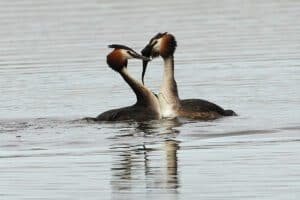
The list of regular presences gives an idea of the place: black-winged stilt, marsh harrier, little grebe, squacco heron, little bittern, wintering ducks in numbers, owls in the wooded strips of the margin. Among the nesters, the little ringed plover stands out. Among the most striking sightings, the osprey on migratory stopover and the glossy ibis, a dark ibis with metallic reflections that looks painted when it lands on the silt. 100 meters of embankment, a decent pair of binoculars and an hour of patience at Torre Flavia yield more than a morning in many famous reserves.
The Kentish Plover, the Species That Decides Everything
The Kentish plover, Charadrius alexandrinus, is a small plover that nests directly on the sand, in a simple depression barely deeper than a footprint, with no material and no shelter. The eggs are camouflaged to the point of being invisible from a meter away. This makes it the most vulnerable species of the whole coast: a foot, a wheel, a dog off leash or a bulldozer for beach cleaning is enough and the clutch is lost. The Metropolitan City of Rome Capital treats it as an umbrella species, that is a species whose protection drags along the recovery of the whole dune ecosystem, and around its nesting it has built a substantial part of the management of the protected area.
Since 2019 the managing body, the Italian League for the Protection of Birds and the European project LIFE Choona have organized volunteer surveillance camps for Kentish plover nests: fencing of the clutches, watch duty, raising awareness among bathers. The outreach initiative that accompanies these activities is titled Non solo Fratini and is offered again during the European Parks Week, in May. If you happen to find a rectangle of cord on the sand with apparently nothing inside, inside there is everything: steer clear and that's it.
The Banding Station
Since 2000 a scientific banding station has operated in the protected area. Between 2000 and 2005, 6,473 birds belonging to 67 different species were caught and marked. These are numbers that tell the role of the marsh as a technical stopover on the Tyrrhenian migration route: birds that arrive from Africa after crossing the Mediterranean and that here find the first point of fresh water and the first reserve of insects after hundreds of kilometers of sea. Take away this scrap of reed bed and you have removed a service station on a highway with no other exits.
The Mammals of the Torre Flavia Marsh
Present in the protected area are the European hedgehog (Erinaceus europaeus), the nutria (Myocastor coypus), the black rat (Rattus rattus), the brown rat (Rattus norvegicus), the house mouse (Mus domesticus), the fox (Vulpes vulpes) and the porcupine (Hystrix cristata). Less frequent is the presence of some mustelids, among them the stone marten (Martes foina). The area is also visited for feeding by many species of bats, which at dusk come out to hunt over the water: the insects emerging from the marsh are a concentrated food resource, and the bats have known it far longer than we have. Porcupine tracks, fallen quills included, are found with some ease along the inner paths.
Amphibians and Reptiles
Among amphibians, eggs, tadpoles at different stages of development and adults of the green frog (Rana kl. hispanica) and of the common toad (Bufo bufo) have been found, as well as the green toad (Bufotes viridis), a species typically tied to sandy coastal environments and temporary pools. Among reptiles, the presence of the European pond turtle (Emys orbicularis), the three-toed skink (Chalcides chalcides), the western green lizard (Lacerta bilineata), the Italian wall lizard (Podarcis siculus) and the grass snake (Natrix natrix) is documented. The European pond turtle is the species that deserves the most attention: it is in sharp decline throughout Italy and its presence in a fragment of wetland like this has a conservation value out of proportion to the size of the site. It is seen in spring, when it basks on emerging logs.
Fish and the Aquaculture Channels
The Torre Flavia Marsh Natural Monument includes within its perimeter a series of channels of artificial origin, for years home to an extensive aquaculture activity centered mainly on Mugilidae. Most of the fish are introduced as fry, while a smaller part enters from the sea by natural upstream movement, when the barrier sluice is opened for fishing or for maintenance operations. The fry is collected between September and the end of October off the coastal channels of the Lazio coast, among them those of Maccarese and Passoscuro. Among the species raised in the Torre Flavia channels are mullets of the family Mugilidae and eels (Anguilla anguilla). Other species are also present, among them Carassius sp. and Gambusia holbrooki. Extensive aquaculture is an ancient practice of Mediterranean lagoons and, managed with judgment, keeps open the waterways that would otherwise close up.
The Marine Mollusks of the Beach
This is the chapter nobody expects. Thanks to the presence of Posidonia oceanica meadows in the stretch of sea in front of the marsh and to the heterogeneity of the seabeds, on the waterline you easily find washed-up shells belonging to more than 130 species of mollusks, distributed among Polyplacophora, Gastropoda, Bivalvia, Scaphopoda and Cephalopoda. The figure is still considered an underestimate of the real malacological richness of this stretch of coast. Bivalves are particularly abundant, accounting for about 40 percent of species, a percentage attributable to the dominance of soft bottoms in the area. A one-kilometer walk on the waterline in January, after a storm surge, is worth a museum case. Shells are looked at and put back down: in the protected area, collecting is not an innocent gesture.
Alien Species
Present in the area are animal species introduced voluntarily or involuntarily by people. The most abundant, and in some cases openly invasive, are three: a crustacean, the red swamp crayfish (Procambarus clarkii), which burrows into the banks and preys on amphibian eggs. A freshwater and brackish fish, the mosquitofish (Gambusia holbrooki), introduced a century ago for the antimalarial fight and today a competitor of the small native cyprinids. And a mammal, the nutria (Myocastor coypus), which eats the reed bed and destabilizes the embankments. To these is added, among reptiles, the red-eared slider, released from domestic aquariums and now settled in the water bodies. These are the three or four names that explain why the management of a wetland does not end with putting up a sign and fencing.

Birdwatching at the Torre Flavia Marsh
Anyone who comes here for the birds must know three things. The first: the hour counts more than the season. The two hours after dawn and the two before sunset are worth as much as the whole day, and at noon in July you will see almost nothing. The second: binoculars are needed, a telephoto lens helps, but the spotting scope on a tripod is the tool that really changes the experience, because the water bodies are far from the walkable embankments. The third: you stay still. Marsh wildlife does not tolerate continuous lateral movement. 20 minutes motionless behind a clump of reeds yield more than two kilometers of walking.
The Birdwatching Seasons at Torre Flavia
From November to February the wintering birds dominate: ducks on the water bodies, herons along the margins, the marsh harrier that patrols the reed bed at low altitude with the rocking flight that makes it recognizable from 200 meters. March and April are the months of the pre-nuptial migration, the most unpredictable and the most exciting: anything can stop here for a day. May and June are the nesting season, the one when you have to be most careful and scrupulously respect the boundaries. Late August and September bring the autumn passage, with waders on the mud exposed by summer evaporation. The best period remains the second half of March: water still high, long light, mosquitoes not yet arrived.
A Curiosity About the Torre Flavia Marsh
The most solid curiosity this place offers is not about a rare animal but about a matter of measurement. Torre Flavia is one of the very few points on the Italian coast where the retreat of the shoreline can be quantified with the naked eye using a dated structure as a yardstick. The tower, built in the early 1500s, stood inland with respect to the waterline: it was a mainland building, with its garrison, its cistern and presumably its vegetable garden. In the first half of the 20th century the sea lapped at it. Until the 1940s the ruin still stood at the waterline. Today it is isolated in the water and reaches the mainland only through an artificial causeway about 100 meters long.
Anyone looking at that stump has in front of them, at the same time, a document of military history and an instrument of geomorphological measurement. The tower has not moved a centimeter: everything else has moved. And the curiosity widens when you think what it means in terms of volumes: 100 meters of retreat along a front of kilometers corresponds to millions of cubic meters of sand removed from the coastal system, in large part held back upstream by river dams and quarries that have interrupted the solid load of the rivers to the sea. The Torre Flavia marsh is the local victim of a sediment budget decided 100 kilometers away, in the hinterland. No sign explains it, and yet it is the key to reading everything you see from here.
There is then a second curiosity, minor and nicer, about the sand. The dark gray sand you walk on between Palo and Santa Severa contains pyroxenes and magnetite of volcanic origin: a magnet passed just above dry sand is covered in black granules in a few seconds. It's an experiment that children repeat for half an hour straight and that explains, better than any lesson, that beaches are made of dismantled mountains.
Something Nobody Tells You About the Torre Flavia Marsh
That the best time to come here is winter, and in particular the week after a storm surge. In the common imagination the marsh is visited in spring, with sun and blooms. In reality from December to February three things happen together. The water bodies are full and host the maximum number of wintering ducks and herons. The waterline, cleaned and reshuffled by waves, yields the greatest quantity of shells and washed-up material, and with more than 130 species of mollusks documented on this stretch of coast the walk becomes a census. And there is nobody. No bathers, no dogs off leash, no line to park.
The second thing almost nobody says concerns the water. Anyone who arrives in August and finds dry, cracked depressions crusted with salt often concludes that the marsh has been abandoned or polluted. It's the opposite: the alternation between flooding and evaporation is the ecological engine of the system, and it is precisely in the dry phase that the soils form on which Sarcocornia perennis, Suaeda maritima and Salsola soda live. The problem is not that the marsh dries out in summer, it's that it dries out too much and too early, because of well pumping and the canalizations that discharge water into the sea. The difference between a natural cycle and a water deficit is not seen by someone who passes through once.
Third thing: the mechanical cleaning of beaches, which tourists take for granted and appreciate, is one of the main threats to coastal biodiversity. The bulldozers carry away the washed-up material, which is the trigger of the dune and the base of the beach's food chain, and destroy Kentish plover nests, which are simple holes in the sand. In the protected area this does not happen, and that is precisely why the beach at Torre Flavia looks less tended than the one in front of the beach clubs. Less tended and infinitely more alive.
The Advice I Give You for Visiting the Torre Flavia Marsh
The advice is to reverse the order of visit that everyone follows. 95 percent of people arrive, head straight for the tower, photograph it from shore, turn around and leave: 40 minutes in all, and the idea of having seen Torre Flavia. Do the opposite. Start from the inside, from the embankments between the water bodies, with the first morning light behind you. Walk slowly along the edge of the reed bed. Only at the end go out onto the beach and reach the point from which the ruin can be seen. This way you reach the tower having already understood what those 100 meters of boulders protect, and the ruin stops being a postcard and becomes the conclusion of an argument.
On the practical side: closed, waterproof shoes, because wet silt is treacherous and halophilous vegetation cuts. Long pants from May onward for mosquitoes and horseflies, which here are no joke. Bring water, because along the route there are no fountains. Binoculars, even modest ones. A hat always, shade never. Avoid the middle hours between June and August: it's not a matter of comfort, there is simply nothing to see because everything is sheltering.
Two behavior rules that I consider non-negotiable. The dog, if you bring one, stays on a short leash, always, even if it's very well trained: to a Kentish plover brooding, a dog off leash is a predator, and the flight reaction exposes the eggs to the sun for long enough to kill them. And the cords that mark the nesting areas are respected to the letter, without stepping over for the better shot. If you want to really understand the site, contact the managing body at Via Roma 141 in Ladispoli and ask for the calendar of guided outings: half a day with the people who run the area is worth 10 visits done on your own, and in a wetland the difference between looking and seeing is all there.
Another Well-Known Fact, Yet Rarely Cited
That Torre Flavia is not an isolated case but the terminus of a chain. Everyone knows that the coast north of Rome was marshy and was reclaimed. Almost nobody connects that general fact to the precise geography of the places they visit in summer. The protected area is the last remnant of the Campo di Mare Marsh, a system of wetlands and coastal brackish marshes that occupied a much wider front than the present one. The reclamations of the early 20th century reduced that system, the urbanization of Campo di Mare in the 1960s fragmented it, the canalization works drained it. What remains, less than 50 hectares, is a residual fragment, not a designed reserve.
The rarely cited fact is that this fragment and the nearby nature reserve of Macchiatonda now work as a single system in the eyes of migratory birds, though administratively separate and managed by different bodies. A bird coming down from the Tyrrhenian route doesn't see two protected areas, it sees two pools of water a few kilometers apart on a coast otherwise concreted for dozens of kilometers. If one of the two degrades, the other loses value. It's worth adding the Bosco di Palo, a little to the south, the last patch of coastal lowland forest in northern Lazio: marsh, forest and dune were the same landscape, today they are three islands.
The second well-known element never lined up concerns coastal defense. It is known to anyone who deals with coasts that rigid works move the problem instead of solving it. At Torre Flavia this has been seen in an exemplary way: the works carried out in 2011 to protect the ruin worked on the structure and produced an increase in erosion to the north, with marked effects precisely on the dunes of the protected area. Defending a 16th-century ruin while increasing the erosive pressure on the habitat that justifies the existence of the protected area is a short circuit that deserves to be discussed more than it is.
The Right Photo to Take at the Torre Flavia Marsh
The right photo is not the one of the tower at sunset. Everybody takes that one, and with the sun setting exactly behind the ruin in summer you get an orange backlight that fills social media every evening from June to August. It's a beautiful image and it isn't the photograph of this place.
The photograph of Torre Flavia is taken at 90 degrees to that one, and it's a compression shot. You need a telephoto lens, even a modest 200 millimeters, and a shooting point on the beach south of the ruin. You frame along the waterline, so that in the same image fall the stump of masonry on the water in the foreground or middle ground, the boulder causeway that connects it to the land, the dune remnant with its pioneer vegetation and, in the background, the built-up front of Ladispoli. Four elements in a single frame: the historic structure, the artificial defense, the surviving habitat, the advancing city. This is the photograph that explains the natural monument, and the telephoto is needed precisely because it compresses distances and puts in relation things that to the naked eye seem unconnected.
Light: early morning, with the low sun behind you and the sea still flat. Blue hour just before dawn if you want silky water, in that case tripod and long exposures. Season: January or February, when the air is crisp, the built-up front stands out sharply and there is no summer haze to blur the planes. If instead you are looking for a second image, aim low: the red glasswort of October on the soils cracked by salt, photographed from above looking down at 50 centimeters from the ground, with the polygonal cracks forming a geometric weave. It's a landscape macro and nobody takes it. Just one iron-clad recommendation: between April and July you do not step off the beaten track to look for the frame on the free sand, because that apparently empty sand holds the Kentish plover nests, and a clutch is worth more than a photograph.
Some Important Events That Happened Here in History
The first great event is the construction of the tower, in the early 1500s, within the plan to reorganize the coastal defense system of the Papal State. It was not an isolated episode: the papacy was reacting to a condition of chronic insecurity of the coast, exposed to the Barbary raids that throughout the 1500s struck the Tyrrhenian coasts, plundering villages and capturing people to be held for ransom or slavery. The towers rose within sight of one another and in the same period the Palo castle was fortified, which then took on the look that has come down to us. The construction of Torre Flavia is therefore an act of military policy, not a lordly whim, and has to be read together with the reorganization of the whole papal maritime front.
The second event is the very long military agony of the tower, which lost its function with the end of the corsair threat and passed by degrees from the state of garrison to that of ruin. The decisive blow came with the Second World War: the bombings that affected this stretch of coast hit the tower and reduced it to its present ruined state. The coast north of Rome was an operations area in the spring of 1944, and the coastal strip between Ladispoli and Civitavecchia saw widespread destruction. The tower, isolated at the water's edge and perfectly recognizable from the sea and the air, was an obvious target.
The third event, the slowest and the most decisive, is the transformation of the territory in the 20th century. The reclamations of the start of the century reduced the great original marsh. In the 1960s the urbanization of Campo di Mare definitively fragmented the system. From the 1970s the residual area was further reclaimed and regulated with channels. In the meantime the sea advanced: until the 1930s the tower was on the coastline, in the 1940s the ruin stood at the waterline, today it is about 100 meters from the mainland.
The fourth event is the reaction, and has a precise date: March 24, 1997, when decree of the President of the Lazio Region number 613 established the Torre Flavia Marsh Natural Monument. From that moment a different story begins, made of ordinary management and research. Since 2000 the banding station has operated, which between 2000 and 2005 marked 6,473 birds of 67 species. In 2006 the volume collecting the data on biodiversity, management and conservation of the area came out for Gangemi, edited by the Province of Rome. In 2011 the works to protect the ruin were carried out. Since 2019 the Kentish plover nest surveillance camps started with the Italian League for the Protection of Birds and the European project LIFE Choona. To these are added the recurring events that made the marsh known to the general public: World Wetlands Day on February 2, European Parks Week in May, the City Nature Challenge, the beach clean-up days. They are minor events in history with a capital H and decisive in the history of this piece of coast: they transformed a dump at the end of the beach into a place that is looked after.
Who Passed Through the Torre Flavia Marsh
The historical figure directly tied to this place is Cardinal Flavio Orsini, to whom the documentation of the managing body attributes the construction of the tower and from whom the name of the whole protected area derives. The Orsini were one of the great baronial families of Rome, with extensive holdings in northern Lazio and a constant weight in the affairs of the Papal State. The building initiative is placed under the pontificate of Pope Leo X, the Florentine Giovanni de' Medici, who ascended to the throne in 1513. With Leo X the whole Roman court of the early Renaissance moves, and the coastal defense plan is one of the least showy and most concrete chapters of that pontificate.
Alongside the Orsini one should remember the Odescalchi, the family tied since the 1600s to the nearby Palo castle, the main garrison of this stretch of coast and the center of the defense system of which Torre Flavia was a satellite. The tower's garrison depended on that castle: whoever stood guard on the square terrace, among the four lookout turrets, answered to a command that resided a few kilometers farther south.
Long before all of them the Etruscans and the Romans had passed through. The immediate hinterland is that of Caere, the great Etruscan city whose monumental necropolises are visited today at the Banditaccia: the coast between Ladispoli and Cerveteri was the maritime outlet of that city and hosted its ports and landing places. In the Roman age the coast filled with seaside villas, and local tradition places right near the tower the remains of one of these villas. Walking the embankments of the marsh means crossing a landscape that has been, in order, an Etruscan port area, Roman villa countryside, medieval malarial marsh, papal military frontier, reclaimed estate and finally protected area.
Those who pass through here today, in numbers, are mainly two categories: ornithologists and volunteers. Researchers and banders have taken turns at the station since 2000. The volunteers of the surveillance camps guard the Kentish plover nests in the breeding season. School groups from the district arrive with the environmental education programs of the managing body. None of them will end up on a plaque, and they are the people keeping the place alive.
Visiting the Torre Flavia Marsh with Children
It works, on two conditions. The first is the season: from October to April it's an excellent outing, from June to August in the middle hours it becomes an endurance test against heat with no shade. The second is the goal: if the goal is to see birds, a small child gets bored in 10 minutes. If the goal is to collect and recognize shells on the waterline, look at the cracks in the salty ground, try the magnet on the black sand and look for porcupine quills along the path, attention holds for two hours.
The route is entirely flat and presents no difficulty. The city stroller, though, suffers on sand and silt, better a baby carrier backpack for the youngest. There are no toilets inside the protected area and no refreshment points: bars and grocery stores are found in Ladispoli, on the seafront and in the center. Bring plenty of water and organize the return before leaving.
Accessibility of the Torre Flavia Marsh
The flat shape is favorable, but the ground is not: the embankments are beaten earth, often irregular, and the connecting stretches cross loose sand, hard to negotiate with a manual wheelchair. For a visit with reduced mobility it's best to contact the managing body in advance at Via Roma 141 in Ladispoli and agree on the most suitable access point and the period, because the state of the walkways changes with the seasons and with storm surges. The guided outings organized by the body are the best opportunity in this respect too, because they include adapted routes.
When to Go to the Torre Flavia Marsh
From November to February for the wintering waterbirds, for the waterline after storm surges and for solitude. March and April for the migration and for the blooms of asphodels, poppies and borage on the uncultivated margins. May and June for nesting, with maximum caution and maximum organized activity, because it is the period of the European Parks Week. October for the color: the glasswort turns red and the salt depressions become a palette. July and August are the worst months for nature and the best for the free beach, if you accept that nature observation is reduced to dawn.
The day of the week counts less than elsewhere, except in summer, when the weekend brings bathers even onto the beach of the protected area. If you come in July or August, come on a Tuesday, at 7 in the morning.
What to See Around the Torre Flavia Marsh
The marsh combines very well with half a day of visits in the district. A few minutes away is Ladispoli, with its seafront and dark sand beaches. Inland, Cerveteri and the Etruscan necropolis of the Banditaccia, a UNESCO World Heritage site, which with its tumulus tombs tells the other face of this territory. Heading north you meet the village and the Santa Severa castle, facing directly onto the sea, and farther on the Santa Marinella beach. Heading south, the Bosco di Palo and, farther down, the Macchiagrande oasis complete the picture of the coastal natural areas. Toward the hilly hinterland, anyone with a whole day can venture to the Cerveteri waterfalls or farther north, toward Lake Bracciano.
A one-day itinerary: dawn at the marsh, late morning at the Banditaccia, lunch in Cerveteri, afternoon at the Santa Severa castle. 30 kilometers in all, 3,000 years of history and three different ecosystems.
The Rules of Behavior in the Torre Flavia Marsh
They are few and they really matter. You don't leave the permitted paths, especially in the breeding season. Dogs must be kept on a leash. No fires, no camping, no collecting of plants, shells or washed-up material. No drones over the protected area without authorization, because a drone over a wetland causes mass flushing of waterbirds, which is exactly the opposite of what is needed. Trash is carried away, including what you find already there: the clean-up days organized by the managing body have set the example, and the beach of the protected area today is in better condition than many equipped stretches. Any intervention or activity inside the protected area requires clearance from the managing body.
Quick Questions About the Torre Flavia Marsh
How much does it cost to enter the Torre Flavia Marsh
No entrance ticket is required: access to the permitted paths is free. Guided visits and educational activities organized or authorized by the managing body may have their own conditions, to be asked directly when booking.
What are the hours of the Torre Flavia Marsh
The area has no gate with posted hours and is walked in daylight hours. The nesting zones are closed off seasonally. For the calendar of activities and any temporary closures it's best to contact the protected area's office at Via Roma 141 in Ladispoli, phone 06 67663321.
Who manages the Torre Flavia Marsh Natural Monument
The Metropolitan City of Rome Capital, through its service dedicated to protected areas and the protection of biodiversity, which also administers the reserves of Nomentum, Macchia di Gattaceca and Macchia del Barco, Monte Catillo, Monte Soratte and Villa Borghese in Nettuno.
When was the Torre Flavia Marsh established
By decree of the President of the Lazio Region number 613 of March 24, 1997, as a natural monument falling within the municipalities of Ladispoli and Cerveteri.
How big is the Torre Flavia Marsh
The official documentation describes it as extending a little under 50 hectares, with a length of about 1,500 meters parallel to the coast and a maximum depth inland of 500 meters.
How do you get to the Torre Flavia Marsh by public transport
By train to Ladispoli-Cerveteri station, on the regional line between Roma Termini and Civitavecchia, then on foot or by bicycle toward the sea and toward the northern edge of the town. The walk takes roughly half an hour.
Can you visit the tower of the Torre Flavia Marsh
No. The ruin is isolated in the water, connected to the mainland by a boulder causeway, and is neither accessible nor visitable. It is observed and photographed from shore.
Why is it called Torre Flavia
From Cardinal Flavio Orsini, to whom the construction of the tower is attributed in the early 1500s within the coastal defense system of the Papal State.
Why is the tower in the middle of the sea
Because of coastal erosion. Until the 1930s the tower stood on the coastline and until the 1940s the ruin was at the waterline. The progressive retreat of the shoreline has isolated it about 100 meters from the mainland.
What birds can you see at the Torre Flavia Marsh
More than 180 species have been recorded. Among the regular or significant presences: black-winged stilt, marsh harrier, little grebe, squacco heron, little bittern, wintering ducks, nesting little ringed plover, owls, and on migration the osprey and the glossy ibis. More than 40 species fall under Annex I of the Birds Directive.
What is the Kentish plover and why is it important
It is a small wader that nests in a simple depression on the sand, without shelter. It is extremely vulnerable to disturbance and to the mechanical cleaning of beaches, and is treated as an umbrella species for the recovery of the dune ecosystem: protecting it means protecting the dune and everything that lives there.
Can you bring a dog to the Torre Flavia Marsh
On a leash, always, and without leaving the permitted paths. In the breeding season a dog off leash is a direct threat to the clutches laid on the sand.
Is the Torre Flavia Marsh suitable for children
Yes, with due precautions: flat route, no shade, no services. It works better outside the summer months and better still if the visit is turned into a hunt for shells, tracks and ground shapes.
Is there a visitor center at the Torre Flavia Marsh
The protected area's office is at Via Roma 141 in Ladispoli and is the reference point and meeting place for organized activities. For hours and access arrangements it's best to contact the managing body in advance.
Can you swim in front of the Torre Flavia Marsh
The stretch of beach is a free beach and is used in summer. The ban on leaving the permitted areas, respect for the nesting boundaries and the common sense of not approaching the tower's boulder causeway in rough seas remain valid.
How long does the visit to the Torre Flavia Marsh take
A quick tour takes an hour. A serious route, with observation of the bodies of water, a stretch of shoreline and a stop in front of the tower, takes two to three hours. For real birdwatching, allow a whole morning.
Do you need to book to visit the Torre Flavia Marsh
Not for an independent walk on the permitted paths. You do need to book for guided visits, environmental education activities and volunteer camps, which are booked through the managing body.
Can you use drones over the Torre Flavia Marsh
Not without authorization. Flying over a wetland makes waterbirds take off en masse and is a serious disturbance, on top of the limits set by aviation regulations.
What is the difference between the Torre Flavia Marsh and the Macchiatonda reserve
They are two nearby, complementary coastal wetlands, with different managing bodies: Torre Flavia is a natural monument of the Metropolitan City of Rome Capital between Ladispoli and Cerveteri, and Macchiatonda is a regional nature reserve a little farther north. For migratory birdlife they work as two stops on the same corridor.
Are there mosquitoes at the Torre Flavia Marsh
From May to September yes, and in large numbers in the evening hours. Long pants and repellent are the solution. In winter the problem doesn't exist.
Which alien species are present at the Torre Flavia Marsh
The most abundant are the red swamp crayfish (Procambarus clarkii), the eastern mosquitofish (Gambusia holbrooki) and the coypu (Myocastor coypus). The red-eared slider, of aquarium origin, has also settled in the bodies of water.
Can you collect shells on the beach at the Torre Flavia Marsh
Inside the protected area collecting isn't allowed. The material washed ashore is the base of the beach's food chain and the trigger of the dune: shells are looked at, photographed and put back where they are.
What is the best time for birdwatching at the Torre Flavia Marsh
Winter for the wintering birds, March and April for the pre-nuptial migration, late August and September for the autumn passage of shorebirds. In any case at first light or in the last light of the afternoon.
Torre Flavia isn't a place that tells well on a postcard. It's small, it's wounded, it's squeezed between a city and an advancing sea, and anyone who arrives expecting a scenic nature park is let down in the first 10 minutes. Then they start to read it. And then that stump of a tower in the middle of the water, that line of reeds behind the breached dune, that rectangle of cord on an apparently empty beach become one of the most effective lessons in geography and ecology you can have an hour from Rome. Go in winter, early, with binoculars and no hurry: that's how this place gives itself. And if you can, go with someone from the managing body, because what you see on your own is a tenth of what's there.
Frequently asked questions about the Torre Flavia Marsh
How much does it cost to enter the Torre Flavia Marsh?
Entering the Torre Flavia Marsh costs nothing: there's no entrance ticket and access to the permitted paths is free. Guided visits and educational activities organized by the managing body may have their own conditions, to be asked about when booking.
What are the opening hours of the Torre Flavia Marsh?
The Torre Flavia Marsh has no gate with posted hours, so you can walk it at different hours of the day. For those looking for birds, the two hours after dawn and the two before sunset are worth as much as the whole day, while at midday in summer you see very little.
When is the best time to see birds at the Torre Flavia Marsh?
November to February is the best period for wintering waterbirds at the Torre Flavia Marsh, when the bodies of water are full and host the largest number of ducks and herons. March and April remain good for migration.
Is the Torre Flavia Marsh suitable for children?
The Torre Flavia Marsh works with children mostly from October to April, because in the middle hours of summer it becomes an endurance test against heat with no shade. If birds aren't the goal, picking up and identifying shells on the shoreline keeps even the youngest busy.
Is the Torre Flavia Marsh accessible by wheelchair or stroller?
At the Torre Flavia Marsh the flat layout helps, but the surface doesn't: the embankments are often uneven packed earth and some stretches cross loose sand, hard to manage with a manual wheelchair. For a visit with reduced mobility it's best to contact the managing body in advance at Via Roma 141 in Ladispoli.
Can you bring dogs to the Torre Flavia Marsh?
Yes, dogs are allowed at the Torre Flavia Marsh but must be kept on a leash. You can't leave the permitted paths, especially in the breeding season, and you can't light fires or camp.
What to see near the Torre Flavia Marsh?
Near the Torre Flavia Marsh you'll find Ladispoli with its seafront and dark-sand beaches, and inland Cerveteri with the Etruscan necropolis of the Banditaccia, a UNESCO World Heritage site. Heading north you also come to the village and castle of Santa Severa.
If you're organizing a day on the coast north of Rome with a group, TourLeaderPro's professional tour accompaniment service and its offerings for Rome and its surrounding area also cover this stretch of coast. For those traveling in English, ItalyPlanner's guides to day trips from Italy's major cities, Italian beaches and things to see in Rome frame the area well.
Article written by the editorial team of TourLeaderPro, contact them for Private/Corporate/V.I.P. Tours and Experiences.
Planning a trip to Rome? The English-language guides to visiting the city are on ItalyPlanner.com.