Marina di San Nicola (RM)
In short. Marina di San Nicola (RM) is a seaside hamlet (frazione balneare) of the Comune di Ladispoli, on the Tyrrhenian coast north of Rome, just under 40 kilometers from the center of the capital and about 3.5 kilometers from the center of Ladispoli.

Marina di San Nicola (RM) is a seaside hamlet (frazione balneare) of the Comune di Ladispoli, on the Tyrrhenian coast north of Rome, just under 40 kilometers from the center of the capital and about 3.5 kilometers from the center of Ladispoli. It is reached from the dedicated junction of the State Road 1 Via Aurelia. On the A12 Roma Civitavecchia motorway, exit at Torrimpietra or at Cerveteri Ladispoli. The locality has no station of its own. The nearest stops on the FL5 Roma Civitavecchia railway line are Torre in Pietra Palidoro, Palo Laziale and Ladispoli Cerveteri, all a few minutes away by car or taxi. The Cotral intercity bus service runs along the Aurelia. Access to the built-up area is free and no toll is charged, but the internal roads, parks and services of the complex are owned by the consortium and have their own rules. Parking is regulated and paid during the summer months, and rates should be read on the signs on site or asked of the Consorzio Marina di San Nicola, based in via della Luna. The beach, like all Italian seafront, is public domain. You can reach it through the gaps and free stretches, as well as from the concession beach establishments. Those arriving for the day have just under a kilometer and a half of fine gray sand in front of them, protected by breakwater rocks, a seafront promenade named after Sergio Leone and, right at the water's edge, the remains of one of the best-preserved Roman villas on the coast north of Rome. For the other coastal towns, it's also worth reading the pages for Ladispoli, Cerveteri and Civitavecchia.
Where Marina di San Nicola (RM) is and how you really get there
Geography matters here more than it seems, because Marina di San Nicola (RM) is wedged into a narrow strip between the Aurelia and the sea, between the Palo woods to the south and Ladispoli to the north. It's a stretch of coast that Romans have known for 70 years and that foreign tourists almost entirely ignore. That's an advantage if you want a day at the sea without the traffic of Ostia and without the crowds of Fregene.
By train: the FL5 line and the stations near Marina di San Nicola (RM)
The FL5 Roma Civitavecchia is the backbone of the entire northern Lazio coast. It leaves from Roma Termini and stops at Tuscolana, Ostiense, Trastevere, San Pietro and Aurelia inside the city. Then it heads for the sea, with stops at Maccarese Fregene, Torre in Pietra Palidoro, Palo Laziale, Ladispoli Cerveteri, Marina di Cerveteri, Santa Severa, Santa Marinella and finally Civitavecchia. The full trip to the port takes just over an hour, and in the regular timetable periods trains run about every half hour. Seasonal timetables change every year and should be checked on the Trenitalia website on the day itself, because extra trains are added in summer and some minor stops are skipped in winter.
The key point to understand is that none of these trains stops at Marina di San Nicola (RM). Palo Laziale is the station closest to it as the crow flies, and only some of the trains serve it. Torre in Pietra Palidoro and Ladispoli Cerveteri have more stops, but they leave you a few kilometers from the beach, in an area where local public transport is designed for residents and not for people arriving with a towel under their arm. Our opinion: if you come by train, get off at Ladispoli Cerveteri, spend your beach time in Ladispoli, and save Marina di San Nicola (RM) for a day when you have a car. Arriving by train and then improvising the last leg is the quickest way to burn through two hours of your vacation.
By car: the Aurelia, the A12 and the junctions for Marina di San Nicola (RM)
From Rome, the natural route is Via Aurelia, which has a junction dedicated to the complex. You exit, head down toward the sea, and within a few minutes you're inside the grid of roads that leads to the seafront. Those who prefer the motorway use the A12 Roma Civitavecchia and choose between the Torrimpietra and Cerveteri Ladispoli toll booths. Torrimpietra is more convenient if you're coming from the south. Cerveteri Ladispoli is more convenient if you're coming from the north or from the Grande Raccordo Anulare via Aurelia bis. Travel time from the Raccordo, under normal conditions, stays under 40 minutes. On weekends in July and August, between nine and 11 in the morning, it can double because of the queue at the junction.
Useful distances to keep in mind: about 30 kilometers from Leonardo da Vinci Airport in Fiumicino, about 50 from Giovan Battista Pastine in Ciampino, and around 40 from the port of Civitavecchia, which is the main cruise port in Lazio. Anyone who disembarks from a cruise with a free day before a flight will find a beach here that's reachable without going into Rome, which is not nothing.
By bus, bicycle and on foot
The intercity connection is handled by Cotral, which runs on the Aurelia: the stop doesn't leave you on the sand, and the final stretch is done on foot or with your own vehicle. Much more interesting is the bike and pedestrian path linking Marina di Palo to Marina di San Nicola (RM): 3 kilometers and 750 meters divided into three sections, the first of which, 1,200 meters long, runs along a dry-stone wall of local stone from 1888 and follows the bed of the old Palo-Ladispoli railway, in service between 1888 and 1938. Of the old line two water tanks for the steam locomotives remain, still visible from the route. The other two sections, 400 meters each and opened in 1980, link the Palo Laziale station to the entrance of Posta Vecchia and then the residential area, crossing cultivated fields and an oak wood. It's the walk I recommend to anyone with a few hours who wants to understand what this coast was like before the villas.

What Marina di San Nicola (RM) really is: a residential complex, not a town
Clarity is needed here, because this is the point that generates the most misunderstandings and a few arguments on the spot. Marina di San Nicola (RM) is not a historic village that grew around a square and a church. It's a residential complex born in the fifties as a summer vacation spot and grown through successive subdivisions, with most of the homes built in the seventies. Administratively it belongs to the Municipality of Ladispoli, which was founded in 1888 by Prince Ladislao Odescalchi and today has over 40,000 inhabitants. The postal code is the same, 00055.
The Consortium and the house rules at Marina di San Nicola (RM)
Since the sixties the management of the territory has been entrusted to a consortium made up of the owners of the roughly 3,000 housing units: the Consorzio Marina di San Nicola, based on Via della Luna. The consortium handles maintenance of the internal roads, greenery, lighting, collection, security and video surveillance, and over the years it has set up services that don't exist in many hamlets: a medical post, ambulance, post office, pharmacy.
This arrangement has two practical consequences for those arriving from outside. The first: the internal roads and parks are not undifferentiated municipal space, and summer parking is regulated by the consortium with a daily fee. The figure changes from season to season and should be read on the spot, not taken for granted. The second: the shore remains public domain and nobody can stop you from going to the beach, but the way you get there, where you leave the car and which services you use goes through rules written by a private entity. It's not a bureaucratic detail: it's the difference between a peaceful day and an argument with an attendant at the gates. In our judgment this formula saved Marina di San Nicola (RM) from the fate of half the Lazio coast, and it's worth respecting without complaint.
The numbers of Marina di San Nicola (RM)
The residential complex covers about 120 hectares, with a very high share of green compared with the built-up area: private gardens, playgrounds, tree belts and remaining scrub. Permanent residents are a little over 1,000 according to the most recent registry data reported by the local portal, while in summer the population exceeds 12,000 vacationers, overwhelmingly Romans. There are about 3,000 housing units, mostly villas and small houses of one or two floors: you won't find apartment buildings, you won't find big hotels, you won't find nightlife. Anyone looking for a nightclub has the wrong address by some 30 kilometers.
An honest note on prices: the real estate market here runs at high values for the Lazio coast, in the range of thousands of euros per square meter, and the prices reported by the local portal refer to spot surveys that go out of date quickly. If you really need the figure, ask a local agency instead of trusting a number you read online.
The Beach of Marina di San Nicola (RM): What Is Public and What Isn't
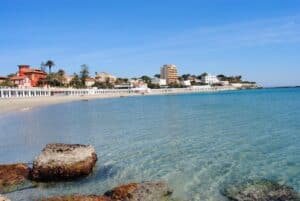
The stretch of beach measures about one and a half kilometers. The sand is gray and fine-grained, a volcanic legacy shared by this whole coast. The seabed slopes down evenly and is protected by a series of breakwater cliffs built to contain erosion, which along this stretch of coastline is a serious and long-standing problem. The barriers have a side effect that families appreciate: behind them the water is almost always calm, and small children have a natural pool.
Beach Establishments and Free Stretches of the Beach at Marina di San Nicola (RM)
The management is mixed. The local portal lists eight beach establishments with free stretches of beach interspersed between them. Names and concessions change over time, so it's better to check the signage along the seafront rather than rely on a list that is two seasons old. The general Italian rule applies here too: the waterline is always passable, and access to the sea cannot be blocked, while umbrellas, loungers, showers, cabins and lifeguard service within a concession are paid.
The practical tip: if you arrive without a reservation on an August weekend, head for the free stretches at the southern end of the seafront, toward Palo, where the crowds are thinner, and bring your own umbrella. If instead you're traveling with very young children or with someone who has mobility difficulties, a beach establishment covers boardwalk access, shade and restrooms in one go, and the difference of 20 or 30 euros is money well spent.
Parking and Access at Marina di San Nicola (RM)
This is where people arrive unprepared. Inside the development, summer parking is regulated and paid, with a daily rate managed by the consortium. The amount should be checked on site because it changes from year to year. In the summer months, the Comune di Ladispoli also sets up a pedestrian area on Via Tre Pesci, between Via Venere and the Stella Marina beach establishment. In the 2024 edition, the ordinance ran from eight in the morning on June 15 to midnight on September 8, with exemptions for authorized vehicles and emergency vehicles, and with six spaces reserved for people with disabilities between Via Marte and the bar La Lucertola. A similar measure is usually renewed every season, with its own dates. It's worth checking the Comune di Ladispoli's albo pretorio before you leave, because the pedestrianized stretch is exactly the one that leads to the sea.
If you arrive by camper, know that the area is not equipped for overnight parking of recreational vehicles and that the internal roads are narrow, with tight-radius curves and low trees. It's not the place for a seven-meter vehicle.
Water Quality at Marina di San Nicola (RM)
Monitoring is the job of ARPA Lazio, which applies EU Directive 2006/7/EC and samples monthly from April to September, with the official bathing season running from May 30 to September 30, across about 220 bathing areas spread along more than 500 kilometers of coast, islands and lakes. There are two microbiological parameters, Escherichia coli and intestinal enterococci, and the classification as excellent, good, sufficient or poor is built on four years of data, not on a single sample.
In the 2026 classification released in April, the regional picture shows 93 percent of waters in the excellent class, six percent in the good class and three percent in the sufficient class, with no water in the poor class. In the Rome Province, the share of excellent waters is 87 percent. The program calls for more than 1,600 seasonal samples. The specific figure for the single Ladispoli monitoring point can be checked on the agency's data portal, which is the only source to use. Temporary municipal bans, when issued after a rain event or an unusual discharge, are a matter of current events and do not change the multi-year classification. Before swimming after days of heavy rain, a look at the ARPA portal and the Comune's ordinances is the smartest thing you can do.
A Curiosity About Marina di San Nicola (RM)
Open a map of the development and you'll notice the streets don't bear the names of the usual Risorgimento heroes, nor those of the flowers or trees found in every coastal development in Italy. In Marina di San Nicola (RM), the street names are entirely astronomical and marine-mythological: Via del Sole, Via della Luna, Via Mercurio, Via Venere, Via Marte, Via Diana, Via delle Pleiadi, Via delle Naiadi. Walking through this grid is a basic lesson in cosmography, and not by accident.
The choice dates back to the founding phase of the development, between the 1950s and 1960s, and it fits the character of the project: a seaside garden city planned on the drawing board, where every element, from the greenery to the signage, had to speak one unified language. Whoever designed these streets preferred the sky to national history, and the result is that your home address reads like a star chart. The real curiosity, however, is something else: the same logic ended up matching the ancient topography of the place. Via Venere and Via Mercurio run exactly over and around the remains of a large imperial Roman villa, and walking on streets named after the planetary gods means passing over mosaic floors that those same gods once painted on the walls. No one planned it, but it's one of those coincidences that make the Lazio coastline more interesting than its reputation suggests.
I'll add one detail that few people notice. The seafront doesn't follow the astronomical rule: it's named after Sergio Leone, and the exception was approved by the Municipality of Ladispoli in 2019. In the grid of stars, the only exception is a film director. If you want a quick image of what this place is like, it's all there.
The archaeological area of Marina di San Nicola (RM) and the so-called Villa of Pompey
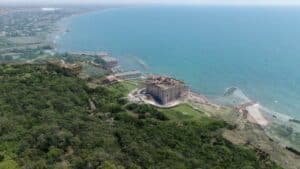
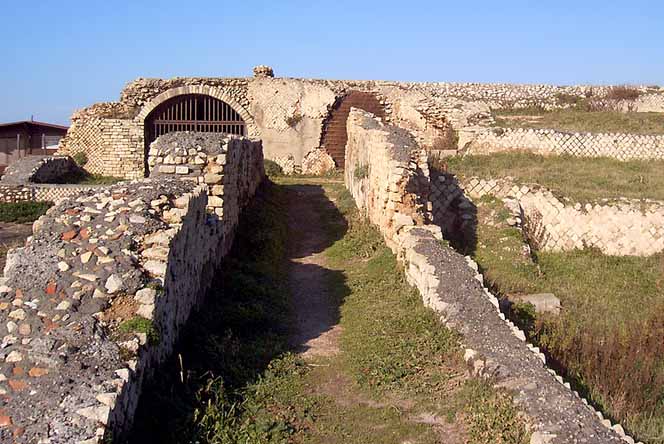
Between Via Venere, Via Alsium and Via Mercurio, close to the beach, the remains of a large Roman maritime villa emerge. It is the most important monument in the development and one of the best-preserved ancient residential complexes along the entire coast north of Rome.
Alsium, Pompey and the name of the villa
Local tradition calls it the Villa of Pompey, attributing it to Gnaeus Pompeius Magnus, who died in 48 BC. The documentary link cited most often is a passage from Cicero's Pro Milone, which places a Pompeian property in the Alsian area. It needs to be said plainly: the attribution is tradition, not established fact. The visible structures date to the 1st century BC and the Augustan age, so the chronology is compatible, but no inscription found so far has unambiguously linked the complex to the name of Pompey.
The later phase is firmer ground. In the 2nd and 3rd centuries AD the property passed to the imperial estate and appears in literary sources as Villa Alsiensis, named after Alsium, the Etruscan and later Roman center that occupied this stretch of coast and served as a sea port for Caere, today Cerveteri. Inscriptions bearing the formula DEI SOLIS MAGNI ELAGABALI come from here, a sign that the complex passed into imperial hands in the Severan age. The villa remained in use throughout the imperial period, with occupation attested into the 4th and 5th centuries AD.
The criptoportico and layout of the villa at Marina di San Nicola (RM)
The complex stretches across a natural promontory of sandstone and, according to reconstructions, the excavated part occupied an area on the order of two hectares within a much larger property. The plan was rectangular, roughly 200 meters by 130 meters, with terraced gardens, a peristyle, reception rooms, a thermal quarter and workshops.
The element visitors can still see today is the criptoportico: a vaulted, half-underground corridor with small gola di lupo openings facing the sea. It served two purposes at once, supporting the terraces above and providing a cool, shaded space during the central hours of summer, and it is the typical solution of Tyrrhenian maritime villas. The bases of the portico columns, in brick covered with white stucco, are also still visible, along with fragments of painted plaster in some rooms. Archaeological sources describe two long colonnaded corridors of more than 130 meters running toward the sea, and a portico of about 80 meters that led down to the beach, with black-and-white geometric mosaic floors.
The finds: the double herm and the amphorae
Documented excavations begin in 1867. Among the recovered materials, the best-known piece is a marble double herm with a head of Janus, now held at Museo Nazionale Etrusco di Villa Giulia in Rome. Alongside the sculpture, the pottery tells a less spectacular and more instructive story: African, Gallic and Hispanic amphorae in large numbers, proof that the villa's small service landing was part of the trade routes of the western Mediterranean and did not serve only the owner and his guests.
Near the main structure, rooms used for commercial purposes and the quays of a small harbor close to the beach have been identified. The residential rooms were paved with mosaic and faced with marble, with wall paintings of which traces remain.
The World War II watchtower
The site also holds a much more recent and much less elegant structure: a concrete lookout tower built during World War II, partly using the villa's ancient materials. It's an eyesore and at the same time a historical record. My advice is to look at it without irritation: it marks the moment when this coast stopped being a holiday destination and became a frontier, with the Tyrrhenian fortification system of 1943 and 1944.
The archaeological park project at Marina di San Nicola (RM)
In October 2018, the Consortium and the competent Superintendency signed an agreement to enhance the area, with the aim of cleaning the site, equipping it with educational panels and themed trails, and opening it to paid guided visits, educational routes for students, and evening events. The work has proceeded in successive phases, and how accessible the area is varies over time. Before you show up at the gate, ask the Consortium whether any visits are scheduled: it's the only way to avoid finding the remains fenced off and readable only from outside.

One thing nobody tells you about Marina di San Nicola (RM)
No guide says this, but here the difference between having a good day and a mediocre one doesn't depend on the weather, it depends on the wind. Marina di San Nicola (RM) faces west and southwest, and when the southwest wind picks up, usually in the early afternoon, the sea behind the rocks stays swimmable but the fine sand starts to fly. If you arrive at 4 in the afternoon on a day with a strong southwest wind, you'll find a windy beach and sunscreen mixed with sand. If you arrive at 8:30 in the morning, you'll find glassy water, low-angle light, and parking.
The flip side is that this same wind has made the place a sports destination. This stretch of coast has been popular with surfers and kitesurfers since the 1980s, long before kiting became a mass sport, and it's one of the few spots on the Roman coast where the combination of seabed, breakwater, and thermal breeze makes for good training conditions even in summer. If you're a sailor or a surfer, the windy afternoon that spoils the day for the beachgoer is exactly your window.
Second thing nobody says, and it concerns logistics. There's no train station, no significant hotel offer, and no shopping center: the settlement was built for people who own or rent a house, not for organized daytime tourism. This means that local services exist and work, from the pharmacy to the medical post with an ambulance, but they're sized for residents and seasonal vacationers. In August, on a peak afternoon, a line at the bar or the pharmacy is normal. It's not bad organization: it's a town of 1,300 people that suddenly hosts 12,000.
My advice for visiting Marina di San Nicola (RM)
There's only one piece of advice, and it's worth more than all the others put together: come early in the morning, and treat the day as a combo of sea plus archaeology plus woods, not as a simple beach outing. If you stay on your towel from 10 to 18, you'll have done what you could have done in 50 other places in Lazio. If instead you plan the day in stages, Marina di San Nicola (RM) becomes one of the most complete day trips along the coast north of Rome.
The suggested sequence works like this. Leave Rome around 7:30, arrive by 8:30, stop and swim while the sea is flat and the light is still good. Around 11, when the sun starts to beat down, walk over to via Venere and via Alsium for the criptoportico and the remains of the villa: a good half hour, longer if you find a guided visit on the schedule. Light lunch nearby, and in the early afternoon, when the beach fills up and the wind picks up, walk the bike and pedestrian path toward Palo, between the dry-stone wall from 1888 and the old steam tanks, all the way to the Castello Odescalchi di Palo and the Bosco di Palo. Head back around 18, with the sun setting over the sea.
Two practical warnings. First: wear closed shoes if you head down toward the archaeological area and the woods, because sand and scrub don't forgive flip-flops. Second: stopping inside the area is regulated, so ask as soon as you arrive instead of discovering the rule at the end of the day. Finally, a clear opinion: if you have just one Sunday and want pure sea with services, go to Santa Marinella, if you want a day that teaches you something, stay here.
Green spaces, parks and the Oasi del Bosco di Palo
The green is the reason this complex has a different physiognomy from the rest of the coast. Of the 120 hectares overall, the share planted with trees and gardens is very high, and the play parks inside are many and spread out, not concentrated in a single area. For those traveling with children it is a concrete advantage: you can alternate beach and shade without moving by car.
The Bosco di Palo, Natural Boundary of Marina di San Nicola (RM)
Right next to the complex, to the south, stretches one of the last portions of Tyrrhenian coastal forest surviving in Lazio: a scrub of about 120 hectares among evergreens and deciduous trees, with dense undergrowth and, rarer still, temporary pools of water that create a damp microenvironment of great value. The area was established as a WWF oasis in 1980 and managed by the association until 2003. In 1995 the entire area obtained recognition as a Site of Community Importance under the Habitats Directive, and since 2016 it has been recognized as an Area of Herpetological Relevance.
The fauna is the reason for the recognition: Hermann's tortoise and European pond turtle, porcupine, badger, Etruscan shrew, tawny owl, green woodpecker and rare crustaceans tied precisely to the temporary pools. Access is not free as in an urban park and visits follow schedules and arrangements that change: they must be checked with the managing body before showing up at the gate. A pedestrian walkway connects Via Diana to the edge of the oasis, and continuing along the shoreline you reach Palo in a few minutes.
The Other Natural Spaces Around Marina di San Nicola (RM)
Within a few kilometers the coast offers two other notable protected areas: the marsh of Torre Flavia, a natural monument north of Ladispoli, with the 16th-century tower now in the sea and a wetland frequented by grebes, herons and waders, and the Macchiagrande Oasis in the municipality of Fiumicino, to the south. Lined up, these three areas tell the landscape that covered the entire Roman coast before the land reclamations and subdivisions.
Another Well-Known Fact, Yet Rarely Cited
That this is a coast of Roman villas everybody knows. What almost nobody connects is why: the coast between Fiumicino and Civitavecchia was not a vacation riviera, it was the coast of southern Etruria, and every maritime villa arose next to a landing place. Alsium was the port of Caere, the very powerful Etruscan city that we today call Cerveteri. Farther north, Pyrgi served the same system, and farther still there was Gravisca for Tarquinia. When Rome absorbs Etruria, those landing places remain, and the Roman aristocracy builds its maritime residences on top of them because the ground was already served by roads, water and moorings.
From here follows a second little-cited thing: the sea, for a Roman owner, was not only a landscape. The African, Gallic and Hispanic amphorae found in the villa of Marina di San Nicola (RM) say that the little port was at work, that the house was also a point of landing and sorting, and that the modern distinction between pleasure residence and productive facility simply does not apply here. The Roman maritime villa was a business with a view.
Third element, this one truly underrated: the coast has kept doing the same job for 20 centuries. The 1888 dry-stone wall along the bike and pedestrian path and the Palo Ladispoli railway in operation between 1888 and 1938 belong to the same logic: connecting the coast to Rome to carry people and goods. The means change, not the function. The little villas of the 1970s of Marina di San Nicola (RM) are the latest installment of a story that begins with the quays of Alsium.
The Right Photo to Take at Marina di San Nicola (RM)
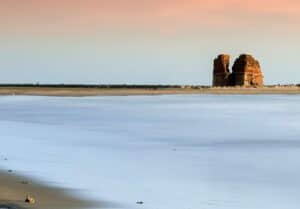
The photograph that takes this place home is not the panorama of the crowded seafront and is not the close-up of the umbrella. It is the shot from below, from the shoreline, that holds together in a single frame the breakwater reef, the line of the cryptoporticus on the sandstone ledge and, in the high background, the squared silhouette of the wartime turret. Three eras in one frame: the 1st century BC, 1943, the concrete of contemporary coastal engineering. There are very few Italian beaches where three historical layers lie so close as to fit in the same lens.
Technically it is best to work early in the morning or in the last hour of light. In the morning the sun comes from inland and lights the ancient structures, leaving the sea in soft shadow. The gray sand, which at noon turns flat and washed out, shows the pattern of the ripples in raking light. A moderate wide-angle focal length, around 24 or 28 millimeters equivalent, holds the three planes together without distorting the cryptoporticus. If you have a polarizer, use it sparingly: here the sky saturates quickly and the risk is a postcard blue that betrays the severe character of the place.
The second photo not to miss is opposite in spirit: the road sign. An intersection of Via Venere and Via Mercurio, with the sea in the background, is the image that explains Marina di San Nicola (RM) better than any caption could. The third, for those with time, is on the bike and pedestrian path toward Palo, at the height of the 1888 dry-stone wall, with the eucalyptus and cypress trees filtering the light of the late afternoon.
Some important events that took place here in history
The first major event is the transformation of the seaside villa into an imperial property. Between the second and third centuries AD the complex entered the prince's estate and appears in the sources as Villa Alsiensis. This means a private estate of the late Republican aristocracy was absorbed by the ruling house, a process that repeated across Italy and that is documented here by the inscriptions with the formula DEI SOLIS MAGNI ELAGABALI, attributable to the Severan period and to the solar cult brought in by Elagabalus. This is not a scholarly detail: those few carved words tell a story of confiscation.
The second event is 1867, the year the documented excavations at the site began. We are in the last years of the Papal States, Roman archaeology is moving from antiquarian collecting to method, and the finds that came out of here, starting with the double herm with a head of Janus that ended up in Villa Giulia, entered the public museum circuit instead of a private picture gallery.
The third is related to the railway and is little remembered: from 1888 to 1938 the Palo Ladispoli line operated. Today what remains of it is the roadbed used by the bike and pedestrian path, the dry-stone wall built of local stone in 1888, and two water tanks for steam locomotives. 50 years of service and then decommissioning: it is the trajectory of dozens of Italian coastal rail connections.
The fourth is World War II. The concrete lookout tower, built by reusing ancient materials from the villa, belongs to the Tyrrhenian defensive system of 1943 and 1944, when an Allied landing was expected along this entire coast. The choice to cannibalize a Roman monument to turn it into a stronghold says everything about the order of priorities of those years.
The fifth is the founding of the development itself in the 1950s and, in the 1960s, the creation of the property owners' consortium: a model of self-government that has held up for more than 60 years and has become the defining feature of the place. The sixth, to close with a recent date, is July 14, 2019, when the seafront was named after Sergio Leone in the presence of mayor Alessandro Grando, the director's nephew Federico Polimanti, and collaborators Roberto Girometti and Andrea De Rosa, exactly 30 years after Leone's death.
Who has passed through Marina di San Nicola (RM)
The most important name is Sergio Leone, and the connection is documented. In the early 1950s the future director of the Dollars trilogy worked as assistant director to Mario Soldati on two films based on Emilio Salgari, shot between Castello Odescalchi in Palo and the beach between Palo and Marina di San Nicola: I tre corsari and Jolanda la figlia del Corsaro Nero, with Renato Salvatori, Ettore Manni and May Britt in front of the camera. The two films are dated by sources to 1952 and 1953, with some variation, so it is more cautious to say they are from the very early 1950s. The same productions featured names who would go on to make Italian film history: Tonino Delli Colli on cinematography, Leo Catozzo on editing, Nino Rota on music, Piero Gherardi on sets, and Franco Brusati, Ennio De Concini, Agenore Incrocci and Furio Scarpelli on the screenplay. Leone later returned to the area as a guest, and the stretch of seafront between Piazzale Diana and Via Tre Pesci now bears his name.
This stretch of coast has served Italian cinema well beyond Leone. Along the route between Palo and the development, scenes have been shot for films that have entered the canon, from Umberto D. to Il sorpasso, up to the international productions with biblical settings of the 1960s. The reason is simple and still valid: pine grove, scrub, beach, Roman ruins and a castle, all within 20 minutes by car and 40 minutes from Cinecittà.
As for famous summer visitors, Marina di San Nicola (RM) has hosted and still hosts, in summer, a list of well-known names from film, television, sport and politics. Among those that local sources consistently mention are Lino Banfi, Jerry Calà, Loretta Goggi, Anna Mazzamauro, Max Gazzè, Alessandra Mussolini, sports executive Daniele Pradè, former Lazio goalkeeper Felice Pulici and Maria Scicolone, as well as several members of parliament. This is a sociological fact more than gossip: the development was born as a second home for the Roman professional middle class and attracted, thanks to its discretion and proximity, a social circle that in Fregene or Sabaudia would have been much more exposed.
Finally, the oldest passages. If the traditional attribution had any basis, Pompey the Great would have passed through here. With greater certainty, the imperial administrators of the second and third centuries AD who managed Villa Alsiensis passed through here, along with merchants who unloaded African and Spanish amphorae on the quays of the small harbor.

When to Go to Marina di San Nicola (RM) and When to Avoid It
June and September are the best months, beyond debate. The water in September is warmer than in June, parking is less complicated, the free stretches of beach breathe, and the services are still open at least until the first 10 days of the month. July is acceptable on weekdays. August weekends are the worst condition: 12,000 people on 120 hectares, and you feel all of them.
Outside the season the area empties out and becomes something else: a November walk along the bike and pedestrian path toward Palo, with the damp woods and the rough sea, is one of the most beautiful outings on the Lazio coast and costs nothing. Many services close, though, so plan your lunch. After a storm surge the beach fills with driftwood and washed-up material, and it's not rare for storm surges to uncover buried structures along this stretch of coast.
Marina di San Nicola (RM) with Children
It's one of the places on the Rome coast that works best with young children, for three concrete reasons: calm water behind the reefs, playgrounds spread throughout the area, and the presence of nearby health services, ambulance included. The drawback is the lack of organized entertainment: there's no water park here, no Ferris wheel, no seafront with amusement rides. For a four-year-old it's perfect, for a 14-year-old looking for company, less so.
Accessibility
The seafront is flat and most beach establishments have sand walkways, but the facilities vary from concession to concession and should be asked for beforehand. The summer ordinance for the pedestrian area of via Tre Pesci provides for parking spaces reserved for people with disabilities between via Marte and the La Lucertola bar, and allows vehicles serving people with disabilities to pass through. The archaeological area, by its nature, is on uneven ground and is not suitable for a wheelchair without assistance.
What's Around Marina di San Nicola (RM)
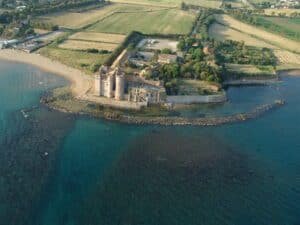
Within a few kilometers there is more material than one day can handle. To the south, the Castello Odescalchi di Palo, a medieval fortification later remodeled and today a high-end accommodation facility, with its woods and the beach below. Further south, the Lido di Maccarese and Fregene Beach, that is, the stretch of coast Romans visit most and that people here deliberately avoid.
To the north, past Ladispoli and the Torre Flavia marsh, you'll come across the Santa Severa Castle with its museum and the Pyrgi archaeological area, and then Santa Marinella. Inland, the Banditaccia necropolis of Cerveteri, a UNESCO heritage site, is a quarter hour by car: it's the smartest combination for a day that wants to combine sea and Etruria. Further away but reachable, Lake Bracciano and the village of Trevignano Romano.
Quick Questions About Marina di San Nicola (RM)
Where exactly is Marina di San Nicola (RM)?
On the Tyrrhenian coast north of Rome, in the municipality of Ladispoli, about 3.5 kilometers south of the center of Ladispoli and a little under 40 kilometers from the center of Rome.
Can you go to the beach at Marina di San Nicola (RM) without being a resident?
Yes. The shoreline is public domain and access to the sea cannot be denied to anyone. What the owners' consortium regulates is the internal roads, parking and the services of the area.
How much does parking cost at Marina di San Nicola (RM)?
In the summer months the internal parking is paid, with a daily rate set by the consortium. The amount changes from season to season: it should be read on the signs on site or asked directly of the Consorzio Marina di San Nicola.
Is there a railway station at Marina di San Nicola (RM)?
No. The closest stations on the FL5 Rome Civitavecchia line are Palo Laziale, Torre in Pietra Palidoro and Ladispoli Cerveteri, and from there you need a vehicle for the last stretch.
How long does it take to get from Rome to Marina di San Nicola (RM)?
By car from the Grande Raccordo Anulare, in normal conditions, less than 40 minutes via Via Aurelia or the A12. On summer weekends in late morning the time can double.
Is the beach at Marina di San Nicola (RM) free or are there beach establishments?
Both. The locality's portal lists eight beach establishments alternating with stretches of free beach along a beach of about a kilometer and a half.
What is the sand like?
Gray and fine-grained, of volcanic origin as along this whole stretch of coast. The seabed is protected by breakwater reefs.
Is the water clean at Marina di San Nicola (RM)?
The classification of bathing waters is the job of ARPA Lazio, which in 2026 indicated 93 percent of regional waters in the excellent class and 87 percent in the province of Rome. The figure for the single monitoring point of Ladispoli can be consulted on the agency's portal, where any temporary bans are also found.
Can the remains of the Roman villa be visited?
The archaeological area between Via Venere, Via Alsium and Via Mercurio is the subject of an enhancement project started in 2018 by the consortium with the Soprintendenza, which provides for paid guided tours and educational paths. Accessibility varies: it's best to ask the consortium whether any openings are scheduled.
Why is it called Pompey's villa?
By local tradition, on the strength of a passage of Cicero's Pro Milone that places a property of Pompey the Great in the Alsium area. The attribution is not confirmed by direct archaeological evidence. What is certain instead is the later imperial ownership, documented by the name Villa Alsiensis.
Is Marina di San Nicola (RM) suitable for children?
Very much so, for the youngest: calm water behind the breakwaters, play parks spread through the complex and nearby health services. Less so for teenagers, because there is no nightlife or organized entertainment.
Are there hotels at Marina di San Nicola (RM)?
Lodging is limited and centered on seasonal rental houses. For a hotel it is best to look at Ladispoli or along the coast toward Santa Marinella.
Can you surf or kitesurf?
Yes, the stretch has been frequented by surfers and kitesurfers since the 1980s, with better conditions on windy afternoons and in the shoulder seasons.
How many inhabitants does Marina di San Nicola (RM) have?
A little over a thousand permanent residents according to the most recent registry data reported by the local portal, which in summer become over 12,000 among vacationers and owners of second homes.
Why do the streets have names of planets and stars?
It is the place-naming choice of the founding phase of the complex, between the 1950s and 1960s: Via del Sole, Via della Luna, Via Mercurio, Via Venere, Via Marte, Via Diana, Via delle Pleiadi, Via delle Naiadi.
Who was Sergio Leone and why does the seafront bear his name?
The director of A Fistful of Dollars and Once Upon a Time in the West began his career as assistant director to Mario Soldati on the Salgari-based films shot between Palo and this beach in the early 1950s. The seafront was named after him on July 14, 2019.
What is the Consorzio Marina di San Nicola?
The body established in the 1960s by the owners of the roughly 3,000 housing units, based on Via della Luna, which manages internal roads, greenery, lighting, security and services of the complex.
Can you walk to the Bosco di Palo from Marina di San Nicola (RM)?
Yes, a pedestrian walkway connects Via Diana to the edge of the oasis and, continuing along the shoreline, you reach Palo in a few minutes. Entry to the protected area, however, is not free and must be arranged with the managing body.
What is the best time to go to Marina di San Nicola (RM)?
June and September, with a preference for September, when the water is warmer and the complex has emptied out. August weekends are to be avoided.
Are there a pharmacy and medical assistance?
Yes, the complex has a pharmacy, a medical station, an ambulance service and a post office, sized however for the resident and seasonal population.
How far is Marina di San Nicola (RM) from the airports and from the port of Civitavecchia?
About 30 kilometers from Fiumicino airport, about 50 from Ciampino and some 40 from the port of Civitavecchia.
What is the difference between Marina di San Nicola (RM) and Ladispoli?
Ladispoli is a city of more than 40,000 residents with an urban seafront, shops, a market and life all year round. Marina di San Nicola (RM) is a residential complex of small villas set in greenery, with few services and no nightlife. They are two opposing ideas of the sea, three kilometers apart.
The overall verdict is that Marina di San Nicola (RM) is the right place for anyone who has understood that the Lazio sea isn't about the most beautiful beach, because that's somewhere else, but about the combination of water, shade and history. Here this combination is as dense as at few other points on the Roman coast: one hour of swimming, half an hour in a Roman cryptoporticus, one hour in relict woodland. If you are happy with just an umbrella spot, you'll leave disappointed. If you expect more, you'll come back.
Frequently asked questions about Marina di San Nicola (RM)
Where exactly is Marina di San Nicola?
Marina di San Nicola is on the Tyrrhenian coast north of Rome, in the territory of the Comune di Ladispoli, about 3.5 kilometers south of the center of Ladispoli and just under 40 kilometers from the center of Rome. It is wedged into a narrow strip between Via Aurelia and the sea, between the Bosco di Palo to the south and Ladispoli to the north.
Can you go to the beach at Marina di San Nicola if you're not a resident?
Yes, you can go to the beach at Marina di San Nicola even if you don't live in the residential complex: the shoreline is public domain, and access to the sea cannot be denied to anyone. Marina di San Nicola is not a historic village but a residential complex born in the 1950s as a summer holiday resort.
How long is the beach at Marina di San Nicola?
The shoreline of Marina di San Nicola measures about 1.5 kilometers, with grey sand of fine grain, a volcanic legacy common to this entire coast. The seabed slopes down evenly and is protected by a series of rock breakwaters built to contain erosion, which on this stretch of coast is a serious and long-standing problem.
Is Marina di San Nicola suitable for children?
Yes, Marina di San Nicola is especially suitable for families. Across the 120 hectares of the complex, the share covered by trees and gardens is very high, with many playgrounds spread out rather than concentrated in a single area, which makes it possible to alternate between beach and shade without having to move by car.
What is there to see at Marina di San Nicola besides the sea?
Between Via Venere, Via Alsium and Via Mercurio, the remains of a Roman maritime villa of considerable size emerge, the so-called Villa di Pompeo, one of the best-preserved ancient residential complexes along the entire coast north of Rome. It also borders the Bosco di Palo, which offers a natural stop for anyone planning a day with several stops.
When is the best time to go to Marina di San Nicola?
June and September are the best months for Marina di San Nicola, no question about it. The water is warmer in September than in June, parking is less complicated, and services are still open at least until the first 10 days of the month. August weekends are the worst condition, with 12,000 visitors on 120 hectares.
How do you get to Marina di San Nicola?
Marina di San Nicola can be reached by train, as well as by car along Via Aurelia. It is a stretch of coast that Romans have known for 70 years and that foreign tourists almost entirely ignore, an advantage for anyone looking for a day at the sea without the traffic of Ostia or the crowds of Fregene.
Article written by the editorial team of TourLeaderPro. Contact them for Tours and Private/Corporate/V.I.P. Experiences. For a day organized on the coast north of Rome, with a licensed tour leader, start from the TourLeaderPro contact page. Tour operators who build itineraries along the Etruscan coast, on the other hand, will find the consulting service in the section dedicated to tour operators.
Planning a trip to Rome? The English-language guides to visiting the city are on ItalyPlanner.com. For those planning days out of the city, there is the guide to the best day trips from Rome, while those who want to understand how Italy's free beaches really work, concessions included, will find the explanation in the guide to free beaches in Italy.