Galeria Antica
In short. Galeria Antica is the abandoned village reached from Via di Santa Maria di Galeria 691, in the northwestern quadrant of the Municipality of Rome, along Via Braccianense: 40 hectares of ruins and woods declared a Natural Monument by Decree no.
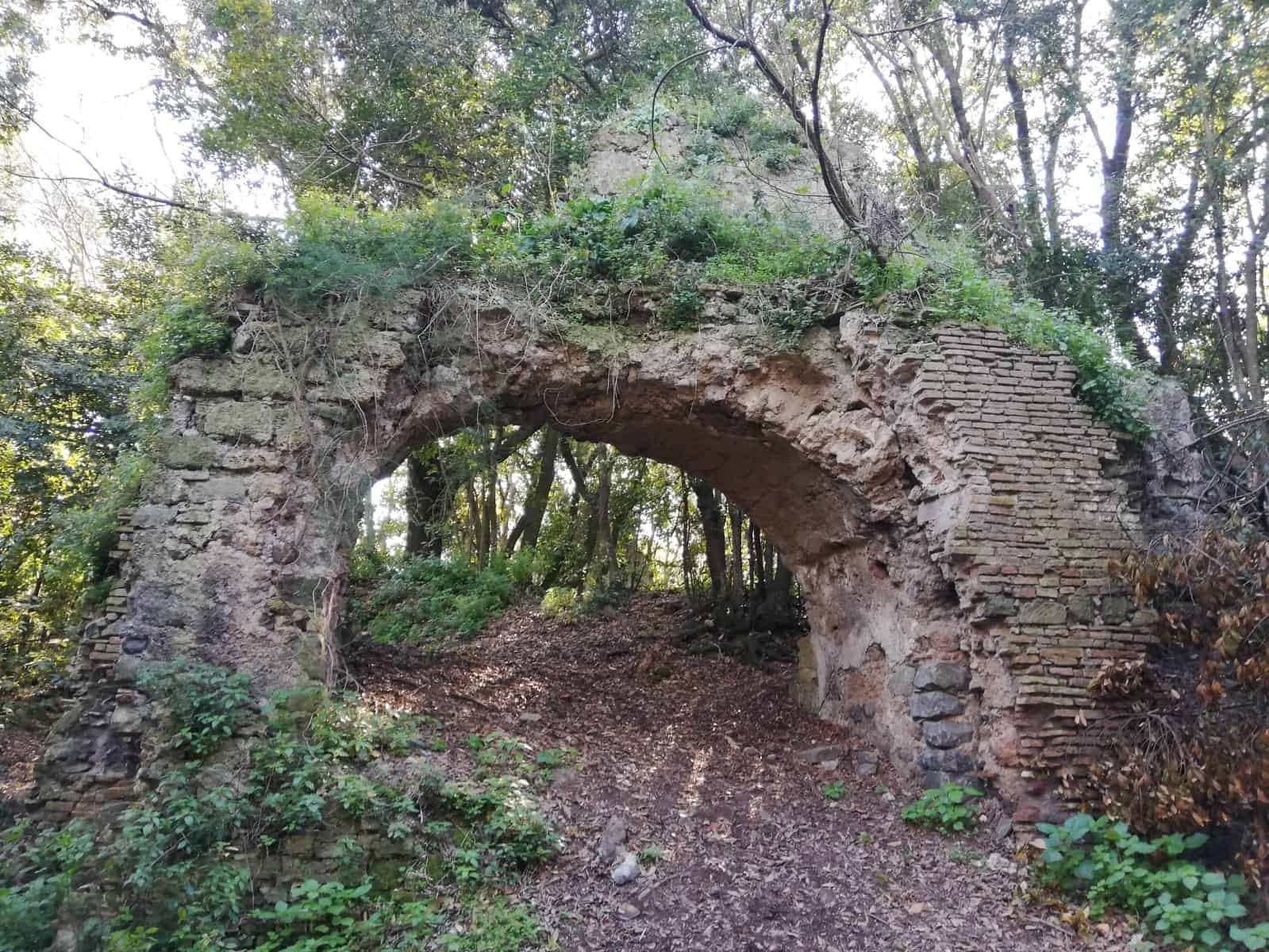
Galeria Antica is the abandoned village reached from Via di Santa Maria di Galeria 691, in the northwestern quadrant of the Municipality of Rome, along Via Braccianense: 40 hectares of ruins and woods declared a Natural Monument by Decree no. 794 of the President of the Lazio Region of May 24, 1999 and entrusted to the Regional Authority for the Management of the System of Protected Natural Areas in the Municipality of Rome, that is, RomaNatura, whose operational office is in Monte Mario, at Via Gomenizza 81. You don't buy a ticket, because there is no ticket office: the official sheet of the protected area states that the site is accessible only on the occasion of organized visits, and the 40 hectares of the monument fall on private land. The contact given by RomaNatura for information is 06.35491587. The Lazio regional portal of protected areas also lists the number 06.35405310 for the same area. By public transportation you get off at the La Storta railway station on the FL3 line and take the ultra-peripheral bus line 030, which terminates at Via di Tragliatella. By car you drive Via Braccianense and leave the car near the turnoff for Santa Maria di Galeria, from where the dirt roads rising toward the cliff start. The ruins are unstable and the ground is full of holes covered by grass. Whoever goes alone goes at their own risk, whoever wants to see Galeria Antica properly calls the managing body and waits for the guided visit.
If the chapter on the dead towns of Lazio interests you, the natural comparison is with Monterano, the ghost village above Canale Monterano: same story of malaria and abandonment, very different visual outcome.

Where Galeria Antica is and how to get there
Geography matters more than place names here. Galeria Antica occupies the top of a tuff spur overlooking the course of the Arrone River, a handful of kilometers from the Grande Raccordo Anulare and yet out of this world. The surrounding landscape is that of the northern Agro Romano: cultivated fields, pastures, rows of elms, patches of woods in the gorges. Whoever arrives expects a monumental sign and finds a dirt road.
The address and access to Galeria Antica
The access given by the managing body is Via Santa Maria di Galeria 691, and the reference office for the natural monument is on Via di Santa Maria di Galeria, 00123 Rome. The official identity card of the protected area specifies two things worth reading twice: the site is accessible only on the occasion of organized visits, and the whole 40-hectare surface falls on private property. They are two dry sentences that completely change how you plan the day. There is no gate with hours, no custodian, no equipped route with railings and panels. There is a cliff with a dead town on top, and those who manage it say so clearly.
The practical consequence is simple: the first number to dial isn't that of a tourist information office but that of the managing body, 06.35491587. Outings with the park rangers and group visits are organized from there. Whoever tries to improvise risks two things, and neither is a fine: breaking an ankle in a hidden hole and entering private land.
How to get to Galeria Antica by public transportation
The combination indicated by the protected area is railway plus scheduled bus. Take the regional FL3 line, the one that from Roma Ostiense and Roma San Pietro goes up toward Cesano, Bracciano and Viterbo, and get off at La Storta. From there starts the ultra-peripheral line 030, a bus terminating at Via di Tragliatella: it's the country bus, with sparse runs, and it's best to check the timetable the day before. From the stop to the start of the dirt roads there's still a stretch on foot.
An alternative exists on the opposite side: the same FL3 serves the Cesano station, which the area's accommodation sector indicates as a reference for reaching the facilities along Via Braccianense. It's the most convenient way for those aiming to combine the walk with lunch at an agriturismo.
How to get to Galeria Antica by car
By car, the reference is Via Braccianense, the road that goes up from Rome toward the lake. The dirt roads leading to the cliff branch off from Braccianense and from the village of Santa Maria di Galeria. The surface is what it is: packed earth, ruts, puddles that last in winter. With a low sedan you get so far and then it's best to park and continue on foot, since the good part starts there anyway.
The practical advice: don't trust the navigator blindly. In that area the place names all resemble each other and the satellite navigator tends to send you toward the town of Santa Maria di Galeria, which is something else than the cliff. If you find yourself in a small square with a bar and a church, you're in the village of the living, not in that of the dead.
How much it costs to visit Galeria Antica
There is no entrance ticket for Galeria Antica, because there is no paid visitor facility. The natural monument has no ticket booth, turnstiles, audio guides. When RomaNatura organizes an excursion with the park rangers, the participation conditions are communicated by the body itself: whoever wants the updated information asks directly at the protected area's number. What you can budget for with certainty is the trip, the right shoes and, if anything, lunch.
What the Galeria Antica Natural Monument is
There is a misunderstanding that has circulated for years and it's best to clear it up right away. Galeria Antica is not an archaeological park. It is a natural monument, and the difference isn't bureaucratic: it changes who puts in the money, it changes what is protected, it changes what can be done on the spot.
The 40 hectares of Galeria Antica
The protected surface is 40 hectares. It's little, compared with the large regional reserves, and it's a great deal if you consider that inside those 40 hectares there are an entire fortified settlement, a river gorge, a holm oak wood, a rocky riverbed and the ruins of a mill. The density of things per square meter, at Galeria Antica, is out of scale with the Agro Romano average.
The perimeter follows the logic of the terrain: it takes the tuff spur, goes down into the gorge of the Arrone, climbs back up the slopes. Whoever looks at the map understands right away that the criterion wasn't to fence a monument but to hold together a system, cliff plus river plus wood.
Who manages Galeria Antica
Management is by RomaNatura, the Regional Authority for the Management of the System of Protected Natural Areas in the Municipality of Rome, with its operational office in Monte Mario, at Via Gomenizza 81, 00195 Rome. It's the same body that holds together the Marcigliana, the Valle dell'Aniene, the Insugherata, the Valle dei Casali, the Laurentino Acqua Acetosa, the Tenuta dei Massimi and the other protected areas within the municipal boundary. Galeria Antica is, of that system, the piece farthest from the center and the hardest to manage, for a reason no body can solve with a resolution: the land is private.
Why Galeria Antica is a natural monument and not an archaeological park
The 1999 establishment comes by the environmental route, with a decree of the President of the Lazio Region. The rationale is explicit in the body's papers: two centuries of complete abandonment allowed the formation of an ecosystem of notable interest. Translated: what's protected isn't the castle as a castle, it's the extraordinary fact that an entire human settlement was reconquered by the wood without interruption for 200 years.
It's a choice that has a price. A natural monument doesn't fund masonry restorations as an archaeological park would, and in fact the ruins of Galeria Antica keep losing pieces. Whoever visits it today sees a place in precarious balance between two protections that don't talk to each other enough. I say it without beating around the bush: it's the most serious limit of this place, and you can see it with the naked eye.
A curiosity about Galeria Antica
The finest curiosity of Galeria Antica isn't about a wall, it's about a tree. Inside the abandoned settlement grow centuries-old holm oaks and laurels that here aren't garden shrubs but real trees, with trunk and high crown. The laurel, throughout the Roman area, is a plant that people keep low for domestic use: it's pruned, picked, forced into a hedge. At Galeria Antica no one has pruned it for 200 years, and the result is a wood of arboreal laurels mingling with field maples and field elms. Walking through a mature laurel grove is a sensory experience you don't forget: the smell, after rain, is that of an enormous kitchen.
There is a second face to the same curiosity. The houses of the village aren't just surrounded by vegetation: they're inhabited by vegetation. Common ivy has filled the rooms, nettle trees have settled on the tops of walls, downy oaks have taken the sunniest slopes, white willows have occupied the strip toward the river. On the vertical masonry grow the rock-dwelling species, navelwort with its round fleshy leaves and pellitory, which is the plant of ruins par excellence throughout the Mediterranean.
What strikes those who know botany is the speed with which a tuff settlement turns into a natural cliff. Tuff is porous, holds water, flakes into scales that become soil. An abandoned tuff wall isn't a human-made object that resists: it's a rock face waiting for colonizers. Galeria Antica is the demonstration, at the gates of Rome, that 200 years are enough. 200 years and the city goes back to being a gorge.
A note for those going in late winter: the laurels bloom early and the scent can be smelled from far away, while the holm oaks stay dark all year. The contrast between the light green of the new laurel leaves and the almost black green of the holm oak, over the gray stones, is the reason this place works photographically even in January.
The tuff spur, the Arrone and the geography of Galeria Antica
To understand Galeria Antica you have to look at it from below, from the gorge, not from above. From underneath you read the reason someone decided to build up there and the reason why, in the end, everyone left.
The gorge and the Arrone River under Galeria Antica
The watercourse that cuts the gorge is the Arrone, the river that rises from Lake Bracciano and flows toward the sea in the direction of Maccarese. In the Galeria Antica stretch the riverbed is rocky, with areas of particular natural interest flagged by the managing body. A rocky riverbed means fast, oxygenated water, with pools and drops: good conditions for rheophilic fish and for amphibians, terrible for those walking in smooth shoes.
Along the river are the ruins of an ancient mill. It's the element that tells the economy of the village better than any chronicle: a castle on the cliff and a mill on the water are the same enterprise, split across two elevations. Whoever visits Galeria Antica and stops only at the top misses half the story.
The tuff and the cavities of Galeria Antica
The spur is tuff, and tuff is the stone that made southern Etruria possible. It's dug with simple tools, hardens in the air, is cut into regular blocks without the need for deep quarries. All the architecture of these villages comes from that characteristic: you quarry the material from the place where you build, and the quarry becomes cellar, tomb, stable, cistern.
Under the castle, in the gorge, there are tombs carved in the rock and the so-called tagliata, that is, an artificial cut in the tuff bank used as an access route or as a defensive work. They are the elements the managing body flags as evidence of the oldest phase. Similar ones are seen by the dozens throughout the territory between Veio and the coast: the tagliata is the signature of the Etruscans on the landscape.
Careiae: the Etruscan origins of Galeria Antica
The ancient name circulates in learned sources in more than one form, Careia and Careiae, and indicated a settlement that some sources place right here. It must be said honestly, because that's how one writes about archaeology: the identification is probable, not certified by an inscription found on the spot.
The tagliata and the tombs in the gorge under Galeria Antica
The material clues of the Etruscan phase, according to the managing body's documentation, are three: the tagliata, some tombs carved in the gorge below the castle, and wall remains. It's not a monumental assemblage like that of Cerveteri and the Banditaccia, where the tumuli form an urban landscape of the dead. Here the evidence is discreet, almost hidden by the wood, and has to be looked for with someone who knows where to look.
It's worth explaining why the tagliata matters so much. In southern Etruscan territory the roads don't go around obstacles: they cut through them, incising the tuff bank with vertical walls even several meters high. Those trenches served to maintain a constant gradient for carts and, in certain cases, to militarily control the passage. Finding a tagliata under a medieval castle means that the castle placed itself on top of an ancient road, not that it invented it.
Galeria Antica between Veio and Cerveteri
The location is that of a border place: the territory of Veio on one side, that of Cerveteri on the other. The two Etruscan cities were rival powers with different vocations, Veii agricultural and continental, Caere maritime and commercial. A settlement placed on the line separating them isn't just any town: it's a place where you control who passes.
Whoever wants to see what Veio meant on the ground can walk the Sorbo, in the valley inside the Veio Park, where the gorge and the sanctuary tell the same grammar of tuff and water. And whoever wants to measure the power of the other rival has Cerveteri half an hour away by car.
The Galerii people: a tradition to handle with care
An explanation of the name has circulated for centuries that calls on a people of the Galerii, founder of the place. It's a learned tradition, not an archaeological fact, and like all etymologies built backward from a place name it should be taken for what it is: a story people told themselves to give a father to a name. The Etruscan hypothesis, founded on what is materially found in the ground, is more solid.
I say this because it's a recurring vice of local popularization: an archaeological attestation and a 16th-century conjecture are put on the same level, and the reader leaves convinced they are two equivalent opinions. They are not. A tagliata and a rock-cut tomb are facts. The Galerii are an armchair legend.

One thing nobody tells you about Galeria Antica
Almost all accounts of Galeria Antica present it as a free place, at no cost, open to anyone who feels like walking. It's the thing nobody tells you, and yet it's written in black and white in the protected area's documents: the 40 hectares of the natural monument fall on private territory, and access is provided only on the occasion of organized visits. It's not a legal detail for a hair-splitting lawyer. It changes the very nature of the outing.
The consequences are three, and all must be said. The first is responsibility: on private land with unstable ruins, whoever enters alone takes on every risk, and the risk here is concrete because the ground is full of deep holes masked by tall grass, and several walls are unstable to the point that getting close is imprudent. The second is conservation: uncontrolled passage accelerates the decay of structures that no one is consolidating. The third is the quality of the visit: without someone who can tell a medieval wall from a 19th-century rebuild, or recognize the tagliata under two meters of brambles, you go home with photos and no understanding.
There is then a second level to this matter, which concerns management. A natural monument established in 1999 on private land is a formula that protects the landscape but doesn't give the body the tools to do structural maintenance on the masonry. The result, visible to anyone, is a settlement that the body literally defines as crumbling and by now overwhelmed by natural vegetation. It's not a poetic phrase put there to attract visitors, it's a diagnosis.
Our firm opinion is that this is the real interest of Galeria Antica for an adult visitor. You don't go to see a restored monument. You go to see what happens to a town when the State declares it important but no one has the ownership, the funds and the mandate to keep it standing. It's a lesson in heritage policy disguised as a walk in the woods.
Galeria Antica in the Middle Ages: the castle and the crossroads of the roads
The most substantial remains you see today are neither Etruscan nor Roman, they are medieval. Galeria Antica, in the Middle Ages, is a fortified village, and its economic reason is the control of a road junction.
The crossroads of Clodia, Cassia and Aurelia
The managing body's documentation is explicit: the village controlled an important crossroads of the ancient roads Clodia, Cassia and Aurelia. They are the three routes that led from Rome toward inland Etruria, toward the north through Sutri and Viterbo, and toward the Tyrrhenian coast. A castle planted where those roads intertwine isn't a peasant refuge, it's an armed customs post.
This explains the disproportion you notice on the spot between the modesty of the site, a town of a few hundred souls, and the substance of the defensive structures. You don't build like this to protect sheep. You build like this to demand a toll and to be courted by anyone in Rome who needed to control those roads.
Count Gerardo and the antipope Benedict X
The first documented lord of the place is Count Gerardo, and the fact the sources attribute to him is one of those that rewrites the geography of power: he hosted the fugitive antipope Benedict X. We are in the middle of the 11th century, in the midst of the struggle between the Roman aristocracies and the reform party that shortly afterward would change the rules of papal election. A fleeing antipope doesn't go hide just anywhere: he goes to someone who has solid walls and has chosen which side to be on.
If this seems to you a footnote detail, try to imagine the scene on the spot. A man who in Rome had been acclaimed pontiff crosses the countryside at night and climbs this cliff, into a castle that then had towers and a lordly palace, and from up there watches the road by which he arrived, waiting to understand whether his protector will defend him. Galeria Antica, for a few months, is the center of a crisis involving all of Western Christendom.
The Orsini and the golden century of Galeria Antica
The period of greatest prosperity of Galeria Antica falls between the 13th and 14th centuries, under the rule of the Orsini family. The Orsini are one of the two great Roman baronial houses, the one that contends with the Colonna for control of the territory around the city and, when it can, the papacy itself. Where the Orsini arrive a system arrives: castles linked among themselves, estates, toll rights, armed men.
In those two centuries the village has the physiognomy that you can still sense among the brambles: a castle with a lordly palace on top, two churches inside the walls dedicated to San Nicola and Sant'Andrea, and the peasants' quarters farther down. It's not a shapeless village grown by addition, it's a hierarchical settlement in which altitude corresponds to rank.
To get an idea of what the Orsini machine of power was in the same area, just go to the castle of Bracciano, which the Orsini built in the 1400s and which is the monumental term of comparison: there the house shows what at Galeria Antica it could no longer afford.
The lower quarters along the river
The part of the village that visitors overlook is that of the peasants, who lived in the lower quarters along the river. It's valuable information because it overturns the postcard image of the castle isolated on the cliff: beneath the lordly palace lived the people who produced the income, near the water, near the mill, near the vegetable gardens.
Today that strip is the most invaded by vegetation, and it's also the most dangerous to walk, because the low structures collapsed first and the ground is uneven. But that's where you understand Galeria Antica as an economic organism and not as a stage set.
The churches of Galeria Antica
A village of this size with four churches is an anomaly that deserves an explanation. The managing body's documentation names two inside the walls, San Nicola and Sant'Andrea, tied to the Orsini phase. Learned local memory recalls two others, Santa Maria della Valle and San Sebastiano. I distinguish the two levels of certainty because it's right for the reader to know where the document ends and where tradition begins.
San Nicola, the church of the castle of Galeria Antica
San Nicola was the church attached to the castle, therefore the church of the lord and not of the people. The dedication to Saint Nicholas of Myra is typical of the medieval Lazio area and is often tied to transit roads and rest stops: Nicholas is the saint of wayfarers and merchants, and in a castle that lives off roads the choice is no accident.
Of San Nicola local tradition recalls that the bell tower survives, attributed to the 1700s, while of the body of the church little remains. The same memory tells that during the malaria epidemic the building was used as an emergency burial place for the village's dead. It's a story consistent with what we know of how people died in the Agro Romano between the 1700s and 1800s, when regular cemeteries were far away and the arms to carry the corpses there were few.
Sant'Andrea
Sant'Andrea is the second church cited in the protected area's documentation for the village's phase of prosperity. Local memory fixes its end in a fire of the first decades of the 1800s, that is, after the abandonment: an empty building, without a maintained roof, that burns or collapses makes no news and leaves no papers. That the memory of a fire is preserved anyway indicates that in the area, though emptied, there was still someone looking.
Santa Maria della Valle, the Old Hospital
Of the church of Santa Maria della Valle tradition also preserves a telling nickname, Ospedale vecchio. In the medieval lexicon the hospital isn't the modern clinic: it's the reception facility for pilgrims, wayfarers and the poor, often run by a confraternity or an order, placed along roads and near fords. A hospital at Galeria Antica confirms the road vocation of the site better than any chronicle.
The same tradition places its ruin in a lightning bolt that supposedly devastated it around the 1500s. It's the kind of news handed down orally that can't be verified today on a document: I report it as memory, not as an established fact.
San Sebastiano
San Sebastiano closes the list. A dedication among the most widespread in central Italy, because Sebastian is the saint invoked against the plague: finding it in a village that would later be depopulated by another epidemic disease has its bitter irony. Local memory fixes its demolition around the 1600s, therefore in the middle of the decline phase, when the town begins to no longer need four places of worship.
Malaria and the abandonment of Galeria Antica
Here lies the heart of the story, and it should be told without romanticism. Galeria Antica wasn't destroyed by a siege or buried by an earthquake. It was emptied by a mosquito.
What malaria really was in the Agro Romano
Malaria in the Agro Romano isn't an episode, it's a regime. For centuries, between the end of summer and autumn, the wetlands around Rome became uninhabitable: the fever struck the farm laborers, killed children, reduced families' capacity to work until it made them insolvent. There's no need to imagine sudden massacres: it was enough that every year a share of the youngest population died for a town to stop reproducing in two generations.
The protected area's documentation is clear on the point: the onset of malaria caused the progressive abandonment of Galeria. Progressive is the key word. Not an event, an erosion.
The Manciforte and the last attempt to save Galeria Antica
In the 1600s the Manciforte family tried to revitalize the settlement by introducing new crops. It's the last act of a strategy that the Roman baronies applied across half the Campagna: if the town depopulates, you change the agricultural model, you bring in different crops, you call in settlers from outside. At Galeria Antica it didn't work. The decline, says the documentation, inevitably continued until the 19th century.
Before then, the village had already changed skin once: from fortified center to simple agricultural estate. It's the classic arc of the castles of the Agro Romano between the 1500s and 1600s, when the pacification of the territory takes away the sense of baronial fortifications and the value of a possession is measured in agrarian rent, not in walls.
The abandonment of the early 1800s
The town is definitively abandoned in the early years of the 1800s. The date local tradition fixes for the final abandonment is 1809: I report it as a handed-down date, because what the official documentation states with certainty is that the site has been uninhabited for two centuries.
Two centuries exactly, or nearly, in which no one has slept up there. It's the number that makes Galeria Antica an ecological case study, and not just one more ruin: 200 years is the time a mature wood needs to form, and indeed the holm oaks found inside the houses are the age of the abandonment.
The tale of the flight from Galeria Antica
Around the abandonment a tale has settled that has circulated for generations in the area: the last inhabitants supposedly left with such haste as to leave behind tools, furnishings and even the bodies of the dead loaded on carts and never taken to be buried, found years later and buried only much later. It's a powerful story, and it's exactly the kind of story that arises when a community tries to give a narrative form to a slow and undignified event like the extinction of a town by fever.
I report it because it's part of the identity of the place, but I label it for what it is: oral tradition, not documented chronicle. Whoever tells you the flight from Galeria Antica as an established fact is selling you a thrill, not a datum.
Santa Maria di Galeria, the village of the survivors
The few who left didn't go far: they stopped a short distance away and gave life to the settlement of Santa Maria di Galeria, which still exists today and is the town where you find the square, the church, the bar and the only restaurant in the area. It's one of the shortest relocations of a settlement known in Lazio: not kilometers of exodus, little more than a move downhill, away from the dampness of the gorge.
It's a useful key of interpretation. Galeria Antica isn't a vanished town, it's a town that moved house. The descendants of those who lived there live a stone's throw away, and the fact that none of them ever came back to rebuild up there says everything about the relationship between that place and the health of those who lived in it.
The advice I give you for visiting Galeria Antica
The most important advice is also the least romantic: don't go alone and don't go in summer. Call RomaNatura at the protected area's number, 06.35491587, ask when the next outing with the park rangers is scheduled and wait for that date. The site is accessible only on the occasion of organized visits and falls on private property. It's written in the natural monument's official identity card, and it's not a formality.
As for the right period, the answer is clear: from mid-November to the end of March. There are three technical reasons. The first is visibility: with the leaves on the ground you can read the walls, thresholds, arches, the structure of the village, which in high summer disappear under the vegetation. The second is the ground: in winter the brambles are less aggressive and the tall grass doesn't mask the holes. The third concerns wildlife: vipers and ticks in January are not a problem.
On equipment there is no compromise, because twisted ankles are frequent. High boots that hold the ankle, never sneakers. Long pants, always, even at 15 degrees Celsius. Work gloves if you intend to push branches aside. A headlamp even if you leave in the morning, because in the cavities and under the masonry the light drops abruptly. Bring water, because there's nothing on site, and bring the phone charged knowing that coverage in the gorge is patchy.
Then there's the unwritten rule that holds at all unstable ruins and that here holds double: you don't go inside the structures and you don't climb on the walls. The body's documentation speaks of a literally crumbling settlement. A tuff wall without a roof for two centuries unloads unpredictably: what has held for 200 years can give way from a vibration. You look from the outside, you photograph from the outside, you stay alive.
Last advice, on method. Dedicate half a day, not two hours. Galeria Antica's time isn't that of a museum visit: it's that of slow observation, in which you walk 20 meters, stop, look at a wall and understand that under the ivy there's an arch. Whoever rushes sees nothing, and goes home saying it's four stones.

The wood that took Galeria Antica back
The vegetation of Galeria Antica isn't a picturesque backdrop, it's the legal reason the site is protected. It's worth looking at it with the attention usually reserved for stones.
The centuries-old holm oaks and laurels of Galeria Antica
The dominant wood is of holm oaks, some centuries old, and laurels that here are real trees. Around them mingle field maples and field elms, while toward the river white willows appear. On the sunniest slopes downy oaks and nettle trees settle, and common ivy climbs wherever it finds a wall.
The succession reads like a textbook. First come the pioneer species that colonize rubble and the tops of walls, hackberries for example, which sprout in improbable cracks. Then the holm oak wood settles in, which is the potential vegetation of these warm, dry slopes. In the cool, damp parts, toward the bottom of the gorge, the riparian community with willows wins out. Galeria Antica offers every rung of this ladder in 40 hectares.
The rock and ruin flora
On the masonry and the tuff walls you find a rich rock and ruin flora, with navelwort and pellitory-of-the-wall as the reference species. Navelwort is a succulent with round leaves and the stalk attached at the center, which looks designed on purpose for growing in cracks. Pellitory-of-the-wall is the one Romans know for less poetic reasons, being one of the main culprits of spring allergies in the city.
If you have an eye trained for the botany of walls, Galeria Antica gives you plenty to chew on. It is an environment where the artificial wall and the natural wall blend together, and the same species colonize both without distinction.
The ferns of the Arrone gorge
The humidity in the riparian zones favors many ferns, among them rustyback fern, bracken and maidenhair fern. The maidenhair fern is the signature of dripping places. It grows where water seeps out of the rock continuously, and its presence shows that the wall has a constant spring, not a seasonal infiltration.
The rustyback fern, on the other hand, is the fern of stones, tiny and leathery, able to dry out completely and turn green again after a rain. Seeing it on the blocks of a medieval wall is a small show of endurance that is worth the effort of the climb.
The animals of Galeria Antica
The fauna of Galeria Antica is read by habitat: the woods, the ruins, the river. They are three different communities living together in a tiny space, and it is this closeness that makes the site interesting to naturalists.
The mammals and reptiles of the woods
In the woods the managing body reports the porcupine and the fox among the mammals, the Aesculapian snake among the snakes, the bee-eater and the common pheasant among the birds. The porcupine is a nocturnal, discreet animal. You are unlikely to meet one, but its fallen quills along the paths are a frequent find and children love them. The Aesculapian snake is a harmless colubrid, elegant, that climbs trees and walls. Whoever crosses its path gets scared, and shouldn't.
The bee-eater deserves a few more words because it is the most colorful bird in Italy, with a coppery back and a yellow throat, and it nests by digging tunnels in earth and tuff walls. An environment like this, with carved gorges and vertical banks, is its ideal habitat. You hear it before you see it, with a gurgling call that comes from above.
The birds of the ruins of Galeria Antica
The abandoned buildings host the roller, the tawny owl, the kestrel and the black redstart. It is the classic community of ruins: species that need cavities to nest and that, in an agricultural landscape where old farmhouses are renovated or demolished, find fewer and fewer places to live.
The roller is the most precious of the group, a blue and brown migratory bird that in Italy has a fragmented and declining distribution. The tawny owl, a nocturnal raptor, is described as frequent in the area. Its call, two deep notes repeated, is the sound that ends any sunset hike around here. Above the cliff you can also spot little owls, black kites, tits and wagtails.
The Arrone river: fish, amphibians, water birds
In the waters of the Arrone the body reports the barbel, the South European roach and the goby. The South European roach is a cyprinid endemic to central and southern Italy, a species that works as an indicator: where there is roach, the water still has a decent quality. Along the banks you find the kingfisher, Cetti's warbler, the green frog and the grass snake, which is the harmless water snake that everyone mistakes for a viper.
Lizards, common geckos and, on mild spring days, many butterflies complete the picture. An entomological outing in April, in this gorge, gives you more species than you would see in a week inside the Raccordo.

Another well-known fact, yet rarely mentioned
Everyone knows that Galeria Antica is an abandoned medieval village. Almost no one mentions that the habitats recognized inside the natural monument are not only the woods and the ruins. The official documentation lists limited farmland, meadows and pastures, woods, the riparian areas of the Arrone stream with the ruins of an old mill, and the abandoned urban settlement. The human settlement, put another way, is classified as a habitat. Not as a monument: as a living environment.
It is a conceptual shift worth underlining, because it turns upside down the way we usually look at a ruin. In the logic of archaeological protection, the wall is a document and the plant growing on it is a problem to be eliminated. In the logic of nature protection applied to Galeria Antica, the wall is the substrate on which a community of rock-dwelling species lives, and the empty rooms are nesting sites for the tawny owl, the kestrel and the roller. The two logics are in open conflict, and at Galeria Antica the second has won.
The second element that is rarely cited is the mill. The list of habitats explicitly includes the riparian area with the ruins of an old mill: a hydraulic installation inside the perimeter of a natural monument. Anyone who studies preindustrial industrial archaeology, if it can be put that way, knows how valuable these remains are, because they tell how the economy of a village really worked, who ground, how much grain went through, who paid the milling fee to the lord.
Third element: the meadows and pastures. Inside the 40 hectares there is not only closed woodland. Grazed clearings are the richest environment of all for plant species and insects in the whole of central Italy, much richer than the shady holm oak wood. If the body one day managed to guarantee controlled extensive grazing on those surfaces, the biodiversity of Galeria Antica would take a leap. That is why whoever brings Maremma cattle into the protected areas of the Agro Romano deserves support, instead of fencing everything off and letting the brambles close the clearings.
The farmhouse and the church of Santa Maria in Celsano
A short distance from the cliff, in the area of Santa Maria di Galeria, there is a second chapter that almost everyone skips and that instead completes the historical picture.
The farmhouse and the Domusculta
The Casale keeps the look of a medieval farming village, and the body's documentation puts forward a solid hypothesis: that it represents the center of the Domusculta Galeria, founded by Pope Zachary in the 8th century. The domuscultae are one of the most interesting administrative inventions of the early medieval Roman period: farms owned by the papacy, organized to supply Rome with grain and foodstuffs at a time when the old imperial supply system had collapsed and the shipments from Africa and Sicily no longer arrived.
Anyone who pictures early medieval Rome as a city of ruins and shepherds would do well to consider this fact. A domusculta is economic planning: you choose fertile lands within a radius that can be covered in a day or two, you settle colonists with favorable contracts, you build storehouses. It is the papal state learning to be a landowner, and Galeria is one of its laboratories.
The church of Santa Maria in Celsano
The church of Santa Maria in Celsano today presents neo-Gothic features dating to the time of Leo XIII, that is, the last quarter of the 1800s, when the taste for medieval revival swept over much of Italian religious building. The interior, however, keeps a much older layout: a basilica-type construction with three naves, with arches resting on granite columns.
The highlight is the paintings. The walls keep 15th-century paintings attributable to artists from the circle of Antoniazzo Romano. Antoniazzo, active in Rome in the second half of the 15th century, is the painter who more than any other defines Roman taste in the 15th century: a synthesis between the Byzantine-style heritage of venerated icons and the perspective innovations that arrived from Tuscany and Umbria. Mind the level of certainty: these are works attributable to his circle, not autograph works, and the distinction matters.
My practical advice is to call first, because like all country churches the opening hours follow the services and not tourism.
The right photo to take at Galeria Antica
The wrong photograph, at Galeria Antica, is the one everybody takes: the wall in the foreground with greenery around it, shot at noon. You get a green and gray mush with no depth, because at noon the closed woods flatten everything and the exposure goes crazy between patches of sun and black shadows.
The right photo is built in three moves. First: the light. Go in the first hour after dawn or the last one before sunset, in winter, when the sun is low and cuts across. In those conditions the tuff gives back a warm, almost golden color, and the reliefs of the masonry all read clearly. Second: the subject. Don't photograph the wall, photograph the meeting between the wall and the plant, that is, the point where the trunk of a holm oak comes out of a window or the roots of a hackberry embrace a block. That is the story of this place, and it is the only one you can tell here and nowhere else.
Third: the vantage point. The view that pays off most is the one from below, from the gorge, with the cliff rising over your head and the ruins glimpsed among the treetops. From there you understand the height, the defensibility, the relationship between the village and the water. From above, instead, you only get a countryside panorama that could be anywhere in Lazio.
On the technical side: moderate wide angle for the relationships between plant and architecture, a short tele to isolate details, and above all a tripod, because under the holm oak wood the light is poor even at noon and without support you risk blur. Avoid the drone: we are inside a protected natural area with nesting raptors and on private property, and the combination of the two advises against any improvisation.
One last warning, of the kind nobody gives. To shoot well here you have to push aside branches, kneel, get close to walls. These are exactly the movements that bring you near unstable structures and holes. The best photo isn't worth a fracture: you can always find an angle two meters away.
Some important events that happened here in history
The history of Galeria Antica isn't made of great battles, but of a few moments when this piece of countryside entered the general affairs of Rome and the Church.
The first event is the founding of the domusculta in the 8th century, attributed to Pope Zachary. It's not a local episode: the domuscultae are the papal response to Rome's food crisis after the end of Mediterranean supplies, and their creation marks the moment when the papacy begins to behave as a territorial power. Galeria enters history as the city's pantry.
The second event is the hospitality granted by Count Gerardo to the fleeing antipope Benedict X. We are in the midst of the crisis that, in the mid-11th century, pits the Roman baronial factions against the reform movement. The refuge of an antipope in a castle of the Agro Romano isn't a picturesque anecdote: it's proof that that cliff counted enough to host a claimant to the throne and, in theory, to defend him.
The third event is the rise of the Orsini between the 13th and 14th centuries, with the village's season of greatest prosperity. In those decades Galeria acquires a castle with a lordly palace, two churches and peasant quarters organized along the river. Anyone who knows the system of Roman baronial castles knows that the entry of a family like the Orsini into a holding equals an infrastructure investment.
The fourth event is the 17th-century attempt by the Manciforte to relaunch the settlement with new crops. It's an economic fact, and that's why it goes unnoticed in accounts, but it's the moment when the gravity of the crisis is measured: when an owner changes the production model to keep people, it means people have already started leaving.
The fifth event, the most important of all, is the definitive abandonment of the early 1800s, with local tradition fixing 1809 as the final date. From that moment begins an involuntary natural experiment that has lasted two centuries and that is the real reason the Galeria Antica Natural Monument exists today.
The sixth event is recent and has a precise date: May 24, 1999, when Decree no. 794 of the President of the Lazio Region establishes the natural monument over the 40 hectares of the cliff. It's the day when abandonment stops being a failure and becomes a value to protect.
Who passed through Galeria Antica
The documented names that cross this cliff are few but weighty, and it's worth listing them with the circumstances, distinguishing what the sources attest from what tradition tells.
The first is Pope Zachary, pontiff from 741 to 752, to whom the managing body's documentation attributes, in the form of a hypothesis, the founding of the Domusculta Galeria in the 8th century. Zachary is the last pope of Greek origin, a diplomat who negotiates with the Lombards and reorganizes the Church's landholdings: the creation of papal farms around Rome bears his political signature even where it doesn't bear his documentary signature.
The second is the antipope Benedict X, who found refuge here as a fugitive, welcomed by Count Gerardo. Elected in 1058 by the Roman nobility and then deposed by the reform party, Benedict X is one of the defeated figures of the great transformation that will lead to the decree reserving papal election to the cardinals. His flight across the countryside north of Rome touches this cliff.
The third is Count Gerardo himself, the first documented lord of Galeria. We know little of him, but that little is enough to place him: a feudatory of the 11th-century Roman aristocracy who takes a side in one of the bitterest contests in the history of the Church, and takes the losing side.
The fourth name is collective, and it is that of the Orsini, the family that between the 1200s and 1300s makes Galeria a prosperous village. The Orsini give the Church more than one pope and the Roman countryside its network of castles: from Galeria to Bracciano, from Monterotondo to Vicovaro, their holdings draw a geography of power that can still be read on maps.
The fifth name is that of the Manciforte, the owners who in the 1600s tried to save the settlement by introducing new crops. They passed through here as agricultural entrepreneurs, not as warriors, and their failure tells the limits of any private investment against an endemic disease.
Finally there is a category of passersby that has no proper names and yet left the deepest mark: the farmers, the millers, the shepherds and the travelers who for centuries used that crossroads between the Clodia, the Cassia and the Aurelia. They are the ones who wore down the steps, dug the cisterns, built the mill on the Arrone, and they are the ones who in the end left, taking the village with them, a kilometer farther on.
Galeria Antica and the Veio Park: two different protected areas
You often read that Galeria Antica is in the Veio Park. It is worth setting things straight, because these are two distinct institutions, with different managing bodies and different perimeters.
The Veio Regional Park was established by Regional Law No. 29 of October 6, 1997 and covers 14,984 hectares between Via Flaminia and Via Cassia, across nine municipalities: Campagnano di Roma, Castelnuovo di Porto, Formello, Magliano Romano, Mazzano Romano, Morlupo, Riano, Rome and Sacrofano. It is managed by the Ente Regionale Parco di Veio, based at Via Castelnuovo di Porto 14 in Sacrofano, telephone 06 9042774. Galeria Antica, on the other hand, is a natural monument of 40 hectares established in 1999 and managed by RomaNatura.
The link between the two places is historical, not administrative: the ancient settlement that precedes the village stood on the border between the territory of Veii and that of Cerveteri. Anyone who wants the full day can combine the two, knowing that they are two different outings and two bodies to contact separately. The regional park offers marked trails and small waterfalls, Galeria Antica offers a dead village and no marked trail.
How to really visit Galeria Antica: safety and common sense
This is the chapter I would like you to read twice, because on the ground things work differently from how they look in photographs.
The holes and the crumbling ruins of Galeria Antica
The ground has many holes of considerable depth, often hidden by vegetation: cisterns, cellars, buried rooms and quarries that the collapse of the floors has turned into traps. In spring and summer the tall grass covers them completely. Some structures, moreover, are inaccessible because they are unstable, and the managing body describes the settlement as literally falling down.
The practical rule is simple: walk in single file on the already beaten track, don't cut across the meadows, don't go under lintels, don't climb on the tops of walls. Whoever leads the group goes in front and probes with a stick where the grass is tall. It seems excessive until you feel the void under the tip of the stick.
Season, time, gear
Season: from November to March, for visibility and safety. Time: early morning, to get low-angle light and to avoid being in the gorge after dark. Gear: high boots, long pants, rain jacket, gloves, flashlight, water, a first aid kit with an elastic bandage. Phone coverage is patchy in the gorge: someone must know where you went and what time you will be back.
Ticks, vipers, brambles
The tick is the real health risk of hikes in the Agro Romano, much more than the viper. You prevent it with long pants tucked into your socks, repellent on the ankles and a careful check of the whole body at the end of the day. Vipers are there, as everywhere in hilly Lazio, and they bite only those who step on them or pick them up. Brambles, finally, are not dangerous but they are relentless: in summer the lower part of the village becomes impassable.
Galeria Antica with children
A frequent question, and a contrarian answer: no, Galeria Antica is not an outing for small children. A place with covered holes, unstable masonry and no protected route is not suited to those who run ahead. For kids 12 and older, accompanied and within an organized visit, it becomes instead one of the most formative experiences you can have in Lazio, because it shows in a tangible way what happens to a village when people leave. For the youngest there are safe and equally beautiful alternatives, like the Castel di Guido oasis or the Macchia Grande woods in Manziana.
Accessibility
It must be said clearly: the site is not accessible to people with mobility difficulties. Dirt tracks, climbs on uneven ground, natural steps in the tuff, no equipped paths. The accommodation facilities in the area, however, report their own accessibility, so a day in the area is possible even for those who can't climb to the cliff, giving up the archaeological part.
When to go to Galeria Antica
The ideal calendar is winter. From November to March the deciduous vegetation is bare, the walls can be read, the ground is safer, the low-angle light is perfect for photographs and the winter fauna makes up for the summer one. Clear days after a storm, with the air washed and the tuff still damp, are the best of all.
April and May have a specific merit, which is the blooming and the passage of migrants: the bee-eater returns, butterflies fill the clearings, the ferns of the gorge turn green again. The price to pay is vegetation that grows fast and visibility that drops from week to week.
July and August I advise against without half measures. Heat, tall grass, brambles, mosquitoes, fire risk in the holm oak wood, invisible holes. There is not a single reason to go in summer, and there are five to avoid it.
Where to eat and sleep near Galeria Antica
On site there is nothing: no bar, no drinking fountain, no refreshment point. The only facilities reported by the protected area are two, both a few minutes away.
The farm stay on the Braccianense
The Agriturismo Casali S. Brigida is on Via Braccianense at km 11.100, on the edge of the natural monument, and answers at 06 3046012. It has 24 rooms and 6 apartments, with a listed price of €80 for the double room, and a restaurant with 100 seats and an organic menu, open Saturday evening and Sunday lunch. A shuttle service is provided and it is listed as accessible to people with motor disabilities. The reference rail connection is the Rome-Cesano line, stopping at Cesano. The same farm sells directly legumes, grains, oil and jams from 60 hectares farmed organically. Prices and hours must be confirmed by phone before you leave.
The restaurant in Santa Maria di Galeria
Ristorante Da Claudio is at Piazza S. Maria di Galeria 4, telephone 06 3046001, with 100 seats and a listed spend between €30 and €35 per person, specializing in roast and grilled meats, closed on Tuesday and accessible to people with motor disabilities. It is where the day ends for those who go up to the cliff in the morning: unpretentious country cooking, after-a-walk portions.
What to see around Galeria Antica
Galeria Antica alone doesn't fill a day, and the area offers quite a few serious things within half an hour by car.
The lake and the Sabatini towns
Going up the Braccianense you reach Lake Bracciano, with the three towns that face it: Bracciano with its castle, Anguillara Sabazia with its promontory and Trevignano Romano below the fortress. It is the simplest and most effective pairing: the morning among the ruins, the afternoon on the water's edge.
The Etruria of Cerveteri
Toward the sea, the natural direction is Cerveteri, ancient Caere, with its city of the dead. Anyone who has seen the cut and the rock-cut tombs under the cliff of Galeria understands much better what a monumental Etruscan tumulus means when they then see it.
The other dead towns of Lazio
The obligatory comparison is with the Monterano reserve, where abandonment because of malaria produced a completely different outcome: there a Bernini church, an aqueduct and a fortress remain standing, and the result is so theatrical that the movies have shot dozens of films inside it. Farther north, Calcata shows the opposite case, an abandoned tuff village that was then repopulated. Not far from the Braccianense there is also the Caldara di Manziana, a geothermal phenomenon that has nothing to do with Galeria Antica and that perfectly completes a day of nature.
Frequently asked questions about Galeria Antica
Where exactly is Galeria Antica?
Galeria Antica is in the northwest quadrant of the Municipality of Rome, on a tuff spur along the Arrone river, near Via Braccianense. The indicated access is Via Santa Maria di Galeria 691, and the reference address of the protected area is Via di Santa Maria di Galeria, 00123 Rome.
Can you visit Galeria Antica freely?
No, and this is a little-known point: the 40 hectares of the Galeria Antica natural monument fall on private land, and access is allowed only during organized visits with the RomaNatura park rangers, who can be reached at 06.35491587 to find out the dates of the next outings.
How much does it cost to enter Galeria Antica?
There is no ticket office at Galeria Antica: the natural monument has no paid entrance, but since it is on private property the visit is made exclusively as part of the outings organized by RomaNatura, which must be arranged in advance by calling the managing body.
Is Galeria Antica safe to visit without a guide?
No: the ground at Galeria Antica has many holes of considerable depth, often hidden by vegetation, such as cisterns, cellars and buried rooms that the collapse of the floors has turned into traps. In spring and summer the tall grass hides them even further, and that is why the advice is not to go alone.
Is Galeria Antica in the Veio Park?
No, Galeria Antica and the Veio Regional Park are two distinct protected areas, with different managing bodies and perimeters: Galeria Antica is a natural monument managed by RomaNatura, while the Veio Park, established by regional law 29 of 1997, covers 14,984 hectares between Via Flaminia and Via Cassia across nine different municipalities.
When is the best time to go to Galeria Antica?
The ideal calendar for Galeria Antica is winter: from November to March the deciduous vegetation is bare, the walls of the abandoned village can be read better, the ground is safer and the raking light is perfect for photographs. Clear days after a disturbance, with the tuff still damp, are the best of all.
Why was Galeria Antica abandoned?
Galeria Antica wasn't destroyed by a siege or buried by an earthquake, but emptied by malaria, which in the Agro Romano was for centuries an endemic regime: between the end of summer and autumn the surrounding wetlands became uninhabitable and the fever steadily struck the population, leading to the progressive abandonment of the medieval village.
If you're organizing the outing for a group, a company or a foreign client, the coordination on these itineraries is handled by the team of TourLeaderPro in Rome, which works precisely on this kind of logistics outside the standard circuits.
Galeria Antica and the other ghost towns of Lazio
Lazio has a small catalog of dead towns, and each tells a different cause. Galeria Antica and Monterano tell of malaria and economic collapse. Other centers tell of landslides, earthquakes, failed reclamations. Galeria stands out for a precise reason: it's the only one of these dead towns that falls inside the territory of the Municipality of Rome.
Put another way, Romans have a ghost town inside their own municipality and almost nobody knows it. You don't need to go to Basilicata or Abruzzo to understand what happens when a community gives up: just take the Braccianense. In our judgment this is the most impressive fact of the whole story, and also the one that makes the current state of conservation unjustifiable.
Those preparing a trip to Rome and wanting to understand the context in English find an overview of day excursions on ItalyPlanner, in the section dedicated to day trips, while for the city proper the reference is the guide to the best things to do in Rome.
Quick questions about Galeria Antica
Where exactly is Galeria Antica?
In the northwestern quadrant of the Municipality of Rome, on a tuff spur along the Arrone River, near Via Braccianense. The access given is Via Santa Maria di Galeria 691, and the reference contact of the protected area is Via di Santa Maria di Galeria, 00123 Rome.
How much does it cost to enter Galeria Antica?
There is no ticket office. The natural monument has no paid entrance, and the conditions for taking part in the organized outings are communicated by the managing body at 06.35491587.
Can you visit Galeria Antica freely?
No. The official identity card of the protected area states that the site is accessible only on the occasion of organized visits, and the 40 hectares fall on private property.
Who manages Galeria Antica?
RomaNatura, the Regional Authority for the Management of the System of Protected Natural Areas in the Municipality of Rome, with its operational office in Monte Mario, at Via Gomenizza 81.
When was the Galeria Antica Natural Monument established?
By Decree no. 794 of the President of the Lazio Region of May 24, 1999.
How big is Galeria Antica?
40 hectares.
How do you get to Galeria Antica by public transportation?
By the FL3 railway line to La Storta station, then by the ultra-peripheral bus line 030, which terminates at Via di Tragliatella.
Can you get to Galeria Antica by car?
You drive Via Braccianense and continue on the dirt roads that branch off from the road or from the village of Santa Maria di Galeria. The last stretch is best done on foot.
How long does the visit to Galeria Antica last?
Half a day is the right measure, approach included. Anyone who also wants to go down into the Arrone gorge should allow a few hours more.
Is Galeria Antica dangerous?
The ground has deep holes hidden by vegetation and several walls are unstable. It's not an equipped route: caution is needed and, ideally, an escort.
Is Galeria Antica suitable for children?
Not for the youngest. From age 12 and up, within an organized visit and always accompanied, it's an experience of great value.
Is Galeria Antica wheelchair accessible?
No. The route is on dirt road and uneven ground, with elevation changes and no access infrastructure.
Can you bring dogs to Galeria Antica?
In protected natural areas specific regulations apply on the handling of animals: the rule should be asked directly to RomaNatura before leaving.
Can you fly a drone over Galeria Antica?
Not advised and to be verified: a protected natural area with nesting raptors and private land are two conditions that require specific authorizations.
What animals do you see at Galeria Antica?
Porcupine, fox, Aesculapian snake, bee-eater and pheasant in the wood. Tawny owl, kestrel, roller and black redstart in the ruins. Kingfisher, Cetti's warbler, green frog and grass snake along the river, where barbel, Italian roach and goby swim.
What trees grow inside the ruins of Galeria Antica?
Holm oaks, some centuries old, arboreal laurels, field maples, field elms, nettle trees and downy oaks on the sunny slopes, white willows toward the river, with common ivy everywhere.
Why was Galeria Antica abandoned?
Because of malaria, which caused its progressive depopulation until the definitive abandonment in the early 1800s.
Who lived at Galeria Antica before the abandonment?
An agricultural community organized around the castle, with the farmers settled in the lower quarters along the river.
Does Galeria Antica have Etruscan origins?
According to some sources yes, with a settlement known as Careia on the border between the territories of Veio and Cerveteri. The tagliata, some tombs in the gorge and wall remains survive.
What's the difference between Galeria Antica and Santa Maria di Galeria?
Galeria Antica is the abandoned village on the cliff. Santa Maria di Galeria is the living settlement, a short distance away, where the square, the church and the restaurant are.
Is Galeria Antica part of the Veio Park?
No. It's an independent 40-hectare natural monument managed by RomaNatura. The Veio Park is a distinct protected area of 14,984 hectares established in 1997 and managed by another body.
What remains of the castle of Galeria Antica?
Ruined masonry submerged in vegetation. The managing body describes the settlement as literally crumbling: it's observed from the outside, without entering the structures.
What churches were there at Galeria Antica?
The protected area's documentation cites San Nicola and Sant'Andrea inside the fortified village. Local memory also recalls Santa Maria della Valle, called Ospedale vecchio, and San Sebastiano.
Is there a mill at Galeria Antica?
Yes, in the riparian area of the Arrone are the ruins of an ancient mill, counted among the habitats of the natural monument.
What's the best time to visit Galeria Antica?
From November to March: bare vegetation, readable walls, safer ground and raking light for photographs.
Where do you eat near Galeria Antica?
At Ristorante Da Claudio in Piazza S. Maria di Galeria 4, and at the restaurant of the Agriturismo Casali S. Brigida on Via Braccianense at km 11.100, open Saturday evening and Sunday lunch.
Can you sleep near Galeria Antica?
Yes, at the Agriturismo Casali S. Brigida, which has 24 rooms and 6 apartments on the edge of the natural monument.
Does Galeria Antica resemble Monterano?
The causes of abandonment are similar, the outcome is not: at Monterano monumental architecture remains standing, at Galeria Antica the wood has covered almost everything.
Do you need a guide to visit Galeria Antica?
Much more than advisable. Without someone who knows the terrain you can't recognize either the structures or the dangers, and access is provided on the occasion of organized visits.
The final verdict on Galeria Antica
If I had to say one thing, I'd say this: Galeria Antica is the most instructive place in the whole Roman province and also the most mistreated. A holm oak grown inside a window silences even an architect, and a student understands here in an afternoon what depopulation means more than he does in a year of lessons. It's a place that teaches.
And so the firm advice is to go, but to go the right way: calling the body, waiting for the organized visit, choosing winter, with the right shoes and with no idea of climbing anywhere. Whoever goes in a rush on an August afternoon goes home saying there's nothing to see, and he'll be right, because he won't have seen anything.
Article written by the editorial team of TourLeaderPro, contact them for Private/Corporate/V.I.P. Tours and Experiences.
Planning a trip to Rome? The English guides for visiting the city are on ItalyPlanner.com.