Csoa Corto Circuito
In short. Csoa Corto Circuito is in Rome on Via Francesco Baracca, in the area that Romans keep calling Cinecittà even when the urban planning registry speaks of Lucrezia Romana, in Municipio VII.
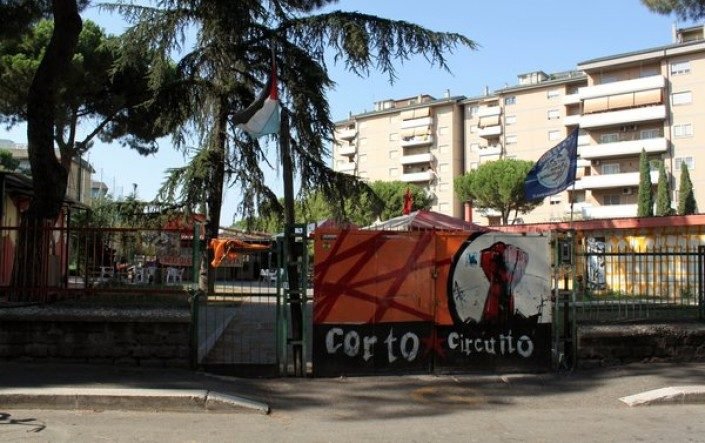
Csoa Corto Circuito is in Rome on Via Francesco Baracca, in the area that Romans keep calling Cinecittà even when the urban planning registry speaks of Lucrezia Romana, in Municipio VII. The acronym before the name should be read in full: occupied self-managed social center, that is a space born from the occupation of an unused building and run in assembly form by those who frequent it, without the separation between organizers and participants that governs a commercial venue. Anyone arriving expecting the welcome of a club with a ticket office and uniformed staff finds something different: a suburban building returned to public use, with a courtyard, a large hall and a series of rooms for activities that change over the course of the week and the year.
It is worth saying right away, because anyone reading the description of a social center often looks between the lines for a political placement. A self-managed space is a political subject as well as a cultural one, and no informational page can pretend otherwise. What follows describes what is at this address, where it is, how to get there and in what neighborhood context it sits, without endorsing or attacking positions. Anyone looking for a stance finds it directly on the center's channels, which speak for themselves and need no intermediaries. On the precise dates of its founding, on the events of the occupation and on any legal proceedings, the available public sources do not always agree with each other, and this page reports only what is stable across several sources, leaving to the social center's official bodies the task of telling its own story in detail.
Where Csoa Corto Circuito is and how to really get there
The address is Via Francesco Baracca, in the urban zone of Lucrezia Romana, a wedge between Via Tuscolana, the Grande Raccordo Anulare, Via Lucrezia Romana and Via delle Capannelle. It is not a neighborhood in the classic sense, with a square and a recognizable commercial axis, but a residential area grown in the last decades of the 20th century around Via Tuscolana, at the point where Rome gradually stops being a compact city and begins to thin out toward the countryside of the Castelli. The popular name of the area, Cinecittà, comes from the film studios that stand a little farther north along the same artery and that ended up giving their name to the surrounding neighborhoods too, including those that technically remain distinct from it.
The administrative perimeter belongs to Municipio VII, which includes, besides Lucrezia Romana, the neighborhoods of Don Bosco and Appio Claudio, parts of Tuscolano and Prenestino Labicano, and the urban zones of Capannelle, Torre Gaia and Casal Morena toward the outside. It is a large municipio, which holds together a dense urban sector near the center and a sparser, more peripheral sector beyond the ring road, and Via Francesco Baracca is in this second portion, right up against the motorway ring.
By metro
Metro line A runs along Via Tuscolana with a sequence of stations that serves the whole southeastern quadrant: after Porta Furba Quadraro and Numidio Quadrato you come to Lucio Sestio, Giulio Agricola, Subaugusta, Cinecittà and finally Anagnina, the terminus of the line. For those heading to Lucrezia Romana the most useful stops are Subaugusta and Cinecittà, from which you continue on foot or with a short bus ride to Via Francesco Baracca. The walking time depends on the exact point of the street you are heading to, but allow a good quarter of an hour from the nearest station.
Those coming back late at night have to consider the service closing times, which on weekdays end earlier than on weekends, when line A extends its service. An event that ends after midnight on a weekday can leave without the metro anyone who has not checked the last useful run in advance.
By bus
Via Tuscolana is the main axis of the surface lines that connect the quadrant to the center and the outer periphery, with runs that go up toward San Giovanni and others that continue toward Anagnina and the Castelli Romani. Some minor lines enter the interior streets of the Lucrezia Romana area and bring you closer if you arrive without a car, but they should be checked each time because the routes of peripheral lines change more often than those of the main axes.
By train
The area has no railway station of its own nearby. Anyone arriving from outside Rome by regional train should get off at Roma Termini and continue by metro, or consider the regional rail stops on the Castelli Romani line, more useful however for those coming from the southeast than for those coming from the rest of the region.
By car and scooter
The proximity to the Grande Raccordo Anulare makes this area convenient for those arriving by car from outside the city or from other parts of Rome, with the exit for Via Tuscolana a few minutes from Via Francesco Baracca. Within the area parking is generally less complicated than in the central neighborhoods, because the urban fabric is sparser and the streets wider, but on the evenings of public events the availability of free spaces on the immediately adjacent streets shrinks anyway, and it is good practice not to leave the car double-parked.
The scooter remains the fastest solution for those moving around inside the city. Those arriving by bicycle find a flat route along Via Tuscolana, less comfortable in the stretches with the highest traffic density near the metro stations.
On foot, from the neighborhood
As with any space born inside a residential fabric, an important part of Corto Circuito's public arrives on foot from Lucrezia Romana and the neighboring areas of Cinecittà Est and Osteria del Curato. For those who do not live nearby, the best way to get oriented remains walking the stretch between the metro station and Via Francesco Baracca at least once, so as to fix the landmarks of the area before going back in the evening.
Getting your bearings in the area
Anyone who does not know this part of Rome has trouble, the first time, understanding where one neighborhood ends and another begins, because the official place names and the way Romans call things almost never coincide. Lucrezia Romana, Cinecittà Est, Osteria del Curato and Quarto Miglio are distinct urban zones on the city's maps, but in spoken language they are often all gathered under the generic label of Cinecittà, with all due respect to administrative precision. The practical advice, for those using a satellite navigator or a public transport app, is to type Via Francesco Baracca directly, rather than relying on the neighborhood name, which can return misleading or overly broad results.
A useful landmark for getting your bearings, visible even from afar along Via Tuscolana, remains the Cinecittà studio complex, which marks the northern limit of this urban sector. Those arriving by car from the ring road, on the other hand, have as an immediate reference the exit dedicated to Via Tuscolana, from which in a few minutes you reach the residential fabric where Via Francesco Baracca is located.
What Csoa Corto Circuito really is: a self-managed space, not a venue
The most common confusion concerns the organizational nature of the place. An occupied self-managed social center has no artistic direction, no owner and no fixed opening hours like a venue with a public entertainment license. Decisions are made in assembly, participation is open to those who frequent the space regularly, and the distinction between organizers and participants remains deliberately blurred: whoever sets up the bar one evening may handle the programming the next and tidy up the hall the following morning.
The model of occupied and self-managed social centers was born in Italy starting in the mid-1970s and spread through the big cities between the end of that decade and the 1980s, with a second wave of occupations in the 1990s that also reached the more peripheral neighborhoods of the capital, including the quadrant running from Cinecittà toward the ring road. It is in this broader historical context that Corto Circuito should be placed, as one of the spaces that in Rome's southeastern periphery carried the experience of self-management out of the central neighborhoods where the phenomenon had been born.
The available public sources do not allow us to fix with certainty an exact date of occupation of the building on Via Francesco Baracca, nor to reconstruct in detail any administrative or legal events tied to the building: anyone looking for this level of precision finds the most up-to-date information directly on the social center's channels, which are also the right source for knowing whether at a given moment the space is carrying on continuous activity or not.
On the economic side, the trait shared by practically all spaces of this kind is the rejection of ordinary commercial logic: there is no price list comparable to that of a licensed venue, and any fees requested to take part in an initiative or to support the space usually take the form of a voluntary contribution or a membership card, meant more to cover the actual running costs than to generate a profit. On this point too, as with hours and calendar, the right source remains the center's direct channel, because the figures given elsewhere, including those circulating in forums or in social groups dedicated to Roman nightlife, tend to age quickly and not to reflect the real situation at the moment you read.
The neighborhood around Via Francesco Baracca: Cinecittà, Lucrezia Romana and Municipio VII
The name Cinecittà, by which most Romans refer to the whole area, comes from the film studios built in the 1930s along Via Tuscolana, a little north of the area discussed here. From that production hub, which has run through the whole history of postwar Italian cinema, the name by extension came to be used for the entire zone that develops around the metro station of the same name, including the residential neighborhoods that rose later toward the ring road.
Lucrezia Romana, strictly speaking, is the urban zone that develops between Via Tuscolana, the Grande Raccordo Anulare, Via Lucrezia Romana and Via delle Capannelle: an area grown mostly in the second half of the 20th century, with a fabric of residential building and neighborhood services that has consolidated in recent decades, thanks also to the archaeological finds that led to the opening of a small antiquarium dedicated to the prehistoric remains that emerged from digs in the area. The territory borders Osteria del Curato to the north, the Gregna zone to the east, Quarto Miglio to the southwest and Appio Claudio to the west, a mosaic of peripheral urban zones that share the same fate: born far from the center, often served late by public transport and known more by those who live there than by those who visit Rome as tourists.
A short distance away, to the west, is the Quadraro neighborhood, one of the historic cores densest in popular identity in the whole southeastern sector of the city. It is here that on April 17, 1944 one of the harshest episodes of the German occupation of Rome took place: the roundup that went down in history under the code name of the operation, with more than 900 men deported to Germany, of whom only half came back. On April 17, 2004 the Quadraro received the gold medal for civil merit for that event, and every year the anniversary brings public memorial events to the neighborhood. The Quadraro is not the same zone as Lucrezia Romana, but the history of the social centers of this whole urban sector is the history of a territory that has always cultivated a strong popular identity, and that in the memory of 1944 finds one of its most shared reference points.
The territory of Municipio VII also preserves important earlier archaeological traces, starting from the fact that the ancient Roman aqueducts crossed precisely this quadrant to carry water toward the city: the Claudian Aqueduct and the Felice Aqueduct run a short distance away, defining the large park that bears their name and that remains one of the most recognizable landscapes of Rome's southeastern periphery.
Another archaeological reference relevant to understanding the territory is the Villa of the Seven Bassi, a residential complex of the Roman era whose remains extend in the easternmost part of the urban zone, between Lucrezia Romana and Osteria del Curato. The site, the subject over the years of study campaigns and of an enhancement project as an archaeological park, shows how much this sector of the Roman periphery, today perceived as purely residential and without history, actually holds a leading ancient stratification, simply less talked about than the big sites of the center.
The Grande Raccordo Anulare itself, which marks the western boundary of Lucrezia Romana, is an infrastructure that changed the shape of the city starting in the 1950s, when it was designed and partly built as a ring connecting the consular roads. Its route ended up becoming, over time, a kind of symbolic boundary between the Rome built in the first half of the 20th century and the one that grew in the following decades toward the outside, and it is exactly in this second band, right by the ring road, that the neighborhood where Corto Circuito stands is located.
A curiosity about Csoa Corto Circuito
The name chosen for a self-managed space almost always says something about how those who occupied it understood its function, and Corto Circuito is no exception: the technical image of the sudden interruption of an intended path points to the idea of a space that interrupts the normal use of an abandoned building to return it to a collective use different from the one originally imagined. It is a type of lexical choice recurring among Roman social centers, which often prefer evocative or ironic names to geographic or celebratory ones, thus standing out also in the way they present themselves before they are even visited.
Another curiosity concerns the geographic location: Corto Circuito is in one of the few stretches of the Roman periphery where a social center arises right up against the Grande Raccordo Anulare, and not inside a dense urban fabric as happens for most analogous spaces in the city, historically concentrated in neighborhoods such as San Lorenzo, the Pigneto, the Quadraro or the Garbatella. This position, more like an urban margin than a neighborhood center, also partly shapes the kind of public that reaches the space: fewer casual passersby, more regulars who come on purpose, often by car or scooter.
What goes on inside: activities, help desks and neighborhood initiatives
The typical repertoire of activities of an occupied self-managed social center in the periphery includes, following a model recurring across the city, live concerts of different genres, popular sport initiatives open to those who do not go to commercial gyms, orientation and assistance desks for the residents of the neighborhood, after-school activities for the youngest and moments of socializing tied to the calendar of the year, from community dinners to neighborhood parties. This is the operating scheme shared by the analogous spaces of the city's southeastern quadrant, from Spartaco in the Quadraro to La Strada in the Garbatella, and in which Corto Circuito fits too.
To know in detail the actual calendar of current activities, with up-to-date hours and ways to take part, the right source remains the social center's direct channels: as with most Roman self-managed spaces, the program changes over the course of the week and the year, with periods of more intense activity and periods of slowdown, and no external informational page can replace a direct check before organizing a visit.
One element shared by almost all the popular sport spaces born inside Roman social centers is the choice of disciplines less tied to the commercial gym market: weightlifting, martial arts, bodyweight training, in some cases team sports played at an amateur level. The stated aim of this kind of initiative, common to the whole network of Roman self-managed spaces, is to offer access to sport free of the cost of commercial memberships, in particular for those in the neighborhood who otherwise could not afford it. The popular after-school programs, where present, also follow the same logic: a free or nearly free service, run by volunteers, aimed at kids of the neighborhood who have no access to private school support.
Something nobody tells you about Csoa Corto Circuito
What is rarely told to those who come from outside is that a space like this, born on the margins of the consolidated city, does not work as a point of passage but as a point of destination. In this part of Rome there is no casual strolling that leads you to discover a venue while walking: whoever arrives at Corto Circuito does so because they decided to come, often after hearing of a specific initiative through word of mouth or the center's social channels. This means that the public you find on site is almost always an informed public, with a higher level of participation than at an ordinary venue, but it also means that whoever turns up by chance, knowing nothing about the evening's program, risks finding closed doors or an activity reserved for a specific group.
Another little-told aspect concerns the relationship between the space and the neighborhood around it. Lucrezia Romana is not a neighborhood with a visible and recognizable identity like the Quadraro or the Garbatella: it is a more recent residential fabric, less talked about by the city press, less present in the imagination of those who do not live there. For this reason a social center operating in this area has a different function from the analogous spaces born in the historic neighborhoods: here self-management arrives in a context where opportunities for autonomous socializing, not organized by the market or by institutions, are rarer, and the added value for those who live there is, if possible, even greater.
A third little-told element concerns the intrinsic fragility of any space born from an occupation. Unlike a venue with a regular lease, an occupied space lives inside a legal condition that can change over time, one way or the other, depending on the fortunes of the building it stands on and on the relationships the center manages to build with the owner or with the institutions. This does not mean that a space born from occupation is less solid than a regular venue: many of the longest-lived Roman social centers count decades of continuous activity precisely in a condition of occupation. It does mean, however, that those who frequent these spaces, in particular those who come from outside and have no established relationship with the scene, would do well never to take for granted the continuity over time of an experience of this kind, and to always check, before setting out, that the activity is actually taking place.
The advice I give you for visiting Csoa Corto Circuito
The most useful advice is never to show up without first checking the social center's official channels in the days immediately before the visit. Unlike a venue with fixed hours published online, a self-managed space communicates its program through its own direct channels, and information gathered from third-party sources or past experiences can turn out to be outdated even after only a few weeks.
It is also worth arriving with a bigger time margin than you would give a commercial venue. Since it is a peripheral space, served less frequently by public transport than the center, a delay caused by a missed bus or a missed connection weighs more than in other parts of the city. Allowing a few extra minutes, especially for those coming from far parts of the city or from outside Rome, avoids the most common mishap for those moving around this quadrant.
The second piece of advice concerns how to get there. Given the position right by the Grande Raccordo Anulare, in an area less served by public transport than the more central neighborhoods, it is worth organizing the return in advance, especially if the evening includes an event that ends after the metro closes. Moving as a group or arranging a shared ride remains the simplest solution for those who do not want to rely only on night public transport.
The third piece of advice, valid for any occupied self-managed social center, concerns the attitude to keep: you enter as you would enter a neighborhood club you do not know, asking when needed, without photographing people without permission and without expecting the kind of service you would find in a commercial venue.
The model of occupied self-managed social centers in Rome
Rome hosts, for more than 40 years, one of the densest fabrics in Italy of spaces born from the occupation of unused public or private buildings and turned into self-managed social centers. The phenomenon runs across several generations and several areas of the city, from central neighborhoods like San Lorenzo and the Pigneto to working-class neighborhoods like the Garbatella and the Quadraro, out to the farthest peripheries, where spaces like Corto Circuito have brought the same organizational model into more recent and less structured urban contexts.
Each space has its own specific history, its own calendar of activities and its own degree of roots in the territory where it stands, but all share some basic elements: the assembly as decision-making body, the absence of a formal hierarchy between organizers and participants, the choice to offer spaces and activities at popular prices or free, and a social function that goes beyond entertainment, often including assistance desks, popular sport activities and initiatives for those in the neighborhood who find no similar point of reference elsewhere.
At the national level, the Roman model of occupied and self-managed social centers is part of a broader phenomenon that has run through almost all the big Italian cities since the 1970s: Milan with the Leoncavallo, Turin with Askatasuna, Naples with Officina 99, Bologna with experiences like the Livello 57, to cite only some of the best-known names outside city limits. Rome, by size and number of inhabitants, is the city that over the decades has developed the densest network of spaces of this type, distributed unevenly across the territory: more concentrated in the historic neighborhoods near the center, sparser but still present in the farthest peripheries, where the need for spaces of autonomous socializing is often even more marked than in the central neighborhoods, precisely because of the smaller supply of low-cost cultural and sports alternatives.
The relationship between social center and neighborhood
One of the hardest aspects to communicate to those who look at these spaces from outside concerns the kind of bond that builds up, over the years, between a social center and the neighborhood that hosts it. It is not an automatic or obvious bond: it requires time, continuity and an ability to respond to real needs of the territory, which range from youth socializing to assistance for those in economic difficulty, down to the simple availability of a covered, free space in which to organize a collective activity. In the more central neighborhoods, where the cultural and social offering is wide anyway, the social center stands alongside other organizations. In the more peripheral neighborhoods, such as those that develop around Via Tuscolana toward the ring road, the function of social outpost that a self-managed space can serve tends instead to be more central, simply because the alternatives are fewer.
This does not mean that the relationship is always simple or free of tension. The history of Roman social centers also tells of phases of conflict with local institutions, moments of negotiation for the regularization of occupied buildings and, in some cases, stories of eviction followed by new occupations elsewhere. These are dynamics that concern the whole network of the city's self-managed spaces, with different outcomes from case to case, and that, to be told accurately for a single address, require direct and verifiable sources, not generic reconstructions.
Another well-known fact, yet rarely cited
A fact well known to those who frequent the Roman self-managed scene, but rarely cited in tourist descriptions of the city, is that the network of occupied social centers has for decades been one of the main circuits of independent live music in the capital, able to host emerging local bands together with established names of the punk, hardcore, reggae and electronic scenes, with a program that often anticipates musical trends that arrive later in commercial venues. This circuit almost never appears in conventional tourist guides, which tend to concentrate on the big theaters and the official concert halls, and yet it remains one of the distinctive features of the city's cultural life for those who live it from the inside.
A second fact, less known to those who do not live in this part of the city, is that the quadrant between Cinecittà, Lucrezia Romana and the Quadraro holds together two very different layers of memory: the ancient one of the Roman aqueducts, which here crossed the countryside to carry water to the consolidated city, and the 20th-century one of the Resistance and of the popular occupations of the postwar period. The two layers are rarely told together, but whoever travels through this part of Rome meets both within a few kilometers.
The right photo to take at Csoa Corto Circuito
The photo that best tells a space like this is not the one of the sign, which is often reduced to a mural lettering or a banner, but the one of the courtyard or the hall during an initiative in progress, with the light of summer evenings filtering through the trees or through the makeshift structures set up for the occasion. It is in that moment, more than in any architectural shot, that you see the difference between a space designed to be photographed and a space designed to be lived in.
Those who instead want a photo that tells the urban context can step back a few meters and shoot the low, regular skyline of the residential buildings surrounding Via Francesco Baracca, with the traffic of the Grande Raccordo Anulare in the background: it is the most honest image of what it means to live, and to organize self-management, in a Roman periphery of the last decades of the 20th century, far from the postcards of the historic center but no less a part of the city.
Some important events that happened here in history
The term should be understood in a broad sense, because the specific history of the occupied space on Via Francesco Baracca is part of a longer territorial story, which is worth distinguishing on several chronological levels.
The ancient level
The area crossed by Via Tuscolana and lying between Cinecittà and the ring road is part of the great system of the Roman aqueducts, which ran here to carry water from the springs of the Alban Hills toward the city. The Claudian Aqueduct and the Felice Aqueduct still cross the landscape a little west of this area today, defining the profile of the Parco degli Acquedotti, one of the most photographed and most recognizable landscapes in the whole Roman periphery. The territory closest to Lucrezia Romana has also yielded, in recent years, traces of prehistoric habitation, documented by the finds kept in the small local antiquarium opened in the second decade of the 2000s.
The 20th-century level
The second level concerns the transformation of the quadrant over the course of the 20th century, with the construction of the Cinecittà studios in the 1930s and the later growth of the residential neighborhoods that took their name from it. On April 17, 1944, in the nearby Quadraro, the roundup took place that led to the deportation to Germany of hundreds of men, an episode that deeply marks the collective memory of this whole sector of the city and that is still remembered every year with public events. In the postwar period the building growth extends progressively toward the ring road, shaping the more recent neighborhoods such as Lucrezia Romana, built largely in the second half of the century to answer the housing demand of a rapidly expanding city.
The recent level
The third level is the closest in time, and it is the one in which the birth of Corto Circuito as an occupied and self-managed space fits. The available public sources do not allow us to fix with certainty the exact date of occupation of the building, but they place the experience within the season of spread of Roman social centers toward the farthest peripheries of the city, a phenomenon that consolidates starting in the 1990s and continues, with ups and downs, in the following decades. In this same period the cultural transformation of the nearby Quadraro also intensifies, which has become one of the Roman hubs of mural painting and of initiatives tied to the memory of 1944, a process that has brought public and media attention to the whole southeastern quadrant of the city, including the Cinecittà and Lucrezia Romana area.
In the same span of time, Cinecittà proper, that is the film studios a short distance from here, goes through a phase of deep transformation: from the role of great factory of postwar Italian cinema, when dozens of productions were shot in the studios at the same time and the area hosted a supporting economy of extras, costume designers, technicians and craftsmen of every kind, it moves progressively to a more diversified model, which includes international productions, television series and a museum route open to visitors. This transformation has also changed over the years the kind of population that lives in the neighboring districts, with a gradual generational turnover that has involved families of film-industry workers together with new residents attracted by prices more accessible than in the central neighborhoods.
On the infrastructure side, the construction of the southern stretch of the Grande Raccordo Anulare and the later extension of metro line A to Anagnina, the terminus opened in the 1980s, permanently changed the accessibility of this sector of the city, making it for the first time well connected to the center while remaining physically on the margins of the consolidated urban area. It is in this context of a recently formed neighborhood, well connected but lacking a recognizable historic center, that a space like Corto Circuito has found its specific function.
Who has passed through Csoa Corto Circuito
It must be said clearly that a self-managed space does not keep a public, verifiable archive of its own program as a theater with a ticket office would, and that the reconstructions circulating online are often incomplete or imprecise. Listing names of artists or guests without a direct source that links them with certainty to this address would mean building an invented list, which does not help the reader. What can be said with reasonable certainty concerns the categories of people that a space of this type passes through over time, and it is more useful information than a list of names.
The musicians
The audience at concerts in a peripheral social center is made up in large part of local bands, groups born in the rehearsal rooms of Rome's southeast, projects that find here one of the few chances to play live in front of a real audience before facing bigger stages. On this base, when the calendar allows, bands from farther afield are grafted, consistent with the genres the circuit of Roman social centers has always hosted: punk, hardcore, reggae, independent rap, electronic.
The athletes
The popular sport initiatives, when present in a space of this type, bring a different public from that of the concerts: people looking for an alternative to commercial gyms, often at more accessible prices, and who frequent the space with a weekly continuity different from that of those who come only for an occasional event. This component, typical of many Roman social centers, helps make the space a daily point of reference more than a place of sporadic events.
The neighborhood groups and associations
The numerically largest category, and the least visible from outside, is that of neighborhood collectives, volunteer groups and associations that use the space to meet, organize initiatives and run assistance desks for the residents of the area. It is this component that, in every lasting social center, determines the character of the space more than any single event.
The residents
The last category is the simplest to describe and the most decisive for the survival of the space: the residents of Lucrezia Romana and the neighboring areas who, over the years, have taken turns in frequenting and, in part, running the center. As with every long-lived self-managed space, continuity depends on this generational turnover: when it stops, the space risks closing.
When to go to Csoa Corto Circuito and when to let it go
The calendar of an occupied self-managed social center does not follow that of a commercial venue. The most active seasons generally remain autumn and spring, periods when continuous activities resume after the summer break and the events calendar fills up again. The Roman summer, with the heat and the emptying of the city, often reduces activity to a minimum, particularly in the central weeks of August.
It is worth going when you already have precise information on a scheduled initiative, checked on the center's official channels in the days immediately before. It is worth letting it go, instead, for those looking for a venue with a predictable formula, table service and a neutral atmosphere: in the city there are hundreds of alternatives better suited to that kind of evening. Anyone passing through Rome for a few days who wants to see the maximum number of things in a short time would do better to spend those hours elsewhere, because this address requires a conscious choice and gives something back only to those who arrive knowing why they are going.
What is around Csoa Corto Circuito
The quadrant between Cinecittà, Lucrezia Romana and the Quadraro offers, within a radius of a few kilometers, a concentration of places that the average visitor to Rome rarely considers.
A short distance away
Going up Via Tuscolana toward the center you reach the Cinecittà Studios, the factory of Italian cinema that since the 1930s has kept producing films and television series and that today also offers a museum route open to the public. Continuing west you reach the Aqueducts Park, one of the most recognizable landscapes of the whole Roman periphery, with the arches of the Claudian Aqueduct and the Felice Aqueduct crossing a large open meadow. Those looking for a more intimate green space, closer to the Appio Claudio quadrant, will find Parco Appio.
The other self-managed spaces of the quadrant
Rome's southeastern sector hosts other occupied self-managed social centers that share with Corto Circuito the same organizational model, though with different histories and locations: CSOA Spartaco in the Quadraro, active since 1999, and Csoa La Strada in the Garbatella, born in 1994. Comparing the three experiences helps you understand how much the way the same model of self-management adapts to the urban context in which it is born varies from neighborhood to neighborhood.
Sport and leisure
Those moving around this quadrant with an interest in neighborhood sport will find points of reference such as the Appio Claudio Tennis Club and organizations tied to popular basketball like Cinecittà Basketball Polaris, examples of how local sport practice, not necessarily tied to the big city facilities, is an integral part of life in these peripheral neighborhoods as much as the social centers are.
Scattered archaeology
Those with a specific interest in archaeology will find, in this same quadrant, the remains of the Villa of the Seven Bassi, a residential complex of the Roman era that extends between Lucrezia Romana and Osteria del Curato, the subject of an enhancement project as a future archaeological park. The site, less known than the big archaeological areas of the historic center, still offers an important testimony of the Roman countryside that surrounded the city in the imperial age, before the arteries of the 20th century and the urban expansion that followed radically changed its landscape.
For a longer day
Those with time can build an itinerary that goes from the Cinecittà quadrant down toward the Quadraro, with its murals and the memory of the 1944 roundup, and continues to the Parco degli Acquedotti, crossing in a few hours a piece of the city that holds together the industrial periphery of cinema, the popular history of the 20th century and one of the most evocative archaeological landscapes in Rome. Those who prefer to stay closer can limit themselves to a loop between Lucrezia Romana and Appio Claudio, discovering a sector of the city that rarely appears in tourist guides but that tells, perhaps better than others, how the Rome of the last 50 years was formed.
Quick questions about Csoa Corto Circuito
Where exactly is it?
On Via Francesco Baracca, in Rome, in the Lucrezia Romana area, popularly called Cinecittà, in Municipio VII.
Since when has it existed?
The available public sources do not allow us to establish with certainty an exact date of occupation of the building. The experience belongs to the season of spread of Roman social centers toward the farthest peripheries of the city.
How do you get there?
The nearest line A stations are Subaugusta and Cinecittà, both on Via Tuscolana, from which you continue on foot or with a short bus ride. For those arriving by car, Via Tuscolana exit on the Grande Raccordo Anulare is a few minutes from the space.
Do you pay to get in?
The terms of access to self-managed spaces vary from one initiative to another and can change over time. Any cards, contributions or membership fees should be asked about directly on the center's official channels before showing up, because any information gathered elsewhere risks being outdated.
What are the hours?
A self-managed space does not have continuous opening hours like a commercial venue. Opening depends on the scheduled activities, which change over the course of the week and the year, and checking on the official channels remains essential before organizing a visit.
What music do you hear?
The range of genres hosted in Roman social centers typically includes punk, hardcore, reggae and dub, independent rap, ska and electronic. The specific calendar is built from time to time and is consulted on the space's official channels.
Are there activities other than concerts?
Yes. The typical model of peripheral occupied self-managed social centers includes popular sport, orientation desks for neighborhood residents, after-school activities and socializing initiatives tied to the calendar of the year. The exact makeup of the program should be checked on the center's direct channels.
Is it suitable for someone who has never set foot in a social center?
Yes, provided you choose a large public initiative for the first contact and behave as you would entering a neighborhood club you do not know: you observe, you ask when needed, you do not photograph people without permission.
Can you eat there?
On the evenings of initiatives, self-managed spaces normally set up a counter with food and drinks run by volunteers, at popular prices. Its presence and format vary, however, from evening to evening and do not amount to a food service with fixed hours.
Is it accessible to people with mobility difficulties?
Buildings recovered through self-management have very variable access solutions, because they come from buildings not designed for that specific use. It is worth contacting the center in advance and asking explicitly about steps, the width of entrances and the services available.
Is the space still active?
Roman occupied spaces have stories that can change over time for different reasons, and checking on the official channels before setting out remains the most sensible precaution, especially for those coming from outside the neighborhood or from outside the city. A check of a few minutes avoids a wasted trip.
What can you see in the surroundings?
In order: the Cinecittà Studios along Via Tuscolana, the Parco degli Acquedotti with the arches of the Claudian Aqueduct and the Felice Aqueduct, the Quadraro with its murals and the memory of the 1944 roundup, and Parco Appio toward the Appio Claudio quadrant.
Do you need to know someone to get in?
No. Public initiatives are open and those who arrive alone meet no particular obstacles. The perceived threshold is more a matter of unfamiliar codes than of real access: a space built on word of mouth looks more closed than it is in practice.
What is the difference from a municipal cultural center?
The main difference is organizational and legal. A municipal cultural center comes from public management or from a regular assignment to an association, with a traceable budget and published opening hours. An occupied self-managed social center comes instead from the occupation of a building and governs itself through the assembly, without management formalized in the same way. The two formulas can coexist in the same neighborhood and can also, in some cases, meet in regularization paths, but they remain distinct models even when the cultural offering they propose is similar.
Is there parking nearby?
The Lucrezia Romana area, being a relatively recent residential fabric, has wider streets than the historic neighborhoods of the center and in general better parking availability. On the evenings of public initiatives, however, local demand for parking spaces rises, and it is worth allowing a few minutes of walking from the parked car to the entrance.
Can you bring a school group or an association to visit?
Guided visits or presentations for organized groups, when offered, follow procedures that must be agreed directly with the center, which decides case by case based on the type of request and the calendar of current activities. There is no standardized booking service comparable to that of a museum or a cultural center with regular opening.
Frequently asked questions about Csoa Corto Circuito
Where is the Csoa Corto Circuito?
The Csoa Corto Circuito is on Via Francesco Baracca, in the Lucrezia Romana area, an area lying between Via Tuscolana, the Grande Raccordo Anulare, Via Lucrezia Romana and Via delle Capannelle, in Municipio VII of Rome, in the zone popularly called Cinecittà.
What is the Csoa Corto Circuito?
The Csoa Corto Circuito is a self-managed space, not a venue with an artistic direction or an owner: decisions are made in assembly and participation is open to those who frequent the space regularly, following the model of occupied self-managed social centers that has been widespread in Rome for more than 40 years.
Since when has the Csoa Corto Circuito existed?
The available public sources do not allow us to establish with certainty an exact date of occupation of the building. The experience belongs to the season of spread of Roman social centers toward the farthest peripheries of the city.
What activities take place at the Csoa Corto Circuito?
The typical repertoire of a self-managed space like this includes live concerts of different genres, popular sport initiatives open to those who do not go to commercial gyms, orientation and assistance desks for neighborhood residents and after-school activities for the youngest.
Why is the space called Corto Circuito?
The name evokes the technical image of the sudden interruption of an intended path, an idea that points to a space that interrupts the normal use of an abandoned building to return it to a different collective use.
How do you find out about events at the Csoa Corto Circuito?
Unlike a venue with fixed hours published online, a self-managed space like the Csoa Corto Circuito communicates its program through its own direct channels: it is worth checking them in the days immediately before the visit, because information gathered from third-party sources can turn out to be outdated.
When are you most likely to find events at the Csoa Corto Circuito?
The most active seasons for an occupied self-managed social center like this generally remain autumn and spring, periods when continuous activities resume after the summer break. The Roman summer, with the heat and the emptying of the city, often reduces activity to a minimum.
What is near the Csoa Corto Circuito?
Going up Via Tuscolana toward the center you reach the Cinecittà Studios, the factory of Italian cinema that since the 1930s has kept producing films and television series. The quadrant between Cinecittà, Lucrezia Romana and the Quadraro also offers other points of interest tied to the popular history of the area.
Those who organize itineraries in Rome for groups, school classes or foreign clients interested in a story of the city that goes beyond the historic center, with stops among 20th-century memory, popular self-management and scattered archaeology, will find the professional tools on TourLeaderPro: the quote request and direct contacts are on the TourLeaderPro contact page, while tour operators working on themed packages tied to contemporary Rome will find the section dedicated to tour operators.
Those planning a trip to Rome and looking for English-language guides will find them on ItalyPlanner.com. To understand how to get around by metro, bus and regional trains, including in the evening hours, the guide to public transport in Rome is useful. Those building their stay around neighborhoods outside the historic center will find a broader overview on what to do in Rome.
Contact Information
Via Filippo Serafini, 57
Roma Roma Città, Roma Città