CSOA Spartaco
In short. CSOA Spartaco is in Rome at Via Selinunte 57, in the Quadraro neighborhood, and has been active since 1999.
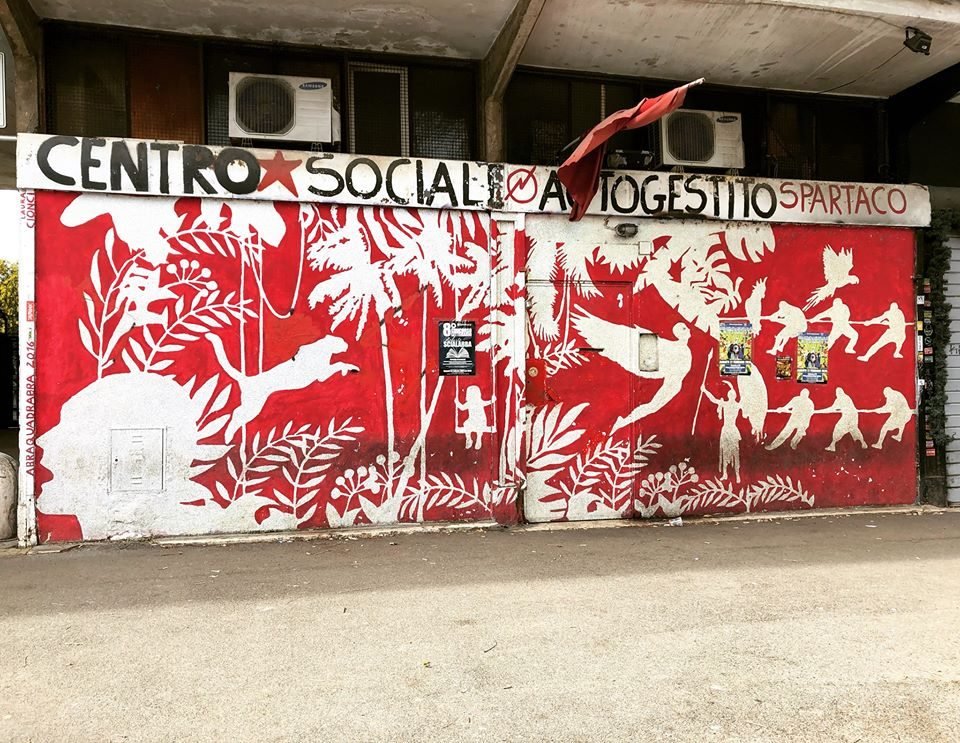
CSOA Spartaco is in Rome at Via Selinunte 57, in the Quadraro neighborhood, and has been active since 1999. The acronym before the name counts as much as the name itself: occupied self-managed social center, that is, a space born from the occupation of an unused building and run in an assembly format by the people who use it, without the separation between organizers and participants that governs a commercial venue. Anyone arriving here expecting the welcome of a club with a ticket office, uniformed staff and table service finds something different: a neighborhood warehouse with a stage, a bar counter, a courtyard and a series of rooms used for activities that change over the course of the week and over the course of the year. In the story the space tells about itself, three formulas recur, common good, critical consumption and active solidarity, and so do the names of some initiatives that over the years split off from the center and took on a life of their own in the neighborhood: the Palestra Popolare Quadraro, Spartacorugby, the self-restoration project of the ruin on Via Sagunto, the contemporary art gallery Garagezero. On the public events side, the two titles that come back most consistently are Quadraro in Jazz and the Festival della Memoria e della Resistenza.
It's worth saying one thing right away, because people reading a description of a social center often look between the lines for a political position. A self-managed space is a political actor as well as a cultural one, and no informational page can pretend otherwise. What follows, however, describes what you do inside, where it is, how to get there and what neighborhood context it sits in, without endorsing or attacking positions. Anyone looking for a stance will find it directly on the center's channels, which speak for themselves and need no intermediaries.
Where CSOA Spartaco is and how to really get there
The address is Via Selinunte 57. The street belongs to the Quadraro grid and is part of that group of streets named after cities of ancient Sicily and Magna Graecia that mark the sector between Via Tuscolana and Via Casilina: Selinunte, Sagunto, Cartagine and their neighbors form a regular mesh of low blocks, built largely between the 1920s and the 1950s, with small apartment buildings of three or four floors, inner courtyards, ground-floor shops and a quantity of garages and storerooms carved out under the houses. The center occupies one of these volumes, not a monumental building: first-time visitors risk walking right past it without noticing, because from the outside the facade has nothing of a shopfront.
The Quadraro is classified as urban zone 6C and belongs to Municipio V of Roma Capitale, while being part, in the historical division of neighborhoods, of Q. VIII Tuscolano. Its perimeter extends in a wedge between Via Casilina to the north and Via del Mandrione to the southwest, as far as Porta Furba. It borders Torpignattara and Casilino on the north side, the Centro Direzionale Centocelle and Don Bosco to the east, Appio Claudio to the south, Tuscolano Sud to the west. These boundaries matter, because the Quadraro is not a through neighborhood: people who don't live there and have no reason to go there tend never to cross it, and this explains why a space that everyone in the neighborhood knows remains almost invisible to people living on the other side of the city.
By metro
Metro line A serves the Quadraro with two stations, Porta Furba Quadraro and Numidio Quadrato, both along Via Tuscolana. They are the two natural gateways for those coming from the center. From Porta Furba Quadraro you enter the neighborhood heading up toward the northeast. From Numidio Quadrato you enter from the opposite side, the one closest to Parco degli Acquedotti. The walk from either stop to Via Selinunte ranges, depending on the route and the crossings, between 10 and 20 minutes: the Quadraro is a sprawling neighborhood and the two stations serve its ends, not its center.
Anyone counting on the metro to get home after an evening has to do a preliminary check that seems trivial and isn't. Line A has operating hours that can vary on weekends and that over the years have been changed several times, also because of construction sites and station modernization works. A night of live music at a social center rarely ends before midnight and often ends much later: anyone who arrives by metro and doesn't check the last useful run on the transport company's channels risks facing a closed station with the prospect of a taxi or a long walk. It's not a minor detail, because the Quadraro is not on the route of taxis circulating late at night and the immediate availability of a car is not guaranteed.
By bus
Surface lines cover the neighborhood along three axes. Via Tuscolana collects the connections that go up toward San Giovanni and down toward Cinecittà and Anagnina. Via Casilina, on the opposite side, carries the lines that connect Porta Maggiore to the eastern outskirts. Inside the neighborhood, a few local lines then enter the inner streets and serve residents. The stops along Via Tuscolana leave you a walk of 10 or 12 minutes from Via Selinunte. Those along Via Casilina are a bit more, because the inner stretch to cover is longer.
The Roman night network exists and partly covers this area, but with long intervals and with routes that don't coincide with the daytime ones. Anyone who decides to rely on a night bus does well to check the exact route before going out, because the stop that's useful for the return may be on a different street from the one for the outbound trip.
By train
On the Mandrione side, the neighborhood is skirted by the bundle of tracks that enter Rome from the southeast. The regional railway that runs in that direction has urban stops nearby, useful above all to those arriving from the Castelli Romani or from the Ciampino line without wanting to go through Termini. Here too, evening frequencies thin out a great deal compared to rush hour, and it's best to check the schedules the same day on the railway operator's channels. For those arriving from outside Rome, switching to the metro at Termini or San Giovanni is still simpler.
By car and scooter
Arriving by car is possible and the neighborhood is not in limited traffic zones of the kind found in the historic center, but parking remains the problem. The Quadraro was built when the automobile was not yet a mass item: the streets are narrow, curbside parking is almost always full, and on evenings when the center hosts a concert the load adds to that of the residents. Drivers do well to allow for a walk of a few blocks and to avoid double parking, which creates real problems here because the roadways don't allow public transportation and emergency vehicles to pass when the usable width narrows.
The scooter remains the most efficient solution, as almost everywhere in Rome. Those who arrive by bicycle find a neighborhood that is flat in the inner part and uphill toward the Mandrione side, with moderate traffic on the residential streets and heavier traffic along the two main arteries.
On foot, from the neighborhood
The difference between arriving from outside and arriving from the neighborhood is the difference that explains this space. For a substantial part of the audience, Spartaco is the place five minutes from home, the one you drop into without planning the evening, and this is a characteristic that Roman social centers born inside a residential fabric share and that downtown venues don't have. Anyone visiting the Quadraro for the first time and wanting to understand how this geography works can walk the stretch between the Porta Furba Quadraro station and Via Selinunte: it's 20 minutes that cross the neighborhood lengthwise and tell you much more than any description.
What CSOA Spartaco really is: a self-managed space, not a venue
The most common confusion concerns the legal and organizational nature of the place. An occupied self-managed social center is not a venue with a public entertainment license, an owner and fixed opening hours. It is a space that comes from the occupation of an unused building and is run by a collective: decisions are made in assembly, participation is open to those who attend, and the distinction between audience and organizers is deliberately blurred. Whoever serves at the bar one evening can play the next one and clean the hall the following morning. This is the general rule of the model, born in Italy starting in the mid-1970s and spread in the big cities between the end of that decade and the 1980s, and it is the model Spartaco belongs to.
The practical consequences are many and it's best to know them before showing up. The first concerns programming: a social center doesn't publish a seasonal schedule months in advance like a theater. Initiatives are decided on short notice, announced on the space's channels and can change. The second concerns access: the forms of entry vary from evening to evening and depend on the type of initiative. The third concerns the structure: the building is what it is, recovered with volunteer work, and doesn't offer the comfort standards of a concert hall. The fourth concerns the rhythm: many activities are weekly and ongoing, others are occasional, and the daily life of the space doesn't coincide with that of the big public events.
For a useful comparison, think of a neighborhood casa del popolo reinterpreted by people three generations younger: the gym, the after-school program, the meeting room, the neighborhood party and the concert coexist at the same address. The difference from the casa del popolo of the past is that here there is no political structure that funds and directs: funding comes from the activities themselves and from the work of those who carry them forward, and the direction is decided by the assembly.
Self-management and volunteer work
The word self-management has a very concrete operational meaning. It means that the sound system is set up by the people who attend, that the bar is run by a rotating shift of people, that the ordinary maintenance of the building is the collective's responsibility and that whoever brings an idea also takes on carrying it out. In a space of this kind the distance between proposing an activity and getting it started is much shorter than in any institutionally affiliated facility, and it is one of the reasons why Roman social centers have hosted, over the years, experiences that elsewhere would not have found a home: theater workshops, Italian schools for foreigners, advice desks, producers' markets, language courses, after-school programs, buying groups.
The flip side is fragility. A space that lives on volunteer work depends on people's availability, and people change. Activities start and stop, schedules shift, some initiatives last 20 years and others a season. Anyone who comes from outside and finds a hall closed at a time when they expected it open has not run into poor service: they have run into the way a place without salaried staff works.
Critical consumption and the common good
The two formulas that recur in the presentation of the space also have an operational meaning. Critical consumption refers to the choice of products sold at the bar and in the markets: short supply chains, local producers, social economy organizations, products from confiscated lands. Common good refers instead to the conception of the building and the neighborhood: the idea that an abandoned space recovered by a group of people produces a value that belongs to those who use it and not to those who own it. These are formulas that anyone familiar with the Roman associations world recognizes immediately and that outsiders may find opaque: the simplest way to understand them is to look at what happens inside, not to read the definition.
The Quadraro around Via Selinunte: the neighborhood as context
To understand Spartaco you have to understand the Quadraro, because the two explain each other. The place name comes from Latin and refers to an old estate owned by the monks of the abbey of Sant'Alessio on the Aventine, granted in emphyteusis to a certain Guatralis, the name from which the current one descended by corruption. The residential core you see today, however, is much more recent and was born between the two world wars, partly as unauthorized or semi-unauthorized building that arose outside the master plan, partly as organized public housing. It's a genealogy the neighborhood still wears in the shape of its streets and the size of its blocks.
The reputation of the Quadraro, however, comes from a specific episode of the Second World War, and it's a reputation the neighborhood has never stopped claiming. During the German occupation of Rome the area hosted draft evaders, deserters, partisans and wanted people, to the point that the German commands called it a wasps' nest. A saying circulated in the city that summed up the situation: to escape the Germans you went to the Vatican or to the Quadraro. On April 17, 1944 the German army responded with a large-scale roundup, an operation code-named Unternehmen Walfisch, that is, Operation Whale. In the course of the morning about 2000 people were detained. The number of men actually deported to Germany varies by source between 600 and 900, with estimates that historians place depending on the registers consulted. Those detained were gathered at the neighborhood cinema and from there transferred to Cinecittà for selection. About half of the deportees did not return.
On April 17, 2004, exactly 60 years later, the territory received the Gold Medal of Civil Valor. This explains why a social center in the Quadraro has for years organized a Festival della Memoria e della Resistenza: it's not an imported theme, it's the history of the block. Anyone wanting to go deeper into the Roman chapter of the war and the occupation will find some reference sites in Rome, including the Historical Museum of the Liberation of Rome on Via Tasso, the Ardeatine Caves Mausoleum and the Casa della Memoria e della Storia.
The landscape: aqueducts, railways, farmhouses
From the point of view of landscape, the Quadraro sits in one of the most interesting positions in the city and one of the least visited by tourists. To the southeast, a few minutes' walk from the edge of the neighborhood, begins the Aqueducts Park, the portion of the Roman countryside where the arches of the Claudio Aqueduct and the Felice Aqueduct cross an open meadow: one of the most recognizable landscapes of Italian cinema and one of the few points in Rome where you can still see the horizon. To the west, along the boundary, runs Via del Mandrione, the street that follows the line of the aqueduct and the railway and that for decades was the symbol of the Rome of shanties. Today it hosts different experiences, including the Snodo Mandrione.
On Via Tuscolana side, where the Felice Aqueduct crosses the street, stands Porta Furba: an arch built under Pope Sixtus V in 1585, in blocks of peperino and tuff with keystone, cornices and inscriptions in travertine, flanked by the fountain remodeled and enlarged in 1733. The etymology of the name remains uncertain: one explanation derives it from the Latin for thief, referring to the brigands who robbed travelers, another from the medieval term used to indicate aqueducts. A little farther southeast, again along the Tuscolana, are the Cinecittà Studios facilities, which are tied to the neighborhood by a long and not always straightforward history, given that it was precisely there that those rounded up in 1944 were taken.
A curiosity about CSOA Spartaco
The curiosity concerns the name and the way a name, in a self-managed space, works as a program. Spartacus is the Thracian gladiator who between 73 and 71 BC led the most famous slave revolt in Roman history, which started from a gladiator school in Capua and ended on Via Appia. For a Roman social center it's a choice that joins two things: the reference to rebellion and the reference to Romanness, because the story of Spartacus belongs to the history of this city and not to an imported imagery. The result is that the name works on two registers at once and that whoever reads it on the facade understands the orientation of the space before even going in.
There is, however, a second level, and it concerns the overlap between the name and the geography. Spartacus's revolt ended along Via Appia with the crucifixion of the surviving prisoners, a row of crosses that according to ancient sources stretched from Capua to Rome. The Quadraro lies exactly in the southeastern sector of the city, the one crossed by the great consular roads that go down toward the south of the peninsula: Via Appia Antica runs a few kilometers away, and Via Casilina and Via Tuscolana cut through the neighborhood. It's not a coincidence contrived at a desk, but it's a coincidence that makes the name less arbitrary than it seems.
A third observation concerns the relationship between the name and sports practice. The center gave life to a rugby team, Spartacorugby, and to a people's gym. The link between a space that bears the name of a gladiator and a neighborhood gym is not rhetorical: the Roman people's gyms, born in several of the city's social centers, introduced a conception of sport as an accessible, non-competitive practice, with fees calibrated to the means of those who attend and with boxing, rugby and martial arts used as tools of sociability before performance. A similar experience, in another neighborhood, is that of the Palestra Popolare San Lorenzo.
What you do inside: concerts, initiatives, social spaces
The most frequent question from people who have never set foot in a social center concerns the concrete content of the days. The answer, for a space like this, is organized on three levels that coexist at the same address and that respond to different audiences.
The music level
Live music is the reason most people from outside the neighborhood know the address. For decades Roman social centers represented the alternative concert circuit, the one that hosted genres and bands that conventional halls didn't book: punk, hardcore, reggae, dub, rap, ska, patchanka, experimental electronic music, independent singer-songwriting, folk music of the South, reworkings of tradition. In this area Spartaco stands out for one title in particular, Quadraro in Jazz, which brings into the neighborhood a genre usually associated with other kinds of venues. Anyone who knows the Roman jazz circuit has in mind the coordinates of places like the Alexanderplatz Jazz Club, the Casa del Jazz and the Elegance Cafè Jazz Club: a jazz series inside a social center sits on a different line, the one that takes the genre out of its usual audience and into a neighborhood context.
On the side of rock concerts and independent bands, the most direct comparison in the city is venues like Largo Venue and Monk, which gathered in a more structured form a part of the audience that in the 1990s attended the social centers. The operational difference remains: in a structured venue the concert is the product, in a self-managed space the concert is one of the activities and often funds the others.
The initiatives level
The second level is that of presentations, debates, screenings and assemblies. It's the part least visible from outside and the one that fills the most evenings over the year. This area includes book presentations, meetings on neighborhood topics, documentary screenings, initiatives tied to civic calendar anniversaries and in particular those of the Resistance, which here carry more specific weight than elsewhere for the historical reason already mentioned. The Festival della Memoria e della Resistenza is the container that gathers this part of the work in the most organized form.
The neighborhood services level
The third level is the one that more than any other defines the difference between a rooted social center and an entertainment venue. This includes the ongoing activities aimed at residents: the people's gym, the rugby team's training sessions, the workshops, the spaces made available to groups and associations, the markets of products from selected supply chains, the activities for the little ones. These are activities that don't make the news and that make up the ordinary fabric of the space. In other quadrants of the city similar functions are carried out, with different setups, by facilities such as the Casa della Cultura di Villa De Sanctis or the Aldo Fabrizi Library and Cultural Center, which however belong to the public system and follow different rules.
Something nobody tells you about CSOA Spartaco
The thing nobody says concerns the relationship between a social center and its neighborhood, and it's less obvious than it seems. The current narrative presents social centers as youth islands separated from their context, attended by people who come from outside and leave at the end of the evening, leaving the neighborhood as they found it. In the case of a space rooted for over 20 years in a residential neighborhood, the dynamic is different and much more interesting: a substantial part of those who attend live within a radius of a few blocks, a part of those who started attending as teenagers now bring their children, and the activities the space has generated over time have left the address and settled elsewhere in the neighborhood.
That's the case of the self-restoration project of the ruin on Via Sagunto, of the people's gym, of the rugby team, of the Garagezero gallery. Each of these experiences was born inside the center and then acquired a relatively autonomous life, with participants who partly overlap and partly don't. This produces an effect that those looking from outside don't perceive: the space's footprint on the neighborhood is wider than the space itself, and a share of residents who have never attended a concert have nonetheless dealt with something that started from there.
The second thing nobody says concerns how the audience forms. In a commercial venue the audience is built with communication: you announce an event, you sell a ticket, those who bought show up. In a self-managed space communication counts less than word of mouth and continuity: people come because they've already been, because they know someone, because on that day of the week in that place something always happens. It follows that someone arriving for the first time alone and without contacts may find an entry threshold perceived as higher than that of a venue, not out of hostility but as a matter of codes. Whoever takes this into account and behaves as they would walking into a neighborhood club runs into no problem.
The third thing concerns downtime. A space like this has long periods of apparent stillness, in particular in the middle months of summer, when Rome empties out and the ongoing activities stop. Anyone arriving in those weeks often finds a lowered shutter and gets the wrong impression that the place has closed. That's why checking beforehand on the space's channels remains, for those coming from far away, the only precaution that really matters.
The advice I give you for visiting CSOA Spartaco
The main advice is not to treat the visit as a visit. A self-managed space is not a monument and has no route: if the evening's program doesn't interest you, there is nothing to see. Anyone who wants to get to know the place has to choose an occasion, not just any day, and the best occasion for a first contact is a large public initiative, that is, an evening of a series or a festival event, when the space is open, crowded and set up to welcome people who don't know it.
The second piece of advice concerns preparation. Before setting out, it's best to check on the center's official channels that the initiative is confirmed, that the time is the announced one and what the entry terms are for that specific evening. The forms of access to Roman self-managed spaces vary over time and from initiative to initiative, and can change without notice: any information gathered elsewhere risks being out of date. This check counts double for those coming from out of town or from outside Italy.
The third piece of advice concerns how to behave in the space. A social center is not an attraction and the people who work there are not service staff: someone who walks in photographing everything, who treats the volunteers at the bar like waiters and who comments out loud on the furnishings creates immediate and entirely avoidable friction. The rule is the same one that applies in any private neighborhood club: you observe, you ask if you have a doubt, you avoid photographing people without asking. It's a courtesy that in a political space also has a practical reason, because not everyone wants to appear in a published photograph.
The fourth piece of advice concerns the surroundings. Anyone coming from far away does well to build a day in the quadrant around the evening: an afternoon at the Aqueducts Park in low light, a walk along the Mandrione, a stop at the neighborhood market, and then the center in the evening. This way the trip makes sense even if the evening doesn't match expectations, and above all you arrive having understood the context instead of dropping into an address cut off from the neighborhood that contains it.
The fifth piece of advice is the most banal and the most neglected: plan the return before leaving the house. Last metro run, night bus route, possible parking spot. In a residential neighborhood that stays silent late at night, finding yourself without a plan is what ruins the most evenings.
The projects born around Spartaco
The most concrete part of the story of this space is the things that came out of it. There are four names that recur in its presentation and each describes a different direction of work.
The Palestra Popolare Quadraro
Roman people's gyms make up an informal network born inside the social centers starting in the 1990s, with a formula that combines low participation fees, absence of commercial purpose and collective management. The most widespread discipline is boxing, joined depending on the case by wrestling, kickboxing, martial arts and functional gymnastics. The distinctive element is not technical but social: the people's gym was born as a response to the rising cost of organized physical activity and as a space of sociability for age and income groups that fitness chains don't reach. In the southeastern quadrant, where the private sports offer is less widespread than in the central neighborhoods, a facility of this kind fills a real gap. Anyone looking for a comparison with the conventional offer in the area will find facilities such as the Circolo Sportivo Villa De Sanctis and the Appio Claudio Tennis Club, which however operate with completely different logics.
Spartacorugby
People's rugby is a phenomenon that over the last 20 years has taken root in several Italian cities, with teams born inside social spaces and built around an idea of team sport that is accessible, with no selection at entry and without high costs. Rugby lends itself particularly well because it requires different bodies in different roles and because the discipline of the third half, the convivial moment that follows the match between the two teams, fits well with a conception of sports practice as an occasion for meeting. For a neighborhood like the Quadraro, where open spaces usable for sport are not abundant, a rugby team also means occupying a field continuously and keeping it in usable condition. In the city there are other experiences of neighborhood rugby, including Appia Rugby, and other team sports rooted in the quadrant, such as the Cinecittà Basketball Polaris.
The ruin on Via Sagunto
Self-restoration is a practice with a long history in Rome and consists of the recovery of an abandoned building by the same people who will then use it, with direct labor and at costs much lower than an ordinary intervention. Applied to a neighborhood ruin, the formula produces two effects: it returns to use a volume that would otherwise remain degraded, and it builds practical skills in those who take part in the work. Via Sagunto is in the same grid of streets as Via Selinunte, a short distance away, and it is one of the addresses where the center's footprint has gone beyond its own perimeter.
Garagezero
The contemporary art gallery born around the center represents the least predictable direction of the work. Contemporary art in Rome has a very concentrated geography, with commercial galleries distributed between the historic center and a few specific axes, and a much thinner presence in the outer neighborhoods. An exhibition space in a neighborhood like the Quadraro changes the relationship between the work and the audience, because it reaches people who would never walk into a gallery downtown. It is a function that in the quadrant is also performed by the fabric of diffuse street art: the Quadraro is one of the Roman neighborhoods where mural painting has found the greatest continuity over the last 15 years, with works distributed across the facades of the apartment buildings and a route you can do on foot without a map, simply wandering among the inner streets.
Another well-known fact, yet rarely cited
The well-known fact is that for 30 years Roman social centers have performed a function that the market and the institutions did not perform, namely providing stages and an audience for music that had no other place. It is well known in the sense that anyone who has followed Italian music since the 1980s knows it. It is rarely cited in the sense that you seldom find it written in the official reconstructions of the Italian music scene, which tend to tell the story of artists from the moment they sign with a label.
The chain is, however, documentable and has a simple logic. A band playing a genre outside the commercial circuit needs three things to exist: a place to rehearse, a place to play in front of someone and an audience willing to listen to something it doesn't know. The social centers provided all three, at costs close to zero, and in this way they functioned as basic infrastructure for entire genres. Early Italian rap, hardcore, the reggae and dub scene, patchanka, a substantial part of world music and of the folk revival had their first audience in spaces of this kind, and many of the artists who today fill halls with thousands of seats started there.
For the Quadraro this function has a specific form, because the southeastern quadrant of Rome is historically one of the most fertile basins of non-commercial Roman music. The distance from the center, the lower rents, the presence of warehouses and basement premises usable as rehearsal rooms have produced a density of bands that no other sector of the city has matched. A space like Spartaco, in this context, works as a node: it gathers what the neighborhood produces and gives it a stage, without any need to cross the city.
A second rarely cited observation concerns the bookkeeping. In a self-managed space the concert is not a profit center but a mechanism of cross-funding: what comes in from a crowded evening covers the expenses of the gym, of the activities for kids, of the help desk, of the utilities. This explains why spaces of this kind program steadily even in periods when the audience is thin, and why the disappearance of a social center from a neighborhood almost always means the simultaneous disappearance of a series of activities that had nothing to do with music.
The right photo to take at CSOA Spartaco
The best photograph in a place like this is not the photograph of the facade, which is the first reflex of whoever arrives and which almost always gives a poor image: a roll-down shutter, a painted wall, an improvised sign. It's an image that tells nothing because it lacks the context that gives it meaning.
The photograph that works is the one that puts the space and the neighborhood together, that is, the one taken from the other side of the street or from the nearest intersection, with the center's entrance on the left or on the right of the frame and the Quadraro's apartment buildings occupying the rest of the shot. This way you see what really matters, namely the fact that this space is located inside an ordinary residential fabric, with laundry hung on the balconies and cars parked along the curb, and not in a disused industrial area or an extreme outskirt. The contrast between the normality of the context and the nature of the space is exactly the subject.
The light and the hour
The Quadraro is a neighborhood of narrow streets with buildings of uniform height, which means that for much of the day the facades stay in shade and the light comes only from above. The best hours are early morning and the ones before sunset, when the sun enters low into the streets oriented the right way and lights up the walls. In the middle hours, especially in summer, the contrast between the shaded street and the sky produces flat images that are hard to recover.
Photographs of the neighborhood
Anyone bringing a camera would make a mistake by limiting themselves to the address. The Quadraro offers at least three subjects that are worth the trip on their own. The first is the painted walls, scattered through the inner streets, which are better photographed in the diffuse light of an overcast day than in full sun. The second is Via del Mandrione, with the aqueduct, the railway and the houses leaning against the arches: an urban landscape that looks like no other in the city and that gives its best at sunset. The third is the Aqueducts Park, which in the first and last hour of light produces the images it's famous for, with the arches cutting across the meadow and the long shadows.
What not to photograph
It's worth repeating something already said, because it's the mistake that creates the most problems. Inside a political space, you don't photograph people without asking. It's not a matter of rudeness but of conscious choice: someone taking part in an initiative can have different reasons for not wanting to appear in a photograph that ends up on a public profile, and the fact of being in a place open to the public doesn't change the substance. Asking costs 10 seconds and settles the matter.
Some important events that took place here in history
The word here should be understood in a broad sense, because a space active since 1999 has a short history compared with that of the place that hosts it. The events that have marked this piece of the city are spread across three different chronological levels and it's worth keeping them distinct.
The ancient level
The sector crossed by Via Tuscolana and Via Casilina is one of the densest in ancient stratification in the whole Roman area, for the simple reason that the two roads follow routes of the Roman age and that the aqueducts that supplied the city passed through here. The Claudio Aqueduct, completed in the first half of the first century AD, and the Felice Aqueduct, built at the end of the 16th century partly reusing ancient routes, run a short distance from the neighborhood and make up its visual southern edge. The construction of the Porta Furba arch under Sixtus V in 1585, and the later remodeling of the fountain in 1733, belong to this long-running story: the city's water supply as a question that runs across the centuries and that gave shape to the landscape of the quadrant.
The 20th-century level
The second level is the one that gave the Quadraro its identity. The neighborhood formed between the wars, grew with internal immigration toward Rome, and during the German occupation became a refuge. On April 17, 1944 the roundup took place: the operation code-named Unternehmen Walfisch, Operation Whale, with the detention of about 2000 people and the deportation to Germany of a number of men that the different reconstructions place between 600 and 900. The gathering took place in the neighborhood cinema, the transfer to the Cinecittà studios, the selection there. About half of the deportees did not return. On April 17, 2004 came the recognition of the Gold Medal of Civil Valor.
The postwar period is the season of the Mandrione shanties, the front of urban poverty that runs along the railway and the aqueduct and that enters Italian literature and cinema as an image of the excluded Rome. The reclamation of that area, public housing, the arrival of the metro and the building of the outer neighborhoods gradually change the picture, but the identity of the Quadraro as a place separate from the rest of the city remains.
The recent level
The third level is that of the last quarter century, and it is the one where Spartaco fits. The year 1999, when the center was born, belongs to a phase of great activism for Roman self-managed spaces, and the function the space takes on in the neighborhood is built in the following years through the initiatives already mentioned. At the neighborhood level, the most visible fact of the last 15 years is the transformation of the Quadraro into one of the Roman hubs of mural painting, with a concentration of works that has brought a new audience here and changed the way the neighborhood is described beyond its borders. In parallel, the calendar of anniversaries tied to the roundup has consolidated, which every year brings the memory of 1944 back into the streets where it happened.
Who has passed through CSOA Spartaco
A preliminary clarification is needed here, because the question lends itself to a kind of answer that would be wrong to give. A self-managed space does not keep a public, verifiable archive of its schedule the way a theater does, and the reconstructions in circulation are often approximate. Listing artists' names without a source linking them to this address would mean building an invented list, and that is not what serves the reader. What can be said with certainty concerns the categories of people a space like this passes through, and it's worth saying because it's more informative than a list.
The musicians
The audience at concerts in a neighborhood space is made up largely of local bands: groups from the southeastern quadrant, projects born in the rehearsal rooms of the surroundings, bands that bring their friends to the first concert and an audience to the 10th. On this layer, on the occasion of the series, musicians of more varied origin are grafted, including those from the jazz circuit that a series like Quadraro in Jazz brings into the neighborhood. It's a movement in both directions: the neighborhood provides the audience, the series provides the name.
The visual artists
The presence of a gallery and of a fabric of diffuse street art in the neighborhood means that authors working on the wall and at urban scale have passed through here. The Quadraro is one of the Roman addresses where this kind of production has concentrated, and anyone looking for the works finds them walking among the inner streets, with no need for a map. The precise attributions of individual works must however be verified on site or on the channels of the projects that promoted them, because the walls change, some works are erased and others rewritten.
The groups and associations
The numerically largest category is the least spectacular: neighborhood collectives, buying groups, volunteer associations, committees, social economy organizations, farm producers who bring their stalls to the markets, volunteer teachers of the language courses, coaches of the sports activities. This is the population that has passed through the space with the most continuity and that has determined its character far more than any passing guest.
The residents
The last category is the most obvious and the most decisive. A social center that lasts more than 20 years in the same neighborhood is passed through by successive generations of residents, and the internal turnover is the condition of its survival. Someone who walks in at 18, takes part, takes on responsibilities and then moves away for life reasons leaves the place to someone else: the continuity of a self-managed space is made of this relay, and when the relay breaks, the space closes.
When to go to CSOA Spartaco and when to skip it
The calendar of a space of this kind doesn't follow that of a venue. The strong seasons are autumn and spring, that is, the periods when the ongoing activities are under way and the calendar of initiatives is full. Winter keeps the rhythm but with more intimate evenings. The Roman summer empties the city and reduces activity to a minimum, in particular in the middle weeks of August, when many such organizations suspend entirely and resume in September.
Spring deserves a separate note for a specific reason. The period around April 17 and April 25 concentrates in the neighborhood the initiatives tied to the memory of the roundup and to the anniversary of the Liberation, and for anyone who wants to understand the relationship between this space and the history of the Quadraro there is no better moment. These are days when the neighborhood moves as a whole, with routes, plaques, meetings and initiatives spread among several places.
When to skip it is just as simple. Anyone looking for a venue with a predictable formula, table service and a neutral atmosphere has hundreds of better alternatives in the city and would do well to pick one. Anyone passing through Rome for two days who wants to see the greatest number of things would do better to spend the time elsewhere, because this address requires a whole evening and gives something back only to those interested in the context. Anyone arriving on any ordinary day without having checked the program simply risks finding it closed.
What's around CSOA Spartaco
Within a few kilometers, the quadrant offers a concentration of things to see that the average visitor to Rome completely ignores.
On foot from the neighborhood
The inner streets of the Quadraro with the painted walls can be covered in an hour of aimless walking. The southeastern edge leads to the Aqueducts Park, which is worth the trip on its own and which in the hours of low light is one of the most beautiful places in the city. On the opposite side Via del Mandrione leads toward Porta Maggiore through a landscape of arches, tracks and houses leaning against them, with a series of cultural experiences set along the route, including the Snodo Mandrione. The Parco Appio completes the picture of nearby green spaces.
One stop away
Going up Via Tuscolana toward the center you reach San Giovanni, with the basilica and the system of the Aurelian Walls, where the Museum of the Walls at Porta San Sebastiano is also located. Going down in the opposite direction you reach the Cinecittà Studios facilities. To the north, beyond Via Casilina, begins Torpignattara, a neighborhood that shares history and recent transformations with the Quadraro and that hosts the Castagneto Prenestino. Toward the Esquilino you reach the Nuovo Mercato Esquilino, the most international market in the city.
For a whole day
Anyone with time can build an itinerary that goes from the Quadraro down to the Caffarella Park and continues to the Appia Antica Park, crossing 2000 years of landscape in a few hours of walking. It's the kind of day that in Rome can be done in very few places and that this quadrant allows better than any other. The calendar of the city's cultural initiatives, including those held in this part of town, can be consulted on the page dedicated to all events.
Quick questions about CSOA Spartaco
Where exactly is it?
At Via Selinunte 57, in Rome, in the Quadraro neighborhood, in the southeastern sector of the city between Via Tuscolana and Via Casilina.
Since when has it existed?
The space has been active since 1999.
How do you get there?
The closest line A stations are Porta Furba Quadraro and Numidio Quadrato, both on Via Tuscolana, from which you continue on foot for a time that ranges between 10 and 20 minutes depending on the route. Alternatively, you use the surface lines along Via Tuscolana and along Via Casilina.
Do you pay to get in?
The terms of access to self-managed spaces vary from initiative to initiative and can change over time. Any membership cards, contributions or association fees must be asked about directly on the center's official channels before showing up, because any information gathered elsewhere risks being out of date.
What are the opening hours?
A self-managed space does not have continuous opening hours like a commercial venue. Opening depends on the scheduled activities, which change over the course of the week and the year. Checking on the official channels remains indispensable.
What music do you hear?
The range of genres hosted in Roman social centers is wide and includes punk, hardcore, reggae and dub, rap, ska, electronic music, independent singer-songwriting and folk music. In this case there is also a series dedicated to jazz, Quadraro in Jazz, and the specific calendar is built case by case and can be consulted on the space's channels.
Are there activities other than concerts?
Yes, and they make up the largest part of the space's daily life: sports activities, workshops, presentations, screenings, initiatives aimed at the neighborhood, producers' markets. Around the center were born the Palestra Popolare Quadraro, the Spartacorugby team, the self-restoration project of the ruin on Via Sagunto and the Garagezero gallery.
Is it suitable for someone who has never set foot in a social center?
Yes, as long as you choose a large public initiative for the first contact and behave as you would walking into a neighborhood club: you observe, you ask when needed, you don't photograph people without asking.
Can you eat there?
On event evenings, self-managed spaces normally set up a stand with food and drinks, run by volunteers and often built on products from selected supply chains. The presence and the format vary from evening to evening, however, and it is not a food service with fixed hours.
Is it accessible to people with mobility difficulties?
Buildings recovered under self-management present very variable access solutions, because they come from buildings not designed for that use. It's best to contact the center in advance and ask explicitly about the presence of steps, the width of the entrances and the facilities.
Is the space still active?
Roman occupied spaces have stories that can change over time for different reasons, and checking on the official channels before setting out remains the most sensible precaution, especially for those coming from out of town. A 30-second check avoids a wasted trip.
What can you see in the surroundings?
In order: the painted walls of the Quadraro, Via del Mandrione with the aqueducts and the railway, Porta Furba with the 16th-century arch and the fountain, the Parco degli Acquedotti, the Cinecittà facilities along the Tuscolana and, widening the radius, the Caffarella and the Appia Antica.
Do you need to know someone to get in?
No. Public initiatives are open and those who arrive alone meet no obstacles. The perceived threshold is a matter of codes, not of access: a space built on word of mouth looks more closed than it is.
Frequently asked questions about CSOA Spartaco
What is CSOA Spartaco really?
CSOA Spartaco is an occupied self-managed social center, a space born from the occupation of an unused building and run by a collective, with decisions made in assembly. It is not a venue with a public entertainment license and fixed opening hours like a traditional club.
Where is CSOA Spartaco?
CSOA Spartaco is at Via Selinunte 57, in Rome, in the Quadraro neighborhood, in the southeastern sector of the city between Via Tuscolana and Via Casilina.
How do you get to CSOA Spartaco?
To reach CSOA Spartaco, the closest metro line A stations are Porta Furba Quadraro and Numidio Quadrato, both on Via Tuscolana, from which you continue on foot for a time that ranges between 10 and 20 minutes.
Since when has CSOA Spartaco existed?
CSOA Spartaco has been active since 1999, in the Quadraro neighborhood. The name recalls Spartacus, the Thracian gladiator who between 73 and 71 BC led the most famous slave revolt in Roman history.
What do you do at CSOA Spartaco?
The activities of CSOA Spartaco are organized on several levels that coexist at the same address: live music is the reason most people from outside the neighborhood know the place, along with social initiatives and projects born around the space, such as the Palestra Popolare Quadraro.
When is it best to go to CSOA Spartaco?
The strong seasons for CSOA Spartaco are autumn and spring, the periods when the ongoing activities are under way and the calendar of initiatives is full. The Roman summer empties the city and reduces activity to a minimum, in particular in the middle weeks of August.
Is it worth visiting CSOA Spartaco without a specific occasion?
No: CSOA Spartaco is not a monument and has no route to visit, so if the evening's program doesn't interest you there is nothing to see. Anyone who wants to get to know the place should choose a large public occasion, such as an evening of a series, instead of showing up on any ordinary day.
If you organize itineraries in Rome for groups, school classes or foreign clients and need to build a route in the southeastern quadrant, between memory of the Resistance, aqueducts and street art, you'll find the professional tools at TourLeaderPro: the quote request and direct contacts are on the TourLeaderPro contacts page, while tour operators working on themed packages tied to contemporary Rome and to neighborhoods outside the classic circuit will find the section dedicated to tour operators.
If you're preparing a trip to Rome and looking for guides in English, you'll find them at ItalyPlanner.com. To understand how to get around by metro, bus and regional trains, including in the evening hours, the guide to public transportation in Rome is useful. If you're building your stay around the neighborhoods outside the historic center, you'll find a broader overview at what to do in Rome.