Aldo Fabrizi Library and Cultural Center
In short. Let's start from the map, because even people who have lived in Rome for 30 years get this address wrong.
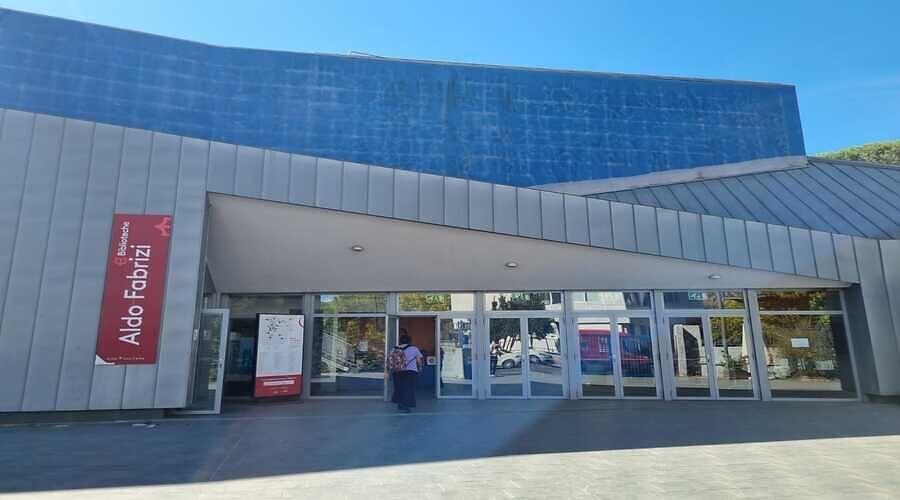
Where the Aldo Fabrizi Library and Cultural Center really is
Let's start from the map, because even people who have lived in Rome for 30 years get this address wrong. The Aldo Fabrizi Library and Cultural Center is at Via Treia 14, postal code 00156, that is, in the San Basilio district, in the northeastern part of the city, inside Municipio IV. It's not in the center, it's not near Campo de' Fiori despite the name it bears, and you can't reach it by strolling after the Colosseum. It's a neighborhood library, a real one, and that is exactly the reason it's worth writing about.
The coordinates, for anyone who wants to put them in their phone before leaving, are 41.93783 latitude and 12.58473 longitude. You need them more than you think, because the name of the street is misleading: in Rome there are several streets with similar names scattered among far-apart municipi, and searching for just "Via Treia" without the street number can send you to the other side of the Grande Raccordo Anulare. Number 14 is the right one. The phone of the branch is 0645460730 and the email address is the institutional one of the municipal network, aldofabrizi@bibliotechediroma.it.
Municipio IV in a few words
Municipio IV is the one that stretches along Via Tiburtina and takes in very different places: Pietralata, Colli Aniene, Ponte Mammolo, Casal Bertone, Tiburtino III, Casal de' Pazzi, San Basilio. It is a piece of the city that grew in successive layers, with the official borgate of the 1930s and 1940s, the public housing districts of the postwar period and the private subdivisions of the 1970s and 1980s that filled the gaps. It has the Aniene river as a natural boundary on one side and Via Tiburtina as its backbone. It's the territory where Rome stops being a postcard and becomes a working city.
Knowing which municipio you're in is not bureaucratic pedantry: in Rome the municipio is the administrative level that decides a large part of concrete things, from maintenance to the calendar of neighborhood events. When the programs of the widespread summer festivals come out, the libraries of Municipio IV appear as a block, and that is where a branch like this one enters the city circuit along with dozens of other spaces.
Why the address should be verified before leaving home
Frankly: Rome's municipal libraries change hours, close for works, temporarily move services. It's not disorganization, it's the normal life of a network of dozens of public branches. Before taking a bus and crossing half the city, the official listing on the Biblioteche di Roma portal should be opened and read. It's a rule that holds for this branch as for all the others, and it saves you a wasted trip.
How to get to the Aldo Fabrizi Library and Cultural Center
San Basilio has no metro. It does, however, have a clear reference point a short distance away: the Ponte Mammolo station on line B, which is also a big interchange hub with the terminals of the suburban buses to Tivoli and the Aniene valley. From Ponte Mammolo leave the surface lines that climb toward the neighborhood, and in barely 20 minutes, traffic permitting, you're on Via Treia. I won't give you line numbers from memory, because in Rome routes are changed with a frequency that makes any written indication obsolete: open the Roman public transit app that same morning and read the updated route.
By car it's simpler than it seems, and it's one of the rare Roman cases where the car really makes sense. San Basilio is reached from Via Tiburtina or from the Grande Raccordo Anulare, the reference exit is the one of the northeast quadrant, and once inside the neighborhood parking is a much smaller problem than in the center. There is no Limited Traffic Zone, there are no electronic gates, there are no blue lines at every meter. Anyone coming from outside Rome who has rented a car doesn't suffer here.
The bicycle and the river
There's a third way, and it's the one I recommend to anyone with time and legs: the Aniene. The river valley is equipped with bike paths and green areas that connect the northeast quadrant to the rest of the city, and arriving in San Basilio by pedaling along the water is a completely different urban experience from the traffic of Via Tiburtina. The river is the geographic reason these neighborhoods exist where they exist, and seeing it before entering the library gives meaning to the place.
How much time to allow
From the historic center, by public transportation, count three quarters of an hour or a little more, adding metro and bus. From Termini station, on line B to Ponte Mammolo, the metro part is about a quarter of an hour. Anyone coming from outside Rome who wants to fit the visit into a day should consider it a stop in its own right, not a snippet between two monuments. It's a common mistake to treat peripheral neighborhoods as quick appendages: they are cities, and cities need time.
What the Aldo Fabrizi Library and Cultural Center really is
Here I have to be honest, and honesty is the best way not to waste your time. The Aldo Fabrizi Library and Cultural Center is not a museum, it is not a house-museum of the actor, it does not contain Aldo Fabrizi's private collection, it does not display his stage costumes or his annotated scripts. It is a municipal public library, part of the Istituzione Biblioteche di Roma, dedicated to the memory of a Roman actor who died in 1990. The difference is substantial and determines everything else: what you find there, who can go in, how you behave.
That said, and said without beating around the bush, the place is interesting precisely for what it is. A public library in a public housing neighborhood is a piece of civic infrastructure, and it's one of those places where you understand how a city really works. If your interest in Rome stops at columns, this listing is not for you. If instead you want to understand where the people who live in Rome go, you're in the right place.
Library and cultural center: two words, two functions
The double name is not a whim. Rome's municipal libraries of the last 20 years were designed to do two things together: preserve and lend books, and host activities. Presentations, workshops for children, courses, meetings, read-alouds, reading groups, initiatives with the schools of the area. In a zone where free indoor gathering places are few, the second function weighs as much as the first. That's why over the years the words "cultural center" have been added to the name in common use and in many directories.
The holdings: what to expect on the shelves
The holdings of a neighborhood municipal library are designed for the public that lives around it. Italian and foreign fiction, popular nonfiction, manuals, a sturdy children's and young adult section, books for the very youngest children, school materials, and audiovisual media. Don't expect ancient collections or manuscripts: those are in the historic libraries of the center, which are another category of institution with another history. Here you come to read, study, borrow and return.
Who can enter the Aldo Fabrizi Library and Cultural Center
It's the most frequent question, so the answer comes first. In a public library of the Comune di Roma you enter freely. There is no ticket, no reservation to access the spaces, you don't need to be a resident of Rome, you don't need to be a university student, you don't need a card to walk through the door and sit down to read. It's a public service, and access is its reason for being.
The card is needed for lending, that is, for taking books out. Registration in the Biblioteche di Roma system is free, is done at any branch of the network with an ID document and is valid for all the others: you take a book from a library in the east quadrant and return it to one at the other end of the city, if that's more convenient. This is the serious advantage of being part of a network and not an isolated branch.
Foreign tourists: yes, but with the right expectations
A foreign visitor can enter exactly like a Roman. Nobody asks you anything. If you want to spend an hour in the cool reading a newspaper or using the wi-fi, you can. If you're looking for material in English, keep in mind that a neighborhood library has a foreign-language section that is limited compared to that of a central library: it exists, but it's sized for the local public. The branches of the Roman network with an intercultural and multilingual vocation are others and more central.
The unwritten rules that apply everywhere
Silence in the reading rooms, phones on silent, conversations in the common areas and not between the tables, backpacks and bulky bags where indicated by the staff. In the children's section the accepted noise level is obviously another, and rightly so: a library where children make no noise is a library where there are no children. The staff is the authority of the place and should be listened to: they are librarians, not custodians, and they know things no online catalog tells you.
The building of the Aldo Fabrizi Library and Cultural Center
This is the point where the listing becomes interesting even for those who don't care about libraries. The building is recent: the current structure was built in 2011. It develops almost 1,000 square meters of floor area spread over two levels, and it is surrounded by a large garden. Put like that it sounds like a land registry record, but try translating it: 1,000 square meters of covered, free, air-conditioned public space, with greenery around it, in a public housing borgata. In context it is worth far more than the number is worth.
The distribution over two levels is the design choice that allows functions to be separated without building walls: the section for the youngest, which is noisy by definition, is far from the tables of those who study. The garden is not a decorative border, it's usable space: in the good season a part of the seating is outdoors, and on Roman days in May and October it is the best place in the building.
80 seats, inside and out
The number that gives the real measure of the place is this: between inside and outside, the library offers more than 80 seats. The public that occupies them is mixed, and it's the part I like telling most: children in the afternoon time slot, middle and high schoolers in the after-school hours, university students looking for a quiet table, adults reading the newspaper, parents accompanying. The study room, the one with the specific purpose, has about 10 dedicated seats.
Accessibility
A fact that must be said because in Rome it can't be taken for granted: access to the structure is total for people with motor disabilities. A building from 2011 is born with accessibility requirements already in the design, which in the historic palaces of the center is achieved only with makeshift solutions when it is achieved at all. Anyone who moves in a wheelchair and in Rome has learned to distrust the word "accessible" can relax here.
Wi-fi and connection
The wireless network is there and it's that of the Biblioteche di Roma system: you access it with your registration credentials and password, from a laptop with the Bibliowifi network and from a smartphone with Bibliosmart, in the indoor spaces. It's a detail that seems minor and isn't: for a segment of the population the library is the place where you download a document, fill in an online application, do a remote job interview. Free public connection is a social service as much as lending is.
Services of the Aldo Fabrizi Library and Cultural Center
I'll make the reasoned list, because it's the part that really matters to those who have to go. On-site consultation: you walk in, take a volume from the shelves, sit down and read it, with no formalities. Local lending: with the card you take books home, and the number of volumes and the duration follow the network's rules, with the possibility of an extension if nobody else has reserved the same title. Intersystem lending: you ask for a book that is in another library of the Roman network and they have it sent here. Interlibrary lending: the same thing, but on a national scale, between different library systems.
This last one is the service Romans know least and that is worth the most. It means that a rare title, which isn't in Rome, can arrive from a library in another city. It isn't instant and involves waiting times and in some cases a small expense reimbursement, but it's the way a reader without means gets access to a book that they would otherwise have to buy. For this service there is also a dedicated email address, distinct from the generic one of the branch.
The children's section and the workshops
In the children's space workshops and read-alouds are organized, and they are not occasional initiatives: they are the ordinary programming of this branch, also carried out for the benefit of the pupils of the Mahatma Gandhi state elementary school, which is a stone's throw away. This is the kind of collaboration that decides whether a neighborhood library is alive or is a warehouse of books. A class that arrives on foot from school, sits on the rug and listens to someone reading aloud is learning, without knowing it, that this place is theirs and that they can come back on their own.
Reading aloud to children is not entertainment. It's the practice that educational research identifies as the strongest predictor of later language competence, and it's free. In a neighborhood where not all families have books at home, story hour at the library is a public policy measure disguised as a recreational activity. If you happen to see one, look at the children's faces and you'll understand what the 1,000 square meters are for.
The study room
The study room with dedicated seats is about 10 stations, to which are added the other seats distributed in the building and in the garden. During exam periods, and in Rome exam periods are three long seasons a year, the seats fill up. The unwritten rule is that of all study rooms in the world: you arrive early, you don't occupy a table with a notebook and then disappear for two hours, you don't phone while seated. It's a pact of reciprocity, and in neighborhood libraries it works better than elsewhere because people know each other by sight.
Periodicals room and periodical material
Like all the branches of the network, the library offers newspapers and periodicals to consult on site, and the network also offers the digital newsstand, that is, access to a wide selection of Italian and international titles through an online platform reserved for members. The upshot is that a retiree in San Basilio can read for free, every morning, more newspapers than he would buy in a month. This too is a public service nobody celebrates.
The network behind the Aldo Fabrizi Library and Cultural Center
This branch is not an island. It is part of the Istituzione Biblioteche di Roma, the library system of the Comune, which manages dozens of branches distributed in all the municipi: from the big central libraries to the small borgata branches, from places specialized in young people to those dedicated to the city's historical memory. It is one of the most extensive public library networks in Italy, and it's the reason a card made at any one of the branches opens all the others.
The identification code of this branch in the National Library Service is RMBE2, alongside which is the code RM1888. They are acronyms that mean nothing to you as a reader, but they explain a fact: the catalog of this library can be queried from outside, its volumes are recorded in a national system, and someone searching for a title on the other side of Italy can discover that the nearest available copy is on Via Treia, in San Basilio. Neighborhood libraries are network nodes, not depots.
The Bibliocard
Alongside the free registration card there has been for years the Bibliocard, a paid card of the Roman system that gives additional services and discounts at a series of cultural partners in the city. It is not necessary to use the library: basic registration is and remains free. It's a tool designed for those who go often and want to support the system, and it's worth asking at the desk what it includes in the current year, because the list of benefits is updated periodically.
The nearby libraries
In the northeast quadrant there are other branches of the network at a reasonable distance, each with its own character. Whoever lives in the area doesn't use a single library: they use the one convenient for lending and the one convenient for studying, which often don't coincide. This is the logic that makes a network more useful than the sum of its parts, and it's also the reason why, when a branch closes for works, the service doesn't drop to zero but is redistributed.
The digital library accessible from the Aldo Fabrizi Library and Cultural Center
A chapter almost no visitor knows, and which is probably the most underused service of the entire system. With your registration credentials, from home and not only from the branch, you access a digital catalog that includes e-books, audiobooks, video, databases and the digital newsstand with hundreds of titles. Digital lending works like the paper kind: you take a title, you keep it for a certain number of days, then it "returns" itself.
Translated: a student in San Basilio who registers on Via Treia has access, from home, to a library that no family could afford to buy. And it's free. The fact that this is so little known is, in our judgment, the biggest communication problem of Italian public culture: we have built excellent services and haven't told anyone about them.
How you access it in practice
You register on site with an ID document, you receive the credentials, you enter the members' area of the network's portal and from there you reach the platforms of digital content. If something doesn't work, the library staff are used to explaining it, because they explain it every day. Asking is nothing to be ashamed of: among the tasks of a contemporary librarian is that of being a digital mediator, and in peripheral branches this function is central.
Works and service changes at the Aldo Fabrizi Library and Cultural Center
This chapter has to be written out of honesty to the reader, and it's the first one you should check before planning a visit. From Monday, December 15, 2025 the branch closed to the public to allow the start of the energy efficiency works financed by the National Recovery and Resilience Plan. During the closure the local and interlibrary lending services are suspended at this branch, while it remains possible to return the volumes borrowed here at any other branch of the Biblioteche di Roma system.
This means something very simple: before going to Via Treia, check the updated status on the official listing of the library on the bibliotechediroma.it portal or phone the branch number. The reopening dates of public construction sites shift, and it's normal that they shift: it's nobody's fault, it's the physiology of building work on a public building in use.
What the energy efficiency works are
It isn't abstract bureaucracy, it is a physical transformation of the building. Energy efficiency work generally means intervening on the envelope, the window frames, the heating, cooling and lighting systems, so that the building consumes less to heat in winter and cool in summer. On a public building of 1,000 square meters and with large glass surfaces, the saving on the bill translates into resources that stay inside the cultural budget instead of ending up in the meter.
The PNRR and the civic hubs
The Biblioteche di Roma have an entire program tied to the National Recovery and Resilience Plan, dedicated to the new civic and cultural innovation hubs. The underlying idea is that the neighborhood library of the next decade will not be only a place where you borrow books, but an outpost of services: digital literacy, coworking spaces, help in accessing online public services, activities for the elderly and for teenagers. Anyone who knows Rome's peripheries understands right away how ambitious this idea is and how necessary.
How to behave during a closure
If you had planned to come and find the branch closed, plan B is simple and it works: books are returned to another branch of the network, lending is done elsewhere, the digital library stays accessible from home without interruption because it doesn't depend on the building. And the neighborhood, that you can still visit: the murals of San Basilio don't close for works, and they are the reason why, even with the library shuttered, a walk around here is not wasted time.
San Basilio, the neighborhood that hosts the Aldo Fabrizi Library and Cultural Center
Now let's leave the building, because the neighborhood is half the story. San Basilio was born as an official borgata in the season when the Fascist regime was gutting Rome's historic center to open the big representative thoroughfares and had to put the evicted families somewhere. The official borgate were the answer: clusters of public housing built far from the center, often in open countryside, poorly connected and equipped with little or nothing. San Basilio is one of these, and it is among the best known.
Whoever arrives there today sees a public housing neighborhood with low buildings, courtyards, open spaces between one block and the next, and a social fabric that has been through difficult decades. If they look more closely they also see one of the few areas of Rome where public planning left real space between buildings, something that almost never happened in the private subdivisions of the 1970s. San Basilio has air, it has green, it has distances between the buildings. It's an unintended and precious legacy.
The name and the geography
The borgata takes its name from the agricultural zone in which it arose, as happened for many of the Roman borgate, which inherited the place names of the old estates and farmhouses. We are in the band between Via Tiburtina and Via Nomentana, in a quadrant that until the 1930s was countryside with farmhouses, vineyards and a few scattered archaeological remains. Rome grew in leaps, leaving gaps that would be filled decades later, and this explains the patchy character of the urban landscape you see as you arrive.
The postwar period and the expansion
The original core was enlarged in the postwar period with new public residential building, following the logic of the big national housing plans that built a good part of the Italian periphery between the 1950s and 1960s. It is in this phase that the neighborhood takes the form it has today, with its web of streets and its public housing stock. Anyone who studies the urban history of Rome finds in San Basilio a kind of open-air manual: every season of Italian public building has left a readable chapter here.
The streets of the Marche around the Aldo Fabrizi Library and Cultural Center
Here is a detail nobody notices on their own. The address of the library is Via Treia. Treia is a town in the province of Macerata, in the Marche. And it's not an isolated case: the place names of San Basilio draw freely on the names of Marche towns. Strolling among the buildings you come across streets named after Recanati, Fiuminata, Corridonia, Montecassiano, Camerino, Cingoli, Osimo, Pollenza. The neighborhood is a small map of the Marche transplanted to the northeast of Rome.
This is a typically Roman custom. The Capitoline naming commission, for decades, assigned each peripheral neighborhood a unified theme: the cities of Sicily in one zone, the towns of Piedmont in another, writers in a third. The result is that in Rome you can tell which part of the city you're in simply by reading the street names, if you know the code. It's a game that still works today and that I recommend you try, because it's the fastest way to find your bearings in an enormous city.
Why the Marche in particular
The criterion of thematic families served to order an urban growth that would otherwise have been chaotic, and it made it possible to name dozens of new streets in one go with a ready-made list. In the case of San Basilio, the towns of the Marche. The fact that a library dedicated to the most Roman of Roman actors stands on a street bearing the name of a town in the Macerata area is one of those contradictions that in Rome don't make the news, but that is worth telling, because it shows how layered the city is even where it seems simplest.
The Mahatma Gandhi school
Next to the library is the Mahatma Gandhi state elementary school, and it's a neighborhood tie that counts: a good part of the activities for the youngest organized by the branch comes precisely from the relationship with this school. A school and a public library facing the same piece of the neighborhood, with classes walking from one to the other, are an educational infrastructure that works without the need for big proclamations.
1974 and the memory of the neighborhood around the Aldo Fabrizi Library and Cultural Center
If you come to San Basilio and want to understand the place, you can't skip this part, and it isn't light. In September 1974 the neighborhood was the scene of some of the hardest days in the recent history of the Roman periphery. The context was the housing emergency: hundreds of families without homes had occupied public housing units that had just been built and not yet assigned, and the eviction operations by the police met the resistance of the occupiers and of the neighborhood.
During those clashes, on September 2, 1974, Fabrizio Ceruso died, a 19-year-old from Tivoli, hit by a bullet. His death has remained in the collective memory of the neighborhood and of the city, and is remembered every year. It's not a touch of local color nor a detail for a tourist brochure: it's a documented historical fact that explains why in San Basilio the word "home" carries a different weight than elsewhere, and why the neighborhood has a tradition of social mobilization that has lasted half a century.
Why I tell it in a listing on a library
Because a public library in a neighborhood like this is not a neutral building. It's the sign that the State and the Comune decided to put here, and not elsewhere, 1,000 square meters of free public space with books in it. In a long history of conflicts over housing and services, the opening of a library in 2011 is a chapter that must be read in the same sequence. Anyone who works on peripheries knows that services arrive late and that when they arrive they have to be defended.
How to behave as a visitor
With respect, which is after all the general rule when you visit a working-class neighborhood where people live and don't perform. You don't photograph people without asking, you don't comment out loud on the state of the buildings, you don't arrive with the air of someone going to see the zoo. San Basilio has a long memory and a proportionate pride. Whoever goes with the right face is treated very well: in the cafe at the foot of the building they'll explain the story of the murals better than any panel.
SanBa and the street art around the Aldo Fabrizi Library and Cultural Center
This is, for a visitor, the real reason to come all the way here, and the library itself points to it: going to Via Treia is also the chance to go discover the street art works created in the streets of the neighborhood by the urban artists involved in the SanBa project. It is one of the most cited participatory public art projects in Italy, and it was born right here, on the blank walls of the public housing buildings.
The design of the project is what distinguishes public art from simple decoration: not murals dropped from above, but works built with the involvement of the residents, with workshops, meetings and a phase of listening to the neighborhood. The result is whole facades transformed into large-format images, visible from afar, which have changed the way San Basilio is looked at by the rest of the city and, more importantly, the way it looks at itself.
How to visit
On foot, calmly, wandering among the streets of the neighborhood. There is no route marked with arrows, and that's half the fun: the works are encountered as you turn a corner, above a parking lot, on the side of a residential building. Allow an hour and a half for a complete, unhurried round, comfortable shoes, and a willingness to ask for directions: the residents know exactly where the best pieces are and are generally glad to tell you.
The right light
The big painted facades have a technical problem every photographer knows: at noon the sun beats down from above and flattens the colors, while in backlight the walls disappear. The good moment is early morning or the two hours before sunset, with the raking light that fills the colors and separates the image from the plaster. If you can choose, pick a slightly hazy day: the white sky of certain Roman spring mornings is the best diffuser there is.
Public art and regeneration: a critical note
It would be dishonest to tell you that painting walls solves the problems of a public housing neighborhood. It doesn't: housing maintenance, transportation, services and jobs are another game, and a much more expensive one. What public art does, when it's done well, is change the narrative: a place that for years saw cameras arrive only for crime news becomes a place someone reaches on purpose to look at something beautiful. It's not little, but it isn't everything, and the first to know it are the residents.
Why an actor gives his name to the Aldo Fabrizi Library and Cultural Center
The library is dedicated to the famous Roman actor who died in 1990. Put like that it sounds like an archive formula, but the choice has a precise logic: naming a borgata library after an actor born poor in the center, who did every kind of job before stepping onto a stage and who built an entire career on the language and the faces of ordinary Romans, is a way of telling the residents that culture is not somebody else's stuff. Aldo Fabrizi, in San Basilio, is not a name on a plaque. He is a hypothesis of identity.
And then there is the literary reason, which is what makes the dedication more than decorative: Fabrizi was not only an actor. He was an author, he wrote sonnets in Roman dialect all his life and published them, he built a small body of poetry devoted largely to home cooking, and he left books that sit in bookshops and libraries by full right. Naming a library after him is not a generic tribute to cinema: it is recognizing a man who worked with the Roman language in verse, not only on stage.
Who Aldo Fabrizi was in one line
A Roman actor born in 1905 and died in 1990, whom the Italian public associates with two opposite images: the comic mask of avanspettacolo and popular cinema, all belly and jokes, and the tragic face of don Pietro in Roma città aperta, the film that in 1945 refounded Italian cinema. Holding these two things together in a single career is a feat very few actors have achieved, in Italy and elsewhere.
Aldo Fabrizi and his childhood at Campo de' Fiori
Aldo Fabrizi was born in Rome on November 1, 1905, in a working-class family of the historic center, in the area around Campo de' Fiori, which then was exactly what it has always been: the market, the shops, the alleys, the houses where many people lived in a few rooms. It is not the Rome of the Grand Tour nor that of the noble palaces, even though it is 200 meters from both. It's the Rome that works, that shouts prices at the vegetable stand and that stays in the street because it can't stay at home.
The family is large and fate is not kind: the father dies when Aldo is still a boy, and on the older children falls the weight of supporting the others. It's the Italian childhood of the early 20th century in its most common version, the one we would now call poverty and that then was simply called life. Fabrizi never made a whining story of it: he made material of it, and the difference between the two is his whole career.
Campo de' Fiori as a school
Whoever grows up in a market learns two things that later pay off on a stage: comic timing and voice. The vendor who has to be heard above the noise of 100 other vendors, who has to stop the passerby with a joke and close the sale in 10 seconds, is doing theater without knowing it. The macchiette that Fabrizi would bring to the avanspettacolo stages in the 1930s come from there, not from an acting school: the tram driver, the greengrocer, the traffic cop, the taxi driver, the elementary school teacher, the innkeeper. Characters he had seen face to face every day.
Campo de' Fiori, incidentally, is also the title of a film that Fabrizi would shoot in 1943 with Anna Magnani, set in that very market. He used to sell vegetables, then he played the fishmonger. Not many actors get to return to the set in the place where they actually worked, and the film gains from it a truth of gestures that can't be taught.
The sister: Elena Fabrizi, Sora Lella
You can't tell about Aldo without his sister. Elena Fabrizi, born 10 years after him, became Sora Lella for Italians: restaurateur on the Tiber Island and, in old age, a hugely popular actress, with a second film career begun when others retire. Her trattoria was for decades a Roman institution, and her face entered the collective memory of Italian cinema of the 1980s. Two siblings of the same poor family of the center, both become national faces: it's a Roman story that seems written by a screenwriter and instead really happened.
Aldo Fabrizi's jobs before the stage
Before becoming an actor, Fabrizi did the list of jobs that in the Rome of those years you did when you had nothing. Errand boy, vendor, porter of goods, street photographer, and other occasional occupations that he himself recounted with irony in the years of his fame. None of these jobs is an irrelevant biographical detail: they are the direct source of his repertoire.
There is a substantial difference between an actor who studies a working-class character and an actor who was that character. The first produces imitation, the second produces recognition. When Fabrizi plays a tram driver or a carter, the audience of the 1940s does not see a gentleman pretending: they see one of their own. This is the reason, much more than technique, for the overwhelming success of his first films.
The move to the stage
The entry into the world of entertainment happens through the service door, that is, avanspettacolo and variety: those programs that in the cinema-theaters preceded the screening of the film with comic acts, songs, sketches. It was a hard circuit, with several shows a day, an audience that paid little and forgave nothing, and no safety net. A comedian who survived avanspettacolo had learned the only thing that really matters: how to hold a room.
The macchiette
The macchietta is a genre that no longer exists today and that then was the backbone of Italian comedy: a stock character built in a few minutes, with a gait, a voice, a catchphrase. Fabrizi created dozens of them, and the most famous, those of the Roman trades, remained in the national repertoire. His strength lay in not overdoing it: Fabrizi's macchiette were believable before they were funny, and this is exactly what made them funny.
Aldo Fabrizi comes to the movies
The move to cinema happens in the early 1940s, in the middle of the war, and produces resounding results right away. Avanti c'è posto..., from 1942, has him as protagonist in the role of a tram driver and sets the formula: the generous and unlucky common Roman, comic and moving in the same frame. The next year come Campo de' Fiori, with Anna Magnani, and L'ultima carrozzella. In three years Fabrizi goes from variety comedian to star of Italian cinema.
A detail that always makes film buffs raise an eyebrow: a young gag writer named Federico Fellini collaborated on the writing of those films. Before becoming the director we know, Fellini worked for years writing jokes and situations, and Fabrizi was one of his first professional reference points. The friendship and the professional relationship between the two run through decades of Italian cinema, with a few storms and many returns.
The formula of the common Roman
What Fabrizi perfects in these films is a human type that will become the basis of all Italian comedy: the ordinary man, not heroic, with his flaws and his dignity, who faces life with that mix of cunning and naivety that Italians recognize as their own. From this mold, in the following years, come characters played by very different actors, but the matrix comes from there and from the contemporary Neapolitan films. Fabrizi is one of the founders of a way of telling Italy.
The language
Then there is the question of the voice, which for Fabrizi is central. He acted in a toned-down Roman dialect, understandable all over Italy, but with the cadence intact. In an era when Italian cinema used an artificial and uniform dubbing language, bringing a recognizable inflection to the screen was a choice of realism even before it was one of comedy. The neorealism that is about to arrive will make this choice a banner.
Roma città aperta and Aldo Fabrizi's don Pietro
In 1945, with the war just ended and Rome still full of rubble, Roberto Rossellini shoots Roma città aperta. It's the film that changes the history of world cinema, and Aldo Fabrizi is its male lead in the role of don Pietro Pellegrini, the priest who helps the Resistance and who in the end is shot by the Germans. Those who knew Fabrizi only as a variety comedian found themselves facing a dramatic actor of the first rank, and the surprise was total.
The production conditions are legendary and have to be told because they explain the aesthetic of the film: film stock bought in pieces wherever it could be found, natural light, shooting in real streets with real rubble, extras taken from the neighborhood. It wasn't a stylistic choice, it was a necessity that became style. The result has a roughness that no glossy film of the era could have, and that even today, watched on any screen, grabs you by the throat.
The scene everyone remembers
It isn't Fabrizi's, and it's right to say so: it's Anna Magnani running after the truck, one of the most cited moments in the history of cinema. But the final sequence, the execution of don Pietro, with the boys whistling from the other side of the fence, is the exact counterpoint to that run, and it's the image with which Fabrizi entered the imagination of two or three generations of Italians. An avanspettacolo comedian who closes a film like this is something you don't forget.
International success
The film came out in Italy in the autumn of 1945 and went around the world, winning leading international recognition and imposing abroad the very idea of a new Italian cinema. For the American and French audiences of the postwar period, the Italy they saw on the screen was that one: gray streets, real people, a priest and a woman of the people. And it's also the reason why Fabrizi's name, already hugely popular in Italy, became known well beyond the borders.
Don Giuseppe Morosini and the figures behind don Pietro
The character of don Pietro is not a pure invention. At its origin are real figures of Roman priests involved in the Resistance and killed during the German occupation of the city, and the names that historiography and collective memory associate with the character are mainly two: don Giuseppe Morosini and don Pietro Pappagallo.
Don Giuseppe Morosini, a priest from Ferentino, was arrested for his activity in support of the Roman Resistance and shot at Forte Bravetta in April 1944. Don Pietro Pappagallo, from Terlizzi in Puglia, who in Rome helped wanted men, Jews and draft evaders by providing documents and hiding places, was arrested and killed at the Fosse Ardeatine in March 1944 together with the other 330 victims of the massacre. The don Pietro of the film bears the name of one and the fate of the other, and in this fusion lies its symbolic force.
Why it matters to know this
Because it changes the way you watch the final scene. That is not a dramaturgical device: it is the transposition of events that happened a few kilometers from the set, a year before filming, to people whom many among the crew had known or had read about in the clandestine newspapers. Roma città aperta was shot while the mourning was still open, and that is why it doesn't resemble any war film built at a safe distance.
A Roman route on the trail of the film
Anyone who gets passionate about this story has in Rome several places to go through, from the Fosse Ardeatine to Forte Bravetta, from the Museo storico della Liberazione on Via Tasso to the streets of the Prenestino where some sequences were shot. It's a hard itinerary and not suited to everyone, but it's the best way to understand what the word Resistance means in this city. And a public library is the right place to look for the books to prepare it.
Aldo Fabrizi and Anna Magnani
The Fabrizi-Magnani pair is one of the great pairs of Italian 20th-century entertainment, and like all great pairs it was not an idyll. The two met and worked together in the world of variety and revue before cinema, found each other again in Campo de' Fiori in 1943 and arrived together at Roma città aperta in 1945. They are complementary in an almost theoretical way: he the belly and the irony, she the fire and the tragedy. Together they work like few others.
Between them there was friction, breakups and long periods of silence, which anyone who has read something about the biographies of the two knows well. I won't go into the detail of the gossip, which in most cases circulates in contradictory and undocumented versions. What is documented is the result on the screen: two actors who in the same frame push each other beyond their usual register.
Two ways of being Roman
Magnani brings a tragic Romanness, almost Greek, of absolute pain and no consolation. Fabrizi brings the Romanness of irony, the kind that in front of catastrophe makes a joke because it's the only way to stay on your feet. They are the two faces of the character of this city, and for once cinema put them side by side instead of choosing. Whoever wants to understand Rome should do this exercise: watch Roma città aperta thinking that those two are the same people seen from two angles.
Aldo Fabrizi, Alberto Sordi, Totò and Federico Fellini
Fabrizi's network of professional relationships is a piece of Italian film history. With Alberto Sordi the bond is that of an older brother: in the years when Sordi struggled to establish himself in cinema, with the public rejecting him and the producers wary, Fabrizi was among those who believed in his talent and supported him in productions that gave him room. The two acted together on several occasions, including Vita da cani, from 1950, and their complicity on screen is that of two people who knew each other from before.
With Totò the most famous meeting is Guardie e ladri, from 1951, directed by Steno and Mario Monicelli: Fabrizi is the brigadier Bottoni, Totò the swindler Ferdinando Esposito, and the chase between the two, which begins as farce and ends as social drama, is one of the absolute peaks of Italian comedy. The film won important recognition in Italy and abroad and remains, 70 years later, the best proof of what Italian popular cinema could do when it had screenplays of that level.
Fellini
With Fellini the relationship is long-lasting and of a different nature: it begins with the young screenwriter who writes gags for Fabrizi's films in the early 1940s and continues across decades, with affection, quarrels and mutual recognition. Fellini recounted more than once how much he learned by observing the way Fabrizi built a character starting from a gait or a detail of clothing. It's the avanspettacolo method applied to cinema, and it entered the Fellinian grammar.
A note on awards
In the course of his career Fabrizi received important recognition from Italian cinema, in particular for his dramatic performances and for roles in which comedy turned into bitterness. I won't give you detailed lists of statuettes and years: that information is found in film encyclopedias, and citing it from memory is the quickest way to make a mistake. The point is another: in the years when Italian cinema was making the finest films of its history, Fabrizi was regarded by his colleagues as a serious actor, not a comedian lent to drama.
Aldo Fabrizi the director
Less known to the general public is the Fabrizi behind the camera, and yet he directed about 10 films between the late 1940s and the 1950s. The first, Emigrantes, from 1948, is the most surprising: it tells the story of a Roman family that emigrates to Argentina, and was shot largely in South America. At a time when Italy was exporting labor all over the world, a comic actor decides to tell about emigration from the point of view of those who leave. It's not the choice of someone who thinks only of the box office.
In the following years he directs family comedies and ensemble films, including the series dedicated to the Passaguai family, launched in 1951, which is in essence the Italian invention of the serial domestic comedy: an average family, its troubles, the episodes that repeat. Anyone who watches certain Italian TV series about the family today is watching, without knowing it, a descendant that starts from there. He also directs Hanno rubato un tram, from 1954, a project that passed through Fellini's hands before arriving in his.
What kind of director he was
A director of actors, not of shots. His films don't have the formal ambition of contemporary auteur cinema and never sought it: they are built on the rhythm of the scenes, on the rendering of characters, on the precision of the dialogue. It's the way of working of someone who comes from the stage, where the camera doesn't exist and everything is played on timing and voice. They are worth catching up with, they are more modern than their reputation suggests.
Aldo Fabrizi the poet: the sonnets in Roman dialect
And here we come to the most solid reason a library bears his name. Fabrizi wrote sonnets in Roman dialect all his life, and in the 1970s he collected them in volumes published and distributed all over Italy. These are not verses tossed off for fun between one film and the next: they are regular sonnets, 14 lines, rhyme scheme respected, built with the ear of someone who knows that Roman dialect has a precise music and doesn't forgive forced lines.
The poetic tradition in Roman dialect is one of the most solid in Italy and has names that appear in the textbooks: Giuseppe Gioachino Belli in the 19th century, with his more than 2,000 sonnets that are a monument of Italian literature, and then Cesare Pascarella, Trilussa, and in the 20th century a flowering of minor and major authors. Fabrizi enters this line as the last to arrive and as a talented amateur, with no pretense of competing with the greats, but with a command of the language that no professional of the pen could have taught him: it was his mother tongue.
What they are about
Small things. Cooking, family, vices, growing old, neighbors, the character of Romans, the passing of time. It's poetry of the ordinary, and its quality lies precisely in the refusal of the noble subject. In a century in which Italian poetry was heading toward obscurity and the fragment, a comic actor wrote perfectly regular sonnets about pasta. Put like that it sounds like a quip, but it is a precise cultural position, and readers understood it: those books sold a lot and for many years.
A warning about what circulates online
Here the one severe recommendation has to be made. On the internet dozens of poems, sonnets and aphorisms circulate attributed to Aldo Fabrizi, often on images with his face, and a substantial part of this material cannot be documented. Some texts are his, others are by other Roman-dialect authors, still others are anonymous compositions that acquired a prestigious signature on the journey from one bulletin board to another. If a line circulates without indication of the collection it comes from, the rule is simple: you say it is attributed to him, not that he wrote it.
The way out of doubt exists and it is exactly the place we are talking about: his collections are real books, cataloged, findable in the library system. You look up the volume, open the index, check. It's the oldest and most effective gesture there is against the circulation of false attributions, and it has the advantage of being free. A library named for an author is also the place where you can check what that author really wrote.
Aldo Fabrizi and cooking in verse
The most famous strand of his poetic output is the gastronomic one. Fabrizi devoted whole volumes of sonnets to Italian cooking, and pasta is the subject that gave him his best-known title. They are not recipe books with quantities: they are poems about dishes, about the ritual of the table, about the art of feeding people well with little. Which is also the very definition of traditional Roman cooking, born as the cooking of leftovers and ingenuity.
There is total coherence between the man and the work. The boy from Campo de' Fiori who sold vegetables, the actor who built his mask on the common Roman, the sister who opened a trattoria that became an institution, and the sonnets on pasta: it's a single biography, not an actor who dabbles in gastronomy. The table, in that world, is not a hobby. It's the only luxury available.
Why they're still liked
Because they are funny and they are precise. Anyone who has cooked recognizes in his verses the right gesture, the detail that only someone at the stove knows, the flaw of the bad cook described without pity. And because Roman dialect, in the kitchen, is an unbeatable language: it has words for textures and flavors that Italian has to explain in three words. If you want to understand why in Rome people argue for 20 minutes over the difference between two pastas, read Fabrizi.
A reading tip
If you're starting from zero, begin with the gastronomic sonnets, which are the most accessible even for those who don't chew Roman dialect, and read them aloud. Roman dialect written on the page seems hard and becomes transparent as soon as you pronounce it: it's a spoken language transcribed, not a language born on paper. Then move on to the others, those about old age and family, which are more bitter than the author's comic fame would lead you to expect.
The mask of the common Roman according to Aldo Fabrizi
There is a cultural work, not only an artistic one, that Fabrizi accomplished and that is rarely credited to him: he gave the common Roman a dignified representation at a time when high Italian culture looked down on him or ignored him. In his characters the common man is never stupid and never merely a figure of local color: he is someone who gets by, who has his morality, who makes mistakes and pays.
This is seen better if compared with what would come later. Commedia all'italiana in the 1960s made the working-class character more cynical, more opportunistic, often contemptible, and did so for precise historical reasons, because the country was changing and satire had to bite. Fabrizi belongs to the earlier phase, the one in which the common man was still a victim and not yet an accomplice. And that is why his films have a tenderness that the later comedy deliberately abandoned.
The face
A word on his main instrument, which was his face. Fabrizi had a broad, mobile face, with small eyes capable of going from cheer to desolation in a single frame. In an era when the movie star had to be handsome, he built a career on the opposite principle: being recognizable. And the audience, which had had enough of stars, responded en masse to an actor who looked like their uncle.
National Roman dialect
The flip side also has to be told, because the history of culture is not a holy card. The national success of Roman actors like Fabrizi contributed to making Roman dialect the best-known and most imitated Italian dialect, and in part to flattening the representation of Romanness into a cliche: the quip, the good-natured cynicism, the disenchantment. Rome is much more complicated than that, as anyone who lives here knows. But clichés always come from something true, and it's the job of whoever tells the city to distinguish the original from the photocopy.
The last years of Aldo Fabrizi and his legacy
Fabrizi worked until an advanced age, alternating cinema, television and public appearances, and remained to the very end a hugely popular figure, the kind people stop on the street. He died in Rome in 1990, at the age of 84, after a career that had run through avanspettacolo, neorealism, comedy, directing and dialect poetry. His sister Elena, Sora Lella, would outlive him by a short time.
The legacy is twofold. On one side the film heritage, which can be consulted, restored, studied, and which includes at least one film that is in all the histories of cinema in the world. On the other the linguistic and poetic heritage, the sonnets, the language, the way of telling a city through its trades. A municipal library that bears his name, in a borgata in the northeast, holds these two legacies together better than a plaque in the center would.
Where to see his films today
His main filmography is widely available: Roma città aperta circulates in restored versions and is regularly programmed in film series, cinematheques and festivals, and the comedy titles can be found in home video editions and in distribution catalogs. Public libraries, it should be remembered, also lend audiovisual material: the Roman system has a dedicated section, and a Fabrizi evening can be organized at zero cost with a free card.
What to look for on the shelves of the Aldo Fabrizi Library and Cultural Center
If you go with an idea in mind instead of at random, the visit pays off 10 times as much. Here are the leads, in order of interest. First lead: Roman dialect poetry. Belli, Pascarella, Trilussa and the contemporaries, plus naturally the collections of the actor to whom the branch is dedicated. It's the best way to understand that Roman dialect is not a wrong way of speaking Italian but a language with a literature two centuries old.
Second lead: the history of Rome in the 20th century. The borgate, the master plan, the German occupation, the Roman Resistance, the reconstruction, the housing question. It's material for which an enormous bibliography exists, often little frequented, and a library in a peripheral municipio is the natural place to find a part of it. Third lead: Italian cinema, books on neorealism, monographs on actors and directors, audiovisual material on loan.
Ask at the desk
I'll repeat something that seems obvious and that almost nobody does: ask the librarian. The online catalog tells you whether a book is there. The librarian tells you which of the four books on the same subject is worth reading, which is too technical, which has just arrived. In a neighborhood branch, where the staff knows its public, this advice is the most precious thing they carry off for you for free.
The "ask at the library" service
The Roman network also offers a remote reference channel, through which you can ask a documentary question and receive an answer from the librarians. It's useful for those who don't live nearby, for those preparing research, for those looking for an unfindable title. It's a free public service that very many citizens don't know they have, and that in other European countries is used 10 times more than in Italy.
What is around the Aldo Fabrizi Library and Cultural Center
Planning a half day here makes sense only if you put the neighborhood into it. The round I recommend is this: arrive in the morning, a good hour for the mural works of San Basilio, then the library if open, then lunch in one of the trattorias or cafes of the neighborhood, which are cheap and unpretentious and where you eat better than in many places in the center at triple the bill. In the afternoon, if you have legs, the Aniene valley.
The park along the Aniene is one of the great lesser-known green spaces of Rome. It doesn't have the fame of Villa Borghese or the scenography of Villa Doria Pamphilj, but it has kilometers of paths, reed beds, meadows and a real river, and on weekdays you are practically alone. For those who visit Rome in summer, and are desperately looking for shade and air, this quadrant is an underrated resource.
Eating in the area
Expect neighborhood cafes, pizza by the slice, bakeries and family trattorias. The average level is honest and the prices are the real prices of Rome, not those of the center. The rule for not going wrong is the same in all Italian peripheries: go in where there are workers and office employees at 12:30, order what they've written by hand on the blackboard and don't ask for carbonara at four in the afternoon.
Combining with other stops
In the northeast quadrant you can fit in visits of very different kinds: the archaeological areas scattered along the consular roads, the complexes of modern building that architecture scholars come to see from all over Europe, the neighborhood markets. It's an itinerary for those who have already seen Rome at least once and now want to understand it. Those on a first trip should do the center first: it's the most honest advice.
Practical tips for visiting the Aldo Fabrizi Library and Cultural Center
In points, here is what it pays to know before deciding whether to go. Check the opening first, always, because the branch is affected by works. Bring an ID if you want to sign up for lending. Allow for the fact that it's not a 15-minute stop: if you come all the way here, devote at least half a day to the neighborhood. Don't expect exhibition material on Aldo Fabrizi: the dedication is in the name, not in a permanent exhibit.
The best time is spring or autumn, for a very concrete reason: the garden. With 1,000 square meters of building and a green space around it, the library in April or October is a pleasant place to be, while in July in Rome any outdoor activity between 11:00 and 16:00 is a mistake. The mid-season Roman days have a light that at these latitudes is a luxury, and around here, without the tall buildings of the center, there is plenty of it.
With children
If you're traveling with small children and find yourself in the area, this place is worth it, and it's one of the rare places in Rome where children are expected and not tolerated. The dedicated section is equipped, the activities are frequent and free, and half an hour of calm seated on a rug with picture books, after days of lines at museums, saves the day for the whole family. It's worth asking in advance for the calendar of read-alouds.
For those who study
If you're a student and looking for a quiet place, know that Roman study rooms are a scarce and contested good, and that peripheral branches are generally less crowded than central ones. The flip side is that the dedicated seats here are about 10, to which are added the other seats of the building and the garden: at peak times it fills up. Arrive early and bring headphones, because a library with an active children's section is never completely silent, and fortunately so.
Accessibility and families
The building has total access for people with motor disabilities, which means a wheelchair or a stroller goes in and out without acrobatics. It's information that in Rome should always be verified and that here, since it's a recent construction, is confirmed by the official listing of the branch.
Frequently asked questions about the Aldo Fabrizi Library and Cultural Center
Do you pay to get in?
No. Access to the libraries of the Roman municipal system is free and open, and you don't need to book to go in to read or consult. Registration, needed for lending, is also free and is done with an ID document.
Do I have to be a resident of Rome?
No. The service is open to everyone, even to those who live elsewhere. For lending, the conditions of the network's rules apply, which the staff explains to you in two minutes at registration.
Are there memorabilia or objects of Aldo Fabrizi?
No, and I repeat it because it's the question I get most often when a library bears the name of a famous person. The dedication is a dedication, not a collection. What you find there connected to him are his books and the bibliography on Italian cinema, which is in any case the most serious way to engage with an author.
How much time is needed?
For the library itself, from half an hour to a whole afternoon, depending on whether you want to take a look or sit down to read. For library and neighborhood together, with the murals and a stop to eat, count a full half day, travel included.
Is it suitable for those who don't speak Italian?
To use the spaces, yes: you go in, read, use the connection. For the holdings, keep in mind that the collection is mostly in Italian, as is natural in a neighborhood library. Those looking for substantial foreign-language holdings find better answers in the central branches and in those with an intercultural vocation in the Roman network.
Can it be used as a study room all day?
Within the limits of opening hours and seat availability, yes. The rules are those of common sense: you don't occupy a table by leaving a book on it for hours, and you free up the seats when you leave.
How do I know if it's open?
By consulting the official listing on the portal of the municipal library system or phoning the branch at 0645460730. It's the step that saves you a wasted trip, and with works under way it's mandatory, not recommended.
A curiosity about the Aldo Fabrizi Library and Cultural Center
The nicest curiosity of this place is a geographic contradiction that nobody points out. Aldo Fabrizi was born and raised in the absolute heart of Rome, a stone's throw from Campo de' Fiori, in that handkerchief of alleys that is today the most photographed and most expensive area of the city. The library that bears his name instead stands to the northeast, at Via Treia 14, in a borgata born to take in the families who had been sent away from the historic center. There is a direct and rather bitter line between the neighborhood where Fabrizi was born and the neighborhood where he is commemorated today: it is the line of the evictions that in the 1930s emptied the rioni to open the regime's great thoroughfares.
Those who were sent to live in San Basilio and the other official borgate came in good part from right there, from the damp rooms of the alleys around Campo de' Fiori and from the gutted neighborhoods. The families were the ones Fabrizi knew by name, the same trades, the same language, the same surnames. Naming a library after him in one of those borgate is, intentionally or not, a way of mending an urban fracture of 90 years ago. The boy from the market ended up giving his name to a house of books built for the children of those who were driven away from the market.
I'll add a second detail, lighter, that always makes people smile on visits: the address. Via Treia takes its name from a town in the Marche, in the province of Macerata, because the place names of this zone of Rome are devoted to Marche towns. The most Roman of Roman actors thus has his library on a street named after a town that has nothing to do with Rome, among Recanati, Camerino and Corridonia. It's one of those oddities that only a city as big as this one can produce without noticing.
One thing nobody tells you about the Aldo Fabrizi Library and Cultural Center
That very much of what you read online signed Aldo Fabrizi, in all likelihood, Aldo Fabrizi never wrote. For years poems, sonnets, reflections on old age and jokes about friendship accompanied by his photograph have circulated, shared by millions, and a substantial part of this material has no verifiable source. Some texts belong to other Roman-dialect authors, others are anonymous, still others are recent compositions that acquired an illustrious signature simply because they sounded a certain way. It's the fate of all popular figures with a recognizable face: they become the container in which the public deposits what it wishes they had said.
The thing nobody tells you is that the solution is within reach and costs nothing, and it is precisely the kind of place we are talking about. Fabrizi's sonnet collections are real books, published, cataloged and findable in the library system. Whoever wants to know whether a poem is his opens the volume, checks the index and has the answer in three minutes. It's the oldest gesture in the world, it's called checking the source, and in 2026 it is worth more than it was in the 20th century, because it has never been so easy to spread a false attribution.
That is why a library named for an author is not just a sentimental tribute. It is the infrastructure that makes it possible to check what that author really wrote. I find there is a poetic justice in this: the man to whom the internet attributes words that aren't his has his name written on a building full of verifiable documents. If I had to point to a single cultural reason to defend public neighborhood libraries, I would choose this one, and not the usual phrases about the pleasure of reading.
The advice I give you for visiting the Aldo Fabrizi Library and Cultural Center
The first piece of advice is banal and indispensable: phone or check the official listing before leaving. The branch is affected by energy efficiency works financed by the National Recovery and Resilience Plan, with closure to the public begun on December 15, 2025, and in public construction sites the dates shift. The number is 0645460730. Five minutes on the phone are worth an hour and a half of round-trip travel, and whoever has once made the trip out to San Basilio to find the door closed doesn't make the mistake twice.
The second piece of advice is one of method, and it's the one that really changes the visit: don't come here only for the library. Come for the neighborhood, and use the library as a base. San Basilio is seen on foot, calmly, looking for the large painted facades of the SanBa project that stand on the blank walls of the public housing buildings. Plan on an hour and a half of walking, comfortable shoes, and a willingness to ask the residents for directions, who know exactly where the best pieces are. The combination of murals, borgata and library tells a piece of contemporary Rome that no itinerary of the center can offer you.
Third piece of advice, on attitude, and I say it without rhetoric because it's what distinguishes a welcomed visitor from a barely tolerated one. San Basilio is a neighborhood where people live, not a set. You don't photograph people without asking, you don't comment out loud on the state of the buildings, you don't arrive with the face of someone on an anthropological excursion. Go into a cafe, order a coffee, say hello. In 10 minutes someone will tell you the story of the murals better than any guide, myself included, and it will be a firsthand story.
Another well-known fact, and yet rarely cited
That this is not an old library, and that its modernity is precisely the point. The current structure was built in 2011: almost 1,000 square meters spread over two levels, surrounded by a large garden, with more than 80 seats between inside and outside and total accessibility for people with motor disabilities. Everyone knows it and nobody tells it, because in the tourist narrative of Rome a building from 2011 doesn't exist: here we talk about centuries, not years.
And yet try thinking about it in terms of the real city. In a public housing neighborhood born of the evictions of the 1930s and grown through difficult decades, the opening of 1,000 square meters of covered, free, air-conditioned public space with greenery around it is a political fact as well as a cultural one. It means someone decided to invest public resources here, and not in yet another project in the center where culture already sells itself. Neighborhood libraries are the least spectacular and most effective part of Italian cultural policy.
The rarely cited fact also has an operational side that matters for the visitor: being a recent building, it works. It doesn't have the architectural barriers of historic palaces, it doesn't have rooms that are freezing in winter, it doesn't have the cramped spaces that in old libraries force continual compromises. Whoever moves in a wheelchair or with a stroller, and in Rome has learned to distrust every promise of accessibility, finds here what they were promised. It's information that's boring to read and precious to have.
The right photo to take at the Aldo Fabrizi Library and Cultural Center
The right photo is not the facade of the library, and I tell you right away to spare you the disappointment: it's a contemporary public building, functional and sober, and it doesn't give memorable shots. The right photo is found 50 meters farther on, on the walls of the apartment buildings, where the large mural works of the SanBa project cover whole facades. That's the image that tells the place: a work of art as tall as a residential building, with the windows of homes inside the drawing, the laundry hung out, the antennas, the people who live inside the picture.
On technique, two pointers that apply to all large-format murals. First, the time: avoid noon, because the overhead sun flattens the colors and crushes the volumes. The good light is that of early morning or the two hours before sunset, raking, which fills the pigments and separates the image from the plaster. A slightly hazy day is even better: the white sky of Roman spring mornings is the biggest diffuser you could wish for. Second, the distance: step back. The temptation is to fill the frame with the work, but the interesting photograph is the one that includes the context, the sidewalk, the cars, a passerby. A mural cut out from its neighborhood is a postcard. A mural in its neighborhood is a document.
Then there is a photo I recommend to those with patience and sensitivity, and it's the hardest: the garden of the library on a weekday in mid-season, with the outdoor tables occupied by students and by a few retirees with the newspaper. It has nothing spectacular and won't get many likes online, but it's the only image that shows what a building like this is really for. Remember the rule as always: people are photographed after asking, or not photographed at all.
Some important events that took place here in history
The first event is the birth of the neighborhood itself, in the years when the Fascist regime was gutting Rome's historic center to open the grand showpiece avenues and had to relocate the displaced families somewhere. San Basilio was born as an official borgata in that season, out in open countryside, far from everything, with minimal services and even worse connections. It is an act of authoritarian city planning that shaped Rome's social geography for the following century, and you can still read it today in the shape of the city.
The second event is September 1974, and it is the harshest. In the middle of a housing emergency, hundreds of homeless families had occupied newly built public housing that had not yet been assigned. The eviction operations met resistance from the occupants and from a large part of the neighborhood, and in the clashes, on September 2, 1974, Fabrizio Ceruso, a 19-year-old from Tivoli, was killed. It is a documented fact, remembered every year by the neighborhood and the city, and it explains why in San Basilio the word home carries a weight it doesn't have elsewhere, and why there is a tradition of social mobilization here that goes back half a century.
The third event is recent and belongs to the positive story: the opening of the library in its current location in 2011 and, a few years later, the participatory public art project that transformed the neighborhood's facades and changed how the rest of the city sees it. The fourth is the one we are going through right now, and it concerns the energy-efficiency renovation funded by the National Recovery and Resilience Plan, with the closure to the public starting on December 15, 2025 and the lending services temporarily moved to the other branches of the network. They are four very different chapters, and it is their sequence that makes this place interesting.
Who has passed through the Aldo Fabrizi Library and Cultural Center
First the names you expect, with a misunderstanding to clear up right away: Aldo Fabrizi never passed through this library, because he died in 1990 and the building dates from 2011. He gives the place its name, not the other way around. That said, whoever browses the shelves meets his usual company: Anna Magnani, who shared the set of Campo de' Fiori and Rome, Open City with him. Roberto Rossellini, who in 1945 gave him the role of Don Pietro. Federico Fellini, who at the start of his career wrote gags for his films. Totò, with whom he made Guardie e ladri in 1951. Alberto Sordi, whom Fabrizi backed when audiences still turned him down. And his sister Elena, Sora Lella, who went from running a restaurant on Tiber Island to becoming a face of Italian cinema at 70.
Then there are the people who really do pass through here, and that is the part that matters most. The classes from the nearby Mahatma Gandhi public elementary school, who arrive on foot for the read-aloud sessions and workshops. The middle and high school kids in the afternoon, who in San Basilio have few other indoor places that are free and heated to spend time in. The university students who take over the tables during exam sessions. The adults who come to borrow books, the retirees who read the newspapers, the parents who bring their little kids to the children's area. The staff of the branch, who have a manager and a reference address, and who are the operational memory of the place.
And then there were the street artists involved in the SanBa project, who worked on the facades of the surrounding apartment blocks with the involvement of the residents, bringing people here who came from other cities just to look at the walls. Lined up, these three groups tell you what a neighborhood library in Rome is today: a piece of civic infrastructure used every day by hundreds of people whose names nobody will ever write down, dedicated to a man who came exactly from that world, and who made sonnets and films out of it.
Article written by the editorial team of TourLeaderPro, contact them for Private/Corporate/V.I.P. Tours and Experiences.
Planning a trip to Rome? The English-language guides to visiting the city are on ItalyPlanner.com.
Contact Information
Via Treia, 14
Roma Roma Città, Roma Città