Csoa La Strada
In short. Where. Via Francesco Passino 24, Garbatella, Rome. The entrance is under the body of the neighborhood's covered market, at the point where the public housing blocks of the 1920s open onto a narrow, residential street.
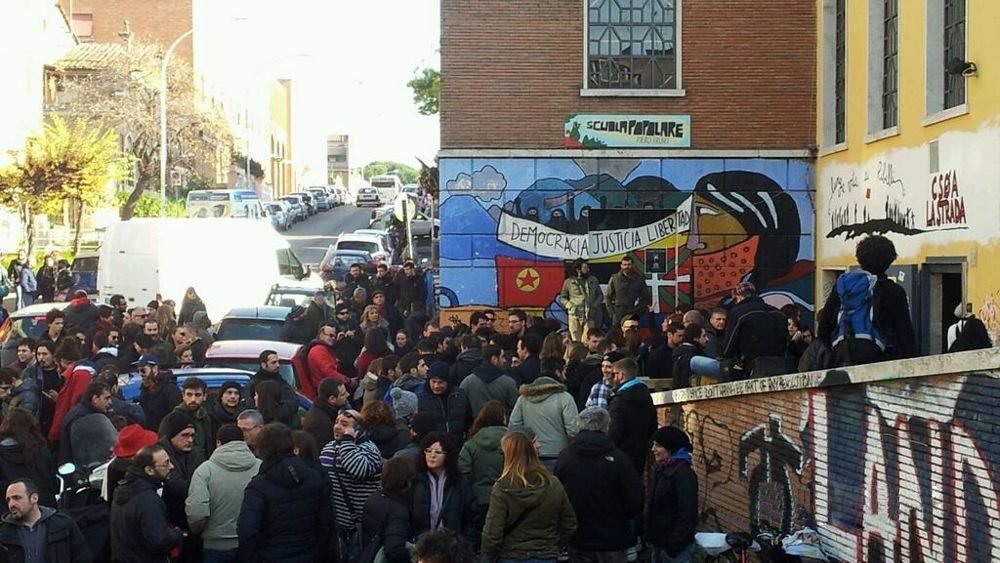
Where. Via Francesco Passino 24, Garbatella, Rome. The entrance is under the body of the neighborhood's covered market, at the point where the public housing blocks of the 1920s open onto a narrow, residential street. The Garbatella stop on Metro line B is a few minutes' walk away.
What it is. One of the historic nerve centers of grassroots culture and solidarity in Garbatella: an occupied, self-managed social center born on October 8, 1994. Concerts and punk festivals, solidarity initiatives, a people's bike workshop, a people's school, a study room, a social and legal help desk, a summer terrace and much more. 32 years of continuous activity in the same building.
How it works. Self-management. There is no artistic director, no press office, no box office. There is an assembly that meets on Monday evening and decides what gets done. The activities are free or at popular prices, and this is not a promotional slogan: it is the internal rule the assembly has given itself and repeats in every public document it produces.
One thing is worth saying right away, because anyone who arrives here finds it written on the walls before even going in. La Strada has a declared political identity and does nothing to soften it. Antifascism, antiracism, antisexism are the three words the social center uses to define itself, in that order, from day one. Those who go in knowing where they are going in find one of the longest-lived and most deeply rooted self-managed spaces in southern Rome, with real cultural output and a network of neighborhood services that has worked for 30 years. Those who go in by chance, drawn by a concert or by the sign for a benefit dinner, find themselves facing an explicit proposal, one that doesn't pretend to be neutral and has no reason to. The two things coexist, and in Garbatella they have coexisted for so long that nobody in the area notices anymore.
What happened on October 8, 1994
The date is precise and the social center repeats it every year, because the anniversary is its main party. On October 8, 1994 a group of high school and university students occupies a space that had been unused for more than 10 years in the premises of Garbatella's covered market. It wasn't just any warehouse: it was the former Enal club on Via Passino, reduced in the meantime to a storage place for seized furniture and dusty paperwork. The group had first tried to obtain its management through ordinary channels. Faced with silence, it chose the path of occupation.
The step is told in a dry way in the social center's materials and in the local news reports that followed its anniversaries: an abandoned building is occupied in order to give it back to the inhabitants through practices of self-management. The wording sounds like a formula. Looking at what got started in the first months, it sounds much less like a formula and much more like a work program.
The first activities were, in order: a help desk for people with drug addiction, because in the mid-1990s heroin was still claiming very young victims in Rome's outskirts and the public service didn't reach everywhere, a desk for foreign people who wanted to regularize their status, a study support service for the neighborhood's kids, concerts, shows, exhibitions, and, for the older residents of the housing blocks, a dance hall with a fixed Monday appointment.
It is worth rereading that list. It contains, in no particular order, harm reduction, the migrants' desk, after-school help, the concert hall and ballroom dancing for the elderly. It is a list that resembles no stock image of the 1990s social center, and that instead describes precisely the way this kind of space has really worked in Italian working-class neighborhoods: as an improvised social first-aid station, kept going by 20-somethings, which took care of the things nobody else within a kilometer took care of.
The covered market, and why it matters that it's there
The location of the space is the first thing that surprises anyone arriving for the first time. It isn't an isolated warehouse on the outskirts, it isn't a decommissioned military fort, it isn't an abandoned factory. It is a space under the neighborhood market, inside the building fabric of an inhabited neighborhood, with the balconies of the housing blocks looking out practically over the door.
This changes everything, and anyone who frequents Roman social centers understands it in five minutes. A social center in an isolated building can do whatever it wants until 4 in the morning and have no relations with anyone. A social center under the market, with neighbors above, has to negotiate its existence every single day: the volume, the hours, the audience leaving, the cleaning of the sidewalk. 30 years of that negotiation produce something you notice right away and that is hard to explain to someone who has never been there: here the separation between those who frequent the social center and those who live in the neighborhood is much blurrier than elsewhere. In Garbatella many of the people who come in are the ones who live in the blocks above.
There is also a less romantic and equally real effect: a space this exposed is also a space easy to hit, and in the social center's history the attacks have not been lacking. I come back to this further on, because it is a part of the story that makes no sense to sweeten.
One last note on the covered market, because it explains part of the character of the place. The neighborhood markets built in Rome in the 1900s were conceived as social infrastructure before being commercial: the point where the neighborhood met every morning. With the decline of small retail many of these buildings have lost stalls and functions, and the Garbatella case is no exception: the social center itself, in 2020, devoted a public statement to the abandonment of the farmers' market on Via Passino, pointing to a year of inactivity of a space that could have served the neighborhood. It is a recurring and not at all ideological theme: what do you do with public containers when the function they were born for runs out. The answer given here in 1994 was to occupy one and fill it with something else. 30 years later, the question is still open for the rest of the building.
It is worth adding that the network this space belongs to doesn't end at the neighborhood. La Strada appears among the nodes of very different Roman realities: the association that works on the right to housing and that comes out of the housing movement's experience, the women's house carved out of a 1920s small building in the Cinecittà area, which since 2008 has offered housing support and cultural activities, the citywide solidarity networks that pool services and tools among associations. Putting these names together serves to understand one thing: the neighborhood dimension is the level at which this kind of experience is seen, but it is not the level at which it is organized.
A curiosity about Csoa La Strada
The nicest curiosity concerns what was inside that space on the morning of the occupation. Not rubble, not industrial equipment, not an empty warehouse: seized furniture. The space of the former Enal club had become a depot of confiscated furnishings and papers, piled up and forgotten for over a decade.
If someone wanted to build a metaphor for 1990s Italy at a desk, they would struggle to find a more effective one: under the market of a working-class neighborhood born to house the workers of a port that was never built, a recreational club of a closed after-work organization, filled with furniture taken from someone for debts, and above all this the housing blocks with families who have lived there for three generations. The occupiers cleared out the furniture, swept the dust, gave it a coat of white paint and opened a help desk for people with drug addiction. In that order.
The second curiosity, minor but telling, concerns the names. None of the internal projects has a neutral name. The study room and the people's school are named after Piero Bruno. The bike workshop bears the name of Alfredo Martini. The food solidarity brigade is called Mompracem, which is the pirates' island of Salgari. The bar is called Garbatella Moonstomp, and anyone with a bit of Jamaican music knowledge recognizes at once the skinhead reggae and first-wave ska citation. The terrace is called Upstairs. The screen-printing workshop is called Helter Skelter. They are names chosen by people who read, listened to records and had opinions about what things are called, and put together they tell of a precise library and record collection.
The projects, one by one
The most honest way to describe La Strada is to list what lives inside it, because the space is not a concert hall with a few side activities: it is a container of projects that govern themselves and share the same door.
Scuola Popolare Piero Bruno. Homework help and study support for middle and high school girls and boys of Municipio Roma VIII. It comes from a collective of university students, works with the method of peer education and mutual aid, with older students, university students and former students who work alongside the younger ones two afternoons a week. The stated goal is to counter school dropout, which in the southern part of the city is a real and measurable problem. The project was inaugurated in 2014, stopped in 2022 and resumed its activities in the autumn of 2025, in the classroom next to the social center, aimed at those aged 10 and up. It is not isolated: it is part of a network of Roman people's schools that covers Tufello, Esquilino, Cinecittà, Trullo, Spinaceto and other neighborhoods, and that exchanges method and people.
Aula Studio Piero Bruno. It comes from a simple observation: in Rome there is a lack of places to study for free, and university libraries have hours and capacities that are not enough. The space is equipped with wifi, outlets, computer stations, dictionaries and reference books, and can host a few dozen people spread between the rooms of the people's school and those of the terrace. Opening follows the calendar of exam sessions, so it is not continuous: it depends on the months.
Ciclofficina Popolare La Strada, named after Alfredo Martini. Active since 2008. It is the project that more than any other explains the difference between a service and a self-managed workshop, and I come back to it shortly because it deserves its own paragraph.
Sportello socio legale Minerva. Run by the association Popica, it offers information and social, legal, health and rights support to those who need it, with access by appointment. It is the direct heir of that help desk for foreigners opened in 1994, and the continuity of that function through 30 years of different regulations is in itself a remarkable fact.
Brigata di Solidarietà Mompracem. Born in the hardest phase of the pandemic as a network for collecting and delivering basic necessities to struggling families in the neighborhood. The detail that sets it apart from a thousand similar initiatives: in inviting those who want to donate food, the social center explicitly asks to buy it in the small neighborhood shops rather than in big retail, because the goal is not only to fill the packages but to keep the local commercial fabric alive. It is an attention to detail that says a lot about the way of thinking of those who run it.
Helter Skelter. Art and screen-printing workshop. Posters, T-shirts, materials, graphics for the initiatives.
Garbatella Moonstomp. The bar, which accompanies all the afternoon and evening activities. Draft beer, long drinks, tea and herbal teas, music played by the bartenders. In a self-produced book on the social center's 20 years one of the regulars describes it as a sonic refuge, the place where you heard the music you didn't hear anywhere else: which is, after all, the most concrete cultural service a bar like this has ever provided.
Upstairs, the terrace. It opens in the good season, Thursday to Saturday from late afternoon, with music, performances, debates, film clubs and food. It looks out over the rooftops of the Garbatella housing blocks, and those who run the programming define it, with no great modesty, as the most beautiful terrace in southern Rome. The ranking is open to debate. The view much less so.
Courses and activities. Over the years the schedule has hosted courses in folk dances of central and southern Italy, from pizzica to tammurriate to the saltarelli of the former Papal States, and workshops in rhythm with signs, the collective improvisation method born in Argentina that lets an improvised orchestra play together from the first meeting. Tango, milonga, hip hop jams and ska nights appear regularly in the event categories.
Something nobody tells you about Csoa La Strada
That the concerts are the most visible part and the least representative part of what happens in here.
Whoever knows the name La Strada by hearsay almost always associates it with music: concerts, punk festivals, nights out. It is a legitimate association, because that part exists and is important. But if you count the time people spend inside this space, music takes up a minority fraction of the total. Most of the hours are made of after-school help, appointments at the legal help desk, bicycles taken apart on a stand, food packages prepared on Saturday morning, meetings. A social center that survives 30 years in the same place doesn't manage it through the quality of its line-up: it manages it because it has built around itself a sufficient number of people who, for very practical reasons, need that door to stay open.
This, by the way, explains a phenomenon that from the outside looks curious: the broad-based solidarity the space receives when it is attacked. When in September 2025 a bomb went off at the entrance, the crowd that filled the square the next day was not made only of activists. There were teachers, parents, shopkeepers, people from the blocks. A structure that for years has given free tutoring to the children of half the neighborhood has a capital of relationships that no music programming can build.
The second little-told element is internationalism, which here is not an adjective but a series of trips. 1994 is also the year of the Zapatista uprising in Chiapas, and the newborn social center of Garbatella absorbs its vocabulary almost immediately. From 1996 the group begins a work of exchange with the Zapatista communities, first as international observers in the militarized zones, then taking part in the 2001 March for Indigenous Dignity, in the birth of the Caracoles in 2003, in the meetings of 2007. In 2002 that bond reaches inside the local institutions: the borough of the time, Roma XI, forms a twinning with the Zapatista autonomous municipality Vicente Guerrero, of the Caracol of Morelia. In that same 2002 a delegation goes to Palestine, in 2008 it returns with a project that brings non-professional athletes to play soccer and basketball with Palestinian peers. These are things a neighborhood social center normally doesn't do, and which here are part of the space's ordinary biography.
The bike workshop, the most concrete piece
If I had to point to a single activity that explains to an outsider what self-management means without any need for political talk, I would point to the bike workshop.
The Ciclofficina Popolare La Strada has existed since 2008 and bears the name of Alfredo Martini. The stated principle is very clear and worth reporting as it is: people's bike workshops are not shops. Bicycles are not sold, spare parts are not sold because the parts are free, no profit is pursued. What circulates are the tools, the salvaged parts and the manual know-how. You bring the broken bicycle, someone shows you how to take that component apart, and the next time you take it apart yourself and maybe show it to someone else.
Over the years the mechanics' collective has also worked on putting back in shape bicycles meant for self-funding auctions, and operates within the network of Roman people's bike workshops, in connection with the city's bike polo team and with the associations that deal with road safety for cyclists. The underlying theme, for those who run it, is not repair in itself: it is urban mobility and the way Roman public space has been designed around the automobile. But the conversation happens with hands dirty with grease, and it is a form of political outreach infinitely more effective than a conference.
Keep one thing in mind: the bike workshop, like the other projects, follows the cycles of available energies. Over the years it has gone through periods of suspension, and the opening calendar should always be checked before showing up with the bike on your shoulders.
My advice for visiting Csoa La Strada
The advice is twofold, and the first part is banal but decisive: before going, check the social center's social channels. Not the website. The social channels.
The social center's website is an extraordinary mine of documents, history and descriptions of the projects, and anyone who wants to understand this place should read it all the way through. But as a calendar it's no use: the project pages describe a setup photographed around 2021, and the live programming travels elsewhere. Instagram, Facebook and Telegram are the channels where dates appear, and on the Instagram account you get an answer with greater reliability than by email. This applies to all Roman self-managed spaces and is a structural feature, not an oversight: communication is done by whoever has time that week.
The second part of the advice is less obvious. If this place really interests you, don't come the first time for a concert. Come in the afternoon, on a weekday, when the help desk or the people's school is open, and stay an hour at the bar. A concert shows you a room full of people and tells you nothing: you could be in any venue in Europe. A Wednesday afternoon shows you two ladies bringing pasta for the packages, a kid doing homework at a table, someone inflating a tire in the courtyard and three people arguing about a deadline. That is the true picture of the space, and if it convinces you then come back in the evening too.
Third indication, for those with more serious intentions: the management assembly meets on Monday evening and is the place where everything is decided. Whoever wants to propose an initiative, a concert, a debate, a workshop, that is the address. There is no form, there is no curator to convince: there is a circle of chairs and a willingness to discuss it. It is very slow and it has worked for 32 years.
Last practical note, valid for any self-managed space: here you don't buy a ticket, you leave a contribution. The benefit dinners, the pay-what-you-want concerts and the bar are the way the structure pays its bills and funds the free projects. Whoever comes in and has something contributes to someone else's after-school help, literally. And it is basic good manners not to take photos of people without asking: in a space where those who need a legal help desk pass through, anonymity is not a pose.
The Garbatella around it: 1920, the housing blocks, the port that isn't there
You can't understand La Strada without understanding where it is, and Garbatella is one of the best-documented and most misunderstood neighborhoods of Rome.
The first stone dates to February 18, 1920, laid by Vittorio Emanuele III in Piazza Benedetto Brin. The stated intention in the inscription set into the wall in the square was to offer quiet and healthy lodging to the makers of the economic renaissance of the Capital: public housing for workers. But the project was bigger and wasn't about the houses. Rome was to be connected to the sea by a navigable canal parallel to the Tiber, with a commercial port less than 200 meters from the Aurelian Walls, around today's Via del Porto Fluviale. The new housing blocks were to host the workforce of that port.
The canal was never dug and the port never existed. What remained were the houses and the place names, which are almost entirely nautical: the shipowners, the divers, the navigators, the passengers. Walking through Garbatella means crossing the nomenclature of an imaginary port, built around an infrastructure nobody ever saw. Few neighborhoods in the world have an urban-planning fossil of this quality.
The neighborhood was built in numbered blocks, with the garden city formula: low buildings, inner courtyards, staircases, vegetable gardens, shared green space. The idea of putting gardens into public housing was explicitly pursued by the administration of the time, and the result is that even today Garbatella is one of the few working-class Roman neighborhoods where the air you breathe between one building and the next is not that of a dormitory. In the following years the neighborhood also took in many families displaced by the demolitions in the historic center, those of the Spina di Borgo to make Via della Conciliazione and those sacrificed to Via dei Fori Imperiali: that is where Garbatella's reputation as a neighborhood of old-time Roman identity comes from.
On the name there are at least 4 hypotheses. The most widespread holds that it derives from the nickname of an innkeeper particularly kind to pilgrims, the Garbata Ostella contracted into Garbatella. A study published in 2019 in the volume Garbatella 100, il racconto di un secolo proposes a more precise and more prosaic reconstruction: the name would be the nickname of Clementina Eusebi, who between 1835 and 1850 ran the inn at the origin of the place name, and would derive from her mother's surname, Maddalena Garbata, widow Eusebi. To tell them apart, the mother was la Garbata and the daughter la Garbatella. Another hypothesis, with some agronomic basis, traces it back to the type of vine training called a garbata, used on the land of the area.
Politically the neighborhood is historically left-wing and working-class, and during the Nazi occupation it was a support for the Resistance on a par with Ostiense, Portuense and Testaccio. This did not make it monolithic: Garbatella has given significant support to very different forces in different elections too, and whoever describes it as a compact bloc is oversimplifying. It is undeniable, however, that the identity of a rebel neighborhood is part of the way Garbatella thinks of itself, and that this self-image has made possible things that elsewhere would have lasted six months.
A piece of data that helps show how dense the local network is: within a few minutes' walk of Via Passino there have been, for years, other self-managed and associative experiences, from the urban gardens to the Casetta Rossa, which since 2001 has carried on a people's bakery, a buying group, workshops and walks. The housing occupations of the CaSette, on Via delle Sette Chiese, began in the autumn of 2003 with about 10 Italian and migrant families. It is an ecosystem, not a sum of isolated cases, and the nodes have been collaborating for 20 years.
Another well-known fact, yet rarely cited
That elected public officials have come out of this social center, and that the move was decided in assembly.
It is a fact that anyone who frequents the area knows and that is rarely laid out in full, perhaps because it upsets the schemes with which the relationship between occupied spaces and institutions is usually told. In 1997, together with the social center Corto Circuito, La Strada decides to test itself in the local elections by running two independent candidates on the lists of Rifondazione Comunista: Luciano Ummarino for Municipio XI and Nunzio D'Erme for the City of Rome. The social center itself, in its own materials, calls that choice unpopular at the moment it was made. Both were elected.
From then on the institutional presence has never stopped. Amedeo Ciaccheri, an activist of the social center, was a borough councilor and later president of Municipio VIII, the one that includes Garbatella and Ostiense: in 2014, interviewed after the fires that had hit the space, he still answered as an activist of the social center and borough councilor.
The interesting point is not the careers of the individuals. It is that a part of the Roman movement of occupied spaces chose very early not to stay out of the institutional game, while keeping the occupation at the same time, and has managed this double belonging for almost 30 years. Anyone who thinks social centers and local administration are two worlds that touch only in evictions misses a considerable part of how southern Rome really works. It is also the reason why La Strada, unlike other Roman spaces, has never undergone an eviction: its existence has been negotiated, contested and politically defended, inside and outside the elected bodies, for three decades.
A second well-known and underrated fact concerns mutualism. From the self-managed housing desk, over the years, came an experiment with a municipal desk in defense of housing rights, with free legal advice and support in eviction procedures. From work with the Afghan citizens who crowded around the Ostiense Air Terminal came a path that led to the Casa del Rifugiato di Roma. These are institutional outcomes of practices that began as volunteer activities inside an occupied space, and they are documented.
How to get there, and what's around
Metro line B is the backbone of this whole quadrant and makes Garbatella one of the easiest Roman neighborhoods to reach. The Garbatella stop is a few minutes' walk from Via Passino. From Termini it is about a dozen minutes by metro, with a change at Piramide or a direct ride depending on the line you take.
Around it there is a concentration of things to see that few other parts of Rome put together in so little space. A short distance away, the Basilica of San Paolo fuori le Mura, one of the four papal basilicas, above which rise the hills that gave this height its first name. Inside the Commodilla park, the entrance to the Catacombs of Commodilla, with a small underground basilica from the late 4th century. On Via Ostiense, the Centrale Montemartini, which displays classical marbles among the turbines of a thermoelectric power plant and is probably the most beautiful museum in Rome for those who love short circuits, and the Museo della Via Ostiense inside Porta San Paolo. A little farther on the Pyramid of Cestius, and across the Tiber the Nuovo Mercato Testaccio and the open-air museum of the Testaccio district. In the opposite direction, EUR, that is, the architectural account of the regime, a few stops away from a neighborhood that was anything but complicit in that regime.
Anyone who wants to understand how the cultural network of this quadrant works today can look at a widespread festival like L'Aperossa between Garbatella and Ostiense, which works across several venues within the same 20-minute walking radius. The fact that a historical archive, a municipal museum and a social space can sit inside the same program says a good deal about how this area has learned to come to an agreement.
The right photo to take at Csoa La Strada
The wrong photo is the one everybody takes: the entrance with the banner, from the front, in broad daylight. You get a readable photograph with no content at all, identical to a thousand others, which communicates only that you were there.
The right photo is taken by looking up. Step back about 20 meters along the street and frame the social center's door together with what is above it: the structure of the covered market and, behind it, the balconies of the housing blocks with laundry hanging out and plants on the windowsills. That frame contains the whole story in a single image. An occupied social center that lives in the basement of a neighborhood's daily life, not outside the world but under people's homes. No caption explains the relationship between these two things better than a shot that holds them together.
The best light is in the late afternoon, when the low sun passes between the blocks and cuts across the street sideways: Garbatella is built on a rise, and the play of light between the staircases and the courtyards is the reason so many photographers come to work here. In the early morning the same street is in shadow and the photograph comes out flat.
If you happen to be here on an evening when the terrace is open, the second photo to take home is from above: the rooftops of the blocks, the antennas, the profile of the neighborhood sloping down toward Ostiense and, on the right day, the dome of San Paolo in the background. It is a viewpoint you can't get from any public lookout, because those rooftops are only visible from up there.
Two warnings, said once and valid always. The first: people. In a space where minors, asylum seekers and people turning to a legal help desk come through, a camera pointed at someone is a gesture that can do real harm. You ask, and if the answer is no the answer is no. The second: during assemblies and debates you photograph only with the consent of the speaker. These are rules nobody will recite to you at the entrance and that everyone expects you to know.
The Roman punk and hardcore scene, a framing
This space's old profile talks about punk concerts and festivals, and the phrase deserves some context, because otherwise it risks sounding like a detail of local color.
Italian punk and hardcore of the 1980s and 1990s was a historical phenomenon with very specific characteristics, and the main one is that it developed almost entirely outside the commercial circuit. No labels, no radio, no licensed venues: self-production of tapes and records, photocopied fanzines, distribution by mail, and occupied spaces as concert venues. For an entire generation of Italian musicians, the only stage available was the stage of a social center, and the only organizational structure available was a collective of 20-somethings setting up the sound system.
In Rome this circuit had a particular density, and La Strada fits into that system starting in 1994. It should be said clearly that the great Roman hub of that scene, the one most cited in reconstructions, is another space in the east of the city, occupied a few years earlier. But the geography of that circuit was not made of a single node: it was a network of dozens of spaces, and Garbatella was one of its reference points for the southern quadrant, where before there was essentially nothing like it.
The legacy of that system can still be seen today in the way this place treats music. Concerts are not programmed with box-office logic, prices stay popular, the stage is opened even to bands that have no audience at all, and genres mix without too much ceremony: punk, ska, reggae, rap, jazz, tango, folk dances and hip hop nights coexist in the event categories. It is exactly the programming model that no commercial operator could afford, and that has survived only where the venue doesn't have to turn a profit to pay the rent.
On this point the social center is explicit in a way worth reporting: in its own materials it defines itself as the only youth reality in the borough that offers music and culture at popular prices. A partisan claim, obviously. But anyone who knows the paid cultural offer of the southern quadrant has trouble denying it entirely.
Some important events that took place here in history
Here is what is documented, with dates, because a chronology says more than any adjective.
October 8, 1994. The occupation. High school and university students enter the former Enal club on Via Passino, abandoned for more than 10 years. In the following months the help desk for people with drug addiction, the desk for foreigners, the study support, the first concerts and the Monday dance hall get started.
1996. The work of exchange with the Zapatista communities of Chiapas begins, which over the years will bring Roman delegations to Mexico as international observers.
1997. The electoral choice. Together with the social center Corto Circuito, La Strada runs two independent candidates who are elected, one to Municipio XI and one to the City of Rome.
2001. Participation in the March for Indigenous Dignity in Mexico. These are the years in which the experience of the Tute Bianche and the Disobbedienti runs through the Roman movement.
2002. Institutional twinning between Municipio Roma XI and the Zapatista autonomous municipality Vicente Guerrero, of the Caracol of Morelia. In the same year a delegation leaves for Palestine.
Autumn 2003. The CaSette are born on Via delle Sette Chiese: more than 10 Italian and migrant families occupy some small abandoned dwellings.
2008. The Ciclofficina Popolare opens, named after Alfredo Martini. In the same year the project Sport sotto l'assedio brings non-professional athletes to Palestine.
Late December 2013. Repeated fires hit the premises on Via Passino around the Christmas days. The investigations will never clarify the dynamics. The social center speaks openly of arson and of intent to intimidate, and in the following months neighborhood solidarity funds the rebuilding of the spaces.
2014. The Scuola Popolare Piero Bruno is inaugurated.
May 2016. New flames hit the social center, again with evident arson origin according to local reports.
2020 and 2021. In the pandemic phase the Brigata di Solidarietà Mompracem is born and takes shape, with monthly distribution of hundreds of food packages to the neighborhood's families, together with the social and legal help desk and the citywide solidarity network the social center belongs to.
January 2023. Within a few days the space hosts an Italian rap night with Kento, who presents a new single, and the presentation of the book Niente da dimenticare by Guido Viale, historic leader of Lotta Continua, in conversation with the writer Erri De Luca and the photographer Tano D'Amico. The audience is so large that a streaming link is set up with the nearby Casetta Rossa so that everyone can follow.
May 2023. Presentation of the book Processo alla solidarietà. La Giustizia e il caso Riace, in the presence of Mimmo Lucano.
October 2024. 30 years. The celebrations run from Tuesday, October 8 to Sunday, October 13, with the opening of an exhibition on the 30 years, debates on the Kurdish and Palestinian questions, meetings on the environment and antifascism, film clubs, concerts and a musical walk through the streets of Garbatella on October 11. The title chosen is a quotation: we started young and we will end young. A few days earlier, at the beginning of October, an explosive device had been set off against the space.
May 15, 2025. A pipe bomb goes off at the entrance and destroys the door.
September 12, 2025. At 4:08 in the morning a third device explodes against the entrance. Next to it, traces of gunpowder are found, along with a banner with an insult aimed at a former member of parliament of the Five Star Movement, with no direct link to the space that was hit. No injuries, material damage, investigations by the forensic police and bomb squad. The following day the neighborhood takes to the square, expressions of solidarity arrive from unions and national newspapers, and the social center calls a public assembly.
October 8, 9, 10 and 11, 2025. 31 years, with the title In alto mare, in viaggio negli abissi del presente. Four days: the opening benefit dinner, a public assembly on the 50 years since the death of Piero Bruno, a historical meeting on Italian migration to California between the 1800s and the 1900s and on contemporary US migration policies, with Tommaso Caiazza, Ilenia Rossini, Luca Celada and Mattia Diletti, an evening on rebel Ireland with a talk moderated by Matteo Mirabella and the screening of the film about the Belfast hip hop group that raps in Gaelic.
October 2025. Public meeting with Basel Adra, co-director of the Oscar-winning documentary No Other Land.
November 2025. Two days of remembrance for the 50 years since the killing of Piero Bruno, on November 21 and 23, under the title Era la migliore gioventù: meetings, music, theater. In the same weeks the Scuola Popolare Piero Bruno, closed in 2022, reopens in the classroom next to the social center.
Spring 2026. Screening of the documentary Cutro, 94 and more, devoted to the shipwreck at Steccato di Cutro and its 94 victims, with the support of the networks that deal with migrants' rights.
On Piero Bruno it is worth spending a few more lines, because his name recurs twice inside this space and those who aren't Roman don't know who he was. Piero Bruno lived in Garbatella, studied at the Armellini technical institute in San Paolo, was active in Lotta Continua and was 18 years old. On November 22, 1975 he took part in a demonstration for the recognition of the People's Republic of Angola, just out of Portuguese colonialism. He was hit by gunfire from the police and died the following day. The investigations never led to a trial, and the case was closed in 1976. That the people's school and the study room of a Garbatella social center bear his name 50 years later is not a decorative tribute: it is the way a community decides what to remember and how. In those same years Lotta Continua had an office on Via Passino, a few steps from where the social center is today, and this geographical coincidence has not gone unnoticed by any of the protagonists.
The attacks, and why they should be told for what they are
There is a thread in that chronology that makes no sense to hide in a footnote: fires in 2013, flames in 2016, devices in October 2024, in May 2025 and in September 2025. The social center has stated that it counted, in less than a year, dozens of episodes of threats, vandalism and damage. In the same area, murals and installations tied to solidarity with Palestine have also been hit.
Telling it is a duty for three reasons. The first is reporting: it happened, it is documented by national and local newspapers, and it is part of the space's history as much as the concerts. The second is context: it helps understand why a community develops the wariness toward strangers with cameras described above. The third is a sense of proportion: a place that has suffered repeated attacks for over a decade and that the next day reopens the people's school is saying something about its own idea of continuity that no press release could say better.
What I will not do is try to establish responsibilities that the investigations have not established. The dynamics, as the social center itself has said on several occasions, have remained obscure. The attributions that circulated in public debate have remained hypotheses. A text like this can report the established facts and the statements of the parties, and must stop there.
Who has passed through Csoa La Strada
The correct list for this place is not a list of celebrities, and it is good to know that before reading it. 32 years of programming at popular prices mostly produce names you don't know, bands at their first concert, collectives that lasted two seasons. That said, a few documented appearances exist and are significant.
Guido Viale, among the historic leaders of Lotta Continua, presented his book Niente da dimenticare here in January 2023, in an evening that filled the room with old militants and the curious.
Erri De Luca and Tano D'Amico were with him on that stage: the writer, and the photographer who more than anyone else fixed the images of the Italian movements of the 1970s.
Mimmo Lucano, the former mayor of Riace, was a guest in May 2023 for the presentation of a book on the judicial proceedings that concerned him.
Kento, a Calabrian rapper and writer, author of books on writing workshops in juvenile prisons, presented a new track of his here in January 2023.
Basel Adra, Palestinian co-director of the Oscar-winning documentary No Other Land, took part in a public meeting in October 2025.
Amedeo Ciaccheri is the most interesting case, because he is not a guest but an in-house product: activist of the social center, then councilor and then president of Municipio VIII. Before him, down the same road, had come Luciano Ummarino and Nunzio D'Erme, elected in 1997.
At the end of every list of this kind there is a residue worth more than the list. The hundreds of girls and boys who did their homework at a table of the people's school and who are 30 today. The volunteer mechanics of the bike workshop who taught a few thousand people to change an inner tube. The neighborhood families who picked up a food package in a hard year. The foreign people who got free legal advice when nobody else gave it to them. These are passages that end up in no press review, and they are the reason this place still exists.
What to expect, concretely
I'm summing up for those who really go, without rhetoric.
The space doesn't look like a club. There are no uniforms, no coat check, the bathroom is what it is, the setups are self-built and the internal signage is scarce. This is not neglect: it is the predictable result of a structure that puts every available euro into the free activities rather than the furnishings.
Prices are low by any Roman standard, and on fundraising nights you pay an entrance contribution, not a presale ticket. The bar generally accepts cash, so it's best to have some.
The audience is more varied than the popular image suggests. On an average evening you cross paths with university students, activists, neighborhood families, 60-year-olds who have been coming to the space since they were 30 and teenagers from the blocks. It is not an environment hostile to those who come from outside, as long as you arrive as a guest.
The programming is irregular by definition. There are very busy weeks and weeks when nothing happens, and periods of closure or suspension of the projects exist and are normal in a structure with no salaried staff. The calendar should always be checked before setting out.
Finally: if the space's declared political identity doesn't sit well with you, that is not a good reason to pretend not to know it before going in, nor to go in looking for a fight. A self-managed social center is not a neutral public service and is the first to say so. Those who go knowing what it is get along fine. Those who go expecting something else do not. No further nuance is needed.
The picture, in the end
32 years in the same basement of a neighborhood market, with no eviction, with a people's school that reopens after three years of pause and a chronology of attacks never cleared up, are a result that speaks for itself. La Strada is not the biggest social center in Rome, it is not the most famous and it is not the one that appears in documentaries on Italian counterculture. It is, however, one of the very few that has crossed three decades holding together three things that usually exclude each other: music, neighborhood mutualism and presence in the elected bodies.
Garbatella, for its part, keeps producing places like this with a regularity that seems topographical before it is political. A neighborhood built around shared courtyards, staircases and common green space generates, by urban form, occasions for encounter that neighborhoods built around cars do not generate. The port was never dug, but the garden city that was meant to serve it is still here, and it works.
Anyone who arrives on Via Passino on an ordinary day, maybe finding the door closed because it wasn't the right day, would do well to walk a bit farther among the blocks before leaving. That is how this neighborhood lets itself be understood: walking inside it, looking up, counting the staircases. The social center is a piece of that story, not a separate attraction.
Frequently asked questions about Csoa La Strada
Where is Csoa La Strada located and how did it begin?
Csoa La Strada is in Garbatella, in Rome, inside the spaces of the neighborhood's covered market on Via Passino. It began on October 8, 1994, when a group of high school and university students occupied a space that had been unused for more than 10 years, the former Enal club, then reduced to a storage place for seized furniture.
How do you get to Csoa La Strada by public transit?
Metro line B is the easiest way to reach Csoa La Strada: the Garbatella stop is a few minutes' walk from Via Passino, and from Termini the metro trip takes about a dozen minutes, with a possible change at Piramide depending on the line.
What music do you hear at Csoa La Strada?
Csoa La Strada has historically been associated with the Roman punk and hardcore scene, with concerts and festivals that in the 1980s and 1990s developed almost entirely outside the commercial circuit. Music remains a visible part of the social center's activity, though not the only one: it takes up a minority fraction of the total time lived in the space.
What can you do at Csoa La Strada besides concerts?
Besides music, Csoa La Strada hosts several self-managed projects, among them the Scuola Popolare Piero Bruno, a homework help and study support service for middle and high school girls and boys of Municipio Roma VIII, and the Ciclofficina Popolare La Strada, active since 2008.
What is the Ciclofficina Popolare at Csoa La Strada?
The Ciclofficina Popolare La Strada, dedicated to Alfredo Martini, has been active since 2008 inside the social center. It follows the stated principle of people's bike workshops, which don't work as shops: bicycles and spare parts are not sold.
How do you know if there is an event scheduled at Csoa La Strada?
To find out what is happening at Csoa La Strada, check the social center's social channels, not the official website. The website collects the history and the description of the projects, but as a calendar it is not up to date, while the social pages reflect the most recent programming.
Has Csoa La Strada been attacked over the years?
Csoa La Strada has suffered several documented episodes of damage over its history, including fires in 2013 and 2016 and devices in October 2024, May 2025 and September 2025. The social center has stated that it recorded, in less than a year, dozens of episodes of threats, vandalism and damage.
If this tour is really for you
Two useful addresses for those who want to go beyond reading. If you lead groups, build itineraries for others or work in hospitality and guiding, the tools and materials of TourLeaderPro are designed exactly for those who have to put together routes that hold up in the field, including the less touristy ones and those harder to explain to a group. If instead you are planning your own trip to Italy and want to work out how to fit Rome in with the rest without wasting days, ItalyPlanner is the right place to line up stops, transfers and priorities. Two different needs, same underlying logic: first you understand a place, then you decide what to do with it.
Contact Information
Via Francesco Passino, 24
Roma Roma Città, Roma Città