Fontanella degli innamorati
In short. On the right side of the Trevi Fountain, set against the wall that closes the square toward Via della Stamperia, there is a rectangular travertine basin with two small spouts.
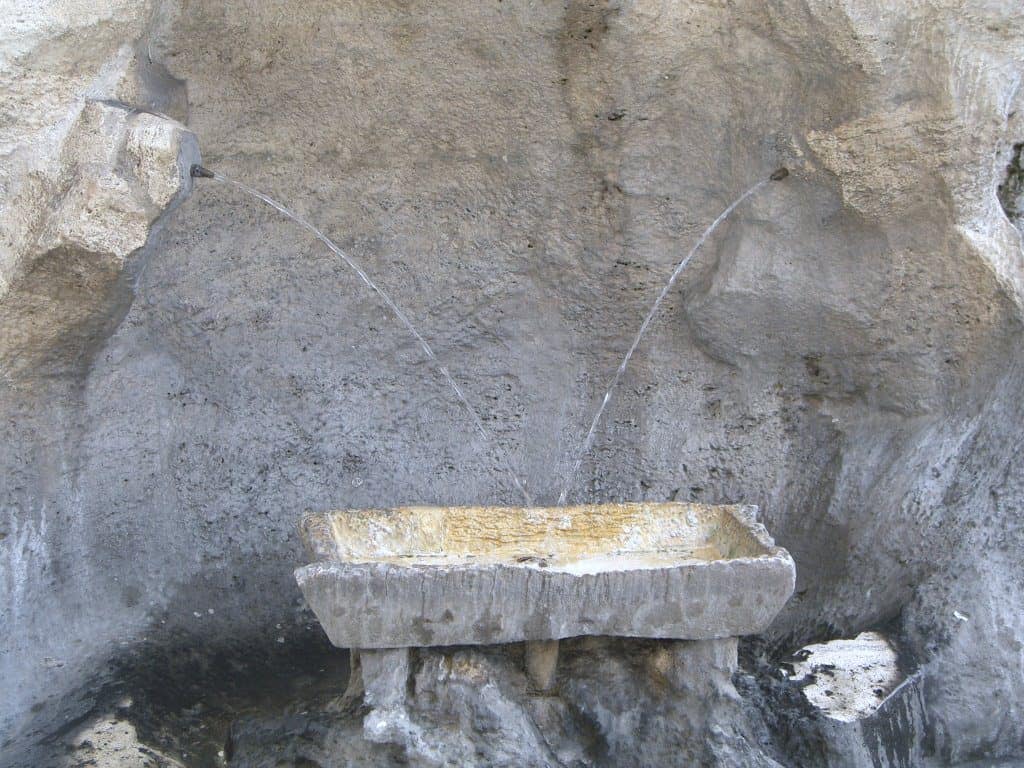
On the right side of the Trevi Fountain, set against the wall that closes the square toward Via della Stamperia, there is a rectangular travertine basin with two small spouts. It has no statues, no monumental inscriptions, no sign to explain it. Anyone arriving in Piazza di Trevi looks up, toward Oceanus and the sea horses, and walks half a meter from this basin without noticing it. Yet Romans have given it a name that says it all: fontanella degli innamorati, the lovers' little fountain.
This has to be said right away, because otherwise the rest makes no sense: this is not an independent monument but a functional detail of the same architectural machine. The Trevi Fountain was born as the end point of an aqueduct, and an aqueduct end point, in the Rome of the popes, always had two faces: the spectacular one, aimed at the public and at propaganda, and the practical one, aimed at people who actually had to collect the water, with a jug or a cup. The basin with the two spouts belongs to the second face. It was for drinking. Then, at some point, a story was built on top of it.
The story is the one about the glass: two sweethearts drink together from the fountain before parting, the glass is broken, and from that moment nobody can separate one from the other. It's folklore, and as folklore it should be told: an oral Roman tradition, also reported by the official tourism portal of Roma Capitale, which calls it exactly that, a tradition and not a documented fact. No archive holds the record of the first broken glass. But this takes nothing away from the place. If anything, it explains why an anonymous travertine basin has a proper name while dozens of identical little fountains scattered around the city have none.

Where the Fontanella degli innamorati Is and How to Really Get There
Mental coordinates, before street ones. Piazza di Trevi belongs to the rione Trevi, the second rione of Rome, a small patch squeezed between the Quirinale rising and the Corso descending. The name of the rione and of the square comes, according to the current reading reported by the official tourism pages of the capital, from a medieval place name tied to the meeting of three streets in the open space, or to the triple water outlet of the fountain that preceded the current one. The two explanations have lived side by side for centuries and neither has been settled for good.
The square is small. Anyone arriving for the first time is always surprised: from outside it seems a big open space must be coming, and instead you enter a funnel. The fountain takes up an entire side, backed against the facade of Palazzo Poli, and the free space in front is barely enough to hold the crowd that packs the steps every day. For this very reason the side basin works as a valve: it lies outside the cone of attention, in a corner where people pass but don't stop.
To find it, the simplest method is this. Stand in front of the fountain, with Oceanus in front of you. Look at the right end of the scenery, where the travertine rustication meets the wall of the square. There, about a meter off the ground, you see a low rectangular basin, a little more than an arm's length wide, with two spouts close together. It has no mask, no coat of arms, no date. Anyone expecting a decorative element steps over it with their eyes. Anyone looking for a service basin finds it in three seconds.
There are four ways into the square, and they are not equal. Via delle Muratte comes from the Corso and is the busiest route, the one for groups: anyone entering here finds the fountain straight ahead, gets the full scenic effect and stays stuck in the flow. Via della Stamperia comes from the side of the Traforo and the Accademia di San Luca, and you come out exactly on the side where the fontanella is: this is the entrance for anyone looking for it. From Via di San Vincenzo you come down a slight slope past the church of Santi Vincenzo e Anastasio, and from Via Poli you enter from the side, from the opposite direction.
By public transport, the real reference point is the Barberini stop on metro line A: from there you walk along Via del Tritone and then down toward the square, seven or eight minutes at a normal pace. Anyone coming from Spagna, also line A, takes more or less the same time, via Via del Tritone or the inner lane of Via Poli. Anyone coming by bus gets off on the Corso, at Piazza Colonna or a little further down, and takes Via delle Muratte. By car the answer is simple: don't. The whole area is inside the limited traffic zone of the historic center and street parking is a chimera.
The tip is about the last stretch. If you arrive from Via della Stamperia, in the last 20 meters it's best to stay on the left side of the street: you come out into the square already on the right side, without having to cross the mass occupying the middle of the open space. If instead you arrive from Via delle Muratte at peak hours, the advice is the opposite: don't even try to cut across, better to follow the perimeter of the square keeping close to the buildings until you reach the right corner.
One thing needs adding about accessibility. The square is on a slope and the central part is laid out as steps down to the big basin. The area where the fontanella stands, though, is on the upper level of the street: anyone moving with a wheelchair or a stroller reaches it without facing steps, entering from Via della Stamperia. It's one of the few elements of the Trevi Fountain that can be approached without going down.
What the Fontanella degli innamorati Really Is: A Service Basin, Not a Monument in Itself
Here a distinction is needed that almost no guide makes, and that changes how you look at the object. In the Roman vocabulary of public waters there are two different families. On one side the mostre: monumental architectures built at the end of an aqueduct to declare, with marble and statues, that this water has reached the city and that someone brought it. On the other the fontanelle: tiny delivery points, scattered through the rioni, made for daily use, with no aesthetic pretensions.
The Trevi Fountain belongs to the first family in a spectacular way: it is the Mostra dell'Acqua Vergine, and the word mostra means exactly a showcase, a place where the arrival of the water is put on stage. The side basin belongs to the second. The interesting thing is that they stand a meter and a half from each other, set in the same block of travertine. In the same structure the papal rhetoric and the neighborhood jug live together.
This coexistence is no accident and no oversight by the designer. Roman monumental mostre were almost always accompanied by usable draw points, because the water of a restored aqueduct also served, and above all, to supply the neighborhood. A fountain that merely sprayed water into a decorative basin would have been, in the mindset of 18th-century Rome, an incomplete object. The water had to reach the people and the people had to be able to take it without stepping into the big basin. Hence the basin with the two spouts: low, convenient, reachable from street level.
The popular name comes much later than the function. First there was a water intake, then a habit of couples drinking there, then the name. Anyone who tells the sequence backwards, as if the basin had been built for lovers, is telling a pleasant but upside-down fairy tale. The honest version is that a piece of hydraulic infrastructure absorbed a sentimental meaning because of its position: in a square that everyone visits at least once, secluded just enough to do something as a couple without being watched.
It's worth comparing it with other fountains in the same city to see how unusual it is. The Barcaccia Fountain at the foot of the steps of Piazza di Spagna is fed by the same aqueduct and has a low rim you can drink from, but it is a signed, recognizable monument. The Triton Fountain in Piazza Barberini is pure sculpture, with water coming out of the shell lifted by the Triton. The Fountain of the Four Rivers in Piazza Navona is pure theater. The Acqua Paola Fountain on the Janiculum is a triumphal arch disguised as a fountain. None of these has, next to it, an element so humble that it became famous for its very modesty.
Then there is the question of the material. Travertine, the stone of Tivoli, is the basic material of the whole Trevi scenery: the artificial cliff from which the horses emerge, the rocks, the side rustication. The basin is made of the same substance, and this makes it visually invisible: it doesn't stand out from the background, creates no color contrast, doesn't call the eye. An architect would say the designer chose not to emphasize it. A Roman would say more simply that it was for drinking, not for being looked at.
The Water from the Two Spouts: The Acqua Vergine and Its Aqueduct
Anyone drinking at the fontanella degli innamorati is drinking water from the Aqua Virgo, the Vergine aqueduct. This is the point that makes the gesture much less trivial than the sentimental postcard. The official tourism portal of Roma Capitale defines the Vergine as the only ancient aqueduct that has remained in continuous use to this day. It isn't an advertising formula: it is a remarkable historical anomaly, because all the other great imperial aqueducts were interrupted, abandoned, dismantled or rebuilt from scratch in modern times.
The aqueduct dates to the age of Augustus and is attributed to Marcus Vipsanius Agrippa, the emperor's son-in-law and architect of the hydraulic reorganization of the Campus Martius. Agrippa needed water for his baths and for the monumental complex he was building in the area where the Pantheon stands today. The Vergine solved the problem: it brought water from springs east of the city, in hill country toward present-day Salone, along a route that was largely underground.
The underground route is exactly what explains its survival. The aqueducts that ran on arches in the Roman countryside were vulnerable: cutting a few piers was enough to put them out of service, and in the Gothic wars of the sixth century that is exactly what happened. The Vergine, instead, ran almost entirely underground, in tunnels cut into the tuff bedrock. Damaging it required systematic work that no besieger felt like doing. So the water kept arriving, maybe in reduced quantity, maybe with interruptions, but it kept arriving.
The name deserves a line. On the reliefs decorating the upper part of the fountain you can see two scenes: on one side a virgin pointing out a spring to some Roman soldiers, on the other Agrippa ordering the construction of the aqueduct. The first scene illustrates the traditional etymology of the name: legend has it that a young girl showed the thirsty soldiers the spot where the water gushed out. This too, like the broken glass, is tradition and not chronicle: it is told because it has been told for centuries and because it is carved on the monument, not because any proof exists.
From a practical point of view, the water of the Vergine has a characteristic Romans know: it is softer than that of other city aqueducts, and for centuries this made it the favorite for certain household uses. Today the city's integrated water service is run by Acea, whose institutional website devotes specific sections to monumental fountains and public delivery points, the so-called nasoni and fontanelle. For the water coming out of the spouts, a common-sense rule applies and nothing more: it is water from the city's public network, subject to the checks required for the water service, and precise information on quality should be sought from the operator, not from a tourist guide.
A detail that almost always goes unnoticed: the water in the big Trevi basin is recirculated, while the water from the side spouts is running network water. The distinction matters. The coins thrown into the big basin end up in a closed circuit that is periodically cleaned, and the proceeds go to a charitable purpose managed by the city administration. The side basin, instead, is not part of that circuit: it is a delivery point. Anyone throwing a coin into it is not taking part in any rite, just dirtying a water intake.
A Curiosity About the Fontanella degli innamorati
The most amusing curiosity is the disproportion between the space this basin takes up in the square and the space it takes up in the city's oral storytelling. Physically we are talking about less than one square meter of travertine in a scenery that measures almost 350 in width by 20 in height. In terms of surface, the fontanella is a negligible fraction of the monument. In terms of stories told, it holds its own against Oceanus.
There is a precise reason, and it has to do with how collective memory works. Big monuments produce admiration, which is a cold, passive feeling. Small, usable objects produce gestures, and gestures are remembered. Nobody remembers having looked at a statue: everybody remembers having drunk from a fountain with a specific person on a specific day. The fontanella degli innamorati exists in the memory of Romans because you could do something there, not because it was beautiful.
Second curiosity, a more technical one. The spouts are two, not one. It seems trivial but it isn't: most Roman fontanelle have a single outlet. Two outlets side by side let two people drink at the same time, one next to the other, without waiting their turn. There are no documentary elements to claim that the designer planned for the couple: it's more likely that the double jet answered a need for flow, to serve more people quickly in a very busy area. The fact remains that the shape lends itself perfectly to the rite attributed to it, and that popular tradition read the object better than tourists read it today.
Fourth curiosity, about the name. In Roman speech you find variants: fontanella degli innamorati, fontanina degli innamorati, and in some transcriptions also fontana degli innamorati. The official tourism portal of Roma Capitale uses the latter form in its description of the monument. The variant with the diminutive is the one most used in speech and conveys the real size better. None of the three is wrong, and none of the three appears on a plaque: the name lives only in people's mouths and in the pages that report it.
The Ritual of the Broken Glass: How the Tradition Was Told
Now it's worth telling the custom in full, because in the short version going around social media everything that made it interesting is lost. The form in which it has reached us is more or less this.
Couples who drink at the fontanella degli innamorati will stay in love and faithful forever.
The formula, so terse, sounds like a magic promise. In reality it describes a rite with a precise structure, and the structure applied to a specific social situation: his departure. Not just any departure, but the long one, the one that separated two young people for months. In 20th-century Italy this meant above all one thing, compulsory military service, which took Roman boys to distant barracks for periods that could exceed a year. It also meant emigration, seasonal work, boarding a ship.
The evening before the goodbye the two went to the fontanella. The girl brought a glass never used before. She filled it with water from the spouts and offered it to her fiancé, who drank. Right after, the glass was broken. Not left behind, not taken back home: broken.
The meaning of the breaking is the part almost nobody explains. A glass never used before and never usable again becomes an object that exists only for that gesture. It can't be reused by anyone else, can't serve for another drink, can't be confused with the objects of daily life. The breaking turns an ordinary act, drinking a sip of water, into an unrepeatable one. It is the same logic found in many Mediterranean folk rituals: the container is destroyed so that the content stays unique.
Then there is the mnemonic component, which is the real key. The traditional account says it explicitly: the memory of having sipped Trevi water in front of the fountain leaves the scene imprinted forever, and with it the love for Rome and for the person left behind in the city. The rite, read this way, is not a magic formula but a memory technique. You pick the most recognizable place in the city, perform an unrepeatable physical gesture, add a sharp sound. Years later, that spot in the square will keep recalling that evening.
It must be said clearly that this is urban folklore. There are no deeds, registers or archive sources documenting the rite, and none of the official sources consulted presents it as a historical fact: they present it as tradition. Anyone who writes that 18th-century Romans systematically practiced the broken glass rite is adding details nobody can prove. The honest form is the cautious one: you tell a tradition, you explain its logic, you don't invent its birth date.
In practice today the rite survives in a reduced and messy version. You sometimes see couples drinking together at the two spouts, often without knowing why they're doing it, simply because someone told them to. The glass is almost always missing, and that's a good thing: broken glass in a square crossed by thousands of people on foot, barefoot in summer, would be a serious problem. If someone wanted to keep the symbolic part without causing damage, the reasonable solution is to bring a glass and take it home whole. The memory works just the same and nobody gets cut.
Something Nobody Tells You About the Fontanella degli innamorati
What you won't find written is that the fontanella degli innamorati has a direct competitor, far more famous, and that the two rites tell two opposite ideas of travel.
The competitor is the coin toss. Everybody knows it: you turn your back to the basin, throw a coin with your right hand over your left shoulder, and the gesture guarantees your return to Rome. This too is tradition, not history, and this too got an enormous push from 20th-century cinema. The interesting point is the comparison between the two rites, which take place a few meters from each other and mean incompatible things.
The coin is the rite of someone who leaves and wants to return: it promises a return to the city. The fontanella is the rite of someone who leaves and wants to be waited for: it promises fidelity between two people. One looks at the place, the other looks at the relationship. One is completed with your back to the fountain, the other by looking at it. One costs a coin, the other costs a glass. One has become world tourist heritage, the other has remained a local fact passed on by word of mouth.
Second thing nobody says: the fontanella is the spot in the square where you best understand how much the Trevi Fountain is an artifact and not a natural phenomenon. When you stand in front of the big basin, the illusion works: it seems the water gushes from the rock, that the cliff has always been there, that the palace grew up around it. When you step to the side instead, you see the joints in the travertine, the rustication that closes the scene, the wall of the square that cuts the scenery off sharply. The fontanella sits exactly on the suture point, where the stage fiction ends and the wall of an ordinary street begins.
Third thing: the secluded position has a remarkable acoustic consequence. The jet of the big fountain produces a continuous white noise that covers voices. Standing next to the basin, with your back to the wall of Via della Stamperia, you get that noise from the side and muffled, and it becomes possible to talk in a normal voice with the person next to you while being inside one of the most crowded squares in Europe. It is an acoustic bubble of two meters by two. Whoever chose that spot for a private farewell rite did not do it by chance.
Fourth thing, a practical one and rather overlooked: that basin is one of the very few points of free drinking water available in the immediate surroundings of Trevi. In an area where a bottle of water has airport prices, a working public intake makes a concrete difference to the budget of a day of visiting, especially between June and September. This purely utilitarian aspect is the reason the fontanella was never removed despite the works that have affected the whole complex over the decades.

My Advice for Visiting the Fontanella degli innamorati
The main piece of advice is just one, and it's about timing. Piazza di Trevi has two completely different lives depending on the hour, and the fontanella can be appreciated in only one of them.
The good window runs from 6:30 to 8 in the morning. In that slot the square is crossed by people going to work, a few runners, people walking the dog and a small number of early-bird visitors. The sun, if the season allows, comes high on the facade and lights the travertine from the right. You can stand next to the basin without being pushed, drink calmly, and look at the scenery from a side viewpoint that during the day is simply unreachable.
The second good window, less comfortable but valid, is after midnight. The square never closes and the night lighting of the fountain is one of the serious shows of Rome. After midnight the flow drops sharply, especially on weekdays and out of season. The water from the spouts, at night, is colder: a tiny detail that anyone who has been there always remembers.
The slot to avoid runs from 10 in the morning to 8 in the evening, every day of the year, with a peak between 11 and 6 in the afternoon. In that slot the square works as a funnel and the right side, the one with the fontanella, becomes the outflow corridor for organized groups. Drinking becomes an exercise in balance among elbows and backpacks.
Second piece of advice, about access. The rules for using the Trevi Fountain have changed in recent years and the official tourism portal of Roma Capitale reports an access fee for the basin area, with set time slots and exemptions for residents, small children and people with disabilities. This concerns the descent toward the monumental basin. The side fontanella is at street level, outside the cordoned area, and remains a public delivery point that can be reached freely. Before planning the visit it's still worth checking the updated conditions on the City's official channels, because the way crowd flows are managed in this square has been changed several times.
Third piece of advice, on how to drink. The spouts are low and close together. The correct position is to lean forward holding your backpack in front, not on your back: bending down with a loaded backpack behind you in the middle of a crowd is the fastest way to knock someone over. If you want to fill a water bottle, hold it tilted under the spout and don't rest it on the bottom of the basin. If you want to respect the tradition, bring a glass from home, drink together with the other person and take it back with you.
Fourth piece of advice, the most valuable and the least followed: give the fontanella at least five more minutes than seem necessary. The value of this place is not in the object, which you look at in 10 seconds, but in the perspective it offers. Standing still there you see the square at work: the groups coming in from Via delle Muratte, the guides raising their little umbrellas, the couples turning around to throw the coin, the street vendors rotating, the municipal police moving people off the railing. It's an observatory, and observatories are to be used standing still.
Fifth piece of advice, for those traveling with children. The basin is at their height and the spout is easy to handle. On a visit to Trevi with small children, the moment they can drink on their own from a centuries-old fountain is worth more than 20 minutes of explanations about sea horses. There is only one risk, getting their shoes wet, and it's solved by keeping them to the side instead of front-on.
Palazzo Poli, the Backdrop Nobody Looks At
Anyone stopping next to the fontanella is in the ideal position to grasp something that is invisible from the square, facing it: the Trevi Fountain is not a freestanding building. It is a facade applied to a pre-existing palace, and that palace is Palazzo Poli.
The sequence of facts is this. In 1732 Pope Clement XII announced the competition for the new mostra of the Acqua Vergine and the architect Nicola Salvi won it. The construction site lasted decades and was completed by Giuseppe Pannini, who intervened by modifying some elements of the design, in particular the cliff. The result is a machine that leans against the front of the palace and absorbs it, replacing its facade with a giant order of columns, an attic with statues and a papal inscription.
The interesting point is this: the palace continues to exist behind the fountain. It has rooms, stairs, windows, an inner life. The windows you see in the giant order are not fake: they belong to real rooms, and from some of those rooms people look down at the square. From the spot where the fontanella stands, looking up along the vertical of the rustication, you catch the way the monumental facade joins the main body of the building and then breaks off, leaving the plainest side of the building exposed.
This reading changes the perception of the whole square. The Trevi Fountain is not a fountain with a palace behind it: it is a palace with a fountain in front, and the 18th-century design did everything so that nobody would notice. The fontanella degli innamorati, placed exactly on the edge of the operation, is the point where the trick stays visible. Anyone looking for it because of the romantic legend also finds a lesson in urban scenography there.
Another Well-Known Fact, Yet Rarely Cited
The well-known fact is that the Trevi Fountain is the terminal mostra of an aqueduct. Every guide writes it, every audio guide repeats it, it appears on every panel. What almost nobody cites is the practical consequence of this statement: it means the square is, first of all, an active hydraulic system. Not a relic, not an inert monument, but an infrastructure that works every day and needs routine maintenance like any technical network.
The visible consequences are several, and they become obvious exactly from the spot of the fontanella. First consequence: the water runs. It isn't pushed by pumps, it arrives by gravity from the elevation of the springs, which is higher than the square. It's the same principle that governed Roman aqueducts and the reason the spouts deliver without taps and without buttons.
Second consequence: travertine behaves like a sponge. In a fountain active for centuries, water deposits calcium carbonate and creates encrustations, patinas, biological colonization. The surfaces near the jets have a different color from the dry ones, and on the rim of the basin you can clearly see the pale halo of the deposits. It's a clock: the thicker the deposit, the more time has passed since the last cleaning.
Third consequence: restorations. The whole complex has undergone major work, including a campaign straddling 1989 and 1991 and a restoration completed in 2014 with the support of a Roman fashion house. During those phases the big basin was emptied and the scenery stayed covered by scaffolding and walkways. The side fontanella, being a delivery point and not a decorative element, has a maintenance history of its own and a much less documented one. It's one of the reasons it can't be established with certainty how much of the current basin is 18th-century and how much is the result of later replacements: travertine gets replaced, and on minor pieces it's done without writing anything down.
Fourth consequence, the one that matters most to visitors: if the square is a system, then it can be switched off. It happens, during maintenance, that you find the spouts closed or the basin fenced off. It isn't frequent, but it happens, and nobody announces it in advance because it's a minor element. Anyone planning a visit around this detail must allow for the possibility of finding it out of service for a few days.
Finally, a clarification on the relationship with the rest of the network. The public drinking fountains of Rome, the nasoni, are a different category: they have the cylindrical cast-iron shape with the curved spout, date in their classic version to the second half of the 19th century and are spread across all neighborhoods. The Trevi basin is not a nasone, though it serves the same function: it belongs to the architecture of the mostra and shares its material. Confusing them is a common mistake, and gives a wrong idea of both.
The Right Photo to Take at the Fontanella degli innamorati
We all know the wrong photo: the basin framed head-on, up close, in full light. The result is a gray rectangle with two pipes. It tells nothing, and a week later whoever took it no longer remembers what it is.
The right photo requires accepting a principle: the fontanella is to be photographed in relation, never isolated. Its meaning comes from the contrast between the modesty of the object and the magnificence of what stands next to it. If you cut the context, you lose the subject.
The framing that works best is this. Position yourself two or three meters from the basin, on Via della Stamperia side, holding the camera or phone at chest height. Compose vertically, putting the basin in the lower third of the screen, slightly off center, and let the upper two thirds be filled by the rising travertine rustication and, in the blurred background, by the cliff with the horses. The result is an image that says exactly the right thing: small in the foreground, enormous behind.
Second framing, more narrative: the hands. Two cupped hands under the spouts, shot from above, with the water falling and the travertine as background. You need a short exposure time, because the jet has to be frozen and not streaked, and the sun must not hit the basin directly, otherwise the white of the water overexposes. It's the photo that best conveys the idea of the rite without needing to explain it.
Third framing, for those with patience: the reverse shot. Instead of photographing the fontanella, you stand next to it and photograph the square from there. You get a side view of the Trevi Fountain that almost nobody has, because almost nobody stops at that spot: the scenery seen at an angle, with the depth of the rustication in the foreground and Oceanus in three-quarter view. In the early morning hours, with the square empty, it's one of the most interesting images you can take away from Rome.
On light there is a simple rule. The square is sunk between tall buildings and gets direct sun for a limited window of the day. The facade faces such that early morning and late afternoon give the best light, raking, which carves the rustication and brings out the grain of the travertine. At noon the light comes from above, flattens everything and produces hard shadows under the spouts. At night the artificial lighting is warm and very directional: the basin ends up almost in shadow, and to photograph it you have to rest the phone on the edge of the wall and use a long exposure.
A recommendation of good manners, worth more than any technical tip: that basin is for drinking. Someone planting themselves in front of it with a tripod for 20 minutes keeps an elderly person, a child or a courier on a bicycle from filling a water bottle. You shoot, you move aside, you come back later.
Some Important Events Here in History
A caveat first: a service basin has no chronology of its own. Its history coincides with that of the fountain it belongs to and of the aqueduct that feeds it. The events that follow therefore concern the complex, and that is the correct way to tell them.
The first event is the building of the aqueduct in the Augustan age, on Agrippa's initiative. From that moment the Campus Martius area has running water and changes urban function: baths, gardens, public facilities. The arrival elevation of the water, very low compared with other aqueducts, forever conditions the geography of the fountains fed by the Vergine, which remain concentrated in the flat part of the city.
The second event is the medieval vicissitudes of the aqueduct: interruptions, reduced flow, repairs. The Vergine never dies completely, and this makes it a unique case among ancient aqueducts. In the 15th century and then in the 16th, restoration works are carried out that give the aqueduct a reliable flow again and relaunch the terminal mostra in the Trevi area, where a more modest fountain already existed, the one that according to one reading gave the place its name because of its triple water outlet.
The third event is 1732: Pope Clement XII announces the competition for the new mostra and awards it to Nicola Salvi. It is the date that splits the history of the square in two. From then on begins a very long construction site, which absorbs enormous resources and turns a neighborhood open space into one of the most ambitious urban scenographies ever built in Europe.
The fourth event is the completion of the work under the direction of Giuseppe Pannini, who modifies some of Salvi's choices, particularly in the building of the cliff. Popular sources place the official inauguration in the early 1760s. This precise dating does not appear in the official pages, which limit themselves to mentioning the 1732 competition and the later completion by Pannini.
The fifth event belongs to the 20th century and is cultural in nature. Postwar Italian cinema takes Piazza di Trevi onto screens all over the world, and the fountain goes from the status of local monument to that of global icon. It is in this phase that the rites tied to the fountain, the coin first of all, spread internationally. The fontanella degli innamorati, instead, stays out of this explosion and keeps an entirely Roman circulation: that is why residents still know it today and visitors do not.
The sixth event is the great contemporary restorations: the campaign between 1989 and 1991 and the one concluded in 2014, sponsored by a Roman fashion house. Both involved the partial closure of the area, the emptying of the basin and the building of raised walkways for visitors. They are also the moments when the square showed its technical skeleton, with the pipes and recirculation systems in plain view.
The seventh event belongs to the most recent years and concerns the management of crowds. The daily influx has forced measures regulating access to the basin area, with caps on numbers and an entrance fee reported by the official channels of the capital's tourism office. It is an important change in the relationship between the city and its most photographed monument, and it directly concerns anyone planning a visit: the square remains public, but the approach to the monumental basin follows rules that did not exist before.
Who Has Passed by the Fontanella degli innamorati
Honesty is needed on this point, because it's where guides invent the most. There are no verifiable accounts of famous people drinking at that specific basin, and anyone writing otherwise is building a scene nobody recorded. What can be said with grounds concerns who passed through the square and who had to do with the complex.
Nicola Salvi is the first name. A Roman architect, winner of the 1732 competition, he spent the last years of his life inside this construction site, which absorbed his career and which he did not see finished. Anyone looking at the scenery is looking at his idea: the fusion of regular architecture and natural rock, the palace that opens and lets the water out, the building of an event rather than an object.
Giuseppe Pannini is the second name. The completion was his, and so were some modifications that changed the character of the cliff compared with the initial design. His work is often dismissed in one line, but without him the square would look different.
Then there are the popes. Clement XII announces the competition and ties his name to the undertaking. The following pontiffs accompany the construction site to its conclusion, and the inscription on the attic celebrates the operation according to the grammar of papal commissioning: the pope brings the water, the city thanks him.
Much further back in time there are Agrippa and Augustus. The aqueduct that feeds the two spouts dates to their era, and one of the two reliefs of the fountain stages Agrippa ordering the works. Anyone drinking at the fontanella is using, strictly speaking, an infrastructure ordered 2,000 years ago.
Then there are the nameless Romans, who are the real protagonists. The women of the rione who came to fetch water with their jugs before running water reached homes. The craftsmen of the workshops on Via della Stamperia. The conscripts and their fiancées, who gave the glass rite the name we read today. None of them appears in a document, and all together they produced the one thing that makes an undecorated travertine basin special: a name.
Finally there are the travelers. Piazza di Trevi has belonged for centuries to the itineraries of the journey through Italy, and in the 20th century it became a must-stop for mass tourism. How many of them noticed the side basin is not known. The impression, for anyone who frequents the square, is that the proportion has always stayed the same: almost everyone looks at Oceanus, very few look to the right.
When to Go to the Fontanella degli innamorati and When to Avoid It
The short answer is: early in the morning, all year round. The long answer deserves a few more lines, because seasons change things quite a bit.
From November to February the square empties noticeably on weekdays, excluding the Christmas and year-end periods. The best hours widen: until 9:30 in the morning you can still stand comfortably next to the basin. The water is very cold, and drinking in January has a penitential value of its own. The winter light, low and raking, is the best of the year on the travertine.
March and April bring the first serious load of visitors, with long weekends and Easter week producing peaks comparable to summer ones. The useful slot narrows to the first hours. The advantage of spring is the temperature: you can stand still in the square for a long time without suffering.
From May to September the square is saturated for much of the day. In the middle of July and August, though, an unexpected window opens: from 6 to 7:30 in the morning the air is still breathable, the light comes in low, and the square is emptier than at any other time of year because summer visitors tend to go out late. It's the slot I recommend to anyone coming to Rome in summer. In this season, moreover, the practical value of the fontanella is at its peak: filling a water bottle at Trevi at 7 in the morning means crossing the center until noon without buying anything.
On days of the week the rule is simple: Tuesday and Wednesday are the best, Saturday and Sunday the worst. Sunday afternoons, in particular, add to the tourist flow the Romans coming down to the center, and the right side of the square becomes an impassable corridor.
What Is Around the Fontanella degli innamorati
The advantage of this position is that it sits at the point of maximum density of the historic center. From here you can reach on foot, in a few minutes, a quantity of things that elsewhere would take a whole day.
Toward the west, taking Via delle Muratte, you reach the Corso in two minutes. From there, going north, you meet Piazza Colonna with the Column of Marcus Aurelius and, right behind it, Montecitorio. Continuing toward the river you reach the Ara Pacis and the Mausoleum of Augustus. Going south instead along the Corso you arrive at Piazza Venezia and the Altar of the Fatherland, with the Capitoline Museums just beyond.
Toward the southwest, in barely five minutes, you enter the heart of the Campus Martius: the Church of Sant'Ignazio di Loyola with its painted vault and fake dome, and a little further the Pantheon. From there to Piazza Navona, with the Fountain of the Four Rivers, add five minutes.
Toward the northeast, going up Via del Tritone, you meet the Triton Fountain in Piazza Barberini, and turning left you go down to Piazza di Spagna with the Barcaccia Fountain at the foot of the steps and Trinità dei Monti at the top.
Toward the east, going up, you reach in 10 minutes the Quirinale hill, with the Quirinal Palace and the Scuderie del Quirinale, which regularly host major exhibitions.
At minimal distance, then, there are two places almost nobody associates with Trevi. The Galleria Sciarra, a covered courtyard from the late 19th century with Liberty decorations dedicated to feminine virtues, is three minutes toward the Corso and is free. The Wax Museum opens right next to the square. Fountain lovers can then round out the day with the Acqua Paola Fountain on the Janiculum and the Fontana della Terrina, the so-called zuppiera, which completes a small itinerary of the less obvious fountains of the center.
For those who want to understand where the water comes from, finally, the logical stop is the page devoted to the Aqua Virgo: route, history and survival of the only ancient aqueduct still in operation. Seen after drinking at the two spouts, the matter takes on a different concreteness.
Quick Questions About the Fontanella degli innamorati
Can you really drink it? The two spouts are a delivery point of the city water network, run by Acea together with the rest of Rome's water service. Anyone wanting precise information on the water's parameters can find it with the service operator, which publishes the data on its own channels.
Does it cost anything? The fontanella is at street level, outside the area of the monumental basin, and is freely accessible. The access rules for the area of the big basin have changed instead, and provide, according to the official tourism portal of Roma Capitale, a fee with time slots and exemptions. It's worth checking the conditions in force on the City's channels before going.
Is it accessible with a wheelchair or stroller? The spot where the basin stands is at street level and is reached without steps by entering the square from Via della Stamperia. The area toward the monumental basin, on the contrary, is stepped.
Is there a plaque pointing it out? No. The name is of popular origin and appears on no inscription. You have to look for it by eye, on the right side of the complex.
Is the glass rite historically documented? No. It's an oral tradition, reported as such also by official sources of the city's tourism. There are no documents attesting its origin, author or date.
Was the fontanella designed by Nicola Salvi for a pair of sweethearts? That's the traditional account, and as such it should be taken. No archive source confirms it. The technical reading, more sober, is that it's a water intake point planned by the system and later loaded with meaning by popular custom.
Can you fill a water bottle? Yes, and it's the most sensible thing to do in an area where bottled water costs considerable sums. Keep the bottle tilted under the spout, without resting it in the basin.
Is it the same as a nasone? No. Nasoni are the cast-iron cylinders with the curved spout found all over the city. The Trevi basin is part of the architecture of the 18th-century mostra and shares its travertine, while serving the same practical function.
What remains is the reason this place deserves the five minutes almost nobody gives it. Rome is full of monuments you look at and empty of monuments you use. The fontanella degli innamorati belongs to the second category, a very rare one: you can touch it, you can drink from it, you can perform a gesture as a pair. It needs no panel to explain it and asks for no tickets. It sits there, on the edge of the most photographed scenery in Italy, and goes on doing what it was built for almost three centuries ago: giving water to whoever passes. The rest, the legend, the glass, the eternal fidelity, was put there by Romans. Which is, after all, how this city has always worked.
Frequently Asked Questions About the Fontanella degli innamorati
Can you drink the water from the Fontanella degli innamorati?
Yes, the two spouts of the Fontanella degli innamorati, in Piazza di Trevi, are a delivery point of the city water network, run by Acea together with the rest of Rome's water service. Anyone wanting information on the water's parameters can find it with the service operator, which publishes the data on its own channels.
Do you pay to see the Fontanella degli innamorati?
No, the Fontanella degli innamorati is at street level in Piazza di Trevi, outside the area of the monumental basin of the Trevi Fountain, and is freely accessible without a ticket at any time of day, like the rest of the square.
What is the best time to visit the Fontanella degli innamorati?
The best window for the Fontanella degli innamorati runs from 6:30 to 8 in the morning. In that slot Piazza di Trevi is crossed by people going to work, a few runners and a small number of early-bird visitors, very different from the crowding of the middle hours of the day.
Where does the water of the Fontanella degli innamorati come from?
The water of the Fontanella degli innamorati comes from the Aqua Virgo, the Vergine aqueduct, defined by the official tourism portal of Roma Capitale as the only ancient aqueduct that has remained in continuous use to this day. It is a remarkable historical anomaly, not an advertising formula.
What is the broken glass rite tied to the Fontanella degli innamorati?
The broken glass rite is a tradition, not a documented historical fact, tied to the Fontanella degli innamorati in Piazza di Trevi: couples who drink at the fontanella would stay in love and faithful forever. It is a popular custom with a precise structure, different from the better-known coin toss in the nearby fountain.
Where exactly is the Fontanella degli innamorati?
The Fontanella degli innamorati is in Piazza di Trevi, in the rione Trevi, the second rione of Rome, next to the monumental Trevi Fountain. It is a small travertine basin of less than one square meter, a delivery point and not a terminal aqueduct mostra like the nearby fountain.
What is near the Fontanella degli innamorati?
Next to the Fontanella degli innamorati stands Palazzo Poli, the building to which the facade of the Trevi Fountain is applied. From Piazza di Trevi, taking Via delle Muratte, you reach the Corso in a few minutes, and going north you arrive at Piazza Colonna and Montecitorio.
Article written by the editorial team of TourLeaderPro, contact them for Private/Corporate/V.I.P. Tours and Experiences. For a guided walk among the fountains and aqueducts of the historic center of Rome, with a licensed tour guide, start from the TourLeaderPro contact page. Agencies and tour operators building itineraries on the center of Rome will find the consulting service in the section devoted to tour operators.
Planning a trip to Rome? The English-language guides for visiting the city are on ItalyPlanner.com. Anyone wanting to understand how to organize their days in the center will find the full picture in the guide on how many days you need in Rome, while those thinking in terms of excursions outside the city can start from the guide to the best day trips from Rome.