Column of the Immaculate Conception
In short. The Column of the Immaculate Conception stands in piazza Mignanelli, the stretch of piazza di Spagna that widens in front of the Palazzo di Propaganda Fide, in the rione Campo Marzio, in Rome.
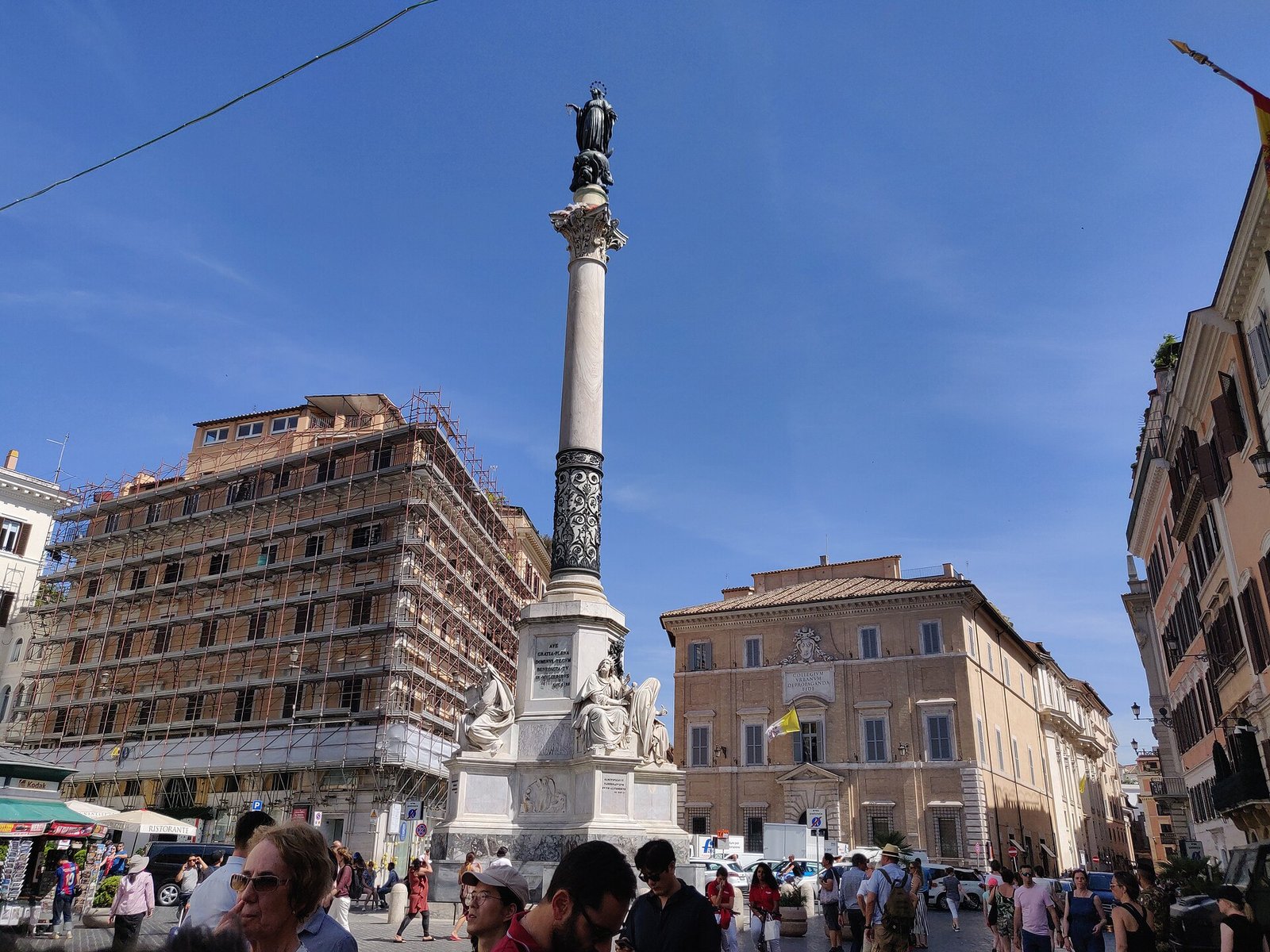
The Column of the Immaculate Conception stands in piazza Mignanelli, the stretch of piazza di Spagna that widens in front of the Palazzo di Propaganda Fide, in the rione Campo Marzio, in Rome. You can look at it for free at any hour of the day and night, with no ticket and no reservation, because it's an outdoor monument on a public square. It has no entrance or ticket office, and no body publishes visiting hours. The official tourist information is on the Turismo Roma portal of Roma Capitale.
The monument celebrates the dogma of the Immaculate Conception, proclaimed by Pius IX on December 8, 1854. An ancient column of cipollino marble, found in 1777 in Campo Marzio, was raised to a design by the architect Luigi Poletti and crowned by a bronze Madonna modeled by Giuseppe Obici. At the base sit four marble prophets. The king of the Two Sicilies, Ferdinand II, paid for the work. The inauguration took place in 1857, and for decades the pope has come here to pray on December 8.
Data checked on September 29, 2026 on the Turismo Roma portal, on Vatican News, on the website of the Diocese of Rome and on that of the Corpo nazionale dei Vigili del Fuoco. The program for December 8, 2026 is not yet published. In 2025 the firefighters laid the wreath of flowers at 7:00 in the morning and Pope Leo XIV arrived at 16:00. For the 2026 edition the reference is the announcements of the Vicariate of Rome and of Vatican News, which usually come out between late November and early December.
At a glance: address, hours, ticket
- Address: piazza Mignanelli, at the south end of piazza di Spagna, in front of the Palazzo di Propaganda Fide, rione Campo Marzio, Rome.
- Operator: no body publishes a management page for the monument, the official tourist information is on the Turismo Roma portal.
- How to get in: there's no entrance, the column is seen from the square.
- Price: free, no ticket and no reservation.
- Hours: always visible. On December 8 the square hosts the firefighters' tribute in the morning and the pope's in the afternoon.
- Getting there: metro line A, Spagna stop, or on foot from via del Corso, from Trevi or from Trinità dei Monti.
- Accessibility: no information published, the column is seen from the paving of the square.
Where it is and what you actually see
If you come down the stairway of Trinità dei Monti and arrive at the Barcaccia, you see the square bend toward the south, in the direction of via di Propaganda and via Due Macelli. That narrower arm is piazza Mignanelli, and the column occupies the center of it. Many people simply call it the column of piazza di Spagna, and the mistake is minor: the two spaces form a single basin, with no visible border on the paving.
From below you read three parts. At the top is the bronze Madonna, about four meters tall according to the Turismo Roma portal. Beneath runs the ancient shaft in cipollino, a light green marble veined with white, with a composite capital that Aci Stampa describes as decorated with olive branches and lilies. At the base a marble pedestal carries four bas-reliefs and, at the corners, four seated prophets: Moses, Isaiah, Ezekiel and David.
The measurements change depending on the source. Vatican News and Aci Stampa give the shaft a height of 11.81 meters and a diameter of 1.45. Turismo Roma rounds to about 12 meters and a meter and a half. Vatican News writes that the whole measures about 15 meters, other official pages attribute 12 meters to the statue or the column without distinguishing. The certain fact is that you always look at the Madonna from below, and up close your neck bends quite a bit.
All around, the square is one of the busiest in Rome. Behind the column rises the facade of the Palazzo di Propaganda Fide, the historic seat of the congregation for the missions, with the side on via di Propaganda designed by Borromini, a name that comes back in our itinerary on Borromini in Rome. On the opposite side is the Palazzo di Spagna, seat of the Spanish embassy to the Holy See, which gave its name to the whole square.
The column has a different function from that of the obelisks or the Roman cochlid columns. It doesn't celebrate an emperor or a victory, but a definition of faith. It stands here for reasons of prestige and visibility: in the mid-1800s piazza di Spagna was the drawing room of foreign travelers, and the Madonna on the column was meant to be seen by everyone, Catholic or not. The result still works today, because anyone who passes through the square notices it even without looking for it.
For those getting around the center, the column is also a practical reference. If you arrange to meet in piazza di Spagna and don't want to get lost in the crowd on the stairway, you do well to point to the base of the Immacolata, recognizable from afar thanks to the statue on top. The arm of piazza Mignanelli is more secluded, less noisy than the stretch in front of the Barcaccia, and from there it's easy to head off toward via del Corso, toward Trevi or toward the metro.
A curiosity about the Column of the Immaculate Conception
The statue nearly came out in half. Vatican News tells that during the casting of the bronze the metal stopped at the height of the middle of the figure. The founder Luigi de Rossi didn't throw out the work: he prepared a new pour to complete the missing part, and the two parts came out perfectly welded. From below no join is visible, and anyone who doesn't know the story has no way of suspecting it looking at the Madonna on top of the column.
The starting model was in plaster. Giuseppe Obici, a sculptor from Modena, prepared the figure at working size, and the mold for the bronze was taken from the plaster. According to Vatican News that model has been preserved, and is recognizable by a light blue scarf. The interesting thing is the division of tasks: Obici signs the invention of the figure, de Rossi the casting, Poletti the direction of the whole monument. Three different trades for a single statue.
Then there's a detail you only notice when you look very high up. The wreath of flowers that the firefighters bring every December 8 doesn't go on the head of the Madonna. The website of the Corpo nazionale dei Vigili del Fuoco writes that it is placed on the statue's arm. Usually in the days after the feast it is still there, hanging at a height from which nobody can remove it except with another aerial ladder.
One thing nobody tells you about the Column of the Immaculate Conception
The pope's monument was paid for by a king. Turismo Roma writes that the work was financed by Ferdinand II, king of the Two Sicilies, as a gesture of reconciliation with the Church. The Roman history blog Rerum Romanarum links the gesture to the question of the Chinea, the feudal tribute that for centuries the rulers of Naples had paid to the pope and that had become a cause of friction between the two courts. The column closed, at least in symbolic form, a long controversy.
It's easier to understand thinking about the position. The monument stands a few meters from the Palazzo di Spagna, that is in front of the representation of another Catholic monarchy, and in front of the Palazzo di Propaganda Fide, the center of the missions. A Neapolitan king financing a Madonna at that point of the city speaks to several interlocutors at once: to the pope, to the European courts, to foreign visitors. Anyone who looks at the column as a simple act of devotion misses half of its story.
Note also the date of the proclamation. December 8 was already the feast of the Immaculate Conception in the calendar of the Church long before 1854, and Pius IX's dogma turned it into a solemnity tied to a precise definition. For the Kingdom of the Two Sicilies, where the cult of the Immaculate Conception had a long tradition, financing the Roman monument meant taking part as a protagonist in that feast. The cost of the work is not published by the available official sources.
The document with which Pius IX defined the dogma is the bull Ineffabilis Deus, of December 8, 1854. The column is its translation into stone and bronze for the city. There was no need to read the Latin to understand the message: it was enough to raise your eyes. It is a point that also explains the choice of a column, a form that in Rome everyone associated with triumph, and which here is bent to a triumph of a theological kind, without weapons and without enemies.
Where does the ancient column come from?
The shaft is Roman, of the imperial age, and was found in the 1700s. Vatican News and Aci Stampa give the date of September 17, 1777, during expansion works on the monastery of the Benedictine nuns of Santa Maria in Campo Marzio, in the rione of the same name, not far from the Pantheon. It was a column in cipollino, the green marble with white veining that the Romans imported from Euboea, left unfinished according to some reconstructions.
On the following period the sources don't agree. Vatican News writes that the column lay where it had been found for 77 years, until the decision of 1854. Turismo Roma and Rerum Romanarum tell instead that it was extracted in 1778 and deposited in piazza di Montecitorio, where it stayed for about 80 years. The second version is the one most repeated. Anyone passing in front of the obelisk of Montecitorio can imagine the shaft lying on the ground, waiting for a project.
Reusing an ancient piece for a Christian monument is a constant in Rome. Sixtus V had Saint Peter and Saint Paul placed on top of Trajan's Column and the Column of Marcus Aurelius, and had the obelisks raised with the cross on top, as you can read in our guide to the obelisks of Rome. Pius IX takes up the same language almost three centuries later, with one difference: his column had never carried anything.
Cipollino is a marble you often meet in Rome, but rarely in a single piece of this size displayed in the middle of a square. The columns of the pronaos of temples and basilicas are usually right against a facade, and are looked at from the front. Here the shaft is seen all around, from the base to the capital. Look at it up close on a sunny day, when the light veining stands out against the green background: it's the oldest part of the monument, and the least observed.
The advice I give you for visiting the Column of the Immaculate Conception
My advice is to arrive from below, from via Due Macelli or from via di Propaganda, and not from the stairway. From the stairway the column is seen from the side and far away, squeezed between the crowd and the buildings. Coming up from the south, instead, you have it in front of you for the whole last stretch, with the Madonna standing out against the sky and the facade of Trinità dei Monti appearing high up only in the last few meters.
Once under the column, walk around the base. The four prophets look in four different directions, and the bas-reliefs are read only one per side. It doesn't take much time: 10 minutes is enough for the full circuit and to pick out the scenes. It's best to do it early in the morning, before 9, when the square is still clear and the stairway is not yet crowded.
The second piece of advice concerns the date. December 8 is the day on which the column makes the most sense, but it's also the day on which you see it worst. In our view the feast is overrated as an occasion to visit for anyone looking for the monument: the square fills up, the barriers keep you away from the base and the view is reduced to a distant statue above a crowd. Anyone who wants to see the column in peace, with the flowers of the feast still at the foot of the base, does better to pass on December 9.
Anyone who wants to attend the ceremony, on the other hand, has to count on a long wait. On the afternoon of December 8 the square is guarded and access may be regulated with security checkpoints, as happens at events with the pope. It's best to arrive well ahead of time, dress warmly and be patient. Anyone who prefers to follow without standing for hours can watch the television broadcast or the Vatican News streaming, which airs the act of veneration every year.
Do you need a ticket or a reservation?
No. The Column of the Immaculate Conception stands in a public square, with no fence, no ticket office and no hours. There are no tickets to see it, and no reservations are needed to attend the tribute of December 8, which takes place outdoors and with free access within the limits set by the police for security. The Turismo Roma portal of Roma Capitale is the official channel for tourist information on the monument.
For the program of the feast the reference is the website of the Diocese of Rome, which publishes the times of the celebrations every year, together with Vatican News. Be wary of anyone selling a reserved spot or an entrance to the ceremony: the square is public. Paid guided tours of the piazza di Spagna area exist, but they are third-party services that cover the whole neighborhood, not a ticket for the column, and they are not named here.
The only practical limit concerns December 8 itself. On that day the square may be closed to ordinary traffic for a few hours, buses detoured and the streets around blocked. The measures change every year and are published by Roma Mobilità and the City in the preceding days. On the other days of the year there's nothing to book: you pass by, look, and continue toward the stairway or toward via del Corso.
Another well-known fact, yet rarely cited
That the firefighters raised the column is repeated by almost everyone. The detail cited less is the speed. The website of the Corpo nazionale dei Vigili del Fuoco writes that on December 18, 1856 the column was brought upright in only 30 minutes. Turismo Roma and Vatican News speak of 220 men engaged in the operation, Aci Stampa of 200. Vatican News specifies that they worked the winches, under the direction of the architect Poletti.
The statue came later. The Vigili del Fuoco give August 5, 1857 as the date the bronze was placed on top of the column. Eight months between the raised shaft and the Madonna in her place, and still more months before the official inauguration. Anyone who imagines the monument born in a single day is wrong: it was a long job site, with separate phases, which required machines, calculations and a crew trained to lift heavy loads.
This is where the link between the firefighters and the column comes from. The floral tribute of December 8 is presented as a remembrance of the colleagues of 1856. On the starting date of the rite the sources don't agree: the Diocese of Rome traces it back to 1857, the blog Rerum Romanarum to 1923, the website of the Vigili del Fuoco to the postwar period, at the request of the Vicariate. Our opinion is that the most solid figure is the Corps' own, which keeps its own history.
The technical detail deserves attention. Raising a monolithic shaft of almost 12 meters without modern cranes required a wooden frame, ropes, winches and a crew pulling in a coordinated way, a job that in Rome had a famous precedent in the raising of the obelisk in front of St. Peter's in the 1500s. The papal firefighters were the most suitable organized force: used to ladders, loads and maneuvers, and disciplined like a military corps.
The right photo to take of the Column of the Immaculate Conception
The photo that tells the story of the column is taken from via Due Macelli, a few meters before the street opens into the square. From there the Madonna stands out against the sky, the shaft rises straight and the facade of the Palazzo di Propaganda Fide acts as a backdrop beside it. You need a normal lens or a slight telephoto, because a wide-angle tilts the vertical lines and makes the column look as if it's falling.
The second photo is of the statue alone. With the sun behind it the bronze becomes a black silhouette. It's best to try at different hours and choose the moment when the light hits the figure from the front, or a cloudy day, which makes the bronze more readable. A telephoto lens lets you isolate the face and the hands. Avoid climbing on low walls, planters or railings to gain height: the right spot is found from the ground, by moving away.
The third photo is for December 8, and it's the hardest. The moment when the firefighter reaches the statue with the aerial ladder lasts a few minutes, at 7:00 in the morning, with little light. The Corps' website speaks of an aerial ladder reaching 27 meters, climbed on foot along 100 steps. You need a fast lens, a shooting spot chosen in advance and the willingness to get up very early on a December morning.
For anyone looking for a different framing there's the stairway. From the middle of the flight, turning toward the south, the column appears at the end of the square, above the roofs of the lower houses, with via Due Macelli opening behind. It's not the clearest photo of the monument, but it places it in the system of the square, with the Barcaccia fountain in the foreground. Remember that on the steps the city police regulations forbid sitting.
How do you get there from the center of Rome?
Metro line A has a stop called Spagna, reopened by Atac on October 4, 2024 and completely renovated in December of the same year, with a corridor that also connects the station to the side of Villa Borghese and the Pincio. From the exit on piazza di Spagna the column is a few minutes' walk, crossing the square toward the south. On the day of December 8 the station has in the past been closed for a few hours during the ceremony: check Atac's notices.
From the historic center the best solution is to walk. From the Trevi Fountain you cross via del Tritone and take via Due Macelli, and in about 10 minutes you arrive under the column. From piazza Colonna and from via del Corso you take via Frattina or via Condotti, and come out on the square from the side of the stairway. From piazza del Popolo you come down via del Babuino.
From piazza Barberini, where the Triton Fountain is, you go down via del Tritone to via Due Macelli or you take via Sistina, passing in front of the Teatro Sistina, to the top of the stairway. The via Sistina route has the advantage of showing the column from above, before going down. For the return you can do the opposite loop, so as to see the monument from both levels of the square.
For buses, the lines that pass along via del Tritone and via del Corso serve the area, but the routes change often because of works and detours. The up-to-date reference is the Atac site, with its route calculator. By car it makes no sense to come: the square and the streets around fall in the limited traffic zone of the historic center, and there are very few parking spots in the area. Better to get around on foot or by metro.
Some important events that happened here in history
On December 8, 1854 Pius IX proclaims the dogma of the Immaculate Conception. In the same year, according to Vatican News and Aci Stampa, it is decided to move the column found in 1777 to piazza Mignanelli. On December 18, 1856 the firefighters raise it in half an hour. On August 5, 1857 Obici's statue is placed on top. On the date of the inauguration the sources don't agree: December 8, 1857 for Vatican News and Turismo Roma, September 8, 1857 for Aci Stampa and Rerum Romanarum.
Then comes a century of popular devotion without papal ceremonies in the square. After 1870 the pope no longer leaves the Vatican for decades, and the tribute to the column is left to the devotion of the Romans. In 1953, a Marian year, according to the Diocese of Rome the papal tribute begins with Pius XII. Vatican News and Aci Stampa give 1958, with John XXIII, as the start of the custom of coming in person every December 8.
On December 8, 1965, the day of the closing of the Second Vatican Council, Vatican News recalls the presence of Paul VI in the square. Since then all the popes have kept the appointment, with a pause during the pandemic years, when the Diocese of Rome notes that the public tribute was interrupted for two years. On December 8, 2025 Pope Leo XIV performs the first act of veneration of his pontificate, welcomed by the cardinal vicar Baldo Reina and by the mayor Roberto Gualtieri.
In 2025 the one who climbed was the most senior section chief of the Rome command. The website of the Corpo nazionale dei Vigili del Fuoco tells of the ceremony at 7:00 in the morning with the aerial ladder at 27 meters and the wreath on the statue's arm. For December 8, 2026 the program is not yet published. The dates of the history of the column, read in a row, span the end of the temporal power, two councils and a Jubilee.
Who has passed by the Column of the Immaculate Conception
The first name is Pius IX, who wanted the dogma and the monument, and according to Aci Stampa watched the works directed by Poletti. The second is Ferdinand II, king of the Two Sicilies, who paid for the work from Naples. The third is Luigi Poletti, an architect from Modena by birth who was active in Rome, the same one who in the 1800s worked on the reconstruction of the Basilica of San Paolo fuori le Mura after the fire of 1823.
Then there are the sculptors. Giuseppe Obici for the Madonna. For the prophets, according to Rerum Romanarum, Adamo Tadolini signs the David, Salvatore Revelli the Isaiah, Carlo Chelli the Ezekiel and Ignazio Jacometti the Moses. Vatican News confirms that each prophet is the work of a different artist. It's a sampler of mid-19th-century Roman sculpture, formed in the wake of neoclassicism, gathered on a single base.
Then the popes of the 1900s and of today. On the role of Pius XII the sources use different words: for Aci Stampa he was the first to lay flowers, in 1953, for Vatican News the tribute in person begins with John XXIII in 1958. After him Paul VI, John Paul II, Benedict XVI, Francis and Leo XIV. With them, every year, the mayors of Rome, who welcome the pope in the square together with the cardinal vicar, and the delegations of religious orders, schools and city associations listed in the program of the Diocese.
The collective protagonist remains, the firefighters. 220 men according to almost all the sources, perhaps 200, at the hoists and winches in December 1856. And a single firefighter, every December 8, at the top of the aerial ladder with the wreath in hand. In Rome it's hard to find another link so direct between a body of the State and a monument of devotion, renewed every year in public in front of thousands of people.
What do the documents say and what is told?
The documents, that is the pages of Vatican News, of the Corpo nazionale dei Vigili del Fuoco and of the Roma Capitale portal, say few certain things. The column comes from Campo Marzio and was found in 1777. It was raised on December 18, 1856 by about 200 firefighters. Obici's statue was placed on August 5, 1857. Ferdinand II paid for the work. On these points the sources coincide, with the exception of the exact number of men and the day of the inauguration.
Tradition adds a meaning to the wreath. It's repeated that the firefighters climb up to remember the colleagues who raised the column, and that the privilege of laying the flowers belongs to them by acquired right. The Corps' website tells a somewhat different story: the rite would have been born in the postwar period, at the request of the Vicariate. The two versions coexist without entirely contradicting each other, because the memory of 1856 explains the choice of the firefighters, not the starting date.
Then there is the level of storytelling that no archive confirms. The best known is that of the casting interrupted halfway up the figure and saved with a second pour: Vatican News reports it, but without citing the document it comes from. The institutional sources attribute the raising only to the papal firefighters at the winches, and any versions with convicts or men sentenced to forced labor find no confirmation. The same goes for any story of apparitions tied to the column.
Another widespread idea concerns the age of the monument. Many tourists think they are looking at a Roman column that has stayed in its place for 2,000 years, like that of Marcus Aurelius in piazza Colonna. The shaft is ancient, the rest is from the 1800s, and the place was chosen in 1854. It's not a legend in the strict sense, but it's the most common misunderstanding among people looking at the column for the first time, and it's worth correcting right away.
How does December 8 work in piazza Mignanelli?
The day starts early. In 2025, according to Vatican News, at 7:00 the firefighters laid the garland on the statue. At 8:30 the band of the Vatican Gendarmerie played a Marian hymn at the foot of the column. At 9:00 a mass was celebrated in the church of Trinità dei Monti. In the afternoon, at 16:00, the pope arrived for the prayer. The program of the Diocese of Rome for 2022 gave similar times, with a procession of workers from Roman companies at 10:30.
The pope's act of veneration is short. The pontiff is welcomed by the cardinal vicar and the mayor, pays tribute with flowers at the foot of the monument and recites a prayer to the Immaculate Conception, then greets those present. The text of the prayer changes every year and is released by the Holy See. Vatican News broadcasts it live and publishes the account. The ceremony takes place with the square full to the edges, and anyone who arrives late follows it mostly from the loudspeakers.
Anyone who wants to follow the ceremony up close has to choose the spot well. The side of the stairway offers a raised but distant view, the arm of via Due Macelli is closer to the base but the barriers can close it off. It's best to arrive in the early afternoon, bring water and something hot, and accept that the view will be partial. The Vatican News live feed shows the ceremony up close, and in many cases the phone screen shows more than you can see from the square.
During the day the base of the column fills with flowers. Religious orders, schools, associations, neighborhood delegations and simple believers bring wreaths and bouquets that are arranged on the base. In the following days the flowers stay, and the column looks different from the rest of the year. It's the moment when the monument is best understood: not an art object to look at, but an outdoor place of worship, with its feast and its calendar.
In the evening, in the basilica of Santi XII Apostoli, the 2025 program included the rosary at 17:45 and mass at 18:30, with the singing of the Tota Pulchra, closing a novena that began on November 29. It's a less known appointment than the one in the square, but tied to the same feast. For 2026 the times are not yet published: in 2025 the Vatican had confirmed the pope's presence already at the end of September, according to the Ansa agency.
A clarification for those traveling in December. December 8 is a national holiday in Italy, and in Rome it coincides with the start of the Christmas season. The center fills with Romans and visitors, and the piazza di Spagna area becomes one of the most crowded in the city. Anyone who chooses that date should know that the column will be the center of a long, noisy, guarded day, not a monument to look at in silence.
The day after the feast the mood changes. The barriers are removed, the square goes back to its ordinary traffic of visitors and the base of the column stays covered by the flowers brought during the day. Someone stops to pray, someone photographs the wreaths, and many pass without knowing why the base is covered in flowers. Then, within a few days, the flowers wilt and are removed.
Who are the four prophets and what do the reliefs tell?
The four prophets seated at the corners of the base are Moses, Isaiah, Ezekiel and David. The choice is not random. They are figures of the Old Testament that the Christian tradition reads as announcements of the Virgin: Isaiah for the prophecy of the young woman who will conceive, Ezekiel for the closed gate of the temple, David as an ancestor of Mary according to the genealogy, Moses for the bush that burns without being consumed. Anyone who looks at the column up close can recognize them by their attributes.
The bas-reliefs of the pedestal tell four scenes. Turismo Roma lists them like this: the Annunciation, the dream of Saint Joseph, the coronation of the Virgin and the proclamation of the dogma. The last is the most curious, because it stages an event that happened three years before the inauguration. It's a rare case of contemporary news carved in marble beneath a sacred statue, in a public square.
The authors of the prophets are different and the style shows. Four different hands mean four ways of handling the drapery, the faces and the poses, within the same academic taste of the era, and the comparison is best made by walking around the base. None of the four has the force of the Baroque figures of nearby Trevi, but together they give the monument a wide, solid base, which holds up the vertical of the column. Our opinion is that they deserve more attention than the statue on top.
The statue on top should be looked at with the same method as the prophets, but from a distance. From the base you only see the silhouette, from the end of the square or from the middle of the stairway you catch the posture and the relationship with the shaft. Binoculars help, and even a phone's zoom is enough to read the face in the hours of soft light. Obici's statue is designed to be seen at a distance, like all the figures that crown the honorary columns of Rome, and looks better that way.
The authors of the bas-reliefs are not given by Turismo Roma or by Vatican News, and the information is not published by the institutional sources. Anyone who wants to dig deeper finds in the reliefs a good reading exercise: each scene is understood on its own, with few figures and clear gestures, designed for someone looking at it while passing. It's best to walk the whole base and put the sequence together in your mind, from the Annunciation to the dogma of 1854.
The Roman monument is not the only column dedicated to the Immaculate Conception in southern Italy. In Naples there is the spire of the Immacolata in piazza del Gesù Nuovo, from the 1700s, and in Palermo the column of piazza San Domenico, also from the 1700s. They are two cities of the kingdom that financed the column in Rome. Placed beside those, the column of piazza Mignanelli looks sober, almost austere: no Baroque ornament, a smooth shaft, four composed prophets and a single statue on top.
When is it hard to see and what should you not expect?
The column never closes, because it has no entrance. It can, however, be hard to get close to. That happens on December 8, when the square fills up and the base stays behind the barriers all day. It happens during big events and demonstrations in the center, when the police close the area. It happens, less often, during works on the square or the stairway. On the other days you pass and look without constraints.
Don't expect a quiet place. Piazza di Spagna is one of the busiest destinations in Rome, with crowds of visitors at every hour of the day and street vendors around the stairway. The column, being in the narrower arm, is less crowded than the Barcaccia, but it's never isolated. Don't expect benches in the shade either: the square is paved and open, and in summer the sun beats on the base for a long time.
Don't expect, finally, anything to visit inside. The column is a solid monument, with no stairs, crypts or spaces open to the public, and the base has no doors to go through. Anyone looking for a Marian place to enter will find the church of Trinità dei Monti at the top of the stairway, with its hours. It's a rare misunderstanding, but it happens to people who see the December 8 crowd on television and imagine a sanctuary behind the statue.
Another thing to know concerns maintenance. No body publishes a calendar of work on the monument, and the column can stay covered by scaffolding for restoration or stability checks with no notice to visitors. If you find scaffolding, the square can still be walked and the rest of the area visited. News about works, when there is any, comes out on the Roma Capitale site and in the local papers on the days the job sites start.
Eating in the area
The piazza di Spagna area is among the hardest in Rome for eating well at an honest price. The density of visitors favors places that aim for the passing customer: photo menus in many languages, touts on the sidewalk, items written with no price, kitchens open from morning to night with no break. Some windows stage hand-made pasta in front of passersby, often as pure scenery. Romans don't sit down in these places, and not out of snobbery.
The reason is practical. Where the price isn't written, the bill adapts to the customer, and where the menu outside is different from the one inside the surprise comes at the end. Places with a direct view of the monument tend to charge for the position more than for the dish. It's best to move a few streets away, toward the side streets between via del Corso and via di Ripetta. To find your way without risk, there's the list of addresses on Google Maps kept by the editorial team.
For a coffee the same caution applies. In the bars around the square the price at the counter and the price at the table can be very different, and the price list isn't always clearly visible. Ask before sitting down, or do as the Romans do, who drink their coffee standing at the bar. Gelato sold a few meters from the stairway should also be chosen carefully, checking the prices and portions displayed before ordering, especially at peak hours.
What to combine in a day
The first combination is immediate. The stairway leads to Trinità dei Monti, where the morning mass is celebrated on December 8, and in front of the church is the Sallustian Obelisk. Continuing along viale Trinità dei Monti you arrive at Villa Medici and then the Pincio, with the public terrace that looks over piazza del Popolo and the dome of St. Peter's in the background.
From the Pincio you go down to piazza del Popolo, with the Flaminian Obelisk in the center, the twin churches on the south side and Santa Maria del Popolo next to the Porta del Popolo. The return toward piazza di Spagna along via del Babuino closes a loop of a couple of hours on foot, with the column as the starting and ending point.
Anyone who prefers to stay on the theme of columns and honorary monuments can go down via del Corso to piazza Colonna, with the Column of Marcus Aurelius and the Galleria Alberto Sordi, and then to Montecitorio, where according to some sources the shaft of the Immacolata lay on the ground for decades. Toward the Tiber you find the Ara Pacis, the Mausoleum of Augustus and San Lorenzo in Lucina.
An alternative leads south, among popes and Baroque. From piazza Mignanelli you reach in a few minutes the Trevi Fountain with Palazzo Poli behind it, then you climb toward piazza Barberini and Palazzo Barberini. The theme of Roman Baroque, which runs through the whole area, is collected in our guides to Bernini in Rome and to Baroque Rome.
If you still have time, Villa Borghese is reached from the Pincio or from the Porta Pinciana, and the Galleria Borghese has its own tickets and hours to check on the museum's site. Anyone looking for other ideas without spending will find suggestions in our guide to free Rome, where the column fully belongs, and in the page on the 22 rioni of Rome, to understand where Campo Marzio ends.
Frequently asked questions
Do you pay to see the Column of the Immaculate Conception?
No. The column is in piazza Mignanelli, a public space at the end of piazza di Spagna, and can be viewed for free at any hour. There's no ticket office, there are no hours and you don't need to book, not even to attend the tribute of December 8, which takes place outdoors with free access within the limits set for security. Anyone offering a ticket for the column is actually selling a third-party service about the area, not an entrance.
Why was the column built?
To celebrate the dogma of the Immaculate Conception, proclaimed by Pius IX on December 8, 1854, according to which Mary was conceived without original sin. The pope decided to commemorate the definition with a monument in one of the busiest squares in Rome, and chose an ancient column found in 1777 in Campo Marzio. The king of the Two Sicilies, Ferdinand II, financed the work, and the architect Luigi Poletti directed the project. The bronze statue is by Giuseppe Obici.
When was it inaugurated?
The column was raised on December 18, 1856 and the statue placed on August 5, 1857, according to the website of the Corpo nazionale dei Vigili del Fuoco. On the inauguration the sources don't agree. Vatican News and the Turismo Roma portal give December 8, 1857, the third anniversary of the dogma. Aci Stampa and the blog Rerum Romanarum give instead September 8, 1857, the feast of the Nativity of Mary. In both cases the ceremony took place in the presence of Pius IX.
Why do the firefighters climb the column on December 8?
To remember the colleagues who in December 1856 raised the column with winches, about 220 men according to most sources. Every December 8 at 7:00 in the morning a firefighter climbs with the aerial ladder up to the statue and lays a wreath of flowers on the Madonna's arm. On the start of the rite the sources don't agree: the Corps' website places it in the postwar period, at the request of the Vicariate, other sources trace it back earlier.
What time does the pope arrive on December 8?
In recent years the arrival has been set at 16:00. In 2025 Pope Leo XIV arrived in the square at that hour, welcomed by the cardinal vicar Baldo Reina and the mayor Roberto Gualtieri, as the program published by Vatican News indicated. The program for December 8, 2026 is not yet published. The reference for the final times is the website of the Diocese of Rome and Vatican News, which usually announce them between late November and early December.
Can you attend the pope's ceremony?
Yes, the ceremony takes place outdoors and anyone can attend from the square, within the limits of the barricaded areas and the security checks. There are no tickets or reservations. It's best to arrive very early, because the square fills up quickly and the area near the base is closed off. Anyone who doesn't want to face the crowd can follow the Vatican News live feed.
Who sculpted the four prophets?
Each prophet is the work of a different sculptor, as Vatican News confirms. According to Rerum Romanarum, the David is by Adamo Tadolini, the Isaiah by Salvatore Revelli, the Ezekiel by Carlo Chelli and the Moses by Ignazio Jacometti. They are artists active in Rome in the mid-1800s, trained in the academic tradition. The four marble statues occupy the corners of the base, beneath the bas-reliefs with the Annunciation, Joseph's dream, the coronation and the dogma.
Where exactly is the column?
In piazza Mignanelli, that is in the southern arm of piazza di Spagna, in front of the Palazzo di Propaganda Fide and a few meters from the Palazzo di Spagna, seat of the Spanish embassy to the Holy See. Anyone arriving from the stairway of Trinità dei Monti finds it beyond the Barcaccia, in the stretch that narrows toward the south, anyone arriving from via Due Macelli finds it straight ahead. The nearest stop is Spagna, on metro line A, renovated by Atac in 2024.
How much time do you need to see it?
For the column alone 10 minutes is enough, the time to walk around the base and read the prophets and the reliefs. It becomes much more, however, if you use it as a starting point. Trinità dei Monti, Villa Medici, the Pincio, piazza del Popolo and the Trevi Fountain are all within a stroll, and with a few open churches along the way the half day fills up without taking any transport.
Who wrote this and on what sources
The text comes from the editorial team of Tour Leader Pro, the Roman outfit that designs itineraries, tours and cultural events between Rome and Lazio. The fares, hours and booking arrangements given here come from the official sources cited in the text as of the date indicated at the opening: for the Column of the Immaculate Conception these are the Turismo Roma portal, Vatican News, the website of the Diocese of Rome and that of the Corpo nazionale dei Vigili del Fuoco. Tell us what you find changed.
Organizing a stop at the column for a group seems easy, because there are no tickets or time slots. The real difficulty is the square: crowds at every hour, tight spaces in the arm of piazza Mignanelli, and on December 8 barriers and checks all day. It's best to set the meeting point away from the stairway and choose a date other than the feast. For those planning cultural outings in the city, a useful resource for people organizing group trips is Tour Leader Pro.
The Column of the Immaculate Conception is also a door onto the religious calendar of Rome, which in December joins the feast of the 8th to the Christmas celebrations and the nativity scenes of the churches of the center. Anyone arriving in the city in those weeks can build a trip around these dates, alternating monuments with services and markets. Putting Rome and Lazio together takes some planning, and a useful resource for building a multi-day itinerary is Italy Planner.