Obelisco Sallustiano
In short. The Sallustiano Obelisk is the red granite monolith that towers at the top of the Spanish Steps, in front of the facade of the church of Trinità dei Monti, and it is one of the most photographed monuments in Rome by people who know almost nothing about it.
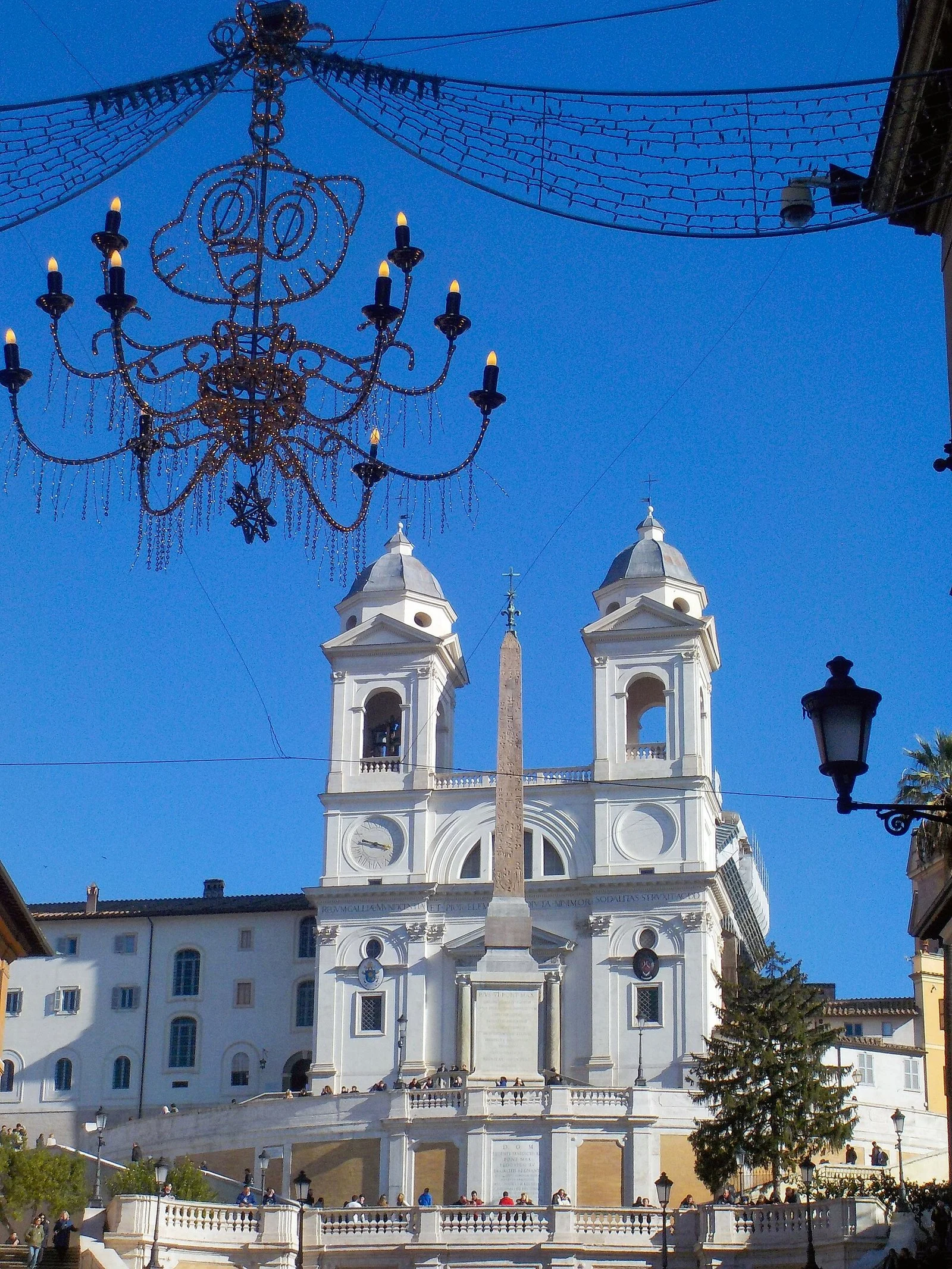
The Sallustiano Obelisk is the red granite monolith that towers at the top of the Spanish Steps, in front of the facade of the church of Trinità dei Monti, and it is one of the most photographed monuments in Rome by people who know almost nothing about it. Its shaft measures 13.91 meters and it belongs to the family of the 13 ancient obelisks that rise in the city's piazzas, but it stands apart from almost all the others for a reason that makes it a nearly comic case in the history of art: it was not brought from Egypt. It was manufactured in Rome, in the imperial age, by Roman craftsmen, and then had hieroglyphs carved on it copied exactly from the Flaminio Obelisk in Piazza del Popolo. The result is a long inscription that says nothing: badly copied signs, some upside down, others with no syntactic sense, put together by stonecutters who treated them as you treat a decorative motif, not as you treat a text. An ancient monument that quotes another ancient monument a few hundred meters away, and gets the quotation wrong. The lines that follow tell where this obelisk comes from, why it bears the name of a Roman historian of the 1st century BC, how it ended up broken in two pieces for 300 years, why a pope left it thrown on the ground for 60 years next to the Lateran and who raised it, in 1789, on the exact spot where we see it today.
Where the Sallustiano Obelisk is and how to get there
The Sallustiano Obelisk stands in Piazza della Trinità dei Monti, in the Campo Marzio district, right at the top of the steps climbing from Piazza di Spagna: it is the point where the climb ends and the panorama over the rooftops of the historic center opens. The piazza is a natural terrace on the flank of the Pincio, at the mouth of Via Sistina and a few steps from the entrance of Villa Medici. There is no ticket, no gate and no schedule: the obelisk is in an open-air public space, visible 24 hours a day, lit in the evening.
On foot from the historic center
From the Trevi Fountain you get there in about 10 minutes going up Via della Stamperia and then Via Sistina, a route that avoids the staircase altogether and lets you arrive in Piazza della Trinità dei Monti from above, without climbing a single step. From Piazza del Popolo the most beautiful way is the one that climbs to the Pincio along the ramp designed by Giuseppe Valadier and continues on the panoramic avenue to Viale della Trinità dei Monti: it's a walk of barely 20 minutes, almost all level once the initial climb is past, and it has the advantage of linking in one go the obelisk of Piazza del Popolo and the one at Trinità dei Monti, that is, the original and its copy. From the Pantheon it takes about 15 minutes.
By public transport
The nearest metro stop is Spagna, on line A, which comes out a few meters from the foot of the staircase: from there you climb on foot, or you take the station's internal elevator that leads directly up, on the Pincio side, avoiding the steps. Whoever prefers the bus can use the lines running along Via del Tritone and get off at Piazza Barberini, about 10 minutes on foot along Via Sistina, or the lines going up Via Veneto toward Porta Pinciana. From Termini the quickest solution is metro A toward Battistini getting off at Spagna: it's a few stops and you stay underground until a step from the destination.
What the Sallustiano Obelisk really is: a Roman copy, not an Egyptian monument
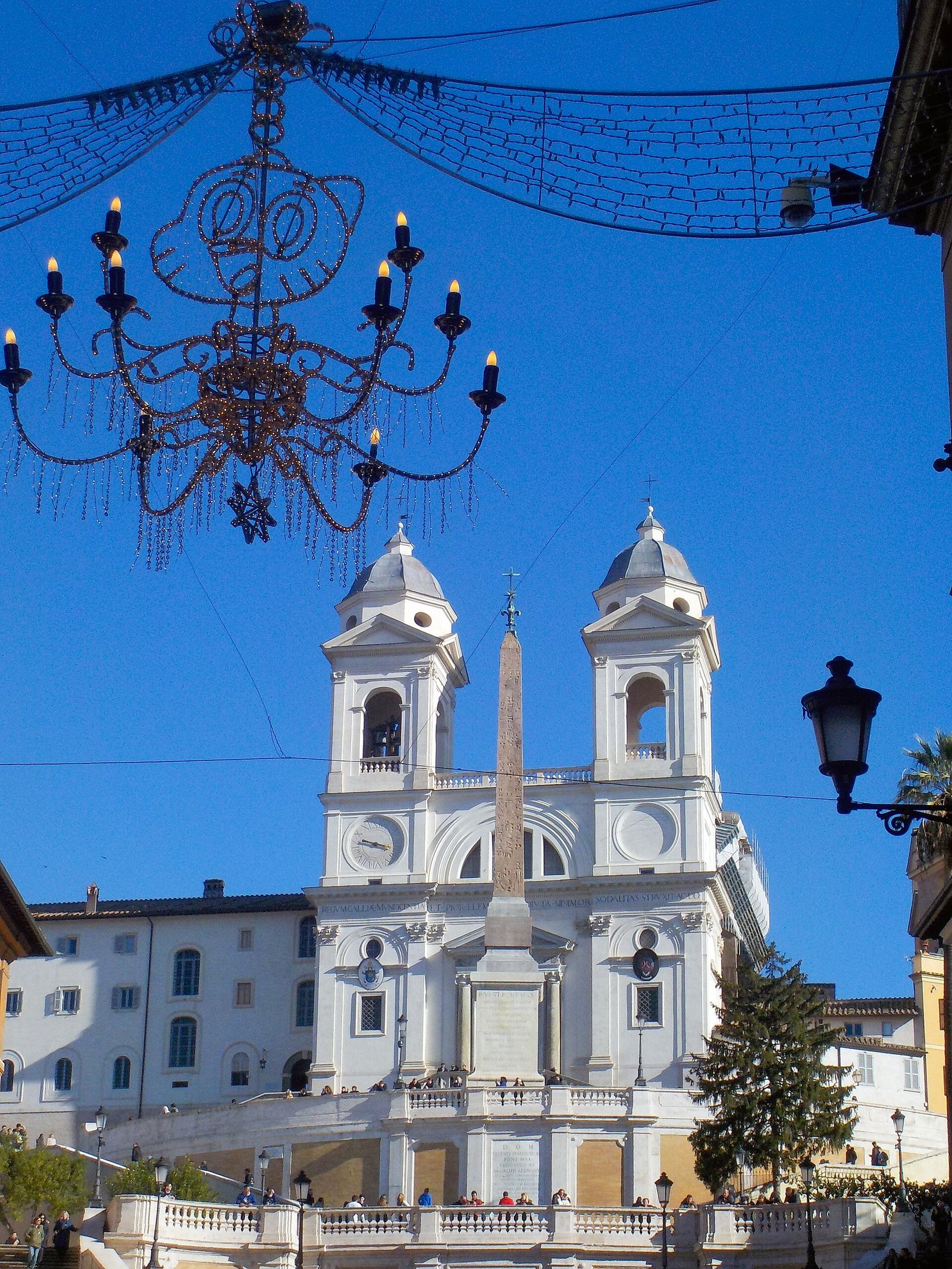
The Sallustiano Obelisk is not an Egyptian obelisk brought to Rome by the conquerors, but an obelisk manufactured in Rome in the imperial age in imitation of the Egyptian ones: this is the point that distinguishes this monument from almost all its Roman colleagues and that is best clarified right away, because most guides take it for granted or skip it altogether. There is no pharaoh who commissioned it, no Egyptian temple in front of which it was erected and no cargo ship that carried it across the Mediterranean. It is, to all effects, a Roman artifact that wants to look Egyptian.
The measurements: almost 14 meters of shaft
The shaft measures 13.91 meters, a figure consistent across the entries of the Rome Capital tourism portal and the repertories on the city's obelisks. On the overall height of the monument, that is, shaft plus modern base plus the crowning cross, the sources don't agree: the Turismo Roma portal indicates about 15.20 meters, while some English-language lists report a figure above 30 meters, which doesn't match what you observe in the piazza and which should in all likelihood be attributed to a compilation error later repeated by other sites. The solid datum, the one you can count on, is the measurement of the shaft: a little under 14 meters of granite. For an immediate point of comparison, the Flaminio Obelisk from which the signs were copied exceeds 24 meters, so the Sallustiano is little more than half its model.
The material: red Aswan granite
The monolith is reported as worked in red granite, the stone of the Aswan quarries in Upper Egypt that the pharaohs used for real obelisks and that the Romans continued to import in large quantities for columns, basins and facings. This means that, although the monument is a Roman product, the raw material is authentically Egyptian: the block was quarried in Egypt, where the quarries had long been under imperial control, and transported to Rome in the rough or partially roughed-out state. The final working and the carving were Roman. It's a subtle but important distinction, because it explains why the Sallustiano has the same material look as the ancient obelisks: the stone is that, the color is that, the grain is that. What changes is who held the chisel and what he knew about what he was carving.
When it was manufactured: a debated dating
On the date of manufacture scholars have no epigraphic foothold, because the hieroglyphic inscription, being copied, contains no names of Roman patrons usable for dating. The entries of the municipal tourism portal place the artifact generically between the 2nd and 3rd centuries AD. A more precise learned tradition, taken up by several popular publications, attributes it to the emperor Aurelian, who reigned between 270 and 275 and who did in fact carry out expansion works on the Horti Sallustiani: in this reconstruction the obelisk would have been erected to adorn the circus or hippodrome that was part of the garden complex. It must be said clearly that this is a reasonable hypothesis, not a documented fact: whoever gives a precise year or a precise emperor is choosing among alternative reconstructions, not citing an ancient source that states it.
Why a Roman would have wanted a fake obelisk
The question that comes naturally is why, in a city that already had dozens of authentic Egyptian obelisks dragged there with enormous logistical effort, anyone would have had a new one made. The answer lies in the difference between a public monument and private furnishing. Authentic Egyptian obelisks arrived in Rome as state trophies and were placed in public places of maximum visibility: the Circus Maximus, the Campo Marzio, the imperial circuses. A private citizen, or an emperor wanting to embellish a country residence inside the walls, certainly could not order an obelisk dismantled from an Egyptian temple to take it to his garden at home. Having one made to measure, with the same stone and the same shape, was the practical solution: expensive, of course, but infinitely simpler. The Sallustiano was born as luxury furnishing for a park, not as a civic monument, and this explains everything else, including the shortcuts taken on the inscription.
The hieroglyphs copied from the Flaminio Obelisk: the wrong quotation
The hieroglyphs carved on the four faces of the Sallustiano Obelisk are the copy, made in the Roman era, of the inscription running on the Flaminio Obelisk now in Piazza del Popolo, the monolith erected in Egypt by the pharaohs Seti I and Ramesses II and brought to Rome by Augustus in 10 BC. It is a fact reported by the Rome Capital tourism portal and taken up consistently by the repertories on Roman obelisks, and it remains one of the most surprising details of the whole monumental heritage of the city.
What is written on the obelisk: practically nothing
The copy was not faithful. The stonecutters who did the work reproduced the signs with systematic errors: some hieroglyphs are carved incorrectly, others are upside down relative to the correct reading direction, others still were rendered as decorative forms with no correspondence to a real sign. The overall result, as the popular sources that have dealt with the case consistently point out, is that the long text running on the Trinità dei Monti obelisk has no coherent meaning: it is not an Egyptian sentence badly copied, it is a sequence of signs that does not constitute a legible statement. Whoever stopped in front of the monument imagining they had before their eyes a prayer to the god Amun or a pharaoh's titulary would be badly mistaken. What they have before their eyes is an ornamental motif composed with the wrong alphabet.
Why the Romans copied signs they couldn't read
A clarification is needed here that avoids treating the Romans as naive, because they were not at all. Hieroglyphic writing, by the time Egypt entered Rome's orbit after 30 BC, was already a restricted and dying skill, mastered by an ever smaller minority of Egyptian priests tied to the great sanctuaries. A Roman architect or stonecutter of the imperial age could have seen hundreds of obelisks and not have the slightest idea how to read a cartouche: exactly as today an educated person can recognize at first glance Arabic or Chinese writing without being able to decipher a single word.
For the Roman mentality, moreover, hieroglyphs were not primarily a text. They were a sign of sacredness, the visual mark of an ancient and mysterious wisdom that Egypt represented in the Mediterranean imagination. The ancient authors who talk about them tend to describe them as allegorical symbols, figures that would allude to abstract concepts by way of images, not as a writing that records sounds and words. This symbolic interpretation, entirely wrong from a linguistic standpoint, survived for centuries and heavily influenced the Renaissance and the 1600s, when scholars like Athanasius Kircher wrote whole volumes of imaginary translations based on exactly that premise. Carving hieroglyphs on a Roman obelisk, in this mental frame, was not a forgery: it was applying to the monument the decorative and symbolic repertoire that belonged to it, as you put a Doric frieze on a Doric temple.
The decipherment comes only in 1822
A chronological fact must be kept in mind that changes the perspective on the whole affair: no one in the world was able to read hieroglyphs from late antiquity until 1822, when Jean-François Champollion announced the decipherment starting from the comparison of the texts of the Rosetta Stone, found in 1799. This means that for about 14 centuries, from the decline of the Egyptian priestly schools until well into the 1800s, the Sallustiano inscription was indistinguishable from an authentic one for anyone looking at it. Popes, cardinals, antiquarians, architects, Grand Tour travelers: all admired a meaningless inscription believing it a message from the depths of the millennia. The fake character of the text became verifiable only when the monument had already been standing for some 30 years at the top of the staircase.
Not all Roman obelisks are like this
It would be a mistake, however, to generalize, and it's worth saying so because it's the part of the story almost nobody tells. In Rome there are obelisks manufactured in the Roman era whose hieroglyphs make perfect sense, because they were composed by people who really knew Egyptian writing. The Agonal Obelisk, the one Gian Lorenzo Bernini placed above the Fountain of the Four Rivers in Piazza Navona, dates to the Domitianic age and bears an inscription drafted specifically, a hymn celebrating Domitian and the deified Vespasian and Titus: a Roman text written in correct hieroglyphs. The same goes for the obelisk tied to the memory of Antinous, now on the Pincio, whose hieroglyphic text actually tells the story of Hadrian's young favorite. The difference depends on the patron and on the workshop: when the emperor commissioned an obelisk and had Egyptian priests able to compose the text, the result was correct. When the work was carried out in Rome by local craftsmen to adorn a park, they copied what was available. The Sallustiano belongs to the second category, and that is why it represents a borderline case: it's not an Egyptian obelisk, it's not even a Roman obelisk with its own text, it's the poorly made photocopy of a monument located a kilometer away.
The Horti Sallustiani, the lost garden that gives the obelisk its name
The name Sallustiano does not come from the place where the obelisk stands today, but from the place where it stood in antiquity: the Horti Sallustiani, the immense green estate that occupied the basin between the Pincio and the Quirinal, roughly the area today bounded by Via Veneto, Via Salaria, Via XX Settembre and the stretch of the Aurelian Walls toward Porta Salaria and Porta Pinciana. It is one of the great vanished gardens of Rome, almost entirely erased by the nineteenth-century urbanization of the Ludovisi district, and the obelisk is among the very few pieces of its furnishings to have come down to us standing.
Who Sallust was
Gaius Sallustius Crispus was one of the greatest Latin historians, author of the Conspiracy of Catiline and the Jugurthine War, works still read today in high schools that guaranteed him a stable place in the canon of Roman literature. He was also, and this part is told much less willingly, a provincial administrator who accumulated an enormous fortune while governing Numidia and who with that money bought, after Caesar's death, the property destined to bear his name. The paradox was not lost on his contemporaries: the historian who in his pages denounces in the sternest tones the moral corruption of the Roman ruling class built his own garden with the proceeds of a governorship in a newly pacified province. His retirement from active politics and later dedication to historiography took place precisely in that villa.
From private garden to the emperors' property
The Horti did not remain long in private hands. Through a series of family successions they passed in AD 21 to the imperial estate, under Tiberius, and from then on were one of the suburban residences available to the court. Vespasian stayed there often, preferring it to the palaces of the Palatine. Nerva died there. Hadrian and later Aurelian carried out expansion and restoration works that changed its layout, and it is in this late phase that, according to the most widespread hypothesis, the erection of the obelisk falls. The complex included pavilions, nymphaea, baths, a temple of Venus Erycina and a circus or hippodrome, that is, an elongated track used for races and horseback rides: it was precisely the spina of this circus, according to the most accredited reconstruction, the place for which the obelisk was conceived, in evident imitation of the obelisks that adorned the spina of the Circus Maximus.
A curiosity about the Sallustiano Obelisk
The most surprising curiosity concerns the tip: above an obelisk born as furnishing for a pagan garden, carved with meaningless hieroglyphs in imitation of an Egyptian cult, there is today a Christian cross that, according to the documentation of the municipal tourism portal, contains a fragment of the Cross and relics of saints, together with the heraldic emblems of the pontiff who had it erected. It is the same formula applied two centuries earlier by Sixtus V, when he had the Lateran Obelisk and the Vatican Obelisk raised, and a cross put on top as a visible sign of a symbolic victory of Christianity over paganism. It is a stratification that concentrates in three vertical meters 2,000 years of Mediterranean religious history: Egyptian stone, pharaonic form, pagan Roman execution, fake inscription, Christian crowning with relic.
A copy that has been luckier than the original
There is a second curious aspect, concerning the relationship between the two monuments. The Flaminio Obelisk, the Egyptian original from which the signs were copied, is a very important monument and more than a thousand years older, but it stands in the center of a vast piazza where the gaze disperses among two twin churches, a monumental gate and three streets opening in a trident. The Sallustiano, the wrong copy, occupies instead the most photographed spot in Italy, at the top of a staircase that appears in dozens of films and in millions of photographs a year. If you measured the fame of the two obelisks in number of images taken, the copy would win by a long way. It is a reversal worth keeping in mind the next time you pass through Piazza del Popolo and look at the original, much older and much less framed.
Something nobody tells you about the Sallustiano Obelisk
The ancient base of the obelisk still exists, it was not lost, and it is not at Trinità dei Monti: it is an enormous block of red granite that today lies, without any marker, in a corner of the gardens of the Capitoline Hill, after having been for 20 years the core of a monument of the Fascist regime. It is one of the most absurd stories of Roman heritage, and practically no guide tells it.
A 30-ton block found in a garden
The most detailed reconstruction, drawn from research on the archive of the Boncompagni Ludovisi family, places in 1843 the discovery of the block during works in the gardens of Villa Ludovisi: a parallelepiped of oriental red granite of imposing dimensions, valued at around 30 tons, recognized as the base on which the obelisk stood in antiquity. The block remained in the villa until the whole property was subdivided and destroyed in the building fever that at the end of the 1800s turned the old gardens into the Ludovisi district. From there the base went to a municipal depot, according to the sources at the water tank in Via Volturno, where it stayed parked for some 30 years without anyone knowing quite what to do with it.
From obelisk base to altar of the regime
In 1926 the block was transported to the gardens of the Capitoline Hill and reused as the main body of the Altar of the Fascist Fallen, inaugurated on October 28, a date chosen to coincide with the anniversary of the March on Rome. For about 20 years the base of the obelisk of the Horti Sallustiani was therefore a political monument of the regime, covered with inscriptions and symbols. With the fall of Fascism the structure was stripped of the added apparatus and simply abandoned where it stood. Today that block lies in a corner of the Capitoline gardens, according to published reconstructions even upside down relative to its original orientation and with the inscribed surface facing a wall, in a condition that no plaque explains to the passerby. The result is that the Sallustiano Obelisk, as a complete historical object, exists nowhere: the shaft at Trinità dei Monti, the ancient base two kilometers away in a public garden, and the two parts have not been seen together since the 1700s.
My advice for visiting the Sallustiano Obelisk
The most useful advice concerns the hour and the direction of arrival: the Sallustiano Obelisk is seen better and photographed better arriving from above, from Via Sistina or from the Pincio avenue, in the early morning hours, when the piazza is empty and the low sun from the east lights from the side the facade of the church and the shaft of the monolith. Climbing the staircase at midday in high season means instead arriving at the top overheated, in the middle of the crowd, and finding an obelisk against the light.
What is forbidden on the steps
A practical point that surprises many visitors: sitting on the steps of the Trinità dei Monti staircase is no longer allowed. The municipal regulation on urban decorum, in force since the late 1910s and applied with regular checks by the local police, forbids lingering seated on the steps, consuming food and drinks on them and damaging the monument in any way, with monetary fines provided for offenders. Since this is a rule subject to updates, it's best to find out about the provisions in force at the time of the visit.
How to fit it into a sensible itinerary
The obelisk is not a destination that justifies a dedicated trip: it is a stop of a few minutes inside a wider route. The suggestion is to build a walk that starts from Piazza del Popolo to see the Flaminio Obelisk, that is, the model, climbs to the Pincio along Valadier's ramps, follows the panoramic avenue alongside Villa Borghese, reaches Villa Medici and finally comes out at Trinità dei Monti in front of the copy. In less than an hour of walking you see in the right order the original and its imitation, and the monument acquires a meaning it wouldn't have alone. From there you go down the staircase toward the Barcaccia Fountain and Via Condotti.
Another well-known fact, yet rarely mentioned
Before arriving at Trinità dei Monti, the obelisk spent about 60 years thrown on the ground next to the basilica of San Giovanni in Laterano, where it had been transported in 1736 by a pope who wanted to erect it there and who then gave up. It is a documented episode, reported by the historical entries on the monument, and it tells of an eighteenth-century Rome much less efficient than the one we imagine.
Clement XII's abandoned project
The pontiff in question was Clement XII, who in 1733 formally asked Princess Ippolita Ludovisi for the obelisk, on whose land the monolith lay broken. On the princess's death, in December of the same year, the pope imposed its delivery to her nephew and heir Gaetano Boncompagni Ludovisi, arguing that antiquities of that rank belonged to the Apostolic Chamber as gifts of the supreme prince: a claim of sovereign prerogative over archaeological heritage that says a lot about relations between the papacy and the Roman aristocracy in the 1700s. The idea was to erect the obelisk in the piazza of San Giovanni in Laterano, in an area the pope was reorganizing. The architects consulted, however, dissuaded him from the project, and the monolith, already transported to the site and divided into sections, simply stayed there.
60 years on the ground next to the Lateran
The striking fact is the length of the wait. From the transport of 1736 to the definitive erection little more than 50 years passed, which become 60 if you count from the moment Clement XII started the process. For that whole period the obelisk stayed on the ground, exposed to the weather and to anyone passing, in an urban area that was then much less frequented than today. The history of the great Roman monuments is full of these dead times, very long periods in which an exceptional piece stays in storage because the project for which it was moved was abandoned and nobody formulated another.
Pius VI and Giovanni Antinori: the pope and the architect who raised three obelisks
The Sallustiano Obelisk was erected in its present position under the pontificate of Pius VI, born Giovanni Angelo Braschi, by the hand of the architect Giovanni Antinori, who conducted the works between 1787 and 1789. The sources show a small divergence on which year to give as the date of the event: some report 1787, others, including the repertories on Roman obelisks, indicate April 20, 1789 as the day of the inauguration. The most economical explanation is that 1787 corresponds to the start of the building site and 1789 to its conclusion, and that the sources citing only one year are choosing one of the two extremes. The date most frequently reported as the conclusion of the works remains 1789.
Three obelisks in six years
The Sallustiano was not an isolated episode but a piece of a program. Pius VI commissioned Antinori himself to raise, within a few years, three of the great monoliths lying unused in Roman depots and building yards: in 1786 the obelisk placed in Piazza del Quirinale, between the colossi of the Dioscuri in front of the Quirinal Palace, in 1787 and 1789 the Sallustiano at Trinità dei Monti, between 1790 and 1792 the Montecitorio Obelisk, the great gnomon that Augustus had brought from Egypt for the meridian of the Campo Marzio. Three difficult building sites in six years, conducted by the same hand, which completed and closed the great urban plan begun two centuries earlier by Sixtus V and his architect Domenico Fontana.
Who Giovanni Antinori was
Antinori, born in Camerino in 1734 and died in Rome in 1792, had a career that was anything but linear. The son of a land surveyor, he studied mathematics with his father and then architecture in Rome, at the Sapienza and the Accademia di San Luca. In 1755 he went to Lisbon, called to take part in the reconstruction of the city after the earthquake, and there he worked on significant projects before ending up in prison for reasons the sources attribute to professional envy or political intrigue. He got out, according to the traditional account, thanks to the help of a Portuguese woman whom he then married. Back in Rome, he won the favor of the Doria Pamphilj family and finally became the pontiff's architect of reference. He died while still directing the Montecitorio building site, which was completed by his collaborator Pasquale Belli: his burial place was lost when the church that housed it was demolished in 1929.
Why a late 18th-century pope raised Egyptian obelisks
The logic of the operation was not archaeological in the modern sense of the term, and it's best to say so in order not to project back sensibilities that did not exist. Raising an obelisk meant first of all giving an urban junction a vertical marker visible from afar, a vanishing point for street perspectives and a reference for those finding their way in the city: it was urban planning, even before preservation. Second, it was a propaganda operation: every raised obelisk bore the coat of arms of the pope who had it erected and the cross that sealed its reconsecration, and reminded anyone passing who governed Rome and by what means. Third, and not least, it was a show of technical strength. Lifting and standing up a monolith of several tens of tons with the means available at the end of the 1700s was a first-rate engineering feat, and its success was publicly celebrated as the inauguration of an infrastructure work is celebrated today.
The eighteenth-century pedestal it rests on today
Since the ancient base had stayed at Villa Ludovisi and was never recovered for the occasion, Antinori had to design a new pedestal for the obelisk, conceived in relation to the piazza and the observation height. It is an element that almost always goes unnoticed and that is nevertheless decisive for how the monument works: the base raises the shaft just enough for the tip to stand out clearly from the profile of the church facade when seen from the bottom of the staircase, and for the whole not to be crushed by the mass of the two bell towers. Whoever observes the monument carefully understands that the placement is not casual but the result of a precise perspective calculation, carried out on a sloping piazza and for a privileged viewpoint, that of the person climbing.
The right photo to take of the Sallustiano Obelisk
The photo that works best is not the one taken from the piazza above, where the obelisk ends up squashed against the church facade, but the one taken from halfway up the staircase looking upward, so that the shaft stands out against the sky and the steps in the foreground give scale and depth. It is the framing that best conveys the function for which the monument was placed there: a vertical marker designed for those climbing.
From the bottom of the staircase, early in the morning
The classic shot is taken from the foot of the staircase, on axis, with the obelisk and the church framed together at the top. It's an image seen a thousand times, but it becomes something else if you take it before seven-30 in the morning, when the steps are clear and the raking light from the east lights up the facade. In those conditions the monument competes with no one in the frame and the geometry of the composition, which is the real subject, reads cleanly.
The detail of the hieroglyphs
A much less practiced and much more interesting subject is the close-up of the carved signs. You need a lens that gets close well, because the inscription already starts at a height above that of the observer, but the result pays off: you see the figures of birds, the horizontal lines, the geometric symbols, and with a little attention you begin to notice that some signs have a different direction from the others, which is exactly the flaw that makes that inscription illegible. It is the photograph that demonstrates, without need for captions, the whole story of the wrong copy. The best light for this detail is the side light of early morning or late afternoon, because overhead sun flattens the carving and makes it vanish.
Some important events that took place here in history
The history of the Sallustiano Obelisk is divided into two sections that hardly communicate with each other: that of the monolith, which begins in the imperial age in the Horti Sallustiani and continues for 15 centuries a few hundred meters from where it stands today, and that of the piazza, which begins at the end of the 1400s with the arrival of the French on the Pincio. The two lines cross only once, in 1789, and since then they coincide.
410: the sack that ended the Horti
The first datable event directly concerning the obelisk's context is the sack of Rome in AD 410 by the Visigoths led by Alaric. The Horti Sallustiani, because of their position in the northeastern sector of the city close to the walls, suffered very serious damage and were never rebuilt. The popular sources link to that event, or in any case to the period immediately after, the fall of the obelisk, which from then on stayed on the ground. It should be noted that the direct connection between the sack and the fall of the monolith is a plausible and recurring reconstruction, not a fact attested by an ancient source describing the episode.
The 1400s and 1600s: a ruin in the reed bed
Research on the documentation of the Boncompagni Ludovisi family has reconstructed that at the beginning of the 1400s the obelisk lay broken near its base, in an uncultivated area, and that it remained in two pieces for about three centuries. In 1621 Cardinal Ludovico Ludovisi bought the property, giving rise to Villa Ludovisi, and the obelisk became part of his park without receiving any particular attention. Between 1652 and 1654 the Jesuit Athanasius Kircher, the greatest scholar of Egyptian matters of his time, described it as almost entirely buried and broken in two parts. It is a precious testimony because it fixes the state of the monument in the mid-1600s and because it comes from the man then considered Europe's foremost expert on hieroglyphs, with the added irony that Kircher himself, author of entirely imaginary hieroglyphic translations, found before him an inscription that was already in itself a fake.
1733 and 1736: the requisition and the transport to the Lateran
In 1733 Clement XII started the process to obtain the obelisk from the Ludovisi and on the princess Ippolita's death, in December of the same year, imposed its delivery to the heir. In 1736 the monolith was transported to San Giovanni in Laterano with a view to a placement that never happened. It is the event that definitively uproots the obelisk from the place for which it had been made and opens the long interval of abandonment already recounted.
April 20, 1789: the erection at Trinità dei Monti
The date the repertories give as the conclusion of Antinori's works is April 20, 1789, with the clarification already made that other sources report 1787, presumably referring to the start of the building site. It is the moment when the obelisk takes the form and position it still has today, with the cross and papal emblems on top and the new pedestal at the base. Note the chronological coincidence: a few months later, on July 14 of the same year, the Bastille would fall in Paris, and within a decade Pius VI would die a prisoner of the French at Valence. The Trinità dei Monti obelisk is, strictly speaking, one of the last great monumental undertakings of papal Rome under the old regime.
Who has passed by the Sallustiano Obelisk
Listing who has passed beneath the Sallustiano Obelisk is impossible, because since 1789 that spot has been one of the most crossed in Europe. One can, however, reconstruct with precision some categories of people who had to do with the monument in a non-casual way, and the result is a gallery covering Latin historians, seventeenth-century Jesuits, popes, architects, English poets and film directors.
Sallust, who never saw it
The first name on the list is a paradox. Gaius Sallustius Crispus, who gives the monument its name, died in 35 or 34 BC, that is, before Egypt came into Rome's orbit and at least two centuries before the obelisk was made. The historian never saw the monolith that bears his name: it carries his name because of his property, not because he commissioned it. It's an interesting case of how Roman monuments get their names, which often record the owner of the land and not the author of the work.
Grand Tour travelers and the English poets
From the 1700s onward the area at the foot of the staircase became the foreigners' quarter of Rome, especially the English one, so much so that the zone was called the English ghetto. The poet John Keats died in 1821 in a room overlooking the staircase, in the building that now houses the Keats-Shelley House. The obelisk had already been in place for over 30 years, and anyone going up or down those steps in that period had it right before their eyes. The generation of English Romantic poets who came to Rome in those years, and that of the northern European painters and architects who came to train on the ancient monuments, therefore knew the monument in its final form, without knowing that the inscription they were admiring meant nothing.
The movies and today's Romans
In the 1900s the staircase and the square became a fixture of the international movie imagination, to the point of being one of the backdrops recognizable at a glance in any film set in Rome. For Romans, though, the obelisk is above all a practical reference point: people say "up at the obelisk" to mean the top of the staircase, and the monument works as a meeting place, a landmark and a mental border between the shopping district below and the residential Pincio neighborhood above. It's a modest function, but a continuous one, and it has lasted for over 200 years.
Around the obelisk: the church, the staircase, the square
The Sallustian Obelisk can't be understood apart from its context, because its present position is the result of a scenic design that involves the church behind it, the staircase at its feet and the square below. All three of these elements have a history of their own, and all three are more recent than the monolith.
The church of Trinità dei Monti
The church of Trinità dei Monti began as a French foundation. In 1495 King Charles VIII bought the land and funded the settlement of the religious of the Order of Minims of Saint Francis of Paola, and construction work began in 1502 under Louis XII. The building was damaged during the Sack of Rome in 1527 and was largely rebuilt starting in the 1530s. The facade with its two symmetrical bell towers, a feature that defines the profile of the square, was completed in 1584 and is attributed to Giacomo della Porta with the collaboration of Carlo Maderno. The consecration took place in 1585 under Sixtus V. Inside is the Deposition by Daniele da Volterra, painted around the middle of the 1500s and considered one of the masterpieces of Roman painting of the period, along with frescoes by Perin del Vaga, the Zuccari and Cesare Nebbia. Since 2016 the church has been run by the Emmanuel Community and keeps its institutional link with France.
The Spanish Steps
The present staircase was built between 1723 and 1726 to a design by the Roman architect Francesco De Sanctis, at the end of a very long story. A French bequest of 1660 had started the first studies, including a project attributed to the circle of Gian Lorenzo Bernini, but a dispute between the Holy See and France over who owned the area blocked everything for decades. Clement XI called a competition in 1717, work began under Innocent XIII and was completed under Benedict XIII in 1726. The work is commonly described as made up of 135 steps arranged in flights that alternately widen and narrow, with intermediate terraces: a Baroque stage machine designed to be walked more than looked at. The staircase was restored in 1995 and again with a project begun in October 2015 and concluded with the inauguration of September 22, 2016, financed by a private sponsor. When the obelisk arrived at the top in 1789, the staircase had already been there for over 60 years, and the monolith was placed precisely to give it the vertical focus it lacked.
Piazza di Spagna and the Barcaccia
At the foot of the steps opens Piazza di Spagna, named after the palace of the Spanish embassy to the Holy See, and in the center of the square is the Barcaccia Fountain, the fountain shaped like a half-sunken boat, made in the early 1600s and attributed to Pietro Bernini with the collaboration of his son Gian Lorenzo. The complex formed by fountain, staircase, church and obelisk is one of the most studied urban sequences in the history of architecture, because it shows how four interventions spread over almost two centuries, carried out by different patrons with different goals, can come together in an ensemble that looks designed all at once.
Frequently asked questions about the Sallustian Obelisk
What is the Sallustian Obelisk?
The Sallustian Obelisk is a red granite obelisk 13.91 meters tall, standing at the top of the Spanish Steps, in front of the church of Trinità dei Monti in Rome. Unlike most Roman obelisks it doesn't come from pharaonic Egypt. It was made in the Roman imperial age to decorate the Horti Sallustiani, the gardens between the Pincio and the Quirinal after which it is named.
Why do the hieroglyphs on the Sallustian Obelisk make no sense?
The hieroglyphs on the Sallustian Obelisk make no sense because they were carved in the Roman age by copying the inscription of the Flaminian Obelisk in Piazza del Popolo, and the copy was done badly: some signs are wrong, others upside down. The Roman stonecutters couldn't read Egyptian writing and treated the signs as a sacred decorative motif, not as a text to be reproduced correctly.
How tall is the Sallustian Obelisk?
The Sallustian Obelisk measures 13.91 meters of shaft, a little more than half the Flaminian Obelisk whose hieroglyphs were copied for it, which is over 24 meters. On the overall height including the pedestal and the cross, sources disagree: the Rome city tourism portal gives about 15.20 meters, while some lists report a much higher figure that doesn't match what you see in the square.
Do you have to pay to see the Sallustian Obelisk?
Seeing the Sallustian Obelisk is completely free and possible at any hour of the day and night, because the monument stands in an outdoor public space in Piazza della Trinità dei Monti, with no fences and no ticket office. The only thing to check in advance is any temporary closure of the square for works, demonstrations or filming, which the city announces from time to time.
How do you get to the Sallustian Obelisk by public transportation?
You get to the Sallustian Obelisk by metro line A, Spagna stop, which comes out at the foot of the staircase. From there you climb the steps or use the vertical link inside the station toward the upper exit on the Pincio side. Alternatively, get off at Piazza Barberini from the buses on Via del Tritone and walk along Via Sistina, about 10 minutes on the flat.
Is the Sallustian Obelisk accessible to people with mobility difficulties?
The Sallustian Obelisk can be reached without tackling the staircase by arriving from above, from Via Sistina or Viale del Pincio, where the route is essentially flat, or by using the vertical link inside the Spagna metro station. The lifts and escalators of Roman stations can be out of service for maintenance without notice, so it's best to check their status before leaving.
Can you climb or touch the Sallustian Obelisk?
You can't climb the Sallustian Obelisk or scramble up its base, and the city regulation on public decorum also forbids sitting on the steps of the staircase below, eating or drinking there, and damaging the monument, with penalties for offenders. Photographing it is free, by day or by night, since it's an outdoor public space.
How long does it take to visit the Sallustian Obelisk?
For the Sallustian Obelisk 10 minutes is enough, the time to walk around it and look closely at the signs carved on the four faces. Adding a visit to the church of Trinità dei Monti brings it to about 40 minutes, and including the walk down the staircase with a stop in Piazza di Spagna and at the Barcaccia Fountain, you can comfortably finish in an hour and a half.
Where was the Sallustian Obelisk before 1789?
Before 1789 the Sallustian Obelisk lay broken on the ground. It stayed for centuries in the grounds of the ancient Horti Sallustiani, later absorbed into Villa Ludovisi, and in 1736 Clement XII had it moved to San Giovanni in Laterano, wanting to erect it in that square but then giving up. It stayed there abandoned for about 60 years, until Pius VI commissioned Giovanni Antinori to raise it at Trinità dei Monti.
One last note for those planning the visit
The Sallustian Obelisk is a short stop that changes meaning completely depending on how you fit it in. Seen alone, in the midday crowd, it's a piece of granite at the top of a famous staircase. Seen after the Flaminian Obelisk, on the same walk, it becomes the record of a way of looking at Egypt that has run through 2,000 years of European culture, made of fascination, misunderstanding and imitation. It's the kind of monument that doesn't ask for time but asks for context, and it's worth giving it that.
If you're building a Rome itinerary that links this stop to the others in the historic center, cross-checking opening hours, distances and travel times, you'll find useful planning tools at Tour Leader Pro, while for a broader picture of getting around and destinations in Lazio and the rest of Italy, Italy Planner is a good resource.