Piazza Barberini
In short. Piazza Barberini is in Rome, postal code 00187, at the intersection of Via del Tritone, Via Sistina, Via Veneto, Via Barberini and Via delle Quattro Fontane.
Piazza Barberini is in Rome, postal code 00187, at the intersection of Via del Tritone, Via Sistina, Via Veneto, Via Barberini and Via delle Quattro Fontane. It is an outdoor public space: you cross it at any hour, with no ticket, no reservation and no opening hours. The two fountains by Gian Lorenzo Bernini that mark it, the Triton Fountain in the center and the Fountain of the Bees at the corner of Via Veneto, are protected by the Capitoline Superintendency for Cultural Heritage of Roma Capitale.
For the rest it is a big intersection on a slope, with traffic circling the central basin and the Barberini stop of metro line A under the sidewalks. Palazzo Barberini, which gives the square its name, does not face onto it: it stands higher up, along Via delle Quattro Fontane. Anyone arriving expecting a square for strolling like Piazza Navona will be disappointed. Anyone looking for Bernini will find two very different works, a few meters from each other.
Information checked on September 29, 2026 on the Capitoline Superintendency pages dedicated to the Triton Fountain and the Fountain of the Bees, on the Roma Capitale tourism portal, on ATAC notices and on the Barberini cinema website for the history of the building. No source gives opening hours, because there are none. None publishes a maintenance calendar: the fountains can be left without water or fenced off for works without notice, as has happened several times in recent decades.
At a glance: address, hours, ticket
- Address: Piazza Barberini, 00187 Rome, between Via del Tritone, Via Veneto, Via Sistina and Via delle Quattro Fontane.
- Manager: the square is public land of Roma Capitale, the two fountains are protected by the Capitoline Superintendency for Cultural Heritage.
- How to enter: there is no entrance, you cross the square on foot from the sidewalks and the pedestrian crossings.
- Price: free, no ticket and no reservation.
- Hours: always accessible, day and night.
- Getting there: metro A, Barberini stop, with exits onto the square.
- Accessibility: the Rome tourism portal points to its accessible Rome section, ATAC publishes the accessible services of its stations.
Where it is and what you really see
The square sits at the bottom of a valley between the Quirinale and the Pincio. From the west comes Via del Tritone, which arrives from Piazza Colonna and the Corso. From the north comes Via Veneto, which continues uphill to Porta Pinciana and Villa Borghese. From the northwest comes Via Sistina, the street of Trinità dei Monti. On the opposite side, Via delle Quattro Fontane climbs toward the Quirinale and Via Barberini toward Termini.
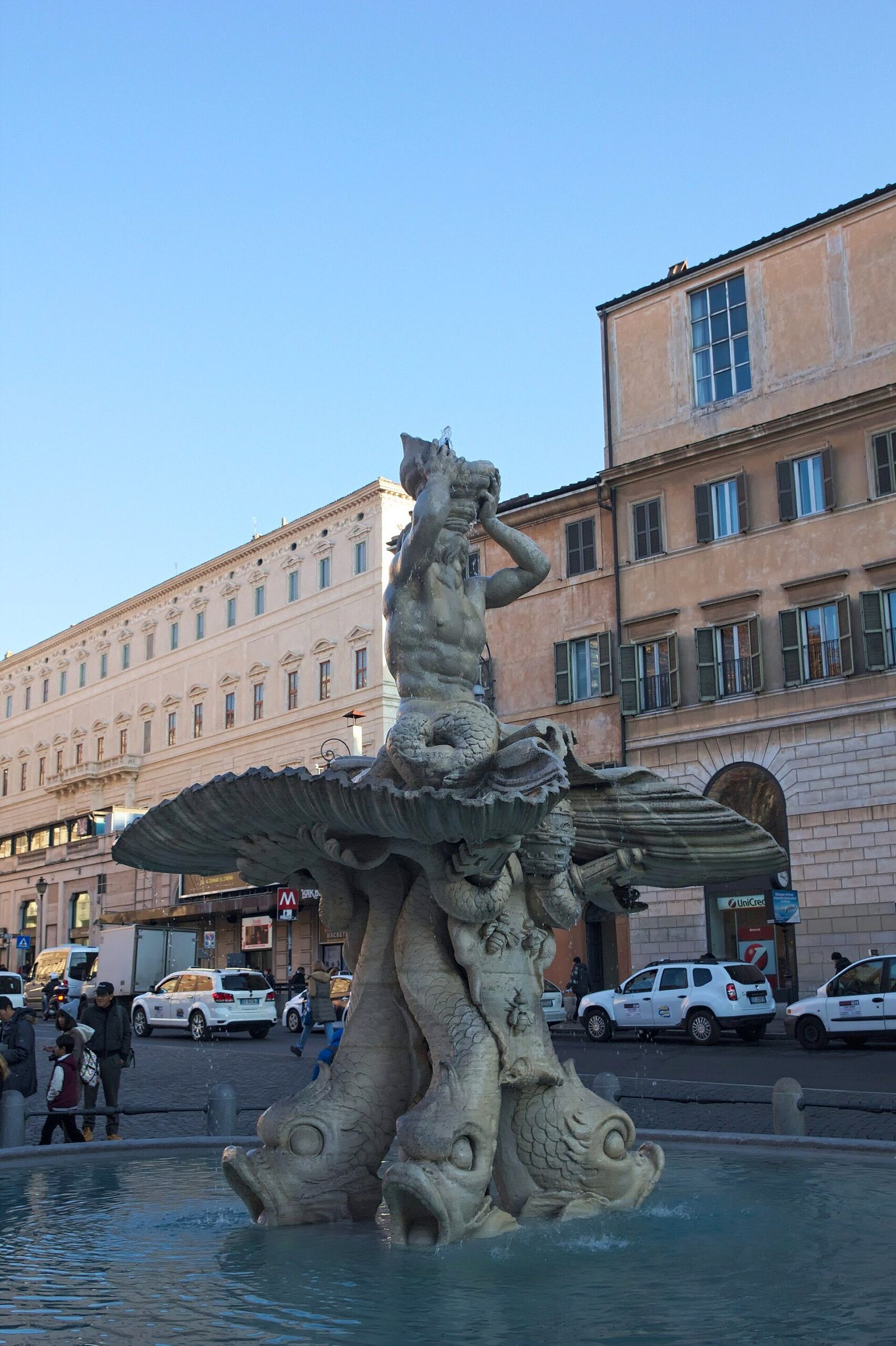
In the center stands the Triton Fountain, in travertine, with the sea god kneeling on a large shell held up by four dolphins. It is the only element of the square that really stops your eye, and also the only one that has not been moved. At the corner with Via Veneto, on the sidewalk at the start of the street, stands the small Fountain of the Bees, an open shell with three sculpted bees.
Around it, the buildings are mostly from the 19th and 20th centuries. One side holds the Barberini cinema building, designed by Marcello Piacentini and built in 1930 according to the cinema's own website. The other sides are taken up by hotels, offices and shops, with the metro entrance on the sidewalks. Apart from the fountains, little of the baroque remains in view. The city's tourism portal notes that the modern look of the square dates from the late 19th and early 20th centuries, with the opening of Via Veneto and Via Barberini.
The difference in level is the first thing you notice on foot. Via Sistina and Via Veneto descend toward the square, Via delle Quattro Fontane climbs toward the Quirinale, Via del Tritone descends again toward the center. Anyone coming from Piazza di Spagna along Via Sistina sees the fountain ahead and below, and it is the best view. Anyone coming out of the metro finds it off to the side instead, already in the traffic, and risks walking past without stopping.
The noise is constant. Cars, taxis and buses circle the basin without pause, and the jet from the Triton's buccina can only be heard when you get close to the edge. There are no benches around the fountain. You stop standing, on the sidewalk or on the edge of the central island when the light allows it. 10 minutes are enough to see both fountains calmly, before moving on to the palaces and churches of the area.
Each side of the square leads to a different piece of Rome. Via Veneto climbs toward the Umbertine districts and the ministries, Via Sistina toward the staircase and the Pincio, Via delle Quattro Fontane toward the Quirinale and the papal palaces, Via del Tritone toward the Corso and Piazza Colonna, Via Barberini toward Termini. That is why the square works better as a starting point than as a destination, and should be used that way.
A curiosity about Piazza Barberini
The square has not always had this name. In the 16th century it was known as Piazza Grimana, from the name of Cardinal Domenico Grimani, Patriarch of Aquileia, who owned property there. Around 1625 the name changed to Piazza Sforza a Capo le Case. Only after Urban VIII Barberini had built the family palace on the hill and commissioned the fountains did the square take the name of the family, and it has not lost it since.
The bees scattered everywhere are the signature of that family. They are the heraldic symbol of the Barberini, as the Capitoline Superintendency recalls in its pages on the two fountains. On the Triton Fountain they appear in the papal coats of arms between the dolphins' tails, on the Fountain of the Bees there are three, clearly visible under the upper valve. Once you start looking for them in Rome you find them on portals, ceilings and altars, because Urban VIII signed a large part of his building projects this way.
The name of the street that descends toward the center also comes from the fountain. Via del Tritone takes its name from Bernini's sea god, and anyone walking it uphill from Piazza Colonna sees the fountain appear at the end, like a point of arrival. It is one of the few cases where a baroque sculpture gave its name to a street opened much later, in the Rome of the capital of the Kingdom.
Via Veneto also has a longer name than the one in use. The Superintendency, on the page about the Fountain of the Bees, calls it Via Vittorio Veneto, the name that recalls the 1918 battle that ended the First World War for Italy. In everyday use almost nobody says it in full. Curiously, the reconstruction of the fountain at the start of the street happened precisely in the war years, between 1915 and 1916.
What does the Triton Fountain represent?
The Capitoline Superintendency dates the fountain between the end of 1642 and the first half of 1643. The patron was Urban VIII, who entrusted the work to Bernini as a public ornament of the city. The material is travertine, and the water came from the Felice Aqueduct, the same one that feeds the Moses Fountain, the monumental display of that aqueduct, reachable on foot by going up Via Barberini.
The subject is a triton, a sea creature half man and half fish, with an upright torso and scaly legs. He kneels on the valves of an enormous shell and blows into a buccina, a spiral shell from which comes the jet that wets the whole sculpture. At the base, in place of the classic baluster foot, four dolphins with intertwined tails hold up the shell and frame the papal coats of arms with the bees.
Looking closely at the coats of arms you can make out the crossed keys and the tiara, the signs of the papacy, above the shield with the Barberini bees. The dolphins' tails wind around one another and support the shell without a real pedestal, as if the sculpture were floating on the water of the basin. The basin itself is low and wide, level with the street, and this makes the figure look taller than it really is when seen from the sidewalk.
The Triton's gesture is the center of the work. The head is thrown back, the cheeks swollen, the arms raised to hold the buccina. The water rises and falls back on the body, on the shell and on the dolphins, and from there into the basin. Without water the fountain loses movement, and anyone who sees it switched off for works has in front of them an immobile and slightly stiff sculpture. With the jet running, the travertine seems bathed by a continuous wave.
The novelty, for the time, is the form. Before Bernini, Roman public fountains were almost always architectural basins, with stacked bowls and geometric profiles. Here the sculpture becomes the whole fountain, and the water runs over the figures as over a rock. The Superintendency speaks of a new baroque conception of urban space. Anyone who has seen the Fountain of the Four Rivers in Piazza Navona will recognize here the first step of that path.
The restorations documented by the Superintendency are many: 1987 and 1988, 1990, 1991 and 1992, 1998 and 2013. Travertine is a porous stone, and constantly running water leaves limescale deposits and dark patinas. Traffic adds smog. For this reason the surface changes color within a few years after each cleaning, and anyone who sees it in archive photos often finds it lighter or darker than it looks in person.
Something nobody tells you about Piazza Barberini
Palazzo Barberini cannot be seen from the square. Many visitors arrive convinced they will find it in front of them, with its facade on the fountain, and walk around the basin looking for it. The palace stands instead higher up, along Via delle Quattro Fontane, set back from the street and preceded by a gate and a garden. From the square you walk up in a few minutes, and only when you reach the gate do you understand its scale.
The reason is historical. The palace was built by the Barberini on the slope of the Quirinale, in an area still of villas and gardens, and the square below was a service open space on the road. The fountain was conceived as a signal from the family to the lower city, not as an ornament for a courtyard. Today the palace houses the Gallerie Nazionali di Arte Antica, and on this site you can find the page on Palazzo Barberini and the Galleria Nazionale d'Arte Antica.
The second thing few people notice concerns the Fountain of the Bees. The Superintendency explains that Bernini conceived it as a public drinking fountain and that originally it worked as a bottino, that is, it collected the return water of the Triton Fountain. The two fountains were therefore a single system. The big one was there to represent the pope, the small one to give people and animals a drink with the same water, before the city moved it and it lost its function.
The third surprise is the slope under your feet. The square seems flat because you cross it on the crosswalks, but it is the bottom of a natural hollow between two hills, and the streets that arrive here all descend. Anyone coming from the metro does not notice, because they come out already at the bottom. Anyone walking from Trinità dei Monti to the Quirinale crosses it downhill and then uphill.
Why is the Fountain of the Bees at the corner of Via Veneto?
Because it is not in its original place. The Capitoline Superintendency places the fountain, designed by Bernini in 1644, at the corner between Piazza Barberini and Via Sistina, near Palazzo Soderini. The city's tourism portal confirms the initial location at the corner of Via Sistina. There it stayed for over two centuries, until in the 19th century it was dismantled. The date of the dismantling is not the same in all sources: the Superintendency gives 1865, other historical reconstructions say 1867.
For half a century the fountain no longer existed, and of Bernini only some fragments survived. Between 1915 and 1916, again according to the Superintendency, it was rebuilt in the corner toward Via Vittorio Veneto, where it stands today. The reconstruction was largely a copy. Of Bernini's work, only fragments of the central bee and of a portion of the valve remain original. The rest is new travertine, worked on the model of the original by those who oversaw the 20th-century reconstruction.
The form is that of an open bivalve shell. The lower valve serves as a basin, the upper one rises like a backrest and carries at its base three bees, the Barberini coat of arms reduced to its symbol. An inscription recorded the pope's intervention to build the fountain as a public ornament of the city, with the same formula used for the Triton. In 2000 the fountain was restored, and in 2004 the head of a bee, lost to vandalism, was replaced with a copy.
The present position has an obvious flaw: the fountain is low, isolated on the sidewalk and surrounded by poles, signs and small tables. Many people pass without seeing it. In May 2026 the national press documented roadworks with a bulldozer a few centimeters from the basin, with the fountain left without protection during the work. It is a small and fragile monument in a very busy corner, and every job on the sidewalk puts it at risk.
The original function as a drinking trough also explains the low form. The fountain was meant for daily use, for filling buckets and watering horses and draft animals, which passed in large numbers along the road toward Trinità dei Monti. Today that role is played by the nasoni, the cast-iron fountains scattered across the whole city, and the Fountain of the Bees has remained as a monument, without the cart traffic that justified it.
My advice for visiting Piazza Barberini
My advice is to arrive from above, from Via Sistina, and not from the metro. Coming down from Trinità dei Monti the Triton Fountain appears ahead, frontal, with the whole square before your eyes. Anyone coming out of the Barberini stop instead finds themselves right in the traffic, to the side of the basin, and gets a fragmented view. If you are already at the metro, it is worth climbing a few dozen meters up Via Sistina and then walking back down, looking.
The second rule is not to stop at the Triton. The Fountain of the Bees is at the corner with Via Veneto, low and isolated on the sidewalk, and you have to look for it. Look at it up close, bending down to the height of the valve, because the bees can only be read that way. Then go up Via delle Quattro Fontane toward Palazzo Barberini and the intersection of the Quattro Fontane, with Borromini's San Carlo alle Quattro Fontane at the corner.
The best time is early morning, before eight, when traffic is lighter and the light comes in from the side on the travertine. In the afternoon the square is full of cars, tourist buses and people waiting at the traffic lights. In the evening the fountain is lit, but the noise remains. In our view the square does not deserve a long stop: it deserves 10 attentive minutes and then a walk uphill toward the Quirinale or toward Via Veneto.
One last rule concerns safety. The square is an intersection with many lanes and long traffic lights, and the buses turn tight around the basin. Do not cross outside the crosswalks to get closer to the fountain and do not climb onto the edge of the basin for a photo. Anyone traveling with small children does better to look at the Triton from the sidewalk and leave close-up photos for the hours of lightest traffic, early morning or Sunday.
Do I need a ticket or a reservation?
No. The square is a public street and the two fountains are viewed from the sidewalk, with no ticket, no reservation and no opening hours. No official source indicates reserved visits or access, and there is no booking service to see them. Free entry applies at any hour of the day and night, except for temporary fencing for works or events. There are no tickets to buy and no paid products tied to the fountains.
You do pay for the museums in the area. The closest is Palazzo Barberini, home of the Gallerie Nazionali di Arte Antica, with ticket and hours published on the official site barberinicorsini.org. The Barberini Mithraeum, the sanctuary of Mithras tied to the palace complex, opens only on set dates and by reservation. For both, only the official channel given in the dedicated pages applies.
Be wary of anyone selling tours or tickets to see the fountains. They are public outdoor monuments, and none of the official sources provides paid or reserved access. Third-party guided tours may include the square as a stop on a longer route, and in that case you pay for the service of the licensed guide, not for access. If someone in the square offers you a ticket for the Triton or the Bees, the ticket does not exist.
Another well-known fact, yet rarely cited
Everyone knows the square takes its name from the Barberini. Few remember that the ground was already famous in ancient times. The Roma Capitale tourism portal indicates that the square occupies the area of the ancient Circus of Flora, where the floral games in honor of spring were held in May. Nothing of the circus remains visible. The memory of the place survived in texts and place names, not in stones, and anyone crossing the square today finds no trace of it.
The second fact rarely cited concerns the street that arrives from the northwest. The city's portal notes that the area became an urban center after Sixtus V opened the Strada Felice in 1586, today's Via Sistina. It was that straight road, designed to connect Trinità dei Monti to Santa Maria Maggiore, that turned a country open space into a hub. Without Sixtus V, Urban VIII would not have had a square to decorate.
The third fact concerns entertainment, long before the cinema. Historical reconstructions of the square recall that in 1634 the Barberini opened a court theater next to their palace, with a capacity given as 2,000 seats, which remained in operation until 1873. The figure does not appear in the official sources, but it helps to read the continuity of the place: about three centuries later, facing the square, Piacentini's big cinema would be born.
The right photo to take at Piazza Barberini
The photo of the Triton is taken from below, getting close to the edge of the basin when the light allows it, with the buccina against the sky and the water jet backlit. A normal lens is enough. Avoid wide shots from the sidewalk: they include cars, signs and poles, and the fountain becomes a detail in the middle of traffic. Better to tighten on the figure and the dolphins, where the coats of arms with the bees can be seen.
The second photo is the Fountain of the Bees, taken three-quarters and at basin height. Standing, the upper valve hides the bees, bending down all three appear together with the inscription. It is best done early in the morning, before the sidewalk fills with passersby and small tables. For an overall photo, instead, the highest point of Via Sistina offers the square seen from above, with the central fountain and the streets converging on it.
In the evening the fountain is lit and the jet stands out well against the dark background. The problem is car headlights, which enter the frame from every side. One solution is to find a spot on the sidewalk where a traffic island or a pole covers the nearest lane, and to shoot when the light is red. On Sunday morning, early, with traffic at its minimum, the square offers the easiest conditions of the whole week.
How do I get there from central Rome?
By metro A, Barberini stop, which has exits directly onto the square. ATAC has announced the full reopening of the station for entry and exit after the closures of recent years for the escalators. From Termini it is two stops, toward Battistini. For buses the safest choice is the route planner of ATAC, because surface lines on Via del Tritone often change because of roadworks and detours.
On foot the square is easy to reach from many points in the center. From the Trevi Fountain you go up the streets toward Via del Tritone in a few minutes. From Piazza di Spagna you go by Trinità dei Monti and come down along Via Sistina. From Piazza della Repubblica you take Via Barberini or Via Vittorio Emanuele Orlando. For elevators and escalators in the stations, see the page of ATAC accessible services.
By car it makes no sense. The historic center is mostly a limited traffic zone, parking in the area is scarce and expensive, and rush-hour traffic slows everything down. Anyone coming from outside Rome is quicker leaving the car in a park-and-ride on metro line A and getting off at Barberini. Taxis and cars with drivers can stop at the edges of the square, but not along the bus lanes.
From Villa Borghese the road is all downhill. You exit from Porta Pinciana and go down Via Veneto, passing the grand hotels and the diplomatic offices, to the corner of the Fountain of the Bees. It is about 10 minutes at an easy pace. It is also the best way to reach the square without going through the traffic of Via del Tritone, and to see the small fountain before the big one, in the reverse of the usual order.
Some important events that happened here in history
In Roman times the area housed, according to the city's tourism portal, the Circus of Flora, tied to the spring festivals. In 1586 Sixtus V opened the Strada Felice, today's Via Sistina, which turned the area into a hub of the new city. In the first half of the 17th century the Barberini built their palace on the hill and between 1642 and 1643 Bernini made the Triton Fountain. In 1644, the year of Urban VIII's death, the Fountain of the Bees was designed.
In the 19th century the city changed the square. The Fountain of the Bees was dismantled, in 1865 according to the Superintendency, and its pieces ended up in storage. Between the late 19th and early 20th centuries the opening of Via Veneto and Via Barberini, as the city's portal recalls, gave the square its present look, with the buildings of Umbertine Rome and the traffic of the new districts coming down toward the Corso.
The 20th century brought the reconstruction and the cinema. Between 1915 and 1916 the Fountain of the Bees returned to the square, in the corner toward Via Veneto. In 1930 the Barberini cinema was built to a design by Marcello Piacentini. Then the metro, with the stop under the square, and the restorations of the Triton up to the one in 2013. In 2004 the head of a bee on the small fountain, lost to vandalism, was replaced with a copy.
Recent years have brought mostly construction sites. The restorations of the Triton listed by the Superintendency followed one another a few years apart between the 1980s and 2013, a sign of how much the travertine suffers from traffic and limescale. In 2022 the cinema completed its renovation. In May 2026 the roadworks at the corner of Via Veneto, with the bulldozer right next to the Fountain of the Bees, ended up in the national press.
Who has passed through Piazza Barberini
The first name is Gian Lorenzo Bernini, who left two works on the square a few years apart. With him Urban VIII, born Maffeo Barberini, who wanted the fountains as a public ornament of the city and as a sign of his family. Before them, Cardinal Domenico Grimani, Patriarch of Aquileia, who had given the square its first name. And Sixtus V, who with his road had decided its urban destiny.
Urban VIII died in 1644, the same year the Fountain of the Bees was designed, and the Superintendency gives his pontificate as 1623 to 1644. The two fountains of the square are therefore among the last public works of his long reign. Every Roman who passed in front of them, to drink or to water the horse, saw the bees of his family, and the message was exactly this: the city's water arrived by the pope's will.
In the 20th century the name most tied to the square is that of the father of Roberto Rossellini, who according to the cinema's website built the Barberini cinema building to a design by Marcello Piacentini. The historical archive of the Istituto Luce holds a photograph of Mussolini leaving the construction site of the future cinema-theater together with Piacentini and other figures. Anyone passing under that building therefore crosses a piece of the history of Roman cinema, as well as of interwar architecture.
The cinema building closes one of the sides of the square. According to the cinema's website it was built in 1930, and was born as a cinema and theater together, with one large hall. In those same years Piacentini was working on Rome's big urban projects, and here he signed a building serving entertainment, with the facade turned toward the fountain. It reads well from the opposite sidewalk, next to the metro exits, looking at the lines of the upper part.
The history of the hall follows that of Italian cinemas. In 1991 the single hall was divided into three, and the operator calls it the first multiplex cinema in Rome. In 1999 the screens became five, and with the renovation completed in 2022 they rose to six, with commercial spaces added. It is one of the few big cinemas in the center still in operation in the same building for almost a century, while other historic halls in the city have closed or changed use.
Then there are the famous passersby of Via Veneto. The street climbing from the square toward Porta Pinciana was, in the 1950s and 1960s, the place of international cinema's nightlife in Rome, told by the films of those years. On this site you can find the route dedicated to Rome in the movies. Farther up, a few minutes from the square, there is also the Church of the Capuchins with its crypt.
What do the documents say and what is told?
The documents, that is, the cards of the Capitoline Superintendency, give the dates of the fountains, the materials, the aqueduct, the restorations and the moving of the Fountain of the Bees. On this the official sources are clear. The city's tourism portal gives for the Triton Fountain a different dating, earlier by 10 years than that of the Superintendency: on this point the sources do not agree, and the Superintendency's dating, which follows the restorations, remains the most detailed.
Tradition tells something else. According to a story widespread among Romans, in the square, in front of the Triton Fountain, the bodies of people found dead and unrecognized were displayed, so that someone could identify them. Another tradition recalls the triumph of the strawberries, a parade of decorated carts that set off from the square with farmers handing out fresh strawberries. Neither story appears in the official sources, and they should be read as popular memory.
Then there is the legend of the inscription of the Fountain of the Bees. The story goes that the date carved indicated a year of pontificate that Urban VIII did not reach, because he died a few days earlier, and that the Romans read in it a bad omen. The tale circulates in many versions, with different years and details. The official sources limit themselves to saying that the inscription recorded the building of the fountain as a public ornament, without confirming the story.
The Circus of Flora also has to be read with caution. The city's tourism portal places it in the area of the square and ties it to the floral games of May, but on site there is no visible remain and the official sources indicate no excavations or documented structures under the intersection. It is a piece of ancient topography handed down by studies and guidebooks, useful to understand the place's bent for festivals, not something you can see.
Finally there is the memory of the name. That the square was called Piazza Grimana and then Piazza Sforza a Capo le Case is reported by historical reconstructions of Roman place names, while the Superintendency's pages on the fountains do not deal with the subject. The present name, instead, needs no documents: just look at the bees sculpted on the two fountains to understand to whom this intersection was dedicated in the 17th century.
How does the square fit into baroque Rome?
Piazza Barberini is the lowest point of a baroque route that climbs toward the Quirinale. From here you reach the Barberini palace, the Quattro Fontane intersection, Borromini's San Carlo and Bernini's Sant'Andrea al Quirinale, up to Piazza del Quirinale. In half a kilometer of climb you see together the works of the two great rivals of 17th-century Rome, a few dozen meters from each other.
For anyone following Bernini in Rome, the square is an almost obligatory stop. On this site you can find the route dedicated to Bernini in Rome, the one on baroque Rome and the one on Borromini in Rome. The two fountains read well together with the other baroque fountains of the center, from the Barcaccia in Piazza di Spagna to the Moro in Piazza Navona.
The most useful comparison is with the Fountain of the Four Rivers. At the Triton Bernini works with a single figure, a shell and four dolphins, in a space of passage. In Piazza Navona, a few years later, he multiplies the figures, adds the rock, the animals and the obelisk, and occupies the center of a ceremonial square. Seeing the Triton first and then Navona helps to understand how the same idea, the sculpture that becomes a fountain, grew in a few years.
The square is also part of the system of fountains of the Acqua Felice. The Triton and the Bees were fed by that aqueduct, the same as the Moses display a few minutes' climb away. Anyone who wants to understand how water reached the upper districts of Rome in the 17th century can follow the aqueduct backward to the Aqueducts Park, where the arches of the Felice run next to the ancient ones of the Claudia.
From the Quattro Fontane intersection also starts Via XX Settembre, which runs straight to Porta Pia, the gate designed by Michelangelo. It is the old Strada Pia, opened in the 16th century, which crosses at a right angle the Strada Felice of Sixtus V right at the Quattro Fontane. Piazza Barberini sits at the low end of this system of straight roads, and it is from here that it is best to begin, to read it uphill, one intersection at a time.
When is it under construction and what not to expect?
The square never closes, but the fountains can be switched off or fenced for works. No official source publishes a maintenance calendar. Over the years the Triton Fountain has been surrounded by scaffolding during restorations, and in May 2026 roadworks at the corner of Via Veneto came close to the Fountain of the Bees. If you find a fence, the fountain can still be seen, but without water it loses half its meaning.
Do not expect a pedestrian square. There are no benches, shaded areas or places to sit around the fountain. Traffic is continuous and crossings must be made on the crosswalks, watching for buses turning tight. Do not expect the Barberini palace on the square either, or remains of the Circus of Flora. The contrary opinion is clear: as a square it is overrated, as a place of two Bernini fountains it is underrated.
During demonstrations and big events in the center, the square can be closed to traffic or crossed by marches, with detours of surface buses. The metro can have exits closed for works or for security. Before leaving it is worth checking the notices of ATAC, which publishes station closures and line detours. The rest of the visit, outdoors, needs no organization.
Finally, do not expect the Fountain of the Bees in its original place, or intact. The one you see at the corner of Via Veneto is largely the 20th-century reconstruction, and the bee that looks newer than the other parts is not an illusion. It is the result of the 19th-century dismantling, the reconstruction and the acts of vandalism of recent decades. Looking at it knowing this makes it more interesting, not less.
Eating in the area
The area between Piazza Barberini, Via Veneto and Via del Tritone is full of places made for people who pass through once. The signs are always the same: the barker with the menu in hand, menus with photos of the dishes, items without a price, places open nonstop with no kitchen break, fresh pasta made in the window as a show. On the most touristy stretches of Via Veneto prices follow the name of the street, not the quality.
Romans do not avoid these places out of snobbery. They avoid them because they know that a place that lives on passing trade does not need customers who come back, and behaves accordingly. The menu displayed outside can be different from the one handed to you at the table, and the cover charge or the service appear only on the bill. The practical rule is to move a few streets away from the main roads and look at where the office workers of the area eat at lunch.
Special attention goes to the outdoor tables on the wider sidewalks, with a view of the fountain or of Via Veneto. The price of a coffee or a dish sitting there can be much higher than at the counter or on a side street, and the posted price list does not always make it clear. Before sitting down, ask for the menu with prices and check if the cover charge and table service are shown.
The neighborhood is full of offices, ministries and hotels, and its everyday food is found on the side streets, away from the better-known facades. To choose without leaving it to chance, there is the list of addresses on Google Maps, with addresses selected across Rome and the surrounding area. No place in the square or on Via Veneto is named here, by choice.
What to combine in a day
The most natural combination is to climb toward the Quirinale. From Piazza Barberini you take Via delle Quattro Fontane, pass in front of Palazzo Barberini and reach the Quattro Fontane intersection, with Borromini's San Carlo. You continue along Via del Quirinale to Bernini's Sant'Andrea and to the square of the Quirinale, with the obelisk and the Scuderie. From there you go down to the Trevi Fountain.
The second itinerary goes north. You climb Via Veneto to Porta Pinciana, in the Aurelian Walls, and enter Villa Borghese. From there you reach the Galleria Borghese, where you see some of Bernini's best-known sculptures, or the Pincio, from which you go down to Piazza del Popolo. It is a day entirely on foot, with a climb at the start and a long descent at the end.
The third goes east, along Via Barberini. In a few minutes you reach the Moses Fountain and Piazza della Repubblica, with the Fountain of the Naiads, the Basilica of Santa Maria degli Angeli and the Baths of Diocletian. It is the route of the water displays: from the 17th-century Felice to the 19th-century Marcia, in under a kilometer.
Anyone with only half a day can instead go down toward the baroque center. From Via Sistina you climb to Trinità dei Monti and pass next to Villa Medici, then go down the staircase to Piazza di Spagna. Alternatively, along Via del Tritone you reach Piazza Colonna, the column of Marcus Aurelius and the Galleria Sciarra, little known to visitors.
On the Trevi side the walk continues with the back of the fountain, that is Palazzo Poli, against which the Acqua Vergine display is set, and with the church of Santi Vincenzo e Anastasio in front of the basin. Anyone climbing instead toward Trinità dei Monti finds the Sallustiano obelisk at the top of the staircase. In both cases the square stays behind you, as a starting point.
To combine the square with an indoor visit, the two closest can also be booked online: the entrance ticket for Palazzo Barberini and Galleria Corsini, a few steps from the Triton Fountain, and the entrance to the Capuchin Crypt on Via Veneto, with tour or audio guide. They are Tiqets affiliate links: if you buy from there Estate Romana receives a small commission, while the price for you stays the seller's.
Frequently asked questions
Do you pay to see Piazza Barberini and its fountains?
No. The square is a public street and Bernini's two fountains are viewed from the sidewalk with no ticket and no reservation. They are protected by the Capitoline Superintendency for Cultural Heritage, which gives no hours or reserved access. You do pay for the museums of the area, such as the Gallerie Nazionali di Arte Antica at Palazzo Barberini, with ticket and hours on the official site. For the list of free places, see our page on free Rome.
Who made the Triton Fountain and when?
Gian Lorenzo Bernini, commissioned by Pope Urban VIII Barberini. The Capitoline Superintendency dates the work between the end of 1642 and the first half of 1643, and describes it as travertine, originally fed by the Felice Aqueduct. The city's tourism portal gives different dates, earlier by about 10 years. The subject is a triton kneeling on a shell held up by four dolphins, blowing into a buccina from which the water jet comes.
Is the Fountain of the Bees still Bernini's original?
Only in small part. Bernini designed it in 1644 for the corner of Via Sistina, near Palazzo Soderini. In the 19th century it was dismantled and between 1915 and 1916 it was rebuilt in the corner toward Via Veneto. According to the Capitoline Superintendency only fragments of the central bee and of a portion of the valve remain original. In 2000 it was restored and in 2004 the head of a bee, lost to vandalism, was replaced with a copy.
Where exactly is the Fountain of the Bees?
At the corner between Piazza Barberini and Via Veneto, on the sidewalk at the start of the street, in an isolated position. It is low and small, and anyone arriving from the metro risks not seeing it. It is not its original location: Bernini designed it for the corner of Via Sistina, near Palazzo Soderini, and the reconstruction of 1915 and 1916 brought it to the present spot. You look at it for free, at any hour, from the sidewalk.
Does Palazzo Barberini face onto the square?
No, and it is the most common mistake. The palace stands higher up, along Via delle Quattro Fontane, set back from the street and preceded by a gate and a garden. From the square you reach it on foot with a few minutes of climbing. It houses the Gallerie Nazionali di Arte Antica, one of Rome's great state picture galleries. Ticket, hours and temporary exhibitions are on the museum's official site, which is also the only channel to use for buying.
Which metro stop serves Piazza Barberini?
The Barberini stop on metro A, with exits directly onto the square. ATAC has announced the full reopening of the station for entry and exit after the closures tied to the escalators. From Termini station it is two stops in the direction of Battistini. For elevators and escalators it is worth consulting the ATAC accessible services page, and for buses the company's route planner, because detours are frequent.
Can you see the Mitreo Barberini from the square?
No. The Mitreo Barberini is part of the palace complex, not of the square, and opens only on set dates and by reservation through official channels. From the street you see nothing. Anyone who wants to visit it has to plan ahead and follow the instructions on the dedicated page of the site. For other similar places under the city, see our page on underground Rome.
What is the best time to see the fountains?
Early morning, before eight, when traffic is lighter and the light comes in from the side on the travertine. In the afternoon the square is full of cars and people at the traffic lights, in the evening the fountain is lit but the noise remains. In the middle hours of summer the square is exposed to the sun and there are no shaded areas to stop in, so it is best to pass through at the start or end of a walk.
Why are there bees everywhere?
Because bees are the heraldic symbol of the Barberini, the family of Pope Urban VIII. On the Triton Fountain they appear in the papal coats of arms between the dolphins' tails, on the Fountain of the Bees there are three, under the upper valve. The same bees are found on many other building projects commissioned by that pope across the city. Anyone visiting St. Peter's Basilica finds them again under the dome, in the bronze baldachin.
Who wrote this and from which sources
The text comes from the editorial team of Tour Leader Pro, the Roman organization that designs itineraries, visits and cultural events across Rome and Lazio. Rates, hours and booking methods given here come from the official sources cited in the text as of the date given at the start: the pages of the Capitoline Superintendency on the two fountains, the Roma Capitale tourism portal, the ATAC notices and the Barberini cinema website. Tell us what you find changed.
Piazza Barberini is one of the most used hubs for organizing a day on foot between the Quirinale, Via Veneto and Trevi. The delicate point is stopping: the square has no spaces where a group can stand without blocking the flow, and the most convenient meeting points are the high sidewalk of Via Sistina or the open space in front of the palace gate. For anyone organizing group trips, a useful resource for planning timing, stops and transfers is Tour Leader Pro.
The square fits into a wider trip to Rome and Lazio, between the baroque of the center, the villas of the Castelli Romani and the villages of Sabina and Tuscia. A couple of days in the historic center are enough for the fountains and the main museums, but the rest of the region asks for time and an orderly program. A useful resource for putting together a multi-day itinerary is Italy Planner.