Lucie Horsch, Metamorphosis at the Aula Magna of the Sapienza, February 6, 2027
In short. Dutch recorder player Lucie Horsch makes her Rome debut on Saturday, February 6, 2027 at 20:30 in the Aula Magna of the Palazzo del Rettorato of the Sapienza, Città universitaria, Piazzale Aldo Moro 5 (00185 Rome), with the program…
Dutch recorder player Lucie Horsch makes her Rome debut on Saturday, February 6, 2027 at 20:30 in the Aula Magna of the Palazzo del Rettorato of the Sapienza, Città universitaria, Piazzale Aldo Moro 5 (00185 Rome), with the program Metamorphosis for the Calliope cycle of the IUC Season, in collaboration with the Accademia Musicale Chigiana. A recital for solo recorder, from Jacob van Eyck and Bach to Berio, Kurtág and Britten, played on eight different recorders. You get there by Metro Line B, stops Policlinico or Castro Pretorio, by trams 3 and 19 or on foot from Termini. For concerts you enter, even on foot, only from Piazzale Aldo Moro 5. IUC Season tickets cost 26 euros in the first section, 21 in the second and 15 in the third, plus a 10% presale fee, with 8 euros for under-30s and 5 for under-18s. They are bought at the IUC office at Lungotevere Flaminio 50, by phone, at the Aula Magna box office from one hour before and on the authorized presale network indicated by the official concert page.
A musician who picked up the recorder at five and was on television at nine, who won the Edison at 17 with her first record and whom the Guardian called the great novelty of her instrument. For her Rome debut she brings a program on the theme of metamorphosis, in a hall where a bronze Minerva welcomes the audience at the entrance.
Lucie Horsch at the IUC: Metamorphosis
Lucie Horsch's concert is scheduled for Saturday, February 6, 2027 at 20:30 in the Aula Magna of the Sapienza, in the Calliope cycle of the 2026/2027 IUC Season. The official calendar gives an expected end around 22:30. It is the flutist's Rome debut.
A Saturday night
The Calliope cycle usually gathers the Saturday concerts at 17:30. Horsch's recital is an exception, starting at 20:30: a full Saturday night, which lends itself to dinner in San Lorenzo before or after the concert.
With the Chigiana
The IUC presents the concert in collaboration with the Accademia Musicale Chigiana. The collaboration brings to Rome a musician who, according to the IUC, is among the most prolific ambassadors of her instrument.
In the season
In the 2026/2027 IUC Season, alongside pianists, quartets and cellists, a recorder recital is a rarity. In our view it is one of the most original concerts on the program, precisely because of the instrument it puts at the center.
The program: four centuries of solo recorder
Lucie Horsch's Metamorphosis program crosses four centuries of music for solo recorder, from the Dutch 1600s of Jacob van Eyck to Bach and Telemann, up to Debussy, Stravinsky, Berio, Kurtág and Britten. It opens and closes with the music of the Netherlands, the flutist's country.
The first half
After Doen Daphne d'over schoone Maeght by Jacob van Eyck, from the collection Der Fluyten Lust-Hof, you hear Georg Philipp Telemann's Fantasia No. 7 in D major "Alla francese" TWV 40:8, Le Printemps de Vivaldi by Jean-Jacques Rousseau, Johann Sebastian Bach's Partita for solo flute in A minor BWV 1013, a selection from Jacques-Martin Hotteterre's Art de Préluder op. 7, Claude Debussy's Syrinx L 129 and the third of Igor Stravinsky's Three Pieces for solo clarinet.
The second half
After the intermission, Telemann's Fantasia No. 1 in A major TWV 40:2, Carl Philipp Emanuel Bach's Sonata in A minor Wq 132, Gesti by Luciano Berio, Engels Nachtegaeltje by van Eyck, "…ein Sappho-Fragment…" from Signs, Games and Messages by György Kurtág, Pan and Phaeton from Benjamin Britten's Six Metamorphoses after Ovid op. 49, and to close Boffons, again by van Eyck.
The myth
The IUC stresses how some pieces tie in with myth: Debussy's Syrinx and Britten's Ovidian portraits evoke pastoral atmospheres and ancient gods. Pan and Phaeton, the two portraits chosen by Britten, come from Ovid's Metamorphoses: the program's title is to be taken literally.
Berio
The most modern moment, according to the presentation, is entrusted to Gesti by Luciano Berio, an avant-garde piece that breaks down the instrument's traditional techniques. It is the piece furthest from the idea many people have of the recorder, and perhaps the most anticipated.
Eight or nine recorders
The metamorphosis, writes the IUC, takes place on several levels: the styles change, and the instrument changes, from the tiny, bright sopranino to the modern tenor recorder with its deep, warm sound. The sources do not agree on the number: the presentation speaks of nine recorders, the flutist's note and the program note of eight.
Who Lucie Horsch is
Lucie Horsch is a Dutch recorder player born in 1999, among the best-known talents of the recorder. She won the Edison in 2016 with her first record, the Opus Klassik in 2019 and in 2020 the Nederlandse Muziekprijs, the Dutch Ministry of Culture's prize.
The beginnings
She began playing the recorder at five. At nine she had her first national recognition, when her performance at the Kinderprinsengrachtconcert in Amsterdam was broadcast on television. She studied recorder with Walter van Hauwe and piano with Marjes Benoist and Jan Wijn at the Amsterdam Conservatory.
Eurovision and the Concertgebouw
In 2014 she represented the Netherlands at Eurovision Young Musicians. In 2016 the Concertgebouw awarded her the Young Talent prize. Her international career began from there.
Recordings
The first album, in 2016, was devoted to Vivaldi's recorder concertos and won the Edison Award. The second, in 2019, collects Baroque concertos with the Academy of Ancient Music and received the Opus Klassik. The third, Origins, from 2022, is an album of folk inspiration, with music by several composers: the same taste for roots found in the van Eyck pieces of the Roman program.
Baroque and modern orchestra
According to the IUC, Horsch performs with ensembles specialized in the Baroque repertoire and with modern orchestras. In the most recent season she debuted with the Hong Kong Philharmonic and the Macedonian Philharmonic Orchestra. The Guardian called her the latest great novelty in the world of the recorder.
A curiosity about Lucie Horsch, Metamorphosis at the Aula Magna of the Sapienza, February 6, 2027
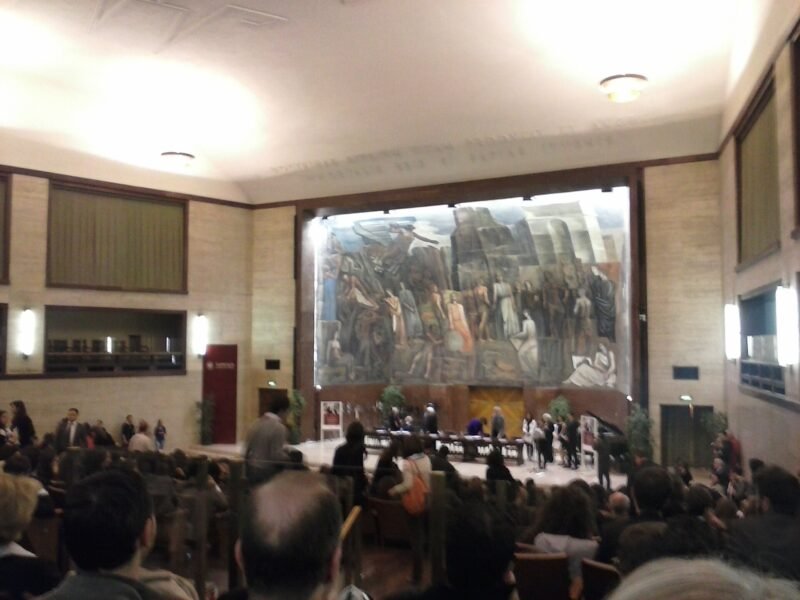
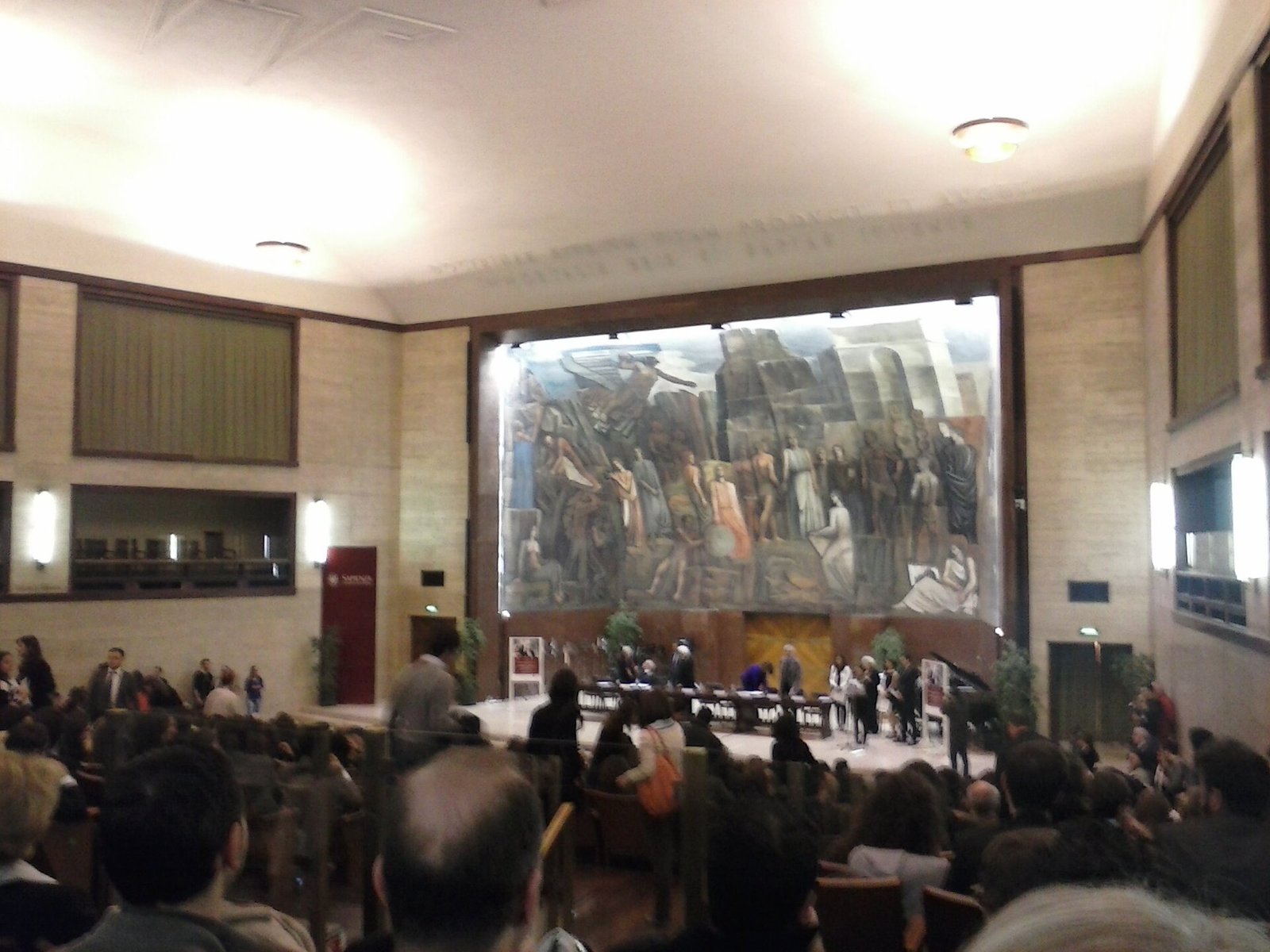
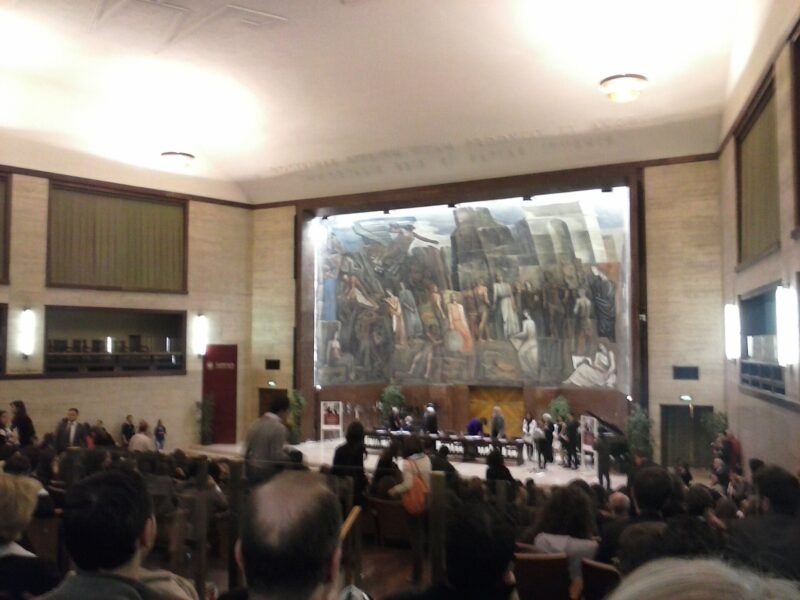
The nicest curiosity concerns the place. The Metamorphosis program is built around myth, with Pan and Phaeton from Ovid's Metamorphoses in Britten's version and Debussy's Syrinx. In front of the Rectorate, at the center of a pool, stands Arturo Martini's bronze Minerva, and on the back wall of the Aula Magna is Mario Sironi's fresco, L'Italia tra le arti e le scienze. Ancient gods in music, a bronze goddess at the entrance: rarely do a program and a hall answer each other so well.
The second concerns a composer. Jacob van Eyck, who opens, runs through and closes the program, lived between 1590 and 1657. All three of his pieces on the program come from the collection Der Fluyten Lust-Hof. Horsch makes him the common thread of her Rome debut, bringing the music of her country at the opening and the close.
Third curiosity: the program also includes a piece born for another instrument, the third of Stravinsky's Three Pieces for solo clarinet, and an 18th-century rereading of another music, Le Printemps de Vivaldi by Jean-Jacques Rousseau, the philosopher. The recorder takes them over, and the metamorphosis of the title concerns the repertoire as well.
The Aula Magna at Sapienza, the hall of the debut
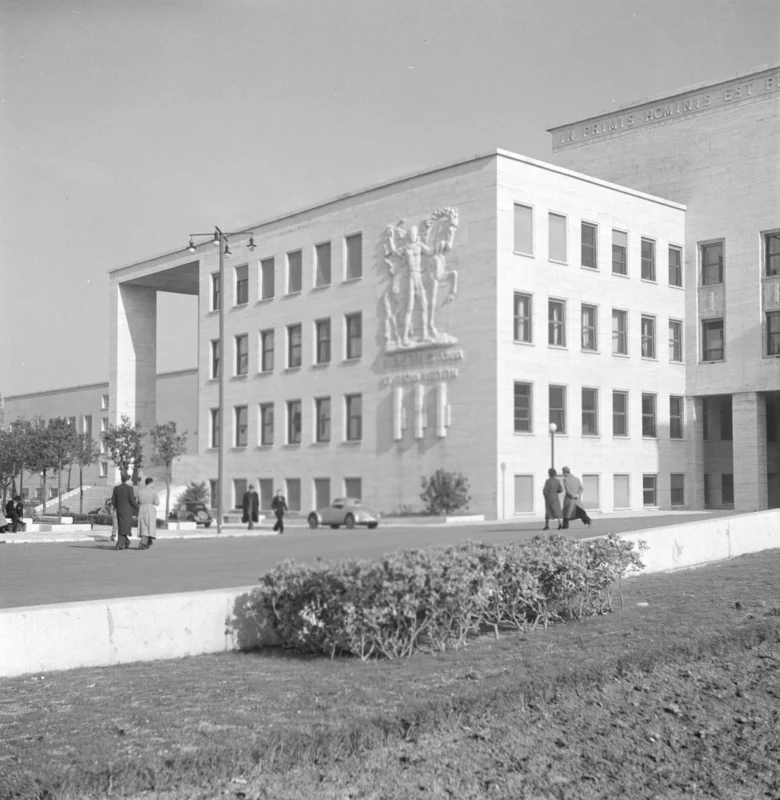
The Aula Magna is in the Palazzo del Rettorato, designed by Marcello Piacentini for the Sapienza's Città universitaria, built between 1933 and 1935 and inaugurated on March 31, 1935 in the presence of Victor Emmanuel III.
The Rectorate
The Rectorate closes the perspective of the campus's great entrance avenue and houses the rector's offices, the Biblioteca Alessandrina and the Aula Magna. In front, at the center of a pool, is Arturo Martini's Minerva, goddess of wisdom and symbol of the university.
Sironi's fresco
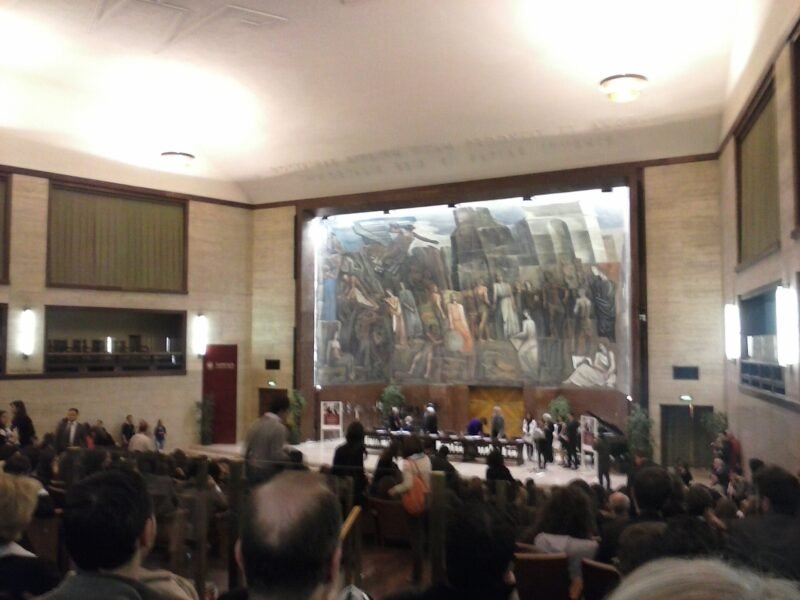
The back wall is occupied by Mario Sironi's 1935 fresco, L'Italia tra le arti e le scienze. A solo recorder recital in front of that great pictorial cycle is a contrast of scale: one musician, one small wooden instrument, an entire wall of figures.
The city of architects
Around the Rectorate stand buildings by Gio Ponti, Giuseppe Pagano, Pietro Aschieri, Giovanni Michelucci and Gaetano Rapisardi. The monumental entrance on Piazzale Aldo Moro is by Arnaldo Foschini. On campus there are also the MLAC and the Gipsoteca.
One thing nobody tells you about Lucie Horsch, Metamorphosis at the Aula Magna of the Sapienza, February 6, 2027
Few people know it, but for IUC concerts the Sapienza opens free parking inside the Città universitaria, for cars, motorcycles, bicycles, taxis and vehicles with disability permits, with access from Piazzale Aldo Moro 5 from about an hour before the concert. The IUC warns that, for reasons beyond its control, it may not always be available.
The second thing is that, in the evening, the Città universitaria has more gates closed than open. The entrance to the concerts, even for those arriving on foot, is only the monumental one at Piazzale Aldo Moro 5. If you come from San Lorenzo you would do well to know it, so as not to walk around the fence.
The third concerns the instrument. A solo recorder in a hall as big as the Aula Magna can seem a gamble. The IUC instead speaks of the intimacy of the setting, which allows contrasts between the warm Baroque sound world, the folkloric and primordial aspects of the instrument and its contemporary effects. In our view the right place is in the first sections, where the pianissimos arrive intact.
The advice I give you for visiting Lucie Horsch, Metamorphosis at the Aula Magna of the Sapienza, February 6, 2027
My advice is to forget the recorder from middle school. The one Lucie Horsch plays is an instrument with a whole family, from sopranino to tenor, and a repertoire of four centuries. If you arrive with the memory of music lessons, you leave with a completely different idea.
Second piece of advice: listen beforehand to Debussy's Syrinx and one of Britten's Metamorphoses in their most widely available versions. In the hall it will be interesting to hear how they change on the recorder.
Third: take advantage of the prices for young people. With 8 euros for under-30s in any section and 5 for under-18s, bringing a teenager who studies an instrument costs little, and a recital like this is a live lesson.
Finally, arrive with time to spare: the avenue of the Città universitaria in the evening, with the lit Minerva, is worth the walk, and is the right prologue for a program devoted to myth.
Tickets for Lucie Horsch
A ticket for the Lucie Horsch concert costs 26 euros in the first section, 21 in the second and 15 in the third, with a 10% presale fee. Under-30s pay 8 euros and under-18s 5 euros, in any section.
Discounts
With the Family Card, designed for two parents with at least one child under 14, each parent pays €10 and each child €5. Sapienza, affiliated institutions and universities have prices of €21, €17 and €12. The carnet of at least six concerts of your choice gives a 10% discount. Discounts cannot be combined.
Where to buy
At the IUC office at Lungotevere Flaminio 50, Monday to Friday from 10:00 to 13:00 and from 14:00 to 17:00, closed on Tuesday during the season. By phone at 06 3610051 and 06 3610052. At the Aula Magna box office, from one hour before the concert. Online on the presale network indicated by the IUC's official website, also with the Carta del Docente. On Saturday the Lungotevere Flaminio office is closed: if you want to buy in person without going through the evening box office, you have to do it in the preceding days.
How to get to the Aula Magna for Lucie Horsch
For the Lucie Horsch concert at the Aula Magna of the Sapienza, use Metro Line B, stops Policlinico or Castro Pretorio, or trams 3 and 19. From Termini you can also walk. You enter only from Piazzale Aldo Moro 5.
Metro Line B
From the Policlinico and Castro Pretorio stops a few minutes' walk takes you to the Piazzale Aldo Moro entrance. For a concert that ends around 22:30 it is best to check beforehand the time of the last Saturday train.
Tram
The 3 and the 19 cross San Lorenzo and run along the University City: the 19 toward the Policlinico and Viale delle Belle Arti, the 3 toward Porta Maggiore, San Giovanni and the Colosseum.
On foot
From Termini station you exit on Via Marsala side and reach Piazzale Aldo Moro in about 15 minutes.
By car
For concerts the free internal parking at Sapienza is available, barring surprises, with access from Piazzale Aldo Moro 5 from about one hour before.
Another well-known fact, yet rarely mentioned
It is well known that the IUC is one of the historic classical music institutions in Rome, the one of Magaloff, Kempff, Menuhin and the Quartetto Italiano. It is less often mentioned that it was born in 1946 on the initiative of some Sapienza students, and not in a conservatory. An institution born among students that brings to Rome a soloist who at 20 was already a recognized virtuoso: the continuity is evident.
A second fact less often told: for 25 years the Aula Magna was not the IUC's hall. Declared unusable in 1968, with nine concerts canceled, the hall returned to hosting the full season only from 1993/94, after the agreement with the university of October 3, 1992.
Third fact: the Città universitaria, inaugurated in 1935, was hit by the first Allied bombing of Rome, on July 19, 1943, together with the nearby San Lorenzo district. The same campus that was damaged that day today hosts one of the liveliest concert programs in the city.
How to plan the evening
For Lucie Horsch's Rome debut it is best to be at the Piazzale Aldo Moro 5 entrance at least half an hour before 20:30. The Aula Magna box office opens an hour before the concert, and if you buy or pick up a ticket on the spot, you do it more calmly by arriving early.
From the gate to the hall
From Foschini's monumental entrance you follow the avenue to the Minerva square. The Rectorate is the building at the end, and the ticket office for subscriptions is under the portico. The avenue is longer than it looks from the gate.
How long it lasts
The official calendar gives an expected end around 22:30. The program is divided into two parts, with an intermission between Stravinsky's piece and Telemann's second Fantasia.
Afterward
On the way out you walk back toward Piazzale Aldo Moro, for Metro Line B or the trams. If you used the internal parking, you leave by the same entrance. San Lorenzo, for a last Saturday night drink, is a few minutes' walk away.
The right photo to take at Lucie Horsch, Metamorphosis at the Aula Magna of the Sapienza, February 6, 2027
The right photo is the one of the stage before the concert: a row of recorders of different sizes, from the smallest to the largest, and Sironi's fresco in the background. It is the image that tells the program better than any description. No photographs during the concert: with a solo recorder, every noise is heard.
The second is taken on arrival, from the end of the campus avenue: Arturo Martini's Minerva at the center of the pool and the lit Rectorate behind. At 20:00 on a February Saturday the campus is dark and Piacentini's facade stands out like a backdrop.
The third on the way out, on Foschini's monumental entrance seen from the inside, with the empty avenue: on Saturday night the Città universitaria has a metaphysical air.
Some important events that took place here in history
The Sapienza University City was inaugurated on March 31, 1935 in the presence of Victor Emmanuel III. In the same year Mario Sironi completed the fresco in the Aula Magna. On July 19, 1943 the first Allied bombing of Rome hit San Lorenzo and also damaged the campus.
In 1946 some Sapienza students founded the Istituzione Universitaria dei Concerti. In the 1959/60 season the Aula Magna hosted Chopin's complete piano works with Nikita Magaloff, the 32 Beethoven sonatas with Wilhelm Kempff, the Quartetto Italiano, Andrés Segovia and the young Salvatore Accardo and Uto Ughi.
In 1968 the hall was declared unusable and nine concerts were canceled. From 1977/78 it hosted free activity for professors and students again, and from 1993/94, after the agreement of October 3, 1992, the full season again. On February 6, 2027 Lucie Horsch makes her Rome debut there.
Who has played Lucie Horsch, Metamorphosis at the Aula Magna of the Sapienza, February 6, 2027
From the Aula Magna have passed, for the IUC, pianists Nikita Magaloff, Wilhelm Backhaus, Edwin Fischer, Alfred Cortot, Wilhelm Kempff, Géza Anda, Aldo Ciccolini and Maurizio Pollini. Violinists Yehudi Menuhin, Georg Kulenkampff, Gioconda De Vito and Adolf Busch. Cellist Pierre Fournier. Guitarist Andrés Segovia. The Quartetto Italiano.
And those who built and decorated the hall: Marcello Piacentini, Mario Sironi, Arturo Martini, as well as Piero Rattalino, artistic director of the IUC from 1969/70. Among the composers on the program is Luciano Berio, who in Rome was president of the Accademia di Santa Cecilia and gave his name to the cavea of the Auditorium.
In the same season the Aula Magna also welcomes, among others, cellist Mario Brunello, pianist Marc-André Hamelin and the Janoska Ensemble. On February 6, 2027 it is Lucie Horsch's turn, her first time in Rome, one of the youngest voices of the season.
Accessibility and families
The IUC Season is among the most affordable in Rome: €8 for under 30, €5 for under 18, and a Family Card with €5 for each child under 14.
Reduced mobility
The internal parking at Sapienza is open to vehicles with a disability permit, from the entrance at Piazzale Aldo Moro 5. For seats in the hall and routes it is best to phone the IUC before the concert.
With kids
The recorder is the instrument through which many kids come to music: seeing it played at this level, in eight or nine different versions, is a rare experience. The 20:30 Saturday time is compatible even with a middle schooler, and with the Family Card the cost is minimal.
Students
Sapienza students under 35 can subscribe with UNIIUC for 50 euros for the whole season or 30 euros for a cycle: the Calliope cycle includes this recital.
San Lorenzo and the surroundings
The University City borders San Lorenzo, a district born between 1884 and 1888 for railway workers and laborers outside the Aurelian Walls and today the heart of Rome's university life.
The neighborhood
Streets named after ancient Italic peoples, railing-balcony houses, the former Pastificio Cerere turned into a contemporary art center: the neighborhood is the natural extension of a Saturday night in the Aula Magna.
By day
If you stay in Rome you can visit San Lorenzo fuori le Mura, one of the seven pilgrimage churches of Rome, the Verano Cemetery and, with tram 3, Porta Maggiore.
Where to eat before or after the concert
San Lorenzo offers trattorias, pizzerias, osterias and student places, with prices generally lower than the historic center.
Before the concert
For a 20:30 concert it is best to eat early: a long aperitivo on Via dei Volsci, Via dei Sabelli or Largo degli Osci, or a quick pizza, and then a 10-minute walk to Piazzale Aldo Moro.
After the concert
The concert ends around 22:30 on Saturday: San Lorenzo is in the middle of its nightlife, and many places are open. For Saturday night, if you want a sit-down dinner, it is better to book.
Early February in Rome
The first week of February is one of the quietest times to visit Rome: museums you can enjoy, lower prices, music seasons in full swing.
Two concerts on the same Saturday
On Saturday, February 6 at 18:00, at the Auditorium Parco della Musica, Tarmo Peltokoski conducts the Orchestra di Santa Cecilia with Bertrand Chamayou in Liszt's First Concerto and Shostakovich's "Leningrad." If you have the energy, you can follow both concerts on the same day, moving from the Auditorium to the Sapienza in time for 20:30, but the margin is tight: consider it only with a fast means of transport.
The weather
Early February evenings are cold and the campus avenue is exposed: a heavy coat is better for the stretch between the entrance and the Rectorate.
A weekend of music
If you arrive in Rome for the weekend of February 6, you find a city out of season, with uncrowded museums and concert halls in the middle of their seasons: Saturday night in the Aula Magna, with dinner in San Lorenzo, is a different way from the usual to experience it.
How to listen to a recorder recital
A solo recorder recital is a particular listening experience: a single melodic line, no chords, no piano, and everything entrusted to the breath, the fingers and the timbre of the instrument chosen for each piece.
Following the instrument changes
With eight or nine recorders on stage, each piece has its own color. The sopranino is bright and high, the tenor deep and warm, as the IUC writes. Noticing when Horsch changes instrument, and how the sound changes, is part of the game of the program.
Baroque and contemporary
The program continually alternates old and modern pieces: Bach and Telemann next to Berio and Kurtág. In our view it is best not to look for a historical line, but to listen to the contrasts: the warm Baroque sound world, the folkloric aspects of the instrument and its contemporary effects, as the presentation describes them.
The silence of the hall
A solo recorder has limited volume. In a hall as big as the Aula Magna the audience has an important part: phones off, no candy wrappers, coats settled before the start.
The IUC, who organizes
The Istituzione Universitaria dei Concerti was born in 1946 on the initiative of Sapienza students, from an idea that matured at the end of 1945, and since then it has organized one of the longest-running concert seasons in Rome, in the Aula Magna of the Rectorate.
A history of performers
In its history the IUC has hosted, among others, Magaloff, Backhaus, Fischer, Cortot, Kulenkampff, Menuhin, De Vito, Busch, Fournier, Kempff, Anda and Ciccolini, and gave its trust to a young Maurizio Pollini. From 1969/70 the artistic direction was Piero Rattalino's.
The years outside the Aula Magna
When the Aula Magna was declared unusable in 1968, the IUC moved its concerts to other halls in the city, including the Teatro dell'Opera, the Eliseo, the Ridotto and San Leone Magno. From 1977/78 a double track followed, and from 1993/94 the season returned entirely to the Aula Magna.
The 2026/2027 season
The 82nd season runs from October 17, 2026 to May 8, 2027, with 35 concerts divided between the Saturday Calliope cycle and the Tuesday evening Minerva cycle.
Frequently asked questions about Lucie Horsch in Rome
When does Lucie Horsch play in Rome?
Lucie Horsch plays on Saturday, February 6, 2027 at 20:30 in the Aula Magna of the Sapienza, Piazzale Aldo Moro 5, for the Calliope cycle of the 2026/2027 IUC Season, in collaboration with the Accademia Musicale Chigiana. It is the flutist's Rome debut, with the program Metamorphosis.
What does Lucie Horsch play?
At the Aula Magna Lucie Horsch plays a solo recorder program that goes from Jacob van Eyck, Telemann, Bach and Hotteterre to Debussy, Stravinsky, Berio, Kurtág and Britten's Metamorphoses after Ovid, alternating eight or nine different recorders.
How much do tickets cost?
A ticket for Lucie Horsch at the IUC costs 26 euros in the first section, 21 in the second and 15 in the third, plus a 10% presale fee. Under-30s pay 8 euros and under-18s 5 euros in any section. The Family Card offers 10 euros per parent and 5 per child.
Where do you buy tickets?
Tickets for Lucie Horsch are bought at the IUC office at Lungotevere Flaminio 50, by phone at 06 3610051 or 06 3610052, at the Aula Magna box office from one hour before and online on the presale network indicated by the IUC's official website.
Who is Lucie Horsch?
Lucie Horsch is the Dutch recorder player born in 1999, trained at the Amsterdam Conservatory, winner of the Edison in 2016, the Opus Klassik in 2019 with the Academy of Ancient Music and the Nederlandse Muziekprijs in 2020. She plays with Baroque ensembles and modern orchestras.
How do I get to the Aula Magna at Sapienza?
You get to the Aula Magna at Sapienza by Metro line B, stops Policlinico or Castro Pretorio, by trams 3 and 19 or on foot from Termini. For IUC concerts the entrance, even for pedestrians, is only from Piazzale Aldo Moro 5.
Is the concert suitable for teenagers?
Lucie Horsch's recital is among the IUC Season concerts best suited to kids, because the recorder is the instrument many of them know from school. Under-18s pay 5 euros in any section, and the 20:30 Saturday time is compatible with a teenager's evening.
How many recorders does Lucie Horsch use in the concert?
For the Metamorphosis recital at the Aula Magna Lucie Horsch alternates several recorders of the same family, from sopranino to tenor. The IUC's sources do not agree on the number: the concert presentation speaks of nine recorders, the flutist's note and the program note of eight.
The final advice on Lucie Horsch in Rome
A Dutch recorder virtuosa making her Rome debut, a program built on the myth of metamorphoses, a hall with Martini's Minerva at the entrance and Sironi's fresco at the back, movie-ticket prices for young people: in our view it is the most surprising recital of the Roman February. My advice is to forget the school recorder, listen to Debussy's Syrinx beforehand, arrive early for a stroll through the lit campus and sit in the first sections.
Article written by the editorial team of Tour Leader Pro, contact them for Private/Corporate/V.I.P. Tours and Experiences.
Planning a trip to Rome? The English guides to visiting the city are on ItalyPlanner.com.
Contact Information
Nearby
 Sapienza University City100 m
- Aula Magna of Sapienza University100 m
- Primo Levi Chemistry Museum100 m
- Museo del Vicino Oriente, Egitto e Mediterraneo100 m
- Museo Laboratorio d’Arte Contemporanea, MLAC100 m
- Gipsoteca – Museum of Classical Art100 m
Upcoming events nearby
- Renata Prunas. Materia risorta at the MLAC of Sapienza, October 8 to November 5, 2026100 m
- IUC Concert Season 2026-2027 at Aula Magna della Sapienza, October 17, 2026 to May 8, 2027100 m
- Mario Brunello at the Aula Magna of the Sapienza, January 19, 2027100 m
- Marc-André Hamelin at the Aula Magna of the Sapienza, January 23, 2027100 m
You might also like
- Angela Hewitt at Aula Magna della Sapienza, February 20, 2027
- Janoska Ensemble at Aula Magna, Sapienza University, January 26, 2027
- Kyle Alessandro at Monk in Rome, January 27, 2027
- Talco Freek Tour 2027 at Hacienda Roma, April 2, 2027
- The Devon Allman Project at CrossRoads Live Club: March 26, 2027
- Voyage 35 (ex Porcupine Tree) at CrossRoads Live Club, March 10, 2027