Serra Moresca
In short. Serra Moresca is the name by which the Moorish-style complex built inside Villa Torlonia, on Via Nomentana in Rome, between the late 1830s and the mid-1840s is known.
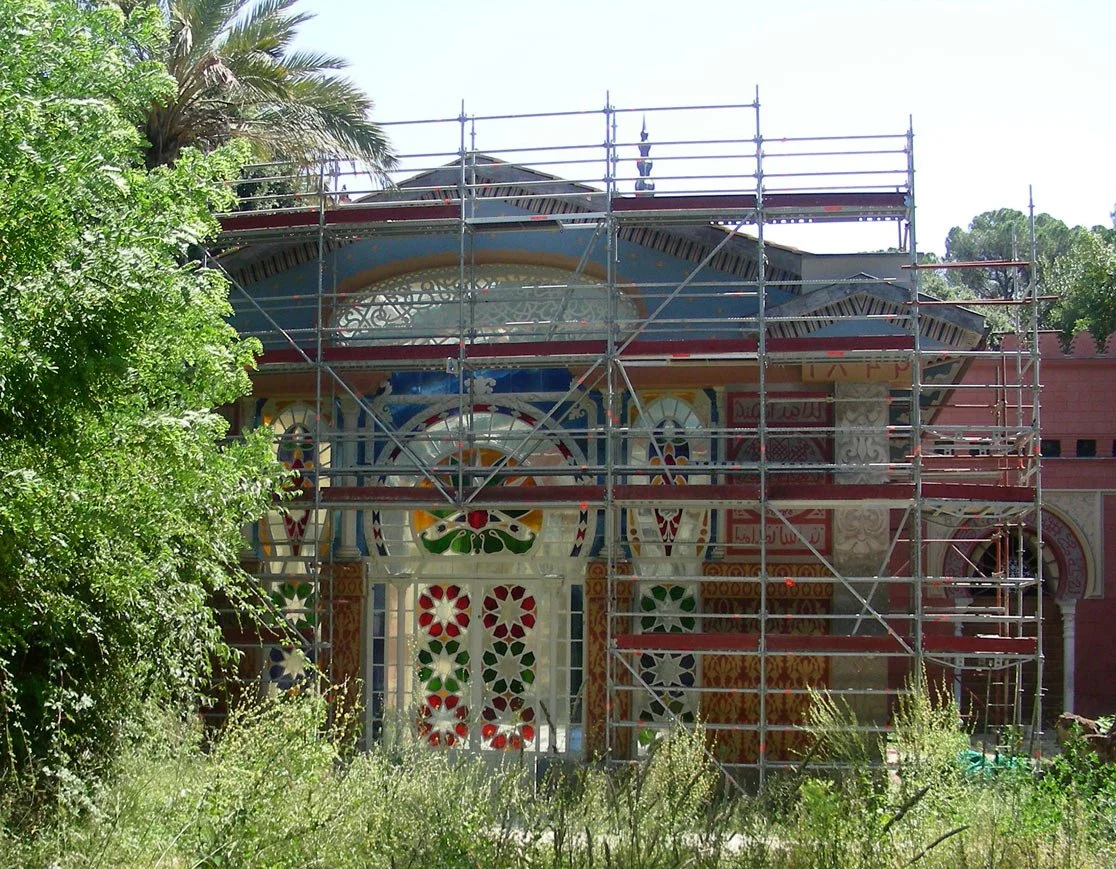
Serra Moresca is the name by which the Moorish-style complex built inside Villa Torlonia, on Via Nomentana in Rome, between the late 1830s and the mid-1840s is known. It includes a garden greenhouse with polychrome windows, a tall tower with cast-iron windows and colored glass, and an artificial grotto with pools and small cascades, all works of the Veneto architect Giuseppe Jappelli, hired by Alessandro Torlonia to enrich the southern sector of the family park. After a long period of neglect and two phases of restoration, the complex opened to the public for the first time on December 8, 2021 and today is visited together with the other buildings of the park, from the Casino Nobile to the Casina delle Civette. Anyone organizing a wider tour of the Nomentana area will find useful information also on the entry for Villa Torlonia.
Villa Torlonia and the family that built it
To understand the Serra Moresca you first have to step back and look at the history of the villa that contains it. Villa Torlonia began as a project of the Torlonia family, a dynasty of bankers of French origin who in the course of the 19th century became one of the richest and most powerful in Rome, with interests ranging from credit to major public works, from landownership to artistic patronage. It was Giovanni Torlonia, patriarch of the family fortune, who in the early 19th century bought the estate on Via Nomentana that was then called Villa Colonna, and started its transformation into a showpiece residence worthy of the rank the house had reached.
From Valadier to Jappelli, a construction site a century long
The first architect called by Giovanni Torlonia was Giuseppe Valadier, the great protagonist of Roman Neoclassicism, who between 1802 and 1806 transformed the estate's main building into a stately palace, the Casino Nobile, with a rigorous, symmetrical plan, typical of the Neoclassical taste that in those years also dominated other major Roman building projects. On the death of Giovanni Torlonia in 1829, the baton passed to his son Alessandro, who continued and considerably expanded his father's project. After 1832 the architect Giovan Battista Caretti took charge of enlarging the main buildings, while Quintiliano Raimondi oversaw the construction of the theater and of the park's orangery. It is in this climate of continuous transformation, with Alessandro Torlonia intent on giving the park a more varied and romantic breadth compared with the Neoclassical rigidity of the initial core, that the intervention of Giuseppe Jappelli and the birth of the Serra Moresca fit.
The park as a tale of several styles
What makes Villa Torlonia an interesting case study for anyone concerned with architectural history is precisely this layering of different styles within the same perimeter: the Neoclassical rigor of Valadier in the Casino Nobile, the eclectic and scenic taste of Jappelli in the southern sector with the Serra Moresca, and later, in the early 20th century, the intervention of the architect Enrico Gennari who, starting in 1908, transformed a pre-existing Swiss Hut of 1840 into the Casina delle Civette, a Liberty-style masterpiece with polychrome windows signed by some of the most important glass artists of the time. In 1842 the park's overall project found another symbolic moment with the erection of the two pink granite obelisks dedicated to the memory of Alessandro Torlonia's parents, still visible today along one of the main avenues.
What the Serra Moresca really is and why it is called that
The name tells exactly what you see. It is not a single building but a small complex of three elements conceived together: the greenhouse proper, a garden pavilion originally meant to house exotic plants and to serve as a reception parlor for the Torlonias' guests, the tower, a vertical structure with large cast-iron windows and colored glass that dominates the rest of the ensemble, and the grotto, an artificial space dug into the ground with pools, small cascades and water lilies, conceived as a cool, shaded resting place in the hot hours. The adjective Moorish is not a generic tour-guide label: it describes precisely the style chosen for the decorations, which take up horseshoe arches, polychrome stuccos, geometric motifs and colors that look explicitly to Andalusian and North African architecture.
The three spaces in sequence
Anyone who walks the complex today follows an itinerary that lines up the three spaces according to a logic conceived from the start to produce a crescendo of surprises: you generally enter from the greenhouse, with its light filtered by the colored windows and the view of the interior fountain, then pass into the grotto, more enclosed and in half-light, and finish by climbing the tower, which gives a different perspective on the surrounding park thanks to its wide glazed openings. It is not a random route: it mirrors the scenographic logic with which Jappelli conceived the whole complex, designed to be discovered little by little and not grasped in a single glance.
A 19th-century caprice, not a mistake of style
A frequent misunderstanding must be cleared up at once. The Serra Moresca is not a random pastiche or a failed attempt at imitating Islamic architecture: it belongs to a precise strand of 19th-century European eclecticism, that of the so-called capriccios or garden follies in exotic style, found in aristocratic parks from London to Vienna by way of the Italian residences most up to date on international taste. Rome, with its English-style gardens of the early 19th century, has very few examples that have come down to today in readable condition, and this makes the Serra Moresca a rare case more than an isolated caprice.
The relationship with the Alhambra of Granada
In popular literature and in the official communications of Musei in Comune the complex is often called the little Alhambra of Rome, a comparison that conveys the idea well but should be taken as a suggestion and not as architectural philology. Jappelli did not copy a specific building of the Alhambra of Granada: he worked by free resemblance, taking from the repertoire of Moorish architecture the elements he needed, arches, stucco decoration, color, to build a scenographic effect consistent with the rest of the romantic park he was designing in the southern sector of Villa Torlonia.
A functional building, not only a decorative one
It must also be said that the Serra Moresca, however scenographic, was not conceived as a pure theatrical backdrop with no function. The greenhouse component had to meet a concrete need, that of protecting and cultivating delicate exotic plants during the coldest months of the year, a practical necessity common to all the great aristocratic gardens of 19th-century Europe, which often hosted prestigious botanical collections as a sign of cultural refinement and scientific curiosity. The choice to clothe this practical function in such an elaborate architectural shell is what sets the Serra Moresca apart from a simple garden greenhouse: here the architecture does not merely accompany the function, it turns it into an occasion for spectacle.
Giuseppe Jappelli, the architect, and Alessandro Torlonia, the patron
Behind the Serra Moresca are two names worth knowing to understand the sense of the operation: who wanted it and who designed it.
Giuseppe Jappelli, the Venetian who brought the romantic garden to Rome
Giuseppe Jappelli, born in Venice in 1783 and died in Venice in 1852, is remembered today above all as the architect of the Caffè Pedrocchi in Padua, one of the symbolic buildings of Italian eclecticism of the early 19th century. He was also one of the leading Italian interpreters of the English-style landscape garden, the formula that replaced the geometric avenues of the formal garden with curving paths, small lakes, groves and small surprise buildings scattered along the way. Called to Rome by the Torlonias, Jappelli redesigned the entire southern sector of the Villa Torlonia park according to these principles, inserting artificial lakes, groves, winding avenues and a series of garden structures including, precisely, the Serra Moresca complex. The project dates to the late 1830s, with the works dragging on into the first half of the 1840s.
Alessandro Torlonia and the sense of an Orientalizing garden
The patron was Alessandro Torlonia, son of Giovanni Torlonia, the banker who had bought the estate on the Nomentana in the early 19th century and had entrusted its first transformation into a villa to the Neoclassical architect Giuseppe Valadier. Alessandro, who inherited the family patrimony and continued its expansion until the 1880s, wanted for the park a more romantic and varied character compared with the Neoclassical rigidity of the original core, and found in Jappelli the right interpreter. Building a Moorish pavilion inside a Roman park of the mid-19th century was not extravagance for its own sake: it fell within the Orientalist taste that ran through educated Europe of the time, fed by the first archaeological campaigns and by travel accounts of North Africa and the Middle East, and said something about the culture and the cosmopolitan ambition of the family that commissioned it.
Architecture and materials: peperino, cast iron and polychrome windows
What strikes anyone visiting the Serra Moresca today is the combination of materials, unusual for a 19th-century Roman building. The load-bearing structure is in peperino, the gray volcanic stone used for centuries in the building trade of Lazio, but alongside this traditional base Jappelli placed iron and cast iron, materials that in the mid-19th century represented a technical novelty even before an aesthetic one: they were the same ones used in the great industrial structures and in the first iron architecture that would soon change the face of European cities. The wide glazing of the tower, with its thin metal tracery, depends precisely on this choice.
The polychrome windows
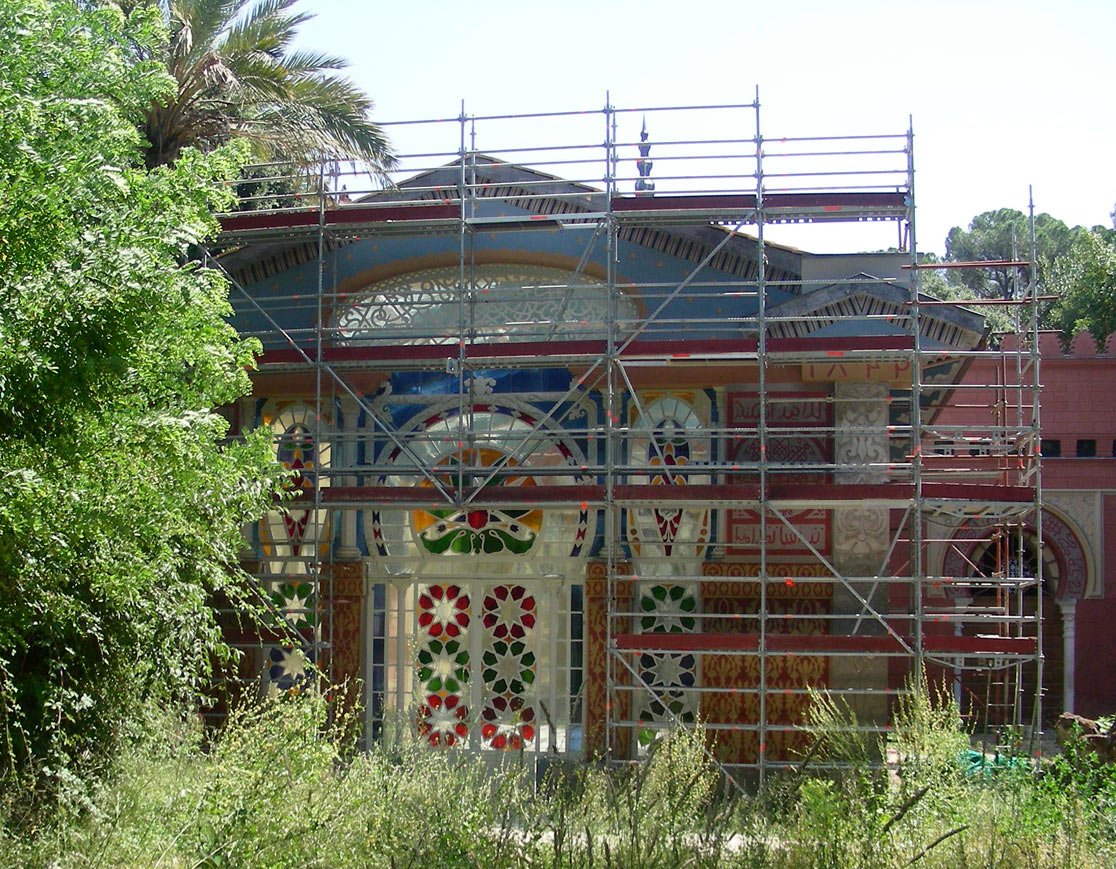
The most photographed and most cited element of the complex is the polychrome windows: panels of colored glass set in the cast-iron structures, which filter the light and color it inside the spaces of the greenhouse and the tower, creating chromatic play on the interior surfaces decorated in stucco. In the greenhouse, the windows frame an interior fountain, and the overall effect, when the sun enters through the large openings, is that of an almost theatrical space, designed more to amaze a guest than for a purely horticultural function.
The stuccos and decorations of the tower
The Moorish Tower carries inside walls richly decorated with polychrome stuccos, with geometric and stylized plant motifs that take up the Islamic decorative repertoire filtered through the eclectic sensibility of the 19th century. It is the highest and most scenographic point of the complex, and it is the part that best conveys Jappelli's ambition to build, with limited means compared with a true Andalusian building, a comparable effect of wonder.
The tower's stucco decorations were one of the most delicate tests of the restoration, because the 19th-century polychrome stuccos, exposed for decades to damp and to seepage from the deterioration of the roofs, had largely lost their original chromatic readability. The restorers' work, carried out with cleaning and consolidation techniques respectful of the historic material, made it possible to recover a good part of the original colors without resorting to invasive reconstructions, in line with the principles of philological restoration applied also to the windows and the cast-iron structures of the whole complex.
The artificial grotto and the theme of the Nymph
The artificial grotto completes the ensemble in a different register, darker and damper compared with the luminosity of the greenhouse and the tower. Pools, small cascades and lit scenographic remains create a small aquatic space where water lilies and lotus flowers live today. In the tradition of the 19th-century romantic garden, a grotto of this kind was often conceived as the place of the Nymph, a classical and at once literary reference that in the most recent readings of the complex is also related to the symbolism of the passage from the darkness of ignorance to the light of knowledge, a theme dear to the Masonic and initiatory culture widespread in the educated circles of the early 19th century, as well as to literary suggestions tied to the Orlando Furioso of Ludovico Ariosto.
Artificial grottoes were a recurring element in the European landscape gardens of the early 19th century, often built with artificial concretions that imitated natural limestone formations, to offer a dark and damp counterpoint to the light and geometric order of the rest of the park. At Villa Torlonia the grotto of the Serra Moresca performs exactly this function, and its placement next to the tower and the greenhouse, rather than at an isolated and distant point of the park, reinforces the reading of the complex as a small unified symbolic route, designed to be crossed in sequence, from the colored light of the greenhouse to the enclosed darkness of the grotto, up to the verticality of the tower that closes the ensemble.
Jappelli's botanical collecting
One aspect of the Serra Moresca less known to the general public concerns its original function tied to botanical collecting. Jappelli also designed the greenhouse to house a collection of exotic plants, among them palms, agaves, pineapples and aloes, consistent with the fashion for scientific and naturalistic collecting that in the 19th century fascinated the great European aristocratic families, often in direct connection with the first botanical exploration journeys in Africa and Asia. The modern museum display has partly recovered this vocation, reassembling a small collection of plants that evokes, with no claim of absolute philological reconstruction, the culture of botanical collecting that animated the original mid-19th-century project.
The long restoration and the reopening to the public
For much of the 20th century and for the first two decades of the 2000s the Serra Moresca stayed closed and in increasingly evident disrepair, while the other historic buildings of the park, from the Casino Nobile to the Casina delle Civette, were restored and given back to the public one after another. The recovery of the complex came last, in two distinct phases.
The first phase, from 2007 to 2013
A first restoration intervention, carried out from 2007 to 2013 with a total investment of about €4.9 million, tackled the structural and decorative deterioration of the building, with the declared aim of a faithful restoration of the original layout in both the structural and the decorative parts, based on the study of historic graphic and photographic documentation and on the descriptions of the places left by the 19th-century historian Giuseppe Checchetelli.
The second phase and the opening of December 2021
At the end of the first work site the building nonetheless remained closed to the public. A second phase of works, carried out by the Capitoline Superintendency for Cultural Heritage with Zètema Progetto Cultura and with a museum display curated by Maria Cristina Tullio, tackled the clearing of the vegetation that had grown uncontrolled around the complex and prepared the spaces for opening as a true visitor route. The result, with a total investment that over the course of the two work sites exceeded €5 million, was the first opening of the Serra Moresca to the public, on December 8, 2021, more than a century after its construction.
The seasonal closure and the reopenings after it
Since then the complex follows an opening calendar that provides for a closure in the months of July and August, with regular reopening in early September, as confirmed by the official communications of the Musei di Villa Torlonia for the seasons after 2021. Anyone organizing a visit in a summer period must keep this in mind and check the updated calendar before leaving, because the seasonal stop concerns precisely the months when the most tourists are moving around Rome.
Hours and tickets to visit the Serra Moresca
Opening hours follow, as for the other Roman civic museums, a seasonal scheme: in the autumn and winter months closing is generally earlier than in the spring and summer months, always Tuesday to Sunday with closing on Monday. The ticket is paid with a full and a reduced rate, and is free for holders of the MIC card, the card of the civic museums of Roma Capitale, as well as for the exemption categories provided by the city regulation, among them children up to age six. Purchase can be made directly at the ticket office of the Serra Moresca or at that of the Casino Nobile, or by booking in advance through the call center 060608, active every day, with a small surcharge for telephone booking.
The practical advice before leaving
Prices and hours of the Roman civic museums are updated periodically, and the Serra Moresca is no exception: before organizing the visit it's always best to check the official page of the Musei di Villa Torlonia or call 060608, rather than trusting a price read in an article from a few seasons ago. The same goes for hours on holidays, which follow particular calendars compared with the ordinary week.
How to visit the Serra Moresca together with the rest of Villa Torlonia
The Serra Moresca is in the southern sector of the park of Villa Torlonia, the portion of garden that Jappelli redesigned in landscape form with small lakes, groves and curving avenues, a few minutes on foot from the central core of the villa where the Casino Nobile and the Casina delle Civette are. A combined ticket covering several buildings of the park, when available, lets you plan in a single morning both the visit to the Moorish complex and the one to the Casino Nobile, which hosts the collections of the Galleria d'Arte Moderna, or to the Casina delle Civette with its Liberty windows, an interesting counterpoint precisely because the theme of the colored window, albeit in a completely different language, returns there too.
The rest of the park worth seeing
Anyone with time for a longer visit can complete the circuit with the Casino dei Principi, the Obelisks of Villa Torlonia erected in 1842 in memory of Alessandro Torlonia's parents, and, in the periods of special opening, the visits to the Villa Torlonia Bunker, the air-raid shelter built during the years when the villa was the residence of Benito Mussolini, who rented it from the Torlonias for one lira a year and lived there with his family for about 18 years, between the 1920s and 1943.
A curiosity about Serra Moresca
The most recurrent comparison in the complex's presentation texts is the one with the Alhambra of Granada, so much so that in Roman newspaper headlines the Serra Moresca is often called the little Alhambra of Rome. The comparison strikes the imagination, but should be taken for what it is: an effective way of describing the atmosphere, not a claim of direct architectural kinship. Jappelli reproduced no specific space of the Andalusian palace, he built an original ensemble that uses the Moorish vocabulary, arches, stuccos, color, light filtered by the windows, to create an autonomous suggestion inside a Roman park of romantic taste. It is the same mechanism by which, in the same period, so many European gardens hosted Chinese pavilions, Egyptian temples or fake Gothic ruins: small themed buildings, designed to amaze whoever strolled in the park, more than to faithfully document a distant culture.
One thing nobody tells you about Serra Moresca
What is rarely told with due clarity is how long the Serra Moresca remained the weak link in the story of the restoration of Villa Torlonia. While the Casino Nobile and the Casina delle Civette became visitable again starting in the 1990s and 2000s, becoming among the most photographed stops of the Nomentano neighborhood, the Moorish complex went through a deterioration that dragged on for decades, with invasive vegetation grown uncontrolled inside and around the buildings, plaster compromised by damp and parts of the polychrome windows lost or seriously damaged. The first work site of 2007-2013, however imposing in investment, was not enough by itself to give the complex back to the city: it took other years and a second targeted intervention, focused precisely on clearing the greenery and on the museum display, for the Serra Moresca to truly open its doors, in December 2021. It is the reason why, even today, many Romans who know the Casino Nobile or the Casina delle Civette well have never seen the tower and the grotto up close: for a considerable part of their lives, quite simply, they could not be visited.
A philological restoration, not a remaking at will
It is worth stressing a technical aspect that distinguishes this intervention from many generic restorations: the work site was based on research into the historical sources, from drawings and period photographs to the descriptions written by Giuseppe Checchetelli in the 19th century, to faithfully reconstruct the original appearance and not a free interpretation. Anyone visiting the Serra Moresca today sees, with reasonable philological approximation, what the guests of Alessandro Torlonia saw almost two centuries ago.
The advice I give you for visiting Serra Moresca
The most useful practical advice concerns the time of the light. The polychrome windows of the greenhouse and the tower are at their best when the sun passes through them at a low angle, so in the first hours of the morning just after opening or in late afternoon, never at full noon when the light is vertical and the colors projected on the interior surfaces are much fainter. Anyone arriving with the aim of photographing the play of color on the floors and stuccos would do well to choose the time slot closest to opening, when attendance is also lower.
Pairing the visit with the rest of the park
Since the complex is in a somewhat secluded position relative to the main entrance of Villa Torlonia, it's better not to treat it as an isolated stop: it's best to plan the visit to the Serra Moresca right after or right before that to the Casino Nobile, so as to also walk the avenues designed by Jappelli in the southern sector of the park, with the artificial lakes and groves that served as the natural frame for the Moorish complex and that remain, even today, one of the quietest and least crowded corners of all of Villa Torlonia.
What to avoid
To avoid, if possible, are weekends in the heart of the school season, when educational visits for schools crowd the complex in the first hours of the morning: a mid-morning time on weekdays remains the calmest choice for anyone who wants to enjoy the windows and stuccos at ease without groups passing through.
What to bring and how to dress
The artificial grotto is a damp and partly shaded space, with floors that can be slippery near the pools: comfortable shoes with non-slip soles are more useful than elegant clothing. In the spring and autumn months, when the temperature swing between morning and afternoon is more marked, it's best to dress in layers, because moving between the closed spaces of the greenhouse and the tower and the open spaces of the park can bring a noticeable change in temperature. A small flashlight on the phone can come in handy for observing the details of the stuccos in the least lit points of the grotto, without however obstructing the visit route with stops that are too long in the narrower passages.
Another well-known fact, yet rarely cited
Almost all popular texts recall that Villa Torlonia was the residence of Benito Mussolini for almost two decades, but few dwell on a detail that directly concerns the sector where the Serra Moresca is. It was precisely in the southern park designed by Jappelli, the same romantic zone conceived for contemplative walks among small lakes and exotic pavilions, that in the 1930s and early 1940s the villa's defensive structures were built, first a simpler air-raid shelter and then, in a second phase, a much larger and more complex bunker, equipped with gas-tight systems. The contrast between the original function of those gardens, conceived for aesthetic pleasure and contemplation, and their later use as a wartime defense apparatus tells well how much the history of Villa Torlonia has been, within a century, able to change sign completely while remaining physically within the same perimeter.
The Nomentano neighborhood around the villa
It is also worth recalling the urban context in which the complex stands. Villa Torlonia faces Via Nomentana, one of the consular roads that connected Rome to Nomentum, present-day Mentana, and the neighborhood that bears the same name developed from the late 19th century and in the first decades of the 20th as a bourgeois residential zone, with Liberty and eclectic apartment buildings that dialogue, at least in spirit if not in style, with the eclectic and citational taste that also animates the buildings of the park, Serra Moresca included.
The right photo to take at Serra Moresca
The image that best conveys the character of the complex is not the exterior of the tower, however scenographic, but the interior of the greenhouse at the moment when light passes through the polychrome windows and projects the colors onto the floor and the stucco-decorated walls. It is a framing that requires patience: you have to wait for the sun to be in the right position relative to the openings and for the flow of visitors to leave the space free for a few moments. A second, more unusual photo is also worth taking, from below looking up inside the tower, to capture the interlacing of the cast-iron structures against the sky filtered by the colored glass: it is a detail that very few photograph, because it requires looking up instead of staying focused on the decorations at eye level.
An alternative for those short on time
Anyone with only a few minutes can settle for a simpler but still effective framing: the facade of the tower seen from the garden, with the reconstructed vegetation in the foreground that recalls the original collection of palms and exotic plants wanted by Jappelli. It is the image that best tells, in a single shot, the dialogue between architecture and nature that was the very sense of the 19th-century project.
A detail to look for on the cast iron
Another framing worth trying, little used compared with the classic frontal shots, is a close-up on the decorative joints of the tower's cast-iron structure, where the stylized plant motifs intertwine with the frames of the colored windows. It is an image that tells the more technical and less immediately photogenic part of the complex, but conveys well the craftsmanship of the metalwork wanted by Jappelli, appreciable today only thanks to the long restoration that made it possible to recover the original elements without wholly replacing them with modern copies.
The grotto detail few people notice
Inside the artificial grotto it is worth looking for the framing that includes together the water of the pools, with the reflections of the water lilies, and a glimpse of the artificial rock walls that define its perimeter. It is a harder space to photograph than the greenhouse, because the light is scarce and diffused, but for that very reason it conveys a more intimate atmosphere, less postcard-like than the most common images of the complex, those taken in the tower or the greenhouse with the backlight of the windows. A light tripod, where permitted, helps obtain longer exposure times without having to raise the camera's sensitivity excessively.
Some important events that happened here in history
The history of the Serra Moresca can be marked out in precise stages, each of which left a mark still readable today.
The construction, late 1830s and first half of the 1840s
The complex was born from the project of Giuseppe Jappelli for Alessandro Torlonia, within the wider landscape transformation of the southern sector of the park. It was one of the last great additions to the overall design of the villa, which in the preceding decades had already been enlarged according to the Neoclassical taste of Giuseppe Valadier and then, after 1832, according to the interventions of the architect Giovan Battista Caretti.
The 20th-century decline
In the course of the 20th century, while the villa went through the well-known events, from the lease to Mussolini to the transfer of ownership to the City of Rome in the postwar period, the Serra Moresca complex experienced progressive abandonment, aggravated by the vulnerability of the materials used, iron and cast iron, much more exposed to atmospheric deterioration than the massive stone of the park's other historic buildings.
The double restoration of the 2000s
The first work site, from 2007 to 2013, and the second, concluded in 2021, are the most important events in the complex's recent history: they made it possible to halt a deterioration that risked becoming irreversible and gave back to the city a building that, for most of its history, had never been opened to the public on a stable basis.
The opening of December 8, 2021
December 8, 2021 remains the watershed date: for the first time, after almost two centuries from its construction, the Serra Moresca became a true visitable museum, with a visit route, a display designed by the curator Maria Cristina Tullio and an entrance ticket, thus completing the recovery of the entire historic heritage of Villa Torlonia after that of the Casino Nobile and the Casina delle Civette.
The transfer of ownership to the City of Rome
An important passage in the history of the whole Villa Torlonia complex, which indirectly concerns the Serra Moresca too, is the transfer of ownership from the Torlonia family to the City of Rome, which took place in the postwar period after the difficult years of the villa's military occupation. From the private property of one of the richest families in the city, the park and its buildings became public heritage, a change of legal status that made possible, decades later, the planning of the great restoration work sites that gave back to the citizenry first the Casino Nobile, then the Casina delle Civette and finally, last, the Serra Moresca itself.
The inclusion in the Musei in Comune system
Another relevant step for the Serra Moresca was its organic inclusion in the Musei in Comune system of Roma Capitale, the civic museum network that manages, among others, the Capitoline Museums and many other historic sites of the city. Being part of this system means following shared rules on tickets, hours and educational programming, and benefiting from the MIC card that allows free or reduced access to dozens of civic museums with a single subscription, a tool particularly useful for anyone who lives in Rome or stays long and wants to visit several sites at ease over the course of a year.
Who has passed through Serra Moresca
In its original phase, the Serra Moresca was conceived for the guests of the Torlonia family, one of the richest and most influential houses of 19th-century Rome, with interests ranging from finance to major public works, among them the draining of the Fucino. Receiving a guest in a space like the greenhouse, with its colored windows and its exotic stuccos, was a way of showing not only wealth but also cultural up-to-dateness, the ability to dialogue with the most refined tastes of the European aristocracy of the time, which in those very years was rediscovering with curiosity the art and architecture of the Islamic world.
The indirect link with the Mussolini years
In the period when Villa Torlonia was the residence of Benito Mussolini, between the 1920s and 1943, the southern sector of the park where the Serra Moresca stands progressively ceased to be a place of display to become, with the construction of the bunker, an area for military and security use. No specific visits by Mussolini to the Moorish complex as such are documented, but his presence in the park for almost two decades inevitably forms part of the historical memory of the whole area, Serra Moresca included.
Today's visitors
Since December 2021 the Serra Moresca has become once again a place open to everyone, no longer a privilege reserved for the guests of an aristocratic family but a stop in a civic museum that receives Romans and tourists, school groups on educational visits and enthusiasts of 19th-century architecture who come on purpose to see one of the very few Roman examples of this kind of Orientalist garden eclecticism.
Scholars and enthusiasts of 19th-century architecture
Among those who have passed through the Serra Moresca in recent years are above all architectural historians, students of architecture and restoration faculties and enthusiasts of the 19th-century eclectic genre, categories of visitors who find here a rare case study in the Roman area: very few other buildings in the city combine so explicitly the Moorish decorative language with the construction techniques in iron and cast iron typical of the early industrial age. The guided visits organized by the Musei di Villa Torlonia, when available, are often scheduled precisely to reach this specialized public, with in-depth looks at the restoration techniques and the historical sources used for the restoration of the windows and stuccos.
Families and occasional visitors
Besides the more specialized audience, the Serra Moresca also attracts families with children, thanks to the immediate visual effect of the colored windows and the somewhat fairy-tale appeal of the artificial grotto with its basins and water features, elements that catch the attention of even very young visitors with no need for technical explanations. For many Roman families, a visit to the Serra Moresca is part of a longer outing in the park of Villa Torlonia, which remains one of the most frequented green lungs of the city's northeast quadrant, with wide lawns, a small pond and play areas for children in addition to the museum buildings.
Orientalist taste in 19th-century Europe
To place the Serra Moresca correctly in the history of architecture, one last piece of context is needed, the European one. During the 19th century, while scientific archaeology was taking its first steps in Egypt and the Middle East and travel accounts of North Africa and the Ottoman Empire were becoming a hugely successful literary genre, the taste of Europe's educated classes opened with growing enthusiasm to the forms of Islamic art. This phenomenon, which art historians generically call Orientalism, showed up not only in painting, with artists depicting harem scenes and imaginary markets, but also in architecture, with the construction of pavilions, smoking rooms, bathrooms and gardens in Moorish or Turkish style inside aristocratic and bourgeois residences from London to Vienna, from Paris to Saint Petersburg.
Comparable European examples
Among the best-known examples of this climate are the Arab rooms of some British and German royal residences, the Ottoman pavilions built in the gardens of some European capitals, and more generally a widespread fashion in interior decoration that led, in the second half of the century, to real Moorish parlors even in middle-class apartments that were not particularly wealthy. The Serra Moresca of Villa Torlonia belongs to this cultural climate with a significant head start over many similar works, since Jappelli's project dates back to the late 1830s, when the Orientalist fashion in Italy was still in its early days compared with other European countries.
Why Rome has so few examples
An observation that architectural historians often make concerns the scarcity of Roman examples of this trend compared with other European capitals. Rome, a city with a classical and papal layout, developed a more cautious relationship with exotic fashions in the 19th century than capitals such as London or Vienna, which were more open by commercial and diplomatic tradition to contacts with the Islamic and Asian world. This is precisely why the Serra Moresca remains unique in the Roman landscape, a garden whim that very few other aristocratic families in the city allowed themselves with the same architectural ambition and the same investment in cutting-edge materials such as iron and cast iron.
The Nomentano neighborhood and the area around the Serra Moresca
Villa Torlonia is in the Nomentano neighborhood, one of the residential areas of Umbertine and post-Umbertine Rome that grew from the late 19th century along the consular road that gives the neighborhood its name and that connected the city to Nomentum, today's Mentana, in the countryside northeast of the capital. The neighborhood developed through successive lots between the late 19th century and the first decades of the 20th, with an urban fabric made largely of middle-class buildings in eclectic and Liberty style, not far in spirit, if not in scale, from the citational taste that had already animated the Serra Moresca a few decades earlier.
A neighborhood of historic villas and residences
Besides Villa Torlonia, the Nomentana area is home to other significant historic residences, including Villa Albani Torlonia, not far away, and several Liberty buildings signed by architects active in Rome in the first decades of the 20th century. Walking from the neighborhood toward the entrance of Villa Torlonia on Via Nomentana lets you take in the contrast between the dense urban grid of the middle-class district and the wide expanse of the historic park, a jump in scale that is part of the experience for those who arrive on foot or by public transport rather than by car.
How to get there
The main entrance of Villa Torlonia on Via Nomentana is served by several lines of the city bus network, which connect the area to the historic center and Termini station in a few minutes. The nearest subway stops are a walk of about a quarter of an hour away, or can be reached with a short bus or bike ride. For those staying around Termini or Porta Pia, Villa Torlonia and the Serra Moresca remain one of the most convenient cultural destinations to reach without planning complicated transfers, and the relative closeness to the historic center makes it suitable for a half day within a wider program of visits in the city.
Planning the visit with the right tools
If you are organizing a stay in Rome that includes several stops among civic museums, historic neighborhoods and lesser-trodden itineraries, it can be useful to pair the Serra Moresca page with a broader planning tool: the site Italy Planner collects itineraries and practical information on several Italian destinations, useful for those who want to build a travel program that goes beyond the capital alone. If instead you are organizing a group, a school or a visit with a professional tour guide, you can find operational resources on Tour Leader Pro, designed for those who work in tour guiding and need practical tools for managing groups and itineraries.
Frequently asked questions about Serra Moresca
What is the Serra Moresca of Villa Torlonia?
The Serra Moresca is a 19th-century complex made up of a garden greenhouse, a tower and an artificial grotto, built in Moorish style inside the park of Villa Torlonia in Rome to a design by the architect Giuseppe Jappelli, commissioned by Alessandro Torlonia for the southern sector of the estate.
Who designed the Serra Moresca?
The Serra Moresca bears the signature of the Venetian architect Giuseppe Jappelli, the same man who built the famous Caffè Pedrocchi in Padua, called to Rome by the Torlonia family to redesign the south sector of the family park as a landscape garden between the late 1830s and the first half of the 1840s.
When did the Serra Moresca reopen to the public?
The Serra Moresca opened to the public for the first time on December 8, 2021, after two phases of restoration carried out starting in 2007, having long remained inaccessible unlike the other historic buildings of Villa Torlonia.
Is the Serra Moresca open all year?
No, the Serra Moresca closes seasonally in July and August and reopens regularly in September. In the other months it can be visited from Tuesday to Sunday, with hours that vary between the autumn-winter period and the spring-summer one, so it is always best to check the updated calendar before your visit.
How much does the ticket for the Serra Moresca cost?
The ticket for the Serra Moresca comes with a full rate and a reduced rate, with free admission for MIC card holders and for the exemption categories set by the City of Rome. The exact amount should be checked on the official website of the Villa Torlonia Museums or by calling 060608, because the fees of the civic museums are updated periodically.
Can you visit the Serra Moresca together with the Casino Nobile and the Casina delle Civette?
Yes, the Serra Moresca is a few minutes' walk from the Casino Nobile and the Casina delle Civette, the other two museums of the Villa Torlonia complex, and when a combined ticket is available it is best to plan the visit of all three buildings in the same morning.
Why is the Serra Moresca called the little Alhambra of Rome?
The Serra Moresca is often called the little Alhambra of Rome because of the evocation that its Moorish-style decorations, its arches and the colors of its windows call up in the collective imagination, even though Giuseppe Jappelli did not reproduce a specific building of the Granada palace but composed an original architecture inspired by that decorative repertoire.
What materials were used to build the Serra Moresca?
The Serra Moresca combines peperino, the traditional volcanic stone of Lazio used for centuries in Roman construction, with iron and cast iron, materials that in the mid-19th century represented an advanced technical choice even outside industrial building, together with the polychrome windows that filter the light inside the rooms of the greenhouse and the tower, creating the characteristic play of colors.
Where exactly is the Serra Moresca inside Villa Torlonia?
The Serra Moresca is in the southern sector of the park of Villa Torlonia, the part designed by Giuseppe Jappelli as a landscape garden with ponds and groves, not far from the central core of the villa where the Casino Nobile and the Casina delle Civette are located, and it can be reached on foot in a few minutes from the entrance on Via Nomentana by following the signs inside the park.