Irama at Palazzo dello Sport in Rome, December 12, 2026
In short. On Saturday, December 12, 2026 Irama performs at Palazzo dello Sport in Eur, the round arena Romans call Palaeur and which for over 60 years has hosted the city's big concerts.
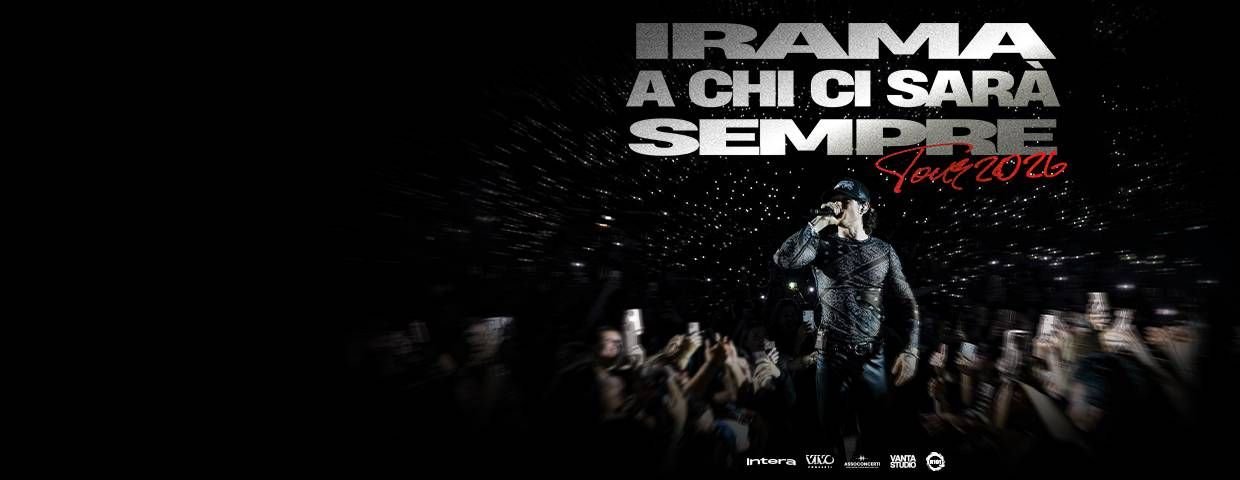
On Saturday, December 12, 2026 Irama performs at Palazzo dello Sport in Eur, the round arena Romans call Palaeur and which for over 60 years has hosted the city's big concerts. It's a date for a young audience, with a production built around lights and video as much as around the songs, and with a repertoire the arena knows by heart: anyone who arrives with their voice already ready that night will use all of it.

What the December 12, 2026 concert is
The evening is an Irama concert at Palazzo dello Sport in Rome, scheduled for Saturday, December 12, 2026. The address is Piazzale dello Sport 1, in the EUR district, at the southern edge of the city, where Rome stops looking like Rome and starts looking like an idea of a city drawn at a desk in the 1930s. The venue, which on official documents appears as Palazzo dello Sport, is called Palaeur by anyone born or raised here, and no official announcement has ever dented that habit.
The Rome date appears as part of a run through arenas, which is the natural scale for an artist of this kind. Not a theater, where the visual production would find no room. Not a stadium, where the relationship with the audience stretches until it becomes abstract. The covered arena is the format in which a contemporary pop setlist works as it was designed: a lighting rig hung from the structure, screens working together with the stage, an audience close enough to send the chorus back before the refrain has even ended.
A methodological premise, best stated right away and not hidden at the bottom. At the time of writing, no official setlist for the Rome evening has been published, nor the names of any guests, nor the lineup of the musicians who will take the stage, nor any reliable data on seat availability. This is information that comes out late, when it comes out, and in many cases stays confidential until the night itself. Anyone looking here for the list of songs or the name of whoever will come on for a feature won't find it, for the simple reason that in verifiable form it doesn't exist. What can be told properly instead is how that building is laid out, how a music evening works inside it, how to get there without arriving sweaty and late, and what it's worth knowing before lining up at a gate in December.
The start time that usually appears on concert announcements at Palaeur is the classic one of Italian arenas, around 21:00, with gates opening a few hours earlier and a possible opening act. The authoritative information, though, remains only what is on the ticket and on the official channels of the venue and the production: times shift, an opening act is added or disappears, and a half hour's difference is the gap between entering calmly and hearing the first song from the corridor.
December 12, 2026 falls on a Saturday, and this isn't a color note. A Saturday night concert at Palaeur has a physiognomy all its own: the audience arrives earlier, lingers longer on the plaza, stays inside until the last encore without looking at the clock and thinking about the alarm. The plaza in front of the entrance, on concert Saturdays, starts filling already in the early afternoon, and anyone who cares about standing spots in the front rows has always known it. Add that December 12 is the middle of December, with the city already in Christmas mode, the lights on in the shopping streets and an evening traffic that on weekends concentrates elsewhere than Eur. For once geography plays in your favor.
Then there's the seasonal factor, which people arriving from outside always underestimate in Rome. A mid-December evening in Eur is cold in a specific way: the district is open, windy, laid out on wide axes that shelter you from nothing, and the plaza of Palazzo dello Sport is one of the most exposed points in the area. The line outdoors, if you do it, you do really outdoors. Inside, instead, with 12,000 people and the lighting rig on, the temperature rises fast and the coat becomes a weight to manage for three hours. This contradiction between outside and inside is what most often ruins the evening for those who haven't thought about it, and we come back to it further on with some practical pointers.
On what you'll see, without entering the field of speculation, it's worth clarifying what kind of show we're talking about. Irama doesn't belong to the category of artists who walk on stage with a guitar and a microphone and let the song do everything. His way of being on stage is constructed: scene changes, management of downtime, moments when the voice is almost alone and others when the production takes up all the available space. It's a language the younger audience reads without needing translation, because it's the same language as the videos they watch every day, and which the older audience sometimes finds disorienting precisely for its visual density.
One last thing about the nature of this date. Palazzo dello Sport, over the course of 2026, hosts a remarkable number of Italian concerts, and the fall and winter season is particularly packed. Among the dates already announced in the same hall are those of Giorgia, POOH, Gigi D'Alessio, Shiva and ANNA. The December 12 evening sits inside this calendar, exactly a week before ANNA's, and anyone who goes to Palaeur with some regularity will notice that December, this year, is a two-visit month.
A curiosity about Irama at Palazzo dello Sport in Rome, December 12, 2026
The curiosity concerns the name of the building, and a misunderstanding that has lasted in Rome for almost 70 years. There are two venues in the city with an almost identical name, designed a few years apart, both tied to the same Olympic story, both with Pier Luigi Nervi's signature on the structure, and still today some people mix them up when buying a ticket or arranging to meet.
The first is the Palazzetto dello Sport, which is at Flaminio, in the north of the city, near the Villaggio Olimpico, and is the smaller of the two: a ribbed dome of a little over 60 meters in diameter, resting on a crown of slanted supports that look like an insect's legs, built in the second half of the fifties. The second is the one we're talking about here, Palazzo dello Sport in Eur, which is the older brother: almost 100 meters of dome, 12,000 seats, inaugurated on June 3, 1960 and immediately put to the test by the Olympic Games of that summer.
The distinction, in everyday speech, resolved itself in a typically Roman way: the big one became Palaeur, the small one stayed the Palazzetto. Whoever says Palazzetto means the one at Flaminio and is never wrong. Whoever says Palasport means the one in Eur and isn't wrong either. The problem arises when someone from outside Rome arrives, reads Palazzo dello Sport on the ticket, sets the navigation on the phone and ends up north of the center with the concert starting eight kilometers away. It happens more often than you'd think, and above all in the evening, when haste makes people sloppy.
Then there's the chapter of commercial names, which added confusion to confusion. Between 2003 and 2018 the Eur venue was known as PalaLottomatica, after a renovation financed by the sponsor, and over the years it changed name again following naming contracts. Romans, for their part, kept saying Palaeur undeterred the whole time, regardless of what was written on the sign, and this is perhaps the only case in which popular habit has won so clearly against marketing. To get your bearings the practical rule is one only: if the address is Piazzale dello Sport 1, Eur district, the building is the right one, whatever they call it this year.
Who Irama is
His birth name is Filippo Maria Fanti and he was born in Carrara on December 20, 1995. He spends the first eight years in Tuscany, then the family moves to Monza, and this double belonging, the Tuscan province of childhood and the Milan hinterland of adolescence, often comes back in interviews as a key to the character. The stage name, Irama, is the anagram of his mother's name, Maria, and it's one of those details repeated so many times that it has almost become part of the official biography.
The first public step comes in 2015, when he takes part in Sanremo Giovani with the song "Cosa resterà", and in 2016 he reaches the Sanremo Festival in the New Proposals section with the same title, without however reaching the category final. In the same 2016 he releases his first studio album, which simply carries his stage name. It's the debut of an artist who by then is 20, with a major label contract and a position in the Italian landscape still to be defined.
The breakthrough comes two years later. In 2018 he takes part in the 17th edition of "Amici di Maria De Filippi" and wins it. The talent show, for an Italian singer of that generation, works as an accelerator: it moves a name in a few months from the category of promises to that of chart protagonists. In the same year "Nera" comes out, the song that more than any other delivers him to the mass audience, and the album "Giovani", released on October 19, 2018 on Warner Music Italy, which earns platinum certification. In 2020 he also wins "Amici speciali", the program's special edition.
The relationship with the Sanremo Festival is, from that moment on, a constant of his career, and a quantitatively important one. His appearances as a competing artist in the main section number five: in 2019 with "La ragazza con il cuore di latta", seventh place. In 2021 with "La genesi del tuo colore", fifth place. In 2022 with "Ovunque sarai", fourth place. In 2024 with "Tu no", fifth place. In 2025 with "Lentamente", ninth place. Five appearances in seven years, with five finishes in the top 10 and four in the top 7, which make him one of the most regular names of the recent Ariston. To these is added the 2016 appearance among the New Proposals.
It's worth dwelling on this figure, because it explains part of the makeup of the audience you'll find at Palaeur. Sanremo, in Italy, is the only event that puts teenagers, people in their forties and grandparents in the same room, and an artist who returns with this frequency inevitably builds a cross-generational following. Anyone imagining a crowd of only 16-year-olds will be surprised: at Irama's arena shows you see groups of young girls, couples in their thirties, parents who accompany their kids and then know the choruses better than they do. It's a young audience in its loudest component, but it isn't an exclusively young audience.
The later discography confirms the trajectory. In 2022 "Il giorno in cui ho smesso di pensare" comes out, released on February 25, which reaches quadruple platinum. In 2023 comes "No Stress", made together with Rkomi, a four-handed work that formalizes a collaboration already tried with the 2022 single "5 gocce". Among the best-known pieces of his repertoire, besides "Nera", are "La ragazza con il cuore di latta" from 2019, "Arrogante" from the same year, "Milano" from 2020 with Francesco Sarcina, "Ovunque sarai" from 2022 and "Colpiscimi", certified platinum. Overall the certifications accumulated exceed 50 between platinum and gold, a volume that places the artist among the best sellers of his generation in the Italian market.
On writing and production, the recurring names in his work are Giulio Nenna and Andrea Debernardi, producers who helped define the recognizable sound of his records. It's a sound that moves between pop, urban elements and broad-breathed ballads, with particular attention to building the chorus and to using the voice as a dramatic instrument more than as a technical vehicle. Whoever listens with an analytical ear notices the insistence on a certain kind of melodic interval and the habit of moving, within the same song, from an almost whispered sung part to a part pushed high. Live, this dynamic becomes the engine of the show.
Among the most cited collaborations are those with Benji and Fede in 2015, with Noemi in the Sanremo context in 2019, with Francesco Sarcina in 2020, with Rkomi between 2022 and 2023, with Riccardo Cocciante during the 2024 Festival and with Arisa during the 2025 one. It's a list that tells of an artist willing to cross different generations and genres, and who hasn't built his identity on a closed niche.
A note that bears directly on the Rome date. Irama's birthday falls on December 20, eight days after the December 12 concert. It isn't useful information in a practical sense, but it's the kind of coincidence the most devoted fans register and comment on, and which sometimes finds an echo on stage. Nobody can say in advance if it will be mentioned that night: it's flagged only as a calendar fact.
One last consideration, a necessary one. Everything written above concerns verifiable facts: birth dates, titles, release years, chart placements, certifications. It doesn't concern what will happen on the evening of December 12, 2026. On the setlist, on the songs that will be performed, on the order, on the presence or not of acoustic moments, on the musicians, on any guests, there is at the moment no official source, and anyone presenting a list of songs for that date as certain is deriving it from other concerts or from their own imagination.
Something nobody tells you about Irama at Palazzo dello Sport in Rome, December 12, 2026
What is almost never said concerns the relationship between the place you occupy and the type of show you came to see, and it's an issue that in a concert with a strong visual component radically changes the experience.
The common reasoning is simple and wrong: the closer you are to the stage, the better you see. It holds for a concert built on the physical presence of the artist, where the goal is to make out facial expression and hear the voice arrive almost direct. It doesn't hold in the same way for a show in which the set design, the LEDs, the lighting changes and the projections are part of the story as much as the songs. In that case, sticking to the barrier means seeing two square meters of stage very well and completely missing the overall design, which was conceived to be viewed from afar.
At Palaeur the geometry makes this evident. The plan is circular, the tiers rise in two concentric rings, and the stage is set up on one side of the hall, cutting out the sections behind it. Whoever is on the floor, in the central part of the rectangle in front of the stage, sees the stage machinery partially and from below, with heads in front and light arms moving in and out of the field of view. Whoever is in the first rows of the lower ring, in a central position relative to the stage, sees the whole set as it was designed, with the projections fully legible and the light movements composing into a single figure.
There is also a question of sound, and this too is rarely told. In a round arena covered by a continuous shell, the worst spot is almost never the farthest one: it's the one where the dome's reflections arrive out of phase with the direct sound from the speakers. In practice, the back of the floor and the highest sections in a lateral position are the zones where the boom is heard most, while the central part of the lower stands receives a cleaner sound. Audio services have worked on this for years, with controlled directivity systems and delay lines that delay the signal for the distant sections, and the result today is incomparably better than at the concerts of the eighties. But the physics of the building remains what it is, and knowing it helps you choose.
The third element concerns seats with limited or reduced visibility. In a circular venue with the stage on one side, there is always a band of lateral sections from which part of the set is hidden, and sometimes a portion of the stage too. These seats are normally flagged as such in the sales systems, and cost less for exactly this reason. There's nothing improper about it: but you need to read the section description carefully before choosing, because the price difference corresponds to a real difference in experience, and in a visual show that difference weighs more than at an acoustic concert.
One last detail nobody puts in black and white. On the standing floor, the position you win by arriving early isn't necessarily the one you keep. With 12,000 people and an audience that at the most energetic moments moves as one, the front rows compress and shift, and whoever has spent four hours in line to be at the barrier may find themselves, midway through the concert, three meters back and off to the side. Anyone who doesn't feel like managing this dynamic will do well to consider a numbered seat, which at Palaeur isn't a fallback but often the best choice.
Palazzo dello Sport in Eur as a space
To understand where you are it helps to start from the fact that Palazzo dello Sport wasn't born as a concert hall, and that everything that works well or badly inside it descends from this origin. It's an Olympic sports facility, designed and built between 1958 and 1960 for the Games of the XVII Olympiad, with the architecture signed by Marcello Piacentini and the structural consultancy entrusted to Pier Luigi Nervi. It was inaugurated on June 3, 1960 and that Games summer it hosted the Olympic basketball and boxing tournaments.
The form is that of a low cylinder covered by a spherical shell. The diameter of the dome is around 100 meters, the thickness of the reinforced concrete shell is 9 centimeters, and the relationship between these two measures is the reason the building appears in all the structural engineering textbooks of 20th-century Italy. Nervi worked like this: he covered enormous spans with minimal quantities of material, replacing mass with geometry and with a system of ribs that distribute loads along calculated lines. The result, seen from inside, is a vault that seems to rest on air.
The capacity is around 12,000 seats, distributed over two tiers of stands, with 16 entrances arranged along the whole perimeter. This number, 16, is one of the smartest design choices of the whole venue: it means the audience doesn't converge toward two or three access points as happens in many stadiums, but spreads along the entire circumference, entering and leaving radially. It's the reason the outflow, at the end of a full concert, is much quicker than you'd imagine looking at the mass of people from inside.
In the concert configuration, the hall is reorganized: the central field becomes a floor, standing or with chairs depending on the setup, the stage takes up one side, and part of the sections behind the stage is closed off or used for technical structures. The audio and lighting control tower is generally in the middle of the floor or at the back of it, and takes up a not insignificant space. Whoever looks at a section map before choosing will do well to find out where it is, because that block takes away the view from the seats immediately behind.
The acoustics deserve a separate discussion, because they're the element that most divides opinion about this hall. A 100-meter spherical shell behaves like an enormous concave reflector: it sends sound waves back toward the center instead of dispersing them, and in a venue built for basketball this was irrelevant or even useful. For amplified music it's a serious complication, which over the years has been tackled with sound-absorbing drapes hung at height, with controlled-coverage sound systems and with a stage design that takes the curvature of the vault into account. Today a well-staged concert at Palaeur sounds correct. A hastily staged one doesn't. You can hear the difference in the first 30 seconds.
From the aesthetic point of view, the building has a quality that's appreciated above all from outside and in the evening hours. A continuous glass band runs all around beneath the start of the roof, and when the interior lights are on that band draws a luminous ring suspended over the plaza. Whoever arrives on foot from Viale dell'Umanesimo in the late afternoon of December, with darkness already fallen, sees the building in this version, and it's by far its best version. It's worth arriving a few minutes early just to look at it from outside before going in.
Around the venue opens a wide plaza, paved, without obstacles, which on concert days hosts the unofficial merchandise stalls, groups meeting up, the organized lines for the floor. It's a space that handles crowds well, but in winter it's completely exposed: there are no porticoes, no shelter, and when the wind blows from the south the wait turns into an endurance exercise. The district's structures, with their travertine and symmetries, are magnificent to photograph and terrible to use as shelter.
How to get there on concert night
The right way to reach Palazzo dello Sport is the metro, and there are no alternatives that stand up to the comparison. Rome's metro line B has a stop called Eur Palasport, and the station exit is a few hundred meters from the venue's entrance, with a flat, lit route that's easy to recognize even for those who don't know the district. From the center, taking B from Termini in the direction of Laurentina, the trip takes around 20 minutes.
For those coming from the north or from areas served by the B1 branch, the point of attention is the Bologna junction: the line splits and you need to board a train headed to Laurentina and not to Jonio. It's a mistake that on paper seems impossible and in practice happens to very many people every evening, especially when the platform is crowded and you board the first train that arrives without reading the display. On concert days the consequence is trivial but annoying: 20 minutes lost and a final dash.
The previous stop along the line, Eur Fermi, and the next one, Laurentina, can become useful on the way back. At the end of a full concert, Eur Palasport receives several thousand people in a few minutes, and access to the platform is rationed for safety reasons. Walking 20 minutes to Eur Fermi, or in the opposite direction to Laurentina, lets you in many cases board a train sooner and more comfortably than those who stay in line at the turnstiles. It's a trick Romans have always used and which is rarely explained to people arriving from outside.
On evening hours, the rule to keep in mind is that Rome's metro closes at 00:30 on the nights between Friday and Saturday and between Saturday and Sunday, and at 23:30 on other days. December 12, 2026 is a Saturday, so the following night falls under the extended schedule, which gives a more comfortable margin than a weekday concert. The fact remains that a concert starting at 21:00 with encores may end around 23:30, and that between the last note and the turnstile a good 20 minutes pass anyway. Anyone with a train or flight the next morning should account for this arithmetic and check the hours in force that day, because night service is changed with some frequency.
Surface alternatives exist but are less reliable. Several bus lines serve Eur and its main avenues, and at night, when the metro closes, a replacement line that follows the route of the B goes into service. On days of heavy turnout the stops closest to the venue may be moved or suspended for public order reasons, so it's best to check the updated situation on the local transport service's channels before counting on a bus as the main plan.
Whoever arrives by car has to count on two distinct problems. The first is parking: the area around Piazzale dello Sport has parking spaces, but on full concert nights they saturate well in advance and the search extends to a radius of several hundred meters, among Viale dell'Umanesimo, Viale dell'Oceano Pacifico and the side streets. The second is leaving: at the end of the evening, thousands of cars pour simultaneously onto the same few routes, and half an hour stopped without moving a meter is an entirely normal scenario. Anyone who can't do without the car should do just one thing: park far from the venue, even a kilometer away, and do the last few minutes on foot. The time gained on the way out amply repays the walk.
Last pointer, for those staying in the center. Eur isn't a district you end up in by chance: you come here on purpose. The distance from the Colosseum is about 8 kilometers, from Termini a little more. A return on foot is not even imaginable. Better to plan the return before leaving home, deciding in advance if you're counting on the metro, the night bus or a car, instead of starting to think at half past 11 at night in the middle of 12,000 people with the same problem.
The advice I give you for visiting Irama at Palazzo dello Sport in Rome, December 12, 2026
There is only one piece of advice and it concerns the coat. It seems trivial and yet it's the variable that determines if the evening will be pleasant or tiring, and it applies specifically to a mid-December concert in this venue.
The situation is this. Outside, on the plaza, in December, after sunset, the temperature drops below 10 degrees and the wind that crosses the avenues of Eur makes it feel lower. The wait outdoors, between line, checks and entry, can last quite a while. Inside, instead, with the venue full, the bodies of 12,000 people and the projectors on, within half an hour you reach a temperature of late spring, and on the standing floor, where you move, you go well beyond it. At that point the down jacket becomes a physical problem: you can't put it down anywhere, it occupies your hands, it turns into a sweaty bundle tied around your waist.
The solution is to dress in thin layers, and bring as an outer layer a garment that can be compressed until it's small. A light shell, a packable insulated jacket, anything that fits in a small backpack. Avoid the long wool coat, which doesn't compress, can't be hung and doesn't get forgotten. Avoid the big bag, because arena entry regulations limit baggage size and an oversize container forces you to turn back.
The second element of the advice concerns arrival time, and here a distinction is needed. Whoever has a numbered seat has no reason to arrive three hours early: the seat is theirs, nobody takes it, and showing up 40 or 50 minutes before the start time is more than enough to get through the checks calmly, find the section, buy something and sit down. Whoever aims instead for the standing floor and wants an advanced position has to reckon with a line that, for artists with a young and organized following, starts in the early afternoon and sometimes in the morning. They are two different strategies and must be decided beforehand, not in front of the gate.
Third element: eat beforehand. Inside the venue there are refreshment points, the lines are long and the prices are what they are. Eur, around dinner time, offers several options along the main avenues and in Viale Europa area, where bars and restaurants are within walking distance. Arriving with your stomach settled, an hour early, and then devoting yourself only to the concert is a strategy that works much better than the opposite.
Fourth and last: download the ticket onto your phone before leaving, and check that the battery is charged. Entry systems at Italian arenas are by now almost entirely digital, the code has to be shown on the screen, and the cell signal in front of a venue with 12,000 people connected at the same time becomes unreliable. A ticket saved offline or printed on paper eliminates at a stroke the main source of entry anxiety.
How concerts work at Palaeur
A music evening in this venue follows a fairly constant pattern, and it's useful to know it so you aren't surprised by the timing.
The gates generally open a couple of hours before the start time indicated on the ticket, sometimes a bit more when an opening act is planned. The opening concerns entry to the venue, not the start of the show: between the moment you go in and the moment the lights go down, more than an hour almost always passes. Whoever enters among the first and chooses the standing floor should therefore prepare for a long wait on their feet before anything even begins.
Entry checks include verification of the ticket and a security check on people and bags. The precise rules vary from event to event and are published by the organizers, but some constants repeat in almost all arenas: limits on the size of backpacks and bags, a ban on bringing in bottles with caps, glass containers, pointed objects, long umbrellas, selfie sticks and in many cases cameras with interchangeable lenses. The phone, obviously, goes in with no problem. The practical advice is to arrive with the bare minimum on you: the fewer things you carry, the faster the passage.
One thing should be said clearly about named tickets. For popular music concerts above a certain capacity threshold, Italian regulations in many cases provide for named issuance, with the holder's name printed on the ticket and checked at the entrance along with an ID document. The procedures and any name-change processes vary from event to event, and it's one of the pieces of information to read carefully at the time of purchase, because a ticket in another person's name can result in being refused entry. The conditions valid for this date are found on the official channels of the production and the venue.
The opening artist, when there is one, plays for 30 or 40 minutes and then leaves the stage for the changeover, which generally lasts between 20 and 40 minutes. That's the window in which it's best to go to the restroom, get something to drink, buy the official merchandise: afterward, with the main concert underway, every move costs you your position and means crossing a row of people unwilling to be moved.
The overall length of an Italian pop concert in an arena runs between two hours and two hours and a quarter, encores included. It isn't a written rule and can vary, but it's the usual measure. Whoever plans to take public transport on the way back should do the math starting from the real start time, which almost never coincides with the printed one.
Another well-known fact, and yet rarely mentioned
The fact is this: Palazzo dello Sport was not built for the 1960 Olympics, or at least not only. It was built for a world's fair that was never held, and the Olympic event came later, as an occasion to complete a plan left suspended for 20 years.
The district where the venue stands was born in the thirties as the site of the Rome Universal Exposition planned for 1942, the event that was supposed to celebrate the regime's twentieth anniversary and which the war canceled. What remained were the plans, the road axes, some completed buildings and others left half-built, and an entire area of the city designed at a desk and without inhabitants. In the postwar years the problem arose of what to do with it, and the answer was to bring it to completion as a modern business district, changing its function without changing its urban layout.
The assignment of the Olympic Games to Rome for 1960 gave that completion a sudden acceleration and a public justification. Palazzo dello Sport was designed and built in a little over two years, between 1958 and 1960, on one of the lots foreseen by the original plan, and its position, at the bottom of an axis that descends toward the south, isn't random but descends from the design of the thirties. The same goes for the nearby Palazzo dei Congressi, for the Square Colosseum and for the layout of the artificial lake.
The consequence, for those arriving at a concert in 2026, is that you walk inside a two-layered urban planning operation. The symmetries, the travertine, the repeated arches and the long perspectives belong to a project of the thirties. The arena, the postwar office buildings, the glass towers of recent decades and the contemporary convention center belong to later strata. The result is a district that looks like no other part of Rome and which, in the evening, with the lights on and the avenues empty, produces an almost cinematic effect. It's no accident that Eur is one of the areas most used by Italian cinema when a modern and slightly unreal city is needed.
This fact, which is found in any text on the history of Roman urban planning, is almost always left out of concert presentations, where the building is reduced to a name and an address. Yet it explains why in the evening, on the way out, you have the sensation of crossing a space out of proportion to the number of people who live in it: those avenues were designed for a world's fair crowd, and for most of the year that crowd isn't there.
Tickets and access, in general
On this chapter the position is clear: no prices are given, no availability is given, no sellout of seats is declared. These are data that change by the hour and which anyone reporting them on a static page ends up telling badly. What can be done is explain how the mechanism works, so the choice is an informed one.
The sale of tickets for concerts in Italian arenas takes place through the networks authorized by the production, which are indicated in the official announcements of the artist and the venue. The golden rule is only one and allows no exceptions: buy only from the channels indicated by the organizer. The unauthorized secondary market is, for Italian concerts, ground on which you lose money and risk being refused entry, especially when tickets are named and the entry check requires showing an ID.
The types of seat in an arena like this are essentially three. The standing floor, which occupies the central field in front of the stage and is the choice of those who want to live the concert in the middle of the crowd, with everything that entails in terms of waiting, pushing and heat. The numbered floor, when provided, with chairs arranged on the field. And the numbered seats on the rings, distributed between the lower and upper stands, with very different views depending on the section and the position relative to the stage.
Whoever buys a numbered seat should pay attention to three indications that appear on sales maps: the presence of the wording about limited or reduced visibility, the position of the section relative to the side of the stage, and the location of the control tower. A frontal section in the lower stands and in a central position, even halfway up, generally offers the best combination of overall view and sound. A very advanced lateral section, very close to the stage but off to the side, offers closeness and little set design.
On refund conditions, name changes and date changes, the general conditions published by the sales network at the time of purchase apply. There is no single rule valid for all events, and the differences between one event and another are real. Reading them before completing the purchase takes two minutes and solves most of the problems that arise afterward.
One last note on minors. Many concerts with a young audience have specific rules on the admission of minors under a certain age, who in some cases must be accompanied by an adult and in others must present a signed release. This information too appears in the event's conditions and should be read in advance, because it's one of the most frequent causes of arguments at the turnstiles.
Accessibility
Palazzo dello Sport has stations reserved for people with disabilities and their companions, placed so as to guarantee a view of the stage and a direct access from outside without having to deal with stands. The venue, having undergone renovation work, has routes and services in line with current regulations.
The correct procedure, for those who need a dedicated station, is to act well in advance. These seats are limited in number, can't always be bought through the normal online route, and in many cases require a specific request to the assistance channels of the organization or the venue, stating your needs. Showing up on concert night hoping for an improvised solution is the worst path.
On the approach route, the good news is that the Eur Palasport station of metro B is equipped with elevators and the walk from the exit to the venue is flat and on regular paving, without significant level changes. The less good news is that the lifts of Rome metro stations can be out of service, and that the transport network's information service is the reference to consult on the same day to check the situation.
For those arriving by car, there are reserved bays near the venue, which on days of heavy turnout are taken very early. Here too, advance is the only effective tool. Whoever travels with a companion can consider a drop-off near the entrance and a later parking farther away.
An element that concerns many people and is rarely considered: volume. A concert in an arena works at high sound levels, and for people with a particular sensitivity to noise, for those who wear hearing aids or for children, using good-quality ear protection doesn't worsen the listening but makes it sustainable. There are filters designed precisely for live music, which lower the overall level without cutting the high frequencies, and over a two-hour evening they make a notable difference.
The right photo to take at Irama at Palazzo dello Sport in Rome, December 12, 2026
The best photograph of this evening isn't the one of the stage. It's the one of the building from outside, taken in the hour before entry, and there is a technical reason why it works better than any shot taken from inside.
In mid-December the sun sets in Rome a little after 16:30, and the blue-light phase, when the sky is still loaded with color but the artificial lights are already on, lasts a good 20 minutes or so between 17:00 and 17:30. In that window Palazzo dello Sport gives its best: the continuous glass band that runs beneath the dome lights up like a ring, the pale concrete takes on a cool tone that contrasts with the warmth of the interior lights, and the circular mass of the building stands out sharply from the sky. For anyone arriving early for the floor line, that window coincides exactly with the waiting time.
The position to look for is frontal to the main entrance, set back about 50 meters on the plaza, so as to have the entire circumference within the frame without having to tilt the lens too far upward. With a phone it's best to use the widest focal length available, keep the camera low, at waist height, and let the paving occupy the lower third of the image: the building gains monumentality and the people in line become a useful scale reference.
On the concert itself, the recommendation is different and goes in the opposite direction. A phone held up for two hours doesn't produce a memory, it produces a file nobody will look at again: sound recorded by a smartphone microphone in an arena is a saturated mush, the image is a smear of light, and meanwhile you've watched the screen instead of the stage. A couple of shots at the strong moments, when the set opens up and the lights draw something recognizable, are worth more than half an hour of video. And there's one thing worth doing at least once: at the end of the show, before leaving, turn toward the stands and photograph the audience. 12,000 people on their feet under a concrete dome from the sixties are a subject the stage can't beat.
Practical rules: professional photographic equipment, interchangeable lenses and tripods don't get into almost any concert, and the specific conditions are published by the organizers. Phones, obviously, are allowed. In some cases the artist or the production may ask not to film certain moments of the show, and the request deserves respect.
What there is around Eur
Whoever arrives in the afternoon has several hours ahead and a district worth walking, above all because most people who come here for a concert never see it by day.
The natural starting point is the Square Colosseum, the Palazzo della Civiltà Italiana, the six-story building of repeated arches that has become the visual symbol of the whole district. It's about 20 minutes' walk from the arena heading north, and it's one of those places that in photos look smaller than they are. Climbing the staircase is worth it even just to look at the city from there.
Halfway you come to the Laghetto dell'Eur, the artificial basin around which the district's central park develops. In winter, with bare trees and low light, it has a completely different character from summer, and the full loop of the perimeter takes a good half hour at an easy pace. On the opposite side from the arena is the Fuksas Cloud, the contemporary convention center that dialogues, deliberately jarringly, with the rationalist architecture around it.
For those who prefer to stay indoors in the cold hours, the Museum of Civilizations gathers in a single complex collections of prehistory, ethnography and folk arts of great importance, and it's one of Rome's least visited museums relative to the quality of what it holds. Not far away is the Palazzo dei Congressi, another cornerstone of the district's architecture, and farther on the Piscina delle Rose, a historic facility also tied to the Olympic season. For greenery, the Eur Social Park occupies a portion of the district and hosts cultural and recreational initiatives during the year.
For eating, the route to keep in mind is Viale Europa, the district's commercial street, where bars, pastry shops and restaurants are concentrated in a stretch walkable from the arena in about 20 minutes. The area empties on weekends, when offices are closed, and this means that on a Saturday night it's easier to find a table than on a weekday evening. Anyone looking for something quick before entering will find several possibilities along the avenues closest to the venue too.
Some important events that happened here in history
The hall's first great event was the 1960 Olympic tournaments, a few months after the inauguration of June 3: the basketball games and the boxing bouts of the Games of the XVII Olympiad were played here, and the building entered the history of Italian sport before it was even a year old.
On the sports side, in the following years the hall hosted leading international events: the volleyball world championships of 1978 and 2010, the European basketball championships of 1991 and continental volleyball competitions. For decades it was also the home of Roman basketball in the top-flight seasons, with a tradition of crowds that left a mark on the city's sports memory.
On the music side, the founding moment is the Rolling Stones concert in 1970, which marks the venue's entry into the circuit of major international rock events. From that moment the hall becomes, with few alternatives, the Roman landing point for artists who don't fit in a theater and don't fill a stadium, and it keeps that function today.
There's also a lesser-known chapter, the political and institutional one: for a long time Palazzo dello Sport hosted party congresses and large assemblies, taking advantage of the capacity and the circular layout that lets everyone see the center of the hall. It's a use that today has almost entirely moved elsewhere, toward the district's convention centers, but which for decades made this building a place of Italian public life and not only of entertainment.
The renovation begun in the early 2000s, accompanied by the change of commercial name to PalaLottomatica between 2003 and 2018, updated systems, services and seating, making the hall compatible with the standards of contemporary productions. It's the reason a building from 1960 can still today host setups weighing several tons hung from the structure and new-generation audio and video systems.
Who has passed through Irama at Palazzo dello Sport in Rome, December 12, 2026
The question, read literally, concerns who has passed through this hall before this evening, and the answer is a list that spans more than half a century of live music. From the Rolling Stones concert of 1970 onward, Palazzo dello Sport has hosted a quantity of international and Italian artists that makes it, along with a few other venues, the great hall of Roman music. Whoever enters on the evening of December 12 enters a room that has already heard practically everything.
Looking at the present and at a nearer horizon, Palaeur's 2026 is a calendar particularly dense with Italian names, and Irama's date sits inside a sequence worth knowing. In the same hall the concerts announced are those of Giorgia on September 24, POOH on October 15, Marco Masini on November 13, Gigi D'Alessio on November 14, Shiva at the end of November and ANNA on December 19, as well as the dates of Lucio Corsi, Nayt and, the following winter, Max Pezzali.
Lined up, these names tell well what Eur's arena has become today: a place that in the same quarter welcomes singer-songwriter music, generational pop, rap and the most popular Italian music, with audiences that barely resemble one another and share only the address. Irama's evening, by placement and by audience makeup, falls in the younger winter block of this calendar, the one that runs from late November to mid-December.
Quick questions
When is the concert? Saturday, December 12, 2026, at Palazzo dello Sport in Rome, Piazzale dello Sport 1, Eur district. The start time should be checked on the ticket and the official channels.
How do you get there? Metro B, Eur Palasport stop, a few minutes' walk from the entrance. From the center the trip takes around 20 minutes. Be careful to take a train headed to Laurentina and not to Jonio.
What's the setlist? No official setlist has been published for this date, and no lists of songs derived from other concerts are given.
Will there be guests? No official announcements about this have appeared.
How much do tickets cost? Prices and availability change over time and should be checked on the authorized sales channels indicated by the organizers.
How long is the concert? A pop concert in an arena usually lasts between two hours and two hours and a quarter, encores included. It isn't an official figure for this evening.
Floor or a numbered seat? For a show with a strong visual component, a frontal numbered seat in the lower stands often offers a better overall view than the floor. The floor remains the choice of those who want the intensity of the crowd.
What can you bring in? The precise rules are published by the organizers. In general there are limits on the size of backpacks and bags and bans on bottles with caps, glass, pointed objects and professional photographic equipment.
How does it work for people with disabilities? There are reserved stations with a companion, limited in number, and they should be requested in advance from the assistance channels of the organization or the venue.
Will you make it in time for the metro on the way back? December 12, 2026 is a Saturday, so the following night falls under the metro's extended schedule. It's still best to check the hours in force that day.
What can you do in the afternoon before the concert? Walk around Eur: the Square Colosseum, the Laghetto, the Nuvola di Fuksas and the Museo delle Civiltà are all within walking distance of the venue.
Frequently asked questions about Irama at Palazzo dello Sport in Rome, December 12, 2026
When is Irama's concert in Rome?
Irama's concert at Palazzo dello Sport in Rome takes place on Saturday, December 12, 2026. The exact start time should be checked on the ticket and on the event's official channels, because it varies from production to production.
Where is Palazzo dello Sport?
Palazzo dello Sport, where Irama performs on December 12, 2026, is at Piazzale dello Sport 1, in the Eur district, at the southern edge of Rome. The venue is commonly called Palaeur by people who live in the city, and is distinct from the Palazzetto dello Sport at Flaminio, which is in the north.
How do you get to Irama's concert at Palaeur?
The best way to reach Palazzo dello Sport on the evening of Irama's concert is the metro. Line B has a stop called Eur Palasport, a few hundred meters from the entrance, with a flat, lit route. From the center the trip takes about 20 minutes.
How much is a ticket for Irama at Palazzo dello Sport?
The ticket price isn't reported here, because prices, available sections and any sellouts change over time. It's best to check the official channels of the event and the venue before buying, avoiding any figure reported elsewhere.
Is Palazzo dello Sport accessible to people with disabilities?
Yes, Palazzo dello Sport has stations reserved for people with disabilities and their companions, with a view of the stage and direct access from outside without stands. The procedure for booking a station should be requested in advance through the dedicated channels.
What time do the gates open for Irama's concert?
At Palazzo dello Sport the gates generally open a couple of hours before the start time shown on the ticket, sometimes earlier when an opening act is planned. The opening concerns entry to the venue, not the start of the show, which follows after some time.
Who is Irama?
Irama, who performs on December 12, 2026 at Palazzo dello Sport in Rome, is the stage name of Filippo Maria Fanti, born in Carrara on December 20, 1995. The stage name is the anagram of his mother's name, Maria, and the artist spent his childhood in Tuscany before moving with his family to Monza.
What is there to see around Palazzo dello Sport before the concert?
Before Irama's concert, the Eur district offers the Square Colosseum, that is the Palazzo della Civiltà Italiana, the six-story building of repeated arches that has become the visual symbol of the area, reachable on foot in about 20 minutes from Palazzo dello Sport.
For those organizing the trip to Rome around this date and looking for professional help in building the itinerary, a useful reference is Tourleader Pro. To learn more about getting around the city and Italy, with practical guides on transport, neighborhoods and travel times, the starting point is ItalyPlanner.