Gigi D’Alessio at Palazzo dello Sport in Rome, November 14, 2026
In short. On November 14, 2026, Gigi D'Alessio returns to Rome for a night at the Palazzo dello Sport in Eur, the round arena that Pier Luigi Nervi and Marcello Piacentini built for the 1960 Olympics and that for more than half a century has…
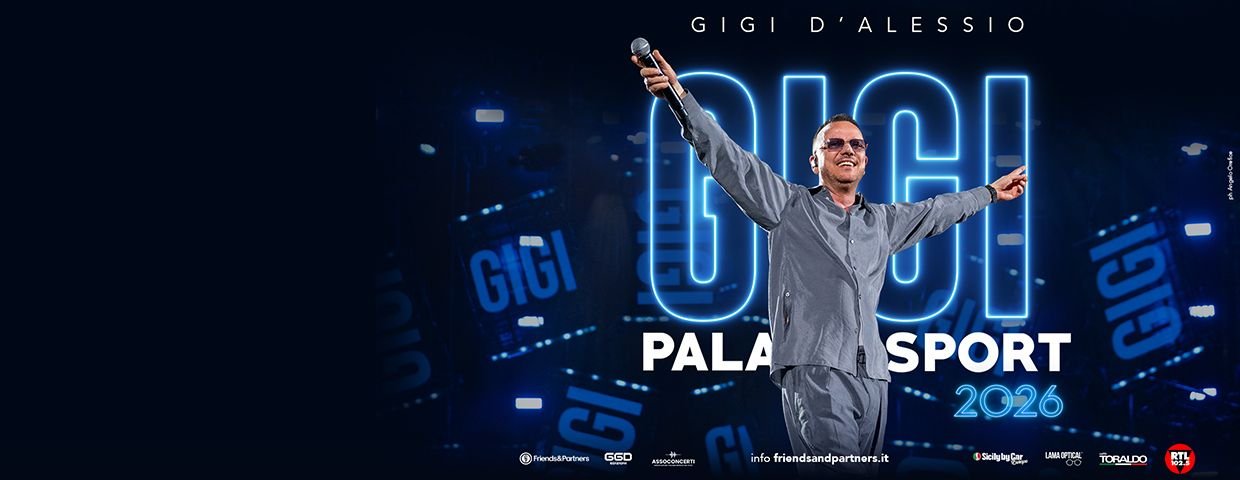
On November 14, 2026, Gigi D'Alessio returns to Rome for a night at the Palazzo dello Sport in Eur, the round arena that Pier Luigi Nervi and Marcello Piacentini built for the 1960 Olympics and that for more than half a century has remained the big hall for live music in Rome. A concert by the Neapolitan singer-songwriter almost never feels like just a concert: it feels more like an extended family evening, with an audience that knows by heart a repertoire built over more than 30 years of career and that sings that repertoire together with the man who wrote it.

What the November 14, 2026 concert is
The event is a Gigi D'Alessio concert at Palazzo dello Sport in Rome, scheduled for Saturday, November 14, 2026. The address is Piazzale dello Sport 1, in the EUR district, on the south side of the city. The venue is the one that on its ID card is called Palazzo dello Sport and that every Roman, without exception, calls Palaeur: two words stuck together, stress on the first, and the matter has been closed for 60 years.
The Rome date is part of an arena tour, which is the scale D'Alessio has worked at for quite some time. He isn't a theater singer-songwriter, he isn't a club singer-songwriter: the format that suits him best is the indoor arena, where the sound holds together, the crowd is compact, and the distance between the stage and the last row stays short enough to allow that call-and-response game that is the real architecture of his shows.
A note on method, because it matters and it's worth putting at the top. At the time of writing, no official set list for the Rome show has been published, nor a list of guests, nor the lineup of musicians who will take the stage. This is information that press offices release late, sometimes never, and that people often discover only when the lights go down. Anyone looking for certainties about which songs will be played, who will drop by for a duet, or how many horns or strings there will be won't find them here, for the good reason that they don't exist in a verifiable form. What can be described, instead, is how a night like this works, what it means to see it in that specific building, and how to get to Piazzale dello Sport without arriving late or arriving angry.
It's worth adding that the time that appears in the announcements for these nights at Palaeur is the usual one for Rome's arenas, in the evening around 21:00, with gates opening a few hours earlier. The information that really counts, though, is always and only the one printed on the ticket and on the venue's official channels, because times shift, opening acts get added, and a change of half an hour makes the difference between walking in calmly and finding the first song already underway.
November 14 falls on a Saturday, and this changes the feel of the night quite a bit. A midweek concert at Palaeur empties the arena at 23:30 because people work the next day. A Saturday concert keeps the audience inside until the last encore and then pours it onto the square with all the calm in the world. Saturday in Eur also has different traffic: fewer commuters on Via Cristoforo Colombo in the late afternoon, more residents' cars parked in the side streets. Anyone arriving by car will notice.
A curious fact about Gigi D'Alessio at Palazzo dello Sport in Rome, November 14, 2026
The curious fact concerns the building more than the artist, and it concerns the ceiling above the heads of the people standing on the floor. The dome of Palazzo dello Sport has a diameter of nearly 100 meters and a thickness of nine centimeters. Nine. Not 90, not nine decimeters: nine centimeters of reinforced concrete, over a stadium-size span. It's one of the numbers most often quoted in the literature on 20th-century Italian structural engineering, and it's the recognizable signature of Pier Luigi Nervi, whose job was exactly this: covering enormous spaces with ridiculous amounts of material, using geometry instead of mass.
The curious thing, in the context of a concert, is that this number has very concrete acoustic consequences. A spherical shell this thin and this wide behaves like a giant reflector: it sends sound back toward the center of the hall instead of dispersing it, and in a venue born for basketball and boxing, where the goal was for everyone to hear the referee and the bell, this was an advantage. For today's amplified music it's a complication, which audio crews solve with controlled-dispersion systems, sound-absorbing drapes hung high up and a stage design that takes the geometry of the vault into account. Whoever walks into Palaeur and looks up sees a secular cathedral in concrete. Whoever works there sees an acoustic problem solved from scratch every time.
Then there's the detail of the continuous glass band that runs along the front of the building, all the way around, below where the roof begins. By day it filters a light that makes the interior almost unreal, with the concrete turning pale and the tiers looking as if they were drawn in pencil. In the evening, during a concert, that band stays dark and the building can be read only from the outside, like an illuminated ring resting on the square. Whoever arrives early and walks around the venue before going in sees both things within an hour, the passage from the last light to full darkness, and it's worth the short walk.
Who Gigi D'Alessio is
Luigi D'Alessio was born in Naples on February 24, 1967. His biography starts from a detail that is often skipped in TV introductions and that instead explains a lot of what you hear on stage: at 12 he entered the San Pietro a Majella conservatory, and at 21 he earned his diploma in piano. It isn't a bit of color. It means that behind the popular singer there is a musician with complete classical training, and that the arrangements of his songs, when you listen to them without prejudice, have a harmonic care that can't be improvised. At 23 he conducted the Scarlatti orchestra.
The decisive step in his professional training, however, happened outside the conservatory, alongside Mario Merola. D'Alessio worked as the official pianist of the king of Neapolitan sceneggiata, and from that apprenticeship he took something no school teaches: a sense of theatrical timing, the ability to build an evening as if it were a story, and the habit of an audience that takes part out loud instead of listening in silence. He would dedicate to Merola the song "Cient'anne", written with Vincenzo D'Agostino, which is one of his best-known songs.
The discography starts in 1992 with "Lasciatemi cantare" and continues with an almost office-like regularity: "Scivolando verso l'alto" in 1993, "Passo dopo passo" in 1995, "Fuori dalla mischia" in 1997. The following decade is the one in which his audience grew beyond the borders of Campania, with "Quando la mia vita cambierà" in 2000, "Il cammino dell'età" in 2001, "Uno come te" in 2002, "Quanti amori" in 2004, "Made in Italy" in 2006, "Questo sono io" in 2008. Then "Ora" in 2013, "Malaterra" in 2015, "February 24, 1967" in 2017, where the title is his date of birth, "Noi due" in 2019 and "Buongiorno" in 2020.
His relationship with the Sanremo Festival is more restrained than his popularity would suggest. His documented appearances as a competing artist are three: in 2000 with "Non dirgli mai", 10th place, in 2001 with "Tu che ne sai", 8th place, and in 2012 with "Respirare", paired with Loredana Bertè, 4th place. That's three appearances in more than 30 years of career, which says something about how this artist built his success: not from the Ariston stage, but from the ground up, record after record and night after night, with an audience that grew by contagion more than by TV exposure.
The big event concerts tell the same story on a different scale. On June 7, 1997, he filled the San Paolo stadium in Naples with 20,000 spectators. On June 19, 1999, he returned to the same stadium and brought 30,000. On September 30, 2005, he sang in Piazza del Plebiscito before a crowd that the reports of the time estimated at more than 200,000 people, one of the most crowded squares Naples remembers. In June 2022, on the 17th and 18th, he returned to Plebiscito for two consecutive sold-out nights, exactly 30 years after his recording debut.
In recent years his face has become familiar even to those who don't seek out his music: judge on "The Voice of Italy" since 2019 and on "The Voice Senior" since 2020, host of "Made in Sud" between March and May 2017. Mainstream TV did what it always does, that is, it turned an artist deeply loved by one part of the country into a presence recognizable to everyone, including those who have reservations about his music. Reservations, after all, have always followed D'Alessio, and he has built a kind of ironic armor on top of them: Neapolitan melody in Italy was long considered a minor genre by critics, and those who practice it soon learn to measure their success by the numbers in the halls rather than by the reviews.
Something nobody tells you about Gigi D'Alessio at Palazzo dello Sport in Rome, November 14, 2026
Nobody says it, but the audience at a Gigi D'Alessio concert in Rome isn't the same audience as at a Gigi D'Alessio concert in Naples, and you can hear the difference from the first song. In Naples the artist sings at home, and the hall works like a compact sounding board: everyone knows everything, even the lesser songs, even the unreleased tracks from two albums ago. In Rome the audience is mixed. There's the Neapolitan community living in the capital that gets together for one night, and there's the Roman and Lazio crowd that knows the 20 or 30 best-known songs and listens to the rest. The result is a two-speed concert, where the singalongs explode intermittently instead of continuously.
The second thing nobody mentions concerns the internal geography of the hall. At Palaeur, as in almost all Italian arenas, the concert setup includes a floor and two rings of tiered seating. The floor, depending on the setup, can be standing or with numbered chairs. They are two radically different experiences, and the difference isn't only about comfort: the standing floor has the most direct sound and the highest energy but the worst visibility for anyone who isn't tall, while the central first ring, the one many consider the least prestigious seat, is almost always the spot where the mix arrives best, because that's where the sound engineer aims the systems. Anyone who picks a seat thinking that closer automatically means better is often proved wrong.
The third unspoken thing concerns timing. A concert of this kind rarely starts at the time written on the ticket. Between the gates opening, a possible opening act and the final setup, the gap between the stated time and the first chord can be half an hour or more. It isn't poor organization: it's the established practice of arenas, which takes into account that a sizable part of the audience arrives late. Knowing this changes the strategy of anyone who has to catch the last train or the last metro: it pays to calculate the real end of the show, not the theoretical one.
The fourth, and the most useful of all: at Palaeur the exit flow after a full concert is slow, and the bottleneck isn't inside the venue but outside, in the stretch between the square and the metro entrance. 10,000 people converging at the same time on an underground station produce a line that, on sold-out nights, can go past 20 minutes. Anyone who isn't in a hurry can stay seated on the tiers five minutes longer and find the square already half empty.
Palazzo dello Sport in Eur as a space
The Palazzo dello Sport was built between 1958 and 1960 and opened on June 3, 1960, a few weeks before the start of the Games of the XVII Olympiad. The signature is double: Marcello Piacentini for the architecture, Pier Luigi Nervi for the structures. It's a pairing that says a lot about Italy in those years, because it brings together the official architect of the previous regime, still very active after the war, and the engineer who was becoming the most exported Italian name in the world in the field of construction.
The plan is circular and the building is covered by a spherical reinforced concrete dome just under 100 meters in diameter, with that thickness of nine centimeters that remains the most quoted figure. The tiers are on two levels and the capacity is around 12,000 seats, with the caveat that for concerts the number changes with the setup: a central stage, an end stage, a standing or seated floor produce different configurations and different capacities. The number that counts is the one for the single night, and only the people selling the tickets know it.
The relationship between the building and the neighborhood deserves a line. Palazzo dello Sport wasn't placed at a random spot: it closes in perspective an axis of the EUR district, in dialogue with the rationalist buildings built 20 years earlier for the Universal Exposition that was never held. When you approach on foot from the right direction, the low, round silhouette appears as a counterpoint to the squared volumes around it. It's a planned urban operation, not a sports shed dropped on the outskirts, and the fact that 65 years later the venue still works as the city's main concert hall says something about the quality of the original design.
The venue went through a renovation between 1999 and 2003, after which for several years it took on a commercial name tied to a sponsor, PalaLottomatica, which many Romans still use out of habit. Commercial names of this kind change over time, and the sign above the entrance isn't necessarily the same as the last time you were there: anyone looking for the venue on maps would do well to search for the address, Piazzale dello Sport 1, which never changes.
In terms of experience, Palaeur is a venue that ages better than you might expect. The internal concourses are wide, restrooms are on both levels, and the food and drink stands work in the logic of the Italian arena, meaning long lines in the break between the opening act and the headliner and no lines during the show. Anyone who needs a drink would do well to get it right after going in or to skip it.
How to get to Palazzo dello Sport
The smart way to get to Palaeur is the metro, and that isn't an opinion. Line B has a stop called Eur Palasport, a few minutes' walk from the venue entrance: you come out into the neighborhood, take the street that goes down toward the square, and in barely five minutes you're in front of the facade. The previous station toward Laurentina is Eur Magliana, the next one is Eur Fermi, and on high-attendance nights it's worth keeping them in mind as alternatives both coming and going: getting off one stop early and walking 10 minutes often saves more time than it costs.
From the historic center the route is simple. Line B passes through Termini, Colosseo, Circo Massimo, Piramide and Basilica San Paolo before reaching Eur, so anyone in any of the areas served by the line arrives without changing. Anyone on line A changes at Termini, which is a simple but crowded transfer. From Termini the ride to Eur Palasport takes about 20 minutes of actual travel, to which you have to add the wait for the train and the time to reach the platform.
A warning about closing time. The Rome metro closes earlier than many visitors expect, with a last run that on weekdays falls shortly after 23:30 and on weekends is extended by about an hour. November 14, 2026 is a Saturday, so the weekend extension works in your favor, but a concert that ends late, added to the line at the station entrance, can still put in trouble anyone counting on the last run. It's worth checking the updated service times in the days before and, if the margin is tight, planning an alternative.
Anyone arriving by car needs to know two things. The first is that Eur is well served by the main roads, with Via Cristoforo Colombo crossing it from north to south and the Grande Raccordo Anulare a short distance to the south, so getting there is never the problem. The second is that parking right near Palaeur on a full concert night is a losing bet: the available spaces run out hours earlier, and wild parking in the neighborhood streets gets fined fairly regularly. The reasonable solution for anyone coming from outside the city is to leave the car at a park-and-ride along line B and finish the trip by metro.
As for buses, the neighborhood is crossed by several surface lines that connect Eur with the Ostiense area, Testaccio and the southern outskirts. They are a good alternative for getting there and much less so for leaving, because after a concert the stops around the square get crowded and the evening frequency isn't designed to absorb a wave of 10,000 people in 20 minutes. Anyone arriving by taxi or with a car service would do well to arrange the return in advance and to set a meeting point away from the square, because right after the concert the area in front of the entrance becomes impassable for vehicles.
My advice for Gigi D'Alessio at Palazzo dello Sport in Rome, November 14, 2026
My advice is to get to Eur two hours early and to use that time for the neighborhood instead of the line. It's a suggestion that applies to any concert at Palaeur, but for a November night it counts double, because in mid-November in Rome darkness comes early and the neighborhood in that light has a character it doesn't show by day.
The route that works best is this. You get off at Eur Palasport, but instead of going straight to the venue you walk five minutes in the opposite direction and come within sight of the Square Colosseum, the Palazzo della Civiltà Italiana, which after sunset is lit from below and gives back an image that looks like nothing else in Rome. From there you go down to the Laghetto dell'Eur, follow the shore, and climb back up toward the Palasport square. It's a walk of just under 40 minutes that crosses the best of the neighborhood and releases that waiting tension that you would otherwise spend in line.
The second piece of advice concerns clothing, and it isn't trivial. Palaeur in concert mode, with 10,000 people inside, gets warm, and the heat comes fast. November in Rome calls for a coat on the street, and inside that coat becomes a bulky weight to hold on your knees for two and a half hours. The coat check, when it's open, has lines in proportion to the capacity. The strategy that works is dressing in light layers under an outer garment you can roll up and set down, avoiding bulky coats that you then don't know where to put.
The third piece of advice is to watch the audience as well as the stage. A Gigi D'Alessio concert in Rome gathers a crowd that spans more generations than the average pop concert: there are the 60-year-olds who have followed him since 1992, there are their children, and there are the grandchildren brought along for initiation. Seeing three generations of the same family singing the same chorus together is a parallel show, and those who go to these concerts as curious spectators rather than fans often find it more interesting than the main one.
The fourth piece of advice, for those coming from outside Rome: don't plan anything else for the next morning. A Saturday night concert at Palaeur ends late, getting back to the center takes time, and a Roman Sunday morning rewards those who sleep. If the trip includes a visit to the historic center, it's better to put it on Saturday before the concert, leaving Eur in the early afternoon, or on Sunday after lunch.
How concerts work at Palazzo dello Sport
A night at Palaeur follows a fairly predictable ritual, and knowing it removes quite a few surprises. Gates usually open a couple of hours before the stated start time. Those who want a good spot on the standing floor arrive before opening and plan on waiting outdoors. Those with a numbered seat gain nothing by arriving early, except the time to get a drink without a line.
Entry checks are the standard ones for large Italian venues: ticket check, bag check, metal detector or a quick pat-down. The rules on what you can bring inside change from event to event and are published by the organizer, but some constants apply almost always: glass bottles and cans stay outside, long umbrellas stay outside, cameras with interchangeable lenses generally stay outside while phones go in without problems. Anyone bringing a large backpack risks having to leave it at the coat check or take it back to the car, which with the metro means losing it for the night.
Inside, the map is simple: a ring of perimeter corridors with the food stands and restrooms, and numbered gates leading to the sections. The section and row numbers are on the ticket, the house staff guide those who get lost, and the sections are clearly marked above each gate. The practical advice is to find your gate as soon as you get in and memorize which side it's on relative to the entrance, because in the dark, with the ring full of people, finding it again after going for a drink takes longer than it seems.
On sound, an honest observation. Palaeur isn't an auditorium and doesn't pretend to be one: it's a concrete dome that reflects, and the acoustic result depends decisively on the audio crew setting up the system that night. Major productions bring line array systems with coverage calculated on the volume of the hall, and the result is clean even in the upper tiers. Lighter productions perform less well, and in certain spots of the hall, especially under the overhangs and in the corners farthest from the speakers, the sound arrives muddy. It isn't a lottery, but it isn't a guarantee either.
A detail on the live repertoire that helps understand the structure of these nights without inventing set lists. D'Alessio has a 30-year catalog, and a sizable part of that catalog is in Neapolitan dialect, a part is in Italian, and a part mixes the two languages in the same song. In his concerts the sequence tends to move between these registers, alternating the songs everyone knows with the more intimate passages at the piano, where his conservatory training comes out directly. Which songs end up on the Rome set list on November 14 hasn't been announced, and anyone who writes it with certainty is imagining it.
Another well-known fact, yet not often mentioned
The well-known fact is that Palazzo dello Sport hosted the boxing events of the Rome 1960 Olympics, from August 25 to September 5, as well as the basketball competitions. The detail that gets mentioned less often than it deserves is who stepped into that ring: among the boxers in the Rome Olympic tournament was an 18-year-old from Louisville, Kentucky, who was still called Cassius Clay and who in Rome won the gold medal in the light heavyweight division. That young man would become Muhammad Ali.
It means that the building where a concert of Neapolitan music will be held on November 14, 2026 is the same building where the most famous boxer of the 20th century won his first international title. There's no plaque shouting it at the entrance, there's no museum route, there's nobody telling it to the audience walking in for a concert. It's simply a fact stored in the history of the building, one of many, and it sits there waiting for those who know it.
The list of major sporting events hosted by the venue is long and spans decades: professional boxing matches between the 1960s and 1970s, the volleyball world championships in 1978 and again in 2010, the European basketball championships in 1991. And then club basketball, which has always been at home at Palaeur and which filled those tiers on nights when the noise, according to those who were there, beat any concert.
The music program began around 1970 and has never stopped since. The result is that Palazzo dello Sport is probably the Roman building that has seen the largest number of different musicians pass across its stage, Italian and foreign, in every possible genre. A building born for gymnastics and boxing turned into the big live music hall of a European capital, and it did so without anyone really deciding it: it happened because it was the only covered space of the right size, and when a city has only one 10,000-seat container, that container becomes the center of everything.
Tickets and access
On tickets there is only one rule and it always applies: you buy them through the official channels of the organizer and the venue, and you avoid unauthorized resale channels. Italian law on secondary ticketing has made the systematic resale of show tickets at a markup illegal, and a ticket bought on an unauthorized channel can turn out to be invalid at the check, with the result of staying outside after having paid.
No information on prices, available sections or sales status for the November 14, 2026 show is published here, and none will be invented. These are figures that change from week to week and have only one reliable source, that is, the official sales channel. Anyone who reads around that a concert is sold out, or that few seats are left, or that prices start from a certain figure, would do well to check directly, because these claims get old within days and get repeated for years.
Some advice on method, on the other hand, can be given with confidence. Tickets for concerts in Italian arenas are by now almost always in the holder's name or in any case tied to a digital verification system: it's worth reading the conditions at the time of purchase, because in some cases the name on the ticket has to match an ID and in others it doesn't. Anyone buying tickets for a group of people should make sure they understand if each ticket needs to be put in an individual name. A change of name, when allowed, is done through a procedure by the seller and has to be completed in advance, not the same evening.
On physical access: you enter through the gates shown on the ticket, not through a single entrance, and getting the gate wrong means walking around the building. The venue is round, a full lap takes several minutes, and on full nights the staff don't always let you cross from one section to another. Looking at the gate number before getting in line is the move that saves the most time of all.
A last note concerning minors. Gigi D'Alessio's concerts draw a family audience and children are a common presence. The rules on admitting minors, on the requirement to be accompanied and on possible free entry under a certain age vary from event to event and are set by the organizer: they are stated in the terms of sale, and that's the right place to look for them before leaving, not after arriving at the gate.
Accessibility
Palazzo dello Sport has spaces reserved for spectators with mobility disabilities and dedicated access routes, as required for venues of this category. The established practice in Italian arenas is that reserved seats have to be requested at the time of purchase through a specific procedure, often different from the one for regular tickets, which includes the option of a companion. It's worth acting well in advance, because the number of spaces is limited and they sell out before the regular sections.
On the approach route, the situation is fairly good. The Eur Palasport metro station and the stretch between the station and the venue are flat or with gentle slopes, and the Eur district as a whole has wide sidewalks and regular crossings, much more than the Roman historic center offers. Wheelchair users find better conditions here than in almost any other part of the city. The only point to check in advance is if the elevators in the metro station are working, since, as in any network, they can be out of service: updated information is on the public transport service's channels.
For spectators with sensory disabilities, the available information is less structured. There are no stable sign language interpreting or assisted listening services declared as permanent features of the venue: these are services that the individual organizer may arrange for their own event. The right path is to contact the organizer of the night directly in advance and ask what is planned, because generic answers about the accessibility of an arena don't answer this specific question.
A practical observation on volume. A concert in an arena reaches high sound levels, and the reflection of the dome doesn't help those with particular hearing sensitivity. Anyone bringing small children, or anyone with hyperacusis, would do well to get linear-reduction earplugs, which lower the level without distorting the sound and cost little. It's a simple precaution that many discover only after their first bad night.
The right photo to take at Gigi D'Alessio at Palazzo dello Sport in Rome, November 14, 2026
The right photo isn't taken inside. Inside, with the stage lights changing every three seconds and the distance from any seat in the tiers, a phone inevitably produces a blurry, dark, noisy image, with a tiny figure in the middle of a confused rectangle. It's the photo everyone takes and nobody looks at again.
The right photo is taken outside, an hour earlier, and its subject is the building. The spot to look for is the square in front, stepping back enough to get the whole ring of the facade into the frame, with the continuous glass band lit up and the shell closing above it. In November, if you arrive around 18:00, you catch the blue hour: that quarter of an hour when the sky isn't black yet but has a deep, even blue, and the building's artificial lights exactly balance the remaining daylight. The pale concrete of Palaeur against that blue is one of the cleanest images Rome can offer, and it doesn't require any special equipment.
The second photo, for those with time who want something less predictable, is taken at the Laghetto dell'Eur, looking for the reflection on the water. With no wind the surface is almost a perfect mirror and gives back a double image of the surrounding architecture. With wind it doesn't work, and in November wind in Eur isn't rare: you go, you look at the water, and if it's choppy you move on without insisting.
The third, the hardest and the most satisfying, is the reverse shot: turning toward the audience instead of the stage, at the moment when the arena sings together and thousands of lit phones draw a constellation across the tiers. That image tells the story of the night much better than any blurry close-up of the artist, and it has the advantage of being technically easier, because the audience's lights are steady while the stage lights change constantly.
A recommendation, because it's needed. The rules on filming during concerts vary from production to production: phone photos for personal use are generally tolerated, long video recordings and the use of professional equipment generally aren't. The signs at the entrance and the instructions of the house staff are the source to follow. And beyond the rules, there's the matter of courtesy: a lit screen held up high for two hours ruins the night for whoever is in the row behind.
What's around Eur
EUR is the most unusual district in Rome, and anyone who comes for a concert and doesn't know it would make a mistake by limiting themselves to the metro-arena-metro route. It was born as the site of a universal exposition planned for 1942, which was supposed to celebrate the 20th anniversary of the Fascist regime and which the war prevented from taking place. Work stopped halfway, the district remained for years an abandoned construction site on the edge of the city, and only in the 1950s was it completed and converted into an office and residential district, with the 1960 Olympics acting as an accelerator.
The result is a piece of city that doesn't look like the rest of Rome: wide, straight streets, white, squared buildings, long perspectives, open spaces between one volume and the next. Anyone arriving from the historic center, where everything is layered and irregular, feels a kind of estrangement. It's the same estrangement that has made Eur one of the most used film sets in Italy, from Antonioni to Bertolucci up to the international productions looking for a ready-built 1960s future.
The symbol building is the Palazzo della Civiltà Italiana, which everyone calls the Colosseo Quadrato, the Square Colosseum: a travertine block pierced by six rows of arches, resting on a base with a monumental staircase and statues at the corners. It's the image of Eur that circulates around the world, and in person it works even better than in photos, because the real scale of the building only comes across when you climb the steps and look up.
Not far away is the Laghetto dell'Eur, an artificial lake surrounded by a park that fills with blossoms in late spring and in autumn takes on more sober colors that some find more beautiful. It's the place where the neighborhood relaxes: people running, families, dogs, benches. After the geometric rigor of the surrounding architecture it feels like a pause, and for those who arrive early for the concert it's the ideal place to spend an hour.
On the more recent side of the neighborhood's architectural story is the Fuksas Cloud, the new convention center designed by Massimiliano Fuksas: a glass box inside which hangs a white, irregular shape, the cloud itself, which contains the auditorium. It's the most debated contemporary building in Rome, built next to the rationalist buildings of the 1930s and in open contrast with their grammar. Like it or not, seeing it in the evening lit from inside is an experience worth the 10-minute detour.
Then there are the Palazzo dei Congressi, with its portico and vaulted hall, and the Basilica dei Santi Pietro e Paolo, which closes an axis of the neighborhood from the top of a flight of steps and whose dome can be seen from very far away, including from the Grande Raccordo Anulare. And there are the museums: the district hosts some of the least visited and most interesting public collections in Rome, which on Saturday afternoons are open and almost empty. Anyone arriving in Rome on the day of the concert with a free afternoon has a concrete alternative here to the line at the Vatican Museums.
On the practical side of eating, Eur is an office district and this shapes its food scene: many places geared to the weekday lunch break, less evening choice than in the center, and a cluster of restaurants and pizzerias in the streets around Via Cristoforo Colombo and toward the lake. On a concert night those places fill up with people waiting for the show, so anyone who wants to have a relaxed dinner before the show would do well to book or to eat early, before 19:30.
Some important events that happened here in history
The timeline of Palazzo dello Sport begins with the opening on June 3, 1960 and with the Olympics that followed a few months later. Those Games were a passage of national identity for Rome and for Italy: the country that 12 years earlier was coming out of the rubble presented itself to the world with venues signed by Nervi, with a live TV broadcast that reached dozens of countries, and with a city that discovered it could organize. Palazzo dello Sport was one of the visual symbols of that story.
The basketball and boxing tournaments were held inside the venue. The boxing tournament, from August 25 to September 5, 1960, brought into the history of the building the name of Cassius Clay, light heavyweight gold at 18, four years before becoming heavyweight world champion and changing his name to Muhammad Ali. It's the most quoted fact in the history of the building and, 65 years later, it remains the one that strikes those who discover it the most.
In the 1960s and 1970s the building became a regular venue for Italian professional boxing, at a time when that sport filled arenas and took up front pages. Then came volleyball: the 1978 world championship and, 32 years later, the 2010 one. And international basketball arrived, with the 1991 European championships.
At the same time, from 1970 onward, Palaeur established itself as the venue for Rome's big concerts. In that decade Italy was discovering the rock concert as a mass phenomenon, with all the social tensions that season brought with it, and Palazzo dello Sport found itself the capital's main stage for a genre that was then considered as political as it was musical. From then on the calendar has never emptied: each decade has brought its own names, its own genres and its own audiences under the same dome.
Between 1999 and 2003 the venue went through a renovation that updated its systems, services and safety, bringing it up to the standards of contemporary performance spaces. It's since that reopening that the building carried the name of a commercial sponsor for years, a habit that has involved almost all Italian arenas and that has produced the curious situation in which a building with a historic proper name is called in three different ways depending on the age of the speaker.
It's worth remembering that Palazzo dello Sport isn't the only work by Nervi linked to those Games: the city also preserves the Palazzetto dello Sport in Flaminio, smaller and for many more beautiful, with its ribbed roof that has become an icon of structural engineering. Anyone who gets hooked looking at the dome of Palaeur has there the second chapter of the same story, on the other side of the city.
Who has passed through Gigi D'Alessio at Palazzo dello Sport in Rome, November 14, 2026
Who has passed through Palazzo dello Sport, over 65 years, is basically anyone who has filled an arena in Italy. The complete list doesn't exist in a searchable form and rebuilding it would be archive work, but the profile is clear: Olympic athletes, professional boxers, top-level basketball and volleyball teams, and an unbroken series of Italian and foreign musicians starting from 1970.
In the 2026 season the venue's calendar brings together a sizable part of the Italian music that moves through arenas. On September 24, 2026 the Giorgia date took place, on October 15 the one by Pooh for their 60 years of career, on November 9 comes the one by Nayt, on November 13 the one by Marco Masini, on December 12 the one by Irama and on December 19 the one by ANNA. Gigi D'Alessio's November 14 concert therefore falls the day after Masini's, on a weekend that brings two different generations of Italian song to Palaeur 24 hours apart.
This crowded calendar tells something precise about Italian live music today: the arena has become the central format again. For a while it seemed that everything would move to stadiums in summer and clubs in winter, leaving indoor arenas in the middle without a clear role. The opposite happened. Stadiums remain reserved for very few names and few dates, clubs can't bear the production costs of today's shows, and the 10,000-seat arena has taken back center stage because it's the only format where a structured show holds up financially and can be repeated in 15 cities.
As for the November 14 stage, who will join D'Alessio on it hasn't been announced. His concerts have an established tradition of guests, often not announced in advance and sometimes decided at the last minute, but this is a general feature of the way he works and not information about the Rome show. Naming names in advance would be inventing.
Quick questions
When is the concert? Saturday, November 14, 2026, at Palazzo dello Sport in Rome, Piazzale dello Sport 1, Eur district. The exact time is the one shown on the ticket and on the organizer's official channels.
Are Palazzo dello Sport, Palaeur and PalaLottomatica the same place? Yes. The venue's proper name is Palazzo dello Sport, Romans call it Palaeur, and for years it carried a commercial name tied to a sponsor. The address, which doesn't change, is Piazzale dello Sport 1.
How do you get there by public transport? Metro line B, Eur Palasport stop, a few minutes' walk from the entrance. From the center you get there without changing from Termini, Colosseo, Circo Massimo and Piramide.
Is it worth going by car? Getting there is easy, parking near the venue on a full concert night much less so. For those coming from outside the city the most sensible solution is to leave the car at a park-and-ride on line B and finish the trip by metro.
What's the capacity? About 12,000 seats on two levels of tiers, with significant variations depending on the setup chosen for the individual concert.
How much are tickets? Prices aren't listed here because they change and because the only reliable source is the organizer's official sales channel. It's best to avoid unauthorized resale channels, where the ticket may turn out to be invalid at the check.
Is the concert sold out? The sales status can't be verified in a stable form and changes constantly. The answer can only be found on the official sales channel, at the moment you look for it.
What's the set list? No official set list has been published. Gigi D'Alessio's repertoire covers 30 years of songs in Italian and Neapolitan, but which songs make it into the Rome show you find out on the night.
Will there be guests? No guests have been announced for the Rome date. D'Alessio's concerts often have them, but no names have been released.
Is it suitable for children? The audience at these concerts is strongly family-oriented and the presence of children is normal. The rules on admitting minors and on the requirement to be accompanied are set by the organizer and should be read in the terms of sale. For the little ones it's a good idea to bring earplugs, because the volume in an arena is high.
Is the venue accessible? There are spaces reserved for spectators with mobility disabilities, to be requested at the time of purchase through a dedicated procedure and well in advance, because there are only a limited number. The route from the metro to the entrance is flat and the district has wide sidewalks.
What can you bring inside? The rules vary from event to event and are published by the organizer. In general glass bottles, cans, long umbrellas and professional camera gear stay outside. Phones go in without problems.
Can you take photos? Phone photos for personal use are normally tolerated, long video recordings and professional equipment generally aren't. What counts is what the signs at the entrance and the house staff say.
What can you see nearby before the concert? The Colosseo Quadrato, the Laghetto dell'Eur, the Nuvola di Fuksas, the Palazzo dei Congressi and the Basilica dei Santi Pietro e Paolo are all within a short walk of the Palasport. With two hours to spare you cover the best of the neighborhood.
What time does it end, and can you make it to the metro? An arena concert usually ends between 23:00 and midnight, and the flow toward the station takes time. November 14, 2026 falls on a Saturday, when metro service runs later than on weekdays, but it's worth checking the updated time of the last run on the public transport channels.
Frequently asked questions about Gigi D'Alessio at Palazzo dello Sport in Rome, November 14, 2026
When is the Gigi D'Alessio concert in Rome?
The Gigi D'Alessio concert at Palazzo dello Sport in Rome is scheduled for Saturday, November 14, 2026. The exact start time is the one shown on the ticket and on the organizer's official channels.
Where is the concert held?
The Gigi D'Alessio concert is held at Palazzo dello Sport in Rome, Piazzale dello Sport 1, in the Eur district. The venue, whose official name is Palazzo dello Sport, is simply called Palaeur by all Romans.
How do you get to Palazzo dello Sport?
The best way to reach the Gigi D'Alessio concert is metro line B, with the Eur Palasport stop a few minutes' walk from the venue entrance. The previous station toward Laurentina is Eur Magliana, the next one is Eur Fermi.
Where do you buy tickets?
Tickets for the Gigi D'Alessio concert at Palazzo dello Sport are bought through the official channels of the organizer and the venue, avoiding unauthorized resale channels: under Italian law on secondary ticketing, a ticket bought elsewhere risks turning out to be invalid at the check.
What time do the gates open?
For the Gigi D'Alessio concert, as for other nights at Palaeur, the gates usually open a couple of hours before the stated start time. Those who want a good spot on the standing floor arrive before opening, while those with a numbered seat gain nothing by arriving early.
Is Palazzo dello Sport accessible to people with disabilities?
Yes, for the Gigi D'Alessio concert Palazzo dello Sport has spaces reserved for spectators with mobility disabilities and dedicated access routes. Reserved seats have to be requested at the time of purchase through a specific procedure, often different from the one for regular tickets.
Are Palazzo dello Sport, Palaeur and PalaLottomatica the same place?
Yes, for the Gigi D'Alessio concert it's always the same venue: the proper name of the building is Palazzo dello Sport, Romans call it Palaeur, and for years it also carried the commercial name PalaLottomatica.
For a visit to Rome built around professional support, with licensed guides and tour leaders who know how to read a neighborhood like Eur beyond the postcard, the reference is Tour Leader Pro, which works with professionals all over Italy. To organize the rest of the trip around the night, from transfers to trips out of the city to free days, the starting point is ItalyPlanner.