Palazzo Cipolla
In short. Anyone walking Via del Corso for the first time should stop at number 320 and let the facade of Palazzo Cipolla do its work in silence.
Palazzo Cipolla on the Corso, in the heart of Rome
Anyone walking Via del Corso for the first time should stop at number 320 and let the facade of Palazzo Cipolla do its work in silence. We are a few steps from Piazza Venezia, on that stretch of street that Romans have always covered in a hurry, distracted, eyes elsewhere. And it is right here, where nobody expects to slow down, that one of the most interesting exhibition spaces in the city opens up. Palazzo Cipolla does not have the monumental presence of a temple or a basilica, it does not force you to look at it. It waits for you, if anything, and whoever learns to recognize it discovers that behind that 19th-century curtain hides a rhythm of rooms, grand staircases and light that is worth the stop.
The right way to talk about Palazzo Cipolla is to start from its position. Via del Corso is the backbone of the historic center, the straight stretch that links Piazza del Popolo to Piazza Venezia over about a kilometer and a half, and it is the direct heir of the ancient Via Lata, the urban stretch of Via Flaminia. Walking here means moving along a street with 2000 years of layers beneath your feet. Palazzo Cipolla faces exactly onto this axis, and when you go in you leave behind the din of the shopping crowd to find yourself in an environment designed for art, for slow contemplation, for the gaze that settles and takes its time.
The first thing to know is not to confuse the building with what it hosts from time to time. Palazzo Cipolla is the exhibition venue of Fondazione Roma, and its programming changes: large monographic exhibitions, retrospectives, photography shows, thematic exhibitions that follow one another through the year. The building stays, the exhibitions pass. That is why, when I plan a visit with someone, my first recommendation is always to check what is on before leaving, because the palace may be open for an extraordinary installation or in the middle of being reinstalled between one exhibition and the next.
It happens to many people to arrive here full of expectations and find the entrance closed, or to wander absentmindedly into an exhibition they didn't know, without the tools to appreciate it. Palazzo Cipolla rewards those who approach it with awareness, who know in advance what they are going to see and why. It is a place that gives a lot, but asks in return for a minimum of preparation, and it is exactly this reciprocity that makes the visit an authentic experience and not a distracted passage among a thousand stimuli in the center of Rome.
The position of Palazzo Cipolla between Piazza Venezia and the Corso
Palazzo Cipolla can be described as a geographic hinge. You are halfway between the Capitoline Hill and the Forums, which stay behind you as you go down toward Piazza Venezia, and the Rome of shopping and strolling that climbs toward the Tridente. Within a radius of a few hundred meters you have the Vittoriano with its dazzling mass of botticino marble, the column of Marcus Aurelius in Piazza Colonna, the Palazzo di Montecitorio, the Galleria Doria Pamphilj with its princely collection, the Trevi Fountain waiting for you behind a couple of turns. It is a neighborhood that concentrates, in a tiny space, centuries of Roman history.
This centrality is no small detail. It means that Palazzo Cipolla is never an isolated destination: it always fits into a wider itinerary, as a stop that breaks the rhythm of the center with an indoor parenthesis of art. It works well like that, as a point of pause and breathing between one walk and another, perhaps in the middle hours when the sun beats on the paving and a cool, dim room becomes the most welcome gift. The position makes it easy to reach from any direction, and for exactly this reason it is easy to slot into an already full day.
There is also an aspect Romans know well: this stretch of the Corso, at the height of Palazzo Cipolla, is one of the places where the city shows its double soul. On one side the popular, mercantile, noisy street, that of the evening struscio and the shop windows. On the other, just past a threshold, the noble palaces with their silent courtyards. Palazzo Cipolla belongs to this second Rome, the one that hides behind the facades and rewards whoever has the curiosity to go in instead of just passing by.
Palazzo Cipolla and the architect Antonio Cipolla
The name of the palace tells its origin. Antonio Cipolla was a 19th-century architect, active at a crucial moment for Rome, when the city was slowly emerging from the papal season to look out onto what would become the capital of the new Kingdom of Italy. Cipolla worked for a long time on Via del Corso and its surroundings, and the stamp of this building, which bears precisely his name, is owed to him. It is a 19th-century palace in the fullest sense of the term: it was born in an era when Roman architecture was seeking a balance between the memory of Renaissance and Baroque models and the new functional needs of the modern city.
When I look at the facade I always try to read it like a text. The proportions, the rhythm of the windows, the play of the cornices tell of a cultured, measured taste, which does not seek amazement at all costs but aims for sober elegance. It is an architecture that converses with the neighboring palaces without wanting to overshadow them, and that fits into the fabric of the Corso respecting its line. This discretion, which today might seem almost shyness, was in fact a precise choice: a building meant to last, to blend in, not to age too quickly with fashions.
During the 1900s and then in more recent decades the palace has undergone restoration and upgrading work that turned it into a contemporary exhibition machine, with systems, lighting and climate control up to museum standards. It is the fate of many historic Roman buildings: born for one function, converted to another, able to reinvent themselves without losing their soul. Palazzo Cipolla today is exactly this, a 19th-century container that welcomes ever new content.
It is worth adding that the discretion of the facade also reflects the way 19th-century Rome conceived civic architecture. Not all buildings had to shout their importance: many, like Palazzo Cipolla, relied on a sober dignity, on an elegance made of right proportions more than of showy ornament. This stylistic choice tells of a city that, on the eve of becoming a capital, was seeking an orderly and modern architectural language, able to converse with the glorious past without slavishly imitating it. Looking at Palazzo Cipolla with this key means reading in it a whole chapter of the history of Roman taste.
Palazzo Cipolla, exhibition venue of Fondazione Roma
To really understand Palazzo Cipolla you have to understand who stands behind it. The building is the exhibition venue of Fondazione Roma, the institution that handles its cultural programming and that over the years has brought exhibitions of national and international importance into these rooms. Fondazione Roma has its roots in the world of foundations of banking origin, those entities that from the 1990s onward took on an important role in supporting art, research and heritage. The space once known as Fondazione Roma Museo finds here, at Palazzo Cipolla, its most visible home.
This lineage helps frame the character of the exhibitions. It is not a museum with a permanent collection to visit that is always the same, but a space that lives on temporary projects, often carried out in collaboration with major Italian and foreign museum institutions. This means that every visit to Palazzo Cipolla can be completely different from the previous one: one time you will find yourself in front of masterpieces of painting, another time photographs, yet another a thematic route that weaves together art and history. The variety is part of its identity.
There is a practical advantage in all this. Since the programming is temporary, it is worth following the official channels of the Museo del Corso, the museum hub of Fondazione Roma of which Palazzo Cipolla is the venue for temporary exhibitions, to find out what is on and to organize the visit. Exhibitions have precise opening and closing dates, hours that can vary, and sometimes come with events, lectures and guided tours. Whoever arrives informed has a much richer experience than whoever leaves it to chance.
There is one last aspect I always stress when talking about Fondazione Roma and its link with Palazzo Cipolla: the consistency of a long-term choice. Permanently devoting a palace in the center to art exhibitions is not an occasional decision, but a commitment that renews itself season after season, with the programming of new exhibitions and the continuous work of maintaining and updating the spaces. This continuity has allowed Palazzo Cipolla to build a loyal public and a solid reputation, becoming a fixed point in the Roman cultural landscape. Whoever returns after years finds a place changed in content but steady in its mission.
The facade of Palazzo Cipolla seen from the Corso
It is worth lingering on the facade, because it is the part of the palace everyone first comes into contact with, often without realizing it. Whoever walks along Via del Corso passes in front of Palazzo Cipolla dozens of times without noticing it, and this is perhaps its most curious fate: being an important building that blends into the daily flow of the street. And yet it is enough to look up, to pull your eyes away from the shop windows and raise them above ground-floor level, to notice the quality of the whole.
The composition of the facade follows a classical logic, with a base, the main floors marked by framed windows and a crowning that closes the building toward the sky. It is a grammar that repeats in a thousand variants in Rome, from Renaissance to 19th-century palaces, and that here is declined with restraint. There are no decorative excesses, no aggressive rustication or protruding statues: everything is kept under control, in a balance that speaks the language of the cultured city.
If you have time, it is worth crossing the street and looking at Palazzo Cipolla from the opposite side of the Corso, to get the right distance. Via del Corso is narrow, and this makes it hard to take in the facade in a single glance if you stay on the same sidewalk. Moving to the other side, or better still framing it at an angle from a point slightly set back, you manage to catch its real proportions and to understand how much bigger it is than it seems from the hurried passage of a pedestrian.
The interior spaces of Palazzo Cipolla
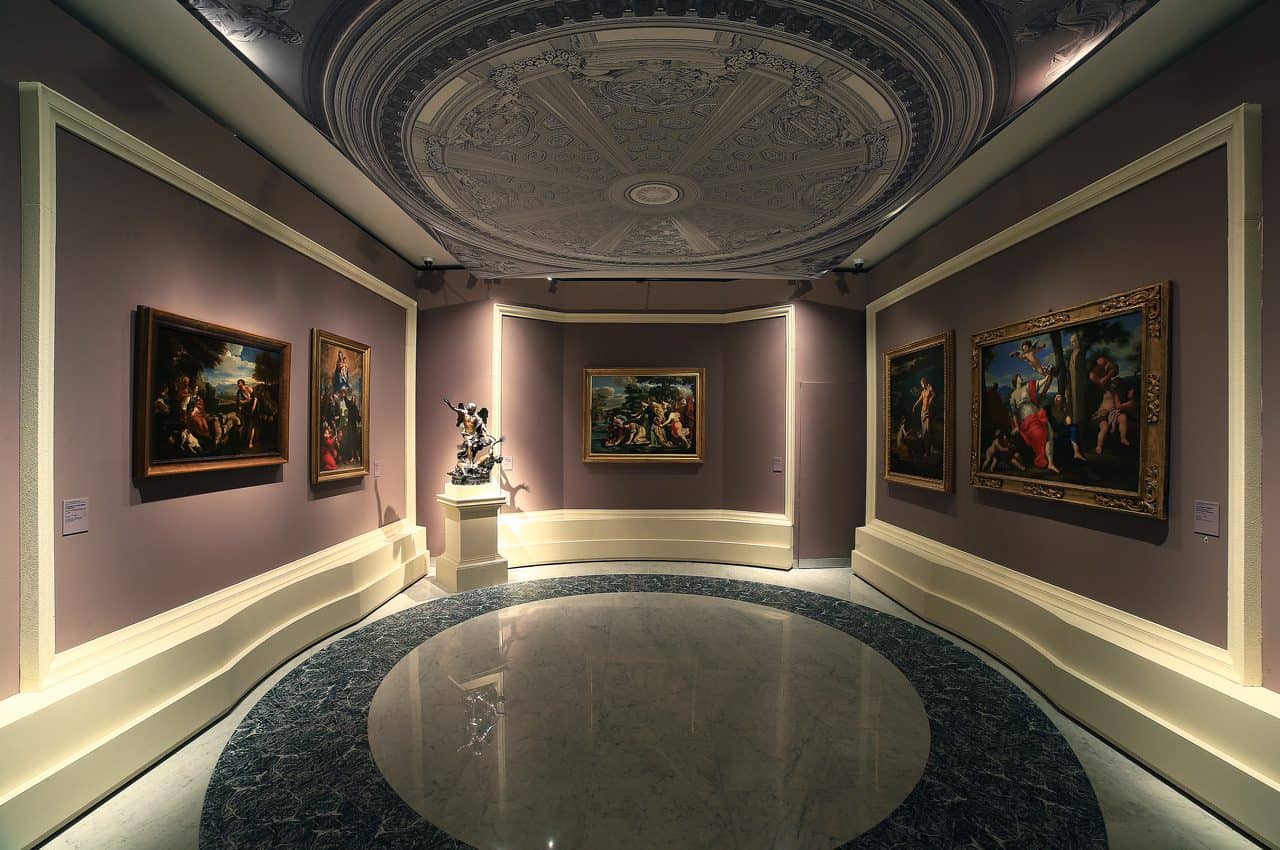
The interior of Palazzo Cipolla is where the palace really gives its best. Past the entrance, you find yourself in a system of rooms spread over the floors, linked by grand staircases and passage areas that were adapted to exhibition needs in the course of the restorations. The rooms have high ceilings, wide surfaces and a light that, depending on the installation, is modulated with curtains, spotlights and museum lighting systems to protect the works and show them off.
I love watching how the same space changes completely from one exhibition to the next. A room that on one occasion hosts large canvases hung at regular distances is turned on another into an immersive environment, with walls painted in dark colors and works lit like jewels in a display case. This flexibility is the sign of a space designed for the contemporary art of display, where the installation is almost a work in itself and contributes decisively to the visitor's experience.
The visiting route, as a rule, unfolds in an orderly way from room to room, in a sequence the exhibition designers study to build a narrative. That is why I always suggest following the order proposed without skipping the first rooms to run to the most famous works: well-designed exhibitions have a beginning, a development and a conclusion, and Palazzo Cipolla lends itself well to this storytelling thanks to the sequence of its spaces.
One last observation on the interior spaces concerns the relationship between the historic architecture and the contemporary installations. Every time I walk in I notice the fruitful tension between the two dimensions: on one side the 19th-century structures, the grand staircases, the high ceilings, the classical proportions. On the other the movable walls, the technological display cases, the multimedia apparatus the exhibition designers introduce to tell the story of the works. This coexistence, when well calibrated, produces a fascinating effect, in which old and new enhance each other. Palazzo Cipolla almost always manages to find this balance, and it is one of the reasons its exhibitions are engaging even from a scenographic point of view.
Palazzo Cipolla and the great art exhibitions in Rome
Rome is not a city of great contemporary art museums as other European capitals are, and for this reason the spaces that host high-profile temporary exhibitions have a particular value. Palazzo Cipolla belongs to that network of exhibition venues that, together with other city institutions, keep alive the programming of temporary shows able to attract a wide public. Over the years these rooms have welcomed exhibitions dedicated to masters of painting, to photography, to modern art and to broad-ranging thematic routes.
What I appreciate about this type of exhibition is their ability to bring to Rome works that normally live elsewhere, in museums and collections scattered around the world. A temporary exhibition is an unrepeatable occasion: it gathers in one place, for a few months, works that will then each return to its own home. Whoever visits Palazzo Cipolla during a major show therefore has an experience they cannot repeat, because that specific configuration of works will never come back identical.
I advise art lovers to consider Palazzo Cipolla as a stop to keep an eye on when planning a trip to Rome. The major exhibitions are usually announced well in advance, and knowing there is an important show on can be one more good reason to choose the dates of your stay. It is a way of living the city that goes beyond the obligatory monuments and adds to the visit a piece of contemporaneity.
I would add that following the exhibitions of Palazzo Cipolla over time also lets you catch a common thread, a cultural line. The programming choices are not random: they reflect a vision, an idea of what is worth bringing to the attention of the Roman public. Whoever frequents the palace with some regularity learns to recognize this stamp, and the visit then becomes part of a wider discourse, of a dialogue continued over the years between the institution and the city. It is one more level of reading, reserved for those who decide to make Palazzo Cipolla an appointment and not an isolated stop.
How to get to Palazzo Cipolla
Getting to Palazzo Cipolla is simple, and this is one of its great merits. Since it is on Via del Corso at the height of Piazza Venezia, it is at the center of a dense network of connections. Many city bus lines that cross the city in all directions pass through Piazza Venezia, and the stop is extremely convenient, practically under the palace. Whoever comes from far away can therefore count on easy access without the need for long transfers.
For those using the metro, the most useful reference is Piazza di Spagna station on Line A, from which you go down along the Corso on a pleasant walk of about 10 minutes, or Piazza Barberini station, on the same line. Alternatively, those who like walking will find that Palazzo Cipolla can be reached on foot from almost any point of the historic center: from Termini station it takes about 20 minutes of walking, crossing the heart of the city.
The advice, however, is to give up entirely on the idea of arriving by car. This area is largely a limited traffic zone, parking is practically impossible and in any case counterproductive, because the pleasure of this neighborhood lies precisely in covering it on foot. Arriving at Palazzo Cipolla walking along the Corso, or coming down one of the lanes that flow into it, is part of the experience as much as the visit itself.
When to visit Palazzo Cipolla
Choosing the right moment to visit Palazzo Cipolla depends on what you are after. If your goal is to enjoy an exhibition at leisure, I suggest avoiding weekends and the middle hours of the busiest days, when the rooms fill up and the pace of the visit slows. Weekday mornings, right after opening, generally offer the most intimate atmosphere, the one in which you can stop in front of a work without feeling the pressure of the people behind you.
Then there is the question of the seasons. Rome in summer is hot and crowded, and an air-conditioned exhibition space like Palazzo Cipolla becomes a precious refuge in the hottest hours of the afternoon. In spring and autumn, on the other hand, the city is at its best, and a visit to the palace combines perfectly with long walks in the center. Winter has the advantage of tranquility: fewer tourists, more intimate atmospheres, and the chance to devote all the time you want to the works.
Always check the hours before going, because they can vary depending on the exhibition on and on holidays. Some exhibitions have evening or extended openings for special events, which are often the most fascinating moments to visit an exhibition space: the artificial light, the silence of the evening, the city lighting up outside. These are details that can turn an ordinary visit into a memory that stays.
I want to insist once more on a practical detail about arriving on foot, because it is the one I recommend with the most conviction. Approaching Palazzo Cipolla on foot lets you prepare mentally for the visit, gradually leave behind the worries of the day and tune in to the rhythm of the city. The walk along the Corso, or through the lanes that flow into it, is an integral part of the experience, a prelude that readies the eye for contemplation. Whoever arrives out of breath, at the last moment, misses this phase of approach, which is instead precious and makes the visit deeper.
Palazzo Cipolla and the neighborhood around the Corso
You don't visit Palazzo Cipolla in isolation: it is a point that counts. The palace is immersed in one of the neighborhoods most dense with history in Rome, and whoever limits themselves to going in and out without looking around loses half the pleasure. A few steps away opens Piazza Venezia, with its roundabout traffic and the stage set of the Vittoriano. A little farther, the climb to the Capitoline Hill designed by Michelangelo. On the other side, the dense web of lanes leading toward the Pantheon and Piazza Navona.
The Corso itself, in front of the palace, is a world. It is the street of the struscio, that ritual stroll Romans have made for centuries, and that still today animates above all the late afternoon hours. Walking on the Corso means immersing yourself in the flow of the living city, among historic shops, noble palaces, churches hidden between the shop windows. Palazzo Cipolla is an island of artistic quiet within this river, and the contrast between the two worlds is part of its charm.
It is worth devoting at least half an hour, before or after the visit, to exploring the surroundings without a precise destination. All it takes is to turn into one of the side lanes to discover courtyards, little fountains, workshops and glimpses that guides rarely point out. It is in this unhurried wandering that you get to know the real Rome, the one that lies around the monuments and forms their connective tissue. Palazzo Cipolla, in this sense, is a gateway to a whole neighborhood.
The church of San Marcello al Corso near Palazzo Cipolla
A short distance from Palazzo Cipolla, still on the Corso, stands the church of San Marcello al Corso, and I never fail to point it out to anyone visiting the area. It is one of those churches the distracted passerby walks past without seeing, because its concave facade, the work of Carlo Fontana, slips into the line of the houses without shouting its presence. And yet crossing its threshold means entering one of the most evocative Baroque interiors of this stretch of the city.
I mention San Marcello al Corso because it is the perfect example of how this neighborhood rewards curiosity. Palazzo Cipolla and the church are a few dozen meters apart, and visiting them on the same walk creates a fascinating diptych: on one side the contemporary art of the temporary exhibitions, on the other the Baroque splendor of a 17th-century sacred interior. It is a leap across centuries and languages made in a few steps, and it conveys well the layering typical of Rome.
Anyone who likes these juxtapositions can build a small themed itinerary around Palazzo Cipolla, lining up the churches, palaces and glimpses of the stretch of the Corso between Piazza Venezia and Piazza Colonna. It is a short, dense route that can be done at leisure in a couple of hours and that has the merit of revealing a refined and secluded Rome, far from the crowds of the great monuments.
The proximity of San Marcello al Corso also offers a cue for a more general reflection on how to visit this neighborhood. Rome does not let itself be understood in watertight compartments: sacred and secular art, the ancient and the contemporary, the famous monument and the hidden glimpse live side by side within a few meters of each other. Palazzo Cipolla is an excellent starting point for training this cross-cutting eye, which rejects sharp separations and picks up instead the links between things. Whoever visits the exhibition and then walks into the nearby church is doing exactly this exercise, and comes out with a richer and truer understanding of the city.
Palazzo Cipolla and the history of Via del Corso
To fully appreciate Palazzo Cipolla you need to know a bit of the history of the street it faces. Via del Corso follows the course of the ancient Via Lata, the urban segment of Via Flaminia, the great consular road that headed north from the center of Rome, toward Rimini and the Adriatic. For centuries this street was the monumental entrance to the city for those arriving from the north, and over the millennia it has kept its role as a load-bearing axis.
The name "Corso" comes from the horse races held here during the Roman carnival, a popular spectacle that for centuries animated the street and involved the entire city. Imagining those horses launched along the straight stretch, between two wings of crowd, helps one understand how much this street has always been a place of collective life, of celebration, of meeting. Palazzo Cipolla, built in the 19th century, fits into this long story as one of the buildings that shaped the modern Corso.
Walking along the Corso today therefore means retracing a layered history, in which the ancient and the modern live together. The 19th-century palaces like Palazzo Cipolla represent the phase in which Rome, on the eve of becoming the capital of Italy, was equipping itself with new urban architecture. Knowing this context makes the visit to the palace much richer, because you no longer look at it as an isolated building but as a piece of an urban story 2000 years long.
Knowing the history of Via del Corso, finally, helps explain why buildings like Palazzo Cipolla were built right here. A central, prestigious street, traveled for centuries by anyone entering or leaving the city toward the north, was the natural place to build important palaces. Facing onto the Corso meant facing onto the public life of Rome, onto its busiest artery. Palazzo Cipolla inherits this centrality and reinterprets it today in a cultural key: where pilgrims, carriages and racehorses once passed, today passes a public drawn by art, in a continuity of public function that runs through the centuries.
What to expect from a visit to Palazzo Cipolla
What to expect from a visit to Palazzo Cipolla depends, first of all, on the exhibition on. It is the concept I always come back to: the palace is a container, and the experience changes radically depending on what it hosts. That said, there are some constants that make every visit recognizable, regardless of the exhibition of the moment.
The first is the quality of the installation. The exhibitions at Palazzo Cipolla are generally curated with care, with educational materials, captions and sometimes multimedia routes that accompany the visitor. The second is the human scale of the spaces: this is not a sprawling museum in which you get lost, but an intimate route that is covered in a reasonable time, usually between an hour and an hour and a half depending on how much you want to linger. This makes it ideal also for those with a full day who want to fit an exhibition between other visits.
The third constant is the atmosphere. Walking into Palazzo Cipolla means detaching from the noise of the Corso and immersing yourself in an environment designed for concentration. Even on the busiest days, the layout of the rooms helps preserve a certain silence, that necessary condition for really looking at a work. It is an experience I recommend living without hurry, turning off the phone and allowing yourself the rare luxury, in a frenetic city like Rome, of slowing down.
Palazzo Cipolla for art lovers
If you are an art enthusiast, Palazzo Cipolla deserves a permanent place on your mental map of Rome. Not because it has a permanent collection to see always, but precisely because it doesn't: it is a space that lives on novelty, and for those who follow exhibitions this means a continuous flow of opportunities. Keeping an eye on its programming means not missing the most interesting shows that pass through the city.
Many visitors return to Palazzo Cipolla several times over the years, each time for a different exhibition, and each time with the feeling of discovering a new place. It is the beauty of temporary exhibition spaces: they build with the public a long-term relationship, made of returns and surprises. The palace thus becomes a kind of fixed appointment, a reference point to come back to in order to know what Fondazione Roma has chosen to bring to the city.
For those traveling from out of town, the advice is to fold the visit into the overall story of the Roman stay. After seeing the great classics, the Vatican museums, the Forums, the Colosseum, devoting time to a temporary exhibition at Palazzo Cipolla adds a different dimension, more contemporary and more intimate. It is the way Romans themselves live art: not only as a heritage of the past to be guarded, but as something alive that keeps happening every day.
Palazzo Cipolla and its relationship with Piazza Venezia
It is worth saying a few words on the relationship between Palazzo Cipolla and Piazza Venezia, because it is a relationship of proximity that conditions the experience of the visit. Piazza Venezia is one of the busiest and most scenic hubs of Rome, dominated by the white mass of the Vittoriano, the monument to Victor Emmanuel II inaugurated in the early 1900s. Stepping out of Palazzo Cipolla and walking a few minutes you find yourself immersed in this imposing urban spectacle.
I often suggest combining the visit to the palace with a climb to the terraces of the Vittoriano, from which you enjoy one of the widest views over the city. The contrast is fascinating: from the intimate seclusion of the exhibition rooms of Palazzo Cipolla you move to the dizzying openness of the panorama from above. In a few minutes of walking you make a leap of scale that sums up well the richness of this neighborhood, able to offer in a tiny patch of land radically different experiences.
Piazza Venezia is also an excellent reference point for getting your bearings. Someone who doesn't know Rome can easily get lost in the maze of the center, but Piazza Venezia, with its monument visible from afar, works as a compass. Remembering that Palazzo Cipolla is a couple of steps from here, on the Corso, helps you find your way and fit the visit into any city itinerary without fear of getting lost.
Services and accessibility at Palazzo Cipolla
A practical aspect I always point out concerns services and accessibility. Being a modern exhibition space carved out of a historic building, Palazzo Cipolla has over time equipped itself with adequate infrastructure to welcome the public, with ticket office, coat check and generally a bookshop tied to the exhibition on, where you can find catalogs and further reading. The catalog, in particular, is often an excellent keepsake and a tool for prolonging the visit even after you have left.
As for accessibility for people with mobility difficulties, historic Roman buildings always present some complexity, but carefully run exhibition spaces like this one tend to provide solutions for overcoming changes in level. The advice, for those with specific needs, is to contact the organization in advance or to check the information on the official channels, because conditions can vary depending on the installation and the areas actually open to the public.
I always remind people that major exhibitions can have lines, especially on weekends and in the last weeks before closing, when everyone rushes to see the show before it disappears. Where available, buying the ticket in advance or booking a time slot saves precious time. Checking these possibilities ahead of time on the official channels of the Museo del Corso is a small gesture that can greatly improve the experience of the day.
Palazzo Cipolla in the context of Roman exhibition venues
Placing Palazzo Cipolla within the broader landscape of Roman exhibition spaces helps in understanding its role. Rome has several venues that host important temporary exhibitions, spread between the historic center and the newer neighborhoods. Each has its own vocation: some favor ancient art, others photography, others still contemporary art or the great retrospectives. Palazzo Cipolla has carved out a recognizable space thanks to the quality and variety of its offerings.
Its very central position gives it a competitive advantage over more out-of-the-way venues: it is easy to reach, it fits into tourist itineraries, and it intercepts the large flow of people who walk Via del Corso every day. This makes it an ideal gateway into the world of exhibitions for those who perhaps are not regular museum-goers but let themselves be intrigued by a poster seen while strolling.
I advise anyone who wants to experience Rome also from the contemporary cultural point of view to build a small network of venues to keep an eye on, and Palazzo Cipolla certainly deserves to be part of it. Following the programming of these spaces means discovering a city that is not only the open-air museum of its ancient monuments, but also a living place where art continues to be produced, exhibited and discussed. It is a more mature and deeper way of getting to know Rome.
A walking itinerary that includes Palazzo Cipolla
To fit Palazzo Cipolla into a Roman day, a walking itinerary that starts from the Corso and makes it the fulcrum works well. You can begin at Piazza del Popolo, at the northern end of the Corso, and descend slowly toward the south, letting the street tell its story. Along the way you meet palaces, churches and squares, until you reach the height of Palazzo Cipolla, where you stop for the visit.
After the exhibition, the itinerary continues toward Piazza Venezia and, if you like, climbs to the Capitoline Hill or to the terraces of the Vittoriano for the view. Alternatively, you can detour toward the Trevi Fountain, which is a few minutes away, or toward the Pantheon, immersing yourself in the ancient heart of the city. Palazzo Cipolla works very well as the central stop of this kind of walk, because it offers an indoor artistic pause in the middle of an outdoor route.
The secret of a good itinerary is not to overfill it. Better a few stops lived at leisure than an endless list of monuments seen in passing. Palazzo Cipolla, with its intimate scale and its strategic position, helps build a balanced day, in which the pleasure of walking alternates with that of contemplation. This is how I recommend living Rome: without hurry, leaving room for the unexpected.
Palazzo Cipolla teaches that the most precious destinations are not always the most famous. In a city like Rome, where everything competes for attention with the force of big names, a space like this asks to be discovered, to be chosen with awareness. And precisely for this reason a visit has a different flavor, more personal, almost the pleasure of a confidence. Whoever includes it in their itinerary makes a small choice of style, that of going beyond the obvious and looking, in the heart of the city, for the corners that can still surprise.
Why Palazzo Cipolla is worth a visit
In the end, the question everyone asks is simple: is it worth visiting Palazzo Cipolla? The answer is yes, but with a condition, that of always checking what is on. When there is an important exhibition, and it happens often, the palace becomes one of the most interesting cultural destinations in the center of Rome, able to offer a quality experience in a historic setting and an unmatched position.
The value of Palazzo Cipolla lies precisely in this combination: an elegant 19th-century building, a well-equipped exhibition space, programming curated by Fondazione Roma, and a location in the beating heart of the city. These are ingredients that, put together, make this palace a place that deserves to be known, not only by passing tourists but also by Romans themselves, who sometimes neglect it precisely because they have it before their eyes every day.
The invitation, then, is not to walk past. The next time you walk Via del Corso at number 320, look up, recognize Palazzo Cipolla, and if there is an exhibition on give yourself the time to go in. You will discover that behind that discreet facade hides one of the liveliest spaces of contemporary cultural Rome, a place where the past of the building and the present of art meet every day.
Palazzo Cipolla and the light of its rooms
If I had to name one technical element that makes the difference in every exhibition at Palazzo Cipolla, I would say without hesitation the light. A 19th-century building like this was born with windows designed to light living rooms or offices, not fragile works of art. The conversion into an exhibition space required a subtle job of controlling natural light and integrating it with artificial light, because every work requires a precise temperature, intensity and direction to be seen at its best and to be protected from the damage that lighting can cause over time.
When I walk into a room, the first thing I notice almost unconsciously is how the light has been handled. Old canvases, with their deep colors, call for a warm, raking illumination that brings out the glazes. Photographs prefer a diffuse, even light. Sculptures play with shadows and have to be lit in a way that carves out the volumes. The exhibition designers at Palazzo Cipolla work on these details with care, and whoever visits attentively can notice how much the perception of a work changes depending on how it is lit.
There is a moment of the day I love particularly, and it is when the outside light of the Corso filters muted through the shading systems and mixes with that of the spotlights. In those hours the room takes on a special depth, an almost suspended quality. It is a detail that escapes haste, but that whoever knows how to look catches and carries away as one of the loveliest memories of the visit. Light, at Palazzo Cipolla, is never casual: it is an integral part of the story each exhibition builds.
Palazzo Cipolla and the pleasure of slowing down in Rome
Rome is a city that runs. The traffic, the horns, the crowd of tourists, the frenetic pace of the center can overwhelm anyone not used to it. For this reason I consider Palazzo Cipolla, and exhibition spaces like it, bastions of slowness in the heart of chaos. Going in means changing gear, moving from the fast pace of the Corso to the meditative one of the art room, where time stretches and the gaze can finally settle.
Many visitors, in the first minutes, struggle to slow down. They come in still with the energy of the street, walk quickly among the works, check the phone. Then, almost always, something clicks: in front of a particular work they stop, sit down if there is a bench, and suddenly realize they have time. This is the gift that a space like Palazzo Cipolla gives those who visit: the chance to take back their own rhythm, in a city that seems to want to take it from you.
I advise everyone to use this opportunity consciously. Don't treat the visit as a box to tick, but as a real pause. Allow yourself to look for a long time at a work that strikes you, to go back and see it again, to sit and simply watch the other visitors. Palazzo Cipolla, with its intimate scale and its sheltered atmosphere, is the ideal place for this exercise in slowness, which in Rome becomes almost an act of resistance to the frenzied rhythm of the city.
Whoever learns to live exhibitions this way takes home much more than whoever rushes through them. It is not a question of how much time you spend inside, but of how you spend it. Half an hour lived with attention is worth more than two hours spent looking distractedly at everything. And Palazzo Cipolla, precisely because it is not huge, lends itself very well to this quality of visit, the one in which a few works looked at well leave a deeper mark than many seen badly.
Palazzo Cipolla and the Roman Tridente
To get your bearings better, it is worth placing Palazzo Cipolla in relation to the so-called Tridente, the urban layout that starts from Piazza del Popolo and branches into three streets: Via del Corso in the center, Via del Babuino and Via di Ripetta on the sides. Palazzo Cipolla is along the central street of the Tridente, the Corso, but toward its southern end, near Piazza Venezia. This puts it at a strategic point, at the crossing between the shopping and art gallery district of the Tridente and the monumental Rome of the Capitoline Hill and the Forums.
The Tridente is one of the most elegant and lively areas of Rome, and walking along the Corso from top to bottom, that is, from Piazza del Popolo toward Palazzo Cipolla, means crossing an important piece of the city. You meet boutiques, historic palaces, churches, and that particular strolling atmosphere that makes Via del Corso unique. Arriving at Palazzo Cipolla at the end of this walk gives the feeling of having traveled a street that is itself a story, and the exhibition becomes the final reward.
I always point out that, staying in the Tridente, you can easily combine the visit to Palazzo Cipolla with other cultural experiences in the area. The side streets of the Corso hide galleries, artists' studios, historic bookshops and cafés that belong to the memory of the city. Building an itinerary that weaves Palazzo Cipolla together with these places means living the Tridente fully, not only as a commercial zone but as a neighborhood of culture and history, which is what it has always been.
Practical tips for visiting Palazzo Cipolla
Here are some practical tips for anyone about to visit Palazzo Cipolla. The first, and the most important, is to check on the official programming which exhibition is on, the hours and the access arrangements. A space with temporary exhibitions has no fixed calendar, and showing up without having checked is the surest way to end up disappointed. A few minutes of checking before leaving home make the difference between a successful day and an empty one.
The second tip concerns clothing and comfort. Since this is a visit that almost always fits into a day of walking around the center of Rome, I suggest comfortable shoes and, in summer, the awareness that you will go from the heat of the street to the cool of the air-conditioned rooms: a light layer to put on and take off is useful. The historic center is lived on foot, on the uneven paving of the sampietrini, and arriving at Palazzo Cipolla rested and at ease makes everything more pleasant.
The third tip is to plan a break. Around Palazzo Cipolla, in the lanes and squares of the neighborhood, there is no shortage of places to stop for a coffee or a quick meal, in the best Roman tradition. Alternating the visit to the exhibition with a pause helps keep attention high and enjoy the day without tiring yourself out. Rome should be savored this way too, between a work of art and a good coffee at the counter, in the slow rhythm the city knows how to give to those who grant it the time.
Finally, a more general tip: let yourself be surprised. Don't arrive at Palazzo Cipolla with overly rigid expectations of what you should feel. Temporary exhibitions have the gift of the unexpected, and it often happens that you go in for one reason and come out struck by something else entirely, by a work you didn't know, by an unexpected juxtaposition, by a detail that stays with you. This openness to surprise is the best attitude for visiting not only Palazzo Cipolla, but all of Rome.
Palazzo Cipolla and the Rome of cultural foundations
Palazzo Cipolla is also a window onto a broader phenomenon, that of the role of foundations in the cultural life of Rome and Italy. Fondazione Roma, which runs the palace's exhibitions, belongs to that world of bodies which, often born from the transformation of old banking institutions, have taken on in recent decades a growing weight in supporting art, research, healthcare and social causes. Understanding this context helps appreciate the meaning of what happens behind the facade of the palace.
Cultural foundations perform a precious function: they fill spaces that the public sector alone could not cover, fund ambitious exhibitions, restore works, support young artists and scholars. When you visit an exhibition at Palazzo Cipolla, you are benefiting from this kind of investment in culture, which makes it possible to bring to Rome exhibitions that otherwise would not be there. It is a little-visible but fundamental mechanism, and it is worth being aware of it as you walk through the rooms.
I tell this part because I believe that knowing the "behind the scenes" enriches the experience. An exhibition does not come from nothing: behind it are years of work, agreements between institutions, negotiated loans, insurance, extremely delicate transport, installations studied down to the smallest detail. Palazzo Cipolla is the visible stage of all this invisible work, and appreciating it also means paying tribute to those who, behind the scenes, make the meeting between the works and the public possible.
Looking at Palazzo Cipolla from this perspective makes it even more interesting. It is not just a beautiful palace with exhibitions inside: it is a node in a complex cultural network, a place where an institution's commitment to the city takes concrete form. Every visit, in this sense, is also a small gesture of support for this cultural ecosystem, and a way of taking part in the artistic life of Rome.
Palazzo Cipolla through the different seasons
Every season gives Palazzo Cipolla and its neighborhood a different character, and the experience changes depending on the time of year. In spring, the center of Rome fills with light and visitors, the days lengthen and strolling along the Corso before or after an exhibition becomes an absolute pleasure. It is perhaps the ideal season, the one in which the city gives its best and in which the combination of an indoor visit and an outdoor walk reaches its perfect balance.
The Roman summer is hot and intense, and here Palazzo Cipolla shows one of its most concrete advantages: the coolness of the air-conditioned rooms. In the middle hours of the afternoon, when the sun makes it hard to be outdoors, taking refuge in an exhibition becomes a wise choice as well as a pleasant one. Many Romans, after all, know this strategy well and use exhibition spaces as oases of cultural refreshment in the hottest months. In the evening, then, the Corso fills up and the neighborhood comes alive with a pleasant nightlife.
Autumn and winter have a more intimate charm. With fewer tourists and a more private atmosphere, a visit to Palazzo Cipolla takes on a different quality, more meditative. The shorter days invite you to take refuge in the rooms, and the low light of the Roman winter, when it filters into the neighborhood, has a melancholy beauty that goes well with the contemplation of art. There is, in short, no wrong season to visit Palazzo Cipolla: each offers its own atmosphere, and it is up to you to choose the one you prefer.
A curiosity about Palazzo Cipolla
There is a curiosity about the palace's very name. Many, hearing "Palazzo Cipolla", imagine some bizarre origin tied to the vegetable, and smile. The truth is more prosaic and at the same time more fascinating: the palace takes its name from Antonio Cipolla, the 19th-century architect who shaped its look. It is one of those cases in which a common, almost popular surname ends up identifying a cultured and important building, and this little short circuit between the everyday and the monumental is entirely Roman.
The name, which at first seems almost comical, suddenly becomes serious as soon as you discover that behind it is a professional who worked to give shape to the Rome of the 19th century. It is a reminder of how important architects are, often forgotten, who built the city we walk in: their names remain carved in the buildings, even when their biographies escape common memory.
I find that this curiosity about the name is also a good way of introducing people to the pleasure of discovery. Rome is full of buildings that bear the surname of those who wanted, built or lived in them, and learning to read these names is like learning a secret language of the city. Palazzo Cipolla is one of the most immediate examples, precisely because the surname, so common, strikes and fixes itself in the memory. Once you know where it comes from, you never forget it, and every time you pass in front of it Antonio Cipolla and his work as an architect in the Rome of the 19th century come back to mind.
Something nobody tells you about Palazzo Cipolla
One thing that is rarely found in writing is how easy it is to walk past Palazzo Cipolla without noticing it. It is one of the most "invisible" buildings on the Corso, not because it is insignificant, but because the street is so saturated with stimuli, shop windows, signs, crowds, that the eye does not stop on the facade. It happens that you look for Palazzo Cipolla on the map while walking right past it, without realizing you have reached it. It is the paradox of an important place hidden in plain sight.
The advice that follows from this is to trust the street numbers. Via del Corso 320 is the reference, and looking for it attentively keeps you from passing the entrance without seeing it. Once you learn to recognize the facade, you never forget it, and you notice how many times you had walked right by without noticing it. It is a lesson that holds for all of Rome: the most beautiful city often hides behind the things we take for granted, and a moment of attention is enough to bring it out.
I add a second little-told detail: the moment between one exhibition and the next. It happens that the palace is closed for reinstallation, in those transition periods when one exhibition has closed and the next is not yet ready. Whoever arrives without checking risks finding the doors shut. That is why I insist so much on checking beforehand: it is not pedantry, it is the surest way not to be let down in front of an entrance that is temporarily inaccessible.
The advice I give you for visiting Palazzo Cipolla
The most important advice I can give you is to always check, before leaving, which exhibition is on at Palazzo Cipolla and what the opening hours are. Since the space lives on temporary exhibitions, its accessibility depends entirely on the programming of the moment. A quick check on the site museodelcorso.com will tell you if it is worth going, what you will see, and if there is the possibility of buying or booking the ticket in advance to avoid lines.
The second tip concerns time. Don't reduce the visit to a sprint. The exhibitions at Palazzo Cipolla are designed to be walked through at leisure, and giving yourself at least an hour, better an hour and a half, lets you really enjoy them. Choose, if you can, a midweek morning, when the rooms are less crowded and you can stop in front of the works without pressure. It is in that tranquility that an exhibition gives its best.
Finally, I suggest you take advantage of the location. Don't come to Palazzo Cipolla only for the exhibition: fold the visit into a wider walk that includes the Corso, Piazza Venezia and the treasures of the neighborhood. That way the day gains a rhythm, and the exhibition becomes the heart of an experience that weaves together art, architecture and street life. It is the best way to live this corner of Rome for anyone who wants to catch its soul.
Another well-known fact, yet rarely cited
It is well known that Via del Corso owes its name to the horse races of the Roman carnival, and yet few connect this story to the buildings that face onto it, like Palazzo Cipolla. Those races, which for centuries set the city off, took place right along the straight stretch in front of the palace, between two wings of crowd packed at the windows and balconies. Imagining Palazzo Cipolla as one of the backdrops of that popular spectacle helps one see it not as an isolated object, but as part of a living and noisy urban scene.
The fact is known to historians, but rarely enters the everyday telling of the palace. And yet it is exactly this kind of connection that makes history alive: knowing that in front of those windows horses passed at full gallop, that the street was the theater of unrestrained festivities, that all of Rome gathered here, gives the building a depth that architectural description alone cannot offer. Every stone of the Corso witnessed these scenes, and Palazzo Cipolla is among the silent witnesses of that long tradition.
This link between Palazzo Cipolla and the carnival races also reminds us that the history of Rome is not made only of solemn events, but also of festivals, revelry, popular life. Too often we tell the city as a museum of serious things, forgetting that its streets have been the stage of merriment and chaos. Palazzo Cipolla faces onto one of these festive streets, and knowing that the Corso was for centuries a place of collective fun adds a touch of lightness to our visit, reminding us that even the most cultured places have around them a history made of ordinary people and shared joy.
The right photo to take at Palazzo Cipolla
The right photo to take at Palazzo Cipolla is not the frontal one, which the narrowness of the Corso makes almost impossible. The suggestion is to cross to the opposite side and frame the facade at an angle, in perspective, letting the line of the Corso's palaces guide the eye. That way you catch the palace in its context, within the flow of the street, and the photograph tells not only of the building but also of the atmosphere of the neighborhood around it.
Another image I recommend is that of the details. The window frames, the entrance portal, the play of shadows on the facade at different hours of the day offer interesting cues for those who love close-up photography. The light of late afternoon, when the sun cuts across the Corso diagonally, gives warm nuances that bring out the stone and the moldings. It is in those moments that the palace, usually discreet, lights up with an unexpected beauty.
Inside the rooms, on the other hand, the situation changes: photography is often regulated depending on the exhibition, and in many cases photographing the works is not allowed for reasons of protection and rights. Always check the rules at the entrance, and respect them. The best photo you can take home from a visit, after all, is not the one snapped in a rush of a work, but the memory of having really looked at it, with your own eyes, without the phone screen in between.
Some important events that happened here in history
The most significant story of Palazzo Cipolla, in recent decades, is that of its transformation into the exhibition venue of Fondazione Roma. It is an event that changed the function of the building, returning it to the city as a place of culture open to the public. From 19th-century palace to space for major exhibitions: this passage represents the most recent and most important chapter of its story, the one that made it the reference point it is today.
Over the years the rooms of Palazzo Cipolla have hosted exhibitions that marked Roman cultural life, bringing to the city notable works and artists and drawing a large public. Every major exhibition is, in its own way, an event: it opens, lives for a few months, draws visitors, generates debate, and then closes leaving room for the next. This succession of events has built, season after season, the palace's reputation as a reliable and ambitious exhibition venue.
It is worth remembering that these events fit into a wider frame, that of the commitment of foundations of banking origin to Italian culture. The choice to devote a historic palace in the center to public exhibition use is itself a historically significant fact, which testifies to a way of understanding heritage not as something to be jealously guarded, but as a resource to be made available to all. Palazzo Cipolla is, in this sense, a small symbol of that vision.
There is one last historical detail I always add, and it concerns the deep meaning of this transformation. Returning a 19th-century palace to the city as an open cultural space means giving new life to a building that would otherwise have stayed closed, reserved, invisible to most. In a historic center where so many palaces remain closed to the public, the opening of Palazzo Cipolla is a small act of urban generosity, a way of sharing with everyone a heritage that belongs to common history. Every exhibition held there renews this gesture, and every visitor who crosses the threshold takes part in this restitution of beauty to the city that guards it.
Who has passed through Palazzo Cipolla
Through Palazzo Cipolla, over the years, has passed a vast and varied public: scholars and art lovers, students, tourists from every part of the world, the curious drawn by a poster seen while walking along the Corso. Major exhibitions have this power, to draw people who don't normally go to museums and turn them, at least for an afternoon, into attentive visitors. Every exhibition leaves behind a trail of different faces that have walked through the same rooms.
Through the works on display, then, many of the great names of art have ideally passed through these rooms, their creations lent for the temporary exhibitions. A painting, a photograph, a sculpture arriving at Palazzo Cipolla carries with it the presence of the artist who made it, and for the length of the exhibition makes this palace its temporary home. It is an indirect but real way in which the masters of art "pass" through here, meeting a new public.
Every visitor, on leaving, takes something away and leaves something behind. Palazzo Cipolla lives on this continuous exchange between the works and those who look at them, between the history of the building and the present of those who walk through it. Whoever has passed through here, be it a great scholar or a casual tourist, has taken part for a moment in the life of this place. And the next time you walk Via del Corso, you too can add your name to the long list of those who have passed through Palazzo Cipolla.
And perhaps this is the loveliest thing I can say about Palazzo Cipolla: that it keeps living thanks to those who walk through it. A palace, in the end, is alive only if someone inhabits it, looks at it, tells its story. Every visitor who walks in here, before the works of an exhibition or simply curious about the facade on the Corso, keeps this place lit and prolongs its history. I hope, with these lines, to have given you a few good reasons to stop the next time you pass along Via del Corso, and to add your own step to those of everyone who, before you, passed through Palazzo Cipolla.

Quick questions about Palazzo Cipolla
Where is Palazzo Cipolla
Palazzo Cipolla is on Via del Corso, at number 320, a few steps from Piazza Venezia. Trust the street number, because it is easy to walk past it without noticing: the street is full of shop windows, signs and crowds and the eye does not stop on the facade. To see it well, cross to the opposite side of the Corso, which is narrow and does not let you take in the building from the same sidewalk.
How do you get to Palazzo Cipolla
Many bus lines pass through Piazza Venezia and the stop is practically under the palace. By metro the reference is Piazza di Spagna station on Line A, from which you go down along the Corso in about 10 minutes on foot, or Piazza Barberini on the same line. From Termini station you get there in about 20 minutes of walking. Forget the car: the area is largely a limited traffic zone.
What can you see at Palazzo Cipolla
It depends on the exhibition on. Palazzo Cipolla is the exhibition venue of Fondazione Roma and has no permanent collection: it hosts temporary exhibitions that follow one another through the year, from painting to photography to thematic routes. Between one exhibition and the next it may be closed for reinstallation. Before leaving check on museodelcorso.com, the site of the Museo del Corso, the museum hub of Fondazione Roma to which the palace belongs, to see what is on and at what hours.
How long does the visit to Palazzo Cipolla take
Usually between an hour and an hour and a half, depending on how much you want to linger. It is not a sprawling museum but an intimate route, spread over rooms linked by grand staircases, which also fits well into a full day. You should follow the order of the rooms proposed by the installation without skipping the first ones, and keep at least half an hour, before or after, to wander the surroundings.
When is the best time to go to find fewer people
Weekday mornings, right after opening, are generally the quietest time. Avoid weekends and the middle hours of the busiest days. Lines are also more likely in the last weeks before an exhibition closes. Where available, buying the ticket in advance or booking a time slot saves you time. Hours can change with the exhibition and on holidays.
What is near Palazzo Cipolla
A few dozen meters away, still on the Corso, is the church of San Marcello al Corso, with Carlo Fontana's concave facade. A few minutes' walk away you have Piazza Venezia with the Vittoriano and its terraces, the climb to the Capitoline Hill and the Trevi Fountain. Within a radius of a few hundred meters you also find the column of Marcus Aurelius in Piazza Colonna and the Galleria Doria Pamphilj.
Article written by the editorial team of TourLeaderPro, contact them for Private/Corporate/V.I.P. Tours and Experiences.
Planning a trip to Rome? The English guides for visiting the city are on ItalyPlanner.com.