Cappella Orsini
In short. There are addresses in Rome that explain themselves and addresses that have to be read the way you read an archaeological stratigraphy, from the bottom up.
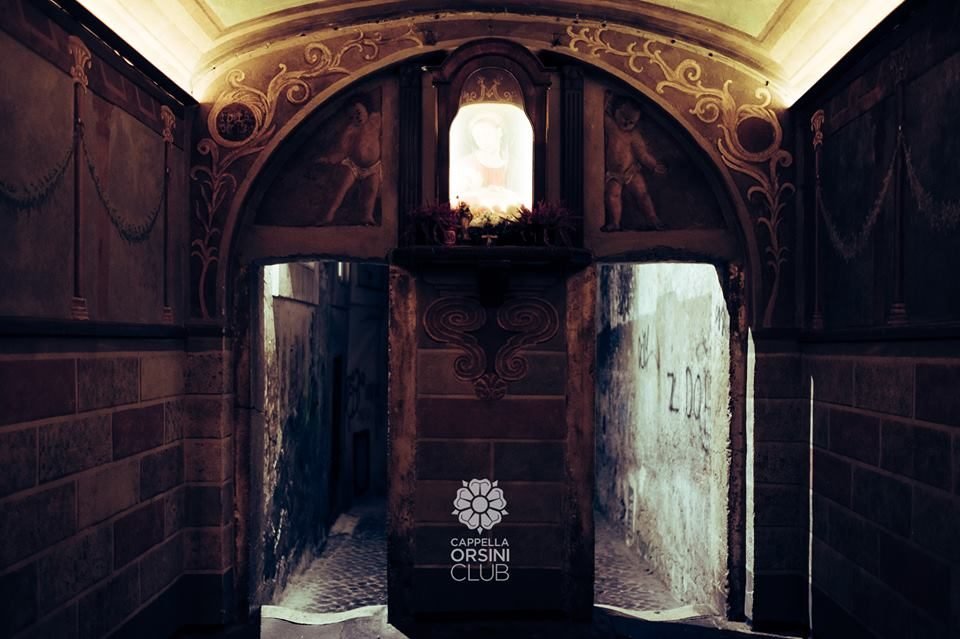
There are addresses in Rome that explain themselves and addresses that have to be read the way you read an archaeological stratigraphy, from the bottom up. Via di Grotta Pinta 21 undoubtedly belongs to the second category. Here, on a little street that curves as if someone had bent it with their hands, opens the restrained facade of Cappella Orsini: a former church dedicated to the Virgin, set inside the cavea of a Roman theater of the 1st century BC, renamed with the surname of one of the most powerful families in European history, deconsecrated, forgotten, used as a warehouse and finally given back to the city as a cultural space, where today exhibitions, concerts, presentations, DJ sets and private parties are held. Four layers behind a single doorway. I don't know many places in the city that manage to do as much in less than 200 square meters.
In Rome the places that work best are not the biggest ones, but the densest ones: where every square meter tells you something you did not expect. Cappella Orsini is one of them. You get there almost by chance, often passing under a covered arch that comes out of Piazza del Biscione, and you find yourself on a street with the exact shape of a theater hemicycle, because no urban planner invented that shape: it was inherited. Under the buildings you see standing there are the radial substructures of the Theater of Pompey, and the street follows the line of that masonry docilely, the way a river follows a valley.
Here is everything you need to know about Cappella Orsini: the history of the church, that of the theater that hosts it in spite of itself, the family that gave it its name, the centuries of abandonment, the contemporary rebirth, the neighborhood around it and the practical tips for anyone asking "tomorrow night I'm going to an event at Cappella Orsini, what do I need to know?". It will be long. But this is one of those places where the length is justified: if you go knowing only that it is "a venue in Campo de’ Fiori", you miss 90 percent of what is under your feet.
Cappella Orsini: a church inside a Roman theater
What exactly Cappella Orsini is
Let's start from the definition, because the name confuses, and rightly so. Cappella Orsini is the name by which Rome knows the former church of Santa Maria in Grottapinta, a place of worship whose existence is documented at least from the end of the 12th century, today deconsecrated and turned into a cultural center and event space. It is not a chapel in the technical sense of the term, that is, a minor space inside a larger church: it is an autonomous church, which also had parish status, and which took the nickname "Cappella Orsini" from the fact that it was under the patronage rights of the Orsini family and was rebuilt at their expense at the end of the 16th century.
This is the point to clear up right away, because there are several chapels linked to the Orsini in Italy and the risk of confusion is very high. There is the Orsini family chapel in Santa Maria sopra Minerva, there is the Monte Savello complex where the Orsini settled on the Theater of Marcellus, there are the foundations in their fiefs of Bracciano and Bomarzo. The one we are talking about here is something else again: it is the family church of the Roman branch that had its own headquarters on the ruins of the Theater of Pompey, between Campo de’ Fiori and Via dei Giubbonari. The address, Via di Grotta Pinta 21, leaves no room for doubt.
Today the building hosts a study center and a series of multipurpose spaces used for exhibitions, courses, conferences, concerts, shows and evenings. It is one of those places that Romans know for completely different reasons: some have been there for an exhibition, some for a wedding, some for a book presentation and some to dance until three in the morning. They are all right. It is the same nave.
Why the name Cappella Orsini outlived the church
I find it fascinating that the official name, Santa Maria in Grottapinta, is today known almost only to scholars and enthusiasts of Roman topography, while the heraldic nickname won out without appeal. It happened because the family name was stronger than the Marian title: the Orsini were everywhere, in this quadrant of Rome, and their surname worked as signage. Saying "the Cappella Orsini" meant saying "the one of the Orsini, under the palace, inside the arch".
There is also a more prosaic reason. When the parish was suppressed in the 19th century and the building lost its autonomous liturgical function, the Marian title stopped being pronounced regularly by anyone. The family name, on the other hand, remained carved in the pediment of the facade and repeated in the memory of the neighborhood. Stones speak longer than parish registers.
The result is that today, if you ask in the area where Santa Maria in Grottapinta is, you risk a few puzzled looks. If you ask where Cappella Orsini is, they point you to the arch. Which says something deep about how urban memory works: the name that helps you find your way survives, not the one that was used for praying.
Where Cappella Orsini is and why the street is curved
The address and the rione
Cappella Orsini is at Via di Grotta Pinta 21, in the rione of Parione, a few dozen meters from Campo de’ Fiori and a quarter of an hour's walk from Piazza Navona. We are in the absolute heart of Renaissance and Baroque Rome, in a web of streets that over the centuries has hosted merchants, craftsmen, innkeepers, Florentine bankers, printers and an industrial quantity of priests. The area has kept a real residential density: it is not a museum-ified neighborhood, people live here, there is laundry hanging and badly parked scooters.
The street is short, little more than an arc of a circle between Via dei Chiavari, Piazza del Biscione and Via del Paradiso. You walk it in two minutes going slowly. But it is precisely that curve that tells the whole story: that layout is an urban fossil, not a medieval oddity. Via di Grotta Pinta follows with remarkable precision the inner course of the cavea of the Theater of Pompey, the first permanent masonry theater ever built in Rome.
The curve that no urban planner drew
It is worth doing a simple experiment. Stop halfway down the street, stand in the middle of the roadway when no one is passing and look right and left. You will see that the buildings draw an almost perfect semicircle, with a wide, regular radius. Now imagine removing the plaster, the doors, the signs, the 19th-century cornices, and replacing them with stone steps that climb upward for about 30 meters. There: you are standing in the orchestra of a Roman theater that hosted tens of thousands of spectators.
The houses you see were not built next to the theater. They were built inside the theater, using as foundations the radial walls that held up the seating. In the cellars and basements of this block there still emerge today stretches of opus reticulatum, that masonry of rhomboid meshes the Romans used as facing, and the access wedges that led the public to the different sectors. The medieval urban fabric did not erase the ancient: it filled it, like a pour that takes the shape of the mold.
This is the reason why at Cappella Orsini it is not worth starting from the door. Let's start from the middle of the street, 10 minutes earlier, looking at a curve. Because once you have seen it you cannot stop seeing it, and from that moment the whole rest of the neighborhood starts talking.
The relationship with Campo de’ Fiori
Campo de’ Fiori is less than 100 meters away. It is the loudest place in the area, with the market in the morning and the bars in the evening, and the hooded statue of Giordano Bruno watching over everything with a not very amused expression. Cappella Orsini is just behind, in a pocket of relative silence reached by crossing the covered arch called the Passetto del Biscione.
The jump in acoustic temperature is one of the reasons the area works so well. You go from a square where everyone talks at once in six different languages to a street where you hear your own steps. 30 seconds. It is one of those contrasts that in Rome are free and that nobody points out to you, because they are so common they seem normal.
I add an orientation note that helps a lot: from Campo de’ Fiori, with your back to the Giordano Bruno monument and the market on your right, take Via del Biscione. 30 steps and you are in Piazza del Biscione. On the left you will see a low arch with a gate. That is the Passetto. Go through it, and you are on Via di Grotta Pinta. Cappella Orsini is right there, on the curve.
How to get to Cappella Orsini
On foot, which is the right way
Cappella Orsini sits in an area where the car is a problem and not a solution. The historic center of Rome is a limited traffic zone for much of the day, the streets around Campo de’ Fiori are very narrow and parking spaces are a mirage. The correct answer to the question "how do I get there?" is almost always: on foot, after getting close by public transport.
From Piazza Navona it is just under 10 minutes: you cross Corso Vittorio Emanuele II at Sant’Andrea della Valle, take Via dei Chiavari or Via del Paradiso and come out on the curve. From Largo di Torre Argentina, 12 minutes going by Via dei Barbieri and Via dei Giubbonari, that is, along the outer perimeter of the ancient theater, which makes the walk educational as well as comfortable. From the Ghetto and from Via Arenula it is a good eight minutes. From the Pantheon, a quarter of an hour.
Buses and trams
The most useful surface corridor is Corso Vittorio Emanuele II, served by many city lines that connect the Vatican, Termini station, the Tridente and Trastevere. The most convenient stop for Cappella Orsini is Sant’Andrea della Valle or the one on Corso Vittorio at Largo Argentina. From both you get there walking five to eight minutes. Largo di Torre Argentina is also the nearest tram hub, with the lines that go down toward Trastevere and toward the Portuense district.
Metro
The metro does not help much, and it is right to say so frankly. None of the existing lines directly serves the quadrant between Campo de’ Fiori and Piazza Navona, which remains the part of the historic center most "uncovered" by the underground network. The stations usable with a bit of walking are Colosseo and Circo Massimo on line B, or Spagna and Barberini on line A, but in all cases these are walks of between 20 and 25 minutes. Better the bus, or better still your own legs.
If you arrive from Termini station with luggage and need to reach a place to stay in the area, the calmest solution is a taxi or a booked transfer that drops you at Largo Argentina or on Corso Vittorio: inside the web of alleys around Cappella Orsini cars physically struggle to turn.
The Passetto del Biscione as a service door
Then there is the access I prefer, and which is in every respect the historic entrance: the Passetto del Biscione, the short covered, vaulted passage that connects Piazza del Biscione to Via di Grotta Pinta. It is not just any shortcut. It is the remnant of one of the corridors that in antiquity connected the inside of the cavea of the Theater of Pompey with the outside. Put differently, it is a gate that Roman spectators used 2,000 years ago for the exact same reason you use it today: to enter and leave the place of the show.
Going through it to attend a concert at Cappella Orsini is one of those small coincidences that make Rome unbearably beautiful. You do the same thing they did, in the same spot, for the same reason. You don't need a guide to appreciate it. You only need someone to tell you beforehand, otherwise you walk under an arch and think you took a shortcut.
The Theater of Pompey under Cappella Orsini
Who Pompey was and why he wanted a theater
Gnaeus Pompeius Magnus is one of those figures history has somewhat crushed under the weight of his rival. We remember Caesar, and Pompey remains the general who lost at Pharsalus. But for an entire generation, in Rome, Pompey was simply the most famous man in the Republic: he had cleared the Mediterranean of pirates in a lightning campaign, had ended the Mithridatic wars, had reorganized the Roman East by redrawing provinces and client kingdoms, and in 61 BC had celebrated his third triumph, an event that contemporaries described as immense.
A man like that has a problem that moderns know very well: how to turn prestige into lasting memory. The Roman answer was public architecture. Pompey chose to give the city what Rome did not yet have: a permanent masonry theater, with stable seating, an attached portico, gardens, fountains and collections of statues. An urban leisure complex on a scale never seen, financed with the booty of the eastern campaigns.
The ban and the trick
There was an obstacle, and not a small one. Republican tradition looked with suspicion on permanent theaters: it was feared that a seated, comfortable audience, gathered regularly, would become a political body. For centuries in Rome theaters had been built of wood, assembled for the festivals and taken down right afterward, with a frequency that seems absurd to us today and was in fact the norm. The Senate had more than once had permanent structures demolished as soon as they were begun.
Pompey got around the obstacle with a solution I find brilliant in its brazenness. At the top of the cavea, at the highest point, he had a temple built dedicated to Venus Victrix, that is, to the goddess of victory under whose protection his family claimed to be. And he declared that the seating was not seating: it was the monumental access stairway to the temple. So not a theater with a temple on top, but a temple with a particularly comfortable stairway, from which by pure coincidence you could see the stage very well.
Nobody really believed it, but nobody could object formally. It is one of those moments when Roman history resembles contemporary administrative law: you respect the letter of the rule and do exactly what the rule wanted to prevent. The temple, by the way, was real and functioning, with sacrifices and regular worship. Which makes the operation even more elegant.
The size of the colossus
The numbers help to understand what we are talking about. The cavea had an outer diameter of about 150 meters. For comparison, the Colosseum, built more than a century later, measures on its major axis just under 190 meters. Modern estimates of the capacity vary, and are more cautious than the ancient catalogs, notoriously generous: the common figure is something on the order of 17,000 spectators, while late antique sources reached much higher figures that archaeologists consider inflated.
The complex did not end with the cavea. Behind the stage stretched an enormous quadriporticus with granite columns, gardens, plane trees, fountains, Greek works of art brought from the East: a place where Romans strolled, met, did business and took shelter from the rain. The quadriporticus reached the sacred area of today's Largo di Torre Argentina. In practice, the entire urban sector between Campo de’ Fiori and Largo Argentina was a single, gigantic Pompeian project.
Cappella Orsini sits in the concave part of this organism, inside the hemicycle, just below the point where the temple of Venus Victrix stood. It is not a random position, as we will see: some read in the location of the church a symbolic replacement, the Christian Virgin installed exactly where the pagan goddess of victory stood. It is a hypothesis with no documentary support and should be taken for what it is, a hypothesis. But the topographic fact remains, and it is impressive.
Fires, restorations and Nero's gilding
A building this large, in a city that burned regularly, had an eventful life. The theater suffered fires in AD 22 and AD 80, and again in the late imperial period, and was restored repeatedly for at least five centuries: the documented interventions go up to the 5th century, which means the Theater of Pompey functioned, in some form, for over 500 years.
Then there is the episode I prefer, because it has the flavor of the great imperial excesses. When the Armenian king Tiridates came to Rome to receive the crown from Nero, the emperor wanted to make an impression and ordered the entire theater to be gilded. Not a part: all of it. And to be done in a single day. The ancient sources tell the operation with a mix of amazement and disapproval, which is more or less the attitude we still have toward Nero.
When you walk down Via di Grotta Pinta, in short, you are not walking inside just any ruin. You are walking inside a building that for half a millennium was one of the busiest places in the capital of the world, and that once, for one evening, was entirely gold.
The Ides of March and the topographic mistake almost everyone makes
Where Caesar really died
Around here the question always comes: "so Caesar was killed here?". The honest answer is: near here, but not here. And the distinction deserves to be made properly, because it is one of those cases where precision makes the story more interesting, not less.
On March 15, 44 BC the Senate was not meeting in the Curia of the Forum, which was being rebuilt. It was meeting in a hall of the Pompeian complex, the Curia Pompeia, which was at the eastern end of the great quadriporticus, on the side of today's Largo di Torre Argentina. That is where Caesar was struck, and that is where, according to the sources, he fell at the foot of the monumental statue of Pompey, his old ally and then defeated rival: a detail so theatrical it seems invented, and yet reported by the ancients with insistence.
From Cappella Orsini to that point it is about 300 meters as the crow flies. Which means Caesar died in the same architectural complex where you are standing, but on the other side, beyond the stage and beyond the gardens. It is like saying that something happened in the opposite wing of a large public building: same address, different room.
The cursed place
What happened afterward is even more interesting and is rarely told. The exact spot of the assassination was considered a locus sceleratus, a place contaminated by the crime, and was walled up by the will of Augustus. Not demolished, not celebrated: closed. The Romans had a very concrete relationship with the ritual contamination of space, and the institutional reaction to a political sacrilege was to physically seal the place where it had happened.
Archaeological investigations in the sacred area of Largo Argentina have identified a structure that has been linked precisely to this Augustan closure. It is a debated identification, like almost everything in this field, but it gives the measure of how much Roman topography remains an open building site: we are not talking about questions settled in the 19th century, but about active debates.
Why am I telling you all this in a profile of Cappella Orsini? Because the way you perceive a place depends on how much you know about it. If you enter Cappella Orsini knowing you are inside the cavea of a theater whose portico hosted the most famous political murder in Western history, the evening changes. Not in the sense that it spoils the party: in the sense that it adds a backdrop. And the backdrop, in Rome, is almost always the best part.
Why it is called Grottapinta
The grottoes that were not grottoes
The place name "Grottapinta", that is, "painted grotto", is one of the most elegant in the historic center and tells of a way of seeing the world that we have lost today. In medieval Latin and in the Roman vernacular, "grotta" did not mean only a natural cavity: it meant any dark, vaulted, semi-underground space. And since the great Roman buildings, once buried by debris and stripped of their roofs, looked exactly like that, the Romans of the Middle Ages and the Renaissance called ancient ruins "grotte".
From here also comes the word "grotesque", which has perhaps one of the most beautiful etymologies in the language. When at the end of the 15th century people went down to explore the buried rooms of Nero's Domus Aurea, the artists found the walls decorated with those fantasies of little monsters, vines and hybrid figures that they immediately imitated. Since those rooms looked like grottoes, the decorative repertoire was called "grottesche". The Italian language has a word meaning "bizarre, deformed" because some Renaissance painters lowered themselves on ropes into a buried imperial palace.
The painted grotto of this block
In our specific case, the "painted grotto" is in all likelihood the vaulted, frescoed space that connects Piazza del Biscione to Via di Grotta Pinta, that is, the Passetto: a dark, covered corridor, decorated with putti, festoons and fake architecture, that anyone of the time would have described without hesitation as "a painted grotto". The name of the passage then extended to the street, and from the street went back to the church, which in fact is called Santa Maria in Grottapinta.
There is a second tradition, which I report because it circulates and because it is pretty: the name would derive from the discovery of an image of the Madonna in a cavity in the stone. There is nothing to support it, and it is likely an explanation constructed after the fact, as often happens with the origins of devotional place names. The first hypothesis, that of the frescoed arch, is by far the most solid.
A curious note on toponymy: in the Middle Ages the church was also known as San Salvatore in Arco, again in reference to the same arch. Which means this building changed its name at least three times in 800 years, and each time the new name came from a detail of the context: the arch, the fresco, the family. None of these names describes the church itself. All of them describe what is around it. I find it a perfect metaphor for this place.
The first records of the church of Cappella Orsini
1186 and the bull of Urban III
The oldest certain date we have for the building we call Cappella Orsini today is February 14, 1186, when Pope Urban III with a bull affiliated it to the basilica of San Lorenzo in Damaso, which is a few hundred meters away, today absorbed into the Palazzo della Cancelleria. Mind the verb: "affiliated". Not "founded", not "consecrated". The document presupposes that the church already existed, and places it in an administrative dependency.
This is how the dating of minor Roman churches almost always works. We do not have the birth certificate, we have the first document in which they already appear grown up. The building, then, predates 1186, but by how much we do not know. The 12th century is in any case a plausible era for a small neighborhood church settled in the ruins, and the fabric of the area in those decades was already densely built.
I want to stress that we are talking about a church existing in an era when the Colosseum was a fortress of the Frangipane, the Theater of Marcellus a castle of the Pierleoni and then of the Savelli, the Mausoleum of Augustus a bulwark of the Colonna. Rome, in the 12th century, was a city of armed families camped inside the imperial ruins. Cappella Orsini was born exactly in that world.
An icon that ended up elsewhere
The church was linked to an ancient Marian image, the so-called Madonna di Grottapinta, traditionally attributed to the hand of Saint Luke, as happened with a great many venerated Roman icons. Modern criticism dates it to the end of the 12th century, which still makes it a piece of great standing. The image was transferred to the basilica of San Lorenzo in Damaso during the 15th century, and is kept there.
The most surprising detail concerns the restorations: in the body of the panel a small circular cavity was found, at chest height, which contained relics. It is a documented practice, that of turning a sacred image into a reliquary, but seeing it applied to a painted panel has something moving about it. The icon also worked as a container, in addition to representing a sacred figure.
On the high altar of the church, after the transfer of the original, a copy was placed. It is a story that repeats often in Roman religious history: the venerated image rises in rank and moves to a more important basilica, and the substitute stays in the church of origin. Whoever goes there to pray, usually, does not notice the difference. It is the cult that counts, not the support.
The Orsini take possession of the theater
Buying a ruin, building a fortress on it
The decisive step in the history of Cappella Orsini comes when the Orsini family gets its hands on the area of the Theater of Pompey. Scholarly tradition places the purchase of the site around the middle of the 12th century, and from that moment on the great hemicycle becomes, in effect, a private neighborhood: the Orsini fortify it, live in it, put towers there, exercise jurisdiction there, protect their clients there.
We have to get rid of the modern idea of "archaeological ruin". For a Roman baron of the 13th century, the Theater of Pompey was an enormous, very solid masonry structure, already equipped with corridors, stairs, vaulted rooms and a closed, defensible plan. Protecting it as a monument was not a thought that was available. It was, in military terms, a castle already built that was only waiting for someone to put a barred door on it. The Orsini did exactly that, as the Savelli had done on the Theater of Marcellus and the Frangipane on the Colosseum.
The sources record restoration and reorganization work on the complex in 1291 and 1343, and in 1296 the construction of a clock tower that became a local landmark to the point that the whole palace was known for centuries as the "Clock Palace". In the 13th century a tower with a clock counts as a political statement, well beyond decor. Whoever controls the measure of public time controls the neighborhood.
The palace that is called Pio Righetti today
The large palace that looms over Piazza del Biscione, and that is set against the side of Cappella Orsini, is the direct descendant of that fortress. Today it is called Palazzo Orsini Pio Righetti, a triple name that is in itself a summary of property history: first the Orsini, then the Pio di Savoia, finally the Righetti.
The structure was deeply renovated around the middle of the 15th century, when Cardinal Francesco Condulmer, nephew of Pope Eugene IV, also came into play. Then, toward the middle of the 17th century, it received the Baroque dress that still defines its facade today, in a building campaign that the sources link to the architect Camillo Arcucci. The result is that compact, severe volume that closes the square, with framed windows and a portal that seems to look down at you. It is not a friendly palace. It is a palace that wants to remind you who was in charge.
The physical relationship between the palace and the church is that of a single organism, not of two buildings simply placed side by side. Cappella Orsini is the private church of that palace, set against its side, reachable through the building fabric. It is the same logic as palatine chapels, applied at an urban scale and without too much ceremony.
The temple, the church and the replacement
Let's go back for a moment to ancient topography, because there is a detail that deserves attention. Cappella Orsini sits at the center of the curve of the cavea, that is, on the axis of the theater, exactly below the position where the temple of Venus Victrix stood. Some scholars have read in this placement a deliberate replacement: the Christian Virgin installed on the sacred axis of the pagan sanctuary of victory.
These are hypotheses to be handled with caution. The continuity of places of worship is a real and well-documented phenomenon in Rome, but it is also a seductive idea that easily leads you to see designs where there is only building convenience: you build where there are solid walls and free space. That said, the coincidence is there, and it is one of those that stay in the mind.
What can be stated without hesitation is a more modest and more concrete fact: the shape of the present building is conditioned by the shape of the theater. The church is narrow and elongated because it settled in a space already designed 2,000 years ago. It is the ancient architecture that dictates the plan of Cappella Orsini: the church follows the walls it found.
Who the Orsini were who give their name to Cappella Orsini
The sons of the she-bear
The Orsini are one of the longest-lived and most powerful families in all of European history. The surname comes from the medieval form "de filiis Ursi", the sons of Orso, and in turn the branch has its roots in the Roman family of the Bobone, documented from the 10th century. The genealogical legend cultivated by the family went back much further, with that ease with which great houses constructed mythical ancestors: it was an exercise in propaganda, not history, and served to establish precedence over rivals.
Their power had three legs. The first was territorial: castles and fiefs arranged in a crown around Rome, from Lake Bracciano to the Maremma, and farther off in the Kingdom of Naples, where they obtained principalities and duchies. The second was ecclesiastical: an impressive output of cardinals and, as we will see, three popes. The third was military: for generations the Orsini were one of the great families of Italian condottieri, with armies of their own hired out to whoever paid best.
Among the main branches are those of Bracciano, Pitigliano, Gravina and Monte Savello. Some died out, like the Pitigliano in the 17th century. Others continue. The Gravina branch is the one that carried the name down to the contemporary age. It is a family that crossed a thousand years of Italian history while remaining, in some form, always in the room where something was being decided.
The coat of arms, the rose and the eel
Whoever enters Cappella Orsini would do well to look up first, at the facade, because the pediment bears the family coat of arms. The Orsini arms are of the kind recognizable even from afar: a field bendy of silver and red, with a rose and an eel. The bear, which the surname would suggest as a natural figure, appears in some variants and in many decorative contexts as a canting emblem, that is, as a visual pun on the name.
The eel of the coat of arms is probably at the origin of the name of the square next door, Piazza del Biscione: the heraldic "biscia" of the Orsini would have given its name to the place, and from there to the covered passage we now call the Passetto del Biscione. It should be said that an alternative explanation also circulates, linking the biscione to the Visconti serpent that arrived in the area with other families that owned the palace. Both versions have supporters. The first is the more widespread in local tradition.
Three Orsini popes
Three members of the family rose to the papal throne, and all three deserve a line. The first was Celestine III, born Giacinto Bobone, elected in 1191 and dead in 1198: an old cardinal elected at almost 90, who governed for seven years in a period of very harsh conflict with the empire and who had the historiographical bad luck of standing between two giants like Clement III and Innocent III.
The second was Nicholas III, Giovanni Gaetano Orsini, pope from 1277 to 1280. He is the pontiff who enormously strengthened the family's position in Rome and in the Patrimonio, with a policy of nepotism as effective as it was shameless. Dante put him in Hell among the simoniacs, upside down in a hole with his feet burning, and had him deliver one of the fiercest self-mockeries of the Commedia: he calls himself a "son of the she-bear", eager to raise up the "cubs", that is, the nephews. Eight centuries later, that line remains the most effective portrait of the Orsini family politics.
The third was Benedict XIII, Pietro Francesco Orsini, pope from 1724 to 1730: a Dominican, personally austere to the point of asceticism, and for that very reason very poorly equipped to control his own court, which was overwhelmed by one of the most resounding scandals of corruption of the century. It was he who proclaimed the jubilee of 1725, and the date is no accident for our story: as we will see, in that very year the altars of Cappella Orsini were renewed.
Orsini against Colonna: the feud that shaped Rome
Two families, one city
You cannot understand Cappella Orsini unless you understand against whom it was fortified. For about three centuries, from the 13th to the 16th, the history of Rome is largely the history of the rivalry between the Orsini and the Colonna. It was not a matter of personal antipathy, but of a territorial division in arms: the Colonna dominated the eastern and southern sector, with Palestrina, Genazzano, the Castelli and, in the city, the area toward the Quirinal and Santi Apostoli. The Orsini held the northern and western sector, with Bracciano, Monterotondo and, in the city, Monte Giordano, the Theater of Pompey and later Monte Savello.
The city was divided into zones of influence like a military map. Crossing the wrong neighborhood in the wrong livery could cost you dearly. The families kept private militias, towers, urban fortresses and networks of clients that included craftsmen, notaries, merchants and priests. Every papal election was also a match between the two camps, and more than one conclave was decided on the edge of this balance.
On top of all this was grafted an inherited ideology: the Orsini were traditionally Guelph, that is, pro-papal, the Colonna tendentially Ghibelline, that is, pro-imperial. But it would be naive to take these labels literally. In practice, the side was chosen according to the opponent: if the Colonna supported a pope, the Orsini found excellent theological reasons to oppose him, and vice versa.
Wars, peaces and settling of scores
The feud went through spectacular moments. There were devastations of fiefs, sieges of castles, ambushes, mutual excommunications, alliances with foreign powers. Popes belonging to one of the two houses seized the chance to go after the other. Popes outside both tried, with mixed fortunes, to impose arbitration. There were solemn peaces, sworn before the pontiff, that lasted as long as it took to get home.
The most famous was the one signed at the beginning of the 16th century under pressure from Julius II, a pope who had a particular allergy to unruly barons and the means to enforce it. It was an important truce, which symbolically marked the end of the era in which two families could hold the capital of Christendom hostage. Power was shifting: from the barons to the centralizing papacy, and from the urban towers to the palaces of representation.
Cappella Orsini belongs to this world in transition. When the Orsini rebuild it at the end of the 16th century, they no longer do it as warlords marking territory, but as great aristocrats displaying devotion, taste and dynastic continuity. The church is not a tower. It is a business card.
A surname that travels around Europe
The surname Orsini circulated a great deal outside Rome. Clarice Orsini married Lorenzo de’ Medici in 1469, the man who would go down in history as the Magnificent: a marriage that brought to mercantile Florence the prestige of Roman baronial blood and that gave Lorenzo entry into an aristocratic circuit that the Medici, technically bankers, did not have.
A generation later, the Orsini found themselves dealing with the Borgia, in a tangle of alliances and betrayals that ended in the classic way for the era, that is, badly for the Orsini. And in the heart of the 16th century the house was the protagonist of one of the darkest episodes in Italian aristocratic crime chronicles, that of Paolo Giordano I Orsini, Duke of Bracciano, and his wife Isabella de’ Medici, who died in 1576 in circumstances that contemporaries judged, with remarkable understatement, "sudden".
I tell you these stories not out of a taste for 16th-century gossip, but because the son of that couple, Virginio Orsini, is precisely the man who in 1599 had the church on Via di Grotta Pinta rebuilt. The name "Cappella Orsini" comes from him. And his biography, as you will see, holds a surprise you do not expect.
Vicino Orsini and the Sacro Bosco: the other face of the family
A condottiero who stops fighting
Before getting to Virginio, allow me a digression on another Orsini, because without him the portrait of the family would remain incomplete and it would be unfair. Pier Francesco Orsini, called Vicino, born in 1523 and dead in 1585, was lord of Bomarzo, in northern Lazio. He did the family trade, that is, condottiero, took part in the wars of his time, knew imprisonment. Then, back in his fief, he did something nobody expected.
He devoted the last decades of his life to having carved, in the wood below the town, a set of colossal figures cut directly from the outcropping boulders of peperino: monsters, dragons, war elephants, a giant tortoise, an orco with a gaping mouth that you can walk through, a house built deliberately out of square that throws off the balance of whoever enters. It is the Sacro Bosco of Bomarzo, the "Park of the Monsters", one of the most enigmatic places of the European Renaissance.
It is not a garden in the current sense. There are no symmetries, perspective axes, geometries of a 16th-century villa. There is an irregular route, scattered with cryptic inscriptions and figures that follow no iconographic program recognized with certainty. One of the inscriptions declares that the work was made "sol per sfogare il core", only to vent the heart. It is one of the most modern phrases the 16th century has left us.
Why Bomarzo concerns Cappella Orsini too
You will wonder what a wood 70 kilometers from Rome has to do with a former church behind Campo de’ Fiori. It matters because it tells the same family from a different and necessary angle. The Orsini were not only warriors and nepotists: they were also cultured, experimental patrons, at times openly eccentric. The same house that produced Dante's pope of the simoniacs produced a lord who had an orco carved in the woods because his heart was in disorder.
The Sacro Bosco was then forgotten for centuries, buried by vegetation, and rediscovered in the 20th century. Salvador Dalí went there in 1948 and was struck by it, and since then Bomarzo has become a fixture in the itineraries of those who care about surrealism and visionary art. It has inspired novels and an opera. To date, nobody has provided a decipherment of the iconographic program that satisfies everyone.
When you enter Cappella Orsini and find a deconsecrated former church used for contemporary art exhibitions, concerts and installations, I suggest you think of Vicino Orsini. There is a family consistency in this attitude of taking a codified space and using it for something else. I don't know if it is a coincidence. You tend to think not.
1343 and the confraternity: Cappella Orsini becomes a place of assistance
The 14th-century reconsecration
The 14th century brings an important step. The sources record for 1343 a reconsecration of the church, with a Marian dedication tied to the theme of the Immaculate Conception, and its entrusting to a confraternity that looked after the poor. It is a year that also appears in the work on the Orsini complex, which suggests a broader building campaign, of which the church was a part.
Confraternities are one of the most underrated aspects of Roman history. They were associations of laypeople, often organized by trade or geographic origin, that dealt with devotion but above all with welfare: dowries for poor girls, care for the sick, burial of the dead without family, ransom of prisoners, accompaniment of the condemned to death. In a city without public services, they were the social safety net.
Entrusting a church to a confraternity therefore meant turning it into a service center as well as a place of worship. At Cappella Orsini, in the 14th century, Mass was said and people knocked to ask for help: it was an address known to those in difficulty. I find that this vocation, which will return strongly in the 19th century, is one of the most interesting keys to reading the building.
The parish church of the 16th century
In the course of the 16th century the situation consolidates: in a list of Roman churches of 1566 Santa Maria in Grottapinta appears as a parish church. That means it had its own territory, a parish priest, registers of baptisms, marriages and deaths, and responsibility for the souls of a certain number of families in the neighborhood.
You have to imagine a Rome with a number of parishes enormously higher than today's, and tiny in size. In the historic center there were parishes that counted a few dozen hearths, that is, a few dozen families, and they barely survived on the income from bequests and alms. This fragmentation would create, in the following centuries, a serious economic problem, which we will see explode in the 19th century.
In the meantime, however, having a parish under one's patronage was for a baronial family a matter of considerable prestige. It meant having a voice in the appointment of the parish priest, in the management of property, in decisions about the building. Cappella Orsini was, in the full sense, the church of the Orsini: from the pediment to the registers.
1599 of Virginio Orsini: the year Cappella Orsini is born
The building site that flips the church
We arrive at the crucial date. In 1599 Virginio Orsini, Duke of Bracciano, promotes a complete reconstruction of the church. It is the intervention that gives the building the appearance we still recognize today and that definitively earns it the nickname Cappella Orsini. The family coat of arms appears on the facade. The interior layout is deeply revised.
The most technically notable detail of that building campaign is the flipping of the orientation: the entrance and the altar swap places. It is an operation that seems minor and is in fact radical, because it completely changes the way you enter, look and pray. Flipping a church means redefining its relationship with the street. And the street, in this case, was Via di Grotta Pinta, that is, the front controlled by the Orsini.
The result is an interior with a simple rectangular plan, with the presbytery separated from the nave by a triumphal arch, and a facade of two orders marked by Ionic pilasters and separated by a cornice, with a lunette window in the upper order and a small bell gable on the right. The facade you see today bears the signs of 19th-century touch-ups, but the layout is the original one. It is restrained neighborhood architecture: it does not seek astonishment, it seeks decorum.
What year 1599 was in Rome
To understand the context it is useful to look at what was happening a few hundred meters away. Rome was preparing for the jubilee of 1600, the great holy year of Clement VIII, and the city was a permanent building site: churches were restored, streets opened, fountains and hospices put in order to receive the pilgrims expected in the hundreds of thousands. Rebuilding the family church in 1599 meant showing up in order for the appointment.
It was also the year of the trial and execution of Beatrice Cenci, the judicial affair that shook the Rome of the time and would become literary material for Shelley, Stendhal and half of Romantic Europe. And the following year, on February 17, 1600, less than 100 meters from Cappella Orsini, in Campo de’ Fiori, Giordano Bruno would be burned alive.
Put these three things together and you have the temperature of the neighborhood at the end of the 16th century: a city in full Counter-Reformation revival, magnificent and ferocious, where new facades were built and stakes were lit in the same square. Cappella Orsini was born, as a name and as a modern building, exactly at that moment.
Virginio Orsini in London and Shakespeare's Duke Orsino
The trip of 1600
And here comes the story that makes everyone raise their eyebrows. Virginio Orsini, second Duke of Bracciano, born on September 11, 1572 and died on September 9, 1615, son of Paolo Giordano I and Isabella de’ Medici, married since 1589 to Flavia Peretti, niece of Pope Sixtus V, and father of 12 children, in December 1600 was in London, a guest of the court of Elizabeth I during the Christmas festivities.
A Catholic Italian aristocrat at the court of the Protestant queen of England was no trivial matter, and it is a useful reminder of how much more fluid the diplomatic and social networks of the era were than our simplifications. The chronicles say that the queen, then over 60 years old, wanted to dance a galliard in front of the guest to show the vigor of her old age. It is the kind of detail worth an entire treatise of political history: Elizabeth used her own body as an instrument of propaganda to the very end.
"If music be the food of love"
The best part is yet to come. An authoritative critical tradition, argued at length in a famous 20th-century study, links the visit of Virginio Orsini to the first performance of William Shakespeare's Twelfth Night, the comedy that opens with the line "If music be the food of love, play on", if music is the food of love, keep playing. That line is spoken by a character called Duke Orsino.
The hypothesis is that Shakespeare named his duke after the illustrious guest present in the hall, according to a practice of courtly homage that was completely normal in Elizabethan theater. It is not a documentary certainty and must be presented as what it is, that is, a well-founded reading but one debated by specialists. But it is verifiable that Virginio Orsini was at court in those weeks, and it is verifiable that the duke of the comedy is called Orsino.
The result is a coincidence I find simply perfect. The same man who in 1599 has a church rebuilt inside the cavea of the first permanent theater of Rome is, a year later, sitting in a London theater perhaps hearing his own name given to a character. The patron of Cappella Orsini is, in all likelihood, the man who lent his name to one of the most famous roles in world theatrical repertoire. Theater below, theater above. If someone wrote it in a novel, they would be told they had overdone it.
The 18th century of Cappella Orsini: the altars of 1725
A family pope and a holy year
In 1724 Pietro Francesco Orsini rose to the papal throne with the name Benedict XIII. He was a Dominican of almost monastic rigor, who kept living like a friar even as pope, and who took up liturgy and pastoral visits more willingly than international politics. He proclaimed the holy year of 1725, and Rome again filled with pilgrims and building sites.
In 1725 itself the high altar of Cappella Orsini was reconsecrated and two new side altars were made, dedicated one to Saint John the Baptist, the other to the Most Holy Crucifix. Further arrangements are recorded in 1728. It is not hard to read in this sequence the combination of two pushes: the jubilee occasion, which required churches to be presented in order, and the not negligible fact that an Orsini sat on the throne of Peter.
The two altarpieces that adorned the side altars are attributed by the sources to Giovanni Antonio Valtellina, author of the Crucifix on the left altar, and to Francesco Alessandrini, author of the Saint John the Baptist on the right altar. They are not first-rank names in the panorama of Roman painting, and for that very reason they tell well what a neighborhood church was: a dignified, well-kept place, served by professional artists of good level, with no pretension to masterpiece.
A small apsed baptistery
From the 18th century also dates an apsed baptismal space that projects from the left side of the building. It is a detail I always notice, because it is the kind of functional addition that reveals a living church: you build a baptistery when there are children to baptize, that is, when the parish works and the population of the rione grows.
The Passetto del Biscione, the secret entrance to Cappella Orsini
What it is, exactly
The Passetto del Biscione is a short covered, vaulted passage that connects Piazza del Biscione with Via di Grotta Pinta, passing under the building mass attached to Palazzo Orsini Pio Righetti. You cross it in about 10 seconds, and in most cases you notice nothing if no one has told you to look up.
Historically, the passage corresponds to one of the connections between the inside and the outside of the cavea of the Theater of Pompey: it is an ancient gateway reused, not a medieval alley dug by chance. In archaeological terms it can be considered the most legible functional trace of the theater in today's street network, together with the curve of the road. It is also, in all likelihood, the "painted grotto" that gave its name to all the rest.
The Madonna of Scipione Pulzone
In the passage in 1594 was placed a panel by Scipione Pulzone depicting the Madonna della Divina Provvidenza. Pulzone, born in Gaeta and active in Rome in the second half of the 16th century, is one of the most refined portraitists of his generation and a devotional painter of great delicacy, exactly the type of artist the Counter-Reformation was looking for: clarity, decorum, controlled emotion.
The work did not stay long in the passage. In 1663 it was transferred to the church of San Carlo ai Catinari, not far away, where it is still venerated. In the Passetto a Marian presence nonetheless remained, and in particular a Madonna del Latte, that is, an image of the Virgin nursing the Child: a very ancient and very popular iconography, which the Counter-Reformation viewed with some suspicion and which the Roman people went on loving without asking permission.
The miracle of 1796
On July 9, 1796 the Madonna del Latte of the Passetto entered the city chronicle. In those weeks, while French armies threatened the Papal States and Rome lived in panic, dozens of sacred images throughout the city were seen to move their eyes, weep, change color. It is the phenomenon known as the "miracles of 1796", one of the most extraordinary collective episodes in modern religious history, with hundreds of testimonies collected and canonical processes started.
What actually happened is a matter on which everyone can form their own idea, and it is not for me to decide it. What is certain is the social effect: a frightened city found in sacred images a collective answer to its own anguish, and the places involved were swept by a wave of popular devotion. The Passetto was consequently arranged as a small urban chapel, with decorations, gates and an apparatus worthy of the cult it hosted.
The frescoes you see today in the vault belong to this decorative tradition: putti playing with flower festoons on a sky-blue ground, fake architecture, a late 18th-century lightness that clashes deliciously with the fact that underneath are the foundations of a Roman theater.
"Cercar Maria per Roma"
There is a Roman saying worth telling here: "cercare Maria per Roma", used to indicate a long, exhausting search with little chance of success. Local tradition ties it precisely to the Marian devotion widespread in the city and to the wanderings of the faithful from one image to another, and this passage is often cited among the places involved.
Like all folk etymologies, it should be taken with a grain of salt: sayings often have multiple origins reconstructed after the fact. I report it because it is part of the local folklore and because it conveys well the atmosphere of a city in which the Madonna was, literally, on every street corner. In Rome the sacred shrines on walls and corners still number in the hundreds: they were public lighting, night protection and neighborhood catechism all in one.
Decay and restoration
In the 20th century the Passetto shared the fate of the church: abandonment. Closed, dirty, used as a public urinal, it had become one of those places Romans avoided and tourists crossed holding their breath. It is an arc that repeated itself in half the city and that today we struggle to imagine, used as we are to a much better-kept historic center.
The turning point came in 2013, when the study center that runs Cappella Orsini obtained the permits to intervene, and over the following two years the passage was restored: cleaning and recovery of the frescoes, tidying of the surfaces, lighting. Since 2016 the Passetto has been visible and walkable again, with a modern copy of the Madonna della Divina Provvidenza in place of the lost image.
It is a story worth telling because it is small and concrete. Not a grand institutional restoration with a plaque, but an intervention born from the organization that occupies the building next door and that decided to take care of its own piece of street. The maintenance of the historic center works this way too, and more often than people think.
The 19th century of Cappella Orsini: the suppressed parish
The bull of Leo XII
In 1824 Pope Leo XII, with the bull Super universam, undertook a radical reform of the Roman parishes. The problem was simple and dramatic: in the historic center there were too many of them, too small and too poor, and the clergy assigned to them lived in economic conditions that were often wretched. The solution was to merge: suppress dozens of parishes and redistribute their territories.
Santa Maria in Grottapinta was among those suppressed. It is the moment when the building stops being a parish church, that is, a center of autonomous religious life with its own people, and becomes in every respect only the chapel of the Orsini. The name we use today is, in this sense, also the sign of a demotion: from parish to chapel.
I consider this one of the most underrated dates in the history of the building. Losing parish status means losing the ordinary income, the daily flow of people, the reason someone feels responsible for the upkeep. From here on the trajectory is downward, and it will take more than a century and a half to reverse it.
The golden Hercules found in the courtyard next door
In the meantime, however, the Theater of Pompey takes a resounding revenge. In 1864, during work in the courtyard of Palazzo Orsini Pio Righetti, that is, literally a few meters from Cappella Orsini, a colossal statue of Hercules in gilded bronze came to light, carefully buried below the walking level.
The statue had been buried on purpose, according to a precise Roman ritual. Next to it was found the marking "FCS", expanded as fulgur conditum summanium: it means, more or less, "here is buried the nocturnal lightning bolt". When lightning struck an object, the Romans considered it touched by the divinity and therefore withdrawn from common use: it had to be buried on the spot, with a rite, and the place was marked. That is how a gilded bronze statue more than three and a half meters tall, instead of ending up melted down like practically all ancient bronzes, has reached us in extraordinary condition.
The piece was acquired by Pope Pius IX, restored by the sculptor Pietro Tenerani, and since then has been in the Round Room of the Museo Pio-Clementino, in the Vatican Museums, where it is known as the Hercules Mastai, from the pontiff's family name. If you have visited the Vatican Museums you have probably seen it: it is that golden giant standing in the center of the circular hall and that almost everyone photographs without knowing where it comes from.
Well: it comes from here. From the courtyard of the palace attached to Cappella Orsini. When you enter Via di Grotta Pinta you are walking a few steps from the spot where, for almost two millennia, a golden god waited underground for someone to dig him up. It is one of those pieces of information that make a walk memorable, and that nobody gives you unless you look for it.
Tata Giovanni: when Cappella Orsini was an orphanage
Who Tata Giovanni was
In 1887 the church and the adjacent palace passed to the Ospizio di Tata Giovanni, a charitable institution founded in Rome in 1784 and devoted to taking in abandoned boys and starting them in work. The name comes from the founder, a Roman mason whom the boys called "tata", that is, dad, in an affectionate usage still alive in the dialect.
I find this the most moving chapter in the history of the building. The church of the barons, the one built by a duke who had danced before the queen of England, becomes the chapel of a shelter for boys without family. The palace, with its great halls, becomes dormitory and classrooms. The same rooms that had hosted the armed clientele of the Orsini now host teenagers learning a trade.
There is a thread connecting this moment to the 14th-century confraternity: both times, this building put itself at the service of those who had nothing. It is not a continuous line, but it is a vocation that resurfaces. And when you see Cappella Orsini used today as an art school and study center, that thread can still be recognized.
1926 and the collapse
In 1926 the Istituto Tata Giovanni moved to a new location, toward Viale di Porta Ardeatina. The church, now without any function, was deconsecrated and reduced to a warehouse. It was the end of a story at least 750 years long, closed without ceremony, the way a shed is closed.
Decades of real abandonment follow. The building decays, the roofing suffers, the rooms fill with what warehouses always fill with. The Passetto next door becomes a place nobody wants to cross. In the Rome of the post-World War II period, with the city expanding toward the suburbs and the historic center emptying out, buildings like this one vanished from collective perception: they were there, but nobody saw them anymore.
Paradoxically, the 60 years as a warehouse are the reason Cappella Orsini is so interesting today. Not being restored saved it from the wrong restoration. Not being reused saved it from invasive reuse. It stood still long enough for someone to arrive with the right idea.
The rebirth of Cappella Orsini: from 1986 to today
An academy with a perfect name
The turning point came in 1986, when the building, by then formally deconsecrated for decades, was recovered and assigned as a school of decorative arts. The name chosen has an elegance that draws a smile: Accademia del Superfluo. A school that deals with ornament, with decoration, with those things that serve no purpose and without which a civilization is not a civilization.
Calling "superfluous" what is taught, in a country that lives on its artistic heritage, is a statement of poetics and a joke at the same time. It is exactly the spirit you would expect from someone who decides to install an art school in a deconsecrated church inside a Roman theater. In that choice of name is the whole character of the place.
The academy's founder, Roberto Lucifero, is the figure who carried the building from the condition of warehouse to the present one. In 2005 the Centro Studi Cappella Orsini was established on the ground floor, becoming the reference cultural body of the structure. It is the same body that, as we have seen, would promote the restoration of the Passetto del Biscione a few years later.
The painted vault and the recovery
During the adaptation work the painted barrel vault of the upper room was preserved, which is probably the most beautiful element of the whole interior and the one that immediately reminds you where you are. You can set up an exhibition of contemporary photography, you can put in a console and a lighting system, you can set a table for dinner: you look up and it is still a church.
The choice not to erase this ambiguity is, in our judgment, the smartest decision made here. It would have been easy, and perhaps more profitable, to turn the space into a neutral box. Instead it was decided to let the double nature remain visible, and that is precisely the reason Cappella Orsini is a place you remember and not just any venue.
Today the building is organized on two floors with spaces that are rearranged periodically and that are identified by different acronyms depending on their use: a more intimate space, a conference and performance room, a club area for evenings. The configuration changes over time and it is always best to check how it is organized at the time of your visit.
What you see today inside Cappella Orsini
The facade
Start from the outside, always. The facade of Cappella Orsini has two orders separated by a cornice, with Ionic pilasters on both levels and a lunette window in the upper part. On the right you see a bell gable, tiny, almost shy. In the crowning appears the coat of arms of the Orsini, which is the signature on the building.
It is restrained architecture, without spectacular gestures, and in this it is typically Roman: in the historic center the minor churches do not compete with the basilicas, they limit themselves to declaring a dignified presence. The proportions derive from the 16th-century layout. The present look of the surface bears the signs of 19th-century touch-ups.
The interior on two levels
Inside, the building develops over two superimposed rooms of similar size. The upper room keeps the barrel vault with its supporting pillars and is the space that best preserves the ecclesiastical character. The lower one, lower in height and more intimate, has a different look and is used differently depending on the events.
The dimensions involved are modest and need to be stated clearly, because they shape the experience: we are talking about rooms that, in the configurations documented for events, hold roughly from 30 to 80 people each, on surfaces between roughly 25 and 65 square meters, with the performance room reaching a height of about six meters. It is not a disco for a thousand people. It is a small place, and its quality lies exactly there.
A yardstick: imagine a room in which, if someone takes the microphone, everyone hears them without effort, and in which at the end of the evening you have seen the face of practically every person present. This completely changes the nature of a concert or a party. Music in a small space with a masonry vault sounds in a way no shed can replicate.
What not to expect
Just as important are the expectations to correct, and I prefer to be blunt. Cappella Orsini is a deconsecrated building that opens on the occasion of events, exhibitions, courses and initiatives of the study center. It has no museum hours. There is no ticket office open every day, no visitor route, no educational panels.
You will not find an intact liturgical apparatus either. The 18th-century altarpieces belong to the history of the building, not necessarily to its present configuration, which has been readapted several times over a century of different uses. Whoever enters thinking to find a furnished church will be thrown off. Whoever enters knowing they will find a cultural space inside a historic shell will come out enthusiastic.
And above all do not expect visible archaeological excavations. The structures of the Theater of Pompey lie in the subsoil of the block and emerge in cellars and private spaces. Here the presence of the ancient is read in the shape of the street and in the logic of the building, not in a glass floor with ruins underneath. It is an intellectual presence, not a spectacular one. For me it is worth more.
Cappella Orsini in the evening: concerts, DJ sets and events
What kind of evenings you find
The evening vocation of Cappella Orsini is what made the name familiar to entire generations of Romans. Over time the space has hosted concerts, DJ sets, presentations, theater shows, screenings, themed parties, cocktail evenings and dinners with music. The programming is not continuous like that of a traditional venue: it works by appointments, often tied to series, seasons or events organized by third parties.
This brings a practical rule that will spare you disappointment: before going, check that something is on. It is not a place to drop by at random on any evening hoping to find it open. It is a place you visit when there is a reason, and you find the reason on the operator's channels, which publishes the calendar with variable advance notice.
The crowd is generally Roman and in the know: people who know where it is, who have been there before, who follow that particular artist or that particular series. It is not a stop on the tourist circuit, and this is precisely its merit. If you are looking for a place to spend an evening among local people, with a historical context that has no equal, you are in the right spot in the city.
The acoustic and visual effect
Playing or dancing under a masonry barrel vault is an experience unlike any other. Sound behaves differently: low frequencies rest on the curved surfaces, reverberations are long, the human voice is naturally supported. The setups take this into account, and technicians who regularly work in historic spaces know that here you cannot raise the volume as elsewhere.
On the visual side, the effect of lights on a sacred architecture is very powerful. It takes little: a raking color on the vault, and suddenly you realize you are drinking something under a triumphal arch. It is a short circuit that some find irreverent and others, like me, simply honest: buildings have always changed function, and a deconsecrated church that hosts live music is far less strange than a deconsecrated church used as a storage depot, which is what happened here for 60 years.
A detail I recommend catching: arrive early, when the lights are still normal and the room is half empty. In that half hour you see the architecture. Afterward you will see the party, and that is as it should be, but the architecture you will already have taken home.
Private events, weddings, corporate meetings
A substantial part of the activity of Cappella Orsini concerns events on commission: receptions, product presentations, meetings, conferences, corporate dinners, private celebrations. The spaces are equipped with a sound system, video projection, screens, internet connection and videoconference capability, and catering is normally handled by outside suppliers chosen by the client.
It is a use that makes perfect sense, and not only for economic reasons. A small space, with a very strong character and a very central location, is exactly what is needed by someone organizing an event for a limited number of guests and wanting them to remember it. In a hotel ballroom you are comfortable and remember nothing. Here it is the opposite.
Anyone considering this option should keep in mind two real limits: the limited capacity and the lack of parking nearby, with everything that implies in terms of logistics in a limited traffic zone. They are constraints that can be managed with a minimum of organization, but they have to be considered beforehand and not on the evening itself.
The neighborhood around Cappella Orsini
Campo de’ Fiori and its double face
Campo de’ Fiori is the square to which Cappella Orsini belongs by natural gravitation, and it has two lives that do not resemble each other. In the morning it is a market: fruit and vegetable stalls, spices, trinkets for tourists, the shouting of the vendors. It is a market partly distorted compared with the one of 50 years ago, but it is still a real market, and still one of the places where you see the Rome that buys food.
In the evening it changes skin and becomes one of the busiest spots of the city's nightlife, with a density of venues that produces considerable crowds on weekends. If you are looking for quiet, Saturday night in Campo de’ Fiori is not the right place. If instead you are looking for urban energy, there is plenty. The difference between the two experiences is enormous, and it is all a matter of time of day.
In the center of the square is the monument to Giordano Bruno, a work by Ettore Ferrari inaugurated in 1889, placed on the spot where the philosopher from Nola was burned alive on February 17, 1600 after a trial for heresy that lasted years. The statue faces the Vatican, and it is no accident: the monument was born as a secular manifesto of Risorgimento Italy, and its installation was a very hard political battle. The pope of the time experienced it as a direct affront.
Piazza del Biscione and Palazzo Pio Righetti
Piazza del Biscione is the small widening between Campo de’ Fiori and the Passetto, dominated by the bulk of Palazzo Orsini Pio Righetti. It is one of the least photographed and most eloquent spaces in the area: a piece of city that has kept the scale and the relationship between volumes, and that makes you understand at a glance what it meant to have a baronial palace on top of you.
Under the square and under the palace are the structures of the Theater of Pompey, and in some basement premises of the block the ancient masonry has been incorporated into the rooms and remains visible. There is no organized archaeological route, because here the ancient is a widespread condition: whoever has a cellar often has a Roman cellar.
Via dei Giubbonari and the other streets of the trades
A little farther on runs Via dei Giubbonari, which is one of the liveliest streets in the neighborhood and which owes its name to the giubbonari, that is, the craftsmen who made doublets. The street names of this area are a catalog of vanished trades: Via dei Chiavari for the key makers, Via dei Balestrari, Via dei Cappellari, Via dei Baullari. Walking here means reading the economic organization chart of a preindustrial city.
What to see near Cappella Orsini
Five minutes on foot
Within five minutes you have a density of things to see that in any other city would make a two-day itinerary. Piazza Farnese with the 16th-century palace that houses the French embassy and the two granite basins from the Baths of Caracalla, used as fountains. Palazzo Spada with Borromini's famous perspective gallery, which looks 30 meters long and measures less than nine. The Ghetto with the Portico of Octavia and the synagogue.
Then Sant’Andrea della Valle with its dome, the second largest in Rome after Saint Peter's, and the basilica of San Lorenzo in Damaso incorporated into the Palazzo della Cancelleria, that is, the church to which Cappella Orsini was affiliated in 1186 and where the icon of the Madonna di Grottapinta is kept. This last pairing I really recommend: seeing the mother church and the daughter church in the same morning gives a depth that neither of the two, alone, manages to convey.
10 minutes away
Widening the radius just a bit: Piazza Navona with the fountains by Bernini and della Porta, the Pantheon, Largo di Torre Argentina with the Republican sacred area and the cat colony that has lived there for decades, Tiber Island, Trastevere across the bridge. The Museo di Roma at Palazzo Braschi for those who want to understand what the city was like before the 19th- and 20th-century demolitions.
Largo Argentina deserves a conscious stop precisely in relation to Cappella Orsini: that is where the Curia Pompeia stood, and it is there, on the western side of the area, that the great quadriporticus of the Pompeian complex ended. Looking at the four Republican temples knowing that behind them was the portico and that the theater began 300 meters farther on gives you back the one thing ruins can never give on their own: scale.
A route I often propose and that works very well in a morning: start from Largo Argentina, cross Via dei Barbieri and Via dei Giubbonari along the outer perimeter of the theater, enter Piazza del Biscione, pass under the Passetto, arrive in front of Cappella Orsini, exit onto Campo de’ Fiori. Just under an hour, and you have walked a vanished Roman building from the outside in.
When to go to Cappella Orsini
The seasons
Spring and autumn are, as almost everywhere in Rome, the best periods: manageable temperatures, excellent light, a lively city. The Roman summer is seriously hot, with peaks in the central months that make any walking itinerary tiring between 11:00 and 16:00. On the other hand it is the season when the city's cultural programming explodes, with series, concerts and outdoor shows at dozens of venues.
Winter is underrated. Rome from November to February has low light, often clear skies, few crowds and more reasonable prices, and a closed, intimate space like Cappella Orsini works better in that season than in August. On a January evening, with the vault lit and 30 people inside, this place gives its best.
The right hours
For the daytime part, that is, the archaeological walk around the building, the best time is early morning, before the Campo de’ Fiori market hits its peak and before the alleys fill up. At half past eight Via di Grotta Pinta is practically deserted and the curve reads perfectly. At 11 it is a completely different story.
For the evening part, Roman hours apply, which are late: things start when elsewhere they are already over. Always check the door opening time of the specific event, because it varies a lot between an afternoon presentation and a music night.
Practical information for visiting Cappella Orsini
Access and visits
The point to understand is that Cappella Orsini is not open to the public at fixed hours. It is a private cultural space that opens on the occasion of its own initiatives and the events it hosts. There is no free-visit entrance as in a museum. Whoever wants to go in has to find an event and take part in it.
The correct way to proceed is to consult the official channels of the study center that runs the space to check the calendar, the access arrangements and any conditions for participation. I do not give hours or prices here because they change with the activity, and giving outdated information would be worse than giving none at all.
For private events and requests to use the spaces, the venue answers the contacts it publishes directly. Here too, availability has to be checked case by case and well in advance, because the number of rooms is limited.
What you can still see from the outside
The good news is that an important part of the experience is free, outdoors and always available. The facade of Cappella Orsini with the coat of arms of the Orsini can be looked at from the street at any time. The curve of Via di Grotta Pinta, which is the most impressive archaeological element, can be walked freely. The Passetto del Biscione, with its frescoed vault and the Marian image, is a public passage.
If you add the outer perimeter along Via dei Giubbonari and the view of Palazzo Orsini Pio Righetti from Piazza del Biscione, you have a complete itinerary of the Theater of Pompey that costs nothing and takes about 40 minutes. For most visitors this is, frankly, 80 percent of the value of the place.
The advice, then, is to separate the two things. The historical and archaeological context you see whenever you want, by day, at your leisure. The interior you see if and when there is an event that interests you. The two experiences add up, but do not depend on each other.
Accessibility and comfort
It must be said honestly that a historic building on two levels, in an alley of the center, is not a space designed for contemporary accessibility. Anyone with specific mobility needs will do well to find out beforehand about the conditions of access to the rooms and about the presence of steps and stairs.
One last practical but not trivial detail: the area is a limited traffic zone and taxis do not enter everywhere. If you book a ride for the end of the evening, agree on a meeting point on a street open to cars, like Corso Vittorio Emanuele II or Via Arenula. Waiting for a car in an alley the car cannot reach is a Roman classic that can be avoided.
A curiosity about Cappella Orsini
The curiosity I choose is the one that keeps seeming the most improbable to me, namely that the patron of the reconstruction of Cappella Orsini in all likelihood lent his name to a Shakespeare character. Virginio Orsini rebuilds the church in 1599. In December 1600 he is in London, guest of honor at the Christmas festivities of the court of Elizabeth I. And the comedy believed to have been performed on that occasion, Twelfth Night, has as its male lead a duke named Orsino, who opens the play with one of the most quoted lines in the English language, "If music be the food of love, play on".
The extraordinary thing is the symmetry. A Roman aristocrat finances the rebuilding of a church built inside the first permanent theater of Rome, and a few months later finds himself a spectator in an Elizabethan theater, perhaps just as an actor speaks his surname on the stage. Theater under his feet in Rome, theater before his eyes in London. In the same biography, within 12 months.
I add the necessary caution of the historian: the identification between Virginio's visit and the very first performance of the comedy is a thesis supported with solid arguments but not unanimously accepted by scholars. What nobody disputes is the presence of the Duke of Bracciano at court in those weeks, and nobody disputes that the duke of the comedy is called Orsino. Coincidences, in history, prove nothing. But this is a remarkable coincidence, and it has the merit of making it impossible to forget the name of this place.
Something nobody tells you about Cappella Orsini
What almost nobody tells you is that for 60 years Cappella Orsini was a warehouse. Not a romantic ruin, not a scenic ruin: a depot. From 1926, when the Istituto Tata Giovanni moved out and the church was deconsecrated, until the mid-1980s, this building was a space where things were piled up. The Passetto next door, with its vault frescoed with putti and festoons, had been reduced to a public urinal.
I say it because it is a part of the story that we tend to remove when we tell the story of the historic center. We like to imagine a noble and uninterrupted continuity, from the Roman theater to the medieval church to the Renaissance palace to the contemporary cultural space. But in between there is almost always a long gap, made of abandonment, damp, leaks and indifference. The historic center that we consider untouchable today was, in large part, saved by the skin of its teeth.
There is, though, an upside I find consoling. Those 60 years of nothing protected the building from something worse, that is, an invasive intervention done at the wrong moment with the wrong ideas. In the 1950s and 1960s restorations were carried out in Rome that we now consider disastrous. Cappella Orsini reached 1986 battered but substantially intact, and whoever put their hands on it had the clarity to preserve the painted vault instead of hiding it behind a false ceiling. Sometimes history saves things simply by forgetting them.
The advice I give you for visiting Cappella Orsini
The advice is methodological and is worth more than any practical information: split the visit into two moments and do them in this order. First the street, then the interior. Never the other way around.
Concretely. Arrive by day, early, when the alleys are still empty. Enter Piazza del Biscione from Via del Biscione, look at Palazzo Orsini Pio Righetti and try to imagine it as a 13th-century fortress with a clock tower. Cross the Passetto slowly, looking at the vault. Come out onto Via di Grotta Pinta and stop at the center of the curve: that is the cavea. Walk the street to the end, then turn and do it again in the other direction along Via dei Giubbonari, so you see the outer side of the same ancient wall. At that point, and only at that point, go back in front of the facade of Cappella Orsini and look at the coat of arms in the pediment. It will have taken you 40 minutes and you will have understood everything.
In the evening, or on another day, go to an event. Now that you know where you are, the interior will tell you things it would not otherwise have said. And arrive early there too: the half hour before the room fills is the half hour in which you see the architecture. Afterward, rightly, you will see only the people.
I add the warning that spares you disappointment: always check beforehand that something is on. Cappella Orsini opens only for its own initiatives and keeps no museum hours. Turning up at random in front of the door hoping it is open is the most effective way to find it closed.
Another well-known fact, yet rarely cited
The fact is this: Via di Grotta Pinta is not curved by chance, and almost everyone who passes through ignores it. You find it written in any manual of Roman topography, it is not a discovery at all, and yet on site there is nothing that points it out to those who walk. No plaque, no panel, no sign. The biggest monument in the neighborhood is invisible because it has become the very plan of the neighborhood.
The Theater of Pompey coincides with Via di Grotta Pinta, instead of lying buried under it like a hidden treasure. It is the block between Campo de’ Fiori and Via dei Giubbonari. It is the cellars of the palaces, the foundations of the houses, the reason certain rooms have walls that are not square. A building 150 meters in diameter, able to host something like 17,000 people, has not disappeared: it has dissolved into the city like sugar in water, and it continues to determine its shape without anyone seeing it.
This is the real lesson of Cappella Orsini, and it holds for all of Rome. The important things are not always the ones fenced off and lit. Very often they are the ones under your feet that you mistake for normality. A street that curves. A low arch between two squares. A wall that in the cellar of a palace has rhomboid meshes. Rome hides nothing: it just does not explain itself. It is up to you to ask the questions.
The right photo to take at Cappella Orsini
The right photo is not the facade. I say it right away because it is the mistake everyone makes: you arrive, frame the front of the church, shoot, leave. The problem is that the street is too narrow for a decent frontal shot, and the facade, however dignified, is not visually memorable. You will get a correct and forgettable photograph.
The right photo is the curve. Stand at one end of Via di Grotta Pinta, at the mouth, and frame the street along its length, keeping the line of buildings that curves toward the end. You need a fairly wide lens and above all the patience to wait for the street to be clear. In that image is everything this place is: a Roman theater that stopped being a building and became a street. It is a photograph that, accompanied by a two-line caption, is worth an entire paragraph of history.
The second photo, the one I recommend to anyone who wants something more atmospheric, is inside the Passetto del Biscione. Position yourself at one end of the passage and frame toward the exit, so you have the frescoed vault above, the dark tunnel in the center and the rectangle of light of the square at the far end. It is backlit, so the exposure has to be managed: if you leave it to the automatic setting the vault will come out black. Overexpose by one stop and recover in post-processing.
The best time for both is early morning, for two reasons: the street is empty and the indirect light that falls between the buildings is soft, without the harsh contrasts of midday. On a street five meters wide with four-story buildings, direct sun is almost always an enemy.
Some important events that happened here in history
The first, and the biggest, concerns the place before there was a church. Between 61 and 55 BC Pompey the Great built here the first permanent masonry theater in the history of Rome, getting around the senatorial ban with the expedient of the temple of Venus Victrix placed at the top of the cavea. It is an event that changes the city's urban planning and customs: from that moment Rome has a permanent place for entertainment, and the model spreads throughout the empire. In 44 BC, at the opposite end of the same complex, Julius Caesar is assassinated in the Curia Pompeia, and the spot is walled up by order of Augustus as a contaminated place.
The second event is February 14, 1186, when Pope Urban III affiliates the church to the basilica of San Lorenzo in Damaso: the first certain documentary attestation of the building. There follows in 1343 the reconsecration with a Marian dedication and the entrusting to a charitable confraternity, at a time when the Orsini are reorganizing the entire complex built on the ruins of the theater. In 1296 they had erected the clock tower that would give the palace its name for centuries.
The third is 1599, the year Virginio Orsini has the church completely rebuilt, flipping its orientation and placing the family coat of arms on the facade: it is the birth certificate of Cappella Orsini as we know it. A little over a century later, in 1725, during the holy year proclaimed by the family pope Benedict XIII, the high altar is reconsecrated and the two side altars dedicated to Saint John the Baptist and the Most Holy Crucifix are created.
The fourth is July 9, 1796, when the Marian image of the adjacent Passetto is caught up in the wave of prodigies that sweeps through Rome on the eve of the French invasion, and the passage is turned into a small urban chapel. In 1824 Leo XII's bull Super universam suppresses the parish. In 1864, a few meters away, the courtyard of the palace yields the colossal statue of Hercules in gilded bronze now in the Vatican Museums. In 1887 church and palace pass to the Ospizio di Tata Giovanni. In 1926 the institute moves out and the building is deconsecrated and reduced to a warehouse.
The fifth and last is the rebirth: in 1986 the space is recovered and assigned as a school of decorative arts, in 2005 the study center is born on the ground floor, making it a place of continuous cultural activity, and between 2013 and 2016 the same body promotes and completes the restoration of the Passetto del Biscione, giving back to the city a passage that had become impassable. 800 years of history, five dates that summarize them, and all inside the same perimeter.
Who has passed through Cappella Orsini
Let's start with who passed through here before the church existed, because they are the biggest names. Pompey the Great, who wanted this place, paid for it and inaugurated it in 55 BC, and who had his political showcase here: the theater, the portico, the gardens, the curia where the Senate met. Julius Caesar, who in the same complex met his death on the Ides of March of 44 BC. And then generations of Roman spectators, tens of thousands at a time, who climbed these seats the way you climb the stairs of a theater today. Nero passed through here at least once with a memorable idea, that of having the entire building gilded in a single day to impress the Armenian king Tiridates.
Then come the Orsini, who made this block their Roman headquarters for centuries. A family that gave the Church three pontiffs: Celestine III, elected in 1191. Nicholas III, pope from 1277 to 1280, immortalized by Dante among the simoniacs with that terrible self-definition of "son of the she-bear" eager to raise up the "cubs". And Benedict XIII, pope from 1724 to 1730, under whose pontificate the altars of this church were renewed. Through marriages, the name spread through half of Europe: Clarice Orsini married Lorenzo the Magnificent in 1469.
The figure who belongs to this building more than any other is Virginio Orsini, Duke of Bracciano, son of Paolo Giordano I and Isabella de’ Medici, husband of Flavia Peretti, niece of Sixtus V, father of 12 children, knight of the Golden Fleece, dead in 1615. He is the man of 1599, the one who rebuilt the church and gave it its name, and he is the man who in December 1600 danced at the court of Elizabeth I and whom Shakespearean criticism links to Duke Orsino of Twelfth Night.
It is worth naming also those who passed through here without illustrious surnames, because it is the part that is always forgotten. The 14th-century confratelli who assisted the poor of the rione. The 16th-century parishioners, a few dozen families who baptized their children and buried their dead here. And the boys of the Ospizio di Tata Giovanni, orphans and abandoned, who between 1887 and 1926 slept and studied in the palace next door and prayed in this church. Nobody knows their names, and they are probably the people who frequented this place longer and more intensely than anyone else.
Finally there are today's people: artists, musicians, curators, students of decorative arts, DJs, photographers, people who got married here, people who presented a book here, people who simply danced here one winter night under a 16th-century barrel vault without knowing they had Pompey under their feet. They too, now, are part of the list. This place has always worked this way: it changes trade, and it takes everyone along.
Article written by the editorial team of TourLeaderPro, contact them for Private/Corporate/V.I.P. Tours and Experiences.
Planning a trip to Rome? The English-language guides to visiting the city are on ItalyPlanner.com.
Contact Information
Via di Grotta Pinta, 21
Roma Roma Città, Roma Città