Filacciano (RM)
In short. Filacciano is at Via Oreste Leonardi 5, postal code 00060, Metropolitan City of Rome Capital, on the tuff spur that closes the Roman Tiber Valley to the north.
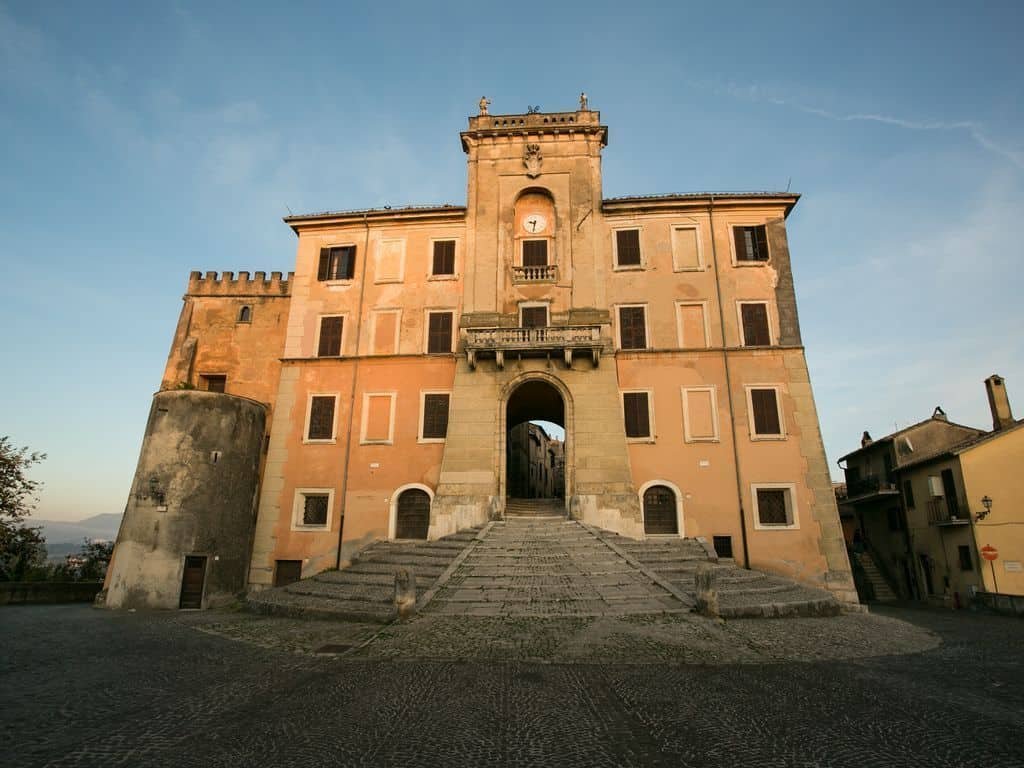
Filacciano is at Via Oreste Leonardi 5, postal code 00060, Metropolitan City of Rome Capital, on the tuff spur that closes the Roman Tiber Valley to the north. The town hall answers at 0765 332113 and the certified email is comunedifilacciano@pcert.it. The village is a little under an hour by car from the center of Rome. By car you leave the A1 at the Ponzano Romano-Soratte toll booth, about three kilometers from the town, and continue on the provincial Tiberina road. By train you get off at the Poggio Mirteto Scalo station or at Stimigliano, both on the Rome-Florence line served by the regional railway FL1 Orte-Fiumicino, and you complete the trip by road transport or a lift. There are no tickets: the town is visited on foot, for free, at any hour of the day. Palazzo Del Drago is private property of the Del Drago family and has no regular public opening: the square, the arch, the fountain and the viewpoint can always be seen from outside, the interiors only on the occasion of events, and for those it's best to check with the town hall or the local promotion body. The churches open at times tied to services, so for the church of Sant'Egidio and for the parish church of Santa Maria Assunta the advice is to ask in town the morning of your visit.
The town measures a little under six square kilometers and has a little over 450 residents: it is one of the smallest municipalities in the province of Rome. The built-up center is at about 247 meters above sea level, while the Tiber floodplain, below, drops to a little over 30. This leap of 200 meters horizontally explains everything you will see: the commanding position over the river, the wind that combs the viewpoint even in August, the stage-set quality of the square that opens onto the void. Anyone who arrives here looking for a museum has the wrong address. Anyone who arrives looking for a 17th-century urban layout still standing almost entire, however, finds one of the smartest things in the Tiber Valley. To place the area within the rest of what Lazio offers, the page of the tourist attractions may help.
Where Filacciano (RM) is and how to get there from Rome
Filacciano occupies the right edge of the Tiber Valley, at the height where the river begins to bend toward the Sabina. From the town the gaze covers to the east the alluvial plain and the river terraces of the left bank, to the northwest the isolated outline of Monte Soratte, which at 691 meters is the only limestone relief in a sea of tuff, and to the south the basin of the Nazzano, Tevere-Farfa reserve. The municipal territory belongs to the Unione Valle del Tevere - Soratte and to the social-health district of ASL Roma 4.
By car to Filacciano
The quickest way from Rome is the Autostrada del Sole northbound as far as the Ponzano Romano-Soratte exit. From the toll booth you are in town in five minutes. Alternatively you can take the whole Tiberina, the road that follows the Roman route that went from Prima Porta up toward the Sabina and toward Otricoli: it is slower but it is also the only way to understand how the river drew this valley, with the reed beds, the poplar groves and the fields that slope down to the water. The provincial stretch that serves the town is the 20/a, which overlaps the 15/A Tiberina. Parking should be looked for outside the old core: the village alleys have a width designed for the cart and the mule, not for the minivan. Piazzale della Fontana is the natural place to leave the car, bearing in mind that during summer events the traffic layout is changed.
By train and public transport
There is no station at Filacciano. The two useful stops are equidistant and both lie on the Rome-Florence direttissima: Poggio Mirteto Scalo to the south and Stimigliano to the north, served by the FL1 that connects Orte to Fiumicino via Tiburtina, Ostiense and Trastevere. From there you need a scheduled bus or a taxi, and on a weekday the road connections are sparse. If you don't drive, do the math first: the afternoon bus, in these towns, is often the last. The advice is simple, with no beating around the bush: Filacciano is visited by car, or within an organized tour that also takes in the abbey of Farfa and the Tiber reserve, because the town by itself takes up two hours, not a day.
By bicycle and on foot along the Tiber
The Tiber Valley between Nazzano and Ponzano Romano is road bike and gravel terrain: lightly trafficked roads, short and nasty gradients, views that change at every bend. The final climb toward Filacciano is short but serious, and in summer it should be tackled early. On foot you can walk the whole town in 20 minutes if you just walk, in an hour and a half if you look, which is the right way.

Filacciano (RM) - Palazzo del Drago - village entrance
What to expect from Filacciano (RM): a planned village, not a grown one
Almost all the towns of the Tiber Valley grew by accumulation: a tower, then the houses leaning against the tower, then the city wall, then expansion outside the gate according to the whim of the owner. Filacciano works differently, and that is the reason it's worth the trip. The medieval core is there, and it is the one clinging to the castle. But the part that stretches downhill, between the 16th and 17th centuries, is organized according to a design, with low buildings, aligned, of constant height, and a street that runs through them until it opens into a rectangular square open to the panorama.
The result is a scenographic layout like a Baroque theater applied to a town of 600 souls. The fountain known as the Mascherone, the access archway and the portal of the palace are set on a single optical axis: whoever arrives from below sees the water, then the void of the arch, then the palace door, lined up like the wings of a stage set. It is not a lucky accident, it is a plan. Local tradition and literature repeated in the area attribute the design to Mattia de Rossi, a Roman, favorite pupil of Gian Lorenzo Bernini and from 1680 architect of the Fabbrica di San Pietro. The attribution is plausible for style and chronology, because the patron was the Muti Papazzurri family and the years are the right ones, but it doesn't appear among the architect's documented works in the major reference books. It should be taken for what it is: a strong traditional attribution, not an archival fact.
The urban structure of Filacciano, gate by gate
You enter from the lower part. Past the first gate you are in the late Renaissance expansion: two-story houses, simple frames, deep and private entrance halls that hide courtyards and stairs. The front is orderly, uniform, almost severe. The street climbs gently and comes out into the square, which is the visual fulcrum of the whole town. Beyond a second historic gate the true medieval village begins, the one of the castle, where the alleys narrow, the tuff surfaces, the walls change texture and the houses lean on one another to hold up. In 10 minutes of walking you cross 300 years of building.
A detail distracted visitors miss: the levels. The town slopes toward the river in terraces, and every terrace has its own view. There isn't a single viewpoint, there are five or six, and the best one isn't the one signposted.
The name of Filacciano: four hypotheses and a document of the 8th century
The place name of Filacciano is one of those puzzles scholars have been passing around for two centuries without closing it. There are essentially four hypotheses in play, and it's best to keep them distinct by degree of solidity.
The first, the most widespread in the town's oral tradition, derives the name from an emperor or in any case a figure named Felicianus, who supposedly had a first castrum built up here, on whose remains the castle later rose. It is the version told in the square. It has no documentary support and must be classified as a scholarly legend of late modern formation.
The second traces the name back to Faliscanum or Faliscianum, that is to the ethnic reference to the Falisci, the people who occupied the right bank of the Tiber between Civita Castellana and Soratte. It has the merit of being consistent with the archaeology of the territory, because the pre-Roman materials found in the area are of Faliscan-Capenate culture.
The third, and it is the most accredited, derives the place name from Flaccianum, that is from the fundus Flaccus, the estate of a Roman landowner named Flaccus. The thesis was supported by Antonio Nibby, the archaeologist and topographer who in the first half of the 19th century systematically reconstructed the ancient geography of the surroundings of Rome, and it rests on a concrete element: a donation document of the 8th century that assigns possession of the Flaccianus estate to the abbey of Farfa, a possession later confirmed by a bull of Pope Stephen IV of the year 817. A farm estate named after a Roman owner that survives as the name of a town is a classic mechanism, repeated all over Lazio, and here it even has the paper trail.
The fourth, a minority one, brings in spinning and textile work. It doesn't stand up to linguistic verification and is probably a modern backdating, born to explain the name of the winter food festival.
The history of Filacciano, from the Capenati to the Del Drago princes
Before Rome: the necropolis of Marisano
In the municipal territory, in the locality of Marisano, materials have been found that document a pre-Roman necropolis of a culture akin to the Faliscan-Capenate one. It is not a sensational discovery in itself: the whole right bank of the Tiber between Capena and Soratte was occupied by communities of this kind, people who spoke an Italic language related to Latin, wrote with an alphabet derived from the Etruscan one and traded along the river. The relevance is one of context. It means that the height of Filacciano was already chosen, already frequented, already considered a good control point before Rome existed as a regional power. The materials are not displayed in the town: the archaeology of the Capenate territory is seen at Capena, between the civic museum housed in the Clock Tower and the area of Lucus Feroniae on the Tiberina, where the federal sanctuary of the goddess Feronia gathered Latins, Sabines and Etruscans.
Filacciano in Roman times
The Roman conquest of the right bank arrives with the campaigns led by Marcus Furius Camillus against Veii, Capena and Falerii Veteres, the city that corresponds to present-day Civita Castellana. In 387 BC the Capenate territory is enrolled in the Stellatina tribe and organized as an allied municipium. The area of present-day Filacciano thus enters the ager Capenas and, with the Augustan reform, Regio VII Etruria. We don't have a Roman urban center up here: we have farms, rustic villas, an agricultural landscape of medium-to-large holdings that produces grain, oil and wine and sends them down to the river. The Tiber, in those centuries, is the highway: barges went up and down carrying goods toward Rome. The road we now call the Tiberina follows the ancient route toward the Sabina and toward Otricoli.
Farfa, the Benedictines and the birth of the castle
With the collapse of the late antique system the valley is depopulated and property concentrates in the hands of the monasteries. The Flaccianus estate passes to the imperial abbey of Farfa, which between the 9th and 11th centuries is one of the great landed powers of central Italy, on a par with Montecassino and with Sant'Andrea in Flumine of Ponzano. The donation of the 8th century and the confirmation by Pope Stephen IV in 817 are the first documents that name this land. It is the Benedictine monks who build, around the year 1000, the church of Sant'Egidio on the isolated rise just below the village, and the first fortified core is probably theirs too. The incastellamento of the Tiber Valley follows this pattern everywhere: the monastery gathers the scattered colonists, brings them up high, puts them behind a wall. This is how the village is born.
The Orsini, 200 years on the fortress
From 1344 Filacciano belongs to the Orsini, and stays with them for two full centuries, until 1544. The Orsini are the family that draws the feudal geography of the Tiber and the Sabina: the same one that controls Nazzano, that weighs on Monterotondo, that clashes with the Colonna for supremacy in the Patrimony of St. Peter. A 14th-century count based on salt consumption credits the town with about 400 inhabitants: for the period and for these dimensions it is a vital community. The castle in this phase is still a true castle, with a military function, not the lordly residence you see today.
Savelli, Naldi and the continual change of hands
From 1544 the fief passes to the Savelli, with Antimo and Antonello, and stays with them until 1593. Then come the Naldi della Bardosiera barons, with Filiberto, Filippo and Ottavio, who hold possession until the early 1700s. In between, a military episode the town has not forgotten: between 1485 and 1486, during the war between the Papacy and the Aragonese of Naples, Filacciano is taken and then rebuilt. It is not a textbook battle, it is one of the endless skirmishes of the Roman baronial conflict. But for a town of 400 people it means walls knocked down and houses to rebuild.
The Muti Papazzurri and the invention of the Baroque village
The decisive moment comes in 1674, when the Muti Papazzurri take over: Giovanni, Pompeo, Scipione, Curzio. It is the family that transforms a castle into a palace and a jumble of houses into an urban layout. They are the patrons of the scenographic axis, the rectangular square, the fountain, the archway. The crescent of their coat of arms is still legible on the front of the palace, and finding it is one of the little games I recommend. In 1704 the town has about 600 inhabitants, the historic peak before the 19th century. In 1706 the death of Monsignor Giovanni Muti Papazzurri triggers a family crisis that slows the building program: the optical axis that was supposed to guide the development of the whole village remains a splendidly executed fragment, never completed. The town you see is an interrupted project, and it is precisely this that makes it legible.
The 19th century: Mauri, Franci, Ferrajoli, Del Drago
In 1810 possession passes to Carlo Mauri, a monsignor, substitute secretary of state of the Roman curia, who leaves his name to a palace in town and his own burial in the chapel of San Filippo Neri attached to Sant'Egidio. From 1833 to 1843 the Franci take over. In 1843 the property goes to Domenico Orsini, then in 1852 to the cavaliere Giuseppe Ferrajoli, who bears the title of marquis of Filacciano. In 1853 the palace and the fief are bought by the Del Drago princes, princes of Mazzano and Antuni, who are still its owners today. They are the ones who give the name by which everybody calls the complex. In 1804 the Napoleonic edict of Saint Cloud, which forbids burials inside inhabited areas, had already produced the present cemetery: a sanitary reform imposed from above that changed the landscape of towns all over Italy.
The 20th century: sharecroppers, cinema, depopulation
The census of 1911 records 705 inhabitants, the absolute historic peak. Then the long decline begins: the war, emigration, the end of sharecropping. In the postwar period, and in particular around the 1950s, families of sharecroppers arrive from the Marche and Abruzzo, poorer lands, and graft themselves onto the local farming community. In 1930 a fire devastates the palace: three children of Prince Clemente Del Drago are pulled to safety by the townspeople. It is an episode still told at Filacciano, and it explains better than any essay the relationship between the town and the owning family. Today the residents are a little over 450.

Palazzo Del Drago of Filacciano
The palace is the reason the town exists and the reason it has the shape it has. It was born as a medieval manor, an outpost of the valley, and was progressively tamed between the 16th and 17th centuries until it became a lordly residence. The front you see from the square is not a castle facade: it is a palace facade, with the portal at the center of the axis, the framed windows, the declared symmetry. Underneath, though, the structure remains the defensive one, and you can read it in the relationships between the volumes and in the base of the walls.
From castle to palace: the 17th-century transformation
The conversion is the work of the Muti Papazzurri, who step in from the later 1600s and continue into the 1700s. The cultural operation is the one being carried out in those years all over Lazio: the Roman nobility no longer needs fortresses, it needs show villas where to spend the holidays and receive guests. The castle stops watching the enemy and starts watching the view. It is the shift also seen at Castelnuovo di Porto and in half the Sabina, but here it is sharper because the entire town is redesigned accordingly.
The fan-shaped staircase
The piece that strikes most is the fan-shaped staircase that links the palace to the square. It is an element of theatrical architecture, of the kind Roman Baroque uses to create a focal point, but at Filacciano it has had for centuries a second life, much more concrete: it was the natural stage of the town's evening life. The roots of the history of Filacciano sink into farming memories, and those memories have a precise place. On summer evenings, once the workday that began at dawn and ended at sunset, from sunup to sundown as the local expression has it, was over, people went up to the square. Often there was an accordion. It was the moment of socializing for a community in which, in the first postwar years, local families and sharecroppers who had come from the Marche and Abruzzo lived side by side. A travertine step has held a town together for 200 years: look at it with that in mind, that staircase.
The scenographic axis: Mascherone fountain, archway, portal
The unique detail of the village, the one no other town in the valley has, is the alignment between the Mascherone fountain, the archway and the portal of the palace. They are three elements designed, executed and built on a single axis, so that the visitor climbing up from below sees them lined up. It is a perspective vista of a Baroque garden applied to the public space of a farming town, and it is the signature of a first-rate architectural culture. The mascherone of the fountain is the classic grotesque face that spouts water from its mouth: a motif of 16th-century derivation, very widely used in Rome, which here works as an entrance backdrop. The practical advice is to stand with your back to the fountain and look up slowly: the effect builds in three seconds.
Can you visit Palazzo Del Drago of Filacciano
Frequently asked questions about Filacciano (RM)
Where is Filacciano (RM)?
Filacciano is in the Metropolitan City of Rome Capital, on the right edge of the Tiber Valley, at about 247 meters above sea level, with the town hall at Via Oreste Leonardi 5, postal code 00060. It is one of the northernmost municipalities of the province of Rome, on the border with the Rieti Sabina.
How far is Filacciano from Rome?
Filacciano is a little under an hour by car from the center of Rome, taking the Autostrada del Sole. From the town the gaze covers the alluvial plain of the Tiber Valley, Monte Soratte to the northwest and the basin of the Nazzano, Tevere Farfa reserve to the south.
What is there to see in Filacciano?
In Filacciano the main monument is Palazzo Del Drago, born as a medieval manor and transformed between the 16th and 17th centuries into a lordly residence, overlooking the scenographic Piazza Umberto I. The town also preserves three churches, two private chapels and other minor noble palaces, such as Palazzo Mauri, Palazzo Arcangeli and Palazzo Leoni.
How long does it take to visit Filacciano?
Two hours are enough to see Filacciano at a relaxed pace: square, palace from the outside, viewpoint, Via Filocastello with its underpasses and the descent to the church of Sant'Egidio. Three hours if the churches are open, half a day with lunch, and a full day if you build a loop with Nazzano and Ponzano Romano.
Is Filacciano suitable for a visit with children?
Yes, Filacciano works well with children because traffic is almost absent and the spaces are on the scale of short legs. The square is a natural playground, the viewpoint is protected and the complete walk around the town takes little time, making it a stop suitable even for families with small children.
What do you eat in Filacciano?
In Filacciano the flagship product is the extra virgin olive oil of the Soratte area, with protected designation of origin recognition, obtained from olive trees on volcanic soils with low yield and a marked bitter and peppery flavor. Pecorino romano is also produced in the territory.
Can the castle of Filacciano be visited?
The dossier does not report an ordinary opening regime for Palazzo Del Drago of Filacciano: the town has no ticket office or permanent information office, so it's best to check with the town hall for any openings before organizing the visit, especially off season.
What is there to see near Filacciano?
Near Filacciano is the Nazzano, Tevere Farfa nature reserve, the first protected natural area established by the Lazio Region, in 1979, which includes territories of the municipalities of Nazzano, Torrita Tiberina, Montopoli di Sabina, Castelnuovo di Farfa and Fara in Sabina, along the course of the Tiber.
The complex is privately owned and has no ordinary public opening. The exteriors, the archway, the staircase and the square can be seen freely and are the part that really counts from the urban planning point of view. For the interiors there is no ticket office: you enter only on the occasion of events, concerts or manifestations organized in agreement with the owners, and the dates must be asked of the town hall. Whoever arrives convinced of finding a castle open to visitors with an audio guide will be disappointed. Whoever arrives to understand how a town is designed will stay much longer than planned. To organize the visit with an authorized tour escort, it's best to turn to the professionals of TourLeaderPro in Rome.
Piazza Umberto I, the urban stage of Filacciano
The square is rectangular, elongated, closed on one side by the front of the palace and open on the other toward the valley. It is the modest masterpiece of the town. The buildings that bound it are low and aligned, with a regularity that has few comparisons in the Tiber Valley, and they belong to the part of the village organized between the 16th and 17th centuries. The void is calibrated: big enough to hold the patron saint's festival, small enough to remain a domestic space. In this square open-air films were projected starting in the 1960s, when the economic boom and the rebirth of Italian cinema brought the screen set up in the evening up here as well. The custom has not been lost: the town hall's summer calendar still includes evenings of cinema, sport and dinner in the square at the end of August, with traffic modified around Piazzale della Fontana.
The viewpoint of Filacciano over the Tiber Valley
From the edge of the historic center opens the panoramic outlook over the Tiber Valley: below, the plain with its meanders and poplar groves. In front, the reliefs of the Sabina. To the northwest the profile of Soratte, which from here is seen along its long side and looks like an island. On tramontana days, when the air dries, the view reaches the Apennine range and the snowy peaks can be made out: how far it reaches depends on the day, and on this it's best to trust your own eyes more than the signs. The right time is late afternoon, when the sun strikes from the west and lights up the tuff of the houses. At dawn, instead, the valley fills with low fog and only Soratte and the bell towers stick out: it is the best show and nobody watches it because at that hour the town is asleep.
The churches of Filacciano (RM)
Despite the very small size of the territory, Filacciano has three churches and two private chapels. For a municipality of a historic 600 souls it is a notable density, and it is explained by the layering of owners: every family that passed through here left an altar.
The church of Sant'Egidio in Filacciano
It is the second building in chronological order of the future village and stands isolated on a rise of ground a little below the castle, in a commanding position over the Tiber Valley. Tradition holds that it was built by the Benedictine monks of Farfa, owners of the estate, around the year 1000. The layout is Romanesque and the current dating places it between the end of the 10th and the 11th century. Sant'Egidio the abbot, the hermit of Greek origin venerated throughout the Benedictine West, is the patron saint of the town and is celebrated on September 1.
The treasure of the church is the 13th-century frescoes. They were commissioned by the Marocce couple in 1228 and are attributed to an anonymous painter whom local critics call the master of Filacciano: a workshop from the Lazio sphere that works at the moment when Roman painting moves from the Byzantine manner to a more narrative language. Look at the hands and the drapery: the stiffness is still that of the icon, but the faces begin to move. The frescoes were preserved in good condition even after the roof collapse that happened on the night between the 16th and 17th of 1968, and have been restored. The commission by a pair of laypeople, and not by the monastery, is the most historically interesting detail: in 1228 it means that in Filacciano there were people who had money of their own and wanted to leave a memory of it on the wall of a church. Private patronage in rural churches of the 13th century is documented but not very frequent, and here it is dated precisely.
Many years after the original building a chapel dedicated to San Filippo Neri was added, where Carlo Mauri is buried, the prelate who in the 19th century was substitute secretary of state of the Roman curia and owner of the fief. The dedication to San Filippo Neri is no accident: Philippine devotion spreads in Lazio from the 1600s and becomes the trademark of an urban, cheerful religiosity that Roman families bring to their country fiefs.
The church of Santa Maria Assunta in Filacciano
It stands inside the village and is reached from Via Filocastello. There is no documented founding date or name of a patron: the reasonable hypothesis, based on analysis of the masonry and on the relationship with the castle, places it between the 15th and 16th centuries, after the rebuilding of the manor by the Orsini. The structure strongly recalls that of Sant'Egidio, which suggests local workers repeating a proven model.
The interior has a single nave, with two side apses dedicated respectively to Santa Maria Assunta and to the Salvatore. On the walls on either side of the altar two niches are carved out that house the statues of San Valentino and of Sant'Egidio the abbot. Light enters from five windows of Gothic layout, and the ceiling has exposed wooden trusses: a poor and honest solution, typical of minor religious building in Lazio, which has the merit of giving back the original volume without the 18th-century false ceilings that elsewhere have erased everything. The exposed trusses are also the reason the acoustics, during sung services, work surprisingly well.
The oratory of Sant'Egidio and the private chapels
To the list is added the oratory of Sant'Egidio, built by the Muti Papazzurri in the phase when the family was redesigning the town: a devotional service building tied to the lordly residence, following a common practice in Roman noble properties. The two private chapels complete the picture. They are not open to the public and appear on no tourist route. I mention them because they are part of the count and because they help understand how dense the devotional fabric of such a small town was.
The minor palaces of Filacciano: Mauri, Arcangeli, Leoni
Whoever stops at the Del Drago misses half the town. Filacciano preserves three other noble buildings that tell of the local agrarian bourgeoisie, the one that wasn't princely but counted.
Palazzo Mauri was built by the marquis Giambattista Mauri, of the family that briefly held the fief in the 19th century. Palazzo Arcangeli dates to around the 1500s, faces Via Filocastello and has a peculiarity visitors never notice: it was connected to a mill. In a town perched 200 meters above the river, controlling a mill meant controlling the bread. Palazzo Leoni, also on Via Filocastello, is recognizable by its vaulted underpass, in all probability built in the 17th century, which crosses the street and links two blocks of building. These covered passages are one of the most characteristic features of the villages of the Tiber Valley and are born of an ordinary necessity: when the family grows and there is no room to expand sideways, you span the street. Via Filocastello, with its entrance halls and its underpasses, is the street to walk slowly.

A curiosity about Filacciano (RM)
The real curiosity of Filacciano is not the castle: it is the fact that this town is the visible remainder of an urban project never finished. When the Muti Papazzurri, in the later 1600s, decided to reorganize the fief, they did not commission merely the restoration of a residence. They had an optical axis laid out that started from the Mascherone fountain, passed under the archway and reached the portal of the palace, and that axis was supposed to be the backbone on which the whole settlement would grow. It was the logic of the great Roman Baroque interventions applied on a tiny scale: you draw a line of direction, you align the fronts, and the city develops by itself along the line.
The line, however, stopped. In 1706 Monsignor Giovanni Muti Papazzurri dies and the family enters a crisis that compromises its finances and its ambitions. The building site is interrupted. What remained to be built was never built, and the town crystallized at the point it had reached: a fragment of urban architecture of the highest quality, set into a rural fabric that did not have time to adapt. It is exactly this incompleteness that makes Filacciano legible. In a completed village you can no longer tell the plan from spontaneous growth. Here you see the seam. You see where the idea ends and the farming town starts again.
There is a second element that visitors almost always ignore. The number of families that succeeded one another in ownership of this tiny fief is impressive: Orsini, Savelli, Naldi della Bardosiera, Muti Papazzurri, Mauri, Franci, Orsini again, Ferrajoli, Del Drago. Nine changes in five centuries, for a town that never exceeded 700 souls. Filacciano was not rich: it was convenient. It sat on a road, looked at a navigable river, produced oil and grain, and cost little. For the Roman nobility it was the fief you bought and sold again when cash was needed, the title added to a name. The history of Filacciano is, read properly, the history of the aristocratic real estate market of the Papal State.
Something nobody tells you about Filacciano (RM)
No guide writes it, but at Filacciano the problem is not what to see: it is when to arrive. The town has fewer than 500 residents, has no ticket office, no permanent information office and no dining sized for tourism. On a Sunday in November at three in the afternoon you'll find the churches closed, nobody in the square and nowhere to sit. It is not hostility: it is demographic arithmetic. Whoever wants to see the churches open must come on the day of the patron saint's festival, September 1, or during one of the food festivals, or ask directly in town that same morning. The second thing nobody says concerns dining: you don't get here at one o'clock without having called ahead. The trattorias of the area work by reservation and on weekdays may simply not open.
The third point is the most useful of all. The public transport link exists on paper and is fragile in practice: the reference railway stations, Poggio Mirteto Scalo and Stimigliano, are both outside the municipal territory and must be reached by a scheduled bus whose runs, in the afternoon and on holidays, thin out a good deal. Whoever has no car and still wants to see this stretch of the Tiber Valley should make a different choice: take Poggio Mirteto or Fara in Sabina as a base, which are better served, and reach Filacciano in a day with a rented vehicle.
Last thing, and it concerns expectations. Photographs of Palazzo Del Drago are around that let you imagine a castle open to visitors. It is not. It is an inhabited private residence, and must be treated as such: you photograph it from outside, you don't ring at the gate, you don't go into the courtyards. This, incidentally, is the reason the village has been so well preserved. A building that someone lives in is a building that someone maintains.
The advice I give you for visiting Filacciano (RM)
Don't come to Filacciano on its own. I mean: don't make it the only destination of a day, because the town will take two full hours and then leave you with half an afternoon on your hands. Build instead a loop along the Tiber Valley and put Filacciano in the middle, as a high pause between two low things.
The recommended itinerary is this. Leave Rome early, exit at Ponzano Romano-Soratte, first stop at the abbey of Sant'Andrea in Flumine below Ponzano Romano: first-rate Romanesque architecture, a wall circuit ordered built in 946 by Alberic II, a bell tower made at the start of the 13th century from one of the three defensive towers, a complex restored for the Jubilee of 2000 with works concluded in 2004. It takes an hour. Then you climb to Filacciano for the square, the palace, the viewpoint and the churches, with lunch booked in the area. In the afternoon you go down to the Nazzano, Tevere-Farfa nature reserve, which is the first protected area established by the Lazio Region, in 1979, recognized as a wetland of international importance under the Ramsar convention already in 1977: you visit the River Museum at Nazzano and walk one of the observation trails on the lake formed by the dam built in the 1950s. Whoever still has energy closes with the climb up Monte Soratte for sunset.
On the season I'm blunt. The best time for Filacciano is the second half of October: the light is low and warm, the valley lights up, the morning fog begins and it isn't cold yet. The worst time is a July afternoon, when the tuff gives back the heat and the square becomes a frying pan. August is ambiguous: it is hot, but it is the only period when the town is truly alive, with evening events, cinema and outdoor dinners. If you have to choose between comfort and the soul of the place, choose the soul. And bring shoes with treaded soles: the alleys are steep and the paving, when damp, doesn't forgive.
Another well-known fact, yet rarely cited
That Filacciano belonged to the abbey of Farfa you read everywhere. What almost nobody explains is what that concretely entailed, and how deeply it determined the shape of the town. Farfa, between the 9th and the 11th century, was an imperial abbey: that is, it enjoyed the direct protection of the Germanic sovereign and was exempt from episcopal jurisdiction. In the Tiber Valley the same status was held by Sant'Andrea in Flumine below Ponzano Romano and by San Salvatore Maggiore in the province of Rieti, as well as Montecassino. It means this valley was not just any land: it was a corridor of power between Rome and the North, and the monasteries that controlled it were political actors, not only religious ones.
The consequences on the ground are three and can still be seen. The first is the founding of the churches: Sant'Egidio was born as the monastic church of an estate, not as the parish of a community, and for this reason it stands isolated on a rise outside the village instead of at the center of the town. The second is the incastellamento: it is the monks who concentrate the colonists scattered across the estates inside a fortified enclosure, and it is from that enclosure that the medieval village is born. The third is the agrarian place-naming, which preserved the names of the Roman estates because the monks recorded them in their cartularies, and indeed the very name of Filacciano comes from there.
Then there is a fact that is rarely cited. The document of the 8th century and the bull of Pope Stephen IV of 817 are not only the first attestations of the name: they are proof that in the early Middle Ages this land had a recognized agricultural value and an owner worth recording. A donation is made when there is something to donate. In the Lazio of the year 800, with the population at historic lows and vast areas gone back to forest, a productive estate above the Tiber was a prime asset. If you want to read this history in continuity, a visit to the abbey of Farfa and its village, and then to the Farfa gorges, completes the picture far better than any explanation.
The right photo to take at Filacciano (RM)
The photograph everybody takes is the frontal one of Palazzo Del Drago from the square. It is a good photograph and has no interest, because it has already been taken 10,000 times and because the front, lit flat in the middle hours of the day, flattens even the staircase.
The right photograph is another one, and only one. Get down low, at the height of the Mascherone fountain, and frame along the axis: water in the foreground, the archway making a black frame in the middle, the portal of the palace at the back, inside the arch. You need a lens that doesn't distort too much, so forget the extreme wide-angle and use a normal one, around 50 millimeters equivalent, stepping back as far as needed. The key is to stop down the aperture to keep the three planes in focus and wait for no one to pass through the arch. This way you photograph not a building but an idea of a plan, which is the only thing at Filacciano you can't find elsewhere.
The right light is that of late afternoon, when the sun comes in from the west and the back of the arch receives the reflection instead of full shadow. In the morning the arch becomes a black blot and the portal disappears.
The second photograph to take home is from the viewpoint, and it should be made at dawn, not at sunset. On late October and November mornings the valley fills with low fog, the Tiber vanishes and above the gray only Soratte and the silhouettes of the bell towers on the left bank remain. With a medium-long focal length, around 130 millimeters, the succession of planes is compressed and you get an image that looks like a Japanese landscape shot in the Sabina. Bring a light tripod because at dawn the shutter times get longer and the wind blows on the viewpoint.
Third tip, less obvious. The vaulted underpasses of Via Filocastello are an excellent subject in black and white, because the cut of light coming in from the end of the passage draws the paving. Wait for someone from the town to pass and shoot backlit: the silhouetted figure inside the stone tunnel tells Filacciano better than any panoramic view. A professional recommendation: always ask permission before photographing people and don't point the lens into private courtyards. In a town of 450 inhabitants good manners are remembered for years, and bad manners too.

Some important events that happened here in history
The first event is documentary and makes no noise, but it is the one that founds everything: the donation of the 8th century that hands the Flaccianus estate to the abbey of Farfa, confirmed in 817 by a bull of Pope Stephen IV. From that moment Filacciano exists in writing. Before there were the height, the necropolis of Marisano and the Roman farms of the ager Capenas. From then on there is a name, an owner and a continuous story.
The second is military. Between 1485 and 1486, during the war between the Papacy and the Aragonese Kingdom of Naples, the town is conquered and subsequently rebuilt. It is the only significant wartime episode in the village's history and must be placed in the right context: the Roman baronial conflict of the late 1400s, with the Orsini and the Colonna lined up on opposite fronts and the small fiefs of the valley used as pawns. For the inhabitants it meant walls to raise again and houses to rebuild.
The third is artistic and has a precise date: 1228, the year in which the Marocce couple commission the fresco cycle of Sant'Egidio. It is not a political event, it is a cultural one, and it left the town's only work of art of absolute importance.
The fourth is the change of 1674, when the fief passes into the hands of the Muti Papazzurri. It is the year that changes the face of the village, because from there starts the building program that produces the square, the fountain, the archway and the transformation of the castle into a palace. The fifth, its mirror, is 1706: the death of Monsignor Giovanni Muti Papazzurri and the family crisis that stops the building site.
The sixth is administrative and concerns all Italian towns, but here it left a visible mark. In 1804 the edict of Saint Cloud, issued by Napoleon, forbids burials inside inhabited centers and imposes cemeteries outside the walls: Filacciano's present cemetery was born of that rule. The seventh is 1853, the year the Del Drago princes buy the palace and the fief and begin an ownership that has lasted more than a century and a half.
The eighth is from 1930 and is the most told in town: a fire devastates the palace and three children of Prince Clemente Del Drago are saved by the townspeople who rushed in. In a community where the owning family and the sharecroppers lived 50 meters apart, that night established a relationship that later generations have kept citing.
The ninth is not a single event but a process, and it is the heaviest of all. The census of 1911 records 705 inhabitants, the historic peak. Since then the curve falls without interruption down to the little over 450 of today. In between there are two wars, emigration to Rome, the end of sharecropping and the arrival, in the 1950s, of farming families from the Marche and Abruzzo who partly replaced those who had left. The recent history of Filacciano is the history of the depopulation of inland Italy, read on a tiny scale and therefore with a clarity that the big numbers lack.
Who has passed through Filacciano (RM)
The first name is that of Marcus Furius Camillus, the military tribune who in the first half of the 4th century BC led the Roman campaigns against Veii, Capena and Falerii Veteres. We have no record of his passing over the height of Filacciano, and it would be wrong to claim it. But we are certain that his wars determined the fate of this territory, which in 387 BC entered the Stellatina tribe as part of the ager Capenas.
The second is Pope Stephen IV, who in 817 confirmed by bull the Farfa possession of the Flaccianus estate. The third, indirectly, is the Benedictine world of Farfa: the abbots who governed one of the imperial abbeys of central Italy also administered this land, and the monks who built Sant'Egidio around the year 1000 are, in effect, the first architects of the town.
Then come the families. The Orsini, lords from 1344 to 1544, are the lineage that gave two popes to the Church and controlled half of Lazio: here they placed a castellan and a garrison. The Savelli, Antimo and Antonello, take over in 1544. The Naldi della Bardosiera barons follow, Filiberto, Filippo and Ottavio. From 1674 the Muti Papazzurri, with Giovanni, Pompeo, Scipione and Curzio, are the figures who left the biggest mark on the look of the village: their coat of arms with the crescent is still visible on the palace.
The most singular name on the list is Mattia de Rossi, a Roman, born in 1637 and died in 1695, son of the architect Marc'Antonio, favorite pupil of Gian Lorenzo Bernini, who treated him almost like a son and took him with him to Paris in 1665. De Rossi directed the works on the balustrade of Ponte Sant'Angelo, was an expert assessor on the stability of the dome of St. Peter's under Innocent XI, became architect of the Fabbrica di San Pietro on Bernini's death in 1680 and head of the Accademia di San Luca in 1681. Local tradition attributes to him the design of the square and of the scenographic axis of Filacciano. The attribution is consistent with the chronology and with the patronage of the Muti Papazzurri, but in the catalogs of his documented works Filacciano does not appear: whoever tells you otherwise is turning a tradition into a document.
Two figures remain from the 19th century. Carlo Mauri, a monsignor, substitute secretary of state of the Roman curia, owner of the fief from 1810 and buried in the chapel of San Filippo Neri attached to Sant'Egidio. And Antonio Nibby, the topographer who studied the surroundings of Rome and proposed the etymology from fundus Flaccus: he was not lord of the place, but he is the man who gave the town its historically grounded name.
From 1853 on the stage belongs to the Del Drago princes, princes of Mazzano and Antuni, who still hold the property. Prince Clemente Del Drago is the involuntary protagonist of the night of the fire of 1930. Finally there is a category of passage that has no proper names but left the deepest mark: the sharecroppers from the Marche and Abruzzo who arrived in the postwar period, who brought up here different dialects, cooking and songs and fused them with the local ones. If today the food festivals of Filacciano have the repertoire they have, it is thanks to them too.
Festivals, food fairs and traditions of Filacciano
A town of this size is truly known only on the days when it gathers. The calendar of events is run by the local promotion body and pro loco, and the precise dates of each edition must be confirmed on the official channel of the town hall or the association before getting in the car, because in a community of volunteers the weekend can shift.
The patron saint's festival of Sant'Egidio Abate
It is celebrated on September 1 and is the main occasion of the year. Sant'Egidio the abbot, a hermit of the Benedictine tradition, is the patron saint of the town and gives his name to the Romanesque church below the castle. It is the day when the community gathers in full, when the doors open and when, if you want to see the frescoes of 1228, you have the best chances.
The food festivals of Filacciano, one per season
The gastronomic cycle is spread across the whole year and follows the farming rhythm. In May the Sagra delle Fave e del Pecorino, which is the Lazio festival par excellence, tied to May 1 and to the harvest of fresh fava beans. Between May and June the Infiorata del Corpus Domini, which is not a food festival but a collective work: the carpets of petals laid on the paving take nights of work and last a few hours, the time of the procession. In July the Sagra delle Fettuccine al Ragù, with handmade egg pasta that is one of the recognized typical products of the town. In summer the Sagra degli Stringozzi al Tartufo, a long pasta shape of Umbrian-Sabine tradition that here meets the truffle of the nearby hills. In August the Sagra della Pizza Fritta and the evening of Cantine Aperte e Lampioni Accesi, which is the moment when the village lights up and is walked on foot with a glass in hand. In December the Sagra de U'filaretto, the winter occasion that closes the calendar.
To these is added the town hall's summer program, which at the end of August offers evenings of cinema, sport, quizzes and dinner in the square, with changes to traffic around Piazzale della Fontana. The open-air screening is the direct continuation of a custom going back to the 1960s, when cinema arrived up here together with the economic boom and the screen was set up in front of the palace. An opinion, and I don't hide it: of all of them, the evening that is worth the trip is that of the lit lamps in August, because it is the only one in which the village's Baroque plan is seen working for what it was conceived for, that is a stage space inhabited in the evening.
What you eat in Filacciano
The town's economy has remained mostly agricultural and the table reflects it without pretense. The flagship product is the extra virgin olive oil of the Soratte area, which has obtained protected designation of origin recognition: olive trees on volcanic soils, low yield, marked bitterness and pepperiness. If you pass through in November, during the milling, ask for the new oil.
Then there is pecorino romano, which in this strip of territory has an ancient production tradition and accompanies the fava beans at the May festival. There is the white fig of Filacciano, a local variety that ripens in summer and is the product most tied to the town's identity, the kind you don't find at the supermarket. There are the handmade egg-pasta fettuccine, which in inland Lazio are dressed with a ragù of mixed meats cooked for hours. There are fried pizzas, which here are a festive dish and not a snack. And there are the falloni, rustic bread-dough pastries stuffed with sauteed greens, which are poor cooking brought to perfection: chicory or chard sauteed in a pan with garlic and chili, closed in bread and baked.
A practical warning that is worth gold. Dining at Filacciano is sized for the residents, not for visitors. On weekdays off season there may be nothing open. Call the day before, or arrange lunch at Nazzano, at Ponzano Romano or at Torri in Sabina, where the offer is broader.
What to see around Filacciano within half an hour by car
Filacciano is an excellent hub for a day in the Tiber Valley and the lower Sabina, and this is the main reason I include it in itineraries.
The Nazzano, Tevere-Farfa nature reserve
It is the first protected natural area established by the Lazio Region, in 1979, and includes territories of the municipalities of Nazzano, Torrita Tiberina, Montopoli di Sabina, Castelnuovo di Farfa and Fara in Sabina. The landscape you see today is artificial in origin and entirely natural in effect: the hydroelectric dam built on the Tiber in the 1950s slowed the current and created a river lake with broad reed beds, which has become one of the most important stopover sites for waterbirds in central Italy. Recognition as a wetland of international importance under the Ramsar convention dates to 1977, that is it precedes the establishment of the reserve. You can observe herons, little egrets, waterfowl and marsh raptors. At Nazzano you visit the River Museum and from there the equipped trails start. Bring binoculars: without them half of the reserve stays invisible.
The abbey of Sant'Andrea in Flumine at Ponzano Romano
Below Ponzano Romano, on the bank of the Tiber, stands one of the most important Romanesque buildings in Lazio. Tradition attributes its founding in the 6th century to Galla, daughter of the patrician Symmachus, and holds that the monastery was built in the 8th century on the initiative of Carloman, brother of Pepin the Short and a monk on Soratte: two items of traditional character, to be handled as such. The solid fact is that in the 9th century Sant'Andrea was one of the imperial abbeys of central Italy, together with Farfa, San Salvatore Maggiore of Rieti and Montecassino. In 946 Alberic II had it fortified with a wall circuit and three defensive towers. From 1074 it depended on the abbey of San Paolo fuori le Mura. One of the defensive towers was turned into a bell tower at the start of the 13th century. From the 1700s the complex declined until it was reduced to a farm. A first restoration was carried out in 1959, while the overall intervention is that of the Jubilee of 2000, with works concluded in 2004. Visiting hours are limited and must be checked with the parish of Ponzano Romano.
Monte Soratte and its hermitages
The 691-meter limestone relief that dominates the horizon to the northwest is a regional nature reserve established in 1997, whose management was entrusted in 2018 to the Nazzano, Tevere-Farfa reserve. At the top is the hermitage of San Silvestro, whose founding is traditionally placed in the 6th century on structures of a temple dedicated to Apollo, with frescoes from the 14th and 15th centuries. Along the slopes you meet the hermitages of Sant'Antonio, Santa Lucia, San Sebastiano and Santa Romana, in uneven states of preservation, and the 19th-century complex of Santa Maria delle Grazie. In the belly of the mountain runs a system of military tunnels dug starting in 1937, used by the German command in 1943 and converted in part, between 1967 and 1972, into a government anti-nuclear bunker. Horace named its snowy peak and Dante cited it in Canto 27 of the Inferno. Few places in Lazio put together so many eras in so little space.
Farfa, the Sabina and the villages of the Tiber
Within half an hour you reach the abbey of Farfa with its village, Castelnuovo di Farfa with the olive oil museum, Poggio Catino and Montebuono. To the west, beyond Soratte, you enter the Faliscan and Etruscan world: Civita Castellana with the portico of the Cosmati and the Sangallo fortress, Calcata suspended above the Treja, Nepi with its gorges and Sutri with the amphitheater carved into the tuff. To the north, along the river, Orte and Vasanello. Within a radius of 40 minutes from Filacciano there is material for a week.
Filacciano with children, with family and with mobility problems
The town works well with children for a simple reason: traffic is almost absent and the spaces are on the scale of short legs. The square is a natural playground, the viewpoint is protected and the complete walk is short. The game for those traveling with kids is the hunt for the crescent of the Muti Papazzurri on the front of the palace: it keeps them busy for 20 minutes and teaches that coats of arms can be read.
On accessibility we must be honest. Filacciano is a perched village with steep slopes, uneven paving, steps and underpasses: the upper part, the medieval one, cannot be walked independently in a wheelchair and presents difficulties even with a stroller. The square and the level stretch leading up to it, however, are passable, and the main panoramic viewpoint is reached without stairs. Those with walking difficulties should limit the visit to that stretch and enjoy the scenographic axis, which is in any case the best thing in the town. For the Nazzano reserve, some stretches of the routes near the museum are easier, but the layout of the trails should be checked with the reserve's office before leaving.
When to go to Filacciano and how much time you need
Two hours are enough to see everything at a relaxed pace: square, palace from the outside, viewpoint, Via Filocastello with the underpasses, church of Santa Maria Assunta and the descent to Sant'Egidio. Three hours if the churches are open and you stop in front of the frescoes as they deserve. Half a day if you add lunch. A full day only if you build the loop with Nazzano and Ponzano Romano.
The best season runs from mid-September to mid-November, with the peak in the second 10-day period of October. Spring is excellent in May, when there are the fava beans and the Infiorata. Summer is hot but it is the only period of evening life. Winter is silent and beautiful on clear tramontana days, when visibility over the valley becomes exceptional, but it is also the period when you are most likely to find everything closed. Those planning a trip to Rome who want to understand how to fit a day outside the city between city visits can start from the three-day Rome itinerary and the day trips in Italy published in English.
Quick questions about Filacciano (RM)
Where is Filacciano (RM)
In the Metropolitan City of Rome Capital, on the right edge of the Tiber Valley, at about 247 meters above sea level, with the town hall at Via Oreste Leonardi 5, postal code 00060. It is one of the northernmost municipalities of the province of Rome, on the border with the Rieti Sabina.
How far is Filacciano from Rome
A little under an hour by car from the center of Rome, taking the Autostrada del Sole as far as the Ponzano Romano-Soratte exit, which is about three kilometers from the town. Those who prefer the scenic road can follow the whole Tiberina, though it takes quite a bit longer.
How many inhabitants does Filacciano have
A little over 450 residents on an area of about six square kilometers. The historic peak was recorded by the census of 1911, with 705 inhabitants.
Do you pay a ticket to visit Filacciano
No. The village is public space and is walked for free at any hour. There are no ticket offices or turnstiles.
Can you visit Palazzo Del Drago of Filacciano
The palace is private property of the Del Drago family and has no ordinary public opening. The exteriors, the staircase, the archway and the square can always be seen. The interiors open only on the occasion of events organized in agreement with the owners: information must be asked of the town hall.
How long does it take to visit Filacciano
Two hours for the village at a relaxed pace, three if you find the churches open, half a day with lunch. A full day only if you add the Nazzano reserve and the abbey of Sant'Andrea in Flumine.
How do you get to Filacciano by public transport
The reference stations are Poggio Mirteto Scalo and Stimigliano, on the Rome-Florence line served by the FL1 Orte-Fiumicino regional railway, both outside the municipal territory. From there you need a bus connection or a taxi. On weekdays the runs are few and on holidays even fewer: if you don't drive, check the timetables before you leave.
What to see in Filacciano in one hour
Piazza Umberto I with the front of Palazzo Del Drago and its fan-shaped staircase, the Mascherone fountain and the large arch lined up on the scenic axis, the viewpoint over the Tiber Valley and the descent with a view of the church of Sant'Egidio.
Are the churches of Filacciano open
They open at times tied to services and have no continuous tourist opening. The best chance of finding them open is on feast days, starting with September 1, the feast of Sant'Egidio Abate. It's best to ask in the village the same morning.
What are the frescoes of the Master of Filacciano
The 13th-century fresco cycle kept in the church of Sant'Egidio, commissioned by the Marocce couple in 1228 and attributed to an anonymous painter from the Lazio area. It is the most important work of art in the village and it survived even the collapse of the church roof, which happened on the night between 16 and 17 of 1968.
Who designed the square of Filacciano
Local tradition attributes the design to Mattia de Rossi, a pupil of Bernini and architect of the Fabbrica di San Pietro from 1680, commissioned by the Muti Papazzurri. The attribution is consistent with the chronology and the style, but it does not appear among the architect's documented works in the major reference catalogs. It should be considered a solid tradition, not an archive fact.
Why it is called Filacciano
The most accredited hypothesis, supported by the archaeologist Antonio Nibby, derives the name from the fundus Flaccus, the estate of a Roman landowner named Flaccus, through the form Flaccianum. It is supported by an 8th-century deed of donation that assigns the estate Flaccianus to the abbey of Farfa, with confirmation in the bull of Pope Stephen IV of 817. Other hypotheses point to the Falisci or to a person named Felicianus.
Is Filacciano suitable for children
Yes. Traffic is almost nonexistent, the spaces are compact and the square is a safe place to play. The slopes can tire the little ones and the stroller struggles on the paving of the upper part.
Is Filacciano wheelchair accessible
Only in part. The square and the flat stretch before it are passable and let you see the scenic axis and the panoramic overlook. The upper, medieval part has steep slopes, steps and uneven paving and cannot be covered independently.
Can you take photographs in Filacciano
In public spaces, yes, freely. The palace is photographed from the outside because it is inhabited: don't enter the private courtyards and don't point the lens into the windows. For people, ask permission.
What is the best time to go to Filacciano
The second half of October for the light and the colors of the valley. May for the fava beans and for the Infiorata of Corpus Domini. August if you want the village alive, with evening events and open-air cinema in the square, accepting the heat.
What are the festivals of Filacciano
The Sagra delle Fave e del Pecorino in May, the Infiorata of Corpus Domini between May and June, the Sagra delle Fettuccine al Ragù in July, the Sagra degli Stringozzi al Tartufo in summer, the Sagra della Pizza Fritta and Cantine Aperte e Lampioni Accesi in August, the patron saint's feast of Sant'Egidio Abate on September 1 and the Sagra de U'filaretto in December. Dates must be confirmed on the official channels of the Comune and the pro loco.
What to eat in Filacciano
Extra virgin olive oil with protected designation of origin from the Soratte area, pecorino romano, the white fig of Filacciano, egg-pasta fettuccine, fried pizzas and falloni, the savory bread-dough pastries filled with sautéed greens.
Are there restaurants in Filacciano
The offer is sized for the residents and on off-season weekdays it can be reduced or absent. It's best to call the day before or to plan lunch in Nazzano, Ponzano Romano or Sabina.
What is the difference between Filacciano and Nazzano
Nazzano has about 1,300 inhabitants, a 13th-century Savelli castle with a quadrangular plan and two towers, the Museo del Fiume and the seat of the nature reserve. It is the village of water and nature. Filacciano has fewer than 500 inhabitants, has no museum and no reserve, but it has the most interesting Baroque urban layout of the stretch. It is the village of architecture. Visiting them together, in the same afternoon, is the right choice.
Is Filacciano a medieval or a Baroque village
Both, and that is its particularity. The upper part around the castle is medieval, while the part that slopes down toward the valley was organized between the 16th and 17th centuries according to a unified design. The two meet along a line that you walk in 10 minutes.
Do you need to book to visit Filacciano
Not for the village, which is freely accessible. Yes for lunch, yes for any extraordinary openings of the palace, yes for a guided visit. If you want an authorized tour guide, you can write to the TourLeaderPro contacts.
Is Filacciano part of a nature reserve
The municipal territory is not within the perimeter of the Nazzano, Tevere-Farfa reserve, which covers the comuni of Nazzano, Torrita Tiberina, Montopoli di Sabina, Castelnuovo di Farfa and Fara in Sabina. Filacciano, however, directly overlooks it, and the panorama from the viewpoint covers a large part of the protected valley.
What can you see from the viewpoint of Filacciano
The Tiber Valley with its meanders and poplar groves, the Sabina hills on the left bank and, to the northwest, the isolated profile of Monte Soratte. On tramontana days visibility stretches as far as the Apennine range.
The final verdict on Filacciano
It's wise to distrust towns that sell themselves as borghi. Filacciano doesn't sell itself at all, and that is exactly why it works. It has no museum, no castle you can visit, no shopping street. It has one thing only, and it has it in a quality you won't find elsewhere in the Tiber Valley: a piece of Baroque urban planning conceived by a first-rate mind, built halfway, and survived intact because nobody ever had the money to ruin it.
Go in the afternoon, stand next to the fountain and look along the axis. If at that moment you don't grasp the difference between a town that grew and a town that was designed, the trip was wasted. If you do grasp it, you hold a key that will serve you in all the other villages you will see afterward. And do one thing that almost nobody does: go down to Sant'Egidio, go in if you can, and stay five minutes in front of those frescoes of 1228. They were paid for by a married couple of this village 800 years ago. There is no tour operator in the world that can sell you that feeling.
Article written by the editorial team of TourLeaderPro, contact them for Private/Corporate/V.I.P. Tours and Experiences.
Planning a trip to Rome? The English guides for visiting the city are on ItalyPlanner.com.