Toffia (RI)
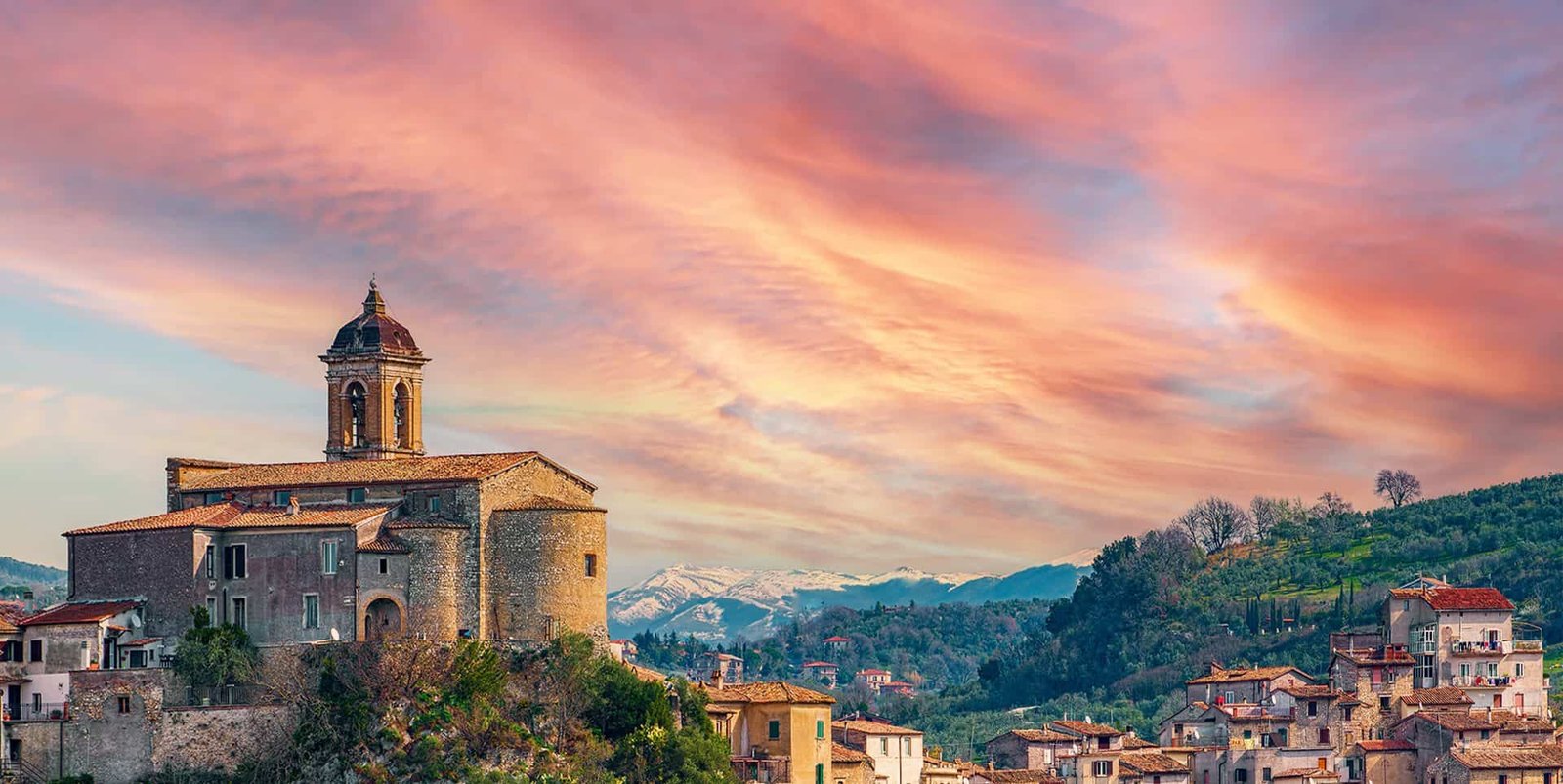
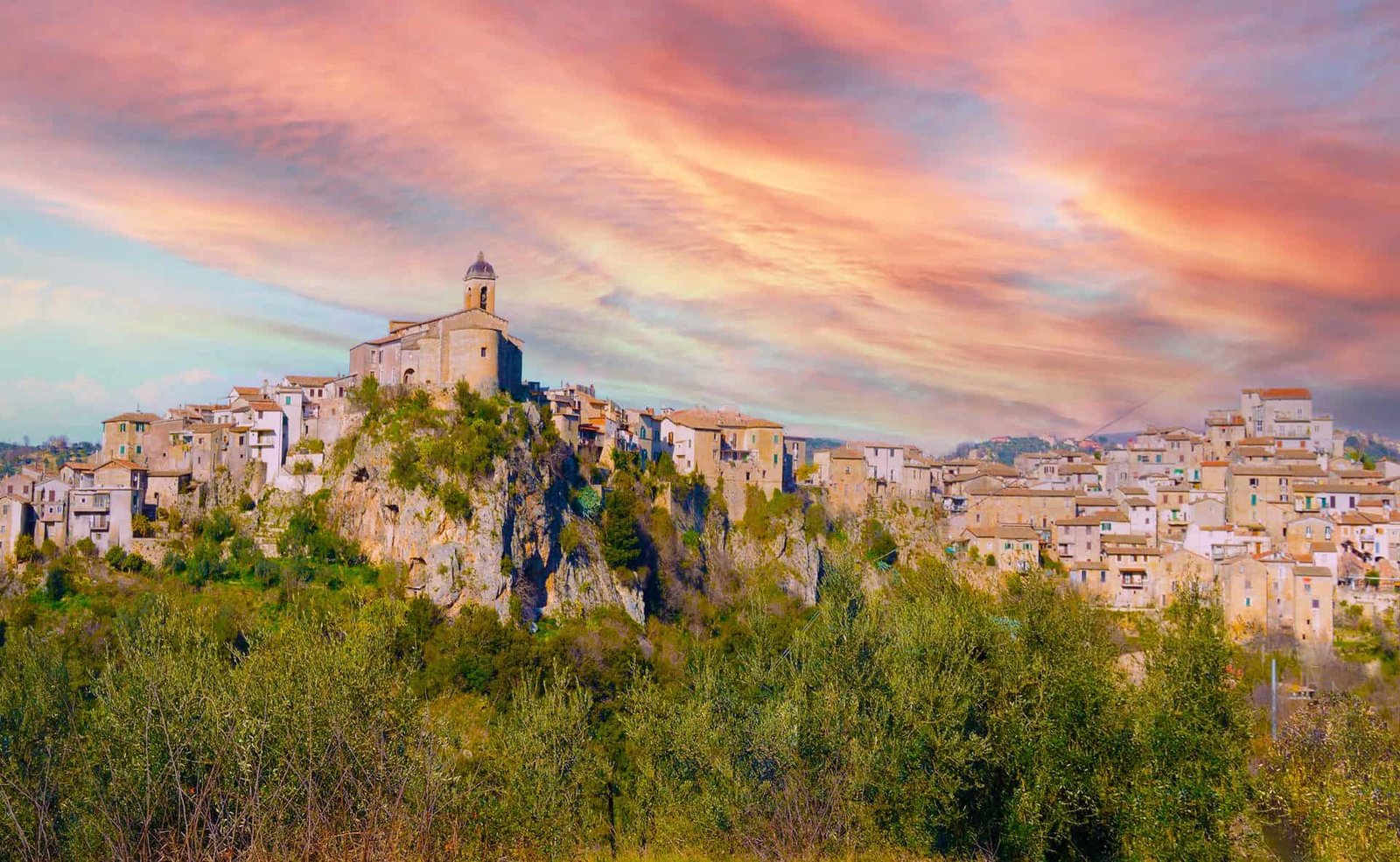
In short. Toffia (RI) is a municipality of a little over a thousand inhabitants in the lower Sabina, in the province of Rieti, at 262 meters above sea level on the last southern spur of the Sabine Mountains, overlooking the Farfa valley.
Toffia (RI) is a municipality of a little over a thousand inhabitants in the lower Sabina, in the province of Rieti, at 262 meters above sea level on the last southern spur of the Sabine Mountains, overlooking the Farfa valley. The town hall is at Via Porta Maggiore 9, 02039 Toffia (phone 0765 326032), inside the 15th-century Palazzo Orsini. By car from Rome you take the A1 motorway to the Fiano Romano exit, then the SS4 Salaria toward Rieti and finally the provincial road 41 Farense, which climbs from Passo Corese toward Farfa and Toffia: about 55 kilometers and an hour to an hour and a quarter of travel depending on traffic leaving Rome. Alternatively you can drive the whole Salaria without the motorway, passing through Passo Corese and Osteria Nuova. If you don't drive, take the FL1 regional train (Orte, Fiumicino Airport and the urban stations of Roma Tiburtina, Ostiense, Trastevere) to Poggio Mirteto Scalo or to Fara in Sabina-Montelibretti, on the Tiber plain, and from there a Cotral intercity bus toward the hill towns, with schedules to check on the Cotral site because they are calibrated for commuters and students, or a taxi. Toffia has no railway station. You leave the car in the spaces along the road that circles the walled perimeter, outside the village, and enter on foot from Porta Maggiore: the historic center is in effect pedestrian and in many alleys a car can't pass. Entrance to the village is free. The churches of San Lorenzo, Santa Maria Nova and Madonna di Loreto open for services and on particular occasions, with no continuous published hours, and for a visit inside it's best to phone the town hall or the parish a few days ahead. The Museo Maria Petrucci, in Casa Raniero, can be visited on request. A full visit of Toffia takes two or three hours. Paired with the Abbey of Farfa, six kilometers away, it fills a whole day.
Toffia belongs to the system of Farfa villages of the Tiber valley, together with Farfa, Fara in Sabina, Castelnuovo di Farfa and Poggio Mirteto. The provincial capital, Rieti, is around 30 kilometers away. Whoever wants to get a sense of the area before leaving will find on ItalyPlanner the English guide to Farfa Abbey, the historical center of gravity of this whole belt of hills, and on TourLeaderPro the private experiences for small groups among the olive groves and medieval villages of the Sabina, with a guide and a car.
How to get to Toffia (RI) and where to leave the car
By car from Rome to Toffia
Getting to Toffia is one of those experiences that, told to a Roman friend, produce the face of someone who doesn't believe it: around 50 kilometers from the Grande Raccordo Anulare and you find yourself in a medieval village with an elliptical plan, clinging to a hill of olive groves, with a silence that enters your ears like a physical thing. And yet that is exactly how it is. The Rieti Sabina begins where the northern outskirts of Rome end, and it begins fast: once past the Fiano Romano junction the landscape changes register, it ripples, it fills with silver.
The simplest road, leaving Rome by car, is the A1 Milano-Napoli motorway northbound, exiting at Fiano Romano. From there you take the SS4 Salaria toward Rieti, which goes up the Tiber valley alongside the plain and then branches off inland. At Passo Corese you leave the Salaria for the provincial road 41 Farense, the road that leads to the Abbey of Farfa and the villages of the lower Sabina: a narrow, well-kept roadway that climbs with wide bends among rows of centuries-old olive trees. The final stretch, the one that brings Toffia into view, is perhaps the most beautiful of the whole itinerary: the road rises, the olive trees open up and the village appears on the ridge, compact, with the houses pressed against one another as if they were cold.
The real travel time, Roman traffic permitting, is around an hour to an hour and a quarter. I advise leaving early, not so much for the traffic as for the light: the Sabina in the morning has a color that you no longer find in the afternoon. Whoever leaves from the northern quadrant of the city, from Prima Porta or from the Flaminia, can consider the whole SS4 Salaria, without the motorway: it is slower, but it crosses Passo Corese and Osteria Nuova and gives the geographic sense of the transition between the Roman countryside and the Sabine hills. From Rieti, instead, you go down the Salaria toward the south and turn off at Osteria Nuova for Poggio Nativo and Toffia: around 30 kilometers.
By train and bus to Toffia
Whoever doesn't drive still has a convenient way in, and it's one of the things that make this corner of Lazio more democratic than people think. The station of Poggio Mirteto Scalo, on the FL1 railway line, is the natural terminus for anyone who wants to reach the Sabina by regional train, together with the Fara in Sabina-Montelibretti station, a few kilometers further south on the same line. The FL1 links Orte to Fiumicino Airport via the urban stations of Rome: from Tiburtina, from Ostiense, from Trastevere you board a train and get off at the foot of the Sabine hills with no changes. From Poggio Mirteto Scalo, which is on the plain near the Tiber, you then climb toward the villages with Cotral intercity buses or, much more simply, with a short taxi ride or a rental vehicle. The schedules of the local buses are designed for residents and students, not for tourists: check them on the Cotral site the day before, and on Sunday the runs shrink to very few.
Where to park in Toffia and how to get around the village
Once you've arrived, the parking question solves itself and fairly painlessly. Toffia is a village of a few hundred inhabitants in the historic center, and this, like all medieval centers built before the invention of the automobile, is essentially pedestrian out of necessity: the alleys are just wide enough to let a donkey loaded with olives through, not a sedan. You leave the car in the spaces along the road that skirts the village, outside the line of the walls, and enter on foot from Porta Maggiore. It's the right way to enter, by the way: Toffia has to be tackled with legs and breath, going uphill, because its spiral structure around the hill is designed precisely to be walked this way.
The shoes are the first serious practical piece of information. The paving is stone, often polished by centuries of wear, and in some places the slope is significant. When it rains it becomes slippery. Smooth soles, elegant sandals and heels are a recipe for a painful day. You need closed shoes with a sole that grips, even in summer.
The second practical piece of information concerns services. Toffia is not a village equipped for mass tourism, and this is at once its good fortune and its limit. There isn't a row of cafes open at all hours, there isn't a tourist information office staffed every day, there isn't an ATM on every corner. There are a couple of businesses that open on village hours, a pharmacy, a post office, a social life concentrated in the hours the Sabines consider civilized and an afternoon closing that, especially in summer, must be respected the way you respect a fact of nature. It's best to stock up on water and any medicines before going up, and lunch has to be organized: either you book, or you bring something to eat and use one of the viewpoints.
When to go to Toffia and when to avoid it
The best time to come is a recurring question, and the answer isn't the one you'd expect. Spring, between April and May, is splendid: the olive trees are in bloom, the broom explodes on the slopes, the temperatures allow walking. But the moment when the Sabina gives its best is the harvest autumn, between late October and November, when the nets spread under the trees turn the hills into a mosaic and the oil mills work around the clock. The air smells of new oil, which is a green, pungent, almost bitter smell. Summer is hot but the village, by its very architecture, is full of shade: the alleys covered by arches stay cool even at noon, and it's one of the reasons these towns were built this way. At Ferragosto the village fills for its street festival, which I talk about further on. August 10 is the feast of the patron saint, San Lorenzo. Winter, outside the festivals, is the season of absolute silence.
One last practical piece of advice, and perhaps the most important: don't arrive in Toffia with a tight schedule. The historic center measures a few hundred meters from gate to gate, and whoever tackles it with a checklist mentality crosses it in 20 minutes and leaves convinced there was nothing there. Whoever instead sits on a low wall and lets half an hour go by sees the village move: a woman hanging laundry, a cat deciding its own routes, the sound of a wooden door opening onto a courtyard. Toffia is made of this. Whoever is in a hurry would do better to go somewhere else.
What Toffia is: a hill on the edge of the Tiber valley
To understand Toffia you have to start from a geographic observation that then becomes historical: this hill is exactly on the edge. It is the point where the Tiber valley, wide, fertile, traversed for millennia by the roads that climbed toward Umbria and the Adriatic, meets the first buttresses of the Sabine Mountains, and where the little valley of the Farfa stream opens toward the greater river. Whoever controlled this edge controlled the passage. And that is why, well before the village we see today existed, the area was inhabited, cultivated, garrisoned.
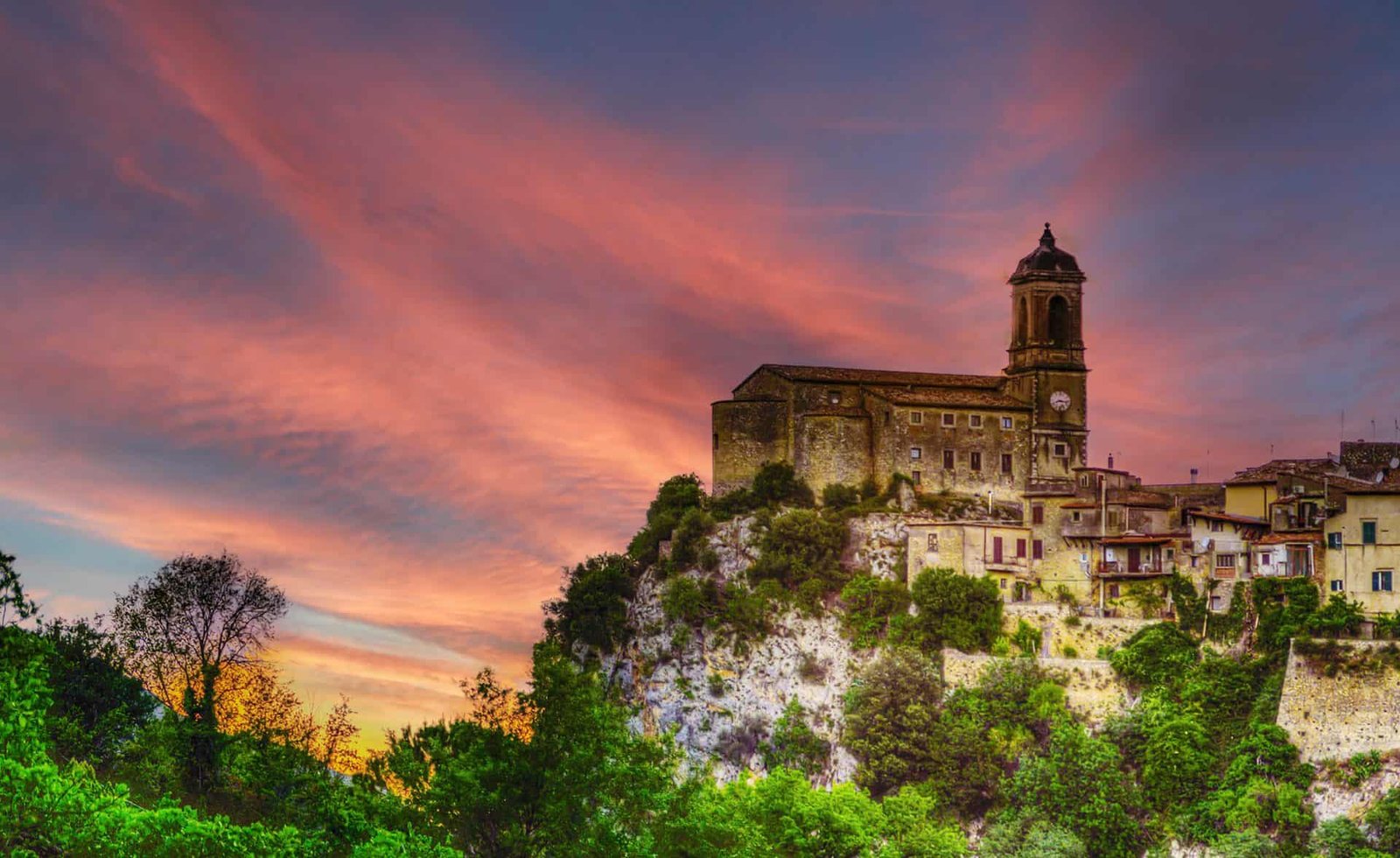
The village rises on a spur of rock, with the old core enclosed in a ring of houses on an elliptical plan and the highest point occupied by the church of Santa Maria Nova, built where the Colonna castle once stood. Outside the ring, on a separate little hill called Cacultiano, stands the church of San Lorenzo, the patron saint. Around it, the municipal territory (a little over 11 square kilometers) is a continuous mantle of terraced olive groves that slope down toward the Farfa and the plain. The neighboring municipalities are Castelnuovo di Farfa, Fara in Sabina, Nerola and Poggio Nativo. Rome is around 40 kilometers as the crow flies to the southwest, Rieti 25 to the northeast: Toffia is a border village between two worlds, that of the Roman countryside and that of the Apennine mountains, and you can feel it in the climate, in the dialect and in the cooking.
The name has two competing etymologies, and neither has been proven. The first derives it from a founder named Theophilus, according to a local learned tradition. The second, which I personally find more convincing for a village built on a spur, from the Latin tophium, meaning hard rock, compact tuff. In the documents of the abbey of Farfa the place appears as Tophia and as castello de Tophila, and from there the place name has come down to us almost unchanged.
The history of Toffia (RI), from the Bronze Age to the abbey of Farfa
Before Toffia: Suna, the Sabines and the Roman villas
The hill was inhabited long before the Middle Ages. In the locality of Cerreto, in the municipal territory, a dig in 1969 brought to light a protohistoric settlement of the Middle Bronze Age, around 1200 BC, which local studies identify with the ancient Suna, one of the centers attributed by the antiquarian tradition to the Aborigines, the people who according to ancient writers preceded the Sabines in these valleys. It is an identification, not a certainty: the cautious reading is that on the hill and in its immediate surroundings people were already living 3,000 years ago.
The Sabines were here, of course, and they are the people who gave their name to the whole historical region. They were not isolated mountain folk as a certain school vulgate would have it: they were farmers and herders with a solid material culture, with sanctuaries and with rich necropolises that archaeology has brought to light throughout the area. The Roman conquest, which took place progressively between the fourth and third centuries BC, did not erase this world but absorbed it: the Sabina became one of the favorite countrysides of the aristocracy of the Urbs, dotted with rustic villas and production facilities that exploited precisely what is still the treasure of the territory today, namely the olive tree. In Toffia this phase left a monumental trace: on Monte Carpignano there remain terraces in polygonal masonry of the third manner, dated to the second century BC, built to support and protect a Roman villa. Other Roman materials, as we will see, ended up in the facade of the church of San Lorenzo and in the squares of the village. Sabina olive growing has a documented continuity that very few European territories can claim, and it runs without interruption through the Roman age, the monastic Middle Ages and the modern age.
Toffia and the abbey of Farfa: the birth of the castle
The moment when Toffia's history becomes clear is the moment the abbey enters the scene. The founding of the Abbey of Farfa, in its historically verifiable form, falls astride the seventh and eighth centuries, with a decisive impulse tied to the figure of the monk Thomas of Maurienne. Within a few generations Farfa stopped being a simple monastery and became something much bigger: a territorial power. Under the protection first of the Lombard dukes of Spoleto and then of the Carolingian sovereigns, the abbey accumulated donations, lands, rights, jurisdictions. In the Carolingian age it was one of the richest monastic institutions in Europe, with properties extending well beyond the Sabina, as far as the Marche and Abruzzo. Farfa was an imperial abbey, that is, it depended directly on the emperor and not on the local bishop or the pope: a legal condition that gave it enormous freedom of action.
Toffia was born within this system. Local sources give the year 897 for the construction of the first settlement (aedificata Tophia) and the first half of the 10th century for the fortification. In the Regesto farfense the castello de Tophila is documented in 940, and already in the early years of the century the castrum Tophiae appears among the possessions of the Benedictines. The dates must be taken with the caution due to an archive compiled more than a century after the facts, but the substance is certain: Toffia is a castle of Farfa foundation, born in the midst of the phenomenon historians call incastellamento. Between the ninth and 11th centuries the population scattered in the countryside, threatened by Saracen raids, local wars and the breakdown of security structures, gathered into fortified nuclei on the heights. It was not a spontaneous process: it was a policy, and it was led by the great landowning lords themselves, the abbey at their head. Gathering the peasants in a castle meant protecting them, certainly, but above all it meant being able to control them, tax them and organize them efficiently.
The bond with Farfa was never either simple or peaceful. The history of the villages of the Farfa fiefdom is a history of tensions: between the abbey and the dukes of Spoleto, who for centuries contested the monks' control of the Sabina and dragged the inhabitants of the castles into their wars. Between the abbey and the lay noble families who from time to time tried to get their hands on the territory. Between the abbey and the local communities that claimed statutes and autonomy. Between monastic power and papal power, which from the late Middle Ages on tried progressively to bring the Sabina back under the direct control of Rome. In the central centuries of the Middle Ages Farfa went through dramatic phases, among them the fire and abandonment that followed the Saracen raids of the ninth century and the later, laborious refounding. Every crisis of the abbey reverberated on the castles that depended on it, and Toffia was no exception.
Toffia as a bishop's seat: San Lorenzo, cathedral of the Sabina
From the very Saracen devastations comes the most singular episode in Toffia's religious history. The ancient episcopal seat of the Sabina was at Forum Novum, present-day Vescovio, in the plain toward Torri in Sabina. When the Saracens destroyed it, local tradition and diocesan sources report that the church of San Lorenzo di Toffia was raised to the rank of cathedral, as the second seat of the diocese of Sabina. It is a fact that explains the otherwise incomprehensible disproportion between a village of a few houses and a church of that importance, with its facade made of Roman and early medieval marbles. For a period the sources do not allow us to measure precisely, the bishop of Sabina had one of his sees here, and Toffia was, in its way, a small capital.
Orsini against Colonna: the village divided in two
From the late Middle Ages on, the picture changes protagonists. With the decline of abbatial power, the hands of the two great baronial families of Rome reach for the castle of Toffia, and the village ends up divided. The Orsini controlled the lower part of the village, around Porta Maggiore, where in the 15th century they built the palace that is now the seat of the town hall. The Colonna dominated the upper part, with the castle that occupied the top of the spur, where in the 17th century the church of Santa Maria Nova rose. This partition, which in Rome was played out in the streets and fortresses of the two houses, produced in the Sabina an architectural consequence still visible today: a number of noble palaces entirely anomalous for a village of this size. Casa Oddoni and Palazzo Ruffetti along Via Porta Maggiore, Casa Orsini in Via Castel di Dentro, Casa Cappucci with its windows, Palazzo Bufalini, Palazzo Palma in Via Montecavallo: from the 14th to the 17th century, every generation of notables left a facade. They are, together with the ellipse, the reason Toffia deserves an attentive visit and not a 20-minute pass-through.
Between the 16th and 17th centuries the religious and civil life of the village is organized into confraternities and institutions: the Company of San Lorenzo Martire, the Company of the Gonfalone, which tradition traces to a passage of Saint Bernardino of Siena in the 15th century, and the Franciscans, who in Toffia have one of the oldest settlements in the Sabina and in 1642 are part of the Custody of Rieti of the Conventual Minors. In 1637 Pope Urban VIII grants Toffia an abbatial seminary, that is, the school for the training of the clergy of the abbey nullius of Farfa: another sign of the weight this village had in the ecclesiastical geography of the Sabina. In the meantime the painters work: in 1507 Santa Maria Nova is inaugurated, in 1611 the stories of Saint Anthony are frescoed in Sant'Alessandro, between 1650 and 1656 Vincenzo Manenti paints for the village churches.
From the Papal States to the province of Rieti
From the late Middle Ages on, the Sabine villages gave themselves municipal statutes, documents that regulate daily life with a precision that is moving today: the rules on grazing, on picking olives, on maintaining fountains, on penalties for those who damage other people's trees. They are texts that tell of an agricultural society where the olive tree was capital, property, inheritance, and where cutting down someone else's tree was a serious crime. The Sabina then entered permanently into the orbit of the Papal States, of which it was part until the unification of Italy. Local memory recalls the passage of Pope Pius VI, taken into exile by the French in 1798, greeted by the citizens of Toffia: an episode of village tradition that should be taken as such. The earthquake of 1703, the same one that devastated Norcia and L'Aquila, damaged the chapel of the Madonna del Carmelo in Santa Maria Nova.
The 20th century brings two administrative changes of jersey: in 1923 Toffia passes from the province of Perugia, and therefore from Umbria, to the province of Rome. In 1927, with the Fascist reorganization of the districts and the creation of the province of Rieti, it is assigned to the latter. Few people outside the Sabina know that these hills were Umbrian for much of the history since unification. The coat of arms and banner of the municipality were granted by presidential decree of October 29, 1997.
The 20th century also brings to the Sabina what it brought everywhere in the Apennines: depopulation. People go down to the valley, toward the railway stations, toward Rome, toward the jobs the village no longer offers. Many houses in the historic center stay empty for decades. Then, starting from the last decades of the century, an inverse movement begins, partial but real: recoveries, restorations, the arrival of foreign residents and of Romans looking for a second home, slow tourism, the recognition of the value of these places. Toffia has come down to us intact precisely by virtue of its marginality: here there was no concrete of the 1960s to scar the profile of the hill, and the medieval ellipse is as legible as a thousand years ago. The village today counts a little over a thousand inhabitants, slightly growing from the lows of the late 20th century.
A curiosity about Toffia (RI)
The first curiosity of Toffia is not inside a church and needs no ticket: it is a stone. In Piazza Lauretana, in front of the church of the Madonna di Loreto, is kept the so-called Marmo di Piazza, a large oval stone of the Roman age, about 135 centimeters long and 110 wide, about 20 thick, with an incised checkerboard and some Christian symbols. According to village tradition it served as a table for concluding deals and for testing coins by making them ring on the surface: whoever bought a field or sold a lot of oil came here, struck the coin on the marble and from the sound understood whether it was good. It is a traditional reading, not an archaeological fact, but it is consistent with a function that in many towns of central Italy the public stone of the square really had: a counter for exchange, for measurement and for justice.
The incised checkerboard, however, opens a broader and more interesting discussion. In Toffia the Roman slabs with incised games are not just one: in the facade of the church of San Lorenzo are walled in two tabulae lusoriae, limestone slabs with checkerboards and game patterns carved into them, coming from tombs of the second century BC, together with reliefs with togate figures and with imperial portraits. The tabulae lusoriae were the boards for the Romans' table games, the ludus latrunculorum and the dice games played in taverns, forums and courtyards. They were incised everywhere, on temple steps and on road paving, and when a slab was reused as building material the game ended up walled into a facade. In Toffia enough survive to build a small history of ancient leisure, and the fact that one of them ended up in the market square with a new function, the coin counter, is an exemplary case of how an object changes meaning across the centuries.
The same square and the streets around it host another piece of reused Rome: a Roman stone lion, a sculpture with the function of a guardian, which today is in Piazza Umberto I. Lions of this type adorned the funerary monuments along the roads of central Italy, and their relocation to the squares of medieval villages as symbols of strength and custody is a phenomenon documented throughout the Sabina and southern Umbria. It's worth looking for these fragments one by one, as in a treasure hunt: the oval marble, the lion, the incised slabs on the facade of San Lorenzo, the reliefs with togate figures. Put together they tell that beneath Toffia, or rather around it, there was a Roman landscape of villas and tombs of which the villa of Monte Carpignano with its polygonal terraces is the most imposing remnant. The medieval village is built, literally, with the pieces of that world.
And one last note, which concerns coins and their music. Testing silver by striking it on a stone was a real practice throughout pre-unification Italy, where coins from different mints circulated and counterfeits were frequent. A village that preserves the memory of this gesture, and that assigned it a precise stone in the square, preserves the memory of a market: Toffia, in the centuries of the abbey and then of the barons, was not only a castle of peasants, but a place where people bargained, weighed, paid. The Marmo di Piazza is worth, for those who know how to read it, as much as an archive document.
Visiting Toffia place by place
The route I describe starts from Porta Maggiore, climbs in a spiral up to Santa Maria Nova, comes back down the opposite side and ends outside the ring, at San Lorenzo. It is less than two kilometers, but with the changes in elevation and the stops you need a good two hours.
Porta Maggiore, the entrance to Toffia
You enter through Porta Maggiore, the main access to the historic center and the first document of the castle's military function. On the jambs you can still see the holes in which the drawbridge chains ran, and at the sides the rooms of the guard posts remain. The passage is a deliberate bottleneck: narrow, with an elbow just inside, where a group of attackers lost every numerical advantage. Stop under the arch for a moment and look back, toward the countryside: the relationship between the village and the olive groves is very clear, the village ends and the cultivated land begins, without that fringe of ragged outskirts that ruins so many Italian historic centers. This clean edge is rare and precious.
Palazzo Orsini, the town hall of Toffia
Just inside the gate, at number 9 Via Porta Maggiore, stands Palazzo Orsini, built in the 15th century by the family that controlled the lower part of the castle and now the seat of the town hall. It is the most recognizable building in the village: the facade has the characteristic travertine Guelph windows, the cross-shaped ones with a stone mullion and transom, and an arcaded loggia that opens the main floor toward the street. A baronial palace in a village of peasants is always a political statement: the Orsini wanted whoever came in through the gate to understand at once who was in charge in that half of Toffia. The fact that today it houses the municipal offices is a small revenge of the community on its former masters. The offices are open during town hall hours. The entrance hall and the facade can always be seen.
Via Porta Maggiore: Casa Oddoni and Palazzo Ruffetti
The street that climbs from the gate is the spine of the lower village and lines up two buildings to look at calmly. Casa Oddoni, from the 14th century, is a medieval tower-house with the typical openings of the period, narrow and with pointed or segmental arches, and with the signs of later raisings. Palazzo Ruffetti, from the 15th century, belongs to the same building generation as Palazzo Orsini: stone portal, regular windows, an idea of noble residence that is no longer a fortress. Between the two you read the passage from the Middle Ages to the Renaissance within 100 years and 50 meters of street. On the walls look for the iron rings for tying animals, the protruding stone brackets and the regular square holes: they are the traces of the wooden structures that over the centuries supported balconies, canopies and walkways of which nothing else remains. An inhabited medieval village had much more wood than we imagine. Wood rots, stone remains, and we form an idea of the Middle Ages far more mineral than reality was.
The arches over the alleys of Toffia
Going up, the alleys begin to pass under the arches, the element everybody photographs and almost nobody interprets. In Toffia there are many, of different periods and workmanship, and they span the alleys creating that play of light and shadow that makes the village so photogenic. The postcard explanation calls them characteristic. The true explanation is more interesting and has to do with scarcity of space. Inside an enclosure village, space is a finite, non-expandable resource: the walls, that is the ring of houses, can't be moved, the hill can't be widened. But families grow, split, need one more room for a son who is getting married, a storeroom for the olives, a stable for the mule. What is left to occupy? The air above the street. This is how a practice arose that in the Middle Ages and the modern age was precisely regulated by municipal statutes: the building of vaults, arches and rooms over the public alley. In exchange for the right to build over the street, the owner took on the obligation to keep the passage below usable, not to obstruct it and often to guarantee its lighting or drainage. An urban-planning contract, in essence, signed centuries before the word urban planning existed.
The second reason, just as concrete, is structural. When you have two rows of tall houses, built in ordinary masonry on sloping ground, separated by three meters of alley, the lateral thrusts of the floors and roofs tend to make the walls rotate outward, that is toward the street. An arch connecting the two walls is a strut: it counters the thrust, ties the buildings together, makes them act as one. In a territory where Apennine earthquakes are a recurring reality (the one in 1703 left its mark here too), this kind of connection has probably saved entire blocks. Many arches that we admire today for their beauty were built after a quake, as reinforcement.
There is then a third effect, not designed but decisive: the microclimate. An alley covered by arches and vaulted passages, squeezed between thick stone walls, stays cool in summer. The wall mass stores the night's cool and releases it slowly, the shade is permanent, the air moves because of the temperature difference between the sunlit upper parts and the shaded lower parts, creating natural currents. Whoever arrives in Toffia on a July day should step into the narrowest covered alley they find and stand still for 30 seconds: the difference from the square in the sun is several degrees. This is not bioclimatic architecture invented by a contemporary designer: it is an empirical technology refined by people who had to live here without air conditioning. Look at the arches from below and look for the differences: some are round, of squared stone, with well-worked blocks. Others are segmental, in poor material, evidently later or rebuilt. Masonry in tufelli, small squared blocks of tuff, is the local technique, and you recognize it in the oldest buildings.
Piazza Lauretana and the church of the Madonna di Loreto
The spiral opens out into Piazza Lauretana, the public space of the upper village, where you find the Marmo di Piazza already mentioned and the church of the Madonna di Loreto, also called Santa Maria in Criptula, today Grottuccia. It is the oldest religious building inside the ring: studies trace it to the early medieval phase of the castle, and interpret it as a castle church, that is, the chapel serving the lord of the fortress and his garrison, a function that in the castles of Farfa was the norm. The travertine portal bears an inscription, sub solio lateranense, which indicates that the church stood on land of the canons of San Giovanni in Laterano: another Roman jurisdiction slipping into the abbey's fief, and a hint of how complicated the map of powers was in a village of a few hundred souls. Inside, the frescoes: a Madonna of the Snow of late Renaissance taste and geometric decorations with floral motifs and grotesques, restored in recent years by the restorer Lidia Del Duca. Under the church there is a crypt, hence the ancient name. When you find it open, go in: it is the place where the Middle Ages of Toffia can be touched by hand.
The convent of San Bernardino and the fresco by Jacopo da Roccantica
On the same square faces the convent complex of San Bernardino da Siena, one of the first Franciscan settlements in the Sabina, active since the 15th century. Tradition ties the founding of the Company of the Gonfalone to the passage of the Sienese preaching saint, who in the first half of the 15th century traveled all of central Italy. The attribution is traditional, not documented. Documented instead, or at least attributed on stylistic grounds, is the late medieval fresco kept in the complex: a Nativity with the angel's announcement to the shepherds and the figures of the physician saints Cosmas and Damian, assigned to Jacopo da Roccantica, a Sabine painter born around 1410 and a pupil of Pietro Coleberti da Priverno, the artist who frescoed the church of Santa Caterina at Roccantica. It is a piece of that provincial late Gothic painting which in inland Lazio has surprising quality and minimal critical fortune. Whoever has seen Santa Caterina at Roccantica will recognize the same school hand: light colors, round faces, a story told in images designed for a community of peasants who could not read.
The Oratory of the Stigmata and the Franciscans of Toffia
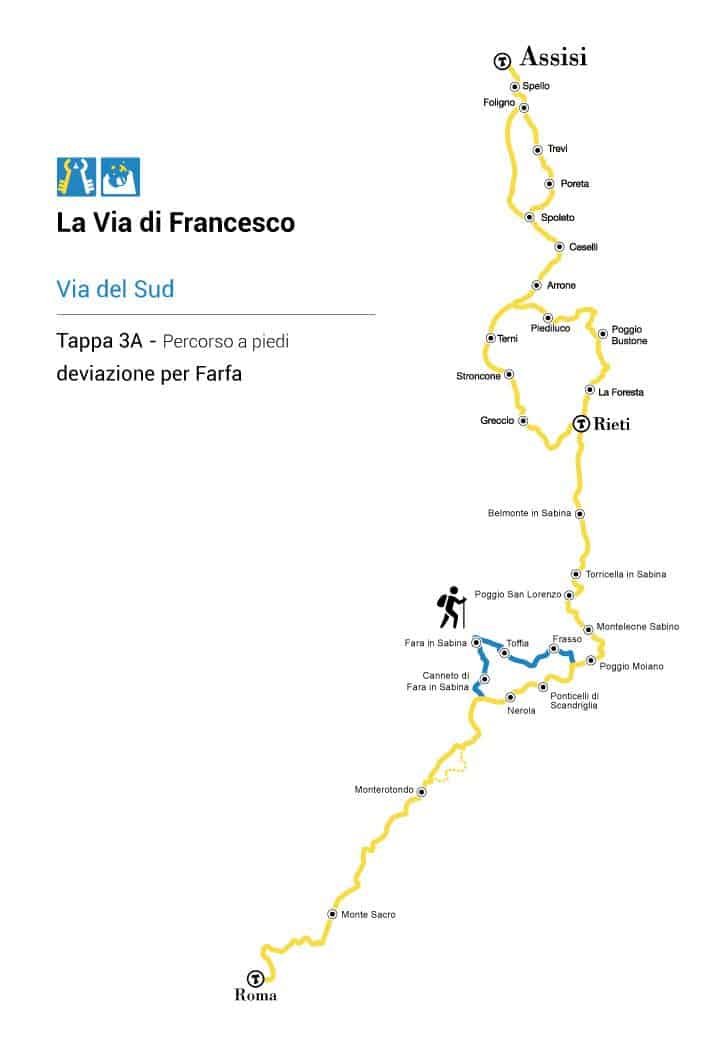
To the Franciscan presence also belongs the Oratory of the Stigmata, the church of a lay confraternity dedicated to the stigmata of Saint Francis, with frescoes by Vincenzo Manenti dedicated to the saint of Assisi. The theme is no accident: Toffia is one of the municipalities crossed by the Way of Saint Francis in Lazio, the route that descends from the Rieti Holy Valley toward Rome, and the memory of the saint's passage, which local sources place in the 13th century and which village tradition preserves without documents, has fed local devotion for centuries. In the Franciscan Oratory is also kept a Madonna among Saints Lucy, John the Baptist, Francis and a friar by the same Manenti, the painter who in the 17th century signed himself Sabinus pictor. Opening depends on the confraternity and the parish. Whoever wants to see them should ask in the village.
Santa Maria Nova, the church on the Colonna castle
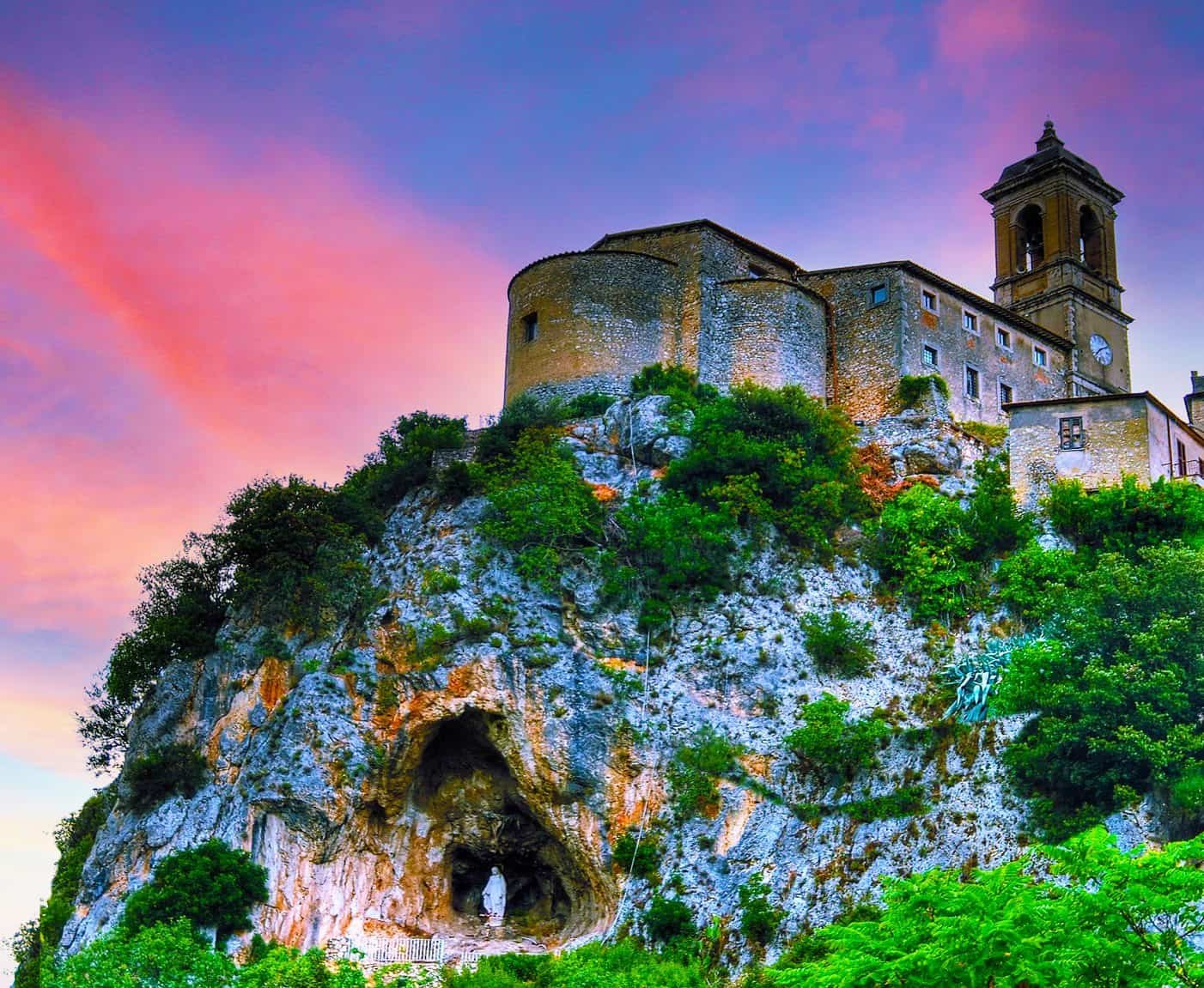
The highest point of Toffia is occupied by Santa Maria Nova, the parish church. It stands where the fortified palace of the Colonna was, and has absorbed its substance: the bell tower is the old keep of the castle repurposed, and the apse is carved out of one of its towers. The name comes from a chapel that existed inside the palace, Santa Maria in Castello. The sources give two dates that must be read together: an inauguration on July 2, 1507, which concerns the Renaissance layout, and the 17th-century reconstruction (a date of 1696 appears in the descriptions) that gave the building its present appearance. Born with a single nave, it was later divided into a central nave and two smaller ones, along which open four altars dedicated to the Madonna and to Saint Stephen.
There are three works to look for. The tondo with the Virgin and Child of the 15th-century Florentine school, an object that in a Sabina village is an anomaly and that bears witness to the ties of the local patrons with the Tuscan art market. The Virgin and Child from the school of Carlo Maratta, the man from the Marche who dominated Roman painting in the second half of the 17th century: a workshop attribution, not the master himself, but of quality. And the chapel of the Madonna del Carmelo, with frescoes by Vincenzo Manenti including a Saint John of Damascus that scholars compare with the Saint Gregory the Great painted by the same Manenti at Subiaco. The chapel was damaged by the earthquake of 1703 and restored. The church also keeps a valuable silver reliquary cross. In the little square in front, silos dug into the rock have been identified, used to store water or grain: the Colonna castle had to withstand a siege, and these are its reservoirs. From the churchyard the view runs over the Farfa valley as far as the hills of Fara in Sabina: it is the village's main viewpoint.
Via Montecavallo, Via Castel di Dentro and the houses of the notables
Coming back down the opposite side you cross the Colonna quarter, which has eloquent place names: Via Castel di Dentro recalls that here you were inside the castle proper, and on it faces Casa Orsini, from the 14th century, older than the palace of the same name and more severe. On Via Montecavallo stands Palazzo Palma, from the 17th century, the last generation of noble residences in the village, with a regular facade that already speaks the language of Roman baroque in a provincial version. Then look for Palazzo Bufalini, from the 16th century, and Casa Cappucci, from the 14th century, famous for its windows: mullioned and single-light stone windows that are among the best-preserved medieval elements of Toffia. This concentration of palaces on a handkerchief of hill can be explained only by the history of the division between the two houses and by the role as bishop's seat and seminary: Toffia had, for its demographic weight, many more notables than a village of olive growers would have deserved.
Also look at the corners of the houses at the tightest bends: many are rounded, blunted. It isn't decoration. It's the memory of the carts and pack animals that passed grazing the wall, and of the wheel axles that over the centuries wore down the stone. In some places you also see paracarri, stone blocks planted vertically at corners to protect the masonry from impacts. They are the traffic bollards of the 14th century, and they still work.
The Museo Maria Petrucci in Casa Raniero
In Casa Raniero, a 17th-century residence, is the seat of the Museo Maria Petrucci, the village's only museum. It gathers the wooden sculptures, the oil paintings and the collection of objects of peasant civilization by the artist Maria Petrucci, who tied her name to Toffia and has also exhibited abroad. It is a small museum, the kind visited in half an hour, and it is worthwhile above all for the dialogue between the sculptures and the house that hosts them: a little 17th-century palace with its ceilings and its stairs, inhabited by wooden figures. Visits are arranged with the town hall, which lists its existence among the places to see in the village without publishing fixed hours.
Sant'Alessandro and the stories of Saint Anthony
Off the main route, the church of Sant'Alessandro is another Franciscan piece: a rectangular hall with a single nave, of deliberate simplicity, which keeps a cycle of frescoes of 1611 with the stories of Saint Anthony. Restored for the Jubilee of 2000, it is usually closed. You see it on special openings. I point it out because it completes the picture: in Toffia the Franciscans had a convent, a confraternity oratory and a church of popular devotion, a presence for such a small village truly out of scale, which is explained by the position along the pilgrims' road between Rieti and Rome.
San Lorenzo, the patron's church outside the walls of Toffia
The tour closes outside the ring, on the little hill of Cacultiano, where stands the church of San Lorenzo Martire, the patron saint, celebrated on August 10. It is the most important building in Toffia and the one with the longest history. Tradition, unproven, has it built in the Lombard age on the remains of a temple of Janus. The foundation is in any case placed in the 10th century, the present structure is from the late 13th century, and in the 17th century the apse was rebuilt on a square plan. It is the church that, after the Saracen destruction of Forum Novum, was designated cathedral and second seat of the diocese of Sabina.
The facade is a small lapidary: walled into it are Roman and early medieval slabs with geometric and zoomorphic decorations, the two tabulae lusoriae with incised checkerboards, reliefs with togate figures and imperial portraits coming from tombs of the second century BC. Before going in, stop for 10 minutes to read this wall: it is the stratigraphy of the Sabina on a single surface, from the Roman tomb to the early medieval screen panel to the medieval portal. Inside, three fixed points. The chapel of San Sisinio, decorated in 1656 with figures of martyr saints and a scene of Saint Andrew with his executioners. The chapel of San Saturnino, rebuilt in 1782, with a painting of the martyrdom by Ferdinandus Henry, an 18th-century artist of whom little is known. And the high altar, with the canvas of the martyrdom of San Lorenzo by Vincenzo Manenti of Orvinio. San Lorenzo, the deacon martyred on the gridiron in 258, is patron of an enormous number of communities in Lazio, and his presence here is consistent with a devotional geography that ties the Sabina to the very ancient Roman Christian tradition. As with almost all the churches of the smaller villages, opening hours are not continuous: it often happens that you find the door closed outside service times, and it's best to inquire in the village.
Monte Carpignano and the Roman villa
Whoever still has legs and half an hour can look, in the countryside above the village, for the terraces in polygonal masonry of Monte Carpignano: walls of large limestone blocks fitted together without mortar, of the third manner according to the traditional classification, dated to the second century BC and built to support the ground of a Roman villa. They are the oldest visible remains in the territory of Toffia and belong to the same season as the Sabine villas of the Roman senators. There is no structured tourist signage: it's best to ask for directions in the village and bring country shoes.
Something nobody tells you about Toffia (RI)
Information on the monuments is found everywhere. The things that follow are rarely put in black and white, because they are learned by making mistakes, coming back several times and talking with the people who live here. They are divided into three blocks.
The village is not a service: it is someone's home
The first thing nobody says is the simplest and the most misunderstood. Toffia is not an attraction with hours, tickets and staff: it is an inhabited village in which daily life goes on independently of the visitor. This difference has very concrete practical consequences that it's better to know before leaving, so as not to go home disappointed, blaming the village for being closed.
Consequence number one: the hours are not tourist hours, they are village hours. In the afternoon, especially in summer, the village truly stops. It isn't laziness, it's an organization of agricultural work handed down: you work early, rest in the hot hours, resume in the late afternoon. Whoever arrives at half past two on a July afternoon will find everything closed and nobody on the street, and will conclude the village is dead. It isn't dead: it's sleeping, and at six it starts breathing again.
Consequence number two: the churches may be closed. The churches of small villages open for services and on particular occasions, because there is no staff to keep them open and supervised all day, and because unfortunately the theft of sacred furnishings in Apennine villages is a real and documented problem. If a visit inside San Lorenzo or Santa Maria Nova is a priority, the right way is to inquire in advance through the parish or the town hall, or to arrange the visit to coincide with service times. Just showing up is a gamble.
Consequence number three: the noise. In a stone village with narrow alleys, sound bounces impressively. A conversation at normal volume in an alley can be heard in five houses. A group of 15 people talking loudly at nine in the evening is, for those who live there, a small nightmare. You don't need to walk in religious silence, you just need to be aware that you are crossing the hallway of someone else's home.
Consequence number four, very practical: public restrooms in these villages are scarce or absent, and the cafes are few and with limited hours. Plan ahead. It seems a minor detail, but it's the thing that ruins more family days than you'd imagine. Consequence number five: the animals. In a Sabina village there are dogs, often loose in courtyards or following their owners, and the cats have an autonomous population with their own territorial hierarchies. Whoever travels with a dog on a leash should take that into account, and always pick up, because in an alley two meters wide any negligence is immediately visible and remembered.
The Toffia logistics nobody puts in writing
First thing: phone coverage and navigation. In the villages of the Sabine interior the signal can be patchy, especially inside the narrow alleys between thick stone walls and in the valleys where you descend toward the Farfa. The operational advice is trivial but effective: download the maps of the area in advance for use without a connection. And don't trust the navigator blindly for the last stretch: in all these towns the system tends to direct you into the historic center, onto alleys where a car physically can't pass or passes without being able to turn back. It is the most frequent error by far, and a sedan stuck under an arch is a spectacle that repeats itself in the Sabina with seasonal regularity. The golden rule: when the road starts to narrow and the paving becomes stone, stop and continue on foot.
Second thing: the provincial roads. They are beautiful and panoramic, but must be taken with the right mindset. They are narrow, with blind curves, without lighting, often with dry-stone walls or ditches instead of a shoulder. In harvest periods you meet tractors, three-wheelers and oil mill vans moving slowly and sometimes stopping wherever they happen to be. In winter, in the shaded stretches, there may be dampness or ice. Driving here means keeping a lower speed than the limit would allow, and staying wide in the curves without ever cutting them.
Third thing: hill weather. Toffia is at 262 meters, an altitude that is not mountain but not plain either, and it is exposed. This produces two phenomena that surprise those coming from Rome. The first is the temperature swing: the difference between sun and shade, and between afternoon and evening, is much more marked than in the city. A sweatshirt in your bag is useful even in May. The second is the wind: on the viewpoints and the high points it often blows, and even a moderate wind on a ridge completely changes the perception of temperature. In compensation, the same exposure gives an air quality and a sharpness of visibility that you don't find on the plain.
Fourth thing: the seasonality of services. Many businesses in the Sabine villages work on a seasonal basis or with reduced hours in the slow months. January and February, excluding the festival periods, are the quietest months by far. It isn't bad, quite the opposite: whoever loves empty places will find the village all to themselves. But you have to arrive equipped, because the probability of finding everything closed is high. Fifth thing: information ages. Hours, openings, festival dates, transport services: everything changes, and in small territories it changes without anyone updating the sites. Checking must always be done on the institutional channels of the town hall, the Pro Loco or the parish, and possibly a few days before departure.
The true value of Toffia, and why you understand it only by going back
Toffia has no masterpiece. There is no famous painting, no Gothic cathedral, no museum that justifies the trip on its own: the works of Manenti and the Florentine tondo are things for connoisseurs, not crowds. Whoever arrives with the mindset of a monument collector is left empty-handed, and indeed some online reviews of these villages say exactly that: pretty but nothing to see. They are right and they are completely wrong. They are right because there really isn't a single object to look at. They are wrong because the object to look at is the whole village, as an organism, and this kind of seeing requires a different training.
A village like this is read the way a text is read. The defensive structure speaks of the fear of a thousand years ago. The arches speak of scarcity of space and of earthquakes. The olive groves speak of the economy. The closed houses speak of emigration. The recent restorations speak of the return. The palaces speak of the rivalry between Orsini and Colonna. The worn steps say how many times that path has been walked. It isn't a list of attractions: it's a stratigraphy. Whoever learns to read it never goes home again saying there was nothing to see, in any village in Italy.
The second thing nobody says is that the value of Toffia is also in what is not there. There is no row of identical souvenir shops, no crush, no village turned into a set for visitors with the residents pushed out toward the outskirts. This balance is fragile and must not be taken for granted: many famous villages in Italy lost it within 10 or 15 years, becoming beautiful and empty. Toffia today is still on the right side of that line, and the way it is visited contributes, in a small way, to keeping it there.
Third thing: the silence. It isn't a figure of speech. On a midweek afternoon out of season, in the upper alleys of this village, the background noise falls to levels that people who live in the city practically never experience. You hear the wind in the olive trees, the bells, a distant dog, a radio from a window. Silence has a measurable physiological effect on people, and half an hour of this silence is worth more than many things we do to relax. It is, literally, a resource of the territory, and it makes sense to treat it as such.
Fourth thing: the oil is the real museum. It is the conclusion I reach every time I go back to the Sabina. The oldest and most continuous heritage of this territory is not a building: it is an agricultural practice with 2,000 years of uninterrupted history, which has shaped the landscape, determined local laws, molded the cooking and defined the cycles of social life. In Toffia almost every family owns a piece of olive grove, and the oil produced is still largely home oil, for family consumption and for relatives in the city. Visiting an oil mill in season, watching the milling, tasting the oil just pressed, green and pungent, is a historical experience as well as a gastronomic one. And it costs infinitely less than a museum ticket.
Fifth and last thing: it takes more than one visit. It's the least marketable advice there is, because nobody wants to be told that one trip is not enough. But it's the truth. The first time in Toffia you look, you get oriented, you take the obvious photos. The second time you begin to notice the details, you recognize the alleys, you choose the light better. The third time, perhaps falling on a festival or on a rainy day or at autumn sunset, the village opens up. It's the same mechanism that holds for music: a piece is understood on the third listen. We are talking about 55 kilometers from Rome, an hour by car or a regional train on the FL1. Going back isn't an undertaking: it's a choice.
My advice for visiting Toffia (RI)
The difference between a successful visit and a disappointing one in a village like this doesn't depend on what you see: it depends on how you see it. And method, in a village of a thousand inhabitants, counts more than any list of monuments. The main advice is this: do two loops, not one. The first loop is the outer loop, the second is the inner loop. It seems a banality and yet it is the key.
The outer loop is done as soon as you arrive, before even entering the village. You leave the car and walk the road that circles the perimeter. It takes a few minutes, and in those few minutes you understand the structure of the settlement better than you would in an hour inside the alleys. You see the curtain of houses closing in on itself, you see how the built-up area follows the curve of the hill, you see the gates and realize that they are few and open exactly where the terrain allowed. In very many similar villages the 19th- and 20th-century growth broke through the ring, opened breaches, backed buildings against the outside that erased the legibility of the structure. Here, through a combination of poverty, marginality and then protection, the ellipse has remained. Whoever makes the full loop sees the curtain of houses present itself as a single wall, tall, almost without windows on the lower levels: it is the sensation a traveler would have had in the year 1000, and it is one of the few truly authentic experiences a village can still offer.
It's worth explaining why that ellipse exists, because it isn't an aesthetic whim but a document. Take a hill with an elongated summit, not a round one. You have to protect a farming community with very limited resources: there's no money to build kilometers of proper walls, with towers, walkways and freestanding masonry. So what do you do? You use the houses. You build the outer ring of dwellings in aderenza, all attached, without a break, with the outer wall blind or pierced only by small openings high up. That wall becomes the curtain wall. The cost of defense is spread across the families, who had to build a house anyway. Every owner is, in effect, the maintainer of a stretch of wall. This is the so-called borgo-recinto, a type that is very common in inland Lazio and in Umbria. The perimeter follows the contour lines of the hill, and since the hill is elliptical, the settlement is elliptical. Inside the ring, the alleys are not a random maze but a spiral system that climbs toward the highest point, where military power, the Colonna castle, and religious power were located. Anyone who came in with hostile intentions had to climb along narrow, forced routes that were easy to defend, under fire from whoever held the summit.
The inner loop comes afterward, entering by Porta Maggiore and leaving on the other side, but without choosing a route: let the slope guide you. The practical rule is very simple: at a fork, take the road that goes up. Sooner or later you reach the top, at Santa Maria Nova. To come back, always take the one that goes down, and you're bound to get out. In a spiral village you never really get lost, you only get lost enough to enjoy it.
The second piece of advice concerns pace. Toffia is not a museum with a set route, it's a lived-in town. The number of interesting things you see is directly proportional to how slowly you walk. Three compulsory stops, not geographical but behavioral: sit at least once on a step in the shade of an arch and stay still for five minutes. Stop in piazza Lauretana and look at the space, not the facades, that is, observe how the square is organized around the church and the marble. And look out from the churchyard of Santa Maria Nova toward the valley, staying until you can make out at least three different villages on the hills opposite. That last one is a sort of game, but it works: when you start to recognize the profiles of the other towns, you've understood that these villages are a visual system, they look at one another, and in the Middle Ages they signaled to one another.
Third piece of advice, and this is the one almost nobody follows: talk to someone. In a village of a thousand residents, the person sitting on the bench or the shopkeeper closing up know things you won't find on any website. You don't need to conduct an interview: a greeting and a real question are enough, something like: excuse me, is this church open? or: where is the view best? Nine times out of 10 the person who answers will tell you something else as well. That's how you learn half of what there is to know. Mind your manners, though: walking into a small town with the camera on and a loud voice is the best way to get every door closed on you. Here, discretion is the currency.
Fourth piece of advice: pair Toffia with something else. On its own it's a morning or an afternoon, not a full day, and anyone who tries to fill eight hours with it ends up bored and then writes ungenerous reviews. The most logical and most beautiful combination is with the Abbazia di Farfa: half a day in the village and half at the monastery, with lunch in between. Alternatively, for those interested in the farming and production side, an olive mill in season or the olive oil museum of Castelnuovo di Farfa. If you're traveling with someone who loves walking more than sightseeing, the perfect day is the village in the morning and the gole del Farfa in the afternoon, with the coolness of the canyon to close the day. If you want a guide who really knows this belt of hills, and a car with a driver to fit three villages into one day without worrying about parking, you can contact TourLeaderPro, which organizes professional tour guiding and private tours starting from Rome.
Fifth piece of advice, on timing. Two windows work better than the others. The first is early morning, between eight and 10: the village is alive, people are out, the alleys are in shade, the light is low and the colors of the stone are warm. The second is late afternoon, the hour and a half before sunset: the Tiber valley fills with golden haze, the olive groves turn from green to silver, and the viewpoints are at their best. The middle hours, especially in summer, are the worst: flat light, heat, a closed town, people indoors. If you arrive at noon, use that time to eat and set out exploring again when the air cools.
Sixth piece of advice, on eating. The Sabina is a land of honest, humble cooking: legumes, soups, bread, white meats and mutton, and of course olive oil, which here is not a condiment but an ingredient. Bruschetta with new oil, in season, is literally the signature dish of the area, and it should be tried where the oil comes from the producer. Always book: in these towns there are few seats, and a group that turns up unannounced on a Sunday at noon risks going without. Seventh and last piece of advice: buy something, and buy it here. Not out of romanticism, but for a practical reason. The economy of villages like Toffia rests on very thin margins, and the difference between a town that stays alive and one that empties out is made of thousands of small purchases. A bottle of Sabina DOP extra virgin olive oil bought directly from the producer, a jar of olives, a bakery product: these are things you take home and that, unlike souvenirs, actually end up on the table.
Vincenzo Manenti and the painters who worked in Toffia
If Toffia has an artist, it's Vincenzo Manenti. Born in 1600 in Canemorto, today's Orvinio, on the other side of the Sabine Mountains, he trained in Rome in the workshop of the Cavalier d'Arpino and then with Domenichino, that is, at the very center of Roman painting in the early 1600s, between late Mannerism and Bolognese classicism. Around 1622 he returned to the Sabina and stayed there for the rest of his life, working for the Orsini and Colonna families, for the Benedictine abbeys and for the parishes of dozens of towns: a provincial painter's career that was chosen, not endured, which earned him the nickname Sabinus pictor. He died in Orvinio in 1674. In Toffia he worked between 1650 and 1656, and left the canvas of the martyrdom of Saint Lawrence on the high altar of the patron saint's church, the frescoes of the chapel of the Madonna del Carmelo in Santa Maria Nova, with the Saint John Damascene, the stories of Saint Francis in the Oratorio delle Stimmate, and the Madonna among Saints Lucy, John the Baptist and Francis in the Franciscan Oratory.
For those who want a judgment and not a list: Manenti is a competent painter, up to date on Roman models, capable of large altarpieces readable from far away, and precisely for this reason useful for understanding how the painting of the capital reached the towns of the Apennines. He is not a genius and you don't go looking for him for a striking aesthetic thrill. You go looking for him to understand the 1600s in the Sabina, its devotion, its commissions, its wish to look like Rome. Anyone who has seen him in Subiaco, Rieti or Orvinio will find in Toffia a coherent stop on that route. Anyone who doesn't know him will discover that art in the Sabina did not end with the Middle Ages.
Before him, the 1400s brought to Toffia Jacopo da Roccantica, a pupil of Pietro Coleberti, with the Nativity of the San Bernardino complex, and an unknown Florentine master, with the tondo of the Virgin in Santa Maria Nova. After him, the 1700s left the painting of the martyrdom of Saint Saturninus by Ferdinandus Henry in San Lorenzo, and the school of Carlo Maratta the Virgin and Child in the parish church. Four centuries of painting in a town of a thousand residents: that's not a little, and no general guidebook says it.
Another well-known fact, yet rarely cited
That the Sabine villages were born as castles of the abbey of Farfa is said by every information panel. What almost nobody mentions is that to understand a town like Toffia, you have to look at the world from the point of view of a peasant around the year 1000. His world had a center, and that center was not Rome: it was the abbey. From there came the rules, the calendars, the prices, the rulings, the famines and the relief. There the documents were kept that said who owned what. There were the library and the scriptorium, the only place within days of walking where anyone could read and write professionally.
The Regesto di Farfa, the great collection of documents compiled by the monks to keep a record of the abbey's rights and properties, is one of the most extraordinary documentary corpora of the European Middle Ages. It isn't a book of stories. It's an archive of contracts, donations, exchanges, lawsuits. But precisely for this reason it's a mine, because it gives back the names of ordinary people, field boundaries, land prices, disputes between neighbors. It is the source in which Toffia appears for the first time, in 940, as castello de Tophila, and it's the kind of source that lets us reconstruct how the communities of these hills really lived. Thanks to Farfa, the Sabina is one of the best documented medieval territories in Italy. Very few places can say as much.
This produced a very particular sacred geography. The castles of the Farfa fief were not simply towns near a monastery: they were nodes of a network that had a physical and symbolic center. Processions, fairs, labor obligations, pilgrimages, everything converged toward the valley floor where the abbey stands. Even today, from the churchyard of Santa Maria Nova, looking toward the depression where the Farfa flows, the logic is clear: the monastery is below, protected, in a secluded hollow, while the castles are above, in view of one another. A network of mutual surveillance with a hidden center. There is one more element: the abbey was imperial, legally dependent on the emperor and not on the pope. In a territory 50 kilometers from Rome, this means that for centuries the papacy had on its doorstep a landed power that did not obey it, and the history of the medieval Sabina is in large part the history of this tug of war. Today the Farfa complex preserves the basilica, the cloister, the library and a small village of little houses that once hosted a merchant fair. If you go, try to read that little village as a 1500s shopping center, because that is exactly what it was. Castelnuovo di Farfa carries the link in its name and hosts an olive oil museum among the most interesting in inland Lazio. Montebuono, farther north, preserves Roman memories and traces of early Christianization. All these towns should be read together, as pieces of a system, not as independent stops.
The olive groves and the landscape of Toffia: Sabina DOP
What you see from the viewpoints of Toffia is not nature. It's a cultural landscape, built, maintained and modified by people for 2,000 years. The terraces held up by dry-stone walls, the service paths between the olive groves, the scattered farmhouses, the tapped springs: all this is ancient agricultural infrastructure. The olive trees did not grow there by chance, they were planted, grafted, pruned and tended by generations who handed down precise technical knowledge. Some specimens in the lower Sabina have an age measured in centuries and circumferences that take several people to embrace. The olivone di Canneto, in the nearby municipality of Fara in Sabina, is considered one of the oldest trees in Europe.
From here comes Sabina DOP extra virgin olive oil, which was among the first protected designations of origin recognized in Italy for oil. The traditional cultivars of the district, including Carboncella, Leccino, Frantoio, Raja and Rosciola, give an oil with a recognizable profile: medium fruity, with grassy and artichoke notes, a bitterness and a pungency that are present but balanced, never aggressive. It's a table oil more than one for elaborate cooking, the kind you put raw on a bruschetta and need nothing else. In Toffia, where almost every family has its own olive grove, the November harvest is still a collective affair: the nets spread out, the ladders, the sacks taken to the mill, the first bruschetta with oil fresh out of the press. If you want to truly understand the area, find a way to be here in those weeks: a visit to an olive mill in season is worth more than three museums.
The right photo to take in Toffia (RI)
In a village like this the temptation to shoot a thousand identical pictures is very strong, and the result, back home, is a folder full of indistinguishable alleys. I'll tell you where the real photo is, and above all why it's there.
The right photo in Toffia is only one, and it's not the panorama. It's the arch. Not a generic arch: an arch that spans an uphill alley, shot from below, so that the frame is divided into three bands. At the bottom the shiny paving, reflecting the light. In the middle the dark band of the covered passage. At the top, beyond the arch, a piece of sky or an illuminated wall. This three-band structure is what makes the photograph readable: a foreground, a tunnel and a bright escape route. It's exactly the composition that painters called repoussoir, that is, a dark element in the foreground that pushes the eye toward the bright background. The moment when this photo works best is when there is direct sun on the upper part and shade on the lower part, that is, mid-morning or mid-afternoon. At noon the sun enters the alley vertically and flattens everything. With an overcast sky the contrast is lost and the image turns gray. After rain, run: the wet paving reflects and the lower band of the frame lights up.
A technical tip, for those shooting with a phone: tap the screen on the lit area at the back, not on the dark one in the foreground. Left to itself, the phone tries to brighten the shadows and irreparably blows out the bright part. By exposing for the highlights, the shadows stay deep and the image gains the drama that is typical of stone villages. Then, in post-production, lift the shadows slightly: you can recover from darkness, you can't recover from blown-out white.
The second photo is the profile of the village from the outside. Driving along the Farense provincial road there are one or two points where the road makes a bend and the town appears from the side, on the ridge, with the olive groves in the foreground and the tower-like bell tower of Santa Maria Nova as the pivot. It's the photo that explains the geography: you understand that it's a village on a hill, that the built-up area is compact, that the relationship with the countryside is direct. The best moment is late afternoon, when the low sun sculpts the volume of the houses and the olive trees turn bright silver. Stop at a safe spot, never on a bend, and use a telephoto lens or a moderate zoom: the wide angle shrinks the village and makes it insignificant, while a longer focal length compresses the planes and makes the olive groves look pressed against the houses, which is exactly the true relationship between the town and its land.
The third photo is the panorama over the valley of the Farfa and the Tiber from the churchyard of Santa Maria Nova. It's the easiest to take and the hardest to make interesting, because vast panoramas are boring if they have no subject. The solution is always the same: put something in the foreground. An olive branch, a stone parapet, a railing, the corner of a house. You need an in-focus element close by to give depth, otherwise it stays a strip of hills that anyone could have photographed anywhere. The golden moment is the hour before sunset, when the haze of the valley becomes light.
The fourth photo, the one I care about most and that almost nobody takes, is the detail. Toffia is full of details that tell more than a panorama: the Roman checkerboards on the facade of San Lorenzo, the Guelph windows of Palazzo Orsini, the mullioned windows of Casa Cappucci, the holes of the drawbridge at Porta Maggiore, an iron ring set into the wall to which animals were tied, a wooden door worn by the sun, steps hollowed in the middle by millions of footsteps, a pot of geraniums on a stone windowsill. Take at least five photos of this kind. They're the ones that, looking back through the folder six months later, really take you back to that alley.
A word on photographic etiquette, which in a lived-in village is not a detail. The windows of the houses are a meter from the alley: pointing a lens into a window is walking into someone's home. The elderly people sitting on the benches are not pieces of folklore: to photograph them, you ask, and you accept a no. Drones, where they're not banned, are still an acoustic violence in a place whose main value is silence, and in many settings they require authorization: find out beforehand and, in any case, avoid flying a motor over people's heads during a festival or a religious service. One last, counterintuitive suggestion: keep the camera in your pocket for the first quarter of an hour. Whoever starts shooting as soon as they arrive sees the village through a rectangle and ends up photographing the obvious things. Whoever walks first and shoots afterward already knows where the lights, the best arches and the glimpses are.
The festivals of Toffia (RI): San Lorenzo, Ferragosto and winter
The town's calendar revolves around two dates in August. August 10 is the feast of the patron saint, San Lorenzo, with the procession and celebrations in the church outside the walls, coinciding with the night of the shooting stars that popular tradition links to the saint's tears. At Ferragosto, for more than 20 years, Toffia has hosted its main festival, a street event that brings actors, musicians, craftspeople, jesters and dancers into the alleys and squares: the village becomes the set of itself, and the audience doesn't watch a show from a seat but walks inside it, climbs the alleys, enters the spaces. A medieval village with narrow alleys, arches, cellars, stairways and stone doorways is already, by itself, the perfect reconstruction of an ancient village: there's nothing to build, you only have to switch on again what's there. The cellars and storerooms that stay closed in daily use are opened. The costumed performers and organizers are in large part the residents themselves.
The social dimension of these festivals is what interests me most. An event like this takes months of preparation, dozens of meetings, costumes, logistics, rehearsals. In a town of a thousand residents it means that practically everyone is involved in some role. The festival is, in these villages, the social infrastructure that holds together a community that would otherwise be fragmented among those who stayed, those who moved down to the valley and those who return only on weekends. It's the moment when the town puts itself back together. The same holds true, on a smaller scale, for the other occasions in the calendar, the processions, the initiatives of the Pro Loco and the town band, the Christmas events that enliven December and the Epiphany throughout the Sabina. The exact dates change from year to year: check them on the municipality's website and on the Pro Loco's channels before setting out.
A tip for those coming to an evening event, in summer or winter: dress warmer than you think. Toffia is on an exposed hill, and in the evening the air coming down from the Sabine Mountains is sharp even in August. The audience stays on its feet, outdoors, for a couple of hours, often standing still in a line in an alley. Anyone who shows up in a city jacket regrets it within 20 minutes. And the light of fire and lanterns on a bare stone wall does something that electric light never does: it reveals the grain, every irregularity of the masonry, every chisel mark. You suddenly realize that those houses were made by hand, stone on stone.
Some important events that happened here in history
A reasoned chronology, with the degree of certainty of each fact, because in such a small town tradition and documents constantly mix.
Around 1200 BC. In the Cerreto area lives a Middle Bronze Age community, whose settlement was excavated in 1969 and which local studies identify with the ancient Suna of the Aborigines. The excavation is documented, the identification hypothetical.
2nd century BC. A Roman villa with terraces in polygonal masonry is built on Monte Carpignano. In the same period date the tombs from which come the slabs with checkerboards and the reliefs set into the facade of San Lorenzo. Documented by the remains.
897. Local sources record the construction of the settlement of Tophia (aedificata Tophia). A scholarly tradition based on Farfa documents.
Early 10th century and 940. The castrum Tophiae appears among the possessions of the abbey of Farfa. In 940 the Regesto of Farfa names the castello de Tophila. Documented.
9th-10th century. After the Saracen destruction of Forum Novum (Vescovio), the church of San Lorenzo is raised to cathedral, the second seat of the diocese of Sabina. Reported by diocesan and local sources. The exact chronology cannot be pinned down.
1219. Pope Honorius III, the Roman Cencio Savelli, visits Toffia. It is the year in which the pope stays for a long time in the Sabina and the Rieti area. Reported by local sources.
1200s. Passage of Saint Francis of Assisi, hosted by the town according to local memory, which is at the origin of the early Franciscan presence and of Toffia's inclusion in the Way of Saint Francis. Tradition.
Late 1200s. The present structure of the church of San Lorenzo is built. Dating from scholarship.
1400s. Saint Bernardino of Siena founds, according to tradition, the Confraternity of the Gonfalone. Jacopo da Roccantica frescoes the Nativity in the San Bernardino complex. The Orsini build their palace near Porta Maggiore, while the Colonna hold the castle at the summit. Tradition for the saint, stylistic attribution for the fresco, documented for the palaces.
July 2, 1507. Inauguration of the church of Santa Maria Nova on the site of the Colonna castle. Documented.
1611. Frescoes with the stories of Saint Anthony in the church of Sant'Alessandro. Documented by the date.
1637. Pope Urban VIII grants Toffia the abbatial seminary of Farfa. Documented.
1650-1656. Vincenzo Manenti works in the town's churches. In 1656 the chapel of San Sisinio in San Lorenzo is decorated. Documented.
1685. Pastoral visit of May 24, of which the records survive. Documented.
1696. Date given for the reconstruction of the parish church. Documented by descriptions, to be read together with 1507.
1703. The great earthquake of the central Apennines damages the chapel of the Madonna del Carmelo. Documented.
1782. Reconstruction of the chapel of San Saturnino in San Lorenzo. Documented.
1798. Pope Pius VI, a prisoner of the French and sent into exile, is greeted by the people of Toffia according to the town's memory. Local tradition. The itinerary of the papal exile is the subject of differing reconstructions.
1923 and 1927. Toffia passes from the province of Perugia to that of Rome and then to the new province of Rieti. Documented.
1969. Excavation of the protohistoric settlement of Cerreto. Documented.
1984. A fire hits one of the town's churches, followed by restoration. Reported by local studies.
October 29, 1997. Presidential decree granting the coat of arms and the gonfalone. Documented.
2000. Restoration of the church of Sant'Alessandro for the Jubilee. Documented.
Who has passed through Toffia (RI)
When you write about who has passed through a small village, the temptation is to hunt for the famous figure, perhaps forcing things a little. Here the names exist, and I give them with their degree of certainty. But first it's worth describing the categories of people who crossed this hill over the centuries, because they are the ones who left the marks you can see.
The popes and saints who passed through Toffia
The highest name is that of Pope Honorius III, whom local sources say visited Toffia in 1219. It's a plausible date: Honorius III, the Roman Cencio Savelli, in those years moved often between Rome and Rieti, the city that the popes of the 1200s used as a summer residence and as a refuge, and the road between the two passed through the Sabina of Farfa. To the same period belongs the tradition of the passage of Saint Francis of Assisi, who left documented traces in the Holy Valley of Rieti, at Greccio, at Fonte Colombo, at Poggio Bustone, and whom Toffia's memory holds to have been a guest of the town. No document proves it, but the very early Franciscan presence and the oratory of the Stimmate say that the community has believed it for eight centuries. In the 1400s tradition has Saint Bernardino of Siena pass through here, the great preacher who traveled central Italy founding confraternities: in Toffia he is credited with the Compagnia del Gonfalone. Finally Pope Pius VI, the pontiff deported by the French in 1798 and dead in exile at Valence the following year: local memory recalls the people of Toffia who greeted him as he passed. Tradition, once again, but tradition that says something true about the town's position along the roads between Rome and the north.
The monks and Gregorio di Catino
The first regular passersby were the monks. Not so much those enclosed at Farfa, but those who moved around: the procurators, the cellarers, the administrators who toured the abbey's holdings to collect rents, check boundaries, draw up contracts. They were, in essence, the officials of an early medieval landholding multinational. They arrived on horseback or on foot, stayed in the homes of local representatives, wrote. Among them one deserves a precise mention, Gregorio di Catino, the monk who between the end of the 11th and the beginning of the 12th century compiled the Regestum Farfense, collecting and transcribing thousands of documents from the abbey archive, including those that name Toffia. It's thanks to him that the medieval Sabina is one of the best documented territories in Europe. We don't know if he set foot in every castle of the fief, but we know for certain that he handled the papers concerning these lands. Anyone who studies the history of these places today does so walking behind him.
The painters: Jacopo da Roccantica and Vincenzo Manenti
Two artists worked here, by documentation or by attribution. Jacopo da Roccantica, born around 1410 and a pupil of Pietro Coleberti, to whom the Nativity of San Bernardino is attributed. And Vincenzo Manenti from Orvinio, who between 1650 and 1656 painted for San Lorenzo, Santa Maria Nova and the Franciscan oratories, and who is, in effect, Toffia's official painter. An artist who stays six years in a town of this size doesn't come by chance: he comes because the confraternities, the barons and the seminary pay, and this says how much Toffia counted in the Sabina of the 1600s.
The pilgrims and today's walkers
Then there are the pilgrims. The Sabina is crossed by very ancient routes: the Salaria, one of the oldest roads in Italy, which owes its name to the salt trade between the Tyrrhenian and the Adriatic, and the routes that ran down from central Italy toward Rome. Whoever was heading to the city of the popes passed through here, and the villages along the ridges offered shelter, water and food. They were not tourists: they were people who walked for weeks, often in very harsh conditions. Hospitality toward the wayfarer was a codified religious duty, and the monastic and Franciscan communities made it a mission. The pilgrims have not ended: Toffia is today one of the municipalities crossed by the Way of Saint Francis in the Lazio stretch between the Holy Valley of Rieti and Rome, and in spring and autumn you meet walkers in the alleys with backpacks and scallop shells, headed to Farfa and then toward the capital. If you want to walk a stretch of it, you'll find in the town a natural rest stop, with water and shade, and on the paths around it the signs of the Way.
The shepherds, the farmers, the emigrants
The most many and most invisible category: the transhumance shepherds. For centuries the flocks have followed the drove roads that connected the Apennines to the plains, and the Sabina was a land of passage and winter pasture. The shepherds arrived in autumn, stayed, left again in spring. They brought wool, cheese, news and words: many expressions of the Sabine dialect and many cheesemaking techniques traveled along those routes. Then the farmers and olive growers, the category that shaped the physical form of the village most: whole generations of families born, raised, married and dead within this elliptical perimeter, cultivating the same terraces, pruning the same trees, repairing the same houses. They are the ones who built the arches, wore down the steps, set the iron rings into the walls, dug the cellars. The history of vernacular architecture has no signatures: it is the anonymous sum of thousands of practical decisions made by people who didn't think they were doing architecture. And yet the result is what today makes people cross half a region to see it.
And the emigrants, the painful category. Between the late 1800s and the 1900s, like the whole central Apennines, the Sabina saw a great many people leave. First toward the Americas, then toward northern Europe, then toward Rome. The houses closed for decades in the historic center are the most eloquent monument to that hemorrhage. It's a story that makes no folklore but that explains why the town emptied out, why so many buildings have come down to us unrenovated, and paradoxically why they are so authentic today: poverty was, in spite of itself, the best landscape protection.
The travelers, the scholars, the new residents of Toffia
The Grand Tour travelers, or rather those who strayed from the canonical routes: the classic itinerary of northern European travelers between the 1700s and 1800s aimed at Rome, Naples and Sicily, but a minority of landscape painters, amateur archaeologists and learned churchmen went up the Tiber valley and the Sabina in search of ruins, antiquities and that landscape of hills, olive trees and hilltop villages that had become a pictorial genre in itself. The scholars: the Sabina of Farfa has been the subject of continuous historical and archaeological research for over a century, and among the names who tied their work to this territory one should recall Cardinal Alfredo Ildefonso Schuster, who before becoming archbishop of Milan was a Benedictine monk and devoted to Farfa a historical monograph, L'imperiale abbazia di Farfa, which has remained fundamental. An artist, Maria Petrucci, chose Toffia for her wooden sculptures and left them in Casa Raniero, where the museum now bears her name. And finally the newcomers: in recent decades the villages of the lower Sabina have attracted Romans looking for a second home, foreigners, above all northern Europeans and Anglo-Saxons, who have bought and restored properties, artists and craftspeople who have found here spaces and rents unthinkable in the city, families who chose to live outside the metropolis while staying connected to it thanks to the railway. It's an ambivalent phenomenon: it has brought resources, restorations and vitality, but it raises the problem of the balance between long-time residents and new owners, between lived-in houses and houses used a few weeks a year. If you want to compare this human stratification with that of other nearby villages, look at Casperia and Roccantica: three very close towns, with the same general history and three very different urban and social outcomes. For the wider frame of the region, the ItalyPlanner page dedicated to Lazio collects guides, villages and day trips from Rome in English.
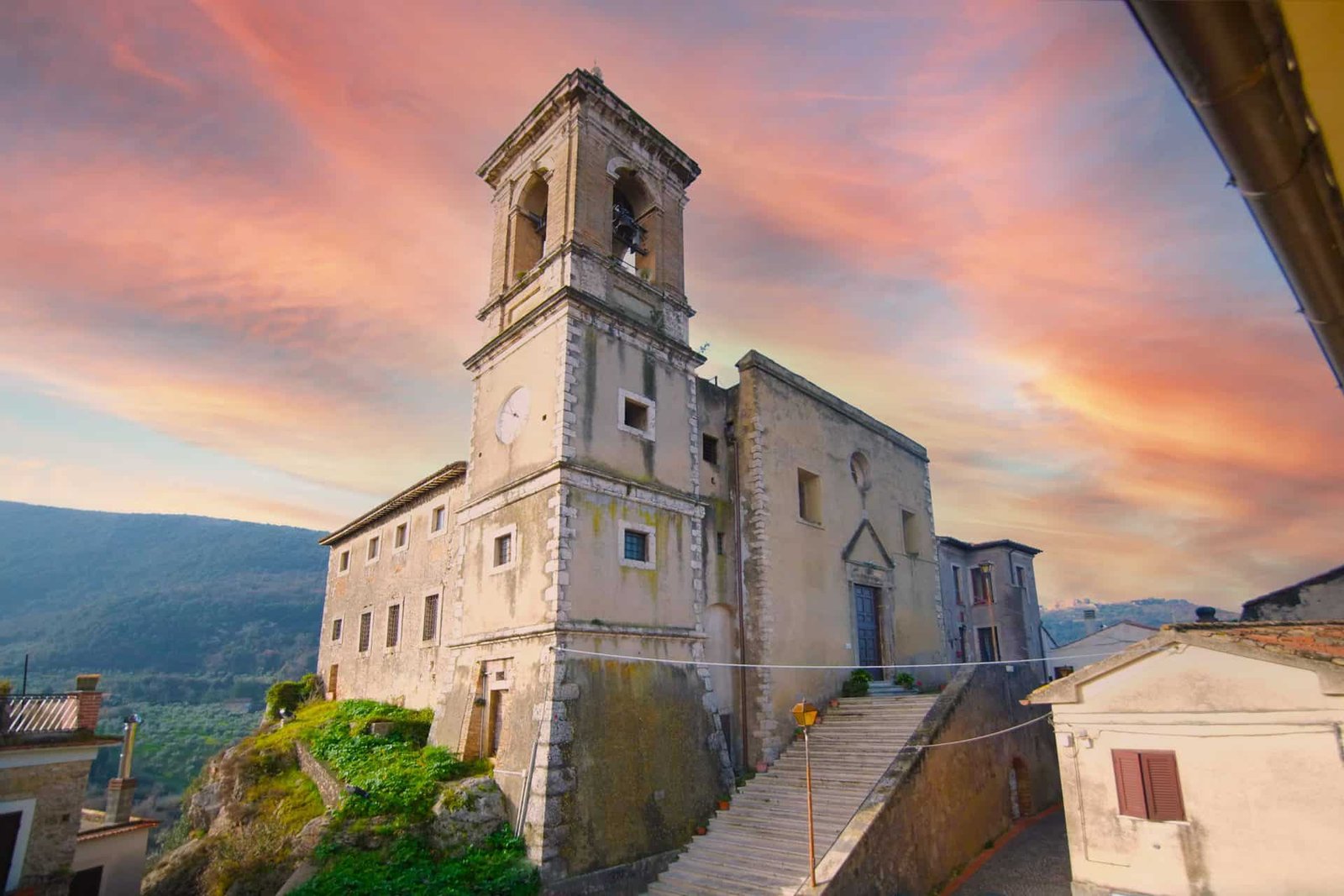
Toffia with kids, accessibility and costs
With children Toffia works better than you'd think, as long as you turn the visit into a game: the hunt for Roman fragments (the oval marble, the lion, the checkerboards on the facade of San Lorenzo), counting the arches, looking for the drawbridge holes at Porta Maggiore, the spiral climb with the rule of always taking the road that goes up. The alleys without traffic are safe. The worn steps and the low parapets of the viewpoints call for attention with the little ones. There are no playgrounds in the historic center. The countryside around and the gole del Farfa are the outlet for an afternoon.
Accessibility needs to be stated clearly, because hiding this fact helps no one. A sloping medieval village with stone paving, steps and narrow alleys is objectively difficult for those with mobility problems, for wheelchairs and for strollers. Some parts are passable, others are not. Via Porta Maggiore and Palazzo Orsini can be reached on a moderate slope. The climb to piazza Lauretana and to Santa Maria Nova is demanding. If you're traveling with someone who has difficulty moving, aim for the perimeter band and for the viewpoints reachable without tackling the hardest climbs, and consider pairing the day with easier places such as Poggio Mirteto or the area of the Abbazia di Farfa, which is flat.
The costs are the strong point: entry to the village is free, the churches are free, parking along the outer road is not paid, the museum can be visited on request. The real expense of the day is lunch and, in season, the oil to take home. A Toffia plus Farfa day for a family of four, with lunch at a trattoria, costs less than a morning in a Roman museum.
What's around Toffia (RI) within a 10-minute radius
The geographic logic is very clear, and Toffia alone is worth a morning but the Sabina is worth a weekend. Six kilometers away is the Abbazia di Farfa, the historic center of gravity of the whole territory, with the basilica, the cloister, the library and the little monastic village of Farfa that formed around it. A little farther on is Fara in Sabina, with its viewpoint, the civic archaeological museum and the olivone di Canneto. Downhill you reach Poggio Mirteto, the service center of the area, with the station and a notable 1700s square. On the other side of the Farfa, Castelnuovo di Farfa hosts the olive oil museum. Heading north you reach Casperia, another concentric-plan village that is entirely pedestrian, and Roccantica, perched beneath the Sabine Mountains with the frescoes of Santa Caterina. If you have a whole day and like walking, include the gole del Farfa, where the stream that gives the abbey its name carves a green canyon that in summer is a blessing. Along the Tiber, the reserve of Nazzano Tevere-Farfa is the right place for waterbirds and for a flat walk. To the east, Orvinio, Manenti's town, and Collalto Sabino close the arc of the Sabine Mountains.
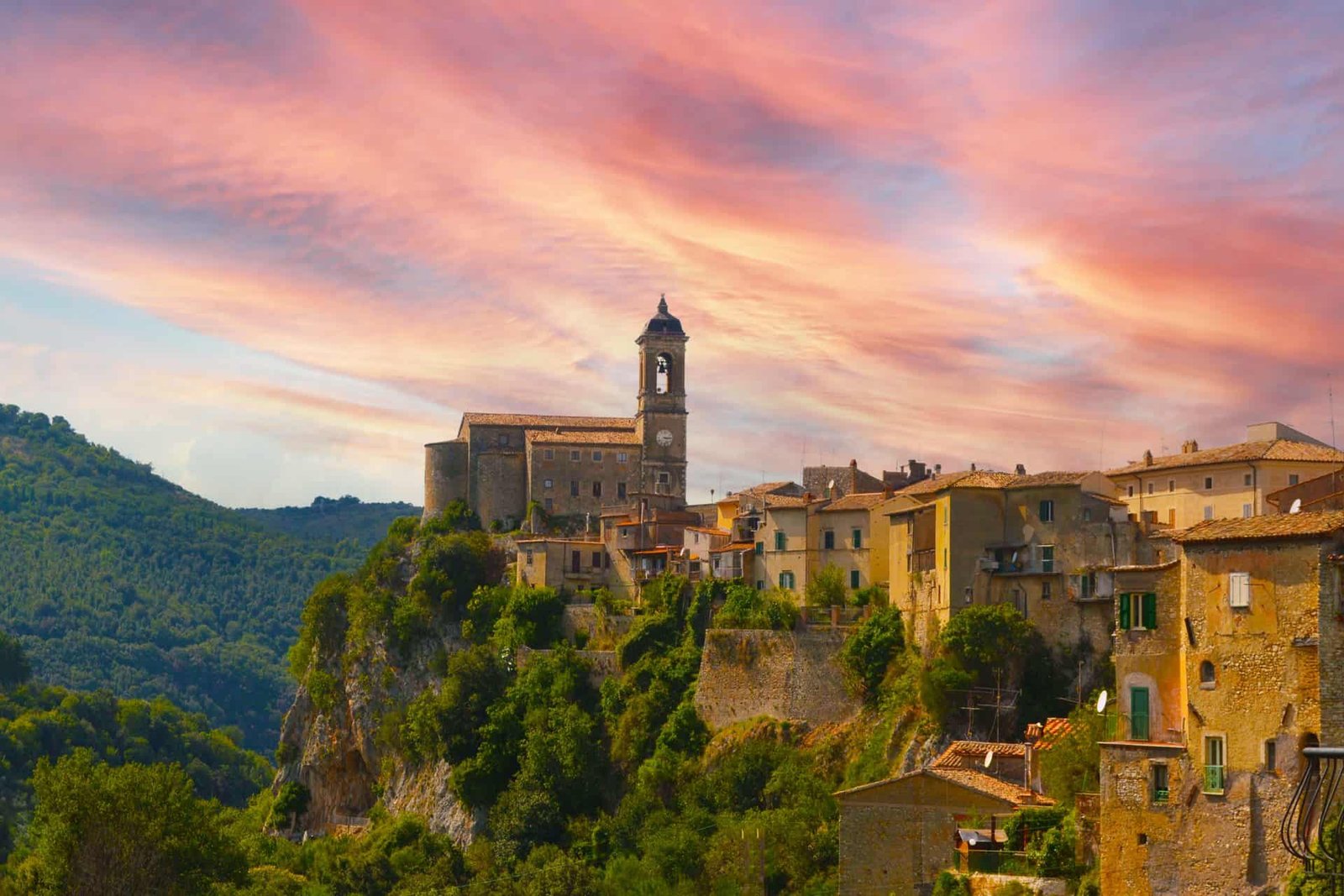
What to eat in Toffia and the lower Sabina
The cooking here is that of the farming Sabina, and it has three pillars. The Sabina DOP oil, already mentioned, which is eaten raw on bruschetta and on everything else. The frascarelli, a rustic dish of flour worked into small irregular lumps with water, cooked like a coarse polenta and dressed with oil, vegetables or cheese, which is the humble dish par excellence of these towns and which few restaurants outside the Sabina know. And the pizza fritta, bread dough fried in oil, sweet with sugar or savory, which shows up at all the town festivals. Around these, classic Apennine cooking: legumes and soups, lamb and abbacchio, pecorino, family-made cured meats, homemade egg pastas. The wine is brought in from the neighboring hills, and it isn't the strong point: here you drink oil, so to speak. In the village and the towns around there are few trattorias and on Sundays they fill up. Booking is essential, and prices should be asked by phone because they change.
Quick questions about Toffia (RI)
Where is Toffia and in which province?
Toffia is in the province of Rieti, in Lazio, in the lower Sabina, at 262 meters above sea level on the last spur of the Sabine Mountains, overlooking the Farfa valley. It borders Castelnuovo di Farfa, Fara in Sabina, Nerola and Poggio Nativo.
How far is Toffia from Rome?
About 55 kilometers by road via the A1 with the exit at Fiano Romano, the Salaria and the Farense provincial road. It's an hour to an hour and a quarter of travel. As the crow flies it's about 40 kilometers.
How do you get to Toffia without a car?
By regional train FL1 from Roma Tiburtina, Ostiense or Trastevere to Poggio Mirteto Scalo or to Fara in Sabina-Montelibretti, then by a Cotral bus toward the hill towns or by taxi. Bus times should be checked on the Cotral website the day before, and on Sundays there are very few runs.
How much does it cost to visit Toffia?
Nothing. The village is freely accessible, the churches are free when they are open, and parking along the outer road is not paid. The Museo Maria Petrucci can be visited on request.
How much time do you need to visit Toffia?
Two or three hours for the outer loop, the spiral climb to Santa Maria Nova, the descent and San Lorenzo outside the walls. With the Abbazia di Farfa and a lunch you fill a whole day.
Where do you park in Toffia?
In the spaces along the road that runs around the walled perimeter, outside the village. You don't enter the historic center by car. The alleys don't allow it and the GPS, if left to its own devices, takes you straight under an arch.
Are the churches of Toffia open?
Not on continuous hours. San Lorenzo, Santa Maria Nova and the Madonna di Loreto open for services and on particular occasions. For an interior visit it's best to phone the municipality (0765 326032) or the parish a few days ahead.
What should you absolutely see in Toffia?
Porta Maggiore with the drawbridge holes, Palazzo Orsini with the Guelph windows, the arches over the alleys, piazza Lauretana with the Marmo di Piazza and the church of the Madonna di Loreto, Santa Maria Nova with the bell tower made from the keep of the Colonna castle, and the facade of San Lorenzo with the walled-in Roman checkerboards.
Why does Toffia have an elliptical plan?
Because the Farfa castle was built following the contour lines of an elongated hill, with the outer houses built in aderenza to form the defensive curtain. It's the medieval borgo-recinto, which has come down here intact to the present day.
Who were the Orsini and the Colonna in Toffia?
The two Roman baronial families who divided the town from the late Middle Ages: the Orsini in the lower part, with the 1400s palace that is now the seat of the municipality, the Colonna in the upper part, with the castle at the summit where Santa Maria Nova rose in the 1600s.
Was Toffia a bishop's seat?
Yes. After the Saracen destruction of Forum Novum, present-day Vescovio, the church of San Lorenzo was raised to cathedral, the second seat of the diocese of Sabina. It's the reason for the disproportion between such a small town and such an important church.
Who was Vincenzo Manenti and what did he paint in Toffia?
A painter born in Orvinio in 1600, trained in Rome with the Cavalier d'Arpino and Domenichino, active throughout the Sabina. In Toffia, between 1650 and 1656, he painted the martyrdom of Saint Lawrence on the high altar of the patron saint's church, the chapel of the Madonna del Carmelo in Santa Maria Nova and the Franciscan frescoes of the Oratorio delle Stimmate.
What is the Marmo di Piazza of Toffia?
A large oval Roman stone, with an engraved checkerboard, kept in piazza Lauretana. According to tradition it served as a counter for closing deals and for testing coins by their sound.
Is Toffia on the Way of Saint Francis?
Yes, it's one of the municipalities crossed by the Lazio stretch of the Way of Saint Francis, between the Holy Valley of Rieti and Rome, and local tradition recalls a passage of the saint in the 1200s.
When is the festival of Toffia?
August 10 for the patron saint San Lorenzo, and at Ferragosto for the street festival with actors, musicians and craftspeople in the alleys. The dates and programs for the year should be checked on the municipality's website and on the Pro Loco's channels.
Is Toffia suitable for children?
Yes, with the visit turned into a game: the hunt for Roman fragments, counting the arches, the rule of the road that goes up. Watch for the worn steps and the parapets of the viewpoints. There are no playgrounds in the historic center.
Is Toffia wheelchair accessible?
Only in part. Via Porta Maggiore and Palazzo Orsini can be reached on a moderate slope. The climb to piazza Lauretana and to Santa Maria Nova is demanding, with steps and stone paving. The area of the Abbazia di Farfa, which is flat, is easier.
What is the difference between Toffia and Casperia?
They are both Farfa villages with a concentric plan, and pedestrian. Casperia is bigger, higher and better known, with complete walls and towers. Toffia is smaller, less visited, and preserves the baronial palaces of the Orsini and Colonna and the works of Manenti. If you have a day you can see both.
What do you eat in Toffia?
Bruschetta with Sabina DOP oil, frascarelli, pizza fritta, legume soups, lamb, pecorino and homemade pasta. The trattorias are few and on Sundays they fill up: book.
When is the best time to visit Toffia?
In spring for the blossoms and in November for the olive harvest and the new oil. In summer, early in the morning or before sunset. At Ferragosto for the festival. Avoid the middle hours of summer afternoons, when the town is closed.
Is there a tourist office in Toffia?
Not an office staffed every day. The points of reference are the municipality, at via Porta Maggiore 9 (0765 326032), and the Pro Loco. For a guided group visit it's best to turn to a professional guide.
Why I keep going back to Toffia
Among the villages of Lazio, Toffia is the ideal one to explain what a Farfa castle is to someone who has never seen one: the intact ellipse, the gate with the drawbridge, the two barons dividing a 300-meter hill, the cathedral outside the walls built with the tombs of the Romans. In an hour you understand a mechanism that in Rome takes a library. My advice is not to come to see something, but to understand something. To come twice, the second time in November with the new oil. And to start your tour of the Sabina here, because it's the place where the Sabine village can be read in the clearest and most intact way. Then Farfa, then Casperia, then Roccantica. But first Toffia.
Article written by the editorial team of TourLeaderPro, contact them for Private/Corporate/V.I.P. Tours and Experiences.
Planning a trip to Rome? The English guides to visiting the city are on ItalyPlanner.com.