Borgo Velino (RI)
In short. You reach Borgo Velino from the Salaria, State Road 4, at the kilometer that separates Antrodoco from Castel Sant'Angelo.
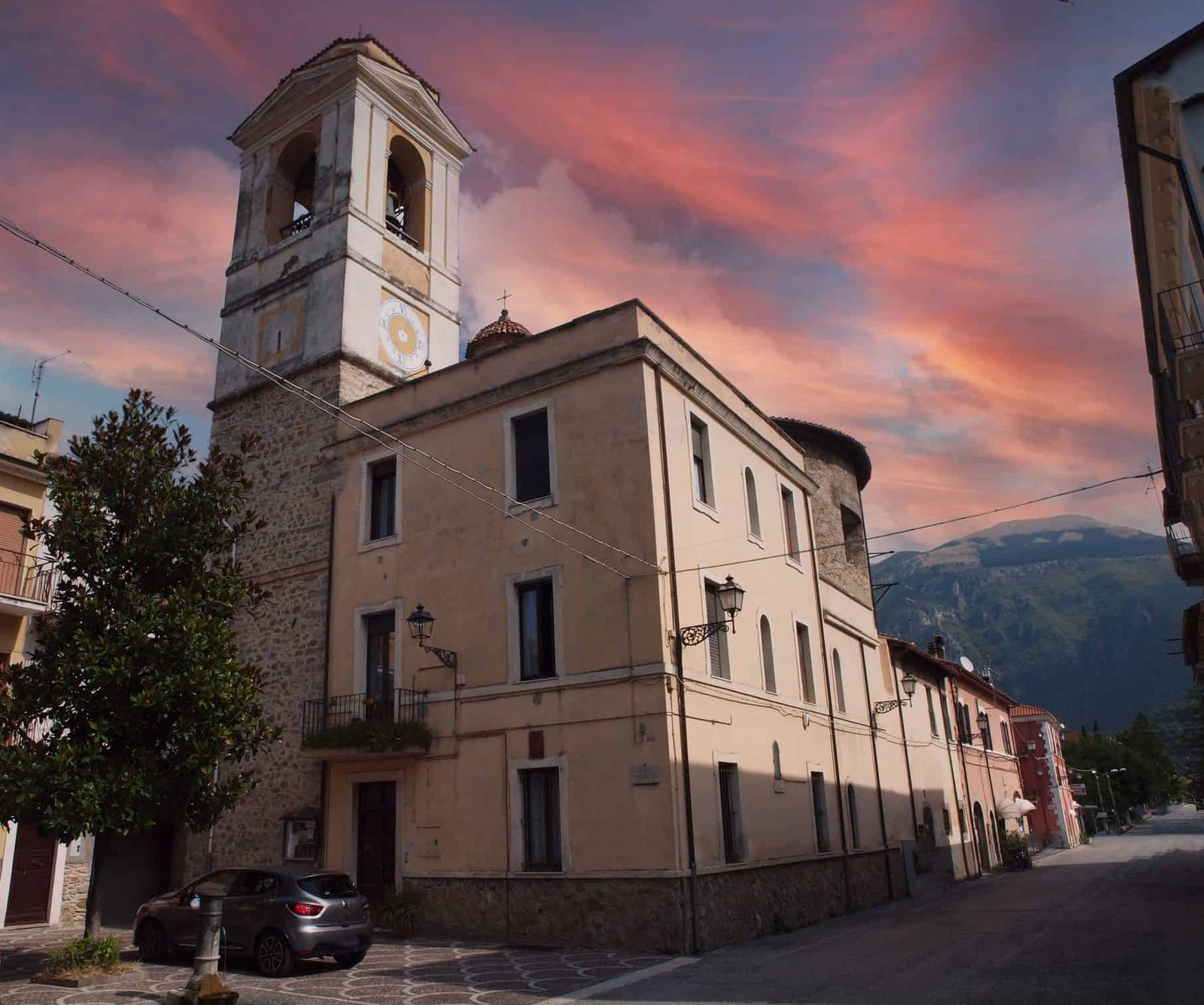

You reach Borgo Velino from the Salaria, State Road 4, at the kilometer that separates Antrodoco from Castel Sant'Angelo. The town hall and the Civic Museum are at Piazza Umberto I 33, 02010 Borgo Velino (RI), telephone 0746 578896, and the municipal office answers in the morning window, roughly between 8:30 and 13:30. From Rome it's a little under 100 kilometers along the Salaria, from Rieti a good 20 or so. If you come by train you get off at the Antrodoco-Borgo Velino station, on the regional Terni-Rieti-L'Aquila-Sulmona line, a little over a kilometer from the historic center. From Rieti the trip takes roughly half an hour and the regional connections are spread throughout the day, but the schedule has to be checked each time on the Trenitalia site, because on this line the runs change with the school calendar and bus replacements happen. The town can be visited free of charge and without a reservation: there is no ticket office, no turnstile, the walled village is open 24 hours a day and the churches open for services or on request at the parish. The hours and opening of the Civic Museum are best arranged with the Municipality before you leave.
Above all, a note on orientation: Borgo Velino is not a stand-alone day trip from Rome, it is the best piece of a loop that includes Antrodoco, Castel Sant'Angelo and Rieti. Whoever comes thinking of filling eight hours inside the walls will be disappointed. Whoever fits it into a day in the Velino valley goes home with the feeling of having seen something that others skip.
About 900 inhabitants, 460 meters above sea level, a single hamlet, Colle Rinaldo, and a name that is less than two centuries old. The town belongs to the Velino Mountain Community and occupies the narrow alluvial plain between the Rieti mountains and the Monte Nuria group, on the left bank of the river that gives it its name. The inhabitants are called borghettani, and it's not an affectation: until June 1863 the municipality was called Borghetto, and the old name survived in the spoken language much longer than the new one.
To understand how Borgo Velino fits into the rest of northern Lazio, it's worth keeping an eye on the region's tourist attractions page: the Velino valley is one of those corridors where the history changes every 10 kilometers, and reading it in separate pieces does justice to none of the towns that make it up.

Where Borgo Velino Is and How to Get There
Geography matters more than history here, because it is geography that made the history. The upper Velino valley is a narrow corridor: upstream the river comes out of the gorges that channel it between limestone walls, downstream it opens into the Rieti basin, which was a lake until the Roman work at the Marmore. Borgo Velino occupies the flat valley floor between Antrodoco and Castel Sant'Angelo, the only point where the valley breathes for a few hundred meters before closing in again. Whoever controlled that valley floor controlled the passage between the Tyrrhenian and the Adriatic, and for almost three millennia that passage has been called the Salaria.
By Car to Borgo Velino, Along the Salaria
From Rome you exit onto the Salaria and stay on State Road 4 toward Rieti, then continue toward L'Aquila. You brush past the town without noticing, because the state road runs right up against the village and the driver watches the road. The signal to look for is the municipality's sign on the right coming from Rieti, after the turnoff for Castel Sant'Angelo and before the built-up area of Antrodoco. The kilometer count, measured on the official distance from the provincial capital, gives a good 20 or so from Rieti and a little under 100 from Rome. The real time is another matter: the Salaria between Passo Corese and Rieti is a nervous road, with single-carriageway stretches and heavy traffic, and whoever leaves Rome on Saturday morning would do well to count on two full hours instead of the hour and 20 that the navigator promises. Parking is not a problem: you leave the car along the provincial road or in the open spaces at the edge of the historic center and go in on foot, because inside the walls the two parallel streets are narrow and the one-way system is unforgiving.
By Train: The Antrodoco-Borgo Velino Station
The station carries the name of two towns and belongs administratively to Antrodoco, but it is closer to Borgo Velino, which is a little over a kilometer of almost flat road from the passenger building. It is a station on the Terni-Rieti-L'Aquila railway, a single-track, diesel-powered line that crosses the Apennines between Umbria and Abruzzo, and for decades it was the only stop in the area. The trip from Rieti ends in a bit under half an hour. From Rome there is no direct train: you get to Rieti by bus, or you take the train to Terni and change. It's an itinerary for those who have time and like it, not for those in a hurry.
Borgo Velino from Rome in a Day
It can be done, and the formula that works best is this: leave early, stop in Antrodoco for the church of Santa Maria extra moenia, lunch in Borgo Velino or nearby, afternoon among the Flavian Nymphaeum, the walled village and the murals, return passing by the Aquae Cutiliae and Lake Paterno. If you want to extend it, add Cittaducale, which is 10 kilometers from Rieti and keeps its Angevin layout almost intact. In winter the loop combines with half a day at Terminillo, which from the valley floor is reached in a good hour passing through Rieti.
A Curiosity About Borgo Velino (RI)
The town's name is 163 years old. In June 1863, two years after the proclamation of the Kingdom of Italy, the municipality of Borghetto asked for and obtained a change of name to Borgo Velino. The reason was not romantic: the newly unified Kingdom found itself with dozens of municipalities with the same name scattered between Piedmont and Sicily, and Borghetto was one of the most overused place names on the peninsula. Postal and military bureaucracy demanded distinguishable names, and the standard solution was to add a geographic qualifier to the generic name. So Borghetto became Borgo Velino, borrowing the name of the river that flows beside it.
The real curiosity is what happened afterward. The new name didn't take root in the spoken language. The inhabitants kept calling themselves borghettani, and they still do today: not velinesi, not borgovelinesi, but borghettani, with the demonym descending from the abolished name. In the Sabine dialect the town remains Borghittu. It rarely happens that a demonym survives the disappearance of the place name it derives from, and it happens almost always when the community perceives the name change as an act imposed from above, not as its own choice. In Borgo Velino the rift between the official name and the felt name has lasted 160 years, and a guest who wants to earn a smile at the bar in the square gets it by calling the locals borghettani.
There is an administrative corollary that makes the story even more curious. The municipality that in 1863 had insisted on a name of its own had it taken away entirely in 1928, when the regime abolished it and merged it into Antrodoco. Borgo Velino returned to exist as an autonomous municipality only in December 1957. In less than a century, then, the town changed name, province and even legal existence, and each time kept calling itself Borghetto within its own walls.
From Viario to Borgo Velino: The Origins of the Town
The history of the settlement is older than the walled village you visit today, and it can be read in three superimposed layers.
Viario, the Sabine Ancestor of Borgo Velino
The first inhabited nucleus of the territory was called Viario and occupied the hills on the right bank of the river, about 30 meters above the water line. The elevation is not random: whoever chose that spot had two worries, the floods of the Velino and men. The river, before modern regulation, flooded the valley floor regularly, and the valley floor was crossed by the Salaria, that is by the road on which armies, tax collectors and brigands passed. 30 meters of elevation solved both problems.
On the antiquity of Viario the local tradition is generous: it claims it predates Rome and links it to the Pelasgians of the Bronze Age. This is tradition, not documentation: the Pelasgians are a category that ancient historiography used to indicate pre-Hellenic populations generically, and applying it to the central Apennines is a 19th-century operation. What can be said with caution is that the area was frequented by Sabine shepherds in pre-Roman times and that in the eastern part of the site, near a medieval tower, scattered remains have been recovered. Of Viario, today, no monument remains to visit: what remains is the name, and the awareness that the valley-floor town was born when security conditions allowed people to come down.
Forca Pretula and the Birth of Borghetto
According to a tradition consolidated by local scholars and taken up in the literature on the territory, the present settlement was founded in the course of the 14th century by the inhabitants of the castle of Forca Pretula, who abandoned the height for the valley floor. It is the reverse of the movement of incastellamento, and at these latitudes it is typical of the late 14th century: when the Kingdom of Naples consolidated control of the northern border, living on the plain became possible again. The new settlement took the diminutive name Borghetto, that is small village, and immediately equipped itself with a wall circuit: a valley-floor town on the Salaria, however pacified the century, built its walls anyway.
The three castles that tradition links to the village are Viario, Forcapretola and Cornallo. Their number is recalled by the three spouts of the fountain in the square, according to one reading. According to another, the spouts allude to the three mountains that surround the town, Terminillo, Giano and Nuria. The two interpretations have coexisted for generations and neither has a document to prove it: they are symbolic readings after the fact, of the kind every town produces about its own fountain.
Something Nobody Tells You About Borgo Velino (RI)
The urban layout of Borgo Velino is not just any Italian medieval layout: it is an imported layout, and its closest kinship is found in France. The town is built on two parallel streets cut by a central transverse axis, with a strong concentration of houses, a wall circuit with rounded corners and a large towered gate on the main axis, oriented toward Rieti. This scheme, and in particular the detail of the rounded corners of the walls, has a precise comparison with the bastides of southwestern France, and the literature on the village cites Rabastens, founded in 1306, as a term of comparison.
The explanation is dynastic. In the 14th century this piece of the Apennines belonged to the Kingdom of Naples, and the Kingdom of Naples was Angevin, that is French. The Angevins brought to southern Italy an urban repertoire matured across the Alps: new towns on a regular plan, founded to repopulate and to control, with a simplified grid, a central square and a geometric wall circuit. Cittaducale, founded in 1308 by Charles II of Anjou and named for his son Robert, duke of Calabria, is the most conspicuous case in the area, with its elliptical layout and the two perpendicular streets that cross in Piazza del Popolo. Borgo Velino is the smaller and later version of the same way of thinking about the city.
Why does nobody talk about it? Because the town is small, because the history of Angevin urbanism in central Italy is a matter for specialists, and because the visitor who enters through the towered gate sees a village that looks to him like a thousand others. It isn't. If you walk the transverse axis, the one the town calls Via degli Otto Cantoni, you understand at a glance that the two parallel streets are not the result of spontaneous growth: they are the design of someone who laid things out first and built afterward. It's an exercise in reading the city that takes a quarter of an hour and completely changes the way you look at Borgo Velino.
Via degli Otto Cantoni, the Central Axis of Borgo Velino
The name is already a program. The cantoni are the corners, the edges of the houses: eight, counted along the transverse axis that connects the two main streets. Walking it means crossing the town across its width in a few minutes, with the houses closing in overhead and the corners marking the rhythm. It is the street where the building density is best measured, and where you see that the building in Borgo Velino is compact out of defensive necessity, not for scenic effect.
The Walls and Towered Gate of Borgo Velino
The wall circuit can still be read well in several stretches, and the rounded corners are the detail to look for: they served to remove blind spots from the besiegers and to distribute the thrusts better, and they are the typological marker that links this village to the repertoire from across the Alps. The large gate, topped by a tower, opens on the central axis in the direction of Rieti, that is toward the provincial capital and toward the border with the Papal State: a gate deliberately oriented toward the side from which trouble could come. Whoever enters from there enters as people entered in the 14th century.
The Flavian Nymphaeum, the Roman Monument of Borgo Velino
On the edge of the built-up area, preserved inside a public garden, stands the most important monument of the territory: a large brick parallelepiped that the archaeological literature and local tradition call the Flavian Nymphaeum. It is datable to the 1st century AD and measures, in the current reading, about 30 meters in length: a figure that places the structure outside the scale of ordinary rural building and within that of representative architecture.
What You See Today of the Flavian Nymphaeum
You see a structure in brick masonry of considerable linear extent, stripped of all its facing. To the modern visitor it appears as a massive wall with niches. To the eye of someone who can read a Roman nymphaeum it appears for what it was, that is an architectural backdrop meant for water, with niches that held statues, surfaces covered in marbles and mosaics, water features fed by a pipe. Of that facing nothing remains: the Roman marbles were the quarry for all the medieval building sites of the valley, and this one is no exception. Looking at the Flavian Nymphaeum means looking at the skeleton of a building that has had its skin removed.
Villa Rustica, Cistern or Sanctuary of Diana: The Three Readings
On the interpretation of the monument the literature is not unanimous, and it's worth distinguishing the degrees of certainty. The traditional reading, the most widespread, sees in the structure the monumental nymphaeum of a large Roman villa rustica, built to host the Flavian emperors when they went up the Salaria. A second reading, more cautious and more technical, has proposed recognizing in it simply a large cistern, that is a hydraulic work with no representative function. A third hypothesis, recently formulated, links the structure to a sanctuary of Diana: the supporting argument is an inscription walled into the church of Santi Dionigi, Rustico ed Eleuterio, which would come from the sanctuary and would have ended up in the medieval masonry through reuse.
None of the three readings is proven. The first is consolidated tradition, the second is a functional hypothesis, the third is a modern hypothesis based on an epigraphic clue. Visitors would do well to keep all three in mind, because the monument has not yet yielded the element that settles the question.
The Flavians and the Velino Valley: Why Right Here
The link between the Flavian dynasty and this piece of the Apennines is not a parochial fantasy: it is one of the best-documented facts of Rieti archaeology. Vespasian, first emperor of the dynasty, was born in AD 9 at Falacrinae, the settlement identified in the territory of Cittareale, a few kilometers further north along the Salaria, where excavations have brought to light a necropolis and a villa of considerable size. Vespasian and his son Titus assiduously frequented the thermal waters of the Aquae Cutiliae, between the territories of Castel Sant'Angelo and Cittaducale, where the remains of a complex arranged on four terraces are preserved, with a natatio measuring 60 by 34 meters. The imperial family, in short, came back to this valley because it was their own valley.
The Nymphaeum of Borgo Velino belongs to this landscape. Be it a villa nymphaeum, a cistern or part of a sanctuary, it belonged to a stretch of the Salaria where in the 1st century building was done with the means of imperial patronage. Whoever looks at it today in a town public garden has trouble believing it, and that is exactly why it's worth going.

The Advice I Give You for Visiting Borgo Velino (RI)
The advice is only one and goes against the instinct of those who organize the day on paper: don't arrive in Borgo Velino at noon. The town is squeezed between two slopes and the vertical light flattens it, the inner streets become a corridor of black shadow against burnt white walls, and the Nymphaeum, which is a brick monument, loses all relief under a high sun. Arriving by 9:00 in the morning or after 17:00 changes the visit: the low-angle light enters the two parallel streets, the murals can be read without reflections and the Roman brick regains its color.
The second part of the advice concerns the order. It's best to start from the Flavian Nymphaeum, which is outside the walls and takes 20 minutes, then enter the town through the towered gate and not from the most convenient parking lot, walk one of the two parallel streets to the end, come back along the other and cross Via degli Otto Cantoni. It's a one-hour route, an hour and a half at an easy pace. Finish in Piazza Umberto I in front of the three-spout fountain, with Palazzo Pezzola on one side.
Third point, and it's the one that saves disappointments: call ahead. The churches of Borgo Velino have no continuous custody, the Civic Museum is inside the town hall and follows office hours, and the difference between a successful visit and a wasted trip is a phone call to the Municipality's number made the day before. It's not a peculiarity of this town: it is the rule for all Apennine municipalities under 1,000 inhabitants, and whoever travels in this part of Lazio should make it a habit.
One last opinion, to be taken as such: if you have only one day and have to choose between Borgo Velino and Antrodoco, go to Antrodoco for the church of Santa Maria extra moenia, which is a monument of European rank, and give Borgo Velino the last hour of the day. If instead you have two days, the order flips: Borgo Velino deserves slow time, and slow time in Borgo Velino is found only when you have nothing else to see before evening.
The Churches of Borgo Velino
Six places of worship between the main town and the hamlet, for 900 inhabitants. It's not an anomaly: it's the snapshot of a community that until the 20th century counted far more people than now and that had confraternities, convents and separate devotions for each district.
The Church of San Matteo Apostolo, the Parish Church of Borgo Velino
It is the big church of the town, 18th-century in layout, and it dominates the built-up area with a mass that appears disproportionate to the visitor compared to the current size of the center. This disproportion is the most eloquent historical fact: the parish church was built when the population and resources of Borghetto were those of a border town of the Kingdom of Naples, with a solid agricultural economy based on wheat, chestnuts and grapes, and with mountain pastures that fed transhumance. Churches are built on the wealth of the moment in which they are built, and they stay standing when the wealth is gone.
The Church of Santi Dionigi, Rustico ed Eleuterio, Known as Sant'Antonio
Outside the built-up area, on the opposite side from the Nymphaeum, stands the most interesting building from a historical point of view. The people call it the church of Sant'Antonio, but the true dedication is to the three saints Dionysius, Rusticus and Eleutherius, the Parisian martyrs whose devotion reached central Italy by French routes, which fits the Angevin picture described above. The dating oscillates between the 11th and 12th centuries depending on the sources, with a reconstruction around 1500 that changed its appearance. In the masonry you can read fragments referred to the 7th and 8th centuries, that is reused early medieval material, and local tradition holds that the building stands over a place of worship dedicated to Diana. The walled-in inscription that fed the hypothesis of the sanctuary of Diana linked to the Nymphaeum is found here.
It is the church I recommend looking for first to anyone with an archaeological interest: a building that cites in its own masonry seven centuries of the site's history, from late antique reuse to Renaissance reconstruction, and that bears a dedication capable of telling on its own the relations between this valley and the French world.
The Church of Santa Lucia
A minor building in the urban fabric, linked to the popular devotion to the saint of Syracuse, deeply rooted in the central Apennines and traditionally connected to the protection of eyesight. It is part of that network of neighborhood churches that in walled villages served the individual districts.
The Convento della Valle and the Franciscan Tradition in Borgo Velino
The former convent of San Francesco, which local tradition calls the Convento della Valle, carries with it the legend dearest to the borghettani: that Saint Francis of Assisi stayed there during his passages through the Sabine country. It must be said honestly that this is tradition, not documentation: the Poverello did frequent the Rieti valley, and the Franciscan sanctuaries of Greccio, Fonte Colombo and Poggio Bustone document that presence, but for Borgo Velino the documentary support is missing.
What is documented instead is more prosaic and more entertaining: in 1472 Pope Sixtus IV taxed the friars of Borghetto for the sum of three ounces and eight grana. It's a minimal figure, and for that very reason it tells two certain things. The first is that in 1472 the convent existed and was recorded by the curia. The second is that the friars were truly poor.

Colle Rinaldo, the Hamlet of Borgo Velino
The municipality's only hamlet stands on the height and preserves a heritage out of proportion to the number of its inhabitants: two churches and the remains of a tower.
The Sanctuary of the Madonna delle Grazie
A 17th-century building, tied to a Marian devotion that has deep roots in the area. It is the sanctuary that gathers the devotional flow of the hamlet and the surrounding countryside.
The Church of the Natività di Maria Santissima
16th-century, it is the focus of the most identity-defining festival of Colle Rinaldo, which falls on the second Sunday of September. Whoever happens to be in town that weekend finds the hamlet in a state of activity that it doesn't have the rest of the year.
The Remains of the Torre del Cassero
They are municipal property and belong to the 15th century. The original structure was polygonal, almost certainly octagonal, and the most accredited reconstruction attributes to it a height between 12 and 15 meters. Today four sides remain. An octagonal tower 14 meters high on a height that dominates the valley floor is, in military terms, an observation and signaling point: it served to see who was coming up the Salaria and to tell those further down. The tower system of this valley worked as a chain, and Colle Rinaldo was a link in it.
Piazza Umberto I and the Civic Architecture of Borgo Velino
The square is the gathering point of the town and the place where the main events take place. Facing it are the town hall, which houses the Civic Museum, and Palazzo Pezzola. In the center, the fountain.
The Three-Spout Fountain of Borgo Velino
The local literature calls it the Romanesque Fountain and refers it to the 11th century, dedicating it to Margaret of Austria and noting the presence of the Farnese coat of arms. On these data it's best to proceed with caution, because they contain an evident contradiction: Margaret of Austria lived in the 16th century and the Farnese inherited the fief after 1586, so a fountain with a Farnese coat of arms cannot be both Romanesque and dedicated to Margaret. The prudent reading is that it is a public fountain of ancient layout, reworked and upgraded in the Farnese era, when the coat of arms was affixed to it. The three spouts, according to the town's tradition, symbolize the three castles tied to the village, Viario, Forcapretola and Cornallo, or the three mountains that encircle it, Terminillo, Giano and Nuria.
Beyond the debate, it is the object that the borghettani feel as their own. Multi-spout fountains in Apennine villages were infrastructure, not ornament: animals were watered, washing was done, basins were filled. The square organized itself around the fountain, not the other way around.
Palazzo Pezzola, the Brigand's House
A late Renaissance building of the 17th century, it opens on one side of Piazza Umberto I and was the home of Giulio Pezzola. It's a fact worth weighing: the valley's most famous brigand did not live in a mountain cave, he lived in a palace on the main square of his own town. Whoever looks at the facade understands in 30 seconds what border brigandage really was in the 1600s, and it wasn't the kind in novels.
The Torre Civica
19th-century, it is the vertical element of the town and belongs to that post-unification season in which Italian municipalities equipped themselves with a public clock and a civic bell, separating the time of the town hall from that of the parish. It is minor architecture, but it tells of a shift in mentality.
The Civic Museum of Borgo Velino
It is housed in the Town Hall, at Piazza Umberto I 33, and is divided into three sections: one dedicated to the peasant world, with objects and tools of rural work and life. One dedicated to the flora and fauna of the Velino valley, with particular attention to plants and medicinal herbs. A third dedicated to frescoes and objects of sacred art. It is classified as an ethnoanthropological ecomuseum and is listed in the national register of earth science museums.
It is not a museum you visit in passing: the opening follows the hours of the municipal offices, in the morning window, and it's best to arrange access by phone. Frankly: the natural history section on the valley's medicinal herbs is the one worth the trip, because it is material gathered in the territory and not replicable elsewhere, while the ethnographic section is a good collection of peasant tools of a type common throughout the Apennines.
Another Well-Known Fact, Yet Rarely Cited
That Borgo Velino is on the Salaria everybody knows. What the Salaria was, and what it meant for this town, almost nobody says, and without that fact the village remains incomprehensible.
Via Salaria is the oldest of the Roman consular roads and it was not built by the Romans: it was inherited. It was the route along which the Sabines carried salt from the salt pans at the mouth of the Tiber toward the Apennine interior and toward the Adriatic, and Rome formalized it by turning a track of transhumance and trade into a state road. This means that the valley floor on which Borgo Velino stands has been a corridor of continuous traffic for at least three millennia, without interruption: salt, flocks, legions, pilgrims, French armies, brigands, trucks.
The consequences for the town are three, and all can be seen. The first is archaeological richness: a monumental nymphaeum of the Flavian age on the valley floor, remains of a villa and a road in the neighboring municipalities, the paved stretch and the milestone preserved at Posta, the imperial baths of the Aquae Cutiliae a few kilometers away. None of these things would be here if the Salaria had not passed here.
The second consequence is military. The valley floor is an obligatory passage, and whoever passes occupies it. In December 1798 French troops violated the northern border of the Kingdom of Naples right along this route, and the places on the Salaria were repeatedly forced to host encampments, supply provisions and pay money to the enemy. The greatest damage, in that campaign, was not suffered by the cities: it was suffered by the road towns, and Borgo Velino was a road town.
The third consequence is economic and still holds today. The town lives on the state road, and the state road brings it the only passers-by it has. 56 active businesses and 139 employees, according to the 2015 survey, in a municipality of 900 people: these are the numbers of a local economy that holds up because the valley floor is not isolated. The Salaria, which in 1798 brought the French, today brings those who stop to buy marroni in the fall. It is the same corridor, with different contents.
Giulio Pezzola, the Brigand of Borgo Velino
The figure who marked the town's imagination was born in Borghetto in 1598, son of a certain Morgante. He married Leonida and had six children, Maddalena, Pirro, Patrizio, Giovanni Battista, Gianluca and Giacomo. He died in 1673 at the age of 75, falling from the fortress of Castel dell'Ovo in Naples, where he had been imprisoned.
40 Years of a Gang
Pezzola's brigand activity lasted roughly 40 years, and during that period he headed a gang made up, depending on the historical moment, of a number of men ranging between 80 and 300. 300 armed men are not a band of stragglers: they are an irregular military formation, and the fact that a single man commanded it for decades says how weak state power was on this border line.
The border in question is the one between the Kingdom of Naples and the Papal State, which cut across the Apennines exactly here. A border between two states, both weak in the mountain periphery, creates a space where whoever is wanted on one side takes refuge on the other and vice versa. The 17th-century border brigandage was not a phenomenon of ordinary crime: it was an unofficial political system, which the two states used and fought depending on convenience.
Border Captain for Spain
The decisive step came in 1624, when the Spanish viceregal court appointed Pezzola border captain. The brigand became an agent of the state, charged with watching the line and suppressing rival gangs: a classic way of solving the problem, that is by enlisting whoever creates it. He served the viceroys of Naples starting from the time of Antonio Álvarez de Toledo, duke of Alba, who held the office between 1622 and 1629, and continued to operate under his successors.
One of his most sensational actions dates to Christmas Eve 1640: on the orders of the duke of Medina Sidonia, Pezzola captured the prince of Sangles in Rome. Capturing a prince inside the capital of the Papal State, on behalf of the Spanish viceroy of Naples, on Christmas night: it is the measure of what the border captain of Borghetto had become.
Masaniello, Madrid and the Fall of Pezzola
In 1647, when Naples rose up with Masaniello, Pezzola fought alongside the Spanish forces against the insurgents. The service earned him the highest recognition: in 1652 he was received in audience by the king of Spain in Madrid. A man born in a town of 900 souls on the Salaria, received by the sovereign of the empire on which the sun never set.
The arc reversed quickly. In 1659 he fell into disgrace and his goods were confiscated. In 1660 he was imprisoned in Castel dell'Ovo. He stayed in prison 13 years. In 1673, attempting to escape, he fell from the fortress and died.
What Remains of Pezzola in Borgo Velino
The palace on the square remains, the name remains, and a historical reenactment that the town dedicates to him in August remains, under the title of the Brigante Pezzola. His story, by admission of the literature that has dealt with it, is still uncertain in many points and enriched by popular imagination: the historical figure and the legendary figure have overlapped to the point that separating them requires archive work still in progress. Whoever attends the reenactment attends the version the town tells itself, and it's a version worth listening to, because it is the way a community processes a cumbersome ancestor.
Our opinion: Pezzola is the best narrative hook of the whole Velino valley, far more effective than the Nymphaeum for those without archaeological training, and the towns of the area exploit him too little.

Margaret of Austria, the Capitoli and the Farnese
Before Pezzola, Borghetto had another famous mistress. From 1472 to 1624 the town was part of the district of Cittaducale, and in the course of the 16th century it became a fief of Margaret of Austria, natural daughter of the emperor Charles V, wife first of Alessandro de' Medici and then of Ottavio Farnese, governor of the Netherlands and lady of a series of Abruzzo and Lazio fiefs.
Margaret's arrival produced a profound change in the community, and it was not a welcome change. Local sources insist on two elements: the fiscal burden imposed on the fief, judged excessive, and the introduction of the Capitoli, a special statute drawn up expressly for Borghetto, which regulated the conduct of the borghettani toward the authorities and the citizenry itself. A code of conduct written from above for a mountain community used to unwritten customs is, historically, the point where central power enters daily life.
Margaret died in Ortona in 1586 and her fiefs passed by succession to the Farnese, who held them until 1731. The Farnese coat of arms on the fountain in the square is the visible sign of that century and a half of belonging. Notice the chronological coincidence: the Farnese fief covers exactly the period in which Giulio Pezzola is born, grows up, commands his own gang and dies. The border brigand and the Farnese feudal lord are the same story seen from two sides.
Memorie, i muri della storia: The Murals of Borgo Velino
Since 2021 the town has hosted a mural art project titled Memorie, i muri della storia, conceived and carried out by the set designer Santina Eleuteri. The work begins along the Salaria and continues inside the historic center, with the declared intention of extending to Colle Rinaldo as well, and is conceived as a work in continuous evolution more than as a closed cycle.
The subjects are taken from the town's history and not from the generic decorative repertoire: the brigand Giulio Pezzola, the ancient salt road, the chestnut harvest, the musicians and flag throwers, the card games, Margaret of Austria, the places of worship and local historic buildings, paintings inspired by 17th-century pictorial works, the agricultural products of the territory. The declared goal is to make the village an open-air museum and to use mural painting as a tool of tourist promotion.
It's an operation that in the last 15 years dozens of Apennine towns have attempted, with very uneven results. Here it works better than average for a precise reason: the subjects are documented and legible, they are not abstract illustrations, and whoever walks along the streets recognizes on the walls the same things found in the Civic Museum and in the August reenactment. The coherence between the painted story and the historical story is what distinguishes an identity project from a decoration. It's best to walk the stretch along the Salaria on foot, not by car: from the window the murals get lost.
The Right Photo to Take in Borgo Velino (RI)
The photograph that brings Borgo Velino home is not the one of the square and not the one of the church. It is the profile of the walled village seen from the valley floor, with the packed houses forming a single compact volume and the mountains behind: it is the image that explains in one stroke what a fortified valley-floor village is, and that no description conveys as well.
The shooting point is looked for from the edges of the built-up area, toward the river, moving until the town lines up with the slope behind it. The right time is first thing in the morning or the last of the afternoon: the low-angle light separates the planes, detaches the volume of the houses from the mountain and gives relief to the wall circuit. At noon the same framing returns a white mass without depth.
The second photograph to take is inside Via degli Otto Cantoni, and it has to be set up the opposite way: here you need backlight. You stand at the mouth of the street with the low sun at the far end, expose for the shadows and let the background burn out. The corners of the houses become a succession of overlapping planes, and it is the visual reading of the building density the town lives on.
The third, for those with patience, is the Flavian Nymphaeum in side light. The Roman brick has a texture that raking sun brings out and that frontal light erases completely. It's best to get close and fill the frame with the masonry, instead of photographing the whole monument from afar: from afar it looks like a retaining wall, up close you see the brick courses and the traces of the niches.
A practical warning that applies to all three: the valley is narrow and the sun disappears behind the slope well before astronomical sunset, especially from October to March. Whoever plans the 18:00 light in November finds the town already in shadow for quite a while.

Some Important Events That Happened Here in History
The town's chronology rests on a handful of dates that truly changed the lives of the borghettani.
The 14th Century: The Descent from Forca Pretula
The founding of the present settlement, placed by tradition in the 14th century, is the foundational event: the inhabitants of the castle of Forca Pretula left the height and settled on the valley floor, building a walled village on a regular plan. It was not a spontaneous move of a few families: it was a planned operation, as the urban design shows.
1472: Sixtus IV's Tax on the Friars of Borghetto
Pope Sixtus IV imposed on the friars of the convent of Borghetto a tax of three ounces and eight grana. It is the first certain document attesting the existence of the convent, and the modesty of the sum captures the poverty of the local religious community.
1586: The Death of Margaret of Austria and the Passage to the Farnese
On the death of the lady of the fief, which took place in Ortona, her fiefs passed by succession to the Farnese. For Borghetto, a century and a half of Farnese belonging began, destined to last until 1731.
1624: Pezzola Appointed Border Captain
The Spanish viceregal court turned the gang leader of Borghetto into an armed official of the Kingdom of Naples. It is the year in which the private history of a family of the town enters international politics.
1642: Pezzola in the Chronicles
Local literature gives this year as that of the first appearance of the brigand of Borghetto on the documented historical scene, and it is the date that the town's memory has kept as the beginning of the story.
1647: Borghetto Against Masaniello
The irregular troops led by Pezzola fought alongside the Spanish during the Neapolitan revolt. An Apennine border town found itself involved in one of the major events in the history of the South.
1673: The Fall from Castel dell'Ovo
After 13 years of imprisonment, Giulio Pezzola died attempting to escape from the Neapolitan fortress. With him ended the organized brigandage of this part of the border in the form it had had for decades.
December 1798: The French Invasion Along the Salaria
French troops violated the security of the borders of the Kingdom of Naples in the area of Rieti, Norcia and Cascia. The greatest damage was suffered by the places along the Salaria, forced repeatedly to host encampments and to supply provisions and money. At the end of that year France controlled almost the whole peninsula, with the exception of Sardinia and a large part of the Kingdom of Naples.
March 1821: The Battle of Antrodoco a Few Kilometers Away
Between March 7 and 10, 1821 the clash that historiography considers the first battle of the Italian Risorgimento was fought in Antrodoco, a very short distance from here. Borgo Velino was not the theater of the fighting, but it was its immediate rear area, with everything that means for a valley-floor town.
June 1863: Borghetto Becomes Borgo Velino
Shortly after Unification, the municipality changed its name. It is the date that closes the ancient story and opens the contemporary one.
1927 and 1928: The Change of Province and the Abolition of the Municipality
In 1927 Borgo Velino passed from the province of L'Aquila to the newly created province of Rieti, and with it the whole upper Velino valley changed region, leaving Abruzzo for Lazio. The following year the municipality was abolished and made a hamlet of Antrodoco. These are the two blows that rewrote the town's administrative identity in 24 months.
December 1957: The Return to Autonomy
After almost 30 years as a hamlet, Borgo Velino became an autonomous municipality again. It is the date the borghettani remember with the greatest satisfaction, and it's easy to see why.
2021: The Town Paints Its History on Itself
With the launch of the project Memorie, i muri della storia, the community chose to tell its story on its own walls. It is the last event in the series, and it is the only one in which the town is subject and not object.
Who Passed Through Borgo Velino (RI)
A valley-floor town on the oldest of the consular roads has seen far more people pass through than it has hosted. Here is who, with the appropriate caution.
Vespasian and Titus
The Flavian dynasty is at home in this valley, and this is not parochialism. Vespasian was born in AD 9 at Falacrinae, today in the territory of Cittareale, along the Salaria north of Antrodoco: excavations there have brought to light a necropolis of 52 tombs and a villa of about 2,500 square meters, and the finds have gone to the civic museum dedicated to Titus Flavius Vespasianus. Father and son frequented the waters of the Aquae Cutiliae, the thermal complex between Castel Sant'Angelo and Cittaducale, in the last years of their lives. The Nymphaeum of Borgo Velino belongs to this system of imperial presences on the valley floor: the traditional reading holds it to be part of a villa built to host the Flavians.
Antrodoco, which in antiquity was called Interocrium, was a posting station on the Salaria, and the literature on the territory records the passages of Vespasian and his sons Titus and Domitian. Whoever walks the valley floor today walks on a stretch of road that saw three emperors of the same family pass.
Saint Francis of Assisi
Local tradition holds that the Poverello stayed at the Convento della Valle during his pilgrimages through the Sabine country. As said, it is tradition and not document. What is historically established is the centrality of the Rieti valley in the Franciscan experience: Greccio, where in 1223 the first nativity scene was set up, Fonte Colombo, where Francis dictated the Rule and underwent the cauterization of his eyes, Poggio Bustone and La Foresta make up the circuit of the four sanctuaries. Borgo Velino does not belong to that circuit, but it belongs to its geographic radius.
Margaret of Austria
The natural daughter of Charles V was lady of the fief in the 16th century and left Borghetto the Capitoli, that is a tailor-made written statute. There is no record that she resided here, but her action of government entered the daily life of the town more than a residence would have.
The Farnese
After 1586 the family held the fief until 1731. Their coat of arms on the fountain in the square is the visible trace of that dominion, and the same house links this corner of the Rieti province to Farnese in upper Lazio and to half of 16th-century Italian art history.
Giulio Pezzola
The most famous borghettano of all time did not pass through here: he departed from here. Born in 1598 in the town, border captain for Spain from 1624, received by the king of Spain in Madrid in 1652, died in Naples in 1673. His palace on the square is the only place in the town where one can say with certainty that a figure of European importance lived.
The French Troops of 1798 and the Armies of 1821
They are not proper names, but they are the passages that left the hardest mark. The French columns that went up the Salaria in December 1798 and the armies that faced each other in Antrodoco in March 1821 crossed this valley floor, and the road towns paid the price in requisitions and billeting.
Santina Eleuteri
The set designer who since 2021 has been painting the town's history on the walls of Borgo Velino is the last name on the list, and the only contemporary one. The project Memorie, i muri della storia extends from the Salaria to the historic center and is still ongoing.
What to See Around Borgo Velino
The useful radius is 20 kilometers, and within that radius the density of serious things is high.
Antrodoco, a Stone's Throw from Borgo Velino
The neighboring center, a little over 2,200 inhabitants, is squeezed among three mountain groups: Monte Giano, 1,820 meters, Monte Nuria, 1,888 meters, and Monte Elefante, 2,089 meters. Its greatest monument is the church of Santa Maria extra moenia, consecrated by the bishop of Rieti in 1051 and cited in a papal document of 1154, with a gabled facade in roughly hewn stone, portal and rose window on the axis, and above all a square bell tower in Lombard Romanesque style with alternating white and red stone that recalls the architecture of L'Aquila. The interior has three aisles, with the central one closed by a semicircular apse frescoed with the blessing Redeemer. Among the frescoes a 14th-century Crucifixion and a Mystic Marriage of Saint Catherine of Alexandria from the early 15th century stand out. The building forms a unified complex with the adjoining baptistery of San Giovanni. The origin of the site, according to the current reading, goes back to a temple dedicated to Diana along the Salaria in Roman times, with reconstruction in the Norman period and enlargements from the 11th century onward.
On Monte Giano, above the town, the DUX inscription can be read, made by planting pines in 1939 and seriously damaged by the 2017 fire. Antrodoco is also the homeland of the Antrodoco marrone, a product with protected geographical indication, and of sweets such as stracci antrodocani and ciambelletti della sposa. The city obtained the title of city in 2006 and until 1927 belonged to the province of L'Aquila.
The Gole del Velino
Upstream of Antrodoco the river cuts into a ravine between rock walls, along the route that leads toward Sigillo and Posta. It is the stretch where the valley closes and shows the geological reason for its own existence. The area is crossed by Italian Alpine Club trails, including number 437, which connects Antrodoco to the Gole and to Sigillo, and it is also frequented by sport climbing, with a recently opened equipped crag. Those who don't hike can limit themselves to the road stretch, which already gives the idea. Those who do hike should find updated information at the local CAI, because the passability of the trails in the ravine changes with the seasons and the state of the river.
Castel Sant'Angelo and the Aquae Cutiliae
A few kilometers toward Rieti, the territory of Castel Sant'Angelo and that of Cittaducale share one of the most notable archaeological complexes of the Rieti area: the Aquae Cutiliae, sulfurous baths known since antiquity, with remains arranged on four terraces along a front of 400 meters and a natatio of 60 by 34 meters, with steep access steps and an apsed room that must have functioned as a nymphaeum. Next to it, Lake Paterno, a body of water of karst origin that Pliny, Seneca and Varro considered the navel of Italy and that was sacred to the Sabine goddess Vacuna. Dionysius of Halicarnassus describes Cutilia as an important center of the Aborigines. It is the place where, according to ancient tradition, Vespasian spent his last days.
Cittaducale
Cittaducale is 10 kilometers from Rieti and keeps the layout of the Angevin new town founded in 1308 by Charles II of Anjou in honor of his son Robert, duke of Calabria: an elliptical plan on the model of the Roman castrum, two perpendicular streets that cross in Piazza del Popolo, where the public buildings face. The cathedral of Santa Maria del Popolo was a diocesan seat until 1818 and shows characteristics of the Abruzzo school, though it suffered the earthquakes of 1703 and 1898. The Cassero di San Magno, the Angevin tower with a horseshoe plan, defends Porta Napoli. For those who read above the question of Angevin urbanism in Borgo Velino, Cittaducale is the proof on the ground.
Rieti and the Center of Italy
Rieti is the provincial capital and is about 20 kilometers away. It keeps its walls, the papal palace, the underground passages of the Roman viaduct and a basin that was a lake until the Roman diversion of the waters toward the Marmore. Whoever goes up the river finds the Marmore Falls, which are the final product of that hydraulic work, a hydraulic spectacle built by the Romans and regulated still today.
Terminillo and the Rieti Mountains
Terminillo reaches 2,217 meters and belongs to the municipalities of Rieti, Cantalice, Leonessa and Micigliano, but the massif as a whole also involves Borgo Velino, Cittaducale and Poggio Bustone. It is about 32 kilometers from Rieti and between 80 and 90 from Rome, which is why it is nicknamed the mountain of Rome. There are two ski areas: Pian de' Valli, on the southern slope at 1,640 meters, and Campo Stella on the Leonessa side. The Italian Alpine Club manages two huts, the Sebastiani at 1,820 meters and the Rinaldi at 2,108. The northern slope keeps the snow longest, until May and June.
The Laghi Lungo and Ripasottile Reserve
On the Rieti plain, northwest of the provincial capital, the Laghi Lungo and Ripasottile Reserve preserves the last two surviving bodies of water of the ancient Lacus Velinus. It is the right environment for those who travel with binoculars, and it is the nature counterpart of an archaeological day in the valley.
Farther Away: L'Aquila, Amatrice, Leonessa
Continuing along the railway and the state road toward the east you reach L'Aquila. Going up the Salaria to the north you meet Amatrice and, with a detour, Leonessa, with its arcaded main street. They are all half-day destinations that share with Borgo Velino the same border history between the Kingdom of Naples and the Papal State.
The Festivals of Borgo Velino, Month by Month
The town's calendar is concentrated between July and October, with a winter tail.
July: Il Borgo in Sagra and Borgoincontra
The season opens with Il Borgo in Sagra, the food event that brings tables into the historic center, and with Borgoincontra, a series of meetings. It is the moment when the town starts to fill with those who come back for the holidays.
August: The Agosto Borghettano
The month is the heart of the calendar and takes its name from the umbrella event that gathers everything, the Agosto Borghettano. Inside there are the Tressette Animato, where the card game becomes a show with costumed extras, the reenactment of the Brigante Pezzola, Campanili sul Velino, the InBorgo Performing Art Festival, and the Not(t)e di Mezza Estate, an international singing competition that falls on August 18. Whoever wants to see Borgo Velino in its liveliest version should come in August, knowing however that they will find the town full and that the silence of the village, which is one of its qualities, is not there in those weeks.
September: The Marian Festivals
On the second Sunday of September the festival of the Nativity of Mary is celebrated in Colle Rinaldo. The fourth Sunday is dedicated to Maria Santissima del Santo Amore. They are the most deeply felt devotional festivals, and have a different character from the August events: less show, more community.
October: The Festival of San Dionigi
On October 9 the festival of the patron saint, San Dionigi, falls, that is the titular of the old church outside the walls. It is the date that closes the outdoor season.
November and December: Marroni and Christmas Markets
In November the local calendar lists the Sagra del Marrone Antrodocano, tied to the valley's chestnut growing and to the area's product with protected geographical indication. In December the Christmas markets arrive. The precise dates change from year to year and should be checked with the Municipality or the Pro Loco before setting out.
What to Eat in Borgo Velino and Around
The cooking is that of the upper Velino valley, that is a poor mountain cooking that chose a few raw materials and worked them well. The territory, as the sources on the municipality record, produces abundant harvests of grains, chestnuts and grapes, and keeps pastures in the high zones.
The Marrone and Chestnut Growing
The chestnut is the signature crop of the valley floor and the slopes, and the Antrodoco marrone is the product with protected geographical indication that represents it. In the mural painting of Borgo Velino the chestnut harvest is one of the chosen subjects, which says how much the crop weighs in the town's self-image.
The Sweets of the Valley
Stracci antrodocani and ciambelletti della sposa are the traditional sweets of the neighboring center, and are found in the bakeries of the area. They are simple preparations, the kind tied to specific occasions in the family calendar.
Where to Eat
The town has a dining offer proportionate to its inhabitants, so limited and not always open out of season. Outside the summer months it's best to call ahead or plan lunch in Antrodoco, which has more choice. On the days of the food festivals, on the contrary, you eat in the square and it's the best solution.
When to Go to Borgo Velino
The short answer: late September and October. The long answer deserves a few more lines.
Spring
From April to June the valley floor is green, the trails toward the Gole are passable and Terminillo keeps snow on the north slope. It is the best season for those who combine the village with walking.
Summer
July and August bring the events and the returned population. The town is alive, but the visit to the village loses its main quality, which is silence. Whoever comes in August should come for the festivals, not for the village.
Autumn
It is the season I recommend. The chestnuts, the low light that brings out the brick of the Nymphaeum and the volume of the houses, the colors of the slopes, the patron saint's festival on October 9 and the marrone festival in November. The town returns to its real size and lets itself be looked at.
Winter
It is cold and the valley is in shadow for much of the day, but Terminillo works and Borgo Velino becomes a stop on the road to the snow. The December markets are the local occasion.
Borgo Velino with Children
It works better than you'd expect, for three reasons. The first is that the village is small and enclosed: inside the walls distances are minimal and traffic is almost absent, so you walk without anxiety. The second is that there is a story of brigands, and the story of Giulio Pezzola, told in front of the palace where he lived, works with any child over six better than any archaeological explanation. The third is the murals: a hunt for the painted subjects along the streets turns the stroll into a game, and the subjects are recognizable.
The natural history section of the Civic Museum, with the valley's medicinal herbs, is the one the little ones follow best, provided you have arranged the opening. For the rest, the Flavian Nymphaeum asks for imagination: it's best to get there after explaining what a nymphaeum was, otherwise it remains a wall.
Accessibility of Borgo Velino
The historic center is medieval in layout, with narrow streets, slopes and uneven surfaces: it can be traversed in a wheelchair only with difficulty and those with walking difficulties must allow for a reduced route. Piazza Umberto I and the front of the town hall are the easiest part. The Flavian Nymphaeum, being in a garden area on the edge of the built-up area, is more easily reached. For the Civic Museum, which is housed inside the town hall, it's best to ask the Municipality for information on access before showing up.
The churches, and in particular that of Santi Dionigi, Rustico ed Eleuterio outside the built-up area, require a move along a road that doesn't always have a sidewalk. Whoever travels with people with reduced mobility should plan close-together stops by car instead of a single walking tour.
Frequently Asked Questions About Borgo Velino (RI)
Where exactly is Borgo Velino?
Borgo Velino is in the province of Rieti, in the upper Velino valley, on the left bank of the river, in the short flat stretch between Castel Sant'Angelo and Antrodoco, at 460 meters of altitude. The town hall is at Piazza Umberto I 33, postal code 02010.
How far is Borgo Velino from Rome?
Borgo Velino is a little under 100 kilometers from Rome along Via Salaria. By car the real travel time ranges between an hour and 40 minutes and two hours, depending on traffic on the Salaria.
What to see in Borgo Velino: what is the Flavian Nymphaeum?
The Flavian Nymphaeum is the most important Roman monument of Borgo Velino, a large brick parallelepiped datable to the 1st century AD and about 30 meters long, preserved in a public garden area on the edge of the built-up center. It is easier to reach than other points of the village, being outside the walls.
Is Borgo Velino suitable for a visit with children?
Yes, Borgo Velino works better than you'd expect with children, because the village is small and enclosed, with minimal distances and almost no traffic. The story of the brigand Giulio Pezzola, told in front of the palace where he lived, works with any child over six.
Is Borgo Velino wheelchair accessible?
The historic center of Borgo Velino, medieval in layout with narrow streets, slopes and uneven surfaces, can be traversed in a wheelchair only with difficulty, and those with walking difficulties must allow for a reduced route. Piazza Umberto I and the front of the town hall are the easiest part, while the Flavian Nymphaeum, in a garden area, is more easily reached.
What is the best time to visit Borgo Velino?
The recommended period to visit Borgo Velino is late September and October. From April to June the valley floor is green and the trails toward the gorges are passable, while July and August bring the town's events but make the visit to the village less comfortable because of the heat.
How much time does it take to visit Borgo Velino?
Half a day is enough to visit the town of Borgo Velino, while a full day is needed to complete the valley loop that also includes the surroundings, such as Antrodoco, with its church of Santa Maria extra moenia consecrated in the Middle Ages.
How to Organize Your Visit to Borgo Velino
Half a day is enough for the town, a full day is needed for the valley loop. Those traveling with a group, or who want someone to build the itinerary among the towns of the Velino valley without wasting time on institutional sites, can turn to the network of licensed tour guides of TourLeaderPro, which works in Rome and Lazio and designs tailor-made itineraries. For small groups and days built around the territory there is the section dedicated to private and small-group experiences. For a quote or a specific request, go through the contacts page.
Those arriving from abroad, or organizing the trip for friends who don't read Italian, will find the English version of this piece of Lazio in the ItalyPlanner guide to Lazio, which sets up the region starting from Rome and the day trips just outside it. The general logic of day excursions, with train times and evening returns, is explained in the page dedicated to day trips in Italy, while those who prepare the capital first and the surroundings only afterward should start from the guide to things to do in Rome.
A One-Day Itinerary from Rome
Departure at 7:30, Salaria as far as Antrodoco, arrival around 9:30. Santa Maria extra moenia and the baptistery of San Giovanni until 11:00. Transfer to Borgo Velino, Flavian Nymphaeum, walled village, Via degli Otto Cantoni and Piazza Umberto I until 13:00. Lunch. Afternoon among the Aquae Cutiliae, Lake Paterno and Cittaducale. Return to Rome via Rieti. It's a full day but not a rushed one, and it covers 2,000 years of history of the same valley.
A Weekend in the Velino Valley
With two days you add the Gole del Velino on foot, the Laghi Lungo and Ripasottile Reserve at dawn, and one of the Franciscan sanctuaries. The advantage of staying overnight is the light: first thing in the morning and the last hour of the afternoon are the two moments when this valley lets itself be photographed, and whoever arrives and leaves the same day loses both.
Quick Questions About Borgo Velino (RI)
Where exactly is Borgo Velino?
In the province of Rieti, in the upper Velino valley, on the left bank of the river, in the short flat stretch between Castel Sant'Angelo and Antrodoco, at 460 meters of altitude. The town hall is at Piazza Umberto I 33, postal code 02010.
How far is Borgo Velino from Rome?
A little under 100 kilometers along Via Salaria. By car the real time ranges between an hour and 40 minutes and two hours, depending on traffic on the stretch between Passo Corese and Rieti.
How far is Borgo Velino from Rieti?
A good 20 or so kilometers along the Salaria toward L'Aquila.
Can you get to Borgo Velino by train?
Yes. The Antrodoco-Borgo Velino station, on the Terni-Rieti-L'Aquila-Sulmona line, is a little over a kilometer from the historic center. From Rieti the trip takes a bit under half an hour. From Rome there is no direct connection: you need to change.
How much does it cost to visit Borgo Velino?
The village has no ticket office: it can be visited free of charge. For the Civic Museum it's best to ask the Municipality for the access conditions.
Do you need to book to visit Borgo Velino?
For the town, no. For the Civic Museum and for the opening of the churches, yes, in the sense that it's best to call the Municipality in advance, because there is no continuous custody.
How long does it take to visit Borgo Velino?
An hour and a half for the walled village and the Flavian Nymphaeum at an easy pace. Half a day if you add the Civic Museum and Colle Rinaldo. A full day if you extend the loop to Antrodoco and the Aquae Cutiliae.
What is the main monument of Borgo Velino?
The Flavian Nymphaeum, a brick structure of the 1st century AD, about 30 meters long, preserved in a garden area on the edge of the built-up area.
Can the Flavian Nymphaeum be visited?
It is preserved in a public green area and is visible from the outside. The conditions of access to the area should be checked on site or with the Municipality.
Why is it called the Flavian Nymphaeum?
For the link between the Flavian dynasty and this valley: Vespasian was born at Falacrinae, along the Salaria to the north, and with his son Titus frequented the baths of the Aquae Cutiliae a little further downstream. The traditional reading sees in the monument the nymphaeum of a villa built to host the emperors. There are, however, also the hypothesis of the simple cistern and that of the sanctuary of Diana.
Who was Giulio Pezzola?
The brigand born in Borgo Velino, then Borghetto, in 1598. For about 40 years he led a gang of between 80 and 300 men on the border between the Kingdom of Naples and the Papal State, was appointed border captain by the Spanish viceregal court in 1624, fought against Masaniello in 1647, was received by the king of Spain in Madrid in 1652, fell into disgrace in 1659 and died in 1673 falling from Castel dell'Ovo while attempting to escape.
Can you visit Palazzo Pezzola in Borgo Velino?
The 17th-century palace that was the brigand's home faces Piazza Umberto I and its front can be admired from the square. For any interior openings, which depend on events, ask the Municipality or the Pro Loco.
Why are the inhabitants of Borgo Velino called borghettani?
Because until June 1863 the municipality was called Borghetto. The name was changed to Borgo Velino, but the old demonym remained in use, and in the Sabine dialect the town remains Borghittu.
How many churches are there in Borgo Velino?
Six between the main town and the hamlet: San Matteo Apostolo, Santi Dionigi Rustico ed Eleuterio known as Sant'Antonio, Santa Lucia, the former convent of San Francesco called the Convento della Valle, and in Colle Rinaldo the Sanctuary of the Madonna delle Grazie and the church of the Natività di Maria Santissima.
What is the oldest church in Borgo Velino?
That of Santi Dionigi, Rustico ed Eleuterio, referred to the 11th or 12th century depending on the sources, rebuilt around 1500 and with reused fragments referred to the 7th and 8th centuries in the masonry.
Was Saint Francis really in Borgo Velino?
Local tradition asserts it for the Convento della Valle, but documentation is lacking. The Franciscan presence in the Rieti valley is instead established at Greccio, Fonte Colombo, Poggio Bustone and La Foresta.
What is the Civic Museum of Borgo Velino?
An ethnoanthropological ecomuseum housed in the Town Hall, in three sections: peasant world, flora and fauna of the valley with medicinal herbs, frescoes and objects of sacred art. The opening follows the hours of the municipal offices, in the morning window.
What are the main festivals of Borgo Velino?
Il Borgo in Sagra and Borgoincontra in July. The Agosto Borghettano with the Tressette Animato, the reenactment of the Brigante Pezzola, Campanili sul Velino, the InBorgo Performing Art Festival and the Not(t)e di Mezza Estate on August 18. The Marian festivals of the second and fourth Sunday of September. San Dionigi on October 9. The marrone festival in November and the markets in December.
When is the best time to go to Borgo Velino?
Late September and October, for the light, the chestnuts and the town returned to its own size. August if you come for the festivals.
Is Borgo Velino good for children?
Yes. The village is small with little traffic, the story of the brigand Pezzola captivates, and the murals of the Memorie project turn the stroll into a hunt for painted subjects.
Is Borgo Velino wheelchair accessible?
Only in part. Piazza Umberto I and the front of the town hall are easy. The inner streets of the medieval village have uneven surfaces and slopes. The Nymphaeum, in a garden area, is simpler to reach.
Can you take photographs in Borgo Velino?
Outdoors yes, without limits. Inside the churches and in the museum the rule of common sense applies, along with any indication from whoever opens up: you ask first and you don't use the flash.
What are the murals of Borgo Velino?
The project Memorie, i muri della storia, started in 2021 by the set designer Santina Eleuteri, who paints on the walls of the town, from the Salaria to the historic center, the subjects of local history: Pezzola, the salt road, the chestnut harvest, Margaret of Austria, the flag throwers, the products of the territory.
What is the difference between Borgo Velino and Antrodoco?
Antrodoco is bigger, has had the title of city since 2006 and has in Santa Maria extra moenia a first-rank Romanesque monument, as well as the Gole del Velino and the PGI marrone. Borgo Velino is smaller and more compact, and offers the walled village of Angevin layout, the Flavian Nymphaeum and the story of Pezzola. They can be visited together in the same half day.
Can you ski near Borgo Velino?
Yes, at Terminillo, which reaches 2,217 meters and has the Pian de' Valli areas at 1,640 meters and Campo Stella on the Leonessa side. From the valley floor you get there via Rieti.
What is there to eat in Borgo Velino?
Mountain cooking based on grains, chestnuts and products of the pastures. The PGI Antrodoco marrone is the signature product of the area, and in the valley's bakeries you find stracci antrodocani and ciambelletti della sposa.
Where do you park in Borgo Velino?
In the open spaces on the edge of the historic center and along the outer roads. Inside the walls the streets are narrow and it's best to enter on foot through the towered gate.
How many inhabitants does Borgo Velino have?
Around 900, with a single hamlet, Colle Rinaldo. The patron saint is San Dionigi.
The Verdict on Borgo Velino
It's wise to distrust towns that present themselves well in photographs. Borgo Velino presents itself badly: from the state road it looks like a row of houses, and whoever passes at 100 an hour has no reason to stop. Then you enter through the towered gate, walk the two parallel streets, cross Via degli Otto Cantoni and realize you are inside a design, not inside spontaneous growth. That design comes from the France of the Angevins and is 700 years old. Outside the walls, in a town garden, there is a wall of Roman bricks 30 meters long that belonged to the landscape of an imperial dynasty born a few kilometers from here. On the square is the palace of a man who commanded 300 armed men and was received by the king of Spain.
Three things, said in a row, are worth more than many minor art cities that charge for a ticket. The final advice is not to come in a hurry and not to come at noon: take an October afternoon, arrive at 16:00, stay until dark and talk to whoever you find in the square. The borghettani tell their brigand better than any panel, and they are the only part of the heritage that can't be photographed.
Article written by the editorial team of TourLeaderPro, contact them for Private/Corporate/V.I.P. Tours and Experiences.
Planning a trip to Rome? The English guides for visiting the city are on ItalyPlanner.com.