Royal Palace of Caserta
In short. The Royal Palace of Caserta has its monumental entrance at Piazza Carlo di Borbone, 81100 Caserta, right in front of the train station.

The Royal Palace of Caserta has its monumental entrance at Piazza Carlo di Borbone, 81100 Caserta, right in front of the train station. You exit the passenger building, cross the square, and the central gate is right there, no vehicle needed. The second entrance is at Corso Pietro Giannone 5, and it's the one for those who enter by bicycle and for those who bought only the Park ticket. The complex is closed on Tuesdays and on December 25. In the April-September season the Royal Apartments open 8.30-19.15 with last entry at 18.15, the Royal Park with the Bosco Vecchio and Via d'Acqua open 8.30-19.00 with last entry at 18.00, and the English Garden is open 8.30-18.00 with last entry at 17.00. The last access from the central gate is set at 18.00. The Palatine Chapel keeps the hours 8.30-18.15. The Court Theater opens only on Saturdays and Sundays from 10.00 to 13.00 and stays closed in August. The Great Gallery with temporary exhibitions opens 8.30-19.00 and is closed on Tuesdays. The tickets published by the museum are: cumulative Royal Apartments with Park and English Garden €18, Royal Apartments €12, Royal Park and English Garden €9, Royal Park only, without English Garden, €3, which can be bought only at the physical ticket office, and Royal Apartments in evening hours €5. Buying online adds a €1 presale fee. The reduced rate for citizens of the European Union aged 18 to 24 is €2, and the Campania ArteCard reduced rate is €7. Under 18, you enter for free, and free admission also applies to people with disabilities holding a Disability Card or law 104 status and to their companion, to Italian teachers with certification, to licensed European Union tour guides, to university teachers and students in the fields set by the ministerial decree, to journalists, and to ICOM members. The ticket office is in Piazza Carlo di Borbone and closes at 18.00. Booking is not mandatory, and tickets can also be bought on site. However, on weekends and on free-admission days it's best to secure your time slot in advance. The museum authorizes only one online reseller, listed on its official website, and tickets purchased are not refundable or changeable. From Rome you can get there in just over an hour on direct fast trains, or by car in about two and a half hours via the A1 to Caserta Nord.
If you're planning a trip outside Rome of one or two days, this guide pairs well with the other major historic residences you can reach in a day from the capital, starting with Villa d'Este and Hadrian's Villa in Tivoli.

What the Royal Palace of Caserta Really Is
Anyone who arrives in Caserta expecting to visit a palace makes the same error of scale people make at Versailles. They picture a building and find themselves facing a political program. The Royal Palace of Caserta is not an enlarged residence. It is the design of an alternative capital, drawn by a single man in one go, with inside it a palace of 1,200 rooms, a court chapel, a theater in the Italian style, a library, a silk factory two kilometers away, an aqueduct 38 kilometers long built specifically to power the fountains, a park that stretches three kilometers in a straight line, and a hunting forest as large as a neighborhood. All of this was planned together, not added over the years. It is this simultaneity that is extraordinary, much more than the size.
The patron was Carlo di Borbone. He had conquered the Kingdom of Naples in 1734 at 18 years old and ruled a state that, on the map of Europe, had only just become independent after two centuries of Spanish and Austrian viceroys. A new king in a new dynasty needs to prove that his kingdom exists. You do that through architecture, because architecture cannot be contradicted. The comparison was explicit and declared: the palace of Versailles built by his great-grandfather Louis XIV and the Royal Palace of Madrid where his father Philip V reigned. Caserta had to stand up to that comparison and, in intention, to win it.
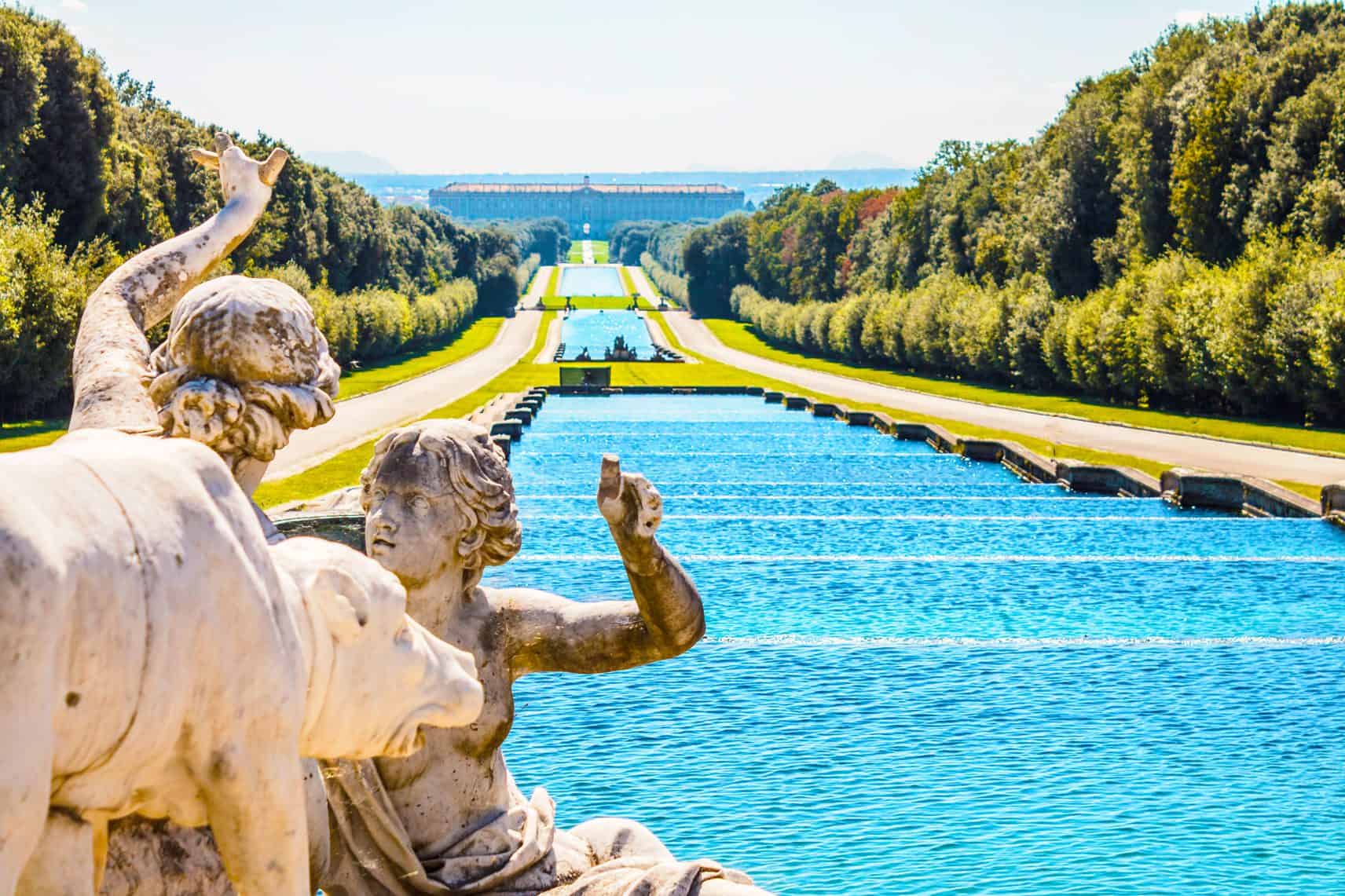
The result is the largest royal palace in the world by volume: over 1 million cubic meters, on a covered area of about 47,000 square meters. The number means nothing until you step into the octagonal vestibule and look straight ahead: the view runs through the main building, out the other side, along the park's avenue, and ends 3 kilometers away at the Grand Cascade that falls down the slope of Monte Briano. One single optical axis, held up by an aqueduct. That view, which people in Caserta call the cannocchiale, is the real work of art of the complex, and it doesn't need captions.
In our view, the Royal Palace of Caserta is the worst-visited Italian monument relative to what it offers. Not because it's rarely visited, far from it. Because almost nobody visits it in the right order, and almost nobody gives it the time it asks for. You arrive at 11:00, rush through the apartments, reach the park at 14:00 with the sun straight overhead and your tongue hanging out, look at the cascade from far away, head back exhausted, and leave convinced it's a tiring place. It's tiring only if you tackle it without a plan. With a plan, it's one of the fullest days you can spend two hours from Rome.
How to Get to the Royal Palace of Caserta from Rome
This is the point that decides whether the day works out, so it's worth tackling it first and with a few numbers in hand. The good news is that Caserta is closer to Rome than most Romans think: the city is served by direct trains, the station is literally across from the palace gate, and no city transfer is needed. The bad news is that travel times vary a lot depending on the train you choose, with a gap that can exceed 2 hours between the fastest and the slowest run.
By Train from Rome to the Royal Palace of Caserta
Caserta is an important railway hub, and from Roma Termini about 20 direct connections run there every day, spread across very different categories. There are the fast trains that run on the high-speed line toward Benevento, Foggia and Bari and stop at Caserta: they are the fastest runs of all and cover the distance in just over an hour, with peaks around 1 hour and 7 minutes. There are the Intercity trains, which take about two hours. And there are the regional trains on the old line to Cassino, which cross the Liri valley and southern Lazio stopping everywhere: they cost very little, but the trip can exceed 3 hours, and on a day trip they are a choice that costs you dearly in time.
The practical advice is blunt: for the Royal Palace of Caserta, take the earliest direct fast train you can find going there, and come back on whichever one you like. An hour of travel each way means being at the gate by 9:30 after leaving Rome at 8:00, and so having the whole daylight day ahead of you. Three and a half hours each way means arriving at noon, and that is a sure way to miss the English Garden, which closes before everything else.
The classic alternative, when the direct timetables don't work out, is changing at Napoli Centrale: you get off the Frecciarossa or Italo after about an hour and 10 minutes, and take a regional train to Caserta, which usually takes between 35 and 50 minutes depending on the type of run. It works well, and it has the advantage of leaving many more timetable options, but you have to allow for the change: Napoli Centrale is a large station, and in rush hour the regional platforms require a few minutes' walk. Those who arrive instead at Napoli Afragola on the high-speed line will find a bus connection to Caserta, but that's a solution to keep as a backup, not as the main plan.
The detail that makes Caserta a unique case in Italy is this: the station is in front of the Palace. Not 10 minutes away, not a bus stop away. You step out, cross Piazza Carlo di Borbone, and you're at the ticket office in just under 5 minutes of easy walking, with Vanvitelli's façade filling the entire field of view. Anyone traveling with children, with luggage, or with people who walk with difficulty will immediately understand how much this matters, and how much it makes Caserta an easier day trip than, for example, a day at Villa Adriana.
The historic train service that the Fondazione FS runs at certain times of the year between Naples and Caserta should also be mentioned, with vintage carriages from the 1930s and 1950s on a route of 24 kilometers. It's a scheduled run, not a regular service, and it should be checked from time to time on the museum's website or on the operator's site. For those coming from Rome, it can become a second, very pleasant day, not a way to get there.
By Car from Rome to the Royal Palace of Caserta
By car, the distance from Rome is about 200 kilometers, almost entirely on the highway, and in normal traffic it takes two and a half hours. The route is simple: A1 Milano-Napoli in the southbound direction, exit Caserta Nord, then follow the signs for the center. If you're coming back from the south or prefer the Campania ring road, take the Caserta Sud exit on the A30. On Friday afternoons and Sunday returns, the stretch between Cassino and Capua can slow down a lot, and half an hour of buffer is never wasted.
But here is the information that almost no guide highlights and that, instead, changes your day: the museum does not have its own parking lot for the public. There is no internal parking area where you can leave the car and meet at the gate. You park in town, in the garages and street spaces of Caserta around the square and the station, following the rates and parking limits of the city lots, and continue on foot from there. This is the main reason why, from Rome, the train remains the best choice: it avoids the problem at its root, you don't drive for two hours before and after an already long day on foot, and in the evening you ride back reading. For those traveling by motorhome, there is a parking area in the Bosco di San Silvestro, the wooded oasis that is part of the Vanvitellian complex.
From Naples Airport and the Port
Naples Capodichino International Airport is about 26 kilometers away and has a bus connection to Caserta, as well as taxis. Alternatively, you can reach Napoli Centrale station and continue by train. The Port of Naples is about 33 kilometers away: from there you can take a bus from the area of Via Francesco De Pretis, or the metro from Municipio to Garibaldi and then the regional train to Caserta. This information is useful for anyone arriving in Italy by sea or air who wants to see Caserta before or after Rome, though it changes little of substance: the Napoli-Caserta regional train remains the final leg in almost all combinations.
The Two Entrances to the Royal Palace of Caserta and Who Should Use Which
The entrances are not interchangeable, and choosing the wrong one costs 20 minutes of pointless walking. The gate on Piazza Carlo di Borbone leads into the Palazzo Reale, and it is the only valid entrance for those holding an Appartamenti ticket and for those with the Campania ArteCard, which must be exchanged for a ticket at the Infopoint. The entrance at Corso Pietro Giannone 5 gives access only to the Parco and the Giardino Inglese, and it is also the only passage allowed for those arriving by their own bicycle, both entering and leaving. If you get off the train and have bought the combined ticket, you don't need to think about it: the right gate is the one right in front of you as soon as you cross the square.
Tickets, Hours and Rules of the Royal Palace of Caserta
The ticket system at Caserta is more complicated than it looks, because the complex is actually made up of three parts that can be visited together or separately: the Palazzo, the Parco Reale with Via d'Acqua, and the Giardino Inglese. Understanding how they fit together saves money for those short on time and saves effort for those with plenty of it.
How Much It Costs to Enter the Royal Palace of Caserta
The ticket that covers everything is the combined ticket for 18 euro, which includes the Appartamenti Reali, the Parco Reale and the Giardino Inglese. This is what I recommend to anyone arriving from Rome for the first time, for a simple reason: if you've made a trip of an hour and a half, it makes no sense to see only half the complex. Those who come back, or who have specific interests, can choose single tickets: Appartamenti Reali 12 euro, Parco Reale and Giardino Inglese 9 euro. There is also a 3 euro ticket for the Parco Reale only, without the Giardino Inglese, which is sold exclusively at the physical ticket office and not online, and it's a notable opportunity for anyone who just wants to walk along Via d'Acqua on a nice day. During evening openings of the Appartamenti, the ticket costs 5 euro. Buying online adds, in all cases, a one-euro pre-sale fee.
Online tickets show two times, and this causes confusion at the ticket desk every single day: the 8.30 is the opening time of the Vanvitellian complex, not yours. The time slot chosen at the time of purchase is the one that applies, and you can't go in earlier. You also aren't allowed to leave the complex and come back in the same day: once you leave, your ticket is canceled. If you want to eat lunch outside, you need to know that beforehand, not at the turnstile.
Discounts and Free Admission at the Royal Palace of Caserta
The discount system follows the ministry rules. Under 18, admission is free. For those aged 18 to under 25, for citizens of the European Union and the European Economic Area, the ticket costs €2 plus any advance booking fee. Campania ArteCard holders get a reduced ticket of €7, but they must enter from Piazza Carlo di Borbone and pick up their ticket at the Infopoint. Admission is free for people with disabilities holding the European Disability Card or Law 104 certification, together with one companion, school groups with their teachers, Italian teachers with proof of service, university teachers and students from the eligible faculties, licensed European Union tour guides and interpreters, journalists, ICOM members, volunteers from recognized cultural associations, and Ministry of Culture staff.
One clarification that saves phone calls: the certificate that grants teachers free admission is valid for one year for permanent staff, and for the length of the contract for those on fixed-term contracts. The Carta del Docente voucher, on the other hand, does not cover the standard visit route: it can be spent on temporary exhibitions with a separate ticket, not on the Royal Apartments. These are two different things, and they get confused constantly.
Free Sunday and Royal Palace of Caserta Passes
Like all state museums, the Royal Palace of Caserta takes part in the free admission Sunday at the museum. Free tickets are limited by number and by time slot, and they are released online starting at 11 on the Monday morning before. Anyone who tries on the Sunday itself, at noon, finds them sold out. On free days the Teatro di Corte, the Gran Galleria and the Giardino Inglese stay closed, and that's why the free Sunday isn't worth it: you save €18 but lose a large part of what you came for, in a crowd that makes it impossible to look at a frescoed vault calmly. If budget is the main constraint, it's better to buy the €3 ticket for the Park only on a weekday.
For people who live nearby or come back often, there is an annual pass, the ReggiaCard, which comes in several types and can also be bought online. It makes sense from three visits a year onward, and for anyone who uses the park as a place to walk, which is really how the people of Caserta experience it.
Royal Palace of Caserta Opening Hours, Area by Area
The hours are not uniform, and this is the classic trap. From April to September, the Royal Apartments are open 8.30-19.15, with last entry at 18.15. The Royal Park, that is the Bosco Vecchio and Via d'Acqua, is open 8.30-19.00, with last entry at 18.00. The Giardino Inglese closes earliest of all: 8.30-18.00, last entry at 17.00, and it stays closed on free Sundays. Last access through the central gate is at 18.00. The Palatine Chapel opens 8.30-18.15, with last entry at 18.10, and hosts the Sunday Mass from 11.00 to 12.00, which is not celebrated in August. The Teatro di Corte opens only on Saturday and Sunday from 10.00 to 13.00, with last entry at 12.45, and is closed on free days and for the whole month of August. The Gran Galleria, home of the temporary exhibitions, is open 8.30-19.00 with last entry at 18.00, and is closed on Tuesdays.
In practice: if you want to see the Teatro di Corte, you have to come on a Saturday or a Sunday and be inside by 12.45. If you want the Giardino Inglese, you have to enter the park by five in the afternoon, which means leaving the apartments by half past two. Anyone who plans the day the other way around, starting with the park, should know that the apartments stay open longer and therefore hold up better in the second half of the afternoon.
To be frank, the complex is a permanent restoration site, and parts of the route may be temporarily inaccessible, including for staffing reasons. The updated calendar and notices are on the official museum website, and before leaving Rome it's worth taking a look, just as you'd check the weather.
What You Can Bring Inside the Royal Palace of Caserta
In the Royal Apartments, the Palatine Chapel, the Court Theater and the Gran Galleria, umbrellas and backpacks larger than 40 by 30 by 10 centimeters are not allowed. Smaller backpacks and bags must in any case be carried in front. Baby carrier backpacks are not allowed, while baby pouches are allowed as long as they are carried in front. Animals are not allowed inside, with the only exception of assistance dogs for people with certified disabilities. Drones are prohibited. Photos and videos for personal use are allowed. Commercial filming is subject to authorization and fees. There is a cloakroom service and a free map handed out at the reception point, which is worth picking up because orientation in the park is less obvious than the geometry suggests.

Charles of Bourbon and the Idea That Gave Rise to the Royal Palace of Caserta
In 1750 the Kingdom of Naples had 16 years of independent life and a 34-year-old king. Charles of Bourbon, son of Philip V of Spain and Elisabeth Farnese, had inherited a dynastic obsession from his mother and a taste for building projects on a continental scale from his father. He had already launched the Teatro di San Carlo, the Real Albergo dei Poveri, the excavations of Herculaneum and Pompeii, and the Capodimonte porcelain manufactory. What he still lacked was the most important thing: a residence that would tell the rest of Europe that the Bourbons of Naples were not a cadet branch but a true monarchy.
The decision to move away from the coast was not an aesthetic whim but a military decision. In 1742 a British naval squadron had appeared before Naples and, under threat of cannons aimed at the city, forced the king to declare himself neutral in the War of the Austrian Succession. A ruler who receives an ultimatum from the sea, and who can be reached within a few hours by a hostile fleet, learns the lesson. The new residence had to be far from the reach of naval artillery. The Caserta plain, some 30 kilometers inland from Naples, offered distance from the coast, water potentially available from the Taburno mountains, fertile land and a central position with respect to the roads that ran up toward Rome.
The plan went beyond the palace. Charles intended to move part of the state's administrative offices to Caserta and to connect the new seat to the capital with a monumental avenue of over 15 kilometers, a straight axis that would have made Naples and Caserta a single urban organism. That avenue was never built, and the palace also lost along the way the central dome and the four corner towers planned in the original design. But the original ambition explains why everything here is oversized compared to a simple country residence. Caserta was meant to be a reserve capital, not a hunting villa.
Nicola Salvi's Refusal and the Call to Luigi Vanvitelli
The first name the king considered was that of Nicola Salvi, the Roman architect who was overseeing the work on the Trevi Fountain. Salvi declined for health reasons, and the history of European architecture took a different path. The king then turned to Luigi Vanvitelli, who at that time was working for the Papal States on restorations of the Basilica of Loreto and who had to be formally transferred from Rome to Naples. Charles obtained permission from the pope to employ the architect, in a negotiation we would today call a transfer between administrations.
Vanvitelli was the son of the Dutch painter Gaspar van Wittel, the view painter who in Rome had invented the modern way of looking at the city. From him the son had learned something no treatise teaches: how a view is built. This is not a biographical detail for a footnote. The entire layout of Caserta, with that optical telescope that starts from the vestibule and ends at the waterfall, is the translation into masonry of the father's trade. An architect without that training would have designed a palace with a garden behind it. Vanvitelli designed a painting and then built a palace inside it.
The Purchase of the Land and the Laying of the First Stone
The chosen site was occupied by the 16th-century palace of the Acquaviva, princes of Caserta. The king bought it from the heir, Duke Michelangelo Caetani, for 489.343 ducats. It was an enormous sum, but it was almost certainly the result of a heavy discount. The Caetani had already suffered the confiscation of part of their property because of their anti-Bourbon history, and they were not in a position to negotiate. On those 16th-century foundations, incorporated into the new building, the Royal Palace was born.
Vanvitelli arrived in Caserta in 1751 and got to work right away, with the explicit assignment of making it one of the most beautiful palaces in Europe. On November 22, 1751, he submitted the final design to the king. Two months later, on January 20, 1752, the king's birthday, the first stone was laid in a ceremony staged as a spectacle: squadrons of light cavalry and dragoons lined up to mark out on the ground the perimeter of the building that would rise, so that the court could see with its own eyes how large it would be. That moment is painted on the vault of the Throne Room in the fresco by Gennaro Maldarelli, and it is one of the few cases in which a building contains the depiction of its own birth.
The Construction Site and Vanvitelli's Men
An undertaking of this scale doesn't rest on one man alone. Vanvitelli surrounded himself with chosen collaborators: Marcello Fronton assisted him on the palace works, Francesco Collecini oversaw the park and the aqueduct and would later become the architect of San Leucio, and the Parisian Martin Biancour was appointed chief gardener. In 1753, when work on the palace was already underway, work on the park began.
Labor is a chapter that is told little and that deserves to be told without beating around the bush. In the eighteenth century the construction site employed to a large extent prisoners and so-called Barbary slaves, captured by Neapolitan ships in operations against piracy along the North African coasts, as well as convicts and local manual laborers. When, in the following century, French control of Algeria put an end to that flow, the cost of labor rose and the timelines stretched out. Caserta's beauty rests also on this, and an honest guide says so.
Why the Royal Palace of Caserta Was Never Completed
In 1759 Charles of Bourbon inherited the throne of Spain, became Charles III and left Naples for Madrid. The patron was leaving after seven years of construction. The sovereigns who succeeded him never had the same determination: Ferdinand IV, then Ferdinand I of the Two Sicilies after the Congress of Vienna, Francis I, Ferdinand II, Francis II. The only one who made a contribution of taste and money was Gioacchino Murat, during the French decade, who had an entire apartment built there in the Empire style.
The final blow came on March 1, 1773, with the death of Luigi Vanvitelli. He was succeeded by his son Carlo Vanvitelli, a capable architect but less visionary and less stubborn than his father, who found himself carrying on a design conceived by another without having the authority to impose it. The palace was declared finished only in 1845, 93 years after the first stone, although it had already been inhabited since 1780. The dome was never built, the four corner towers not even that, and the four colossal statues of the Princely Virtues planned for the entrance remained on paper. Caserta is, in the proper sense, an unfinished masterpiece, and whoever looks at it knowing this looks at it better.
The Royal Palace of Caserta as a Royal Residence: Two Centuries of Events
The palace began to be lived in before it was finished, as happens to all buildings that are too large. Ferdinand IV of Naples, son of Charles and king at eight years old under the regency of Bernardo Tanucci, made it his hunting residence and moved there permanently after the eruption of Vesuvius in 1767, which took away any desire to still live at the Royal Palace of Portici, too close to the volcano. From then on Caserta became the place where the Bourbon court spent a large part of the year.
His wife, Maria Carolina of Habsburg-Lorraine, daughter of Maria Theresa and sister of Marie Antoinette, personally took charge of the decoration of the interiors with a cultured taste and an evident political determination. To her are owed the picture gallery collection, the porcelain collection and, above all, the idea of the English Garden. Anyone who visits Caserta thinking it is a male palace, made of hunting and parades, has not understood which half of the complex bears the queen's signature.
In 1799 the proclamation of the Parthenopean Republic expropriated the palace and the crown's other properties. The building did not suffer serious structural damage, but it was stripped of a large part of its precious furniture. A portion was recovered with the Restoration, and it was Maria Carolina herself who handled the refurnishing, giving the rooms the layout they essentially still keep today. In 1806 Napoleon conquered the Kingdom of Naples and gave the crown to his brother Joseph Bonaparte, while the Bourbon family took refuge in Sicily under British protection. In 1808 Joseph was sent to reign in Spain and his place in Naples was taken by Gioacchino Murat, who truly fell in love with Caserta and had the Empire apartment set up there, which today is one of the most elegant sections of the visit.
After the Congress of Vienna in 1815 the Bourbon monarchy returned under the name Kingdom of the Two Sicilies, and the palace went back to doing what it had always done: hunting residence, court venue, home of ceremonies. But a long decline also began. In 1860 the kingdom was absorbed into the Kingdom of Italy. The Royal Palace passed to the Savoys, who used it occasionally, hosting among others Emanuele Filiberto, Duke of Aosta, until in 1919 Victor Emmanuel III handed it over to the Italian State. From then on the story of Caserta is a public story: military academy, Allied headquarters, state museum, UNESCO site.
The architecture of the Royal Palace of Caserta: the numbers and the design
Described as the monumental conclusion of the Italian Baroque, the Royal Palace of Caserta is actually a border building, with a Baroque layout in its staging and an already classicist vocabulary in its surfaces. The complex, finished in 1845, has about 1,200 rooms and 1,742 windows, for an estimated total cost of 8,711,000 ducats. The south front, the one you see arriving from the square, measures a little under 250 meters in length and almost 38 meters in height. The palace covers about 47,000 square meters, has over 1,000 chimney flues and 34 staircases, and with over a million cubic meters it is the largest royal residence in the world by volume.
The plan is a rectangle with two inner wings crossing in a cross shape and carving out four courtyards of over 3,800 square meters each. It is a layout of Spanish derivation, the same principle as the Escorial and the Royal Palace of Madrid, but applied with a modern logic of lighting and circulation: no room is left windowless, every wing has two exposures, and the distribution of services runs along axes independent from the representative ones. Vanvitelli had been ordered to make something magnificent, but he was a practical man and he made something magnificent that worked.
The facades and the statues never made
The main facade has a central projecting block crowned by a pediment and, on the sides, two more projecting blocks where the transverse wing joins. The rhythm is marked by 12 columns and by a rustication occupying the lower level, lightening toward the top according to the classical rule. The front toward the garden repeats the same design, with the variation of windows framed by fluted pilasters. According to Vanvitelli's design, the main entrance was to be guarded by four colossal statues depicting as many Princely Virtues arranged in a precise order: Magnificence, Justice, Clemency, Peace. They were never sculpted. Looking at the facade today, the void left by those four figures explains why the front seems to many a little severe: it lacks the moral commentary the architect had written on it.
The octagonal vestibule and the telescope view of the Royal Palace of Caserta
Past the threshold you enter the lower octagonal vestibule, 15 meters and 22 in diameter, ringed by 20 Doric columns. To the right and left open the passages to the courtyards. Ahead, a triple portico leads to the geometric center of the building, and at the far end a third vestibule opens onto the park. Anyone who enters distracted crosses this space in 20 seconds. Anyone who stops, instead, realizes they are inside a telescope: from that point the gaze crosses the whole palace, exits on the north side, takes the avenue of the park and reaches the Great Waterfall, three kilometers farther on.
It is the cleverest stroke of theater in 18th-century Italian architecture, and it works for a technical reason worth explaining: the ground of the park rises progressively toward the mountain, so that the basins and fountains, instead of vanishing in perspective, stack one above the other like the tiers of a theater. Vanvitelli did not place the fountains where they were convenient. He placed them where they served the picture. If you have time for only one gesture in the whole visit, make it here: stand in the center of the vestibule, on the axis, and look. Then come back at the end of the day, when the light comes from the west and the waterfall is lit from the side.
The Grand Staircase of the Royal Palace of Caserta
On the side of the octagonal vestibule opens the Grand Staircase, or royal staircase, 18.5 meters wide and 14.5 high, in marbles of several colors, with a single flight that climbs and splits into two opposite flights up to the upper vestibule. It is Vanvitelli's absolute masterpiece and one of the three or four most important staircases in Europe, together with the one at Würzburg by Balthasar Neumann and the one at the Royal Palace of Madrid.
The trick is optical and theatrical at the same time. Anyone climbing the central ramp sees a blank wall ahead and cannot tell where the staircase leads. Only on reaching the landing do they discover that the space opens in two directions and that a double elliptical vault opens above their heads. The upper vestibule is also pierced by openings through which the court could watch guests arrive without being seen, and through which music and light filtered. It was a machine for making an impression, designed by a man who knew exactly what effect he wanted to achieve and in what order.
Two marble lions keep watch at the edges of the first landing, works by Pietro Solari and Paolo Persico. One represents strength tamed by arms, the other strength guided by reason, and together they are a discourse on good government disguised as decoration. Set against the central wall is the statue of Charles of Bourbon sculpted by Tommaso Solari, flanked by the allegories of Truth by Andrea Violani and Merit by Gaetano Salomone. The vault was frescoed by Girolamo Starace Franchis with The Four Seasons and The Palace of Apollo, a program that equates the sovereign with the sun and his kingdom with the natural cycle: Versailles-derived solar iconography, applied with Neapolitan restraint.
Facing the staircase, the Latin Hercules was placed in 1807, also known as the Resting Farnese Hercules, an ancient statue unearthed in August 1545 in the Baths of Caracalla along with the far more famous Farnese Hercules, now in the Museo Archeologico Nazionale di Napoli. Restored by the sculptor Angelo Brunelli, the statue stands on a pedestal bearing the motto Gloria virtutem post fortia facta coronat, glory crowns virtue after brave deeds. It occupies the spot Vanvitelli had intended for a fountain with Hercules crowned by Glory, which was never carried out: another substitution, another piece of the project left on paper.
A contrarian observation: the Scalone d'Onore is the most photographed space in Caserta and, paradoxically, the least looked at. People climb while snapping photos and never look up at the double vault, which is the real structural invention of the space. Climb slowly, stop on the landing, and turn to look down. The staircase seen from above, with people climbing it, is a different thing from the staircase seen from below.

The Palatine Chapel of the Royal Palace of Caserta
From the upper vestibule, facing whoever arrives from the staircase, the Palatine Chapel opens. The declared model is the royal chapel at Versailles, and the reference is not hidden: a rectangular single-nave hall, paired columns supporting a barrel vault, a gallery for the royal family, and a high altar at the far end with a raised presbytery. Vanvitelli designed it as a sacred reception hall, that is, as a space where liturgy and court coexist without either one prevailing.
The chapel was inaugurated at Christmas 1784 and still preserves the original feeling of a space designed for light: high windows cast blades of light across the marble surfaces, and the gilding is used sparingly compared with contemporary Neapolitan taste. During the Second World War the space suffered serious damage: the organs and all of the sacred furnishings were lost. The restoration gave back the structure and surfaces, not the furnishings, and this absence is felt: a court chapel without an organ and without fittings is a body without a voice.
Sunday mass is celebrated from 11.00 to 12.00, with a break in August. It's best to visit during the first half hour of opening, when morning sun enters from the east and the barrel vault returns that diffuse, slightly cool light that eighteenth-century painters called lume di chiesa.
The Court Theater of the Royal Palace of Caserta
Behind the chapel, built into the palace, hides one of the most beautiful and least seen rooms in the entire complex: the Court Theater, inaugurated in 1769 in the presence of Ferdinand IV. It has a horseshoe plan, five tiers of boxes, a capacity of about 450 seats, alabaster columns from Sicily recovered from the excavations of the Serapeum of Pozzuoli, and a royal box set in the center of the second tier.
The brilliant idea, however, is behind the stage. The back wall can be opened onto a room that looks directly onto the park, meaning the backdrop of the stage could be the real garden, with real trees and a real sky instead of a painted canvas. I don't know of any other historic Italian theater where the landscape enters the stage this way. Vanvitelli, son of a view painter, brought the view inside the theater.
The Court Theater is also the direct predecessor of the Teatro di San Carlo, in certain acoustic features, and it is considered one of the best-preserved 18th-century theaters in Europe because it did not undergo the 19th-century remodeling that transformed nearly all the others. Pay attention to the hours, because they are the first thing you'll lose track of: it is open only on Saturday and Sunday from 10.00 to 13.00, with last entry at 12.45, and it is closed in August and on free-admission days. If you come from Rome on a Saturday, put it first on your schedule and then go up to the apartments. Otherwise you won't make it.
The Royal Apartments of the Royal Palace of Caserta, Room by Room
On the left of the upper vestibule begins the route through the actual apartments. It is a long sequence, laid out according to the logic of the 18th-century enfilade: the doors are aligned, and from one end to the other you see the full perspective of the rooms. This is no affectation. The enfilade was a way to measure social distance: whoever was received in the first room counted for little, whoever reached the king's bedchamber counted for a great deal. Walking through the apartments in order means climbing the hierarchy of the Bourbon court one room at a time.
The Hall of the Halberdiers
Start with the Hall of the Halberdiers, the first checkpoint, where the elite guard unit was stationed. On the vault is the fresco by Domenico Mondo from 1785, showing the triumph of Bourbon arms: a late Baroque painting of great fluidity, the last breath of the Neapolitan school before neoclassicism took over. Mondo was a pupil of Francesco Solimena and carried on his manner with a lighter palette. Look at the allegorical figures in the corners: they are still fully eighteenth century, while 15 meters away, in the New Apartment, you are already in full Empire style. Caserta is a building where decades touch each other as you pass through a door.
The Hall of the Bodyguards
Next is the Hall of the Bodyguards, furnished in Empire style and decorated with 12 bas-reliefs by Gaetano Salomone, Paolo Persico and Tommaso Bucciano, with stories taken from mythology and ancient history. These works are hard to see properly because they are up high and because nobody points them out. Stop at two or three of them at least and look for the way the three sculptors, although working together, each kept their own signature. Persico is the most dramatic, Salomone the most restrained.
Alexander's Hall
The third room is named after Alexander the Great and is also known as the Room of the Hand-Kissing, because this is where the sovereign received the homage of the subjects admitted to court. The vault is frescoed by Mariano Rossi, who painted the Marriage of Alexander and Roxana here in 1787: a subject chosen on purpose, because it celebrates the union between the Western conqueror and the Eastern princess, that is, the idea of a monarchy that joins different worlds. Mariano Rossi is the same Sicilian painter who had frescoed the salon of the Galleria Borghese in Rome. Anyone who knows that ceiling will recognize the same whirling energy of the figures here.
Alexander's Hall sits at the center of the main façade and acts as a hinge: to the left you go into the Old Apartment, to the right into the New Apartment. This is where you have to decide the order of the visit, and the best choice is to go left first, into the Old Apartment, because it is chronologically consistent and because at the far end of that wing is the Nativity scene (Presepe), which you won't appreciate when you're tired.
The Old Apartment and the Four Seasons Rooms
The Old Apartment was the first to be lived in, by Ferdinand IV and Maria Carolina, and it is the one where you can still feel the air of the 18th century. The walls are covered with silks from the San Leucio manufactory, produced two kilometers away inside the same royal complex: a very rare case in Europe of a residence that makes its own fabrics. The first four rooms are conversation rooms dedicated to the Four Seasons, frescoed among others by Antonio Dominici and Fedele Fischetti, with an iconographic program that links the cycle of the year to the virtues of court life. Fischetti in particular is one of the names to keep in mind: his bright, elegant, almost drawn painting proves that neoclassicism arrived in Naples through grace rather than rigor.
The Study and Bedroom of Ferdinand II
Continuing from the study of Ferdinando II, we reach one of the high points of the whole visit: the tempera paintings by Jakob Philipp Hackert, the German landscape painter who was court painter to the Bourbons and a friend of Goethe. Hackert painted on these walls the views of Capri, Persano, Ischia, the Vaccheria di San Leucio, Cava de' Tirreni and the English Garden of the Palace itself. This last one is an extraordinary firsthand document: it shows the garden as it looked a few years after it was planted, when the trees were still small and the fake ruins looked like what they were, which was fake. Comparing that view with today's garden, after your visit, is one of the most instructive exercises you can do in Caserta.
From the study, through a corridor, you pass into the bedroom of Ferdinando II. The original furniture was destroyed after the death of the sovereign, which occurred in 1859 from an illness thought to be contagious, and it was remade in the Empire style. This is a room that tells two stories at once: the end of a dynasty and the fear of contagion in the pre-unification 19th century. The bed you see is not the one the king died in, and knowing why changes the way you look at the room.
The Reception Halls and the Palatine Library
Beyond the bedroom open the reception hall and a series of antechambers that lead to the Palatine Library, commissioned by Maria Carolina and arranged according to Enlightenment criteria. It is not the library of a king who collects: it is the library of a queen who reads, with sections on science, natural history, law and travel alongside the classics. The furniture was designed specifically for the room, the shelves follow the curve of the walls, and light comes in through high windows that protect the spines of the volumes. Anyone interested in the history of the book should slow down here more than anywhere else.
The Elliptical Hall and the Royal Nativity Scene of the Royal Palace of Caserta
From the library you pass into the Elliptical Hall, which houses the Royal Nativity Scene, one of the two or three most important Neapolitan nativity scenes in the world, together with those of the Palazzo Reale and the Museo di San Martino in Naples.
The tradition of the court nativity scene was started by Charles of Bourbon and carried on by his successors. The real enthusiast was Francis I, a tireless collector of figurines, but the entire royal family took part: the Palace's historical archive shows that court artists and craftsmen worked on the annual construction of the nativity scene, among them the painters and set designers Salvatore Fergola and Giovanni Cobianchi, and alongside them the princesses and court ladies, who personally sewed the costumes of the figures. It is a detail that overturns the image of the Bourbon court as a place of idleness: for weeks, every year, the women of the royal family worked as seamstresses.
The base structure, which in Neapolitan nativity vocabulary is called lo scoglio, is built of cork and covers an area of about 40 square meters. On it are arranged about 1,200 figures, placed according to strict rules that assign each canonical scene its place: the Nativity and the Adoration of the Magi, the grazing of the water buffalo, the stop at the fountain, the market, the Neapolitan tavern with its musicians and patrons. The main figures are made entirely of terracotta. The smaller ones have a tow core supported by an iron wire, with only the head, hands and feet in terracotta. To these are added the so-called minuterie, that is, the tiny accessory objects: baskets, cured meats, fish baskets, jugs, tools of the trade, which in the 18th-century Neapolitan nativity scene are an independent artistic genre, often in silver and ivory.
The one on display in the Elliptical Hall is a reconstruction made in 1988 of the great nativity scene that Ferdinando II had set up in 1844. The original was lost in a theft that took place in 1985, a wound that people in Caserta still remember. The reconstruction does not have the documentary value of the original, but it has a quality that no museum display case possesses: it respects the order and narrative logic of the royal nativity scene, and it lets you read the way 18th-century Naples represented itself. The Neapolitan nativity scene is not a devotional object: it is a portrait of society, in which the sacred occupies one corner and the rest of the scene is filled by the people, food, commerce and the tavern.
The New Apartment: the Hall of Mars
Returning to the Hall of Alexander and turning right, you enter the New Apartment, built between 1806 and 1845, that is, between the French decade and the end of the Bourbon kingdom. The shift in style is sharp, and it's worth taking all of it in at once: you leave the 18th century and enter the Empire.
The first room is the Sala di Marte, designed by Antonio de Simone in neoclassical style and frescoed by Antonio Galliano. It is dedicated to the god of war and furnished like a military manifesto: bas-reliefs with trophies of arms, winged victories, the Napoleonic repertoire applied to a monarchy that the Napoleonid had subjected to it. The funniest detail is exactly this: the Bourbons, who returned in 1815, did not tear down the Empire-style decoration wanted by the French. They inherited it and completed it. In politics it's called pragmatism. In art history, it's called continuity of the worksite.
The Sala di Astrea
Next is the Sala di Astrea, dedicated to the goddess of justice, with reliefs and gilded stuccoes by Valerio Villareale and Domenico Masucci. Villareale, from Palermo, was one of the most refined neoclassical sculptors of the Mezzogiorno and had worked in Rome in Canova's circle. In his reliefs you can recognize that smooth, almost milky surface that is the signature of the Canovan school. Astrea is the goddess who, according to myth, left the earth last when men became corrupt, so she is perfectly suited to an antechamber of the throne: the sovereign who receives people here presents himself as the one who will bring her back.
The Throne Room of the Royal Palace of Caserta
We arrive at the richest room in the entire palace: the Sala del Trono, 36 meters long and 13.5 wide, completed in 1845 to a design by architect Gaetano Genovese. Here the king received ambassadors and official delegations, here sovereign justice was administered, and here the court balls were held.
The decoration is a political speech written on the walls. Along the perimeter runs a series of gilded medallions with the effigies of all the sovereigns of Naples, from Ruggero d'Altavilla to Ferdinand II of Bourbon, with two eloquent absences: Joseph Bonaparte and Joachim Murat, erased from the succession because they were considered usurpers. Below, a second series shows the coats of arms of all the provinces of the kingdom, that is, the map of power. On the vault dominates the fresco by Gennaro Maldarelli of 1844, which depicts the ceremony of laying the first stone in 1752.
Stop under that ceiling and do the math: in 1844 the kingdom paints, above its own throne, the scene of the founding that took place 92 years earlier, in a palace that will be declared finished the year after and that 16 years later will no longer have a king. It's the best historical short circuit I know of in an Italian monument, and almost no one tells it.
Joachim Murat's Bedroom and the Empire-Style Rooms
Beyond the Throne Room are the private rooms of the New Apartment, completed after 1816. The most notable is the bedroom of Joachim Murat, furnished in Empire style with very high-quality mahogany furniture, many pieces of which bear the initials of the French king. Murat ruled Naples for seven years and ended up shot at Pizzo Calabro in 1815. His furniture, however, stayed and kept serving the Bourbons. This too says something about the relationship between people and objects in history.
The back rooms and private cabinets, when accessible, show the palace's domestic side: writing desks, work chairs, stoves, facilities. The court didn't live only in the reception rooms, and seeing the smaller rooms helps you understand how 1,200 rooms could serve some purpose.
Terrae Motus: contemporary art inside the Royal Palace of Caserta
Along the route through the apartments, spread between the 19th-century wing of the king's quarters and the 18th-century wing of the hereditary princes' quarters, you come across a collection that catches you off guard: Terrae Motus. The Neapolitan gallerist Lucio Amelio conceived it after the Irpinia earthquake of November 23, 1980, gathering the greatest artists of the time to turn the catastrophe into creative material. It resulted in a set of 72 works, of which about 20 are currently on display, with names such as Joseph Beuys, Andy Warhol, Keith Haring, Anselm Kiefer alongside many Italians. Amelio assigned it to the Royal Palace, where it arrived in 1994.
The pairing of a Warhol canvas with a silk wall from San Leucio is a deliberately experimental curatorial choice, and not everyone likes it. I like it, and here's why: Terrae Motus was born from a disaster that tore apart the Mezzogiorno, and it is displayed in a palace built to demonstrate the solidity of that same Mezzogiorno. Together, the two things tell the story of the South better than any caption could. If you only want to see the 18th century, keep walking. But whoever stops for five minutes in front of the Beuys leaves Caserta with one more question.

The Picture Gallery of the Royal Palace of Caserta, Room by Room
The painting collection of the Royal Palace of Caserta begins with the core gathered by Maria Carolina and grows in the nineteenth century through court purchases and with works that won prizes at the Accademia di belle arti di Napoli. It is not a collection of absolute masterpieces, and it doesn't pretend to be: it is a portrait of a dynasty's taste, and it should be viewed as such. Nine rooms, arranged by theme, that can be walked through in half an hour and that nobody ever talks about. Here is what they contain.
Room I: the Orientalists
The first room holds the Orientalist paintings of Michele Scaroina, evidence of the constant interest of the Bourbon court in the Eastern world. It was not drawing-room exoticism: the Kingdom of Naples had diplomatic and trade relations with the Sublime Porte and the North African regencies, and Orientalist painting was also a way of representing those relations. Look at how the fabrics are treated: it is painting done by someone who had access to real fabrics.
Room II: the students of the Accademia di Napoli
The second room gathers works by the best students of the Accademia di belle arti di Napoli, that is, the works that won prizes in academic competitions and were bought by the crown. The piece to point out is the painting by the Foggia painter Giuseppe De Nigris, Landscape with Ossian and a Young Girl Playing the Cetra. The subject is no accident: the Songs of Ossian published by James Macpherson in the second half of the eighteenth century, later largely revealed to be a literary forgery, were one of the founding texts of European Romanticism, and their fortune in Italy passed through the translation by Melchiorre Cesarotti. Finding Ossian on a wall in Caserta means seeing how up to date the court's taste was with Northern fashions.
Room III: Francesco Podesti and Leonardo
The third room houses the work of the Ancona native Francesco Podesti, Leonardo Presenting the Idea of the Last Supper to Ludovico il Moro, Duke of Milan. It is a history painting in the full sense of the term, with a precise reconstruction of the setting and an extremely refined execution. Podesti was one of the most esteemed painters of the papal state in the nineteenth century, and he frescoed the Sala dell'Immacolata in the Vatican for Pius IX. The theme, the artist explaining his own invention to a prince, was a subject that was hugely popular in the nineteenth century because it legitimized the social role of the painter.
Room IV: still lifes
The fourth room gathers a collection of still lifes. It is a school in which Naples gave its best between the seventeenth and eighteenth centuries, with a tradition running from Giovan Battista Ruoppolo and Giuseppe Recco to the court painters of the following century. Anyone who loves this genre should stop to look at the treatment of the fish and game: these paintings were meant for dining rooms and pantries, and their function was also to display the abundance of the royal table.
Room V: the school of Salvator Rosa
The fifth room displays paintings from the school of Salvator Rosa, the Neapolitan painter who in the seventeenth century invented the stormy landscape, with bandits, ruins and broken trees. Rosa is one of the Italian artists most loved by the English on the Grand Tour, so much so that his name became an adjective for picturesque taste. The link with Caserta runs deeper than it seems: the Giardino Inglese, visited at the end of the park, arises exactly from that sensibility, that is, from the idea that wild nature is more moving than ordered nature.
Room VI: saints, the Passion and martyrdom
The sixth room gathers works linked to the theme of saints, the Passion and martyrdom. These are court devotional paintings, often of high quality, that document the official religiosity of the Bourbon monarchy: a religiosity of display, controlled, serving the legitimization of power. Anyone arriving from Rome with Roman Baroque in mind will notice a more severe and less theatrical tone.
Rooms VII and VIII: portraits of the Bourbon court
Rooms seven and eight house the collection of portraits of the Bourbon court and of the European ruling houses bound to it by marriage. This is the part of the gallery that best conveys what an eighteenth-century dynasty was: a system of alliances made of marriages, and therefore of faces. Look for portraits of Maria Carolina and compare them with those of her sister Marie Antoinette, if you have one in mind: the Habsburg resemblance, with the pronounced lower lip, is visible to the naked eye and is the genetic signature of a European policy.
Room IX: Salvatore Fergola and Italy's first railway
The ninth room is dominated by the canvas by Salvatore Fergola of the Inauguration of the Napoli-Portici Railway, and it is the painting I recommend seeing last because it is the most interesting in the entire collection. It depicts the inauguration on October 3, 1839 of the first railway built in Italy, seven and a half kilometers between Naples and Portici, commissioned by Ferdinand II. Fergola was a court painter and stage designer, the same man who worked on the royal presepe, and he paints the event as a popular festival with the locomotive in the middle of the crowd.
The documentary value is enormous, but there's more: that painting is proof that the Bourbons were not just the conservatives that post-unification historiography has made them out to be. They built the first railway, the first steamship in the Mediterranean, the first Vesuvian observatory, and on a wall of the Royal Palace they bragged about it with a painting. Room IX alone is worth the time spent in the picture gallery, and anyone who skips it loses the only chance to see the Kingdom of the Two Sicilies describe itself as a modern state.
The Royal Park of the Royal Palace of Caserta and Via d'Acqua
Leaving the palace on the north side, you enter the park, and the second visit begins, which is completely different from the first. The Royal Park covers more than 100 hectares and runs south to north for about three kilometers along a single straight axis. To this you add the 23 hectares of the English Garden and the 76 hectares of the San Silvestro Woods, the wooded oasis that closes the complex to the west.
The backbone of the park is Via d'Acqua: three linear kilometers of basins, canals, small waterfalls and monumental fountains, fed by the Carolino Aqueduct. The basins are lined with shaped holm oaks and oak groves, and they were conceived to be all visible together from the entrance vestibule of the palace. There are six monumental fountains, and you meet them in this order as you climb toward the mountain: Margherita Fountain, Fountain of the Dolphins, Fountain of Aeolus, Fountain of Ceres, Fountain of Venus and Adonis, Fountain of Diana and Actaeon, the last one topped by the Great Waterfall.
The sculptors who worked on this complex are almost always the same: Gaetano Salomone, Tommaso Solari, Pietro Solari, Andrea Violani, Paolo Persico and Angelo Brunelli. Many fish live in the basins, mostly carp and crucian carp, and aquatic plants grow there such as Myriophyllum spicatum and Potamogeton crispus: a naturalist's detail, but useful for understanding that these basins are real ecosystems and not ornamental pools.
Before setting off, a practical warning that is worth more than any fact: the climb is constant, the return is downhill but just as long, and as the crow flies there are about three kilometers from the palace to the waterfall, that is six round trip. In the July sun, without a hat and without water, it is a serious physical test. If you're not up for it, take the electric shuttle.
The Margherita Fountain
The first one you meet, past the Old Woods and the parterre, is the Margherita Fountain, also called del Canestro. It closes the Italian garden and opens the path upward with the first of the longitudinal basins. It is the plainest of them all and serves as a prelude: a central jet, a circular basin, and behind it the perspective that begins to stretch out. Anyone who turns around here sees the whole palace and understands how long the northern front is.
The Fountain of the Dolphins
Next comes the Fountain of the Dolphins, the work of Gaetano Salomone, with three sea monsters with the head and body of a dolphin, deliberately grotesque in shape, with water coming out of their mouths. The basin that belongs to it is very long, nearly 500 meters, 27 wide and three deep: it is the first of the great rectangular mirrors that set the rhythm of the axis.
The key to reading it is this: the dolphins are not decorative but heraldic. The dolphin is a symbol of dominion over the sea and the Bourbon monarchy of Naples was a maritime power. Every fountain of Via d'Acqua supports a piece of political discourse, and the sequence as a whole tells of sovereignty over the elements, over nature and over destiny.
The Fountain of Aeolus
The Fountain of Aeolus represents the god of the winds who, prompted by Juno, unleashes the storm against Aeneas and the Trojans: an episode from the first book of the Aeneid, and therefore a direct reference to the Trojan origins of Italy. It was made by Gaetano Salomone, Angelo Brunelli, Andrea Violani, Paolo Persico and Pietro Solari.
It is also the most glaring of the unfinished works of Caserta. Today there are 28 statues of winds against the 54 called for by the design, and of the great central group with Aeolus and Juno on a chariot drawn by peacocks only a wooden model remains, prepared by Vanvitelli himself. What you see, however, is still grand: a porticoed hemicycle closes the basin at the top, and a waterfall drops in front of some arches of the portico like a veil of water. Look at it from an angle, moving sideways: the veil opens and closes depending on the angle, and it is an effect that Vanvitelli had calculated.
The Fountain of Ceres
Further on you reach the Fontana di Cerere, a marble work from Carrara by Gaetano Salomone, which forms seven cascades and is populated with dolphins, tritons, nereids, and statues of the Sicilian rivers Oreto and Simeto, all spouting tall jets of water. At the center, the goddess Cerere holds a medallion with the Trinacria, the three-legged symbol of Sicily. Around her are nymphs and dragons.
The meaning is obvious and worth spelling out, because almost no one tells it. Cerere is the goddess of grain, and Sicily was the granary of the kingdom. This fountain is a declaration of sovereignty over the island, carved in marble and placed along the park's main axis so that ambassadors would see it. The shells, tritons, and amphorae at the sides of the goddess represent the rivers from which the water that makes the land fertile flows. It is eighteenth-century agricultural propaganda, and it's extremely beautiful.
The Fountain of Venus and Adonis
The last one before the cascade is the Fontana di Venere e Adone, a large marble group showing the moment when Venus tries to dissuade Adonis from going hunting, knowing by premonition that a boar will kill him. Around the two main figures are nymphs, dogs, boys, and cupids, in a crowded composition full of movement that reads like a theatrical scene.
Adonis doesn't listen and dies. The theme, in a park built by a dynasty of avid hunters, carries a subtle irony that I doubt was unintentional: hunting, the passion of the Bourbon kings, is shown here as the cause of death of the most beautiful of mortals. Sit on the edge and look at the group from below upward, as it was meant to be seen. The figures are arranged on staggered planes, and the composition gains depth.
The Grand Cascade and the Group of Diana and Actaeon
At the far end of the park, set against the side of the mountain, the Grande Cascata plunges down. It is the waterfall that closes the optical axis starting from the palace vestibule three kilometers further down. The water arrives here from the Carolino Aqueduct, runs down the rock face, and gathers in a basin decorated with the famous group of Diana e Atteone, the work of Paolo Persico, Tommaso Solari, and Angelo Brunelli.
The story is split in two, on opposite sides of the basin. On one side is Diana, surrounded by nymphs, preparing for her bath: some are undressing, one is drying herself, another turns around suddenly. On the other side is Atteone, the hunter who dared to look at the goddess naked, who is already partly transformed into a stag, with antlers sprouting from his forehead, while his own dogs lunge at him to tear him apart. The scene captures the exact moment of the metamorphosis, which is the hardest choice a sculptor can make.
I'll say something unpopular: the Diana and Actaeon group is the true sculptural masterpiece of Caserta, superior in invention to everything inside the palace. It gets overlooked because people arrive there exhausted after an hour of walking. If you've taken the shuttle and you're fresh, walk all the way around it, from both sides, and look at the dogs' heads. They are portraits of real animals, each with a different character. In all of eighteenth-century Europe, there is nothing like it outdoors.
Anyone with the legs and stamina can climb further, along the side path, to the top of the cascade. From up there you can take in the entire Via d'Acqua and see the palace at the far end, tiny. This is where you really understand what Vanvitelli designed, and it's also the place not to miss if you have the time.
The Italian Garden, the Peschiera and the Castelluccia
The lower section of the park, the part closest to the palace, is laid out according to the principles of the formal Italian garden, with the Bosco Vecchio, the parterres, and the regulated perspectives. Here you'll find two structures that tell a side of the Bourbon court that is usually not told: the playful and military side at once.
The Peschiera Grande of the Royal Palace of Caserta
The Peschiera Vecchia was built in 1769 at the wish of Ferdinand IV, who was 18 years old at the time, and it served two purposes: raising fish for the royal table and hosting mock naval battles. In 1789 the Peschiera Grande was completed, a rectangular basin measuring 270 meters by 105 meters, three and a half meters deep, with a small island at the center. The design and supervision of the works were by Francesco Collecini, who oversaw them during the master's absences as general site manager.
The basin has a rectangular plan, is bordered by a parapet interrupted by boat landings that face the water, and at its center it keeps the island that the documents call la pagliara, now covered by vegetation. It was meant to hold a pavilion armed with arrows and small cannons, and it was later converted into a place for entertaining guests.
The naval battles took place right here and were not a symbolic game. The king in person, at the head of a flotilla of boats, led the assault on the straw hut fortified like a small fort, with loopholes and small cannons. Real small cannons were used, along with rifles and mortars, scaled down but working. To maintain the royal fleet, a group of sailors originally from the island of Lipari, the so-called Liparoti, was transferred to Caserta. A dedicated neighborhood was built for them near the fishpond, where they settled with their families. That name has remained in the place names of Caserta.
Stop for a moment on the image: a 20-year-old king who, on an artificial lake dug inside his own garden, commands a fleet of scale models served by real Aeolian sailors, firing real cannons at a straw fort. No novel dares so much.
The Castelluccia
Not far away, at the eastern end of the woods, stands the Castelluccia: a miniature fortress built in 1769 for amusement and, in all likelihood, for the military instruction of the royal princes. Originally it had an octagonal tower, a drawbridge and above all a bastioned wall, which made its military character obvious, even if only a game. Collecini remodeled it, turning it into a games pavilion for the young Ferdinand. In 1819 the bastions were converted into gardens and the original design was partly lost. Anyone looking at the Castelluccia today sees a gentle building and doesn't imagine that it was born as a training ground for children of royal blood.
The English Garden of the Royal Palace of Caserta
At the top of the park, to the right of the main axis, opens the most original chapter of the entire complex: the English Garden, 23 hectares, over 220 tree species, four historic greenhouses and 24 sculptures. It is one of the oldest and most important landscape gardens in Europe, and it is the part of Caserta that best repays the time spent.
Maria Carolina, Hamilton, Banks and Graefer
The garden was wanted by Queen Maria Carolina of Habsburg-Lorraine, on the advice of Sir William Hamilton, British plenipotentiary minister to the Kingdom of the Two Sicilies, volcanologist, collector of ancient vases and one of the most interesting figures of eighteenth-century Europe. The boundary wall was completed on April 7, 1787. On the following April 26 Carlo Vanvitelli presented the project to the court.
To find the right botanist Hamilton turned to Sir Joseph Banks, president of the Royal Society of London, the naturalist who had sailed with Captain James Cook on the expedition of the Endeavour. The choice fell on John Andrew Graefer, a pupil of Philip Miller, a leading figure among Anglo-Saxon botanists, already known for having introduced many exotic plants into England, some from Japan. Graefer arrived in Caserta in the second half of the 1780s and began building the garden year after year, with plants and seeds collected at Capri, Maiori, Vietri, Salerno, Cava de' Tirreni, Agnano, at the Solfatara and at Gaeta. In 1789, while the construction site was under way, he published in England the descriptive catalog of over 1,100 species and varieties of herbaceous and perennial plants.
The project is therefore signed by Carlo Vanvitelli, but the hand that makes it grow is Graefer's. It is a successful collaboration between an Italian architect who designs the views and an English botanist who knows which trees are needed to fill them: two different trades, and at Caserta you can see that they listened to each other.
What You See in the English Garden
The character is that of the landscape garden, that is, an apparent disorder built with extreme precision: rare and non-native species, watercourses, small lakes, artificial hills and, above all, ruins built on purpose to look ancient, following the fashion born from the excavations of Pompeii and Herculaneum that the Bourbons themselves had begun.
There are three things to look for. The Bath of Venus, with the statue of the goddess emerging from the water inside an artificial grotto crossed by a stream: it is the most photographed spot in the garden and one of the few places in Italy where eighteenth-century stage design still works exactly as it was intended. The Cryptoporticus, a fake Roman underground space, filled with sculptural fragments and real ancient elements from the Campanian excavations. And the ruined Doric temple, or Italic temple, built already broken, with snapped columns and blocks scattered in the grass.
It's worth understanding the game, because it is the intellectual heart of the place: at the very moment the court was digging up Pompeii and bringing real ruins to light, it was building false ruins in its own garden. The ruin, for the taste of the late 18th century, was not a leftover but an aesthetic genre, the way the passing of time was represented. It is the same sensibility that in Rome animates Piranesi's views.
The Graefer Greenhouses
The four historic greenhouses, now known as the Graefer Greenhouses, are part of the botanical heritage of the complex and have been restored to be returned to visitors. They contain and protect the most delicate part of the collection. Anyone with an interest in historical botany should plan at least half an hour here, and check beforehand what is accessible that day.
A warning about hours, because it is the most frequent mistake at Caserta of all: the English Garden closes at 18:00 with last entry at 17:00, that is, an hour before the rest of the park, and it is closed on free-admission Sundays. Anyone who reaches the Great Waterfall at 17:15 finds the gate barred and misses the best part. Organize the day the opposite way from what would come naturally: first the garden, then the return at leisure along the Water Way.
The Carolino Aqueduct and the Ponti della Valle
Nothing of what has just been described would work without water, and at Caserta there was no water. Vanvitelli's park cannot stand without an aqueduct, and that aqueduct is a masterpiece of engineering equal to the palace, even if few people see it because it runs outside the museum's enclosure.
The Carolino Aqueduct, designed by Luigi Vanvitelli and begun in 1753, draws water at the Fizzo springs, at Bucciano in the territory of Airola, on the slopes of Monte Taburno, at an elevation of 243 meters above sea level. From there the water travels 38 kilometers to the Royal Palace, mostly in tunnel: the conduit crosses six mountain ridges and passes three valleys on as many viaducts. The work took about 17 years. The water reached Caserta in the decade after the start of construction and since then has fed all the fountains of the park without interruption, by gravity, without a single pump.
The famous stretch is that of the Ponti della Valle, in the Valle di Maddaloni, between Monte Longano and Monte Garzano: a viaduct with three tiers of arches, 60 meters high and about 500 meters long, openly inspired by Roman aqueducts and in particular by the model of the Pont du Gard. Anyone arriving from Rome who knows the Aqueducts Park has the right tool to understand it: it is the same idea, the same logic of constant slope, the same declared monumentality, applied 1,600 years later by an architect who had studied the originals on site.
The Ponti della Valle lie along the road between Maddaloni and Valle di Maddaloni, about 10 kilometers from the Royal Palace, and you reach them by car in a quarter of an hour. They can be seen from outside for free and there are walking paths nearby. Anyone with a car and an extra half day would do well to go: without the Ponti della Valle, Caserta is understood only halfway. The palace is the stage, the aqueduct is the machine that makes it work.
A page of Risorgimento history also passes over this viaduct: on October 1, 1860, during the battle of the Volturno, the Ponti della Valle were the scene of one of the decisive clashes between Garibaldi's men and the Bourbon army. An ossuary monument, erected afterward nearby, remembers the fallen.
San Leucio, silk and the laws of 1789
Behind the Royal Palace, on a hill, stands the Belvedere di San Leucio, and with it one of the most surprising stories of 18th-century Europe. The land was bought by Charles of Bourbon in 1750. In 1773 Ferdinand IV, who went hunting there, commissioned a structure to host him during the hunts. Between 1776 and 1778 he entrusted Francesco Collecini with the restoration of the Belvedere casino, enlarged and decorated by 1786.
In 1778 the king made a decision no other European sovereign would have made: turning his own hunting residence into a factory. The Real Colonia di San Leucio was born, a manufacturing hub for the production and processing of silk, with housing and schools for the workers. Not a workshop next to a village, but a village designed around a workshop, with the workers' houses, the church, compulsory schools for boys and girls.
In 1789, the same year as the French Revolution, Ferdinando IV enacted the Leuciane laws, the colony's charter. They contained principles that, in the context of the time, were startling: equal rights for men and women, abolition of the dowry, compulsory education, inheritance rules based on merit rather than wealth, and care for the sick and elderly paid for by the community. An absolute king writing an egalitarian code for a village of silk workers, while the Bastille falls in Paris. Historians disagree about how much was Enlightenment utopia and how much was productive paternalism. The text, however, is what it is.
The factory really did work, and the silks of San Leucio gained international fame. They still cover the walls of the apartments in the Reggia and, according to local tradition, were used in residences and institutions around half the world. The complex can be visited today with the Museo della Seta, which keeps the original looms. Opening hours and tickets follow their own schedule, separate from the palace's, and should be checked before you go. The Belvedere di San Leucio was added to the World Heritage list in 1997 together with the Reggia and the Acquedotto Carolino.
The Royal Palace of Caserta, UNESCO World Heritage Site
In 1997 UNESCO added to the World Heritage list the site called Monumental Complex of the 18th-century Royal Palace of Caserta with the Park, the Vanvitelliano Aqueduct and the San Leucio Complex, recognized under four cultural criteria. The official reasoning is clear, and it's worth passing on its meaning: the complex, created by the Bourbon king Charles III in the mid-1700s to rival Versailles and the Royal Palace of Madrid, is exceptional in the way it brings together a magnificent palace with its park and gardens, the natural woodland, the hunting residences and a silk factory.
The point that matters, and that often gets lost in the formal wording of such recognitions, is that one word: together. Caserta isn't listed because the palace is big. It's listed because the palace, park, aqueduct and factory are one single project, conceived at the same moment by the same mind, and because that project represents the most complete attempt ever made in Europe to turn the Enlightenment idea of a state that governs its territory into architecture. Anyone who visits only the apartments sees a quarter of the UNESCO site.
How to Really Visit the Royal Palace of Caserta
Now for the practical part, the one that decides if you'll go back to Rome happy or exhausted. The Royal Palace of Caserta is a monument that punishes improvisation, because the internal distances are real and the opening hours of the individual rooms don't line up.
How Much Time You Need for the Royal Palace of Caserta
A practical rule, with the useful numbers for building a schedule. The Appartamenti Reali with the Pinacoteca and the Presepe take one and a half to two hours if you really look, in one hour you only walk through them. Walking the Parco Reale to the Grande Cascata and back takes between two and three hours, including stops at the fountains, and it's six kilometers on foot. The Giardino Inglese needs at least an hour, and it deserves two. The Teatro di Corte, when it's open, takes 20 minutes to see. Adding it up, a full visit takes five or six actual hours inside the complex, not counting lunch.
From Rome, this means one thing: you need to leave on a train that reaches Caserta by 10 in the morning. If you arrive at noon, you'll have to give something up, and the first thing you'll have to give up, much against your will, will be the Giardino Inglese.
The order I suggest for those with the whole day is this: gate at 8.30 or shortly after, straight to the park by shuttle as far as the waterfall, then walk down calmly along Via d'Acqua, stopping at the fountains, Giardino Inglese around noon when the light under the trees is still good, lunch, apartments in the afternoon, when the heat outside builds and the indoor rooms stay cool. The reverse route, apartments first and park after, works in winter, but in summer it's torture.
The Electric Shuttle of the Royal Palace of Caserta Park
The museum runs an electric shuttle that travels the central axis of the park and Via d'Acqua, about three kilometers. It costs €3 round trip, and tickets are bought on board or near the vehicle. The service runs every day from 9.00 until the Parco Reale closes.
The stops follow the sequence of the fountains. Outbound: departure from the Parco Reale entrance, first stop at the Fontana dei Delfini, second at the Fontana di Eolo, terminus at the Fontana di Diana e Atteone. Return: departure from near Diana e Atteone, first stop Eolo, second Delfini, terminus near the Palazzo Reale.
Three euros for six kilometers saved is the best investment you can make in Caserta, and not only for people who don't walk well. The trick: take the shuttle only on the way up, climb to the waterfall while still fresh, and then walk down. Going downhill halves the effort, the fountains come in reverse order but are easier to see because you look at them from above, and the palace grows in front of your eyes step by step. This is how the park should be seen.
Bikes and Golf Cars in the Park of the Royal Palace of Caserta
The second option is the bicycle. At the entrance to the Royal Park, on the palace side, a bike rental service run under concession operates: the hourly price is 5 euros for traditional bicycles and 6 euros for electric ones. It's the ideal solution for those who want to go as far as the Bosco Vecchio, the shady and less visited part of the park, where the roads are long and the points of interest are far apart.
Those who arrive with their own bicycle can bring it inside, but entry and exit are only possible through the Corso Giannone access. Don't try the central gate, they'll send you back and that's 15 minutes lost. Finally, there are the golf cars, which complete the four options for visiting the park: on foot, by bike, by shuttle, by golf car.
The Royal Palace of Caserta with Children
It's one of the Italian monuments that works best with children, and I say this from direct experience. The park is huge, kids run around, you can see fish in the basins, there are fountains with sea monsters and Actaeon's dogs, which are terrifying just the right amount. The Royal Nativity Scene with its 1,200 figures keeps any child over five glued in place. The Peschiera, with the story of the boy king's naval battles, is a story that always works.
But pay attention to two concrete things. The first: baby carrier backpacks are not allowed in the Royal Apartments. Only infant carriers, worn on the front, are permitted. The second: distances. With a small child the shuttle isn't a luxury but a necessity, and keep in mind that the park in the July sun, with no shade along the central axis, is demanding even for an adult. Bring water and hats. There are also audio guides designed for children at a cost of 4 euros.
Accessibility at the Royal Palace of Caserta
Access to the Royal Apartments for people with disabilities is through a dedicated elevator. For the Royal Park, the museum recommends using the shuttle, which is equipped for people with disabilities. Six wheelchairs are available for public use on request, bookable by email at the museum's designated address. Entry is free for those holding the European Disability Card or the Law 104 certification, and for one companion. Certified assistance dogs are allowed.
In the park, the main avenues have a compact, passable surface, but the English Garden has dirt paths, changes in level and steps near the artificial grottoes: those who use a wheelchair should keep this in mind and consider in advance which part of the garden to tackle.
Audio Guides, Guided Tours and Services at the Royal Palace of Caserta
Audio guides are a paid service that cannot be reserved in advance. The cost of the individual audio guide for the Royal Apartments is 5 euros, the one for the Royal Park also costs 5 euros, and the combined Apartments plus Park option costs 8 euros, for children there is a dedicated version at 4 euros. Earphones are available for organized groups, and booking guided tours and educational assistance goes through the museum services concessionaire.
Overall there is a restaurant, a café and a buvette, plus the bookshop, the cloakroom, restrooms and Wi-Fi connection. The complex's map is picked up for free at the welcome point at the entrance, and it's worth taking: in the park distances are deceiving, and the English Garden has a layout that isn't easy to figure out.
One tip: have lunch early, around half past 12, or late, after two. In the central time slot the on-site food spots fill up and you lose 40 minutes waiting in line, time you then miss in the garden. And remember that once you leave the complex, you can't go back in.
When to Go to the Royal Palace of Caserta and When to Avoid It
The absolute best time, without a doubt, is the second half of April or the first half of October. The park is at its peak, temperatures make it possible to walk three kilometers without suffering, the low-angled light of morning and late afternoon shapes the fountains instead of flattening them, and school groups are at a manageable number. May is beautiful, but it's the month of school trips: if you come in May, arrive when it opens.
Avoid, if you can, Saturdays and Sundays in July and August. The heat along the central axis of the park, which has no shade, is severe, and the combination of mugginess and distances produces halved visits. If your only available day is in midsummer, reverse the order: park at opening, apartments in the afternoon, and use the shuttle without guilt.
Avoid also, for different reasons, the free-admission Sunday, as already said: you save €18, you find the English Garden closed, the Court Theater closed, the Great Gallery closed and a crowd that makes it impossible to stop in front of anything. Free admission makes sense for those who live 20 kilometers away and come back often, not for those who arrive from Rome once in a lifetime.
In winter Caserta has a particular charm and the empty courtyards are something worth the trip, but the days are short and the hours get shorter compared with the summer half-year: check before leaving. The Christmas period, with the Royal Nativity Scene, has a sense all its own for those who want to truly understand the Neapolitan nativity tradition.
What to see around the Royal Palace of Caserta
Anyone arriving from Rome for the day usually has no time for anything else, and does well: the Royal Palace fills a whole day. But if you stay overnight, or come back a second time, the area has four things worth your time.
Casertavecchia, the medieval village 10 kilometers away on the Tifatini hills, with the Romanesque cathedral of the 12th century, the bell tower with mullioned windows and the Norman tower. It was the original settlement of Caserta, gradually abandoned when the court moved everything to the plain. The contrast between the Duomo of Casertavecchia and the Royal Palace, two opposite ways of understanding power a thousand years apart, is a lesson in architectural history in half a day.
The Belvedere di San Leucio with the Silk Museum, mentioned above, a few kilometers from the palace.
The Ponti della Valle at Valle di Maddaloni, the viaduct of the Carolino Aqueduct, with the Garibaldian ossuary monument.
Santa Maria Capua Vetere, about 10 kilometers away, with the Campanian amphitheater, the second largest in Italy after the Colosseum and older than it, and the Mithraeum, one of the best-preserved Mithraic sanctuaries of the Roman West. Anyone with a passion for antiquity should seriously consider this addition: this is the city where Spartacus led the gladiators' revolt in 73 BC.
On the way back toward Rome, those traveling by car can add a stop at Gaeta or Sperlonga, both on the southern Lazio coast, or extend toward the Amalfi Coast if the trip lasts several days. Those who stay in Lazio and want to compare Caserta with the great Roman residences will find material at Palazzo Farnese at Caprarola, where Vignola had solved the problem of the monumental staircase 200 years earlier, and at the Quirinal Palace, the other great Italian sovereign residence with a garden.

A curiosity about the Royal Palace of Caserta
In 1861, just after the birth of the Kingdom of Italy, Savoyard officials arrived at Caserta with the task of inventorying everything the palace contained. They were Piedmontese, they were methodical, and they found themselves facing an object that in their experience did not exist. They recorded it with a formula that has become legendary in the Caserta archives: strange guitar-shaped object. It was a bidet.
The anecdote has circulated for more than a century and is worth handling with the caution it deserves, because it belongs to local tradition more than to certified documentation. But even if it were constructed after the fact, it says a precise historical truth. The bidet, which today in Italy is taken for granted, in the 18th century was a piece of French luxury furniture, and the Bourbon court of Naples was one of the most up to date in Europe in its domestic habits: it followed the fashions of Paris and Madrid because those were the family courts. Savoyard Piedmont, austere and military, had a much more sober relationship with comfort. That inventory record captures the gap between two Italies that were about to become one.
There is a second reason why this detail deserves to be told in front of the Grand Staircase: it reverses the roles. The South that in the post-unification narrative is backward had palaces with bidets, the first railway on the peninsula, a silk manufacture with an egalitarian statute and a 38-kilometer aqueduct built without a pump. It is not a nostalgic argument, it is an inventory datum. And the inventory was written by the winners.
The curiosity also has a contemporary tail. In 2019 the Royal Palace of Caserta hosted the archery events of the 30th Summer Universiade, with targets lined up in the park and athletes shooting along Vanvitelli's axis. An architect who had designed a 3 kilometer perspective to impress ambassadors found himself, 267 years later, with an Olympic-level competition field laid out on his line.
One Thing Nobody Tells You About Royal Palace of Caserta
Almost everyone knows there is a theater inside the palace. Few people mention that it can only be visited on Saturdays and Sundays from 10.00 to 13.00, with the last entry at 12.45, and that it stays closed for the entire month of August and on free admission days. As a result, most visitors to the Royal Palace of Caserta leave without seeing the Palace Theater, which is probably the most valuable room in the entire building.
It is valuable for a technical reason that deserves explanation. Almost all historic Italian theaters were remodeled in the 1800s: enlarged, redecorated, and adapted to romantic taste and new safety rules. The Palace Theater in Caserta was not. Opened in 1769, it was never transformed, because it was not a public theater but a private hall of the crown, and when the court stopped using it, it simply closed. What you see today, with five tiers of boxes, alabaster columns from the excavations of Pozzuoli, and the royal box on the second tier, is an authentic 18th-century theater, not a reconstruction.
Then there is the invention that has no equal: the back wall of the stage opens onto the park. The backdrop could be the real garden, with real trees, a real sky, and the real light of the afternoon. Imagine an 18th-century opera in which, at the start of the third act, the wall opens and the scene becomes an actual landscape. I don't know of another theater in Italy that does this.
The practical advice that follows is blunt: if you're coming from Rome and can choose the day, come on a Saturday, enter at 8.30, and make the Palace Theater the very first thing you see, even before the apartments. It costs you 20 minutes and gets you the room that 90 percent of visitors will never see. If instead you show up on a Tuesday, you'll find the Royal Palace of Caserta closed altogether, and that is the most expensive mistake of all.
The Advice I Give You for Visiting Royal Palace of Caserta
There is only one piece of advice, and it concerns the order, not the contents: do the park first, take the shuttle up and walk down. Everything else follows from this.
The reason is physical before it is aesthetic. Between the palace and the Grand Cascade there are 3 kilometers of gentle, constant uphill walking, going and coming back makes 6. If you walk uphill after two hours spent in the apartments, you arrive at the cascade drained, look at the group of Diana and Actaeon for 90 seconds, and walk back cursing Vanvitelli. If instead you take the electric shuttle for €3 round trip, use only the outbound ride, and let yourself be dropped at the terminus by Diana and Actaeon, you arrive fresh in front of the most beautiful sculpture in the complex and still have the breath to climb to the viewpoint above the cascade.
Then walk down. The descent is the real gift: the fountains come in reverse order, you see them from above instead of from below, and the palace grows in front of you step by step until it fills the entire horizon. It is exactly the camera movement Vanvitelli had in mind, just in reverse, and it works even better.
In the middle, around noon, slip into the English Garden, which closes at 18.00 with the last entry at 17.00, so it absolutely has to be done earlier. Only afterward, in the afternoon, go up to the Royal Apartments, which stay open until 19.15 and are visited indoors when the heat outside becomes unpleasant.
Two practical corollaries. Buy the combined ticket for €18: spending an hour and a half on the train to see half the complex is a bad deal. And take the first direct fast train of the morning from Roma Termini, the one that puts you at the gate by 10:00. In Caserta, time is not an organizational detail. It is the variable that determines how much you will see.
Another Well-Known Fact, Though Rarely Mentioned
The well-known fact is that the Royal Palace of Caserta was built to rival Versailles and is the largest royal palace in the world by volume, with more than 1 million cubic meters. All the guides say this, all the signs say this, all the websites say this. What almost no one adds is that Caserta was never finished, and that its current size is the remnant of a much more ambitious project.
The list of what was never built is impressive. The central dome was never built. In Vanvitelli's design it was meant to rise above the crossing of the building blocks and give the palace a vertical profile. The four corner towers were never built either. They would have closed the rectangle like the bastions of a fortress. The four colossal statues of the Princely Virtues meant for the main entrance were never carved: Magnificence, Justice, Clemency, Peace. The monumental avenue of more than 15 kilometers that was supposed to connect Caserta to Naples and make the two cities a single organism was never built. Even inside the park, the unfinished state is visible to the naked eye. The Fountain of Aeolus has 28 statues of 20 against the 54 planned, and of the large central group with Aeolus and Juno on a chariot pulled by peacocks, only the wooden model that Vanvitelli had prepared remains.
There are three reasons, and they add up. In 1759 Charles of Bourbon left for Madrid and the patron disappeared. In 1773 Luigi Vanvitelli died, and his son Carlo, though talented, didn't have the authority to impose his father's design. In the nineteenth century the labor system changed and costs rose. The palace was declared finished in 1845, 93 years after the first stone, and 16 years after the kingdom that had wanted it no longer existed.
I'll say something the people of Caserta don't always like: this incompleteness is a value, not a wound. A finished building is a dead building, one that claims it has said everything. Caserta, by contrast, carries the traces of its own failed project, and whoever learns to read them sees a double palace, the one that was built and the one that was imagined. It's the same reason certain Michelangelo sculptures left half-finished move you more than the polished ones.
The Right Photo to Take at the Royal Palace of Caserta
The photo that's worth the trip is taken inside the lower octagonal vestibule, on the axis, looking north. From there, one frame captures the triple portico, the rear vestibule, the park avenue, the basins and, three kilometers farther on, the Grande Cascata on the side of the mountain. It's Vanvitelli's telescope, and it's one of the very few images in the world where a building, a garden and a mountain fall into the same frame without any editing.
The technical conditions matter. You need a wide-angle lens, because with a standard lens the portico cuts off the edges. You have to stand exactly in the center, moving until the columns of the portico line up perfectly. A few centimeters off and the symmetry breaks, and this photo depends on symmetry. And you need the right light, which here means early morning, when the low sun lights up the far end of the telescope and the vestibule stays in shadow, creating the contrast that gives depth. At noon the far end blows out and the effect is lost.
The second photo to take, and for me the most beautiful of all, is from the top of the Grande Cascata looking toward the palace. Take the side path, come up above the waterfall, and turn around. Below you, Via d'Acqua stretches for three kilometers with the basins lined up like mirrors, and at the far end, very small, the mass of the palace. It's the image that explains the design better than any floor plan. Light matters here too: in the late afternoon the sun comes from the west and cuts the basins from the side, and the water lights up.
The third is an interior shot: the Scalone d'Onore photographed from the first landing looking down, with people climbing and the two lions in the foreground. Almost everyone photographs the staircase from the bottom up, getting the picture that appears on 10,000 postcards. From above, you see the double elliptical vault and understand how the space opens up. It's the photo that tells the story of the invention, not just the grandeur.
One last warning that will save arguments: photos and videos for personal use are allowed, while filming for profit requires permission and fees, and drones are not permitted. Anyone arriving with a professional filming plan should ask first.
Some Important Events That Happened Here in History
The first is the founding. On January 20, 1752, Charles of Bourbon's birthday, the first stone was laid in a ceremony staged like a military spectacle. Squadrons of light cavalry and dragoons were drawn up on the ground to trace the perimeter of the future building, so the court could see with their own eyes how big it would be. Gennaro Maldarelli's fresco on the vault of the Throne Room, painted in 1844, captures that scene.
The second is the opening of the Acquedotto Carolino in the 1760s, when water from the Fizzo springs, captured at the foot of Mount Taburno 38 kilometers away, arrived by gravity inside the park and the fountains began to work. For the history of European hydraulic engineering, it is an event on a par with the construction of the palace.
The third is the flight of 1798. On December 23, 1798, the botanist John Andrew Graefer, the man who had built the English Garden, left Caserta aboard Admiral Horatio Nelson's ship, together with the royal family fleeing the French advance. The court took refuge in Palermo. The garden remained without its creator, and it was saved from ruin by Graefer's three sons, who leased it from the French Directory in Naples and continued to care for it. A few months later, in 1799, the Parthenopean Republic expropriated the palace and stripped it of a large part of its furniture.
The fourth event is October 1, 1860: during the Battle of the Volturno, decisive for the fall of the Kingdom of the Two Sicilies, the Ponti della Valle of the Carolino Aqueduct were the scene of one of the fiercest clashes between Garibaldi's forces and the Bourbon army. The aqueduct built by a king to make the fountains of his palace gush became, 120 years later, a military position in the war that kingdom lost.
The fifth is the most serious and the most decisive: the Second World War. After the Allied landing in Campania, the Royal Palace became the headquarters of the Allied forces in the Mediterranean, and the building filled with offices, commands and military apparatus. It was during that period that the Palatine Chapel suffered the damage that cost it its organs and all its sacred furnishings.
The sixth is the consequence of the fifth, and it closes the war in Italy. On April 29, 1945, inside the Royal Palace of Caserta, the instrument of local surrender of the German forces and of the other forces under the command or control of the German Southwest Command was signed, in the presence of British, American and German delegated officers and a Soviet observer. The surrender became operative on May 2, with the ceasefire set for noon, 2 in the afternoon Italian time. The war in Italy ended with a signature affixed in a Bourbon palace, six days before Germany's general surrender. It is the most important historical event to have taken place within these walls, and in Caserta it is still told far too little.
The seventh is recent and painful: in 1985, the great royal nativity scene commissioned by Ferdinando II in 1844 was stolen. What is admired today in the Elliptical Hall is the reconstruction from 1988, faithful in its layout and narrative logic, but not the original.
The eighth, finally, is the recognition of 1997, when UNESCO inscribed the Caserta complex on the World Heritage List together with the Park, the Carolino Aqueduct and the Belvedere of San Leucio.
Who Has Passed Through the Royal Palace of Caserta
The first name is obvious and must be stated in full: Carlo di Borbone, king of Naples and later Charles III of Spain, who conceived the project, laid the first stone in 1752 and left in 1759 without seeing it finished. With him came Luigi Vanvitelli, Roman by birth and son of the Dutch vedutist Gaspar van Wittel, who worked in Caserta from 1751 until his death on March 1, 1773, and who built here the work of his life. Then his son Carlo Vanvitelli, who took up his legacy and designed the English Garden.
Ferdinando IV passed through here, the boy king who grew up in this park amid scale naval battles and hunting parties, along with his wife Maria Carolina of Habsburg-Lorraine, sister of Marie Antoinette, who wanted the picture gallery, the porcelain and above all the English Garden. Gioacchino Murat passed through, king of Naples from 1808 to 1815, who had his imperial apartment furnished here, and whose mahogany furniture, bearing his initials, remained after he was shot in Pizzo Calabro.
In 1787, Johann Wolfgang von Goethe arrived in Caserta during the Italian journey that would change German literature. He came away most impressed by the gardens and by the idea that an aqueduct could bring an entire river here, turning it into a waterfall over the artificial rocks, and in his pages on the Italian journey the Caserta plain is described as a region that seems to be all one garden. In those same years, Jakob Philipp Hackert was working here, court painter to the Bourbons and friend of Goethe, author of the views that can still be seen today in the study of Ferdinando II.
Sir William Hamilton, British ambassador in Naples, volcanologist and collector, passed through these rooms. He persuaded the queen to build the English Garden, and he would also go down in history for the triangle between his wife Emma and Admiral Horatio Nelson. And it was precisely on Nelson's ship that, on December 23, 1798, John Andrew Graefer embarked, the English botanist and pupil of Philip Miller chosen on the recommendation of sir Joseph Banks, the naturalist who had sailed with Captain James Cook on the Endeavour.
They were followed by the Savoys: the Palace was used occasionally after 1860, hosted among others Emanuele Filiberto, Duke of Aosta, and was handed over to the Italian State by Vittorio Emanuele III in 1919. In the twentieth century the palace hosted the Accademia della Regia Aeronautica and, during World War II, the Allied commands in the Mediterranean: British, American and German officers found themselves in the same hall on April 29, 1945, to sign the surrender of German forces in Italy.
And then there were the directors who passed through here. George Lucas filmed the scenes of Naboo's royal palace here for the first and second episodes of Star Wars. J. J. Abrams set part of Mission: Impossible III here. Ron Howard worked here in June 2008 on Angels & Demons, based on the novel by Dan Brown. Before them, in 1942, a very young Alberto Sordi had played an officer cadet here in I tre aquilotti, directed by Mario Mattoli, shot while the Air Academy occupied the palace. No other Italian monument has hosted such a mixed crowd: an Enlightenment king, an English botanist, an admiral, a German poet, an Allied military command and the Jedi knights.
The Royal Palace of Caserta in Film and Television
Few Italian monuments have a filmography comparable to that of the Royal Palace of Caserta, and the reason is technical before it is aesthetic: here there are enormous, symmetrical rooms, free of elements that date the scene, and with light that can be controlled. For a director of photography, that is a rare condition.
The most famous case is that of George Lucas, who chose the Scalone d'Onore and the upper vestibule to represent the royal palace of the planet Naboo in the first and second episodes of Star Wars, The Phantom Menace from 1999 and Attack of the Clones from 2002. Anyone who has seen those films instantly recognizes the double flight of stairs and the elliptical vault, and anyone who hasn't seen them will still notice on the way up that the space has something cinematic about its construction. Vanvitelli had designed a machine for making an impression: 250 years later, Hollywood has noticed.
Then there are Mission: Impossible III by J. J. Abrams and, above all, Angels & Demons by Ron Howard, based on the novel by Dan Brown: the crew worked in Caserta from June 17 to 20, 2008, using the palace's rooms to recreate the Vatican interiors that could not be filmed in Rome. It is the funniest paradox in the history of cinema shot in Italy: Hollywood's Vatican is a Bourbon palace in the province of Caserta.
The Italian filmography is just as long. The Royal Palace appears in Donne e briganti, Ferdinando I re di Napoli, Il pap'occhio, Sing Sing, Li chiamarono briganti, Ferdinando e Carolina, Io speriamo che me la cavo. Of particular interest is I tre aquilotti from 1942, directed by Mario Mattoli, with a very young Alberto Sordi as an officer cadet: at the time the palace housed the Accademia della Regia Aeronautica, and the filming took place inside a working military school.
On television, the interiors were used for the TV drama Giovanni Paolo II, where they once again recreate Vatican palaces, and for Luisa Sanfelice. Some scenes from the second series of Elisa di Rivombrosa are set at the Palace, although in reality they were shot in a Roman location: this is a clarification that is rarely made and worth making, because confusion between setting and filming location is the main source of cinematic legends.
Quick Questions About the Royal Palace of Caserta
How Much Does a Ticket to the Royal Palace of Caserta Cost
The combined ticket that includes the Royal Apartments, Royal Park and English Garden costs €18. The Royal Apartments alone cost €12, the Royal Park with the English Garden €9, the Royal Park alone without the English Garden €3 but only at the ticket office. Buying online adds a €1 presale fee.
When the Royal Palace of Caserta Is Closed
The complex is closed every Tuesday and on December 25, except for special openings announced by the museum. The Teatro di Corte is also closed all of August, the Gran Galleria on Tuesdays, and the English Garden on free-admission Sundays.
How Long a Visit to the Royal Palace of Caserta Takes
A full visit takes five or six hours: about two for the apartments with the Pinacoteca and Presepe, two or three for the park up to the waterfall and back, at least one for the English Garden. Those with only three hours should choose between the palace and the park, and not try to do both.
How to Get to the Royal Palace of Caserta from Rome
By direct train from Rome Termini: fast services take a little more than an hour, Intercity trains about two, and regional trains via Cassino more than three. Alternatively, Frecciarossa or Italo to Napoli Centrale, then a regional train to Caserta. By car, take the A1 to the Caserta Nord exit, about 200 kilometers and two and a half hours.
The Caserta train station is next to the Royal Palace of Caserta
It's right across from it. Leave the station, cross Piazza Carlo di Borbone, and you'll reach the entrance in about five minutes on foot, with no changes in elevation. It's one of the few major Italian monuments you can walk to from the train.
Do you need to book to visit the Royal Palace of Caserta
It's not mandatory, and tickets can also be bought on site, but the museum recommends buying online, which assigns a time slot. On weekends, during holiday bridges, and on free-admission days, booking is effectively necessary. The museum authorizes only one online reseller, listed on its official website, and tickets are non-refundable and non-changeable.
Is entry free at the Royal Palace of Caserta on the first Sunday of the month
Yes, the complex takes part in the free-entry Sunday. €0 tickets are limited by number and time slot, and they can be booked online from 11:00 on the Monday before. On those days, the Teatro di Corte, Gran Galleria, and Giardino Inglese remain closed.
How big is the park at the Royal Palace of Caserta
The Parco Reale covers more than 100 hectares and stretches for about three kilometers along the central axis. To this are added the 23 hectares of the Giardino Inglese and the 76 of the Bosco di San Silvestro. Via d'Acqua is three linear kilometers long.
Can you visit the park without going into the palace
Yes. There is the Parco Reale and Giardino Inglese ticket for €9 and the Parco Reale-only ticket for €3, the latter available only at the physical ticket office. Those entering just for the park can use the Corso Pietro Giannone entrance.
Is there a shuttle inside the Royal Palace of Caserta park
Yes, an electric shuttle runs along the central axis and Via d'Acqua, with stops at the Fontana dei Delfini, the Fontana di Eolo, and the terminus at the Fontana di Diana e Atteone. It costs €3 round trip, paid on board, and runs every day from 9:00 until the park closes.
Can you rent bicycles at the Royal Palace of Caserta
Yes, at the entrance to the Parco Reale on the palace side. The hourly rate is €5 for traditional bicycles and €6 for electric ones. Those bringing their own bicycle must enter and exit only through Corso Giannone.
Is the Royal Palace of Caserta accessible by wheelchair
The Royal Apartments can be reached by a dedicated elevator. For the park, the museum recommends the shuttle, which is equipped for people with disabilities. Six wheelchairs are available on request, bookable by email. Entry is free with a Disability Card or Law 104, with a companion included.
Can you take photographs at the Royal Palace of Caserta
Yes, for personal use. Photo and video shoots for commercial purposes require authorization and fees, and drones are not allowed without a formal request.
Can you enter the Royal Palace of Caserta with a backpack
In the Royal Apartments, the Cappella Palatina, the Teatro di Corte, and the Gran Galleria, backpacks and bags up to 40 by 30 by 10 centimeters are allowed, worn in front. Umbrellas, larger backpacks, and bulky items must stay outside. Baby carrier backpacks are not allowed. Infant belly carriers are allowed, worn in front.
Can you bring a dog to the Royal Palace of Caserta
No. Animals are not allowed, with the only exception of assistance dogs for people with certified disabilities.
Can you leave and re-enter on the same day
No. Once you leave the complex, your ticket is canceled and does not allow re-entry. If you want to have lunch outside, you'll need to plan accordingly.
Is there parking at the Royal Palace of Caserta
The museum does not have its own parking for the public. You park in town, in the structures and spaces around the square and the station. For campers, there is a parking area near the Bosco di San Silvestro.
How much do audio guides at the Royal Palace of Caserta cost
The individual audio guide for the Royal Apartments costs €5, the one for the Parco Reale €5, and the combination of the two routes €8. A version for children is available for €4. The service cannot be booked in advance.
What's the difference between the Royal Palace of Caserta and Versailles
Versailles began as a later expansion of a hunting lodge and grew in layers over several phases. Caserta was conceived as a single project, with the palace, park, aqueduct, and factory designed together. Caserta is larger by volume, while Versailles has more garden area and a denser political history. Those who have seen both usually find Versailles richer inside and Caserta more impressive in its overall layout.
Why the Royal Palace of Caserta Is a UNESCO World Heritage Site
Because in 1997 UNESCO recognized its value as a single complex that brings together the palace, the park and gardens, the natural woodland, the hunting lodges, the Carolino Aqueduct and the San Leucio silk factory. It's not only the palace that is listed: it's the whole system.
The Royal Nativity Scene at the Royal Palace of Caserta Is the Original One
No. The original, commissioned by Ferdinando II in 1844, was lost in the theft of 1985. The one on display in the Elliptical Room is a reconstruction from 1988, which keeps the layout, the cork rock outcrop of about 40 square meters and the roughly 1,200 figures arranged according to the traditional scenes.
The Royal Palace of Caserta Is Good for Children
Very much so. The park lets kids walk and run, the fountains tell stories that children enjoy following, and the Royal Nativity Scene with its figures keeps them glued in place. You'll need water, hats and the shuttle, because the distances are real. Remember that baby carriers are not allowed inside the palace.
Can San Leucio Be Visited with the Same Ticket as the Royal Palace of Caserta?
No. The Belvedere di San Leucio with the Museo della Seta has its own ticket and its own opening schedule, separate from the palace's, and you should check it before planning your visit.
Where Are the Ponti della Valle
Along the Carolino Aqueduct, in the Valle di Maddaloni, about 10 kilometers from the Royal Palace of Caserta. The viaduct is 60 meters high and about 500 meters long, with three tiers of arches, and you can see it from the outside for free.
Is a Guided Tour of the Royal Palace of Caserta Worth It?
For the palace, yes, if the group is small: without an explanation, the apartments become a corridor of beautiful, silent rooms. For the park, no: the park is best enjoyed on foot, and a guide who talks for three kilometers is more tiring than the route itself. The formula I recommend is a guided tour of the palace and a free walk in the park.
What to See Near the Royal Palace of Caserta
Casertavecchia with its 12th-century Romanesque cathedral, the Belvedere di San Leucio with the Museo della Seta, the Ponti della Valle in Valle di Maddaloni, and the Campanian amphitheater in Santa Maria Capua Vetere with its Mithraeum. All of these are reachable in less than half an hour from the palace.
Let's close with the one thing that is worth more than any list of opening hours. The Royal Palace of Caserta doesn't ask for admiration, it asks for attention. If you rush through it, it will leave you with the impression of a huge and somewhat cold place, and you'll return to Rome with a few photographs and no real memories. If instead you give it a full day, a sensible order and the patience to really look at two or three things, it will show you one of the most ambitious ideas that eighteenth-century Europe ever had: a state that builds a landscape around itself, and that to do it diverts a river from 38 kilometers away. Stop in the center of the vestibule, look down the telescope, and think that the water down there comes from the Taburno by gravity alone. Then go and see it up close.
Article written by the editorial team of TourLeaderPro, contact them for Tours and Private/Corporate/V.I.P. Experiences.
Are you planning a trip to Rome? The English-language guides for visiting the city are on ItalyPlanner.com.