Oasi di San Valentino
In short. Oasi di San Valentino is a private equipped area located in the Gricilli locality, in the municipal territory of Pontinia, in the Latina Province, right along the border with Priverno and a few minutes from the first hairpin bends climbing toward Sezze.
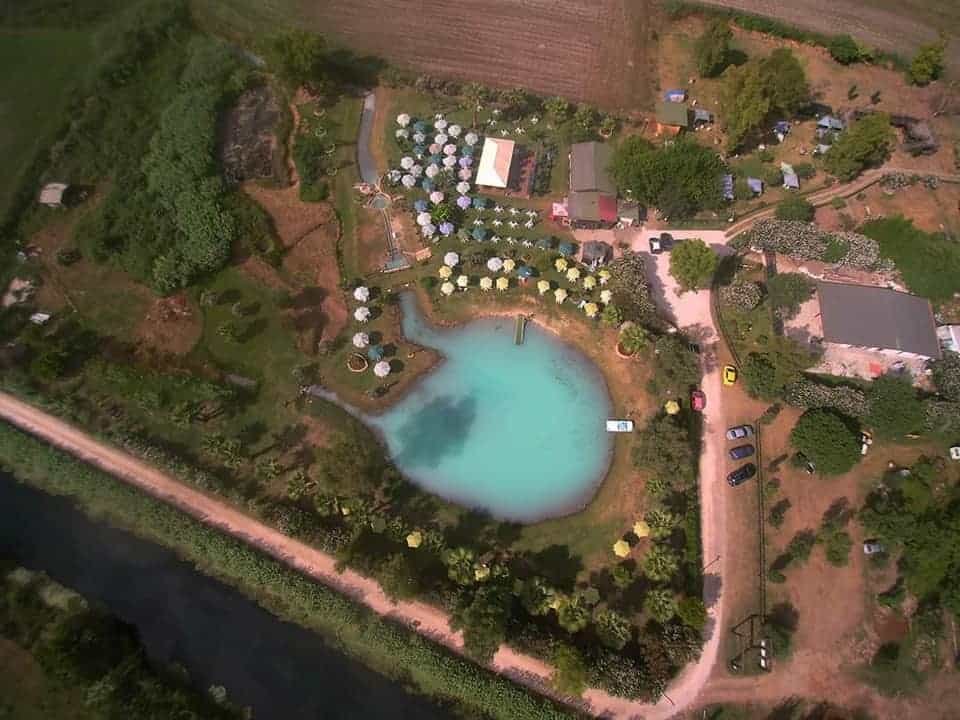
Oasi di San Valentino is a private equipped area located in the Gricilli locality, in the municipal territory of Pontinia, in the Latina Province, right along the border with Priverno and a few minutes from the first hairpin bends climbing toward Sezze. There is only one reason it exists, and a quarter of an hour on site is enough to understand it: sulfur water pools rise from the grass, fed by the same deep springs that carved out the small lakes of the Gricilli. Not a thermal facility with white coats and medical records, not a swimming pool with chlorine: open-air pools of mineral water, in the middle of a fenced meadow, at the foot of the Lepini Mountains and a couple of kilometers as the crow flies from the villages of Priverno and Sezze.
The confusion almost always comes from the name. Many arrive convinced they're entering a nature oasis run by a public body, with marked trails, educational panels and a ticket office, instead they find a private property with paid entry, a picnic area, a refreshment stand and the option of stopping even with a tent or a camper. The actual natural area, the protected one, lies all around and goes by other names: Laghi dei Gricilli, Laghi del Vescovo, Fontana di Muro. They are two different things that coexist a few hundred meters apart, and understanding the difference before you set out resolves 90 percent of the misunderstandings in advance.
From Rome it takes about an hour and a half by car. The road is simple up to a point and then becomes rural: the last stretch runs along Strada dei Gricilli, roughly halfway between the hamlet of Ceriara and the Fossanova abbey, through reclaimed countryside where signs are scarce and the navigation system sometimes suggests shortcuts that end on private dirt tracks. It's worth calling ahead, both to find out whether the place is open and to confirm the route: the number given by the management is 339 6601411.

Oasi di San Valentino in Gricilli, in the municipality of Pontinia in the Latina Province: the sulfur water pools rise directly from the grass of the equipped area, and the dull blue color of the water is the first thing you notice on arrival.
Where Oasi di San Valentino is and how you actually get there
The geography of this corner of the Pontine plain deserves a few lines, because it explains everything else. It sits in a narrow strip between the last slopes of the Lepini Mountains and the course of the Uffente river, crossed lengthwise by the Rome-Naples railway line and by a road running alongside it. It's the strip of plain that the 1930s land reclamation drained last, or rather didn't drain at all, because here the water didn't come from the sky but from below: it rose and still rises from the carbonate subsoil of the Lepini, and no drainage canal could do much about it.
By car from Rome
The most direct route starts from the Grande Raccordo Anulare and takes Via Pontina toward Latina. Past Latina, you continue toward Pontinia, then head for Priverno and the Fossanova abbey, which is the most visible landmark in the whole area and appears on signs well before Gricilli. Strada dei Gricilli branches off there and runs parallel to the railway. Under normal conditions, count on between 90 and 100 minutes from the ring road. On summer weekends, Via Pontina fills with traffic heading to the sea and travel time stretches out in ways that are hard to predict, with queues forming mostly between Aprilia and Latina, southbound in the morning and northbound in the late afternoon.
One alternative many people overlook is to come from the opposite direction, that is, from the A1 motorway, exiting at Frosinone and heading down toward Priverno through the Amaseno valley. The distance gets longer, but you avoid Via Pontina entirely, and the final stretch crosses farmland that is much more beautiful than what you see from the state road. Anyone coming from Naples or lower Lazio finds this a natural route and has no reason to take the coastal road.
By train
The reference station is Priverno-Fossanova, on the Rome-Naples railway line via Formia, served by regional trains that connect Rome Termini with Minturno and Naples. From the station to the Gricilli area the distance takes a few minutes by car or about 20 minutes by bike on flat road, but there is no local shuttle service, and taxis at the station are not always available. Anyone without their own transport risks being stranded, and the practical advice is to arrange the transfer in advance or take your bike on the train, which is allowed in the equipped carriages on this line. The Strada dei Gricilli, flat and lightly trafficked, is also very well suited to cycling. From Priverno-Fossanova you can complete a loop in one morning that passes the abbey, the ponds and the equipped area, with the only warning that in summer there is little shade along the road.
La sosta
Inside the private property, parking is provided for and included in the entry fee. Outside, along the Strada dei Gricilli and on the pullouts that overlook the ponds, parking is informal, and on weekends in July and August it fills up quickly, with cars left on the grassy verge and passage made difficult for the farm vehicles that work here all year round. Parking so that you don't block access to the fields is not an optional courtesy. It is the reason some properties in the area have gradually closed their paths to the public.
What Oasi di San Valentino really is: a private equipped property, not a nature reserve
The formula is that of a private equipped area with day admission. You pay a fee per person, enter a fenced meadow, choose where to set up and stay for the day. Inside the perimeter there are the pools fed by sulfur water, shaded areas, tables for packed lunches, a refreshment point and the facilities. Those who want to stay beyond the day can do so with a tent or camper, according to the conditions the management communicates from time to time.
The figure that has been circulating for years for admission is 10 euros per person. Rates at a private property change with the season, and the only serious way to know them before getting in the car is to call 339 6601411. The same advice applies to the opening calendar, which follows the warm season and the weather far more than a published schedule.
Anyone who arrives expecting free entry is caught off guard. It's worth turning the reasoning around: 10 euros for a whole day in a meadow with thermal water in the open, shade, tables and the option to cook are not expensive in absolute terms. They only seem expensive because the landscape around is open and free, and the eye struggles to accept that a few meters from a freely walkable countryside there is a fence with a gate. The difference is made by the pools. Those are inside, and outside there is no accessible equivalent.
What to expect in practice
The meadow is the real star. There are only a few pools, of modest size, and the water that fills them comes directly from the aquifer: opaque, a milky blue that shifts to green depending on the light, with the unmistakable smell of hydrogen sulfide that you notice even before seeing them. The temperature stays constant throughout the year, and this is why the experience changes radically with the season. In August the water feels refreshing compared to the air, while in autumn the same water seems lukewarm.
The rest is ordinary in the best sense of the word: tables, benches, barbecues, a structure for refreshments, restrooms. Anyone looking for a spa with guided routes, bathrobes and treatments is in the wrong place by several dozen kilometers. For that there are the equipped thermal establishments, and in Lazio the historic reference is the Acque Albule springs at Bagni di Tivoli, which share the sulfur chemistry with the Gricilli but certainly not the setting.
The refreshment point and cooking
The refreshment area has a troubled history, which I cover later in the section on events. What matters for anyone planning a day is that packed lunch is fully provided for, and in fact it is the most common option among regular visitors, who arrive in the morning with cooler bags, towels and folding chairs and head off at sunset. Bringing plenty of drinking water is a basic precaution: the water in the pools is mineralized and sulfated, and of course it is not drunk.
The sulfur water pools of Oasi di San Valentino: what you can do and what to know beforehand
Bathing in the pools is the reason this place exists, and it is also the part that requires some practical warnings. The water contains sulfates, chlorides, dissolved carbon dioxide and sulfur compounds. In the Pontine plain this type is historically labeled acqua albula, the same term used at Tivoli. It is a strongly encrusting water that leaves whitish deposits on surfaces and stones with prolonged contact, and it has an acrid smell that is recognizable from far away.
The smell
It deserves a paragraph of its own because it is the first cause of surprise. Hydrogen sulfide has the smell everyone associates with rotten eggs, and at low concentrations it becomes the trademark of every sulfur spring in Italy. After 20 minutes your nose adapts and stops registering it, your swimsuit and towels, on the other hand, don't adapt at all and hold onto it. Anyone who drives home with wet clothing sealed in a bag discovers that very evening how stubborn it is. A separate bag and a dry change of clothes solve the problem.
Swimsuit, Jewelry and Fabrics
Sulfur reacts with silver and blackens it quickly and visibly. Rings, chains and earrings must be removed before going into the water, without exceptions, and the same goes for watches with light-colored finishes. White or very light swimsuits tend to turn gray and sometimes yellow in a way that washing doesn't fully recover: a dark, already worn swimsuit is the reasonable choice. Synthetic technical fabrics hold up better than cotton.
How Long to Stay in the Water
Mineral waters are not a bathtub. The rule of thumb that every Italian thermal spa applies is that of short, repeated immersions, with breaks out of the water between them and plenty of hydration. Anyone with cardiovascular problems, anyone who is pregnant, and anyone taking medication should check with their doctor first, just as they would for any equipped thermal baths, with the added drawback that there is no medical staff on site here.
Children
The lawn is an ideal environment for children, and the pools are shallow, but the murky water reduces visibility to a few centimeters and the edges can be slippery due to mineral deposits. Direct supervision cannot be delegated. Rock shoes, the rubber ones used at the seaside, solve the footing problem better than any other solution.

A Curiosity About the Oasi di San Valentino
The curiosity concerns the name of the locality, not that of the equipped area. The residents of nearby villages have never called these water basins Laghi dei Gricilli or Laghi del Vescovo: they call them Triciglia. It is a popular place name that does not appear on official maps and survives only in spoken use in Sezze and Priverno. Anyone who asks an older local for directions using the names from the maps risks getting a puzzled look, anyone who says Triciglia is understood right away.
The fact that a handful of small lakes has three different names says a lot about their history. Gricilli is the name of the road and of the farming settlement born from land reclamation. Laghi del Vescovo points to the historic church ownership of these lands, in an area where the diocese of Terracina, Priverno and Sezze exercised land rights for centuries. Triciglia is instead the name that came before all the others, that of the shepherds and farmers who visited the pools when the surrounding plain was still a marsh.
In the official place-name records of the Lazio Region, the area appears as geosite number 50 of the Lepini hydrogeological system, and as a site of community importance with the code IT6040003. Three popular names and two technical codes for four pools and a few hectares of meadow: rarely does a place this small accumulate so many names.
The Gricilli Lakes Around the Oasi: San Carlo, Laghi del Vescovo, Mazzocchio
Around the equipped area lies a system of water bodies that is worth knowing about, because it is the geological reason the sulfur water pools exist too. Coming from Priverno, the first one you reach is the Lago di San Carlo, circular, with a diameter on the order of 80 meters, isolated from the others.
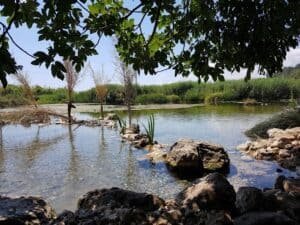
Heading south you find the main group, properly called the Laghi del Vescovo: four bodies of water, three of them sulfur and one of fresh water. The three sulfur ones can be recognized at first sight by an unnatural sky-blue color, almost milky, that has nothing to do with the green of lowland waters. In the local literature they appear under the names Lago Bianco, Lago Verde and Lago Piccolo. The fourth one, which is fresh water, is called Lago Nero, and it is recognized by its shape as well as its color, which forms a fairly clear figure eight when seen from above.
Farther south, in a spot that makes it practically invisible from the road, is located the Lago Mazzocchio, surrounded by tall reed beds and a eucalyptus wood planted during the reclamation era. It is fed by the waters of a canal that, after a pumping station, rejoins the Uffente river farther on. Anyone driving along the road doesn't see it at all, and many guidebooks mention it without ever having seen it.
Size, and why the sources don't agree
Here it's best to be explicit, because the figures in circulation diverge. The local popular information sheets give the figure-eight lake a maximum length of around 150 meters and a depth of about 18 meters. The technical studies on the subsidence phenomena of the Pontine Plain collected by the Istituto superiore per la protezione e la ricerca ambientale instead describe sub-circular outlines with diameters reaching 120 to 130 meters and average depths between 10 and 15 meters. The two sets of figures don't necessarily contradict each other, because one concerns the overall length of a two-lobed body of water and the other the average diameter of the individual basins. In any case, they remain orders of magnitude to be taken for what they are, namely estimates.
One point on which the sources agree is elevation: the lakes sit at levels close to sea level, with lake bottoms that in some places drop below zero. The reclaimed plain around them lies a few meters above sea level, and this explains why the hydraulic system of the Agro Pontino still depends today on mechanical lifting plants.
How they formed
They are not volcanic lakes, and they are not barrier lakes. They are sinkholes, that is, chasms produced by sudden ground collapses. The mechanism that the studies reconstruct combines several factors: the gradual subsidence of the plain, the presence at depth of fractured carbonate rocks that continue the Lepini massif, active underground water circulation, and hydrothermal manifestations that rise along the faults. The technical literature describes two distinct circuits, one karst and one hydrothermal, and attributes the origin of the basins to a geothermal karst phenomenon controlled by tectonic dislocations still active in the Quaternary.
That the process is still ongoing is shown by a documented episode: in April 1991 the area recorded ground settlements with variable drops, in some spots less than one meter and in others close to two meters, accompanied by inclined fractures. This is not a fossil landscape: the ground is still moving.

Something nobody tells you about the San Valentino Oasis
Mosquitoes. No tourist page mentions them, and they should be the first line. You're in a surviving wetland in the heart of a reclaimed plain, with reed beds, still water pools and irrigated meadows: the perfect setting for a population of dipterans that, from sunset on, becomes the dominant variable in any plan. In June, July and August, the hours after sunset call for repellent, long sleeves and a minimum of organization, or the day ends earlier than expected.
There is a historical reason behind this practical banality, and it is a heavy one. For centuries the Agro Pontino was the malaria-ridden territory par excellence of the Papal States, and the integral land reclamation of the 1930s was created to eliminate the stagnant water that fed the parasite's life cycle. Malaria was declared eradicated in Italy in 1970, and today's health risk is nil. The nuisance, however, has remained exactly the same. The Gricilli survive as a remnant of that amphibious landscape that the reclamation wiped out elsewhere, and the mosquitoes survive with them.
The second concerns network coverage. In this fold of the plain, with the Lepini Mountains acting as a screen on one side, the phone signal is patchy and in some spots absent. If you plan to use your navigation system for the last kilometer, or to look up the phone number online once you arrive, you may find yourself without tools: it's better to save the directions and the contact before leaving.
The Advice I Give You for Visiting the Oasi di San Valentino
There's only one piece of advice, and it goes against the instinct of the majority: come here outside the bathing season, on a mild day in May, September or early October, and treat the day as an outing in the Pontine plain, where the pools are one stop and not the only goal.
There are three reasons, and none of them is sentimental. The first is the water temperature, which stays almost constant all year at around 20 degrees: in August, with 40 degrees in the air, that water is simply cool and the thermal sensation disappears, in October, with 15 degrees in the air, the same water becomes a lukewarm pool and the experience flips. The second is mosquitoes, which drop off sharply outside the hot months. The third is crowding: on summer weekends the grass and the parking spots along the road fill up, while in the low season you can spend a whole afternoon with about 10 people in total.
How to Build the Day
Leave Rome early, first stop at the Fossanova Abbey, one of the best-preserved Cistercian complexes in Italy, a few minutes from the small lakes. Second stop at the equipped area for swimming and lunch, taking it easy, with no rush to leave. In the afternoon, drive back up toward one of the Lepini towns: Sezze and Priverno are the closest, but with another half hour you reach Sermoneta, Bassiano, Norma or Cori, and the contrast between the plain at sea level and the towns perched on the rock is the real spectacle of this province.
What to Pack
A dark swimsuit you won't mind ruining, a second dry swimsuit, a waterproof bag for wet things, rubber shoes, a towel you don't mind staining, mosquito repellent, plenty of drinking water, a hat. Silver jewelry stays at home. If the plan includes a packed lunch, bring a proper cooler bag: on this plain, in July, the sun shows no mercy.
Fontana di Muro, the Green Areas and the Protected Zone Around the Oasis
A few hundred meters from the equipped area is Fontana di Muro, a spring that gushes into a small body of fresh water of remarkable clarity, all the more surprising when compared with the milky cloudiness of the sulfur pools a short distance away. It's the place anyone who grew up here remembers first, and it's also the heart of the only part of the Pontinia municipality recognized as a site of community importance and special protection zone.
The historic name that appears in the oldest documents is Fontana Muro, and local tradition tells of a use that sounds remote today: during the seasonal transhumance between the mountain pastures and those of the plain, the waters of this spring were used to treat animals' wounds and to whiten wool. These uses fit the local chemistry, because sulfur has antiseptic properties long known to shepherds, and they place these water bodies within a specific economic history, that of the tratturi that linked Abruzzo and the Lepini to the Pontine plain.
The Recognized Habitats
The documentation accompanying the protection proposal lists four types of habitats of community interest: Mediterranean wet meadows with tall herbs, calcareous oligomesotrophic waters with Chara vegetation, natural eutrophic lakes, and oligotrophic waters with very low mineral content. Put simply, a space of a few hectares holds chemically opposite aquatic environments, from waters rich in salts to waters almost free of minerals, and this coexistence is precisely what makes the site rare.
The species
Among the species cited in the protection sheets are the common kingfisher, the European pond turtle, and two freshwater fish of Italian fauna, the rovella and the cobite. On the botanical front, water lilies, ferns, wild orchids and specialized marsh vegetation are reported. It's not a list from a large national park, and that's exactly the point: these are small, isolated populations, surviving in a patch of land in the middle of an entirely agricultural plain, and for this reason disproportionately fragile for their size.
Anyone who arrives with binoculars and a bit of patience, on a spring morning, has a good chance of seeing something. Anyone who arrives at noon on an August Saturday will mostly see other people. The difference between the two experiences is huge and depends entirely on the time you choose.
Protection Still Fragile
The European recognition as a site of community importance and special protection zone has existed for years, and for just as many years local observers have reported that it has not translated into operational management on the ground: the proposal to establish a natural monument has been put forward and has not been completed. In the news reports and notices from environmental groups in Pontinia, the same complaints keep coming up: abandoned waste, alterations to riparian vegetation, fires lit near the spring, unregulated access. This explains why part of the land around has been fenced off by the owners, and why the very existence of a paid, equipped area should also be read as a form of controlling entrances.

Another well-known fact, yet one rarely mentioned
The well-known fact is that the Gricilli are among the very last fragments of pre-reclamation landscape left in the Agro Pontino. You read it in every sheet and repeat it without thinking. What almost no one adds is the quantitative comparison, and the comparison is striking.
Before the 1930s, the Pontine plain was a marshland of tens of thousands of hectares, a continuous system of swamps, reed beds and water-loving woods that ran from the sea up to the slopes of the Lepini Mountains. Integral land reclamation turned it within a few years into an agricultural territory drained by hundreds of kilometers of canals and kept dry by pumping stations that still work today and without which a large part of the Agro would go back under water. Three significant traces of that original environment remain today: the Gricilli, the wetlands inside the Circeo National Park with the Pantanello area, and the spring system of Ninfa. From tens of thousands of hectares to a few dozen: this is the real ratio.
There is a second fact, just as well known among specialists and almost never mentioned elsewhere: the coexistence, in such a small space, of sulfur waters and fresh water is a rarity that in this region is found in only two other settings, the San Vittorino plain near Cotilia, in the Reatino, and in part the area of Tivoli with the Acque Albule system. Three places in all of Lazio. The value of the Gricilli is not scenic in the postcard sense: it is geochemical, and it is written in the palette of colors you see from the road, with sky-blue and green pools 50 meters apart.
The third little-mentioned element concerns the thermal regime. The water that feeds the pools stays essentially constant at around 20 degrees all year, because it comes from a deep circuit and is not affected by the season. This means that in winter, when the air drops below 10 degrees, steam rises from the water. Anyone who passes along the Strada dei Gricilli on a January morning, with frost on the fields and smoke rising from the sky-blue pools, sees the most beautiful thing this place has to offer, and sees it without paying anything and without meeting anyone.
The right photo to take at the Oasi di San Valentino
The right photo is not the one of the pool seen from the edge of the lawn with people in it: it always comes out flat, the water loses its color, and the result looks like a neglected swimming pool. The right photo focuses on the color of the water against the green of the lawn and the gray of the Lepini Mountains, and it requires three precise conditions.
The time
The first is the time of day. The milky sky-blue of the sulfur waters is a color of low, raking light: it comes alive in the early morning and in the hour before sunset, while at noon the high sun flattens and bleaches it. Early in the morning, moreover, the surface is still and reflects the mountain barrier.
The angle
The second is the angle. You need to crouch down, bring the camera or phone a few centimeters above the water and include three horizontal bands in the frame: the sky-blue water in the foreground, the green band of the lawn and reeds in the middle, the profile of the Lepini Mountains at the top. It is a simple composition that always works, because it takes advantage of the color contrast that makes up the visual identity of the place.
The filter
The third is technical: a polarizing filter changes the result dramatically. By reducing reflections on the surface, it brings out the mineral suspension that gives the water that color, and it restores a saturation that you can perceive with the naked eye but that the sensor alone does not register.
The photo nobody takes
And then there is the photograph that almost no one brings home, because it requires coming in the wrong month: the steam rising from the water on a cold winter morning, backlit, with the low sun cutting through the fog. It takes a clear January day, a departure from Rome before dawn, and the willingness to be cold for an hour. In return you get an image that doesn't look like any other photograph of the Pontine plain.
Some important events in the history of this place
A place of four pools and a lawn seems to have no history, and yet its story is the same as that of the whole plain around it. It's worth laying it out, because every stage left a mark that is still visible today.
The long age of the marsh
For centuries this strip of plain was land of marshes and malaria, the territory the popes repeatedly tried to drain without ever succeeding in a lasting way. In that context the Gricilli were not an anomaly but the norm: standing water, reeds, seasonal grazing. The church ownership of the land, the origin of the name Laghi del Vescovo, belongs to this very long phase, during which human presence was tied to herding and transhumance more than to settled farming.
The reclamation of the 1930s
The integral reclamation of the Agro Pontino is the event that redrew the landscape in which the area sits. Within a few years the marsh was drained by a network of canals, the new towns of the plain were founded, and thousands of settlers arrived from Veneto and Friuli, whose accent can still be recognized today in the surnames and speech of these towns. Pontinia, the municipality to which the Gricilli administratively belong, was born in that period, in the mid-1930s, as a new agricultural center. The consequence for our corner of the territory was paradoxical: the water that rose here from the subsoil could not be drained, and so a fragment of the old landscape survived precisely thanks to its hydraulic stubbornness.
1970 and the end of malaria
Malaria was declared eradicated in Italy in 1970. For the Agro Pontino it was the closing of a chapter 2,000 years long, and for the Gricilli it was the moment when the pools could stop being seen as a health threat and start being seen as a resource. The bathing use of the sulfur waters, with the first informal swims and later the first forms of organized management, belongs to the following decades.
April 1991
In April 1991 the area was affected by ground subsidence documented in studies of the sinking phenomena of the Pontine Plain: the ground lowered by under one meter in some spots and by close to two meters in others, with ground fractures at steep angles. It is the episode that more than any other shows that these lakes are not an inert remnant but the result of a geological process that is still active, and that a sinkhole is not an event of the distant past.
European recognition and the geosite
The area has been included in the European network of Sites of Community Importance under code IT6040003 and classified as a special protection zone. Lazio regional legislation on protected natural areas, with regional law number 29 of 1997, included the site among the geosites of the hydrogeological system of the Lepini Mountains, with number 50. Over the years, a proposal to establish a natural monument has developed around these acts, backed by local environmental groups, and it has not yet reached its goal.
September 27, 2020
On the afternoon of September 27, 2020, a fire destroyed the structure of the restaurant at the Oasi di San Valentino, on via dei Gricilli in the territory of Pontinia, close to the border with Priverno. Rescuers arrived in the early afternoon and worked for hours. The venue was closed and there were no injuries. The prevailing hypothesis reported in the news linked the start of the fire to a lightning strike during the thunderstorm that was crossing the area at that time. It is an episode worth keeping in mind: the hospitality of this place has seen interruptions and reopenings, and a phone call beforehand remains the only reliable way to check the status of the services.

Who passed through the Oasi di San Valentino
Anyone expecting a list of celebrities will be disappointed, and it has to be said plainly: the local news and the available literature about this place record no famous names. The value of this place has nothing to do with glamour. The people who really passed through here and left a mark are others, and telling their stories is more interesting.
The transhumance shepherds
The first visitors documented by local tradition are the shepherds who came down from the mountain pastures to the plain and used water from the Fontana Muro spring to treat the wounds of their animals and to whiten wool. It is a use that links these water bodies to a pastoral economy that lasted for centuries, and that explains why a seemingly marginal place was perfectly well known to those who worked the land long before it appeared in any guidebook.
Church ownership
The name Laghi del Vescovo is not decorative: it refers to the landholdings of the diocese in an area where church property represented a significant share of the land for centuries. Behind that place name you can glimpse a long sequence of administrators, tenant farmers and farm managers, people whose names do not appear in books but who determined how these lands were used for generations.
The reclamation settlers
The Venetian and Friulian families who arrived in the 1930s to populate the new towns of the Agro Pontino are the protagonists of the most radical transformation this plain has ever seen. Their descendants live today in Pontinia and the nearby towns, and they are largely the regular visitors to the small lakes, the ones who call the water bodies Triciglia and know exactly which pool has the best bottom.
The geologists
Among those who have spent more hours here than anyone else are the researchers who have studied the sinkhole phenomena of the Pontine plain. The Laghi del Vescovo appear in the technical literature on Italian sinkholes with measurements, sections and reconstructions of the deep water circuits. Without that work, this place would be just a group of colored pools. Thanks to that work, we know why they are colored and how they formed.
The Environmentalists of Pontinia
The last category is that of the local groups that have documented the state of the site with photographs for years, denounce its decay and ask for its effective protection. A large part of the images and information circulating about Fontana di Muro and the Laghi del Vescovo exists because someone local went to photograph the spring year after year. It's a form of presence less spectacular than a famous name and much more useful.
When to Go to Oasi di San Valentino and When to Avoid It
The calendar of this place doesn't look like that of a beach, and treating it as one almost always leads to the wrong day.
Spring, the Best Season
April, May and the first half of June are the golden period. The meadows are green, the marsh vegetation is in the middle of its cycle, birds can be seen, mosquitoes haven't yet reached summer densities and the air temperatures let you stay in the water without being cold when you get out. It's also the moment when the color contrast between the light blue pools and the countryside works at its best. The downside is that the management of the equipped area follows the hot season, and in April the services may not have started yet: calling ahead counts double.
Summer, the Crowded Season
July and August are the months when the place really operates and when it is almost certainly open, but also the ones when it offers the least. The heat of the Pontine plain in the central hours is heavy, natural shade is limited, mosquitoes from sunset on become a serious problem and weekends bring a crowd that changes the nature of the place. Anyone with no alternative should at least do one thing: arrive at opening time, not at noon.
September and October, the Smart Season
From the second half of September to mid-October conditions are optimal again. The air softens, the water keeps its constant temperature and so feels warmer compared to the surroundings, insects decline, visitors almost disappear. It's the window I recommend to anyone who wants to understand why this place has a reputation, and not simply check that it exists.
Winter
From November to March the equipped area is in all likelihood closed and swimming is out of the question. It remains, though, the most beautiful season for walking the Strada dei Gricilli, looking at the lakes from the outside and photographing the steam rising from the water on cold mornings. Anyone with an interest in nature or photography finds in January and February conditions that no other month offers. The surface of the side pullouts, after days of rain, becomes muddy, though, and low cars risk getting stuck.
What's Around Oasi di San Valentino
The Gricilli area works much better as the center of a varied day than as a single destination. Within half an hour by car you find a density of things to see that few other spots in southern Lazio can match.
Fossanova Abbey
It's the most important monument in the immediate vicinity and the road reference point for the whole area. One of the best preserved Cistercian complexes in Italy, with church, cloister, chapter house and guesthouse, it can be reached from the small lakes in a few minutes. Anyone planning the day should put it in the morning, before swimming, when the light inside the church is better and the groups are still few.
Priverno and Sezze
Priverno preserves a medieval historic center gathered around the town hall square and hosts the city museums, including the archaeological one tied to the site of Roman Privernum. Sezze, perched higher up on the Lepini slope, offers a view over the reclaimed plain that alone justifies the climb: from up there you grasp at a glance the geometry of the land reclamation, with canals and farms laid out at right angles all the way to the sea.
The Villages of the Lepini
Behind opens the Lepini Mountains Nature Park with its sequence of towns at altitude. Sermoneta with the Caetani castle, Bassiano with its walls and its ham tradition, Norma overlooking the void above the plain, Cori with the Temple of Hercules. They are all reachable in under an hour from the Gricilli and offer the perfect counterpoint to a morning spent at sea level.
The Ninfa Garden
The Ninfa Garden comes from the same hydrogeological phenomenon as the Gricilli, that is, from the waters of the Lepini Mountains that resurface at the base of the massif, and it is the monumental, cultivated version of it. Visiting it on the same day as the sulfur pools means seeing two opposite results of the same geological cause. Access is regulated by openings on set dates and by reservation, and it needs to be planned in advance.
The sea and the coastal wetlands
From the Gricilli, the coast is reached in a good half hour. Terracina with the Temple of Jupiter Anxur, the spiaggia di Torre Paola below the promontory, the Circeo National Park with the coastal lakes, including the Lago di Fogliano, and farther north the Lido di Latina. Anyone who wants to understand the story of the land reclamation will find the Pontine Land Museum in Latina, which uses objects and documents to tell the story of how this plain was transformed.
Quick questions about the Oasi di San Valentino
Do you have to pay to enter Oasi di San Valentino?
Yes, it is a private property with a daily entry fee per person. The figure that has been going around for a while is 10 euros. Rates and conditions should be confirmed by calling the management at 339 6601411.
Is the water warm like in a thermal bath?
No. The waters of this system keep a constant temperature of around 20 degrees all year round. In summer they feel cool compared to the air, and in autumn and winter they feel lukewarm. There is no artificial heating.
Can you swim for free in the Gricilli lakes?
The lakes you can see from the Strada dei Gricilli are part of a site protected at the European level, and a large part of them lie on private land. The pools that can be accessed in a regulated and equipped way are the ones inside the paid property. Treating the area like a free beach is the fastest way to get even the last access points closed.
Can you get there without a car?
By train, you get off at Priverno-Fossanova on the Rome-Naples line via Formia, but from the station to the site you still need a transfer: a taxi, a ride, or a bicycle. There is no dedicated public connection.
Can you camp there?
The management allows stopping with a tent or a camper. Conditions, periods and rates must be requested directly at the number listed, because they are subject to seasonal changes.
Are there mosquitoes?
Yes, and in significant numbers in the hot months from sunset onward. You are in a remaining wetland area, so insect repellent and long sleeves are part of the basic gear from June to September.
Does the sulfur water ruin swimwear?
It can gray and yellow light fabrics, and it quickly tarnishes silver. Wear a dark swimsuit, leave your jewelry at home, and bring a separate bag to take the wet things home.
Is it suitable for children?
The lawn and the shallow pools work well with children, but the water is cloudy, and the edges can be slippery because of mineral deposits. Supervision must be constant, and rubber shoes help a lot.
What is the difference between Oasi di San Valentino and Fontana di Muro?
Fontana di Muro is the very clear freshwater spring found in the park of the Laghi dei Gricilli, within the area recognized as a site of community importance. Oasi di San Valentino is the private property equipped with the sulfur water pools. They are a short distance apart and belong to the same hydrogeological system, but their chemistry, color and access rules are completely different.
In our opinion, Oasi di San Valentino should be taken for what it is: a private property in a geologically extraordinary place, not a thermal facility and not a nature reserve. Anyone who arrives expecting bathhouse-style service will be disappointed. Anyone who arrives to spend a day with their feet in water that comes from the heart of the Lepini Mountains, in a meadow on the edge of the last surviving marsh of the Agro Pontino, will take home one of the least predictable days this province has to offer. The key is the season. Come in May or October and you'll understand. Come at Ferragosto and you'll wonder why everyone talks about it.
Frequently asked questions about the Oasi di San Valentino
Do you have to pay to enter Oasi di San Valentino?
Yes, Oasi di San Valentino is a private property with a daily entry fee per person. The figure that has been going around for a while is 10 euros, but rates and conditions should be confirmed by calling the management at number 339 6601411 before you go.
Is the water at Oasi di San Valentino warm like in a thermal facility?
No, the waters of Oasi di San Valentino stay at a constant temperature of around 20 degrees all year, so they are not as warm as in a real thermal facility. In summer they're quite cool compared with the air temperature.
What is the best time to visit Oasi di San Valentino?
The best time to visit Oasi di San Valentino is outside the bathing season, on a mild day in May, September or early October, treating the day as an outing in the Pontine Plain rather than as its only goal. April, May and the first half of June remain the golden period anyway, when the meadows are green and the mosquitoes haven't yet reached summer numbers.
Are there mosquitoes at Oasi di San Valentino?
Yes, mosquitoes are a very real presence at Oasi di San Valentino, since it's a wetland with reed beds, still water and irrigated meadows. In June, July and August, the hours from sunset onward become the factor that affects the day the most, so it's worth taking them into account when planning.
Can you sleep at Oasi di San Valentino?
Yes, those who want to stay beyond the day at Oasi di San Valentino can do so with a tent or camper, because the equipped area also allows for this in addition to the day entry. Inside the perimeter there are in any case tables for packed lunches, shaded areas, a refreshment point and the facilities.
Why do locals call the waters of Oasi di San Valentino by a different name?
The people of the towns near Oasi di San Valentino call these pools Triciglia, not Laghi dei Gricilli or Laghi del Vescovo as the official maps list them. It's a popular place name that survives only in the spoken use of Sezze and Priverno, useful to know if you ask directions from an older local.
What is there to see near Oasi di San Valentino?
Near Oasi di San Valentino is Fossanova Abbey, the most important monument in the immediate area and the road landmark for the whole zone, a Cistercian complex among the best-preserved in Lazio. Not far away there is also Fontana di Muro, a freshwater spring of remarkable clarity compared with the murkiness of the sulfur pools.
Article written by the editorial team of TourLeaderPro, contact them for Tours and Private/Corporate/V.I.P. Experiences. For an organized day around the Laghi dei Gricilli, Fossanova Abbey and the villages of the Lepini Mountains, with a licensed tour guide, start from the TourLeaderPro contact page, tour operators that build itineraries in southern Lazio and the Agro Pontino will find the consulting service in the section dedicated to tour operators, by contrast.
Planning a trip to Rome? English guides to visiting the city are on ItalyPlanner.com. For those thinking in terms of days out of the city, there's the guide to the best day trips from Rome, while those looking for water and nature without beach establishments will also find the guide to free beaches in Italy useful.