Terme del Bagnaccio
In short. The Terme del Bagnaccio are at Strada del Garinei snc, 01100 Viterbo, in the countryside north of the city, and since August 2, 2025 they have been a paid thermal park run by Rise S.r.l.
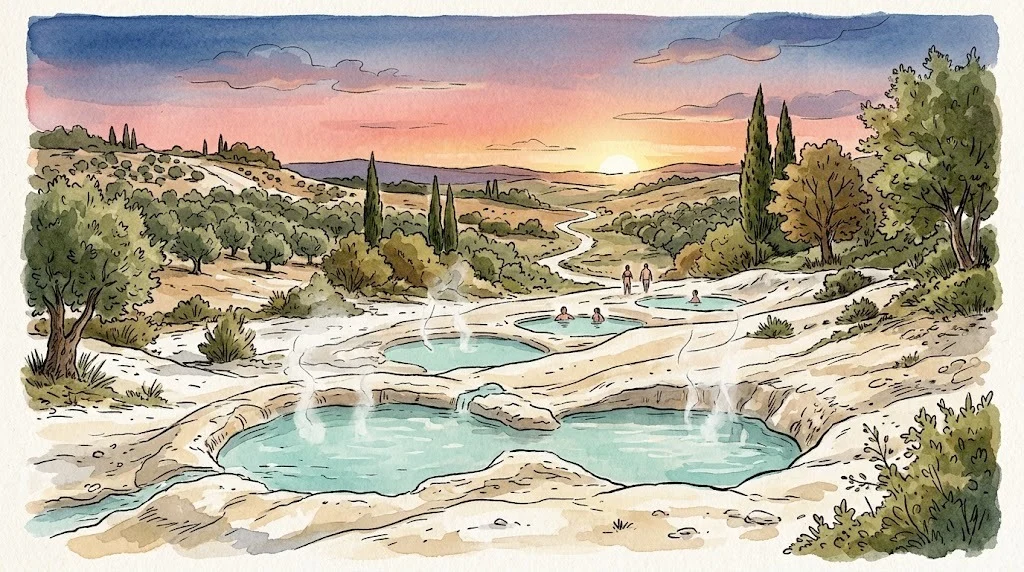
The Terme del Bagnaccio are at Strada del Garinei snc, 01100 Viterbo, in the countryside north of the city, and since August 2, 2025 they have been a paid thermal park run by Rise S.r.l. under a sub-concession from the Municipality of Viterbo: €8 for weekday entry, €12 on holidays and the days before holidays from May to October, €10 on winter holidays. You pay at the entrance or in the operator's online shop, with no stated mandatory reservation.
Anyone who remembers the Bagnaccio of 10 years ago, with the association membership card and the steaming pools in the middle of the meadow, will find the same place and a different model. The five outdoor pools are still there, the water still gushes out at over 60 degrees Celsius and cools as it flows, Via Francigena still passes a short distance away. What has changed is the gate, the price list, the hours, and above all the fact that there is now a party that answers for everything.
The practical information comes from the operator's official site, from the prices and hours pages and from municipal documents reported by the local press. Rates and seasonal hours change with the park's calendar, and the concession expires at the end of 2027: before leaving Rome, call the number published by the operator and have them confirm opening, last entry and the conditions of the day.
Where it is and what you really find
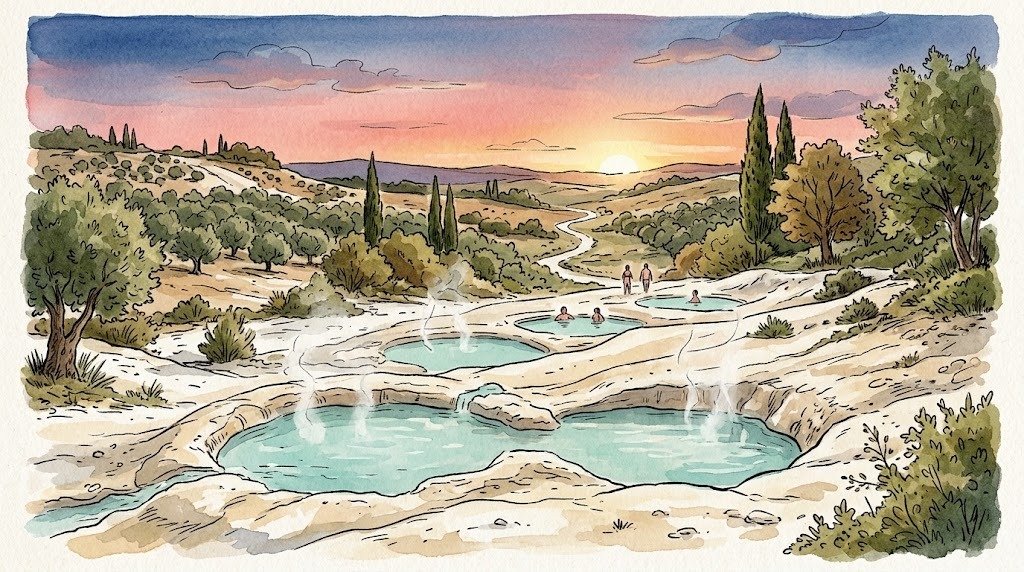
The park is in the thermal plain that opens north of Viterbo, between the Cassia and the road to Castiglione in Teverina, about 8 kilometers from the historic center according to the city's thermal portal. The official address is Strada del Garinei with no street number, and it's the address to put in your GPS: the old directions that circulate online mention Strada Castiglione and take you to the right area but not to the gate.
Inside you find five outdoor pools, which the operator numbers from B1 to B5, dug into the ground and fed by the hyperthermal springs of the area. The operator states temperatures between 36 and 43 degrees for the pools and gives about 63 degrees at the source. The water enters hot in the first pool and loses heat as it passes into the following ones, so anyone who wants to stay a long time picks the pools farthest from the inflow point.
Around the pools the operator has organized three areas that did not exist before in this form: an agricultural area with organic crops and a social garden project, a thermal botanical garden created with the University of Tuscia and the Angelo Rambelli Botanical Garden of Viterbo, and a stop for Via Francigena pilgrims. The core remains the water, the rest serves to fill the hours between one bath and the next.
What you don't find: a wellness center with cabins, massages and indoor pools, an in-house restaurant declared on the site, a hotel. The city's thermal portal notes that near the Bagnaccio there are no accommodation facilities, bars or restaurants. If you want the spa with bathrobe and herbal tea room, you have to go elsewhere, for example to the Terme dei Papi, on the other side of the city.
On the provision of changing rooms, showers and restrooms the operator's site doesn't go into detail, and the descriptions you read online often refer to the previous management. The price list includes loungers on the lawn and spots with an umbrella, so a minimum of equipment is there. For everything else, from the locker to the hot shower, call first and take nothing for granted: in the countryside, without services, one forgotten detail ruins the day.
Hours, tickets and subscriptions
The price list published by the operator for weekdays is this: €8 for full entry, €5 for pilgrims with a credential, €4 for people with disabilities, €5 for children under 6, €7 for students. On holidays and the days before holidays the full price goes up to €12 from May 1 to October 31 and to €10 from November 1 to April 30, students pay €9 and the other reductions stay at €5.
You buy directly from the operator, in two ways: at the park's ticket desk or on the online shop linked to the official Bagnaccio site, where weekday entry, holiday entry, the five-entry pass and the annual subscription are on sale. There are no authorized resellers on tour platforms and there is no skip-the-line ticket: there is one gate and the prices are those of the official price list, with no markup.
For those who come back often there are two options. The annual subscription costs €100 per person, is valid until December 31, 2026 and gives unlimited entry, excluding the umbrella spot. The five-entry pass costs €35 and is valid for six months. For access you need a key card with a €5 security deposit, paid only the first time. A single lounger on the lawn costs €5, the spot with two loungers and an umbrella €10.
Hours depend on the season. In the winter period, from September 16 to June 15, the park opens at 9:00 on Monday and from Wednesday to Sunday, at 10:30 on Tuesday, and closes at 20:00 on weekdays, at 22:00 on Saturday and at 21:00 on Sunday. The last entry is one hour before closing. Today, at the end of September, this calendar applies, so the long evenings until 23:30 are over until June.
In the summer period, from June 16 to September 15, it always opens at 9:00 except Tuesday, at 10:30, and closes at 22:00 from Monday to Thursday and on Sunday, at 23:30 on Friday and Saturday. On summer weekends the last entry is an hour and a half before closing. The operator doesn't state the reason for the delayed Tuesday opening and doesn't publish fixed closing days during the year.
A practical tip on winter hours. The sun sets early, between November and February around 17:00, and from that moment the air cools quickly. Getting out of water at 40 degrees with 4 degrees outside, in the dark, to go and change is an experience worth avoiding. Plan to get out with some light left, and keep the dry change of clothes within reach.
A curiosity about the Terme del Bagnaccio
The name is an affectionate pejorative. Bagnaccio means ugly bath, a makeshift bath, and it's what the people of Viterbo have always called this stretch of hot water in the middle of the fields, with no buildings and no services. The paradox is that the place with the most modest name is the one that in the ancient world had a name on the empire's road map, while many baths with grand names are recent inventions.
The pools are emptied and refilled every night. The operator writes this, and it explains something the regulars know well: in the morning the water is clear and very hot in the arrival pool, as the hours pass it clouds from the mud stirred up by feet and cools slightly. Whoever arrives at opening finds the pools in the best condition of the day, whoever arrives at sunset finds a lived-in version.
The other curiosity concerns the color. The bottom and edges of the pools are covered with light-colored incrustations, which are the travertine deposited by the water as it cools and loses carbon dioxide. The whole plain around Viterbo is made of this stone, formed over thousands of years by the same springs. The buildings of the historic center that you'll see after the bath are also built with that rock born from hot water.
Something nobody tells you about the Terme del Bagnaccio
The official site is bagnaccio.com. The old domain bagnaccio.it, which for years was the association's site and still shows up at the top of search engines, now hosts promotional content for online casinos next to old information about the baths. Those pages still carry the association membership card, outdated hours and a set of rules from the previous management. Don't use them to plan your day and don't leave your data there.
The same problem affects many online guides and many blogs. A large part of what you read around about the Bagnaccio, that is, entry with an annual card, a free contribution for occasional guests, a camper area with an evening barrier, was written before the closure of 2022 and has never been updated. Today's park has a single-entry price list and a commercial operator. Whoever arrives with the old information risks getting the hours and the expectations wrong.
Reliable data can be found in three places: the site bagnaccio.com with the prices and hours pages, the phone number published by the operator, that is 347 282 3452, and the email address info@bagnaccio.com. The owner of the site, according to the privacy notice published in January 2026, is Rise S.r.l. If a page you're reading doesn't carry these references, treat it as history, not as practical information.
One last thing nobody writes. Whoever looks for free hot springs in the Viterbo area often ends up at the Bagnaccio because for years it was presented as such, but today it isn't. The free pools of the area are others, and they have different rules and problems. For those, in Viterbo, the reference is the listing for the Piscine Carletti, which remain free access.
Who runs the Bagnaccio today and how it got here
The thermal-mineral water deposit called Bagnaccio is the subject of a mining concession of the Municipality of Viterbo, which entrusts its exploitation through a sub-concession. The area where the pools are located is private, as the urban planning councilor Emanuele Aronne recalled, speaking of a private site of public interest. It's this double nature, public water on private land, that made the recent story so complicated.
Until 2022 the park was run by a social promotion association called Il Bagnaccio, which had organized access with an annual card. In 2022 the park closed, between May and June according to the local press, which doesn't agree on the exact day. A period of more than three years of shutdown followed, with disputes between municipal offices and administrative courts over obligations of the old agreement and works to be demolished.
In 2025 the Municipality published a notice to find the new sub-concessionaire. Only one company took part in the tender, Rise S.r.l., based in Rome, which obtained a score of 81.67 out of 100. The award decision is dated April 28, 2025, the sub-concession lasts until December 31, 2027 and provides for an annual fee of about €24,660 to the Municipality, subject to adjustments.
The operator had to obtain the health, environmental and urban planning authorizations before reopening, and the ASL carried out the required checks. The inauguration was held on Saturday, August 2, 2025 at 10:00, with Mayor Chiara Frontini. The 2027 expiry is the thing to keep in mind for anyone buying the subscription: beyond that date the conditions will depend on a new act of the Municipality.
My advice for visiting the Terme del Bagnaccio
Go in the morning on a weekday, at the 9:00 opening, and not on Tuesday, when it opens at 10:30. You pay €8 instead of €12, you find the water freshly renewed and the lawn almost empty. On a summer Saturday afternoon the park fills with families and groups, the hot pools get crowded and the silence the operator puts at the center of its communication no longer exists.
If you work and a weekday is impossible, the second choice is a winter Sunday morning. €10, cold air, steam rising from the pools and very few people until noon. The contrast between water at 40 degrees and air at 5 is the reason Romans make this hour-and-a-half drive in January, and the Bagnaccio is at its best in the cold months.
Bring flip-flops with rubber soles. The bottom of the pools is natural, with mud and travertine incrustations, and the edges are uneven. Barefoot you slip and scrape yourself, especially getting in and out of the hottest pools. Bring also a large towel, a full change of clothes and a waterproof bag for the wet swimsuit, because the smell of sulfur stays on fabrics for days.
Take off rings, chains and silver watches before getting in the water. The weakly sulfurous waters blacken silver in a few minutes, and removing the tarnish costs more than the ticket. The same goes for glasses with delicate metal frames. Anyone with treated or lightened hair would do well not to dip their head: thermal water dries it out and the smell survives more than one shampoo.
Call before leaving, always. The park is outdoors and lives on weather, maintenance and health checks, and an extraordinary closure may be announced only on the operator's channels. The published number is 347 282 3452. Ask if all the pools are open, if there is a private event and what the last entry of the day is, which in winter is one hour before closing.
Don't stay too long in the hottest pools. The rule that works is the 20-minute rule: you get in, you stay, you get out, you drink water, you sit in the shade or somewhere sheltered, and only then do you go back in. Whoever spends two hours straight in the pool at 43 degrees comes out with a heavy head and the rest of the day lost, and the trip ends in the car with the window open.
The water: what the operator declares
The operator describes the springs as hyperthermal, of the alkaline-earth bicarbonate sulfate type, weakly sulfurous, and gives the temperature at the source as about 63 degrees. The city's thermal portal reports for the hyperthermal springs of the area values between 65 and 66 degrees, the encyclopedia entry on the site says 65 degrees. The sources differ by two or three degrees, but the common point is that the water comes out too hot to get into.
On its site the operator presents the waters as known for their beneficial effects on skin, joints and muscle relaxation. That is the operator's declaration, not medical advice. The operator publishes no contraindications or health warnings, and there is no authorized label for therapeutic use on record. Anyone with heart or blood pressure problems, who is pregnant or is on therapy must ask their doctor before getting into water above 40 degrees.
The ISPRA document on the Roman baths of Viterbo, published in 2020, describes the waters of the Viterbo basin as rich in carbon dioxide and sulfur compounds, including hydrogen sulfide, the gas that gives the smell of eggs. Outdoors and with wind the concentration stays low, but anyone who feels dizziness, nausea or a headache must get out of the water immediately and move away from the surface of the pools.
The same study places the Bagnaccio in the larger geothermal basin of Viterbo, where the high-temperature springs come out between 52 and 65 degrees and deposit extensive travertine formations. It's the same system that feeds the Bullicame and the city's establishments. The individual springs have similar characteristics, and the differences between one place and another depend more on the management and the pools than on the water.
Rules, safety and what to bring
The internal rules of the new management are not published on the official site. The operator gives no rules on the web about animals, glass containers, food brought from home, minimum age for individual pools or maximum stay times. The rules circulating online, including the ban on minors under 14 in some pools, belong to the previous management. Ask by phone before showing up with a dog or with children.
At night the park is closed. The published hours close between 20:00 and 23:30 depending on the day and the season, and outside those hours access is not allowed. The night photos of baths under the stars that circulate on social media are mostly from before 2022 or taken on summer evenings within the hours. Whoever thinks of getting in by climbing the fence commits a violation and risks much more than a fine.
Safety, in a place like this, concerns three things. The first is heat: the water at the inflow point is much hotter than in the rest of the pool, and children must never be allowed near the jet. The second is the gas, which we've already talked about. The third is the bottom: mud, travertine, sudden changes in level. Get in slowly, with shoes on, and never dive.
On parking the operator publishes no information on the official site, neither rates nor hours. Ask by phone where to leave the car. According to the published descriptions the last stretch of the access road is unpaved, so in the rain it's best to drive slowly and not trust the puddles. The old camper parking service was part of the previous management: if you travel by camper, ask the operator if it's still active.
On trash the usual rule holds, and at the Bagnaccio it weighs more because the place is in the middle of the fields. Everything you bring in, you take back out, including cigarette butts and caps. The free thermal areas of the Viterbo area have had serious dirtiness problems over the years, and those who frequent them know it well. A paid park with staff at the entrance helps, but doesn't replace the behavior of those who come in, and one crowded afternoon is enough to leave the lawn in terrible condition.
In your bag put plenty of drinking water, because the heat of immersion dehydrates more than you think, a hat for the summer, sunscreen, flip-flops, two towels and something to eat if you haven't booked a lunch in the city. Leave glasses and glass bottles at home in any case: on the edge of a pool broken glass is a danger to everyone, whatever the rules say.
Another well-known fact, yet rarely cited
These waters have an ancient name written on a document. The Tabula Peutingeriana, the medieval copy of a Roman road map kept in Vienna, marks along Via Cassia a station called Aquae Passeris, and scholarly tradition places it right in this area of springs. It's the same map that shows the great cities of the empire. Few thermal places in Lazio have an attestation of this weight.
The problem is that the map gives the name and the road, not the exact point. Aquae Passeris indicates a rest station with its waters, and in the area north of Viterbo the hot springs and Roman remains are several. The 2020 ISPRA study links the statio of the Tabula to the Terme del Bacucco, a short distance from today's pools. The Bagnaccio is within that landscape, not necessarily its center.
The rarely cited fact is the other end of the thread: the Roman Cassia, of which a well-preserved stretch of paving survives north of the Bagnaccio, became in the Middle Ages the route of Via Francigena. The pilgrims heading down to Rome passed in front of the same springs that had seen the travelers of the empire. Today the operator reserves for them a €5 entry with the credential.
The Roman remains of the area: Bacucco and Lettighetta
In the countryside of the Bagnaccio the encyclopedia entry on the site points to two Roman thermal complexes, the Terme del Bacucco and the Terme della Lettighetta. A local reconstruction describes them almost facing each other, along the road known as the Commenda. They are not part of the thermal park and are not included in the ticket: they are seen from outside, and whoever wants to get closer must find out about accessibility, because the information is not published.
The Bacucco is the larger ruin. The descriptions speak of walls in squared tuff blocks and bricks, of large niches with terracotta pipes that carried hot air, and of heated rooms identified as calidaria and as a sudatio, the room for the steam bath. Over one of the Roman vaults a small farmhouse was built, which gives its name to the whole complex.
The Bacucco should be looked at with respect and caution. The ruin is in the countryside, on land that is not always public, and the visiting conditions are not published. Don't enter fenced properties, don't climb the walls and don't take fragments. A photo from the road, in afternoon light, conveys the mass of the building well and is enough to understand what it was.
Anyone with a serious archaeological interest finds an overall picture in the study on the Roman baths of Viterbo published in 2020 by ISPRA in the memoirs of the Geological Map of Italy, which relates the springs, the travertine and the ancient installations of the territory. It's a technical text, but the entries on individual sites can be read even without being a geologist and help to understand why the Romans built right here.
From the Bacucco, according to the same local source, five large granite columns were taken to the city over the centuries, now reused in several places in Viterbo. And the ruin entered the history of art: Michelangelo made sketches of it, kept in the Wicar collection in Lille, with a photographic reproduction at the civic museum of Viterbo. It's a detail worth remembering when you look at those ruins from the road.
To grasp the scale of these installations you need to have seen the great baths of the city. In Rome the Baths of Caracalla and the Baths of Diocletian show the imperial model. The Bacucco is a provincial version, built over waters that already came out of the earth hot, so without the problem of heating them with furnaces.
The right photo to take at the Terme del Bagnaccio
The photo is the steam. Take it on a cold morning, between November and February, with the low sun behind the pools: the steam rising from the hot water lights up and draws columns above the lawn. Stand to the side of the sun, not fully backlit, and keep the edges of the pools in the lower part of the frame. In summer, with warm air, the steam can't be seen.
The second shot is toward the Cimini. From the edge of the pools farthest from the entrance the view opens onto the plain and the hills that close off Viterbo to the east. At sunset, on summer evenings with long opening hours, the sky takes on color and the water reflects it. Wait for people to leave the pools for dinner, around 20:00, and you'll have still water and a mirror surface.
Respect those who are bathing. The park is a place where people stay in swimsuits for hours and look for quiet, and nobody wants to end up in a stranger's stories. Frame the water and the landscape, not the people, and if there is someone recognizable in the photo ask permission. The operator publishes no rules on filming, but any commercial use of the images must be agreed with them.
Avoid the cell phone near the water without a case. Steam, splashes and sulfur are enemies of electronics, and lenses fog up as soon as they leave the cold bag. Leave the phone at room temperature a few minutes before shooting, clean the lens with a dry cloth, and if you want to shoot inside the water use a real waterproof case, not a plastic bag.
How to get there from Rome
By car it's simple. From Rome you take the Cassia bis or the A1 highway with exit at Orte and the expressway to Viterbo, you cross the city heading north and exit onto the Cassia toward Montefiascone, then take provincial road 7 and a stretch of unpaved road of about two kilometers, according to the published descriptions. Allow an hour and a half from Rome without traffic. Put Strada del Garinei, Viterbo, in the GPS, and follow the signs on the last stretch.
Without a car it's hard, and it's best to say so clearly. The city's thermal portal writes that there is no scheduled bus service to the Bagnaccio. From Rome you reach Viterbo by train, on the regional FL3 line from Roma Ostiense to Viterbo Porta Fiorentina, or on the Roma Viterbo railway run by Cotral, but from the station about 8 kilometers of countryside remain.
From the station the only practical solution is a taxi, to be booked for the return as well, because in the countryside you don't find any in circulation and the phone signal isn't always good. With two or three people the cost is split, alone it weighs. The operator mentions no shuttles or agreements with transport services: if you're looking for one, ask at the official number before leaving.
In our judgment, and it holds for all the thermal Tuscia, without a car it's better to change destination. If you arrive in Viterbo by train and want to bathe, the Piscine Carletti and the city's establishments are closer and easier to reach. The Bagnaccio makes sense with a car, or on foot as a stop on the pilgrimage route. For everyone else the round-trip taxi doubles the cost of the day.
On foot there is the pilgrims' road. Via Francigena, on the stage from Montefiascone to Viterbo, passes over the paving of the Cassia and next to the Bagnaccio springs before entering the city by Porta Fiorentina. Whoever walks with the credential gets in for €5 and, according to the operator, can also stop to rest in the park for free. For the full stage you need a day and good shoes.
By bicycle the route from Viterbo is short but without dedicated bike paths, with a stretch of busy Cassia. Cyclists can follow the Francigena's bike variants, which avoid the state road. For a complete picture of the route in Lazio, with stages and rest points, there is our guide to Via Francigena in Lazio, from Proceno to Rome.
Some important events that happened here in history
In Roman times the area is a rest station along the Cassia, with the name Aquae Passeris recorded on the road map that we know today in the medieval copy called the Tabula Peutingeriana. The current operator dates the use of the waters to the third century BC, that is, to the passage between the Etruscan and Roman worlds. It's a popularizing dating: the certain documents are the map and the remains of the thermal installations.
In the Middle Ages the route of the Cassia becomes Via Francigena, and the Bagnaccio becomes a resting place for pilgrims headed to Rome. According to local tradition the hot pools were used to wash foot wounds after days of walking. The written sources on this use are scarce, but the position of the springs on the route makes the use almost inevitable.
In the 20th century the area is frequented by the people of Viterbo, and according to the reconstructions published by the old association there were wooden facilities, which disappeared after the war, and a 1919 project for new baths that was never carried out. After the war wells are drilled in the area. The site is frequented again in the last decade of the century as a spontaneous bathing area, and the association organizes access starting in 2013.
In 2022 the park closes, after a long administrative dispute over the old agreement and the works carried out. More than three years without bathers follow, a public notice by the Municipality to find a new sub-concessionaire and a tender with a single participant. On April 28, 2025 the award decision assigns the park to Rise S.r.l., with the term set at December 31, 2027.
On August 2, 2025 the park reopens with a public inauguration, in the presence of the mayor of Viterbo and the urban planning councilor. Since then the Bagnaccio has operated with paid entry, subscriptions and fixed hours. The shift from an association with a membership card to a company with a price list and a fee to the Municipality is the biggest change of its recent history.
Who passed through the Terme del Bagnaccio
The Roman travelers of the Cassia, first. Merchants, officials, soldiers headed for inland Etruria and for the north. For them a station with hot water was a practical service, like a service area with showers today. We don't know their names, but we know the station was important enough to end up on the official road map, and that says how much traffic passed through here.
The pilgrims of Via Francigena, for centuries, with their staffs and their shells. Many came from northern Europe and had months of walking behind them. Arriving in Viterbo, the last big city before Rome, was a moment of rest and care. Today the pilgrims have returned, fewer but recognizable: backpack, credential, marked feet. The operator names them expressly in its communication.
Michelangelo, according to the local source, stopped to draw the Bacucco. He wasn't the only Renaissance artist interested in the Roman ruins of Tuscia, but he is the biggest name tied to this countryside. Sketches of ancient ruins were study material for 16th-century architects, and the Roman baths were the model for the great vaulted halls they designed in Rome.
And then the people of Viterbo, generations of them. For them the Bagnaccio was for decades the Sunday bath, the place where you went with grandparents and friends, free or almost. That's why the closure of 2022 was felt as a loss for the city and why the reopening of 2025 was celebrated. The local public remains the base of the park.
The Romans arrived last. For those who live in the capital, the hot pools in the Viterbo countryside have become over the years a weekend destination, an hour and a half by car away, an alternative to the sea in winter. They more than others should update their old habits: the 2025 park has hours, tickets and rules, and the gate closes at the stated time.
Bagnaccio, Bullicame or Carletti: which to choose
The contrarian position is this: whoever misses the wild and free Bagnaccio from before 2022 is wrong. Those pools were overcrowded on weekends, clean when it happened, with rules left to good will. Today you pay €8, the water is changed every night, the ASL did the checks before the reopening and there is someone who answers the phone. For an outdoor thermal bath it's an honest price.
The Piscine Carletti remain the choice for those who want free access and accept crowding, irregular cleaning and no services. The Bullicame is the spring cited by Dante in the 14th canto of the Inferno, and is worth the visit for its history more than for the bath. The Bagnaccio sits in the middle: natural like the free pools, regulated like a facility.
Anyone looking for a real thermal center, with big pools, changing rooms and treatments, must look elsewhere. The Terme dei Papi in Viterbo are the city's historic establishment. Outside the Viterbo area there are the Terme di Stigliano, the Terme di Cretone near Rome and the Terme di Fiuggi for drinking water.
On the coast, toward Civitavecchia, there are the Terme Taurine and the Ficoncella, with more spectacular Roman remains and popular pools. Farther north the Bagni di Sant'Agostino of Tarquinia. Near Rome the Acque Albule of Tivoli and the Mola di Oriolo Romano park. Each has its own public, and none replaces the others.
Eating in the area
At the Bagnaccio you don't eat, or almost. The city's thermal portal notes that in the surroundings there are no bars or restaurants, and the operator publishes no in-house food service. You bring lunch from home or arrange it in the city, in Viterbo, 10 or 15 minutes by car. And that's where you have to be careful, especially in the streets of the historic center most frequented by visitors.
The first sign to avoid is the menu with photos of the dishes, laminated, translated into five languages. A place that has to show you the picture of the carbonara is talking to people who don't know what it is, and cooks for people who pass through once. The second sign is the lady rolling pasta in the window or in the street: it's a show designed to stop the passerby, not a guarantee about the kitchen.
The third sign is the person at the door who invites you to come in. A place that has to get its customers by stopping them in the street has no regular customers, and regular customers are the only guarantee there is. The same goes for places open without a break from morning to night: a serious kitchen has a pause, because the people who work there need to rest and prepare the next service.
The fourth sign concerns places set up in front of the most photographed monuments. They tend to have items with no price on the menu, dishes of the day recited aloud, sometimes a different price list between the outside tables and the dining room. Always ask the price before ordering. The people of Viterbo don't avoid these places out of snobbery: they avoid them because they know that 100 meters away you eat better and spend less.
The criterion is to look at who is sitting there. If at lunch, on a weekday, there are office workers, laborers and local families speaking the dialect of Tuscia, you're in the right place. So you don't have to go by trial and error, I keep updated our list of the places where we eat, in Rome and the surroundings, and we update it when the places change.
For an outdoor lunch after the bath, the simplest solution is to shop in Viterbo before leaving: bread, cheeses and cured meats of Tuscia, seasonal fruit, water. The park has a lawn and loungers, and a packed lunch between one bath and the next is the most sensible thing. Ask the operator where eating is allowed and take everything back, even the leftovers.
What to combine in a day
The most natural combination is the bath in the morning and the city in the afternoon. Viterbo has a compact medieval center, with the San Pellegrino quarter and the papal palace, and is easy to cover on foot in three or four hours. If you happen to be there in early September, find out about the Macchina di Santa Rosa, the illuminated tower carried on shoulders through the city's streets.
Those with a car can head north. Montefiascone is a few kilometers away and looks over Lake Bolsena, with Bolsena, Marta and Capodimonte on its shores. To the east is Civita di Bagnoregio, which however deserves a day of its own and not an afternoon after the bath.
A few kilometers from the park are the remains of Ferento, with the Roman theater, and the Villa Lante of Bagnaia, with its water gardens. Farther east the Park of the Monsters of Bomarzo and the villages of Vitorchiano and Celleno. Nature lovers go up to Lake Vico, under the Cimini.
To the west the direction is Etruscan. Tuscania is half an hour away, with its Romanesque churches, and farther on Tarquinia with the Monterozzi Necropolis. On the way back to Rome you can pass through Caprarola and the Palazzo Farnese, or through Sutri with its amphitheater carved in tuff.
Those traveling for several days can build a small tour of the thermal baths of Lazio. A day at the Bagnaccio and in Viterbo, one on the coast between Civitavecchia and Tarquinia, one toward Rome with Tivoli or Cretone. Lazio has more thermal springs than you'd think, and each has a different character, from monumental Roman pools to parks in the middle of the fields. Tuscia remains the richest area.
Frequently asked questions
Are the Terme del Bagnaccio free?
No, not anymore. Since August 2, 2025 the park has been run by Rise S.r.l. under a sub-concession from the Municipality of Viterbo and entry is paid: €8 on weekdays, €12 on holidays and the days before holidays from May to October, €10 on holidays from November to April. Reductions are provided for pilgrims, people with disabilities, children under 6 and students.
Do you still need the association card?
No. The annual card was the system of the old social promotion association that ran the park until 2022. Today you pay the single entry, the five-entry pass at €35 or the annual subscription at €100. To get in you need a key card with a €5 security deposit, paid only on the first visit.
What are the opening hours?
From September 16 to June 15 the park opens at 9:00, on Tuesday at 10:30, and closes at 20:00 on weekdays, at 22:00 on Saturday and at 21:00 on Sunday. From June 16 to September 15 it closes at 22:00, and at 23:30 on Friday and Saturday. The last entry is one hour before closing, an hour and a half on summer weekends.
Can you bathe at night?
No. The park is fenced and closes between 20:00 and 23:30 depending on the day and the season, and outside the hours published by the operator access is not allowed. The longest evenings are Friday and Saturday in summer, until 23:30. Whoever wants a bath under the stars must come on those evenings and respect the last entry.
How hot is the water in the pools?
The operator gives temperatures between 36 and 43 degrees for the five pools, with about 63 degrees at the source. Other sources report values around 65 degrees for the springs of the area. The water is hotter near the inflow point and cools in the following pools. Avoid going near the jet and don't let children go near it.
Can you get to the Bagnaccio by public transportation?
With difficulty. The Viterbo thermal portal writes that there is no scheduled bus service to the Bagnaccio. From Rome you reach Viterbo by train, with the FL3 from Roma Ostiense or with the Roma Viterbo railway run by Cotral, and from the station you need about 8 kilometers by taxi. Via Francigena pilgrims get there on foot from Montefiascone.
Can you bring dogs and children?
The rules of the new management are not published on the official site, so the rules on animals and minimum age must be asked of the operator before leaving, at 347 282 3452. The price list provides a reduced €5 entry for children under 6. The rules circulating online about minors belong to the old management and may no longer apply.
Is the water of the Bagnaccio good for your health?
The operator describes the waters as hyperthermal, alkaline-earth bicarbonate sulfate and weakly sulfurous, and presents them as known for beneficial effects on skin, joints and muscle relaxation. That is its declaration, not medical advice, and it publishes no contraindications. Anyone with heart or blood pressure problems, or who is pregnant, must ask their doctor before getting in.
Who wrote this page
This page comes from the editorial team of Tour Leader Pro, the Rome-based company that designs itineraries, tours and cultural events across Rome and Lazio. The rates, hours and access conditions reported here come from the operator's site and the cited municipal documents, as of the date given at the start. The park is under a sub-concession expiring at the end of 2027: check everything again before leaving and tell us what you find changed.
Organizing a day at the thermal baths of Tuscia means fitting together seasonal hours that change in mid-September and mid-June, taxis to be booked in advance because in the countryside they don't pass by, lunches to arrange in the city and a last entry that comes early in winter. Whoever has to solve this kind of problem, for themselves or for a group, finds on Tour Leader Pro working materials designed for those who accompany and for those who organize on their own.
For the big picture, that is regional trains and seasonal schedules, rentals, airports, transfers between one province and another and destinations in Lazio outside the center of Rome, from the volcanic lakes of the north to the thermal baths of Tuscia to the Tyrrhenian coast and the villages of the interior, a useful resource for putting together a multi-day itinerary is Italy Planner.