Terme di Cretone
In short. The Terme Sabine di Cretone are on Via dell'Acqua Sulfurea, in the locality of Cretone, a hamlet of Palombara Sabina (00018), and are closed now: the 2026 season ran from May 28 to September 13, every day from 09:00 to 18:30.
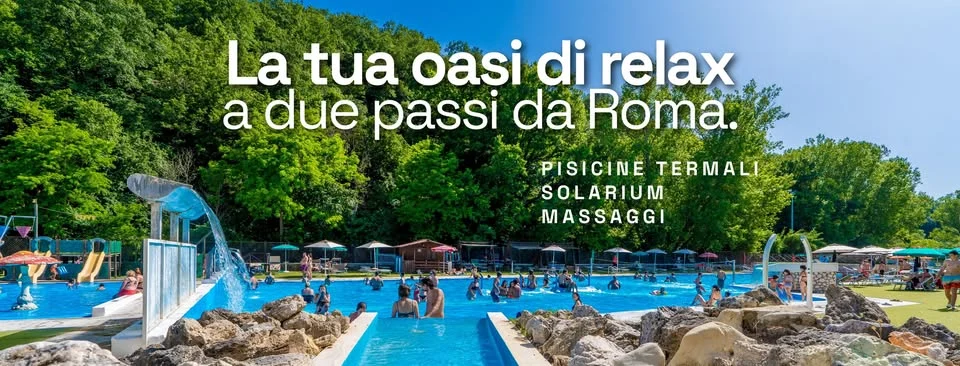
The Terme Sabine di Cretone are on Via dell'Acqua Sulfurea, in the locality of Cretone, a hamlet of Palombara Sabina (00018), and are closed now: the 2026 season ran from May 28 to September 13, every day from 09:00 to 18:30. The facility is private, you pay at the entrance or book on the website termesabine.it, and the full weekday ticket in 2026 cost 12 euros. The operator has not yet announced the 2027 reopening.
Let's be clear right away about what they are. Not a thermal center with doctors and covered treatments open all year, but a large summer swimming complex with three pools fed by a sulfur spring, lawns, umbrellas, a bar and a hot-food counter. The water comes out at around 23 degrees. In summer it is a cool pool that smells of sulfur, half an hour by car from the Raccordo. With those expectations the place works. With others it disappoints.
Season, prices, hours and connections given here were checked on September 28, 2026 against the operator's official website, the 2026 price list published online and the local press sources cited further on. Since May 28, 2026 the facility has passed to new management, so fares and rules may change from one season to the next: before leaving, next spring, phone 0774 615100 and have the dates and prices confirmed.
Where it is and what the facility is like
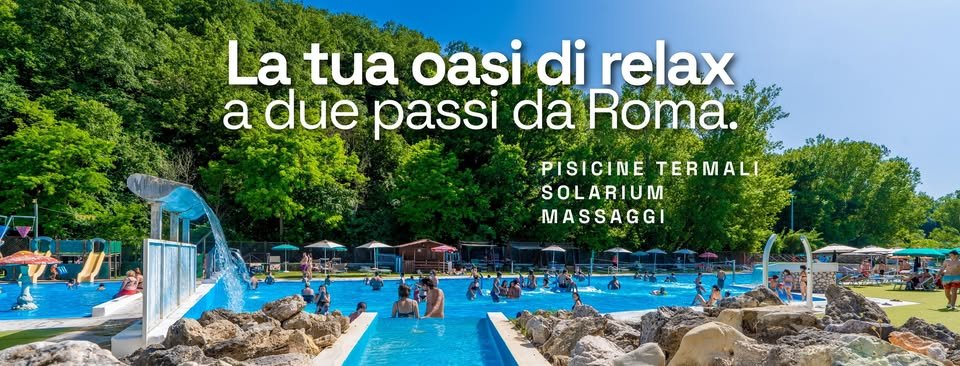
Cretone is a hamlet of Palombara Sabina, on the side of the Roman Sabina that descends toward the Tiber valley, between the Salaria and the northwestern slopes of the Monti Lucretili. The baths are below the town, at the foot of a wood, and are reached by a signposted secondary road. Rome is about 30 kilometers away as the crow flies, but the real time depends entirely on traffic on the Salaria.
The operator describes an area of about three hectares with three large pools, one of them reserved for children, for an overall water surface of around 1,500 square meters. The pools are fed directly from the spring, with continuous water exchange. Around them are paved and grassy sunbathing areas, changing rooms, cloakroom, bar, hot-food counter and a video room. In 2026 the new management added a wellness area with two saunas and two whirlpool tubs.
On the lawn you choose among three formulas. Those who come in with the single ticket settle wherever they find room and pay separately for lounger, deck chair, umbrella or cabin, six euros each. Then there are three equipped areas for two people, called Silver, Gold and Platinum VIP, with prices that on holidays reach 60 euros a couple. It is the same logic as a beach club in Ostia, moved to the hills.
Next to the pools, according to the most recent tourist guides, the facility has tennis, five-a-side soccer and padel courts, and in summer it runs water aerobics classes and activities for children. The in-house restaurant offers Roman-cuisine first courses and homemade desserts, according to what the operator writes. For the rest Cretone remains a simple place, with no pretense of luxury: lawn, concrete, umbrellas, milky water and the smell of hard-boiled eggs that reaches you already from the parking lot.
A curiosity about the Terme di Cretone
Before the pools, at Cretone the water was used to make ice. According to local tourist sources, until the 1970s a dry-ice factory worked on the site, using the carbon dioxide abundant in the underground waters. Dry ice is solid carbon dioxide, and an aquifer that releases it in quantity became a raw material at almost no cost. The conversion into a swimming complex came later.
The industrial history explains the look of the place well. Those who arrive expecting columns, marble or a Liberty-style establishment in the manner of Salsomaggiore find instead rectangular pools, fences and a forecourt. The baths were born from a productive use of the water and then converted to leisure, as happened across half of Lazio. There is no historic building to visit, and nobody should sell it to you as one.
The smell too has a chemical explanation that the operator itself publishes on its blog. Sulfur waters contain hydrogen sulfide, and according to the definition given on the Cretone site we are talking about waters with at least one milligram per liter of hydrosulfuric acid. The human nose perceives it at very low concentrations. That is why the smell is noticeable even a few degrees away in temperature, and why it stays on swimsuits after washing.
A practical tip that follows from this chemistry. Sulfur blackens silver and dulls certain plated metals: rings, chains and watches with silvered parts are best left in your bag or at home. It is something you learn the first time and that you rarely read on the signs at the entrance. The same goes for light swimsuits of delicate fabric, which after a few swims take on a yellowish tint.
For those coming from Rome there is also a detail about finding your way. The facility presents itself under the name Terme Sabine di Cretone, while the maps, the road signs and the locals almost always say terme di Cretone. It is the same facility. In your navigator look for Via dell'Acqua Sulfurea in Palombara Sabina, because the word Cretone alone takes you to the center of the hamlet, on the hill, and not to the pool.
The water: what the operator states and what it doesn't
The operator describes the water as calcium sulfur, with a temperature of around 23 degrees. Other informational sources, including a press release picked up by the Agenparl agency in August 2026, give a range of 23 or 24 degrees and also cite iodine, iron and chlorine among the components. The operator does not publish a full analytical sheet, with values per liter, on the site. Anyone who needs it for medical reasons should ask the facility directly.
On the official site you read that the water has been recognized by the Ministry of Health since 1987 for therapeutic and cosmetic properties, with a list of disorders of the skin, bile ducts, stomach, joints and respiratory system. This is what the operator states. The operator does not give the decree, with number and date. We report the statement for what it is, without turning it into a promise of a cure.
The operator does not publish contraindications. No page of the site talks about pregnancy, heart problems, blood pressure, recommended bathing time or minimum age for the sulfur pools. Common sense says that anyone with a condition or taking medication should ask their own doctor first, and that a prolonged soak in sulfur water should not be treated like an ordinary swim. Real spa treatment centers have a doctor on the premises. Here there is none on record.
A clarification on temperature that many misunderstand. 23 degrees is a summer pool temperature, cooler than many heated municipal pools. In the classification of thermal waters this is called hypothermal water, that is, warmer than the average spring but far from the 35 or 40 degrees that people associate with the word terme. In August it is a relief. At the end of May, with wind, for many it is cold.
A last note on the use of the water. The operator's site dedicates a page to therapy with sulfur waters and mentions inhalations and insufflations, that is, treatments that in treatment spas are done with dedicated equipment and under medical supervision. That page describes what is done in general with this type of water, not the list of services active at Cretone in the current season. They are two different things and it is best not to confuse them.
Something nobody tells you about the Terme di Cretone
The position I take, and I'll say it plainly: calling them terme creates the wrong expectation, and the comparison with Saturnia or Viterbo that you read around is misleading. You don't come to Cretone in winter to sit in hot water with steam rising. You come in summer, in July and August, to spend the day in an outdoor pool with a water that is different from chlorine. Put that way, it is an excellent proposition.
Those looking for truly hot water in Lazio need to go elsewhere, and the alternatives are not lacking. In the province of Viterbo there are the Bullicame, the Terme del Bagnaccio, the Terme dei Papi and the Piscine Carletti. These are waters that come out well above 30 degrees and that are used in winter too. Cretone plays in another league.
The second point nobody says concerns the bill. The single admission seems cheap, but a family of four on a July Saturday, with two children between six and 12, one umbrella and two loungers, easily goes over 70 euros before having lunch. It is not an outrageous figure for a whole day, but not the working-class price that the word Sabina would make you imagine either.
The third concerns the crowd. On summer holidays Cretone fills with families from Guidonia, Mentana, Monterotondo and the northeast districts of Rome, with radios, balls and cooler bags. It is a popular place in the best sense of the term. Those looking for silence and contemplation choose a weekday, or early morning, when the pools have just been filled and the lawn is still empty.
Last point, the most delicate. Whoever tells Cretone as a carefree place forgets that in 2023 a child died here, and that the facility stayed under seizure for months. It is not a reason not to go, and the new management put safety first in its presentation to the press. It is a reason to go in with open eyes, look at where the drains are and ask the staff questions.
Hours, season and tickets
The 2026 season stated by the operator ran from May 28 to September 13, every day from 09:00 to 18:30. A different closing date, September 20, circulates on a tourist site, but the operator and the press release picked up by Agenparl give the 13th. Out of season the facility is closed and does not organize winter openings. For 2027 the operator has not yet published the opening dates.
The ticket is bought in three ways. At the box office, the same day. Online, from the booking page linked to the official site of the Terme Sabine, which in 2026 offered an interactive seat map and, according to the local press, a 10 percent discount on loungers, umbrellas, cabins and parking. Or at affiliated ticket outlets, bars and tobacconists in Palombara, Marcellina, Moricone, Mentana, Guidonia and Monterotondo Scalo. Products on international tourist portals do not exist.
The 2026 price list published by the operator: on weekdays 12 euros full and nine euros for children between six and 12, on pre-holidays and holidays 15 and 11 euros, afternoon entry from 14:00 at 10 euros full and nine reduced. Children under six don't pay. The operator also counts June 2, June 29 and August 15 as holidays, and says so explicitly.
Then there are the passes, useful for those who live nearby: five, 10 or 20 weekday entries at 45, 80 and 160 euros, with the holiday versions costing more. Residents of Palombara Sabina get a 50 percent discount on single admission on weekdays, holidays and pre-holidays excluded. The private jacuzzis cost 30 euros for two people and 40 for three or four, according to the site.
A warning on the prices you find online. Several tourist sites still report a weekday full ticket of 10 euros and a holiday one of 13, and a May 2026 article gives 10 euros as the general rate. The price list published on the operator's site says 12 and 15. The sources do not agree, and in these cases the official price list prevails. At the box office, bring a few euros more anyway.
My advice for visiting the Terme di Cretone
Go on a weekday at the end of June or the start of July, at 09:00 sharp, and book your shaded spot online. It is the moment when the 23-degree water is pleasant, the lawn is still green, the heat of the Roman plain has already arrived and schools have just closed but the mass holidays have not begun. The weekday ticket, moreover, costs three euros less.
Choose the afternoon ticket only if you know what it involves. From 14:00 you pay less, but the shaded spots are taken from the morning and the July sun, at three in the afternoon on an exposed lawn, does not forgive. Afternoon entry makes sense in late August and September, when at 16:00 the light drops and the air temperature gets close to that of the water.
Bring flip-flops with a sole, an extra large towel and a swimsuit you don't mind ruining. Sulfur leaves its smell on the fabric for a couple of washes and darkens light colors. If you have prescription glasses with a metal frame, leave them in the locker. For small children, a jacket to put on as soon as they come out: the cool water and the breeze from the woods chill them faster than you think.
Phone before you leave, especially in the first days of the season and in case of bad weather. After a summer storm the operator may delay the opening of the pools or close some areas of the lawn, and the information travels faster by phone than on social media. The published number is 0774 615100. Also ask if the restaurant is open at lunch and if the shuttle from the station is running.
Safety, rules and what to bring
No animals are admitted at the Terme di Cretone, not even small ones: the operator writes it plainly in the price list. If you travel with a dog you have to make arrangements beforehand. On food brought from outside, glass and the swim cap requirement the operator gives no written rules on the site. Ask when you book, because facilities of this kind often change the rules from one season to the next, and with new management the risk goes up.
Safety in the water is a serious matter here, for reasons we tell further on. The 2026 new management told the local press about a daily emptying of the pools for hygiene reasons and the presence of lifeguards with long experience. For your part, the rule is just one: children in the water are always watched, even in the small pool, and never left near vents or drains.
Sulfur water is milky and not transparent like that of a chlorinated pool. The bottom is hard to see, the depth is harder to read and whoever goes in for the first time does not immediately understand where they lose their footing. Ask the staff the depth of the pools, enter by the ladders and do not dive. The operator does not publish the depth of the individual pools, and this is a fact that would deserve a clearly visible sign.
For accessibility, precise public information is missing. The lawn, the paths and the pool edges require attention anyway from those who have difficulty moving, and the nearest railway station, Piana Bella di Montelibretti, according to the RFI entry does not offer an assistance service for people with disabilities. Those traveling in a wheelchair should call the operator and check the entrance, changing rooms and access to the water beforehand.
When to go and what not to expect
The best period runs from the second half of June to the end of August. Before that, the 23-degree water is cool for many and the windy days of late spring take away the pleasure of staying in the water. After Ferragosto the facility is still open, but the evenings shorten and from September the lawn empties early. July holidays are the most crowded days of the season, and the most expensive too.
Don't expect a luxury wellness center. The equipped areas with loungers and umbrellas improve comfort, but the heart of the place remains the lawn with the pools. Don't expect crystal-clear water either: the opaque color and the smell are precisely the sign of the sulfur spring, not a lack of cleanliness. Those who arrive with the idea of a hotel pool spend the first hour complaining, then usually adapt.
Don't expect medical services or treatments covered by the health service either. Several tourist sources talk of inhalations, aerosols and mud treatments, but the operator's site, in the part dedicated to the 2026 season, presents mainly bathing, massages and the wellness area. If you are interested in a real thermal treatment, with a medical visit and prescription, ask the facility beforehand what is actually active in that season.
Finally, don't expect a quiet day on the holidays of high summer. Music, children, balls and lines at the bar are part of the picture. On weekdays, especially Tuesday and Wednesday, the atmosphere changes completely, with local retirees, a few couples and few families. It is a different experience, at a lower price, and for those who can choose it is the right choice.
Cretone with children
For families Cretone has three good cards: the pool reserved for the little ones, free entry under six and a lawn to run on with no danger from roads. Tourist guides also mention entertainment and water aerobics activities in the summer months. For a child who has never met a water that smells of eggs the first reaction is disgust, the second is curiosity. Tell them beforehand where that smell comes from.
The limit is shade. The equipped lawn has paid umbrellas and a limited number of trees, and the best spots under the branches are taken in the first hours. With small children it pays to book an umbrella or an equipped area online, and to arrive early anyway. A packed lunch, if the operator allows it, cuts the cost, but ask by phone before setting out with the cooler bag.
I repeat a point for those arriving with small children. In milky water a child who slips below the surface disappears from sight in an instant. Armbands or a vest for those who don't swim, an adult always in the water with the smallest, and no distraction with the phone. It is not a ritual recommendation. It is the rule that holds in every pool, and here it holds even more.
Another well-known fact, yet rarely cited
Those who live in the Sabina have always known it, but it doesn't appear in guides: Cretone is not a town invented for the baths. It is a village with a thirteenth-century castle and a history much longer than the facility. In 1983 the Archaeological Superintendency of Lazio dug a group of pit tombs there dated to the seventh and sixth centuries BC, along the fosso delle Grottoline. Sabine peoples, before Rome.
The castle of Cretone dates to the thirteenth century, and in the walls you can recognize fragments of medieval pottery built into the masonry. The village stands on a hill of sandstone and conglomerate overlooking the plain formed by two streams coming down from the Lucretili. The patron saint is San Vito, celebrated on June 15. In July there is the peach festival, in September the one for the ciammellocco, an ancient savory pastry.
The territory produces extra virgin oil with Sabina protected designation of origin, one of the oldest in Italy for olive-growing tradition. The olive trees you see going down toward the baths are not decoration. They are the reason this countryside has been inhabited and farmed continuously for centuries, and the reason why in autumn, with the bathing season closed, the area is still worth a trip for those looking for oil mills and new oil.
The other known and rarely cited fact concerns water in general. The whole belt between Tivoli, Guidonia and the lower Sabina rests on a system of mineralized springs rich in gas. The Acque Albule of the Bagni di Tivoli are the best-known case, with sulfur lakes at the same temperature as Cretone. The travertine that built Rome comes from that same water chemistry.
The right photo to take at the Terme di Cretone
The photo to take is the one of the color of the water with the woods behind. Stand on the long side of the big pool, with the sun at your back, and frame the milky blue and green surface with the dark line of the trees at the top. It is the only image that tells what makes Cretone different from a municipal pool. Take it at 09:00, before the swimmers come in and ruffle everything.
With the phone, lower the exposure. Sulfur water reflects a lot and the white of the pool edge easily burns out the highlights. Tap the screen on the lightest part and lower by a third. The color comes back, and the opaque blue typical of dissolved sulfur reads better. With midday light, instead, the same framing becomes flat and grayish, with no depth.
A rule of common sense that holds in every public pool and that I recall firmly here. Don't photograph strangers, and above all don't photograph children who are not yours. On holidays the lawn is full of families and it takes a moment to find an unknown face in the foreground. If you want the view of the full pools, take it from the top of the lawn, with the figures small and unrecognizable.
The second image is outside the baths. Go up to Palombara Sabina in late afternoon and photograph the town from below, with the profile of the castle on the top of the hill and Monte Gennaro behind. From Cretone you see the silhouette of Palombara from almost every bend. With the low light of the end of the day the stone of the village takes on a warm color that the morning does not give back.
If you want to photograph the spring itself, know that inside the facility there is no spectacular pool like those in the Viterbo area, where the water boils in plain sight. The water reaches the pools through the plumbing. The detail to look for, then, is the whitish encrustations on the edges and on the inlet vents, where calcium carbonate and sulfur deposit leaving marks that up close have an almost mineral look.
How to get there from Rome
By car you leave Rome on the Salaria in the direction of Rieti and follow the signs for Palombara Sabina and Cretone. Tourist sources calculate 40 or 50 minutes from the Raccordo, but on summer Saturdays the Salaria between Settebagni and Monterotondo often jams. An alternative is the Nomentana as far as Mentana and then the provincial roads toward Palombara. The baths' parking can also be booked online.
By public transport the operator indicates the FL1 regional train, the Fiumicino-Orte line, in the direction of Fara Sabina, getting off at the Piana Bella di Montelibretti station. From there the urban service of Palombara Sabina run by SAP leaves, with a line connecting the station, the Terme Sabine and the center of Palombara. Tickets are bought at authorized outlets or on the MooneyGo app.
A caution on the shuttle schedule. The timetable published on the baths' site bears the wording in force from July 1, 2024 and on the operator's page there are departures between 08:30 and 19:00, but there is no confirmation for 2026. Before taking the train call the baths and have them tell you if the connection is running and what time the last run to the station passes.
On the train, check the board. The FL1 regional trains headed toward Fara Sabina and Poggio Mirteto leave from Tiburtina, Nomentana, Fidene and the other stations of the Roman node, but always check that the run you choose stops at Piana Bella. The station is small, with two tracks and reduced services, and at evening peak hours the return toward Rome is crowded. Allow a good hour and a half from the center.
Those doing a day in the Sabina can combine the baths with Monterotondo, with its historic center on the hill, or continue on the Salaria toward Fara in Sabina and the Abbey of Farfa. Those who prefer greenery find a few kilometers away the Nomentum Nature Reserve and the Macchia di Gattaceca.
For the drive back, avoid leaving at 18:30 sharp on summer Sundays. It is the hour when half the facility lines up toward the Salaria, and the stretch toward Rome slows down all the way to the Raccordo. Better to stop for dinner in the Sabina and set off again after 21:00, or leave the baths in mid-afternoon. On weekdays the problem almost disappears, but the evening commuter traffic toward the city remains.
Some important events that happened here in history
Seventh and sixth centuries BC: the pit tombs excavated in 1983 along the fosso delle Grottoline document a stable presence in the territory of Cretone in the archaic age. We are in the heart of the Sabine world, the same one that Roman tradition links to the origins of the city with the rape of the Sabine women and with the kings who came from Cures. It is the oldest part of the history of the place.
Thirteenth century: the castle of Cretone is born, while nearby Palombara passes under the control of the Savelli, who will hold it for over three centuries. The Savelli are one of Rome's great baronial families, with two popes, and Palombara becomes one of their fortified bases northeast of the city. In the seventeenth century the fief passes to the Borghese, who take its ducal title.
Until the 1970s: according to local tourist sources, the site of the current facility hosts a dry-ice factory that exploits the carbon dioxide of the water. Then the conversion toward leisure. In 1987, according to what the operator states, the water obtains recognition from the Ministry of Health, and from that moment the facility presents itself to the public as a thermal establishment.
August 17, 2023: an eight-year-old child dies in one of the pools, sucked in by the drain during the emptying of the pool. The investigative sources reported by the national press say the protective grate was missing. The Tivoli prosecutor's office opens a case for negligent homicide, the facility is put under seizure and the summer stay for the elderly organized by Rome's Municipio VI is also canceled.
February 14, 2024: the Tivoli prosecutor's office orders the lifting of the seizure, because the consultant's inspections are over, with reopening subject to the requirements of the ASL and of the prosecutor's office itself. In summer 2024 the baths are open again. On May 28, 2026 a new management begins, which in its presentation to the press puts safety, hygiene and daily emptying of the pools at the center.
Who passed through the Terme di Cretone
The Sabines, before anyone. The archaic burials of Cretone tell of a community that lived on these hills seven centuries before Christ, farmed, raised animals and buried its dead along the streams. Nobody knows if they knew the sulfur spring. It is plausible, because the smell of the water is noticeable from afar, but no find proves it, and the tourist sources that speak of ancient use cite no documents.
Then the Savelli, lords of Palombara for centuries. Local tradition links to the family the cerasa del Papa, the Palombara cherry that is said to have won over Honorius IV, born Giacomo Savelli, pope in the 1280s, giving rise to an annual gift of cherries to the papal court. It is village lore, not an archive document. But the June cherry festival comes from there.
The Borghese, who in the seventeenth century take over from the Savelli and bring Palombara into the system of fiefs of the family of Paul V. The name is the same as the Galleria Borghese and Villa Borghese in Rome, and the wealth that built those collections also came from agricultural income from territories like this one, made of oil, wheat and chestnuts.
The workers of the dry-ice factory, of whom the local sources keep only a generic memory. And then, from the 1980s, tens of thousands of swimmers: families from Rome's northeast periphery, elderly people from the municipal summer stays, members of professional orders and associations that over the years have had agreements with the facility, like the Tivoli Bar Association in the 2024 season.
And an eight-year-old child who came to play in this pool and did not go home. We remember him without a name, out of respect for the family, and so that whoever walks into Cretone today knows that the safety of a facility depends on concrete and verifiable choices. Ask, observe, demand that vents and drains be protected. It is a right of those who pay for the ticket.
Cretone, the castle and Palombara Sabina
Palombara Sabina sits at 372 meters above sea level, on the northwestern spurs of the Lucretili, with Monte Gennaro towering over it from the east. The historic center climbs in a spiral to the top of the hill, where the Castello Savelli stands, today called Castello Savelli Torlonia. It is the main reason to go up to the town after a morning at the pool, and from Cretone a few minutes of road are enough.
In the castle are displayed Roman marble sculptures found in 1986 in the municipal territory, among them a Roman-era copy of the statue of Peace, Eirene, attributed to the Greek sculptor Cephisodotus. It is a piece that many Romans do not know they have half an hour from home. The castle's opening hours vary and are often tied to guided visits and special days: consult the website of the Comune di Palombara Sabina before going.
In the municipal territory there is also the abbey of San Giovanni in Argentella, one of the oldest places of worship in the area, and from Palombara the trails of the Parco dei Monti Lucretili leave toward Monte Gennaro. Those with a full day and a car can swim in the morning and go up to the abbey in the afternoon, when the light comes in slanting among the trees.
This whole part of the Roman Sabina is little trodden by organized tourism. Villages like San Polo dei Cavalieri and Percile, on the other side of the Lucretili, have intact historic centers and very few visitors. Farther north, beyond the border with the province of Rieti, Orvinio and Toffia complete a loop that in autumn, with the new oil, has few rivals in Lazio.
The town is also worth it for its cooking and its calendar. In June the cherry festival draws people from all over the province, and in autumn the oil mills of the area press the new oil of the Sabina denomination. They are two opposite moments of the year, one in the middle of the bathing season and one with the baths closed, and they tell better than any sign why this countryside has been inhabited for so long.
The alternatives when Cretone is closed
From mid-September to the end of May Cretone is closed, and whoever wants sulfur water near Rome has to move. The closest alternative is Tivoli: the Acque Albule of the Bagni di Tivoli feed the Terme di Roma facility, with outdoor pools in the warm season and treatment services. The temperature of the spring is similar to that of Cretone, around 23 degrees, and there too the smell of sulfur reaches you before the entrance.
In Tivoli, then, the trip enriches itself. After the swim you go up into the town for Villa d'Este, the Parco di Villa Gregoriana and the Sanctuary of Hercules Victor, or you go down toward Hadrian's Villa. Prices and openings of the Tivoli pools have to be checked on the operator's site, which updates them from season to season.
Those looking for hot water in winter should go toward Viterbo or toward Civitavecchia. The Terme Taurine and the Ficoncella are the most convenient for those who live west of Rome, while the Terme di Stigliano are between Canale Monterano and Bracciano. In the same area, the Caldara di Manziana shows a natural gas phenomenon with no swimmable pools.
For those thinking of drinking cures more than bathing, the regional reference is the Terme di Fiuggi, with an entirely different tradition, tied to water for drinking. Toward the northwest, the Parco della Mola di Oriolo Romano also has mineral waters. None of these places replaces Cretone in everything, but each covers a piece of what Cretone offers in summer.
Those who don't want to travel too far instead stay in north Rome and combine the Cretone swim with a visit to Monterotondo or Mentana. It is the most convenient solution for those arriving by train, because the FL1 line stops at both Monterotondo and Piana Bella. With a little patience on the schedules you can build a day without a car: morning in the water, afternoon in the historic center, return in the evening.
Eating in the area
Inside the baths there is the restaurant with hot-food counter, and for those who stay all day it is the most convenient solution. If you want to go out instead, Palombara and the nearby towns have serious local cooking, made of oil, legumes, homemade pasta and grilled meat. The problem, as everywhere near a vacation spot, is recognizing the places that work for people who pass only once.
The first signal is the menu with photographs of the dishes, laminated and translated into several languages. In the Sabina you see it less than in Rome, but along the through roads it shows up. A restaurant that has to show you the picture of a carbonara is talking to someone who has never eaten it. The second signal is the person at the door inviting you in: a place with regular customers has no need for one.
The third signal is the sheet of pasta rolled out in the window or on the sidewalk, staged to stop passersby. Good fresh pasta is made in the kitchen, in the morning. Then there are the kitchens open with no break from morning to night, the menu items with no price, the different menus between the outside tables and the indoor room. Always ask the price of fish and of the dish of the day before ordering.
Romans don't avoid these places out of snobbery, they avoid them out of experience: they pay more and eat worse. The criterion is to look at who is sitting at lunch on a weekday. If there are workers, office staff and families from the town, you are in the right place. To avoid going by trial and error find our list of the places where we eat.
A warning on the closing days of village restaurants. In the Sabina many trattorie close one day a week, often Monday or Tuesday, and in August some take their summer break right in the weeks when the baths are fullest. Phone before going up to town for dinner, especially on weekdays, and don't count on finding kitchens open after 22:00.
What to pair it with in a day
By car, the most sensible combination is the baths in the morning and a Sabina village in the afternoon. Poggio Mirteto and Poggio Catino are half an hour to the north, Castelnuovo di Farfa and Torri in Sabina a little farther. Small towns, with real squares and few people, where a gelato at six in the afternoon closes a day in the water well.
Those who love rivers can go down toward the Tiber and the Nazzano Tevere Farfa Reserve, or go up the Farfa Gorges, where in summer the stream water is cold and clean. The contrast between the sulfur pool of the morning and the running water of the afternoon pleases kids more than it pleases adults, who prefer the shade.
Those looking north see the isolated profile of Monte Soratte, which you climb in half a day and which gives one of the widest panoramas of the Tiber valley. Toward the river, Civitella San Paolo and Castelnuovo di Porto complete a loop on the other bank. In October, with the baths closed, it is the best way to get to know this piece of Lazio.
Those who stay tied to the theme of thermal water can build a multi-day route. You start from the Roman baths in the city, the Baths of Caracalla and the Baths of Diocletian, to understand what bathing meant to an ancient Roman. Then you move on to the living springs of the countryside, from Tivoli to Cretone, and finally to the hot waters of the Viterbo area, with Tivoli as the central stop.
A day at Cretone also fits well with a visit to the Valle dell'Aniene Nature Reserve on the way back to the city, if you live in the northeast quadrant of Rome. A walk along the river in late afternoon closes the water day with another water, less smelly and quieter, and spares you the evening line on the Salaria toward the Raccordo.
Frequently asked questions
Are the Terme di Cretone open now?
No. The 2026 season stated by the operator ran from May 28 to September 13, every day from 09:00 to 18:30, and the facility does not organize winter openings. The operator has not yet published the dates of the 2027 season. Usually the reopening falls between the end of May and the start of June, but it is best to wait for the announcement on termesabine.it or to phone 0774 615100.
How much does admission to the Terme di Cretone cost?
According to the 2026 price list published by the operator, the full ticket costs 12 euros on weekdays and 15 on holidays and pre-holidays, 10 euros with entry from 14:00. Children between six and 12 pay nine euros on weekdays and 11 on holidays, under six you get in free. Loungers, deck chairs, umbrellas and cabins are paid separately, six euros each.
Is the water at the Terme di Cretone hot?
No, at least not in the sense usually given to the word terme. The operator states a temperature of around 23 degrees, other sources say 23 or 24. It is a cool water, suited to the warm months, very different from the Viterbo springs that exceed 30 degrees. That is why the facility works only in summer and stays closed in the cold months.
Can you get to the Terme di Cretone without a car?
The operator indicates the FL1 regional train in the direction of Fara Sabina as far as the Piana Bella di Montelibretti station, and then the shuttle of the Palombara Sabina urban service run by SAP, which passes by the baths. The timetable published on the baths' site is valid from July 2024. Before leaving, phone to find out if the run is active and what time it goes back to the station.
Can you bring dogs or other animals?
No. The operator writes in the price list that no animals are admitted, not even small ones, and the rule applies to the whole area of the facility, lawns and shaded zones included. If you travel with a dog you have to make arrangements before leaving. Keep in mind that in summer leaving an animal in the car in the parking lot, even for a short time, is dangerous and must never be done.
Does the water of Cretone have healing properties?
The operator states that the water has been recognized by the Ministry of Health since 1987 for therapeutic and cosmetic properties, and mentions disorders of the skin, bile ducts, stomach, joints and respiratory system. It does not publish, however, the decree or the contraindications, and there is no medical service on record in the facility. Those with conditions or taking medication should ask their own doctor before swimming.
What happened at the Terme di Cretone in 2023?
On August 17, 2023 an eight-year-old child died in a pool, sucked in by the drain during the emptying of the pool. The Tivoli prosecutor's office opened a case for negligent homicide and seized the facility, then lifted the seizure on February 14, 2024 with reopening subject to the requirements of the ASL. Since May 28, 2026 the facility has had new management.
What alternatives are there out of season near Rome?
The closest is Tivoli, with the Acque Albule of the Bagni di Tivoli and the Terme di Roma facility, fed by sulfur water at the same temperature as Cretone. For truly hot water in winter you have to go to the Viterbo area, to the Bullicame, the Bagnaccio or the Terme dei Papi, or toward Civitavecchia to the Ficoncella and toward Bracciano to the Terme di Stigliano.
Who wrote this page
This page comes from the team at Tour Leader Pro, the Rome-based outfit that designs itineraries, visits and cultural events across Rome and Lazio. Season, fares and connections given here come from the official sources cited in the text as of the date stated at the top. The facility changed management in 2026 and prices change every year: recheck them before leaving and tell us what you find different.
Organizing a day outside Rome means fitting together bathing seasons that open and close on variable dates, shuttles that depend on the urban service of a small comune, regional trains that don't stop everywhere and villages where museums open only by reservation, for yourself or for a group of 40 people. Whoever faces this kind of work will find on Tour Leader Pro materials designed for those who lead and for those who organize on their own.
For the wide picture, that is regional trains and seasonal schedules, rentals, airports, moves from one province to another and Lazio destinations outside the center of Rome, from the Sabina to the volcanic lakes of the north to the Tyrrhenian coast and the villages of the interior, a useful resource for putting together a multi-day itinerary is Italy Planner.