San Polo dei Cavalieri (RM)
In short. San Polo dei Cavalieri (RM) is a castle village at 651 meters above sea level on the southern foothills of the Monti Lucretili, about 30 kilometers northeast of Rome and about 10 kilometers above Tivoli.
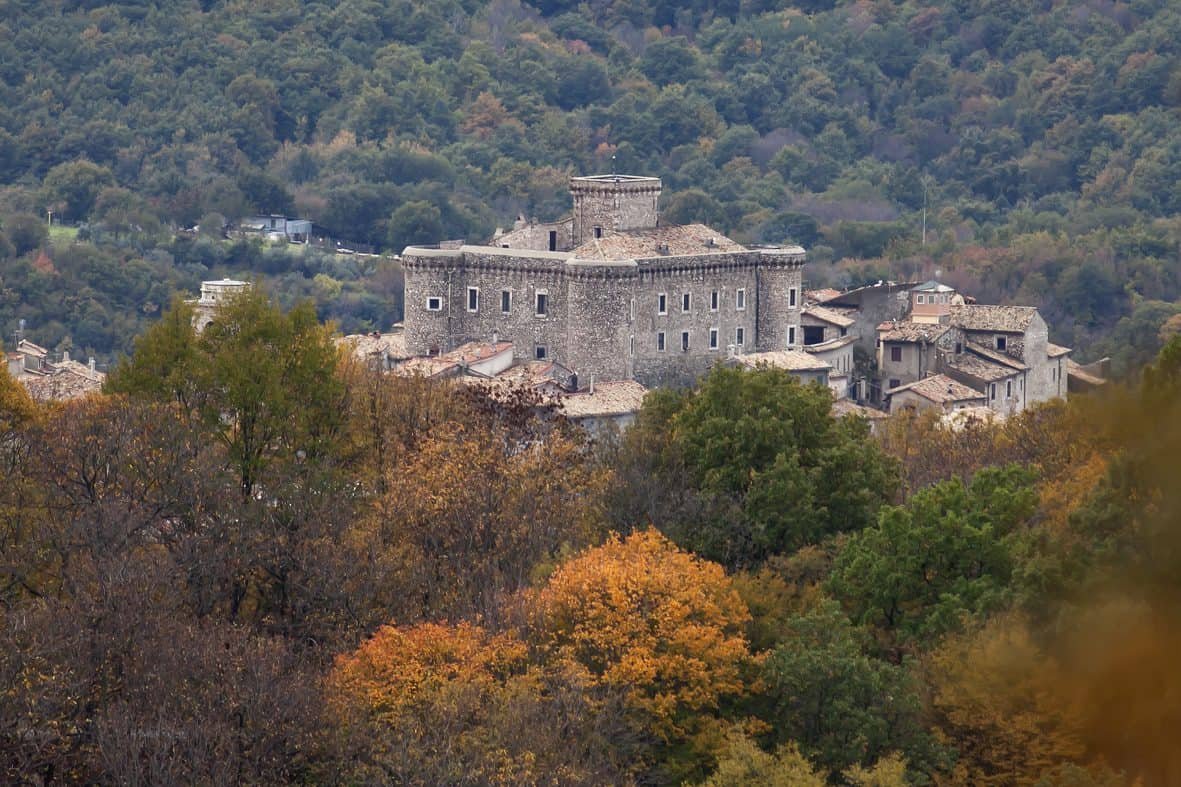
San Polo dei Cavalieri (RM) is a castle village at 651 meters above sea level on the southern foothills of the Monti Lucretili, about 30 kilometers northeast of Rome and about 10 kilometers above Tivoli. The municipal territory measures 42.53 square kilometers and has almost 3,000 residents. The postal code is 00010, the area code 0774, the town offices are on Via dei Cavalieri and up-to-date contact details appear on the website of the Comune di San Polo dei Cavalieri. There is no ticket to pay: the town is public, you enter on foot through the gates of the village and walk around freely at any hour. The Orsini-Cesi-Borghese castle, which is the main monument, is privately owned and has no regular visiting hours: it opens for events, ceremonies and special openings announced by the managers, so you need to contact them before going up. By car you come from the A24, Tivoli exit, then Via Tiburtina Valeria and the provincial road that climbs in hairpin turns. By public transportation you combine the Roma Tiburtina-Tivoli regional train with the intercity bus that goes up the valley, and times should be checked on the regional carrier's website before leaving because they change a lot between weekdays and holidays. Parking is just outside the walls: inside the village the streets are as wide as a loaded mule.
If you want to place San Polo dei Cavalieri (RM) within the wider picture of day trips, you will find the full overview on the page of villages and places near Rome, which collects destinations reachable in less than an hour's drive from the Grande Raccordo Anulare.
I'll say it right away, no beating around the bush: San Polo dei Cavalieri is one of the very few towns in the Tivoli area where the relationship between fortress and settlement can still be read with the naked eye, without any need for reconstructions. The keep occupies the center, the houses wind around it in concentric circles, the gates of the enclosure are still where the monks wanted them. If you come from Tivoli, after the crowds of Villa d'Este, you find yourself in a place where the loudest noise is the bell tower.

Where San Polo dei Cavalieri (RM) is and how to get there from Rome
The town occupies the ridge that closes the Tivoli basin to the north. Below, to the south, the ground drops onto the Monte Catillo Nature Reserve and then onto Tivoli. To the north and east opens the limestone ridge of the Monti Lucretili, with Monte Gennaro closing the horizon at 1,271 meters. The neighboring municipalities are Guidonia Montecelio, Licenza, Marcellina, Monteflavio, Palombara Sabina, Roccagiovine, Tivoli and Vicovaro: a list that says well how much San Polo dei Cavalieri is a hinge between the Aniene valley and the mountainous Sabina.
By car from Rome to San Polo dei Cavalieri
The fastest route is the A24 Roma-Teramo motorway to the Tivoli exit, then the Tiburtina Valeria state road toward Tivoli Terme and the provincial road that branches off toward the mountain. From the Raccordo allow just under an hour if you don't run into the commuter traffic on the Tiburtina, which at rush hour is deadly. The final climb is a series of tight but well-paved hairpin turns, with a low guardrail and the drop on the right: if you suffer from vertigo, sit on the left. In winter, after a snowfall, the provincial road may be closed or may require chains on board: it is a mountain road for all intents and purposes, even if the mountain is half an hour from Rome.
If you're coming from the northern quadrant of the city you can go via Via Nomentana and Mentana, then Palombara Sabina, and climb from there: it adds 20 minutes but you cross the Sabine countryside, which in May is a sight. If you arrive from the east, from the direction of Vicovaro and Subiaco, you go up the Aniene valley and cut across through Roccagiovine.
By public transportation: how to get to San Polo dei Cavalieri (RM)
There is no direct, fast connection from Rome. The workable combination is the regional train from Roma Tiburtina to the Tivoli station, then the intercity bus that climbs to the town. Runs are few and concentrated in school and work hours, with reduced service on holidays: before setting out it's best to fix the return time in writing, otherwise you're left on foot at the top. It's a boring recommendation, but more than one group has walked down to the valley floor for not having looked at the timetable board.
Where to park in San Polo dei Cavalieri
The parking areas are along the road that circles the village, just outside the historic perimeter. You can't enter within the walls by car unless you're a resident, and that's a good thing: the alleys have steps, arches and covered passages that no car could digest. Count on five minutes on foot from the parking lot to the main square, uphill.
The village of San Polo dei Cavalieri (RM): how the town is laid out
The layout is the classic one of Lazio's incastellamento: a fortified core at the top, a ring of houses built against the walls that serve as a defensive curtain, and later growth that slides along the contour lines. The result is a vertical labyrinth in which the main street is almost horizontal and all the others are staircases. The gates of the medieval enclosure can still be recognized by their lowered arches and iron hinges. Above some of them remain the worn coats of arms of the lords who succeeded one another.
The alleys and staircases of the village
My advice is to leave the map in your pocket and always go up. Every detour leads either to the castle or to an overlook onto the valley. The houses have portals in local stone, often with a dated lintel, and the upper floors are connected by flying arches that span the alley: a structural solution born to stiffen the walls against Apennine earthquakes, not to make scenery. The vaulted spaces under the houses, which they call cellars here, were storerooms for oil and wine and in some cases still keep the millstone.
Piazza della Vittoria and the Riu vecchio fountain
Piazza della Vittoria is the civic center of the town, and it is tied to a chapter that in San Polo was lived as a matter of survival: water. Around 1871, with the population growing and the springs insufficient, the Comune had an aqueduct built whose arrival point, the Riu vecchio, was right in this square. It sounds like a detail from the municipal archive. In a ridge town, where the limestone rock drinks all the rain and gives it back at the valley floor, having a source at the top meant being able to stay.

The Orsini-Cesi-Borghese castle of San Polo dei Cavalieri (RM)
It is the reason you come up here. The castle presents itself as a large rectangular body with a wide sloped base, four semicylindrical towers at the corners and, at the center, the keep that the people of San Polo simply call the Rocca. The structure rises over three floors. The oldest core is the isolated watchtower that guarded the valley floor: the monks fortified it between the 11th century and the following century, when the place was the center of the Fundum Sancti Pauli in Jana, and from that tower everything else grew.
The position is no accident. From here you control the two valleys that separated the fief from the very powerful Tivoli, and you keep an eye on the road that climbs toward the Sabina. A ridge castle isn't there to withstand a long siege: it is there to see who is coming, and to signal it.
The structure, the keep and the towers of the San Polo dei Cavalieri castle
The quadrangular plan with corner towers and the crenellated walkway is the result of the great reconstruction commissioned by the Orsini in the second quarter of the 15th century. An inscription dated November 23, 1438 attributes the direction of the works to a Mastro Guglielmo: it is one of those names that survive by chance, carved in stone by a building site that wasn't thinking of posterity. The fortress also had an outpost toward the town, at the spot that is still called Piazza Padella today. The central keep is traditionally dated to the 10th century: it is a dating that the owner reports and that should be taken for what it is, a consolidated tradition more than a laboratory measurement.
The entrance hall and the chapel
You enter a space that originally was a quadrangular open-air courtyard and that was covered at a later time, turning into an entrance hall. On the left side opens the chapel. This is the point where you grasp the double nature of the building: the masonry is that of a fortress, the use is already that of a noble residence. The covering of the patio is the hinge between the two phases.
The banquet hall
The banquet hall preserves a chromatic decoration that runs along all four walls for about one meter 30 in height, like a continuous band. It is not a museum decoration: it is the fixed furnishing of a room in which people ate, negotiated and held the audiences of the fief. Look at it from the side, with the raking light of the afternoon, and you will see how much brush work lies under what at first sight seems a simple colored baseboard.
The Hall of the Bishops
A quadrangular room, frescoed on the southern and eastern sides. On the south wall stands the coat of arms of Pietro Donato Cesi, bishop, the man who bought the fief in 1558 and opened the most fortunate season of this building. A painted coat of arms in a reception hall is not vanity: it is a notarial act in color, the way a new family communicated to its subjects that the master had changed.
The Hall of the Cardinals
For me it is the most beautiful room in the castle. Three large frescoed fake curtains open as many views onto the Aniene Valley: it is landscape painting entering a baronial palace of inland Lazio, ahead of the whole 17th-century fashion for views. Anyone who has seen the rooms of Villa d'Este in Tivoli will recognize the same idea, translated however to a provincial scale and with a freshness that the great court cycles have lost.
The Hall of the Four Seasons
Quadrangular, entirely frescoed except for the north wall. The theme of the seasons, in a palace that was also a farm, was not a literary whim: whoever owned this fief lived on oil, grain and chestnuts, and the cycle of the year was the real calendar of power.
The frescoes, the Zuccari and Guido Guidetti
When the Cesi transformed the military fortress into a residence, they called first-rate workshops to work on it. Local tradition, taken up by studies of the palace, assigns the frescoes to the School of the Zuccari and to Girolamo Muziano, and attributes to the architect Guido Guidetti, a pupil of Michelangelo, the opening of the large fireplaces and the windows that gave light to the rooms. On these attributions it is best to be honest about the degree of certainty: they are attributions of tradition, not documented signatures room by room. They remain credible because those were exactly the workshops the Cesi had at their disposal in Rome in those years.
The San Polo dei Cavalieri castle today: visits, weddings and events
The castle is still in private hands. One part is a residence, the rest is opened for weddings, ceremonies, parties and themed evenings, with a few special summer openings announced by the managers. There is no ticket office with fixed hours, and this is the practical fact that ruins more trips: whoever climbs to San Polo dei Cavalieri convinced of entering the castle the way you enter a civic museum risks finding the door closed. The right channel is direct contact with the managers, who publish the calendar on their own channels. The village, the view and the churches are worth the climb anyway, even with the door closed.
Federico Cesi, the Accademia dei Lincei and San Polo dei Cavalieri (RM)
Here is where the town's cultural game is played, and it is a game at a European level. Federico Cesi, born in Rome on February 26, 1585 and died in Acquasparta on August 1, 1630, was Duke of Acquasparta and Prince of Sant'Angelo and San Polo. In 1603, at the age of 18, he founded the Accademia dei Lincei together with the Dutch physician and naturalist Johannes van Heeck, the mathematician Francesco Stelluti and the man of letters Anastasio De Filiis, the first scientific academy of the modern age. The name came from the lynx, the animal that according to ancient naturalists saw through things: a research program condensed into a single word.
The baronial palace as a place of study
Cesi didn't use San Polo as just any holiday retreat. Transformed into a baronial palace, the building became an operating base for the plant-collecting campaigns on nearby Monte Gennaro, already famous among botanists at that time for the richness of its flora. Cesi's project was a botanical encyclopedia, the Tabulae Phytosophicae, and the first Lincei anticipated by decades the comparative method of modern plant morphology. That material also came out of the excursions made on these mountains.
Galileo Galilei and the Lincei
Galileo Galilei was admitted to the Academy in 1611, and from that moment Cesi became his most effective protector in the Rome of cardinals and congregations. A letter of June 20, 1612 documents the intellectual exchanges connected with the castle. As for Galileo having slept in person at San Polo dei Cavalieri, local tradition tells it with conviction but the papers don't prove it: it's one of those things that should be told as tradition and not as fact. Documented, on the other hand, and far more important, is Cesi's role in protecting the scientist from Pisa from the clash with the church authorities. With Cesi's death in 1630 that protection vanished, and within a few years Galileo found himself alone facing the trial.
The 1626 statute
In 1626 Federico Cesi granted San Polo a second statute, after the vernacular one that Napoleone Orsini had given the town in the second-to-last quarter of the 15th century. A statute is the document that regulates weights, measures, pastures, crop damage and penalties. Reading one means entering the daily life of a mountain community better than 10 chronicles would.

The churches of San Polo dei Cavalieri (RM)
Four places of worship tell four different moments in the town's life: the medieval village, the lordly reconstruction, the cemetery outside the walls and the vow against the plague. You can visit them in barely an hour, all on foot, and opening hours depend on the parish: outside service hours you may have to ask on site.
The church of Santa Lucia
It is the oldest in the town, built in the 15th century and located in the old part of the village, set against the castle. The plan is a Greek cross, with a single nave, two chapels and a wooden truss ceiling. The recent history of this building is a story of community: in 1985 a public subscription made it possible to restore the left sacristy, which was the most precarious part, but only the direct intervention of the Soprintendenza per i Beni Ambientali e Architettonici del Lazio made it possible to complete the work. The church was reopened for worship on December 13, 1995, Saint Lucy's day.
During that work, on the wall that housed the high altar, frescoes dating to around the 16th century came back to light. Among them is a rose window with an epigraphic inscription recalling a first restoration in 1590: a church that was already being restored in the 1500s, and that in the 1900s risked collapse. It's worth going in just for that rose window.
The church of San Nicola di Bari
Dedicated to the town's patron saint, it dates to the 13th or 14th century. In 1587 it was rebuilt and enlarged at the wish of the lordly family, keeping the single nave. The exterior is almost severely simple, without ornamental motifs, which clashes with its role as the main church: the richness is all inside.
On the portal you can read a Latin dedication to Saint Nicholas, which local tradition explains as thanks from the crusaders of San Polo dei Cavalieri on their return from the Holy Land. Entering through the main door, on the right, there is a fresco of the Baptism of Jesus, the work of an anonymous 16th-century artist. A little further on, also by an anonymous hand, an oil painting of the Madonna in glory between Saint Roch, Saint Lucy and Saint Liberata: the three saints who recur in all the churches of the town, which says what the local fears were, plague and disease. The coat of arms of San Polo was placed as an ex voto for the end of the pestilence of 1656.
On the left wall a second 16th-century oil painting by an anonymous artist depicts Saint Nicholas and Saint Mary Magdalene. The holy water font is in scarlet marble. The first altar on the right is dedicated to the Madonna of the Rosary, as can be read from the 16th-century canvas behind it. The second altar on the right is dedicated to the Mother of Good Counsel, with a painting from 1808. It is a small museum of provincial devotional painting, where the value is not in the signatures but in the continuity: four centuries of popular commissions in a single room.
The church of Santa Liberata
It stands at the entrance of the cemetery. The consecration was on August 27, 1550, but the foundation seems to date to the previous century: 1493 is carved on a step of the altar. Outside it has a gabled structure, with a pediment above the entrance portal and a sloping roof interrupted by a central dome. Inside the plan is a Greek cross, with the four arms covered by barrel vaults and the dome opening at their intersection. It is the most elegant building in the town from a spatial point of view, and almost nobody goes in.
The church of San Rocco
It dates to the early 18th century and was born as an act of gratitude toward the saint for the end of the plague that in the middle of the previous century had almost wiped out the community. The dimensions are minimal, and the bell tower is just as small. The interior has a rectangular plan with a barrel vault. Apse and nave are separated by a round arch in which two niches open with statues of the Immaculate Conception and of Saint Joseph. On the altar is a half-length Sacred Heart made in mosaic, and behind it a canvas from the first half of the 18th century with the Madonna, Saint Roch and Saint Sebastian, that is, the two anti-plague saints par excellence. Anyone visiting San Polo dei Cavalieri with an eye to social history will find here the most direct document: an entire town that, reduced to 377 souls, builds a church to say thank you for having survived.
A curiosity about San Polo dei Cavalieri (RM)
The real curiosity of San Polo dei Cavalieri is not in the castle: it is in the meadow above it. When Federico Cesi organized the botanical collecting campaigns of the first Lincei, he chose as his working ground the summit plateau of Monte Gennaro, and to that place the Lincei gave a name that says everything about their ambition: Anfiteatro Linceo. It was not a poetic metaphor. An amphitheater is a space in which you look, and they climbed up there to look at the plants one by one, draw them, classify them, compare them, with the idea of building an encyclopedia of the plant world that nobody had ever attempted. The mountain above San Polo was their open-air laboratory.
Try to hold the two images together. On one side Palazzo Cesi, with its frescoed curtains and episcopal coats of arms. On the other a group of young scholars who, four centuries ago, climbed these trails with herbarium boxes and came back down with material that ended up in the letters sent to Galileo. The first modern scientific academy in Europe was not born only in Roman palaces: it took air and samples on a karst plateau of the Monti Lucretili, two hours' walk from this town.
There is a second layer of curiosity, smaller and just as revealing. The municipal territory preserves the traces of a late Bronze Age hilltop settlement on Monte Morra: a triple ring of walls and the remains of huts. It means that the choice to stay up high, here, is at least 3,000 years old, and that the medieval castle invented nothing. It only gave a stone form to a decision that someone had already made, for the same reasons, a thousand-odd years earlier: from up here you see everything, and whoever sees first decides.
The Monti Lucretili Regional Nature Park and San Polo dei Cavalieri (RM)
San Polo dei Cavalieri is one of the 13 municipalities of the Monti Lucretili Regional Nature Park, established by regional law number 41 of June 26, 1989 and subsequently amended by law number 15 of May 26, 1994. The protected area covers 18,204 hectares between the provinces of Rome and Rieti and is one of the largest in Lazio. The other municipalities are Licenza, Marcellina, Monteflavio, Montorio Romano, Moricone, Orvinio, Palombara Sabina, Percile, Poggio Moiano, Roccagiovine, Scandriglia and Vicovaro. The park authority is based in Palombara Sabina, at Viale Adriano Petrocchi 11, telephone 0774 637027.
The peaks and plateaus
The highest peak in the park is Monte Pellecchia, 1,368 meters. The most famous is Monte Gennaro, 1,271 meters, the profile you can recognize with the naked eye from Rome looking northeast on tramontana days. In the municipal territory of San Polo dei Cavalieri you climb Monte Guardia, 1,185 meters, and cross Monte Morra, which is the home mountain. The landscape alternates beech forests, karst plateaus, sinkholes, swallow holes and small lakes: the geology is that of limestone, which absorbs water at the surface and gives it back to the springs of the valley floor.
Flora and fauna of the park
The beech forests of these mountains are among the closest to Rome. The symbol plant of the park is the storax, and among the rare species is the Sabine iris. On the fauna side, the return of the wolf and a pair of eagles nesting on the slopes of Monte Pellecchia are documented. In the karst fields you may come across free-roaming horses: they are not wild, they are grazing animals, and they should be left in peace.
CAI trail 303 from San Polo dei Cavalieri to the Pratone di Monte Gennaro
It is the classic hike from the town, and the park classifies it as CAI trail 303. It starts from San Polo dei Cavalieri, measures about 8 kilometers, involves 400 meters of elevation gain and 80 of descent, takes two and a half hours of walking and has difficulty E, that is, hiking: no technical equipment is needed, you need a pair of hiking boots and trained legs.
The route leaves the town along a mountain road in the direction of Monte Morra and leaves it at around 900 meters. From there it continues north on a scenic trail that opens the view onto the Aniene valley and the towns of Marcellina and Palombara Sabina. The most beautiful stretch is the Valle Cavalera, a wide transhumance track with a bed of white limestone rocks carried by seasonal waters, enclosed between ancient beech forests and holly trees of notable size. At a fork, taking the left, you emerge onto the Pratone: a vast karst field dotted with sinkholes and swallow holes, with the summit of Monte Gennaro closing the scene. The right branch instead splits off toward Campitello, CAI trail 303E.
A clear opinion: the Pratone should be done in spring or autumn, never in August at noon. On that plateau there is no shade and no water, the limestone throws back the heat and the beech forest ends before you reach the top. In May, instead, the bloom on the plateau is one of the most beautiful things Lazio knows how to offer, and you understand why the Lincei climbed up there with their herbarium boxes.
Easy hikes for those who are not in shape
If you don't feel up to the two and a half hours to the Pratone, you can stop at the first stretch of the track, up to the point where the road ends and the trail begins: just under an hour, almost all on a gentle climb, with the panorama over the Tivoli basin opening up progressively. Alternatively, the park counts dozens of marked trails, and from San Polo dei Cavalieri you can reach by car the starting points of other routes, from the laghetti di Percile to the valleys around Percile.

Something nobody tells you about San Polo dei Cavalieri (RM)
No guidebook writes it, and yet it is the fact that changes the trip: the Orsini-Cesi-Borghese castle cannot be visited whenever you want. It is private property, one part is lived in, the rest works as a venue for weddings, ceremonies and events. There is no ticket office, no printed schedule, no visiting slot every hour. Public openings exist, but they are special and are announced by the managers on the castle's channels. Whoever sets out from Rome on a Sunday morning imagining a museum finds a closed door and a courtesy sign, and then writes that there is nothing to see in San Polo. The truth is that they hadn't phoned.
The second piece of this information concerns the civic museum. It was established on August 11, 2001, so it exists on paper, but it has been closed since 2003: whoever looks in town for a collection of local finds will not find it open. This too should be known beforehand, not in front of the door.
The third thing nobody tells you concerns real timing. San Polo dei Cavalieri can be walked entirely in two hours, churches included, and it is a small town. If you come only for the village, you'll go home with the feeling of having driven an hour for a stroll. The day works if the village becomes one stop in a program: in the morning a stretch of trail 303 toward the Pratone, at noon the town and the churches, in the afternoon the descent to Tivoli for Hadrian's Villa or for Villa Gregoriana Park. In that form the day is full and the town gives its best. On its own, it is an hour and a half of pleasure and nothing more.
I'll add a practical note worth gold in winter: up here, at 651 meters and with open exposure to the north, the wind changes everything. A day that is mild in Rome can be six degrees colder here, with the tramontana sweeping the ridge. Bring an extra layer even in May.
The advice I give you for visiting San Polo dei Cavalieri (RM)
Go up early in the morning and walk around the town counterclockwise, starting from the outer parking lot and keeping the castle always on your right. This way you first pass the houses built against the walls, then the staircases of the old core, and you reach the keep when the light is still raking and the stone has the right color. Do the full circuit of the outer perimeter before slipping into the alleys: it helps you understand the layout, and without understanding the layout a castle village remains a series of pretty glimpses.
Second piece of advice, and I insist on it: phone the castle beforehand. If there is an event, access is precluded. If there is a special opening, it is worth moving the date of the trip to coincide with it. A village like this lives on occasional openings, and whoever organizes the trip at random loses the best part.
Third, don't come without decent shoes. Even staying in town you walk on uneven paving, stone steps worn smooth by use and slopes of 10 percent. With leather sandals you slip easily leaving the square. And if you also plan even just the first stretch of trail 303, you need real hiking boots.
Fourth, plan for lunch in town and book it. The places to eat are few, on Sunday they fill up with families from the surrounding area, and it's not rare for them to close on weekdays in the low season. A town of 3,000 inhabitants doesn't have the continuous dining of a city, and finding yourself wandering around looking for a table at two in the afternoon is the fastest way to ruin your day.
Last piece of advice, the one nobody follows: stay an hour longer. San Polo dei Cavalieri is a town where the best thing happens when you stop looking for monuments, sit down at the overlook over the valley and look at Tivoli below, the Acque Albule basin and, on clear days, the profile of Rome with the dome of Saint Peter's in the background. That view, by itself, justifies the climb.
The history of San Polo dei Cavalieri (RM)
From the Bronze Age to the Roman age
The first evidence of settlement in the area comes from Monte Morra, where a triple ring of walls and traces of huts referable to a late Bronze Age hilltop settlement have been identified. From the late Republican age onward the landscape changes: villas and rustic installations equipped with cisterns for the water supply multiply, and their ruins can be recognized in several places near the modern town. It is the same phenomenon that filled the whole Tivoli belt with villas, the one that has its imperial example in Hadrian's Villa and its reference sanctuary in the Sanctuary of Hercules Victor.
The Castrum Sancti Pauli and the monks
After the end of imperial rule, fortified settlements of Italic or foreign origin form in the countryside of Lazio, often with a strong presence of barbarian elements, called castrum and considered the beneficium, that is, the extension, of a monastery. San Polo was born this way. The first documentary mention is from 1081, when Pope Gregory VII confirmed that the Castellum Sancti Pauli in Jana belonged to the Benedictine abbey of San Paolo fuori le mura. It was the monks who fortified the old isolated watchtower at the center of the estate, between the 11th century and the end of the same century: the keep you see today at the center of the castle is the direct heir of that tower.
The Orsini, the reconstruction and the statute
In the 15th century the fief passes to the Orsini of the Tagliacozzo branch, by papal will. The sale from the monks to the family is regularized in 1429. The Orsini invest massively: between 1433 and 1439 the medieval castrum is transformed into a military fortress with a quadrangular plan, crenellated walls and corner towers, and the inscription of November 23, 1438 recalls the master builder Guglielmo. In the third quarter of the century Napoleone Orsini grants the town the first statute in the vernacular: the sources waver between 1476 and 1479, and in cases like this it is best to keep the order of magnitude and not the bare date. The fortress loses its ancient medieval structure and becomes the residence of a lordly branch.
The Cesi and the season of the Lincei
In 1558 Paolo Giordano I Orsini sells the castle to Pietro Donato Cesi, bishop of Narni, for 27 thousand gold scudi. It is the decisive moment. His nephew Federico Cesi transforms the fortress into a baronial residence, has it frescoed, opens fireplaces and windows in it, and makes the town one of the places of his own intellectual activity: in 1613 he becomes first prince of San Polo, in 1626 he grants the new statute. For a few decades a mountain village above Tivoli is an address that matters in the European republic of letters.
The plague of 1656 and the Borghese
Then the plague arrives. The epidemic of 1656 decimates the community: 377 inhabitants remain. It is the number that explains everything that comes after, from the church of San Rocco built by vow to the coat of arms walled in as an ex voto in San Nicola. With the end of the Cesi principality, around 1678, the baronial palace and the attached lands pass to the Borghese, who keep it as a summer residence until the mid-19th century. The repopulation of the center was entrusted, according to a tradition that the papers do not clarify, to the Trusiani: the new owners, in any case, did not concern themselves with the demographic aspects of the town.
Why it is called San Polo dei Cavalieri
The original name is simply San Polo, from the Castrum Sancti Pauli. The addition of dei Cavalieri comes later and is traced back to the passage of a chivalric order, perhaps the Knights of Saint John. This too is an explanation from tradition, not a fact documented with a deed in hand, and it should be stated for what it is. The fact remains that the town carries a name that promises knights and delivers a castle: few place names are as honest.
The 19th century: Garibaldi, the band, the first mayor
In 1849 Giuseppe Garibaldi passed through here with Anita and the volunteers fleeing Rome after the fall of the Roman Republic. The maneuver was deliberate: to mislead the armies pursuing him, Garibaldi pretended to continue from Tivoli toward Arsoli, and instead took the road to San Polo, then passing through Palombara Sabina, Mentana and Monterotondo, to reach Romagna through the Rieti area. In 1867, during the campaign for the liberation of Rome, the territory was again the scene of Garibaldian movements, of which testimonies remain in the Museo Nazionale della Campagna garibaldina dell'Agro Romano per la liberazione di Roma, in Mentana.
On November 22, 1863 the musical band of San Polo dei Cavalieri is born, first conductor Giuseppe Fantoni of Cento. In 1871 the first mayor takes office, Valeriano Paoloni. These are the dates with which a mountain community enters the unified State: first music, then administration.
The water war and the separation of Marcellina
The hardest chapter of the town's modern history is about water. With the population growing and the springs insufficient, the Riu vecchio aqueduct is built in Piazza della Vittoria. In 1900 the shortage hits the hamlet of Marcellina, and to serve it a second aqueduct is built by buying two springs at Roccagiovine from the Marquis Gallo for 5,000 lire. It is not enough: the disputes between Marcellina and San Polo sharpen until July 5, 1909, when Marcellina becomes an autonomous municipality. The separation, it must be said, did not end the conflict.
The 20th century
In 1910 the Gazzetta di San Polo is born. In 1920 the Rome-San Polo dei Cavalieri carriage road is inaugurated, the road that brings cars up here and changes forever the relationship with the plain. In 1922, on Good Friday, the Società Fiamma switches on the street lighting in the alleys. In 1939 the castle is restored. In the postwar period it passes to Dr. Chiappini, then to the architect Luca Brasini, who oversees a structural intervention, and then to the jurist Andrea Berardi, commemorated by a plaque placed by the Accademia Nazionale dei Lincei. The Berardi family keeps ownership until 1986, and one wing still belongs to it today. The rest is taken over by private parties who restore the fortress, bringing the central keep and the frescoes of the patron's halls back to light. A last conservation campaign, carried out in 1986 under the supervision of the Soprintendenza per i Beni Ambientali e Architettonici del Lazio, closes the cycle of 20th-century restorations.

Another well-known fact, yet rarely mentioned
That Lazio produces good oil everyone knows. That San Polo dei Cavalieri falls within the area of the Sabina protected designation of origin, and is included in the itinerary of the Strada dell'olio e dei prodotti tipici della Sabina, is rarely written. Yet it is the economic fact that explains the landscape: the terraced olive groves you see climbing the hairpin turns are not decoration, they are the activity that has kept this community going for centuries, together with chestnuts and cherries.
The Sabina is one of the oldest olive-growing areas in Italy, with groves that in some cases have centuries behind them, and the hill belt between 300 and 700 meters, exactly that of San Polo, gives oils of great finesse because ripening is slow and harvesting is late. Whoever comes up to the town between October and November finds the olive mills in full operation: it is the moment when the air of the village smells of pomace, and when buying directly from the producer makes a sense that doesn't exist at the supermarket.
The second rarely mentioned fact concerns the musical band. Founded in 1863, the band is not a folkloric detail: in a 19th-century mountain town the band was the music school, the social service and the community's calling card at the festivals of neighboring towns. That one was founded in San Polo dei Cavalieri eight years before the first elected mayor says something precise about the order of priorities of these people.
Third and last point: the hamlet of Marcellina, today a municipality of almost 7,000 inhabitants on the plain below the mountain, was for centuries part of San Polo. Looking at the map from the top of the village you understand the logic of the separation of 1909, and you also understand why it is still debated. They are two towns that share the same mountain and not the same water.
The right photo to take at San Polo dei Cavalieri (RM)
The photograph everyone tries is the castle from the square, head-on. It is the least interesting: the door is tall, the square is narrow, the lens doesn't take in the whole and the wall ends up squashed. The right photo of San Polo dei Cavalieri is taken from outside the town, on the provincial road that climbs, at one of the hairpin turns that sit about a hundred meters below the level of the village. From there the town reads for what it is: a cone of houses culminating in the keep, with the semicylindrical towers at the corners and the valley plunging away to the right. Best light, late afternoon in winter, when the low sun arrives raking from the west and separates the volumes.
The second shot to take home is from the viewpoint over the valley. On tramontana days you see the Tivoli basin, the steam of the Acque Albule, and in the background the silhouette of Rome. A modest telephoto lens, a 135 or a 200, compresses the planes and puts the dome of Saint Peter's behind the hills: it is the photo that explains better than any text why this castle was built here. With the wide angle, instead, the same view tells nothing.
The third is inside the village, and should be sought out at leisure: the flying arches that span the alleys create natural wings, and in the middle hours the light comes in from above forming sharp blades on the paving. Put a human figure at the end of the passage to give scale, otherwise the image doesn't convey how narrow those cuts are. Avoid summer noon, which flattens everything. The good moment is early morning, when the town is still empty and the shutters are opening.
A practical warning: the castle interiors are private and are not photographed without permission, and during private events the question doesn't even arise. In the churches you ask the parish priest and turn off the flash, which must never be used on the 16th-century frescoes of Santa Lucia.
Some important events that happened here in history
The first is the bull of 1081, with which Pope Gregory VII confirms the possession of the castle to the abbey of San Paolo fuori le mura. It is the town's documentary birth certificate, and it falls in one of the most dramatic years of Gregory's pontificate, that of the clash with Henry IV: while the emperor was marching down on Rome, the curia was putting its peripheral papers in order. A small castrum above Tivoli enters written history for an act of administration, not for a battle.
The second is the building site of 1433-1439, with the inscription of November 23, 1438 that recalls master builder Guglielmo. Six years of work in a mountain fief, with lime and stone carried by mule, are an enormous effort: the Orsini were equipping a military stronghold in a contested area, and the expense proves it.
The third is the sale of 1558, 27 thousand gold scudi from Paolo Giordano I Orsini to Pietro Donato Cesi, bishop of Narni. It is the moment when the castle stops being a war machine and becomes a cultured residence.
The fourth is the plague of 1656, which reduces the town to 377 inhabitants. There is no more serious event in the history of this community: more than half the population is lost, the cultural season of the Cesi is interrupted, and the demographic reconstruction will take generations. The town's two votive churches, San Rocco first of all, are the monument to that disaster.
The fifth is Garibaldi's passage in 1849, with the feigned maneuver toward Arsoli and the detour to San Polo. For one night the town hosts the most famous retreat of the Italian Risorgimento.
The sixth is the separation of Marcellina on July 5, 1909, the only case in which a quarrel over water produced a new municipality on the map of Italy in this part of Lazio.
The seventh, and the most recent, is twofold and bitter. On April 2, 2000, works of sacred art were stolen from the church of San Nicola, some of them valuable: part of the material was recovered in 2005 by the carabinieri of the Cultural Heritage Protection unit of Rome. On September 23, 2001 a fire put the town in serious danger. Two dates that the people of San Polo remember well, and that say how fragile the heritage of small villages is: one night is enough to empty a church, one windy afternoon is enough to put the town at risk.
Who has passed through San Polo dei Cavalieri (RM)
Federico Cesi, the founder of the Accademia dei Lincei, is the highest name tied to this town: here he was prince from 1613, here he granted the statute of 1626, and from the baronial palace he organized the botanical campaigns on Monte Gennaro that the Lincei called Anfiteatro Linceo. He was not an aristocrat bored on holiday: he was a researcher with a European network of correspondents, who died at 45 in Acquasparta on August 1, 1630, leaving his encyclopedia of plants unfinished.
Before him the fief had belonged to the Orsini of Tagliacozzo, and the name of Napoleone Orsini, who gave the town its first statute in the vernacular, remains tied to the passage from a subject community to a community with written rules. Pietro Donato Cesi, bishop of Narni, bought the castle in 1558 and left his frescoed coat of arms there in the hall that takes its name from the bishops.
On the artistic side, tradition has the School of the Zuccari and Girolamo Muziano working here, two central names of Roman painting in the second half of the 16th century, and attributes to Guido Guidetti, a pupil of Michelangelo, the design of the fireplaces and windows opened in the new residence. They are handed-down attributions and not signed ones: I report them as such.
Galileo Galilei entered the Accademia dei Lincei in 1611 and was in continuous contact with Cesi. A letter of June 20, 1612 attests to the exchanges connected with the castle. Local tradition has him as a guest of the palace, and in San Polo dei Cavalieri they will tell you so with confidence: the documentation, as things stand, proves the correspondence and the protection, not the stay.
Giuseppe Garibaldi and Anita passed through here in 1849 with the column of volunteers. In the 1900s the castle's history crosses paths with the architect Luca Brasini, author of one of the restoration works, and the jurist Andrea Berardi, whose memory is entrusted to a plaque commissioned by the Accademia Nazionale dei Lincei: four centuries after Cesi, the academy puts its own name on these walls again.
One last presence, collective and without famous names: the crusaders of San Polo, who according to the Latin dedication on the portal of San Nicola returned from the Holy Land and thanked the saint. Documented or legendary, they left the town half of its name.
What to eat in San Polo dei Cavalieri (RM)
The cooking is that of the Monti Lucretili, meaning poor in ingredients and rich in good fats: Sabina extra virgin olive oil, mutton and goat meat, sheep's milk cheeses, chestnuts, legumes, handmade pasta. Rolling-pin fettuccine with wether sauce is the Sunday dish. Coratella with artichokes appears in spring. Wood-fired bread, in these towns, is still bought early in the morning and is gone by evening.
Olive oil and cherries
Olive oil is the defining product. The area falls within the Sabina DOP and the Strada dell'olio e dei prodotti tipici della Sabina, and in autumn the olive mills work at full capacity. Buying new oil in November, still cloudy, is one of the best reasons to come up here out of season. Cherries, which they call cerase here, are the other historic product of the slope: the harvest falls between late May and June and for decades fed the town festivals.
Where to eat
The places are few and family-run, inside the village and along the access road. Don't expect experimental cooking, expect mountain portions and honest bills. Book, especially on Sundays and on October weekends, when the town fills up for food events.
Frequently asked questions about San Polo dei Cavalieri (RM)
How far is San Polo dei Cavalieri from Rome?
San Polo dei Cavalieri is about 30 kilometers as the crow flies northeast of Rome, which becomes a little under an hour by car from the Grande Raccordo Anulare via the A24 and Tivoli, traffic permitting. The town occupies the ridge that closes the Tiburtine basin to the north.
Do you pay a ticket to visit San Polo dei Cavalieri?
No, San Polo dei Cavalieri is an inhabited town and you can enter and walk its streets for free. Any tickets concern only special openings of the Orsini-Cesi-Borghese castle, which is private property and has no fixed ticket office.
Can you visit the Orsini-Cesi-Borghese castle of San Polo dei Cavalieri?
The Orsini-Cesi-Borghese castle of San Polo dei Cavalieri is private property, partly lived in and partly used as a venue for weddings, ceremonies and events. There is no printed schedule or fixed visiting slot: public openings are special and are announced by the managers on their own channels.
What is the connection between San Polo dei Cavalieri and the Accademia dei Lincei?
San Polo dei Cavalieri is tied to Federico Cesi, who in 1603, at 18, founded the Accademia dei Lincei together with Johannes van Heeck, Francesco Stelluti and Anastasio De Filiis. Cesi was prince of the town from 1613 and organized from the baronial palace the botanical campaigns on Monte Gennaro, which the Lincei called Anfiteatro Linceo.
Is San Polo dei Cavalieri suitable for a trip with children?
Children like San Polo dei Cavalieri because it offers a real castle, with round towers and a keep, that doesn't need much explaining. Keep in mind, though, that the walk through the town is short but all steps, so tiring with a stroller, while it is fun with children who walk on their own.
Is San Polo dei Cavalieri wheelchair accessible?
A ridge-top castle village like San Polo dei Cavalieri is not a place accessible independently: the inner streets have steps, uneven paving and steep slopes, with several passages covered by arches with raised thresholds. Anyone in a wheelchair can go along the flat stretch around the main square and enjoy the panoramic view.
What is the best time to visit San Polo dei Cavalieri?
The best season to visit San Polo dei Cavalieri is spring, between April and June, when the town is mild, the trails are dry and the Pratone del Monte Gennaro blooms. The second recommended period is autumn, between late September and November, with the beech woods changing color and the olive mills running.
What do you eat in San Polo dei Cavalieri?
The cooking of San Polo dei Cavalieri is that of the Monti Lucretili, based on Sabina extra virgin olive oil, mutton and goat meat, sheep and goat cheeses, chestnuts, legumes and handmade pasta. Fettuccini rolled out with a rolling pin with mutton sauce are the Sunday dish, while coratella with artichokes appears in spring.
Festivals, food fairs and events in San Polo dei Cavalieri (RM)
The patron saint's festival is that of Saint Nicholas and falls on December 6. It is a winter festival, in a ridge town: whoever goes will find the village cold, with the lights on early and an atmosphere that has nothing to do with the summer food fairs.
The neighborhood market is held every Monday and lasts a morning: it is small, but it is the moment when you see the whole town in one square.
In autumn, usually in October, the local calendar hosts food events dedicated to local products, chestnuts included. In summer the Pro Loco organizes programs that mix music, traditions and cooking, and at Christmas a living nativity set in the medieval village has been staged several times, which works well with this scenery. Dates vary every year: before planning the trip around an event it's best to ask the Comune or the Pro Loco for confirmation.
The castle, for its part, has a calendar of its own of ceremonies and themed evenings, and in the good seasons it announces special openings. Anyone organizing a tailor-made group trip in this area can rely on professionals who know the territory: the tour guiding service of TourLeaderPro exists exactly for this kind of day, where the value lies in logistics and local contacts more than in the ticket.
What to see around San Polo dei Cavalieri (RM)
The town works better as a base or as a stop than as a single destination. Within 20 minutes by car you descend to Tivoli, which is an art city for all intents and purposes: Villa d'Este with its fountains, Hadrian's Villa on the plain below the city, the Villa Gregoriana Park in the gorge of the Aniene and the Sanctuary of Hercules Victor. Halfway, on the slope that faces the town, the Monte Catillo Nature Reserve offers short walks with views of the city.
Toward the valley floor you meet the Acque Albule, the sulfurous waters that the Romans called Albulae Aquae and that still today feed the thermal spas of the plain. Going up the Aniene valley instead, you reach the villages of the upper valley: Anticoli Corrado, the town of models and painters, Cervara di Roma perched on the rock, Subiaco with its Benedictine monasteries and further east Arsoli. For those who like to walk, the Sentiero dei Briganti is a stage-by-stage route that crosses these Apennines.
Staying inside the park, the laghetti di Percile are the most curious water destination of the Lucretili, and all the information on the protected area is collected on the page dedicated to the Monti Lucretili. Anyone who instead wants to change quadrant completely, and go from the mountains to the extinct volcanoes, will find south of Rome the Castelli Romani Park.
San Polo dei Cavalieri (RM) with children
Children like the village for a simple reason: there is a real castle, with round towers and a keep, and nothing needs to be explained. The limit is that you can't get in whenever you want, so the promise should be calibrated before leaving, otherwise disappointment is guaranteed.
The walk through the town is short and all steps: with a stroller it's tiring, with children who walk it's fun. The first stretch of the track toward Monte Morra, with its wide surface and gentle slope, also suits families: you can do half an hour of climbing, stop at the first overlook and turn back. In spring, on the meadows, you may see horses grazing, which for a city child is worth more than any museum.
Bring water: there are drinking fountains in town, but not on the trail.
Accessibility of San Polo dei Cavalieri (RM)
It must be said frankly: a ridge castle village is not an accessible place. The inner streets have steps, uneven paving and steep slopes, and several passages are covered by arches with raised thresholds. Those who use a wheelchair can go along the flat stretch around the main square and enjoy the panoramic overlook, but the full circuit of the old core cannot be done independently. The churches have stone thresholds and in some cases a few entrance steps.
For those with mild mobility difficulties the practical advice is to arrive by car as close as possible to the square, move along the horizontal ring and give up the staircases: you lose part of the village, you keep the panorama, which is the best thing.
When to go to San Polo dei Cavalieri (RM)
The best season is spring, between April and June: the town is mild, the trails are dry, the Pratone blooms and the cherries ripen. The second good period is autumn, between the end of September and November, with the beech forests changing color and the olive mills in operation.
July and August are the least interesting months for walking, because on the ridge and on the karst fields there is no shade, but they are the months when the town lives on evening events and when the altitude gives cool evenings while Rome suffocates. Winter is for those looking for silence: short days, strong wind, a few snowfalls that can complicate the climb, and a village you see as it truly is, without tourists.
The day of the week matters more than you would think. On Monday there is the market and the town is lively. On Sunday the restaurants are full and so are the streets. On Tuesday and Wednesday out of season San Polo dei Cavalieri is practically empty, and several businesses stay closed. If you want atmosphere, choose a weekday. If you want services, choose the weekend.
Quick questions about San Polo dei Cavalieri (RM)
How far is San Polo dei Cavalieri from Rome?
About 30 kilometers as the crow flies northeast of the capital, which becomes a little under an hour by car from the Grande Raccordo Anulare via the A24 and Tivoli, traffic permitting.
Do you pay a ticket to visit San Polo dei Cavalieri (RM)?
No. The village is an inhabited town, you enter and walk around for free. Any tickets concern only special openings or events organized in the castle.
Can you visit the Orsini-Cesi-Borghese castle?
Not with fixed hours. The castle is private and is opened for ceremonies, events and special openings announced by the managers: it must be contacted before the visit.
How much time do you need to visit San Polo dei Cavalieri?
Two hours are enough for the village and the churches. A full day is built by adding a stretch of CAI trail 303 in the morning and Tivoli in the afternoon.
What is the altitude of San Polo dei Cavalieri (RM)?
The town center is at 651 meters above sea level. In the municipal territory you climb up to the 1,185 meters of Monte Guardia.
How do you get to San Polo dei Cavalieri by public transportation?
By regional train from Roma Tiburtina to Tivoli and then the intercity bus that climbs to the town. Runs are few: times must be checked on the carrier's website before leaving.
Is San Polo dei Cavalieri part of the Monti Lucretili Park?
Yes, it is one of the 13 municipalities of the Monti Lucretili Regional Nature Park, established in 1989 and spread over 18,204 hectares between the provinces of Rome and Rieti.
What is the most beautiful trail from San Polo dei Cavalieri?
CAI 303 toward the Pratone di Monte Gennaro: eight kilometers, 400 meters of elevation gain, two and a half hours, hiking difficulty.
Do you need to be fit for trail 303?
You need normal physical condition and suitable hiking boots. There are no exposed passages or equipped stretches, but the elevation gain and the lack of shade on the plateau make themselves felt.
Are there fountains or water points along the trail?
In town yes. Along the route to the Pratone they can't be counted on: it's best to climb with your own supply.
Who is the patron saint of San Polo dei Cavalieri (RM)?
Saint Nicholas, celebrated on December 6.
When is the market held in San Polo dei Cavalieri?
Every Monday morning, in the town's neighborhood market.
Why is it called San Polo dei Cavalieri?
The original name, San Polo, comes from the Castrum Sancti Pauli. The addition of dei Cavalieri is traditionally traced back to the passage of a chivalric order, perhaps the Knights of Saint John.
Was Galileo Galilei really in San Polo dei Cavalieri?
Local tradition says so. What is documented is his entry among the Lincei in 1611, his relationship with Federico Cesi and a letter of June 20, 1612 tied to the castle. A personal stay is not proven.
Is the civic museum of San Polo dei Cavalieri open?
No. It was established on August 11, 2001 and has been closed since 2003.
Is it suitable for children?
Yes, with some care: the castle from the outside makes an impression, the village is short, the first stretch of the track toward the mountain is within reach of families. The stroller, on the other hand, is a problem in the alleys.
Is San Polo dei Cavalieri wheelchair accessible?
Only in part. The ring around the main square and the viewpoint can be traveled. The old core, made of staircases and uneven paving, cannot.
Can you take photos freely?
Outdoors yes. Inside the castle you need the owners' permission, and in the churches you ask the parish priest and avoid flash on the frescoes.
Where do you park in San Polo dei Cavalieri (RM)?
In the parking areas along the road that circles the village. Inside the walls traffic is in practice reserved for residents.
What is the difference between San Polo dei Cavalieri and Tivoli?
Tivoli is an art city with UNESCO-protected sites and thousands of visitors a day. San Polo dei Cavalieri is a ridge village of 3,000 inhabitants, with no ticket offices and no lines. They are complementary: silence in the morning, fountains in the afternoon.
What is the typical product of San Polo dei Cavalieri?
Extra virgin olive oil: the territory falls within the Sabina PDO area and the Strada dell'olio e dei prodotti tipici della Sabina. Then chestnuts and cherries.
Does it snow in San Polo dei Cavalieri?
Yes, at 651 meters it can snow in winter, and on those days the provincial access road requires caution and winter equipment.
Is it better to sleep in San Polo dei Cavalieri or in Tivoli?
If you want to walk in the Lucretili, sleep up high, where the trailheads are a step away. If you are focusing on Villa Adriana and Villa d'Este, stay lower down, near the city. The accommodations in the village are few and must be booked in advance.
How many inhabitants does San Polo dei Cavalieri (RM) have?
A little under 3,000, over a municipal territory of 42.53 square kilometers.
Our opinion on San Polo dei Cavalieri (RM)
San Polo dei Cavalieri is one of the places to recommend with the most conviction and the most caveats. With the most conviction, because the relationship between landscape, castle and intellectual history here is out of proportion to the size: a village of 3,000 souls that was a Cesi principality and the base of the botanical excursions of the first Lincei is not just any town, and the panorama from the top repays the climb by itself. With the most caveats, because it is a place that punishes improvisation: castle closed if you don't call, restaurants closed if you don't book, buses that don't come if you don't check the timetable.
If I had to indicate a single way to experience it, I'd say this: start early, walk two hours toward the Pratone, come back to town for lunch, tour the churches in the early afternoon and stay on the overlook until the light falls over Tivoli. Anyone who works in tourism and builds tailor-made itineraries knows that a day like this is worth 10 destinations ticked off in a rush: it is the same principle that guides the tailor-made experiences for small groups in the area around Rome. And if you are preparing a trip to Italy starting from English, the general picture of the capital is in the guide to things to do in Rome, while those looking for mountains and nature will find the chapter dedicated to Italian mountains and parks.
Article written by the editorial team of TourLeaderPro, contact them for Private/Corporate/V.I.P. Tours and Experiences.
Planning a trip to Rome? The English-language guides to visiting the city are on ItalyPlanner.com.