Terme di Stigliano
In short. Terme di Stigliano is at Via Bagni di Stigliano 2, in Canale Monterano, and in 2026 it is open: it is run by Stigliano Servizi srl as a thermal hotel with park and spa.
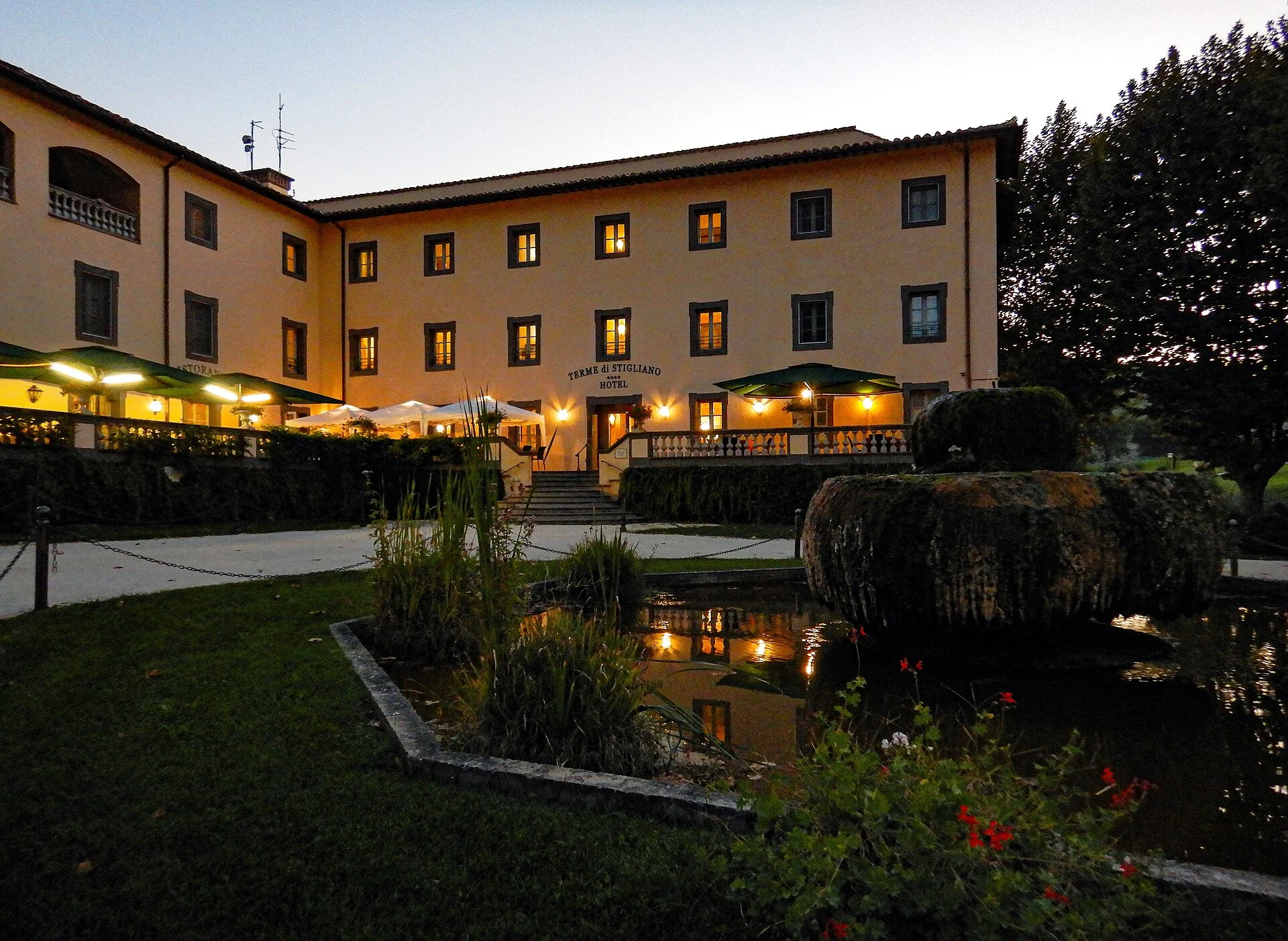
Terme di Stigliano is at Via Bagni di Stigliano 2, in Canale Monterano, and in 2026 it is open: it is run by Stigliano Servizi srl as a thermal hotel with park and spa. Non-guests enter for the day only by reservation, by phone at 06 99805977 or by writing to benessere@termedistigliano.it. The thermal park alone costs €25 on weekdays and €30 on Saturday, Sunday and holidays, from 10:00 to 19:00. The Helius day spa starts at €65.
We are in the countryside between Bracciano and Tolfa, on the edge of the Monterano Reserve, in a valley where hot water has been coming out of the ground since before Rome existed. Here you won't find free pools or public tubs: you'll find a four-star hotel built over an ancient sanctuary, with a park of 20 hectares, outdoor thermal ponds and a documented history that starts in the sixth century BC and arrives, with many gaps, to today.
Rates, hours and packages given here are those published by the operator on its own site as of September 28, 2026, the day that is also the first anniversary of the official inauguration of the day spa. The price list changes with the seasons and with offers, and some packages have declared expiry dates. Before getting in the car, call and have them confirm the price, the entry time and exactly what the ticket you're buying includes.

Where it is and what you really see
The locality is called Bagni di Stigliano and belongs to the municipality of Canale Monterano, even though the town is a few kilometers away. The operator places the property inside the Monterano Nature Reserve and speaks of the Tolfa Mountains as the horizon: it's a correct description of the landscape, made of low hills, Turkey oak woods, pastures and valleys cut into the tuff. The operator declares 50 kilometers from Rome, other guides give 70: it depends on where you start and which road you choose.
The complex has three parts that are best kept distinct. There is the hotel, a historic building with about 40 rooms, a restaurant and a private church. There is the Olympus spa, reserved for those who sleep in the hotel. And there is the thermal park with the ponds, the thermal pool, the fresh water swimming pool and the new Helius area, which is the part open to non-guests. When someone tells you they've been to Stigliano, ask them in which of the three.
What a day visitor sees is mostly the park. The two scenic thermal water ponds, for which the operator gives temperatures between 27 and 35 degrees, are outdoors and are used depending on the weather. There is a semi-Olympic swimming pool of non-thermal water, a thermal pool overlooking the watercourse that runs at the bottom of the valley, lawns, a bamboo thicket and internal paths. The approach is that of a garden, not of a bathing establishment.
Of the ancient remains an ordinary guest sees little. The area of the temple excavated in the 1970s is not presented as an archaeological route, and the operator speaks generically of a residence built on the remains of ancient Roman temples. The sweating grotto inside the Helius spa is described as an environment inspired by Roman baths. Anyone arriving hoping for an archaeological park with panels and finds is disappointed: the archaeology here is read in publications, not along the paths.
A curiosity about Terme di Stigliano
Here there is a thermal pool for dogs. It's not a joke: the operator has set up a Dog Spa with a sulfur-iodine pool reserved for animals, a green area of over 5,000 square meters for running around and a self-service washing station that costs €1 a minute. Entry to the Dog Spa is listed at €25 for hotel guests, included in the overnight stay, and it is open from 9:00 to 20:00.
The curious thing is the contrast. On this ground, 26 centuries ago, someone left bronze statuettes of Heracles in a sanctuary, and today you wash your dog with coin-operated shampoo. It's a sign of vitality more than of decline: ancient baths were practical places, frequented by people who brought animals, luggage and ailments with them. The idea of the bath as a silent temple is 19th-century, not Roman.
One practical point remains that the operator doesn't clarify. The Dog Spa page speaks of hotel guests and doesn't say if someone arriving for the day with their own dog can use it, or if the dog can enter the thermal park along with its owner. The regulations can be downloaded from the site, but on a detail like this it's best to call the main number 06 99805977 first and get an answer by voice, instead of showing up at the gate with the leash in hand.
The second curiosity concerns the name. Many tourist pages write that the Romans called the place Thermae Stygianae, from the infernal river Styx. It's an effective etymology and appears everywhere, but the 17th-century maps consulted by scholars write something else: Bagni di Stigliano olim Aquae Apollinares, that is, once Waters of Apollo. The ancient name tied to the god of light and medicine is documented, the one tied to the underworld is storytelling.
Hours, tickets and how to get in as a non-guest
The basic package is called Ingresso Parco Termale and costs €25 per person from Monday to Friday, €30 on Saturday, Sunday and holidays, with entry from 10:00 to 19:00. It includes the scenic thermal ponds, the thermal pool and the semi-Olympic fresh water swimming pool. The operator doesn't state towels or bathrobes included in this package: bring them from home or ask by phone if they can be rented on site.
You buy directly from the operator, which is the only channel that matters. The page of the Helius Day Spa packages on the Terme di Stigliano site shows all the packages with the booking and request buttons. Alternatively you book by phone at 06 99805977 or with an email to benessere@termedistigliano.it. On the big experience portals no specific product for this thermal park appears, and a ticket resold with a markup would make no sense at all.
Above the basic package are the Helius spa packages. The Full Day Spa Experience starts at €65, runs from 10:00 to 20:00 and includes a locker and a kit with bathrobe and towel, with a security deposit of €20. The Morning Spa Experience starts at €49, from 10:00 to 15:00. The Evasione Pomeridiana starts at €49 from 15:00 to 20:00, or from €102 with dinner included.
There are then variants with aperitif or light lunch that start at €85, and an evening package called Stigliano AperiSunset, from 17:00 to 20:00, from €29 with an enriched aperitif and a glass of prosecco or a spritz. For the spa's private evenings the price is not published and must be asked. All amounts are given as starting prices, and the operator doesn't publish the differences between weekdays and holidays for the spa packages.
What the Helius spa includes, according to the operator: the Roman sweating grotto, sauna and biosauna, salt room, infrared rooms with aromas and herbs, cold room with ice waterfall, sensory showers, relaxation areas, indoor pool with hydromassage and the sensory thermal pool on the river, in addition to the ponds, the Belvedere cold pool and the park's saltwater pool. Access, the operator specifies, is allowed by reservation only.
Finally there are the packages with a room. The Day Use offer is listed at €149 per room, and several packages per person or per couple start from €99 and go up to over €300 for romantic packages with an overnight stay. Validity and precise content of each offer are not detailed on the offers page, so before paying have them send you in writing what is included, above all access to the Olympus spa.
Something nobody tells you about Terme di Stigliano
In May 2019 the Città metropolitana di Roma suspended the thermal treatments at Stigliano. The news reports of those days give the official reasons: the discharge of the waters of the three springs had never been authorized, the documentation on the channels and the analyses was incomplete, the arsenic values slightly exceeded the legal limits, and the Ministry of the Environment had given a negative opinion. Hotel, restaurant and wellness center stayed open.
The owner at the time contested the scope of the measure, arguing that it concerned only the thermal treatments and that the water quality was adequate. The mayors of the area took the matter to the Region because about 60 jobs were at stake. The administrative follow-up of that affair is not clearly published on the institutional sources available, and the current operator doesn't speak of it on its site.
Why it matters to you today. The current site describes a hotel with a spa and thermal park and doesn't present thermal treatments covered by the National Health Service, nor prescriptions from the family doctor, nor mud or inhalation cycles. Some industry portals instead continue to list Stigliano as an accredited facility, with data dating from before 2019. If you're looking for a course of treatments with a prescription, ask by phone before booking anything.
The company that runs the property today is Stigliano Servizi srl, with registered office at the same address as the baths. In September 2025 it opened the new Helius day spa to the public and officially inaugurated it on September 28 of the same year, presenting it as the wellness hub of the Monterano Reserve. It's a clear change of approach: from the traditional medical bath to wellness with day-pass entry.
Our reading is that the change saved the place. A bath that lives on accredited treatments depends on authorizations, analyses and public reimbursements, and one negative opinion is enough to stop everything. A facility that sells days in the park and stays depends on customers. It's not a romantic choice, but it's the one that keeps the gates and the paychecks going.
The water: what the operator declares and what it doesn't
The operator speaks of thermal water in the ponds and in the pool on the river and describes the Dog Spa pool as sulfur-iodine. It doesn't publish a complete chemical analysis on the site, doesn't state the flow of the springs and doesn't list contraindications. For the ponds it gives a temperature range that changes from page to page: 27 to 35 degrees on one, 27 to 30 on another. These are values that also depend on the season and the weather.
External sources add data that don't match each other. The portal of the thermal baths federation classifies two springs as sulfur-iodine, called Bagnarello and Fonte di Bellezza, at 53 and 39 degrees. A geographic study published in 2020 reports 56 degrees for the Bagnarello and 36 for the Bagno Grande. Tourist guides speak of five springs between 30 and 38 degrees. The sources disagree, and the only figure valid for the bather is the one the operator gives you.
On the healing properties I write nothing, and not out of perfunctory caution. The therapeutic indications circulating online derive from the season of the health accreditation, the one stopped in 2019, and the current operator doesn't claim them. What can be said with certainty is that the water is hot, that it smells of sulfur like all the sulfurous waters of the area, and that people have been immersing themselves in it for millennia.
Bather's common sense, valid for any hot sulfurous water. Those with heart or blood pressure problems, those who are pregnant and those who take particular medications ask their doctor beforehand, not afterward. Silver objects in sulfurous waters tend to tarnish, so rings and chains stay in the locker. And in the outdoor ponds you get in gradually, because the temperature shock on cold days is strong.
My advice for visiting Terme di Stigliano
Go on an off-season weekday, between October and April, with the basic park package. €25, hot outdoor ponds, cool air on your face and few people: it's the way this place performs at its best. In summer thermal water at 30 degrees under the July sun loses much of its point, and the park fills with families looking mainly for the cool pool.
In our judgment the day spa is overrated for those who come for the water. The sauna, the biosauna, the salt room and the ice waterfall you find in any wellness center in Rome. What you find only here are the thermal ponds in the middle of the countryside, and those are included in the €25 entry. Spend the difference on dinner.
Always book, even on November weekdays. The access declared by the operator is by reservation, the spots for non-guests are calibrated on the hotel guests, and an isolated facility in the countryside has no interest in letting in people who show up without notice. Ask by phone also if the ponds are open that day: the operator writes that they are used depending on the outside temperature and weather conditions.
Bring what you need, because you're in the countryside and the first shop is kilometers away. Spare swimsuit, slippers, towel, a bathrobe if you don't take the package with the kit, a water bottle and something warm to put on when you get out of the water. The park's regulations can be downloaded from the site: read them beforehand, because that's where the rules on swim caps, food brought from outside and children's ages are found, which the main page doesn't report.
Last tip: figure in the return. The road back toward Rome goes through small towns and stretches with no lighting, and after four hours in hot water you drive worse than you think. If you take the evening package or the sunset aperitif, arrange with someone who doesn't soak or consider a night in the area. No bath is worth a curve taken badly in the dark.
Aquae Apollinares: documents, tradition and legend
Let's start with what the documents say. The Tabula Peutingeriana, the medieval copy of a Roman road map, marks a station called Aquae Apollinares between the road that led to Tarquinia and Via Clodia, in the area of Lake Bracciano. In the area of the Stigliano temple a marble slab with a dedication to Apollo was found, datable to the middle of the second century AD, with the formula Apollini Sancto sacrum.
The problem is that a few kilometers away, on the north shore of Lake Bracciano, are the Bagni di Vicarello, and there too Apollo left heavy traces. In 1852, while cleaning the Vicarello spring, a votive deposit was found with dedications to the god and four silver cups engraved with the itinerary from Cadiz to Rome. After that discovery the Enciclopedia Italiana gave Vicarello as the definitive identification.
The question, however, did not close. The Enciclopedia dell'Arte Antica considers the attribution still debated and cites precisely the dedication to Apollo found at Stigliano. The epigraphist Lidio Gasperini proposed distinguishing two stations: the Aquae Apollinares veteres, the older ones, at Stigliano, and the novae at Vicarello. The proposal is taken up by a 2020 geographic study on historical cartography. The sources disagree, and honestly it's the most serious conclusion.
Then there is the tradition. The 17th-century maps, from Holstenius's of 1636 to those of the end of the century, write Bagni di Stigliano olim Aquae Apollinares, that is, they take the identification for granted. It's a scholarly tradition, built by cartographers who worked on ancient texts and on places. It carries weight, but it isn't proof: it says what 17th-century scholars believed, not what the Romans knew.
Finally the legend. Many tourist pages, and the press release presenting the new spa, tell that Pliny the Elder supposedly wrote that the legions returning from Egypt had to purify themselves at Stigliano before entering Rome. None of the pages that repeat it gives the book and paragraph of the Naturalis historia. Until someone does, it's a legend, and the detail of the patricians of the age of Tiberius belongs in the same drawer.
Why I insist on this distinction. Because the true story is more interesting than the invented one. A sanctuary frequented from the sixth century BC, a temple with a dedication to Apollo, a debate among scholars that has lasted 170 years and two thermal sites contending for the same name: it's excellent material. There is no need to add marching legions to make it presentable.
Another well-known fact, yet rarely mentioned
Stigliano was truly excavated. Between 1970 and 1975 the universities of Chieti and Macerata carried out campaigns that brought to light a sanctuary complex, with part of a temple and a bath building. In 1990 the remains of a second bath installation emerged, and in 1994 there was a restoration intervention. These are data reported by the Enciclopedia dell'Arte Antica, not brochure reconstructions.
The temple was of the prostyle type, with columns only on the front, on a base of pumiceous tuff of which the southeast half is preserved. Among the finds are bronze statuettes of Heracles from the fifth century BC, black-glaze pottery and pottery of the type called Genucilia from the fourth and third centuries, fragments of bucchero from the sixth century, coins from the middle Republican age and marble fragments.
Translated for those who don't do archaeology: the place was already frequented in the Etruscan age, before Rome controlled this territory, and continued to be until the second or third century AD. Bucchero is the black pottery typical of the Etruscans, the same you see in quantity at the Etruscan Museum of Villa Giulia. Stigliano was a border sanctuary of the waters, between the spheres of Caere and Tarquinia.
The 2020 geographic study speaks of a fortified pagus on the river Lenta established by Caere, the Etruscan city we now call Cerveteri, in a defensive role toward Tarquinia. It's a reconstruction, not an excavation datum. But it helps to understand why Etruscan and then Roman objects are found here: border hot waters were shared places of worship, frequented by those who traveled between the two cities.
The right photo to take at Terme di Stigliano
The photo is the steam over the ponds on a cold morning. Between November and February, around 10:00, when the gates open and the outside air is still a few degrees, a low mist rises from the hot water that covers the surface and softens the woods behind. Stand on the side of the pond with the sun behind you, low, and let the steam fill the lower two thirds of the frame.
Before shooting, ask. The park is frequented by guests in swimsuits, and the rule of civility before even that of law is not to photograph recognizable people without their consent. In the first hours the ponds are often empty, and that's another reason to arrive at opening. A phone in a waterproof case is fine, a reflex camera near the sulfurous water is not: the fumes aren't good for electronics.
The second shot is the facade of the historic hotel seen from the park, with the terrace fountain in the foreground, in the late afternoon. The operator describes the restaurant terrace as overlooking a fountain, and in raking light the building loses its hotel look and regains that of the vacation residence it was. In summer it's the light of the aperitif, in winter that of 16:00.
Avoid the photo of feet in the water with the glass of prosecco. Everyone takes it, it says nothing about the place and it could be taken in any pool in Italy. If you want a detail, look for the concretions left by the water on the edges of the pools and channels, with their pale colors and deposits. They are the only thing that distinguishes a thermal water from a heated water.
How to get there from Rome
By car it's the only really convenient option. From Rome you follow Via Braccianese toward Bracciano and then the signs for Manziana and Canale Monterano, to the locality Bagni di Stigliano. Those coming from the coast use the Aurelia and head inland. The operator declares 50 kilometers from Rome and good reachability from Fiumicino airport too, but doesn't publish detailed road directions: rely on the navigator with the exact address.
A warning about the navigator, which has already betrayed more than one visitor. Stigliano is also the name of a municipality in Basilicata, in the province of Matera, and of other minor localities in Italy. If you type only Terme di Stigliano or Stigliano, some apps offer you the wrong destination 500 kilometers away. Enter the full address with Via Bagni di Stigliano 2 and Canale Monterano, and check the province of Rome before leaving.
By train the reference station is Manziana-Canale Monterano, on the FL3 regional line Rome-Viterbo, served on weekdays by hourly trains toward Roma Ostiense and toward Viterbo. The problem is the last kilometers. The station is far from the baths and the operator indicates no shuttles or dedicated public connections. You need a taxi booked in advance or a ride arranged with the facility.
There are suburban bus connections toward Canale Monterano, but frequencies and stops useful for Stigliano must be checked each time. The official channel is the Cotral website, with the timetable search, or the toll-free number 800 174 471. On holidays, precisely the days when people think of the baths, runs are reduced a lot. Don't plan a day here by public transport without a plan for the return.
For groups the picture changes. A 50-seat coach arrives without problems, but both access and the simultaneous entry of many non-guests must be agreed with the facility, because the ponds have limited capacity. The best solution for a party is to combine the morning in the reserve with the afternoon at the thermal park, with lunch in between.
Those arriving from the north can fit Stigliano into a tour of the southern Tuscia: Blera and Barbarano Romano are on the way, with their rock-cut necropolises. From the southwest you come up from Civitavecchia through Allumiere and Tolfa, a road of hills and pastures with Maremma cattle and horses grazing free.
Some important events that happened here in history
Sixth century BC: the bucchero fragments indicate the first use of the sanctuary in the Etruscan age. Between the fifth and third centuries the Heracles statuettes and the pottery arrive. In the late Republican and Imperial age the temple and the bath installations are built, and in the middle of the second century AD someone dedicates to Apollo the marble slab found in the excavations. Ancient use fades out between the second and third centuries.
Middle Ages. The baths appear in documents of bequests and donations of 1321, 1460 and 1477. According to the most widespread reconstructions, the 1321 document is the will with which Count Pandolfo dell'Anguillara left to his children the castle and the baths of Stigliano. Toward the end of the 15th century the property passes to the Orsini, the great baronial family that controlled a good part of this territory.
In 1671, according to the 2020 geographic study, the baths are purchased by Pope Clement X, born Emilio Bonaventura Altieri, who has a building with rooms for stays constructed. The current operator instead writes that the building was constructed in the 18th century by the Altieri princes. The sources disagree on the century, but agree on the family: it is the Altieri who turn the baths into a vacation place.
19th and 20th centuries. Between 1851 and 1852 the establishment is renovated. The 1930s are the moment of greatest splendor, with a first-class hotel and a complete thermal offer. The Second World War brings damage, recovery comes in 1949, then in the 1970s the crisis, the same one that hits many Italian baths when insurance-covered treatments change and tourism takes other roads.
The last 25 years. From 1999 a redevelopment oriented to wellness begins, and a deep renovation of the establishment is given as completed in 2006. In May 2019 the Città metropolitana suspends the thermal treatments. On September 6, 2025 the Helius day spa opens to the public, inaugurated on September 28, 2025 in the presence of institutional representatives. Today the complex works as a thermal hotel with a park open to non-guests.
A detail that ties this story to that of the territory. The same Altieri who buy the baths are the lords of Monterano, the village on the rock now abandoned, where in the 17th century they had the workshop of Gian Lorenzo Bernini work on the convent of San Bonaventura and on the fountain. Anyone who visits Monterano, the ghost town in the morning and Stigliano in the afternoon follows the same family in two places.
Who has passed through Terme di Stigliano
The pilgrims of the ancient sanctuary, first and longest of all. Etruscans of Caere and Tarquinia, then Romans, for seven or eight centuries left statuettes, coins and vases here in exchange for a healing or a safe journey. We don't know their names, but we know their objects, and it's the most concrete form of presence an archaeological site can give back.
Pandolfo dell'Anguillara, count of a family that in the 14th century dominated the south shore of Lake Bracciano and that left its name to Anguillara Sabazia. For him the baths were an asset to pass on to heirs along with the castle. It's a good reminder: in the Middle Ages baths were not leisure but income, with tolls, rents and rights of use.
The Orsini, lords of half of northern Lazio between the 15th and 16th centuries, the same family that built the Odescalchi Castle in Bracciano before it passed to the Odescalchi. According to tourist reconstructions they promoted the waters of Stigliano as a remedy for the ailments of the time. Their dominion over the lake and the surrounding hills explains why the baths stayed within the same system of power.
Clement X Altieri, a Roman, pope from 1670 to 1676, elected at nearly 80. His pontificate is remembered more for the family than for him: his adopted nephew, Cardinal Paluzzo Altieri, handled the affairs of government and strengthened the family estate. The purchase of the baths of Stigliano and the care for Monterano are part of that policy of consolidating the family's fiefs.
The 17th-century cartographers, starting with Lucas Holstenius, a German scholar who came to Rome in the service of the Barberini, who between 1636 and 1637 drew the area writing the ancient name beside the baths. After him, and throughout the century, other cartographers repeated the same wording. Without them the debate on the Aquae Apollinares wouldn't even have begun, because they are the ones who put the ancient name on the modern map.
The scholars of the 19th and 20th centuries. The Jesuit Raffaele Garrucci wrote of it in 1864, the archaeologist Salvatore Bastianelli in 1942, Lidio Gasperini in the 1960s and 1970s with his epigraphic studies, then the teams of the universities of Chieti and Macerata with the excavations. These are the names you find in the bibliography, and they are the ones to cite when someone tells you the legend of the legions.
When it's closed and what not to expect
The operator lists the thermal park open every day with entry from 10:00 to 19:00 and the Helius spa from 10:00 to 20:00, but doesn't publish a calendar of annual closures, maintenance shifts or rest days. The outdoor ponds depend on the weather, and on a day of storm or strong wind they may be closed even if the facility is open. Call the same morning, not the week before.
Don't expect an archaeological park. The remains of the temple and the ancient installations are not presented as a visiting route, there are no dedicated explanatory panels and no archaeological guided tour is published. Anyone who wants to understand the site has to arrive prepared or accompanied. To see what a great ancient bath complex was, it's better to go to the Baths of Caracalla in Rome.
Don't expect free pools or free tubs either. Stigliano is a private paid complex, fenced, with controlled entry. Anyone looking for free hot water in the Tuscia has other destinations, which you'll find further on. And don't expect accredited thermal treatments: the current operator doesn't publish them, and the 2019 affair explains why it's best not to take them for granted.
On accessibility the operator doesn't publish an overall statement for the thermal park. The terrain is that of a valley with slopes, lawns and paths, and the natural ponds don't have the ramps of a modern pool. Anyone in a wheelchair or with mobility difficulties must ask by phone which pools are actually reachable and if lifts exist, before booking.
On children the operator doesn't publish a minimum age on the main pages, even though the booking form distinguishes adults and children. The age rules for the Helius spa, for the sweating grotto and for the saunas are not stated, and in wellness centers hot environments often have age limits. If you come with small children, ask beforehand what they can use and plan the day around the park and the cool pool.
Nearby alternatives for anyone looking for hot water
The most immediate comparison is with the Mola di Oriolo Romano, north of Lake Bracciano: another thermal water in the area, another way of experiencing it. Farther on, to the north, Viterbo has the widest offer in Lazio, with the Bullicame and the Piscine Carletti on the free side and the Terme dei Papi on the equipped one.
On the coast, at Civitavecchia, are the Terme Taurine and the Ficoncella, that is, a large Roman complex to visit and popular pools to use, reachable from Stigliano by heading down toward the sea. Anyone who wants to stay closer to Rome has the Acque Albule of Bagni di Tivoli. They are all sulfurous waters, with different smells and temperatures, and each has a recognizable crowd.
For those willing to go farther, the area around Viterbo offers the Terme del Bagnaccio and the Terme di Cretone in the Sabina, while for anyone looking for the bath for the drinking-water cure the classic destination remains Fiuggi. They are very different places from Stigliano, and comparing them helps you choose the right one for the kind of day you have in mind.
Then there are the places where the water isn't used but looked at. The Caldara di Manziana is an area of gas emissions inside a natural zone, a few kilometers from here. The Solfatara of Nepi tells the same Sabatini volcanism from another angle. In these places you don't soak: you walk, you look, you respect the bans.
The criterion for choosing, for anyone looking for the right bath. If you want free water and accept the crowd, go to Viterbo or Civitavecchia. If you want a quiet afternoon in the countryside with a hotel's services, Stigliano. If you want ancient history standing, Caracalla or the Taurine. Mixing up expectations is the surest way to go home unhappy.
Eating nearby
Inside the complex is the restaurant Il Ninfeo, which the operator declares open to outside customers too but only by reservation, with evening service from 19:30 to 22:00. You book by writing to ilninfeo@termedistigliano.it or by calling 06 99805977 and choosing extension 3. Prices aren't published on the restaurant's page, so ask for them when you book. Lunch for non-guests is tied to the spa packages.
Outside the baths you're in the middle of the countryside, and this protects you from a good part of the traps found in Rome and in tourist towns. But not all of them. On the roads leading to Lake Bracciano and at the scenic spots some places work on the passing Sunday crowd, and the signs for recognizing them are always the same. It's worth running through them again, because here people go wrong from tiredness more than from naivety.
First sign: the menu with photos of the dishes, maybe translated into four languages. A place that has to show you the picture of the carbonara is talking to someone who doesn't know what it is, and that crowd doesn't come back. Second: the woman rolling out the pasta sheet in the window or at the door. It's theater. Pasta done well is made in the kitchen, in the morning, away from the street and the gaze of passersby.
Third sign: someone at the door inviting you in. Someone with regulars doesn't have to stop anybody in the street. Fourth: the kitchen open without a break from morning to night, which means dishes prepared ahead and reheated. Fifth: items with no price, fish of the day by weight with no figure, different price lists between inside and outside. Always ask the price before ordering, without embarrassment.
On the chain signs you find identical in so many squares, no malice: they're convenient, predictable and always open, and anyone traveling with tired kids chooses them for good reasons. Romans simply don't go, because they look for something else: seasonal cooking, the local wine, the place where the owner knows what he bought that morning. In the towns of the Tolfa and around the lake this still exists.
The criterion is to look at who is seated. Workers at lunch, local families on Sunday, people who talk to the waiter by name: you're in the right place. To get your bearings without trial and error there's our list of the places where we eat, in Rome and the surrounding area. In small towns call first: many places open only on weekends.
What to combine in a day
The natural pairing is the morning on foot in the Monterano Reserve, with the ruins of the abandoned village on the rock and the Diosilla Falls, and the afternoon in the ponds of Stigliano. Two or three hours of walking on tuff paths, then hot water: it's the ideal day for anyone looking for something outside Rome that isn't yet another village in a row.
Those who prefer the lake can start from Trevignano Romano or from Lake Martignano, inside the Bracciano and Martignano Park, and come down to Stigliano in the afternoon. In autumn and spring it works very well. In summer less, because after a morning in the lake sun ponds at 30 degrees become a senseless idea.
For the woods there are two destinations close by: the Bosco Macchia Grande of Manziana, flat and suited to families, and the Beech Forest of Allumiere in the Tolfa Mountains, higher up and cooler. In October and November the colors of the leaves and the hot water in the afternoon make one of the best-turned autumn days in all of Lazio.
Those who want to stay with the Etruscans have the Banditaccia Necropolis in Cerveteri, that is, the city that controlled this territory when the sanctuary of Stigliano was in operation, or the Monterozzi Necropolis in Tarquinia, the other border power. They are full half days, and with the afternoon at the baths the day is complete.
For those coming from Rome who want to understand the context of ancient baths before soaking, the right day to prepare is in the city: the Baths of Diocletian and Palazzo Massimo are sites of the Museo Nazionale Romano, the same museum that holds the silver cups of Vicarello. Looking at those cups and then coming here makes concrete a debate that would otherwise stay on paper.
Frequently asked questions
Is Terme di Stigliano open in 2026?
Yes. As of September 28, 2026 the operator, Stigliano Servizi srl, lists on its site the hotel, the Olympus spa for guests, the Helius day spa and entry to the thermal park for non-guests, with mandatory reservation. The address is Via Bagni di Stigliano 2, Canale Monterano. The phone is 06 99805977 and the wellness email is benessere@termedistigliano.it.
Can you enter for the day without sleeping at the hotel?
Yes, with the packages for non-guests. The Ingresso Parco Termale costs €25 on weekdays and €30 on holidays and weekends, from 10:00 to 19:00, and includes thermal ponds, the thermal pool and the fresh water swimming pool. The Helius spa starts at €65. The Olympus spa, instead, is reserved for hotel guests and can't be bought by the day.
How hot is the water in the ponds?
The operator gives temperatures between 27 and 35 degrees for the scenic ponds, but one of its pages reports a lower range, between 27 and 30. The springs that feed them are hotter, and external sources give different values for each. The ponds are used depending on the outside temperature and weather conditions, so it's best to ask the same day.
Are accredited thermal treatments offered at Stigliano?
The current operator doesn't publish thermal treatments covered by the National Health Service. In May 2019 the Città metropolitana di Roma had suspended thermal treatments over problems with discharge authorization and documentation. Some portals still list the accreditation with earlier data. Before showing up with a doctor's prescription, ask for confirmation at 06 99805977.
Are there Roman remains to see?
The excavations of the 1970s brought to light a temple and ancient bath installations, with finds from the sixth century BC to the second AD. The operator, however, doesn't offer an archaeological route or dedicated guided tours. Inside the Helius spa there is a sweating grotto presented as inspired by Roman baths. The archaeology of the site is known mostly through the scholarly literature.
Does Stigliano correspond to the ancient Aquae Apollinares?
The sources disagree. At Stigliano a dedication to Apollo from the second century was found, and the 17th-century maps write Bagni di Stigliano olim Aquae Apollinares. At Vicarello, on Lake Bracciano, a large votive deposit for Apollo was found in 1852. A proposal by scholars distinguishes two localities: the veteres at Stigliano and the novae at Vicarello.
Can you go to the baths with a dog?
The complex has a Dog Spa with a sulfur-iodine pool for dogs, a green area of over 5,000 square meters and self-service washing, open from 9:00 to 20:00. The operator lists it for hotel guests and doesn't specify if it is accessible to those entering for the day, or if dogs can accompany their owners in the thermal park. Ask by phone before leaving.
How do you get there without a car?
With difficulty. The nearest railway station is Manziana-Canale Monterano, on the FL3 regional line Rome-Viterbo, but it is far from the baths and the operator indicates no shuttles. You need a booked taxi or a ride arranged. For suburban buses toward Canale Monterano, look up the timetables on the Cotral website or at the toll-free number 800 174 471, keeping in mind the reductions on holidays.
Who wrote this page
This page comes from the editorial team of Tour Leader Pro, the Rome-based outfit that designs itineraries, visits and cultural events between Rome and Lazio. Rates, hours and access methods given here come from the operator's official pages and from the other sources cited in the text as of the date given at the top. Since it's a private facility with seasonal offers, recheck them before you leave and tell us what you find changed.
Lining up a day between the Roman Tuscia and Lake Bracciano means fitting together ponds that open depending on the weather, country roads with no lighting, trains that stop far from the destination and buses that thin out on holidays, for yourself or for a group of 40 people. Anyone facing this kind of puzzle will find on Tour Leader Pro working materials designed for those who guide and for those who organize on their own.
For the wider picture, meaning regional trains and seasonal timetables, rentals, airports, transfers between provinces and destinations in Lazio outside central Rome, from the volcanic lakes of the north to the Tyrrhenian coast and on to the villages of the interior and the baths of the Tuscia, a useful resource for building a multi-day itinerary is Italy Planner.