Bullicame
In short. The Bullicame is on Strada Bulicame, with no street number, in the countryside west of Viterbo toward the Tuscanese.
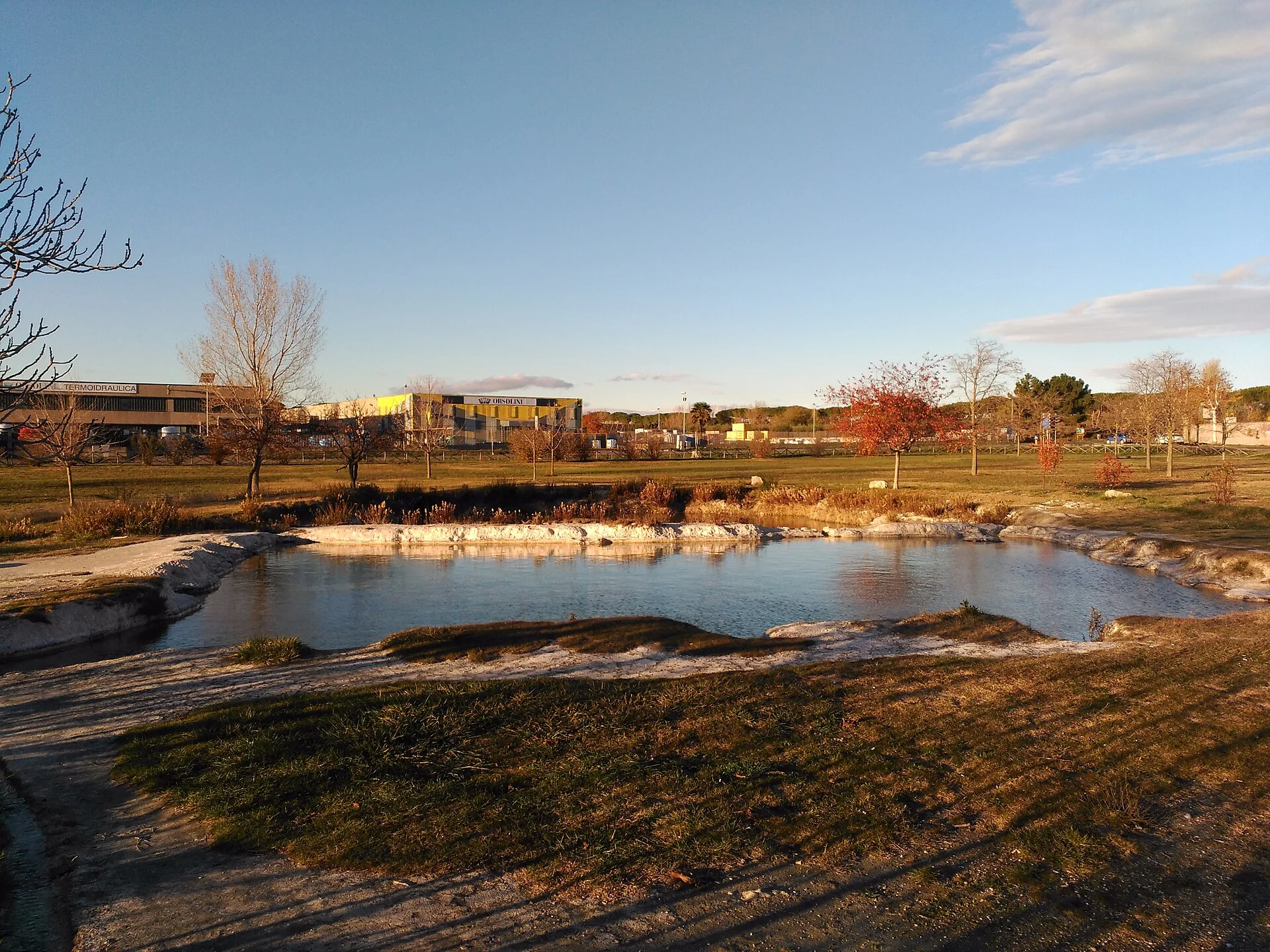
The Bullicame is on Strada Bulicame, with no street number, in the countryside west of Viterbo toward the Tuscanese. It's a thermal park of the Municipality of Viterbo: entry is free, you don't book anything and there is no ticket office. Inside there are the fenced hot spring, with water coming out at around 58 degrees Celsius, and two free pools where you bathe. Almost no services, short hours, closing in the afternoon.
Even people who have never been through Tuscia know the name, because Dante uses it in the Inferno as a point of comparison for a red, boiling stream. That's why the people of Viterbo treat the Bullicame as a piece of their city, and defend it even when the park is badly kept. The bath is the reason they go. The spring and the literature are the reason you should go.
The practical information reported here comes from the sources consulted as of September 28, 2026: the notices of the Municipality of Viterbo, the regional concession on the thermal basin, the local reports on work at the spring. The Municipality doesn't publish official park hours on a dedicated page, and in the last 10 years the hot water in the pools has been missing for long periods. Before leaving Rome check the notices on the portal of the Municipality of Viterbo.
Where it is and what you really see
The park occupies a countryside plateau between the Strada Tuscanese and the thermal zone, at a distance from the historic center of Viterbo that guides put between two and a half and four kilometers, depending on where you measure from. Access is by a dirt road, the signs are scarce, and whoever uses GPS is better off setting the Botanical Garden of the University of Tuscia, which is right across from it.
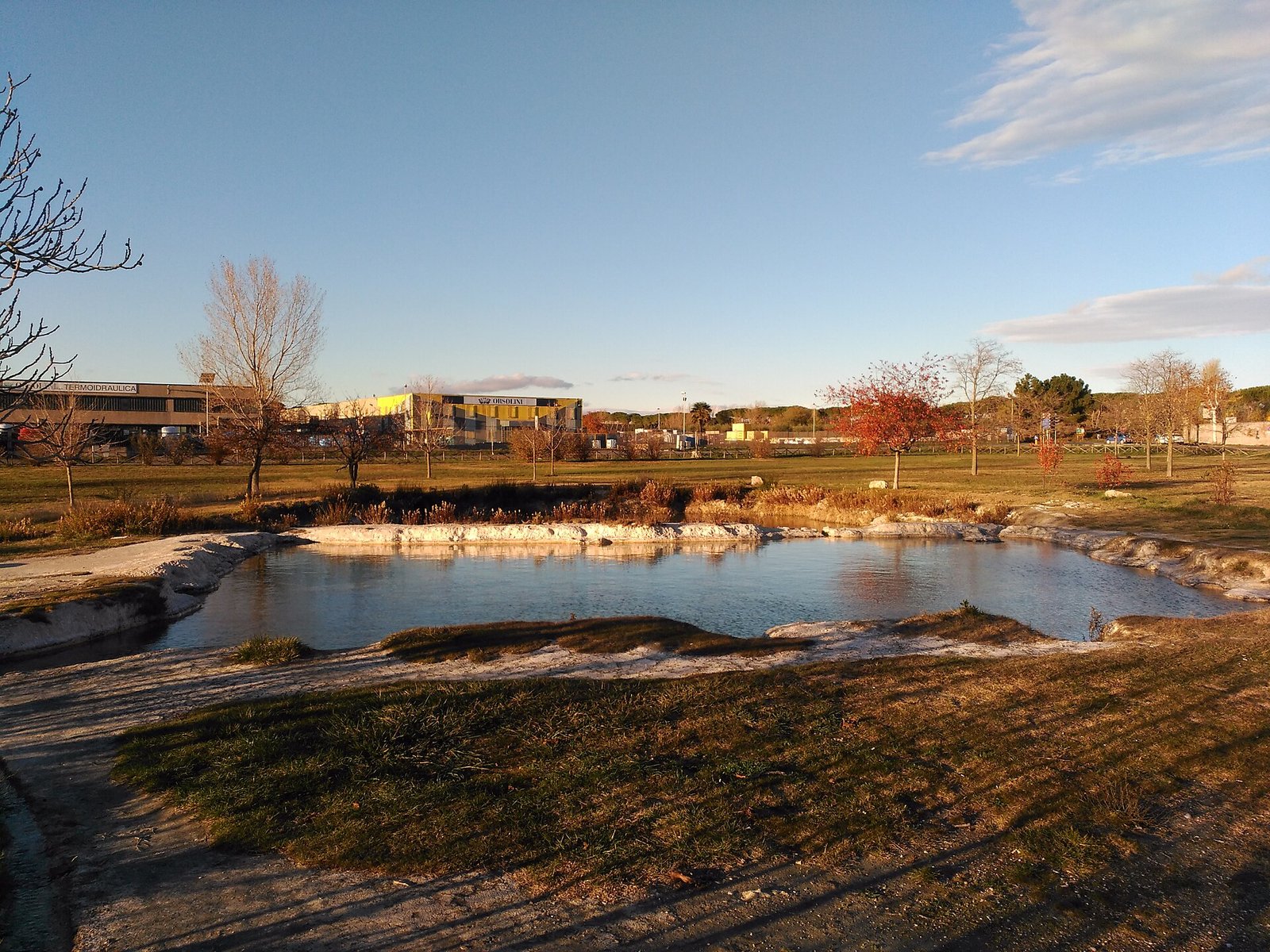
Past the gate you see first of all the crater: a small lake of steaming water, with encrusted edges, closed off by a transparent barrier. From there the water runs down in limestone channels that it built itself over the centuries, depositing the limestone it carries dissolved. It's the most interesting part of the park, the one Dante describes, and the only one you can't touch.
There are two pools. One small and round, near the spring, receives the hottest water. The other is larger and elongated, and the water cools as you move away from the point where it enters. Under the small waterfall with which the channel pours into the pool people stand to have their shoulders massaged. The Municipality doesn't publish the temperature of the pools, and it varies a lot with the flow.
Next to the crater is the stele with Dante's verses, the piece everyone photographs. Around it, a lawn with a few trees, a small unattended dirt parking lot, chemical toilets when they are there. No bar, no showers, no changing rooms, no umbrellas. Whoever arrives expecting a spa has the wrong address: the spa is another one, it's called Terme dei Papi and has a separate page.
How to get in, who runs it and how much it costs
Entry is free of charge. The park belongs to the Municipality of Viterbo, which is also the holder of the regional concession on the entire Bullicame thermal basin, renewed in 2017 for 30 years, until October 25, 2047, over an area of almost 148 hectares. It is the Municipality that opens and closes the gate, that decides the work at the spring and that signs extraordinary closures when needed.
On hours the sources don't agree, and an official schedule is not published on a Municipality page. Local guides give closing at 17:00 in winter and at 18:00 in summer, others speak of opening from the morning until sunset, and visitors' reviews tell of gates found closed at hours different from those on the sign. The practical rule is just one: arrive in the morning.
Inside the park, supervision is entrusted to volunteers, who watch the bathers and, according to the local guides, give notice half an hour before closing. Over the years the Municipality has announced guardianship, video surveillance, perimeter lighting and a drinking water connection, in a program of €120,000. How much of that program is operational today the Municipality doesn't state on a dedicated page, and on site the park remains spartan.
There are no tickets, presales or packages to buy for the Bullicame, and whoever offers them to you is selling you a transfer or a guide, not the entry. The channel for official news, including closures and works, is the institutional portal of the Municipality of Viterbo, where the notices come out. There, for example, the closure for the whole day of January 13, 2025 for maintenance of the spring was announced.
The Bullicame is not an isolated spring. It's the most famous among the many hot outflows of the Viterbo thermal basin, which includes among others the Carletti, San Sisto, Bagnaccio, Zitelle and Piazza d'Armi springs. They are sister waters, rising from the volcanic subsoil of the Cimini area, and every well opened for a hotel or a spa takes pressure off all the others. That's why the reports on the Bullicame always talk about wells.
A curiosity about the Bullicame
The Bullicame has a namesake on a moon of Jupiter. On the surface of Io, the moon with the most intense volcanic activity in the solar system, there is a region called Bulicame Regio. To name the features of Io astronomers drew on fire gods and on places of Dante's Inferno, and a spring that Dante uses as an image of the infernal rivers had every credential to end up up there.
The name comes from the verb bulicare, that is, to boil, to gurgle, and describes what you see at the crater: bubbles rising to the surface in water that steams even in summer. Dante writes Bulicame with a single l, the park's modern spelling uses two, and on signs and in documents you find both, often on the same page. The access road, for example, is called Strada Bulicame.
The second curiosity concerns the water and not the words. The Bullicame is also the spring that feeds the Terme dei Papi, the spa that declares it uses exclusively hyperthermal water from the Bullicame spring. Whoever bathes for free in the municipal pool and whoever pays the entry to the spa draw in essence from the same basin, with very different wells, flows and treatments.
The third is a naturalists' detail. The guides describe the park as a habitat of the green toad, an amphibian that frequents pools and open wetlands. Whoever arrives in spring, early in the morning, before the lawn fills up, can hear its call around the drainage ditches. It's one more good reason not to leave trash and not to pour soaps or shampoos into the pools.
Something nobody tells you about the Bullicame
For years the free pools were left without thermal water. Local reports date the start to November 25, 2014 and link the problem to the San Valentino well, which diverted the water toward a thermal hotel in the area. The regional concession of 2017 already provided for the mining closure of that well, but for the hot water to return to the park's pools it took about five years.
The well was closed during the term of Mayor Giovanni Arena, with the hotel switching to another well within its own property, the Sant'Albino. Shortly afterward a second intervention closed the leak of the Zitelle well, which according to the Municipality had been losing 15 liters per second since 1952. The local press then reported the return of thermal water to the park's main basin.
The flow of the spring, in any case, has been declining since the end of the 20th century, and it takes little for the pool to cool. In a period after the water returned, a hump of limestone deposited at the mouth of the channel prevented the spring water from reaching the pool, which stayed full of cold water. It's the same limestone the water deposits by itself: without regular maintenance the system clogs.
What nobody tells you, then, is this: the hot bath at the Bullicame is not a given of nature. It is the result of choices about wells, concessions and periodic cleanings. The basin is only one and it is shared by the free spring, the spa and the hotels. When the reports talk about lukewarm or empty pools, the reason is rarely the spring itself.
Dante and the Bullicame: what the text says
The passage is in canto 14 of the Inferno, lines 79-81. Dante and Virgil walk in the third ring of the seventh circle, among the violent against God, on a sandy waste where flames rain down, and they come to a small red stream that comes out of the forest of the suicides. To describe it the poet uses a comparison that his readers could verify: "As from the Bulicame comes a stream / that the sinful women then share among themselves."
The literal meaning is clear. As a stream comes out of the Bulicame that the sinful women then share among themselves, so that brook runs down over the sand. In the following lines Dante adds two observations as a witness: the red color of the water, which still makes him shudder, and the fact that the bed and banks of the brook have turned to stone. Whoever looks at the park's channels understands at once what he is talking about.
The Bullicame returns, perhaps, two cantos earlier too. In canto 12, among the violent against their neighbor immersed in the boiling blood of the Phlegethon, Dante uses bulicame as a common noun, to indicate the seething mass from which the damned emerge up to their throats. Some commentators read in it a reference to the Viterbo spring, others only the generic sense of the word. The explicit and certain citation remains the one in canto 14.
Who are the sinful women? Here the commentators come in. The early ones explain that the prostitutes of Viterbo had baths of their own, fed by conduits from the spring water, and Benvenuto da Imola, in the 14th century, finds the comparison apt for the redness, the color and the stench. A second reading, proposed by more recent scholars, sees in the sinful women the workers who soaked hemp, for which medieval Viterbo was known.
There is also the hypothesis of a copyist's error, pettatrici in place of peccatrici, that is, the women who combed the fiber. On the municipal documents the sources don't agree: one scholarly tradition cites a Viterbo edict of 1469 that reserved the Bulicame to prostitutes, keeping them away from the baths of honest women, another reports an edict that instead banned them from access. In both cases the link between the spring and the prostitutes has a written basis.
The question everyone asks remains: was Dante here? No document says so. Local tradition takes it as certain and links it to the trips between Florence and Rome along the Francigena around 1300, and in 2021 the Municipality of Viterbo built a Dante itinerary with signs at the places of the city cited in the Commedia. The precision of the comparison suggests an eyewitness, but it remains a hypothesis.
My advice for visiting the Bullicame
Go early in the morning on a weekday out of season, from October to March. With the cold air the steam over the crater shows up well, the hot pool is a real pleasure instead of a cooking pot, and the small unattended parking lot has room. On spring and summer weekends the lawn fills up, the round pool becomes a line and the sense of the place is lost.
Bring everything, because inside there is nothing. Towel, rubber flip-flops for the encrusted and slippery edges, a jug or a few bottles of fresh water to rinse off, since there are no showers and the smell of sulfur stays on you for hours. An old swimsuit, because sulfur compounds stain light fabrics and blacken silver. Leave rings and chains at home.
Take the closing time into account before leaving Rome. Whoever leaves home after lunch arrives around 16:00, struggles to find parking and has barely an hour before the volunteers start calling people out. The Bullicame is not a sunset place, the gate closes earlier. A full morning, with lunch in town and the afternoon devoted to another place in Tuscia, is the right day.
The contrarian advice is this: don't come for the bath, come for the spring. The municipal pool, even in good periods, is a country pool with on-and-off maintenance, and whoever looks for the free hot bath as the main experience is often disappointed. The steaming crater, the stone channels and the stele with Dante's verses are worth the trip. The bath is a bonus.
If the bath really interests you, check the news the day before. In recent years the Municipality has closed the park for maintenance of the spring, and local reports note at times cold or dirty pools. In March 2026 a local news site documented trash, abandoned flip-flops and plastic bottles at the park entrance. A quick search of the municipal notices avoids the disappointment and a wasted trip.
A warning about winter gear. The Bullicame in winter is beautiful, but getting out of hot water at five degrees with no changing room is an experience to factor in. A heavy bathrobe, a wool hat, a towel to spread on the lawn for changing and a waterproof bag for the wet swimsuit make the difference between a pleasant morning and a cold. Keep a blanket in the car for the return.
Safety: boiling water, gas and pool bottoms
The spring comes out at around 58 degrees, a temperature that burns in a few seconds. That's why the crater is closed off by a transparent barrier, and the fence must always be respected, even when you see someone leaning over for a photo. Children must be held by the hand near the crater and the channels, where the water still runs very hot and the edges are slippery.
In the small pool, and in the large pool near the jet, the water can be very hot. Get in slowly, test first with your foot, stay briefly and get out now and then. Those with heart or blood pressure problems, those who are pregnant, those who bring small children would do well to ask their doctor before prolonged hot baths: for the free pools of the Bullicame no operator publishes health guidance or contraindications.
The smell of rotten eggs you notice on arrival is that of sulfur compounds dissolved in the water. The Municipality doesn't publish gas measurements in the park. In the thermal areas of volcanic Lazio the rise of gas from the subsoil is a known phenomenon, so the usual precautions apply: don't lie down for long in hollows, don't keep your head at water level near the crater, move away if headaches or dizziness arrive.
The bottoms of the pools are uneven and covered with deposits and slippery mud. No jumping, no diving, no running on the edges. Glass is the most dangerous thing in a place where you walk barefoot: bring drinks in plastic or in a flask and take your trash away with you. The park's rules don't appear to be published online, but on this you don't need rules, common sense is enough.
On dogs and animals the information is not published, and in any case a dog in a hot, crowded pool is not a good idea. At night the park is closed: the Bullicame is not a pool open at any hour, and whoever climbs the fence has no assistance. The phone, according to several visitors, sometimes gets no signal. Go in pairs, and tell someone where you are.
Another well-known fact, yet rarely cited
The Bullicame was a stop on Via Francigena already at the end of the first millennium. In the itinerary of Sigeric, the Archbishop of Canterbury who around 990 returned from Rome noting down the stops, the sixth mansio out of the city is recorded as Sce Valentine, San Valentino, the name of the locality of the springs. The same name carried by the well closed to give the water back to the pools.
The detail says two things. The first: the stop noted down doesn't carry the name of the city but that of the waters, where those who had been walking for days could wash and tend their feet. The second: the name San Valentino has accompanied the place for more than a thousand years and survives today in the place names of the wells. Whoever walks Via Francigena in Lazio still passes through these parts.
The third fact concerns duration. The sources agree in saying that the area was used for bathing from the Etruscans until the 18th century, with Roman installations, medieval baths and modern-era establishments that followed one another around the springs. Today's Bullicame, with its two country pools, is what remains after centuries in which the same water fed far bigger installations.
Whoever wants to see what public baths on an imperial scale were like finds the comparison in Rome, at the Baths of Caracalla and the Baths of Diocletian. Closer to the Bullicame in type of water are the Acque Albule of Tivoli, also sulfurous and frequented since antiquity. There, however, the spa has swallowed everything, here the spring can still be seen in the open air.
The Bullicame is also a stop on the Dante itinerary that the Municipality of Viterbo has marked in the city with dedicated signs. The other places are in the center: Porta Romana, Piazza del Gesù where Henry of Cornwall was killed in 1271, the cathedral square tied to the popes cited in the Commedia, the church of San Francesco with the tombs of Clement IV and Adrian V. Whoever has a day can follow it after the bath.
Legends of the Bullicame: documents, tradition and tale
Three different kinds of stories circulate about the Bullicame, and it's best to keep them separate. There are the documents: Dante's text, Sigeric's itinerary, the municipal acts on the prostitutes, the regional concession. There is tradition: Dante passing through here and seeing the spring with his own eyes, the baths of the prostitutes fed by conduits. And there is the legend proper, that of the horse of the Sun.
The legend tells that one of the horses pulling the chariot of the Sun fell into the earth where the spring is today. Trapped underground and unable to get out, the animal thrashes furiously, and the hot, foamy slobber it produces is the water that rises from the crater. According to local tradition the horse even had a name, Animoso, and the story is reported in the 15th-century chronicle of Niccola della Tuccia.
The level of documents, in this case, is minimal: there is a chronicle that records the legend, not a fact. The level of tradition is richer, because the people of Viterbo link the tale to the ancient idea that horses' foam had healing virtues. The level of legend is pure mythological tale, with the solar chariot of the classical tradition transplanted into the countryside of Viterbo.
It's worth doing the same exercise on Dante. Document: the verses of canto 14 and the explicit comparison. Tradition: the poet crossing Viterbo and seeing the women at the baths. Legend: whoever points out the precise spot where he would have stopped. A 19th-century Dante scholar proposed recognizing the bath of the sinful women in the ruins of the Bagno di Ser Paolo Benigno, a hypothesis that remained just that.
The right photo to take at the Bullicame
The photo is the crater with the steam, on a cold morning, backlit. Stand on the side opposite the sun, let the cloud of steam stand out against the dark background of the trees, and shoot the surface of the water with the bubbles rising. In summer the steam is almost invisible and the photo becomes any small lake. Between November and February it's something else.
The second shot is the channels. Crouch down to water level and shoot the stone bed that the water itself has built, with the light incrustations and the streaks of color. It's the image that explains, better than any panel, the passage where Dante describes bed and banks made of stone. A wide-angle lens and a slow shutter speed give the water a silky effect.
The stele with the verses should be photographed from the side, with the raking morning light that makes the carved letters readable. Head-on and in full sun it comes out flat and illegible. If you want the readable text and the crater in the same image, look for a spot farther back and use the stele as a foreground, accepting that the steam in the background stays blurred.
A rule of respect, before technique: in the pools there are people in swimsuits who didn't ask to end up in a photo. Avoid wide shots with recognizable bathers and always ask if you want to film someone. The place is small, people know each other, and the photographer who goes around the pool with a telephoto lens is noticed at once, and not favorably.
Bullicame, Piscine Carletti, Bagnaccio and Terme dei Papi
Around Viterbo the hot waters, free and paid, are several, and the names get confused. The Bullicame is the municipal park with the historic spring, two pools and Dante's stele. The Piscine Carletti are another free municipal area, with a page of their own. The Municipality often treats them together: in March 2020 the mayor's ordinance for the coronavirus closed both.
The Bagnaccio is another area of hot pools in the same countryside, with a different management history and periods of closure, and this too has a separate page where you find the updated status. The Terme dei Papi, finally, are a paid spa, with a pool, treatments and its own cosmetics line, fed by the water of the Bullicame spring.
The choice depends on what you're looking for. If you want to see Dante's place and the steaming spring, the Bullicame is the only one. If you want to soak for a long time, with showers, services and a certain schedule, the spa is the answer, for a fee. The other free areas have conditions that change from season to season, and must be checked on their respective pages before leaving.
In the rest of Lazio free or nearly free hot springs are few. At Tarquinia there are the Bagni di Sant'Agostino, on the sea, toward Civitavecchia the Terme Taurine and the Ficoncella, near Canale Monterano the Terme di Stigliano, in Sabina the Terme di Cretone. The Terme di Fiuggi are another story, made of drinking water.
For a calmer day of water, without hot baths, there are also the Mola di Oriolo Romano and the Acquarossa Waterfalls, a few kilometers from Viterbo. None of these replaces the Bullicame, but whoever travels with children who can't take hot water finds a sensible alternative there. Always check the access, because in these areas too the rules change with the season.
How to get there from Rome
By train you take the Trenitalia regional FL3 line, which leaves from Roma Ostiense and stops at Trastevere and San Pietro, to the terminus at Viterbo Porta Fiorentina. The trip takes around an hour and a half, even longer for some runs, with trains about every hour on the Viterbo stretch. The line has a reputation for frequent delays: check the return schedule before leaving, not when you're in the pool.
From the station to the Bullicame a few kilometers of road with no sidewalk remain, which are not worth doing on foot. The simplest solution is a taxi from Porta Fiorentina, arranging the return too, because in the countryside you don't find any. An urban bus stop is about 200 meters from the spring, but lines and frequencies must be asked of Viterbo's urban transport operator.
Alternatively there is the Roma-Viterbo railway that leaves from Piazzale Flaminio, run by Cotral: slower, with stretches where service in recent years has been reduced or replaced. Cotral publishes on its site the timetable search also for the bus runs and has a toll-free number, 800 174 471. With two changes the day gets quite a bit longer, and it's best to leave early.
By car from Rome you go up the Cassia or the A1 with exit at Orte and the expressway to Viterbo, in a little over an hour without traffic. From Viterbo you take the Strada Tuscanese westward, toward Tuscania, pass the Aeronautica Militare command and shortly after take the dirt road of the Bullicame. The parking lot is small, free and unattended: don't leave anything in view.
Some important events that happened here in history
Between the Etruscan age and the 18th century the area of the springs hosts baths of every era. The Romans build thermal installations in the countryside west of today's Viterbo, in the Middle Ages the baths become a service of the city and a stop for pilgrims. The long duration of this use is the most solid fact, while the dates of individual buildings remain, in most cases, uncertain.
Around 990 Sigeric of Canterbury notes the stop at Sce Valentine in his itinerary of return from Rome, the sixth after the city. In the 13th century Viterbo is one of the seats most frequented by the popes, and in the early years of the 14th century Dante writes canto 14 of the Inferno, where the Bulicame becomes the comparison for the red stream. From that moment the spring has a literary fame that no other water in Tuscia can claim.
In the 14th century Fazio degli Uberti, in the geographical poem Dittamondo, describes a water so hot it could cook a sheep in a very short time, and praises its virtues against the mal della pietra, that is, kidney stones. In 1469, according to Dante studies, a municipal edict regulates the access of prostitutes to the Bulicame baths, and the sources don't agree on what the rule was.
In the 20th century the flow begins to decline, and the wells dug in the thermal basin for hotels and spas weigh on the spring. In 1952 the leak of the Zitelle well opens, which the Municipality will close only decades later. On November 25, 2014 the thermal water disappears from the free pools, and for years little or nothing reaches the Bullicame, amid appeals, controversies and promises.
In 2017 the Region renews to the Municipality of Viterbo the concession on the Bullicame basin for 30 years, extending it to over 147 hectares and setting the maximum flows of the authorized wells: six liters per second for the Sant'Albino, between 23 and 24 for the small well of the Terme dei Papi, 10 for the Gigliola. The same concession provides for the mining closure of the San Valentino well.
In March 2020 Mayor Giovanni Arena closes the Bullicame park and the Piscine Carletti by ordinance for the coronavirus emergency. In the same period the San Valentino well is plugged and the water returns to the pools, with a redevelopment program of €120,000. On January 13, 2025 the park stays closed for a whole day for maintenance work on the spring.
In spring 2026 the local press reported on a study of a possible handover of the park to private management. As of the date these details were checked, management remains municipal and entry free. If the model changes, hours, services and perhaps costs will change too, and it's the first thing to recheck in the coming months before setting out.
The rest, for now, is news. The discussions about the Bullicame come back every season with the same arguments: the declining flow, the private wells, the maintenance of the pools, the trash, the risk that the park becomes a paid service. Whoever comes from Rome doesn't have to take a side, but knowing that the place you see is the result of this unstable balance helps to understand why it changes so much from one visit to the next.
Who passed through the Bullicame
Sigeric, Archbishop of Canterbury, on his way back from Rome where he had received the pallium, at the end of the 10th century. His travel diary is little more than a list of stops, but it is the document on which Via Francigena is founded as we walk it today. That he recorded the waters of San Valentino as a stop says how much the place mattered to those who walked.
Dante Alighieri, certainly as someone who knew the place, perhaps in person. The comparison of canto 14 works only if the reader has in mind the spring, the stone channels and the women at the baths, and Dante was writing for readers who traveled that road. That the poet saw the Bulicame with his own eyes is tradition, not document. Whoever writes with that precision, however, has usually been there.
Fazio degli Uberti, a Florentine exile like Dante, who in the Dittamondo tells in verse a journey through the known world and also lingers on this spring, struck by the heat of the water. And Benvenuto da Imola, commentator of the Commedia in the 14th century, who explains to his readers who the sinful women of Dante's line were and why the comparison was so fitting.
The women of the baths, prostitutes or hemp workers as they may have been, are the most cited and least known visitors of the Bullicame. None left a name. We know about them only what the commentators and the municipal magistrates wrote, that is, men who talked about them to regulate their access or to explain a line. It's a story that remains to be written.
In the 20th century and today the Bullicame is the place of the people of Viterbo. Families, elderly people of the neighborhood, groups of young people, campers who do the tour of the free hot springs of central Italy, modern pilgrims of the Francigena who treat themselves to an hour in the pool. The popes of the 13th century, who held court in Viterbo for decades, you find instead in the historic center of the city, between the papal palace and the cathedral.
Last, foreign travelers. The Bullicame has appeared for years in international guides to free Italian hot springs, and it happens that you find Germans, Dutch and Americans in the pool who arrived by camper. For them, as for anyone, the advice is the same: no soaps, no glass, no loud music, and respect for the local people who consider the pool a good of the city. These are the unwritten rules that keep the park alive.
When it's closed and what not to expect
The park is closed at night, and the afternoon closing comes early, between 17:00 and 18:00 depending on the season, with the uncertainties already mentioned. The Municipality also closes it for work on the spring, with notices published on its portal usually a few days before. In case of health or public order emergencies mayoral ordinances may arrive, as happened in 2020.
Don't expect services. No showers, no changing rooms, no bar, no organized shade. Chemical toilets have been there, but several visitors describe them as minimal or not always accessible. There is no medical assistance or lifeguard. The staff present, when there is any, are volunteers who watch the area and signal closing. Everything else depends on you.
Don't expect the water to always be the same. The temperature of the pools depends on the flow of the spring, the cleaning of the channels and the season, and over the years visitors have found everything, from a pleasantly hot pool to a cold one. Don't even expect a well-kept park: reports of trash at the entrance, the latest in March 2026, are recurring.
Don't expect, finally, health guidance. Many sites attribute to the Bullicame water benefits for skin, joints or breathing, but for the free pools no operator publishes analyses, guidance or contraindications. Whoever wants thermal water used for treatment, with a doctor and checks, must turn to an authorized spa, not to a municipal park.
Eating in the area
Inside the park you can't eat anything and in the surroundings there is only countryside: the first places are along the Strada Tuscanese, a couple of kilometers away, or in the city. If you spend the morning at the pools, bring water and something to eat, then have lunch in the center of Viterbo. The choice there is wide, but the historic center has its traps, the same as Rome's.
First sign: photos of the dishes on the menu displayed outside. A place that has to show you the picture of the carbonara or the gnocchi is talking to people who don't know what they are, and that public doesn't come back. Laminated menus, translated into five languages, with the portions photographed under a yellow light, tell of a kitchen built for people who pass through once and are never seen again.
Second sign: the lady rolling out the pasta sheet in the window or on the sidewalk. It's theater, not a guarantee. Well-made fresh pasta is prepared in the kitchen, in the morning, away from the dust of the street. Third sign: the person at the door who stops you and invites you in. A place that has to get its customers in the street has no regular customers, and those are exactly the only guarantee.
Fourth sign: the kitchen open without a break from morning to night, which means ready-made, reheated dishes. Fifth: the places in front of monuments with items without prices, the fish of the day at an undeclared weight price, sometimes a different menu between the indoor room and the outside tables. Always ask the price before ordering, and if the answer is vague, get up.
The people of Viterbo, like Romans, don't go to those places, and not out of snobbery: they know that 100 meters away you eat better and spend less, in trattorias with a break between lunch and dinner and a handwritten menu. So you don't have to go by trial and error, here is our list of the places where we eat, updated when the places change.
What to combine in a day
The natural pairing is the center of Viterbo, with the medieval quarter, the papal palace and the spindle-shaped fountains. If you're there in early September, on the evening of the 3rd the city carries the Macchina di Santa Rosa in procession. A few kilometers away, on the opposite side of the city, Villa Lante at Bagnaia is the most successful water garden in Tuscia, and together with the Bullicame it makes a pair of very different waters.
Those who prefer the Etruscans have the rock-cut necropolises within reach. Castel d'Asso is the closest, Norchia the most scenic, and Ferento adds the Roman theater. Continuing on the Tuscanese, the same road as the Bullicame, you reach Tuscania and the Tuscania Nature Reserve.
Toward the Cimini there is Lake Vico with its nature reserve, and beyond the ridge Caprarola with Palazzo Farnese. San Martino al Cimino and Soriano nel Cimino are easy half days, with chestnut and beech woods within reach of the road.
To the north Lake Bolsena is half an hour away, with Montefiascone on the crater rim and the shore towns, Marta and Capodimonte. To the east are the Park of the Monsters of Bomarzo, Vitorchiano on its peperino spur and, a little farther, Civita di Bagnoregio.
Whoever has time for a long day can go down toward the sea and finish at Tarquinia, with the Monterozzi Necropolis and the painted tombs, and maybe the Tarquinia Salt Pans at sunset. Morning at the Bullicame, afternoon with the Etruscans: it's one of the most recommended days out of Rome, and it works in every season.
Frequently asked questions
Is the Bullicame free?
Yes. The Bullicame is a thermal park of the Municipality of Viterbo with free entry, no ticket office and no reservation. There are no official tickets to buy online. The only cost is that of the trip, plus possibly a taxi from the Viterbo Porta Fiorentina station, because inside the park there are no paid services or refreshment points.
Can you bathe in the spring?
No. The spring comes out at around 58 degrees and the crater is closed off by a transparent barrier precisely to avoid burns. You bathe in the two pools fed by the channel that runs down from the spring: a small, hotter one near the jet, a larger, elongated one where the water cools as you move away.
What temperature is the water in the pools?
The Municipality doesn't publish the temperature of the pools, which depends on the flow of the spring and the cleaning of the channels. Near the jet the water is very hot, in the far part of the large pool it is lukewarm. In some periods, because of problems with the wells or limestone clogging the inflow, visitors have found the pools cold or almost empty.
What are the park's hours?
An official schedule is not published on a Municipality page and the sources don't agree. Local guides give opening in the morning and closing at 17:00 in winter and 18:00 in summer, others speak of closing at sunset. At night the park is closed. Arrive in the morning and check the notices on the portal of the Municipality of Viterbo before leaving.
Where does Dante cite the Bullicame?
In canto 14 of the Inferno, lines 79-81, where the red stream crossing the sand of the violent against God is compared to the stream that comes out of the Bulicame and that the sinful women share among themselves. In canto 12 the word bulicame appears as a common noun for the boiling blood of the Phlegethon. Next to the crater a stele carries the verses.
What is the difference from the Terme dei Papi and the Piscine Carletti?
The Bullicame is the free municipal park with the historic spring and two pools. The Terme dei Papi are a private paid spa, with services and treatments, fed by the water of the Bullicame spring. The Piscine Carletti are another free municipal area not far away. All three places have a dedicated page, with their respective access rules.
How do you get there without a car?
By regional train FL3 from Roma Ostiense, Trastevere or San Pietro to Viterbo Porta Fiorentina, in about an hour and a half, then by taxi to the park, arranging the return. An urban bus stop is about 200 meters from the spring. Alternatively there is the Roma-Viterbo railway from Piazzale Flaminio, run by Cotral, which is slower.
Are there showers, changing rooms and restrooms?
No. The park has no showers, changing rooms, bar or umbrellas. Over the years chemical toilets have been installed, which visitors describe as basic and not always available. Bring a towel, rubber flip-flops, fresh water to rinse off the sulfur and something to eat. The dirt parking lot is small, free and unattended.
Who wrote this page
This page comes from the editorial team of Tour Leader Pro, the Rome-based company that designs itineraries, tours and cultural events across Rome and Lazio. The management, access and hours reported here come from the sources referred to in the text as of the date given at the start: since it's a municipal park with frequent work at the spring, check them again before leaving. Tell us what you find changed.
Lining up a day in Tuscia means fitting together regional trains that stop at Viterbo, gates that close in the afternoon, necropolises with no custodian and museums with reduced hours, for yourself or for a group of 40 people. Whoever faces this kind of puzzle finds on Tour Leader Pro working materials designed for those who accompany and for those who organize on their own.
For the big picture, that is regional trains and seasonal schedules, rentals, airports, transfers between one province and another and destinations in Lazio outside the center of Rome, from Tuscia to the volcanic lakes to the Tyrrhenian coast and the villages of the interior, a useful resource for putting together a multi-day itinerary is Italy Planner.