Terme di Fiuggi
In short. The Terme di Fiuggi are two separate hydropinic parks: the Fonte Bonifacio VIII at piazza Frascara 1 and the Fonte Anticolana at viale Fonte Anticolana 1, both in Fiuggi, in Frosinone Province.
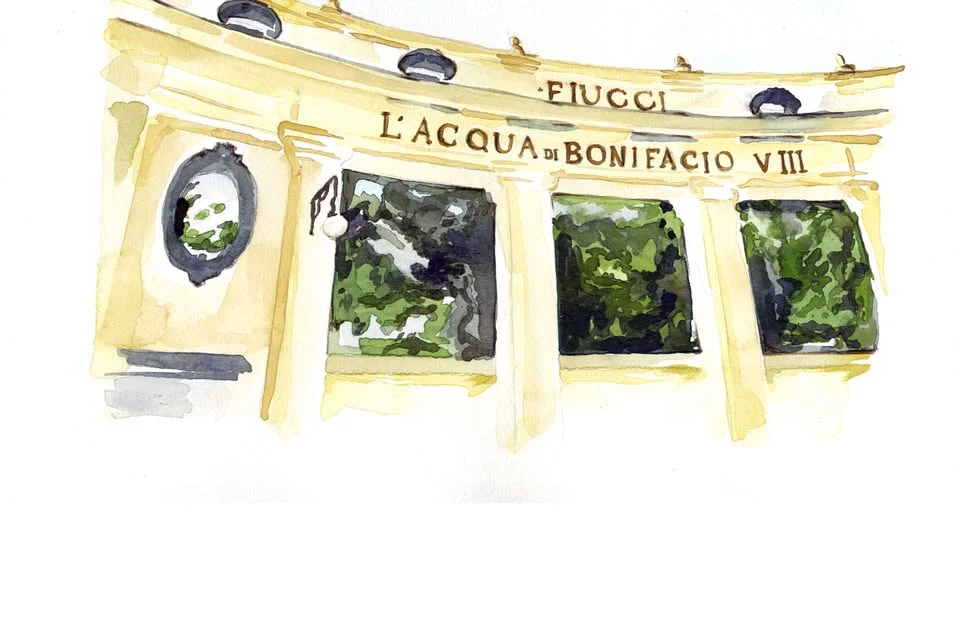
The Terme di Fiuggi are two separate hydropinic parks: the Fonte Bonifacio VIII at piazza Frascara 1 and the Fonte Anticolana at viale Fonte Anticolana 1, both in Fiuggi, in Frosinone Province. They are run by Acqua e Terme Fiuggi S.p.A., the same company that bottles the water, now controlled by the fund of Leonardo Maria Del Vecchio. You enter with a ticket at the cash desk, no booking needed, and the hydropinic cure is done with the family doctor's prescription.
Let's clear one thing up right away, because it is the misunderstanding that ruins the most trips. In Fiuggi you don't soak. There are no hot pools, no thermal swimming pools, no steaming sulfur water. The water of Fiuggi is cold, low in minerals, and you drink it. Whoever arrives with a swimsuit in the bag and the idea of the Bullicame is disappointed. Whoever arrives knowing that the terme here is a park with little fountains and a ritual of the glass finds what they are looking for.
Hours, addresses and practical information come from the official sources consulted on September 28, 2026: the operator's website, the pages of the DMO Alta Ciociaria and the other sources cited in the text. The operator publishes the hours but not the rates, and the seasonal calendar changes from year to year, with a delicate passage right at the beginning of October. Before setting out, phone the terme and have them confirm which fonte is open and at what time.
Where They Are and What the Two Fonti Are
Fiuggi has two separate souls, a couple of kilometers of downhill road apart. Up high the medieval village, the one we tell about in the page dedicated to Fiuggi. Down below the 20th-century spa town, made of hotels, avenues and villas, grown up around the springs. Both fonti are in the lower part, the one locals still call Fiuggi Fonte, and between one and the other it's a few minutes by car.
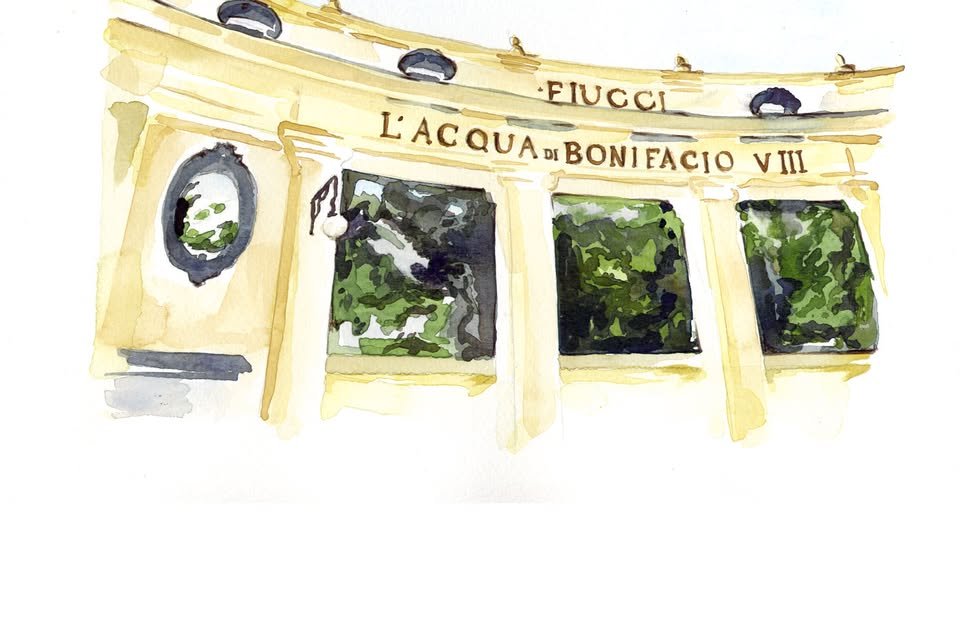
The Fonte Bonifacio VIII is the main establishment. The operator describes it as a modern architecture signed by Luigi Moretti, with curved volumes, open porticoes and essential lines, and places there the treatment paths, the hydropinic treatments, the inhalations and the consultations of the Centro Studi Calcolosi Urinaria. It is the place you go to drink the water at the serving points, walk under the porticoes and do the prescribed cure. Around it there is a park with tall trees and shaded avenues.
The Fonte Anticolana, which the operator also calls Fonte Nova, is a bigger and greener park. Sequoias, chestnut trees, small lakes, then the tennis courts, the minigolf, the play area for children, the dance floor, the walking trails and a panoramic little train. Since July 2026 it also hosts a tree adventure park. If the Bonifacio is the terme of the cure-takers, the Anticolana is the terme of families and long afternoons.
The water is the same, the spring is the same aquifer of the Monti Ernici. The context changes. At the Bonifacio you drink in an environment designed for the cure, with clinics and medical paths. At the Anticolana you drink between a round of minigolf and a walk under the sequoias. The ticket is separate and the hours too, in certain seasons, diverge. Whoever has only one day must choose, and further on we explain how.
A note on addresses, because you will run into three different ones. The operator gives piazza Frascara 1 for the Bonifacio. The DMO Alta Ciociaria places it in località Spelagato, which is the name of the area. Older guides report piazza Martiri di Nassirya. They are three ways of naming the same entrance. On your navigator search for Fonte Bonifacio VIII and forget the street: in town everyone knows it by that name.
A Curiosity About the Terme di Fiuggi
Fiuggi, as the name of a municipality, is a little over a century old. Until 1872 the town was called Anticoli, then Anticoli di Campagna, and only in 1911 did it take its current name, with a decree signed by Victor Emmanuel III in the same year in which the Fonte Bonifacio VIII was inaugurated. The town took the name of the locality of the springs. In practice an entire municipality renamed itself after its water.
The old name survives in the Fonte Anticolana and in the adjectives the elderly still use. The addition of Campagna, after Unification, served to distinguish it from other homonymous centers in Lazio, such as Anticoli Corrado in the Aniene valley. Whoever does archive research on Fiuggi before 1911 must look for Anticoli, otherwise they find nothing. It is a detail that many local history enthusiasts discover late and with effort.
The second curiosity concerns the rights to the water. According to local history, in 1425 Pope Martin V, Oddone Colonna, granted the community of Anticoli the free and perpetual use of the spring. The Colonna were lords of half of southern Lazio, and their trace in Rome can still be read in the Galleria Colonna. That privilege explains why still today residents have separate treatment at the entrance to the fonti and their own access to the water.
The third is commercial. Bottling begins in 1889 and the company is born in 1905, according to the operator's corporate account. In 2022 the Ministry of Enterprises recognized Acqua Fiuggi as a historic brand of national interest. The result is that almost all Italians have drunk this water at the table, and very few know that you can drink it at the source, spring-cold, in a park designed by one of the great Roman architects of the 20th century.
Something Nobody Tells You About the Terme di Fiuggi
Michelangelo's letter does not name Fiuggi. It is the sentence on which half the local marketing rests, and it has to be read in full. In 1549 Michelangelo writes to his nephew Lionardo that he has drunk for about two months, evening and morning, the water of a fountain 40 miles from Rome, "which breaks the stone." The document exists and is published in the collections of the correspondence. The name of the town, however, is not in the letter.
40 Roman miles make about 60 kilometers, and Fiuggi is at that distance from Rome. No other water in the area has the same fame against stones. The identification with Fiuggi is therefore reasonable, and it is the one accepted by everyone. But it is an identification, not a quotation. Whoever tells you that Michelangelo wrote the name of Fiuggi is reconstructing, and whoever tells you that Michelangelo came here to take the cure is making it up.
The letter does not say that the artist moved from Rome. It says that he drank the water for two months, evening and morning, and the most probable thing is that he had it brought to the city, as was already done for the popes. Michelangelo in 1549 was 74 years old and swamped by the building site of Saint Peter's. The image of the old sculptor strolling under the chestnut trees of Anticoli is nice, but no document supports it.
Why it matters. Because the promotional pages of half of Ciociaria, and even some serious guides, write that Michelangelo came to Fiuggi. It is not so. The water came to Michelangelo, and that is already extraordinary enough. If you want to see the Michelangelo of those years, in Rome you have the Capitoline Hill that he was redesigning right then, and the rest you will find in our guide Michelangelo in Rome.
Boniface VIII and Michelangelo: Documents, Tradition, Legend
Let's line up the three levels. First level, the documents. For Michelangelo there is the letter of 1549 to his nephew, a certain text, with the fountain 40 miles away that breaks the stone. For Boniface VIII local history cites expense registers of the Apostolic Camera, kept in a papal codex, with 187 entries of water transported between January 1299 and January 1303 by two muleteers, Orlanduccio and Ugone.
On those registers an honest clarification is needed. We know them through local historiography, which also reports the sum paid by the papal treasury, 663 gros tournois. Those who consulted them in the original have reported on them, and the figure comes out the same from one author to the next. The fact remains that these are transport accounts: they say the water traveled toward the pope, not why the pope wanted it.
Second level, tradition. Tradition says that Boniface VIII, Benedetto Caetani of Anagni, suffered from stones and drank this water for that reason. It also says that the pope had feudal rights over Anticoli, which is consistent with the power of the Caetani in the area. It is a solid, ancient tradition, taken up by the operator and by all the guides. But the medical diagnosis of a 13th-century pope remains a reconstruction after the fact.
Third level, legend. Here come the versions in which Michelangelo stays in Fiuggi, drinks at the spring and leaves cured, or those in which Boniface VIII discovers the spring in person during a hunting trip. None of these scenes has a document behind it. They are stories born when the 20th-century spa town needed illustrious ancestors, and found them. Go ahead and tell them to the children, knowing what they are.
The line to take is simple. Boniface VIII and Michelangelo drank water that almost certainly came from here. Neither of the two, as far as we know from the documents, left any trace of a stay. The pope had his palace in Anagni, today visitable as Palazzo Bonifacio VIII, half an hour away by road. The artist had Rome. The water, instead, moved on muleback.
My Advice for Visiting the Terme di Fiuggi
Go in the morning to the Bonifacio and in the afternoon to the Anticolana, if both are open. In the morning the Fonte Bonifacio is alive, with those taking the cure, the ritual of the glass and the lines at the serving points, and it is the moment when you understand what a hydropinic terme is. In the afternoon the Anticolana gives its best, with the shade of the sequoias and children who have room to run.
Phone ahead, always, and in this season even more. The operator publishes for both fonti the hours from 8 to 12 and from 15:30 to 19:30, every day. In past years, however, from October 1, the local press reported a change of hours at the Bonifacio and the closing of the Anticolana. The contact given by the DMO Alta Ciociaria is 0775 546401, the operator's email is info@acquafiuggi.eu.
Bring a glass of your own or buy the one they sell at the entrance, and don't drink it all in a hurry. The hydropinic cure, as the operator describes it, is a path with its own timing, and even those who come in just out of curiosity do well to sip while walking, as the cure-takers do. Half a liter drunk fast sends you looking for the restrooms, and the facilities at the fonti exist but are not around every corner.
If you have health problems, before drinking liters of a water that the operator presents as diuretic, ask your doctor. It is not bureaucratic caution. It is what the terme themselves put at the center of the real cure, which goes through the clinics and the prescription. Someone who enters as a visitor drinks a few glasses and runs no particular risks. Someone who wants to take the cure must do it with a doctor.
One last piece of advice concerns the day of the week. On Saturdays and Sundays of good weather the fonti fill up with Roman families and groups, and the Anticolana in particular changes face, with music, kids and lines at the adventure park. If you can, come on a Tuesday or Wednesday. You will find the regular cure-takers, the silence under the covered walkways and staff with time to answer your questions.
Hours, Tickets and Hydropinic Cure
The hours published by the operator are the same for the two fonti: Monday to Sunday from 8 to 12 and from 15:30 to 19:30. The operator does not state on the website seasonal opening and closing dates, nor the rates for daily admission, subscriptions or reductions. The figures circulating on hotel sites and magazines belong to different seasons and the sources do not agree. The price has to be asked at the cash desk or by phone.
The ticket is bought at the entrance of the fonti. The official reference channel is the page Terme di Fiuggi on the Acqua Fiuggi website, with hours and addresses, and the local press reported in the spring of 2026 the introduction of an electronic ticket office. There is no dedicated product for entry to the fonti on the big booking portals, and none is needed: be wary of anyone selling you priority access to a park where there is no line.
The hydropinic cure proper is something else compared to admission. According to the DMO Alta Ciociaria it is among the services recognized by the National Health Service for urinary tract stones, and it is activated with the family doctor's prescription on the public service prescription pad. The amount of the ticket and the exemptions follow the national rules on spa treatments: ask your doctor or the clinics of the Fonte Bonifacio before leaving.
Residents have their own conditions, a legacy of an ancient privilege on the use of the water, and for them too the arrangements have to be asked of the operator. For organized groups the best thing is to write in advance to info@acquafiuggi.eu stating date, number of people and fonte. The operator does not publish a group rate, so any figure that reaches you from an agency has to be verified with the terme.
The adventure park of the Anticolana has a separate ticket, sold by whoever runs it and not included in the entrance to the fonte. The press that followed the opening of July 2026 reports routes for children and adults with prices that differ by duration. Here too, before promising your kids the day in the trees, ask whether the park is open on the day you chose, because it depends on the season and the weather.
What the Operator Declares About the Water
The operator presents the water as light and pure, born in the woods of the Monti Ernici, with purifying qualities. The DMO Alta Ciociaria, on the page dedicated to Acqua e Terme Fiuggi, describes it as low in minerals, poor in calcium and sodium, with diuretic properties that would favor kidney function and the elimination of uric acid. These words are declarations by those who run and promote the water, not guaranteed medical facts.
What can be said without stretching is that the hydropinic cure of Fiuggi has a public recognition for a precise condition, urinary tract stones, and that the terme provide it through a medical path and a dedicated study center. All the rest, from generic purification to seasonal well-being, belongs to the language of promotion. Telling the two apart is the best way to respect this water.
The contraindications are not published on the operator's terme page. This does not mean there are none: a cure that increases diuresis should be assessed by a doctor, above all for those with heart or kidney problems or who take drugs that act on fluids. The clinics of the Fonte Bonifacio exist precisely for this, and before starting a cure of several days have a medical visit.
One last technical observation. The water comes out cold, at a mountain spring temperature, and has nothing of the smell and color of the sulfur waters of the Viterbo area. It is water that tastes of little, and that is exactly what those who drink it for the cure look for. Whoever expects a particular taste is surprised by its neutrality, and children drink it willingly.
Another Well-Known Fact, Yet Rarely Cited
The Fonte Bonifacio VIII you see today is a work by Luigi Moretti, the Roman architect of the Girasole on viale Bruno Buozzi and of the Casa delle Armi at the Foro Italico. From 1965, in collaboration with the company Condotte, Moretti designed and carried out the new arrangement of the establishment, completed in the late 1960s. Architects know it, the operator writes it, and almost no visitor looks up to notice.
Before Moretti the Fonte was an Art Nouveau complex, like the rest of the spa town of the early century. The Palazzo della Fonte, the grand hotel inaugurated in 1913 to a design by Garibaldi Burba, still gives the idea of that taste. Moretti replaced the old structures with curved roofs and open porticoes that follow the terrain, and the result is one of the few great public spaces of Italian modernism designed for standing still and drinking.
Moretti died in 1973, a few years after closing the Fiuggi building site. In Rome you meet him everywhere without knowing it: the Olympic Village of 1960, the parking garage under Villa Borghese, the buildings of the Foro Italico. Whoever knows those works recognizes in Fiuggi the same way of bending concrete into soft curves. For a lover of 20th-century architecture, the Bonifacio is worth the trip regardless of the water.
The rarely cited fact is that this play of roofs has a practical function. The porticoes served to shelter thousands of cure-takers from sun and rain while they drank and walked, because the hydropinic cure is done in motion. The Touring Club speaks of hundreds of little fountains and a capacity of tens of thousands of people. Today those numbers seem exaggerated, but they tell the story of the Fiuggi of the boom years.
A Morning at the Fonte Bonifacio, Step by Step
Arrive around nine, when the earliest cure-takers have already done the first round and the serving points are in full activity. The parking around the entrance at that hour can be found. At the cash desk ask right away the price and whether the fonte closes at noon as in the published hours, because the midday breaks are rigid and at 12 the staff starts to usher people out without much ceremony.
Inside, before drinking, take a full tour under the roofs. It serves to get your bearings, to understand where the serving points, the restrooms, the bar and the clinics are, and above all to look at the architecture calmly, before the bladder dictates the rhythm of the visit. Whoever starts from the glass spends the morning between fountain and bathroom and of Moretti's work sees only the floors. Half an hour of initial walking changes the day.
Then drink, one glass at a time, walking between one serving point and the next. It is what everyone you see around does, and it is the way the fonte was designed: the covered path serves precisely to keep people moving. Observe the regular cure-takers, with the graduated glass and the watch. They are the local experts, and if you ask politely they will gladly tell you how the day works.
Around half past 11, leave and go up to the upper village for lunch, or go down toward Anagni. Whoever stays in Fiuggi can go back to the Anticolana at half past three, when it reopens, and close the afternoon under the sequoias. In a well-built day you see both fonti without hurry, as long as you don't waste time in the midday break, which is long and has to be filled elsewhere.
A practical detail few consider. Fiuggi is in the hills, on the Monti Ernici, and the morning temperature is noticeably lower than in Rome, even in summer. Under Moretti's roofs, in the shade and with the air circulating, at nine on a June day you're comfortable with a light sweatshirt. In spring and autumn, with an overcast sky, you need a real jacket.
The Fonte Anticolana and the Adventure Park
The Fonte Anticolana was born after the Bonifacio, and on the precise date the sources do not agree. The DMO Alta Ciociaria speaks of an inauguration in the early 1920s, local history dates the discovery of the spring to 1921 in località Pantano, the Touring Club indicates the 1930s. It is likely that they are speaking of different moments, between discovery, capture and opening to the public. For the visitor little changes, for whoever writes history it changes a lot.
Today the Anticolana is the largest and best equipped park. The operator lists sequoias, chestnut trees, small lakes, tennis, minigolf, play area, dance floor, trekking and panoramic little train. Our page on the municipality gives it 14 hectares. The Touring Club also mentions the Teatro delle Fonti, the space that over the years has hosted shows and summer concerts. It is the part of the terme where you spend an afternoon without looking at the clock.
On July 22, 2026 an adventure park was inaugurated inside the Anticolana, built by the operator with a specialized company and entrusted to certified instructors. Suspended walkways, Tibetan bridges, pulleys, routes of different difficulty. It is part of the relaunch plan started in 2024 by the new ownership, which in the first half of 2026 also carried out maintenance works on both structures. For families it is the strongest new argument.
On summer events the operator does not publish a program on its website. In past summers the fonti hosted concerts, dance evenings and festivals, but the 2026 program of Fiuggi, from what emerges from the sources consulted, was concentrated in the municipal theater and the squares of the town. If you want to know whether there is a concert at the Fonte Bonifacio or the Anticolana on the date you are interested in, ask the operator and check the Comune's calendar.
For those coming from Rome there is a useful comparison. The Baths of Caracalla and of Diocletian tell the story of the public bath as a social fact, with pools, gyms and libraries. Fiuggi tells another idea, that of the 20th century, where the cure is a slow walk with a glass in hand. Seeing both things, a few days apart, helps to understand how much the relationship of Italians with water has changed.
The Right Photo to Take at the Terme di Fiuggi
The right photo is taken under Moretti's roofs, looking up. Stand where the portico curves and shoot the line of the concrete bending against the sky, with the trees of the park entering from the edge of the frame. It is the photograph that tells this place better than any little fountain, because it shows the thing nobody expects to find in a provincial terme: architecture of international level.
The second framing is the gesture, not the place. A hand filling the glass at the serving point, the water falling, people in line with the graduated glass. It works in black and white, it works in the morning when the light enters sideways under the porticoes. Ask permission if you frame recognizable people: many cure-takers are elderly, and not all of them like ending up on social media while they take the cure.
At the Anticolana the photo is under the sequoias. Shoot from below the straight trunks with a person at the foot to give scale, or the small lake with the reflections of the trees in the late afternoon. Avoid the frontal framing of the games and equipment: they are useful but photographically say nothing. The adventure park, if you photograph it, works better with kids suspended between one tree and the next seen from afar.
A technical tip. Under the roofs the difference in light between the shade and the open sky is strong, and the automatic modes burn the sky or blacken the concrete. Meter the light on the pale concrete, not on the sky, and accept that the background is bright. The overcast days, which in Fiuggi in spring and autumn are frequent, give a soft light perfect for Moretti's curves.
How to Get There from Rome
By bus you leave from the Anagnina terminal, the end of Metro Line A. The Cotral intercity runs connect Rome to Fiuggi, some direct by motorway and others with a longer route through the towns. The trip stated in the directions for a congress hosted in Fiuggi in 2025 is about an hour and a half. The day's schedules are checked on the timetable search of the Cotral website.
By train you go from Roma Termini to the Anagni-Fiuggi station, on the line to Cassino. The station is in the municipality of Anagni, about 8 kilometers from the historic center and even farther from Fiuggi. The train takes from a little over half an hour to an hour depending on the type of run, then you need a bus from the station forecourt toward Fiuggi, about half an hour. Connections are not guaranteed: check them before leaving.
By car you take the A1 motorway toward Naples and exit at Anagni-Fiuggi, then follow the expressway to the town. It is about 75 kilometers and an hour of travel from the center of Rome without traffic. It is the most comfortable solution if you want to see both fonti and maybe combine Anagni or the Certosa di Trisulti. In Fiuggi Fonte parking, outside peak weekends, is not a problem.
Whoever thinks of arriving by train all the way to Fiuggi must know that this railway no longer exists. The narrow-gauge line Rome-Fiuggi-Alatri-Frosinone entered service in 1916 and was closed on December 27, 1983 after a landslide, while the urban stretch between Fiuggi Fonte and Fiuggi Città had already been suppressed in 1960. The old station houses can still be seen along the road, and they are a piece of the history of Roman holidaymaking.
Between the two fonti and the upper village it is best to get around by car or with the urban service, if active. On foot from the Bonifacio to the Anticolana you can get there, but they are busy avenues and not always with a sidewalk. Going up on foot to the historic center from the lower part is a real walk, uphill, which in the July heat I advise against for those who are not trained. The village should be seen, but arriving without effort.
Some Important Events That Happened Here in History
Between 1299 and 1303, according to the expense registers cited by local history, the water of the Anticoli spring is transported regularly for Boniface VIII. It is the first documented use of the fonte as cure water, and it coincides with the tensest years of the pontificate, up to the slap of Anagni in September 1303, when the men of the king of France assaulted the pope in his palace. Boniface died in Rome a month later.
In 1425 Martin V recognizes the community of Anticoli's free use of the water, according to local tradition. In 1549 Michelangelo writes to his nephew about the fountain that breaks the stone. In 1889 bottling begins, in 1905 the company is born. These are the steps that turn a village spring into a national product, a century before the town itself takes the name of its water.
1911 is the key year. The Fonte Bonifacio VIII is inaugurated and the municipality becomes Fiuggi. Two years later the Palazzo della Fonte opens, an Art Nouveau grand hotel frequented by the court and the government. According to local tradition, taken up by many guides, Giovanni Giolitti signed there acts tied to the war with Turkey of 1911, and in 1914 the declaration of Italian neutrality left from that hotel. On the precise circumstances the sources do not agree.
In 1916 the railway from Rome arrives, in 1928 the golf course opens, today among the oldest in Italy with its 18 holes. After the Second World War the season of the grand hotels closes and that of mass spa tourism begins, with thousands of cure-takers on the national health plan. It is in this climate that in the 1960s Luigi Moretti redesigns the Fonte Bonifacio, thinking of crowds that no longer exist.
The latest years are corporate history. In 2023 the Comune transfers the business unit to a company of local entrepreneurs, and in June 2024 the fund LMDV Capital of Leonardo Maria Del Vecchio acquires 71.17 percent of Acqua e Terme Fiuggi, with the Comune keeping a 5 percent share. The new bottling plant, the maintenance of the fonti and, in July 2026, the adventure park follow.
Finally there is a date that concerns those who come today. In the spring of 2026 the local press reported maintenance works on both fonti and the arrival of the electronic ticket office, within the relaunch plan of the new ownership. Whoever saw the fonti 10 years ago and remembers them as neglected will find something different. Not everything is finished, but the direction is that of a site that is being cared for again.
Who Has Passed Through the Terme di Fiuggi
Boniface VIII, Benedetto Caetani, pope from 1294 to 1303, the pontiff of the bull Unam Sanctam and of the first Jubilee in history. He gave the fonte its name, and more than passing through it he had it pass, on muleback, toward his palaces. His Anagni can be visited in a morning, with the palace, the cathedral and the Anagni Cathedral Museum, where objects tied to his pontificate are kept.
Michelangelo Buonarroti, who in all likelihood never set foot in Fiuggi but drank its water for two months. The years of the letter are those of the Cappella Paolina and of the Saint Peter's building site. Whoever wants to put together the late Michelangelo can start from the Moses in San Pietro in Vincoli and from the Last Judgment in the Sistine Chapel, which he had finished a few years earlier.
Martin V, Oddone Colonna, the pope who in 1417 closed the Western Schism and brought the papacy back to Rome for good. Local tradition attributes to him the privilege on the water granted to the inhabitants of Anticoli. From Palazzo Colonna to the fiefs of southern Lazio, his family drew the territory you cross to get here, from Genazzano to Palestrina.
Giovanni Giolitti and Victor Emmanuel III, the illustrious guests of Art Nouveau Fiuggi. The first was a regular visitor, the second signed in 1911 the decree that gave the town its current name. With them came ministers, diplomats and a part of good Roman society, which in summer moved here for the cure. The lower town, with its villas and wide avenues, is built to measure for that public.
Luigi Moretti, who left in Fiuggi one of his last works. And finally, in recent times, Leonardo Maria Del Vecchio, now president of the company according to the operator's website, with his relaunch bet. Nobody can say now how it will end, but for the first time in decades the fonti see investments and works instead of closures. For those who know the tired Fiuggi of the 2000s, it is an evident change of climate.
When They Are Closed and What Not to Expect
The seasonal calendar is not published by the operator, and this is the weak point of the terme's communication. The local press announced in 2026 the seasonal opening of the Fonte Bonifacio on April 1, and in previous years the closing of the Anticolana on October 1, with reduced hours at the Bonifacio in the cold months. If you go in autumn or winter, take for granted that at least one of the two fonti is closed, and phone.
Now our contrarian position. The Terme di Fiuggi are overrated as a wellness destination and underrated as an architecture destination. Whoever comes looking for a day at the terme in the modern sense, with pools and hydromassage, gets the wrong place and goes home unhappy. Whoever comes for Moretti's park, the history of the popes and a glass of cold water at the spring finds one of the most unusual days in Lazio.
Don't expect a spa. There are no pools, no hot baths, no mud. The operator lists inhalations and treatments tied to the cure, but not a wellness center open to the passing visitor. Whoever looks for hot water must go to the Viterbo area or to Tivoli. Whoever looks for the silence of the great spa parks of the early century, instead, finds it here, above all on weekdays.
Don't expect the crowds of the golden years either. Many of the hotels of Fiuggi Fonte are closed or underused, and outside of August and weekends the lower town has a suspended air. For some it brings melancholy, I like it. It is the best moment to understand what Italian spa holidaymaking was, before the relaunch under way changes the landscape again.
Last warning on accessibility. The Fonte Bonifacio, according to the description of a hotel in the area that lists its services, has elevators and moving walkways between levels, a sign of the era when cure-takers were thousands and often elderly. The operator does not however publish an updated accessibility sheet. If you move in a wheelchair, make a phone call before leaving and ask which routes are practicable on the day of the visit.
Eating in the Area
Fiuggi is a city of hotels, and this weighs on the whole restaurant offer. For decades those who came for the cure ate on full board, and the restaurants open to the public grew in a logic different from that of the neighboring towns. You eat well, but you have to know how to choose, and some signals count here as in Rome. Here they are, without naming names, because names change and signals remain.
First signal: the menu with photographs of the dishes, laminated, translated into several languages. A place that needs to show the image of the fettuccine is speaking to a passing public, not to those who live here. Second signal: the lady rolling out the pasta in the window or on the street. It is scenery to stop the passerby, not proof of quality. Serious fresh pasta is made in the kitchen, in the morning, away from the dust.
Third signal: someone at the door inviting you in. A place that has to stop customers in the street usually has no regulars. Fourth: the kitchen open without a break from morning to night, because a real kitchen crew takes a pause. Fifth: the places in front of the points of greatest passage with items without prices, fish of the day by undeclared weight, or a different menu between the dining room and the outside tables.
Romans and Ciociari don't go there, and not out of snobbery. The customers who go are those with no other reference, and those places are designed for them. The criterion is to look at who is seated on a weekday: if there are local families, office workers, laborers, the kitchen holds up. If there are only visitors with a map in hand, it is not a condemnation, it is information.
The cooking of the area is that of mountain Ciociaria, with homemade pasta, legumes, cheeses, grilled meats and the Cesanese wines on the road toward Piglio. Many trattorias in the nearby towns open only on weekends and at tight hours, so phone ahead. So you don't have to go by trial and error, I keep updated our list of the places where we eat.
What to Combine in a Day
The natural pairing is Anagni, about half an hour away by road. In the morning at the Fonte Bonifacio, in the afternoon among the cathedral, the pope's palace and the Arcazzi di Piscina. The circle closes: the water that traveled toward the pope and the palace where the pope drank it. For a group it is the perfect day, with the history holding together without forcing.
Whoever prefers the mountains can go up toward the Certosa di Trisulti and Collepardo, with its karst sinkholes, or toward Guarcino and Vico nel Lazio with its intact town wall. Higher still there are Trevi nel Lazio, la Portella and Filettino, at the sources of the Aniene.
On the abbey side the choice is wide: Casamari Abbey and Veroli are less than an hour away. For archaeology there are the Cyclopean walls of Alatri, the Roman Theater of Ferentino and the fortress of Fumone. They are all half days that pair well with a morning at the fonti.
Whoever comes from Rome and wants to break the trip eastward finds on the road Piglio with its wineries, then Arcinazzo Romano with the Villa of Trajan, and farther on Subiaco with the Sacro Speco. It is a longer loop, suited to those who sleep a night in the area and are in no hurry to get back.
Fiuggi and the Other Thermal Baths of Lazio
Fiuggi is the exception in the thermal landscape of Lazio, because here the water is drunk and you don't soak in it. In the Viterbo area things work the other way around: hot sulfur waters, pools and basins. The Terme dei Papi and the Bullicame are the other way of understanding the terme, with another papal story behind them, and the Terme del Bagnaccio are the more spartan version, with a reduced ticket.
On the coast and toward the Tolfa Mountains there are the Terme Taurine and the Ficoncella of Civitavecchia, the Terme di Stigliano and farther northeast, in Sabina, the Terme di Cretone. Near Rome remain the Acque Albule of Tivoli. Whoever wants hot water chooses among these. Whoever wants the cure you drink comes to Fiuggi.
The comparison helps you choose the right day. In winter the hot terme of the Viterbo area give their best, while Fiuggi risks finding you with a fonte closed. From May to September Fiuggi works fully, with the Anticolana open and the cool of the hill making the difference compared to the plain. For a Roman escaping the July sultriness, it is a concrete argument.
Frequently Asked Questions
Can you swim at the Terme di Fiuggi?
No. The Terme di Fiuggi are hydropinic terme: the water is drunk at the serving points of the two parks, the Fonte Bonifacio VIII and the Fonte Anticolana, and there are no pools or thermal basins open to visitors. The water comes out cold. Whoever looks for hot baths must turn to the terme of the Viterbo area, such as the Bullicame or the Terme dei Papi, or to the Acque Albule of Tivoli.
What are the opening hours of the fonti?
The operator, Acqua e Terme Fiuggi, publishes for both fonti the hours from 8 to 12 and from 15:30 to 19:30, Monday to Sunday. The seasonal calendar is not published on the website and in past years hours and openings have changed from October. Before leaving it is a good idea to ask for confirmation at 0775 546401 or write to info@acquafiuggi.eu.
How much does admission to the Fonte Bonifacio VIII cost?
The operator does not publish the rates on its website, and the figures circulating in magazines and hotel sites belong to different seasons and do not agree with each other. The price of daily admission, subscriptions and reductions has to be asked at the cash desk or by phone to the terme. Residents have separate conditions, and the adventure park also has its own ticket.
How do you take the hydropinic cure with the National Health Service?
According to the DMO Alta Ciociaria the hydropinic cure of Fiuggi is among the services recognized for urinary tract stones. You need the family doctor's prescription on the public service prescription pad, to present to the clinics of the Fonte Bonifacio. Ticket and exemptions follow the national rules on spa treatments, so ask your doctor for the details before leaving.
Did Michelangelo really come to Fiuggi?
No document says so. The letter of 1549 to his nephew Lionardo speaks of a water drunk for two months, evening and morning, from a fountain 40 miles from Rome that breaks the stone, without naming the town. The identification with Fiuggi is reasonable and shared. The artist's stay at the spring, instead, belongs to stories born later.
Who runs the terme today?
The fonti are run by Acqua e Terme Fiuggi S.p.A., the company that bottles the water. Since June 2024 the majority, 71.17 percent, belongs to the fund LMDV Capital of Leonardo Maria Del Vecchio, and the Comune of Fiuggi keeps a 5 percent share. The same company also runs the town's historic golf course, opened in 1928.
How do you get there from Rome without a car?
From the Anagnina terminal, the end of Metro Line A, the Cotral intercity runs to Fiuggi leave, with a trip of about an hour and a half. Alternatively you take the train from Roma Termini to the Anagni-Fiuggi station and from there a bus to Fiuggi, about half an hour. Updated schedules are checked on the Cotral website.
Are the terme suitable for children?
The Fonte Anticolana yes, more than the Bonifacio. The park has a play area, minigolf, small lakes, a panoramic little train and since July 2026 a tree adventure park with routes for different ages and a separate ticket. The Fonte Bonifacio is more suited to adults who take the cure or who come for the architecture of Luigi Moretti and the history of the spring.
Who Wrote This Page
This page comes from the editorial team of Tour Leader Pro, the Roman outfit that designs itineraries, visits and cultural events between Rome and Lazio. Hours, addresses and access arrangements reported here come from the official sources cited in the text as of the date given at the opening. The terme change calendar with the seasons and the operator does not publish the rates: phone before leaving and tell us what you find changed.
Putting together a day in Ciociaria means fitting together fonti that open and close according to the season, intercity buses that thin out on holidays, abbeys with prayer hours, mountain villages connected by narrow roads and trattorias that open only on Saturday, for yourself or for a group of 40 people. Whoever faces this kind of puzzle finds on Tour Leader Pro working materials designed for those who guide and for those who organize on their own.
For the wide picture, that is regional trains and seasonal schedules, rentals, airports, moves between one province and another and destinations in Lazio outside the center of Rome, from Ciociaria to the volcanic lakes of the north to the Tyrrhenian coast and the villages of the interior, a useful resource for putting together a multi-day itinerary is Italy Planner.