Santa Rosalia Chapel – Palazzo Barberini Colonna
In short. The Santa Rosalia Chapel is at Via Barberini 30, in Palestrina, in Rome Province, built against the side of Palazzo Colonna Barberini, which dominates the historic center from the height of the terraces of the Sanctuary of Fortuna Primigenia.
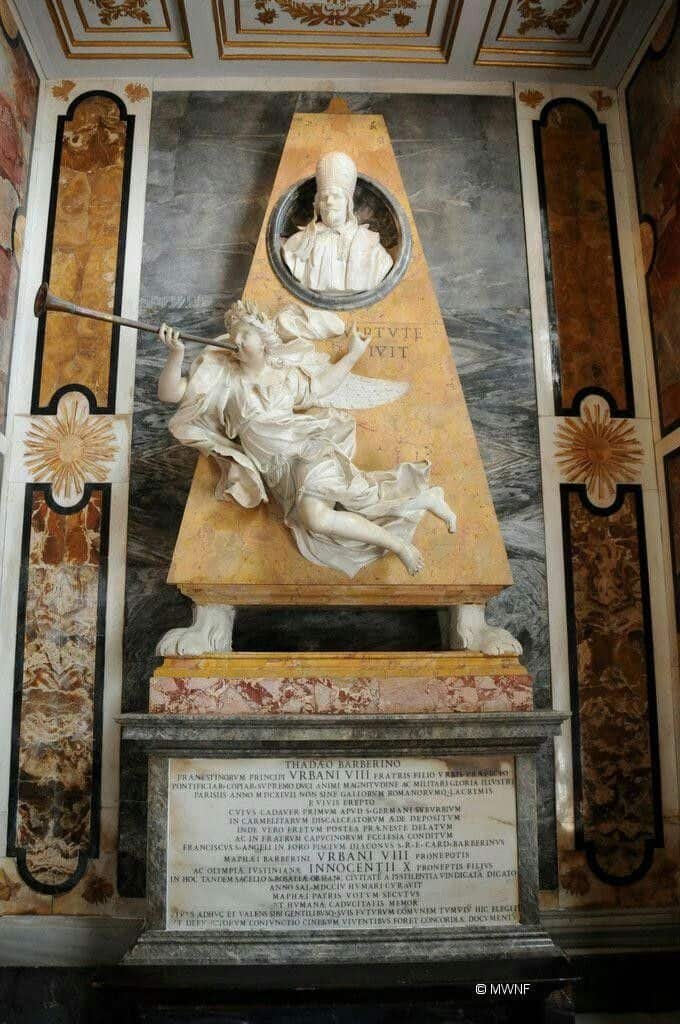
The Santa Rosalia Chapel is at Via Barberini 30, in Palestrina, in Rome Province, built against the side of Palazzo Colonna Barberini, which dominates the historic center from the height of the terraces of the Sanctuary of Fortuna Primigenia. It isn't a parish church and it isn't a museum: it's the palatine chapel of the Barberini princes, that is, a family's private church, and this explains everything there is to know about its appearance, its history and above all how you visit it. It has no hours posted on the door, no ticket seller, and you don't get in by happening to pass by. You get there by reservation, as part of the guided visits the owners organize in the private apartments of the palace, or during the extraordinary openings that now and then put it on the calendar. I ask you to keep that in mind from the first line, because it's the thing that ruins the most outings: you climb up to Palestrina convinced you'll find an open door and you find a closed gate.
That said, and with the uncomfortable part out of the way, here's why it's worth the effort of getting organized. Palestrina is 37 kilometers from Rome along Via Prenestina, a bit under an hour by road, and inside that palace there are two things you don't expect: a Hellenistic sanctuary of the 2nd century BC that literally holds up the foundations of the building, and a small Roman Baroque interior of polychrome marbles and stuccoes that seems torn from a church in the center of Rome and transplanted here, in the provinces, with all its arrogance. The Santa Rosalia Chapel is that second piece. In a few square meters you find a plague vow, the mausoleum of a dynasty that governed the Church for 20 years, the signature of an architect who worked for the popes and a sculpture that for two centuries passed for a Michelangelo. Not bad for a family chapel in a town of 22,000 inhabitants.
Where the Santa Rosalia Chapel is and how to get there
The exact address is Via Barberini 30, 00036 Palestrina (RM). We're in the upper part of the historic center, the part the people of Palestrina call simply "up at the palace," because the whole town climbs in steps up the flank of Monte Ginestro and the palace sits at the top, where the houses end and the sky begins. The chapel is wedged into the body of the building on the right as you face the palace's main façade, and from outside you notice little: its architecture stays sober outside and unloads all its effect inside, following an unwritten rule of Roman Baroque that holds for half the Eternal City. Access to the private part of the complex, the part where the family still lives and where the chapel is, normally happens from the ramp of Via dei Merli, which climbs to the prince's garden.
By car from Rome to the Santa Rosalia Chapel
The simplest road is the Prenestina, State Road 155, which takes you from Rome to Palestrina in 37 kilometers of curves, gentle at first and then decisive. Alternatively, take the A24 Rome-L'Aquila motorway and exit at Tivoli, or the A1 Rome-Naples exiting at San Cesareo or Valmontone. They are all solutions of a little under an hour, with the enormous variable of Roman outbound traffic: leaving at 8:30 on a Thursday morning and leaving at 7:30 the same Thursday are two different experiences, and the second costs you 40 more minutes. The obvious but true advice is to get moving early.
Parking in Palestrina is a less dramatic issue than feared. The municipality lists eight parking areas, with free spaces at Piazzale Kennedy, Piazza della Pace and Piazzale Belvedere, and paid spaces in Piazza Italia and in three other squares in the center. The point is that the palace is up high and the convenient parking is down low: count on a walk uphill of 10 to 15 minutes with real slopes, or drive up as far as the signs allow and accept that the spaces up there are few. With the wrong shoes that climb is felt, and some people give up halfway.
By public transport to Palestrina
The road link is handled by Cotral buses, which leave from the Roma Anagnina terminus, the end of Metro Line A. It's the most direct solution for those without a car: you get off the metro, board the coach, and you arrive in Palestrina in a good hour depending on traffic on the Casilina. Alternatively there's the rail route, with the regional line Roma Termini-Zagarolo, but from Zagarolo station you then have to take a bus up to Palestrina, and the connection isn't always generous. If you have a timed reservation for the visit, and with this chapel you almost certainly will, allow plenty of margin: arriving 20 minutes early and having a coffee is much better than arriving five minutes late and finding the group already inside.
What you actually visit at the Santa Rosalia Chapel - Palazzo Barberini Colonna
Here a clarification worth its weight in gold is needed, because the full name of the place, Santa Rosalia Chapel - Palazzo Barberini Colonna, holds together two things that in practice have different rules. Palazzo Colonna Barberini is today divided in two. One part is public: it houses the Prenestino National Archaeological Museum, has belonged to the State since 1956 and is visited with an ordinary ticket like any state museum. The other part is private: it's the residence of the Barberini family, includes the historic apartments, the garden, the nymphaeum and the Santa Rosalia chapel itself, and is visited only through guided visits by reservation, paid, organized by the owners.
It means that the archaeological museum ticket doesn't open the chapel for you, and that the chapel visit doesn't include the museum. They are two separate routes, with two separate ticketings, inside the same building. It's a situation that generates an impressive number of misunderstandings, and up here the first thing to clear up is exactly this. If you want to see both, and it's strongly recommended because together they tell 2,200 years of stratification in one go, you have to arrange two distinct entries on the same day, asking the owners when a guided visit is available and fitting the museum in before or after.
Why the Santa Rosalia Chapel has no public hours
The reason is simple and I even find it endearing: because it's still a family chapel. It was never deconsecrated or turned into state property, it has remained the private mausoleum of the princes of Palestrina, and its door is somebody's front door. Prince Benedetto Barberini opens the private rooms for guided visits, and on those occasions the chapel enters the route. Outside those windows there are no continuous hours, because there would be nobody to stand guard and no reason to keep it open. You find online generic hours that have circulated for years, usually a broad band like 9:00 to 19:00: don't trust them and don't set out on that basis. Write or call first.
The extraordinary occasions to get in
Besides the visits by reservation there are the big national events, which remain the simplest and cheapest way to set foot in here. The European Heritage Days have several times put on the calendar evening openings dedicated to the splendors of Palazzo Colonna Barberini, with routes among the frescoes and the collections. The Fondo Ambiente Italiano has organized excursions that combine in a single day the Sanctuary of Fortuna Primigenia, the museum, the prince's private apartments and the church of Santa Rosalia, described in the program, with a summary I share, as a small Baroque jewel. These are limited-capacity days and should be booked as soon as they come out, because the places run out in a few hours.
The 1656 plague and the vow that gave rise to the Santa Rosalia Chapel
Every Baroque church is born from an occasion, and the occasion for this one was fear. In the spring of 1656 the plague moved up from Naples toward the Papal States and in a few months entered Rome. It was a fast and ferocious epidemic, which struck with particular cruelty the densest neighborhoods, Trastevere and the ghetto, and which paralyzed the life of the city for more than a year. Pope Alexander VII, who had just taken the throne, reacted with a health machinery that today we would call an emergency protocol: sanitary cordons at the gates, lazarettos on the Tiber Island and outside the walls, control of goods, bans on gatherings, health certificates for those who traveled. On July 21, 1656 he proclaimed an extraordinary jubilee against the contagion, because in the 17th century the response to an epidemic was both administrative and religious, and nobody saw a contradiction between the two.
The contagion pushed into Lazio, along the consular roads and the commercial junctions. Palestrina, which lay on the Prenestina a few hours' walk from Rome, was exposed. The town organized itself, closed up, counted its dead, and came out with much less damage than feared. From this gap between the expected disaster and the actual disaster came gratitude, and from gratitude came the chapel. Maffeo Barberini, second prince of Palestrina, decided to erect a church as a thank-you offering for the intercession of the saint who had protected his town. The construction site started in 1656, that is, in the very year of the epidemic, and the consecration came in 1660.
What a plague vow really meant
It's worth explaining this word well, because the modern tourist reads it as a generic devotional gesture and it isn't. The vow was a contract. It had a precise legal structure, often registered by a notary, with one party who committed to build, endow and maintain a sacred building, and a heavenly counterparty from whom a specific intervention was requested. Whoever made the vow wasn't expressing a feeling: they were signing an obligation, and breaking the vow was considered a serious risk. Italian votive churches, from the Salute in Venice on down, are all children of this mechanism, and the Santa Rosalia Chapel belongs to exactly the same family, on a princely scale instead of a state one.
There is also a political aspect it would be hypocritical not to name. A prince who builds a votive church after an epidemic is saying something very precise to his town: I was here, I asked on your behalf, I'm paying. It's an act of gratitude and at the same time an act of government, a way to reaffirm the bond between the family and the fief at a moment when that bond had been put to the test. The Barberini, as we'll see shortly, had just gone through a political crisis that had almost wiped them out. The chapel arrives at the moment of the return, and it is also a declaration of regained stability.
The dates that wobble and why
If you look for information on this church you'll find two different completion dates, and it's worth clarifying them. Local sources and the municipality indicate a construction site between 1656 and 1660 with consecration in 1660. Other sources, including the biographical ones on the architect, move the inauguration to 1677. They aren't in contradiction as it seems: in the 17th century a church was blessed and opened for worship even long before it was finished, and the finishing works, the marbles, the stuccoes, the altars and the tombs could continue for decades. Here, as we'll see, the two main funerary monuments arrive in 1704, 48 years after the laying of the first stone. The construction of a noble chapel isn't an event, it's a process as long as a life.
Why a Palermo saint: Rosalia, the Barberini and Urban VIII
Standing in front of the altar the question is always the same: what is a Sicilian saint doing on top of a mountain in Lazio? It's an excellent question, because the answer tells how cults worked in 17th-century Catholic Europe. Rosalia wasn't a local saint, had never been to Palestrina, had no connection with the Prenestina. She was, however, at that precise historical moment, the most effective anti-plague brand on the European devotional market, and the Barberini had in effect launched her themselves.
The 1624 discovery on Monte Pellegrino
The story begins in Palermo. In 1624 the city was overwhelmed by the plague. An embroiderer, Girolama La Gattuta, said that in a dream she had seen a young hermit appear who showed her the exact spot to dig, on Monte Pellegrino, the promontory that closes the Conca d'Oro to the north of the city. On July 15, 1624, in a cave of that mountain, bone remains embedded in a mass of calcareous concretion were found. Cardinal Archbishop Giannettino Doria summoned six doctors to verify the authenticity of the remains, had them recognized as the remains of Rosalia, the noble hermit who lived in the 12th century, and organized a solemn procession through the streets of the city. The chronicle of the time notes that after that procession the epidemic ceased.
From that moment Rosalia becomes the Santuzza, patron of Palermo, and her cult spreads with a speed we would now call viral. Pope Urban VIII, that is, Maffeo Barberini, entered her in the Roman Martyrology in 1630, giving her in effect the universal recognition that turned her from a Sicilian devotion into the anti-plague patron of all Christendom. I add, for historical honesty, that the affair also had a long scientific tail: in the 19th century the English geologist William Buckland maintained that those bones were from a goat, and an examination conducted in 1987 established instead that they belonged to a human individual of the female sex. The debate on the identification remains open, the history of the cult does not.
The family's account with the saint
Here is the point that makes this chapel different from a thousand other anti-plague churches. The Barberini didn't choose Rosalia at random among the available saints: they chose the saint their pope had canonically promoted 30 years earlier. When in 1656 the plague returns and threatens Palestrina, Prince Maffeo, who bears the name of his great-uncle the pontiff, turns to the family's saint. It's a devout gesture and a dynastic one at once, a way of saying that the protection Urban VIII had extended to Christendom now returned, like a favor, upon the family's town. Building a church to Rosalia in Lazio in 1656 meant claiming a line of continuity between the Barberini pontificate and the present of the house.
Francesco Contini, the house architect who designed the Santa Rosalia Chapel
The project bears the signature of Francesco Contini, born in Rome on July 27, 1599 and died in the same city on July 20, 1669, son of the painter Pietro Contini and Felicia Sebastiani. He is one of those names that Roman Baroque enthusiasts know and tourists don't, and he deserves a few lines because without him half of what you see in Palestrina wouldn't exist. Contini was, literally, the house architect of the Barberini: he worked for the family for over 30 years, following their building sites in Rome and in the fiefs of the Roman province, from 1638 until his death.
Who Contini was on the Roman scene
His career is that of a very solid professional who lives alongside giants without being crushed by them. In 1643 he became architect of the College of Propaganda Fide, in 1650 he entered the Academy of Saint Luke. He signed the façade of Palazzo Barberini on Via dei Giubbonari between 1640 and 1642, with a restrained doorway between columns that held up a triangular pediment, and the church of Santa Maria Regina Coeli in Rome in 1654. Critics place him in the Borrominian vein rather than the Berninian school, which is curious because on the occasion of the Sant'Agnese in Agone affair he sided against Borromini. Let's say he shared his taste for geometry without sharing his character.
There is also a detail I love to tell that gives the measure of the man: Contini is also the author of the great survey and plan of Hadrian's Villa at Tivoli, the document that for generations has allowed archaeologists and architects to understand the structure of the imperial residence. A professional who moves from surveying an ancient complex to designing a votive chapel without changing register is exactly the kind of figure that 17th-century Rome produced in series and that now seems extraordinary to us.
Contini's work in Palestrina
In Palestrina Contini didn't just sign the Santa Rosalia Chapel. He designed the cruciform nymphaeum at the back of the palace, that extraordinary scenographic backdrop built in the 1660s at the wish of Maffeo Barberini, and drew the famous Barberini Triangle, the country lodge with a triangular plan that is probably his most original invention and which I'll discuss further on. Consider that these three building sites are contemporary or nearly so: we're between 1656 and 1669, the last 13 years of his life, spent largely on this mountain. Palestrina is, in a very concrete sense, his professional will.
Contini died in 1669, and this explains why the date 1677 appears as the moment of the church's completion. The building site outlived him, carried on also by his son Giovan Battista Contini, who collaborated with his father at least from the Triangle and who would later have an independent career of considerable standing. When you enter the chapel, then, you're looking at a work conceived by a man who never saw it finished. It's a more common condition than people think in 17th-century architecture, and it takes nothing away from the coherence of the whole: the design was clear, and those who came after respected it.
How to read the architecture of the Santa Rosalia Chapel
Entering here after crossing the garden and the palace rooms always produces the same effect: a jump in visual temperature. You go from residential spaces, with 16th-century frescoes and family furniture, to a compact, saturated space, where every surface is worked and where light is administered with calculated stinginess. The chapel is architecturally embedded in Palazzo Colonna Barberini, that is, it isn't an autonomous building set next to the palace but a room carved out of the body of the building, and this condition determines its form: contained plan, vertical development, few windows, the whole scene concentrated on the presbytery and the two side walls.
The choice to forgo the exterior
Anyone who arrives hoping for a monumental façade is disappointed, and is wrong to be. The renunciation of the exterior is a choice of genre: the palatine chapel doesn't have to announce itself to the town, it has to welcome the family. It has no square in front, no churchyard, no bell tower soaring. Its public was the princes, their guests and their servants, not passersby. This, incidentally, is why the interior can afford to be so sumptuous without being vulgar: it isn't trying to impress a stranger, it's furnishing a room of the house that happens to be a church.
The rule of the Baroque: where the light goes
If I had to teach someone to look at a Baroque interior in 30 seconds, I'd tell them to ignore the decorations for a moment and follow the light. In Roman Baroque, light doesn't illuminate uniformly: it is channeled, hidden at the source and made to fall on a target. Here the target is the altar with the altarpiece of Santa Rosalia, and everything else in the chapel works by contrast, with the dark marbles and gray medallions that absorb and the gilding and white stuccoes that give back. Try standing on the threshold, looking for 10 seconds without saying anything and figuring out where the brightness enters from. It's an exercise that works in any church built between 1620 and 1720.
The marbles and stuccoes: the material of the Santa Rosalia Chapel
The official description speaks of a splendor of precious marbles and stuccoes, and it's a right formula but a bit lazy, because the matter of the marbles deserves to be explained to those who've never noticed it. In 17th-century Rome a chapel was valued, literally, by the weight of its stone. Polychrome marbles weren't ornament: they were visible capital. Giallo antico came from the quarries of Chemtou in Roman Tunisia and circulated by reuse, that is, it was obtained by dismantling ancient columns and cladding. Verde antico came from Thessaly, red porphyry from Egypt, pavonazzetto from Phrygia. Each of these stones was, in effect, a piece of the Roman Empire put back into circulation. Whoever bought them knew it very well and wanted it known.
Why giallo antico says it all
In the funerary monuments of this chapel giallo antico plays a leading role: the pyramids that serve as backdrop to the busts are in giallo antico, resting on lion's paws. Pause for a moment on this detail. Giallo antico was a stone that in the 17th century could not be quarried, because the Numidian quarries were out of reach: every block available in Rome came from an excavation, a demolition, a trade in antiquities. Using it for a funerary pyramid meant saying, without writing it anywhere, that the family had access to the materials of imperial antiquity. For the Barberini, who had taken more than one piece from the Baths and the Pantheon, it was a perfectly in-character statement.
Stucco, or the art of pretending
Alongside marble works stucco, which is the great economic invention of the Baroque. A mix of lime, marble dust and binders, modelable by hand and by mold, which on drying becomes hard and very white and lets you obtain in weeks volumes that in marble would have taken years. It isn't a poor man's trick: 17th-century Roman stuccoers were highly specialized craftsmen, often of Ticino and Lombard origin, who handed down workshop recipes and were paid well. When you look at the frames, the festoons, the angels and the white drapery of this chapel, you're looking at a trade that today survives in very few hands. And you're also looking at the reason a provincial chapel could afford to look like a Roman church.
The altar of the Santa Rosalia Chapel and the lost altarpiece by Carlo Maratta
The altar is made up of an altar frontal inlaid with precious marbles, that is, that front panel that closes off the altar table and that in rich churches became a small picture in stone, with geometric or figurative inlays assembled like a mosaic. Above it, the altarpiece: a canvas by Francesco Reali representing Santa Rosalia among the plague victims. The subject is the canonical one in 17th-century anti-plague iconography: the saint on high, often in glory among the clouds, interceding. Below, the bodies of the sick and dying, the town in the background, sometimes an angel with a sword sheathing the weapon as a sign that the scourge is over.
The canvas that is there and the painting that is not
Here comes the part that makes this altar interesting, and a little melancholy at once. The Reali canvas you see is a copy. The original was a painting by Carlo Maratta, made by the artist expressly for this church, and today it is lost. Carlo Maratta, or Maratti, born in Camerano in 1625 and died in Rome in 1713, was the most authoritative painter in late 17th-century Rome, the heir of the classicism of Andrea Sacchi, the man popes and princes commissioned altarpieces from when they wanted something indisputable. Having a Maratta on the altar of your family chapel was, in the language of the time, the equivalent of a first-rate signature.
That the painting has disappeared is one of those losses that tell more than many presences. We don't know for certain when or how: the history of the Barberini collections in the following centuries is made of sales, inheritance divisions, transfers and dispersals, and it isn't at all strange that an altar canvas in a provincial chapel walked out through a door without anyone noting the date. What remains is the copy, which nonetheless has a notable documentary value, because it preserves the composition for us: looking at Reali, we look at Maratta's thought.
How to look at an anti-plague altarpiece
Here is the key to reading, which also holds for the dozens of similar paintings scattered across Lazio. An anti-plague altarpiece always has three registers. At the top the intercessor saint, in an attitude of supplication upward and not toward the viewer: they are talking to God, not to you. In the middle the transition zone, where angels, clouds and the sign that the prayer has been accepted usually appear. At the bottom suffering humanity, painted with a realism that in the 17th century could be very harsh: buboes, abandoned bodies, gravediggers with masks. Whoever commissioned these paintings didn't want a consoling image, they wanted a reminder. Baroque devotion worked also by contrast between the horror one had passed through and the grace that had stopped it.
Bernardino Cametti and the sculptural cycle of the Santa Rosalia Chapel
The name you should take home from this visit, if you have to take just one besides Contini's, is Bernardino Cametti. A Roman sculptor of Piedmontese family, born around 1669 and died in 1736, he is the author of the sculptural cycle that decorates the presbytery and of the two great sepulchral monuments on the side walls. The description that circulates calls him a pupil of Gian Lorenzo Bernini. The documentary biography is more precise and more interesting: Cametti trained for 15 years in the workshop of Lorenzo Ottoni, who in turn came from the Berninian tradition, and obtained the rare privilege of using a studio at the French Academy in Rome. He is Bernini's heir by workshop lineage, not by direct contact, and that makes him a perfect witness of how the master's language was transmitted to the next generation.
Rome and Paris in the same chisel
That passage through the French Academy is not a scholar's detail. Cametti is the artist in whom, according to a critical formula I find very felicitous, the drawing of Rome and the color of the French mingle. His figures have the Roman compositional structure, monumental and clear, but a softer, more undulating treatment of surfaces, more attentive to the epidermal effect. He's one of the bridges between the late Baroque and the Rococo, and in the Palestrina chapel this shows very well in the way the drapery, the hair and the angels' wings are worked, treated with light in such a way as to stand out within a very rigid geometric score.
His career gave him satisfactions: he entered the Congregation of the Virtuosi at the Pantheon in 1708, became an academician of Saint Luke in 1719, was made a knight. In 1729 he made the great relief of the Annunciation for the basilica of Superga in Turin, which earned him the title of royal sculptor. His Diana the Huntress, today in the Berlin museums, is considered by many his masterpiece. He never became prince of the Academy of Saint Luke, the highest office, but his is nonetheless a protagonist's trajectory.
1704, the year of the monuments
The two great funerary monuments are dated 1704. It's a date to savor: the church had been consecrated in 1660 and perhaps completed in 1677, Prince Taddeo had died in 1647 and Cardinal Antonio in 1671. The tombs thus arrive decades after the deaths they commemorate, commissioned by a later generation arranging the memory of its ancestors. It's the normal functioning of the dynastic mausoleum: first you build the container, then, when means and circumstances allow, you fill it with monuments. In 1704 whoever pays is telling their era that the family is still here and remembers where it comes from.
The two funerary monuments: how they're made and what they tell
They are placed on the side walls, one facing the other, and it's an arrangement to be read as a dialogue. On one side the prince, on the other the cardinal: temporal power and ecclesiastical power, that is, the two legs any papal family of the 17th century walked on. Placing them in symmetry meant affirming that the House of Barberini stood on both.
The geometry: pyramid and circle
The composition of each monument plays on two elementary figures. The triangle, that is, a sort of pyramid in giallo antico held up by lion's paws, which serves as backdrop. And the circle, that is, the gray marble medallion that contains the bust of the deceased. Pyramid and medallion are two topoi of 17th-century Roman funerary sculpture, and each carries a meaning. The pyramid is the emblem of eternity and memory, borrowed from ancient tombs and in particular from the Pyramid of Cestius that Romans had before their eyes. The round medallion is the portrait, that is, the person, the individual who re-emerges from the abstraction of funerary architecture.
Over this rigid scaffolding, Cametti places movement. Angels in suspended Baroque poses break the symmetry and carry the action: one writes the epitaph on the monument of Cardinal Antonio, the other blows the trumpet on that of Taddeo. It's the classic repertoire of fame and memory. The scribe angel fixes the name so it won't be lost. The trumpeter angel announces, and alludes at once to earthly glory and to the final resurrection. Whoever entered here in the 18th century read these signs the way we read the icons on a phone: immediately, with no need for explanation.
The detail of the lion's paws
Don't move on without looking at them. The lion's paws that hold up the pyramids are a direct borrowing from ancient furnishings, from Roman tripods and thrones, and in the 17th century they were a mark of nobility of language. They are also, technically, the hardest part: a badly carved lion's paw turns the monument into a piece of furniture, a well carved one makes it an animal that crouches and supports. Here they work, and together with the veining of the giallo antico they create a base that seems alive. It's the kind of detail for which it's worth having your phone flashlight at hand, because the natural light at that point is always scarce.
Taddeo Barberini, the first prince buried in the Santa Rosalia Chapel
The bust you see in the gray medallion, under the angel with the trumpet, is that of Taddeo Barberini, born in 1603 and died in 1647. He was the son of Carlo Barberini and nephew of Pope Urban VIII, and he was the only layman among the brothers: the other two, Francesco and Antonio, took the purple. When his father died in 1630, Taddeo inherited the patrimony, titles and offices, becoming the secular pivot of the family's power. He had married Anna Colonna in 1627, and from that marriage comes, among other things, the double name of the palace we still call Colonna Barberini today. In 1629 he received the title of prince of Palestrina, in 1631 he was named prefect of Rome, and he also bore the title of general of the Holy Roman Church.
The War of Castro and the collapse
His story takes a bad turn in 1641, when he led the papal army in the invasion of the Duchy of Castro, the Farnese fief on the northern Tyrrhenian coast. It was a costly war, badly conducted, and one that ended with a humiliating peace for the papacy. It cost a fortune to the coffers of the Papal States and destroyed the Barberini's military reputation. When Urban VIII died in 1644 and Innocent X Pamphilj took the throne, the bills all came due together: inquiries opened into the management of public money during the previous pontificate and into the conduct of the war.
On September 27, 1645, Taddeo and his brother Cardinal Antonio fled to Paris. Their assets were seized. In France they found the protection of the court and above all of Cardinal Mazarin, who was Italian, who knew the Roman mechanisms well and who had every interest in keeping a papal family in disgrace close at hand. The negotiation for their return went on for years, but Taddeo didn't make it: he died in Paris in 1647, in exile, before the agreements for the return of the assets were finalized. The first prince of Palestrina died far from Palestrina, and that is why his monument here has the symbolic weight it has.
Why his tomb matters
When in 1704 the descendants place the monument to Taddeo inside the family chapel, they are closing a wound almost 60 years old. Symbolically bringing home the man who had died an exile, giving him a monumental tomb in the heart of the fief that had given him his title, means declaring that the exile is over and that the family has won its battle for survival. Roman families have always known how to use stones to make retroactive politics, and this is one of the most legible cases I know.
Cardinal Antonio Barberini, from Reims to Palestrina
The other bust is that of Antonio Barberini the Younger, born in Rome on August 5, 1607 and died in Nemi on August 3, 1671, two days before turning 64, struck by apoplexy. He was created cardinal by his uncle Urban VIII, reserved in pectore on August 20, 1627 and published on February 7, 1628, with the title of Santa Maria in Aquiro. He was 20 years old. It's the lightning career typical of a pope's nephew, and Antonio played it with the exuberance you'd expect: he was a patron of theater and music, a protector of artists, a man of the court before a man of the church.
The French exile and the second life
He fled to Paris with his brother Taddeo in September 1645, and in France he made a notable parallel career: he received the protection of Louis XIV and Mazarin, was awarded the Order of the Holy Spirit, and in 1657 became archbishop of Reims, that is, holder of the see in which the kings of France were crowned. In 1653 he had been designated bishop of Poitiers, an appointment however never confirmed by the Holy See. He reconciled with Innocent X and returned to Rome on July 12, 1653, and the sources agree in recounting that from then on his life changed register: a late, austere conversion that led him to take his dioceses seriously. He was suburbicarian bishop of Frascati from 1655 and of Palestrina from 1661.
The journey of his bones
And here's the detail I like best of all in this chapel. At his death, in 1671, Antonio Barberini was buried in the church of San Lorenzo near Palestrina. Only afterward were his remains transferred to the family church dedicated to Santa Rosalia. It means the 1704 monument isn't a symbolic cenotaph: it's the final landing of a man who in life had moved from Rome to Paris to Reims and back, and who in death made one last move to join his brother. The two who had fled together in 1645 find each other, 60 years later, facing each other, on the two walls of the same room. If there is a way to tell a family through sculpture, this is it.
Four monuments and a dynasty: the mausoleum of the Santa Rosalia Chapel
Besides the two major tombs, the interior houses four great Barberini funerary monuments in all. The chapel is thus not just a votive church: it is the dynastic mausoleum of the princes of Palestrina, the place where the family decided to deposit its memory outside Rome. It's a choice that deserves attention, because the Barberini had in Rome far more visible funerary spaces, starting with the family burials in the basilica of Sant'Andrea della Valle and in the city's other foundations. Choosing Palestrina meant tying memory to the princely title more than to the city of the papacy.
The fief bought in 1630
Let's recall how the Barberini had arrived up here. Pope Urban VIII bought the fief of Palestrina in 1630 to give it to his brother Carlo Barberini. Before then the town had belonged to the Colonna for centuries, and the Colonna had built there, over the ruins of the ancient sanctuary, the palace that still bears their name next to that of the new owners. The 1630 handover is classic papal nepotism of the era: the pope uses the resources of the Papal States to endow his family with a princely title and a territory, turning Florentine merchants who had arrived in Rome only a few generations earlier into feudal aristocracy.
From that moment and for over a century, until the mid-18th century, the Barberini princes and cardinals invested in Palestrina with impressive continuity: rebuilding of the palace, churches, the nymphaeum, the Triangle, public works, artistic commissions. The scholars who have worked in the family archives describe this process as the transformation of a provincial fief into an ideal city, and it isn't rhetoric: it was a conscious project, which used architecture as an instrument of dynastic prestige.
The bees you'll see everywhere
If you have a trained eye, in this chapel and in the whole palace you'll find bees. Three golden bees arranged in a triangle on a blue field are the Barberini coat of arms, and are probably the most successful corporate logo in the history of Italian art. You find them on St. Peter's Baldachin, on the Fountain of the Bees in Piazza Barberini in Rome, on gates, portals, ceilings, and of course up here. The bee has a convenient and well-built symbolism: industriousness, sweetness of honey, supposed virginity, and above all that trail of eloquence that the classical tradition attributed to bees settling on the lips of poets. In the Santa Rosalia Chapel the bees appear in the places where the family wants to sign. Look for them, it's a game that keeps children busy for the whole visit.
The Sala dei Depositi and the masterpiece that used to be in here
Adjoining the chapel is the Sala dei Depositi, now restored, and to tell about it you have to start from what is no longer there. Until 1939 in these rooms, between the church and the sacristy, a marble sculptural group 2.51 meters high, depicting the dead Christ supported by two figures, was kept. It's the sculpture the world knows as the Palestrina Pietà, or Barberini Pietà, and which for almost two centuries was attributed to Michelangelo Buonarroti.
Where the Pietà comes from
The first documented mention dates to 1756, when the local historian Leonardo Cecconi, in his Storia di Palestrina, recalls it in the church of Santa Rosalia, in the Barberini chapel, describing it as a sketch by the famous Buonarroti. It is Cecconi, then, who inaugurates the attribution. The problem, which modern scholars have raised with growing insistence, is that before that date the sculpture appears nowhere: there is no document from Michelangelo's time that names it, none of his biographers speaks of it, and as has been observed with a ferocious quip it would be the only Pietà by the master about which no contemporary ever wrote a line. How the group arrived in Palestrina also remains unknown.
The proposed dating oscillates around the mid-16th century, between 1547 and 1559, that is, in the years of Michelangelo's late, unfinished Pietàs, those of the Florentine Deposition and the Rondanini Pietà. This is exactly what fed the misunderstanding for generations: the sketched character, the partly unworked surface, the torsion of the bodies. These are elements that look Michelangelesque and that, on close examination, may very well belong to a sculptor of his circle or to a late-16th-century follower who reworks his manner, perhaps on a reused ancient block.
The Pietà today: from Palestrina to Florence
The sculpture left Palestrina in 1939 and is now at the Galleria dell'Accademia in Florence, in the Prisoners' Gallery, that is, the corridor leading to the David, among the famous unfinished slaves. The sale by the family dates to the previous year, 1938, and the group then passed into the State's collections. It's a passage with its own precise historical temperature: these are the years in which the Fascist regime was building a national narrative through masterpieces, and the purchase of a presumed Michelangelo Pietà had an evident propaganda weight. Recent studies on the case have insisted precisely on this intertwining of art market, attribution and cultural politics.
What critics say today
The prevailing position is that the work should be removed from Michelangelo's catalog. The total silence of contemporary sources is considered decisive: for an artist documented like few others in history, whose life was told twice by biographers who knew him personally, a monumental Pietà unknown to everyone is statistically impossible. This takes nothing away from the quality of the group, which remains a powerful work of great impact, and that is why it continues to be displayed in one of the most visited halls in Italy. Simply, its label has changed.
The copy in the cathedral
In Palestrina, meanwhile, the gap has been filled. A copy of the sculptural group is set up in the cathedral of Sant'Agapito, in the center of town, a few minutes' walk from the palace. I recommend going, and not to settle for a substitute: seeing it in the context for which the original sculpture was conceived, that is, a provincial interior with its light and its scale, helps you understand the effect it must have had when it stood here, in a room adjoining the princes' chapel. And it spares you the line in Florence.
Palazzo Colonna Barberini, which embeds the Santa Rosalia Chapel
Now let's raise our gaze from the interior to the building, because the chapel can't be understood without the palace and the palace can't be understood without what lies beneath it. Palazzo Colonna Barberini is an architectural lasagna of 2,200 years. At the base are the structures of the Roman sanctuary of the late Republican period, 2nd century BC. On top are the building phases from the early Middle Ages onward: the Colonna built a palace here already in the 12th century, occupying the upper terraces of the ancient complex. Above that are the 15th-century works, attested by an inscription on the main portal dated 1498. And on top are the Barberini, who rebuilt the building in its present forms starting in 1640, raising it and giving it a rooftop loggia on the façade.
A floor that is a lesson
The point where this stratification is best seen is the entrance, where ancient elements surface in the floor. Stop and look down, because it's rare to be able to touch with your eyes the joint between two millennia in one square meter. The semicircular shape of the palace, which from outside looks like a designer's whim, is in fact the exact imprint of the upper hemicycle of the sanctuary: the medieval builders and then the Barberini simply built inside a shape that was already there, because demolishing it would have cost far more than going along with it. The ancient architecture conditioned the form of everything that grew on top of it.
The Zuccari frescoes
The palace rooms preserve cycles of frescoes with mythological, biblical and historical subjects, attributed by critics to the circle of the Zuccari, between the late 16th century and the early years of the 17th. Taddeo and Federico Zuccari were among the most sought-after painters in Counter-Reformation Rome, and their workshop worked across half of Lazio. These are decorations earlier than the Barberini's arrival, so they belong to the Colonna phase of the building, and whoever visits the private apartments meets them along the route together with the Salone of Urban VIII, the fully frescoed room where, according to tradition, the pontiff liked to receive guests when he came up to Palestrina.
Beneath the Santa Rosalia Chapel: the Sanctuary of Fortuna Primigenia
If I had to name a single reason why Palestrina deserves a day even for those who know nothing about the Baroque, I'd say this. Beneath the palace, and beneath the chapel, stretches the sanctuary of the goddess Fortuna Primigenia, which scholars call without beating around the bush the greatest complex of late Republican architecture in ancient Italy. It's not a figure of speech: for scenographic ambition and mastery of the landscape there is nothing comparable in the Roman world before the great imperial achievements.
Six terraces on the mountainside
The complex is arranged on six artificial terraces built on the slopes of Monte Ginestro, connected by ramps and staircases. You climb in stages, and at each level the landscape opens up more: from the terrace of the forums you pass to the hemicycle nymphaea, then to the terrace of the hemicycles with its Ionic portico, up to the upper hemicycle on which the palace rests. It's architecture conceived as an experience of movement: whoever climbed wasn't looking at a building, they were crossing a sequence. The traditional dating placed it in the Sullan period, that is, the early 1st century BC. The most recent studies tend to move it to the middle or late 2nd century BC. The finds attest in any case that the cult was already active between the 4th and 3rd centuries.
The sortes praenestinae, the oracle of Palestrina
Fortuna Primigenia wasn't a decorative deity: she was an oracle, and one of the most frequented in Italy. The mechanism was this: the believer asked the question, and a child, who symbolically represented the boy Jupiter, drew by lot oak-wood tablets engraved with short phrases, the sortes. The priest interpreted. Cicero, who was from the area and who wrote an entire treatise on divination, speaks of it with the skepticism of the intellectual and the Roman's respect for tradition. Thinking that beneath the Baroque chapel lies the floor of a Republican oracle is one of those short circuits that make Italy unbearable to foreigners and irresistible to everyone.
1944: the war that destroyed Palestrina and brought the sanctuary back to light
There is a precise moment when the history of this place breaks in two, and it is the summer of 1944. Palestrina lay on the line of advance toward Rome, and its center was hit by heavy bombing. The medieval houses that over the centuries had swallowed the structures of the sanctuary, building inside and on top of them as has always been done in Italy, were in large part destroyed. Under the rubble the ramps, the retaining walls and the hemicycles re-emerged. The remains of the sanctuary, which had over time been swallowed by the medieval settlement, were brought back to light precisely as a result of that bombing.
An archaeological gain nobody would have wanted
It is one of the most ambiguous episodes in the history of Italian heritage, and it has to be told with caution because it risks sounding cynical. The bombs killed people and erased an urban fabric eight centuries old. At the same time they handed over to archaeology a complex that nobody could ever have excavated, because doing so would have required demolishing an inhabited neighborhood. The sanctuary we admire today exists as a visible monument thanks to a tragedy, and Palestrina has rebuilt its tourist identity on what the war involuntarily gave back to it. It's not a consoling reading: it is simply what happened.
What the palace lost
The palace suffered damage and after the war the family decided to give up a part of it to the State, which acquired it in 1956 and turned it into an archaeological museum. The landscape of the estate also changed: the original layout around the Barberini Triangle included avenues of cypresses arranged in a radial pattern, a 17th-century scenographic layout that is no longer recognizable today precisely because of the 1944 bombing. When you visit these places, then, you are looking at a mutilated landscape. Knowing what is missing helps you imagine what was there.
The nymphaeum and the prince's garden next to the Santa Rosalia Chapel
Next to the palace opens the prince's private garden, created in the second half of the 17th century, and from there you enter the rooms of the visitable apartment. The scenographic heart is the cruciform nymphaeum designed by Francesco Contini, the chapel's architect, in the 1660s, at the wish of Maffeo Barberini. The most recent studies, based on archival documents and published in scholarly venues, describe it with a 17th-century formula that is worth more than any paraphrase: a place made like a theater, with fountains, statues and pots of citrus.
What a nymphaeum is and why we talk about it so much
The word comes from Greek and originally indicated a place consecrated to the nymphs, typically a grotto with spring water. The Romans made it an architectural genre: niche-shaped rooms, lined with mosaics, shells, pumice, tuffs, with water features and statues. The Renaissance and the Baroque rediscovered it as the showpiece of the aristocratic garden, because it let you do three things at once: cool off, amaze and demonstrate control over water, which in a hill city was the most precious and hardest resource to manage. A working nymphaeum meant the owner had springs, conduits and the money to maintain them.
The one in Palestrina is particularly interesting because it is born in dialogue with the ancient: we are on a Roman sanctuary famous precisely for its hemicycle nymphaea, and Contini designs a Baroque nymphaeum a few dozen meters from the Republican ones. It's no accident, it's a quotation. The Roman 17th century loved these learned short circuits, and whoever commissioned knew very well that educated guests would catch the allusion. It was the way the new aristocracy declared itself the legitimate heir of the ancient one.
The terrace over the church
On the route through the private rooms there is a moment worth the ticket by itself: from the winter garden you look out onto the terrace of the church of Santa Rosalia, and from there the view opens onto the whole surrounding panorama. Beneath you is the Sacco valley, ahead the Lepini and the Prenestini mountains, and on clear days, toward the west, you can make out the silhouette of Rome with the dome of St. Peter's. It has been called one of the most beautiful panoramas of Rome's day-trip country, and for once the promotional formula is modest compared with reality. With the right sky you can even see the sea.
The Barberini Triangle, the eccentric twin of the Santa Rosalia Chapel
In the estate, a short distance away, stands a building I recommend to anyone interested in architecture: the Barberini Triangle, a work by Francesco Contini with the collaboration of his son Giovan Battista, built between 1660 and 1669. It began as a country farmhouse, that is, as a rural building of the estate, and from this humble function it draws a formal freedom that in the city would have been unthinkable. Contemporary sources called it a little palace of marvelous loveliness, and the definition conveys the idea well.
A building built on a geometric figure
The form is played entirely on the use of recurring geometric figures. The plan is an equilateral triangle, the elevation rises over three floors and culminates in a hexagonal rooftop loggia. Inside, the space is articulated with three side triangles, one of which contains the staircase, and a central hexagon, whose ground-floor pavement is a white, black and orange mosaic. The three façades are identical, with arched doorway, windows and small balconies following one another in symmetrical progression. The rooftop loggia was frescoed with pergola decorations and fictive views, the classic repertoire of painted 17th-century loggias.
Why a triangle
The answer here is a small gem of the history of patronage. The building was commissioned by Maffeo Barberini as a tribute to his wife Olimpia Giustiniani, married in 1653, whose family coat of arms bore a triangular tower. Building a triangular-plan lodge for one's consort meant turning heraldry into architecture, engraving her name in the landscape of the estate. Add that the triangle is also the arrangement of the three Barberini bees, and you'll understand that the building is a full-scale nuptial rebus. When I say Roman Baroque was a language, this is exactly what I mean.
Around the Triangle, as we said, ran avenues of cypresses arranged in a radial pattern, which opened from the farmhouse onto the countryside like the ribs of a fan. That design is unreadable today, erased by the bombing and by postwar agricultural changes. What remains is the building, which continues to be one of the most singular inventions of 17th-century architecture in Lazio and which very few tourists know they have two steps away while visiting the museum.
The Prenestino National Archaeological Museum in the same building
The public part of the palace houses the Prenestino National Archaeological Museum, inaugurated in 1956 and renovated in 1998. Since December 2014 it has come under the management of the Ministry of Culture through the Polo Museale del Lazio, and in 2024 it obtained scientific and financial autonomy, becoming part of the institute that brings together the museums and archaeological parks of Praeneste and Gabii. It is the chapel's next-door neighbor, and visiting it is complementary to visiting the private part.
How the route is organized
The exhibition is arranged over three floors. On the lower floor are the testimonies of the cult of Fortuna, Hellenistic sculptures and the famous Fasti Praenestini, the epigraphic calendar of the Augustan age that documents Roman festivals with a level of detail no other source provides. On the first floor are Roman sculptures of the imperial age, inscriptions, funerary goods and sepulchral cippi. On the second floor, in room 16, is the piece everyone comes to see.
The Nile Mosaic
The Palestrina Nilotic mosaic is one of the most extraordinary things you can see in Italy, and I keep being amazed at how little known it is outside specialist circles. It depicts a map of the course of the Nile, from the borders with Ethiopia down to the Mediterranean, populated by hundreds of figures: hippopotamuses, crocodiles, ibises, Ethiopian hunters, Ptolemaic buildings, soldiers, banquets under pergolas, boats. It was made directly on site with a highly refined technique, probably by Alexandrian craftsmen, around the middle of the 2nd century BC, and decorated the apse of a room in the lower complex of the sanctuary. It was discovered and detached in the early 17th century, that is, in the full Barberini era, and it is therefore a piece that belongs to the family's history as much as the chapel does.
The collections also include precious bronzes, strigils, decorated cistae and engraved mirrors, the celebrated Praenestine bronze production that between the 4th and 3rd centuries BC was exported throughout the Mediterranean, and a marble relief of the Augustan age from the Grimani series. The museum recorded 20,776 visitors in 2014 and 22,586 in 2015: numbers that, for a site of this importance, say how off the beaten path it still is.
Museum hours and tickets
The museum is in Piazza della Cortina and is open Wednesday through Monday from 9:00 to 19:30, with last entry at 18:30. On Tuesday it is closed. The ticket can be bought at the museum ticket office or online on the ministerial network, and the same ticket gives access to three places: the museum, the Sanctuary of Fortuna Primigenia and the complex of buildings of the Praeneste forum. The phone number is 06 9538100. This is information that changes, like all practical information in this country, and you should verify it the day before leaving.
How to organize the visit to the Santa Rosalia Chapel - Palazzo Barberini Colonna
I'll recap in operational terms, because it's the part you really need. To get into the chapel you must book a guided visit to the private rooms of the palace, which is arranged by contacting the owners. The address is Via Barberini 30, the email reference is the palace's, and the residence's website, palazzobarberinipalestrina.it, gives the updated procedures and the calendar of openings. Visits are paid and in groups. On some occasions the owners also offer theatrical formats, with costumed actors who recount court life. Prince Benedetto Barberini personally welcomes groups on certain occasions, which makes the experience rather special.
How much time you need
For the guided visit to the private rooms alone, with garden, nymphaeum, apartment, Salone of Urban VIII, terrace and chapel, allow an hour and a half. For the archaeological museum, if you want to look at it seriously and not just walk through, a good hour and a half, of which at least 20 minutes in front of the mosaic. For the sanctuary, which is walked uphill and outdoors, an hour. If you add the cathedral and a stroll through the historic center, you're at a full day. Better not to compress it: Palestrina isn't a place for hit and run, and the worst way to visit it is to rush.
Accessibility and practical warnings
The historic center of Palestrina is uphill, with serious differences in level, staircases and ancient paving. The sanctuary is visited by climbing ramps. The palace has stairs. Those with mobility difficulties should find out beforehand, asking expressly which parts of the route are passable: the museum part has better solutions than the private part, which remains a historic home with all the limits that implies. Bring shoes with non-slip soles, because the polished paving stones are treacherous in the damp, and keep in mind that in summer the afternoon climb is an exercise in endurance.
What to see in Palestrina besides the Santa Rosalia Chapel
Once up here it would be a shame to limit yourself to the palace. Palestrina is ancient Praeneste, one of the oldest cities in Lazio, recorded by the sources as Rome's rival in the archaic phase and then absorbed into its system. It has a compact historic center, which can be covered on foot in a couple of hours, and it's full of things that aren't in the guidebooks.
The cathedral of Sant'Agapito
The cathedral basilica is dedicated to Saint Agapitus, the young martyr of Praeneste, and stands on the area of the ancient forum, reusing Roman structures in its walls. It preserves notable works of art and a crypt with a 9th-century reliquary, in addition to the copy of the Pietà we've talked about. The Romanesque bell tower is one of the few medieval elements to have survived the bombing in good condition. The relationship between the cathedral below and the palace above perfectly tells the social structure of the town: clergy and community at forum level, the prince above everyone, on the last terrace of the pagan sanctuary.
Giovanni Pierluigi, the town's most famous son
Giovanni Pierluigi da Palestrina comes from here, born around 1525 and died in Rome in 1594, the composer who gave his name to a style and whom generations of conservatory students know through Palestrinian counterpoint. Legend has it that with his Missa Papae Marcelli he convinced the fathers of the Council of Trent not to abolish sacred polyphony, demonstrating that more voices could be written without making the text incomprehensible. Music historians have scaled the anecdote back, but the fact that the town gave its name to a way of composing remains one of Italy's most curious cultural firsts. In town there is his birthplace and a museum dedicated to him.
The forum of Praeneste and the mosaics
The complex of the forum buildings, included in the same museum ticket, comprises rooms with high-quality mosaic floors and the so-called apsed hall. It is the part of the site that visitors skip most often because it's less spectacular than the upper sanctuary, and they're wrong: that is where you see the civic heart of the ancient town, and the marine mosaics preserved there are splendid.
When to go to the Santa Rosalia Chapel: seasons, light, calendar
Palestrina sits 450 meters above sea level, on a west-facing slope, and this determines everything: the climate, the light, the best moment to climb. In summer the historic center takes sun all afternoon and the stones give back heat until evening. In winter, with the north wind, the palace square freezes. The ideal season, as for almost all of inland Lazio, runs from mid-April to mid-June and from mid-September to the end of October.
The right light for the interior
Since it's an enclosed space, with few openings and artificial lighting, the time of day matters less than elsewhere for the chapel itself. It matters a great deal, though, for the route that precedes it: the garden, the nymphaeum and above all the terrace. A mid-morning visit gives you the sharpest panorama, because the sun is still behind you relative to the direction of Rome and the air hasn't yet accumulated haze. A late-afternoon visit, on the other hand, gives you backlight over the valley, with the ridges of the Lepini standing out and the countryside turning orange. The two experiences are different and both are worth it: choose based on what you want to take home.
The calendar of occasions
The simplest windows for getting in remain the national events. The European Heritage Days, which fall in autumn, have several times hosted evening openings dedicated to the palace and its collection. The Fondo Ambiente Italiano days, in spring and autumn, have included Palestrina in their itineraries with routes that link the sanctuary, museum, private apartments and the church of Santa Rosalia. The municipality and local associations also organize cycles of meetings and lectures at the museum during the winter. Keep an eye on the official channels in the months before the trip: it's the cheapest and richest way to see what normally stays closed.
It works in the rain
A useful note. Palestrina is a destination that handles bad weather well, unlike many Roman day trips. The museum is indoors and visited over three floors, the chapel is indoors, the cathedral is indoors. The only part that suffers is the outdoor sanctuary, which gets slippery in the rain and has to be tackled with caution. If you have a reservation and the weather turns, don't cancel: flip the order of the day and put the interior first.
A short glossary to understand the Santa Rosalia Chapel
A handful of technical words are needed, which are often heard without being understood. I put them here in plain terms, so that when you hear them you'll know what's being talked about and the visit will be twice as rewarding.
Palatine chapel
It is the private church attached to a palace, reserved for the lord, his family and his court. The term derives from palatium, and the historical model is the palatine chapel of the emperors. It isn't a parish, it has no cure of souls, and its chaplain is paid by the owner. This legal condition explains why even today the door opens according to the rules of a house and not those of a public place of worship.
Paliotto
It is the panel that covers the front of the altar. It began as a cloth drape, the antependium, and in the 17th century often became a fixed panel in inlaid marbles, scagliola or repoussé metal. When you hear that an altar has a frontal inlaid with precious marbles, as here, it means that front surface is a true mosaic of cut and joined hard stones.
Commesso and scagliola
Commesso is the technique of cutting stone slabs to a template and joining them to form a design, with no visible joints. Scagliola is its budget stand-in: a mixture of colored selenite plaster, incised and filled, able to imitate marble commesso at a fraction of the cost. In provincial churches they are often found together, and telling them apart by eye is a small connoisseur's exercise: scagliola has more matte surfaces and more fluid designs, marble has veining that never repeats.
Cenotaph and sepulcher
They aren't the same thing, and in the Santa Rosalia chapel the distinction matters. The sepulcher holds the remains. The cenotaph is an empty commemorative monument, erected in a place different from the burial. Some sources call the monuments made by Cametti in 1704 cenotaphs, others speak of sepulchers. In the case of Cardinal Antonio we know that his bones were in fact transferred here from the church of San Lorenzo. It's the kind of ambiguity that accompanies almost all dynastic mausoleums, where the tombstones and the bodies don't always travel together.
The mistakes I see made most often in Palestrina
Here is a ranking of the most common mistakes: avoiding five of them improves the day more than any refined advice.
First: showing up without a reservation
It's worth repeating, because it's 90 percent of cases. The chapel and the private apartments have no free admission. Whoever arrives hoping for luck sees the gate, takes a photo and leaves. An email written two weeks ahead completely changes the outcome of the trip.
Second: confusing the two Barberini palaces
In Rome, on Via delle Quattro Fontane, is the Palazzo Barberini that houses the National Gallery of Ancient Art, with Borromini's helical staircase, Bernini's straight one and the ceiling of the Triumph of Divine Providence frescoed by Pietro da Cortona. It's another building, in another city, with another ticket. The confusion between the two is so frequent that I now always anticipate it. They are both Barberini, they are both splendid, and they have nothing to do with each other from a practical standpoint.
Third: skipping the sanctuary because it looks like just stones
Many visitors leave the museum, look at the terraces uphill and decide they've seen enough. It's the worst mistake, because the museum can only be understood after walking on the complex that contains it. 30 minutes of climbing completely changes the perception of what you saw in the rooms.
Fourth: going on a Tuesday
The archaeological museum is closed on Tuesday. It seems trivial, but it's the most common reason a day in Palestrina is half wasted. If your only free day is Tuesday, arrange the private visit to the palace and the cathedral, and accept that you won't see the mosaic.
Fifth: not looking up
It holds in all Baroque churches and holds here in particular. People walk in, look at the altar at eye level, take a photo and walk out. The best things are up high: the ribs, the cornices, the putti in the corners, the bees hidden in the friezes. The Baroque is an art designed to be looked at with your neck bent back. If you leave without a sore neck, you haven't seen it.
A curiosity about the Santa Rosalia Chapel - Palazzo Barberini Colonna
The curiosity concerns the paradox of the dedication. This chapel is dedicated to a saint who had never been venerated in Palestrina before, who belonged to another island, another liturgical language, another civic history. Rosalia was the Santuzza of Palermo, the virgin hermit of Monte Pellegrino, and to the people of Palestrina in 1656 she must have sounded exactly the way a devotion imported from abroad would sound to us today. And yet the prince imposed her, and within a generation the cult took root. It's one of the clearest cases of what historians of religiosity call a cult of dynastic import: the saint doesn't arrive from below, she arrives from above, together with the lord's coat of arms.
But the truly tasty detail is another. The saint the Barberini bring to Palestrina is the same one a Barberini had promoted from Rome 30 years earlier. Urban VIII, that is, Maffeo Barberini, had entered her in the Roman Martyrology in 1630, sanctioning her universal cult. When in 1656 his great-nephew and namesake, also Maffeo Barberini, decides to whom to entrust his town threatened by the plague, he chooses the family saint. It's a perfect closed circle: the family canonizes, the family invokes, the family builds, the family has itself buried in the building that resulted. In four moves, a universal devotion becomes a private affair.
Then there is the quirk of the calendar that completes the picture. Rosalia's feast falls on September 4, and the discovery of the relics is celebrated on July 15, the date of 1624 on Monte Pellegrino. In the middle of July, that is, in the month when Palermo celebrates the Festino, Sicily's biggest popular festival, with the triumphal float that travels the Cassaro and hundreds of thousands of people in the street. Up here, on the same date, the same saint was honored instead in a locked marble room, before about 10 people of the princely family. Two opposite ways of venerating the same woman, at the same hour, 700 kilometers apart.
One thing nobody tells you about the Santa Rosalia Chapel - Palazzo Barberini Colonna
What no guide tells you is that this chapel's fame, for two entire centuries, didn't depend on its architecture, its marbles or its tombs. It depended on a piece of marble that stood in a side room and had nothing to do with the original project: the Pietà. From 1756, when Leonardo Cecconi flagged it in his Storia di Palestrina attributing it to Michelangelo, until 1939, when it was carried off, the reason a cultured traveler climbed all the way up here was to see that sculptural group. The chapel was the container, the Pietà was the content.
The consequence is that when in 1939 the sculpture left for Florence, the Santa Rosalia Chapel suddenly lost its reason for fame and sank into an obscurity from which it has not yet fully emerged. Try the test: look up how many popular texts dedicate a page of its own to it, and compare them with those dedicated to the Pietà. The ratio is embarrassing. An entire episode of Roman Baroque outside Rome, with the signature of the Barberini house architect and the marbles of one of the most refined sculptors of the late 17th century, was for decades a mere address to cite in the provenance of a work that is elsewhere.
And there's a second layer of irony. The attribution to Michelangelo, which had made the chapel famous, is today considered untenable by critics: no document from Michelangelo's time names the work, none of his biographers cites it, and for an artist as well documented as he is this silence is decisive. So the chapel was famous for two centuries thanks to a wrong attribution, lost the object of that fame, and went on being ignored even after the attribution fell. The real Baroque, the one that stayed attached to the walls, never had its moment. When you enter, keep it in mind: you are looking at the part of this place that nobody ever came to see.
The advice I give you for visiting the Santa Rosalia Chapel - Palazzo Barberini Colonna
The advice is only one, plain and simple: write first, and write well. Send an email to the owners at least two weeks ahead, say how many of you there are, what dates you have available, and above all say explicitly that you're interested in the Santa Rosalia chapel. This third element is what makes the difference, because the visit routes can vary and the chapel isn't automatically included in all the formulas. Asking specifically greatly increases the probability that your tour will include it, and costs nothing.
The second part of the advice concerns the order of the day, and here the conviction is firm. Do the sanctuary first, then the museum, and keep the chapel for last. Climb the Roman ramps on your legs, look at the landscape from every terrace, enter the museum and spend at least 20 minutes in front of the Nile mosaic. Only then enter the Baroque chapel. If you follow this sequence, the last room arrives as a logical conclusion of 2,000 years of history built one on top of another, and not as a decorated room isolated from its context. If you do the opposite, the chapel will just look pretty to you, and you'll have missed the point.
Third thing, practical but decisive: bring a small flashlight, or at least keep your phone charged. The chapel is an enclosed space with restrained lighting, the dark marbles absorb light and the best details, the lion's paws, the veining of the giallo antico, the angels in the high corners, are in shadow zones. Ask the guide if you can light them, which in the great majority of cases is allowed, and really look at them. The difference between seeing and looking, in a Baroque interior, is 300 lumens.
Another well-known fact, yet seldom cited
The fact is this: the sanctuary that holds up the palace, and therefore the chapel, wasn't uncovered by digging. The bombs gave it back to us. The remains of the Fortuna Primigenia complex had been over time swallowed by the medieval settlement, with houses built inside and on top of the Roman ramps, and were brought back to light as a result of the bombing of the town center in 1944. Everyone in Palestrina knows it, you read it in any serious entry, and yet almost no visit dwells on this passage, which is instead the most important for understanding why the site looks the way it does.
The consequences are everywhere, if you know where to look. The urban fabric has holes and patches, with postwar buildings next to ancient walls. The landscape of the estate has lost the radial cypress avenues that drew the surroundings of the Barberini Triangle, erased precisely by the 1944 bombing. The palace itself, damaged, was then partly given up to the State, which acquired it in 1956 to make it the archaeological museum: without the war, in all likelihood, the whole building would still be private and none of us would set foot in it.
It's worth saying because it's a reminder of the ambiguity of heritage. We visit a spectacular Hellenistic sanctuary that exists as a visible monument thanks to a destruction that killed people and erased centuries of living town. It's not a story to tell with archaeological enthusiasm alone. It's a story to be kept whole, with the gain and the loss in the same sentence. When you climb the ramps and the valley opens up before you, know that you are walking on a wound that someone up here still remembers by name.
The right photo to take at the Santa Rosalia Chapel - Palazzo Barberini Colonna
The right photo isn't the altar. I say it at once because it's the one everybody takes and it almost never works: the altar is at the back, the light reaches it in a controlled way and the phone camera, trying to compensate, returns a blown-out rectangle in the center and a useless darkness around it. The right photo is the funerary monument at an angle. Stand two or three meters from the wall, diagonally to the sepulcher, at chest height, and frame vertically, taking in the giallo antico pyramid, the gray medallion with the bust and the angel who writes or plays. In that single image are all three ideas of the chapel: geometry, portrait and movement.
The technical reason is simple. Head-on, those monuments flatten: the pyramid becomes a drawn triangle, the medallion a circle, and the relief disappears. Turning 30 or 40 degrees, instead, the lion's paws emerge from the plane, the angel detaches, the bust gains volume and the marble veining catches grazing light. It's the same principle by which sculpture photographers never stand in front of the subject. If you can, rest your elbow or phone on something steady, because in such dark rooms the exposure time lengthens and blur is your real enemy, much more than grain.
Then there's the second photo, the one nobody thinks to take and which is the one you really end up framing: the view from the church terrace. From the winter garden you look out onto the Santa Rosalia terrace and the view opens onto the whole surrounding panorama, with the valley below and the mountains in the distance. Frame it horizontally with a piece of parapet or masonry in the foreground, to give depth, and wait for a cloud to create a patch of shadow on the countryside: that patch is what separates a flat postcard from an image that tells about a place. And if you get there in the last hour of light, don't think twice.
Some important events that took place here in history
The first event is the change of ownership in 1630, and it is the one that makes everything else possible. Pope Urban VIII bought the fief of Palestrina to give it to his brother Carlo Barberini, taking it from the Colonna who had held it for centuries. In one stroke the town changed master, the palace changed name, and a family of Florentine origin that had arrived in Rome only a few generations earlier found itself with a principality. From that moment and for over a century the Barberini princes and cardinals would invest here systematically, turning a provincial fief into a dynastic showcase.
The second is the flight of 1645. On September 27 of that year Taddeo Barberini, first prince of Palestrina, and his brother Cardinal Antonio left Rome for Paris, pursued by Innocent X's inquiries into the management of public money and into the disaster of the War of Castro. The family's assets were seized. Taddeo died in exile in Paris in 1647, before the agreements for restitution were concluded despite Mazarin's intervention. Antonio reconciled with the pope and returned to Rome on July 12, 1653. It's the gravest crisis in the history of the Barberini, and the chapel we visit today is, strictly speaking, a monument of the aftermath.
The third event is the plague of 1656 and the vow that followed. The epidemic moved up from Naples, entered Rome and spread into Lazio. Alexander VII proclaimed an extraordinary jubilee on July 21 of that year. Palestrina came out of it better than expected, and Maffeo Barberini had this church erected as a thank-you offering to Santa Rosalia. The construction ran between 1656 and 1660, the consecration took place in 1660, and the finishing work continued for a long time afterward, so much so that some sources give 1677 as the year of actual completion, when the architect Francesco Contini had already been dead for eight years.
The fourth is 1704, the year Bernardino Cametti placed the two great funerary monuments on the side walls, definitively turning the votive church into a family mausoleum. The fifth is 1939, when the Pietà left these rooms for the Galleria dell'Accademia in Florence, after the previous year's sale. The sixth is 1944, with the bombing that devastated the historic center and brought the ancient sanctuary back to light. The seventh is 1956, with the State acquisition of the public part of the palace and the opening of the Prenestino National Archaeological Museum, renovated in 1998 and made autonomous in 2024. Seven dates, and inside them lies the whole modern history of this address.
Who passed through the Santa Rosalia Chapel - Palazzo Barberini Colonna
Let's start with those who passed through to stay. Cardinal Antonio Barberini, who died in Nemi on August 3, 1671, was first buried in the church of San Lorenzo near Palestrina and later moved to the family church dedicated to Santa Rosalia. He is the man who had been created cardinal at 20 by his papal uncle, who had fled to France, who had become archbishop of Reims in 1657 and suburbicarian bishop of Frascati and then of Palestrina, and who after his Roman return of 1653 had changed his life. Beside him, in the twin monument, his brother Taddeo, first prince of Palestrina, prefect of Rome from 1631, died an exile in Paris in 1647. In all, the interior houses four great Barberini funerary monuments: it is the house of a dynasty's dead.
Then there are those who passed through to work. Francesco Contini, Roman, 1599-1669, house architect of the Barberini, author of the project for the chapel, the palace nymphaeum and the Triangle, and incidentally also of the great survey of Hadrian's Villa at Tivoli. His son Giovan Battista, who collaborated on the building sites and carried them on. Bernardino Cametti, sculptor, trained for 15 years in the workshop of Lorenzo Ottoni and with a studio at the French Academy in Rome, author of the sculptural cycle and the 1704 sepulchers, later academician of Saint Luke and royal sculptor in Turin. Carlo Maratta, the greatest painter of late 17th-century Rome, who painted for this altar the now-lost altarpiece of Santa Rosalia. And Francesco Reali, author of the canvas that preserves the memory of that painting.
There are the patrons, who passed through here as masters of the house: Maffeo Barberini, second prince of Palestrina, born in 1631 and died in 1685, gonfalonier of the Holy Roman Church, knight of the Golden Fleece from 1673, husband of Olimpia Giustiniani, married in 1653, patron of the church, the nymphaeum and the Triangle. And Olimpia herself, great-niece of Innocent X, whose marriage was arranged on paper to reconcile the Barberini with the Pamphilj after the exile, and for whom her husband had a triangular-plan building constructed in homage to the family coat of arms. Over everyone hovers the figure of Urban VIII, the pope who bought the fief, who entered Rosalia in the Roman Martyrology and who according to tradition received guests in the frescoed hall that still bears his name.
Finally there are those who pass through today, and who are not as few as people think. The groups welcomed by Prince Benedetto Barberini on visits to the private rooms. The participants in the European Heritage Days and in the excursions of the Fondo Ambiente Italiano, who have included the church in their routes calling it a small Baroque jewel. The scholars who in recent years have put their hands back into the family archives, restoring to historiography the role of the Barberini in the construction of modern Palestrina. And, with a bit of luck and an email written in time, you.
Quick questions
Where is the Santa Rosalia Chapel
The chapel is at Via Barberini 30 in Palestrina, in Rome Province, built against the side of Palazzo Colonna Barberini, in the upper part of the historic center. Palestrina is 37 kilometers from Rome along Via Prenestina, a bit under an hour by road. Be careful not to confuse it with the Palazzo Barberini on Via delle Quattro Fontane in Rome, which is another building in another city.
How do you get to Palestrina from Rome
By car the simplest road is the Prenestina, State Road 155, in 37 kilometers. Alternatively take the A24 exiting at Tivoli or the A1 exiting at San Cesareo or Valmontone. By public transport there are Cotral buses from the Roma Anagnina terminus, in a good hour. The convenient parking lots are down below and the palace is up high: count on 10 to 15 minutes of walking uphill.
Do I need to book to visit the Santa Rosalia Chapel
Yes, always. It is still the private chapel of the Barberini family and has no public hours or free admission. You can get in only with the guided visits to the private rooms of the palace, which are booked by contacting the owners: procedures and calendar are on the site palazzobarberinipalestrina.it. Write at least two weeks ahead and ask expressly that the tour include the chapel, because it isn't included automatically in all the formulas.
Is the archaeological museum ticket also valid for the chapel
No. The palace is divided in two: the public part houses the Prenestino National Archaeological Museum and is visited with an ordinary ticket, the private part includes apartments, garden, nymphaeum and chapel and is visited only through the owners' paid guided visits. They are two routes with two separate tickets. The museum is open Wednesday through Monday from 9:00 to 19:30, with last entry at 18:30, and is closed on Tuesday.
What can you see in the Santa Rosalia Chapel
You find a small Baroque interior of polychrome marbles and stuccoes, designed by Francesco Contini for the Barberini princes as a vow after the plague of 1656. On the altar is the canvas by Francesco Reali with Santa Rosalia among the plague victims, a copy of a lost painting by Carlo Maratta. On the side walls are the funerary monuments of Taddeo and Cardinal Antonio Barberini, sculpted by Bernardino Cametti in 1704. Bring a small flashlight, because the room is dark.
How much time does the visit take
For the guided visit to the private rooms, with garden, nymphaeum, apartment, Salone of Urban VIII, terrace and chapel, allow an hour and a half. If you add the archaeological museum you need another good hour and a half, and an hour for the sanctuary, which is walked uphill and outdoors. With the cathedral and a stroll through the historic center you reach a full day, which is the right way to see Palestrina.
Article written by the editorial team of TourLeaderPro, contact them for Private/Corporate/V.I.P. Tours and Experiences.
Planning a trip to Rome? The English-language guides to visiting the city are on ItalyPlanner.com.