Church of Santa Rita
In short. The Church of Santa Rita is at Via Montanara 8, next to Piazza Campitelli, on the side of Via del Teatro di Marcello, and the first thing to know is that today it is no longer a church.
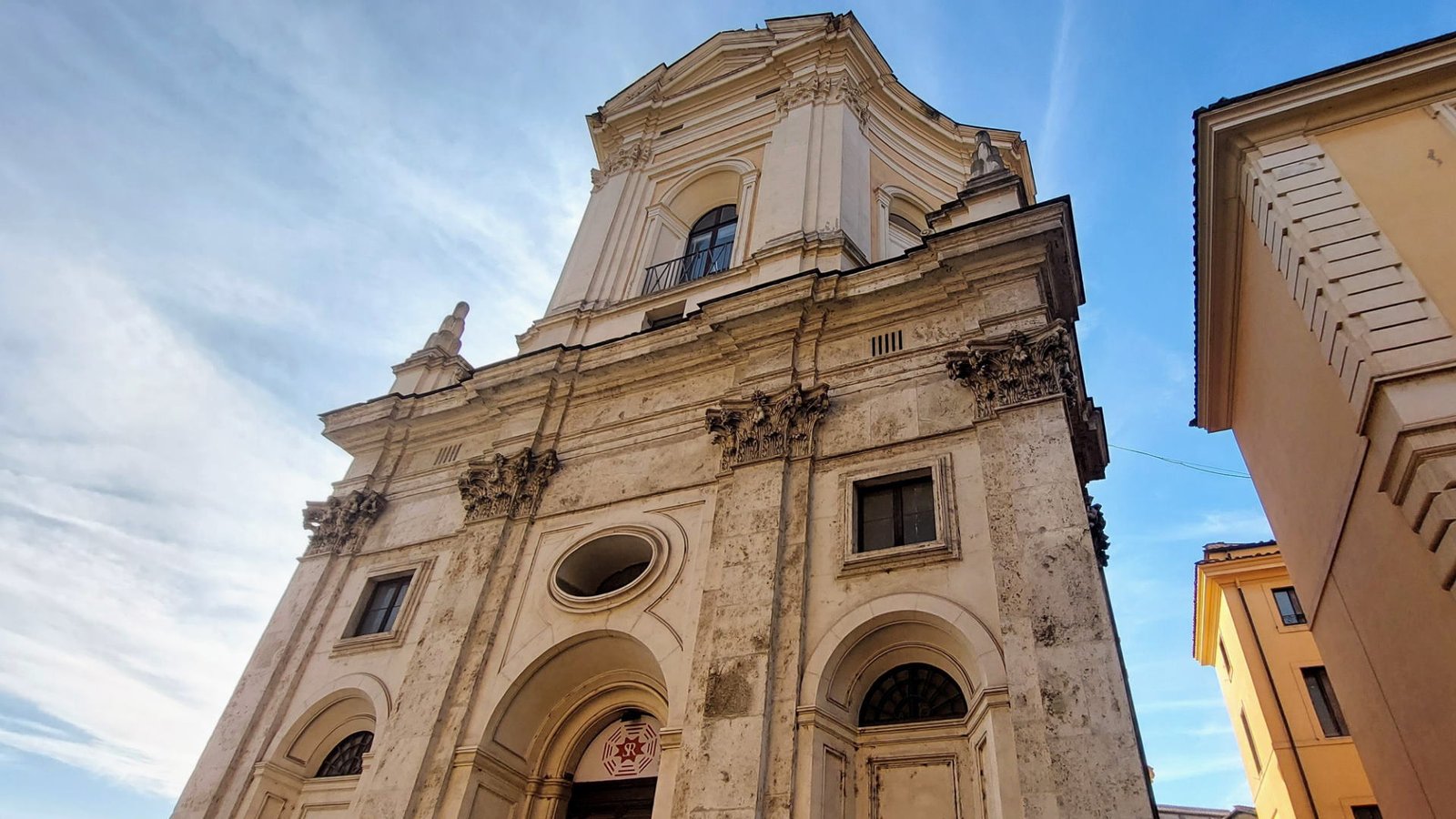
The Church of Santa Rita is at Via Montanara 8, next to Piazza Campitelli, on the side of Via del Teatro di Marcello, and the first thing to know is that today it is no longer a church. It has been deconsecrated. It's called Sala Santa Rita, belongs to Roma Capitale, and is run by the Dipartimento Attività Culturali: inside they hold exhibitions, concerts, conferences, screenings, workshops. If you go there to light a candle you'll be disappointed. If you go to see a baroque church that was taken apart stone by stone and put back together 100 meters further on, then you've understood well where you're going.
This is one of the places in Rome that needs a preface, because people arrive with the wrong idea in their heads. The Church of Santa Rita is a real building, standing, with the facade by Carlo Fontana put back together piece by piece, and it's also a municipal exhibition hall that opens when there's an exhibition and stays closed when there isn't. The two things live badly together in the guidebooks and very well together in person. The problem, if anything, is working out when it's open.
Address, current use, management and history come from institutional sources and from consultable records. The fixed hours of the Church of Santa Rita are not published, neither on the Culture Roma portal nor on the record of the Sovraintendenza Capitolina. The only documented opening time is that of the 2024 reopening, discussed further on, and it was tied to a specific exhibition. Translated into practice: before crossing half the city for the Church of Santa Rita, check that there's an exhibition on. Without an exhibition, the door is closed.
Where Exactly the Church of Santa Rita Is and How to Get There
Via Montanara is a short street that branches off Via del Teatro di Marcello and climbs toward Piazza Campitelli. The Church of Santa Rita is on the corner, with the facade facing the traffic and the side facing the climb. If you come from Piazza Venezia, take Via del Teatro di Marcello keeping the Campidoglio on your left and walk: after the big Anagrafe building the street descends, and on the left this two-order baroque front opens up, looking as if it had been planted there by mistake, with the modern flank of the 1930s buildings pressing against it. It's not a mistake. It's exactly what happened: the church was put where there was room.
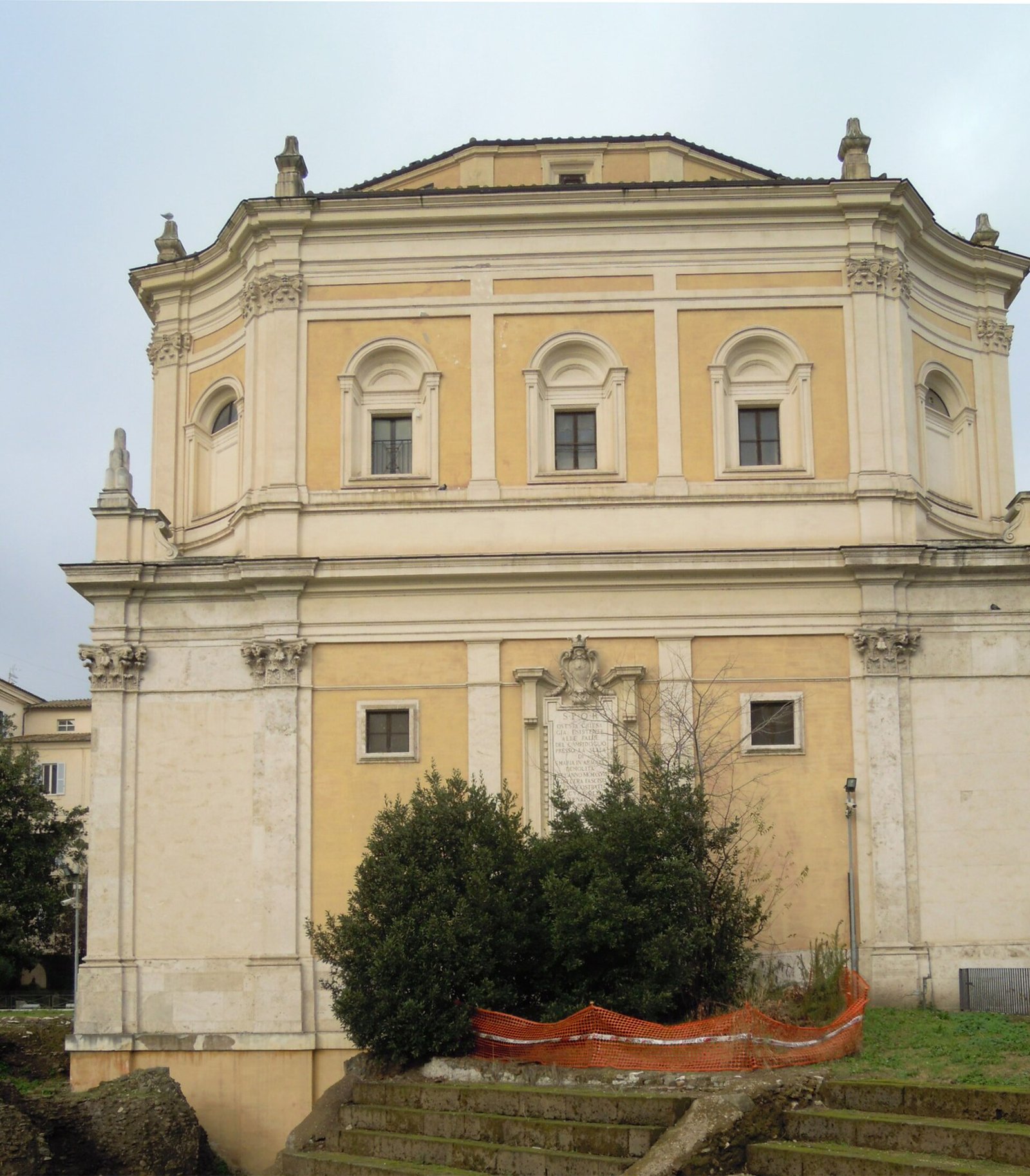
On public transport you need caution, because this is the point where travel pages fill up with badly copied numbers. The ATAC site lists two lines that have Teatro Marcello as their terminus, the 44 and the 715: the terminus is confirmed, the route should be checked on the app before leaving. The metro doesn't come here: the nearest stop on line B is Colosseo, and from there you walk a stretch along Via dei Fori Imperiali. By tram, the terminus of the 8 at Piazza Venezia leaves you a few minutes away. Line numbers in Rome change: check before waiting at a stop that may no longer exist.
The real advice is different: you don't go to the Church of Santa Rita on purpose by bus. You get there on foot, as part of a walk that includes the Capitoline Hill, the Capitoline Cordonata and the staircase of Aracoeli. Because that's where the Church of Santa Rita was born, and that's where the sense of the whole story lies.
What is the exact address of the Church of Santa Rita in Rome
Via Montanara 8, Rome, Municipio I, Rione Campitelli, adjacent to Piazza Campitelli. Both the Culture Roma record and the Turismo Roma record give it. The Sovraintendenza Capitolina on its page writes only "Via Montanara", without a street number. The main door is the one under the baroque facade, at the corner with Via del Teatro di Marcello: no secondary entrances open to the public are listed. If you search a map for "Sala Santa Rita" you find the same point, because it's the same building with two names.
Is the Church of Santa Rita open every day
No, and this is the costliest misunderstanding. The Church of Santa Rita opens on the occasion of the exhibitions and cultural initiatives held there, not with church hours. On the Culture Roma portal of the Comune di Roma no ordinary opening hours appear: the events appear, each with its own dates. So the right question to ask isn't "what time does it open" but "is something on this week". If the answer is no, you see the Church of Santa Rita from outside, and from outside you see it very well.
How much does it cost to enter the Church of Santa Rita
Exhibitions at the Church of Santa Rita are normally free of charge: the record on the municipal culture portal says so, speaking of events that are usually free, and the 2024 reopening press release said it too, where it explicitly reads "ad ingresso libero e gratuito". No ticket price list for the public is published. There is instead a municipal procedure for granting the space to third parties, with its own fees, but that concerns those who want to organize an event, not those who want to visit one. So: as a visitor, count on zero euros and a bit of luck with the calendar.
Why This Church Is in the Wrong Place
Here is the heart of it. The Church of Santa Rita was not built where you see it today. Until 1928 it stood at the foot of the Campidoglio, on the left side of the staircase of Santa Maria in Aracoeli, along a street that no longer exists. Then the pickax of the Governatorato leveled that piece of the city to open Via del Mare, that is, the present Via del Teatro di Marcello, and the church was taken apart. Not simply demolished: dismantled, numbered, put in storage. And 12 years later put back together here, on Via Montanara, with the original stones.
The technical term is anastylosis and it's the same word used for Greek temples put back on their feet by archaeologists. Applied to a 17th-century baroque church it has a certain effect. The plaque on the building says it brutally, with the calendar of the time: "This church, formerly standing at the foot of the Campidoglio near the staircase of S. Maria in Aracoeli, demolished in the year 1928, VI of the Fascist era, was rebuilt here by the Governatorato of Rome. April 21, 1940." The text is given by both the Italian entry and the English entry of Wikipedia. April 21: the Natale di Roma. It's not a date chosen at random, and in 1940 it wasn't at all.
Who rebuilt the Church of Santa Rita after the dismantling
The record on info.roma.it indicates Gustavo Giovannoni as responsible for the reconstruction between 1928 and 1940, with the collaboration of Vincenzo Fasolo. Giovannoni is the big name of Italian architectural restoration of those years and is also one of the theorists of so-called diradamento edilizio, that is, exactly the type of intervention that had erased the church's original context. The attribution isn't confirmed by the pages of the Sovraintendenza Capitolina or by Wikipedia, which are silent on the point: it is therefore the datum of a single source, not an established certainty.
What does the Church of Santa Rita stand on today
According to the record on info.roma.it, the reconstruction that began in 1938 was set on the remains of the temple of Bellona, in Piazza Campitelli area. It's a detail that no plaque explains to you and that makes the Church of Santa Rita a sort of Chinese box: a 17th-century church, which had absorbed a medieval church, reassembled in the 1930s over the foundations of a republican temple. Rome does that. Here too the datum comes from that record and does not appear on the institutional pages.
Why did they demolish the old church in 1928
To open Via del Mare, the road axis that was to connect Piazza Venezia to the Tiber and, in the regime's intentions, to Ostia. Today that stretch is called Via del Teatro di Marcello. The operation was part of the so-called isolation of the Capitoline hill: entire blocks were knocked down to leave the Campidoglio in view on its own, like a monument on a pedestal. The Church of Santa Rita stood exactly in the middle of the route. On this all the sources agree, from the Sovraintendenza Capitolina to Roma Segreta to the two Wikipedias.
Which Church of Santa Rita? There Is More Than One in Rome
A clarification is needed here, because if you search "Chiesa di Santa Rita" in Rome you get at least four different things and three of them have nothing to do with Via Montanara. It's worth telling them apart so you don't end up in the wrong place.
The first is the one discussed here: the Church of Santa Rita da Cascia in Campitelli, Via Montanara 8, deconsecrated, today Sala Santa Rita.
The second is the Church of Santa Rita da Cascia alle Vergini, on Via delle Vergini at the corner with Via dell'Umiltà, Rione Trevi, near the Trevi Fountain. This is a living church, with Masses, and it's the one where the Roman devotion to Saint Rita actually moved. The link between the two is direct and is told further on, because it's the most interesting part of the whole story.
Then there are the 20th-century parishes, which have nothing to do with the baroque: Santa Rita da Cascia a Monte Mario and Santa Rita da Cascia a Casalotti, the latter listed in the registry of Italian churches of the Episcopal Conference in the suburbicarian diocese of Porto-Santa Rufina. They are neighborhood churches, very busy on May 22, but if you're a tourist that's not where you're going.
If you have an address in hand and don't know which it is, the criterion is simple: Via Montanara or Piazza Campitelli means Campitelli, the former church. Via delle Vergini or Via dell'Umiltà means Trevi, the church open for worship. Everything else is suburb and parish.
Are the Church of Santa Rita in Campitelli and the one alle Vergini the same thing
No, they are two distinct buildings about a kilometer apart, but they are linked by a move. The confraternity that had its historic seat in Campitelli, the one of the Holy Thorn of the Crown of Our Lord Jesus Christ and of Saint Rita da Cascia, moved to the Vergini and took with it the title and the devotion. From that moment the church in Rione Trevi, which was called Santa Maria delle Vergini, became Santa Rita da Cascia alle Vergini. The Campitelli church, instead, lost its faithful, and when it was reassembled on Via Montanara it never got them back. That's why today one is an exhibition hall and the other still has Masses.
Where do you go on May 22 for Saint Rita in Rome
Not to the Church of Santa Rita on Via Montanara, which is deconsecrated and celebrates nothing. The Roman reference in the historic center is Santa Rita da Cascia alle Vergini, and then the parishes dedicated to the saint in the neighborhoods. May 22 is the liturgical memorial of Saint Rita, confirmed by the record of the Dicastery for the Causes of Saints. If your goal is the blessing of the roses, inquire directly at the church: the times of the celebrations change every year and you won't find them written anywhere a year in advance.
What are the hours of the church of Santa Rita alle Vergini
On the website of the church at Via dell'Umiltà 83/B, for the summer period these openings are listed: Monday to Friday from 7.00 to 9.00, Saturday from 17.30 to 19.30, Sunday from 10.30 to 12.30. The summer Masses of July and August are: Saturday vigil Mass at 18.30, Sunday at 11.30, weekday at 8.00. The phone number given is 06 6784031. These are summer hours and they change with the season, so check before leaving. They serve only by contrast: the Church of Santa Rita in Campitelli has no hours like that, because it is no longer a church.
A Curiosity About the Church of Santa Rita
The real curiosity is that this church was not born dedicated to Saint Rita, and for most of its existence it was called something else: San Biagio. San Biagio de Mercato, or de Mercatello depending on the source, from the medieval market held in the elongated square in front of the Aracoeli. The church appears in the Catalogus Camerarii of 1192, as reported by the record of Churches of Rome Wiki, and had been built on the remains of a Roman insula. The Bucabella family, or Buccabella, kept it as a family chapel and buried its dead there between the 14th and 15th centuries.
Saint Rita comes later, much later. She comes when a group of people from Cascia living in Rome, folks from the upper Valnerina who were in the capital for work, set up a confraternity and chose that little church as their seat. From that moment little San Biagio begins to be called Santa Rita too, first in cohabitation, then with the new dedication swallowing the old one. The definitive turning point is 1900, the year of the canonization: from then on the name San Biagio disappears from current use and only the Church of Santa Rita remains.
It's worth telling because it's the exact opposite of how things usually work in Rome. Usually it's the ancient title that survives everything, even when the church has been rebuilt three times. Here instead the ancient title died and the new one won, and won so well that today even the Comune, which stages contemporary art exhibitions there, calls that hall by the name of a 15th-century Augustinian nun.
Why was the Church of Santa Rita previously called San Biagio
Because it was a medieval church dedicated to Saint Blaise, bishop and martyr, attested in the Catalogo del Camerario of 1192 and located next to the market held at the foot of the Campidoglio: hence the epithet "de Mercato" or "de Mercatello". The patronage passed to the Bucabella family, which according to the Italian entry of Wikipedia had built an older church on the site in the 11th century. The dedication to Saint Rita was added alongside the original one in the 17th century with the arrival of the confraternity of the people from Cascia and prevailed entirely in 1900. For a certain period the building was known as San Biagio e Beata Rita, that is, with both names attached.
Who were the Bucabella family
A Roman family that between the 14th and 15th centuries held the patronage of the church and used it as a burial place: several funerary inscriptions of theirs remain on record, according to the record of Churches of Rome Wiki. The Italian entry of Wikipedia even attributes to them the construction of the older church in the 11th century. Beyond this the sources are silent: personal names, coats of arms and the events of the Bucabella are not documented.
What does "in Campitelli" mean
It's the indication of the rione. Campitelli is Rione X of Rome, the one that includes the Campidoglio, the Roman Forum, the Palatine and the area around Piazza Campitelli. It serves to distinguish this church from the others dedicated to the same saint, exactly as "alle Vergini" serves to identify the one in Rione Trevi. There is a small inconsistency in the sources: the Roma Segreta record classifies the church under Rione Sant'Angelo and not under Campitelli, while info.roma.it places it in Campitelli. The boundary between the two rioni passes right around here and is one of those things people in Rome gladly argue about.
Carlo Fontana and the Cleverest Facade in the Neighborhood
The name behind the Church of Santa Rita is Carlo Fontana, 1634-1714, one of the architects who closed the season of Roman baroque and handed it over to the 18th century. Fontana had worked with Pietro da Cortona, with Rainaldi and above all with Bernini, and here he faced a small, nasty problem: a tiny church wedged into a narrow street, with no space in front to look at it face-on.
The solution is well explained by the record of the Sovraintendenza Capitolina: Fontana devised perspective tricks designed for a diagonal, not frontal, perception. That is, he designed a facade that works for someone who sees it at an angle, walking, not for someone standing stock-still in front of it. It's the reasoning of a top-level craftsman, and it's the reason why still today, when you go down Via del Teatro di Marcello and the Church of Santa Rita appears to you edge-on, the effect is better than when you plant yourself in front of it to take the photo.
The facade has two orders, with Corinthian pilasters, a central arched entrance and two blind side arches topped by small windows, and in the upper part appear the Chigi mountains, that is, the heraldic emblem of Pope Alexander VII Chigi. Above the central door is an oculus, a bull's-eye window. These are elements noted by all the records, from Roma Segreta to Churches of Rome Wiki, and that you can check with your own eyes standing on the opposite sidewalk.
Who designed the Church of Santa Rita
Carlo Fontana (1634-1714). On this all the sources agree: Sovraintendenza Capitolina, Culture Roma, Turismo Roma, Wikipedia in Italian and English, Roma Segreta, Churches of Rome Wiki. Fontana worked on the existing San Biagio de Mercato, rebuilding it, not starting from free ground. The facade you see today on Via Montanara is his, reassembled with the original stones after the 1928 dismantling. You sometimes read that the facade is a copy: that does not appear in any of the cited sources, which all speak of recomposition of the original material.
In what year was the Church of Santa Rita built
Here the answer is uncomfortable: the sources do not agree. The Italian entry of Wikipedia says 1665. The English entry of Wikipedia says 1643. The Sovraintendenza Capitolina says "around 1650". Turismo Roma says "around 1653". Culture Roma says 1665. Churches of Rome Wiki and Roma Segreta speak of the facade completed in 1665. Info.roma.it gives a span of 1643-1940 and the facade of 1665.
The reading that holds almost everything together is that the construction site was long, starting in the 1640s or 1650s with the facade finished in 1665: that way 1643 and 1665 stop contradicting each other and become the endpoints of the same work. But this is our own reconstruction, not a datum from a source: the certain datum is that the sources say different things.
When did the confraternity of the people from Cascia take the church
Here too the sources diverge by a few years. The Sovraintendenza Capitolina writes that in 1655 the sodality of the people from Cascia settled in the church. Roma Segreta and Churches of Rome Wiki give 1658 as the year in which Pope Alexander VII Chigi granted the church to the confraternity of the Holy Thorn of the Crown of Christ. The Italian entry of Wikipedia says that Alexander VII donated it to the people from Cascia living in Rome, entrusting it to the confraternity, without giving the year. A three-year gap doesn't change the substance, but the difference remains: if you need the exact date for serious work, go to the archive, not to a web page.
Why are the Chigi mountains on the facade
Because the pope who granted the church to the confraternity was Alexander VII, born Fabio Chigi, and the six mountains topped by the star are the emblem of his family. Putting them on the facade was the standard way of saying who had paid or who had authorized. The Roma Segreta record notes it. If you have a trained eye, you find the Chigi mountains everywhere in Rome, from the colonnade of St. Peter's to the church of Santa Maria della Pace, and it's one of the best games to play while walking with a kid who is getting bored.
Something Nobody Tells You About the Church of Santa Rita
That the reconstruction, from a religious point of view, was a complete failure. No guidebook writes it, because it's a story that ends badly and guidebooks prefer endings with a bow.
Here is how things went according to Churches of Rome Wiki. The confraternity of Saint Rita, which was the soul and engine of that church, had already left in 1904, moving to Santa Rita da Cascia alle Vergini in Rione Trevi. When the Campitelli church was dismantled in 1928, therefore, it had already been empty of community for a quarter of a century. And when in 1940 the Governatorato reassembled it on Via Montanara, with plaque and inauguration on the Natale di Roma, the confraternity showed no interest in going back. The result is that the rebuilt building never had a real liturgical life.
From then on it's a long drifting. In 1952 the church was entrusted to the Piccola Opera della Divina Provvidenza, the religious of don Orione, as reported by both Roma Segreta and info.roma.it. In 1990 it returned to the Comune di Roma. Then the restoration between the late 1990s and the early 2000s, and the transformation into an exhibition space. A church dismantled to make a road, reassembled out of pride, and then recycled as an exhibition hall. Put like that it sounds like a defeat. It's one of the most honest stories Rome has to tell about itself.
Why is the Church of Santa Rita deconsecrated
Because it lost its community long before it lost its place. The confraternity had moved to the Vergini in 1904, the building was dismantled in 1928 and reassembled in 1940 without the members returning, the 1952 entrusting to the religious of don Orione was not enough to give it back a role, and in 1990 the property returned to the Comune di Roma. Today the Church of Santa Rita is registered as a deconsecrated building used as a cultural space. The sources agree on the outcome, with some differences on the intermediate dates.
What happened to the paintings and statues of the Church of Santa Rita
Churches of Rome Wiki writes that all the paintings and statues have been removed and that the baroque altar remains on site. Where exactly they ended up, one by one, does not appear in any citable source. Lists circulate, but none is confirmed by an institutional source, so the datum remains not available. What you see inside the Church of Santa Rita today is the architecture, not the furnishings.
What the Inside of the Church of Santa Rita Is Like
Inside it is small. This must be said right away, because anyone arriving with an average Roman church in mind is thrown off: here you are standing in a room. A beautiful room, but a room.
On the shape of the plan the sources consulted don't say the same thing, and the difference is not a scholar's detail. The Sovraintendenza Capitolina and Roma Segreta speak of an octagonal plan, preceded by a small atrium flanked by two rectangular rooms. Culture Roma also speaks of a baroque building with an octagonal plan. Wikipedia, both in Italian and in English, describes instead an interior in the form of a Greek cross with a convex rhomboid plan, comparing it to Borromini's San Carlo alle Quattro Fontane. Churches of Rome Wiki describes an octagonal layout with four diagonal walls. The two readings are not entirely irreconcilable, because an irregular octagon with four short diagonal sides can to the naked eye be read as a cross with rounded arms. But the contradiction is there and it's right that you know it.
The rest, on which the sources do agree: Corinthian pilasters on the walls, in giant pairs according to Churches of Rome Wiki, a vault with stucco moldings, a central dome, and at the back the apse with the baroque altar in polychrome marbles, which is the only furnishing left in its place. Wikipedia also notes a stained-glass window with the image of Saint Rita da Cascia. The ceiling, again according to Churches of Rome Wiki, has a design of festoons that forms a Maltese cross in cream on a gray ground.
In our judgment the interior of the Church of Santa Rita works better today as a container than as a church. Stripped of everything, with the walls cleaned by the restoration, it's a space with a very strong geometry and no distraction. Not by chance the Comune puts contemporary art inside: it's one of the few historic Roman places where a modern work isn't crushed by the context but talks with it as an equal.
How big is the Church of Santa Rita
Small: it is a single central-plan room preceded by an atrium, not a church with naves. The exact measurements in meters are not published by the sources consulted. For a practical idea: it's a space you walk through entirely in five minutes and that fills up with about 50 people standing. Whoever organizes exhibitions there treats it as a single room, not as a route.
What do you see inside the Church of Santa Rita today
The architecture and the exhibition on view, period. Inside the Church of Santa Rita you find the baroque altar in polychrome marbles left in place, the Corinthian pilasters, the stuccoed vault, the dome and the stained-glass window with Saint Rita noted by Wikipedia. Everything else, paintings and sculptures, has been removed. So if you enter during an exhibition, what you are looking at is a dialogue between a baroque shell and contemporary works, and the shell often wins. It's not a criticism of the artists: it's that the place is overbearing.
Does the Church of Santa Rita really resemble San Carlino
The entries of Wikipedia in Italian and English claim it, comparing the plan to that of Borromini's San Carlo alle Quattro Fontane. The comparison holds in principle, that is, a small central hall with complex geometry carved out of an impossible space, but don't expect Borromini's virtuosity: here we are on a different scale and at a different level of ambition. And since other sources describe the plan as octagonal and not as a rhomboid Greek cross, the comparison should be taken with a grain of salt. If you go there looking for San Carlino you'll be disappointed. If you go looking for a minor baroque church that solved a hard problem well, you'll come out happy.
The Advice I Give You for Visiting the Church of Santa Rita
There is only one piece of advice and it counts for more than all the rest: don't set out without checking that there's an exhibition open. The Church of Santa Rita has no published ordinary opening hours. It opens for events. If there's no event, you find the door closed and your visit shrinks to two minutes of facade.
In practice, in the morning before going out, do this: open the Roma Capitale culture portal and look for Sala Santa Rita in the events calendar. If you find an exhibition with dates that include today, go. If you find nothing, treat the Church of Santa Rita as a stop along the way within a bigger walk and not as a destination. The single number of Roma Capitale for tourist and cultural information is 060608, given both by the Turismo Roma record and by the 2024 reopening press release: if you have doubts, call it and ask whether the hall is open today. You'll save yourself a useless walk.
Second piece of advice, less obvious: go at an angle. Fontana designed it to be seen walking diagonally, not frontally. So don't arrive from Via Montanara aiming straight at the door: come down from Piazza Campitelli and let the facade open up to you from the side. It's the only way to understand why that man was well paid.
Third, on when: the area around Via del Teatro di Marcello is noisy and busy all weekday long. Early Sunday morning is another matter. If you can choose, choose that. The light on the facade is better in the afternoon, we'll get to that further on.
Fourth, an unpopular piece of advice: if you have only one day in Rome, the Church of Santa Rita is not your priority. Let's be honest. With one day only, go to the Colosseum and the Capitoline Museums and that's it. The Church of Santa Rita is a stop for a second or third visit, for people who are digging into Rome and not ticking it off a list.
How long does it take to visit the Church of Santa Rita
10 minutes inside, if there's a small exhibition, 20 if the exhibition is dense and you start reading the captions. From outside, five minutes are more than enough to walk around the facade and understand how it's wedged between the buildings. It's one of those places that don't ask for time but ask for attention: if you get there in a rush between two stops you won't understand anything, if you stop for a quarter of an hour a light bulb goes on about how this part of Rome was remade in the 1930s.
Do you need to book for the Church of Santa Rita
For exhibitions normally no: they are free admission and you simply walk in. That said, individual initiatives, conferences or concerts may require registration or an invitation, because the space is small and places run out quickly. No booking platform dedicated to the Church of Santa Rita is listed, so the reference remains the page of the specific event on the municipal culture portal. If it's a concert, take it for granted that you need to book and check.
Is the Church of Santa Rita accessible to people with disabilities
It is not certain. The Turismo Roma record refers generically to the section on accessibility of the tourist portal without giving specific information on this building, and there is nothing in the other sources consulted. What you can see from outside is that the entrance is raised above the sidewalk, like practically all Roman baroque churches. If you need a certain answer, call 060608 and ask about the Sala Santa Rita on Via Montanara: it's the only serious way to know beforehand.
Another Well-Known Fact, Yet Rarely Cited
The fact is this: the Church of Santa Rita is not the only Roman building that was moved in the 1930s, and it's not even the biggest. But it's the one that lost the most.
In the operation of isolating the Capitoline hill and opening Via del Mare, an entire piece of inhabited city was ripped open: streets, houses, workshops. Via della Pedacchia, which Roma Segreta gives as the street the church faced, no longer exists. The Sovraintendenza Capitolina speaks of the "antica via Giulio Romano" to locate the original building. These are place names you no longer find on any map. The Church of Santa Rita is one of the very few physical fragments of that fabric that survived, and they survived because someone decided it was worth numbering the stones.
The little-cited point is this: that same culture that dismantled churches to reassemble them is the culture that had just finished destroying the context in which those churches made sense. The object was saved and the place was thrown away. The Church of Santa Rita on Via Montanara is intact and serves no purpose. The Church of Santa Rita at the foot of the Aracoeli was a neighborhood's church. When you walk past it, this is the thing to keep in mind.
One last observation, more practical than historical. The Church of Santa Rita, as it is today, has a quality that churches in their original place don't have: you can see that it was put back together. Look at the joints, look at how the facade attaches to the modern flanks, look at the base. It's a building that confesses to being a reconstruction. In a century of restorations that try to pretend nothing happened, this is a virtue.
What other buildings were moved in Rome in the 1930s
There were several cases tied to the demolitions of the ventennio, but a list from an institutional source is not available. The certain datum is that the Church of Santa Rita was dismantled in 1928 for the opening of Via del Mare and recomposed by anastylosis on Via Montanara, with inauguration on April 21, 1940. If you're looking for the general picture of the Capitoline demolitions, the right place to start is the Archivio Storico Capitolino and the publications of the Sovraintendenza Capitolina.
What does anastylosis mean
It means putting a building back on its feet by reusing its original elements, numbered and cataloged before the dismantling. It's the technique used to raise the columns of ancient temples again, and it's rarely applied to modern buildings. The Italian entry of Wikipedia uses exactly this term for the Church of Santa Rita: dismantled piece by piece in 1928, put in storage, rebuilt in 1940 by anastylosis. In practice it means that the stones you see are the ones that stood at the foot of the Campidoglio, not copies.
Why did the reconstruction take 12 years
Between the 1928 dismantling and the 1940 inauguration 12 years pass, and the sources don't give the same start date for the reassembly: Churches of Rome Wiki says 1937, the Sovraintendenza Capitolina gives the period 1938-1940, info.roma.it says the reconstruction started in 1938. The initial plan, according to Roma Segreta and the English entry of Wikipedia, was to reassemble the church at the original spot: something that was then not done. So the years in storage are also the years of a discussion about where to put it back. Churches of Rome Wiki also notes that the construction site suffered interruptions linked to the war.
What was saved of the medieval church
Churches of Rome Wiki reports that the small bell tower and an ancient apse fresco were preserved. No available source says where these elements are now and whether they are visible to the public: on that point the datum is n/d. Consider that Fontana's building had already absorbed or replaced almost everything of the old San Biagio: the medieval church, in fact, had already disappeared inside the baroque one two and a half centuries before the pickax of 1928.
The Church of Santa Rita from Church to Exhibition Hall
The second life of the Church of Santa Rita begins in 1990, when the property returns to the Comune di Roma, and takes shape with the restoration at the end of the century. Here too, the sources date things slightly differently: Roma Segreta speaks of a restoration between 1999 and 2003, the Sovraintendenza Capitolina of an overall restoration "around 2000", Culture Roma says the same, Turismo Roma writes that since 2004 the hall has been a multifunctional space dedicated to contemporary art. Lined up, they tell the same process with the clock set differently.
Since then the Church of Santa Rita has entered the circuit of cultural spaces of Roma Capitale, run by the Dipartimento Attività Culturali. Exhibitions, lectures, conferences, concerts, screenings, workshops and performances pass through. And it's also available for institutional activities, which in practice means that every now and then there's an official presentation and you're left outside.
In 2024 there was a real reopening, after a restoration. According to the account of a trade outlet, the hall reopened to the public on April 21, 2024, once again on the Natale di Roma, with an exhibition dedicated to the Dea Roma by Pietro Tenerani, a plaster herm datable to around 1847 on loan from the Museo di Roma. The exhibition stayed open from April 21 to May 12, 2024, every day from 11.00 to 19.00, with free admission. It's a historical datum, not a current schedule: that schedule applied to that exhibition.
What exhibitions have been seen at the Church of Santa Rita recently
The most recent ones documented on the Roma Capitale culture portal are all from 2025: Lo sguardo periferico. La grafica sociale di Coco Cerrella, from February 28 to March 7, 2025. Steam Shadow by Laura Federici, from March 21 to April 10, 2025. And the exhibition Ya Baba with the sculpture of Aly Baba Faye, from December 13 to 21, 2025. Note the duration: two weeks, three weeks. This is the rhythm of the Church of Santa Rita, and it's the reason it pays to check before leaving.
Is there an exhibition on at the Church of Santa Rita in 2026
For the Church of Santa Rita no 2026 exhibition program is published: the documented events stop at December 2025. That doesn't mean there is nothing. The official calendar is on the Culture Roma portal of Roma Capitale, updated event by event. In August, moreover, a good part of the municipal cultural spaces slow down considerably.
Can you rent the Church of Santa Rita for an event
There is a municipal procedure for granting the Sala Santa Rita for cultural events and initiatives, with fees set by Roma Capitale: it's a service listed among the institutional pages of the Comune. Anyone who wants information must contact the offices of the Dipartimento Attività Culturali. It is a space with a cultural vocation: it's not a hall for private parties.
The Right Photo to Take at the Church of Santa Rita
The right photo is not the frontal facade. It's the one everybody takes and it's the one that comes out badly: from the front the Church of Santa Rita loses out, squashed by the buildings and the traffic, and the result is a flat postcard of a building that looks smaller than it is.
The right photo is three-quarter, from the sidewalk of Via del Teatro di Marcello, staying about 20 steps toward Piazza Venezia and framing the facade at an angle with the side running off along Via Montanara. It's exactly the diagonal perception for which Fontana designed that front, as the Sovraintendenza Capitolina writes. With that angle the facade regains depth, the two orders read one above the other and the Corinthian pilasters cast the shadow they should.
On light: the main front takes well in the afternoon. Early in the morning the street is in shadow and the colors come out dull. In the late afternoon of summer, instead, the stone warms up and the contrast between the facade and the gray 1930s buildings next to it becomes the real subject of the photo. If you have patience, wait for a bus to pass and shoot right after: that stretch of road is very busy and without a gap in the traffic you end up with half the frame full of sheet metal.
The second photo, the one nobody takes, is the detail of the Chigi mountains in the upper part of the facade. You need a decent zoom or a phone with a telephoto lens. It's a small heraldic trophy that explains who allowed that church to exist, and in a close-up it reads very well.
The third, if you're lucky enough to find it open, is from the inside toward the door: from the altar looking back, with the oculus above the entrance letting the light in. Exhibitions normally allow photos without flash, but it's not a given: ask the staff in the hall, because when there are works on loan the rules change.
One last thing, and it counts as a warning: don't try to take the photo in the middle of the roadway. Via del Teatro di Marcello is a fast street with a bus lane, and there are buses that arrive without making a sound. It happens that tourists get seriously scared over a photograph they could have taken from the sidewalk.
Can you take photos inside the Church of Santa Rita
In general, free-admission exhibitions in Roman municipal spaces allow photos without flash and without a tripod, but no specific regulation for the Church of Santa Rita is published. A practical rule that applies everywhere: ask whoever is in the hall before raising your phone. If the exhibition includes works on loan from other institutions, the restrictions are almost always stricter and can go as far as a total ban.
What is the best spot to photograph the facade
The opposite sidewalk of Via del Teatro di Marcello, moved toward Piazza Venezia, so as to take the facade at three-quarters. If instead you want the framing that tells the story of the building, then position yourself so as to have in the same photo the Church of Santa Rita and, behind it or to the side, the flank of the Campidoglio: that way you understand where it comes from and where it ended up. It's a less beautiful photograph and a much more intelligent one.
Is it worth photographing the Church of Santa Rita in the evening
It depends on the night lighting, which changes over the years. In any case the whole stretch of Via del Teatro di Marcello in the evening is a nice walk, with the Campidoglio lit up above and the Vittoriano as a backdrop. If you pass in the evening, take the walk anyway, even just to see how the scale of the neighborhood changes when the cars thin out.
Some Important Events That Happened Here in History
Here is what emerges from the sources, with the warning that where the numbers wobble it is indicated.
| Year | What happens | Who reports it |
|---|---|---|
| 1192 | San Biagio appears in the Catalogus Camerarii | Churches of Rome Wiki |
| 11th century | An older church built by the Bucabella family | Wikipedia in Italian |
| 14th-15th century | Patronage and burials of the Bucabella | Churches of Rome Wiki |
| 1626 or 1627 | Beatification of Rita da Cascia | Dicastery for the Causes of Saints says October 19, 1626. Sovraintendenza Capitolina and Cathopedia say 1627 |
| 1655 or 1658 | Settlement of the confraternity of the people from Cascia | Sovraintendenza Capitolina says 1655. Roma Segreta and Churches of Rome Wiki say 1658 |
| 1643, 1650, 1653 or 1665 | Reconstruction of the church to a design by Carlo Fontana | the sources do not agree, see above |
| 1665 | Completion of the facade | Churches of Rome Wiki, Roma Segreta, info.roma.it |
| 1900 | Canonization of Saint Rita, on May 24. The dedication prevails over that to San Biagio | Dicastery for the Causes of Saints, Wikipedia |
| 1904 | The confraternity moves to Santa Rita alle Vergini | Churches of Rome Wiki, Wikipedia, Diocese of Rome |
| 1928 | Dismantling for the opening of Via del Mare | all the sources consulted |
| 1937 or 1938 | Start of the reassembly on Via Montanara | Churches of Rome Wiki says 1937. Sovraintendenza Capitolina and info.roma.it give 1938 |
| April 21, 1940 | Inauguration of the rebuilt church | plaque, Wikipedia, info.roma.it |
| 1952 | Entrusted to the Piccola Opera della Divina Provvidenza of don Orione | Roma Segreta, info.roma.it |
| 1990 | The property returns to the Comune di Roma | Sovraintendenza Capitolina, Roma Segreta, info.roma.it |
| 1999-2003 or "around 2000" | Overall restoration | Roma Segreta gives 1999-2003. Sovraintendenza Capitolina and Culture Roma say around 2000 |
| 2004 | The hall becomes a multifunctional space for contemporary art | Turismo Roma |
| April 21, 2024 | Reopening to the public after restoration, with Tenerani's Dea Roma | trade outlet, press release picked up |
Look at the right-hand column: five rows out of 17 have two possible dates, or even four. It's not sloppiness of the sources, it's what happens when a small building crosses eight centuries and nobody has ever written the definitive monograph. Better a table with question marks than a fake, smooth chronology.
What was the Catalogus Camerarii
A list of the churches of Rome compiled at the end of the 12th century, one of those repertories that historians use to date the existence of a building when there is nothing else. That San Biagio appears in the 1192 catalog means that at that date the church existed and was relevant enough to be recorded. It doesn't mean it was built that year: the Italian entry of Wikipedia speaks of a Bucabella church already in the 11th century. On the medieval phase of the Church of Santa Rita, the popular sources say little.
Was the church moved for the Vittoriano or for Via del Mare
Here is a case in which the sources openly contradict each other. Most of them, that is the Italian and English entries of Wikipedia, Roma Segreta, the Sovraintendenza Capitolina, Churches of Rome Wiki and info.roma.it, link the 1928 dismantling to the opening of Via del Mare and the isolation of the Capitoline hill. The Wikipedia entry on the church of Santa Rita alle Vergini and the record of the Diocese of Rome say instead that the Campitelli church was dismantled in 1904 for the construction of the monument to Vittorio Emanuele II. The two versions differ both on the date and on the reason.
1904 is documented as the year of the confraternity's move to the Vergini, and 1928 as the year of the building's dismantling: in our judgment they are two different facts that some source has packaged together, but that's an interpretation, not a datum from a source. If someone tells you the Vittoriano version with absolute certainty, know that there is another version, supported by more sources, that says something else.
Who Has Passed Through the Church of Santa Rita
The Church of Santa Rita has no list of famous people to show off, and whoever offers you one is probably making it up. It was a small church, of the neighborhood and of a confraternity, not a papal basilica. Here is who really passed through, according to the sources.
Carlo Fontana passed through for work, and left the design. He is the biggest name linked to this building, and it's no small thing: Fontana was a pupil and collaborator of Bernini, architect of the Fabbrica di San Pietro and master of a generation of designers who then worked in half of Europe. Here he had a modest client and an impossible space, and the answer he gave to that problem is exactly the reason the facade still works.
Pope Alexander VII Chigi, as far as is known, did not say Mass here, but he put his coat of arms on it and granted the church to the confraternity: his passage is carved in the stone, high up, with the six mountains and the star. The relationship between Alexander VII and Carlo Fontana, besides, is one of the main threads of mid-17th-century Rome.
Then there are the people from Cascia in Rome, and they are the real protagonists. People from the Valnerina who emigrated to the capital, organize themselves into a confraternity, take a church and bring the cult of their own saint to it. It's a story of a regional community in the city, identical in substance to that of the Lombards at San Carlo al Corso or the Florentines at San Giovanni dei Fiorentini. The difference is that the people from Cascia, in the end, moved out.
Roma Segreta names as founder of the confraternity of the Holy Thorn a monsignor Cruciano da Cascia. He is the only proper name of a churchman linked to this church that appears from a source, and it should be taken as a datum of that record, not as consolidated news.
In the 20th century Gustavo Giovannoni and Vincenzo Fasolo pass through, according to the info.roma.it record, as authors of the reconstruction. And the religious of don Orione pass through, who had the building in trust from 1952. Then the contemporary artists pass through, who have exhibited here since the restoration: among those documented on the municipal portal are Laura Federici, Coco Cerrella and Aly Baba Faye, with exhibitions from 2025.
And finally there is Pietro Tenerani, but indirectly: in 2024 his herm of the Dea Roma, on loan from the Museo di Roma, was the work that reopened the hall. Tenerani, a neoclassical sculptor, never set foot in this church. A plaster of his arrived here, almost two centuries later.
Did Saint Rita ever go to Rome
There is a lovely detail. According to the hagiographic account reported by Cathopedia, Rita bore on her forehead for the last 15 years of her life the wound of a thorn from the crown of Christ, and that mark mysteriously disappeared the day before a pilgrimage to Rome that she had planned. The sense of the story, in the logic of hagiography, is that the wound was an obstacle to showing herself in public and that it disappeared so she could leave. If she really went, and when, cannot be said: they are devotional tales, not chronicle. The official record of the Dicastery for the Causes of Saints does not mention the trip to Rome.
Who was Carlo Fontana
An architect born in 1634 and died in 1714, as the record of the Sovraintendenza Capitolina indicates. He worked in the workshop of Gian Lorenzo Bernini and became one of the protagonists of the last season of Roman baroque, with a very long career straddling the 17th and 18th centuries. The Church of Santa Rita is one of his minor works in size and one of the most interesting for how it solves a constraint. You don't find here the spectacle of the great Roman churches: you find a visibility problem solved with intelligence.
Are there famous people buried in the Church of Santa Rita
None is recorded, and since the building was dismantled and reassembled the question also has an unpleasant practical side. The only documented burials are those of the Bucabella family, in the medieval phase, with several funerary inscriptions on record. What happened to those inscriptions and those burials in 1928 is not written anywhere: here the datum is n/d. If someone tells you about illustrious tombs inside the Church of Santa Rita on Via Montanara, ask them for the source.
Saint Rita, the Roses and May 22
It's worth understanding who this woman was, because she is one of the most popular saints in Italy and her popularity is made of one thing only: desperate cases. Rita is the saint you turn to when there is nothing left to do. In a Catholic country this is a very strong positioning, and it explains why so many neighborhood churches built in the 20th century are dedicated to her.
The official record of the Dicastery for the Causes of Saints registers her like this: baptismal name Margherita Lotti, born probably in 1371 at Roccaporena in Umbria, died between May 21 and 22, 1447. Married to Paolo di Ferdinando, two children, then a widow, then an Augustinian nun in the monastery of Santa Maria Maddalena in Cascia after the age of 36. In 1432 she received the stigma of a thorn on her forehead, which she bore until death. Beatified on October 19, 1626 by Urban VIII, canonized on May 24, 1900 by Leo XIII in St. Peter's. Liturgical memorial on May 22.
On the dates of birth and death, though, the sources don't agree with each other. Cathopedia gives the birth as 1381 and the death on May 22, 1447 at the age of 66, which with 1381 doesn't even add up arithmetically. Churches of Rome Wiki writes 1377-1447. A Vatican News article of May 23, 2025 on the 125 years since the canonization even reports the death on May 22, 1457. On the beatification, the Dicastery says October 19, 1626 while the Sovraintendenza Capitolina and Cathopedia speak of 1627. The only datum on which everyone agrees is the canonization: May 24, 1900, Leo XIII.
The rose is her symbol and comes from the account of the prodigy of Roccaporena: Rita, by then dying, is said to have asked a relative to go and fetch a rose bloomed in her garden in the middle of winter, and with it two figs. This is how Cathopedia reports it. From this comes the tradition of the blessing of the roses on May 22, practiced in the shrines and parishes dedicated to the saint all over Italy. It's a hugely popular rite: in the right places there are very long lines of people with a bunch in their hand.
But let's go back to Via Montanara, to close the circle: at the Church of Santa Rita in Campitelli nothing happens on May 22. It's deconsecrated. The roses are blessed elsewhere. If you're looking for that rite in Rome you have to go to a church open for worship and dedicated to the saint, and the most central is Santa Rita da Cascia alle Vergini. Check the hours directly with them, because they change every year.
Why is Saint Rita the saint of the impossible
Because her hagiographic biography is a sequence of no-way-out situations resolved anyway: a violent marriage, the loss of her husband and children, the admission to the monastery denied and then obtained. Tradition made her the patron of lost causes and popular devotion adopted her en masse. The record of the Dicastery for the Causes of Saints stresses that Rita went through three states of life, married, widowed and nun, and that she faced her husband's mistreatment with patience, reconciling him with God. It's the language of official hagiography, reported as such.
What does Cascia have to do with Rome
It has to do with it through emigration. The people from Cascia who worked in Rome in the 17th century organized themselves into a confraternity and took this church at the foot of the Campidoglio as their seat, bringing to it the cult of their blessed fellow citizen. It's the same mechanism as the national and regional churches that dot the center of Rome. If you're interested in the opposite end of this story, that is Cascia itself, with the shrine and the monastery, it's in Umbria, in the upper Valnerina, and you go there in a day from Rome only if you leave early and have a car.
When are Saint Rita's roses blessed
On May 22, the day of the liturgical memorial. The practices change from church to church: in some places the roses brought by the faithful are blessed, elsewhere blessed roses are handed out, and in some shrines the rite is accompanied by novenas and processions. The precise times of the Roman celebrations for 2027 don't exist yet. The certain datum is where not to go: not to Via Montanara.
A Half Day on Foot Around the Church of Santa Rita
As has been said, you don't go to the Church of Santa Rita on purpose. You pass by. But the walk you pass it on is one of the best in Rome, and here it is laid out for those who have already been to Rome once.
You start high up. Climb the cordonata capitolina, that wide, gentle ramp designed by Michelangelo, and arrive in Piazza del Campidoglio. Next to it, on the steep staircase that climbs in parallel, is Santa Maria in Aracoeli: that staircase is your point zero, because it's at its foot, on the left side, that the Church of Santa Rita stood for almost three centuries. Stand at the bottom, turn around and try to imagine a two-order baroque facade wedged in where there is asphalt today. It's the most useful exercise you can do in the whole day.
From there you go down to Via del Teatro di Marcello and in five minutes you're in front of the Church of Santa Rita. You make the stop it deserves, five minutes or 20 depending on whether it's open. Then you keep going down.
Below, the Teatro di Marcello awaits with its arches and the buildings built on top of it. Then the Forum Boarium, with the two republican little temples that are among the most underrated things in the center. Then Santa Maria in Cosmedin, where you find the line for the Mouth of Truth. And here it has to be said clearly: the line for the Bocca della Verità is the worst use of time in the center of Rome. 30 or 40 minutes standing to put your hand in an ancient manhole and take a photo. The portico of Santa Maria in Cosmedin and the Romanesque bell tower are worth 10 times more and cost no queue.
If instead from the Church of Santa Rita you head toward the river, in five minutes you're in the Ghetto, with the Synagogue and the Museo Ebraico, and from there you cross to the Tiber Island. This is the piece most recommended in the late afternoon, when the light comes in low on Via del Portico d'Ottavia.
The whole walk, slowly and without entering the museums, is three hours. With the Capitoline Museums included it becomes five and a half and eats your day, but the Capitolini, if you skipped them the first time, have to be done.
What to see near the Church of Santa Rita
In less than 10 minutes on foot you have the Campidoglio with the Capitoline Museums, the staircase and the church of the Aracoeli, the Teatro di Marcello, Piazza Campitelli with the church of Santa Maria in Campitelli, the Portico d'Ottavia and the Ghetto with the Synagogue and the Museo Ebraico, the Foro Boario with the little temples and Santa Maria in Cosmedin. A little further are the Isola Tiberina and, on the other side, Piazza Venezia with the Vittoriano. It's one of the densest concentrations in Rome: the problem here is not finding what to see, it's choosing what to skip.
Which way do you go to the Ghetto from the Church of Santa Rita
Toward the river. Leaving the Church of Santa Rita, keep Via del Teatro di Marcello on your left and go down toward the Teatro di Marcello, then turn right toward the Portico d'Ottavia. It's a few minutes' walk and there's no way to go wrong, because the Portico d'Ottavia is a piece of ancient ruin among the houses that you can see from afar. The Ghetto is one of the rare central Roman neighborhoods where you eat well in the evening without ending up in a trap, but always check the bill before sitting down.
Can you see the Church of Santa Rita from the Campidoglio
From Piazza del Campidoglio no, because the square is closed in by the buildings. You catch a glimpse of it going down toward Via del Teatro di Marcello and you frame it well from the lower part of the Aracoeli staircase. The most instructive viewpoint, if you want to understand the geography of the story, is exactly from there: in a single glance you have the staircase where the Church of Santa Rita stood until 1928 and, a hundred meters further on, the spot where it stands now. It's not a panorama, it's a lesson.
How Long Rome Takes to Put a Church Back on Its Feet
12 years, in this case. But the real question is another: why did they do it?
Because in the 1920s and 1930s, while whole neighborhoods were being knocked down, a public discourse on preservation was being built at the same time. The stones were numbered, cataloged, put in storage with the declared intention of reassembling them in the same place. Then the same place no longer existed, because a road ran through it, and so the church went where there was room. It's a short circuit that repeats itself in Rome and that this building tells better than an essay.
In 1940 the reconstruction was presented as a merit of the Governatorato, and the plaque says so explicitly. It would be easy to dismiss it as propaganda. It would also be wrong: those stones are here today instead of in a dump, and Carlo Fontana's facade still exists. The two things stand together and don't cancel each other out.
Is the Church of Santa Rita a historical fake
No, and it's a frequent question. A fake is a copy passed off as an original. Here we are in front of an authentic building reassembled in a different place, with its own stones, and the fact is declared by a plaque on site. The legitimate debate is not about the authenticity of the material but about the value of context: is a monument worth for what it is made of or for the place where it stands? The Church of Santa Rita is one of the Roman cases where this question can be touched by hand.
Why didn't they put it back where it was
Because a road runs through where it stood. The initial plan, according to Roma Segreta and the English entry of Wikipedia, was precisely to rebuild it at the original spot, and the demolition caused discussion from the start. But the opening of Via del Mare had materially erased that piece of buildable ground, and in the end Via Montanara was chosen. The technical and administrative reasons for that choice do not appear in the sources: it is known that the decision changed, not by whose hand.
Was the church rebuilt identical to how it was
In the appearance of the facade and in the layout, yes: they speak of anastylosis and reuse of the original stone. But "identical" is a word that never works entirely with these interventions. The base, the attachment to the neighboring buildings, the relationship with the street and the entrance level are necessarily different, because the place is different. And the info.roma.it record adds that the reconstruction was set on the remains of the temple of Bellona, which tells you how deeply the relationship with the ground has changed. Look at it knowing this: what you see is an original in a new situation.
Things to Avoid and Things to Insist On
On the neighborhood there is an unpopular opinion to give. The area between Piazza Venezia and the Ghetto is full of businesses that live off passing trade: bars with terrace prices and highway rest-stop coffee, stalls with magnets, restaurants with the menu in six languages and the photo of the dish. It's not a new phenomenon and it's not scandalous, but it makes you lose time and money in a part of the city where time is precious.
Rule of thumb: the more a place sits exactly on the route between two famous monuments, the more likely it is to be mediocre. Two side streets in the wrong direction are enough to change worlds. No names of places are given here: places close, signs change and a guide that sends you to a dead address has done you harm.
On one thing, instead, it pays to insist: bring water. Via del Teatro di Marcello in summer is an oven, there is no continuous shade and the traffic heats the air. On the other hand there are drinking fountains in this area, and Roman water is good. It's a banal piece of advice that saves more afternoons than any itinerary.
Last, on shoes: from here on down it's all sampietrini, and sampietrini with a smooth sole are a dangerous sport. If it rains, they become a skating rink. It's not a detail for the anxious, it's the number one reason for sprained ankles in every season.
Is the area around the Church of Santa Rita safe
It's a central area, very busy by day and also frequented in the evening, with the Ghetto and Piazza Venezia a few minutes' walk away. The typical problem here is not personal safety but pickpocketing on crowded transport and at the points of maximum tourist crush. The usual care of the historic center of a European capital applies: backpack in front on the bus, phone not in the back pocket. Nothing more alarming than that.
Is there a public restroom near the Church of Santa Rita
The presence and hours of public toilets on this stretch are not verified. The solution that always works in the center of Rome is to enter a bar, buy something and ask. If you're doing the walk with the Capitoline Museums on the program, the museum's restrooms are your anchor and are reachable in a few minutes from the Church of Santa Rita.
Can you park near the Church of Santa Rita
It's strongly discouraged. We are inside the limited traffic zone of the historic center, with electronic gates and automatic fines, and street parking here is a mirage even for residents. The ZTL rules and hours change over time: if you absolutely must come by car, check first on the official mobility pages of Roma Capitale. The right way to reach the Church of Santa Rita is on foot, from any direction.
When is the worst time to come here
The middle hours of a summer weekday: heat, traffic, full buses, narrow sidewalks. And bridge Saturdays, when Piazza Venezia is one continuous jam. The best time is early Sunday morning, or a weekday autumn afternoon with low light. The Church of Santa Rita has no lines of its own, because it's not a mass attraction: the lines that ruin your day are those of the other places around.
What Is Really Worth It and What Is Overrated Around Here
Here is the uncomfortable exercise, the one that is never done in guidebooks.
Worth the line: the Capitoline Museums. No discussion. They are the oldest public museum in the world and the collection is what it is. If you have two real hours, spend them there.
Worth the time, without a line: the Aracoeli staircase and the church at the top, which almost everybody looks at from below and nobody climbs. It's about 124 steps: the exact number is not confirmed by an official source. At the top is one of the most impressive churches in Rome and it's almost always half empty. The Foro Boario with the two little temples is also worth it: 10 minutes, free, and there's never anybody there.
It's overrated: the Bocca della Verità. It's worth repeating. 40 minutes of line for a manhole. If you really care, go at nine in the morning as soon as they open and close the matter in 10 minutes.
It's a trap: any "skip the line" tour sold on the street by someone who stops you on the sidewalk with a laminated badge. In this area there are quite a few. If you want a guided visit, book it from an operator you choose yourself, not from someone who grabs you by the sleeve in front of the Vittoriano.
Somewhere in between: the Church of Santa Rita itself. It's not an absolute masterpiece and it won't change your life. It's a small building with an enormous history, and the relationship between the two is exactly the reason it deserves five minutes of your afternoon. Whoever sells it as a secret treasure is exaggerating. Whoever ignores it entirely misses the key to reading the whole neighborhood.
Is it worth going in if the exhibition doesn't interest you
Yes, without hesitation. If the Church of Santa Rita is open, go in even if the artist on show means nothing to you, because you see the building only this way. There are no ordinary openings: the exhibition is your ticket to be inside a baroque shell reassembled stone by stone. Walk around the works out of respect and then look at the vault, the pilasters, the altar. It takes a quarter of an hour in all and it's free.
Which is better, the Church of Santa Rita or Santa Maria in Campitelli
They are two different things and are 50 meters from each other, so the right question is the order, not the choice. Santa Maria in Campitelli is a large church, open for worship, with an imposing baroque interior. The Church of Santa Rita is a small hall, deconsecrated, open only for events. Do Santa Maria in Campitelli first, which you almost certainly find open, and then try the door of the Church of Santa Rita. If it's closed, you still have the square, which is one of the most beautiful and least trodden in the center.
Is Piazza Campitelli worth a stop
Yes. Piazza Campitelli is one of those Roman squares that nobody photographs: intimate, with the fountain in the middle, the noble palaces around and very little foot traffic compared with what there is 50 meters lower down. From the Church of Santa Rita you get there in a minute going up Via Montanara. If you have to stop to catch your breath during the walk, stop there and not on Via del Teatro di Marcello.
The Practical Information in a Table
Where n/d appears, the datum is not published.
| Item | Datum |
|---|---|
| Historic name | Church of Santa Rita da Cascia in Campitelli, formerly San Biagio de Mercato |
| Current name | Sala Santa Rita |
| Address | Via Montanara 8, Rome, Municipio I, adjacent to Piazza Campitelli |
| Status | Deconsecrated building, property of Roma Capitale |
| Use | Exhibition and multipurpose space: exhibitions, conferences, congresses, concerts, screenings, workshops, performances |
| Management | Dipartimento Attività Culturali of Roma Capitale |
| Ordinary hours | n/d: no fixed hours are published, opening follows the events calendar |
| Admission | Exhibitions are normally free |
| Booking | Not required for exhibitions. Possible for conferences and concerts, check on the event |
| Information | Roma Capitale single number 060608 |
| Calendar | Culture Roma portal of Roma Capitale, Sala Santa Rita page |
| Architect | Carlo Fontana (1634-1714) |
| Reconstruction | Dismantling 1928, reassembly by anastylosis, inauguration April 21, 1940 |
| Accessibility | n/d: no specific information published in the sources consulted |
| Transport | On the ATAC site lines 44 and 715 appear with terminus at Teatro Marcello. Route and stops to be checked on the app. Metro B, Colosseo stop, then a stretch on foot |
How is the exact name of this church written
On this site it appears as Chiesa di Santa Rita, without qualifications. In the literature and on institutional pages you find it as the church of Santa Rita da Cascia in Campitelli, and as Sala Santa Rita when speaking of the current use. If you're looking for street directions, the term that works best on maps is Sala Santa Rita, because it's the one associated with the activity under way. If you're looking for historical information, search the long name with "in Campitelli", otherwise you end up on the churches of the same name.
The Deconsecrated Churches of Rome and Why It's Worth Going In
The Church of Santa Rita belongs to a little-told Roman category: the buildings of worship that are no longer places of worship and that the Comune, the State or private owners have converted. Halls that became exhibition rooms, oratories that became auditoriums, churches that became storerooms. It's a piece of the city that never enters the itineraries and that instead has a curious quality: without the furnishings and without the faithful, the architecture reads much more sharply.
Inside an active church the eye always goes somewhere: the high altar, the painting, the saint of the day, the chapel with the candles. In a stripped church the eye notices the geometry. In the Church of Santa Rita you see the plan, you see the pilasters, you see how the dome closes a small space making it seem taller. It's a study experience, not a devotional one, and it's not worse: it's different.
The trade-off is obvious: a building like this has lost the function for which it was made. There are people for whom this is a bereavement, and it's understandable. But between a deconsecrated church that hosts exhibitions and a church closed for 30 years with the roof taking on water, the first is preferable without hesitation.
How many deconsecrated churches are there in Rome
A precise number does not appear from official sources, and in any case it depends on what you count: churches reduced to secular use by decree, churches closed but not deconsecrated, oratories absorbed into public buildings. The certain datum that concerns you is that the Church of Santa Rita on Via Montanara is among them, with an active cultural use recognized by the Comune di Roma. If the topic interests you, the documented starting point is the catalogs of the Sovraintendenza Capitolina.
What happens to a church when it is deconsecrated
Its legal regime changes and its use changes: the sacred furnishings are removed, the altar loses its liturgical function and the building can be assigned to activities compatible with the decorum of the place. In the case of the Church of Santa Rita, the paintings and statues were removed while the baroque altar in polychrome marbles remained in place as an architectural element. The formal transfer to the Comune di Roma is from 1990 according to the sources. The canonical detail of the procedure is not needed for the visit.
The Neighborhood That Is No More
It's worth understanding what disappeared, because without this the Church of Santa Rita remains just a curiosity.
Before 1928, between the Campidoglio and the Teatro di Marcello there was a dense fabric of houses, alleys and small squares. Via della Pedacchia, which Roma Segreta gives as the church's street, was one of those. The Sovraintendenza Capitolina places the building "sull'antica via Giulio Romano". Piazza d'Aracoeli, where the medieval market was held, was according to Churches of Rome Wiki a long, rectangular square, something quite different from today's open space.
The idea that guided the demolition was that of isolation: freeing the ancient monuments from everything that had grown around them over the centuries, to make them seen clean. Applied to the Campidoglio, to the Teatro di Marcello complex and to the temples of the Foro Boario, it produced the views we take for granted today and erased the neighborhood that held them together. The Church of Santa Rita, with its numbered stones, is what remains of that cleaning.
When you walk past it, raise your eyes to the buildings around it: they are from the 1930s, with that massive, regular language that you recognize by eye in Rome. The baroque church among them is not out of place by chance. It's out of place because it's the only survivor.
What was Via del Mare
The road axis opened in the 1920s and 1930s to connect Piazza Venezia to the Tiber and, in the overall design, to the road that led to Ostia. The central stretch is now called Via del Teatro di Marcello. Its opening entailed the demolition of the building fabric between the Campidoglio and the river, and the Church of Santa Rita was exactly on the route. On this all the main sources agree, with the sole exception of the records that attribute the move to the construction site of the monument to Vittorio Emanuele II.
Are traces of the demolished neighborhood still visible
Few and indirectly. The Church of Santa Rita is the most conspicuous trace, because it's a piece of that neighborhood physically transported. For the rest there remain the historical photographs, which are consulted at the Archivio Storico Capitolino, and the vanished place names that can be read in 19th-century guidebooks. Which photographic collections are consultable online, and in what way, should be asked of the Archivio Storico Capitolino, which is the right place.
Quick Questions About the Church of Santa Rita
These are the most frequent questions. Each answer starts with the answer.
What is the Church of Santa Rita called today
Sala Santa Rita. It's the name under which you find it on the cultural portals of Roma Capitale, on exhibition posters and on maps. The full name of the historic building is the church of Santa Rita da Cascia in Campitelli, and the Sovraintendenza Capitolina in its record uses the formula "Sala S.Rita già Chiesa di S.Rita da Cascia", which lines up both identities. If you search online and find nothing under Chiesa di Santa Rita, try Sala Santa Rita: it's the same door.
Is the Church of Santa Rita still consecrated
No. It's a deconsecrated building owned by Roma Capitale, used for cultural activities. The Italian entry of Wikipedia says so explicitly and the record of the Sovraintendenza Capitolina explains that since 1990 the property has returned to the use of the Comune di Roma. No Mass is celebrated inside and there are no services. The baroque altar has remained in its place as an architectural element, not as an altar in use.
Who runs the Church of Santa Rita
The Dipartimento Attività Culturali of Roma Capitale, as indicated by the Culture Roma portal and the record of the Sovraintendenza Capitolina. The Sovraintendenza speaks of use by the "Dipartimento IV" with the function of exhibition space: it's the old name of the same office. The single reference number for information is 060608.
What is the official website of the Church of Santa Rita
The institutional reference is the Culture Roma portal of Roma Capitale, where the Sala Santa Rita has its page with the scheduled events. The historical-architectural record is instead on the website of the Sovraintendenza Capitolina ai Beni Culturali. They are the two reference sources, because they are the only ones that answer for what they write.
Is there a Mass in the Church of Santa Rita
No, never. It's deconsecrated in terms of use and has no reference clergy. If you're looking for a Mass dedicated to Saint Rita in the center of Rome, the place is Santa Rita da Cascia alle Vergini, at Via dell'Umiltà 83/B: on its website, for the summer, the Saturday vigil Mass at 18.30, the Sunday Mass at 11.30 and the weekday Mass at 8.00 are listed. These are summer hours that change with the season, so phone before leaving.
Is the Church of Santa Rita the one dismantled stone by stone
Yes, and it's its main characteristic. Dismantled in 1928 during the works for Via del Mare, kept in storage, reassembled by anastylosis on Via Montanara and inaugurated on April 21, 1940. The plaque on the building declares it in its own words. It's a Roman case worth telling, because it's documented, it's visible and it doesn't need to be inflated to make an impression.
Why does the church look badly planted with respect to the street
Because the relationship between the building and the street level of Via Montanara was decided on paper in the 1930s, and it's not the one the church had at the foot of the Campidoglio. When you reassemble a building you have to choose at what height to set it down, and the choice depends on the ground you find and the new streets. It's one of the ways in which you can see with the naked eye that the Church of Santa Rita was not born here. The other is the way the sides attach to the neighboring buildings.
Is it worth coming all this way just for the Church of Santa Rita
No, and whoever tells you yes is selling you something. The Church of Santa Rita is a stop within a walk, not a stand-alone destination. That said, if you're already within 10 minutes' walk it would be silly not to stop by: it's free, it's quick and it explains why this neighborhood has the shape it has. The right criterion is distance. Within the walk of the Campidoglio and the Ghetto, yes. Crossing the city on purpose, no.
Is the Church of Santa Rita suitable for children
It depends on what's on show. The building itself is small, takes 10 minutes to visit and doesn't ask for patience: the story of the dismantling and reassembly, told well, children like a lot because it's concrete and you can see it. Contemporary art exhibitions, on the other hand, can be tough. The practical advice is to use the Church of Santa Rita as a story to tell during the outdoor walk and to go in only if the exhibition is visually strong.
What is the difference between the Church of Santa Rita and Santa Maria in Aracoeli
Everything except geography. Santa Maria in Aracoeli is a large medieval basilica at the top of its staircase, open for worship, with an interior of columns taken from older buildings and a history tied to the Campidoglio. The Church of Santa Rita is a tiny baroque hall, deconsecrated, which stood at the foot of that same staircase and which today is a hundred meters further on. Visit them in the same afternoon and you'll understand both better.
Is the Church of Santa Rita on the list of free museums in Rome
It's not a museum and has no permanent collection, so it doesn't fall within the museum circuits with tickets and free Sundays. It's a municipal exhibition space where exhibitions are normally free admission. The practical difference for you is that you won't find the Church of Santa Rita in the tourist cards and passes: you don't need one, because when it's open you walk in without paying anything.
How many steps does the Aracoeli staircase have
Many, and the exact number is not confirmed by a citable source. It's one of those figures that circulate in three different versions and that every guidebook repeats with absolute confidence. What really matters to you is something else: they are steep, without generous landings and without shade. If you have knee problems, go up from the cordonata capitolina, which is a gentle ramp, and enter the Aracoeli from the side entrance at the top.
Where do you find up-to-date news on the openings
On the Roma Capitale culture portal, on the Sala Santa Rita page, where the events are listed with their respective dates. Alternatively call the single number 060608. Be wary of general event sites that report fixed hours for this address: a fixed schedule is not published by any institutional source. If someone writes you that the Church of Santa Rita opens Monday to Friday from such-and-such to such-and-such, ask them where they got that datum.
Contact Information
Via Montanara, 8
Roma Roma Città, Roma Città