Kandinsky, the Revolution of Abstraction at Palazzo Bonaparte
In short. From September 15, 2026 to February 14, 2027, Palazzo Bonaparte devotes the rooms of its piano nobile to Vassily Kandinsky, the man most often named, more than anyone else, as the father of abstract painting.
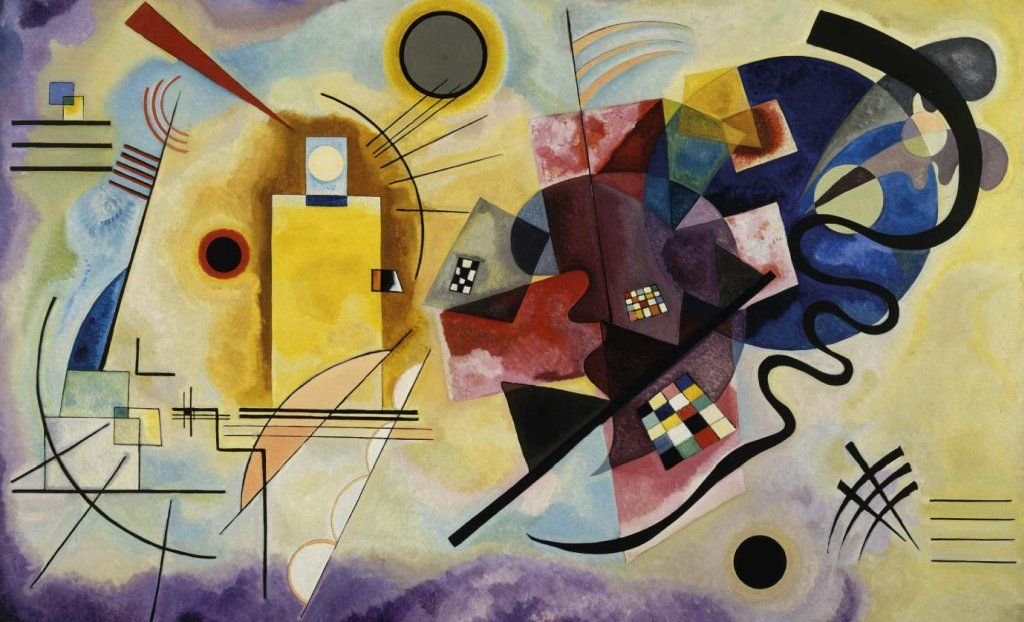
From September 15, 2026 to February 14, 2027, Palazzo Bonaparte devotes the rooms of its piano nobile to Vassily Kandinsky, the man most often named, more than anyone else, as the father of abstract painting. The show is curated by Angela Lampe, brings together more than 70 works and arises from a specific circumstance: the temporary closure for restoration of the Centre Pompidou in Paris, which has made available for loan a substantial core of paintings that normally can't be moved. That core comes largely from the bequest of Nina Kandinsky, the artist's second wife, who in 1976 donated to the Paris museum the collection that had remained in the studio.
As these lines are being put together the show has not yet opened: a few days remain until the opening, advance sales appear to have been open since May 4 and the venue's website still places it in the section of upcoming exhibitions. It's worth saying right away, because it changes how it's best to organize yourself: whoever reads now has the rare advantage of being able to choose the time slot in the first week, when attendance has not yet reached the numbers that a retrospective of this scale usually brings from October onward.
Alongside the main name there is a second: Gabriele Münter, a painter, Kandinsky's life partner for more than a decade and a central figure of German Expressionism, who according to the official presentation is being shown in Italy for the first time. The venue also speaks of more than 25 years since the last major Italian retrospective devoted to the master.
What follows serves to frame the show, to tell who the man who decided to take objects out of the painting really was, to explain how the palace that hosts it works, how much it costs to enter, how to get there, and what is worth seeing nearby, given that Piazza Venezia is probably the densest point of layering in all of Rome.
What the show is and where it takes place
The venue is Palazzo Bonaparte, Piazza Venezia 5, at the corner between the piazza and the start of Via del Corso. Since 2019 the palace has operated as an exhibition space under the name Spazio Generali Valore Cultura, in a formula that holds together the ownership, the Generali Group, and the programming, entrusted to Arthemisia. The palace's official page says it explicitly: after a major restoration, Generali Italia opened to the public a building that for almost all its history had been a private residence and then an office building.
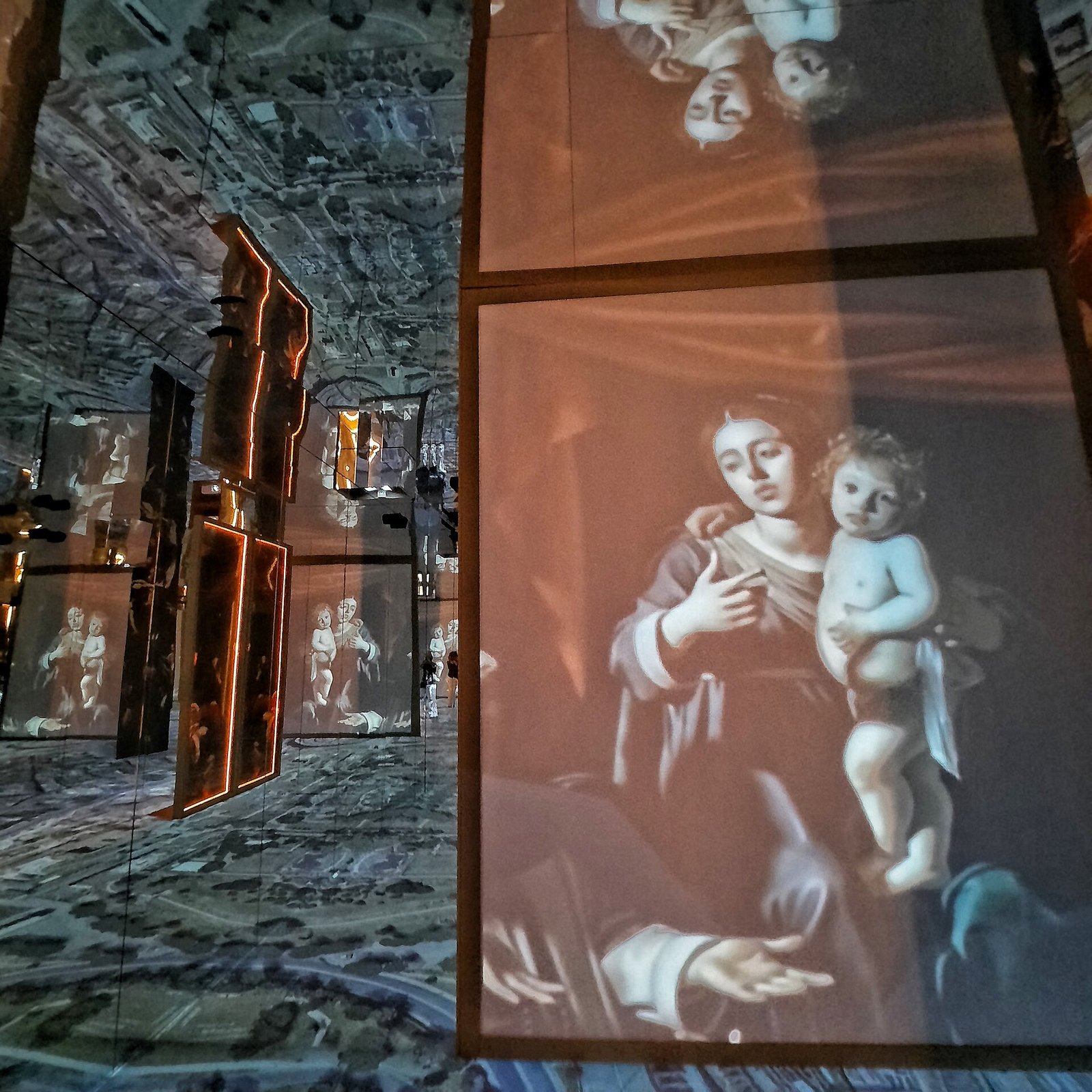
The Kandinsky show is the first big opening of the 2026 and 2027 season. The path, according to the venue's presentation, is organized in five sections and retraces the artist's whole biographical arc, from established lawyer in Moscow to protagonist of the European avant-garde. So it is not a monographic show on a single period, but a true retrospective, which tries to show how a painter arrives by degrees at a radical decision instead of taking it in one night.
Two works are cited by name in the official presentation as pivots of the path: Gelb-Rot-Blau from 1925, that is Yellow, Red, Blue, a large oil on canvas now at the Centre Pompidou, and L'Arco nero from 1912. They are the two chronological poles of an arc: the first belongs to the Bauhaus years, when geometric construction governs everything. The second to the moment when form dissolves and color runs free on the canvas. Putting them in the same path means telling two different Kandinskys who are nonetheless the same person.
Dates, hours and why timing matters
The opening and closing dates are September 15, 2026 and February 14, 2027. Five full months, with the whole season of the autumn long weekends and the holidays inside it, which in Rome means a very irregular flow of visitors.
The hours published by the venue are these: Monday to Thursday from 9:00 to 19:30, Friday, Saturday and Sunday from 9:00 to 21:00. The ticket office closes an hour earlier, and this is the detail that ruins more visits than you'd think: at 20:15 on Saturday the entrance is still open, but you can no longer buy a ticket.
The calendar of special openings published by the venue is: Sunday, November 1 from 9:00 to 21:00, Tuesday, December 8 from 9:00 to 21:00, Thursday, December 24 from 9:00 to 18:00, Friday, December 25 from 12:00 to 21:00, Saturday, December 26 from 9:00 to 21:00, Thursday, December 31 from 9:00 to 18:00, Friday, January 1 from 12:00 to 21:00, January 2 to 6 from 9:00 to 21:00, and finally February 12 to 14 with extended hours from 9:00 to 23:00. That last line deserves attention: in the final three days the show stays open until late in the evening, a practice big exhibitions adopt to absorb the final rush. Anyone running late against all their good intentions therefore has a lifeboat, but these are also the days with the highest chance of crowded rooms.
On the subject of booking, the official position is clear and worth quoting as it is worded: booking is not mandatory, but it is strongly recommended. On the busiest days, that is Saturday, Sunday and holidays, admission for visitors without a booking cannot be guaranteed. Put in practical terms: on a Sunday in November, showing up without a ticket is a gamble.
Who Vasilij Kandinsky was
The name appears written in many forms, because it passes through three alphabets and as many lives: Vasilij Vasil'evič Kandinskij in the transliteration from Russian, Wassily or Vassily in the German and French versions that the artist himself adopted. He was born in Moscow in 1866 into a well-off family, his father a tea merchant with Siberian roots, and he grew up partly in Odessa. He studied law and political economy at the University of Moscow, graduated, did research, and for a handful of years was a respected jurist with an academic career ahead of him.
The turning point came around age 30. He turned down a professorship and moved to Munich to study painting, which in the 1890s meant giving up a solid social position to start over as a student in a foreign country. He attended Anton Ažbe's private school and then the Academy, where his teacher was Franz von Stuck. He was not an early talent: he was an adult man, cultured, methodical, who set about learning a trade from scratch.
In his Munich years he founded and led groups and associations, because his idea of art always included an organizational and theoretical component. In 1901 he created the Phalanx group, which had a school attached. It was there that he met Gabriele Münter, then his student, with whom he shared more than a decade of life and work, largely in the house at Murnau, at the foot of the Bavarian Alps. In 1911 he was among the promoters of the Blaue Reiter, the Blue Rider, together with Franz Marc: not a movement with a manifesto and membership cards, but an almanac and a series of shows that put avant-garde painting, Bavarian folk art, African masks, children's drawings and musical scores on the same level.
The outbreak of the First World War broke everything. As a Russian citizen in Germany he had to leave. He returned to Moscow, separated from Münter in painful circumstances never truly mended, and in 1917 married Nina Andreevskaja. In the years immediately after the revolution he took part in the reorganization of Soviet art institutions, with posts in museums and institutes of artistic culture, before the climate turned toward positions hostile to abstraction.
In 1921 he left Russia never to return. From 1922 he taught at the Bauhaus, first in Weimar, then in Dessau, finally in Berlin, until the school was closed in 1933 under Nazi pressure. It was in those years that he wrote the second of his fundamental theoretical texts, Punto, linea, superficie (Point and Line to Plane), from 1926, and that his painting took on the geometric and measured form that many consider his signature, even though it is only one of his periods.
The last chapter is French. He settled in Neuilly-sur-Seine, at the gates of Paris, in an apartment with a studio overlooking greenery, and took French citizenship. There he worked until his death, in 1944, in an occupied France where the art he had helped found was officially branded degenerate. The works left in the studio passed to Nina, and they are largely the ones that would enter the French public collections in 1976.
A curiosity about Kandinsky, the Revolution of Abstraction at Palazzo Bonaparte
Kandinsky said more than once that he perceived colors as sounds and sounds as colors. It was not a conference metaphor: he described yellow as a blaring trumpet, blue as a cello descending toward the double bass, green as a held, motionless note. In his writings he set out a real catalog of correspondences between instrumental timbres and hues, with a precision that disconcerts anyone reading him for the first time.
From here descend the musical titles he used for entire series of paintings: Impressioni, Improvvisazioni, Composizioni. They are terms taken whole from the musicians' vocabulary, and the choice was deliberate. In the hierarchy he had in mind, the impression arose from the direct impact with external nature, the improvisation from an almost unconscious inner impulse, the composition from a long and reasoned elaboration, exactly like a symphony compared with a theme improvised at the piano.
The interesting and little understood point is that for him music had the advantage. Western music had stopped imitating anything centuries earlier: no one asks a sonata to resemble a landscape. Painting, instead, had remained bound to the obligation to represent. His ambition, declared without circumlocution, was to free painting from the same constraint, bringing it to the level of autonomy that music already possessed.
In the Roman show this theme is not a decorative detail: the official presentation puts it at the center when it speaks of paintings that must sound like a melody and act directly on the soul. Anyone who goes in knowing this looks at the canvases differently, looking for rhythms, intervals and silences instead of hidden figures.
The birth of abstraction, as it really happened
The textbook version says that in 1910 Kandinsky painted the first abstract watercolor in history and that from that moment art changed. The reality is more interesting and much less tidy.
For one thing, the dating of that sheet has been debated for decades: some scholars believe it was backdated by the artist himself, and that it actually dates from a couple of years later. For another, the idea of eliminating the recognizable subject was not born in a single head: in the same years, in different parts of Europe, other painters were arriving at similar conclusions by their own routes. Frantisek Kupka in Paris, Piet Mondrian in the Netherlands, the Futurists in Italy, the Rayonists in Russia, each with an independent path. Assigning a date and a single father to a collective phenomenon is a narrative convenience, not a historical fact.
What can be said with more solidity is how Kandinsky got there. His painting of the Munich years starts from landscapes and fairy-tale scenes of Russian ancestry, with riders, domes and mountains, painted with an increasingly bright palette. Gradually the objects lose their outlines: the rider becomes an arc of color, the hill a band, the church a vertical accent. There is no leap, there is a dissolve lasting years, and in many canvases of the period between 1910 and 1913 the figure is still there, legible to whoever knows where to look.
The text that accompanies this passage is Lo spirituale nell'arte (Concerning the Spiritual in Art), published in Munich between the end of 1911 and 1912. It is a strange book, part treatise, part manifesto, part profession of faith. The central thesis is that every form and every color produces a vibration in the soul of the viewer, and that the artist has an almost priestly responsibility in handling them. The vocabulary reflects the Theosophical and Anthroposophical climate that circulated in the Europe of the time, and this can disorient a contemporary reader: it was not parlor mysticism, it was the language with which a generation tried to say that art no longer had to serve to describe.
There is then the question of historical responsibility, which is often passed over in silence. Kandinsky did not abandon the figure out of formal whim. He did it in the decade that led Europe to the slaughter of 1914, convinced that a materialist civilization had reached the end of the line and that an art able to speak directly to the spirit was needed. His most explosive canvases are contemporary with the years in which the continent was preparing to destroy itself. Reading them as decorative exercises means missing the point completely.
Something nobody tells you about Kandinsky, the Revolution of Abstraction at Palazzo Bonaparte
The master of abstraction lived a large part of his adult life as a stateless person in fact, and his painting bears the marks of that condition more than is admitted.
Consider the concrete facts. Born a subject of the Russian empire, he built a career in Germany. In 1914 he had to leave Germany because he was Russian. In 1921 he left Russia because the new power considered his research a bourgeois remnant. In 1933 he had to leave Germany a second time, because the Nazi regime closed the Bauhaus and put abstract painting on the list of degenerate art. He obtained French citizenship a few months before France entered the war, and spent his last years under German occupation, in a country where exhibiting that kind of painting had become impracticable.
Four exiles in 30 years. Each time leaving behind works, furniture, papers, students, friendships. When he left Germany in 1914, a considerable part of the Munich output remained in Gabriele Münter's hands, and it was she who hid it during the Nazi years, physically saving it from destruction. An important portion of what is known today of that period exists because a woman with whom he had broken off relations abruptly decided to protect his paintings anyway.
The consequence on the work is visible. Kandinsky's abstraction never has the coldness of the technical utopia found in other protagonists of the same period. Even in the most geometric canvases of the Dessau period there remain traces of an imagery that comes from elsewhere: profiles that recall onion domes, arcs that resemble horse yokes, hints of horizon. Anyone who knows Russian folk art and icons recognizes some of those modules without effort. An artist who lost the ground beneath his feet four times carries with him a portable baggage, and that baggage ends up in the paintings.
What you see in the show
The number communicated by the venue is more than 70 masterpieces, belonging largely to the bequest of Nina Kandinsky, with the Centre Pompidou as the main lender. The path is divided into five sections and follows biographical order: the Russian formation, the years of Munich and the Blaue Reiter, the return home, the Bauhaus, the Paris period.
On the precise content of the rooms it is right to be cautious: the complete list of works does not appear to have been published before the opening, and the two canvases cited by name in the presentation, Gelb-Rot-Blau from 1925 and L'Arco nero from 1912, are the only ones the venue indicates explicitly. The rest will be seen on entering.
What can be anticipated, instead, is what to look for, because a retrospective of this kind works well only if you know how to read the evolution rather than the individual pieces. Here are the four phases that mark out any Kandinsky path.
The figurative and fairy-tale phase. Before 1910 the painting is full of riders, couples in costume, domes, woods and Bavarian landscapes, treated with thick impasto and bright colors. Anyone expecting abstraction from the first room is thrown off: here there are still stories.
The dissolution. Between 1910 and 1914 the forms open up. The lines become autonomous from the objects they described, the patches of color detach from the outlines, the surface fills with energy. It is the phase in which the musical titles appear and in which the canvas stops being a window and becomes a field of forces.
The geometry. From the return to Russia and throughout the Bauhaus period the painting puts itself in order. Circle, triangle, straight line and angle become the elements of an alphabet, arranged on often light grounds with an almost architectural control. Here is the most evident difference from the previous phase: where before there was explosion, now there is measure.
The Paris phase. In the last 10 years soft, organic forms appear, recalling microorganisms, embryos, biological elements seen under a microscope, immersed in grounds of tender color. Many visitors don't associate them with the name they have in mind, and they are among the most surprising things to see in person.
To these four phases the Roman show adds the chapter on Gabriele Münter, presented as a previously unseen focus. In terms of display it means that in at least part of the path you will look at two painters, not one.
Gabriele Münter, the name beside
For decades Münter was cataloged as Kandinsky's companion, with her painting reduced to a footnote. The revision of this judgment has been under way for some time, with monographic shows of international standing, and the official presentation of the Roman show describes her as a fundamental figure of Expressionism, shown in Italy for the first time.
A few useful elements for understanding why it matters. Münter came to painting from a training that included photography, practiced seriously during a long trip to the United States, and that photographic eye can be recognized in her framing: sharp crops, close-ups, wide fields bounded by dark outlines. Her work was not a softened version of Kandinsky's, it was something else, more tied to the figure, the portrait and the landscape, with a capacity for chromatic synthesis that many contemporaries acknowledged in her.
A useful note for those who photograph or study: Münter died in 1962 and in Italy economic rights last 70 years from the author's death, so her works are still protected, while those of Kandinsky, who died in 1944, have passed out of that term.
The advice I give you for visiting Kandinsky, the Revolution of Abstraction at Palazzo Bonaparte
The advice is only one and it is worth more than all the others put together: walk through the rooms twice, and the second time in reverse.
The reason is simple. A retrospective built in chronological order leads the viewer to treat the first rooms as a premise to get through to reach the famous Kandinsky. The result is that you cross the figurative phase absent-mindedly and arrive at the circles and triangles without having in mind where they come from. Retracing the path backward, with the geometries still in your eyes, the Bavarian landscapes and the riders of the first room change meaning completely: you see the arcs, the rounds, the diagonals already present under the figure. The second pass takes a quarter of the first and is worth double.
I add three practical tips that make a difference in a crowded show.
Choose the right time slot. With opening at 9:00 every day, the first hour of a weekday morning is the best window of all. The second best is the evening tail of Friday and the weekend, when closing at 21:00 pushes the peak forward: from 19:00 on the rooms thin out, always remembering that the ticket office closes at 20:00.
Use the audio guide, which appears to be included in the ticket. The official ticket information lists the audio guide as free. In a show where the biographical context explains a good part of the painting choices, having the commentary in your headphones saves you from queuing in front of the panels.
Distance and then closeness. In front of a large-format abstract canvas the first look should be from afar, five or six meters, to grasp the overall balance of the masses. Only afterward is it worth stepping closer for the surface, the glazes, the pentimenti. Doing the opposite, that is starting from the detail, is the surest way to leave with the feeling of not having understood anything.
Palazzo Bonaparte as a venue
The building dates from the 17th century. The date given by the palace's official chronology is 1657, with the design by Giovanni Antonio De Rossi for the Marchesi d'Aste. The facade combines the Baroque vocabulary with a composure of layout that is more late Renaissance, and anyone passing through Piazza Venezia recognizes it by the curved front that faces the intersection with Via del Corso. Around 1760 the property passed to the Marchesi Rinuccini, a Florentine family.
The name it bears today arrives in 1818, when Letizia Ramolino Bonaparte, Napoleon's mother, bought it for 27,000 gold piastres and made it her home. She lived there until her death, in 1836, by then in her eighties and largely withdrawn. Since then the building has been Palazzo Bonaparte to everyone, even though it later changed owners several times: in 1905 it passed from the Princes of Canino and Musignano to the Marchesi Misciattelli of Orvieto, and in 1972 it entered the holdings of INA Assitalia, a company of the Generali Group, which has remained its owner.
There is an object that connects the palace directly to the Napoleonic story: one of the plaster copies of Antonio Canova's Mars the Peacemaker, the colossal statue that portrays Napoleon in heroic nudity, is located on the piano nobile. The marble original, by an ironic twist of history, is at Apsley House in London, that is in the residence of the Duke of Wellington, the man who closed the game at Waterloo.
For a visitor, the fact that a major show is held in a historic residence and not in a museum built for the purpose has practical consequences. The rooms are those of a noble apartment: a sequence of spaces in enfilade, decorated ceilings, tall windows overlooking the piazza. The path develops vertically, with an elevator to reach the floors. Don't expect the neutral spaces of a white cube: here the container shows, takes part, and in a show devoted to color this is one more element to take into account.
Maria Letizia Ramolino's little green balcony
The palace's best-known detail is a closed little veranda, painted green, that juts out at the corner between Piazza Venezia and Via del Corso, a few meters above the ground. The venue's official description tells it plainly: the palace is known for its little green balcony, from which Maria Letizia Ramolino, mother of Napoleon Bonaparte, watched the comings and goings through the slits of the little veranda.
It is worth dwelling on this image, because it tells of a precise condition. Letizia arrived in Rome after her son's fall, under the pope's protection, in a position halfway between illustrious guest and special watched person. Going out was complicated, and her world gradually shrank to those rooms. The closed veranda with its slits was the compromise: seeing without being seen, following the life of the noisiest city in Europe while staying inside.
One last note of atmosphere, reported by the venue's chronology as a handed-down tale and not as a documented fact: it is told that on the night of May 5, 1821 a mysterious visitor appeared to Letizia announcing that at that very moment Napoleon was freed from his sufferings, and then vanished. That night, on Saint Helena, Napoleon really died. The official chronology presents the episode as a legend, and as such it should be taken.
Another well-known fact, yet rarely mentioned
Everyone knows that Piazza Venezia is the center of Rome. Far fewer know that Palazzo Bonaparte is the only building on the piazza that remains substantially as it was before the piazza was invented.
The piazza you cross today is little more than a century old. Until the end of the 19th century the space in front of Palazzo Venezia was much smaller and enclosed, an irregular crossing between the Corso and the streets that climbed toward the Campidoglio, with dense blocks where there is now emptiness. Then came the Vittoriano, whose first stone was laid on March 22, 1885 by Umberto I to a design by Giuseppe Sacconi, and Sacconi himself redesigned the whole piazza to make room for the monument. Whole blocks, alleys, churches and houses disappeared. Part of the building fabric was demolished and rebuilt farther back, and in 1906 the Palazzo delle Assicurazioni at number 11 was inaugurated, designed expressly to echo the style of the 15th-century Palazzo Venezia directly opposite, so as to create two symmetrical wings.
In the midst of this operation of urban surgery, Palazzo Bonaparte stayed where it was and as it was. It was not set back, not redone in a different style, not absorbed. The result is that De Rossi's 17th-century building, with its curved facade and its little veranda, is the only point on the piazza where you see the layout that preceded the great reorganization: everything else around it is 19th-century, 20th-century or completely reinvented.
There is a consequence that directly concerns the show. The palace is not set back from the street line like its neighbors, so it sits closer to the traffic and to the level of the piazza. Anyone who comes out after two hours of abstract painting finds themselves immediately in the noisiest and busiest spot in the city, with no buffer zone. It is a contrast worth planning for, and further on we will say where to go to absorb it.
Tickets and access
Advance sales appear to have been open since May 4. The venue strongly recommends buying in advance and notes that tickets can also be bought on site, but that in that case entry may involve waits to respect the rooms' safety capacities.
This is the fare framework published by the venue for the show, with a free audio guide included in the admission ticket.
Full price €18.00. The full fare.
Reduced €17.00. Reserved for those who have turned 70, with ID. For young people from 11 to under 18. For members of the law enforcement forces. For people with disabilities. For journalists with a National Order card, professional, trainee or freelance. For holders of the Arthemisia Card and holders of a ticket for the organizer's other current shows.
Atac reduced €16.00. For those with the annual Metrebus Card pass, valid Monday to Friday excluding holidays, purchasable only at the ticket office by showing the annual card and an ID.
Generali agreement reduced €16.00. For employees and agents of the Generali Group, customers with personal documentation and shareholders.
University students reduced €15.00. Every Tuesday, holidays excluded, for all university students with no age limit. It is the most interesting reduction for those who can choose the day, because it sets no age ceilings.
Special reduced €10.00. For licensed guides who are not accompanying a group.
Trenitalia reduced €13.50. For those holding a Frecciarossa, Frecciargento or Frecciabianca ticket with destination Rome, dated up to two days before entry. It is purchased exclusively at the show's ticket office, the travel ticket must be shown at the entrance and allows you to skip the line. Reductions cannot be combined.
Children reduced €8.00. From 4 to under 11.
Open ticket €22.00. Allows entry without fixing a date and time slot, on a day of your choice from the day after purchase, without communicating anything in advance. Beware of a clause that is often overlooked: the Open ticket can be used no later than February 8, so it does not cover the last days of the show.
Group reduced €16.00. Booking mandatory, minimum 10 and maximum 20 people, microphone system mandatory.
School reduced €7.00. Booking mandatory, maximum 25 people, microphone system mandatory for secondary schools.
Free. Children under 4. One companion or guide for each booked group. Two teachers for each school group. ICOM members, with the ticket to be collected at the cash desk and without the right to skip the line. One companion per person with a disability. Holders of invitation coupons. Holders of the Arthemisia Vip Card. Journalists with a National Order card on duty, with accreditation requested by the newsroom at the organizer's press address.
To the prices must be added the booking and advance-sale fees: €1.50 per person for groups and individuals, €1.00 per student for school groups, plus any agency fees.
For guided tours the published rates concern groups: €120.00 for adult groups in Italian and €130.00 in a foreign language, €90.00 for school groups in Italian and €100.00 in a foreign language, with the ticket fare excluded and booking mandatory. The microphone system, mandatory for adult groups and secondary schools with an outside guide lacking their own equipment, costs €20.00 per group. For individual visitors there are guided tours by aggregation, with a calendar and advance purchase on the sales channel indicated by the venue.
A note for teachers and for those entitled to culture cards: purchase with the teacher bonus and culture cards, according to the official information, is possible exclusively through the online sales channel indicated by the venue, not at the ticket office.
On conduct in the show, the published rules are precise. Bags and bulky objects must be left at the cloakroom, which is free. Small bags may enter after a check of the contents. Smoking is forbidden, including e-cigarettes. Using flash is forbidden. Filming with tripods or professional equipment without prior authorization from the management or the press office is forbidden, even on a personal basis. Making phone calls inside the exhibition spaces is forbidden. Eating and drinking in any interior room of the palace is forbidden. Animals cannot enter, with the exception of pet therapy dogs and guide dogs in case of disability, in both cases upon showing suitable documentation.
One last rule that makes many lose their entry: whoever has booked must arrive on time and in any case no more than five minutes early compared with the time indicated. Arriving half an hour early hoping to get in right away doesn't work, and arriving late can mean not getting in at all.
Accessibility
The official accessibility information is detailed and worth reporting precisely, because in a historic palace the difference between accessible and practicable is played out in the details.
The palace is listed as accessible to visitors with disabilities. Those using their own wheelchair can reach the main entrance at Piazza Venezia 5 in complete independence. Inside, according to what is declared, there are no difficulties in visiting all the rooms of the show and reaching the restrooms. The staff at the entrance indicate the route to the elevator. The restrooms for people with disabilities are on the second floor, so using the elevator is a normal part of the visit and not an exception.
Those who need a wheelchair can tell the staff at the entrance, who will take steps to provide one if available. The wording used is exactly this, that is availability is not guaranteed in advance. In case of a loan, an ID document is temporarily held and the staff accompany the visitor to the elevator that leads to the floors. Anyone who doesn't want to take risks on a crowded day does well to phone the venue's number first.
On the fare side, visitors with disabilities are entitled to the reduced ticket. They may be asked to show the certificate under Law 104 of 1992 or, for foreign visitors, an equivalent certification. Free admission, where provided, extends to the companion of people who are not self-sufficient and carries the right to skip the line. In these cases the ticket is bought directly on the day at the palace ticket office.
For guide dogs, as said, access is allowed with suitable documentation, along with dogs used in pet therapy.
Two observations that the official information does not cover and that it is honest to flag as such. The first concerns crowding: in a heavily visited show, moving by wheelchair through the rooms of a historic residence with passages in sequence is distinctly easier in the early hours of a weekday morning. The second concerns arrival: Piazza Venezia is a complicated traffic hub, and anyone arriving by car with a disability permit would do well to check the parking conditions in the area in advance, because the zone is a limited traffic zone and the situation of reserved spaces in the immediate vicinity changes over time.
The right photo to take at Kandinsky, the Revolution of Abstraction at Palazzo Bonaparte
Let's start with what not to do. Inside, flash is forbidden, tripods and professional equipment require prior authorization, and Münter's works are still covered by rights. So the interesting photography, in this case, is almost all outside.
The photo worth taking is the little green balcony at the corner. It should be sought from the opposite sidewalk, on the side of the Palazzo delle Assicurazioni, with a medium telephoto lens or simply with the phone's zoom, so as to compress the plane and isolate the little veranda from the facade. It works because that emerald green, against the travertine and ocher of the building, is the only strong chromatic accent of the whole corner, and it is exactly the kind of relationship between color and surface that you have just finished looking at in the show.
The hour matters a great deal. At mid-morning the front receives direct light and the green saturates. In the late autumn afternoon the facade goes into shade while the Vittoriano behind remains lit, and the little veranda stands out like a dark patch on a light ground. Two opposite images, both valid.
The second framing to take home is the one that puts together the corner of the palace and the start of Via del Corso. You position yourself to have the curved facade on the left and the straight vanishing line of the street disappearing toward the north: it is the perspective from which you understand why that window was such a coveted observation point, with the horse race arriving right from there.
A recommendation that seems obvious and is not: photos in Piazza Venezia are taken from the sidewalk, never from the crossings. It is an intersection where buses, trams, taxis and private traffic converge from six directions, and the temptation to step back one pace to frame better is the most common way of ending up in the middle of the roadway.
Some important events that happened here in history
Few facades in Rome have witnessed so much history at close range. This is an essential selection, drawn from the chronology published by the palace's owner.
From the 15th century. Along the street that passes under these windows the Palio dei Barberi was run, a race of horses launched without riders that for centuries was the culminating moment of the Roman Carnival. The decisive phase, when the animals were stopped with nets in the alley of the Ripresa dei Barberi, took place a few meters from here.
1657. Giovanni Antonio De Rossi designs the building for the Marchesi d'Aste.
Around 1760. The palace passes to the Marchesi Rinuccini of Florence.
1803. Antonio Canova creates Mars the Peacemaker, a neoclassical portrait of Napoleon. One of the five plaster copies is still today on the palace's piano nobile.
1818. Letizia Bonaparte buys the building for 27,000 gold piastres and gives it the name it still bears.
1821. On the night of May 5, according to the handed-down tale, an unknown visitor announces to Letizia that her son is free from his sufferings. It is the night in which Napoleon dies on Saint Helena. The official chronology presents it as a legend.
1836. Madama Letizia dies in her rooms at Piazza Venezia 5.
Around 1850. Gas lighting arrives in Piazza Venezia before the rest of Rome, and at night it lights this facade too.
1861. On March 17 Victor Emmanuel II is proclaimed king of Italy. In Rome, still under papal government, the spontaneous celebrations are repressed with arrests and searches.
1870. Breach of Porta Pia. Rome is annexed to the Kingdom of Italy and becomes its capital.
1885. On March 22 Umberto I lays the first stone of the Vittoriano. The winning design is by Giuseppe Sacconi.
Late 19th century. Sacconi redesigns the whole piazza around the monument. Palazzo Bonaparte remains intact.
1905. The Princes of Canino and Musignano, heirs of the family, sell to the Marchesi Misciattelli of Orvieto.
1906. The Palazzo delle Assicurazioni at number 11 is inaugurated, built to echo the 15th-century Palazzo Venezia opposite.
1911. On June 4 Victor Emmanuel III inaugurates the Vittoriano, 26 years after the first stone, in conjunction with the International Exposition for the 50th anniversary of Unification.
1921. The Unknown Soldier is interred at the center of the Vittoriano staircase, on November 4, in memory of the more than 600,000 fallen of the First World War.
1936. On May 9 Mussolini proclaims the birth of the Empire from the balcony of Palazzo Venezia, that is from the building that closes the piazza on the opposite side.
1944. On the evening of June 4, after nine months of occupation, Rome is liberated by the Allies. It is also the year Kandinsky dies at Neuilly-sur-Seine, on December 13.
1948. On June 2 the Festa della Repubblica is celebrated for the first time. President Luigi Einaudi pays homage at the tomb of the Unknown Soldier.
1953. Audrey Hepburn, star of Roman Holiday opposite Gregory Peck, directed by William Wyler, passes in front of the palace on the Vespa.
1960. Alberto Sordi, in the role of the protagonist of Luigi Zampa's Il Vigile, directs traffic from the post at the intersection with Via del Corso, a few meters from the entrance.
1972. The palace enters the holdings of INA Assitalia, of the Generali Group.
2019. After a major restoration, Generali Italia opens the building to the public as the first Generali Valore Cultura space, with programming entrusted to Arthemisia. The first big show is devoted to Impressionism.
Who has passed through Kandinsky, the Revolution of Abstraction at Palazzo Bonaparte
The show has yet to open, so the list of illustrious visitors will be a matter for the coming months. It makes sense, though, to look at the question from two different sides, and in both cases the answer is dense.
Who has passed through these rooms. Letizia Ramolino lived here for the last 18 years of her life, and in those rooms she received for decades the flow of relatives, exiles, diplomats and curious people that revolved around the Bonaparte name in Rome. After her the palace passed to the Princes of Canino and Musignano, a branch of the family tied to Lucien Bonaparte, and then to the Misciattelli. In the 20th century it became the seat of insurance offices, which means thousands of people who worked for decades behind those windows without anyone being able to go in and see them. Since 2019, with the reopening to the public, the major monographic shows have passed through the piano nobile, bringing a mass public back into these rooms.
Who passed beside Kandinsky. His personal address book is a piece of 20th-century art history. In Munich he worked with Gabriele Münter, Alexej von Jawlensky and Marianne von Werefkin, all four linked by the Murnau season. With Franz Marc he built the Blaue Reiter almanac, and around that enterprise revolved August Macke and Paul Klee. With Arnold Schönberg, the composer who was demolishing tonality in the same years in which he was demolishing the figure, he had an exchange of letters and a friendship that is one of the most fascinating documents of the period: two men arriving at the same conclusion from two different arts and noticing it by reading each other.
At the Bauhaus his colleagues were called Paul Klee, with whom he shared for years a semi-detached house in Dessau, Laszlo Moholy Nagy, Josef Albers, Oskar Schlemmer, under the direction first of Walter Gropius and then of Ludwig Mies van der Rohe. In Paris, in the 1930s, he frequented the avant-garde circles in which Joan Miro, Jean Arp, Robert and Sonia Delaunay, Constantin Brancusi and Marcel Duchamp moved.
Finally the person without whom this show would not exist: Nina Kandinsky, married in 1917, custodian of the studio and the works after 1944, and author of the 1976 donation that brought the corpus into the French public collections. The official label of one of the works in the show, Gelb-Rot-Blau, cites her explicitly as donor. Without that decision, a loan of this breadth would not be materially possible.
What's around Piazza Venezia
Stepping out of the doorway you find yourself at the point where Rome changes nature at every corner. Here is how to move if you don't want to merely cross the piazza to reach the stop.
On the spot. Opposite, the Altar of the Fatherland fills the whole backdrop of the piazza, with the tomb of the Unknown Soldier and the monumental staircase. Inside the complex, the Ala Brasini hosts exhibition spaces that often have their own programming. On the opposite side of the piazza, the National Museum of Palazzo Venezia occupies the 15th-century building that gave its name to everything else.
Climbing to the Campidoglio. To the right of the Vittoriano starts the Capitoline Cordonata, the ramp designed by Michelangelo that leads up to the Capitoline Hill, and from there you enter the Capitoline Museums. Beside the Cordonata, the much steeper staircase climbs to Santa Maria in Aracoeli. The combination of a retrospective on abstraction in the morning and Capitoline Rome in the afternoon is a brutal pairing in the best way. A little farther, Trajan's Markets give the view from above over the whole complex of the Imperial Forums, and from there you continue toward the Colosseum.
Toward the Tridente. Taking Via del Corso you enter the straight stretch that reaches Piazza del Popolo. After a few hundred meters, on the right, the Galleria Alberto Sordi offers a stop under cover, and farther on open Piazza Colonna and the side streets that lead toward the Pantheon. On the same axis, a little to the east, are the Trevi Fountain and the small, surprising Galleria Sciarra, a Liberty-style courtyard entirely painted that most passersby ignore.
To stay on art. Less than five minutes' walk along the Corso, the Galleria Doria Pamphilj holds one of the most important private collections still in their original place in Europe. Anyone who wants to build an entirely 20th-century day can instead look to the Palazzo delle Esposizioni and the Scuderie del Quirinale, a quarter of an hour's walk uphill, both venues of big temporary shows. For archaeological finds, the Crypta Balbi tells the story of urban layering better than any panel.
On the venue's general page, regardless of the show on view, the reference remains Palazzo Bonaparte.
How to get there
The address is Piazza Venezia 5, and the worst way to reach it is the private car. The piazza is the hub where almost all the traffic of the center converges, the zone is subject to restrictions and street parking in the immediate vicinity is practically nonexistent.
Bus. It is the natural means: Piazza Venezia is served by a high number of city lines arriving from all directions, and the stop is a few meters from the doorway.
Metro. The piazza has no active station of its own on the historic lines. The most common solution is Line B getting off at Colosseo and about 10 minutes on foot along Via dei Fori Imperiali, or Line A getting off at Barberini or Spagna and a longer walk. Works on Line C have been under way in the area for years, periodically changing pedestrian routes and street-level stops: it's best to check the situation the day before leaving.
Train. From Termini you arrive with direct buses in a few minutes, or on foot in about 20 minutes via Via Nazionale. Those arriving by high-speed train should remember the dedicated reduction described above, purchasable only at the ticket office.
On foot. From the Pantheon it is about 10 minutes, from the Trevi Fountain a little more, from the Colosseum a good quarter of an hour. For those staying in the historic center, walking remains the most efficient choice.
Quick questions
When does the show open?
September 15, 2026. It closes on February 14, 2027.
Where is it?
At Palazzo Bonaparte, Piazza Venezia 5, Rome.
Who curated the show?
Angela Lampe, according to what the venue indicates.
How many works are there?
More than 70, in five sections.
Where do they come from?
Largely from the Centre Pompidou in Paris, which was able to grant a substantial core of loans thanks to the temporary closure for restoration, as well as from other international institutions. The corpus is largely that of the bequest of Nina Kandinsky.
How much is the full ticket?
€18.00, with a free audio guide included, plus the advance-sale fees.
Is there a ticket without a fixed date?
Yes, the Open ticket at €22.00, usable on a day of your choice starting from the day after purchase, but not beyond February 8.
Do I need to book?
It is not mandatory, but it is strongly recommended. On weekends and holidays admission for those without a booking is not guaranteed.
What are the hours?
Monday to Thursday from 9:00 to 19:30, Friday, Saturday and Sunday from 9:00 to 21:00. The ticket office closes an hour earlier.
Are there special openings?
Yes, on holidays in November, December and January, and extended hours until 23:00 from February 12 to 14.
Can I take photographs?
Filming with flash is forbidden, as are tripods and professional equipment without prior authorization.
Is there a cloakroom?
Yes, and it is free. Bags and bulky objects must be left there.
Is it suitable for children?
Yes. The children's reduced fare covers the range from 4 to under 11, admission is free under 4 and the venue offers activities for families by aggregation.
Is it wheelchair accessible?
Yes. The main entrance can be reached independently, the rooms can be visited, the elevator serves the floors and the dedicated restrooms are on the second floor.
How much time does the visit take?
For a retrospective of more than 70 works in five sections, an hour and a half is the reasonable minimum. Two and a half hours also allow the second pass in reverse recommended above.
How far is it from the Colosseum?
About a quarter of an hour on foot along Via dei Fori Imperiali.
Frequently asked questions about Kandinsky, the Revolution of Abstraction at Palazzo Bonaparte
When does the Kandinsky show at Palazzo Bonaparte open?
The show Kandinsky, la rivoluzione dell'astrazione opens at Palazzo Bonaparte on September 15, 2026 and closes on February 14, 2027, for a total of five months that include the whole season of the autumn long weekends and the holidays.
Where is Palazzo Bonaparte?
Palazzo Bonaparte, the venue of the Kandinsky show, is at Piazza Venezia 5, at the corner between the piazza and the start of Via del Corso. Since 2019 the palace has operated as an exhibition space under the name Spazio Generali Valore Cultura.
How much is a ticket for the Kandinsky show?
The full ticket for the Kandinsky show at Palazzo Bonaparte costs €18.00, with a free audio guide included. There is also a reduced ticket at €17.00 and a reduction for university students on Tuesday at €15.00. Advance sales have been open since May 4.
What are the hours of the Kandinsky show?
The show keeps these hours: Monday to Thursday from 9:00 to 19:30, Friday, Saturday and Sunday from 9:00 to 21:00. The ticket office closes an hour before the show closes.
Who curated the Kandinsky show at Palazzo Bonaparte?
The show is curated by Angela Lampe, according to what the venue indicates, and presents more than 70 masterpieces belonging largely to the bequest of Nina Kandinsky, with the Centre Pompidou in Paris as the main lender.
Is Palazzo Bonaparte accessible to people with disabilities?
Yes, Palazzo Bonaparte is listed as accessible to visitors with disabilities: those using their own wheelchair can reach the main entrance at Piazza Venezia 5 in complete independence.
How do you get to Palazzo Bonaparte?
Palazzo Bonaparte is at Piazza Venezia 5, a hub served by a high number of city bus lines arriving from all directions. The private car is not recommended because street parking in the area is practically nonexistent.
Who was Vasilij Kandinsky?
Vasilij Kandinsky, to whom the Palazzo Bonaparte show is devoted, was born in Moscow in 1866 into a well-off family and grew up partly in Odessa, before studying law and political economy and becoming one of the pioneers of abstract art.
Before you leave the house
To sum up the essentials: a retrospective on Vassily Kandinsky at Palazzo Bonaparte, Piazza Venezia 5, from September 15, 2026 to February 14, 2027, curated by Angela Lampe, more than 70 works in five sections, with a chapter devoted to Gabriele Münter. Full price €18.00 with audio guide included, Open €22.00 valid until February 8, university students reduction on Tuesday at €15.00. Open every day from 9:00, closing at 19:30 Monday to Thursday and at 21:00 Friday to Sunday, ticket office closed an hour earlier. Booking not mandatory but strongly recommended, especially on weekends. Cloakroom mandatory for large bags, no flash, no tripods without authorization. Arrive by bus or on foot, car not recommended.
Two things are worth more than all the others. The first: the time slot matters more than the day. The first hour of a weekday morning and the last hour of the long evenings are the moments when an installation like this is truly looked at, instead of being crossed in single file. The second: before leaving, the source to consult for prices, hours, special openings and access rules remains the venue's official website, because these are exactly the pieces of information that change over five months of programming.
If you're looking for other itineraries in Rome and Italy, practical guides and travel ideas built by someone who works in the field, you'll find everything on ItalyPlanner. If instead you need a licensed guide, a tour leader or professional assistance for a group, the reference is TourLeaderPro.