Lateran Palace
In short. You can enter the Lateran Palace today only by booking a date and time through the Opera Romana Pellegrinaggi circuit: €14 with an audio guide, €18 with the guided tour at 15:00, Monday to Saturday between 9:00 and 17:00, entrance from…
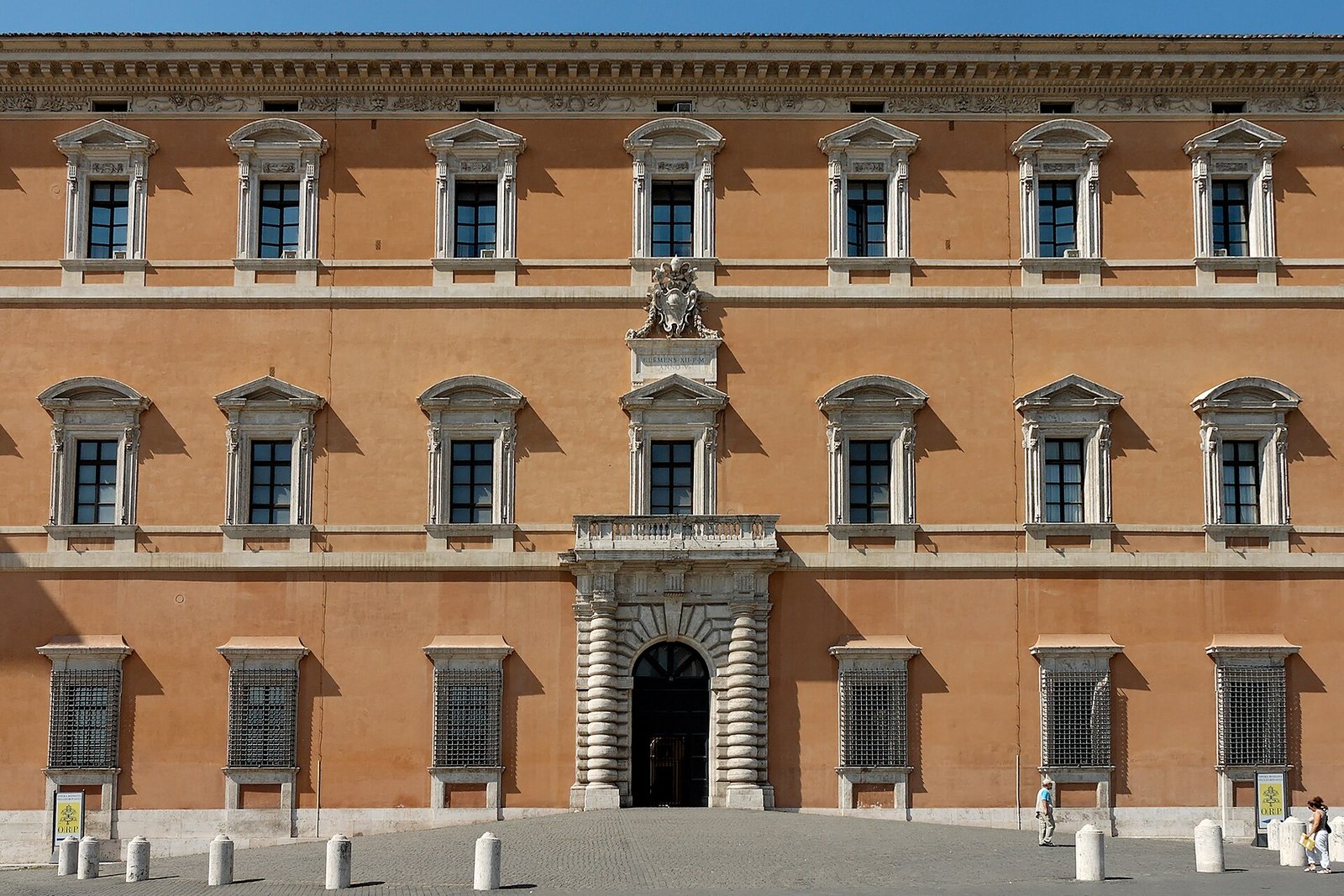
You can enter the Lateran Palace today only by booking a date and time through the Opera Romana Pellegrinaggi circuit: €14 with an audio guide, €18 with the guided tour at 15:00, Monday to Saturday between 9:00 and 17:00, entrance from Piazza di San Giovanni in Laterano, 00184 Rome, next to the Basilica of St. John Lateran. On Sundays and religious holidays the palace is closed. The route covers the piano nobile: 10 state rooms, the papal apartment and the private chapel.
The rest of the building is not a museum. It is the seat of the Vicariate of Rome, the offices through which the pope's diocese governs the city, with its address at number 6/a of the same square. The palace you see is the one Domenico Fontana built for Sixtus V between 1585 and 1589, and on February 11, 1929, in one of its rooms, the Lateran Pacts between the Holy See and the Kingdom of Italy were signed.
Data checked on September 29, 2026 on the website of the Basilica of St. John Lateran, on the Palazzo Lateranense pages published by Opera Romana Pellegrinaggi, on the Vatican Museums website and in the yearbook of the Italian Episcopal Conference. The Vatican Historical Museum, which for years occupied part of the palace, no longer exists as a route at the Lateran: the Vatican Museums report its closure in 2013 and the redistribution of its collections to other sites, described further on.
At a glance: address, hours, ticket
- Address: Piazza di San Giovanni in Laterano, 00184 Rome, the palace next to the basilica. The Vicariate is at number 6/a.
- Visit operator: Opera Romana Pellegrinaggi (Omnia circuit), email info@palazzolateranense.com, phone +39 06 69896.1.
- How to get in: by mandatory reservation of date and time only, with an audio guide or with a guided tour.
- Price: audio guide €14, €12 for ages 6 to 17 and EU students aged 18 to 25. Guided tour €18, reduced €14.
- Hours: Monday to Saturday 9:00-17:00, guided tour at 15:00. Closed on Sundays and religious holidays.
- Getting there: Metro A, San Giovanni stop, about five minutes on foot according to the operator.
- Accessibility: route declared accessible, with elevators for those with mobility difficulties.
Where it is and what you actually see
The palace closes off the northern side of the Lateran complex. Looking at the square with the Lateran obelisk, you have the palace's large squared facade in front of you and, next to it, the side of the basilica. The baptistery is on the same square, a little further on. The Holy Stairs is on the other side of the street, toward the east. You can walk around all of it in a few minutes, with no need for transport.
Inside, the route open to the public covers the first floor, the piano nobile. The official sources speak of 10 rooms covering almost 3,000 square meters, with decorated vaults and ceilings, the private apartment of the bishop of Rome, a bedroom, a library, the private chapel and the room where the Pacts were signed. The operator names, among others, the Sala di Costantino, the Sala di Salomone and the Sala degli Apostoli.
The heart of the route, for anyone who arrives with a minimum of historical curiosity, is the Sala della Conciliazione. Here are kept the large table and the eight Oriental chairs in carved mahogany used for the signing, together with a gilded bronze writing set. The wooden ceiling is by Cesare Santarelli, dated 1589. On the walls, the official source describes the figures of 23 pontiffs, from Peter to Sylvester I, and scenes linked to Sixtus V.
Don't expect a picture gallery or display cases with ancient finds. The Historical Museum, which for years occupied part of the palace, left in 2013, and its collections can now be seen in the Vatican and at Castel Gandolfo. What remains is the building itself: the sequence of state rooms of a late sixteenth-century pope, with the furnishings and decorations that the official sources describe. It is a short visit, about an hour.
The visit unfolds in a few steps. On arrival you go to the reception desk with your reservation, you activate the audio guide on your own phone or wait for the guide, and you go up to the piano nobile, with elevators available to those who need them. The rooms are crossed in sequence. The operator also includes assistance and supervision in the price, and the online reseller mentions a multilingual booklet describing the route.
A curiosity about the Lateran Palace
The writing set used on February 11, 1929 was already almost 80 years old. The basilica's official source attributes it to Ignazio Borgognoni and dates it to 1850: gilded bronze, an object from the age of Pius IX, when the Papal State still existed and nobody imagined the breach at Porta Pia. With that set they signed the agreement that closed the question opened by the very end of that State.
There is a second coincidence, less well known. The table stands in a room with the figures of 23 popes, from Peter up to Sylvester I, that is, up to the pontiff under whom, according to the same source, the first Lateran palace was completed and inaugurated in 324. The 1929 signing therefore took place under the eyes of the popes of the age of persecutions and of the Constantinian peace, a coincidence worth noting while you look at the table.
The eight mahogany chairs are described as Oriental by the source. The data doesn't clarify who commissioned them or where they come from, and the operator doesn't say. It's worth looking at them carefully during the visit: together with the table, they are the only furnishing in the room that the public documentation explicitly links to the ceremony. The furnishings of the other rooms are described in generic terms.
Something nobody tells you about the Lateran Palace
Entering the palace you don't leave Italy, but you don't enter Vatican City either. The Pacts signed in these rooms, besides granting sovereignty to the Vatican State, recognized for the Lateran complex an extraterritorial status. In practice it is Italian territory on which the Holy See enjoys the immunities that the treaty guarantees. There is no border, there are no border controls, and the square remains a square of Rome.
The second thing people tend to ignore concerns the real use of the palace. Sixtus V rebuilt it as a summer residence, but the basilica's same official source calls that reconstruction more symbolic than real: the popes, back from Avignon, had by then chosen the Vatican. In 1794 the building was entrusted to the Hospice of San Michele. A papal palace, for long periods, did something else.
Third thing: the palace works. From 1977, according to the account published by the basilica, Paul VI reorganized the Vicariate there, giving shape to John XXIII's idea of gathering the diocesan administration near the cathedral. The rooms you can visit are one part of a building full of offices. That is why the hours are those of an institution, religious holidays are closed days and the route doesn't extend beyond the piano nobile.
Finally, there is a calendar detail. Until December 13, 2021 the piano nobile was not open to ordinary visits, and guides printed before that date may describe the palace as closed or as home to the Historical Museum alone. Both pieces of information are now wrong: the museum is gone, while the state rooms can be visited. It's wise to distrust any description that doesn't take this change into account.
From the Patriarchio to the palace of Sixtus V
The first palace, the Patriarchio, was born with Constantine's choices. The basilica's website places the area where the Domus Faustae stood, belonging to the emperor's wife, and a Severan-era barracks for the guard soldiers. The complex was completed and inaugurated in 324, under Sylvester I. For about 1,000 years, with interruptions and reconstructions, it was the residence of the popes and the place of their banquets and formal meetings.
The decline has precise dates. In 896 an earthquake severely damaged the Lateran buildings. The fires of 1307 and 1361 did damage that the sources describe as irreparable. Meanwhile, from 1309, the papal seat had moved to Avignon with Clement V. When Gregory XI returned to Rome, the pontifical residence moved to the Vatican, where the popes settled from 1377. The Patriarchio remained, used less and less and more and more ruined.
In 1585 Sixtus V arrived. According to the official source he decided to restore the palace and make it a summer residence, also to give visible strength to the decrees of the Council of Trent. The encyclopedic sources add that he had what remained of the medieval building demolished. The commission went to Domenico Fontana, and work began in June 1585. The model, according to the same sources, was Palazzo Farnese, visible in the squared mass and the regular facade.
Fontana's building site closed in May 1589 and the palace was inaugurated at the end of the same month. On the dates the sources don't entirely agree: the encyclopedia entry indicates a first use as a summer papal residence already from 1586, while the official source dates the inauguration to 1589. The ceiling of the Sala della Conciliazione, signed by Cesare Santarelli in 1589, coincides with the end of the works. Sixtus V died the following year, in 1590.
After the Sistine season the palace changed owner and function several times. In 1794 it was entrusted to the Hospice of San Michele, and in 1810 Giovanni Battista Ottaviani started a series of restorations. The twentieth century brought it back to the center with the signing of the Pacts, then with the interventions of John XXIII and Paul VI, up to the reopening wanted by Pope Francis. A history in fits and starts, far from the image of the always-inhabited royal palace that many people expect.
My advice for visiting the Lateran Palace
The advice is to book the first slot in the morning and put the palace before the basilica. The basilica is open every day from 7:00 to 18:30 with free entry, so it doesn't need a fixed time. The palace instead works in slots with mandatory date and time. Once that is fixed, you build the rest of the morning around it: cloister, baptistery, Scala Santa, without rushing.
Download the Vatican&Rome app first, which the operator indicates as support for the audio guide, and arrive with a charged phone. The audio guide is available in Italian, English, French, German, Spanish and Portuguese. The guided tour, on the other hand, exists only in Italian and English, at 15:00. For those who read up on the history before going in, in our opinion the audio guide is more than enough, and the four euros of difference are better spent elsewhere.
Watch what you wear. The sales conditions of the official site exclude entry with sleeveless clothing, clothing that is too low-cut or shorts above the knee, and provide for refusal for tattoos or symbols considered offensive to Catholic morals. In summer the risk of being refused entry is real. A scarf or a light shirt in your bag solves the problem for the basilica too.
One last point: don't book the palace thinking you will find the Vatican Historical Museum there. Several guides and travel sites still place it here, but the Vatican Museums report the closure of the Lateran route in 2013. Anyone looking for carriages, popemobiles and weapons should go to the Vatican Museums or to Castel Gandolfo, as explained further on. At the Lateran you see the palace, not those collections.
On timing, it's worth considering the closing of the cloister, which the basilica's website sets at 17:00 Monday to Saturday, like the palace. Anyone who books an afternoon slot risks finding the cloister already closed on the way out. The basilica stays open until 18:30 and the basilica's museum until 17:30, so a visit to the palace in the early afternoon still leaves room for the cathedral, but not for everything else.
For timing, a reasonable estimate: an hour for the palace, another for basilica and cloister, a good half hour for baptistery and Scala Santa, to which you add the waits. With the 9:00 slot you leave the complex around lunchtime without hurrying. With the afternoon slot it's better to reverse the order and see the basilica first, which opens at 7:00, leaving the palace for last and giving up the cloister if time is short.
How much does it cost and how do you book?
The ticket with audio guide costs €14 for adults and €12 for young people aged 6 to 17 and European Union students between 18 and 25. The guided tour costs €18, reduced to €14 for the same categories. The operator also offers a combination with the Catacombs of San Sebastiano at €22. Booking a date and time is mandatory, and the stated duration is about an hour.
The official channel is the Palazzo Lateranense page on the Omnia portal of Opera Romana Pellegrinaggi, where you choose between audio guide and guided tour. The same entry with audio guide is also sold on GetYourGuide as a Palazzo Lateranense ticket with audio guide, with the operator listed as Opera Romana Pellegrinaggi itself. The conditions, however, change: the official site excludes refunds, while the reseller offers free cancellation up to 24 hours before.
| Category | Audio guide | Guided tour |
|---|---|---|
| Adults from 18 | €14 | €18 |
| Young people 6 to 17 | €12 | €14 |
| EU students 18 to 25 | €12 | €14 |
The rates are those published by the operator on the date given at the start. The price includes entry, the reservation and assistance in the rooms. For groups, schools and parishes, it's best to write to info@palazzolateranense.com or call Opera Romana Pellegrinaggi at +39 06 69896.1, Monday to Friday between 9:00 and 13:00 and between 13:30 and 17:00. The organization's offices are at Via della Pigna 13/a, near the Pantheon.
A detail that matters in the choice: on the resold product the stated duration is 45 minutes and the opening days don't entirely match those of the operator. For the days, the basilica's official site is the reference, and it shows the palace open Monday to Saturday from 9:00 to 17:00. If in doubt about a specific date, especially in weeks with religious holidays, it's best to ask the official email before buying.
Anyone traveling with a group, a class or a parish has one more alternative to consider: the excavations under the basilica. The basilica's website lists them as visitable for groups of up to 20 people, with a request by email at least 72 hours ahead. The two visits can be combined on the same day, but they must be booked through different channels, with different rules, and with a time margin between one and the other.
Another well-known fact, yet rarely cited
Everyone knows the name of the Lateran Pacts, few connect the adjective to a specific building. The Pacts are called that because they were signed here, on February 11, 1929, in the Sala della Conciliazione, not in the Vatican or in a ministry. Cardinal Pietro Gasparri, Pius XI's Secretary of State, and Benito Mussolini, head of the Italian government, signed. The place of the signing, then, is written in the very name of the agreement.
The symbolic value of the place is obvious. The Lateran was the seat of the pope's cathedral as bishop of Rome, and the palace was his historic home before the move to the Vatican. Signing there meant closing the Roman question, opened in 1870, in the oldest place of papal power in the city. Sovereignty went to Vatican City, while the Lateran obtained the extraterritorial condition it still keeps today.
Anyone who enters the room with this framework in mind looks at the furnishings differently. The table, the eight chairs and the gilded bronze writing set are not leading works of art. They are ceremonial objects, and their value lies entirely in the date they are tied to. To understand what followed, that is, the birth of the Vatican State, the natural next visit is to Piazza San Pietro.
The right photo to take at the Lateran Palace
The best photo is taken outside, from the square, with the obelisk in the foreground and the palace's facade in the background. The obelisk was raised here by Domenico Fontana in 1588, a year before the end of the palace's building site: same pope, same architect, same urban project. Putting the two elements together in the frame tells the story of Sixtus V's Rome better than any caption.
For the framing, it's best to move back toward the center of the square, until the tip of the obelisk and the whole facade fit in the photo. With the high summer sun the pale stone burns out and the shadows disappear, so early morning and late afternoon give better results. The square is busy: waiting for a red light clears the scene of buses and taxis for a few seconds.
Inside, the operator doesn't publish rules on photographs in the rooms. It's best to ask at the reception desk before pulling out your phone, and in any case no flash on the frescoes. If it's allowed, the shot worth taking is the Sala della Conciliazione with the table in the middle and Santarelli's ceiling above: a single, still photo, with the whole room, is enough to tell the story of 1929.
How do you get there from central Rome?
The simplest way is Metro A to the San Giovanni stop: the operator estimates about five minutes on foot to the palace. Coming out of the metro you pass the walls, reach the front of the basilica's main facade and walk along its right side to the obelisk square, where the online reseller places the reception desk. From Termini, Metro A takes a few minutes, and the San Giovanni stop is also convenient for those arriving from Piazza di Spagna.
From the Colosseum you walk along Via di San Giovanni in Laterano, a slightly uphill walk that passes in front of the Basilica of San Clemente and ends right on the obelisk square. It's the most sensible route for those coming from the Colosseum and wanting to combine ancient and papal in the same morning. Allow about 20 minutes at an easy pace.
The operator also lists stop 10, San Giovanni in Laterano, of its tourist bus service. For regular buses and trams the palace's official pages give no numbers: it's best to check the route on the ATAC website using the address of Piazza di San Giovanni in Laterano. By car, the area is busy and parking is difficult, so it is not recommended for anyone who doesn't know the city.
If you walk from Termini station, you can go through the Esquilino, along Via Merulana, where Palazzo Merulana stands, and come out in front of the obelisk from the north side. It's a straight, flat walk that connects the two great papal basilicas of the area. If you want to extend it, the site also has pages dedicated to the Esquiline Hill and its monuments.
Some important events that took place here in history
In 324, according to the basilica's official source, the Patriarchio was completed and inaugurated under Sylvester I. In 896 an earthquake severely damaged the complex, and the following year, in 897, the so-called cadaver synod was held at the Lateran: Pope Stephen VI had the exhumed body of his predecessor Formosus put on trial. It is one of the darkest episodes in papal history, and the chronicles place it here.
Between the 10th and 12th centuries the complex received the dedications it still bears: Sergius III to Saint John the Baptist, Lucius II also to Saint John the Evangelist. In 1307 and 1361 two fires devastated the buildings. In 1309 Clement V moved the official seat to Avignon, and from 1377 the popes settled in the Vatican. The Lateran thus lost the function of residence it had held for almost 1,000 years.
In 1585 Sixtus V entrusted the reconstruction to Domenico Fontana, completed in May 1589. In 1588, in the square, Fontana raised the obelisk that Constantius II had brought to Rome in 357 and placed in the Circus Maximus, found in 1587 broken into three pieces. In 1794 the palace passed to the Hospice of San Michele, and in 1810 Giovanni Battista Ottaviani's restorations began.
On February 11, 1929 the Lateran Pacts were signed in the palace. In 1977 Paul VI reorganized the Vicariate of Rome there. On July 28, 1993 a car bomb severely damaged the side entrance, the loggias and part of the facade. In 2013 the Vatican Museums closed the Lateran Historical Museum. On December 13, 2021 the piano nobile opened to the public at the wish of Pope Francis.
The 2021 opening has a documented origin. The Vatican press reports a letter from Pope Francis dated February 20, 2021 to Cardinal Vicar Angelo De Donatis, with the idea of opening the palace to visitors. In the early days the visits, for groups of at most 30 people, were led by the Missionary Sisters of Divine Revelation. Today sales and the audio guide route go through Opera Romana Pellegrinaggi.
Who passed through the Lateran Palace
First of all, the popes of the Middle Ages passed through here: from Sylvester I, under whom the Patriarchio was inaugurated, to Gregory XI, the last to return from Avignon before the definitive move to the Vatican. For almost 1,000 years the Lateran was the center of the Church of Rome, and the place of formal meetings and banquets that the official source mentions without listing them one by one.
Sixtus V is the pope of the current palace, Domenico Fontana his architect. In the same years Fontana raised the obelisk in the square and worked for the same pope in many parts of the city, from the Moses Fountain to the Vatican obelisk. Cesare Santarelli signed the wooden ceiling of the Sala della Conciliazione in 1589. Ignazio Borgognoni made in 1850 the gilded bronze writing set that served for the 1929 signing.
On February 11, 1929 Cardinal Pietro Gasparri, for the Holy See of Pius XI, and Benito Mussolini, for the Italian government, entered the Sala della Conciliazione. In the second half of the twentieth century the palace returned to the center of diocesan life: John XXIII imagined gathering the diocese's administration near the cathedral, and Paul VI did it in 1977. From the Second Vatican Council comes the distinction between the Vatican Curia, for the universal Church, and the Lateran one, for Rome.
More recently, Pope Francis wrote the 2021 letter that led to the opening of the piano nobile, addressed to Cardinal Vicar Angelo De Donatis. The Missionary Sisters of Divine Revelation led the first visits. In earlier centuries, between 1794 and the nineteenth century, the palace also housed the activities of the Hospice of San Michele, whose internal organization, however, the published sources do not describe.
A name often cited, and one to treat with caution, is Constantine's. The basilica's website links him to the origin of the complex and to the Domus Faustae, his wife's house, but there is no visible trace of that phase in the rooms open to the public. Anyone who wants to see the ancient Lateran has to go down under the basilica, into the excavations, which can be visited by reservation and only by small groups.
Where did the Vatican Historical Museum go?
The Vatican Historical Museum is no longer at the Lateran. According to the Vatican Museums, in 2013 a measure by Pope Francis established the Department of Historical Collections and decided to close the previous Lateran Historical Museum. The collections were reorganized and distributed to different sites. Any guide or site that sends you to the Lateran to see carriages, uniforms or portraits of popes reports information that has been out of date for more than 10 years.
Today the carriages are in the Carriage Pavilion, within the Vatican Museums route: wanted by Paul VI in 1973 and renovated from 2013, it holds ceremonial carriages, period berlins and 10 historic popemobiles. The Gallery of Papal Portraits has been in the Papal Palace of Castel Gandolfo since 2015. The Armory of Urban VIII has been since 2018 in the Sala Vecchia degli Svizzeri of the apartment of Julius II.
The Armory of the Gendarmerie has been since 2013 in the barracks of the Vatican Gendarmerie Corps, and for this site the Vatican Museums don't indicate visiting arrangements. The practical result is simple: there is no unified route. Anyone who has the old museum at the Lateran in mind has to split the search between a visit to the Vatican Museums, where the pavilion is, and a trip to Castel Gandolfo.
The editorial team's contrarian position is this: the palace is often sold as the home of the popes, but its most interesting part isn't the apartment. It's the Sala della Conciliazione, that is, twentieth-century politics. Anyone who arrives expecting the lived-in rooms of a pontiff finds state rooms, little inhabited for centuries. Anyone who arrives to understand 1929 leaves with a visit worth every euro spent.
To complete the picture at Castel Gandolfo, the Gallery of Papal Portraits is inside the Papal Palace, already mentioned above. It's a half-day trip outside Rome, which pairs well with Lake Albano and the towns of the Castelli. Anyone short on time who wants to see at least the carriages must instead count on the whole visit to the Vatican Museums, because the pavilion is along that route.
Facts, tradition and legend around the Lateran
The documents say few things, and clear ones: the Patriarchio inaugurated in 324, the fires of 1307 and 1361, Fontana's reconstruction between 1585 and 1589, the signing of February 11, 1929, the reopening of December 13, 2021. On these points the official and encyclopedic sources coincide, with the sole difference on the dates when use of the Sistine palace began, already noted above.
Tradition adds the story of the origins. The basilica's website takes up Eusebius of Caesarea's account of the vision of the cross that Constantine and his army are said to have had in the sky, and on that basis explains freedom of worship and the building of the first basilica as an ex voto. It is an ancient story and an authoritative one for the Church, but it remains a story: no room in the palace documents it.
Into legend, finally, fall many stories linked to the complex, beginning with that of the Scala Santa, which according to tradition is the staircase of Pilate's praetorium brought to Rome. The palace doesn't contain it: the staircase is in the building opposite, and its devotion has its own hours and rules. Keeping the three levels separate helps avoid attributing to the Sistine palace stories that belong to other places on the square.
Then there is the cadaver synod of 897, which seems legend and is instead recorded by the chronicles: the trial of the body of Pope Formosus ordered by Stephen VI. The sources don't say in which room of the old Patriarchio it took place, and in any case those buildings no longer exist after Sixtus V's demolitions. Placing it in a specific room of the current palace is a mistake.
The palace within the Lateran complex
The palace is one piece of a system. Next to it is the cathedral basilica of Rome, with free entry every day between 7:00 and 18:30. The cloister opens Monday to Saturday from 9:00 to 17:00, the basilica's museum every day from 9:00 to 17:30. A great monumental staircase, described by the Vatican press, connects the palace directly to the basilica. The visiting route, however, doesn't include entry to the basilica, which stays free and separate.
Under the basilica are the excavations, for which the basilica's website gives the reception of the Vatican Museums as the contact. The same basilica website lists visits for groups of at most 20 people, to be booked by email at accoglienza.musei@scv.va at least 72 hours ahead. The palace, on the other hand, is sold by Opera Romana Pellegrinaggi. Confusing the two channels is a frequent mistake.
On the square are the obelisk and the baptistery, and across the street the Scala Santa. A few blocks to the north is the Villa Giustiniani Massimo at the Lateran. Toward the east you can walk to Holy Cross in Jerusalem, with the Amphitheatrum Castrense and the stretch of the Aurelian Walls that incorporates it. The Lateran complex is the center of an entire neighborhood.
If you think in thematic itineraries, there are two threads to follow. The first is that of Sixtus V and his obelisks, gathered in the page dedicated to the obelisks of Rome, with the Esquiline obelisk at the end of Via Merulana. The second is that of the seventeenth century, with Borromini's work inside the basilica, told in the itinerary Borromini in Rome.
Anyone who loves libraries and archives should know that the library the sources cite among the rooms of the piano nobile is one of the rooms on the route, and the operator doesn't indicate any possibility of consultation. In the same way the private chapel is crossed as a historic room. The operator doesn't indicate the possibility of celebrations or moments of prayer for visitors: anyone arriving with a parish group who wants a celebration must turn to the basilica, not the palace.
For questions about the basilica the official site gives the number 06 698 86433, for the basilica's museum 06 698 86409, for the palace the email info@palazzolateranense.com. They are three different contacts, and each answers only for its own part. Anyone organizing a full day at the Lateran does well to write or call all three, especially in periods of major celebrations in the cathedral, when spaces may have limitations.
When is it closed and what shouldn't you expect?
The palace is closed every Sunday and on religious holidays, according to the basilica's website and the operator's. The calendar of religious feasts doesn't always match that of civil holidays: some solemnities fall on weekdays and other civil observances involve no closures. Before planning a visit in a week with feast days, it's best to check slot availability on the official portal, which shows only open dates.
Don't expect to wander freely through the palace. The route is limited to the piano nobile, and the other parts of the building house the Vicariate's offices and can't be visited. Don't expect the Historical Museum of old either: its collections were redistributed among the Vatican Museums, the Apostolic Palace and Castel Gandolfo. And don't expect a long visit: the operator says about an hour, the reseller 45 minutes.
Another limit concerns tickets. The official site's conditions exclude refunds of purchased tickets, booking fees and additional services. Anyone with an uncertain schedule has to take this into account, or choose a channel that allows cancellation. The guided tour has only one time, 15:00, and only in Italian and English: those who speak other languages have the audio guide as their only option.
For accessibility the operator declares the route accessible and elevators available for those with significant mobility difficulties. It doesn't publish anything, however, on strollers, luggage or cloakroom. Anyone traveling with suitcases or bulky backpacks should ask the official email first. For the basilica, the website lists access for people with disabilities, with ramps and platforms, and gives the number 06 698 86433.
One last warning concerns the change of management. The first visits, in 2021, were led by the Missionary Sisters of Divine Revelation for groups of up to 30 people, and older travel pages may still report those arrangements. Today the channel is Opera Romana Pellegrinaggi, with the address info@palazzolateranense.com. Before writing or calling a contact found online, it's best to compare it with those published on the basilica's website.
Eating nearby
The San Giovanni area lives on offices, schools and residents, and on the side streets you can still eat at normal prices. The problem is the strip around the basilicas and the metro stops: places with a touter on the sidewalk, picture menus in six languages, items with no price, a kitchen open nonstop from morning to night. These are signs a Roman recognizes immediately, and for that reason avoids, without any snobbery.
A place that never closes its kitchen almost always works with ready-made products. A different menu between the one displayed outside and the one handed to you at the table, or prices that change depending on who sits down, are the sign of a place that lives off passing trade. The lady making fresh pasta in the window, often, is a staged act. It's worth walking 100 meters more.
On timing the Roman rule applies: lunch is served more or less between 13:00 and 14:30, dinner not before 19:30. A place that offers pasta and main courses at 11:00 in the morning or at 17:00 works for tourists, not for the neighborhood. Anyone leaving the palace around 13:00 has just the right time to move a few blocks and sit where the area's office workers eat.
The rule is to move two or three blocks away from the monumental squares, toward the lived-in streets of the Esquilino or the Celio, and look for short menus, handwritten or printed, with prices clearly shown and dishes that change with the season. For concrete addresses, selected with these criteria, there is the list of addresses on Google Maps, updated over time.
What to combine in a day
The most obvious morning, and the most sensible, stays on the Lateran: palace at the first slot, then basilica, cloister and baptistery, finally the Scala Santa. With a couple more hours you climb the Celian Hill, where the Basilica of the Four Crowned Saints and Santo Stefano Rotondo are. It's a compact day, almost all flat or on a gentle uphill.
Anyone who prefers the thread of the ancient goes down toward the Colosseum along Via di San Giovanni in Laterano, stopping at San Clemente, and then continues toward the Roman Houses of the Celio and the Basilica of Saints John and Paul. For a break, Villa Celimontana offers lawns and shade. Everything is reachable on foot, with no transport.
Anyone who has already seen the Lateran and wants to complete the story of 1929 can take the reverse route: a morning in the Vatican, among St. Peter's, the Museums with the Sistine Chapel and the Vatican Gardens, where you see what was born from the signing in the Sala della Conciliazione. The Carriage Pavilion, with the historical collections, is along that route.
For a day outside the center, the operator offers the combination with the catacombs of San Sebastiano, on the Appian Way. In our opinion it makes sense only for those who already plan the Appian Way Regional Park, perhaps with Porta San Sebastiano and the Museum of the Walls. Otherwise you spend half a day on transport to save a few euros.
Anyone who prefers to stay on the Esquilino has an equally compact alternative. From Piazza di San Giovanni, toward the northeast, you reach Porta Maggiore and the underground basilica of Porta Maggiore, which however opens only on dates and in ways set by the operator. Along the way you meet Santa Bibiana and, toward Piazza Vittorio, Sant'Eusebio. Always check opening times before setting out.
Frequently asked questions
Can you visit the Lateran Palace without a reservation?
No. The operator lists a reservation of date and time for the visit as mandatory, both with the audio guide and with the 15:00 guided tour. You book on the Omnia portal of Opera Romana Pellegrinaggi or through authorized resellers. For information on availability and groups the official address is info@palazzolateranense.com, and the organization's switchboard answers on weekdays during office hours.
How much does the Palazzo Lateranense ticket cost?
With the audio guide €14 for adults, €12 for young people aged 6 to 17 and for European Union students aged 18 to 25. With the guided tour €18 for adults and €14 reduced. There is a combination with the catacombs of San Sebastiano at €22. The rates are those published by the operator on the date given at the start and may change.
Is the Vatican Historical Museum still in the Palazzo Lateranense?
No. The Vatican Museums state that in 2013 the Lateran Historical Museum was closed and the collections redistributed. The carriages and popemobiles are in the Carriage Pavilion of the Vatican Museums, the Gallery of Papal Portraits at Castel Gandolfo since 2015, the Armory of Urban VIII in the Apostolic Palace since 2018. At the Lateran today you visit only the piano nobile.
Are the palace visits organized by the Vatican Museums?
No, the visits to the piano nobile are sold by Opera Romana Pellegrinaggi through the Omnia circuit. For the excavations under the basilica, on the other hand, the official site gives the contact of the Vatican Museums reception: visits for groups of up to 20 people with a reservation by email at accoglienza.musei@scv.va, at least 72 hours ahead. They are two different visits, with separate channels and rules, and it's best not to confuse them.
Where were the Lateran Pacts signed?
In the Sala della Conciliazione of the Lateran Palace, on February 11, 1929. Cardinal Pietro Gasparri, Pius XI's Secretary of State, and Benito Mussolini, head of the government, signed. In the room are kept the table, the eight mahogany chairs and the gilded bronze writing set of 1850 used for the ceremony, under Cesare Santarelli's wooden ceiling of 1589.
How long does the visit last and in which languages is it available?
The operator says about an hour, while the product resold online speaks of 45 minutes. The audio guide, which works with the Vatican&Rome app, is available in Italian, English, French, German, Spanish and Portuguese. The guided tour starts at 15:00, in Italian and English. For groups with special needs it's best to write first to the palace's official address.
Is there a dress code to enter?
Yes. The official site's conditions don't allow entry with sleeveless clothing, excessively low-cut clothing or shorts that don't reach the knee. Entry can also be refused for tattoos or symbols considered offensive to Catholic morals. The same rules of decorum in effect apply to the basilica next door, so it's best to dress with the whole morning in mind.
Is the palace part of Vatican City?
No. The Lateran is on Italian territory, but the 1929 Lateran Pacts recognized an extraterritorial status for it, with the immunities provided by the treaty in favor of the Holy See. For the visitor nothing changes: there are no border controls, you pay in euros and you arrive from the square as at any other monument in Rome.
Does the palace ticket also get you into the basilica, the cloister or the Scala Santa?
No. The ticket includes only the piano nobile of the palace. The operator specifies that the visit doesn't include the basilica, the cloister, the Sancta Sanctorum and the baptistery. The basilica has free entry every day from 7:00 to 18:30 in any case, while the cloister, the basilica's museum and the Scala Santa have their own hours and rules, to be checked on their respective sites.
Who wrote this and from which sources
The text comes from the editorial team of Tour Leader Pro, the Rome-based outfit that designs itineraries, visits and cultural events across Rome and Lazio. Rates, hours and booking arrangements given here come from the official sources cited in the text on the date given at the start: the website of the Basilica of St. John Lateran, the Omnia portal and the pages of the Vatican Museums. Let us know what you find changed.
Organizing this visit for a group means working with fixed slots, non-refundable bookings and a strict dress code, and fitting the palace together with basilica, cloister, excavations and Scala Santa, each with its own hours and channels. For those who organize group trips to Rome, a useful resource for method, contacts and programs is Tour Leader Pro, with materials designed for those who manage people and timing.
The Lateran is the natural starting point for a trip that holds together the Rome of the popes, the ancient one and the surroundings, from Castel Gandolfo to the Castelli Romani and on to the Appian Way. Lining up these stops in a multi-day program, with realistic transfers and days that aren't overloaded, takes a bit of planning, and a useful resource for putting together a multi-day itinerary is Italy Planner.