Porta Tiburtina
In short. Porta Tiburtina, also called Porta San Lorenzo, can be viewed for free from the street but today you can't go inside: the Sovrintendenza Capitolina, which manages it, lists it as temporarily closed to the public for a restoration…
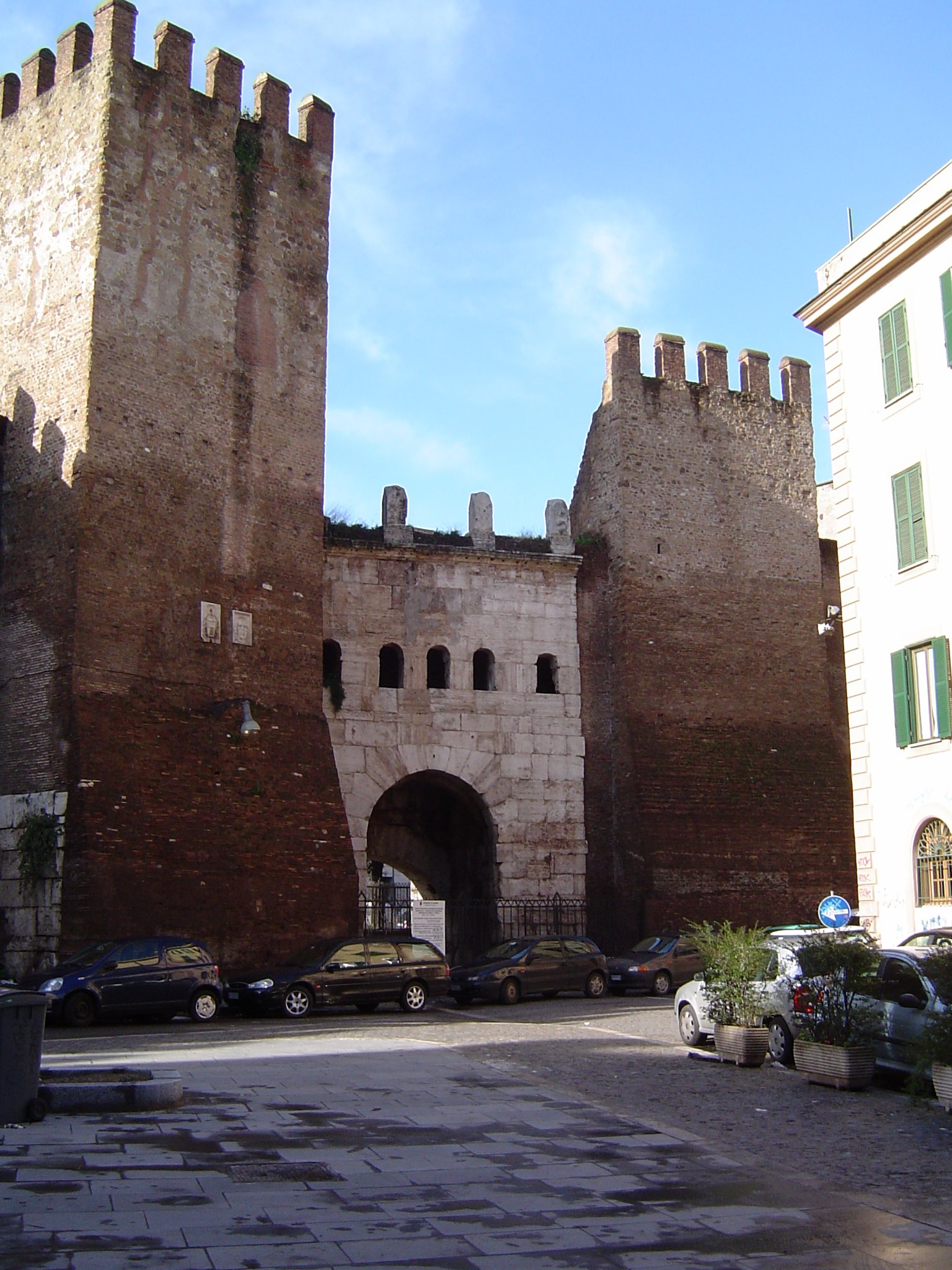
Porta Tiburtina, also called Porta San Lorenzo, can be viewed for free from the street but today you can't go inside: the Sovrintendenza Capitolina, which manages it, lists it as temporarily closed to the public for a restoration project and for the setup of the interior spaces. It is on Viale di Porta Tiburtina, between Via di Porta San Lorenzo, on the city side, and Via Tiburtina antica, at the entrance to the San Lorenzo neighborhood. To look at it from outside you need no tickets or reservations.
It's a gate of the Aurelian Walls built over an older monument: the travertine arch that in 5 BC, under Augustus, carried three aqueducts, the Aqua Marcia, the Tepula and the Iulia, over Via Tiburtina. Aurelian incorporated it into the circuit between 270 and 275, and Honorius at the beginning of the 5th century built a second gate with towers in front of it. From here Via Tiburtina leaves toward the Basilica of San Lorenzo and the Verano.
Data checked on September 29, 2026 on the Sovrintendenza Capitolina page devoted to the monument, on the Rome city tourism portal and on the announcements of visits published in recent years by the same operator. If you want to see the gate from outside you don't need to book anything. Visits with an archaeologist of the Sovrintendenza, when they are scheduled, are booked at 060608, the Roma Capitale contact center open every day from 9:00 to 19:00.
At a Glance: Address, Hours, Ticket
- Where: Viale di Porta Tiburtina, Rome, between Via di Porta San Lorenzo and Via Tiburtina antica.
- Operator: Sovrintendenza Capitolina ai Beni Culturali, Piazza Lovatelli 35, Rome.
- How to get in: today you can't. The operator lists the gate as temporarily closed to the public for restoration and setup of the interior spaces.
- Price: free for those who look at it from the street. Reopening date and future fares not published.
- Hours: none for the exterior, which can be seen at any hour.
- Information and visits by the operator: 060608, every day from 9:00 to 19:00.
- Getting there: on foot from the Termini station area or from the San Lorenzo neighborhood.
Where It Is and What You Actually See
The gate is on the eastern side of the center, where the walls separate the Esquilino and the station area from the San Lorenzo neighborhood. Inside the circuit it is reached by Via di Porta San Lorenzo. Outside begins Via Tiburtina antica, which heads straight toward Piazzale del Verano. It's an intersection of traffic, tram tracks and wide sidewalks, not an intimate square. The gate stands in the middle of all this, still, with its two faces.
The first face is the inner one, toward the city. The Sovrintendenza Capitolina describes it as the Roman side, with the Augustan travertine arch. Above the archway you read three inscriptions one above the other, facing the inside of the city. The Rome city tourism portal adds the Tuscan-order pilasters at the sides and the decorated keystones. It's the oldest face and the one that really tells why the gate is here.
The second face is the outer one, toward San Lorenzo. Here the gate shows its military look, with the towers and battlements, according to the Sovrintendenza's description. Above the outer arch the encyclopedia entry on the gate mentions five small windows, opened in the Honorian period to give light to the chamber from which the closing was operated. If you come from the Verano you see this side first, and often stop here.
Between the two faces there is the thickness of the wall and the history of four centuries. The Augustan arch was born as a bridge for water, Honorius's gate as a defense. Since 1917, according to the operator's chronology, the archway has been closed to traffic and has become an archaeological area. Cars and trams pass around it, pedestrians skirt the circuit. The gate, in the middle, is no longer a passage but a monument to be looked at from both sides.
At the sides of the gate the walls continue. To the south the circuit runs in the direction of Porta Maggiore, about a kilometer away, along a stretch that the Sovrintendenza describes as free of significant level changes. To the north the walls climb toward Viale Pretoriano and the Castro Pretorio. Along the circuit still run the traces of the ancient aqueducts and of the one by Sixtus V, because on this side, in antiquity as in the 16th century, water entered the city.
Outside the walls the neighborhood changes face. San Lorenzo grew up next to the railway and the Verano, and today lives alongside the Sapienza University campus. Continuing on the Tiburtina you reach the Verano Cemetery and the Basilica of San Lorenzo fuori le Mura, the destination that gave the gate its second name.
A Curiosity About Porta Tiburtina
For centuries Romans called it neither Tiburtina nor San Lorenzo. According to the encyclopedia entry on the gate, people also called it Capo de' Bove or Porta Taurina, for the bucrania, that is, the sculpted ox heads, that decorate the travertine of Augustus's arch and the architrave of the outer gate. A street name, given by looking at what was in front of you, without needing to read the inscriptions.
Bucrania were a common motif in Roman architecture, tied to sacrifices and to the decoration of public monuments. Here, though, they became a sign of recognition. Whoever entered Rome from the Tiburtine countryside, with carts or on foot, saw the ox heads above the gate and used them as a reference. The same name, Capo di Bove, became fixed elsewhere, as around the Mausoleum of Cecilia Metella on the Appian Way, which is also decorated with ox heads.
The curious thing is that the motif is found on both faces of the gate, even though they were born four centuries apart. On the Augustan arch the bucrania are part of the original decoration. On the architrave of the outer gate, from the Honorian period, the encyclopedia entry points to them again. Whoever built the defensive gate, in short, took up a motif of the older arch, perhaps for continuity, perhaps for reuse of material.
To find them it's best to look up, unhurried, first from the inner side and then from the outer one. The travertine is worn and blackened, and in the flat light of noon the reliefs blend into the surface. With the sun from the side, in the morning or the afternoon, the ox heads stand out from the stone. A phone zoom helps a lot, especially from a distance.
Above the outer arch there is a second detail that almost no one notices. The English encyclopedia entry explains that the five small openings at the top, built in Honorius's time, gave light to the room from which the gate was operated. Behind those little windows worked whoever had to close the passage in case of danger. Looking at them from below helps you imagine the gate as a machine, not as a simple facade.
One Thing Nobody Tells You About Porta Tiburtina
Porta Tiburtina was not born as a gate. It was born as a bridge for water. The Augustan arch served to carry three stacked aqueducts over Via Tiburtina, and only three centuries later, when Aurelian laid out the new circuit, was it turned into a defensive opening. The Sovrintendenza writes it clearly: the monument developed around a travertine arch built for the Marcia, Tepula and Iulia waters.
This changes the way you look at it. The three inscriptions above the archway don't celebrate the gate or the defense of the city. They record work on the aqueducts: the construction under Augustus and the restorations by Titus and Caracalla. It's as if the maintenance plaques of a water pipe had stayed on a city gate. Whoever reads them thinking of a triumphal arch misunderstands the whole monument.
There is also a simple way to remember it. According to the encyclopedia entry, the three inscriptions correspond to the three stacked channels inside the arch: the highest to the Iulia, the middle one to the Tepula, the lowest to the Marcia. Whoever looks at the inner front is therefore looking, in section, at three water channels one above the other, each with the name of the emperor who took care of it. It's a label on the pipework, written in fine Roman capitals.
The contrary position, in our view, is this: it's a mistake to look at Porta Tiburtina from the San Lorenzo side, the one with the towers and battlements, which is also the side almost everyone photographs. The towers are the most reworked part, between Honorius, the medieval restorations and the popes. The piece that matters is the Augustan arch facing the city, with the three inscriptions. If you come all the way here and don't go to the inner side, you've seen only half of the gate, and the less interesting half.
How Did an Arch for Water Become a Gate of the Walls?
When Aurelian decided on the new circuit, between 270 and 275, the builders used everything they found along the route. Aqueducts, tombs, enclosure walls became pieces of the walls. The Augustan arch on the Tiburtina was already there, solid, in travertine, exactly where the road left the city. The Sovrintendenza dates its transformation into a gate to those years. It was a practical choice, not an aesthetic one, at a time when Rome was in a hurry to close itself in.
The reuse had an evident advantage. The arch was already tall, already built in stone, already aligned on the road. It was enough to close it with doors and flank it with the towers of the new wall. The fact that water kept flowing above was no problem, indeed: Aurelian's circuit in many points runs right along the aqueducts, and in this eastern stretch of the city the two lines, the water one and the defense one, end up coinciding.
The next leap came with Honorius. According to the Sovrintendenza's chronology, in 401 the original towers were incorporated into new quadrangular bases. The encyclopedia entry on the gate adds that Honorius built a second structure outside the first, with five small windows at the top, and that he perhaps replaced Aurelian's semicircular towers with the square ones still visible. The same entry mentions a different hypothesis, which moves the change of the towers to the 16th century, by Alessandro Farnese.
The dating of the Honorian works is supported by an inscription. The Rome city tourism portal recalls that Honorius's inscription attributes the work on the walls to the prefect Flavius Macrobius Longinianus, and the encyclopedia entry specifies that he was prefect of Rome in 402. It's this name that makes it possible to place the works between 401 and 402, in the years when the Gothic threat was becoming concrete.
After Honorius the gate did not stop changing. The Sovrintendenza lists major work on the towers between the 12th and 14th centuries and a restoration under Pope Nicholas V in 1451. In 1585 the Felice aqueduct of Sixtus V passed next to the gate. In 1869 came a demolition, in 1917 the closure to traffic. Every era took something away or added something, and the result is a layered monument, to be read like a book with many hands.
Whoever looks at the towers from the San Lorenzo side can try to recognize these layers. Honorius's quadrangular bases, the facings redone in the Middle Ages, the 15th-century restorations have different masonry, with bricks, blocks and textures that change from one point to another. You don't need to be an archaeologist to notice that the gate wasn't built in one go. It's enough to stop a few minutes and compare the lower part with the upper one.
My Advice for Visiting Porta Tiburtina
My advice is to approach it from the city side, from Via di Porta San Lorenzo, and not from San Lorenzo. This way the first thing you meet is the Augustan arch with the inscriptions, that is, the main piece of the monument. You stop, read the three texts from top to bottom, look for the bucrania. Only afterwards do you walk around the gate, along the walls, to see the outer side with the towers.
For the gate, 20 or 30 minutes are enough. The rest of the time is best given to the stretch of walls toward Porta Maggiore, which the Sovrintendenza has used several times as a visiting route. It's about a kilometer on the flat, along the circuit, with the aqueducts running alongside the wall. Arriving at Porta Maggiore you find the same idea as Porta Tiburtina, a gate born from the arches of an aqueduct, but on a monumental scale.
The best time is the morning of a weekday, when the traffic is still manageable and the light reaches the outer side. The inner side, which faces the city, gets the sun mostly in the afternoon, and that is when the inscriptions are best read. If you have time you can make two passes, one in the morning and one in the late afternoon, perhaps after the Verano or after a walk through the neighborhood.
If you want to understand the gate with an archaeologist, keep an eye on the Sovrintendenza Capitolina website. In past years the operator organized free visits meeting in front of the gate, on Via Tiburtina antica, always with mandatory booking at 060608 and a limited number of places, between 15 and 30 people depending on the appointment. Dates are announced from time to time, and it's best to book as soon as they appear.
To read the inscriptions on your own, a few keys are enough. The encyclopedia entry gives the text of the highest one: IMP CAESAR DIVI IVLI F AVGVSTVS, that is, the emperor Caesar Augustus son of the divine Julius, followed by the title of pontifex maximus, the 12th consulship and the 19th tribunician power. The one at the bottom begins with IMP TITVS CAESAR DIVI F VESPASIANVS AVG. Recognizing the names is already half the work.
Do You Pay Anything and Can You Go Inside?
To look at the gate you pay nothing and book nothing. You observe it from the street, from both sides, at any hour. Inside, instead, today you can't go. The official page of the Sovrintendenza Capitolina on Porta Tiburtina lists the monument as temporarily closed to the public, with a restoration and interior setup project under way. The reopening date is not published.
There are no tickets to buy online and no alternative platforms to consult. No tourist products devoted specifically to Porta Tiburtina appear, and a generic tour of Rome that mentions it in passing gives no access to the interior spaces. The only useful channel is the operator's: the official page for the opening status and 060608, the Roma Capitale contact center, for the scheduled visits.
The opening project is not new. In September 2022, on the occasion of the European Heritage Days, the Sovrintendenza presented the opening of the wall walkway at Viale Pretoriano and wrote that work was continuing at the nearby Porta Tiburtina in view of its upcoming opening to the public. For that visit the operator listed payment of the site ticket at the current fare, free for holders of the MIC card.
The free visits of previous years had simple rules. In 2017 the meeting point was on Via di Porta San Lorenzo, in 2019 on Via Tiburtina antica, with booking at 060608 starting seven days before. In February 2024 an itinerary from Porta Tiburtina to Porta Maggiore lasted an hour, with the meeting point at the intersection of Via Tiburtina antica and Viale di Porta Tiburtina and a maximum of 20 participants. For new dates it's best to check the operator's website.
Another Well-Known Fact, Yet Rarely Cited
That the gate is called San Lorenzo for the basilica outside the walls almost everyone knows. Less cited is that right here water came back into the city many centuries after the end of the empire. In 1585, according to the Sovrintendenza's chronology, the Felice aqueduct was built, commissioned by Sixtus V. Its pipeline runs along the walls in this stretch, and a short distance from the gate the pope had a celebratory arch built.
The encyclopedia entry on the Arch of Sixtus V dates it to 1585, the first year of his pontificate, and places it a very short distance from Porta San Lorenzo. One of the inscriptions records the underground pipeline of the Acqua Felice for 13 miles, another the opening of the streets toward Santa Maria Maggiore and Santa Maria degli Angeli. With the construction of Termini station, in the 19th century, part of the aqueduct was dismantled, but the arch was preserved.
The result is a rare continuity. In the same spot in the city, 16 centuries apart, Augustus and Sixtus V brought water above or beside the road to Tivoli, and both wrote it on stone. If you want to see where the Acqua Felice arrived, you'll find the Moses Fountain, its terminal display, on the other side of the station.
The Right Photo at Porta Tiburtina
The photo that tells the gate is taken from the inner side, from Via di Porta San Lorenzo, a few dozen steps from the arch. The frame takes in the travertine archway, the pilasters at the sides and the three inscriptions at the top, one above the other. It is the image that explains the monument: an arch for water turned into a gate. It works best in the afternoon, when the light reaches the inner facade and warms the stone.
The second photo is from the outer side, a bit farther back, with the towers whole, the battlements and the five small windows above the arch. From here you understand the gate as a defense, with its height and its weight. It's best to include a stretch of wall to the right and to the left, so the gate appears for what it was, an opening in a continuous circuit. Watch out for traffic and tracks when looking for the right spot.
The third photo is a detail: a bucranium or a line of inscription. You need zoom and you need light from the side. With an overcast sky the letters are hard to read, and the reliefs flatten out. The rule holds for all shots: no photos from the roadway, no stepping past the fences of the archaeological area, and an eye always on the vehicles going around the gate.
A fourth photo, less obvious, links the gate to the water of later centuries. Toward the station, a short distance away, the Arch of Sixtus V bears the date 1585 and the name of the Acqua Felice. Photographing the two arches close together in time, one of Augustus and one of a 16th-century pope, tells the continuity of this water line better than any caption. My advice is to keep them in the same series of images.
How Do You Get There From Central Rome?
The simplest way is on foot from the Termini station area. From the east side of the station you reach Via di Porta San Lorenzo and follow it to the end, arriving at the gate from the inner side, the right one to start with. Nearby is the Arch of Sixtus V, which anticipates the water theme. It's a short walk, on city streets, with no climbs.
If you come from the Esquilino you can start from Piazza Vittorio Emanuele II and head east, passing the church of Santa Bibiana, which the encyclopedia entry on the gate cites as close to the monument. From there you reach the walls and follow them north to the gate. Alternatively you can do the route in reverse, from Porta Maggiore to Porta Tiburtina, along the kilometer of circuit described by the Sovrintendenza.
If you come from San Lorenzo or from the university, the gate is at the end of Via Tiburtina antica, and you meet it from the outer side. In this case it's best to walk around it right away and look for the Augustan arch on the inner side before stopping at the towers. The area is served by trams and buses, but routes and stops change often because of works, and it's best to check them on the ATAC website the same day.
A construction site to keep in mind is that of the new Tiburtina tramway. According to Roma Servizi per la Mobilità the line will start from the Piazzale del Verano hub, at the intersection with Viale Regina Elena, and run for about 1.34 kilometers on Via Tiburtina to the west square of Tiburtina station. Entry into service is expected by the end of 2026. By car, instead, the visit isn't worthwhile: traffic is heavy and parking is scarce.
Some Important Events That Happened Here
The first event is the construction of the arch, in 5 BC, under Augustus. The date is derived from the highest inscription, which the encyclopedia entry reports with the emperor's titles: consul for the 12th time, with the tribunician power for the 19th. Then the restorations: Titus in AD 79 and Caracalla in 212, according to the Rome city tourism portal. The Sovrintendenza lists for the two interventions the ranges 79-81 and 212-217.
The second event is the arch's entry into the walls, between 270 and 275, and the third is Honorius's reinforcement in 401-402. Since then the gate follows the history of the circuit: sieges, restorations, closures. Between the 12th and 14th centuries, according to the Sovrintendenza, the towers underwent major work, and in 1451 Pope Nicholas V had the gate restored. These are the centuries in which Rome rebuilt its defenses piece by piece.
On November 20, 1347 the gate was the scene of a battle. According to the encyclopedia entry, at Porta San Lorenzo Cola di Rienzo won a clear victory against the forces of the Roman barons, and in the clash their commander, Stefano Colonna the Younger, died. The English version of the same entry places the clash on the evening of that day. It's one of the best-known episodes of the tribune's short political season.
In 1585 the gate entered a new chapter in the history of water. The Sovrintendenza lists for that year the construction of the Felice aqueduct, commissioned by Sixtus V and named with his given name, Felice Peretti. A short distance from the gate the pope had an arch raised with three inscriptions, one of which records the underground pipeline of 13 miles. Porta Tiburtina thus again had a working aqueduct beside it, as in Augustus's time.
In 1869 the gate lost a part of itself. The Sovrintendenza lists for that year the demolition of the inner enclosure. The English encyclopedia entry writes that between 1869 and 1870 Pius IX had much of the surviving stone removed to build a commemorative column of the Ecumenical Council, left unfinished because of the capture of Rome. The sources don't agree on the details, but agree on the date and on the pope.
In 1917, according to the Sovrintendenza, the gate was closed to traffic and turned into an archaeological area. On July 19, 1943 the first air raid suffered by Rome hit the San Lorenzo neighborhood: among the places documented in the exhibition promoted by Roma Capitale for the 80th anniversary are Piazzale Tiburtino, Via Tiburtina antica, the Basilica of San Lorenzo and Piazzale del Verano. The memory of that day is part of the city's places of memory.
Who Passed Through Porta Tiburtina
The first names are those carved on the arch. Augustus, who had the passage for the aqueducts built in 5 BC. Titus, son of Vespasian, who restored it in AD 79. Caracalla, who intervened at the beginning of the 3rd century. There's no sign that any of the three physically passed through here to see the work, but their names are still above the heads of those who look at the gate from the inner side.
Then come the emperors of the walls. Aurelian, who turned the arch into a gate in the 270s. Honorius, who at the beginning of the 5th century had the outer gate and the new tower bases built. And with him an official, Flavius Macrobius Longinianus, prefect of Rome in 402, whose name on the Honorian inscription still serves scholars today to date the work. An administrative name that survived longer than many illustrious ones.
The Middle Ages bring Cola di Rienzo and the Colonna here. On November 20, 1347, in front of Porta San Lorenzo, the tribune defeated the barons and Stefano Colonna the Younger lost his life in the clash. Later come the popes: Nicholas V, who restored the gate in 1451, and Sixtus V, who in 1585 brought the Acqua Felice next to the walls and had the celebratory arch built a short distance away.
The last pope on the list is Pius IX. In 1869, according to the Sovrintendenza, the inner enclosure of the gate was demolished, and the English encyclopedia entry links to the operation the recovery of stone for a column dedicated to the Ecumenical Council, never completed after the capture of Rome in 1870. It's a gesture that says a lot about the era: an ancient gate used as a quarry to celebrate an event of the present, on the eve of the end of the popes' temporal power.
For centuries, though, the biggest group of passersby were the pilgrims headed to the Basilica of San Lorenzo fuori le Mura. The gate's very name, according to the encyclopedia entry, changed over time to Porta San Lorenzo precisely because of the nearness of the shrine. After them came the funeral processions headed to the Verano, the workers of the workshops and the railway yard, and today the students of the Sapienza.
What Do the Inscriptions Say and What Do the Popular Names Say?
What the documents say is written on the stone. The encyclopedia entry gives the text of the three Augustan inscriptions and places them like this: at the top Augustus's, tied to the Aqua Iulia, in the middle Caracalla's, tied to the Tepula, at the bottom Titus's, tied to the Marcia. The Rome city tourism portal confirms the order: at the top the construction, in the middle Caracalla, at the bottom Titus. Later is the Honorian inscription with Longinianus's name.
What remains uncertain should be said as such. On the square towers there are two hypotheses: the encyclopedia entry attributes them probably to Honorius, but also mentions the possibility of a 16th-century rebuilding commissioned by Alessandro Farnese. On 1869 the sources don't agree on what was demolished: the Sovrintendenza speaks of the inner enclosure, the English entry of much of the surviving stone, destined for a column never finished.
The dates of the imperial restorations also have two versions. The Rome city tourism portal lists 79 for Titus and 212 for Caracalla, that is, the years written in the inscriptions according to the encyclopedia entry. The Sovrintendenza prefers wider ranges, 79-81 and 212-217, which correspond to the reign years of the two emperors. It's not a real contradiction, but a different degree of caution, and it's worth knowing when you read signs and books on the gate.
Then there are the names, which belong to tradition and not to documents. Porta Tiburtina is the ancient name, from the road to Tibur, present-day Tivoli. Porta San Lorenzo comes from the basilica and the pilgrimage. Capo de' Bove and Porta Taurina come from the bucrania on the arch. They are three ways of looking at the same monument: from the road map, from devotion and through the eyes of those who passed every day under those stone heads.
What Do You See Along the Walls to Porta Maggiore?
The stretch of walls between Porta Tiburtina and Porta Maggiore is the one the Sovrintendenza chose for an itinerary on the defensive system of imperial Rome and on the city's water supply. The itinerary page speaks of about a kilometer, without significant level changes, with small monuments included in the circuit. You walk with the circuit always beside you, and the water theme stays present from start to finish.
At Porta Maggiore the discussion begun at Porta Tiburtina becomes monumental. There too the walls incorporate the arches of an aqueduct, but of much larger size, and next to it is the Underground Basilica of Porta Maggiore, visitable only on dates and terms set by the operator. If you want to see aqueducts in the countryside, free of the city, you'll find the long arcades in the Aqueducts Park.
In the opposite direction, to the north, the walls climb toward Viale Pretoriano. The Sovrintendenza presented in 2022 the opening of the Aurelian Walls walkway in that stretch, as the outcome of a project begun with the acquisition and restoration of the monument. It's the same project that concerns Porta Tiburtina. Openings of the walkway follow the operator's calendar, and it's best to check them at 060608 before going.
The advice, for those short on time, is to choose one direction only. To the south you meet the aqueducts and Porta Maggiore, on a route already tested by the Sovrintendenza. To the north you follow the wall to Viale Pretoriano, a less frequented stretch, with the restored walkway. Doing both in the same morning is possible, but the traffic around the gate makes going from one side to the other tiring.
Porta Tiburtina Among the Other Gates of the Walls: What Is Different?
The gates of the Aurelian Walls are not all alike. Some are openings born with the circuit, like Porta Latina or Porta Asinaria. Others were redesigned as facades, like Porta Pia or Porta del Popolo. Porta Tiburtina belongs to the rarest family, that of gates born from an older monument, together with Porta Maggiore. Porta San Paolo, with the Pyramid of Cestius incorporated into the circuit not far away, shows another form of reuse.
A useful comparison is with the Arch of Drusus, on the Appian Way, just before Porta San Sebastiano: there too an ancient arch was used to carry water over the road. If you want to climb inside a gate of the walls, you'll find the Museum of the Walls right at Porta San Sebastiano. Porta Tiburtina, for now, is only viewed from outside.
The oldest circuit helps you understand the city's growth. The Servian Walls ran much farther inside, and on the Esquilino the Arch of Gallienus occupies the place of one of their gates. Much farther south, toward the Celio, is Porta Metronia. At the opposite extreme, toward Villa Borghese, is Porta Pinciana. Lining them up shows how each gate had a different function and history.
In our view, among all the gates of the circuit this is the one where you can best read, without modern additions in front, three stacked imperial inscriptions tied to water. Porta Maggiore has larger arches and a greater impact, but it is surrounded by a knot of tracks and roads that makes it hard to stop. Here stopping is easier, on the inner side, and the monument is understood in a few minutes of careful reading.
When Is It Hard to See and What Not to Expect?
The exterior of the gate never closes, but there are moments when it's hard to see. Rush hour traffic makes stopping tiring, especially on the San Lorenzo side. With an overcast sky or at noon the inscriptions and bucrania are hard to read. In the evening the lighting helps you see the masses, not the details. If you come to read the stone, you have to come with the right light.
Don't expect to go in. The Sovrintendenza lists the monument as temporarily closed to the public, and the visits of past years were exceptional appointments, with booking and limited places. Don't expect a visitor center or detailed panels either: the gate is a monument on the street, and you have to bring the history with you. Barriers or scaffolding can appear without notice, because the restoration project is still under way.
The Tiburtina tramway construction site, on the stretch between Piazzale del Verano and Tiburtina station, can change public transport routes and stops in the area until the expected entry into service. The Sovrintendenza's visits do not follow a fixed calendar either. If you organize the trip months ahead you will hardly find a date already published. It's best to check the operator's website in the weeks before and call 060608.
One last warning concerns expectations about the neighborhood. San Lorenzo is a lively, lived-in area, with graffiti on the walls, bars open late and many young people. If you arrive expecting a monumental setting as tidy as the historic center's, you'll be thrown off. Porta Tiburtina is an ancient monument inside a city that works and studies, and it should be taken that way: without expecting a well-kept pedestrian area around it, with Roman stone next to the tracks.
Eating Near Porta Tiburtina
San Lorenzo is a neighborhood of students and residents, with many places and prices often lower than the historic center's. It's a real advantage, but here too it's best to choose carefully. In the evening the neighborhood fills up, and next to the places frequented by Romans there are places that live off passing trade. The rule is the usual one: be wary of those who bet on the quantity of people and not on the cooking.
Toward Termini station the signs of the traps are more frequent, and worth recognizing: photo menus in four languages, barkers on the sidewalk, items with no price, kitchens open continuously with no break, the window with the lady rolling fresh pasta in front of passersby. None of these elements is illegal, but together they say the place counts on you not coming back. Romans know it and walk on.
A practical tip concerns hours. San Lorenzo comes alive mostly in the evening, while at lunch many places in the neighborhood work mostly with students and with people who have their office nearby. If you visit the gate in the morning and then continue toward the Verano you can stop for lunch in the neighborhood without hurry. If you arrive in the late afternoon for the light on the inscriptions you instead find the area already full of people.
The simplest solution is to move a few streets toward the interior of San Lorenzo or toward the Esquilino, where you eat at lived-in-neighborhood prices. For water there are the nasoni, the city's public drinking fountains. To choose without surprises, a starting point is the list of addresses on Google Maps, with selected places across Rome and Lazio.
What to Combine in a Day
The natural pairing is with San Lorenzo and the Verano. From the gate you follow Via Tiburtina antica to Piazzale del Verano, enter the Verano Cemetery and visit the Basilica of San Lorenzo fuori le Mura. On the way back you cross the neighborhood, following our page on what to see in San Lorenzo. Next to the gate, at Via Tiburtina antica 25, is the Parco dei Caduti del July 19, 1943.
If you prefer water and walls, go south to Porta Maggiore, and from there continue toward Holy Cross in Jerusalem and the Amphitheatrum Castrense, also incorporated into the Aurelian circuit. Farther on, along the walls, you reach Porta Asinaria and the Basilica of San Giovanni in Laterano. It's a full day on foot, all on the theme of defenses and aqueducts.
A variant, for those who love recent history, is to stay in the neighborhood. The Parco dei Caduti del July 19, 1943, at Via Tiburtina antica 25, hosted in 2023 the Roma Capitale exhibition on the 80 years since the bombing, with materials on Piazzale Tiburtino, the basilica and the Verano. From there you can continue to the Sapienza university campus and close the day among the streets of San Lorenzo.
If you want to stay inside the walls you find the Esquilino a short distance away. There are Santa Bibiana, Piazza Vittorio with the Porta Alchemica, Sant'Eusebio, the Nuovo Mercato Esquilino and, farther on, Santa Maria Maggiore. For an overview of the district there's the page on what to see in the Esquilino, which holds together churches, markets and ancient remains.
Toward the station, finally, are the museums. The Baths of Diocletian and Palazzo Massimo alle Terme, venues of the Museo Nazionale Romano, complete the visit well with materials from ancient Rome. If you prefer a different neighborhood you can push on to Pigneto, beyond Porta Maggiore. For ideas at no cost there's the page on Free Rome, where a gate viewed from the street finds its place.
Frequently Asked Questions
Can you visit inside Porta Tiburtina?
Not today. The Sovrintendenza Capitolina lists the monument as temporarily closed to the public, with a restoration and interior setup project under way, and doesn't publish a reopening date. The gate can be viewed for free from the street, from both sides, at any hour. To find out if visits with an archaeologist of the operator are scheduled, call 060608, open every day from 9:00 to 19:00.
Why is it also called Porta San Lorenzo?
For the nearness of the Basilica of San Lorenzo fuori le Mura, which you reach by following Via Tiburtina past the gate. According to the encyclopedia entry on the monument, the name changed over time precisely because of this link with the shrine and with the pilgrims who went to it. The ancient name, Tiburtina, comes instead from the road that led to Tibur, present-day Tivoli.
What do the three inscriptions say?
They record work on the aqueducts, not military victories. The highest one gives the name and titles of Augustus and is tied to the construction of the arch in 5 BC. The one in the middle names Caracalla, who intervened in 212, the one at the bottom Titus, who restored in AD 79. They face the inside of the city, and are read from Via di Porta San Lorenzo side.
Which aqueducts passed over the gate?
Three stacked aqueducts: the Aqua Marcia, the Tepula and the Iulia, as the Sovrintendenza Capitolina indicates. The Augustan arch served precisely to carry them over Via Tiburtina, and only later was it turned into a gate of the walls. According to the encyclopedia entry, each of the three inscriptions corresponds to one of the channels: at the top the Iulia, in the middle the Tepula, at the bottom the Marcia.
Why did they call it Capo de' Bove?
For the bucrania, the sculpted ox heads that decorate the travertine of Augustus’s arch and the architrave of the outer gate. According to the encyclopedia entry on the monument, people also called it Porta Taurina for the same reason. You look for them by looking up, on both sides, with a raking light that makes the reliefs stand out from the worn stone.
What happened in 1347 at Porta San Lorenzo?
On November 20, 1347 the battle between Cola di Rienzo’s militias and the forces of the Roman barons was fought in front of the gate. According to the encyclopedia entry, the tribune won a clear victory and in the clash the barons’ commander, Stefano Colonna the Younger, died. It’s one of the best-known episodes of Cola’s short rule over the city.
Who manages Porta Tiburtina?
The Sovrintendenza Capitolina ai Beni Culturali of Roma Capitale, which is based at Piazza Lovatelli 35 and looks after the city walls. Its page on the monument reports the history of the gate, the chronology of the works and the opening status, today temporarily closed to the public. For information and visit bookings the contact given is 060608, the Roma Capitale contact center open every day from 9:00 to 19:00.
What did Pius IX do in 1869?
According to the Sovrintendenza Capitolina, in 1869 the inner enclosure of the gate was demolished. The English encyclopedia entry writes that between 1869 and 1870 Pius IX had much of the surviving stone removed for a column dedicated to the Ecumenical Council, left unfinished after the capture of Rome. The sources don’t agree on the details of the demolition, but they name the same pope and the same year.
How long does it take to see it?
For the gate, 20 or 30 minutes are enough, including the walk between the inner side with the inscriptions and the outer side with the towers. If you add the stretch of walls to Porta Maggiore, about a kilometer on the flat, allow another hour. With the Verano, the Basilica of San Lorenzo and the neighborhood you easily reach half a day.
Who Wrote This and On What Sources
The text comes from the editorial team of Tour Leader Pro, the Roman company that designs itineraries, visits and cultural events across Rome and Lazio. Fares, hours and booking methods reported here come from the official sources cited in the text as of the date given at the start: the Sovrintendenza Capitolina pages on the monument and on the visits, the Rome city tourism portal and Roma Servizi per la Mobilità for the tramway. Tell us what you find changed.
Organizing a visit to Porta Tiburtina, for yourself or for a group, means above all choosing the right light for the inscriptions, checking if the Sovrintendenza has scheduled an opening and booking it right away at 060608, and deciding if to combine the Verano or the stretch of walls toward Porta Maggiore. For those who organize group trips to Rome with itineraries on the ancient city and its defenses, a useful resource is Tour Leader Pro.
Roman aqueducts are only one chapter in the long history of water between Rome and Lazio, which continues with the springs of the Aniene, the arcades in the countryside toward the Castelli Romani and the villas of Tivoli built around fountains. If you want to widen your view beyond the city you’ll find many other places tied to water in the region. To put together a multi-day trip, a useful resource for building an itinerary is Italy Planner.