Arch of Drusus
In short. The Arch of Drusus is on Via di Porta San Sebastiano, at the start of Via Appia Antica, a few meters inside Porta San Sebastiano, and you look at it for free from the street: no ticket, no reservation, no opening hours.
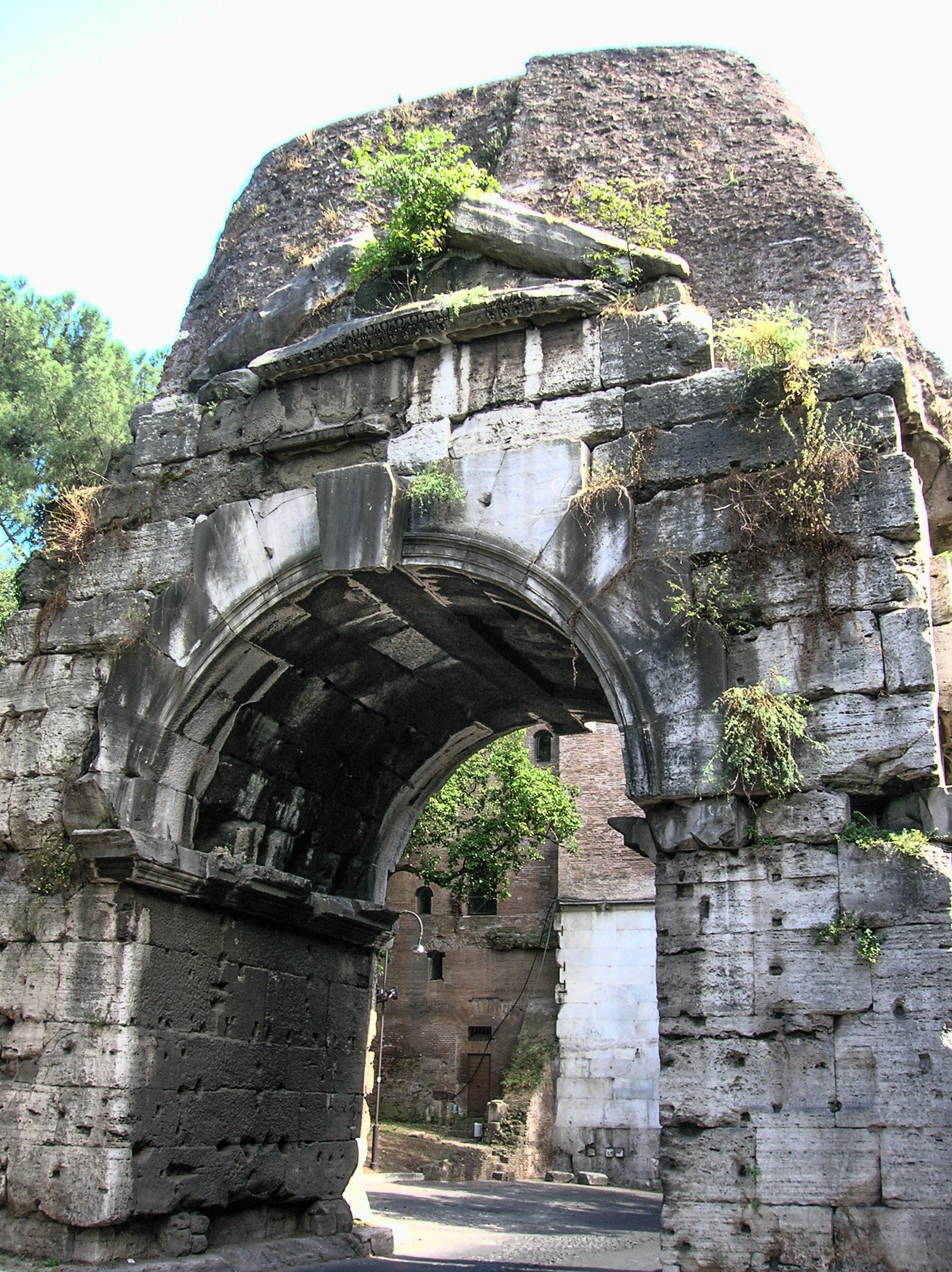
The Arch of Drusus is on Via di Porta San Sebastiano, at the start of Via Appia Antica, a few meters inside Porta San Sebastiano, and you look at it for free from the street: no ticket, no reservation, no opening hours. There is no interior to visit. The monument is listed by the Capitoline Superintendency of Roma Capitale, and for information the city's tourist portal refers you to the 060608 contact center. Next to it, at number 18, the Museo delle Mura is free and opens Tuesday through Sunday.
The name is misleading. It is not the arch the Senate dedicated to Drusus the Elder, Augustus's stepson who died in 9 BC. The Capitoline Superintendency describes it as the archway through which water reached the Baths of Caracalla, and Wikipedia attributes it to Caracalla, who had a branch of the Aqua Marcia built, the Aqua Antoniniana, for his new baths. A question remains open, however, which the most recent studies have brought back to the fore: before the water, was there already an arch here?
Data checked on September 29, 2026 on the Capitoline Superintendency page dedicated to the arch, on the tourist portal of Roma Capitale, on the official website of the Museo delle Mura and on the communication of Roma Servizi per la Mobilità about the new limited traffic zone of the Appia Antica. For the arch there are no opening hours to confirm, because it is an open-air structure above a public road. For the museum next door, on the other hand, the closing days matter, and so does a notice about the wall walkway, closed since June.
In brief: address, hours, ticket
- Address: Via di Porta San Sebastiano, right by Porta San Sebastiano, at the beginning of Via Appia Antica. The Museo delle Mura is at number 18, 00179 Rome.
- Operator: the monument is listed by the Capitoline Superintendency of Roma Capitale. The arch has no ticket office or custodian. Information at the 060608 contact center, every day from 9:00 to 19:00.
- How you get in: you don't. The arch is viewed from the street, from both sides.
- Price: free. The Museo delle Mura is free too, with no reservation for individual visitors, with a free reservation at 060608 for groups of 5 to 20 people.
- Hours: none for the arch. Museo delle Mura Tuesday through Sunday from 10:00 to 16:00, last entry one hour before, closed Monday, May 1 and December 25.
- How to get there: on foot along Via di Porta San Sebastiano, from the Baths of Caracalla area. The museum operator doesn't list bus lines and refers you to 060608.
- Accessibility: the arch is at street level. The museum, according to the tourist portal of Roma Capitale, is partially accessible and has no elevator.
Where it is and what you really see
The arch spans the last stretch of Via di Porta San Sebastiano, just before the road passes through the walls and becomes Via Appia Antica. The Capitoline Superintendency defines it as the archway found at the start of the Appia on leaving the city, positioned inside the gate of the same name in the Aurelian Walls. Sotterranei di Roma specifies that it stands a few meters toward the inside from the gate. Whoever arrives from the center, therefore, meets it first, and only afterward sees the towers.
What remains is a single archway. The tourist portal of Roma Capitale recalls that originally there was more than one arch, faced in marble, and that today only one segment survives. The richer side faces the gate, that is toward the outside of the city. There, according to Wikipedia and Sotterranei di Roma, two columns set on a high plinth that frame the facade are preserved, and part of the triangular pediment.
Roma Segreta describes the two columns with composite capitals, topped by an architrave. Above the architrave rises a massive attic, decorated by the pediment. The Encyclopaedia Romana of the University of Chicago adds the materials: a facing of white marble and columns of Numidian marble, the yellow stone also known as giallo antico. This is not the equipment of a simple hydraulic work. Whoever designed it wanted it to be looked at by those arriving from the Appia.
Inside the attic, according to Roma Segreta, ran the specus, the channel in which the water flowed. This is the detail that changes how the monument is read. The pediment and the attic are not decoration placed on top of a passage, but the very container of the conduit. The arch was a bridge for water disguised as a monumental gate. When looking at it from below it is worth keeping this section in mind: the solid part at the top was the most important one, the one that did the work.
From the city side the arch looks barer, because the columns and the pediment are on the opposite side. This is the reason many people walk under the archway without noticing anything. The practical advice is simple: once you've passed the arch, turn around. Between the arch and the gate you can read the real facade, and you also understand the short distance between the two monuments, which in late antiquity were joined by walls.
All around is the urban stretch of Via Appia, today called Via di Porta San Sebastiano. Going back toward the center you meet the Parco degli Scipioni, the Tomb of the Scipios, the Columbarium of Pomponius Hylas and the church of San Cesareo de Appia. Beyond the gate, instead, begins the countryside of the Appian Way Park, with its tombs, catacombs and farmhouses.
A curiosity about the Arch of Drusus
An arch of Drusus on the Appia did really exist. The Encyclopaedia Romana recalls that the Notitia, the late-antique catalog of the regions of Rome, lists an arch of Drusus in the first region, the one crossed by the Appia. It also reports the passage of Suetonius according to which the Senate voted Drusus a marble arch adorned with trophies on Via Appia, together with the surname Germanicus for him and his descendants.
The name, then, doesn't come from nowhere. The scholars of the Renaissance knew from ancient texts that on the Appia, in this area, an arch dedicated to Augustus's stepson had stood. Faced with a marble arch with columns and a pediment, at the start of the same road, the connection came naturally. Roma Segreta says it clearly: the confusion probably arose from the existence of a real arch dedicated to Drusus on Via Appia.
The real curiosity is the second half of the story. According to the passage of Suetonius reported by the Encyclopaedia Romana, together with the arch the Senate granted Drusus the surname Germanicus, extended to his descendants. The arch of the Appia, in short, was tied to a name destined to last far longer than the stone on which it was inscribed, and which the family would carry with it for generations.
Of the authentic arch, the open sources indicate no recognizable remains. The one that bears its name is another construction, later by more than two centuries according to the traditional dating. What remains is the paradox of a monument famous for something it is not, which survived thanks to a wrong identification. If the humanists had not taken it for the arch of a prince, perhaps it would have been treated with less regard in the centuries when many ancient structures were being dismantled.
One thing nobody tells you about the Arch of Drusus
Almost all popular texts repeat the same formula: it is not a triumphal arch, it is a piece of aqueduct. The formula is convenient but too sharp. The Capitoline Superintendency, on the page dedicated to the monument, writes that recent research suggests that the arch, originally, could have been a triumphal arch, only later inserted into the course of the Severan aqueduct. The refutation of the name of Drusus stands. The refutation of the honorary arch, on the other hand, is far from closed.
In 2019 the publisher Edipuglia published, in the Bibliotheca Archaeologica series, a volume by Valeria Di Cola entitled L'arco di Druso sulla via Appia. The publisher's presentation describes three successive lives of the monument: first a marble arch on Via Appia, then a support for the Aqua Antoniniana, finally an architectural element of the inner gate of Porta San Sebastiano. It is a layered reading, which holds the two traditions together instead of choosing between them.
The sources, moreover, do not agree on the sequence. Wikipedia and Roma Segreta present the arch as built for the aqueduct in the 3rd century AD, and Roma Segreta adds that it was made monumental at an unspecified time to serve as an entrance to the Appia. Sotterranei di Roma dates it to 215. The Superintendency and the 2019 volume instead open to the hypothesis of a preexisting arch. None of the open sources claims that it is the arch voted to Drusus.
The contrary position, in our judgment, is this. Dismissing it as a simple service archway is an error almost as big as calling it the triumphal arch of Drusus. Columns of Numidian marble, composite capitals, pediment: nobody spends like that to get a pipe across. Whatever the order of the phases, whoever wanted it was thinking of a solemn entrance to the city. Look at it with this question in mind, and it stops being a ruin to hurry past.
Why is it called the Arch of Drusus if Drusus has nothing to do with it?
The Capitoline Superintendency places the origin of the name in the humanist and Renaissance era, when the arch was studied specifically. Scholars split between two readings: a triumphal arch dedicated to Drusus the Elder, who died in 9 BC, or part of the Antonine aqueduct that brought water to the baths. The first hypothesis had the literary texts on its side, the second the position and the structure. The name settled on the first, and has never left.
Drusus the Elder, as the Superintendency recalls, was Augustus's stepson, and 9 BC is the year to which tradition linked the arch. The honor the Senate paid him, a marble arch adorned with trophies on Via Appia according to Suetonius, celebrated at once the man and the family of the princeps. An arch with trophies, along the road that led toward the South, was a precise political message, addressed to anyone entering the city.
The monument we see, instead, belongs to the age of the Severans. Caracalla reigned in the first decades of the 3rd century AD, and the tourist portal of Roma Capitale dates the arch precisely to the 3rd century. Between Drusus and Caracalla more than 200 years pass. No ancient document ties this structure to the name of Drusus: the link is entirely modern, the result of a comparison between a text and a ruin that seemed made for each other.
Today the institutional sources keep the two names together. The Superintendency page is titled Arco di Druso, Acquedotto Antoniniano, placing the traditional name next to the established function. The tourist portal of Roma Capitale calls it Arco di Druso and immediately explains that it was part of the Antonine aqueduct. It is the most honest solution: the name is by now a place name, as happens with many places in Rome that have carried wrong names for centuries.
Rome, after all, is full of monuments christened by mistake by antiquarians. The mechanism is always the same: a passage of an ancient author mentions a building in a certain area, a ruin in that area seems to match, and the identification is passed from guide to guide until it becomes common sense. In the case of the Arch of Drusus the name held on even after the hydraulic function had become clear to everyone. Changing it, at this point, would only create confusion.
The advice for those who read different texts is to pay attention to the dates. Whoever writes that the arch is from 9 BC is repeating the Renaissance identification, not an archaeological fact. Whoever writes that it is from the 3rd century refers to the aqueduct phase. Whoever speaks of an older arch reused in the aqueduct takes up the recent studies cited by the Superintendency. They are three different claims, and popular texts often mix them without saying so.
Where did the water come from and where did it end up?
The water that passed over the arch belonged to the Aqua Antoniniana. Wikipedia and Roma Segreta describe it as a branch of the Aqua Marcia, one of the oldest and most prized aqueducts of Rome, commissioned by Caracalla to supply his new baths. The name of the aqueduct and that of the emperor, in the sources, go together: the Superintendency speaks of the Antonine aqueduct and of the Severan aqueduct, from the name of the dynasty.
The tourist portal of Roma Capitale explains the function of the arch precisely: to carry the Antonine aqueduct across Via Appia to supply the Baths of Caracalla. The arch, that is, was the point where the conduit crossed the most important road of the southern quadrant of the city. In such an exposed spot, under the eyes of anyone entering Rome from the Appia, a simple masonry arch would not have been enough. Hence, probably, the care in the facing.
From the arch the conduit continued toward the baths, which lie lower down, along the same axis. The Encyclopaedia Romana recalls that the aqueduct ended in a large reservoir with a series of cisterns, in which the water deposited its sediments and was heated. Today of the arcades that connected the gate to the baths, along Via di Porta San Sebastiano, no visible stretches remain comparable to the arch. The arch is the surviving piece of a vanished route.
Whoever wants to understand how an elevated aqueduct looked has to go outside the city. The Aqueducts Park, on the Tuscolana, preserves long rows of arches in the countryside. Closer, on the Caelian, the Arch of Dolabella shows the same phenomenon in reverse: an older arch reused as a support for an aqueduct, the Neronian one. And at Porta Maggiore aqueducts and walls cross in a single monument.
The Baths of Caracalla were a large imperial complex, and a complex of that kind required an enormous and constant quantity of water. The arch on the Appia should be read as one of the service works of that building site. Whoever visits the baths and then climbs up to the gate walks, in reverse, the road the water took. A short itinerary, which gives meaning to both monuments.
My advice for visiting the Arch of Drusus
The advice is to arrive on foot from the center, along Via di Porta San Sebastiano, and not by car from the Appia. Coming from the city the arch presents itself from behind, bare, and right behind it the towers of the gate appear. It is the right sequence to understand what you are looking at. Arriving from outside, instead, you pass under the gate and then under the arch almost without noticing, because your gaze stays on the walls.
Once past the archway, stop and turn around. The facade with the two columns, the composite capitals and the rest of the pediment faces the gate, and can be read well only from the space between the two monuments. Here you also understand the inner gate: the two structures are so close that you only need to imagine two side walls to close a courtyard. It is best to stay on the edge of the road, because the archway is a narrow passage for pedestrians and vehicles.
Then enter the Museum of the Walls, at number 18. It is free and, according to the tourist portal of Roma Capitale, occupies five rooms in the towers of the gate. Seeing the arch first and the museum after helps place the arch inside the system of the Aurelian Walls. Keep in mind that the wall walkway has been closed since June and that the terrace of the tower is not accessible.
As for the day, Tuesday morning and weekdays in general have an advantage: the museum is open, and the traffic on the road is the ordinary kind, without the weekend crowd heading for the Appia. On Monday the museum is closed, and the arch alone takes a few minutes. On weekends, since September 19, 2026, the new limited traffic zone is active beyond the gate, and the Appia becomes more pleasant on foot and by bicycle.
Do you pay anything and how do you get into the Museo delle Mura?
For the arch you pay nothing and reserve nothing. It is an open-air monument above a public road, and the tourist portal of Roma Capitale gives no hours or fares, referring for information to the 060608 contact center and to the page of the Capitoline Superintendency. There is no ticket for the arch. If someone sells one, they are selling something else, usually a guided walk that also includes the arch.
The official website of the Museo delle Mura indicates free entry for everyone. Individual visitors do not need to reserve. Groups of 5 to 20 people, plus any guide, enter only with a free reservation at 060608, and reservation is mandatory for schools as well. For the museum and for the arch we do not list online purchases: they aren't needed, and no platform can sell what the municipality offers for free.
| Day | Museum of the Walls |
|---|---|
| Tuesday to Sunday | 10:00-16:00, last entry one hour before closing |
| Monday | Closed |
| May 1 and December 25 | Closed |
The museum publishes precise rules on capacity. A maximum of 20 visitors can enter at the same time, with a limit of 5 people per room, and the maximum stay is 50 minutes. The terrace of the tower is not open to the public. On the busiest days, therefore, you may have to wait a few minutes at the entrance. If you are more than four people, it is best to call 060608 first and check how to handle the reservation.
The museum's website notes that guided tours in several languages are paid and by reservation, and among its educational offerings it has also published a free 60-minute guided tour with translation into Italian Sign Language, to be booked at 060608. For an archaeological reading of the arch and of the first stretch of the Appia, the reference points are the tours organized by the museum and licensed tour guides, with programs and prices published on their own channels.
A notice not to be overlooked concerns the walkway. The official website announces that the walkway of the Aurelian Walls at Porta San Sebastiano has been closed since June 15, 2026 for utilities work, and gives no reopening date. The walkway, which the tourist portal describes as walkable for about 400 meters, is one of the main reasons for the visit. Before planning the day, check the notice on the museum's website or ask at 060608.
Another well-known fact, yet rarely cited
That the arch is tied to the gate is known. Less often cited is the way it was. Roma Segreta writes that during the reign of Honorius, between 401 and 403, the arch became the inner gate of the Porta Appia, today's Porta San Sebastiano, and was joined to it with walls that formed an inner court. The tourist portal of Roma Capitale places the work in the 5th century, under the same emperor, with a defensive purpose.
Sotterranei di Roma describes the mechanism in more detail. Following a restoration the two towers of the gate were enlarged, raised and connected with two parallel walls to the preexisting arch, a few meters away toward the inside, so as to form a courtyard in which the arch served as an inner gate. Whoever forced the first opening found themselves shut in a confined space, under fire from the defenders, in front of a second passage.
Of those walls today almost nothing is visible. Wikipedia writes that nothing remains of the two large walls, Roma Segreta that little remains of the court. The sources do not agree on the degree of preservation, but they agree that the courtyard, as an enclosed space, no longer exists. To imagine it you have to look at the distance between arch and gate and complete the sides in your mind. It is the most useful exercise you can do on the spot.
The fact says a lot about the Rome of the 5th century. A monument born for water, or perhaps for celebration, was turned into a military structure because the city needed to defend itself. The same happened to many parts of the Aurelian Walls, reinforced precisely under Honorius. The arch, in short, changed function at least twice without changing place, and it survived partly for this reason.
The right photo to take at the Arch of Drusus
The photo that tells the story of the place puts the arch and the gate together. You take it from the inside, from the city side, with the arch in the foreground and the towers of Porta San Sebastiano framed in the archway. This way you see in a single image the relationship between inner gate and gate, and the short distance separating them. It is best to shoot when the road is clear, without hurry, staying on the edge and never stopping in the middle of the roadway.
The second photo is the one of the facade with the columns. It has to be taken from the space between the arch and the gate, facing the city. Here you can read the two columns on the plinth, the composite capitals and the rest of the pediment. A wide-angle lens helps, because there is little room to step back. The phone zoom is useful too, to isolate the capitals and the yellow of the Numidian marble.
The light changes the result a lot. The colored marble of the columns looks better in soft light, early in the morning or in the late afternoon, when the raking sun brings out the flutings and the moldings. At midday the contrast between the light of the street and the shadow of the archway flattens everything. On cloudy days, instead, the colors of the stone read better, even if the sky stays white.
A third, less obvious image concerns the attic. From below, looking at the upper part of the arch, you understand where the specus of the aqueduct passed. Photograph the attic from some distance, so that the full volume above the archway shows. It is the photo that explains better than any caption why this arch was not just a gate: above the columns ran the water destined for the baths.
How do you get there from central Rome?
The most sensible way is on foot. Via di Porta San Sebastiano starts from the Baths of Caracalla area and climbs to the gate, along the urban course of Via Appia. The route passes in front of the Tomb of the Scipios and the Parco degli Scipioni. It is a narrow road, between high walls, with sidewalks that are not always comfortable, and it should be walked with care. In return it prepares you well for the arrival, because the arch appears at the end, suddenly.
For public transport the museum operator lists no lines on the hours page and refers you to the 060608 contact center and to the map published on the site. The tourist portal of Roma Capitale does the same. We do not list bus lines that don't appear in an official source: before leaving it is best to calculate the route with the tools of Roma Servizi per la Mobilità or of the transport company.
Whoever arrives by car should know about the novelty of 2026. Roma Servizi per la Mobilità announces that from September 19 the limited traffic zone of the Appia Antica is operational on Saturday and Sunday from 7:00 to 19:00, all year except August, on the stretch from the intersection with Via delle Mura Latine to Via Appia Pignatelli. The electronic gates are in pre-operation for at least 30 days before automatic fines.
The same communication specifies that pedestrians, bicycles, public transport, tourist buses, emergency vehicles and vehicles serving people with disabilities can pass without restrictions, and that in the zone the limit is 30 kilometers per hour. For those who visit the arch and continue on the Appia, the consequence is simple: on the weekend it is best to leave the car and move on foot or by bicycle. The arch in any case lies outside the controlled stretch, inside the walls.
Some important events that happened here in history
The first event is the construction of the aqueduct. In the first decades of the 3rd century AD Caracalla had the Aqua Antoniniana brought to his baths, and the arch became the point where the water crossed over the Appia. Sotterranei di Roma gives 215 as the date, the tourist portal the 3rd century in general. If the hypothesis of a preexisting arch is correct, the history of the monument begins earlier, with an honorary phase whose author is unknown.
The second is the military transformation. Between 401 and 403, under Honorius, according to Roma Segreta, the arch was connected to the Porta Appia to form a defensive court. The tourist portal of Roma Capitale places the work in the 5th century. From that moment on, anyone entering the city from the Appia had to get through two openings in sequence. The gate, reinforced, became one of the main entrances of the fortified city.
An inscription on the gate, recalled by Sotterranei di Roma, commemorates the battle fought on September 29, 1327 by the Ghibelline Roman militias of the Colonna, led by Giacomo de' Pontani, against the Guelph army of the king of Naples, Robert of Anjou. The clash took place at the gate, a few meters from the arch. It is one of the rare medieval episodes documented by an inscription at this point of the walls, and it can still be read by those who know where to look.
On April 5, 1536, for the entry into Rome of the emperor Charles V, Antonio da Sangallo transformed the gate into a real triumphal arch, according to Sotterranei di Roma. On December 4, 1571, for Marcantonio Colonna, the victor of Lepanto, the triumphal procession passed through here. In both cases whoever entered through the gate then passed under the arch, a few meters farther on. The monument, mistaken for a triumphal arch, thus served as the backdrop for real triumphs.
In the 20th century the gate changed use. The website of the Museo delle Mura relates that between 1939 and 1943 it became the home and private studio of Ettore Muti, secretary of the National Fascist Party. In 1970 the city took possession of it again, in 1989 the city council established the Museo delle Mura and in 1990 the exhibition was inaugurated. The latest step is recent: since September 19, 2026 the Appia beyond the gate has been a limited traffic zone on weekends.
Who has passed by the Arch of Drusus
The first name is that of Caracalla, who according to Wikipedia ordered the construction of the aqueduct of which the arch was part. The second is Honorius, the emperor who at the beginning of the 5th century inserted it into the defensive system of the gate. Between these two moments, and for many centuries after, anyone entering Rome from the south passed under the archway: travelers, armies, pilgrims bound for the catacombs and basilicas of the Appia.
In the modern age the names become more precise. In 1536 the emperor Charles V entered through here, with the gate transformed for the occasion by Antonio da Sangallo. In 1571 it was the turn of Marcantonio Colonna, returning from Lepanto. Both of them, after passing the towers, went under the arch that the scholars of the time already called the arch of Drusus. It was probably in those decades that the name consolidated, also through the descriptions of the triumphs.
In the 20th century the arch had Ettore Muti as a neighbor, who between 1939 and 1943, according to the museum, lived in the gate. The sources do not agree on the dates: Sotterranei di Roma gives the period 1942-1943. After the war the gate went back to the city and, with the museum, to the public. Since then, whoever visits the Museo delle Mura passes in front of the arch twice, on arrival and on leaving.
Among those who have passed by with the most attention are those who have studied the monument. The Superintendency recalls the humanist and Renaissance scholars who first examined it specifically. The volume by Valeria Di Cola published by Edipuglia in 2019 traces its history from antiquity to the present. It is this research that reopened the question of the honorary arch, which popular texts had long taken as settled.
What do the documents, tradition and legend say?
The documents say three things. The first: Suetonius, reported by the Encyclopaedia Romana, attests that the Senate voted Drusus a marble arch with trophies on Via Appia. The second: the Notitia lists an arch of Drusus in the first region. The third: the arch we see carried the Aqua Antoniniana across the road, toward the Baths of Caracalla, as the Capitoline Superintendency and the tourist portal of Roma Capitale indicate.
The scholarly tradition, born between Humanism and the Renaissance, joined these data in a wrong identification. The marble arch with columns at the start of the Appia was taken for the arch of Drusus, and the name passed into the descriptions of the city. The recent tradition, that of the studies cited by the Superintendency and of the 2019 volume, reopens the hypothesis of an older honorary arch, later reused by the aqueduct. The two traditions should not be confused.
Then there is the legend, which here concerns the road more than the arch. The first stretch of the Appia outside the walls is tied to Christian stories, the best known of which is set a little farther on, at the Domine Quo Vadis Church. For the arch there is no real legend. There is a misunderstanding, which has had the same force as a legend: it gave the monument its name and protected it.
Keeping the three levels distinct also helps in reading the guidebooks. Whoever writes that the triumph of Drusus passed here is telling a modern legend, not a fact. Whoever writes that the arch was built for the aqueduct reports the prevailing reading. Whoever writes that it was a reused honorary arch reports a serious scholarly hypothesis. None of the three positions, given the state of the open sources, completely cancels the others.
Where does the arch stand along the first mile of the Appia?
The arch is the hinge between two Appias. Inside the walls is the urban Appia, today Via di Porta San Sebastiano, which climbs from the Baths of Caracalla area to the gate. Outside is the Appia Antica of the park, with its tombs and catacombs. The arch stands on the last inner stretch, and marks the point where the road begins to turn into countryside. For this reason it is best visited as the start or end of a route, not as an isolated stop.
On the inner side, besides the tombs already mentioned, there is Porta Latina, reachable by following the walls, with the basilica of San Giovanni a Porta Latina and the Oratory of San Giovanni in Oleo. The museum itself stands inside Porta San Sebastiano. Arch, gate and museum form a single complex, which makes sense only when you look at them together.
On the outer side the classic destinations of the Appia begin. You meet the Catacombs of San Callisto, the Catacombs of San Sebastiano with the Basilica of San Sebastiano fuori le mura, the Villa of Maxentius, the Mausoleum of Cecilia Metella and Capo di Bove. Not far away, on the Ardeatina, the Ardeatine Caves Mausoleum and the Catacombs of Domitilla.
Along the walls, toward the east, other gates of the Aurelian circuit follow one another. Porta Metronia and Porta Asinaria are on the side of the Caelian and the Lateran, while toward the west the route leads to Porta San Paolo and the Pyramid of Cestius. Whoever has time can read the arch within this sequence of openings, each with its own history of reuse and reinforcement.
For those following the theme of the catacombs, the arch is the natural starting point toward the Christian burial areas of the Appia, gathered on the page dedicated to the Catacombs of Rome. For those following the theme of water, it leads back to the baths. Few monuments in Rome sit at the crossing of so many different itineraries with so little space around. It is one more reason to stop for a few minutes instead of rushing under it.
When is it closed and what not to expect?
The arch never closes, because it has no entrance. You can see it at any hour, by day and in the evening too, from the street. What closes is the museum next door: on Monday, May 1 and December 25, according to the official website. Whoever plans the visit on a Monday will see the arch and the gate from the outside, but will not be able to enter the towers. The 060608 contact center answers every day from 9:00 to 19:00.
Don't expect a fenced archaeological site, with panels, routes and custodians. The arch is part of the road, and the road is in use. Don't expect to climb the arch or see the inside of the specus either: there is no access. The part that can be read is the outer one, with the columns toward the gate. Whoever expects a whole triumphal arch, like those of the Forum, will be disappointed: here a fragment survives.
On the museum side, two limits weigh. The walkway on the walls has been closed since June 15, 2026 for utilities work, with no published reopening date. The terrace of the tower is not accessible. The museum can still be visited in its rooms, with the capacity rules already seen, but the most spectacular part of the visit, the walk up on the walls, is not available at the moment.
One last warning concerns traffic. The archway is a narrow passage for pedestrians and vehicles, and stopping to take photos in the middle of the road is dangerous. Look and photograph from the edges, with patience. On weekends private traffic bound for the Appia is limited beyond the gate, since September 19, 2026, but the restriction concerns the outer stretch and does not cancel the passage of authorized vehicles and public transport.
Eating in the area
The area between the Baths of Caracalla and the start of the Appia Antica is not dense with restaurants, and this partly protects you from traps. A few signals, though, apply everywhere: the barker on the sidewalk, photo menus in four languages, items with no price or with the price given by word of mouth, places open continuously without a kitchen break, a different menu inside and outside. These are the signs of kitchens designed for people passing through once.
Romans avoid these places for a simple reason, not out of snobbery: whoever works with customers who won't return has no interest in taking care of quality. The same goes for places in front of monuments that adjust the bill to the customer, and for fresh pasta rolled out in the window as a lure. Better to move a few streets away, look for a place frequented by people who live in the area, and always ask for the menu with prices.
For those who want to start from addresses already selected, between Rome and Lazio, there is the list of addresses on Google Maps. Along the Appia Antica, on fine days, a sensible alternative is a packed lunch to eat in the green areas of the park, following the operator's rules. With the arch, the museum and a stretch of the Appia, the day holds up well even with a simple meal.
What to combine in a day
The most logical pairing is with the Baths of Caracalla. You visit the baths in the morning, then walk up Via di Porta San Sebastiano, stopping at the Parco degli Scipioni and in front of San Cesareo de Appia, up to the arch and the Museo delle Mura. It is the same route the water took, in reverse. In half a day you hold together the destination of the aqueduct and the point where it crossed the Appia.
Whoever has the whole day can go out through the gate and continue on the Appia Antica. The catacombs, the Villa of Maxentius and the Mausoleum of Cecilia Metella take time, and the opening days should be checked on the operators' websites. On weekends, with the new limited traffic zone, the route on foot or by bicycle becomes quieter. The afternoon can end farther on, at the Villa of the Quintilii.
For a day on the theme of water, the arch pairs with the Parco degli Acquedotti, the Arch of Dolabella on the Caelian and Porta Maggiore. They are three different ways in which Roman aqueducts intertwined with arches and walls, and seen in sequence they make the method of the ancient engineers clear. For the neighborhood around the Caelian, on the site you will also find Caelian Hill: what to see, useful to complete the day.
Whoever wants a day without spending money finds several free places in the area: the arch, the Museo delle Mura, the churches and the walks on the Appia. On the site you will also find the pages Free Rome and Free Museums in Rome, to put together other stops. For those traveling with children, the page Rome with Kids helps calibrate times and distances.
Frequently asked questions
Do you pay to see the Arch of Drusus?
No. The arch is an open-air structure above Via di Porta San Sebastiano and you look at it for free, with no ticket and no reservation. The tourist portal of Roma Capitale gives no hours or fares and refers to the 060608 contact center. The Museo delle Mura next door, at number 18, is also free, open Tuesday through Sunday from 10:00 to 16:00, with last entry one hour before closing.
Is the Arch of Drusus really dedicated to Drusus?
No. The name goes back to the scholars of Humanism and the Renaissance, who identified it with the arch voted by the Senate to Drusus the Elder, who died in 9 BC. The Capitoline Superintendency and the other sources tie it instead to the Antonine aqueduct of the 3rd century AD. Recent studies hypothesize an older honorary arch reused by the aqueduct, but no open source attributes it to Drusus.
What do the Baths of Caracalla have to do with it?
A lot. The arch served to carry the Aqua Antoniniana over Via Appia, and that water was destined precisely for the Baths of Caracalla. Wikipedia and Roma Segreta describe the Aqua Antoniniana as a branch of the Aqua Marcia commissioned by Caracalla for his new baths. According to Roma Segreta, the water channel ran inside the attic of the arch, above the columns and the archway.
Can you climb the arch or go inside it?
No. The arch has no access and is viewed only from the street. For going up inside a structure of the walls there is the Museo delle Mura, in the towers of Porta San Sebastiano, with five rooms. The walkway on the walls, however, has been closed since June 15, 2026 for utilities work, with no published reopening date, and the terrace of the tower is not accessible.
Where can you see the columns best?
From the space between the arch and Porta San Sebastiano, facing the city. The two columns on a high plinth and the rest of the pediment are on the side that faces the gate, according to Wikipedia and Sotterranei di Roma. Whoever arrives from the center sees the barer side first, and has to pass the archway and turn around. Always stay at the edges of the road, because the passage is narrow.
How much time does the visit take?
For the arch, 10 or 15 minutes are enough, the time to look at it from both sides and read its relationship with the gate. The Museo delle Mura sets a maximum stay of 50 minutes. With the walk from Caracalla along Via di Porta San Sebastiano and the stops at the Scipios, the whole thing comfortably takes half a day, which can be extended by continuing on the Appia Antica.
Is it accessible for wheelchair users?
The arch is at street level and can be viewed without particular barriers, although the sidewalks in the area are narrow and the passage under the archway is shared with vehicles. For the museum the tourist portal of Roma Capitale indicates a partially accessible entrance, without an elevator, and accessible restrooms. For details it's best to call 060608 before leaving.
Can you arrive by car on the weekend?
As far as the gate yes, but beyond it you need to be careful. Roma Servizi per la Mobilità announces that since September 19, 2026 the limited traffic zone of the Appia Antica is operational on Saturday and Sunday from 7:00 to 19:00, except in August, from the intersection with Via delle Mura Latine to Via Appia Pignatelli. Pedestrians, bicycles and public transport pass without restrictions.
Who wrote this and on what sources
The text comes from the editorial team of Tour Leader Pro, the Rome-based outfit that designs itineraries, visits and cultural events between Rome and Lazio. The fares, hours and reservation arrangements given here come from the official sources cited in the text at the date indicated at the opening: the page of the Capitoline Superintendency, the tourist portal of Roma Capitale and the website of the Museo delle Mura. Tell us what you find changed.
Organizing a visit to the Arch of Drusus, for yourself or for a group, mostly means choosing the right day, avoiding the Monday when the museum is closed, checking the state of the walkway and, for groups of five people or more, booking for free at 060608. For those who organize group travel, Tour Leader Pro is a useful resource for setting up timing, permits and logistics.
The historical sources used are Wikipedia, Roma Segreta, Sotterranei di Roma, the Encyclopaedia Romana and the publisher's page for the volume by Valeria Di Cola. To link the Appia to the Castelli Romani and the rest of Lazio in a multi-day trip, a useful resource for putting together a multi-day itinerary is Italy Planner.