Arch of Dolabella
In short. The Arch of Dolabella is on Via di San Paolo della Croce, on the Caelian, and you look at it from the street: free entry, no ticket, no booking, no hours.
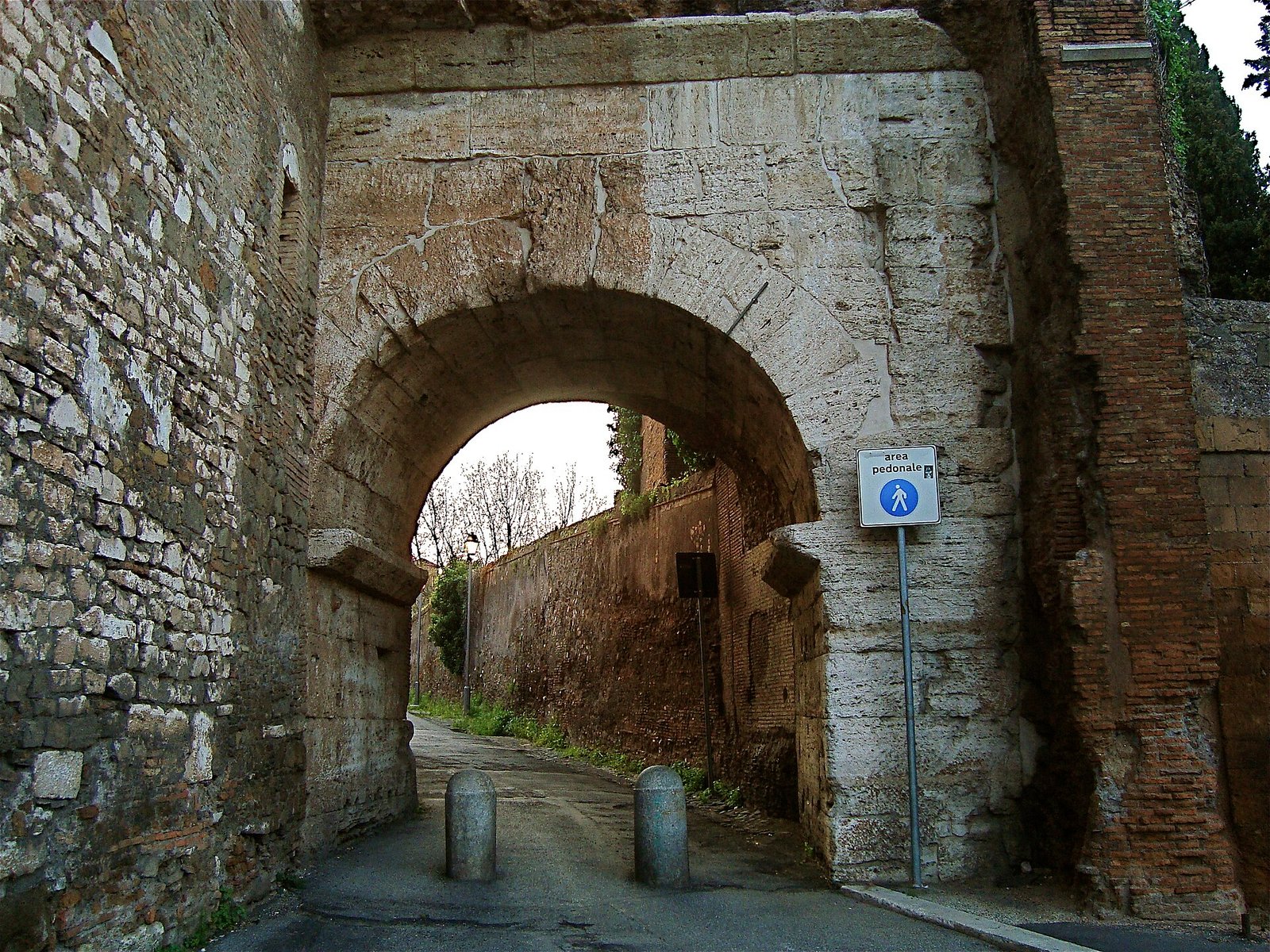
The Arch of Dolabella is on Via di San Paolo della Croce, on the Caelian, and you look at it from the street: free entry, no ticket, no booking, no hours. There is no interior to visit. It is a travertine archway built in 10 AD, with the bricks of the Neronian aqueduct above it and, beside it, the church of San Tommaso in Formis, at number 10 on the same street. For official information Roma Capitale gives the contact center 060608.
The name comes from the two consuls of that year, Publius Cornelius Dolabella and Gaius Junius Silanus, who had it built by decree of the Senate, as the inscription on the attic says. The sources read it as the travertine rebuilding of a gate of the Servian Walls, in all likelihood the Porta Celimontana. Later the arch became the support for the last stretch of the aqueduct ordered by Nero. Above the archway, according to tradition, Saint John de Matha, founder of the Trinitarians, spent his last years.
Data checked on September 29, 2026 on the tourism portal of Roma Capitale, on the page of the Sovrintendenza Capitolina dedicated to the Neronian aqueduct, on the website of the Order of the Most Holy Trinity and on the other sources cited further on in the text. For the arch there are no hours to confirm, because it is an outdoor structure over a public street. For the church next to it, instead, the only published appointment is the Sunday and holiday Mass, and the visiting conditions must be asked of the order's general curia using the contacts in the box.
At a glance: address, hours, ticket
- Where: Via di San Paolo della Croce, Celio district, along the route of the ancient Clivus Scauri. Sotterranei di Roma gives Largo della Sanità Militare as the reference.
- Operator: no ticket office and no custodian. Official information from the Roma Capitale contact center 060608, open every day from 9:00 to 19:00.
- How you enter: you don't. The arch is looked at from the street and walked through on foot.
- Price: free, no ticket and no booking.
- Hours: none for the arch. San Tommaso in Formis, Via di San Paolo della Croce 10: Mass on Sundays and holidays at 10:30, according to the Trinitarians' website.
- How to get there: Metro B stop Colosseo or Metro C stop Colosseo-Fori Imperiali, then uphill on foot toward the Caelian.
- Contacts for the church and the cell: general curia of the Trinitarians, 06 35420529, curia@trinitari.org.
Where it is and what you really see
Via di San Paolo della Croce is the street that cuts across the top of the Caelian following the route of the ancient Clivus Scauri, one of the hill's Roman climbs, as the English encyclopedia entry on the monument indicates. The arch spans it with a single archway. All around is a quiet Caelian, made of high walls, convents, gardens and hospitals, very different from the crowd that presses a little lower down around the amphitheater.
The monument is smaller than the name suggests. The tourism portal of Roma Capitale gives about four meters in width and 6:56 in height, a measurement that Sotterranei di Roma refers to the original height. The same survey adds that the arch today is buried by about two meters. What you see, then, is the upper part of an opening that in antiquity was taller, with the street level of the time buried under your feet.
The travertine is smooth, without reliefs. The English encyclopedia entry stresses it: no sculpted decoration. On the sides of the archway two strongly projecting moldings mark the point where the curve begins, the armilla, as the Sotterranei di Roma survey calls it. Above runs the attic with the consuls' inscription. It's sober architecture, more a public work than a celebration, and it should be looked at with that expectation.
On top of the travertine there is a second monument, of a completely different color. These are the bricks of the Neronian aqueduct, the branch of the Claudian aqueduct that the Sovrintendenza Capitolina dates to the reign of Nero, between 54 and 68 AD. The same page lists the arch among the points where the arcades are still visible. Looking carefully you can make out the point where the brickwork rests on the older stone.
In the masonry, above the archway, there is a small window. It is the detail most passersby don't notice and that gives sense to the whole place. The tourism portal of Roma Capitale links that little window to the cell where Saint John de Matha lived in his last years. Right next to it is the church of San Tommaso in Formis, entrusted to the Trinitarians, with the entrance at number 10 of the same street.
The rest of the picture falls into place by walking a few minutes. To the east the street opens onto Piazza della Navicella, where the main entrance of Villa Celimontana and the church of Santa Maria in Domnica open. To the west the Clivus Scauri descends, with the Basilica of Santi Giovanni e Paolo and, beneath it, the Roman Houses of the Caelian. For the whole hill, on the site you'll also find Celio: what to see.
The English encyclopedia entry places the arch at the northern corner of the Castra Peregrina, a Roman military camp that occupied this part of the hill. Today nothing of that complex is visible from the street. The name serves, however, to understand why the top of the Caelian was so busy in the imperial age, among barracks and aqueducts. The arch was a point of passage within this system, not an isolated monument as it appears now.
The Clivus Scauri, part of which Via di San Paolo della Croce follows, was one of the hill's ancient roads. Today the name survives in the stretch that descends toward San Gregorio, between the flank of the basilica of Santi Giovanni e Paolo and the convent walls. Walking along it you grasp the logic of the place: the gate opened along an uphill road, and whoever entered the city from this part of the hill had to pass under the archway, as pedestrians still do today.
A curiosity about the Arch of Dolabella
The name of the church next door comes from the aqueduct. The tourism portal of Roma Capitale explains that "in Formis" derives from the Latin forma Claudia, the term used for the Claudian aqueduct, on whose structures the building was constructed. Roma Segreta too links the name to the proximity of the arch that carries the Neronian arcades. So a church dedicated to an apostle carries in its name a Roman hydraulic work.
The word forma, in the Latin of engineers, indicated the water conduit. In the Middle Ages the arcades of the aqueducts were still the tallest and most recognizable structures of the urban periphery, and became orientation points. Calling a church "of Saint Thomas by the aqueducts" was a practical way of saying where it was, as today you would say "near the bridge" or "behind the station." The place name stayed even when the water stopped flowing.
There is then a second detail. According to the English encyclopedia entry, originally the arch may have supported a branch of the Aqua Marcia, before Nero used it for the extension of the Claudian. If the hypothesis is correct, this travertine opening carried water, in different eras, for two distinct lines. No official source confirms the detail, so it should be taken as a scholars' reading, not as an established fact.
The monument's name too lost a piece along the way. In common usage it is called Arch of Dolabella, but the two consuls of the inscription are cited on equal terms, and the tourism portal of Roma Capitale in fact uses the full form, Arch of Dolabella and Silanus. Silanus, the flamen of Mars, has vanished from spoken language. It often happens with double names: the first remains, the easiest to remember, and the second becomes material for epigraphy enthusiasts.
One thing nobody tells you about the Arch of Dolabella
Calling it an arch is misleading. It is not a triumphal arch and does not celebrate any victory. The tourism portal of Roma Capitale defines it as a gate of the Servian Walls rebuilt in the Augustan age, and the inscription speaks of a work carried out by decree of the Senate under the care of two consuls. It is a public construction project. Its plain form is explained that way, by function, not by lack of means.
The second point concerns the gate itself. The identification with the Porta Celimontana is the most accepted, but it is not the only one ever proposed. The Wikipedia entry on the gates of the Caelian recalls that studies have reversed earlier conclusions, based on place names, on the position of the Celimontana and the Querquetulana. The English encyclopedia entry considers the Celimontana the most probable hypothesis, adding however that the importance of this access route is not clear.
What the sources agree on is that the travertine of 10 AD replaced an older gate. Roma Segreta points out on the right side of the arch blocks of Grotta Oscura tuff, remains of the earlier gate, which confirm the defensive function of the spot. The arch you see, then, is the third layer of a story: the tuff gate, the Augustan rebuilding, the aqueduct resting on top.
The opposing view, in our judgment, is this. Anyone who comes all the way here for the arch itself risks being disappointed: on its own it is a modest structure, without sculptures, half buried. The part that really deserves the climb is the Neronian arcades that continue along the Caelian, and the little window of the cell above the archway. The arch should be read as the hinge of a system. Seen as an isolated monument, it is looked at for a minute and forgotten.
Was it a gate in the walls or a piece of aqueduct?
Both, at different times. The Porta Celimontana began as an opening in the Servian circuit, the walls that tradition attributes to King Servius Tullius and that were rebuilt in the Republican age in tuff blocks. Wikipedia recalls that the name of the gate, like that of the nearby Querquetulana, derived from the height to which it gave access. For the complete system of the Servian gates, on the site you'll find the guide to the Servian Walls.
In 10 AD the walls had long since lost their military function. Rome had expanded well beyond the circuit, and the gates survived as urban passages and landmarks. The travertine rebuilding by the consuls Dolabella and Silanus should be read in this climate: Augustus's city was renewing its openings with nobler materials, no longer thinking of a siege. The new gate was a civil work, meant to last.
Then came the water. The Sovrintendenza Capitolina dates the Neronian aqueduct to the period between 54 and 68 AD and describes it as a secondary structure of the Claudian aqueduct. The English encyclopedia entry specifies that Nero's extension used the Arch of Dolabella for the last stretch. The sources don't agree on the exact moment when the brick enclosed the travertine: Sotterranei di Roma speaks of restorations under Septimius Severus, Wikipedia gives 211 AD, under Caracalla.
The overlap is still legible to the naked eye. Below, the pale squared stone of the Augustan gate, above, the red bricks of the aqueduct. Few monuments in Rome show so well, at a single glance, two urban functions succeeding each other on the same spot. Another example, with a gate arch turned into a monument, is the Arch of Gallienus on the Esquiline, which the tourism portal of Roma Capitale gives as the only other surviving Servian gate.
What does the consuls' inscription say?
The text carved on the attic, as transcribed by Roma Segreta and Wikipedia, is P CORNELIVS P F DOLABELLA, C IVNIVS C F SILANVS FLAMEN MARTIALIS, COS, EX S C FACIVNDVM CVRAVERVNT. With the abbreviations resolved: Publius Cornelius Dolabella son of Publius and Gaius Junius Silanus son of Gaius, flamen of Mars, consuls, by decree of the Senate saw to it that it was built. They are few words, but they say who, when and with what authority.
The rarest detail is Silanus's title. The flamen Martialis was the priest in charge of the cult of Mars, an ancient and highly prestigious religious office. Finding it carved on an urban gate, next to the consulship, says a lot about the family's social weight. The final formula, faciundum curaverunt, is the typical one for public works: the magistrates neither pay nor dedicate, they oversee the works.
On the name of the second consul the popular sources are not aligned. Sotterranei di Roma writes Caio Giulio Silano, while Roma Segreta, Wikipedia and the English encyclopedia entry give Gaius Junius Silanus, and the inscription clearly reads IVNIVS. The correct reading is Junius. It's worth remembering when comparing different texts: a transcription error, repeated on many pages, ends up looking like a second version of the facts.
Reading the inscription on site takes a bit of patience. The attic has to be looked at from below, and the abbreviations typical of Latin epigraphy have to be resolved in your head: P F stands for Publii filius, son of Publius, COS for consules, EX S C for ex senatus consulto. It's worth photographing the attic and enlarging the image at leisure, comparing it with the transcription. That way the stone speaks again, line by line, in its bureaucratic and precise language.
My advice for visiting the Arch of Dolabella
The advice is to arrive from below, on foot, and without hurrying. Climbing from the Colosseum toward the Caelian you understand physically what a gate on a hill meant: the road climbs, the noisy city stays behind you, and at the top you find the opening. Arriving by taxi at Piazza della Navicella loses exactly this sequence, which is the key to understanding why the gate was here.
Once under the arch, it's worth stopping on both sides, because the reading of the attic and the relationship between the aqueduct masonry and the travertine change depending on the point of view. Then look for the little window up high. It's small and easy to miss, but it's the point that connects the Roman story to the medieval one. If you have a light pair of binoculars or the zoom on your phone, use it here.
Finally, before leaving, walk around the church of San Tommaso in Formis. Wikipedia places the 13th-century portal with the Trinitarian mosaic on the side of Largo della Sanità Militare, and many pass under the arch without knowing that roundel exists. Arch, window and mosaic together tell the same story, and seen in sequence, within a few minutes, they make the stop much fuller.
As for timing, Sunday morning has a precise advantage. At 10:30 the Sunday Mass is scheduled at San Tommaso in Formis, the only published opening of the church, and anyone who wants to see the interior can arrive a little early, respecting the service. On other days the arch is looked at from outside, at any hour of daylight, and the church remains a building to admire from the outside, with the portal's mosaic always visible.
Do you pay anything and can you go up to the cell?
For the arch you pay nothing and book nothing. It is an outdoor monument over a public street, and you look at it at any hour. The tourism portal of Roma Capitale publishes neither hours nor fees for the arch and refers, for any information, to the contact center 060608. There are no official tickets to buy, and be wary of anyone selling an entry to the arch: there is no entry.
The cell of Saint John de Matha is another matter. Wikipedia describes it as a small room that can be visited, but no opening hours are published. The tourism portal of Roma Capitale, on the church's page, says to contact the general curia of the Order of the Most Holy Trinity for Mass times and visiting conditions, at the numbers 06 35420529 and 06 52725090 or at the address curia@trinitari.org. Write in advance.
For the church of San Tommaso in Formis the Trinitarians' website gives a single Mass, on Sundays and holidays at 10:30, at the address Via di San Paolo della Croce 10. Outside that time the church has no published openings. No platform sells specific visits to the arch or the cell, and for this place we point to no online purchases: the only sensible channel is direct contact with the Trinitarians.
When you write to the general curia, it's best to be precise: possible dates, number of people, language, specific interest in the cell or the church. A clear request is more likely to get an answer. For an archaeological reading of the arch and the Caelian, instead, the reference is licensed tour guides and the cultural associations that organize visits on the hill, with programs and prices published on their own channels. Before booking it's worth checking that the offer really includes the arch and not just the churches of the hill.
Another well-known fact, yet rarely cited
That the Neronian aqueduct passed through here is well known. Less cited is where it ended up. The Sovrintendenza Capitolina writes that Domitian built a major extension to supply the imperial palaces on the Palatine, with a stretch of arcades crossing the valley between the Caelian and the Palatine. The water that passed over the Arch of Dolabella, then, ended up in the emperors' residences, on the other side of the valley.
Some popular sources instead link Nero's aqueduct to the Domus Aurea, the palace built after the fire of 64. The two readings don't exclude each other: Nero brought the water onto the Caelian for his great complex, his successors pushed it further, to the Palatine. In both cases the destination was the same, the residences of power, and this explains the care with which the work was maintained over the following centuries.
The Sovrintendenza also recalls the later interventions: reinforcements by the Flavians, Hadrian, Septimius Severus and Caracalla, with the signs of the Severan restoration still visible on Via Statilia. An aqueduct that goes through a century and a half of imperial maintenance explains why, above the arch, the brickwork is not uniform. Each restoration left its skin of bricks, and the travertine arch stayed underneath, holding everything up.
The right photo to take at the Arch of Dolabella
The photo that truly tells the story of the place holds the two materials together: the pale travertine below and the brick of the aqueduct above. To get it, step back a few paces along the street and frame vertically, so that the arch fills the lower part and the Neronian arcades rise toward the sky. A frame too tight on the archway loses half the story.
The second photo is a detail: the little window of the cell. With the zoom, isolate it against the brick masonry that surrounds it. It's an image few people take home and which, with a caption, explains more than many wide views. Then the third shot, the mosaic of the portal of San Tommaso in Formis, with Christ enthroned between the two prisoners, to be shot from below and without flash.
A warning about light and traffic. The street is narrow, closed in between high walls, and it's worth trying at different hours to find the moment when the travertine isn't in full shade. Watch out for service vehicles and the residents who pass by: shoot from the edge, without stopping in the middle of the roadway, and without climbing on low walls or fences to look for a better angle.
One last idea, for those who like photo series. Photographing the arch and then, along the walk, the other stretches of the Neronian aqueduct listed by the Sovrintendenza lets you build a small sequence on the same theme: the brickwork running above the streets of the Caelian, interrupted by churches, gardens and palaces. Placed side by side, those images explain the aqueduct better than a map, and the arch becomes its final chapter, the one where the water met the gate.
How do you get there from central Rome?
The simplest way is the metro to the Colosseum. The Colosseum Archaeological Park gives the Colosseo stop on line B and the Colosseo-Fori Imperiali stop on line C. In the same area pass, according to the Park, bus lines 51, 75, 81, 85, 87 and 118 and tram 3. From there you climb on foot toward the Caelian, along Via Claudia, to Piazza della Navicella.
From Piazza della Navicella you take Via di San Paolo della Croce, and the arch is met along the street, with San Tommaso in Formis at number 10. Anyone who prefers to arrive from the other side can climb the Clivus Scauri, starting from the area of San Gregorio al Celio and skirting the basilica of Santi Giovanni e Paolo along the route of the ancient clivus. In our judgment it's the nicest climb, because you reach the arch from the same direction as the Roman road.
Surface lines in Rome change often because of construction work, and Roma Capitale periodically publishes changes to the tram network. Before setting out, check the route on the ATAC website or with the contact center 060608. Accessibility is not published for the arch: the tourism portal of Roma Capitale refers to the Roma Accessibile section, and you should allow for the fact that all the approaches to the Caelian are uphill.
Those arriving instead from the area of San Giovanni in Laterano, perhaps after a visit to the basilica, can follow the Neronian arcades on foot along Via di Santo Stefano Rotondo to Piazza della Navicella. The Sovrintendenza Capitolina lists precisely this street among the stretches where the aqueduct is still visible, and walking along it you have it in front of you for a long stretch, before reaching the arch. It's the approach most consistent with the monument's history, because you walk beside the water the arch was meant to carry.
Some important events that happened here in history
In 10 AD the consuls Publius Cornelius Dolabella and Gaius Junius Silanus, by decree of the Senate, have the old tuff gate rebuilt in travertine. Between 54 and 68, according to the Sovrintendenza Capitolina, Nero brings onto the Caelian the branch of the Claudian aqueduct that uses the arch as a support. Domitian then extends it toward the Palatine, and under Septimius Severus and Caracalla the arcades are restored and enclose the travertine.
The next leap is medieval. The Trinitarians' website writes that Pope Innocent III gave the church of San Tommaso in Formis to the order in 1209, while Roma Segreta gives 1207 for the passing of the complex to John de Matha. Here the founder set up a hospital for the poor, the sick, pilgrims and ransomed slaves, and according to Wikipedia in 1210 the portal was adorned with the Cosmatesque mosaic. The saint died on December 17, 1213.
Roma Segreta then tells of the decline and the return. In 1379, under Urban VI, the Trinitarians left Rome, and in 1389 Boniface IX entrusted the complex to the Vatican Chapter. The Trinitarians' website recalls that in 1655 the founder's remains were transferred to Spain. Wikipedia dates the complete rebuilding of the church to 1663, and the sources don't agree on the order's return: 1898 for Roma Segreta, 1925 for Wikipedia.
In the 20th century the church reopens to the public. Roma Segreta gives 1926, and adds that the old hospital had been demolished to make room for a research institute. Wikipedia points out the modern stained glass of the single nave, dated 2000. The arch, in all this time, has stayed where it was, with the street continuing to pass beneath it. It is one of the few points of the Caelian where the sequence between the Roman age, the Middle Ages and the present can be read without excavations.
Who passed through the Arch of Dolabella
The first name is the one carved on the stone. Publius Cornelius Dolabella, after the consulship of 10, was legate in Illyricum between 14 and about 20 and proconsul in Africa in 23 and 24, where according to the Enciclopedia Treccani he defeated the Numidian rebel Tacfarinas. His colleague Gaius Junius Silanus held the title of flamen of Mars. Two high-ranking careers, tied forever to a neighborhood gate.
Then the emperors who put their hand to the aqueduct: Nero, the Flavians with Domitian, Hadrian, Septimius Severus and Caracalla. None of them left his name on the arch, but all left bricks. It's an indirect presence, made of maintenance and water, less spectacular than a dedicatory inscription and perhaps more concrete. For the neighborhood's most famous emperors' arch you only need to go down to the Colosseum and the Arch of Constantine.
The medieval protagonist is John de Matha, founder of the Order of the Most Holy Trinity, born for the ransom of slaves. The Trinitarians' website writes that he died here on December 17, 1213 and was buried in the church, before the transfer of his remains to Spain in 1655. With him pass the popes who mark the history of the complex: Innocent III who gives it, Urban VI under whom the order leaves Rome, Boniface IX who entrusts it to the Vatican Chapter.
The last name is that of the street. Via di San Paolo della Croce recalls the founder of the Passionists, who according to ACI Stampa died in Rome on October 18, 1775 in the house of Santi Giovanni e Paolo, which had become the congregation's headquarters. The room where he died is still in the building of the general curia, restored in 2017. On the same street, then, two founders of religious orders coexist, a few centuries apart.
Among the least remembered passages are those of nameless people. Wikipedia and Roma Segreta describe the Trinitarians' hospital as a place of welcome for the poor, the sick, pilgrims and ransomed slaves. For decades, then, the hospital next to the arch took in people freed from captivity, whose memory is entrusted to no known plaque. The mosaic on the portal, with the two prisoners on either side of Christ, is their only collective portrait.
The cell of Saint John de Matha: documents, tradition, legend
What the documents say is limited but solid. The church of San Tommaso in Formis was given by Innocent III to the Trinitarians at the beginning of the 13th century, John de Matha placed his seat there and died there in 1213, and next to it a hospital for the poor, the sick, pilgrims and ransomed slaves operated. The mosaic on the portal, with the inscription SIGNVM ORDINIS SANCTAE TRINITATIS ET CAPTIVORVM, is a visual document of that mission.
What tradition says is the cell above the arch. Roma Segreta calls it an 18th-century tradition, according to which the saint lived in a small room above the archway from 1209 until his death. The tourism portal of Roma Capitale uses a prudent conditional: the saint probably resided in the cell that corresponds to the little window above the arch. None of the open sources cites a medieval document that proves it directly.
What belongs to legend, in the hagiographic sense, is the vision. The Trinitarians' website explains that the mosaic represents the vision of John de Matha: Christ enthroned between two chained prisoners, one white and one black. It is the order's founding story, and as such it should be read, that is, as an image of a vocation. The mosaic, instead, is a real object, which the sources attribute to the master Iacopo and his son Cosma, whose names appear on the portal.
Lined up, the three parts support each other without being confused. The saint's presence in this place is certain. The cell above the arch is plausible and ancient as a tradition, but not proven. The vision belongs to the spirituality of the order. Anyone who raises their eyes toward the little window, knowing all this, is looking at a place where history left a sure mark and devotion added the rest.
Where can you still see the arcades of the Neronian aqueduct?
The arch is one point on a long line. The Sovrintendenza Capitolina lists the stretches where the Neronian arcades can still be observed: Via Statilia, Via Domenico Fontana, Piazza di San Giovanni in Laterano, Via di Santo Stefano Rotondo, Via and Piazza della Navicella, the stretch above the Arch of Dolabella and the garden of Villa Wolkonsky, residence of the British ambassador.
Following this line on foot is one of the smartest ways to read the Caelian. From the area of the Basilica of San Giovanni in Laterano, with the Holy Stairs and the Lateran Palace, the arcades climb toward Via di Santo Stefano Rotondo, skirt the church of Santo Stefano Rotondo and arrive at the Navicella. The Arch of Dolabella is the last support before the descent toward the Palatine.
Not all the stretches listed by the Sovrintendenza are accessible. The garden of Villa Wolkonsky, given as the residence of the British ambassador, is a diplomatic seat, and the arcades that cross it cannot be freely visited. The stretch of Via Statilia, with the signs of the Severan restoration, and that of Via di Santo Stefano Rotondo are instead seen from the street. In Piazza della Navicella, also on the Sovrintendenza's list, are the main entrance of the villa and the church of Santa Maria in Domnica.
The Claudian aqueduct, of which the Neronian is a branch, entered the city farther east. Its monumental arcades can be seen at Porta Maggiore, where the water crossed over the consular roads, and outside the walls in the Aqueducts Park, where they run for kilometers through the countryside. Seeing them before or after the arch helps in understanding the scale of the work: the Caelian is the final part of a route that began in the Aniene valley.
For those who like this kind of itinerary, the comparison with the Aurelian Walls is instructive. The Aurelian circuit too, two and a half centuries later, incorporated stretches of aqueduct into its defenses, as at Porta Maggiore. In Rome infrastructure was not demolished when its function changed: it was reused, faced, enclosed. The Arch of Dolabella is a small and very clear example of this habit.
When is it closed and what not to expect?
The arch never closes, because it has no gates. What can change is visibility: restoration scaffolding or roadworks can partly cover the archway. The data on ongoing construction sites is not published on a dedicated page, so if you're coming on purpose, it's worth asking the contact center 060608 if any work is planned. In any case the visit remains short, and anyone expecting an archaeological site with a route and panels will be disappointed.
Don't expect to go up to the cell without arrangements. The room above the arch belongs to the Trinitarians' complex, and the visiting conditions must be asked of the general curia. Don't expect the church to be open on just any weekday either: the only published time is the holiday Mass at 10:30. Showing up at the door outside hours, ringing doorbells, is not the right way to ask.
What you always see, even with the church closed, is the mosaic above the entrance of the old hospital, which Wikipedia places on the side of Largo della Sanità Militare. There's no need to go in. What is needed is a minimum of attention to the surroundings: the Caelian hosts health and religious facilities, and the driveways must be left clear. No tripods in the middle of the street, no parking in front of the gates. The visit works well that way too, staying on the sidewalk.
Villa Celimontana, a few steps away, does have published hours. The tourism portal of Roma Capitale gives opening from dawn to dusk, from 7:00 to 18:00 between May 1 and October 31 and from 7:00 to 17:00 between November 1 and April 30. If you plan to combine the arch with a walk in the villa, keep these limits in mind, especially on winter afternoons, when the light and the gate close early.
Eating in the area
The top of the Caelian is made mostly of convents, hospitals and gardens, and the restaurants are few. That's an advantage. The traps are concentrated lower down, around the Colosseum and along the streets that lead to the Forums: photo menus in many languages, barkers at the door, places open nonstop from morning to night with no kitchen break. Romans recognize them at first glance and keep walking. Not out of snobbery, but because those places live on customers who won't come back.
Other signs to watch for: the lady making fresh pasta in the window to attract passersby, items with no price on the board, a different menu outside and inside, places with a view of a monument that adapt the bill to whoever sits down. None of these signs, on its own, guarantees you'll eat badly. Together, though, they describe a place designed for passing trade and not for the neighborhood's regular clientele.
The simplest criterion is to move away from the monument streets and look in the neighborhood's residential streets for places with a short menu, written prices and customers who call the staff by name. Those who prefer a packed lunch will find the right benches and lawns in Villa Celimontana. For a selection of addresses outside the tourist circuits consult the list of addresses on Google Maps.
What to combine in a day
The most natural pairing is the whole Caelian. From Piazza della Navicella you enter Villa Celimontana, then go down the Clivus Scauri toward the Basilica of Santi Giovanni e Paolo and the Roman Houses, as far as San Gregorio al Celio. On the other side of the square is the church of Santa Maria in Domnica, and a little farther on Santo Stefano Rotondo, with its circular plan.
Those who want to stay on the theme of gates and walls can build a route in stages. The Servian Walls have their longest stretches near Termini, the Arch of Gallienus is the other gate left standing, and to the south you reach the Aurelian circuit with Porta Latina, San Giovanni a Porta Latina, Porta San Sebastiano and the Museum of the Walls.
Along the same axis, between the two circuits, are the tombs of the urban Via Appia: the Tomb of the Scipios in the Parco degli Scipioni and the Columbaria of Vigna Codini, which the Appia Antica Archaeological Park currently gives as not accessible. Going down instead to the south, in the direction of Via delle Terme di Caracalla, you find the Baths of Caracalla, San Sisto Vecchio and Santa Balbina.
Those who prefer medieval churches have, a short distance away, the Basilica of the Santi Quattro Coronati and the Basilica of San Clemente, both between the Caelian, the Colosseum and the Lateran. For classical ancient Rome, the Palatine, the Roman Forum and the Circus Maximus are reached on foot going down from the hill. More ideas without a ticket are in the guide Free Rome.
An alternative afternoon follows the aqueduct eastward. After the Lateran you reach the Basilica of Santa Croce in Gerusalemme and the Amphitheatrum Castrense, incorporated into the Aurelian Walls, and from there Porta Maggiore, where you also find the Underground Basilica of Porta Maggiore. For those who love hidden places under the city, on the site you'll also find Underground Rome.
Frequently asked questions
What does the mosaic of San Tommaso in Formis represent?
The roundel above the old entrance of the hospital depicts Christ enthroned between two chained prisoners, one white and one black, with the inscription SIGNVM ORDINIS SANCTAE TRINITATIS ET CAPTIVORVM. The Trinitarians' website links it to the vision of the founder, John de Matha. Wikipedia and Roma Segreta date it to 1210 and attribute it to the Cosmatesque workshop of the master Iacopo and his son Cosma.
Do you pay to see the Arch of Dolabella?
No. The arch is over Via di San Paolo della Croce, a public street, and is looked at for free at any hour, with no ticket and no booking. The tourism portal of Roma Capitale gives neither fees nor hours and refers to the contact center 060608, open every day from 9:00 to 19:00. Be wary of any offer proposing a paid entry to the arch: there is no interior to visit.
Why is it called the Arch of Dolabella?
The name comes from one of the two consuls of the year 10 AD, Publius Cornelius Dolabella, who with his colleague Gaius Junius Silanus oversaw the construction by decree of the Senate, as the inscription on the attic says. For this reason the full name is also found, Arch of Dolabella and Silanus, used by the tourism portal of Roma Capitale. Silanus, a little-known detail, was also flamen of Mars, an ancient and prestigious priesthood.
Was the Arch of Dolabella a gate in the walls?
According to the sources, yes. The tourism portal of Roma Capitale describes it as a gate of the Servian Walls rebuilt in the Augustan age, and the most accepted identification is with the Porta Celimontana. Roma Segreta points out on the right side tuff blocks of Grotta Oscura from the older gate. Wikipedia recalls however that the position of the Caelian's gates has been the subject of second thoughts by scholars.
What does Nero's aqueduct have to do with it?
Nero had a branch of the Claudian aqueduct built that crossed the Caelian, and the Sovrintendenza Capitolina places the stretch above the arch among those still visible. The English encyclopedia entry writes that the Neronian extension used the arch for the last stretch. The brick arcades you see above the travertine are those, restored in the Severan age, and on the exact moment of their enclosing the sources don't agree.
Can you visit the cell of Saint John de Matha?
The data on hours is not published. Wikipedia describes the cell as a small room that can be visited, but the tourism portal of Roma Capitale says to contact the general curia of the Order of the Most Holy Trinity for the visiting conditions, at the numbers 06 35420529 and 06 52725090 or by writing to curia@trinitari.org. It's best to write well in advance, explaining dates and number of people.
When is the church of San Tommaso in Formis open?
The Trinitarians' website gives Mass on Sundays and holidays at 10:30, at Via di San Paolo della Croce 10. Other opening hours are not published. For visits outside Mass the reference is the order's general curia. The Cosmatesque mosaic of the old hospital's portal, instead, is seen from the outside at any time, with no need to go in.
How do you get to the Arch of Dolabella by public transport?
The Colosseum Archaeological Park gives Metro B, Colosseo stop, and Metro C, Colosseo-Fori Imperiali stop, as well as some bus lines and tram 3 in the area. From the Colosseum you climb on foot toward Piazza della Navicella and take Via di San Paolo della Croce. Surface lines change often because of works: check the route on the ATAC website before leaving.
How long does it take to see the arch?
For the arch itself a few minutes are enough, the time to read the inscription, look for the cell's little window and look at the mosaic of San Tommaso in Formis. It makes sense, though, as a stop on a longer walk on the Caelian, with Villa Celimontana, Santi Giovanni e Paolo, Santo Stefano Rotondo and the arcades of the Neronian aqueduct. Half a day lets you see the hill at leisure, without rushing.
Who wrote this and on what sources
The text comes from the editorial team of Tour Leader Pro, the Roman company that designs itineraries, visits and cultural events across Rome and Lazio. Rates, hours and booking procedures reported here come from the official sources mentioned in the text, as of the date given at the opening: the tourism portal of Roma Capitale for the arch and the church, the Sovrintendenza Capitolina page on the Neronian aqueduct, the Trinitarians' website. Let us know what you find changed.
Organizing a stop at the Arch of Dolabella, for yourself or for a group, seems trivial but takes some care. The street is narrow, the cell and the church open only with arrangements made in advance, and the Caelian has to be tackled uphill. For those who plan cultural outings and have to coordinate times, transfers and contacts with operators, a useful resource for those who organize group trips is Tour Leader Pro.
The arch is a short stop, and it works better within a trip that takes in ancient Rome, the basilicas and the less-traveled hills. Those with a few days available can add to the city the Castelli Romani, Tivoli with its villas or the countryside crossed by the aqueducts. To put it all in order, a useful resource for building a multi-day itinerary is Italy Planner.