Porta Metronia
In short. Porta Metronia can be seen for free from the street, in Piazza di Porta Metronia, on the stretch of the Aurelian Walls between San Giovanni in Laterano and Porta Latina.
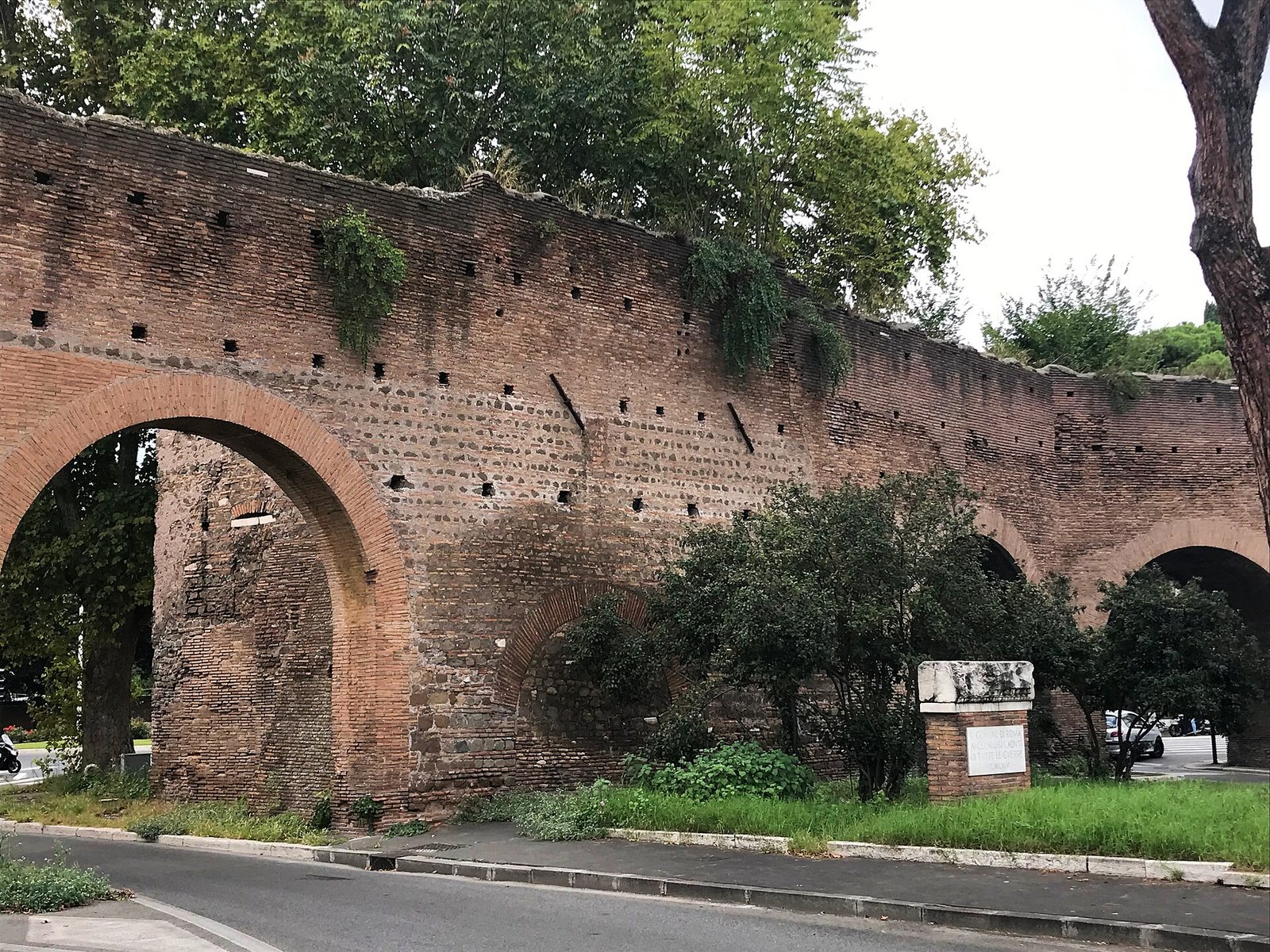
Porta Metronia can be seen for free from the street, in Piazza di Porta Metronia, on the stretch of the Aurelian Walls between St. John Lateran and Porta Latina. It has no ticket office, no hours and you can't go inside. The ancient arch has been walled up since the 12th century, and the archways that cars drive through today are openings from the 1900s. The Roma Capitale tourism portal lists the Sovrintendenza Capitolina as the operator, with the contact center 060608 for information.
It is a minor gate, a postern, that is a secondary passage toward the Celian Hill hill: a single arch without ornaments, cut directly into the brick wall. In 1122 Pope Callixtus II turned it into the opening for the marrana, the artificial watercourse called Acqua Mariana. On the inner wall two plaques remain, one from 1157 with the names of the senators of the Roman commune and one from 1579. The rest is a stretch of walls among the best preserved of the circuit.
Data checked on September 29, 2026 on the Roma Capitale tourism portal, on the Museo virtuale delle Mura di Roma run by Roma Capitale, on the pages of the Sovrintendenza Capitolina and on Roma Capitale's announcements on metro line C. The gate can be seen without booking anything. The only things to book are the free itineraries that the Sovrintendenza organizes from time to time along the walls, with a meeting point right in this square, and the visits to nearby monuments that require it.
In Brief: Address, Hours, Ticket
- Where: Piazza di Porta Metronia, Rome, on the stretch of the Aurelian Walls between Porta Asinaria and Porta Latina.
- Operator: Sovrintendenza Capitolina ai Beni Culturali, which looks after Rome's city walls.
- How to enter: you don't. The ancient arch is walled up and is seen from the inner side of the walls, from the square.
- Price: free, no booking.
- Hours: none. The gate is visible at any hour from the street.
- How to get there: metro line C, Porta Metronia station in Piazzale Ipponio, opened on December 16, 2025.
- Information: Roma Capitale contact center 060608. The operator doesn't publish accessibility information for the site.
Where It Is and What You Really See
Piazza di Porta Metronia is a large tree-lined crossing at the foot of the Celio, between the San Giovanni district and the Appio Latino. Anyone arriving here for the first time sees mostly traffic: cars, buses, traffic lights, and the big modern archways opened in the wall to let the roads through. The real gate is none of those openings. It is a smaller, taller arch, closed for centuries, at the base of a tower that juts toward the inside of the city.
The ancient piece is recognizable if you know what to look for. The Museo virtuale delle Mura di Roma describes it as a single arch without decoration, and the encyclopedia entry on the gate adds that it has no jambs or architrave: it is a simple brick arch. From the city side the arch today sits about one meter above street level. It is walled up, and precisely for this reason it is little noticed among the modern openings.
The tower that houses the arch is an addition from the early 5th century. According to the Museo virtuale delle Mura di Roma, when the emperor Honorius had the circuit raised, a tower jutting toward the inside was built against the gate, perhaps a second gate, a guardhouse or the housing of a closing mechanism. On the inner wall of the tower the two plaques can be read, the one of 1157 and the one of 1579. They are the main reason to stop here.
The terrain explains a lot. The Museo virtuale delle Mura di Roma recalls that in this sector the ground was steep and irregular, and that the natural valley, with its marshy areas, was called palus Decenniae in antiquity. Above the gate, on the city side, rises the Celio with Villa Celimontana and the church of Santo Stefano Rotondo. Below, the square occupies the bottom of the valley where water once flowed.
Comparison with the other minor gates of the circuit helps to understand what you have in front of you. According to the encyclopedia entry, around 402, with Honorius's works, posterns such as Pinciana and Asinaria were promoted to real gates, with towers and more carefully made archways. Porta Metronia was not. It remained a service opening, with a feature that distinguishes it from the others: it opened at the base of a crenellated turret, not between two towers.
From the outer side a different landscape opens. Beyond the modern archways begins the Appio Latino, a residential district of the 1900s with wide avenues and tall buildings. From here you follow the walls southwest, toward Porta Latina, along Viale Metronio. The Sovrintendenza Capitolina indicates the stretch between the two gates as one of the best preserved of the entire circuit, and adds that it is best appreciated from the outer side.
Toward the north, instead, the walls climb back toward the Lateran along Via della Ferratella. The Museo virtuale delle Mura di Roma describes this stretch as the continuation of the circuit up to Porta Metronia, alongside a tennis sports club. At the end is Piazzale Ipponio, with the entrances of the new metro station. Anyone arriving by metro therefore makes the first piece of the way with the walls beside them, and meets the gate from the inner side.
A Curiosity About Porta Metronia
The 1157 plaque doesn't name the pope. It recalls a restoration of the walls ordered by the Senate and the Roman People, with the abbreviation SPQR, and lists the senators who decided it. The Roma Capitale tourism portal presents it as one of the two plaques on the inner wall of the tower. For a medieval inscription on a Roman public work it is a detail that counts: in those years the city was trying to govern itself, with a commune of its own.
The encyclopedia entry on the gate transcribes its text, in medieval letters and with many abbreviations. The beginning goes like this: ANNO MCLVII INCARNT DNI NRI IHV XRI SPQR HEC MENIA VETUSTATE DILAPSA RESTAURAVIT SENATORES. Roughly translated: in the year 1157 of the incarnation of our Lord Jesus Christ, the Senate and the Roman People restored these walls, collapsed with age. The names of the senators follow, one after another, without punctuation.
The very absence of punctuation makes the list uncertain. In the transcription there appear, among others, Sasso, Giovanni di Alberico, Roieri, Buccacane, Pinzo, Filippo, Giovanni di Parenzo, Pietro, Cencio di Ansoino, Rainaldo Romano and Nicola Mannetto. The encyclopedia entry warns that the names remain uncertain and that tradition identifies about 10 councilors. In front of the plaque it's best to read the names as a group, not as an official list to be counted.
The two plaques are on the inner wall of the tower, that is on the city side. Anyone who looks at the gate only from outside, from Viale Metronio or from the sidewalk of the Appio Latino, doesn't see them at all. It is one of the reasons many pass by here without noticing. To find them you have to stay inside the walls, stand in front of the jutting tower and look up above the walled-up arch.
The context helps explain why the commune was rebuilding the walls. According to the encyclopedia entry, they were years of conflict: Pope Adrian IV had struck the city with an interdict, the ideas of Arnold of Brescia had set Rome alight, and the army of Frederick Barbarossa had arrived at St. Peter's. The Senate answered with works on the defenses. The plaque, placed on a minor gate, is a political declaration carved in marble.
Something Nobody Tells You About Porta Metronia
The arches everybody drives through are not the gate. The encyclopedia entry explains that the four side arches were opened for traffic reasons, in two phases, in the first half of the 1900s, and that they ended up taking the name of the closed gate. The sources don't agree on the details: the Roma Segreta site speaks of one opening during Fascism and another in the postwar period. In any case they are modern openings.
The height of the ancient arch also tells a modern story. The Museo virtuale delle Mura di Roma explains that at the beginning of the 1900s the ground was raised with earth from the excavations of the Baths of Caracalla, and that this fill buried forever the original walking surface and the water channel. That is why the arch appears raised about one meter above the street. The ancient ground lies lower, under the asphalt.
The opposing position, in our opinion, is this: anyone who looks for a monumental gate at Porta Metronia has the wrong place, and anyone who dismisses it as a busy crossing is even more wrong. The gate never had a facade, and doesn't need one. Its value is in the two plaques and in the story of the water. The most common mistake is to photograph a modern archway and leave convinced of having seen the Aurelian gate.
There is also a practical flip side. Precisely because it has no monument shape, Porta Metronia almost never appears in tourist tours of the Celio, which stop at Santo Stefano Rotondo or at Santi Giovanni e Paolo. Anyone who comes down this far finds a neighborhood square, without stalls and without crowds. You look at the tower, read the inscriptions, step out of the walls and walk along the best-preserved stretch of the southern circuit.
Why Did a Gate Become the Passage for a Watercourse?
In 1122 Pope Callixtus II brought an artificial watercourse to Rome, the Acqua Mariana, which Romans called the marrana. The Roma Capitale tourism portal explains that it served to irrigate vegetable gardens and drive mills. Porta Metronia was chosen to let it into the city, which even then had little importance for traffic. The Museo virtuale delle Mura di Roma links the choice to the natural valley and the wet areas found here.
The encyclopedia entry reconstructs the route. The water started from the Squarciarelli area, near Grottaferrata, crossed the countryside between Via Appia Nuova and the Tuscolana, entered the city under the arch of Porta Metronia and joined a stream coming down from the Lateran. From here it continued toward the Circus Maximus and reached the Tiber near the outlet of the Cloaca Maxima.
From that moment the gate stopped being a passage for people and carts. The arch was closed and only the opening for the water remained. The Museo virtuale delle Mura di Roma dates the transformation to the 12th century and ties it to Callixtus II's hydraulic program. For centuries, then, Porta Metronia was not a gate but the intake mouth of a canal, guarded like every weak point of the circuit.
The water brought work and also disease. The Roma Segreta site reports that the stagnant water created a marshy area called Lo Pantano, and both the encyclopedia entry and Roma Segreta recall a serious epidemic in 1601, tied to the unhealthiness of the place. The Roma Capitale tourism portal adds that the area remained marshy until the reclamation of the 1900s, carried out with the works of the Passeggiata Archeologica.
The memory of the water remains in the street names. Via della Ferratella, which follows the walls toward the Lateran, owes its name to the marrana, but the sources don't agree on why. The Roma Segreta site ties it to the iron grate placed on the canal to prevent smuggling. The encyclopedia entry instead ties it to the waters rich in ferrous minerals that came down from the Lateran. The two explanations have coexisted for a long time, and neither is confirmed by an official source.
My Advice for Visiting Porta Metronia
My advice is to arrive from above, from the Celio, and not from the traffic side. From Villa Celimontana or from Santo Stefano Rotondo you walk down toward the square and see the gate from the inner side, the right one. You stop in front of the jutting tower, look for the walled-up arch raised above the street, and read the two plaques before crossing. The rest of the square you look at afterward, with your eye already trained.
The inscriptions take a bit of patience. The letters are medieval, dense, with many abbreviations, and read better in side light. It's worth bringing the transcription on your phone and comparing it word by word with the stone. You find the date MCLVII, the abbreviation SPQR, the word SENATORES and the names in a row. It's a five-minute exercise that changes the way you look at the place.
Then you leave the walls through one of the modern archways, on the pedestrian crossing, and walk along Viale Metronio toward Porta Latina. It is the stretch that the Sovrintendenza names among the best preserved, with square towers at regular intervals. For the gate 20 minutes are enough. With the walk to Porta Latina and a stop in the basilica of San Giovanni a Porta Latina you need about two hours.
The best time is the morning of a weekday, after rush hour, or Sunday morning, when traffic drops. In summer, in the middle hours, walking along the outer walls is tiring, and it's best to start early. Anyone who wants to understand the gate with an archaeologist can follow the Sovrintendenza's free itineraries along the walls, which often start right from Piazza di Porta Metronia, with booking at 060608.
Do You Pay Anything and Can You Go Inside?
For the gate you pay nothing and book nothing. You look at it from the square and the nearby streets, by day and by evening. The ancient arch is walled up, the tower doesn't appear to be open to the public and the operator doesn't indicate visits to its rooms. There are no tickets to buy and no products on sale on tourist-activity platforms dedicated specifically to Porta Metronia.
The only way to get an on-site reading is the free itineraries of the Sovrintendenza Capitolina. The page of the itinerary from Porta Metronia to Porta Latina reports an edition on March 31, 2024 at 11:30, lasting one hour, meeting in Piazza di Porta Metronia on the gardens side, maximum 25 people, booking mandatory at 060608, active from 9:00 to 19:00. The new dates have to be looked up on the operator's site.
Anyone who wants to go up inside a gate of the walls has only one possibility in this area: the Museum of the Walls, inside Porta San Sebastiano, on Via Appia. Hours, capacity and entry conditions should be checked on the museum's official site before leaving. On foot from Porta Metronia you reach it following the walls south, passing by Porta Latina, in a walk of less than half an hour.
The archaeological museum built into the metro station, for now, is not a possibility either. The Roma Capitale tourism portal writes that the station was inaugurated on December 16, 2025, but that the museum is closed and not accessible to the public. Hours and tickets, therefore, are not published. To find out if and when it will open it's best to ask the contact center 060608.
Another Well-Known Fact, Yet Rarely Cited
That the walls of Rome were restored continually, for centuries, is well known. Less often cited is that at Porta Metronia the restorations left the signature of the same family more than four centuries apart. The Roma Capitale tourism portal indicates that the second plaque, of 1579, recalls a restoration financed by Cesare Giovenale Manetti. The name Mannetto already appears on the 1157 plaque, in last place on the list of senators.
The Museo virtuale delle Mura di Roma explicitly links the two inscriptions. The restoration of 1579, under Pope Gregory XIII, was promoted by a conservator of the Campidoglio descended from that Nicola Mannetto who appears among the senators of 1157. The spellings change from one source to another, Manetti, Mannetto, Mannetti, but the meaning is clear. A Roman family came back to put its hand to the same gate, and wanted to write it next to the ancestor's plaque.
The pope of the second restoration also left his mark in the area. The Museo virtuale delle Mura di Roma recalls that in 1574, five years earlier, under the same Gregory XIII, the nearby Porta Asinaria was decommissioned and replaced by Porta San Giovanni, higher up, because the ground level had changed. In the same decade, then, the sector of the walls between the Lateran and the Celio was reorganized: a new gate to the north, a restoration at Porta Metronia.
Between the two plaques the titles change, not the substance. In 1157 the senators of the commune sign, in 1579 a conservator of the Campidoglio, that is one of the city magistrates of Rome under the government of the popes. In both cases it is a civic institution putting its name on a public work on the walls. Anyone who reads the two stones side by side has in front of them four centuries of Roman municipal history in a few square meters.
The Right Photo to Take at Porta Metronia
The photo that tells the story of the gate is taken from the inner side, from the sidewalk of the square, with the jutting tower in the center. The frame must include the walled-up arch, the brick wall around it and, if possible, the line of the street below, so as to show the drop of about one meter. It is an image without effects, but it immediately explains the story of the raised ground and the arch left high.
The second photo is a detail: the plaques. You need the phone's zoom or a long lens, and light coming from the side to make the letters stand out from the stone. With the sun high the engravings flatten. It's worth shooting the 1157 plaque so that the date MCLVII and the abbreviation SPQR are legible in the same image. It is the most effective photographic proof of the medieval Roman commune.
The third photo is taken from the outer side, along Viale Metronio, moving a few tens of meters away from the square. From here you see the curtain wall with the square towers at regular intervals, the stretch the Sovrintendenza names among the best preserved. It works well in the late afternoon, when the raking light warms the brick. Watch out for traffic and for cars maneuvering along the avenue.
One rule applies to every frame. No photos from the middle of the roadway or under the archways, where cars and buses pass and there is little room for pedestrians. The best photos are taken from the sidewalks and from the traffic islands reached on the pedestrian crossings. Anyone who wants a view from above of the area can go up to Villa Celimontana, from where you sense the drop in elevation between the hill and the valley of the marrana.
How Do You Get There from Central Rome?
The most direct way is metro line C. Roma Capitale opened the Porta Metronia station on December 16, 2025, in Piazzale Ipponio, next to the Aurelian Walls, together with the Colosseo Fori Imperiali station. The Comune's portal on urban transformations places the station about 500 meters south of Piazza San Giovanni in Laterano. From the exit you follow the wall along Via della Ferratella to the gate's square.
Anyone starting from the Colosseum can take line C for one stop, or walk up the Celio. The most pleasant route passes beside the basilica of Santi Giovanni e Paolo, under the Arch of Dolabella, along Villa Celimontana and Santo Stefano Rotondo, and then descends toward the square. This way you arrive at the gate from the inner side, the one with the plaques.
From San Giovanni in Laterano the walk is short. You go down from the basilica's square toward Piazzale Ipponio, meet the walls and follow their inner side to Porta Metronia. Anyone coming from the Baths of Caracalla does the route in reverse: goes up toward Porta Latina, follows the outer walls along Viale Metronio and arrives at the gate from the Appio Latino side.
The square is also served by surface buses, but routes and line numbers change often because of works and events, and it's best to check them on the ATAC site the same day. By car the visit isn't worthwhile: the square is a busy crossing, parking is scarce and the gate can be seen in a few minutes on foot. Anyone coming from outside Rome does better to leave the car near a metro station.
Some Important Events That Happened Here in History
The first event is the construction of Aurelian's circuit, in the 270s of the 3rd century, when Rome closed itself back inside a wall after centuries as an open city. Porta Metronia was born as a third-rate postern, according to the encyclopedia entry. At the beginning of the 5th century Honorius raised the walls: other minor gates, like Pinciana and Asinaria, became real gates, while Porta Metronia remained a simple service opening, with the addition of the tower jutting toward the inside.
The second event is 1122, with the arrival of the marrana. Callixtus II turned the gate into an opening for water and closed it to passage. The third is 1157, when the Senate of the Roman commune restored the walls and left the plaque with the names of the senators, in years of open conflict with the pope and with the emperor. Since then the tower has carried on its inner wall one of the most political pages of medieval Rome.
The fourth event is the restoration of 1579, under Gregory XIII, financed by Cesare Giovenale Manetti and recalled by the second plaque. The fifth is less glorious: the epidemic of 1601, which the encyclopedia entry and the Roma Segreta site tie to the unhealthiness of the marshy area created by the standing water. For centuries the valley at the foot of the Celio was a place of vegetable gardens, mills and stagnant water, far from the inhabited city.
In the first half of the 1900s the area changed face. The Roma Capitale tourism portal ties the reclamation to the works of the Passeggiata Archeologica, and the Museo virtuale delle Mura di Roma explains that the earth from the Caracalla excavations buried the ancient surface and the canal. In the same decades the archways for traffic were opened. Outside the walls the Appio Latino district was growing, and the gate was becoming the crossing we know.
The last chapter was written underground. The Metro C company, which built the line, reports that between July and October 2018 the ground under the walls was consolidated with injections, and in March and April 2019 the two tunnel boring machines passed under the circuit, under continuous monitoring that recorded practically negligible effects. On December 16, 2025 Roma Capitale opened the Porta Metronia station, which brought the name of the gate back onto the city's everyday map.
Who Has Passed Through Porta Metronia
The first name, perhaps, is the one the gate still preserves today. The Museo virtuale delle Mura di Roma considers it probable that Metronia derives from the properties of a certain Metrobius or Metronianus, a landowner of the area. Nothing else is known. Then come the builder emperors: Aurelian, who decided the circuit, and Honorius, who raised it and added the tower. There is no record that either of them passed through here, but the arch and the tower bear their building signature.
The most important medieval name is that of Callixtus II, the pope who in 1122 brought in the Acqua Mariana and closed the gate to passage. After him come the senators of 1157, who signed the restoration with their names: Sasso, Giovanni di Alberico, Buccacane, Cencio di Ansoino, Rainaldo Romano, Nicola Mannetto and the others on the list. In the background of the plaque move Adrian IV, Arnold of Brescia and Frederick Barbarossa, without being named.
In the 1500s Gregory XIII and Cesare Giovenale Manetti appear, conservator of the Campidoglio, who financed the restoration of 1579 and had the second plaque engraved. Then for centuries mainly the water passed through here, and those who worked in the vegetable gardens and mills of the valley. They are not recorded names, but they are the people for whom the marrana had been built, and who also paid its price in the epidemics.
In recent years archaeologists and engineers have passed through here. According to the Roma Capitale tourism portal, between 2015 and 2018 the excavations for the metro station investigated almost 50,000 cubic meters of archaeological ground over an area of 3,300 square meters. On December 16, 2025, at the inauguration of the station, those present were the mayor Roberto Gualtieri, the Minister of Infrastructure Matteo Salvini and the Minister of Culture Alessandro Giuli, according to Roma Capitale's announcement.
More recently, archaeologists of the Sovrintendenza Capitolina have set out from the square with their free itineraries along the walls. The edition of March 31, 2024, dedicated to the stretch between Porta Metronia and Porta Latina, had its meeting point in Piazza di Porta Metronia, gardens side, for a maximum of 25 participants. They are small events, announced on the operator's site, that bring attention back to a gate that for centuries was above all a passage for water.
Metrobio, Metaura, Gabiusa: What Is Document, Tradition and Legend?
What the documents say is solid. The two plaques on the tower, of 1157 and 1579, can still be read on the spot. The closing of the gate and the passage of the Acqua Mariana under Callixtus II, in 1122, are agreed on in all the sources consulted. The medieval forms of the name are also documented: the Museo virtuale delle Mura di Roma lists in the historical cartography the variants Metrobia, Metroia, Metrovi and Mitrobiensis.
What tradition says concerns the origin of the name. The most accepted hypothesis ties it to a landowner called Metrobius, or Metronianus, of the late antique period, about whom, however, no other information remains. The encyclopedia entry also recalls the name Porta Gabiusa, tied to the road toward the ancient city of Gabii. On the use of this name for the gate the two sources consulted converge, on the exact route of that road much less.
The name Gabiusa leads far from the Celio. Gabii was an ancient city of Lazio east of Rome, and the fact that a minor gate bore its name suggests that, at least for a period, a road headed toward that area passed on this side of the city. Anyone who wants to see what remains of the city can read our page on Gabii, with the operator's directions for the visit.
Then there is the learned legend. According to the encyclopedia entry, some philologists of the 1300s proposed the name Porta Metaura, deriving it from the Latin expression meta aurum, a reference to gold with no basis in the sources. It is the same medieval taste for fanciful etymologies that is also found at Porta Latina. It should be told as a curiosity of the Middle Ages, not as an explanation of the name.
Via della Ferratella also has its small double version. The iron grate against smuggling, reported by the Roma Segreta site, and the ferrous waters that came down from the Lateran, reported by the encyclopedia entry, are two plausible explanations, but neither is confirmed by an official source. In front of the gate it's best to keep the three levels separate: the plaques are documents, Metrobius is tradition, Metaura is legend.
What Do You See Along the Walls Between Porta Asinaria and Porta Latina?
The Museo virtuale delle Mura di Roma devotes to this sector an itinerary of over three kilometers, from Porta Asinaria to Porta Latina, with Porta Metronia halfway. The stretch has been partly altered by later interventions and by modern urbanization, and some portions came back to light during the works for line C. It is a route to do on foot, with the walls almost always beside you, inside or outside depending on the point.
From Porta Asinaria the walls descend along the slope of the Lateran and follow Via Sannio. The Museo virtuale delle Mura di Roma points out that near Villa Elika the wall hides from view, and that between the villa and the garden of the Pontificio Seminario Romano a small secondary gate opens, the posterula lateranense. A little farther the wall runs alongside the facilities of a sports club and continues along Via della Ferratella to Porta Metronia.
After Porta Metronia the rhythm changes. According to the Museo virtuale delle Mura di Roma, between Porta Metronia and Porta Latina the walls count 19 towers regularly spaced 30 meters apart, with a slightly undulating course toward the southwest. The towers have a square plan and two floors connected by a staircase, and are largely from the age of Honorius. Walking on the outer side you count one interval after another, as in a technical drawing.
The Sovrintendenza Capitolina describes the same stretch as one of the best preserved of the entire circuit, visible above all from the outside. From the inner side the walls close off the offshoots of the Celio and the lesser Aventine, with gardens, religious institutes and the Parco degli Scipioni to the south. From the outer side you follow Viale Metronio to Via Latina, where the circuit opens again in an ancient gate with two towers.
At the end of the stretch is Porta Latina, which compares well with Porta Metronia. The former was born as a main gate, with a travertine archway and semicircular towers. The latter always remained a minor passage. A little farther are the Tomb of the Scipios, the Columbarium of Pomponius Hylas and the oratory of San Giovanni in Oleo, with different visiting arrangements to be checked with the respective operators.
What Is Under the Square, in the New Metro C Station?
The Porta Metronia station of line C descends to 30 meters deep on five underground levels, with two entrances, according to Roma Capitale's announcement on the opening. It is in Piazzale Ipponio, next to the walls, and connects the area in a few minutes with San Giovanni and with the Colosseum. For anyone coming to see the gate it is the natural stop, and it makes the square reachable without passing through surface traffic.
During the excavations one of the most important archaeological discoveries of recent years emerged. The Comune's portal on urban transformations describes a military complex of the 2nd century AD, with a barracks and a so-called commander's house, probably abandoned in the second half of the 3rd century. The station's design was redrawn to preserve the remains on site and restore the visual relationship with the Aurelian Walls.
The Roma Capitale tourism portal describes the planned route: a walkway along the whole archaeological site, with a close-up view from above of the barracks, and a stretch that crosses the commander's house with the original corridor. Part of the frescoed ceiling, collapsed, should be put back together. It is an underground museum that sits alongside the other visits of underground Rome, but for now it remains closed.
As of the date given at the opening, in fact, the Roma Capitale tourism portal reports that the Porta Metronia museum is closed and not accessible to the public. The station works, the museum doesn't. Anyone passing through the metro can see the corridors and the spaces open to travelers, but not the barracks. To know when it will be possible to visit it's best to ask the contact center 060608 or check the Roma Capitale tourism portal.
For information on the station as a transport service, the Roma Capitale tourism portal gives ATAC Roma Mobilità as the reference, with the number 06 46951 and the sites viaggiacon.atac.roma.it and romamobilita.it. Notices about line schedules, elevators and escalators come through there. Anyone with mobility difficulties does well to check the status of the equipment before choosing this stop, because in a station 30 meters deep elevators and escalators make all the difference.
When Is It Hard to See and What Shouldn't You Expect?
The gate never closes, but there are moments when it is hard to see. At rush hour the square is a traffic knot, noisy and not suited to stopping in front of the plaques. In the evening the public lighting isn't enough to read the inscriptions, which need side light. In summer, in the middle of the day, the walk along Viale Metronio becomes tiring. The morning remains the right moment.
Don't expect a monument with panels, a visitor center or a marked route. Porta Metronia is a minor gate on a street, and the story has to be brought with you. Don't even expect to enter the tower or to see the canal of the marrana, buried by the fill of the 1900s. The walls are subject to periodic restoration, and barriers or scaffolding can appear without notice at any point on the stretch.
Around the square too there are construction sites to take into account. The Comune's portal on urban transformations indicates the redevelopment of the Metronio covered market, at Via Magna Grecia 50, for over 14 million euros, with the end of works planned for the third quarter of 2026. The station museum, as said, is not yet open. The Sovrintendenza's free itineraries don't follow a fixed calendar and have to be looked for week by week.
Eating Near Porta Metronia
The area around the gate doesn't live on tourism. Inside the walls are the Celio, with villas, churches and institutes, and the Lateran with its offices. Outside are the Appio Latino and San Giovanni, lived-in neighborhoods with bars, pizzerias and neighborhood trattorias, frequented by those who live and work there. Anyone looking for food here finds normal prices, because the clientele is made up mostly of residents.
The signals to recognize are the ones valid across Rome, and you meet them above all going down toward the Colosseum: photo menus in four languages, touts on the sidewalk, items without a price, kitchens open continuously without a break, the window with the woman rolling fresh pasta in front of passersby, a different menu inside and outside. None of these elements is illegal, but together they say that the venue doesn't expect to see you again.
On a nice day the simplest solution is a picnic lunch at Villa Celimontana or in the Parco degli Scipioni, with water from the city's nasoni. Anyone who prefers to sit down does well to look in the streets of the Appio Latino or San Giovanni, away from the more touristy axes. To choose without surprises, a starting point is the list of addresses on Google Maps, with venues selected between Rome and Lazio.
What to Combine in a Day
The most natural pairing is the Celio. From Porta Metronia you go up to Santo Stefano Rotondo and Villa Celimontana, then pass under the Arch of Dolabella and reach the basilica of Santi Giovanni e Paolo, with the Case Romane del Celio beneath the church. Going down toward the Circus Maximus you meet San Gregorio al Celio. Hours and tickets should be checked on the sites of the respective operators.
Toward the north the walls lead to the Lateran. In a few minutes you reach the basilica of San Giovanni, the Holy Stairs, the Lateran Palace and the Lateran obelisk. Anyone who wants to stay on the theme of walls can continue to Porta Asinaria and then toward Holy Cross in Jerusalem and the Amphitheatrum Castrense, incorporated into the circuit. Along the road, toward the Colosseum, you also find the basilica of the Santi Quattro Coronati and the basilica of San Clemente.
Toward the south the route follows the outer walls to Porta Latina, then descends along Via di Porta Latina to Porta San Sebastiano and the Museo delle Mura. From there you come out on Via Appia Antica, toward the Appia Antica Park. It is a full day on foot, made of gates, tombs and medieval churches, with the Baths of Caracalla as a possible detour on the way back.
Anyone who prefers a shorter day can go down from Porta Latina toward the Baths of Caracalla and return to the city along the avenue of the baths. Along the road you find San Sisto Vecchio and, on the Aventine side, Santa Balbina. Farther on is the Circus Maximus, where the marrana arrived after crossing Porta Metronia. It is a simple way to follow, on foot, the route of the medieval water.
For the general picture of the city's defenses there are our pages on the Aurelian Walls and on the older Servian Walls. To compare Porta Metronia with the gates turned into monuments it's worth seeing Porta Maggiore, Porta San Paolo and Porta Pia. For zero-cost ideas there is Free Rome, where a gate that is seen from the street finds a place with full right.
Frequently Asked Questions
Do you pay for Porta Metronia?
No. The gate is seen from the square and the nearby streets without a ticket and without booking, at any hour. It is part of the city walls looked after by the Sovrintendenza Capitolina, according to the Roma Capitale tourism portal. The itineraries that the Sovrintendenza organizes from time to time along the walls are also free, with mandatory booking at 060608. The contact center answers every day from 9:00 to 19:00.
Which is the real gate, among the arches of the square?
The ancient gate is the small walled-up arch at the base of the tower that juts toward the inside of the city, about one meter above street level. The big archways that cars drive through are modern openings. According to the encyclopedia entry there are four, opened in two phases in the first half of the 1900s for traffic reasons. The plaques of 1157 and 1579 are on the inner wall of the tower.
What does the 1157 inscription say?
It records that in the year 1157 the Senate and the Roman People restored the walls, collapsed with age, and goes on with the list of the senators who decided the works. It doesn't name the pope. It was placed in years of conflict between the Roman commune, Pope Adrian IV and the emperor Frederick Barbarossa, according to the encyclopedia entry. The transcription of the names remains uncertain, because the text has no punctuation.
What was the marrana?
It was the Acqua Mariana, an artificial watercourse brought to Rome by Pope Callixtus II in 1122 to irrigate vegetable gardens and drive mills. It started from the Squarciarelli area, near Grottaferrata, entered the city under the arch of Porta Metronia, continued toward the Circus Maximus and reached the Tiber. To let it through, the gate was closed to traffic. The original canal is today buried under the street.
Why is it called Porta Metronia?
The Museo virtuale delle Mura di Roma considers it probable that the name derives from the properties of a landowner called Metrobius or Metronianus. In historical cartography forms such as Metrobia, Metroia, Metrovi and Mitrobiensis appear. The encyclopedia entry also recalls the name Porta Gabiusa, tied to the road to Gabii, and the legendary etymology Metaura, proposed in the 1300s with no basis in the sources.
Can you visit the museum in the metro station?
Not yet. The Porta Metronia station of line C has been open since December 16, 2025, but the Roma Capitale tourism portal indicates that the museum with the 2nd-century Roman barracks is closed and not accessible to the public. Hours and tickets are not published. To find out when it will open it's best to ask the contact center 060608 or check the Roma Capitale tourism portal.
What is the stretch of walls between Porta Metronia and Porta Latina like?
It is one of the best preserved of the entire circuit, according to the Sovrintendenza Capitolina, and is best appreciated from the outer side, along Viale Metronio. The Museo virtuale delle Mura di Roma counts 19 towers there with a square plan, regularly spaced 30 meters apart, with two floors connected by a staircase and largely from the age of Honorius. You walk it on foot, for free, at any hour.
How much time do you need to see it?
For the gate 20 minutes are enough, including reading the two plaques and passing to the outer side to see the walls. With the walk along Viale Metronio to Porta Latina, which counts 19 towers according to the Museo virtuale delle Mura di Roma, you need about two hours. Anyone who adds the Celio or the Lateran can comfortably fill half a day, all on foot.
Who Wrote This and on Which Sources
The text comes from the editorial team of Tour Leader Pro, the Rome-based business that designs itineraries, visits and cultural events across Rome and Lazio. The fares, hours and booking methods reported here come from the official sources cited in the text, as of the date given at the opening: the tourism portal and the Museo virtuale delle Mura di Roma Capitale, the pages of the Sovrintendenza Capitolina and the announcements on line C. Let us know what you find changed.
Organizing a visit to Porta Metronia, for yourself or for a group, mostly means choosing the right hour, away from rush-hour traffic, and putting the gate inside a walk on foot along the walls. The Sovrintendenza's free itineraries have limited places and should be booked as soon as they appear. For anyone organizing group trips to Rome, with themed itineraries on the ancient and medieval city, a useful resource is Tour Leader Pro.
The story of the marrana doesn't end at Porta Metronia. The water came from the Castelli Romani, and the countryside between Via Appia Nuova and the Tuscolana still preserves aqueducts, farmhouses and traces of ancient canals. Anyone who wants to widen their view beyond the walls will find, an hour from the city, villages, villas and parks to combine with a visit to Rome. To put together a multi-day trip, a useful resource for putting together an itinerary is Italy Planner.