Fontana del Mascherone
In short. The Fontana del Mascherone is in via Giulia, at the corner with via del Mascherone, in the Regola district, a few meters from the Farnese arch and the back of Palazzo Farnese.
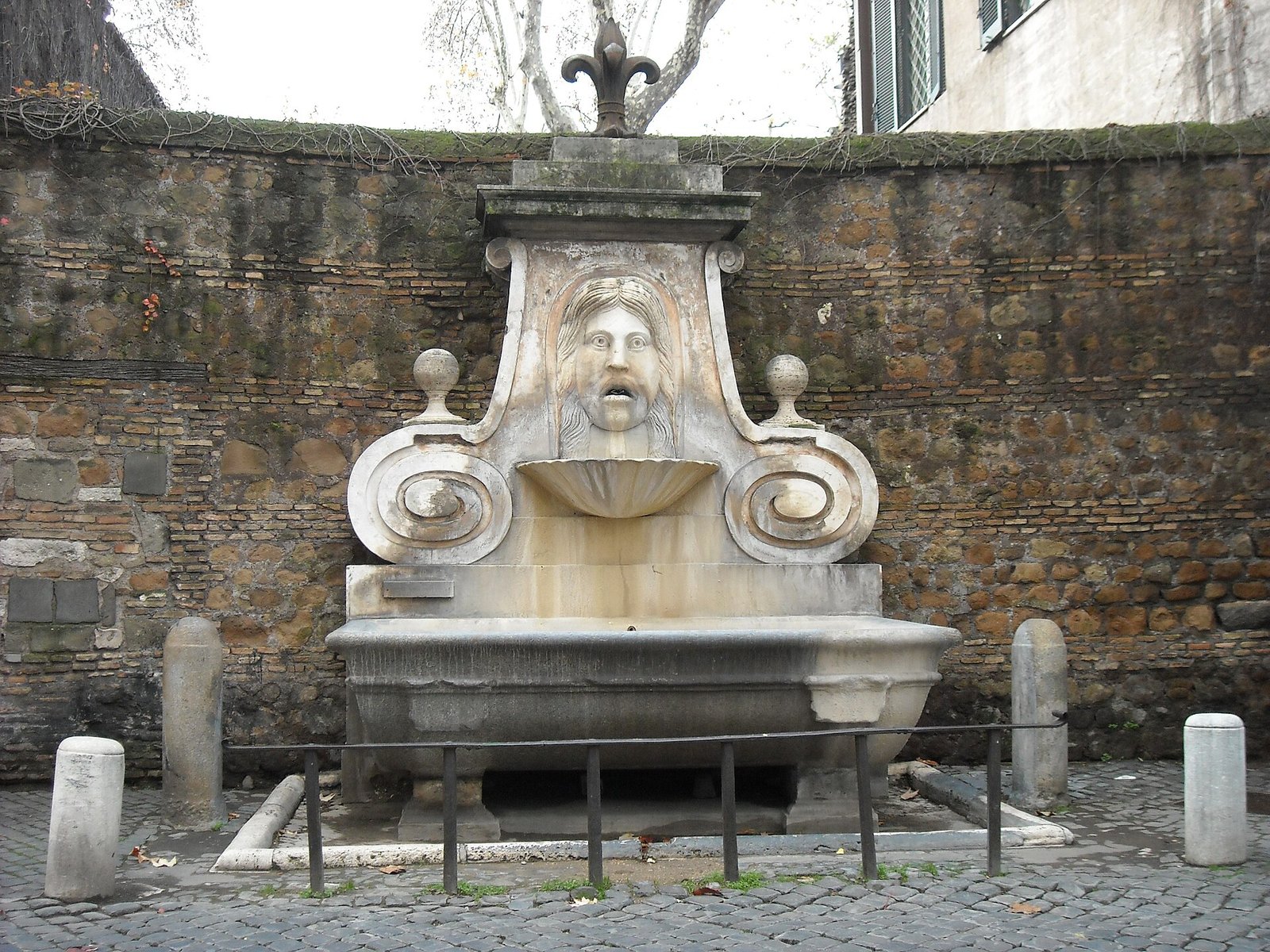
The Fontana del Mascherone is in via Giulia, at the corner with via del Mascherone, in the Regola district, a few meters from the Farnese arch and the back of Palazzo Farnese. You can see it for free, at any hour, with no ticket and no booking: it's a public fountain set against a wall on the street. Protection falls to the Capitoline Superintendency for Cultural Heritage of Roma Capitale, which catalogs it among the fountains of medieval and modern Rome.
The work dates from the second quarter of the 17th century, according to the Superintendency, and some reconstructions give 1626 as the year of construction. The attribution goes to Girolamo Rainaldi, the same architect to whom the Turismo Roma portal assigns the two twin fountains of piazza Farnese. The water came from the Paolo aqueduct. At the center a large ancient marble mask, with wide-open eyes, pours the water into a shell-shaped basin, and from there into a granite thermal tub.
Data checked on September 29, 2026 on the Capitoline Superintendency's page dedicated to the fountain, on the tourist portal of Roma Capitale and on the municipal contact center 060608. None of these sources gives hours or fares, because they don't exist: the fountain is seen from the street, day and night. No maintenance calendar is published either, so you may find it without water. The story of the wine poured during the Farnese celebrations is documented for one episode in 1720, the rest is tradition.
At a glance: address, hours, ticket
- Address: via Giulia, at the corner with via del Mascherone, Regola district, Rome, near the Farnese arch.
- Operator: Capitoline Superintendency for Cultural Heritage of Roma Capitale.
- How you get in: there's no entrance, the fountain is viewed from the street.
- Price: free, no ticket and no booking.
- Hours: always visible, the operator doesn't publish hours or maintenance calendars.
- How to get there: on foot from Campo de' Fiori, from piazza Farnese or from Ponte Sisto, Atac lines to be checked on the company's website.
- Accessibility: Turismo Roma points to the Accessible Rome section of its portal, the operator doesn't publish specific information.
Where it is and what you actually see
The fountain occupies the stretch of via Giulia, the straight street that runs parallel to the Tiber and takes its name from Pope Julius II, in the part closest to Ponte Sisto. The Superintendency describes it as set against the wall that separates via Giulia from the Lungotevere, not far from the rear elevation of Palazzo Farnese. Whoever arrives from Ponte Sisto meets it after a few minutes of walking, a few meters from the arch covered in climbing plants.
The composition reads from top to bottom. At the top a metal lily, emblem of the Farnese. Below, a white marble elevation frames the mask, a large ancient face with an open mouth from which the jet comes out. The water falls into a shell-shaped basin, then into a granite thermal tub, and finally into a basin slightly sunken relative to the street level. The Superintendency lists as materials gray granite, white marble, travertine and metal.
The dimensions are modest. It isn't an aqueduct show fountain like the Fontanone del Gianicolo, and it doesn't have the staging of the fountains of piazza Navona. It's a street fountain, designed for those passing on foot or on horseback along via Giulia. For this very reason it should be looked at up close, stopping in front of the basin, and not from the end of the street, from where it blends into the wall and the vegetation of the arch behind it.
The context helps. Behind the fountain there is no palace but the wall of the Lungotevere, built at the end of the 19th century with the river embankments, according to the Turismo Roma portal. Before that construction the fountain stood isolated in a small piazza, with free space around it. Today you look at it head-on, almost flattened against the wall. It takes a small effort of imagination to put it back in the 17th-century piazzetta, open toward the river and toward the Farnese gardens.
The material helps tell the periods apart. The gray granite of the tub and the marble of the mask are ancient pieces, with the marks of time and water. The white marble of the elevation belongs instead to the 17th-century assembly, and is the smoothest, most regular surface. The metal lily is a heraldic symbol applied on top of everything else, and the only element that has nothing to do with water. By looking at the colors and surfaces you understand where the ancient ends and the Baroque work begins.
A curiosity about the Fontana del Mascherone
Almost nothing you see was carved for this fountain. The mask is ancient, of Roman date according to the most widespread popular reconstructions, and the granite tub is defined by the Superintendency as an ancient thermal tub. The 17th-century architect did an assembly job: he took Roman pieces, stacked them one on top of the other and held them together with a new elevation and the patron's coat of arms. The result looks unified, but it's a collage.
The practice wasn't rare in the Rome of the popes. The great families collected ancient marbles from excavations and from their own vineyards, and reused them to decorate courtyards, gardens and fountains. Reuse had an obvious advantage: it gave prestige, because it tied the family name to antiquity. In the case of the Mascherone, the lily at the top says who pays, the ancient face below says from which past that family wanted to descend.
A comparison gets the idea across. The Mouth of Truth is also a large ancient marble face with an open mouth, and it too changed function over the centuries. At Santa Maria in Cosmedin the face became a test for liars, in via Giulia it became a monumental tap. The two faces belong to the same family of Roman objects, and looking at them on the same day helps you understand how much the city has recycled its own past.
The shell-shaped basin deserves a separate look. It's the connecting piece between the face and the tub, and serves to break the jet before it falls into the granite. The shell is a frequent motif in Roman fountains of the 16th and 17th centuries, because it evokes the sea and water immediately. Here it also works as a frame, because it separates the mask from the tub and gives the composition a vertical movement that would otherwise be missing.
One thing nobody tells you about the Fontana del Mascherone
In Rome there is more than one Fontana del Mascherone. The best known is the one in via Giulia, but on the Aventine, in front of Santa Sabina, there is another with the same name. According to popular sources it was composed in 1936 by joining a 16th-century mask and an ancient granite tub, that is, with the same assembly method used in via Giulia three centuries earlier. Anyone looking for directions must specify the street, otherwise they risk ending up on the wrong hill.
The second detail concerns the timing. The Superintendency writes that the work was already planned in 1570, more than half a century before it was built. The water was missing. The project stalled until, in 1612, the Acqua Paola was channeled, the aqueduct ordered by Pope Paul V that brought water into the city from the Janiculum side. Only then did the fountain become possible, and it was built in the second quarter of the century. For decades via Giulia waited for a pipe, not an architect.
The classification is instructive too. The Capitoline Superintendency places the fountain among the sites of medieval and modern Rome, not among those of ancient Rome, even though the two most visible pieces, the face and the tub, are Roman. What counts is the moment the work was composed, not the age of the materials. It's a useful criterion for the visitor as well: in front of the Mascherone you are looking at a Baroque work made with ancient fragments, not an ancient monument arranged in the 17th century.
The name of the side street also has a simple story. Via del Mascherone, which opens onto via Giulia right next to the fountain, bears the same name as the fountain. In Rome it often happens that an object gives its name to a street, and that the name survives even when the object changes position or function. Here fountain and place name have stayed close, and you only need to look up at the plaque on the corner to see the connection.
Who wanted it and why right here?
The patron is recognized by the lily. Turismo Roma writes that the emblem at the top of the fountain identifies the commission of the Farnese, the family that owned the great palace behind via Giulia. The fountain is on the rear side of Palazzo Farnese. Putting it here meant signing the back of the property too, the part seen from via Giulia and from the river.
The attribution to Girolamo Rainaldi is given as probable both by the Superintendency and by the city's tourist portal. Rainaldi was an architect of the Roman 17th century, and Turismo Roma also assigns him the two twin fountains of piazza Farnese, the ones with the large basins in front of the palace facade. The coherence is evident: the same architect, the same family, two building sites a few dozen meters apart, one on the ceremonial piazza and the other on the street behind the palace.
There was also a practical reason. The Acqua Paola came from the Janiculum, on the right bank, and reached the Regola district after crossing the river. A public fountain in via Giulia brought running water to an inhabited street, frequented by artisans and residents, as well as by nobles. The service function and the prestige function overlapped. The Farnese gave water to the neighborhood and at the same time reminded whoever took it whose merit it was.
The exact date remains open. The Superintendency uses a cautious formula, second quarter of the 17th century, that is, between 1626 and 1650. Some popular reconstructions instead give 1626 as the precise year of construction. The two pieces of information don't contradict each other, but the second is not confirmed by an official source. Whoever writes a single date in a caption should prefer the Superintendency's formula, since it has custody of the monument.
My advice for visiting the Fontana del Mascherone
The advice is to walk via Giulia on foot from one end to the other, and to treat the fountain as a stop within the street, not as an isolated destination. Starting from Ponte Sisto you soon meet the Mascherone and the arch, then the long row of palaces and churches as far as San Giovanni dei Fiorentini. In the opposite direction the fountain becomes the end of the walk, and the river a few steps away offers the simplest way back toward Trastevere.
For those who have difficulty moving around, the fountain is one of the easiest stops in the center. It's viewed from the street, with no steps to climb and no entrances to get through, because the basin is sunken below street level and the mask is clearly visible from street level. The operator doesn't publish specific accessibility information, and Turismo Roma points to the Accessible Rome section of its portal. The real limit is the narrow sidewalk and the traffic passing next to it.
It's worth stopping at least five minutes in front of the basin. The time is for telling the pieces apart: the ancient face, the shell, the thermal tub, the sunken basin, the lily at the top. Look at the details of the face, the eyes, the beard, the mouth worn by the water. Don't sit on the edge and don't put your feet in the basin: going into the city's fountains is forbidden by municipal rules, and this fountain is a protected monument, not a courtyard trough.
The last piece of advice concerns the hour. Via Giulia is narrow and the buildings are tall, so direct light reaches the fountain only at certain hours of the day. Early in the morning the street is quiet and the sound of the water is clearly heard. At rush hour, instead, the passing of cars and scooters along via Giulia makes stopping less pleasant. In our judgment the best window is between 8 and 10 in the morning, on weekdays.
Via Giulia is also a residential street. Behind the facades are homes, offices, cultural institutes and embassies, and the people who live there walk it every day. So it's best to keep your voice down, not block the doorways and not occupy the roadway for photos. Stopping in front of the Mascherone is brief by definition, and respecting those who live on the street makes the visit easier too, because the street stays quiet and the fountain can be heard better.
Do you need a ticket or a booking?
No. The Fontana del Mascherone is an outdoor monument on a public street, with no visiting enclosure, no ticket office and no hours. The tourist portal of Roma Capitale gives no fares or time slots, and the Superintendency's page treats it as an urban work, not as a site with an entrance. No bookings are needed for any type of visitor. Those arriving in large numbers do well to leave the passage on the street clear, since it's narrow and busy.
The official channel for historical information is the fountain's page on the website of the Capitoline Superintendency. For practical questions, such as reports of faults or an empty tub, the Municipality's reference is the contact center 060608, active every day from 9:00 to 19:00, also reachable at the address info@060608.it. The operator doesn't sell tickets and doesn't organize visits dedicated to the fountain alone, so be wary of anyone offering a paid entrance.
For those who want a deeper reading of via Giulia and the Regola district there are guided visits offered by third-party operators and licensed tour guides, for a fee. The fountain's operator doesn't publish a list of operators, and the choice is left to the visitor. In any case the fountain is easy to understand on your own too, with a bit of time and the essential information: who wanted it, where the mask comes from, from which aqueduct the water arrived, why it stands against a wall today.
The situation changes for nearby places. If the fountain is part of a day that includes museums, galleries or villas in the area, each has its own ticket office, hours and closing days, to be checked on the respective official websites before leaving. A stop at the Mascherone, instead, can be slipped in at any time, even late in the evening or in the morning before the openings. It's one of the few points on the route that doesn't require organizing in advance.
Another well-known fact, yet rarely cited
That the lily is the Farnese coat of arms is known by almost everyone who passes through piazza Farnese. Less often cited is the fact that the fountain was born to stand at the center of an open space. Turismo Roma writes that originally it was isolated in a small piazza, and that only with the construction of the Tiber embankments, at the end of the 19th century, did it find itself set against the current wall. The fountain hasn't moved much, it's the city around it that has changed.
That piazzetta had other uses too. The Superintendency recalls that in 1660 the space hosted an open-air theater. Details on who organized it and what was staged there are not published, but the fact is enough to give the idea of a lively public place, not a simple intersection. The streets of Baroque Rome were stages for feasts, processions and shows, and via Giulia, with its noble palaces, was one of the most suitable.
The construction of the embankment walls along the Tiber changed the whole relationship between via Giulia and the river. Before, behind the houses and gardens, there were the banks and the passages to the water. Afterward, a high wall separated the street from the river and from the new Lungotevere. The Mascherone found itself squeezed against that wall, with the basin facing the inside of the city. Whoever knows the fountain only like this struggles to imagine it as it was, in a piazza open toward the water.
There's also a heraldic detail that few notice. The full Farnese coat of arms, according to popular sources, carries six lilies, but on the fountain only one appears, isolated at the top of the elevation. The whole shield wasn't needed: in via Giulia, a few meters from the palace, a lily was enough to say whose fountain it was. It's a sign of confidence, almost of familiarity with the street, typical of a family that felt itself the master of the district.
The right photo to take at the Fontana del Mascherone
The photo that tells the story of the fountain is taken head-on, from the middle of the street when no vehicles are passing, with the mask at eye level and the lily at the top of the frame. A normal lens is needed: a strong wide angle would distort the face and widen the wall around it too much. The strength of the shot is the contrast between the ancient face, dark and worn, and the lighter marble of the elevation. With the diffused light of a cloudy day the details read better.
The second photo puts the fountain and the arch together. Move a few meters along via Giulia, until the arch enters the field of view, and frame vertically the Mascherone in the foreground with the Farnese arch and its climbing plants in the background. It's the most widespread image, and for this reason it's worth looking for a personal angle: a different hour, a close detail, the water blurred by a longer exposure. Don't climb on the edge of the basin to gain height: it's forbidden and damages the stone.
The third possibility is a close-up detail. Get close to the basin, without going into it, and frame only the mouth of the mask with the jet coming out. With side light the beard and cheeks take on relief, and the falling water creates a vertical line that cuts the image. Avoid flash, which on wet marble produces white reflections and flattens everything. For those shooting with a phone, it's best to tap the screen on the face to expose the darkest part correctly.
The season changes the background. The climbing plants on the arch look different in different months of the year, denser and greener in spring and summer, sparser and colorful in autumn. Whoever wants the photo with fountain and arch does well to take this into account. In winter the light is low and the street stays in shade for much of the day, so the mask is better photographed at noon. In summer, on the contrary, it's best to avoid the middle hours.
How to get there from the center of Rome?
The simplest way is on foot. From Campo de' Fiori you cross piazza Farnese, go around the palace and come down onto via Giulia, a route of a few minutes. From Trastevere you cross Ponte Sisto, take via Giulia to the left and the fountain appears almost at once. From piazza Navona you go down toward the river through the streets of the Parione district, in a quarter of an hour of walking.
For buses and the tram the up-to-date reference is the Atac website, with route calculation, because lines and stops along the Lungotevere often change due to works and detours. It makes no sense to come by car: the area is regulated by limited traffic zone gates, parking spots are very few and via Giulia is narrow. Those arriving by bicycle must take into account the narrow street and the traffic, and watch out for pedestrians who stop in front of the fountain.
Anyone coming from St. Peter's can walk the whole of via Giulia. From Castel Sant'Angelo you cross the river, reach San Giovanni dei Fiorentini and take the street toward the south. It's a flat route, with no climbs, with churches and palaces at every step. At the end, next to the arch, you reach the fountain. It's the longest route, but also the most sensible, because it makes you understand that the Mascherone is the closing point of an entire urban axis.
From Termini station the route requires a change. It's best to reach largo di Torre Argentina by public transport, checking lines and stops on the Atac website, and from there continue on foot toward Campo de' Fiori and piazza Farnese. The walking stretch takes about 10 minutes, on flat streets. Alternatively you can go as far as the Lungotevere and come down onto via Giulia by the side streets that connect it to the river.
Some important events that happened here in history
In 1570 the fountain is already planned, according to the Superintendency, but the water to build it is missing. In 1612 the Acqua Paola is channeled, and the project becomes possible again. In the second quarter of the 17th century the fountain is built with the ancient mask, the thermal tub and the Farnese lily, on a design attributed to Girolamo Rainaldi. Some reconstructions set the year at 1626. In 1660 the piazzetta around the fountain hosts an open-air theater, another fact reported by the Superintendency.
The context explains the dates. Between the end of the 16th and the beginning of the 17th century the popes reactivate or build new aqueducts, and the city fills with fountains. The Acqua Felice arrives in the city with its show fountain, the Fountain of Moses in largo di Santa Susanna, and a few years later the Acqua Paola brings new water to the right bank and then to the districts along the river. The Mascherone is born within this season, when having a fountain in front of your house was a sign of power.
1720 is the year of the most told episode. The Turismo Roma portal writes that, to celebrate the election of Marco Antonio Zondadori as Grand Master of the Order of Malta, the Farnese had wine come out of the fountain instead of water for three consecutive days. It's the only episode of the wine tradition that the Municipality's portal links to a precise date and a name. All the other tales of feasts with wine remain undated and with no published document.
At the end of the 19th century comes the biggest transformation. The construction of the Tiber embankments changes the profile of via Giulia, and the fountain finds itself set against the new wall. The small piazza that contained it disappears. Since then the fountain has stayed where it is seen now, with the basin sunken relative to the street. The operator doesn't publish a list of 20th-century restorations, and the dates of the most recent interventions are not confirmed by an official source.
Who has passed by the Fontana del Mascherone
The first name is that of the Farnese, the family that left the lily at the top and had its Roman palace right behind the street. The second is Girolamo Rainaldi, the architect to whom the fountain is attributed, also active in piazza Farnese. Then there is Pope Paul V, without whose aqueduct the fountain would never have existed. The sources don't preserve a statement of intent from them, but the fountain speaks for them.
Then there is Marco Antonio Zondadori, elected Grand Master of the Order of Malta. It was in his honor that, in 1720, the mask poured wine for three consecutive days, according to what Turismo Roma reports. The sources don't say if Zondadori was present, nor who the Romans were who approached the fountain in those days. He remains a name tied to the fountain for a party, more than for a visit, and it's enough to show the weight of the Farnese in the life of the district.
Missing, instead, is the pope. The aqueduct bears the name of Paul V, and without his water the fountain wouldn't exist, but no papal coat of arms appears on the Mascherone. The only symbol is the Farnese lily. The patron took all the visible credit, leaving the pontiff only the name of the aqueduct. In the Rome of the 17th century it was a normal choice, and says a lot about the relationship between the great families and the authority that supplied them with water.
More recently the arch next to the fountain was the center of an installation. According to the press, in 2021 the French artist Olivier Grossetète built out of cardboard the never-completed bridge between Palazzo Farnese and the opposite bank, lifted with hot-air balloons, in collaboration with the French Embassy, which is based in Palazzo Farnese itself. Every day, then, the residents of the district pass by, along with cyclists heading to the Lungotevere and visitors coming down from piazza Farnese toward the river.
Did wine really come out of the mask?
The documents, that is, the Superintendency's records and the Turismo Roma portal, say few things for certain. The fountain belongs to the Farnese, the lily says so. It's attributed to Girolamo Rainaldi. It was originally fed by the Paolo aqueduct. The mask is ancient, the tub is a granite thermal tub. Turismo Roma adds the episode of 1720 with the wine poured for three days in honor of the new Grand Master of the Order of Malta. On the points covered by both, the two institutional sources coincide.
Tradition widens the story. According to several popular reconstructions, during the feasts organized by the Farnese family wine came out of the mouth of the mask instead of water. The wording is generic: it doesn't say how many times, in which years, for which feasts. It may be the generalization of the 1720 episode, or the memory of several similar feasts. The sources don't allow us to establish it, and the only documented date remains that of Zondadori's election.
Then there's the level of legend. Tales circulate of wine flowing regularly, of drunken commoners in via Giulia for days, of fountains connected directly to the palace cellars. No institutional source reports them. Better to treat them as tavern stories, pleasant but with no document. Even the technical mechanism, that is, how the wine reached the mouth of the mask, is not described by public sources, so any explanation about barrels hidden behind the wall remains a hypothesis.
Our opinion is that the wine story is the most overrated part of the fountain. It's the one always told, the one that ends up in article headlines and photo captions. But it concerns an episode of three days in almost four centuries. The truly interesting part is something else: the reuse of ancient pieces to build a new work, a family's signature on the back of its own palace, and the change of the city around it, from the theater of 1660 to the embankment walls of the 19th century.
What does the Acqua Paola have to do with it?
The Acqua Paola is the aqueduct that Pope Paul V had built at the beginning of the 17th century, and that the Superintendency gives as the original source of the fountain. The monumental show fountain of that aqueduct is the Acqua Paola Fountain, the Fontanone on the Janiculum, on the opposite bank of the river. The Mascherone is one of the minor fountains fed by that network, and it stands down low, at street level, while the Fontanone dominates the city from above.
Relating the two fountains helps read the geography of Rome. The water arrived on the Janiculum, at the show fountain, and from there descended toward Trastevere and crossed the Tiber to serve the left bank. Via Giulia and the Regola district were at the far end of this route. The Farnese fountain was therefore an arrival point, and its construction depended entirely on the availability of water that only a great papal aqueduct could guarantee.
The difference between a show fountain and a minor fountain is also one of language. The show fountain celebrates the aqueduct and the pope who built it, with inscriptions, coats of arms and triumphal-arch architecture. The minor fountain celebrates whoever pays for it and serves those who live on the street. The Mascherone belongs to the second category, but with an extra ambition: the ancient face and the lily turn a neighborhood water point into a calling card of the most powerful family in the district.
Anyone who loves fountains can build a small itinerary on the theme. After the Mascherone, piazza Farnese with its two twin basins, then the Turtle Fountain in piazza Mattei, and finally the 20th-century neighborhood fountains. For drinking along the way there are the nasoni, the public cast-iron drinking fountains. The operator of the Mascherone doesn't say if the fountain's water is drinkable, so it's best to use those.
What is the arch over via Giulia?
A few meters from the fountain, an arch spans via Giulia connecting the buildings on the two sides. It's the Farnese arch, covered in climbing plants, one of the most photographed spots on the street. According to the tradition reported by many popular sources, it was the first part of a private bridge that was meant to join Palazzo Farnese to the Villa Farnesina, across the Tiber, and the project is attributed to Michelangelo. The bridge was never completed, and of the idea only the arch remains.
The attribution to Michelangelo and the story of the bridge should be taken with caution. Popular sources repeat that the project stopped because of the artist's death and the family's financial problems, but complete documentation of the project is not confirmed by an official source. What you see is clear: an arch over the street, tied to the Farnese, which today frames in green this whole part of via Giulia.
Passing under the arch is the best way to understand its function. From the middle of the street you can see that it connects the two sides of via Giulia, and that there's a passage above. The official sources on the fountain don't indicate visits inside the arch. You look at it from below, stopping for a moment at the side of the street so as not to get in the way of traffic. Whoever wants the overall view should move a few dozen steps away along via Giulia, in either direction.
Fountain and arch are read together. The lily on the fountain and the arch over the street tell the same ambition: to occupy via Giulia, to mark it with their own symbols, to connect the palace to the river and to the opposite bank. The Farnese didn't limit themselves to a facade on a piazza. They wanted a system that started from piazza Farnese, descended toward the Tiber and, in the most ambitious plans, crossed it. The fountain is the piece of that system that remained closest to daily use.
When is it turned off and what shouldn't you expect?
The fountain never closes, because it has no entrance. It can, however, be left without water, because of faults or maintenance of the systems, and the operator doesn't publish a calendar of these interventions. The only way to know is to go by. If you find the basin empty, the mask, the shell, the tub and the lily are still visible from the street. To report a fault the Municipality's channel is the contact center 060608, active every day from 9:00 to 19:00.
Don't expect a big fountain. Anyone arriving after seeing Trevi or the Four Rivers may be disappointed by the size. The Mascherone is a street work, on a pedestrian scale, and its interest is in the details and the history, not in the scale. Don't expect a piazza around it either: the fountain is on a narrow sidewalk, on a street where cars and scooters pass, and the space to stop is limited. Better to stand to the side, leaving the passage clear.
Don't expect, finally, to find wine. The story is so widespread that you sometimes hear visitors convinced that once a year the fountain is filled for a celebration. No occasion of this kind exists, and no official source announces one. The wine tradition belongs to the past, to the era of the Farnese feasts, and the only documented episode dates to 1720. Today only water comes out of the mouth of the mask, when the fountain is running.
One last warning concerns coins. In Rome's most famous fountains throwing a coin has become a ritual, and you sometimes see the same gesture in front of the Mascherone. It has no foundation in the tradition of this fountain, and the sunken basin isn't designed to collect objects. Coins settle on the bottom and dirty the stone. Better to leave the ritual to the Trevi Fountain, where it truly belongs to the history of the monument.
Eating in the area
The area between via Giulia, piazza Farnese and Campo de' Fiori is one of the busiest in the center, and the places on the main piazzas live mostly off passing trade. The signs to recognize are always the same: photo menus in four languages, barkers on the sidewalk, items written with no price, a kitchen open from morning to night with no break. Some windows stage handmade pasta in front of passersby, and often it's only scenery. Romans don't sit down here, and not out of snobbery.
The reason is practical. Where the price isn't written, the bill adapts to the customer, and where the menu outside is different from the one inside, the surprise comes at the end. It's best to move to the inner streets of the Regola district or toward Trastevere beyond Ponte Sisto, choosing places with prices displayed. To get your bearings without risk, there's the list of addresses on Google Maps kept by our team.
The same caution applies to a coffee. In the bars of the busiest piazzas the price at the counter and the price at the table can be very different, and the price list isn't always clearly visible. Ask before sitting down, or do as Romans do, who drink their coffee standing at the counter in a few minutes. Those who need a longer break will find a few benches and some shade along the river, going down the staircases of the Lungotevere.
What to pair it with in a day
The first pairing is along the same street. A few steps from the fountain is Santa Maria dell'Orazione e Morte, home of a confraternity, with a facade you notice even when passing in a hurry. Nearby is Palazzo Falconieri, home of the Hungarian Academy, which opens mostly for events and exhibitions. Further on, in via del Gonfalone, the Criminology Museum and the Oratorio del Gonfalone complete the picture of the district.
Those who prefer churches can continue north. Along via Giulia and in the nearby streets are Sant'Eligio degli Orefici, Santo Spirito dei Napoletani, San Biagio degli Armeni and, at the end, San Giovanni dei Fiorentini. Toward piazza Farnese you reach the Galleria Spada, an art collection housed in a noble palace a few minutes' walk away. On the other side of the district are San Paolo alla Regola and Santa Maria in Monticelli.
An alternative takes you across the river. From Ponte Sisto you enter Trastevere and reach the Farnesina, the villa the arch was supposed to connect to the palace. From there you climb to the Janiculum for the Fontanone of the Acqua Paola, closing the water's route from the street fountain to the monumental show fountain. Along the climb are San Pietro in Montorio and the Tempietto del Bramante, with one of the widest views of the city.
Those with still more time can head east. From Campo de' Fiori you reach the Ghetto, with piazza Mattei and the Turtle Fountain, then the Portico d'Ottavia and the Tiber Island. Those interested in another fountain with a family coat of arms can look for the Barberini's Fontana delle Api. For other free ideas there's the list of suggestions in Free Rome, where the Mascherone fully belongs.
Those who prefer to stay among palaces and piazzas can go north. From Campo de' Fiori you reach the Palazzo della Cancelleria, with the basilica of San Lorenzo in Damaso incorporated in the building, and a little further piazza Navona with the Fountain of the Four Rivers. Along the way you meet Pasquino, the best known of the talking statues, another ancient piece reused by the city with a new function.
Frequently asked questions
Do you pay to see the Fontana del Mascherone?
No. The fountain is in via Giulia, on a public street, and is viewed for free at any hour of the day and night. There's no ticket office, no hours and no need to book. The tourist portal of Roma Capitale gives no fares and the Capitoline Superintendency catalogs it as an urban fountain. Anyone offering a ticket for the fountain is actually selling a visit of the area, not an entrance to a closed site.
Where exactly is the fountain?
In via Giulia, at the corner with via del Mascherone, in the Regola district. The Superintendency describes it as set against the wall that separates via Giulia from the Lungotevere, not far from the back of Palazzo Farnese. The easiest reference is the Farnese arch covered in climbing plants, which spans the street a few meters away. Arriving from Ponte Sisto you meet it after a few minutes on foot, on the side of the street toward the river.
Who designed the Fontana del Mascherone?
The Capitoline Superintendency and the Turismo Roma portal attribute it to Girolamo Rainaldi, an architect of the Roman 17th century, to whom Turismo Roma also assigns the two twin fountains of piazza Farnese. The patrons are the Farnese, recognizable from the lily at the top of the elevation. The attribution isn't certain enough to exclude other names, and the sources use cautious formulas, but none proposes a different architect.
What period is the mask from?
The mask is ancient. The Superintendency calls it the celebrated ancient mask that pours the water, and several reconstructions date it to the Roman era. It is therefore much older than the fountain, built in the second quarter of the 17th century. The granite tub below is also ancient, described by the Superintendency as a thermal tub. The fountain is an assembly of reused Roman pieces, held together by a Baroque elevation and the Farnese coat of arms.
Is it true that wine came out of the fountain?
One episode is documented. The Turismo Roma portal reports that in 1720, to celebrate the election of Marco Antonio Zondadori as Grand Master of the Order of Malta, the Farnese had wine come out of the fountain for three consecutive days. Tradition says it happened during the family's feasts in general, but without precise dates. Today no occasion repeats the custom, and only water comes out of the mouth.
Can you drink the fountain's water?
The operator doesn't say if the water of the Fontana del Mascherone is drinkable, and the fountain isn't designed for drinking: the jet falls into a basin and then into a tub, with no spout meant for passersby. To fill a water bottle it's best to use the nasoni, the public cast-iron drinking fountains found throughout the center. Don't go into the basin and don't sit on the edge, because municipal rules forbid it.
Why is the fountain set against a wall?
Because the city around it has changed. Turismo Roma writes that originally the fountain stood isolated in a small piazza, and that only with the construction of the Tiber embankments, at the end of the 19th century, did it find itself against the current wall. The Superintendency adds that in 1660 that space hosted an open-air theater. Today's look, squeezed between the street and the wall, is the result of the major works on the river.
Is there another Fontana del Mascherone in Rome?
Yes. On the Aventine, in front of the basilica of Santa Sabina, there's another fountain called del Mascherone. According to popular sources it was composed in 1936 by joining a 16th-century mask and an ancient granite tub. It's a different work, far from via Giulia, and shouldn't be confused with the Farnese one. When you look for directions or photographs, always specify the street or the hill to avoid mix-ups.
How much time does it take to see it?
For the fountain alone, five or 10 minutes is enough, the time to stop in front of the basin and recognize the pieces. It becomes much more if you use it as a stop on a walk along via Giulia. From Ponte Sisto to San Giovanni dei Fiorentini the route takes an hour with a few stops, and by adding piazza Farnese, Campo de' Fiori or the Farnesina across the river you fill half a day without taking any transport.
Who wrote this and from what sources
The text comes from the editorial team of Tour Leader Pro, the Rome-based outfit that designs itineraries, visits and cultural events across Rome and Lazio. Fares, hours and booking arrangements reported here come from the official sources cited in the text, as of the date given at the top: for the Fontana del Mascherone, the page of the Capitoline Superintendency, the tourist portal of Roma Capitale and the municipal contact center 060608 are authoritative. Tell us what you find changed.
Fitting the Mascherone into a visit program seems easy, because there are no tickets or shifts. The real difficulty is the street: via Giulia is narrow, busy with cars and scooters, with minimal sidewalks in front of the fountain. It's best to set the meeting point in piazza Farnese or at Ponte Sisto and give the information before arriving. For those planning cultural outings in the city, a useful resource for those who organize group trips is Tour Leader Pro.
The Fontana del Mascherone is the last stretch of an aqueduct that starts far from the center and reaches the city from the Janiculum. Following the Farnese outside Rome instead leads to Caprarola, in the Viterbo area, where the family built another palace with gardens and fountains. Putting together the city and the province takes a bit of planning, and a useful resource for putting together a multi-day itinerary is Italy Planner.